
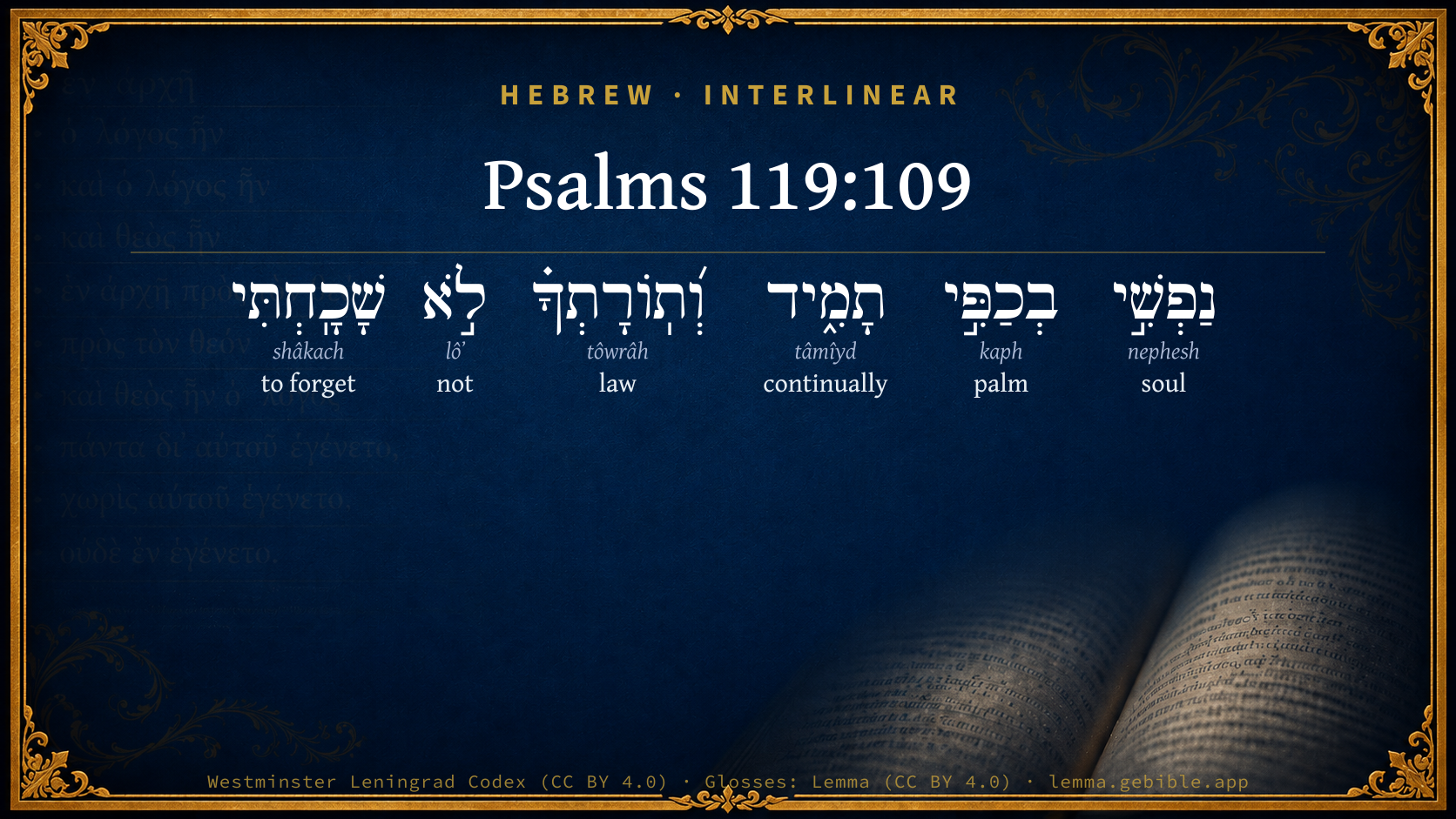
Psalms 119:109

Hebrew (Westminster Leningrad Codex) Psalms 119:109 appears in the Hebrew Old Testament. The text above is from the Westminster Leningrad Codex. Each word links to its Strong’s number, a concise gloss, and parsing drawn from the Open Scriptures Hebrew Bible morphology. Click any word for its full Brown-Driver-Briggs (BDB) entry.
Download image
Cite this verse

Psalms 119:109 (World English Bible). Public Domain. Lemma interlinear Bible study tool, https://lemma.gebible.app/v/psalms/119/109.

Show BibTeX & RIS
BibTeX
RIS
English Translation
My soul is continually in my hand, Yet I won't forget your law.
World English Bible · Public Domain
Download a study sheet

One document with this verse’s original text, its word-by-word gloss line, the meaning frame, cross-references with their text, attributed commentary, and full source and license credits — printable, and it pastes into notes with its structure intact.

This verse Autodidact and up

Study sheet (.html) Plain text (.txt)

A passage Seminary Student

Up to 50 verses in one chapter. A passage sheet keeps up to 6 commentary sources and 12 cross-references per verse, in the order this page ranks them, and says so on the sheet whenever that leaves anything out. Ask for a single verse and you get the Autodidact verse sheet above.

Everything on this page stays free to read, with no account — the sheet is a download of what is already on screen, not access to it.

Want to remove ads? Support Godless Engineer
Compare translations 3

The same verse in 3 English versions, stacked beneath the original-language interlinear above. Click any original word for its lexicon entry.

Each is an independent rendering of the whole verse — the interlinear is not word-aligned to these translations.

Highlighted words mark where these versions differ — a whole-verse word diff, not a word-by-word alignment.

  • World English Bible Public Domain
    My soul is continually in my hand, Yet I won't forget your law.
  • King James Version Public Domain
    My soul is continually in my hand: yet do I not forget thy law.
  • unfoldingWord Literal Text CC BY-SA 4.0
    My soul in my palm continually, but I do not forget your teaching.

unfoldingWord Literal Text — © unfoldingWord, licensed CC BY-SA 4.0. Word-aligned USFM3 via Door43 (git.door43.org/unfoldingWord/en_ult).

Versions to compare (up to 4)

3 of 4 selected

Show all 17 translations

Every available English version of this verse, each an independent rendering of the whole verse.

  • World English Bible Public Domain
    My soul is continually in my hand, Yet I won't forget your law.
  • Berean Standard Bible Public Domain
    I constantly take my life in my hands, yet I do not forget Your law.
  • Majority Standard Bible Public Domain
    I constantly take my life in my hands, yet I do not forget Your law.
  • King James Version Public Domain
    My soul is continually in my hand: yet do I not forget thy law.
  • American Standard Version (1901) Public Domain
    My soul is continually in my hand; Yet do I not forget thy law.
  • Revised Version (1885) Public Domain
    My soul is continually in my hand; yet do I not forget thy law.
  • Geneva Bible (1599) Public Domain
    My soule is continually in mine hande: yet doe I not forget thy Lawe.
  • Young's Literal Translation Public Domain
    My soul `is' in my hand continually, And Thy law I have not forgotten.
  • Literal Standard Version CC BY-SA 4.0
    My soul [is] in my hand continually, || And I have not forgotten Your law.
  • Unlocked Literal Bible CC BY-SA 4.0
    My life is always in my hand, yet I do not forget your law.
  • unfoldingWord Literal Text CC BY-SA 4.0
    My soul in my palm continually, but I do not forget your teaching.
  • Darby Bible Public Domain
    My life is continually in my hand; but I do not forget thy law.
  • World Messianic Bible Public Domain
    My soul is continually in my hand, yet I won’t forget your Torah.
  • Webster's Bible Public Domain
    My soul is continually in my hand: yet I do not forget thy law.
  • Free Bible Version CC BY-SA 4.0
    My life is always at risk, but I will not forget your law.
  • Bible in Basic English Public Domain
    My soul is ever in danger; but I still keep the memory of your law.
  • JPS Tanakh (1917) Public Domain
    My soul is continually in my hand; yet have I not forgotten Thy law.

Literal Standard Version (2020), Covenant Press — licensed CC BY-SA 4.0. Text via the HelloAO Bible API (eBible.org). Unlocked Literal Bible (unfoldingWord) — licensed CC BY-SA 4.0. Text via the HelloAO Bible API (eBible.org). unfoldingWord Literal Text — © unfoldingWord, licensed CC BY-SA 4.0. Word-aligned USFM3 via Door43 (git.door43.org/unfoldingWord/en_ult). Free Bible Version, Dr. Jonathan Gallagher — licensed CC BY-SA 4.0. Text via the HelloAO Bible API (eBible.org).

Word by word

More ways to search: Search by grammar → Find every occurrence → Compare this word →

Practice this passage: Drill this verse → Learn its vocabulary →

About this verse

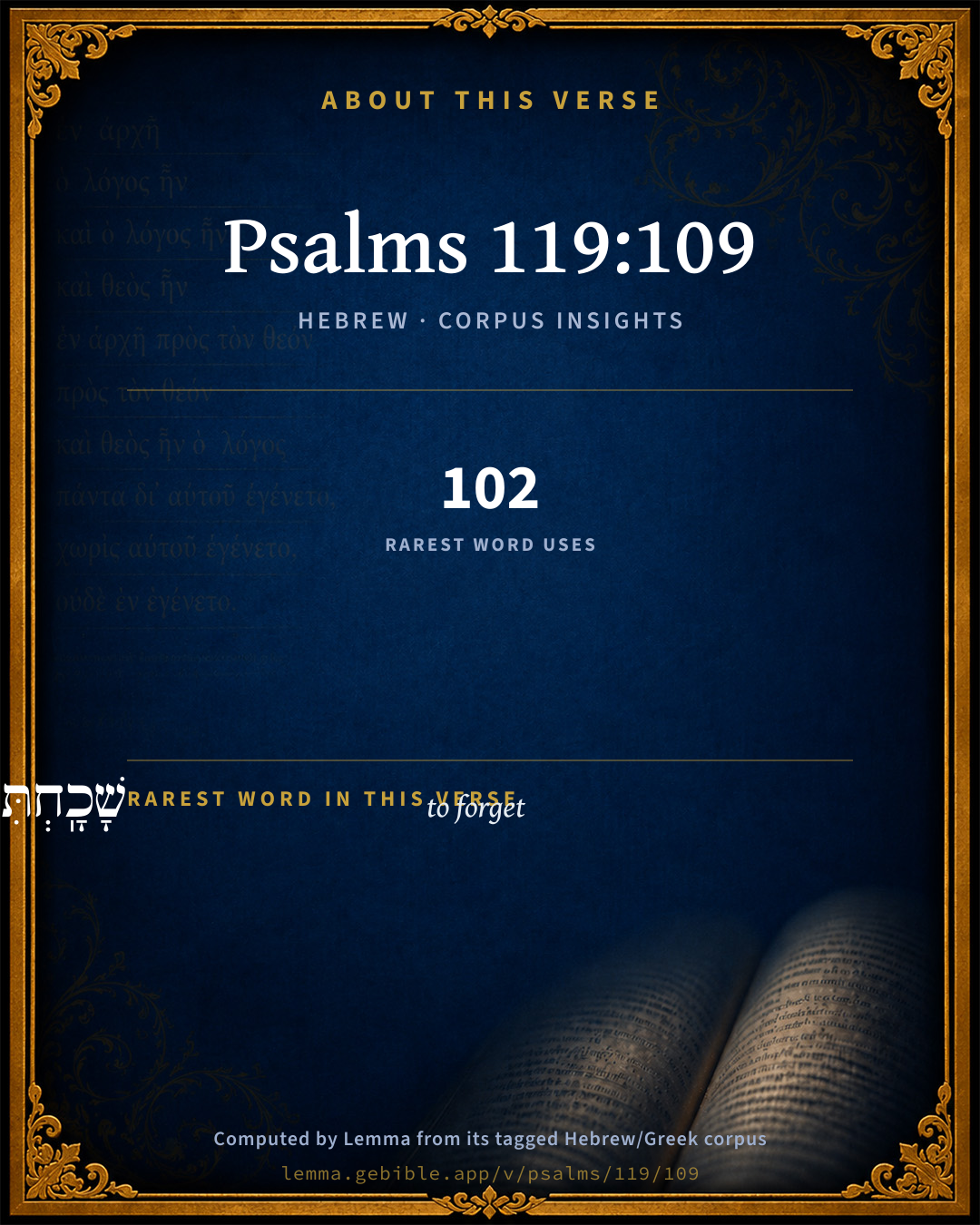
These counts appear in no published source. They are computed here, from the morphology-tagged text and Lemma’s own curated glosses. What Lemma adds →

6
words
6
distinct lemmas
Wisdom
section

Grammatical profile

  • 1 verb
  • 4 nouns
  • 1 particle

Verb forms

  • שָׁכָֽחְתִּי Qal · Perfect

Hebrew & Septuagint length

In English translation the verse runs 13 words from the Hebrew and 14 from the Septuagint (LXX English) — closely comparable.

A rough comparison of the two English renderings, which tokenize alike — not a word-level alignment.

Word counts can differ between the Hebrew and the Greek without any difference in meaning — e.g. the Hebrew direct-object marker אֵת has no separate Greek word, and Greek often adds the article ὁ.

Cross-references

10

Topical passages linked to Psalms 119:109 in the Treasury of Scripture Knowledge — connected by theme and wording, ordered by reader-vote popularity; previews shown in the World English Bible.

  • Judges 12:3 When I saw that you didn't save me, I put my life in my hand, and passed over against the children of Ammon, and Yahweh delivered them into my hand: why then are you come up to me this day, to fight against me?
  • Job 13:14 Why should I take my flesh in my teeth, And put my life in my hand?
  • 1 Corinthians 15:31 I affirm, by the boasting in you which I have in Christ Jesus our Lord, I die daily.
  • 1 Samuel 19:5 for he put his life in his hand, and struck the Philistine, and Yahweh worked a great victory for all Israel: you saw it, and did rejoice; why then will you sin against innocent blood, to kill David without a cause?
  • 1 Samuel 20:3 David swore moreover, and said, Your father knows well that I have found favor in your eyes; and he says, Don't let Jonathan know this, lest he be grieved: but truly as Yahweh lives, and as your soul lives, there is but a step between me and death.
  • Psalms 119:83 For I have become like a wineskin in the smoke. I don't forget your statutes.
  • Psalms 119:117 Hold me up, and I will be safe, And will have respect for your statutes continually.
  • Psalms 119:152 Of old I have known from your testimonies, That you have founded them forever.
  • Romans 8:36 Even as it is written, "For your sake we are killed all day long. We were accounted as sheep for the slaughter."
  • 2 Corinthians 11:23 Are they servants of Christ? (I speak as one beside himself) I am more so; in labors more abundantly, in prisons more abundantly, in stripes above measure, in deaths often.

Cross-references courtesy of OpenBible.info (CC BY 4.0).

Hebrew and Greek witnesses Masoretic Hebrew ↔ Greek Septuagint

The same verse in the two great witnesses to the Old Testament, shown verse-for-verse.

You’re reading Greek Psalm 118 (Hebrew Psalm 119). The Septuagint counts the superscription, so verse numbers can differ from the Hebrew — chapter-level alignment, not verse-by-verse. Numbering follows Rahlfs.

These are two independent witnesses, not word-aligned to each other, and the Septuagint is shown in lemma (dictionary) form.

Hebrew Psalms 119:109 Masoretic · Westminster Leningrad Codex

נַפְשִׁ֣י בְכַפִּ֣י תָמִ֑יד וְ֝תֽוֹרָתְךָ֗ לֹ֣א שָׁכָֽחְתִּי

My soul is continually in my hand, Yet I won't forget your law.

World English Bible · Public Domain

Greek LXX Greek Psalm 118:109 Septuagint · lemma form

ὁ ψυχή ἐγώ ἐν ὁ χείρ ἐγώ διά πᾶς καί ὁ νόμος σύ οὐ ἐπιλανθάνω

My soul is continually in your hands; and I have not forgotten your law.

LXX2012 (modern English Septuagint) · Public Domain

On this verse, Adam Clarke's Commentary discusses the Septuagint’s reading. Read the note in Commentary ↓

Hebrew: Westminster Leningrad Codex (CC BY 4.0). Greek: Septuagint (public domain); English from LXX2012 (modern English Septuagint) (Public Domain). How the Septuagint differs from the Hebrew →

Commentary

Notes on Psalms 119:109 from classic Christian and Jewish commentators (each source and its license shown beneath its notes). The classic Christian expositions comment on the surrounding passage and are grouped to its opening verse, so a note may address several verses; the Jewish commentaries on the Tanakh (Rashi and others) are per-verse, so they appear only where the commentator wrote on this verse.

Lemma curates 59 commentaries, every one of them public domain or Creative Commons licensed, each selected and text-cleaned for this edition rather than reprinted as found. About our sources →

Trapp's Complete Commentary

John Trapp

Psa 119:109 My soul [is] continually in my hand: yet do I not forget thy law.

Ver. 109. My soul (or life) is continually in my hand] i.e. Continually hazarded and ready to be laid down for righteousness’ sake. I am neither fond of life nor afraid of death in this case; I make no more of life than a child doth of his bird, which he carrieth in the palm of his hand held open. See Jdg 12:3 Job 13:14.

Yet do I not forget thy law] Notwithstanding all these dangers; nay, I love it, and like it so much the better, as those, Psa 44:17 Rom 8:2-4, and that holy martyr who caught up the Revelation cast into the same fire with himself, and cried, O beata Apocalypsis, &c. Oh blessed revelation.

John Trapp, A Commentary or Exposition upon All the Books of the Old and New Testament (1647–1656) — public domain. Text from a community e-Sword module.

The Biblical Illustrator

Joseph S. Exell

Psa_119:109-112

My soul is continually in my hand.

Religion

Religion is here presented in three aspects.

I. As a deeply felt need in the immediate prospect of death. My soul is continually in my hand. That is, my life is in constant danger: death confronts me.

II. As a spirit of persevering faithfulness through all trials.

1. It is a persevering spirit. Yet I do not forget Thy law.

2. It holds on through all trials. The wicked have laid a snare for me, still I erred not.

3. It holds on through all trials to the end, Even unto the end.

III. As a precious inheritance and a permanent joy.

1. Genuine religion is an inheritance. A heritage for ever. It is the only intrinsic, inalienable inheritance.

2. Genuine religion is a permanent joy. For they are the rejoicing of my heart. True goodness never fails to flood the soul with joy. It is indeed a well of water. (Homilist.)

Mans bodily life

Let soul here stand for mans bodily life, and then we have two thoughts suggested.

I. It is something outside of himself. The human frame, with its complicated parts and various organs is no more the man than the house is the resident, the costume the wearer, the harp the lyrist. We carry it in our hand.

II. It is sometimes that he must surrender. This implies--

1. A sense of temporariness.

2. A sense of obligation. We should always be ready to present our bodies, as well as our souls and spirits, a sacrifice unto God. (Homilist.)

The Biblical Illustrator, edited by Joseph S. Exell (c. 1880s–1900s) — public domain. Text from a community e-Sword module.

Joseph Benson's Commentary

Psa 119:109-110. My soul is continually in my hand — Exposed to perpetual and extreme danger, as any precious and frail thing is which a man carries openly in his hand, and which he may easily let fall, or be deprived of by violence. This is true of us all: we stand in jeopardy every hour, and there is but a step between us and death. But David considered himself as being peculiarly in danger, because, as he says in the next verse, the wicked had laid a snare for him — Intending, probably, Saul and his courtiers, who were unwearied in their endeavours to get him into their power, that they might take away his life.

Joseph Benson's Commentary on the Old and New Testaments (1811–1818) — public domain. Text from a community e-Sword module.

J. A. Alexander on Psalms

Joseph Addison Alexander

109. (Psa 119:109) My soul is in my hand always, and (yet) thy law I have not forgotten. The sense of the strong figure in the first clause is clear from Jdg 12:13, 1Sa 19:5; 1Sa 28:21, where he who risks or jeopards his own life, in war or otherwise, is said to put his soul into his hand, as if to have it ready to give up or throw away at any moment. The same expression reappears in Job 13:14. The meaning of the whole verse is, that even amidst the deadly perils which environed him, he still remembered the divine law, as an object of supreme affection.

Joseph Addison Alexander, The Psalms Translated and Explained (1850) — public domain. Text from a community e-Sword module.

Geneva Bible (1599)

Geneva Bible translators

That is, I am in continual danger of my life.

Geneva Bible (1599) marginal notes — public domain. Text via Bolls.life.

Matthew Henry's Commentary

Here is, 1. David in danger of losing his life. There is but a step between him and death, for the wicked have laid a snare for him; Saul did so many a time, because he hated him for his piety. Wherever he was he found some design or other laid against him to take away his life, for it was that they aimed at. What they could not effect by open force they hoped to compass by treachery, which made him say, My soul is continually in my hand. It was so with him, not only as a man (so it is true of us all; wherever we are we lie exposed to the strokes of death; what we carry in our hands is easily snatched away from us by violence, or if sandy, as our life is, it easily of itself slips through our fingers), but as a man of war, a soldier, who often jeoparded his life in the high places of the field, and especially as a man after God's own heart, and, as such, hated and persecuted, and always delivered to death (Co2 4:11), killed all the day long. 2. David in no danger of losing his religion, notwithstanding this, thus in jeopardy every hour and yet constant to God and his duty. None of these things move him; for, (1.) He does not forget the law, and therefore he is likely to persevere. In the multitude of his cares for his own safety he finds room in his head and heart for the word of God, and has that in his mind as fresh as ever; and where that dwells richly it will be a well of living water. (2.) He has not yet erred from God's precepts, and therefore it is to be hoped he will not. He had stood many a shock and kept his ground, and surely that grace which had helped him hitherto would not fail him, but would still prevent his wanderings.

Matthew Henry's Commentary on the Whole Bible (1708–1710) — public domain (CC PDM 1.0). Text via the HelloAO Bible API.

Adam Clarke's Commentary

Verse 109. My soul is continually in my hand] נפשי naphshi, my life; that is, it is in constant danger, every hour I am on the confines of death. The expression signifies to be in continual danger. So Xenarchus in Athenaeus, lib. xiii., c. 4: Εν τῃ χειρι την ψυχην εχοντα, "having the life in the hand;" which signifies continual danger and jeopardy. There is some thing like this in the speech of Achilles to Ulysses, HOM. Il. ix., ver. 322: -

Αιει εμην ψυχην παραβαλλομενος πολεμιζειν·

"Always presenting my life to the dangers of the fight."

My soul is in thy hand, is the reading of the Syriac, Septuagint, AEthiopic, and Arabic; but this is a conjectural and useless emendation.

Adam Clarke's Commentary on the Bible (1810–1826) — public domain. Text from a community e-Sword/MySword module.

John Calvin's Commentaries

109. My soul is continually in my hand. He declares, that no calamities, afflictions, or dangers, which he had experienced: had withdrawn him from the service of God, and the observance of his law. To bear his soul in his hand, is equivalent to his being in danger of his life, so that the soul was, as it were abandoned to the wind. Thus Job, (Job 13:14,) when he pines in his miseries: and is looking for death every moment, and dreading it, complains that his soul was in his hand; as if he had said, It is plucked from its own dwelling-place: and is under the dominion of death. This form of expression is therefore unhappily wrested to an absurd meaning by ignorant people, who understand the prophet as intimating, that it was in his own power to govern his life as he pleased. So far from intending to convey such an idea, by this circumstance he commends his own piety, declaring, that although he was tossed among shipwrecks, and death in a hundred forms hovered before his eyes, so that he could not rest in security for a single moment, yet he had not cast from him the love and study of the Divine law. Here, again, it is well to notice the severe and arduous conflicts by which the fathers, under the law, were tried, that dangers and fears may not frighten us, or, by the weariness they produce, deprive us of courage, and thus prevent the remembrance of the Divine law from remaining impressed on our hearts.

John Calvin's Commentaries (1540-1563) — public domain. Text from the Calvin Translation Society English edition (1840s-50s) via the Christian Classics Ethereal Library (ccel.org). Calvin's coverage is partial (roughly two-thirds of the Bible); uncommented books and verses are honest gaps, never fabricated. The 19th-century editor's footnotes and remarks are omitted so the notes are faithfully Calvin's own voice.

Ellicott's Commentary for English Readers

(109) My soul.—For this figure of peril see Jdg_12:3; 1Sa_19:5, &c.

A Bible Commentary for English Readers, edited by Charles John Ellicott (1878–1897) — public domain. Text from a community e-Sword module.

The Cambridge Bible for Schools and Colleges

gen. ed. J. J. S. Perowne

109. ‘To put one’s life in one’s hand’ is a metaphor for hazarding it (Jdg_12:3; 1Sa_19:5; 1Sa_28:21; Job_13:14), apparently because a treasure carried in the hand instead of being concealed is liable to be lost or snatched away. The reading of some MSS of the LXX in thy hands is doubtless a correction of a phrase which was not understood.

The Cambridge Bible for Schools and Colleges (gen. ed. J. J. S. Perowne; Cambridge University Press, 1878–1918) — public domain. Text from a community e-Sword module.

John Gill's Exposition

SAMECH.--The Fifteenth Part.

SAMECH. I hate vain thoughts,.... Or thoughts: evil thoughts are undoubtedly meant, no other can be the object of hatred to a good man; they are such as are contrary to the law of God, and forbidden by it, mentioned in the next clause as the object of love, in opposition to these; and which are abominable to God, and defiling to men; should be forsaken, need pardon; and, if not pardoned, will be brought into judgment, and there exposed, and men punished for them. There are multitudes of these rise up in the minds of men, not only bad men, but good men; even sometimes atheistical blasphemous thoughts, as well as proud, haughty, revengeful, lustful, impure, and worldly ones; which, when observed by a good man, give him great concern and uneasiness, and raise a holy indignation in him against them. The word is used for the "opinions" of men; the ambiguous, doubtful, wavering, and inconstant sentiments of the mind, Kg1 18:21, and is used of branches, or the tops of trees, waved with the wind to and fro: and may be applied to all heterodox opinions, human doctrines, damnable heresies; such as are inconsistent with the perfections of God, derogate from his grace, and from the person and offices of Christ; and are contrary to the word, and which are therefore rejected and abhorred by good men. The Targum is,

"I hate those who think vain thoughts;''

and so Jarchi and Aben Ezra interpret it of persons, thinkers, or devisers of evil things; and to this sense are the Septuagint, Vulgate Latin, and all the Oriental versions; and which is approved of by Gussetius (k); even free thinkers, such as devise things out of their own brains, and regard not the law, doctrine, or word of God;

but thy law do I love; which forbids and condemns such vain and wicked thoughts, and requires pure and Holy Ones. Or, "thy doctrine"; which comes from God, is concerning him, and reveals his mind and will, his grace and love, to men; the doctrine of Christ, concerning his person, office, and work; the doctrine of the Scriptures, which contain the whole Gospel of Christ, as well as the law of God; the doctrine according to godliness, and which is good, sound, and wholesome, and to be received in the love of it.

(k) Ebr. Comment. p. 564.

John Gill's Exposition of the Whole Bible (1746–1763) — public domain (CC PDM 1.0). Text via the HelloAO Bible API.

Albert Barnes' Notes on the Bible

My soul is continually in my hand - The Septuagint renders this, “My soul is always in thy hands,” but the Hebrew will not admit of this construction. The idea in the original is that his soul - his life - was always in jeopardy. The expression seems to be proverbial. Anything taken in the hand is liable to be rudely snatched away. Thus a casket of jewels, or a purse of gold in the hand, may at any moment be seized by robbers. See the notes at Job 13:14. Compare 1Sa 19:5; Jdg 12:3. The meaning here is, that his life was constantly in danger.

Yet do I not forget thy law - Notwithstanding the danger to which I am exposed, and the care necessary to defend my life, I do not allow my mind to be turned from meditating on thy law, nor do I suffer any danger to deter me from obeying it. Compare the notes at Psa 119:61.

Albert Barnes' Notes on the Bible (1834–1885) — public domain. Text from a community e-Sword/MySword module.

Matthew Poole's English Annotations

In my hand; exposed to perpetual and extreme danger, as any precious and frail thing is which a man carrieth openly in his hand, whence it may easily fall or be snatched away by a violent hand. See the same or like phrase, Jdg 12:3; 1Sa 19:5; Job 13:14.

Matthew Poole's English Annotations on the Holy Bible (1683–1685) — public domain. Text from a community e-Sword/MySword module.

The Treasury of David

Charles H. Spurgeon

Ver. 109. My soul is continually in my hand. He lived in the midst of danger. He had to be always fighting for existence hiding in caves, or contending in battles. This is a very uncomfortable and trying state of affairs, and men are apt to think any expedient justifiable by which they can end such a condition: but David did not turn aside to find safety in am, for he says,

Yet do I not forget thy law. They say that all things are fair in love and war; but the holy man thought not so: while he carried his life in his hand, he also carried the law in his heart. No danger of body should make us endanger our souls by forgetting that which is right. Trouble makes many a man forget his duty, and it would have had the same effect upon the Psalmist if he had not obtained quickening (Ps 119:107) and teaching (Ps 119:108). In his memory of the Lord's law lay his safety; he was certain not to be forgotten of God, for God was not forgotten of him. It is a special proof of grace when nothing can drive truth out of our thoughts, or holiness out of our lives. If we remember the law even when death stares us in the face, we may be well assured that the Lord is remembering us.

Ver. 109. My soul is continually in my hand. He had his soul in his hand, ready to give whenever God should take it. And this is to be observed, that there is no trouble so ready to take away the life of God's children, as they are ready to give it. As Elijah came out to the mouth of his cave to meet with the Lord; and Abraham in the door of his tent to speak to the angel; so the soul of the godly stands ready in the door of the tabernacle of this body to remove when the Lord shall command it; whereas the soul of the wicked lies back, hiding itself, as Adam among the bushes, and is taken out of the body perforce; as was the soul of that worldling; "This night thy soul shall be required of thee; "but they never sacrifice their souls willingly to the Lord. William Cowper.

Ver. 109. My soul is continually it, my hand. If any one carry in the hand a fragile vessel, made of glass or any other similar material, filled with a precious liquor, especially if the hand be weak, or if from other causes dangers be threatening, he will scarcely be able to avoid the breaking of the vessel and the running out of the liquor. Such is the condition of my life, which I, set upon by various enemies, carry as it were in my hand; which, therefore, is exposed to such great danger, as that I always have death present before my sight, my life hanging on the slenderest thread. Andreas Rivetus, 1572-1651.

Ver. 109. My soul is continually in my hand. The believer is always in the very jaws of death. He lives with wings outstretched to fly away. Paul testified, "I die daily." In the extremity of persecution, the fervent desire was to know what God would have him to do. Henry Law.

Ver. 109. My soul is continually in my hand. I make no more of life than a child doth of his bird which he carrieth in the palm of his hand held open. John Trapp.

Ver. 109. My soul is continually in my hand, etc. Why doth David say, "My soul is in mine hand"; had he called it out of the hand of God, and taken the care of it upon himself? Nothing less. His meaning is only this, I walk in the midst of dangers and among a thousand deaths continually; I am in deaths often, my life is exposed to perils every day, yet do I not forget thy law: I keep close to thee, and will keep close to thee whatsoever comes of it. Augustine upon that place doth ingeniously confess that he understood not what David meant, by having his soul in his hands; but Jerome, another of the ancients, teacheth us, that it is an Hebraism, signifying a state of most extreme peril. The Greeks also have drawn it into a proverb speaking the same thing.

But why doth the holding or putting the life in the hand signify the exposing of the life to peril? There is a twofold reason of it.

First. Because those things which are carried openly in the hand are apt to fall out of the hand, and being carried in sight, they are apt to be snatched or wrested out of the hand. And, therefore, though to be in the hand of God signifies safety, because his hand is armed with irresistible power to protect us; yet for a man to carry a thing in his own hand is to carry it in danger, because his hand is weak, and there are safer ways of carrying or conveying a thing than openly in the hand. If a man be to ride a long journey with any treasure about him, he doth not carry it in his hand, but puts it in some secret and close place where it may be hidden, and so be more secure. The Chaldee paraphrast, to express the elegancy of that place forecited out of the Psalm, gives it thus, "My life is in as much danger as if it stood upon the very superficies or outside of my hand, "as if he had no hold of it, but it stood barely upon his hand; for that which is set upon the palm of the hand, and not grasped, is in greater danger. Things safe kept are hidden or held fast.

Secondly. There is another reason of that speech, because when a man is about to deliver a thing or to give it up, he takes it in his hand. They that put themselves upon great perils and dangers for God and his people, deliver up their lives and their all to God. Hence that counsel of the Apostle (1Pe 4:19): "Let them that suffer according to the will of God commit the keeping of their souls to him in well doing, as unto a faithful Creator." So here, the life of men in danger is said to be put in the hand, because such are, as it were, ready to deliver and commit their lives unto God, that he would take care of their lives to preserve them from the danger, or to take them to himself if they lose them in his service. Joseph Caryl.

Ver. 109. The soul's life in jeopardy. The life of the soul secured.

Ver. 109-110. Here is,

1. David in danger of losing his life. There is but a step between him and death; for "the wicked have laid a snare" for him. Wherever he was he found some design or other laid against him; which made him say, "My soul is continually in my hand." It was not so only as a man it is true of us all that we are exposed to the strokes of death but as a man of war, and especially as "a man after God's own heart."

2. David in no danger of losing his religion through this peril; for,

(a) He "doth not forget the law, "and therefore is likely

to persevere.

(b) He hath not yet erred from God's precepts, and

therefore it is to be hoped he will not. M. Henry.

Psalms 119:110*

Charles H. Spurgeon's The Treasury of David (1869–1885) — public domain. Psalms only. Text from a community e-Sword/MySword module.

The Pulpit Commentary

My soul is continually in my hand; i.e. my life is in constant jeopardy. (comp. Jud_1:12:3 1Sa_19:5 1Sa_28:21) Yet do I not forget thy Law (comp. vers. 16, 83, 93, etc.).

The Pulpit Commentary (1880–1919), ed. H.D.M. Spence-Jones & Joseph S. Exell — public domain. Text from a community e-Sword module.

John Wesley's Explanatory Notes

Is - Exposed to perpetual danger.

John Wesley, Explanatory Notes Upon the Whole Bible (1754–1765) — public domain. Text via the GEBible commentary corpus.

unfoldingWord translationNotes

Door43 World Missions Community

My life is always in my hand

This is an idiom that means the writer's life is always in danger. AT: "My enemies are often trying to kill me" (See: Idiom)

I do not forget your law

This can be stated in positive form. AT: "I always remember your laws" (See: Litotes)

The wicked have set a snare for me

Wicked people trying to capture and kill the writer is spoken of as if they were hunters setting a trap to catch an animal. (See: Metaphor)

The wicked

This nominal adjective can be stated as an adjective. AT: "Wicked people" (See: Nominal Adjectives)

I have not strayed from your instructions

Not disobeying God's instructions is spoken of as if the writer has not walked away from God's instructions. This can be stated in positive form. AT: "I obey your instructions" (See: Metaphor and Litotes)

translationWords

law

evil

snare

astray

unfoldingWord translationNotes — © Distant Shores Media and the Door43 World Missions Community, licensed CC BY-SA 4.0. Source: git.door43.org/Door43/en_tn.

Rashi

Rabbi Shlomo Yitzchaki (Rashi)

My soul is constantly in my hand I have very often been in serious danger, close to death, but nonetheless, I have not forgotten Your Torah (following the pattern of “Whoever has a headache should engage in the Torah”).

Rashi on the Tanakh — English translations: “The Judaica Press complete Tanach with Rashi, translated by A. J. Rosenberg” (CC BY 4.0); “Pentateuch with Rashi's commentary by M. Rosenbaum and A.M. Silbermann, 1929-1934” (public domain); “The Metsudah Tanach series, Lakewood, N.J” (CC BY 4.0); and “The Book of Joshua, Metsudah Publications, 1997” (CC BY 4.0). Text via Sefaria.

Lesson kit

Teaching starters — assembled from the data on this page, not authored interpretation. Every prompt links to the verse data it draws on. Edit before teaching.

Psalms, in the Wisdom, opens this verse with 6 words (6 distinct Hebrew lemmas). Its most distinctive word is shâkach (“to forget”). A historical commentator’s framing appears above. Read the whole chapter for the surrounding context.

Discussion questions

  1. The word shâkach carries the sense “to forget.” How does it shape the verse?
  2. How does Judges 12:3, which shares this passage’s theme, read alongside this verse?
  3. These translations render this verse differently. What is at stake in choosing one wording over another?
  4. «שָׁכָֽחְתִּי» is a Qal Perfect verb. How does that grammatical form shape the action described?
  5. Compare how Trapp's Complete Commentary and The Biblical Illustrator read this verse. Where do they agree or differ?

Things to notice

Reading settings

Reading text

Shown beneath each verse's original-language words.

Old Testament
Old Testament edition

Read the OT as the Masoretic Hebrew (MT) or the Greek Septuagint (LXX).

English shown for the Greek Septuagint (in the Hebrew ↔ Greek comparison).

Comparing translations? Open the Compare panel on any verse page to stack up to four side by side.