
Psalms 78:10

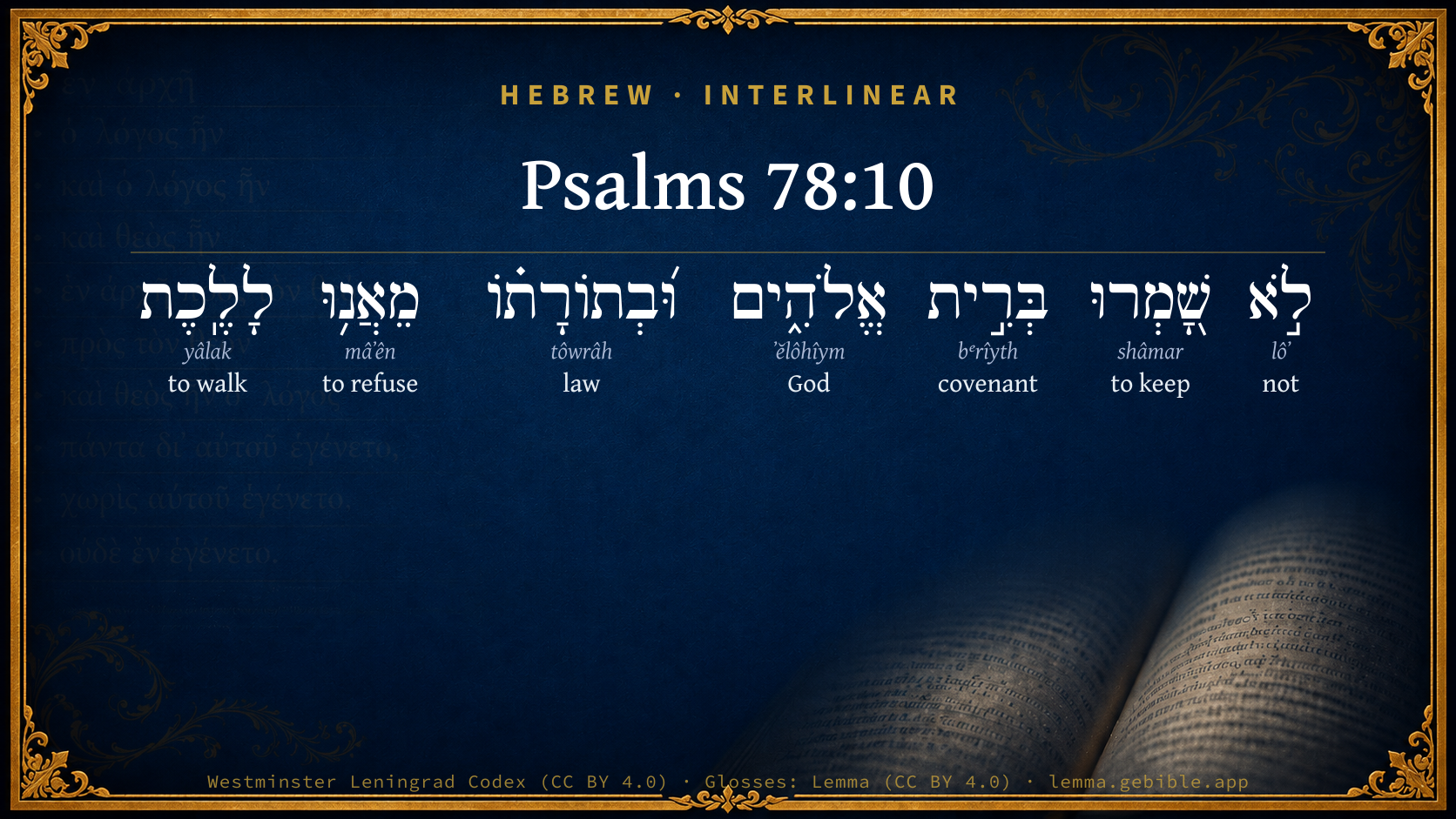
Hebrew (Westminster Leningrad Codex) Psalms 78:10 appears in the Hebrew Old Testament. The text above is from the Westminster Leningrad Codex. Each word links to its Strong’s number, a concise gloss, and parsing drawn from the Open Scriptures Hebrew Bible morphology. Click any word for its full Brown-Driver-Briggs (BDB) entry.
Download image
Cite this verse

Psalms 78:10 (World English Bible). Public Domain. Lemma interlinear Bible study tool, https://lemma.gebible.app/v/psalms/78/10.

Show BibTeX & RIS
BibTeX
RIS
English Translation
They didn't keep God's covenant, And refused to walk in his law.
World English Bible · Public Domain
Download a study sheet

One document with this verse’s original text, its word-by-word gloss line, the meaning frame, cross-references with their text, attributed commentary, and full source and license credits — printable, and it pastes into notes with its structure intact.

This verse Autodidact and up

Study sheet (.html) Plain text (.txt)

A passage Seminary Student

Up to 50 verses in one chapter. A passage sheet keeps up to 6 commentary sources and 12 cross-references per verse, in the order this page ranks them, and says so on the sheet whenever that leaves anything out. Ask for a single verse and you get the Autodidact verse sheet above.

Everything on this page stays free to read, with no account — the sheet is a download of what is already on screen, not access to it.

Want to remove ads? Support Godless Engineer
Compare translations 3

The same verse in 3 English versions, stacked beneath the original-language interlinear above. Click any original word for its lexicon entry.

Each is an independent rendering of the whole verse — the interlinear is not word-aligned to these translations.

Highlighted words mark where these versions differ — a whole-verse word diff, not a word-by-word alignment.

  • World English Bible Public Domain
    They didn't keep God's covenant, And refused to walk in his law.
  • King James Version Public Domain
    They kept not the covenant of God, and refused to walk in his law;
  • unfoldingWord Literal Text CC BY-SA 4.0
    They did not keep the covenant of God, and they refused to walk in his law.

unfoldingWord Literal Text — © unfoldingWord, licensed CC BY-SA 4.0. Word-aligned USFM3 via Door43 (git.door43.org/unfoldingWord/en_ult).

Versions to compare (up to 4)

3 of 4 selected

Show all 18 translations

Every available English version of this verse, each an independent rendering of the whole verse.

  • World English Bible Public Domain
    They didn't keep God's covenant, And refused to walk in his law.
  • Berean Standard Bible Public Domain
    They failed to keep God’s covenant and refused to live by His law.
  • Majority Standard Bible Public Domain
    They failed to keep God’s covenant and refused to live by His law.
  • King James Version Public Domain
    They kept not the covenant of God, and refused to walk in his law;
  • American Standard Version (1901) Public Domain
    They kept not the covenant of God, And refused to walk in his law;
  • Revised Version (1885) Public Domain
    They kept not the covenant of God, and refused to walk in his law;
  • Geneva Bible (1599) Public Domain
    They kept not the couenant of God, but refused to walke in his Lawe,
  • Douay-Rheims (1899) Public Domain
    They kept not the covenant of God: and in his law they would not walk.
  • Young's Literal Translation Public Domain
    They have not kept the covenant of God, And in His law they have refused to walk,
  • Literal Standard Version CC BY-SA 4.0
    They have not kept the covenant of God, || And they have refused to walk in His law,
  • Unlocked Literal Bible CC BY-SA 4.0
    They did not keep the covenant with God, and they refused to obey his law.
  • unfoldingWord Literal Text CC BY-SA 4.0
    They did not keep the covenant of God, and they refused to walk in his law.
  • Darby Bible Public Domain
    They kept not the covenant of God, and refused to walk in his law;
  • World Messianic Bible Public Domain
    They didn’t keep God’s covenant, and refused to walk by his Torah.
  • Webster's Bible Public Domain
    They kept not the covenant of God, and refused to walk in his law;
  • Free Bible Version CC BY-SA 4.0
    They did not keep God's agreement, and refused to follow his laws.
  • Bible in Basic English Public Domain
    They were not ruled by God's word, and they would not go in the way of his law;
  • JPS Tanakh (1917) Public Domain
    They kept not the covenant of God, and refused to walk in His law;

Literal Standard Version (2020), Covenant Press — licensed CC BY-SA 4.0. Text via the HelloAO Bible API (eBible.org). Unlocked Literal Bible (unfoldingWord) — licensed CC BY-SA 4.0. Text via the HelloAO Bible API (eBible.org). unfoldingWord Literal Text — © unfoldingWord, licensed CC BY-SA 4.0. Word-aligned USFM3 via Door43 (git.door43.org/unfoldingWord/en_ult). Free Bible Version, Dr. Jonathan Gallagher — licensed CC BY-SA 4.0. Text via the HelloAO Bible API (eBible.org).

Word by word

More ways to search: Search by grammar → Find every occurrence → Compare this word →

Practice this passage: Drill this verse → Learn its vocabulary →

About this verse

These counts appear in no published source. They are computed here, from the morphology-tagged text and Lemma’s own curated glosses. What Lemma adds →

7
words
7
distinct lemmas
Wisdom
section

Shared distinctive vocabulary

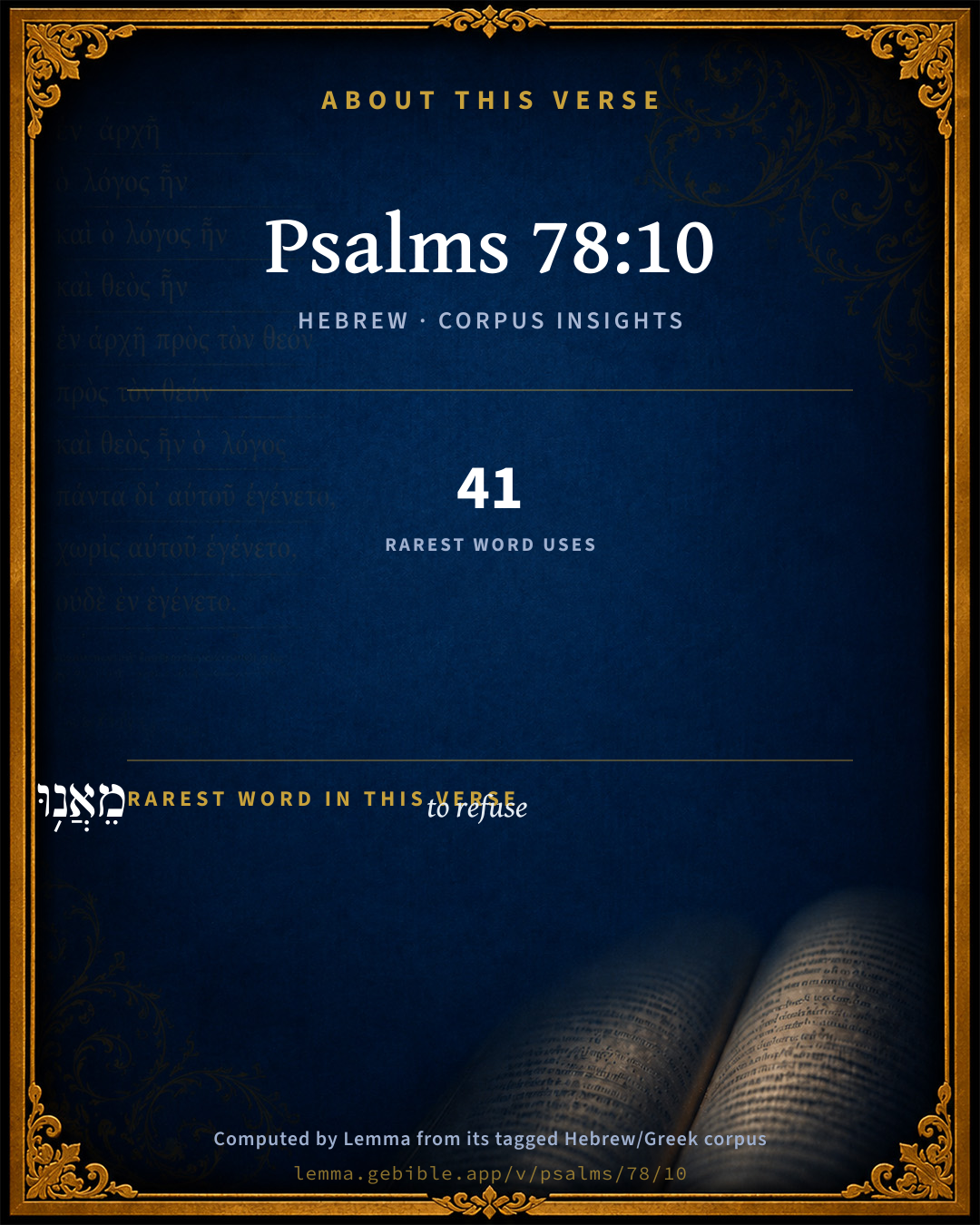
מֵאֲנ֥וּ to refuse H3985 occurs in 39 verses of the Hebrew Bible. Also found in:

Grammatical profile

  • 3 verbs
  • 3 nouns
  • 1 particle

Verb forms

  • שָׁ֭מְרוּ Qal · Perfect
  • מֵאֲנ֥וּ Piel · Perfect
  • לָלֶֽכֶת Qal · Infinitive Construct

Hebrew & Septuagint length

In English translation the verse runs 12 words from the Hebrew and 14 from the Septuagint (LXX English) — closely comparable.

A rough comparison of the two English renderings, which tokenize alike — not a word-level alignment.

Word counts can differ between the Hebrew and the Greek without any difference in meaning — e.g. the Hebrew direct-object marker אֵת has no separate Greek word, and Greek often adds the article ὁ.

Cross-references

6

Topical passages linked to Psalms 78:10 in the Treasury of Scripture Knowledge — connected by theme and wording, ordered by reader-vote popularity; previews shown in the World English Bible.

  • Deuteronomy 31:20 For when I shall have brought them into the land which I swore to their fathers, flowing with milk and honey, and they shall have eaten and filled themselves, and grown fat; then will they turn to other gods, and serve them, and despise me, and break my covenant.
  • Deuteronomy 31:16 Yahweh said to Moses, Behold, you shall sleep with your fathers; and this people will rise up, and play the prostitute after the strange gods of the land, where they go to be among them, and will forsake me, and break my covenant which I have made with them.
  • Judges 2:10–12 Also all that generation were gathered to their fathers: and there arose another generation after them, who didn't know Yahweh, nor yet the work which he had worked for Israel.
  • Nehemiah 9:26–29 Nevertheless they were disobedient, and rebelled against you, and cast your law behind their back, and killed your prophets that testified against them to turn them again to you, and they committed awful blasphemies.
  • 2 Kings 17:14–15 Notwithstanding, they would not hear, but hardened their neck, like the neck of their fathers, who didn't believe in Yahweh their God.
  • Jeremiah 31:32 not according to the covenant that I made with their fathers in the day that I took them by the hand to bring them out of the land of Egypt; which my covenant they broke, although I was a husband to them, says Yahweh.

Cross-references courtesy of OpenBible.info (CC BY 4.0).

Hebrew and Greek witnesses Masoretic Hebrew ↔ Greek Septuagint

The same verse in the two great witnesses to the Old Testament, shown verse-for-verse.

You’re reading Greek Psalm 77 (Hebrew Psalm 78). The Septuagint counts the superscription, so verse numbers can differ from the Hebrew — chapter-level alignment, not verse-by-verse. Numbering follows Rahlfs.

These are two independent witnesses, not word-aligned to each other, and the Septuagint is shown in lemma (dictionary) form.

Hebrew Psalms 78:10 Masoretic · Westminster Leningrad Codex

לֹ֣א שָׁ֭מְרוּ בְּרִ֣ית אֱלֹהִ֑ים וּ֝בְתוֹרָת֗וֹ מֵאֲנ֥וּ לָלֶֽכֶת

They didn't keep God's covenant, And refused to walk in his law.

World English Bible · Public Domain

Greek LXX Greek Psalm 77:10 Septuagint · lemma form

οὐ φυλάσσω ὁ διαθήκη ὁ θεός καί ἐν ὁ νόμος αὐτός οὐ θέλω πορεύομαι

They kept not the covenant of God, and would not walk in his law.

LXX2012 (modern English Septuagint) · Public Domain

Hebrew: Westminster Leningrad Codex (CC BY 4.0). Greek: Septuagint (public domain); English from LXX2012 (modern English Septuagint) (Public Domain). How the Septuagint differs from the Hebrew →

Commentary

Notes on Psalms 78:10 from classic Christian and Jewish commentators (each source and its license shown beneath its notes). The classic Christian expositions comment on the surrounding passage and are grouped to its opening verse, so a note may address several verses; the Jewish commentaries on the Tanakh (Rashi and others) are per-verse, so they appear only where the commentator wrote on this verse.

Lemma curates 59 commentaries, every one of them public domain or Creative Commons licensed, each selected and text-cleaned for this edition rather than reprinted as found. About our sources →

Trapp's Complete Commentary

John Trapp

Psa 78:10 They kept not the covenant of God, and refused to walk in his law;

Ver. 10. They kept not the covenant, &c.] And so betrayed themselves into the hands of divine justice, they were worthily worsted. See 2Ch 15:2.

And refused to walk in his law] They were set upon it, and would not be ruled by their father Ephraim, or any other that counselled them to the contrary; and haply said the like to them that Archidamus did to his too daring son, Aut viribus adde aut animis adime, Either add to thy forces or abate of thy courage.

John Trapp, A Commentary or Exposition upon All the Books of the Old and New Testament (1647–1656) — public domain. Text from a community e-Sword module.

Joseph Benson's Commentary

Psa 78:10-11. They kept not the covenant of God — Their cowardice was the effect of their unbelief and disobedience; and refused to walk in his law — Their disobedience was accompanied with obstinacy and contempt of God’s laws. And forgat his works — Not historically, but practically. They did not so remember them as to love, and serve, and trust in that God, of whose infinite power and goodness they had had such ample experience.

Joseph Benson's Commentary on the Old and New Testaments (1811–1818) — public domain. Text from a community e-Sword module.

J. A. Alexander on Psalms

Joseph Addison Alexander

10. (Psa 78:10) They kept not the covenant of God, and in his law refused to walk. They violated the condition of their national vocation, and refused to do the very thing for which they were brought out of Egypt.

Joseph Addison Alexander, The Psalms Translated and Explained (1850) — public domain. Text from a community e-Sword module.

Adam Clarke's Commentary

Verse 10. They kept not the covenant of God] They abandoned his worship, both moral and ritual. They acted like the Ephraimites in the above case, who threw down their bows and arrows, and ran away.

Adam Clarke's Commentary on the Bible (1810–1826) — public domain. Text from a community e-Sword/MySword module.

John Calvin's Commentaries

10. They kept not the covenant of God. This is the reason assigned for the Ephraimites turning their backs in the day of battle; and it explains why the divine assistance was withheld from them. Others, it is true, were guilty in this respect as well as they, but the vengeance of God executed on that tribe, which by its influence had corrupted almost the whole kingdom, is purposely brought forward as a general warning. Since then the tribe of Ephraim, in consequence of its splendor and dignity, when it threw off the yoke, encouraged and became as it were a standard of shameful revolt to all the other tribes, the prophet intended to put people on their guard, that they might not suffer themselves in their simplicity to be again deceived in the same manner. It is no light charge which he brings against the sons of Ephraim: he upbraids them on account of their perfidiousness in despising the whole law and in violating the covenant. Although he employs these two words, law and covenant, in the same sense; yet, in placing the covenant first, he clearly shows that he is speaking not only of the moral law, the all-perfect rule of life, but of the whole service of God, of the truth and faithfulness of the divine promises, and of the trust which ought to be reposed in them, of invocation, and of the doctrine of true religion, the foundation whereof was the adoption. He therefore calls them covenant-breakers, because they had fallen from their trust in the promises, by which God had entered into covenant with them to be their Father. Yet he afterwards very properly adds the law, in which the covenant was sealed up, as it were, in public records. He aggravates the enormity of their guilt by the word refuse, which intimates that they were not simply carried away by a kind of thoughtless or inconsiderate recklessness, and thus sinned through giddiness, want of knowledge or foresight, but that they had purposely, and with deliberate obstinacy, violated the holy covenant of God.

John Calvin's Commentaries (1540-1563) — public domain. Text from the Calvin Translation Society English edition (1840s-50s) via the Christian Classics Ethereal Library (ccel.org). Calvin's coverage is partial (roughly two-thirds of the Bible); uncommented books and verses are honest gaps, never fabricated. The 19th-century editor's footnotes and remarks are omitted so the notes are faithfully Calvin's own voice.

The Cambridge Bible for Schools and Colleges

gen. ed. J. J. S. Perowne

10. the covenant of God] See Exo_19:5; Exo_24:3; Exo_24:7-8.

The Cambridge Bible for Schools and Colleges (gen. ed. J. J. S. Perowne; Cambridge University Press, 1878–1918) — public domain. Text from a community e-Sword module.

John Gill's Exposition

They kept not the covenant of God,.... Either the covenant of circumcision, which was neglected during their travels through the wilderness, Jos 5:5 or the covenant made with the people of Israel at Mount Sinai, Exo 24:7 and this is to be understood not of the children of Ephraim only, but of the Israelites in general, who in many instances broke the covenant, and were not steadfast in it, Psa 78:37; see Gill on Jer 31:32.

and refused to walk in his law; the law of God, which was given forth by him, by the disposition of angels, through the hands of a mediator, Moses, as a rule of their walk and conversation; but they refused to order their conversation according to it, being unwilling to be subject to it, but despised and cast it away; a sad instance of the corruption of human nature, and the depravity of man's will, boasted of for its freedom, yet what is common, and to be observed in all mankind.

John Gill's Exposition of the Whole Bible (1746–1763) — public domain (CC PDM 1.0). Text via the HelloAO Bible API.

Albert Barnes' Notes on the Bible

They kept not the covenant of God - The covenant which God had made with the entire Hebrew people. They did not maintain their allegiance to Yahweh. Compare Deu 4:13, Deu 4:23; Deu 17:2.

And refused to walk in his law - Refused to obey his law. They rebelled against him.

Albert Barnes' Notes on the Bible (1834–1885) — public domain. Text from a community e-Sword/MySword module.

Matthew Poole's English Annotations

Their disobedience was accompanied with obstinacy and contempt of God’s laws.

Matthew Poole's English Annotations on the Holy Bible (1683–1685) — public domain. Text from a community e-Sword/MySword module.

The Treasury of David

Charles H. Spurgeon

Ver. 10. They kept not the covenant of God. Vows and promises were broken, idols were set up, and the living God was forsaken. They were brought out of Egypt in order to be a people separated unto the Lord, but they fell into the sins of other nations, and did not maintain a pure testimony for the one only true God.

And refused to walk in his law. They gave way to fornication, and idolatry, and other violations of the decalogue, and were often in a state of rebellion against the benign theocracy under which they lived. They had pledged themselves at Sinai to keep the law, and then they wilfully disobeyed it, and so became covenant breakers.

Ver. 10. Walk in his law. Note, we must walk in the law of God, this is that narrow and sacred way which Christ traces before us. At Athens there was iera odov, the sacred way, by which, as Harpocratio relates, the priests of the mysteries travelled to Elusin. At Rome also there was a way which was called Via Sacra. To us also there is a way to the skies, consecrated by the footsteps of the saints. It behooves us therefore not to loiter, but to be ever on the march. Thomas Le Blanc.

Ver. 10-11. The gradations of sin: neglecting, rejecting, forgetting God. C. D.

Psalms 78:11*

Ver. 10-11. The gradations of sin: neglecting, rejecting, forgetting God. C. D.

Psalms 78:12*

Charles H. Spurgeon's The Treasury of David (1869–1885) — public domain. Psalms only. Text from a community e-Sword/MySword module.

Whedon's Commentary on the Bible

Daniel D. Whedon

10. They kept not the covenant of God—As already stated, they had forsaken God, and God had now forsaken them, and this was the real cause of their cowardice, which is here set down as crime. We must understand Ephraim, not exclusively, but as the leading tribe, and responsible for the day’s disasters, especially for the capture of the ark, which had been taken from Shiloh contrary to the will of God.

Daniel D. Whedon (gen. ed.), Commentary on the Old and New Testaments (1874–1909) — public domain. Text from a community e-Sword module.

The Pulpit Commentary

They kept not the covenant of God. (comp. Deu_29:25 Deu_31:20 1Ki_19:10, 1Ki_19:14, etc.) And refused to walk in his law. (see Jud 2:11-13 8:33 10:10)

The Pulpit Commentary (1880–1919), ed. H.D.M. Spence-Jones & Joseph S. Exell — public domain. Text from a community e-Sword module.

Lesson kit

Teaching starters — assembled from the data on this page, not authored interpretation. Every prompt links to the verse data it draws on. Edit before teaching.

Psalms, in the Wisdom, opens this verse with 7 words (7 distinct Hebrew lemmas). Its most distinctive word is mâʼên (“to refuse”). A historical commentator’s framing appears above. Read the whole chapter for the surrounding context.

Discussion questions

  1. How does “to refuse” (mâʼên) shape what this verse is saying?
  2. Genesis 37:35 shares the word «to refuse» with this verse. How do the two illuminate each other?
  3. The translations on this page render this verse differently — a whole-verse word diff, not a word-by-word alignment. What might account for the different wordings?
  4. The verb «שָׁ֭מְרוּ» is Qal Perfect. How does its form color the action?
  5. Reading how Trapp's Complete Commentary and Joseph Benson's Commentary read this verse, where do the two commentators agree and where do they part?

Things to notice

Reading settings

Reading text

Shown beneath each verse's original-language words.

Old Testament
Old Testament edition

Read the OT as the Masoretic Hebrew (MT) or the Greek Septuagint (LXX).

English shown for the Greek Septuagint (in the Hebrew ↔ Greek comparison).

Comparing translations? Open the Compare panel on any verse page to stack up to four side by side.