
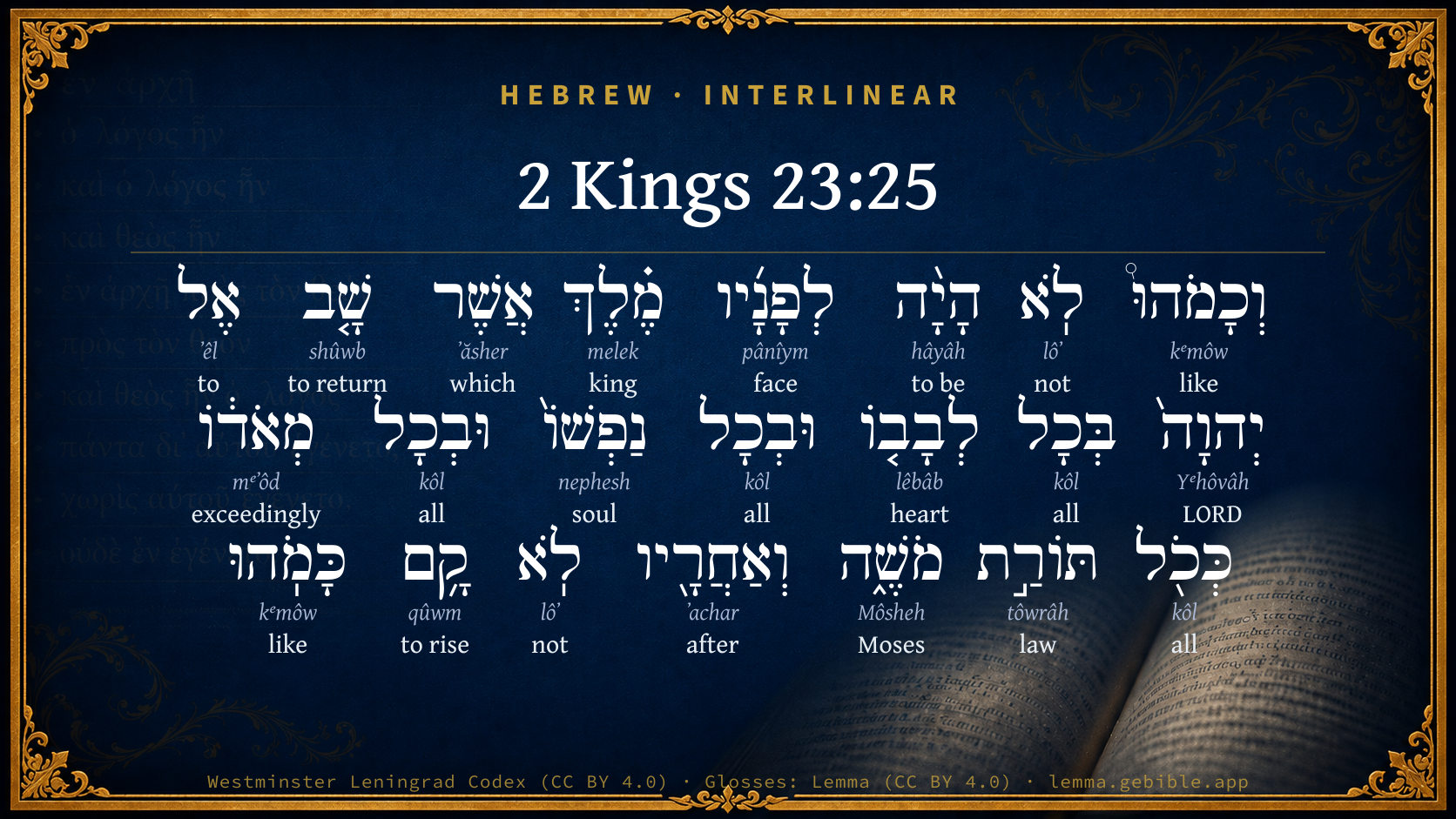
2 Kings 23:25

Hebrew (Westminster Leningrad Codex) 2 Kings 23:25 appears in the Hebrew Old Testament. The text above is from the Westminster Leningrad Codex. Each word links to its Strong’s number, a concise gloss, and parsing drawn from the Open Scriptures Hebrew Bible morphology. Click any word for its full Brown-Driver-Briggs (BDB) entry.
Download image
Cite this verse

2 Kings 23:25 (World English Bible). Public Domain. Lemma interlinear Bible study tool, https://lemma.gebible.app/v/2-kings/23/25.

Show BibTeX & RIS
BibTeX
RIS
English Translation
Like him was there no king before him, who turned to Yahweh with all his heart, and with all his soul, and with all his might, according to all the law of Moses; neither after him arose there any like him.
World English Bible · Public Domain
Download a study sheet

One document with this verse’s original text, its word-by-word gloss line, the meaning frame, cross-references with their text, attributed commentary, and full source and license credits — printable, and it pastes into notes with its structure intact.

This verse Autodidact and up

Study sheet (.html) Plain text (.txt)

A passage Seminary Student

Up to 50 verses in one chapter. A passage sheet keeps up to 6 commentary sources and 12 cross-references per verse, in the order this page ranks them, and says so on the sheet whenever that leaves anything out. Ask for a single verse and you get the Autodidact verse sheet above.

Everything on this page stays free to read, with no account — the sheet is a download of what is already on screen, not access to it.

Want to remove ads? Support Godless Engineer
Compare translations 3

The same verse in 3 English versions, stacked beneath the original-language interlinear above. Click any original word for its lexicon entry.

Each is an independent rendering of the whole verse — the interlinear is not word-aligned to these translations.

Highlighted words mark where these versions differ — a whole-verse word diff, not a word-by-word alignment.

  • World English Bible Public Domain
    Like him was there no king before him, who turned to Yahweh with all his heart, and with all his soul, and with all his might, according to all the law of Moses; neither after him arose there any like him.
  • King James Version Public Domain
    And like unto him was there no king before him, that turned to the LORD with all his heart, and with all his soul, and with all his might, according to all the law of Moses; neither after him arose there any like him.
  • unfoldingWord Literal Text CC BY-SA 4.0
    And to his face a king was not like him, who returned to Yahweh with all of his heart and with all of his soul and with all of his strength, according to all of the Law of Moses. And after him, one has not arisen like him.

unfoldingWord Literal Text — © unfoldingWord, licensed CC BY-SA 4.0. Word-aligned USFM3 via Door43 (git.door43.org/unfoldingWord/en_ult).

Versions to compare (up to 4)

3 of 4 selected

Show all 18 translations

Every available English version of this verse, each an independent rendering of the whole verse.

  • World English Bible Public Domain
    Like him was there no king before him, who turned to Yahweh with all his heart, and with all his soul, and with all his might, according to all the law of Moses; neither after him arose there any like him.
  • Berean Standard Bible Public Domain
    Neither before nor after Josiah was there any king like him, who turned to the LORD with all his heart and with all his soul and with all his strength, according to all the Law of Moses.
  • Majority Standard Bible Public Domain
    Neither before nor after Josiah was there any king like him, who turned to the LORD with all his heart and with all his soul and with all his strength, according to all the Law of Moses.
  • King James Version Public Domain
    And like unto him was there no king before him, that turned to the LORD with all his heart, and with all his soul, and with all his might, according to all the law of Moses; neither after him arose there any like him.
  • American Standard Version (1901) Public Domain
    And like unto him was there no king before him, that turned to Jehovah with all his heart, and with all his soul, and with all his might, according to all the law of Moses; neither after him arose there any like him.
  • Revised Version (1885) Public Domain
    And like unto him was there no king before him, that turned to the LORD with all his heart, and with all his soul, and with all his might, according to all the law of Moses; neither after him arose there any like him.
  • Geneva Bible (1599) Public Domain
    Like vnto him was there no King before him, that turned to the Lord with al his heart, and with all his soule, and with all his might according to all the Lawe of Moses, neither after him arose there anie like him.
  • Douay-Rheims (1899) Public Domain
    There was no king before him like unto him, that returned to the Lord with all his heart, and with all his soul, and with ail his strength, according to all the law of Moses: neither after him did there arise any like him.
  • Young's Literal Translation Public Domain
    And like him there hath not been before him a king who turned back unto Jehovah with all his heart, and with all his soul, and with all his might, according to all the law of Moses, and after him there hath none risen like him.
  • Literal Standard Version CC BY-SA 4.0
    And like him there has not been before him a king who turned back to YHWH with all his heart, and with all his soul, and with all his might, according to all the Law of Moses, and after him there has none risen like him.
  • Unlocked Literal Bible CC BY-SA 4.0
    Before Josiah, there had been no king like him, who turned to Yahweh with all his heart, all his soul, and all his might, who followed all the law of Moses. Nor did any king like Josiah arise after him.
  • unfoldingWord Literal Text CC BY-SA 4.0
    And to his face a king was not like him, who returned to Yahweh with all of his heart and with all of his soul and with all of his strength, according to all of the Law of Moses. And after him, one has not arisen like him.
  • Darby Bible Public Domain
    And before him there had been no king like him that turned to Jehovah with all his heart and with all his soul and with all his might, according to all the law of Moses; neither after him arose there his like.
  • World Messianic Bible Public Domain
    There was no king like him before him, who turned to the LORD with all his heart, and with all his soul, and with all his might, according to all the Torah of Moses; and there was none like him who arose after him.
  • Webster's Bible Public Domain
    And like him was there no king before him, that turned to the LORD with all his heart, and with all his soul, and with all his might, according to all the law of Moses; neither after him arose there any like him.
  • Free Bible Version CC BY-SA 4.0
    Never before was there a king like him who committed himself to the Lord in all his thoughts and attitudes, and with all his strength, keeping all the Law of Moses. There was no king like him afterwards either.
  • Bible in Basic English Public Domain
    Never before had there been a king like him, turning to the Lord with all his heart and with all his soul and with all his power, as the law of Moses says; and after him there was no king like him.
  • JPS Tanakh (1917) Public Domain
    And like unto him was there no king before him, that turned to the LORD with all his heart, and with all his soul, and with all his might, according to all the law of Moses; neither after him arose there any like him.

Literal Standard Version (2020), Covenant Press — licensed CC BY-SA 4.0. Text via the HelloAO Bible API (eBible.org). Unlocked Literal Bible (unfoldingWord) — licensed CC BY-SA 4.0. Text via the HelloAO Bible API (eBible.org). unfoldingWord Literal Text — © unfoldingWord, licensed CC BY-SA 4.0. Word-aligned USFM3 via Door43 (git.door43.org/unfoldingWord/en_ult). Free Bible Version, Dr. Jonathan Gallagher — licensed CC BY-SA 4.0. Text via the HelloAO Bible API (eBible.org).

Word by word

More ways to search: Search by grammar → Find every occurrence → Compare this word →

Practice this passage: Drill this verse → Learn its vocabulary →

וְכָמֹהוּ֩
kᵉmôw
H3644
“and · like · him”
Conjunction + Preposition + Suffix, Personal, 3rd Person, Masculine, Singular
Part of Speech
Conjunction + Preposition
Full BDB Definition

Origin: a form of the prefix "k-", but used separately [compare H3651 ]

TWOT: TWOT - 938

like, as, the like of which (adverb) - when, according as, as it were (conjunction)
  1. לֹֽא lôʼ H3808 “not” Particle, Negative
  2. הָיָ֨ה hâyâh H1961 “to be” Verb, Qal, Perfect, 3rd Person, Masculine, Singular
  3. לְפָנָ֜יו pânîym H6440 “to/for · face(s) · his” Preposition + Noun, Common, Both, Plural, Construct + Suffix, Personal, 3rd Person, Masculine, Singular
  4. מֶ֗לֶךְ melek H4428 “king” Noun, Common, Masculine, Singular, Absolute
  5. אֲשֶׁר ʼăsher H834 “which” Particle, Relative
  6. שָׁ֤ב shûwb H7725 “to return” Verb, Qal, Perfect, 3rd Person, Masculine, Singular
  7. אֶל ʼêl H413 “to” Preposition
  8. יְהוָה֙ Yᵉhôvâh H3068 “LORD” Noun, Proper
  9. בְּכָל kôl H3605 “in/at · all of” Preposition + Noun, Common, Masculine, Singular, Construct
  10. לְבָב֤וֹ lêbâb H3824 “heart · his” Noun, Common, Masculine, Singular, Construct + Suffix, Personal, 3rd Person, Masculine, Singular
  11. וּבְכָל kôl H3605 “and · in/at · all of” Conjunction + Preposition + Noun, Common, Masculine, Singular, Construct
  12. נַפְשׁוֹ֙ nephesh H5315 “soul · his” Noun, Common, Both, Singular, Construct + Suffix, Personal, 3rd Person, Masculine, Singular
  13. וּבְכָל kôl H3605 “and · in/at · all of” Conjunction + Preposition + Noun, Common, Masculine, Singular, Construct
  14. מְאֹד֔וֹ mᵉʼôd H3966 “exceedingly · his” Noun, Common, Masculine, Singular, Construct + Suffix, Personal, 3rd Person, Masculine, Singular
  15. כְּכֹ֖ל kôl H3605 “like/as · all of” Preposition + Noun, Common, Masculine, Singular, Construct
  16. תּוֹרַ֣ת tôwrâh H8451 “law of” Noun, Common, Feminine, Singular, Construct
  17. מֹשֶׁ֑ה Môsheh H4872 “Moses” Noun, Proper
  18. וְאַחֲרָ֖יו ʼachar H310 “and · after · him” Conjunction + Preposition + Suffix, Personal, 3rd Person, Masculine, Singular
  19. לֹֽא lôʼ H3808 “not” Particle, Negative
  20. קָ֥ם qûwm H6965 “to rise” Verb, Qal, Perfect, 3rd Person, Masculine, Singular
  21. כָּמֹֽהוּ kᵉmôw H3644 “like · him” Preposition + Suffix, Personal, 3rd Person, Masculine, Singular

About this verse

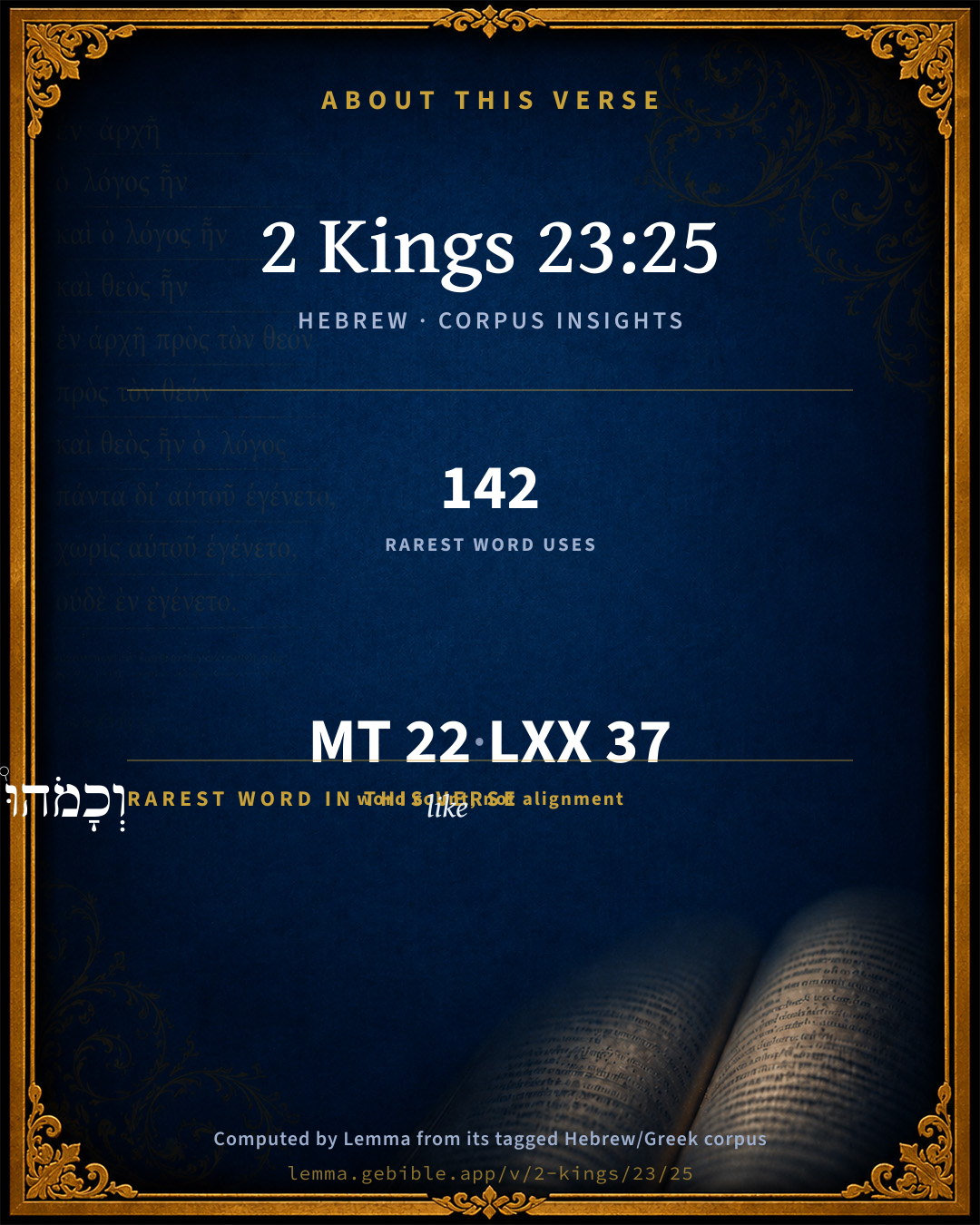
These counts appear in no published source. They are computed here, from the morphology-tagged text and Lemma’s own curated glosses. What Lemma adds →

22
words
17
distinct lemmas
Historical
section

Grammatical profile

  • 3 verbs
  • 12 nouns
  • 4 prepositions
  • 3 particles

Verb forms

  • הָיָ֨ה Qal · Perfect
  • שָׁ֤ב Qal · Perfect
  • קָ֥ם Qal · Perfect

Repetition

Words recur within this verse — often emphatic in Hebrew:

  • בְּכָל all H3605 ×4
  • וְכָמֹהוּ֩ like H3644 ×2
  • לֹֽא not H3808 ×2

Hebrew & Septuagint length

In English translation the verse runs 41 words from the Hebrew and 43 from the Septuagint (LXX English) — closely comparable.

A rough comparison of the two English renderings, which tokenize alike — not a word-level alignment.

Word counts can differ between the Hebrew and the Greek without any difference in meaning — e.g. the Hebrew direct-object marker אֵת has no separate Greek word, and Greek often adds the article ὁ.

In the original languages it is 22 Hebrew tokens and 37 Greek tokens — but the two are counted differently (Hebrew bundles its prefixes and suffixes into one token; the Greek is in lemma form), so that isn’t a like-for-like length.

Cross-references

12

Topical passages linked to 2 Kings 23:25 in the Treasury of Scripture Knowledge — connected by theme and wording, ordered by reader-vote popularity; previews shown in the World English Bible.

  • 2 Kings 18:5 He trusted in Yahweh, the God of Israel; so that after him was none like him among all the kings of Judah, nor [among them] that were before him.
  • Jeremiah 29:13 You shall seek me, and find me, when you shall search for me with all your heart.
  • Deuteronomy 6:5 and you shall love Yahweh your God with all your heart, and with all your soul, and with all your might.
  • 1 Kings 8:48 if they return to you with all their heart and with all their soul in the land of their enemies, who carried them captive, and pray to you toward their land, which you gave to their fathers, the city which you have chosen, and the house which I have built for your name:
  • 2 Kings 23:3 The king stood by the pillar, and made a covenant before Yahweh, to walk after Yahweh, and to keep his commandments, and his testimonies, and his statutes, with all [his] heart, and all [his] soul, to confirm the words of this covenant that were written in this book: and all the people stood to the covenant.
  • John 1:17 For the law was given through Moses. Grace and truth came through Jesus Christ.
  • Deuteronomy 4:29 But from there you shall seek Yahweh your God, and you shall find him, when you search after him with all your heart and with all your soul.
  • 1 Kings 2:4 That Yahweh may establish his word which he spoke concerning me, saying, If your children take heed to their way, to walk before me in truth with all their heart and with all their soul, there shall not fail you (said he) a man on the throne of Israel.
  • 1 Kings 15:5 because David did that which was right in the eyes of Yahweh, and didn't turn aside from anything that he commanded him all the days of his life, except only in the matter of Uriah the Hittite.
  • Nehemiah 10:29 They joined with their brothers, their nobles, and entered into a curse, and into an oath, to walk in God's law, which was given by Moses the servant of God, and to observe and do all the commandments of Yahweh our Lord, and his ordinances and his statutes;
  • Malachi 4:4 "Remember the law of Moses my servant, which I commanded to him in Horeb for all Israel, even statutes and ordinances.
  • John 7:19 Didn't Moses give you the law, and yet none of you keeps the law? Why do you seek to kill me?"

Cross-references courtesy of OpenBible.info (CC BY 4.0).

Hebrew and Greek witnesses Masoretic Hebrew ↔ Greek Septuagint

The same verse in the two great witnesses to the Old Testament, shown verse-for-verse.

These are two independent witnesses, not word-aligned to each other, and the Septuagint is shown in lemma (dictionary) form.

Hebrew 2 Kings 23:25 Masoretic · Westminster Leningrad Codex

וְכָמֹהוּ֩ לֹֽא הָיָ֨ה לְפָנָ֜יו מֶ֗לֶךְ אֲשֶׁר שָׁ֤ב אֶל יְהוָה֙ בְּכָל לְבָב֤וֹ וּבְכָל נַפְשׁוֹ֙ וּבְכָל מְאֹד֔וֹ כְּכֹ֖ל תּוֹרַ֣ת מֹשֶׁ֑ה וְאַחֲרָ֖יו לֹֽא קָ֥ם כָּמֹֽהוּ

Like him was there no king before him, who turned to Yahweh with all his heart, and with all his soul, and with all his might, according to all the law of Moses; neither after him arose there any like him.

World English Bible · Public Domain

Greek LXX 2 Kings 23:25 Septuagint · lemma form

ὅμοιος αὐτός οὐ γίγνομαι ἔμπροσθεν αὐτός βασιλεύς ὅς ἐπιστρέφω πρός κύριος ἐν ὅλος καρδία αὐτός καί ἐν ὅλος ψυχή αὐτός καί ἐν ὅλος ἰσχύς αὐτός κατά πᾶς ὁ νόμος μωυσῆς καί μετά αὐτός οὐ ἀναἵστημι ὅμοιος αὐτός

There was no king like him before him, who turned to the Lord with all his heart, and with all his soul, and with all his strength, according to all the law of Moses; and after him there rose not one like him.

LXX2012 (modern English Septuagint) · Public Domain

Hebrew: Westminster Leningrad Codex (CC BY 4.0). Greek: Septuagint (public domain); English from LXX2012 (modern English Septuagint) (Public Domain). How the Septuagint differs from the Hebrew →

Targum (Aramaic paraphrase)

1

The Targum is the ancient Jewish Aramaic paraphrase of the Hebrew Scriptures — an interpretive translation, not the Hebrew text itself. Onkelos (literal) and Pseudo-Jonathan (expansive) render the Torah, and Jonathan the Prophets. Coverage is partial: where no permissively-licensed English translation exists for a verse, only the Aramaic is shown. This is verse-level text, not a word-by-word alignment to the Hebrew.

  1. Targum Jonathan Prophets (Joshua–Malachi)
    וּכְוָתֵיהּ לָא הֲוָה קֳדָמוֹהִי מַלְכָּא דְתַב לְפוּלְחָנָא דַייָ בְּכָל לִבֵּיהּ וּבְכָל נַפְשֵׁיהּ וּבְכָל נִכְסוֹהִי כְּכֹל אוֹרַיְתָא דְמֹשֶׁה וּבַתְרוֹהִי לָא קָם כְּוָתֵיהּ:

    (no public-domain English translation for this verse)

    Targum Jonathan — Aramaic: “Mikraot Gedolot” (public domain). English: “Sefaria Community Translation” (CC0 1.0 (public-domain dedication)); “London "Chaldee Paraphrase," 1871” (public domain). Text via Sefaria.

Commentary

Notes on 2 Kings 23:25 from classic Christian and Jewish commentators (each source and its license shown beneath its notes). The classic Christian expositions comment on the surrounding passage and are grouped to its opening verse, so a note may address several verses; the Jewish commentaries on the Tanakh (Rashi and others) are per-verse, so they appear only where the commentator wrote on this verse.

Lemma curates 59 commentaries, every one of them public domain or Creative Commons licensed, each selected and text-cleaned for this edition rather than reprinted as found. About our sources →

Matthew Henry's Commentary

Upon the reading of these verses we must say, Lord, though thy righteousness be as the great mountains - evident, conspicuous, and past dispute, yet thy judgments are a great deep, unfathomable and past finding out, Psa 36:6. What shall we say to this?

I. It is here owned that Josiah was one of the best kings that ever sat upon the throne of David, Kg2 23:25. As Hezekiah was a non-such for faith and dependence upon God in straits (Kg2 18:5), so Josiah was a non-such for sincerity and zeal in carrying on a work of reformation. For this there was none like him, 1. That he turned to the Lord from whom his fathers had revolted. It is true religion to turn to God as one we have chosen and love. He did what he could to turn his kingdom also to the Lord. 2. That he did this with his heart and soul; his affections and aims were right in what he did. Those make nothing of their religion that do not make heart-work of it. 3. That he did it with all his heart, and all his soul, and all his might - with vigour, and courage, and resolution: he could not otherwise have broken through the difficulties he had to grapple with. What great things may we bring to pass in the service of God if we be but lively and hearty in it! 4. That he did this according to all the law of Moses, in an exact observance of that law and with an actual regard to it. His zeal did not transport him into any irregularities, but, in all he did, he walked by rule.

II. Notwithstanding this he was cut off by a violent death in the midst of his days, and his kingdom was ruined within a few years after. Consequent upon such a reformation as this, one would have expected nothing but the prosperity and glory both of king and kingdom; but, quite contrary, we find both under a cloud. 1. Even the reformed kingdom continues marked for ruin. For all this (Kg2 23:26) the Lord turned not from the fierceness of his great wrath. That is certainly true, which God spoke by the prophet (Jer 18:7, Jer 18:8), that if a nation, doomed to destruction, turn from the evil of sin, God will repent of the evil of punishment; and therefore we must conclude that Josiah's people, though they submitted to Josiah's power, did not heartily imbibe Josiah's principles. They were turned by force, and did not voluntarily turn from their evil way, but still continued their affection for their idols; and therefore he that knows men's hearts would not recall the sentence, which was, That Judah should be removed, as Israel had been, and Jerusalem itself cast off, Kg2 23:27. Yet even this destruction was intended to be their effectual reformation; so that we must say, not only that the criminals had filled their measure and were ripe for ruin, but also that the disease had come to a crisis, and was ready for a cure; and this shall be all the fruit, even the taking away of sin. 2. As an evidence of this, even the reforming king is cut off in the midst of his usefulness - in mercy to him, that he might not see the evil which was coming upon his kingdom, but in wrath to his people, for his death was an inlet to their desolations. The king of Egypt waged war, it seems, with the king of Assyria: so the king of Babylon is now called. Josiah's kingdom lay between them. He therefore thought himself concerned to oppose the king of Egypt, and check the growing, threatening, greatness of his power; for though, at this time, he protested that he had no design against Josiah, yet, if he should prevail to unite the river of Egypt and the river Euphrates, the land of Judah would soon be overflowed between them. Therefore Josiah went against him, and was killed in the first engagement, Kg2 23:29, Kg2 23:30. Here, (1.) We cannot justify Josiah's conduct. He had no clear call to engage in this war, nor do we find that he asked counsel of God by urim or prophets concerning it. What had he to do to appear and act as a friend and ally to the king of Assyria? Should he help the ungodly and love those that hate the Lord? If the kings of Egypt and Assyria quarrelled, he had reason to think God would bring good out of it to him and his people, by making them instrumental to weaken one another. Some understand the promise made to him that he should come to his grave in peace in a sense in which it was not performed because, by his miscarriage in this matter, he forfeited the benefit of it. God has promised to keep us in all our ways; but, if we go out of our way, we throw ourselves out of his protection. I understand the promise so as that I believe it was fulfilled, for he died in peace with God and his own conscience, and saw not, nor had any immediate prospect of, the destruction of Judah and Jerusalem by the Chaldeans; yet I understand the providence to be a rebuke to him for his rashness. (2.) We must adore God's righteousness in taking away such a jewel from an unthankful people that knew not how to value it. They greatly lamented his death (Ch2 35:25), urged to it by Jeremiah, who told them the meaning of it, and what a threatening omen it was; but they had not made a due improvement of the mercies they enjoyed by his life, of which God taught them the worth by the want.

Matthew Henry's Commentary on the Whole Bible (1708–1710) — public domain (CC PDM 1.0). Text via the HelloAO Bible API.

Trapp's Complete Commentary

John Trapp

2Ki 23:25 And like unto him was there no king before him, that turned to the LORD with all his heart, and with all his soul, and with all his might, according to all the law of Moses; neither after him arose there [any] like him.

Ver. 25. And like unto him was there no king, &c.] He was a matchless man, a peerless prince, the world’s paragon,

“ Hic regum decus et iuvenum flos, spesque bonorum.

Deliciae saecli et gloria gentis erat. ”

As Cardan singeth of our Edward VI, a second Josiah, as all good men acknowledged. See 2Ki 18:5.

And with all his might.] Heb., With his utmost vehemency, strength, and diligence; he did all that he could do.

John Trapp, A Commentary or Exposition upon All the Books of the Old and New Testament (1647–1656) — public domain. Text from a community e-Sword module.

The Biblical Illustrator

Joseph S. Exell

2Ki_23:25-37

And like unto him there was no king before him.

Josiahs reformation

This and the previous chapter show us the influence of a godly sovereign. This prince at the age of twenty-six begins to repair the house of God. This leads to the discovery of the long-lost book of the law. At once Josiah obeys its teaching. He consults Huldah, and receives the Lords message. Finding himself exempted from vengeance on account of his repentance, he endeavours to lead his people to obtain the same exemption, and for this purpose institutes a thorough national reformation. This, we read, consisted of

(1) purifying the temple of idolatrous vessels;

(2) putting down all idolatrous teachers;

(3) defiling all idol altars throughout the land;

(4) keeping the Passover in a solemn manner. From this we may learn--

I. That personal reformation springs from a knowledge of Gods word applied to the heart by faith. It was this that influenced Josiah (Psa_119:130). The entrance of Thy word giveth light (Act_17:11-12). Therefore many believed.

II. That true personal reformation consists of doing and undoing.

1. Undoing old associations, by--

(1) Looking sin in the face, and comparing ourselves with our pattern, by the light of Gods written Word (Php_2:5, etc.).

(2) Cleansing the temple of God (2Co_6:16) of all that defiles.

(3) Giving up all people, practices, and places which tempt to sin; e.g. cards, novels, balls, etc.: let each conscience decide for itself.

2. Doing, by--

(1) Entering into a solemn covenant with God to obey Him, etc.; confirmation.

(2) Publicly, as well as privately, keeping His commandments and wishes; Holy Communion.

III. That personal reformation has results:

1. Comfort and peace to those who carry it out. For thirty years Josiahs reign was a peaceful and happy one to himself. So soul-reformation brings peace to the believer.

2. A blessing, though it may be only a temporary one, to those who, even outwardly, take part in it. The punishment pronounced upon the land was deferred (2Ki_22:20) till after Josiahs death, and a believer brings blessings on those around him.

3. The fulfilment of Gods word (2Ki_23:16 and Isa_5:11). The Christian rejoices in the fulfilment of Mat_11:28-30. But notice two warnings:

1. No personal reformation can be effected without the guidance and grace of the Holy Spirit (Joh_16:8, etc.; Zec_4:6).

2. Personal piety cannot stop national punishment (of. Zec_3:2). Josiah has a grand epitaph written over him (verse 25) by the finger of God. May much be ours! (J. W. Mills, M. A.)

The Biblical Illustrator, edited by Joseph S. Exell (c. 1880s–1900s) — public domain. Text from a community e-Sword module.

Joseph Benson's Commentary

2Ki 23:25. Like unto him was there no king before him — For his diligent study in God’s law, and his exact care, and unwearied industry, and fervent zeal, in rooting out idolaters, and all kinds and appearances of idolatry, not only in Judah, but in Israel also; and in the establishment of the true religion in all his dominions, and in the conforming of his own life, and his people’s too, (as far as he could,) to the holy law of God: though Hezekiah might excel him in some particulars.

Joseph Benson's Commentary on the Old and New Testaments (1811–1818) — public domain. Text from a community e-Sword module.

The Preacher's Complete Homiletical Commentary

Joseph S. Exell (gen. ed.)

CRITICAL AND EXPLANATORY NOTES.—

2Ki_23:26. Notwithstanding the Lord turned not—The nation’s heart was not changed by all this fervour of the king and the reformation of external worship. Jeremiah’s ministry during Josiah’s reign shows the gross moral corruption and total spiritual falsity of this hopelessly apostate people.

2Ki_23:28-30. Josiah slain at Megiddo—Necho, the son of Psammeticus, ascended the throne of Egypt in the twentieth year of Josiah. The two rival monarchies of Egypt and Assyria were then still struggling for ascendancy. Palestine was a coveted frontier territory. From Manasseh’s time Juda’ was tributary to Assyria, and Josiah felt necessitated to rally to Assyria’s side against Necho of Egypt. On the Egyptian monarch’s way to Charchemish, by the Euphrates, Josiah intercepted his line of advance by meeting his in the great vale of Migeddo, in the plain of Esdraelon. Although Necho remonstrated (Chronicles account), yet Josiah opposed him, and was slain.

2Ki_23:31-34. Jehoahaz—It was the people’s act to raise Shallum, Josiah’s youngest son, afterwards named Jehoahaz, to the throne in preference to his elder brother Eliakim. This popular choice may be accounted for by Shallum’s military spirit (Eze_19:3), and his resolute opposition to the Egyptian monarchy; for there were two parties in the Jewish state, the one favouring allegiance with Assyria, the other with Egypt. He was quickly deposed by Necho.

2Ki_23:34-37. Eliakim, named Jehoiakim by Pharoah-Necho, followed an evil course, and was a reckless ruler. Jeremiah portrays his character most vividly (2Ki_22:13-19).—W. H. J.

HOMILETICS OF 2Ki_23:25-37

FAILURE IN THE WORK OF REFORMATION

I. That the work of Reformation may fail, notwithstanding the exemplary character of the principal agent (2Ki_23:25). High praise is here accorded to Josiah. It is usually maintained that Hezekiah equalled or surpassed him in trusting Jehovah (2Ki_18:5), but that he excelled Hezekiah in his scrupulous adherence to the minute details of the Mosaic law. It is, however, evident from this verse that Josiah was also conspicuous for his trust in Jehovah, for he turned to the Lord with all his heart, and with all his soul, and with all his might. The eulogy of Josiah, as of Hezekiah, may be regarded as a passage worded after the manner of oriental hyperbole, not to be literally understood, but as intended to distinguish a person who was gifted with specially great qualities. Josiah was the best character that age could produce, and was the fittest to grapple with the abuses that others deplored, but were powerless to rectify. With all the high personal qualifications and supreme royal influence possessed by Josiah, his reforming work was not permanently successful. He was not the first, or the last, great man who has attempted a great and much-needed reform, and failed.

II. That the work of Reformation fails when it does not prevent the accomplishment of the threatened doom (2Ki_23:26-27).—After all the colossal and drastic efforts of Josiah to remove the dark curse that lowered over his kingdom and people, we learn from these verses the fateful sentence is still unrepealed. The evil was too deep and inveterate to be easily eradicated. By a comparatively early death, the good king was removed from the evil to come. Scarcely had the wail of lamentation for the popular monarch died away, ere the people relapsed into their former sins. The nation sank into deeper gloom, and the vial of Divine wrath, so long and patiently restrained, was at length poured out. The position of Judah at this time was similar to that of the Netherlands when William the Silent retired for a time from his loved Fatherland, which he felt himself unable to save, and a thunderbolt burst upon the land in the savage onslaught of the Duke of Alva and his butchering army—the thunderbolt that ultimately fell on Israel being Sennacherib and his victorious legions.

III. That the work of Reformation fails when it does not raise up competent agents to perpetuate its policy (2Ki_23:28-37).—Josiah left no successor, either clerical or lay. The priests whose cause he had so bravely championed, had not the ability, or the will, to press forward the good work; and his two sons—Jehoahaz and Jehoiakim—who held the sceptre but as vassals under the dominating authority of the Egyptian monarch, showed their dislike to their father’s reforming work by throwing in their lot with the opposing party. They forsook the God of their father, and became idolaters. A great work of genuine reform usually creates its own agents, who perpetuate and consolidate the work, when the pioneer advocate is no more; and there must have been something defective about the plans and methods of Hezekiah’s work that failed to do this. “Reformation,” says Sir Joshua Reynolds, “is a work of time. A national taste, however wrong it may be, cannot be totally changed at once; we must yield a little to the prepossession which has taken hold on the mind, and we may then bring people to adopt what would offend them if endeavoured to be introduced by violence.”

IV. That the work of Reformation fails when it does not thoroughly penetrate the heart and life of every member of the community.—Reform, to be real and abiding, must be personal, convincing the judgment, biassing the will, changing the spirit. “Reform, like charity, must begin at home. Once well at home, how will it radiate outwards, irrepressible, into all that we touch and handle, speak and work; kindling ever new light by incalculable contagion, spreading in geometric ratio, far and wide, doing good only wherever it spreads, and not evil” (Carlyle). National evils are thoroughly cured only so far as the individual is morally transformed and exalted.

LESSONS:—

1. The mightiest efforts of reform may come too late.

2. The failure of any worthy effort is an occasion of sincere sorrow to the good.

3. Failure should lead to self-examination and more complete trust in God.

GERM NOTES ON THE VERSES

2Ki_23:25-28. We cannot doubt that the sanguinary acts of Josiah, no less than of Elijah and Jehu, are condemned by Him in whom was fulfilled the spirit of the true Deuteronomy, the Revived Law, which the impetuous king carried out only in its external observances, and by its own hard measures. It was the first direct persecution that the kingdom of Judah had witnessed on behalf of the True Religion. Down to this time the mournful distinction had been reserved for the half-Pagan king Manasseh. But cruelty had here, as in all like cases, provoked a corresponding cruelty; and the reformation of Josiah, if from his youth and zeal it has suggested his likeness to our Edward VI., by its harsher features encouraged the rough acts which disfigured so many of the last efforts of that and other like movements of the Christian Church. But, in spite of all this effort, the kingdom of Judah was doomed. Perhaps the very vehemence of the attempt carried with it its own inefficacy. Even the traditions which invested Josiah with a blaze of preternatural glory, maintained that in his day the sacred oil was for ever lost. Too late is written on the pages even which described his momentary revival. It did not reach the deeply-seated, wide-spread corruption which tainted rich and poor alike.—Stanley.

2Ki_23:26-27. The downward course of sin.

1. May reach a depth from which recovery is hopeless.

2. The best considered efforts of reform may fail to arrest.

3. Sinks at last to its inevitable doom.

2Ki_23:29-30. The hope of Judah.

1. Rose to its brightest zenith amid the reforming efforts of Josiah.

2. Was quenched in that monarch’s death.

3. Rose no more in the history of the kingdom.

4. Will revive and burst into perfect glory, only under the sceptre of the Messiah-King.

—The early death of the king was no punishment for him, for he was thus gathered in peace to his fathers; but it was a chastisement for his unrepentant people, who now lamented him, and saw, when it was too late, what noble purposes he had had in their behalf.

2Ki_23:30. His fall caused a universal mourning. Jeremiah wrote a lamentation for him (Lam_4:20). His loss formed the burden of regular songs even after the captivity, when “the mourning of Hadad-rimmon in the valley of Megiddon” was still the type of the deepest national affliction (Zec_12:11). “Well might such feelings be excited by the battle of Megiddo. That great valley of Esdraelon, the lists of Palestine, the scene of the great victories of Barak and of Gideon, was now stained with a second defeat more disastrous than that in which Saul lost his life. Then it had witnessed the fall of the short-lived dynasty of the people’s choice, but now it saw the virtual end of the earthly monarchy of the house of David. Hence may be traced the mystic significance which surrounds the name of this battlefield. The prophet Zechariah employs the mourning of Megiddo as a type of the more wholesome sorrow of Judah, in the day when God shall pour out upon them the spirit of grace and prayer, as a preparation for His final destruction of all the nations that come up against Jerusalem; and his imagery is adopted in the visions of the Apocalypse. On the very scene of the two most signal defeats of Israel and Judah by their most inveterate enemies, the Philistines and Egypt, the seer beholds the mystic “Battle of Armageddon,” which avenges all such defeats by the final overthrow of the kings of all the world in the great day of God Almighty” (Zec_12:9-14; Rev_16:14-16).—Dr. Smith’s Student’s Scripture History.

—What eye doth not now pity and lament the untimely end of Josiah? Whom can it choose but affect to see a religious, just, virtuous prince, snatched away in the vigour of his age? After all our foolish moan, the Providence that directed that shaft to his lighting place, intends that wound for a stroke of mercy. The God whom Josiah serves, looks through his death at his glory, and by this sudden violence will deliver him from the view and participation of the miseries of Judah. O the wonderful goodness of the Almighty, whose very judgments are merciful! O the safe condition of God’s children, whom very pain easeth, whom death revives, whom dissolution unites, whom their very sin and temptation glorifies!—Bp. Hall.

2Ki_23:31-37. Royal automata.

1. Divested of personal freedom and power, and manipulated by a grasping and imperious will (2Ki_23:33-35).

2. Imitating with mechanical helplessness and precision the worst features of wicked predecessors (2Ki_23:32-37).

3. Maintained by the privations and sufferings of their subjects (2Ki_23:35).

4. Indicate a lowering of natural spirit and prestige.

2Ki_23:32. The reassertive power of sin.

1. Repressed for a time by the influence of public reformation.

2. Ready to take advantage of the slightest relaxation of restraint.

3. Defiantly awaits its unavoidable punishment.

2Ki_23:35. “He exacted the silver and the gold of the people.” Though he received likely from the subjects no less sums of curses than of coin.—Trapp.

2Ki_23:37. Jehoiakin was a most unprincipled and oppressive tyrant. Jeremiah sternly rebukes his injustice and oppression, his cruelty and avarice, and his reckless luxury in building himself a magnificent palace; and contrasts all this with his father’s justice to the poor (Jer_22:13-19). In the Chronicles his name is dismissed with an allusion to “all the abominations that he did.” To all his other evils he added this, that he slew Urijah, the prophet (Jer_26:20; Jer_26:23).

The Preacher's Complete Homiletical Commentary (gen. ed. Joseph S. Exell; Funk & Wagnalls, c. 1892) — public domain (pre-1929). A full-Bible homiletical/sermon-outline anthology covering 65 of 66 books (2 John is absent from the source module). Text from a community e-Sword module.

Adam Clarke's Commentary

Verse 25. Like unto him was there no king] Perhaps not one from the time of David; and, morally considered, including David himself, none ever sat on the Jewish throne, so truly exemplary in his own conduct, and so thoroughly zealous in the work of God. David was a greater but not a better man than Josiah.

Adam Clarke's Commentary on the Bible (1810–1826) — public domain. Text from a community e-Sword/MySword module.

Ellicott's Commentary for English Readers

(25) And. like unto him was there no king before him.—Comp. 2Ki_18:5-6, where a similar eulogy is passed upon Hezekiah. It is not, perhaps, necessary to insist upon any formal contradiction which may appear to result from a comparison of the two passages. A writer would not be careful to measure his words by the rule of strict proportion in such cases. Still, as the preceding account indicates, the Mosaic law does not appear to have been so rigorously carried out by any preceding king as by Josiah. (See Note on 2Ch_30:26.)

With all his heart . . .—An echo of Deu_6:5. That Josiah’s merits did not merely consist in a strict observance of the legitimate worship and ritual, is evident from Jer_22:15-16, where he is praised for his righteousness as a judge.

A Bible Commentary for English Readers, edited by Charles John Ellicott (1878–1897) — public domain. Text from a community e-Sword module.

The Cambridge Bible for Schools and Colleges

gen. ed. J. J. S. Perowne

25. no king before him] For before the kingdom was established the religious strictness of the people had greatly degenerated, and even the best rulers never were so solemnly recalled to the legal regulations as Josiah was by the discovery of the temple-copy of the Law. The next verse makes it clear why there was no such good king after Josiah. The evil doings of Manasseh had corrupted the nation past redemption. The reforms of Josiah lasted not nearly so long.

‘The evil that men do lives after them:

The good is oft interred with their bones.’

We have now come to the last mention of the book which was found in the temple and of its influence. From the allusions to its contents we can see that it must have contained such threatenings against neglect of the Law as are found in Deuteronomy; such injunctions for the putting down of idolatry and its attendant superstitions as we have now in Deuteronomy and Leviticus, and such ordinances concerning the observance of the passover as are found in Exodus and in Numbers. Without saying therefore that the book was in the form which we now possess (for that probably underwent revision in the days of Ezra and even later), yet there was in it that which represented for that time the same code and regulations as we have now in the books of Moses, from which it is seen that the portions read by Josiah and Shaphan were substantially derived. It is to be supposed that modifications would be here and there introduced into the regulations, both for civil and religious observances, according to the changed circumstances of the people. But these would only be made by persons acting in the spirit of the great lawgiver, and endued with zeal for God’s service as he was, and therefore everything thus included would continue to be called, as it continued to be in spirit, the law of Moses.

The Cambridge Bible for Schools and Colleges (gen. ed. J. J. S. Perowne; Cambridge University Press, 1878–1918) — public domain. Text from a community e-Sword module.

John Gill's Exposition

And the Lord said, I will remove Judah also out of my sight, as I have removed Israel. Not from his all seeing eye, but from being the object of his special care and protection; the meaning is, that he would suffer them to he carried out of their land into captivity as Israel was; this he had said in his heart, was determined upon; the decree was gone forth, and it was irrevocable:

and will cast off this city Jerusalem which I have chosen: for the place of his worship, the people having forsaken his worship there, and followed after idols:

and the house of which I said, my name shall be there; the temple, called after his name, and where his name was to be, and had been, called upon.

John Gill's Exposition of the Whole Bible (1746–1763) — public domain (CC PDM 1.0). Text via the HelloAO Bible API.

Albert Barnes' Notes on the Bible

And like unto him ... - See 2Ki 18:5 note. We must not press the letter of either passage, but regard both kings as placed among the very best of the kings of Judah.

Albert Barnes' Notes on the Bible (1834–1885) — public domain. Text from a community e-Sword/MySword module.

Haydock's Catholic Bible Commentary

Like him. Every person has some peculiarity, which distinguishes him from every other. (Haydock) --- Thus we say of many saints: There was none found like unto him, Ecclesiasticus xliv. 20. (Tirinus)

George Leo Haydock (1774–1849), Haydock's Catholic Family Bible and Commentary, 1859 edition — public domain. Excludes Psalms (Douay-Rheims chapter numbering differs from Protestant) and Deuterocanonical books (Catholic canon only).

Matthew Poole's English Annotations

Like unto him there was no king before him, to wit, for his diligent study in God’s law, and his exact care, and unwearied industry, and fervent zeal, in rooting out of idolaters, and all kinds and appearances of idolatry, not only in Judah, but in Israel also; and in the establishment of the true religion in all his dominions, and in the conforming of his own life, and his people’s too, (as far as he could,) to the holy law of God; though Hezekiah might excel him in some other particulars; of whom therefore the like is said above, 2Ki 18:5.

Matthew Poole's English Annotations on the Holy Bible (1683–1685) — public domain. Text from a community e-Sword/MySword module.

Whedon's Commentary on the Bible

Daniel D. Whedon

25. Like unto him was there no king before him — It is commonly held that Hezekiah equalled or surpassed him in trusting Jehovah, (2Ki_18:5,) but that he excelled Hezekiah in his scrupulous adherence to all the law of Moses. But see note on 2Ki_18:5.

Josiah was the last true theocratic king of Judah, and, from the great events belonging to his reign, as well as his profoundly earnest effort to extirpate idolatry from all Israel, his name and memory are highly panegyrized in the annals of his people. “The remembrance of Josiah,” says the son of Sirach, “is like the composition of the perfume that is made by the art of the apothecary; it is sweet as honey in all mouths, and as music at a banquet of wine. He behaved himself uprightly in the conversation of the people, and took away the abominations of iniquity. He directed his heart unto the Lord, and in the time of the ungodly he established the worship of God. Except David, Hezekiah, and Josiah, all were defective.” Sir_49:1-4.

Josiah’s reformation is open to criticism, for its methods of violence were such as have ever characterized religious persecutions, and it failed, as the subsequent history shows, to effect any permanent change in the nation for the better. “Large as is the space occupied by it in the historical books,” says Stanley, “by the contemporary prophets it is never mentioned at all.”

It may therefore be held up as signal evidence and admonition that violent measures are useless to effect a genuine or permanent reformation. But we must not judge Josiah’s work by the standards of our Christian age. What other or milder measures could we rationally expect a Jewish king of that age to have thought of? “Judaism,” says Sumner, (in Schaff’s Lange,) “had intolerance as one of its fundamental principles. Violence in support of Jehovah’s religion was a duty of a Jewish king. In attempting to account for and understand the conduct of Josiah, it would be as senseless to expect him to see and practice toleration as to expect him to use firearms against Necho. We can never carry back modern principles into ancient times and judge men by the standards of to-day.”

Daniel D. Whedon (gen. ed.), Commentary on the Old and New Testaments (1874–1909) — public domain. Text from a community e-Sword module.

The Pulpit Commentary

And like unto him was there no king before him. (see the comment on 2Ki_18:5) The writer of Kings cannot be said to place Josiah above Hezekiah, or Hezekiah above Josiah. He accords them the same degree of praise, but, in Hezekiah"s case, dwells upon his trust in God; in Josiah"s, upon his exact obedience to the Law. On the whole, his judgment accords very closely with that of the son of Sirach (Ecc 49:4). "All, except David and Ezekias and Josias, were defective: for they forsook the Law of the Most High." That turned to the Lord with all his heart, and with all his soul, and with all his might. This triple enumeration is intended to include the whole moral and mental nature of man, all the energies of his understanding, his will, and his physical vitality. (see the comment on Deu_6:5 a passage which is in the writer"s mind) According to all the Law of Moses. This is an indication that, in the writer"s view, the whole Law was contained in the book found by Hilkiah. Neither after him arose there any like him. This is but moderate praise, since the four kings who reigned after him Jehoahaz, Jehoiakim, Jehoiachin, and Zedekiah were, one and all, wicked princes.

The Pulpit Commentary (1880–1919), ed. H.D.M. Spence-Jones & Joseph S. Exell — public domain. Text from a community e-Sword module.

John Wesley's Explanatory Notes

No king - For his diligent study in God's law, and his exact care, and unwearied industry, and fervent zeal, in rooting out idolators, and all kinds and appearances of idolatry, not only in Judah, but in Israel also; and in the establishment of the true religion in all his dominions, and in the conforming of his own life, and his peoples too, (as far as he could) to the holy law of God: though Hezekiah might excel him in some particulars.

John Wesley, Explanatory Notes Upon the Whole Bible (1754–1765) — public domain. Text via the GEBible commentary corpus.

Lesson kit

Teaching starters — assembled from the data on this page, not authored interpretation. Every prompt links to the verse data it draws on. Edit before teaching.

2 Kings, in the Historical, opens this verse with 22 words (17 distinct Hebrew lemmas). Its most distinctive word is kᵉmôw (“like”). A historical commentator’s framing appears above. Read the whole chapter for the surrounding context.

Discussion questions

  1. The word kᵉmôw carries the sense “like.” How does it shape the verse?
  2. 2 Kings 18:5 shares this passage’s theme. How do the two illuminate each other?
  3. “all” occurs 4× in this one verse. What is the effect of the repetition?
  4. The translations on this page render this verse differently — a whole-verse word diff, not a word-by-word alignment. What might account for the different wordings?
  5. The verb «הָיָ֨ה» is Qal Perfect. How does its form color the action?
  6. Reading how Matthew Henry's Commentary and Trapp's Complete Commentary read this verse, where do the two commentators agree and where do they part?

Things to notice

Reading settings

Reading text

Shown beneath each verse's original-language words.

Old Testament
Old Testament edition

Read the OT as the Masoretic Hebrew (MT) or the Greek Septuagint (LXX).

English shown for the Greek Septuagint (in the Hebrew ↔ Greek comparison).

Comparing translations? Open the Compare panel on any verse page to stack up to four side by side.