Isaiah 24:5

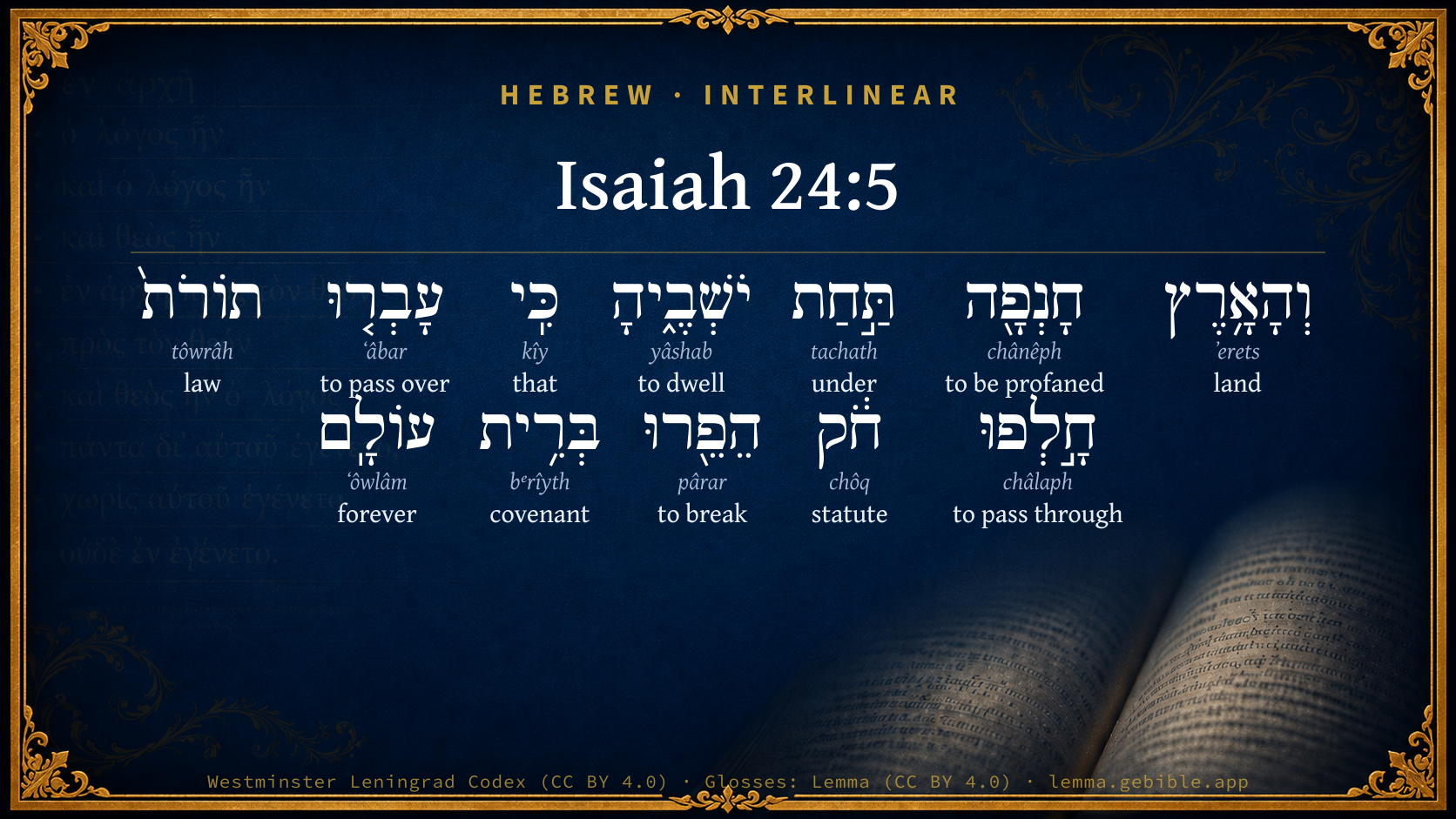
Hebrew (Westminster Leningrad Codex) Isaiah 24:5 appears in the Hebrew Old Testament. The text above is from the Westminster Leningrad Codex. Each word links to its Strong’s number, a concise gloss, and parsing drawn from the Open Scriptures Hebrew Bible morphology. Click any word for its full Brown-Driver-Briggs (BDB) entry.
Download image
Cite this verse

Isaiah 24:5 (World English Bible). Public Domain. Lemma interlinear Bible study tool, https://lemma.gebible.app/v/isaiah/24/5.

Show BibTeX & RIS
BibTeX
RIS
English Translation
The earth also is polluted under the inhabitants of it; because they have transgressed the laws, violated the statutes, broken the everlasting covenant.
World English Bible · Public Domain
Download a study sheet

One document with this verse’s original text, its word-by-word gloss line, the meaning frame, cross-references with their text, attributed commentary, and full source and license credits — printable, and it pastes into notes with its structure intact.

This verse Autodidact and up

Study sheet (.html) Plain text (.txt)

A passage Seminary Student

Up to 50 verses in one chapter. A passage sheet keeps up to 6 commentary sources and 12 cross-references per verse, in the order this page ranks them, and says so on the sheet whenever that leaves anything out. Ask for a single verse and you get the Autodidact verse sheet above.

Everything on this page stays free to read, with no account — the sheet is a download of what is already on screen, not access to it.

Want to remove ads? Support Godless Engineer
Compare translations 3

The same verse in 3 English versions, stacked beneath the original-language interlinear above. Click any original word for its lexicon entry.

Each is an independent rendering of the whole verse — the interlinear is not word-aligned to these translations.

Highlighted words mark where these versions differ — a whole-verse word diff, not a word-by-word alignment.

  • World English Bible Public Domain
    The earth also is polluted under the inhabitants of it; because they have transgressed the laws, violated the statutes, broken the everlasting covenant.
  • King James Version Public Domain
    The earth also is defiled under the inhabitants thereof; because they have transgressed the laws, changed the ordinance, broken the everlasting covenant.
  • unfoldingWord Literal Text CC BY-SA 4.0
    And the earth is polluted under its dwellers, for they have transgressed laws, they have changed the statute, they have broken the covenant of eternity.

unfoldingWord Literal Text — © unfoldingWord, licensed CC BY-SA 4.0. Word-aligned USFM3 via Door43 (git.door43.org/unfoldingWord/en_ult).

Versions to compare (up to 4)

3 of 4 selected

Show all 18 translations

Every available English version of this verse, each an independent rendering of the whole verse.

  • World English Bible Public Domain
    The earth also is polluted under the inhabitants of it; because they have transgressed the laws, violated the statutes, broken the everlasting covenant.
  • Berean Standard Bible Public Domain
    The earth is defiled by its people; they have transgressed the laws; they have overstepped the decrees and broken the everlasting covenant.
  • Majority Standard Bible Public Domain
    The earth is defiled by its people; they have transgressed the laws; they have overstepped the decrees and broken the everlasting covenant.
  • King James Version Public Domain
    The earth also is defiled under the inhabitants thereof; because they have transgressed the laws, changed the ordinance, broken the everlasting covenant.
  • American Standard Version (1901) Public Domain
    The earth also is polluted under the inhabitants thereof; because they have transgressed the laws, violated the statutes, broken the everlasting covenant.
  • Revised Version (1885) Public Domain
    The earth also is polluted under the inhabitants thereof; because they have transgressed the laws, changed the ordinance, broken the everlasting covenant.
  • Geneva Bible (1599) Public Domain
    The earth also deceiueth, because of the inhabitantes thereof: for they transgressed the lawes: they changed the ordinances, and brake the euerlasting couenant.
  • Douay-Rheims (1899) Public Domain
    And the earth is infected by the in- habitants thereof: because they have transgressed the laws, they have changed the ordinance, they have broken the everlasting covenant.
  • Young's Literal Translation Public Domain
    And the land hath been defiled under its inhabitants, Because they have transgressed laws, They have changed a statute, They have made void a covenant age-during.
  • Literal Standard Version CC BY-SA 4.0
    And the earth has been defiled under its inhabitants, || Because they have transgressed laws, || They have changed a statute, || They have made void a perpetual covenant.
  • Unlocked Literal Bible CC BY-SA 4.0
    The earth is polluted by its inhabitants because they have transgressed the laws, violated the statutes, and broken the everlasting covenant.
  • unfoldingWord Literal Text CC BY-SA 4.0
    And the earth is polluted under its dwellers, for they have transgressed laws, they have changed the statute, they have broken the covenant of eternity.
  • Darby Bible Public Domain
    And the land is polluted under the inhabitants thereof; for they have violated the laws, changed the statute, broken the everlasting covenant.
  • World Messianic Bible Public Domain
    The earth also is polluted under its inhabitants, because they have transgressed the laws, violated the statutes, and broken the everlasting covenant.
  • Webster's Bible Public Domain
    The earth also is defiled under its inhabitants; because they have transgressed the laws, changed the ordinance, broken the everlasting covenant.
  • Free Bible Version CC BY-SA 4.0
    The earth is polluted by its people; they have flouted God's laws, violated his regulations, and broken the eternal agreement with him.
  • Bible in Basic English Public Domain
    The earth has been made unclean by those living in it; because the laws have not been kept by them, the orders have been changed, and the eternal agreement has been broken.
  • JPS Tanakh (1917) Public Domain
    The earth also is defiled under the inhabitants thereof; because they have transgressed the laws, violated the statute, broken the everlasting covenant.

Literal Standard Version (2020), Covenant Press — licensed CC BY-SA 4.0. Text via the HelloAO Bible API (eBible.org). Unlocked Literal Bible (unfoldingWord) — licensed CC BY-SA 4.0. Text via the HelloAO Bible API (eBible.org). unfoldingWord Literal Text — © unfoldingWord, licensed CC BY-SA 4.0. Word-aligned USFM3 via Door43 (git.door43.org/unfoldingWord/en_ult). Free Bible Version, Dr. Jonathan Gallagher — licensed CC BY-SA 4.0. Text via the HelloAO Bible API (eBible.org).

Word by word

More ways to search: Search by grammar → Find every occurrence → Compare this word →

Practice this passage: Drill this verse → Learn its vocabulary →

חָנְפָ֖ה
chânêph
H2610
“to be profaned”
Verb, Qal, Perfect, 3rd Person, Feminine, Singular
Part of Speech
Verb
Stem
Qal
Form
Perfect
Person
3rd Person
Gender
Feminine
Number
Singular
Full BDB Definition

Origin: a primitive root

TWOT: 696

to be profaned, be defiled, be polluted, be corrupt - (Qal) - to be polluted - to be profane, be godless - (Hiphil) - to pollute - to make profane, make godless, cause to be defiled
  1. וְהָאָ֥רֶץ ʼerets H776 “and · the · land” Conjunction + Particle, Definite Article + Noun, Common, Both, Singular, Absolute
  2. תַּ֣חַת tachath H8478 “under” Preposition
  3. יֹשְׁבֶ֑יהָ yâshab H3427 “dwelling · her” Verb, Qal, Participle Active, Masculine, Plural, Construct + Suffix, Personal, 3rd Person, Feminine, Singular
  4. כִּֽי kîy H3588 “that” Conjunction
  5. עָבְר֤וּ ʻâbar H5674 “to pass over” Verb, Qal, Perfect, 3rd Person, Common, Plural
  6. תוֹרֹת֙ tôwrâh H8451 “laws” Noun, Common, Feminine, Plural, Absolute
  7. חָ֣לְפוּ châlaph H2498 “to pass through” Verb, Qal, Perfect, 3rd Person, Common, Plural
  8. חֹ֔ק chôq H2706 “statute” Noun, Common, Masculine, Singular, Absolute
  9. הֵפֵ֖רוּ pârar H6565 “to break” Verb, Hiphil, Perfect, 3rd Person, Common, Plural
  10. בְּרִ֥ית bᵉrîyth H1285 “covenant of” Noun, Common, Feminine, Singular, Construct
  11. עוֹלָֽם ʻôwlâm H5769 “forever” Noun, Common, Masculine, Singular, Absolute

About this verse

These counts appear in no published source. They are computed here, from the morphology-tagged text and Lemma’s own curated glosses. What Lemma adds →

12
words
12
distinct lemmas
Prophets
section

Notable vocabulary

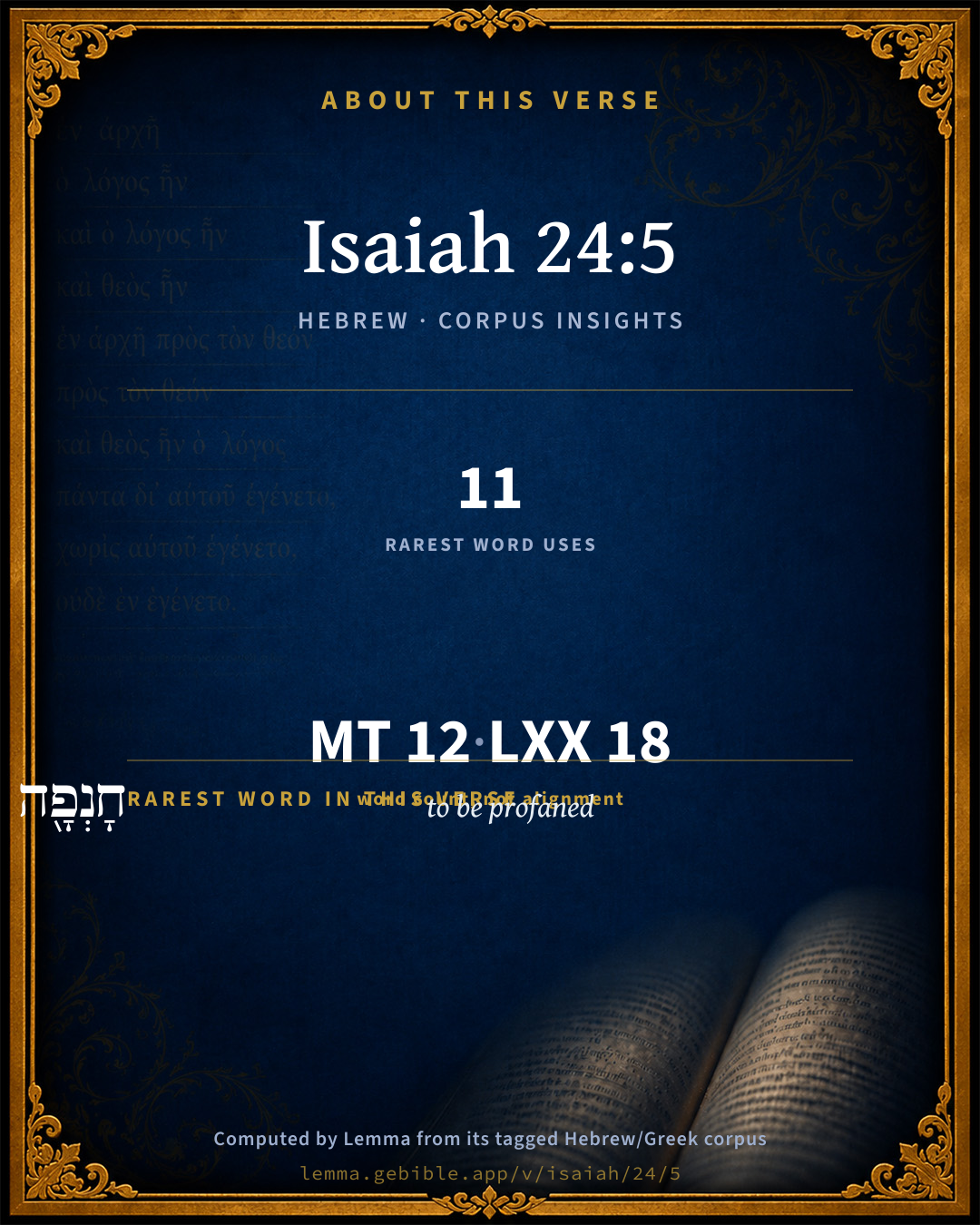
The rarest word here is חָנְפָ֖ה to be profaned H2610 — appearing just 11 times in the whole Hebrew Bible.

Shared distinctive vocabulary

חָנְפָ֖ה to be profaned H2610 occurs in 9 verses of the Hebrew Bible. Also found in:

Grammatical profile

  • 5 verbs
  • 5 nouns
  • 1 preposition
  • 1 conjunction

Verb forms

  • חָנְפָ֖ה Qal · Perfect
  • יֹשְׁבֶ֑יהָ Qal · Participle Active
  • עָבְר֤וּ Qal · Perfect
  • חָ֣לְפוּ Qal · Perfect
  • הֵפֵ֖רוּ Hiphil · Perfect

Hebrew & Septuagint length

In English translation the verse runs 23 words from the Hebrew and 23 from the Septuagint (LXX English) — the same length.

A rough comparison of the two English renderings, which tokenize alike — not a word-level alignment.

Word counts can differ between the Hebrew and the Greek without any difference in meaning — e.g. the Hebrew direct-object marker אֵת has no separate Greek word, and Greek often adds the article ὁ.

In the original languages it is 12 Hebrew tokens and 18 Greek tokens — but the two are counted differently (Hebrew bundles its prefixes and suffixes into one token; the Greek is in lemma form), so that isn’t a like-for-like length.

Cross-references

39

Topical passages linked to Isaiah 24:5 in the Treasury of Scripture Knowledge — connected by theme and wording, ordered by reader-vote popularity; previews shown in the World English Bible.

  • Hebrews 13:20 Now may the God of peace, who brought again from the dead the great shepherd of the sheep with the blood of an eternal covenant, our Lord Jesus,
  • Romans 8:20–21 For the creation was subjected to vanity, not of its own will, but because of him who subjected it, in hope
  • Daniel 7:25 He shall speak words against the Most High, and shall wear out the saints of the Most High; and he shall think to change the times and the law; and they shall be given into his hand until a time and times and half a time.
  • Hebrews 9:1 Now indeed even the first covenant had ordinances of divine service, and an earthly sanctuary.
  • Genesis 3:17–18 To Adam he said, "Because you have listened to your wife's voice, and have eaten of the tree, of which I commanded you, saying, 'You shall not eat of it,' cursed is the ground for your sake. In toil you will eat of it all the days of your life.
  • Genesis 6:11–13 The earth was corrupt before God, and the earth was filled with violence.
  • Leviticus 18:24–28 "'Don't defile yourselves in any of these things: for in all these the nations which I am casting out before you were defiled.
  • Leviticus 20:22 "'You shall therefore keep all my statutes, and all my ordinances, and do them; that the land, where I am bringing you to dwell, may not vomit you out.
  • Numbers 35:33–34 So you shall not pollute the land in which you are: for blood, it pollutes the land; and no expiation can be made for the land for the blood that is shed therein, but by the blood of him who shed it.
  • 2 Kings 17:7–23 It was so, because the children of Israel had sinned against Yahweh their God, who brought them up out of the land of Egypt from under the hand of Pharaoh king of Egypt, and had feared other gods,
  • 2 Kings 22:13–17 Go you, inquire of Yahweh for me, and for the people, and for all Judah, concerning the words of this book that is found; for great is the wrath of Yahweh that is kindled against us, because our fathers have not listened to the words of this book, to do according to all that which is written concerning us.
  • 2 Kings 23:26–27 Notwithstanding, Yahweh didn't turn from the fierceness of his great wrath, with which his anger was kindled against Judah, because of all the provocation with which Manasseh had provoked him.
  • 2 Chronicles 33:9 Manasseh seduced Judah and the inhabitants of Jerusalem, so that they did evil more than did the nations whom Yahweh destroyed before the children of Israel.
  • Psalms 106:36–39 They served their idols, Which became a snare to them.
  • Isaiah 1:2–5 Hear, heavens, And listen, earth; for Yahweh has spoken: I have nourished and brought up children, And they have rebelled against me.
  • Isaiah 50:1 Thus says Yahweh, Where is the bill of your mother's divorce, with which I have put her away? or which of my creditors is it to whom I have sold you? Behold, for your iniquities were you sold, and for your transgressions was your mother put away.
  • Isaiah 59:1–3 Behold, Yahweh's hand is not shortened, that it can't save; neither his ear heavy, that it can't hear:
  • Isaiah 59:12–15 For our transgressions are multiplied before you, and our sins testify against us; for our transgressions are with us, and as for our iniquities, we know them:
  • Jeremiah 3:1–2 They say, If a man put away his wife, and she go from him, and become another man's, will he return to her again? Won't that land be greatly polluted? But you have played the prostitute with many lovers; yet return again to me, says Yahweh.
  • Ezekiel 7:20–24 As for the beauty of his ornament, he set it in majesty; but they made the images of their abominations [and] their detestable things therein: therefore have I made it to them as an unclean thing.
  • Ezekiel 20:13 But the house of Israel rebelled against me in the wilderness: they didn't walk in my statutes, and they rejected my ordinances, which if a man keep, he shall live in them; and my Sabbaths they greatly profaned. Then I said I would pour out my wrath on them in the wilderness, to consume them.
  • Ezekiel 20:24 because they had not executed my ordinances, but had rejected my statutes, and had profaned my Sabbaths, and their eyes were after their fathers' idols.
  • Daniel 9:10 neither have we obeyed the voice of Yahweh our God, to walk in his laws, which he set before us by his servants the prophets.
  • Mark 7:7–9 But in vain do they worship me, Teaching as doctrines the commandments of men.'
  • Deuteronomy 32:15 But Jeshurun grew fat, and kicked: You have grown fat, you are grown thick, you are become sleek; Then he forsook God who made him, Lightly esteemed the Rock of his salvation.
  • Deuteronomy 32:20 He said, I will hide my face from them, I will see what their end shall be: For they are a very perverse generation, Children in whom is no faithfulness.
  • Joshua 24:25 So Joshua made a covenant with the people that day, and set them a statute and an ordinance in Shechem.
  • 2 Samuel 23:5 Most assuredly my house is not so with God; Yet he has made with me an everlasting covenant, Ordered in all things, and sure: For it is all my salvation, and all [my] desire, Although he doesn't make it grow.
  • Psalms 55:5 Fearfulness and trembling have come on me. Horror has overwhelmed me.
  • Psalms 105:10 And confirmed the same to Jacob for a statute; To Israel for an everlasting covenant,
  • Isaiah 10:6 I will send him against a profane nation, and against the people of my wrath will I give him a charge, to take the spoil, and to take the prey, and to tread them down like the mire of the streets.
  • Jeremiah 50:5 They shall inquire concerning Zion with their faces turned toward it, [saying], Come you, and join yourselves to Yahweh in an everlasting covenant that shall not be forgotten.
  • Ezekiel 22:24–31 Son of man, tell her, You are a land that is not cleansed, nor rained on in the day of indignation.
  • Micah 2:10 Arise, and depart! For this is not your resting place, Because of uncleanness that destroys, Even with a grievous destruction.
  • Luke 1:6 They were both righteous before God, walking blamelessly in all the commandments and ordinances of the Lord.
  • Genesis 17:13–14 He who is born in your house, and he who is bought with your money, must be circumcised. My covenant will be in your flesh for an everlasting covenant.
  • Ezra 9:6–7 and I said, my God, I am ashamed and blush to lift up my face to you, my God; for our iniquities are increased over our head, and our guiltiness is grown up to the heavens.
  • Ezekiel 37:26 Moreover I will make a covenant of peace with them; it shall be an everlasting covenant with them; and I will place them, and multiply them, and will set my sanctuary in the midst of them forevermore.
  • Daniel 9:5 we have sinned, and have dealt perversely, and have done wickedly, and have rebelled, even turning aside from your precepts and from your ordinances;

Cross-references courtesy of OpenBible.info (CC BY 4.0).

Hebrew and Greek witnesses Masoretic Hebrew ↔ Greek Septuagint

The same verse in the two great witnesses to the Old Testament, shown verse-for-verse.

These are two independent witnesses, not word-aligned to each other, and the Septuagint is shown in lemma (dictionary) form.

Hebrew Isaiah 24:5 Masoretic · Westminster Leningrad Codex

וְהָאָ֥רֶץ חָנְפָ֖ה תַּ֣חַת יֹשְׁבֶ֑יהָ כִּֽי עָבְר֤וּ תוֹרֹת֙ חָ֣לְפוּ חֹ֔ק הֵפֵ֖רוּ בְּרִ֥ית עוֹלָֽם

The earth also is polluted under the inhabitants of it; because they have transgressed the laws, violated the statutes, broken the everlasting covenant.

World English Bible · Public Domain

Greek LXX Isaiah 24:5 Septuagint · lemma form

ὁ δέ γῆ ἀνομέω διά ὁ καταοἰκέω αὐτός διότι παραβαίνω ὁ νόμος καί ἀλλάσσω ὁ πρόσταγμα διαθήκη αἰώνιος

And she has sinned by reason of her inhabitants; because they have transgressed the law, and changed the ordinances, even the everlasting covenant.

LXX2012 (modern English Septuagint) · Public Domain

On this verse, Adam Clarke's Commentary discusses the Septuagint’s reading. Read the note in Commentary ↓

Hebrew: Westminster Leningrad Codex (CC BY 4.0). Greek: Septuagint (public domain); English from LXX2012 (modern English Septuagint) (Public Domain). How the Septuagint differs from the Hebrew →

Targum (Aramaic paraphrase)

1

The Targum is the ancient Jewish Aramaic paraphrase of the Hebrew Scriptures — an interpretive translation, not the Hebrew text itself. Onkelos (literal) and Pseudo-Jonathan (expansive) render the Torah, and Jonathan the Prophets. Coverage is partial: where no permissively-licensed English translation exists for a verse, only the Aramaic is shown. This is verse-level text, not a word-by-word alignment to the Hebrew.

  1. Targum Jonathan Prophets (Joshua–Malachi)
    וְאַרְעָא חָבַת תְּחוֹת יַתְבָהָא אֲרֵי עֲבַרוּ עַל אוֹרַיְתָא אַבְטִילוּ מוֹעֲדַיָא אַשְׁנִיאוּ קְיָמָא דִי מִן עַלְמָא:

    The land hath become guilty beneath her inhabitants, because they have transgressed the law, and they have made the festivals to cease, they have changed the everlasting covenant.

    Targum Jonathan — Aramaic: “Mikraot Gedolot” (public domain). English: “Sefaria Community Translation” (CC0 1.0 (public-domain dedication)); “London "Chaldee Paraphrase," 1871” (public domain). Text via Sefaria.

Commentary

Notes on Isaiah 24:5 from classic Christian and Jewish commentators (each source and its license shown beneath its notes). The classic Christian expositions comment on the surrounding passage and are grouped to its opening verse, so a note may address several verses; the Jewish commentaries on the Tanakh (Rashi and others) are per-verse, so they appear only where the commentator wrote on this verse.

Lemma curates 59 commentaries, every one of them public domain or Creative Commons licensed, each selected and text-cleaned for this edition rather than reprinted as found. About our sources →

Trapp's Complete Commentary

John Trapp

Isa 24:5 The earth also is defiled under the inhabitants thereof; because they have transgressed the laws, changed the ordinance, broken the everlasting covenant.

Ver. 5. The earth also is defiled,] {a} viz., With sin, and therefore so decayed; yea, the very visible heavens are defiled with man’s sin, and shall therefore be purged by the fire of the last day; like as the vessels that held the sin-offering was to pass the fire.

Because they have transgressed the laws.] Natural and moral; those bounds and banks set to keep men within the compass of obedience: "but the unjust knoweth no shame," {Zep 3:5} is lawless, aweless, yokeless, untameable, untractable as the wild ass colt, as the horse and mule, &c.

Changed the ordinances.] Or, Passed by the ordinances - sc., by sins of omission, as before by commission; so in Heb 2:2, "every transgression and disobedience," i.e., every commission and omission.

Broken the everlasting covenant.] Disannulled, vacated the covenant founded in Christ, when coming unto his own, his own received him not; when the Pharisees and others, by slighting holy offers and ordinances of grace, "rejected the counsel of God against themselves." {Luk 7:30} This last especially brought the curse. {Isa 24:6} Some by laws here understand the judicial laws, by ordinances the ceremonial, and by everlasting covenant the Decalogue. Others by laws, the municipal laws of the commonwealth, by ordinances the laws of nations, as not to violate an ambassador, &c., by everlasting covenant the law of nature, which is that "light that lighteneth every man that cometh into the world." {Joh 1:9}

{a} Nempe contactu sceleratorum hominum. - Pisc.

John Trapp, A Commentary or Exposition upon All the Books of the Old and New Testament (1647–1656) — public domain. Text from a community e-Sword module.

The Biblical Illustrator

Joseph S. Exell

Isa_24:5

The earth also is defiled under the inhabitants thereof

The earth polluted by sin

The inhabitants of the earth pollute it by their sins: the children of Israel defiled Gods land by filling His inheritance with the carcasses of their abominable things, with their idolatries, with their wicked inventions and corrupt ways.

(R. Macculloch.)

Transgression

They have transgressed the laws of nature, of conscience, and of nations--the ceremonial, judicial, and moral laws, delivered to them by Jehovah Himself. These laws, stamped by the sacred authority of the one great Lawgiver, which they ought to have religiously observed, they presumptuously transgressed, omitting to do what He required and committing what He had forbidden. (R. Macculloch.)

The earth cursed for mans sake

The Bible gives no support to the theory that matter itself is evil. God created all things; and God saw everything that He had made; and, behold, it was very good. When, therefore, we read in the Bible that the earth is cursed, we read that it is cursed for mans sake; when we read of its desolation, it is as the effect of mans crime. (G. A. Smith, D. D.)

The everlasting covenant

The covenant is that with Noah, and the law that against bloodshed (Gen_9:5-6). (A. B. Davidson, LL. D.)

The Biblical Illustrator, edited by Joseph S. Exell (c. 1880s–1900s) — public domain. Text from a community e-Sword module.

Joseph Benson's Commentary

Isa 24:5-6. The earth also — Rather, And the land is defiled under the inhabitants thereof — By the wickedness of its people. Here we have the causes of the divine judgment upon the land: because they have transgressed the laws — The laws of God revealed to them, and pressed upon them in a singular manner; changed the ordinance — God’s ordinances concerning his worship and service; broken the everlasting covenant — The covenant made between God and Abraham, and all his posterity, which was everlasting, both on God’s part, who, upon the conditions therein expressed, engaged himself to be a God to them, and to their seed for ever; and on Israel’s part, who were obliged thereby to constant and perpetual obedience through all generations. Therefore hath the curse — The curse of God threatened to transgressors; devoured the earth — See this illustrated Zec 5:1. And they that dwell therein are desolate — Reduced to poverty, by the spoiling of their goods. The inhabitants are burned — Destroyed by fire and sword, or consumed by the wrath of God, which is often compared to fire; and few men left — The prophet’s general meaning is, that the inhabitants of the land should waste away and be consumed, being partly cut off by the sword, partly dispersed by the public calamities, partly destroyed by famine, and partly carried into captivity, so that but few of them should remain, and they only of the poorer sort. And this was the face of things in Judea at the time referred to.

Joseph Benson's Commentary on the Old and New Testaments (1811–1818) — public domain. Text from a community e-Sword module.

Tyndale Open Study Notes

Tyndale Open Resources

24:5 Isaiah was probably referring to the everlasting covenant that God made with all humanity through Noah (Gen 9:8-17). The prophet saw a parallel with the wickedness in his day and the wickedness of the pre-flood world.

Tyndale Open Study Notes — © Tyndale Open Resources, licensed CC BY-SA 4.0. Text via the HelloAO Bible API.

Geneva Bible (1599)

Geneva Bible translators

That is, rendereth not her fruit for the sin of the people, whom the earth deceived of their nourishment, because they deceived God of his honor.

Geneva Bible (1599) marginal notes — public domain. Text via Bolls.life.

Jamieson, Fausset & Brown

Robert Jamieson, A. R. Fausset & David Brown

earth--rather, "the land."

defiled under . . . inhabitants--namely, with innocent blood (Gen 4:11; Num 35:33; Psa 106:38).

laws . . . ordinance . . . everlasting covenant--The moral laws, positive statutes, and national covenant designed to be for ever between God and them.

Jamieson, Fausset & Brown — Commentary Critical and Explanatory on the Whole Bible (1871) — public domain (CC PDM 1.0). Text via the HelloAO Bible API.

Adam Clarke's Commentary

Verse 5. The laws - "The law"] תורה torah, singular: so read the Septuagint, Syriac, and Chaldee.

Adam Clarke's Commentary on the Bible (1810–1826) — public domain. Text from a community e-Sword/MySword module.

Ellicott's Commentary for English Readers

(5) The earth also is defiled.—The verb is used of blood-guiltiness in Num_35:33, of impurity in Jer_3:1-2; Jer_3:9. It includes, therefore, all the sins that, in modern phrase, desecrate humanity. Taking the word in its wider range, each form of evil was a transgression of the “everlasting covenant” of Gen_9:16.

A Bible Commentary for English Readers, edited by Charles John Ellicott (1878–1897) — public domain. Text from a community e-Sword module.

The Cambridge Bible for Schools and Colleges

gen. ed. J. J. S. Perowne

5. The earth also is defiled (literally, profaned) under the inhabitants thereof] That the land of Israel is profaned by the sins of its people, is a prominent idea in the O.T.; the conception is here extended to the whole earth. The condition of the world resembles that which preceded the Deluge (Gen_6:11).

changed the ordinance] Rather, disregarded (lit. “passed by”) the ordinance.

the everlasting covenant] The expression is taken from Gen_9:16, and refers to the covenant made after the flood with Noah and his family as representatives of the human race. The sin of the world lies in the violation of these fundamental dictates of morality, especially the law against murder, which is the principal stipulation of the Noachic covenant (Gen_9:5-6). The conception is probably a late one.

The Cambridge Bible for Schools and Colleges (gen. ed. J. J. S. Perowne; Cambridge University Press, 1878–1918) — public domain. Text from a community e-Sword module.

John Gill's Exposition

The earth also is defiled under the inhabitants of it,.... Or, "and the earth"; or, "for the earth is defiled" (q); and so it is a reason why it is emptied and spoiled, because polluted and corrupted with the fornication of the whore of Rome, with her idolatries and superstitions, with which the inhabitants of the earth are defiled; or with her rapine and violence, cruelties, bloodshed, and murders; for blood defiles a land, Num 35:33 all which are committed by the inhabitants of the earth, subject to the see of Rome, by reason of which it may be said to be corrupted or defiled; so the phrase may be interpreted "for", or "because of the inhabitants of it": thus Jarchi and Kimchi, because of their wickedness and impieties; see Rev 11:18 or, "the earth is deceitful" (r), or plays the hypocrite; promising and showing as if it would bring forth fruit, and brings forth none, but is barren and unfruitful, because of the sins of the inhabitants of it; see Rev 18:14,

because they have transgressed the laws; of God and man, as antichrist and his followers have done; who is that wicked that "lawless one", that sets up himself above laws, and takes upon him to dispense with the laws of God and man, Th2 2:4 and in innumerable instances has transgressed both, casting all contempt upon them, and bidding all defiance to them, as being not at all bound and obliged by them:

changed the ordinance; or "ordinances"; the singular for the plural, a collective word; the ordinances of divine revelation, of the Gospel dispensation, those of baptism, and the Lord's supper; the former of these is changed, both as to subjects and mode, from adult baptism to infant baptism, from immersion to aspersion; and the latter, in it the bread and wine are pretended to be changed into the very body and blood of Christ, and is only given in one kind to the laity, and made a real sacrifice of, when its end and use are only to commemorate the one sacrifice already offered up; moreover, by the "ordinance" may be meant the Scriptures, which are the "the rule of judgment"; which antichrist has most miserably perverted, and has changed and altered the sense of them; taking upon him to be the infallible interpreter of them, and judge of all controversies, forbidding the reading of them to the people, and setting up his own decrees, definitions, and determinations, above them; and is "that throne of iniquity, that frameth mischief, by a law", or ordinance, of his own making, and which he puts in the room of the divine law or ordinance, Psa 94:20 where the same word is used as here; and he is that little horn, that thought to change times and laws, Dan 7:25,

broken the everlasting covenant; not the eternal law of nature, nor the everlasting covenant of circumcision, or that made with Israel on mount Sinai; but the new covenant, or the administration of the covenant of grace under the Gospel dispensation, which is to last to the end of time, and lies in the ministration of the word, and administration of ordinances; which antichrist has done all that in his power lies to break, make null and void, by corrupting the word, and changing the ordinances, and setting up his own institutions above them, and against them.

(q) "et terra", V. L. "nam terra", Piscator. (r) "hypocrita est", Montanus, Tigurine version.

John Gill's Exposition of the Whole Bible (1746–1763) — public domain (CC PDM 1.0). Text via the HelloAO Bible API.

Albert Barnes' Notes on the Bible

The earth also is defiled under the inhabitants thereof - The statements in this verse are given as a reason why the curse had been pronounced against them, and why these calamities had come upon them, Isa 24:6. The first reason is, that the very earth become polluted by their crimes. This phrase may denote that injustice and cruelty prevailed to such an extent that the very earth was stained with gore, and covered with blood under the guilty population. So the phrase is used in Num 33:33; Psa 106:38. Or it may mean in general that the wickedness of the people was great, and was accumulating, and the very earth under them was polluted by sustaining such a population. But the former is probably the correct interpretation.

Changed the ordinance - Or, the statute (חק chôq). This word, from חקק châqaq, to engrave, and then to make or institute a law or an ordinance, is usually applied to the positive statutes appointed by Moses. The word statute accurately expresses the idea. These they had changed by introducing new statutes, and had in fact, if not in form, repealed the laws of Moses, and introduced others.

Broken the everlasting covenant - The word ‘covenant’ here is evidently used, as it is often, in the sense of law. By the term ‘everlasting covenant,’ Vitringa correctly supposes is denoted the laws of nature, the immutable laws of justice and right, which are engraven on the conscience, and which are inflexible and perpetual.

Albert Barnes' Notes on the Bible (1834–1885) — public domain. Text from a community e-Sword/MySword module.

Matthew Poole's English Annotations

The earth also, Heb. And the land; or, this land; for here is an emphatical article in the Hebrew text.

Is defiled under the inhabitants thereof; by the wickedness of its people; of which see Lev 18:25,27; Num 35:33, &c. The laws; the laws of God revealed to them, and pressed upon them in a singular manner, called simply the laws, as the word of God is ofttimes called the word, by way of eminency.

The ordinance; God’s ordinances concerning his worship and service; the singular being put collectively for the plural.

The everlasting covenant; the covenant made between God and Abraham, and all his posterity, renewed with the Israelites at Sinai, which was everlasting, both on God’s part, who, upon the conditions therein expressed, engaged himself to be a God to them and to their seed for ever; and on Israel’s part, who were obliged thereby to constant and perpetual obedience through all generations. All these clauses clearly prove that the earth or land which this prophecy concerns, is no other than the land of Israel and Judah.

Matthew Poole's English Annotations on the Holy Bible (1683–1685) — public domain. Text from a community e-Sword/MySword module.

Whedon's Commentary on the Bible

Daniel D. Whedon

5. The earth… is defiled — The land consecrated to Jehovah is profaned by practices of the people.

Daniel D. Whedon (gen. ed.), Commentary on the Old and New Testaments (1874–1909) — public domain. Text from a community e-Sword module.

The Pulpit Commentary

The earth also is defiled. Hitherto the prophet has been concerned with the mere fact of a terrible judgment to be sent by God upon the whole world. Now he sets forth the cause of the fact. It is the old cause, which has reduced so many lauds to desolation, and which in the far-off times produced the Flood, viz. the wickedness of man. (Gen_6:5-13) The earth is "defiled" or "polluted" by the sins of its inhabitants, and has to be purged from the defilement by suffering. They have transgressed the laws. Apart from both Judaism and Christianity, all mankind have been placed by God under a double law:

1. The "law written in their hearts", (Rom_2:15) which speaks to them through their consciences, and lays them under an obligation that cannot be gainsaid.

2. The law of positive commands, given to the entire human race through the common progenitors, Adam and Noah, which is obligatory upon all to whom it has been traditionally handed down; but which has been only very partially handed down, and it is not generally felt as obligatory. Mankind has in all ages largely transgressed both laws, and both would seem to be pointed at in the present passage. The transgression of the "law written in the heart" is doubtless that which especially calls down God"s vengeance, and makes him from time to time execute wrath on the whole world.

Changed the ordinance; rather, broken, violated. Transgression in act is intended, not formal abrogation of the Divine ordinances. Broken the everlasting covenant. Mr. Cheyne supposes an allusion to the covenant made with Noah; (Gen_9:16) but it seems better to understand that "everlasting covenant" which exists between God and man, in virtue of the nature wherewith God has endowed man, and of the laws which he Ires impressed upon man"s con. science. Sophocles well says of these laws, that they are uqipodev ouranian di aiyera teknoyentev wn Olumpov pathnov oude nin ynata fusiv ahnerwn etikten oude mhn pote laya katakoimasei ~

Or"Laws that walk on high, begot and bred In upper air, whose only sire is Heaven; Nor did the race of mortals give them birth, Nor will oblivion ever cause them sleep.

Vers. 5, 6. The necessary connection of suffering with sin.

"Because they have transgressed the laws... therefore hath the curse devoured the earth." The great Eastern empires had no staying power. In a few generations dynasties, even empires, were swept clean away. And the reason is not far to seek. The great Eastern kingdoms were founded on blood-shedding; and for the sin of violence God keeps the curse of destruction. "A lesson which he taught the world once for all when he swept away the old violent humanity with a flood: "The earth never spews out its inhabitants until they have defiled it by their sin." This subject is presented to us under a variety of aspects, and with an abundance of illustration. It is one of the great messages of the Bible. We do but give it here a little freshness of form and setting.

I SIN COMES FIRST. God always begins with Eden. The Eden of bright happy youth in every man"s life. There is no suffering where there is no sin. Thorns and briers come when man has acted in willfulness. Suffering has no mission save as the corrective of sin and sin"s consequences. Our first parents disobey, and then suffering comes. Man follows the "devices and desires of his own heart," and then the corrective Divine judgments come. And suffering has always this justification, that sin has come first. Illustrate in the case of King Saul.

II SIN MAY HAVE A LONG TETHER. This often creates confusion in men"s minds. They think the sin cannot be evil because the punishment is so long delayed. So the uncleanness of cities goes on for years, and seems to be no serious evil; but presently the plague comes and sweeps its thousands away. Israel presumed on the holding over of its national judgments, but presently overwhelming destruction came. We can often sin on for years with apparent impunity, never with real impunity. Storms are gathering, though they wait their time for bursting.

III SUFFERING KEEPS SIN COMPANY ON ITS WAY. It is always present; always ready to give signs of its presence; always making monitions. It is held back only in the long-suffering of God"s mercy, the "goodness of God thus leading men to repentance.

IV SUFFERING PLAINLY STAMPS THE EVIL OF SIN IN THE END. AS in the case of the drunkard, the sensualist, the dishonest. You can tell the value of a thing by its wage, and the "wages of sin is death." You can estimate a thing by its issues, and "sin, when it is finished, bringeth forth death." This lesson the history of individuals and of nations, ancient and modern, teaches, but teaches in vain to the sons of men. We say, "Ah, yes! It may be true of sin , but it is not true of our sin. R.T.

The Pulpit Commentary (1880–1919), ed. H.D.M. Spence-Jones & Joseph S. Exell — public domain. Text from a community e-Sword module.

John Wesley's Explanatory Notes

Defiled - By the wickedness of its people. The laws - The laws of God. Ordinance - God's ordinances concerning his worship and service; the singular being put for the plural. Covenant - The covenant made between God and Abraham, and all his posterity, which was everlasting, both on God's part, who, upon the conditions therein expressed, engaged himself to be a God to them and to their seed forever; and on Israel's part, who were obliged thereby to constant and perpetual obedience thro' all generations.

John Wesley, Explanatory Notes Upon the Whole Bible (1754–1765) — public domain. Text via the GEBible commentary corpus.

J. A. Alexander on Isaiah

Joseph Addison Alexander

“And the land has been profaned under its inhabitants, because they have transgressed the laws, violated the statute, broken the everlasting covenant.” Almost all writers seem to apply the passage to the Jews, and to understand it as referring their calamities to their transgressions. The land is said to be profaned as being a holy land or consecrated to Jehovah. Most interpreters suppose a special reference to pollution by blood or the guilt of murder. The reference in this verse is to the divine law generally. The three terms used are substantially synonymous, law, statute, covenant, being continually interchanged. The simple meaning of the verse is that they disobeyed the will of God.

Joseph Addison Alexander, The Prophecies of Isaiah (1846–1847; New York: Scribner, 1870–1878) — public domain. Text from a community e-Sword module.

Rashi

Rabbi Shlomo Yitzchaki (Rashi)

And the land has deceived This is a sort of deceit; it produces grass but does not produce growing grain; it shows growing grain, but there are no wheat kernels in its stalks (lit., in its straws).

because of its inhabitants (תַּחַת יוֹשְׁבֶיהָ) lit., under its inhabitants; because of its inhabitants.

the everlasting covenant That is the Torah that they received with a covenant.

Rashi on the Tanakh — English translations: “The Judaica Press complete Tanach with Rashi, translated by A. J. Rosenberg” (CC BY 4.0); “Pentateuch with Rashi's commentary by M. Rosenbaum and A.M. Silbermann, 1929-1934” (public domain); “The Metsudah Tanach series, Lakewood, N.J” (CC BY 4.0); and “The Book of Joshua, Metsudah Publications, 1997” (CC BY 4.0). Text via Sefaria.

Ibn Ezra

Rabbi Abraham ibn Ezra

תורות The laws. The laws which are dictated by common sense, in which all agree. are generally distinguished by saying that the former refers to those laws which society would make even without revelation; the latter, to such laws as would not be made without direct command in Scripture. This distinction is not applicable here, because the prophet speaks in this passage of laws that concern all nations. The explanation, however, given here by I. E., does not agree with his remark on Gen. 26:5, where תורה is explained to refer to the law of circumcision. What I. E. means by the laws contained in the natural order of things or by the covenant of the universe is more clearly stated in his commentary on Gen. 26:5, namely, שילך אדם אחרי מעשיו Man shall follow the ways of God displayed in his works. Comp. I. E. on Lev. 19:19.

חלפו They have abolished. Comp. יחלוף, he shall abolish (2:18).

חק Ordinance. The laws of God, contained in the natural order of things; and this is likewise the meaning of ברית עולם, the covenant of the universe.

Ibn Ezra on the Tanakh — English translations: “Sefaria Community Translation” (CC0 1.0 (public-domain dedication)); “Yalkut, Sifsei Chachomim Chumash, Metsudah Publications, 2009” (CC BY 4.0); and “Commentary of Ibn Ezra on Isaiah - trans. by M. Friedlander, 1873” (public domain). Text via Sefaria.

Lesson kit

Teaching starters — assembled from the data on this page, not authored interpretation. Every prompt links to the verse data it draws on. Edit before teaching.

Isaiah, in the Prophets, opens this verse with 12 words (12 distinct Hebrew lemmas). Its most distinctive word is chânêph (“to be profaned”). A historical commentator’s framing appears above. Read the whole chapter for the surrounding context.

Discussion questions

  1. The word chânêph carries the sense “to be profaned.” How does it shape the verse?
  2. Numbers 35:33 shares the word «to be profaned» with this verse. How do the two illuminate each other?
  3. These translations render this verse differently; the difference is in the English rendering, not the original. What questions does that raise?
  4. The verb «חָנְפָ֖ה» is Qal Perfect. How does its form color the action?
  5. Reading how Trapp's Complete Commentary and The Biblical Illustrator read this verse, where do the two commentators agree and where do they part?

Things to notice

Reading settings

Reading text

Shown beneath each verse's original-language words.

Old Testament
Old Testament edition

Read the OT as the Masoretic Hebrew (MT) or the Greek Septuagint (LXX).

English shown for the Greek Septuagint (in the Hebrew ↔ Greek comparison).

Comparing translations? Open the Compare panel on any verse page to stack up to four side by side.