
Daniel 9:11

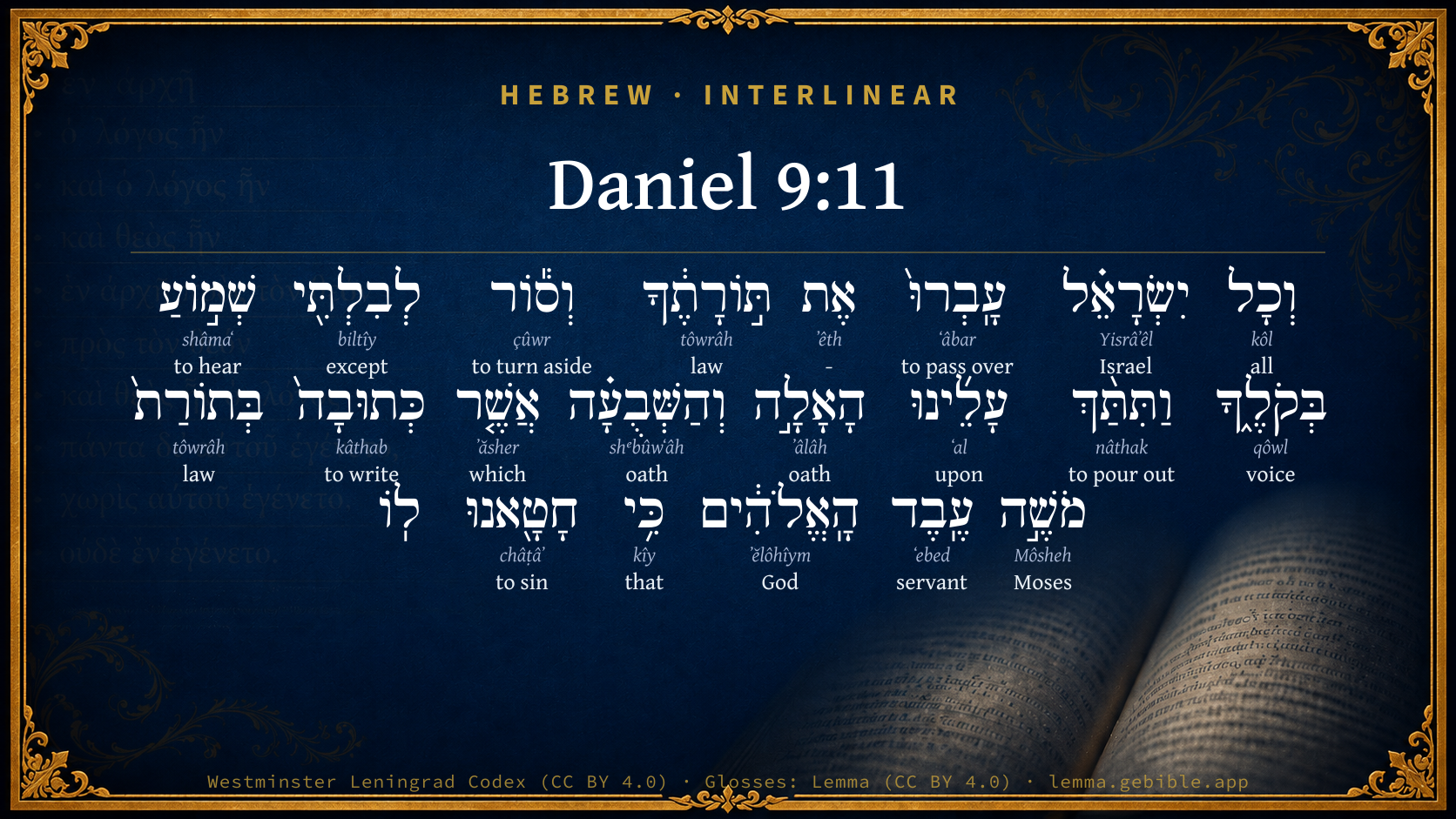
Hebrew (Westminster Leningrad Codex) Daniel 9:11 appears in the Hebrew Old Testament. The text above is from the Westminster Leningrad Codex. Each word links to its Strong’s number, a concise gloss, and parsing drawn from the Open Scriptures Hebrew Bible morphology. Click any word for its full Brown-Driver-Briggs (BDB) entry.
Download image
Cite this verse

Daniel 9:11 (World English Bible). Public Domain. Lemma interlinear Bible study tool, https://lemma.gebible.app/v/daniel/9/11.

Show BibTeX & RIS
BibTeX
RIS
English Translation
Yes, all Israel have transgressed your law, even turning aside, that they should not obey your voice: therefore has the curse been poured out on us, and the oath that is written in the law of Moses the servant of God; for we have sinned against him.
World English Bible · Public Domain
Download a study sheet

One document with this verse’s original text, its word-by-word gloss line, the meaning frame, cross-references with their text, attributed commentary, and full source and license credits — printable, and it pastes into notes with its structure intact.

This verse Autodidact and up

Study sheet (.html) Plain text (.txt)

A passage Seminary Student

Up to 50 verses in one chapter. A passage sheet keeps up to 6 commentary sources and 12 cross-references per verse, in the order this page ranks them, and says so on the sheet whenever that leaves anything out. Ask for a single verse and you get the Autodidact verse sheet above.

Everything on this page stays free to read, with no account — the sheet is a download of what is already on screen, not access to it.

Want to remove ads? Support Godless Engineer
Compare translations 3

The same verse in 3 English versions, stacked beneath the original-language interlinear above. Click any original word for its lexicon entry.

Each is an independent rendering of the whole verse — the interlinear is not word-aligned to these translations.

Highlighted words mark where these versions differ — a whole-verse word diff, not a word-by-word alignment.

  • World English Bible Public Domain
    Yes, all Israel have transgressed your law, even turning aside, that they should not obey your voice: therefore has the curse been poured out on us, and the oath that is written in the law of Moses the servant of God; for we have sinned against him.
  • King James Version Public Domain
    Yea, all Israel have transgressed thy law, even by departing, that they might not obey thy voice; therefore the curse is poured upon us, and the oath that is written in the law of Moses the servant of God, because we have sinned against him.
  • unfoldingWord Literal Text CC BY-SA 4.0
    All Israel has transgressed your law and turned aside, not obeying your voice. The curse and oath that are written in the law of Moses, the servant of God, have been poured out on us, because we have sinned against him.

unfoldingWord Literal Text — © unfoldingWord, licensed CC BY-SA 4.0. Word-aligned USFM3 via Door43 (git.door43.org/unfoldingWord/en_ult).

Versions to compare (up to 4)

3 of 4 selected

Show all 18 translations

Every available English version of this verse, each an independent rendering of the whole verse.

  • World English Bible Public Domain
    Yes, all Israel have transgressed your law, even turning aside, that they should not obey your voice: therefore has the curse been poured out on us, and the oath that is written in the law of Moses the servant of God; for we have sinned against him.
  • Berean Standard Bible Public Domain
    All Israel has transgressed Your law and turned away, refusing to obey Your voice; so the oath and the curse written in the Law of Moses the servant of God has been poured out on us, because we have sinned against You.
  • Majority Standard Bible Public Domain
    All Israel has transgressed Your law and turned away, refusing to obey Your voice; so the oath and the curse written in the Law of Moses the servant of God has been poured out on us, because we have sinned against You.
  • King James Version Public Domain
    Yea, all Israel have transgressed thy law, even by departing, that they might not obey thy voice; therefore the curse is poured upon us, and the oath that is written in the law of Moses the servant of God, because we have sinned against him.
  • American Standard Version (1901) Public Domain
    Yea, all Israel have transgressed thy law, even turning aside, that they should not obey thy voice: therefore hath the curse been poured out upon us, and the oath that is written in the law of Moses the servant of God; for we have sinned against him.
  • Revised Version (1885) Public Domain
    Yea, all Israel have transgressed thy law, even turning aside, that they should not obey thy voice: therefore hath the curse been poured out upon us, and the oath that is written in the law of Moses the servant of God; for we have sinned against him.
  • Geneva Bible (1599) Public Domain
    Yea, all Israel haue transgressed thy Lawe, and are turned backe, and haue not heard thy voyce: therefore the curse is powred vpon vs, and the othe that is written in the Lawe of Moses the seruant of God, because we haue sinned against him.
  • Douay-Rheims (1899) Public Domain
    And all Israel have transgressed thy law, and have turned away from hearing thy voice, and the malediction, and the curse, which is written in the book of Moses the servant of God, is fallen upon us, because we have sinned against him.
  • Young's Literal Translation Public Domain
    and all Israel have transgressed Thy law, to turn aside so as not to hearken to Thy voice; and poured on us is the execration, and the oath, that is written in the law of Moses, servant of God, because we have sinned against Him.
  • Literal Standard Version CC BY-SA 4.0
    and all Israel has transgressed Your law, to turn aside so as not to listen to Your voice; and poured on us is the execration, and the oath, that is written in the Law of Moses, servant of God, because we have sinned against Him.
  • Unlocked Literal Bible CC BY-SA 4.0
    All Israel has transgressed your law and turned aside, refusing to obey your voice. The curse and oath that are written in the law of Moses, the servant of God, have been poured out on us, for we have sinned against him.
  • unfoldingWord Literal Text CC BY-SA 4.0
    All Israel has transgressed your law and turned aside, not obeying your voice. The curse and oath that are written in the law of Moses, the servant of God, have been poured out on us, because we have sinned against him.
  • Darby Bible Public Domain
    And all Israel have transgressed thy law, even turning aside so as not to listen unto thy voice. And the curse hath been poured out upon us, and the oath that is written in the law of Moses the servant of God: for we have sinned against him.
  • World Messianic Bible Public Domain
    Yes, all Israel have transgressed your law, turning aside, that they should not obey your voice. “Therefore the curse and the oath written in the Torah of Moses the servant of God has been poured out on us, for we have sinned against him.
  • Webster's Bible Public Domain
    And all Israel have transgressed thy law, even by departing, that they might not obey thy voice; therefore the curse is poured upon us, and the oath that is written in the law of Moses the servant of God, because we have sinned against him.
  • Free Bible Version CC BY-SA 4.0
    The whole of Israel has broken your law and turned away from you, not listening to what you had to say. That's why the condemnation that comes from our broken promise has been poured out on us—because of our sin, as made clear in the Law of Moses, the servant of the Lord.
  • Bible in Basic English Public Domain
    And all Israel have been sinners against your law, turning away so as not to give ear to your voice: and the curse has been let loose on us, and the oath recorded in the law of Moses, the servant of God, for we have done evil against him.
  • JPS Tanakh (1917) Public Domain
    Yea, all Israel have transgressed Thy law, and have turned aside, so as not to hearken to Thy voice; and so there hath been poured out upon us the curse and the oath that is written in the Law of Moses the servant of God; for we have sinned against Him.

Literal Standard Version (2020), Covenant Press — licensed CC BY-SA 4.0. Text via the HelloAO Bible API (eBible.org). Unlocked Literal Bible (unfoldingWord) — licensed CC BY-SA 4.0. Text via the HelloAO Bible API (eBible.org). unfoldingWord Literal Text — © unfoldingWord, licensed CC BY-SA 4.0. Word-aligned USFM3 via Door43 (git.door43.org/unfoldingWord/en_ult). Free Bible Version, Dr. Jonathan Gallagher — licensed CC BY-SA 4.0. Text via the HelloAO Bible API (eBible.org).

Word by word

More ways to search: Search by grammar → Find every occurrence → Compare this word →

Practice this passage: Drill this verse → Learn its vocabulary →

וַתִּתַּ֨ךְ
nâthak
H5413
“and · to pour out”
Conjunction + Verb, Qal, Sequential Imperfect, 3rd Person, Feminine, Singular
Part of Speech
Conjunction + Verb
Stem
Qal
Form
Sequential Imperfect
Person
3rd Person
Gender
Feminine
Number
Singular
Full BDB Definition

Origin: a primitive root

TWOT: 1442

to pour out or forth, drop (or rain), be poured, be poured out, be melted, be molten - (Qal) to pour forth - (Niphal) to be poured, be poured out - (Hiphil) to pour out, melt - (Hophal) to be melted
  1. וְכָל kôl H3605 “and · all of” Conjunction + Noun, Common, Masculine, Singular, Construct
  2. יִשְׂרָאֵ֗ל Yisrâʼêl H3478 “Israel” Noun, Proper
  3. עָֽבְרוּ֙ ʻâbar H5674 “to pass over” Verb, Qal, Perfect, 3rd Person, Common, Plural
  4. אֶת ʼêth H853 “-” Particle, Direct Object
  5. תּ֣וֹרָתֶ֔ךָ tôwrâh H8451 “law · your” Noun, Common, Feminine, Singular, Construct + Suffix, Personal, 2nd Person, Masculine, Singular
  6. וְס֕וֹר çûwr H5493 “and · to turn aside” Conjunction + Verb, Qal, Infinitive Absolute
  7. לְבִלְתִּ֖י biltîy H1115 “to/for · except” Preposition + Conjunction
  8. שְׁמ֣וֹעַ shâmaʻ H8085 “to hear” Verb, Qal, Infinitive Construct
  9. בְּקֹלֶ֑ךָ qôwl H6963 “in/at · voice · your” Preposition + Noun, Common, Masculine, Singular, Construct + Suffix, Personal, 2nd Person, Masculine, Singular
  10. עָלֵ֜ינוּ ʻal H5921 “upon · us” Preposition + Suffix, Personal, 1st Person, Common, Plural
  11. הָאָלָ֣ה ʼâlâh H423 “the · oath” Particle, Definite Article + Noun, Common, Feminine, Singular, Absolute
  12. וְהַשְּׁבֻעָ֗ה shᵉbûwʻâh H7621 “and · the · oath” Conjunction + Particle, Definite Article + Noun, Common, Feminine, Singular, Absolute
  13. אֲשֶׁ֤ר ʼăsher H834 “which” Particle, Relative
  14. כְּתוּבָה֙ kâthab H3789 “written” Verb, Qal, Participle Passive, Feminine, Singular, Absolute
  15. בְּתוֹרַת֙ tôwrâh H8451 “in/at · law of” Preposition + Noun, Common, Feminine, Singular, Construct
  16. מֹשֶׁ֣ה Môsheh H4872 “Moses” Noun, Proper
  17. עֶֽבֶד ʻebed H5650 “servant of” Noun, Common, Masculine, Singular, Construct
  18. הָֽאֱלֹהִ֔ים ʼĕlôhîym H430 “the · God(s)” Particle, Definite Article + Noun, Common, Masculine, Plural, Absolute
  19. כִּ֥י kîy H3588 “that” Conjunction
  20. חָטָ֖אנוּ châṭâʼ H2398 “to sin” Verb, Qal, Perfect, 1st Person, Common, Plural

About this verse

These counts appear in no published source. They are computed here, from the morphology-tagged text and Lemma’s own curated glosses. What Lemma adds →

22
words
20
distinct lemmas
Prophets
section

Notable vocabulary

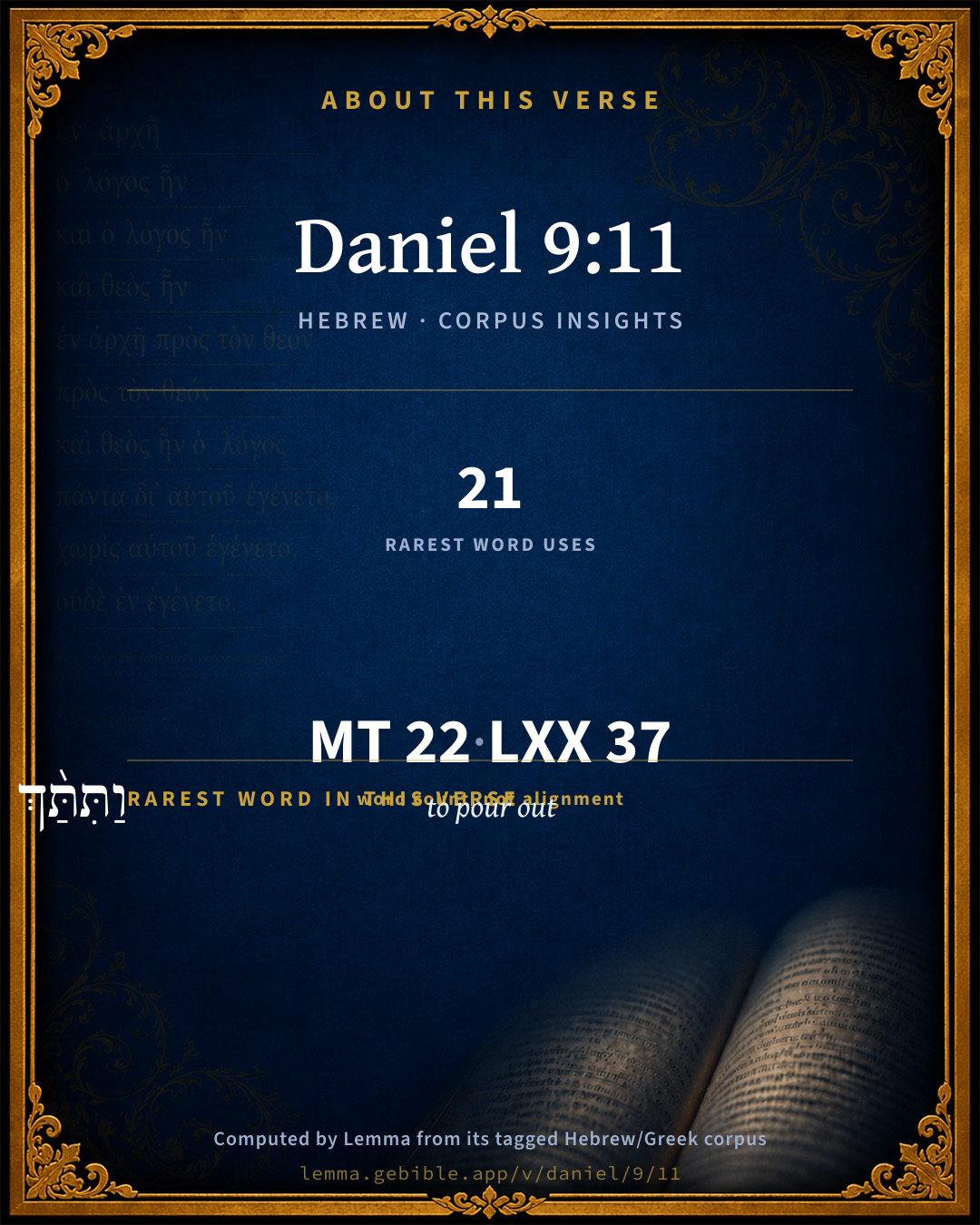
The rarest word here is וַתִּתַּ֨ךְ to pour out H5413 — appearing just 21 times in the whole Hebrew Bible.

Shared distinctive vocabulary

וַתִּתַּ֨ךְ to pour out H5413 occurs in 19 verses of the Hebrew Bible. Also found in:

Grammatical profile

  • 6 verbs
  • 10 nouns
  • 2 prepositions
  • 2 conjunctions
  • 2 particles

Verb forms

  • עָֽבְרוּ֙ Qal · Perfect
  • וְס֕וֹר Qal · Infinitive Absolute
  • שְׁמ֣וֹעַ Qal · Infinitive Construct
  • וַתִּתַּ֨ךְ Qal · Sequential Imperfect
  • כְּתוּבָה֙ Qal · Participle Passive
  • חָטָ֖אנוּ Qal · Perfect

Repetition

A word recurs within this verse — often emphatic in Hebrew:

  • תּ֣וֹרָתֶ֔ךָ law H8451 ×2

Hebrew & Septuagint length

In English translation the verse runs 47 words from the Hebrew and 43 from the Septuagint (LXX English) — closely comparable.

A rough comparison of the two English renderings, which tokenize alike — not a word-level alignment.

Word counts can differ between the Hebrew and the Greek without any difference in meaning — e.g. the Hebrew direct-object marker אֵת has no separate Greek word, and Greek often adds the article ὁ.

In the original languages it is 22 Hebrew tokens and 37 Greek tokens — but the two are counted differently (Hebrew bundles its prefixes and suffixes into one token; the Greek is in lemma form), so that isn’t a like-for-like length.

Cross-references

12

Topical passages linked to Daniel 9:11 in the Treasury of Scripture Knowledge — connected by theme and wording, ordered by reader-vote popularity; previews shown in the World English Bible.

  • Jeremiah 8:5–10 Why then is this people of Jerusalem slidden back by a perpetual backsliding? they hold fast deceit, they refuse to return.
  • Isaiah 1:4–6 Ah sinful nation, A people loaded with iniquity, A seed of evil-doers, Children who deal corruptly! They have forsaken Yahweh. They have despised the Holy One of Israel. They are estranged and backward.
  • Deuteronomy 28:15–68 But it shall come to pass, if you will not listen to the voice of Yahweh your God, to observe to do all his commandments and his statutes which I command you this day, that all these curses shall come on you, and overtake you.
  • Deuteronomy 27:15–26 Cursed be the man who makes an engraved or molten image, an abomination to Yahweh, the work of the hands of the craftsman, and sets it up in secret. All the people shall answer and say, Amen.
  • Deuteronomy 29:20–29 Yahweh will not pardon him, but then the anger of Yahweh and his jealousy will smoke against that man, and all the curse that is written in this book shall lie on him, and Yahweh will blot out his name from under the sky.
  • Deuteronomy 30:17–19 But if your heart turn away, and you will not hear, but shall be drawn away, and worship other gods, and serve them;
  • Deuteronomy 31:17–18 Then my anger shall be kindled against them in that day, and I will forsake them, and I will hide my face from them, and they shall be devoured, and many evils and troubles shall come on them; so that they will say in that day, Haven't these evils come on us because our God is not among us?
  • Deuteronomy 32:19–42 Yahweh saw [it], and abhorred [them], Because of the provocation of his sons and his daughters.
  • 2 Kings 17:18–23 Therefore Yahweh was very angry with Israel, and removed them out of his sight: there was none left but the tribe of Judah only.
  • Jeremiah 9:26 Egypt, and Judah, and Edom, and the children of Ammon, and Moab, and all that have the corners [of their hair] cut off, who dwell in the wilderness; for all the nations are uncircumcised, and all the house of Israel are uncircumcised in heart.
  • Ezekiel 22:26–31 Her priests have done violence to my law, and have profaned my holy things: they have made no distinction between the holy and the common, neither have they caused men to discern between the unclean and the clean, and have hid their eyes from my Sabbaths, and I am profaned among them.
  • Leviticus 26:14–46 "'But if you will not listen to me, and will not do all these commandments;

Cross-references courtesy of OpenBible.info (CC BY 4.0).

Hebrew and Greek witnesses Masoretic Hebrew ↔ Greek Septuagint

The same verse in the two great witnesses to the Old Testament, shown verse-for-verse.

These are two independent witnesses, not word-aligned to each other, and the Septuagint is shown in lemma (dictionary) form.

Hebrew Daniel 9:11 Masoretic · Westminster Leningrad Codex

וְכָל יִשְׂרָאֵ֗ל עָֽבְרוּ֙ אֶת תּ֣וֹרָתֶ֔ךָ וְס֕וֹר לְבִלְתִּ֖י שְׁמ֣וֹעַ בְּקֹלֶ֑ךָ וַתִּתַּ֨ךְ עָלֵ֜ינוּ הָאָלָ֣ה וְהַשְּׁבֻעָ֗ה אֲשֶׁ֤ר כְּתוּבָה֙ בְּתוֹרַת֙ מֹשֶׁ֣ה עֶֽבֶד הָֽאֱלֹהִ֔ים כִּ֥י חָטָ֖אנוּ לֽוֹ

Yes, all Israel have transgressed your law, even turning aside, that they should not obey your voice: therefore has the curse been poured out on us, and the oath that is written in the law of Moses the servant of God; for we have sinned against him.

World English Bible · Public Domain

Greek LXX Daniel 9:11 Septuagint · lemma form

καί πᾶς ἰσραήλ ἐν καταλείπω ὁ νόμος σύ καί ἀποἵστημι ὁ μή ἀκούω ὁ φωνή σύ καί ἐπιἔρχομαι ἐπί ἐγώ ὁ κατάρα καί ὁ ὅρκος ὁ γράφω ἐν ὁ νόμος μωσῆς παῖς ὁ θεός ὅτι ἁμαρτάνω αὐτός

Moreover all Israel have transgressed your law, and have refused to listen to your voice; so the curse has come upon us, and the oath that is written in the law of Moses the servant of God, because we have sinned against him.

LXX2012 (modern English Septuagint) · Public Domain

Hebrew: Westminster Leningrad Codex (CC BY 4.0). Greek: Septuagint (public domain); English from LXX2012 (modern English Septuagint) (Public Domain). How the Septuagint differs from the Hebrew →

Commentary

Notes on Daniel 9:11 from classic Christian and Jewish commentators (each source and its license shown beneath its notes). The classic Christian expositions comment on the surrounding passage and are grouped to its opening verse, so a note may address several verses; the Jewish commentaries on the Tanakh (Rashi and others) are per-verse, so they appear only where the commentator wrote on this verse.

Lemma curates 59 commentaries, every one of them public domain or Creative Commons licensed, each selected and text-cleaned for this edition rather than reprinted as found. About our sources →

Trapp's Complete Commentary

John Trapp

Dan 9:11 Yea, all Israel have transgressed thy law, even by departing, that they might not obey thy voice; therefore the curse is poured upon us, and the oath that [is] written in the law of Moses the servant of God, because we have sinned against him.

Ver. 11. Yea, all Israel.] There is a general defection; the whole body of Israel hath deeply revolted, a rabble of rebels have taken up arms against heaven, even a giant-like generation.

Therefore the curse.] Confirmed by oath, by adjuration, and execration.

Is poured upon us.] As by whole pailfuls. The Vulgate hath it, Stillavit super nos maledictio, The curse hath dropped upon us. There may be much poison in little drops howsoever.

Because we have sinned against him.] This he hath never done with, but still holdeth his finger on this sore, as his greatest grievance.

John Trapp, A Commentary or Exposition upon All the Books of the Old and New Testament (1647–1656) — public domain. Text from a community e-Sword module.

Joseph Benson's Commentary

Dan 9:11-14. Yea, all Israel have transgressed thy law — Not here and there one, but the generality of them; the body of the people have transgressed, by departing, and taking themselves out of the way, that they might not hear, and so might not obey thy voice: therefore the curse is poured upon us, and the oath, &c. — That is, the curse that was ratified by an oath in the law of Moses. This further justified God in their troubles, that he only inflicted the penalty of the law, of which he had given them fair notice. It was necessary for preserving the honour of God’s veracity, and saving his government from contempt, that the threatenings of his word should be executed; otherwise they would have looked but as bugbears, nay, they would have had no terror in them. And he hath confirmed his words against us — Because we broke his laws, And against our judges that judged us — Because they did not, according to the duty of their places, punish the breach of God’s laws. He informed them frequently, that if they did not execute justice, as terrors to evil-doers, he must and would take the work into his own hands; and now, says Daniel, he has confirmed what he said, by bringing upon us a great evil — In which the princes and judges themselves have deeply shared. For under the whole heaven hath not been done, &c. — See note on Lam 1:12; Lam 2:13; Eze 5:9. As it is written, &c., all this is come upon us — This is a devout acknowledgment, that, from the very beginning of their state, they had been forewarned that such evils as they now suffered would come upon them, when they forsook the Lord their God, and turned aside from the observation of his law. And it is an humble confession of God’s justice and providence, in making his judgments exactly fulfil the threatenings denounced many ages before by Moses. Yet we made not our prayer before the Lord our God — Not in a right manner, as we should have made it, with a lowly, penitent, and obedient heart; we have been smitten, but have not returned to him that smote us; literally, we have not entreated the face, or, as Wintle translates it, have not deprecated the wrath, of the Lord our God. We have taken no care to make our peace with God, and reconcile ourselves to him. Daniel set his brethren a good example of praying continually, but he was sorry to see how few there were that followed his example; in their affliction it was expected they would seek God early, but they sought him not, so as to turn from their iniquities and understand his truth. Therefore hath the Lord watched upon the evil — Hebrew, watched over the evil; namely, hath taken care that his threatenings should be fulfilled, as a just judge takes care that execution be done, according to the sentence pronounced; because we have not been melted, he hath kept us still in the furnace, and watched over it to make the heat yet more intense; for when God judges he will overcome, and will be justified in all his proceedings.

Joseph Benson's Commentary on the Old and New Testaments (1811–1818) — public domain. Text from a community e-Sword module.

Geneva Bible (1599)

Geneva Bible translators

As Deut. 27:15, or the curse confirmed by an oath.

Geneva Bible (1599) marginal notes — public domain. Text via Bolls.life.

Jamieson, Fausset & Brown

Robert Jamieson, A. R. Fausset & David Brown

all-- (Psa 14:3; Rom 3:12).

the curse . . . and . . . oath . . . in . . . law--the curse against Israel, if disobedient, which God ratified by oath (Lev. 26:14-39; Deu 27:15-26; Deu. 28:15-68; Deu. 29:1-29).

Jamieson, Fausset & Brown — Commentary Critical and Explanatory on the Whole Bible (1871) — public domain (CC PDM 1.0). Text via the HelloAO Bible API.

Adam Clarke's Commentary

Verse 11. Therefore the curse is poured upon us] It is probable that he alludes here to the punishment of certain criminals by pouring melted metal upon them; therefore he uses the word תתך tittach, it is poured out, like melted metal, for this is the proper meaning of the root נתך nathach.

Adam Clarke's Commentary on the Bible (1810–1826) — public domain. Text from a community e-Sword/MySword module.

Ellicott's Commentary for English Readers

(11) The curse.—The passages in the books of Leviticus and Deuteronomy, to which Daniel refers, had already been noticed by Isaiah (Isaiah 1), as having received a partial fulfilment in his times. It remains for Daniel to realise the complete “pouring” out of the curse. It is poured out like a torrent of rain (see Exo_9:33); as the fire melts the silver (Eze_22:20-22), so does the curse cause the nation to melt away.

A Bible Commentary for English Readers, edited by Charles John Ellicott (1878–1897) — public domain. Text from a community e-Sword module.

The Cambridge Bible for Schools and Colleges

gen. ed. J. J. S. Perowne

11. even by departing] and have turned aside, as Dan_9:5.

so as not to obey (hearken to) thy voice] as Jer_18:10; Jer_42:13 (Heb.).

and so there hath been poured out upon us the curse and the oath, that is written, &c.] ‘Poured out,’ as Jer_42:18; Jer_44:6 (of anger): ‘the curse that is written in,’ as Deu_29:20, the reference being here to Deu_28:15 ff.; ‘curse’ strengthened by ‘oath,’ as Num_5:21, Neh_10:29.

Moses, the servant of God] Neh_10:29 : and (with Jehovah for God) Deu_34:5, and often in Josh, (as Jos_1:1; Jos_1:13; Jos_1:15, Jos_8:31; Jos_8:33).

The Cambridge Bible for Schools and Colleges (gen. ed. J. J. S. Perowne; Cambridge University Press, 1878–1918) — public domain. Text from a community e-Sword module.

John Gill's Exposition

Yea, all Israel have transgressed thy law,.... Even God's professing people, on whom he had bestowed distinguishing favours and blessings, and gave them such a law as no other people had, and yet they transgressed it; not a few, or the greatest part only, but the whole body of them: and indeed there is no man that lives without sin, or the transgression of the law, in thought, word, or deeds; no, not a just man; but these transgressed the law in a very heinous manner, both the first as well as the second table of it, committing idolatry, and all manner of impiety, in which they continued:

even by departing, that they might not obey thy voice; by departing from the law, and the precepts of it; from God and his worship; from the temple of God, and the service of it; and from the tribes of Judah and Benjamin: it seems to have some respect to the separation of the ten tribes under Jeroboam, who set up the calves at Dan and Bethel, that the people might not obey the voice of the Lord, in going to worship at the solemn feasts in Jerusalem:

therefore the curse is poured upon us, and the oath that is written in the law of Moses the servant of God: that is, the just punishment of their sins was inflicted on them; or the curse the law threatened the transgressors of it with was come upon them in its large extent, and overflowed them like a flood; which God swore he would bring upon them, if they transgressed his law; or which they by an oath imprecated and pronounced upon themselves, should they not hearken to it, but transgress and disobey it:

because we have sinned against him; and therefore this curse was not a causeless one; sin, the transgression of the law, was the cause of it.

John Gill's Exposition of the Whole Bible (1746–1763) — public domain (CC PDM 1.0). Text via the HelloAO Bible API.

Albert Barnes' Notes on the Bible

Yea, all Israel have transgressed ... - Embracing not only the tribe and the kingdom of Judah, but the whole nation. The calamity, therefore, had come upon them all.

Even by departing - By departing from thy commandments; or by rebellion against thee.

That they might not obey thy voice - By refusing to obey thy voice, or thy commands.

Therefore the curse is poured upon us - As rain descends, or as water is poured out. The “curse” here refers to what was so solemnly threatened by Moses in case the nation did not obey God. See Deut. 28:15-68.

And the oath that is written in the law of Moses ... - The word here rendered “oath” (שׁבועה shebû‛âh) means, properly, a “swearing,” or “an oath;” and hence, either an oath of promise as in a covenant, or an oath of cursing or imprecation - that is, a curse. It is evidently used in the latter sense here. See Gesenius, “Lexicon” Daniel saw clearly that the evils which had been threatened by Moses Deut. 28 had actually come upon the nation, and he as clearly saw that the cause of all these calamities was thai which Moses had specified. He, therefore, frankly and penitently confessed these sins in the name of the whole people, and earnestly supplicated for mercy.

Albert Barnes' Notes on the Bible (1834–1885) — public domain. Text from a community e-Sword/MySword module.

Haydock's Catholic Bible Commentary

Fallen, by drops, (stillavit. Deuteronomy xxvii. 13. &c.) (Haydock) like an inundation.

George Leo Haydock (1774–1849), Haydock's Catholic Family Bible and Commentary, 1859 edition — public domain. Excludes Psalms (Douay-Rheims chapter numbering differs from Protestant) and Deuterocanonical books (Catholic canon only).

Matthew Poole's English Annotations

1. When sin is epidemical, it is sad and fatal to a nation, as in Psa 14:3; Rom 3:12; so a deluge of sin brought a deluge of judgment, Gen 6:13,17.

2. This makes the gap great, and leaves none to stand in it. Then the curse comes upon a people, i.e. the punishment of the breach of God’s law, Jer 42:18; 44:12. This,

1. Shows the holiness of God’s law.

2. It shows the sinfulness and heinousness of sin, the breach of it.

3. It shows the necessity and excellency of Jesus Christ, who was sent of God to bless us, in freeing us from the curse of the law by becoming a curse for us.

Matthew Poole's English Annotations on the Holy Bible (1683–1685) — public domain. Text from a community e-Sword/MySword module.

The Pulpit Commentary

Yea, all Israel have transgressed thy Law. even by departing, that they might not obey thy voice; therefore the curse is poured upon us, and the oath that is written in the Law of Moses the servant of God, because we have sinned against him. The versions do not present any points worthy of special consideration. The prayer is resumed during the greater part of this verse. The reference here is to Lev_26:14 and Deu_28:15, the probability being more in favour of the latter, from the reference to the "oath." The last clause is a lapse again into the narrative style. In the parallel passage in Baruch it is narrative throughout. This clause may easily have been a gloss added by a scribe and inserted in the text by a copyist. There may, however, simply be an error in the prenominal suffix.

The Pulpit Commentary (1880–1919), ed. H.D.M. Spence-Jones & Joseph S. Exell — public domain. Text from a community e-Sword module.

Rashi

Rabbi Shlomo Yitzchaki (Rashi)

have befallen us Heb. וַתִּתַּךְ, and You caused to reach us, like (Exod. 9:33): לֹא נִתַּךְ אָרְצָה, and Onkelos rendered: did not reach the earth.

the curse and the oath the curses of the Covenant with which You adjured us at Horeb (Lev 26:14): “And if you do not listen etc.”; all the curses written there.

Rashi on the Tanakh — English translations: “The Judaica Press complete Tanach with Rashi, translated by A. J. Rosenberg” (CC BY 4.0); “Pentateuch with Rashi's commentary by M. Rosenbaum and A.M. Silbermann, 1929-1934” (public domain); “The Metsudah Tanach series, Lakewood, N.J” (CC BY 4.0); and “The Book of Joshua, Metsudah Publications, 1997” (CC BY 4.0). Text via Sefaria.

Lesson kit

Teaching starters — assembled from the data on this page, not authored interpretation. Every prompt links to the verse data it draws on. Edit before teaching.

Daniel, in the Prophets, opens this verse with 22 words (20 distinct Hebrew lemmas). Its most distinctive word is nâthak (“to pour out”). A historical commentator’s framing appears above. Read the whole chapter for the surrounding context.

Discussion questions

  1. What does “to pour out” (nâthak) contribute to the verse as a whole?
  2. Exodus 9:33 shares the word «to pour out» with this verse. How do the two illuminate each other?
  3. “law” occurs 2× in this one verse. What is the effect of the repetition?
  4. These translations render this verse differently. What is at stake in choosing one wording over another?
  5. The verb «עָֽבְרוּ֙» is Qal Perfect. How does its form color the action?
  6. Reading how Trapp's Complete Commentary and Joseph Benson's Commentary read this verse, where do the two commentators agree and where do they part?

Things to notice

Reading settings

Reading text

Shown beneath each verse's original-language words.

Old Testament
Old Testament edition

Read the OT as the Masoretic Hebrew (MT) or the Greek Septuagint (LXX).

English shown for the Greek Septuagint (in the Hebrew ↔ Greek comparison).

Comparing translations? Open the Compare panel on any verse page to stack up to four side by side.