
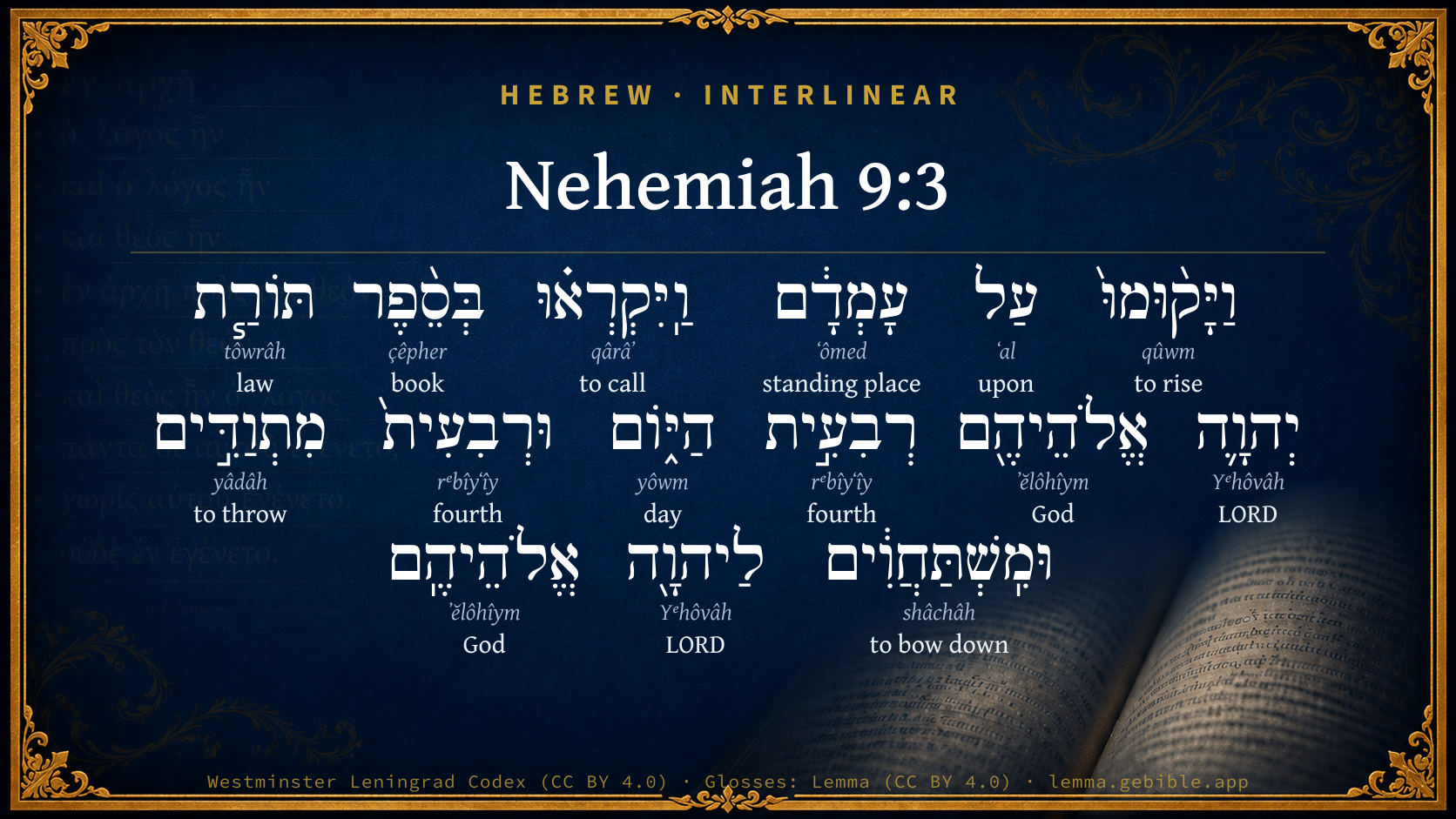
Nehemiah 9:3

Hebrew (Westminster Leningrad Codex) Nehemiah 9:3 appears in the Hebrew Old Testament. The text above is from the Westminster Leningrad Codex. Each word links to its Strong’s number, a concise gloss, and parsing drawn from the Open Scriptures Hebrew Bible morphology. Click any word for its full Brown-Driver-Briggs (BDB) entry.
Download image
Cite this verse

Nehemiah 9:3 (World English Bible). Public Domain. Lemma interlinear Bible study tool, https://lemma.gebible.app/v/nehemiah/9/3.

Show BibTeX & RIS
BibTeX
RIS
English Translation
They stood up in their place, and read in the book of the law of Yahweh their God a fourth part of the day; and [another] fourth part they confessed, and worshiped Yahweh their God.
World English Bible · Public Domain
Download a study sheet

One document with this verse’s original text, its word-by-word gloss line, the meaning frame, cross-references with their text, attributed commentary, and full source and license credits — printable, and it pastes into notes with its structure intact.

This verse Autodidact and up

Study sheet (.html) Plain text (.txt)

A passage Seminary Student

Up to 50 verses in one chapter. A passage sheet keeps up to 6 commentary sources and 12 cross-references per verse, in the order this page ranks them, and says so on the sheet whenever that leaves anything out. Ask for a single verse and you get the Autodidact verse sheet above.

Everything on this page stays free to read, with no account — the sheet is a download of what is already on screen, not access to it.

Want to remove ads? Support Godless Engineer
Compare translations 3

The same verse in 3 English versions, stacked beneath the original-language interlinear above. Click any original word for its lexicon entry.

Each is an independent rendering of the whole verse — the interlinear is not word-aligned to these translations.

Highlighted words mark where these versions differ — a whole-verse word diff, not a word-by-word alignment.

  • World English Bible Public Domain
    They stood up in their place, and read in the book of the law of Yahweh their God a fourth part of the day; and [another] fourth part they confessed, and worshiped Yahweh their God.
  • King James Version Public Domain
    And they stood up in their place, and read in the book of the law of the LORD their God one fourth part of the day; and another fourth part they confessed, and worshipped the LORD their God.
  • unfoldingWord Literal Text CC BY-SA 4.0
    And they rose up in their place, and they read aloud the book of the law of Yahweh their God a fourth of the day, and a fourth of the day were confessing and prostrating themselves to Yahweh their God.

unfoldingWord Literal Text — © unfoldingWord, licensed CC BY-SA 4.0. Word-aligned USFM3 via Door43 (git.door43.org/unfoldingWord/en_ult).

Versions to compare (up to 4)

3 of 4 selected

Show all 18 translations

Every available English version of this verse, each an independent rendering of the whole verse.

  • World English Bible Public Domain
    They stood up in their place, and read in the book of the law of Yahweh their God a fourth part of the day; and [another] fourth part they confessed, and worshiped Yahweh their God.
  • Berean Standard Bible Public Domain
    While they stood in their places, they read from the Book of the Law of the LORD their God for a quarter of the day, and they spent another quarter of the day in confession and worship of the LORD their God.
  • Majority Standard Bible Public Domain
    While they stood in their places, they read from the Book of the Law of the LORD their God for a quarter of the day, and they spent another quarter of the day in confession and worship of the LORD their God.
  • King James Version Public Domain
    And they stood up in their place, and read in the book of the law of the LORD their God one fourth part of the day; and another fourth part they confessed, and worshipped the LORD their God.
  • American Standard Version (1901) Public Domain
    And they stood up in their place, and read in the book of the law of Jehovah their God a fourth part of the day; and `another' fourth part they confessed, and worshipped Jehovah their God.
  • Revised Version (1885) Public Domain
    And they stood up in their place, and read in the book of the law of the LORD their God a fourth part of the day; and another fourth part they confessed, and worshipped the LORD their God.
  • Geneva Bible (1599) Public Domain
    And they stood vp in their place and read in the booke of the Lawe of the Lord their GOD foure times on the day, and they confessed and worshipped the Lord their God foure times.
  • Douay-Rheims (1899) Public Domain
    And they rose up to stand: and they read in the book of the law of the Lord their God, four times in the day, and four times they confessed, and adored the Lord their God.
  • Young's Literal Translation Public Domain
    and rise up on their station, and read in the book of the law of Jehovah their God a fourth of the day, and a fourth they are confessing and bowing themselves to Jehovah their God.
  • Literal Standard Version CC BY-SA 4.0
    and rise up on their station, and read in the Scroll of the Law of their God YHWH a fourth of the day, and a fourth they are confessing and bowing themselves to their God YHWH.
  • Unlocked Literal Bible CC BY-SA 4.0
    They stood up in their places, and for one-fourth of the day they read from the book of the law of Yahweh their God. For another fourth of the day they were confessing and bowing down before Yahweh their God.
  • unfoldingWord Literal Text CC BY-SA 4.0
    And they rose up in their place, and they read aloud the book of the law of Yahweh their God a fourth of the day, and a fourth of the day were confessing and prostrating themselves to Yahweh their God.
  • Darby Bible Public Domain
    And they stood up in their place, and read in the book of the law of Jehovah their God a fourth part of the day; and a fourth part they confessed, and worshipped Jehovah their God.
  • World Messianic Bible Public Domain
    They stood up in their place, and read in the scroll of the Torah of the LORD their God a fourth part of the day; and a fourth part they confessed and worshiped the LORD their God.
  • Webster's Bible Public Domain
    And they stood up in their place, and read in the book of the law of the LORD their God one fourth part of the day; and another fourth part they confessed, and worshiped the LORD their God.
  • Free Bible Version CC BY-SA 4.0
    They spent three hours standing there reading the Book of the Law of the Lord their God, and another three hours confessing their sins and worshiping the Lord their God.
  • Bible in Basic English Public Domain
    And for a fourth part of the day, upright in their places, they were reading from the book of the law of their God; and for a fourth part of the day they were requesting forgiveness and worshipping the Lord their God.
  • JPS Tanakh (1917) Public Domain
    And they stood up in their place, and read in the book of the Law of the LORD their God a fourth part of the day; and another fourth part they confessed, and prostrated themselves before the LORD their God.

Literal Standard Version (2020), Covenant Press — licensed CC BY-SA 4.0. Text via the HelloAO Bible API (eBible.org). Unlocked Literal Bible (unfoldingWord) — licensed CC BY-SA 4.0. Text via the HelloAO Bible API (eBible.org). unfoldingWord Literal Text — © unfoldingWord, licensed CC BY-SA 4.0. Word-aligned USFM3 via Door43 (git.door43.org/unfoldingWord/en_ult). Free Bible Version, Dr. Jonathan Gallagher — licensed CC BY-SA 4.0. Text via the HelloAO Bible API (eBible.org).

Word by word

More ways to search: Search by grammar → Find every occurrence → Compare this word →

Practice this passage: Drill this verse → Learn its vocabulary →

עָמְדָ֔ם
ʻômed
H5977
“standing place · their”
Noun, Common, Masculine, Singular, Construct + Suffix, Personal, 3rd Person, Masculine, Plural
Part of Speech
Noun
Type
Common
Gender
Masculine
Number
Singular
State
Construct
Full BDB Definition

Origin: from H5975

TWOT: 1637a

standing place
  1. וַיָּק֨וּמוּ֙ qûwm H6965 “and · to rise” Conjunction + Verb, Qal, Sequential Imperfect, 3rd Person, Masculine, Plural
  2. עַל ʻal H5921 “upon” Preposition
  3. וַֽיִּקְרְא֗וּ qârâʼ H7121 “and · to call” Conjunction + Verb, Qal, Sequential Imperfect, 3rd Person, Masculine, Plural
  4. בְּסֵ֨פֶר çêpher H5612 “in/at · book of” Preposition + Noun, Common, Masculine, Singular, Construct
  5. תּוֹרַ֧ת tôwrâh H8451 “law of” Noun, Common, Feminine, Singular, Construct
  6. יְהוָ֛ה Yᵉhôvâh H3068 “LORD” Noun, Proper
  7. אֱלֹהֵיהֶ֖ם ʼĕlôhîym H430 “God(s) · their” Noun, Common, Masculine, Plural, Construct + Suffix, Personal, 3rd Person, Masculine, Plural
  8. רְבִעִ֣ית rᵉbîyʻîy H7243 “fourth” Adjective, Ordinal number, Feminine, Singular, Construct
  9. הַיּ֑וֹם yôwm H3117 “the · day” Particle, Definite Article + Noun, Common, Masculine, Singular, Absolute
  10. וּרְבִעִית֙ rᵉbîyʻîy H7243 “and · fourth” Conjunction + Adjective, Ordinal number, Feminine, Singular, Absolute
  11. מִתְוַדִּ֣ים yâdâh H3034 “throwing” Verb, Hithpael, Participle Active, Masculine, Plural, Absolute
  12. וּמִֽשְׁתַּחֲוִ֔ים shâchâh H7812 “and · bowing down” Conjunction + Verb, Hishtaphel, Participle Active, Masculine, Plural, Absolute
  13. לַיהוָ֖ה Yᵉhôvâh H3068 “to/for · LORD” Preposition + Noun, Proper
  14. אֱלֹהֵיהֶֽם ʼĕlôhîym H430 “God(s) · their” Noun, Common, Masculine, Plural, Construct + Suffix, Personal, 3rd Person, Masculine, Plural

About this verse

These counts appear in no published source. They are computed here, from the morphology-tagged text and Lemma’s own curated glosses. What Lemma adds →

15
words
12
distinct lemmas
Historical
section

Notable vocabulary

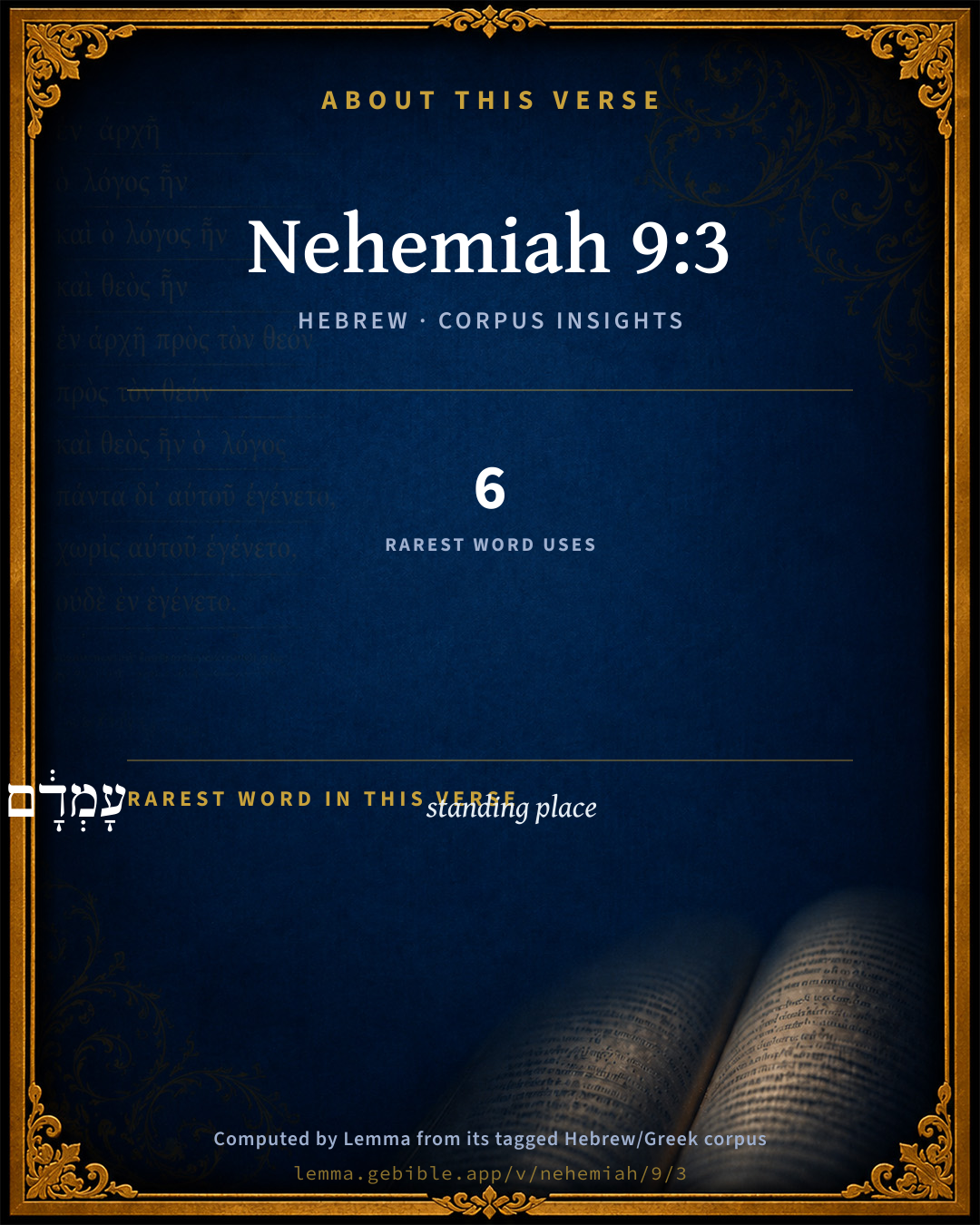
The rarest word here is עָמְדָ֔ם standing place H5977 — appearing just 6 times in the whole Hebrew Bible.

Shared distinctive vocabulary

עָמְדָ֔ם standing place H5977 occurs in 6 verses of the Hebrew Bible. Also found in:

Grammatical profile

  • 4 verbs
  • 8 nouns
  • 2 adjectives
  • 1 preposition

Verb forms

  • וַיָּק֨וּמוּ֙ Qal · Sequential Imperfect
  • וַֽיִּקְרְא֗וּ Qal · Sequential Imperfect
  • מִתְוַדִּ֣ים Hithpael · Participle Active
  • וּמִֽשְׁתַּחֲוִ֔ים Hishtaphel · Participle Active

Repetition

Words recur within this verse — often emphatic in Hebrew:

  • יְהוָ֛ה LORD H3068 ×2
  • אֱלֹהֵיהֶ֖ם God H430 ×2
  • רְבִעִ֣ית fourth H7243 ×2

Cross-references

2

Topical passages linked to Nehemiah 9:3 in the Treasury of Scripture Knowledge — connected by theme and wording, ordered by reader-vote popularity; previews shown in the World English Bible.

  • Nehemiah 8:3–4 He read therein before the broad place that was before the water gate from early morning until midday, in the presence of the men and the women, and of those who could understand; and the ears of all the people were [attentive] to the book of the law.
  • Nehemiah 8:7–8 Also Jeshua, and Bani, and Sherebiah, Jamin, Akkub, Shabbethai, Hodiah, Maaseiah, Kelita, Azariah, Jozabad, Hanan, Pelaiah, and the Levites, caused the people to understand the law: and the people [stood] in their place.

Cross-references courtesy of OpenBible.info (CC BY 4.0).

Hebrew and Greek witnesses Masoretic Hebrew ↔ Greek Septuagint

The same verse in the two great witnesses to the Old Testament, shown verse-for-verse.

These are two independent witnesses, not word-aligned to each other, and the Septuagint is shown in lemma (dictionary) form.

Hebrew Nehemiah 9:3 Masoretic · Westminster Leningrad Codex

וַיָּק֨וּמוּ֙ עַל עָמְדָ֔ם וַֽיִּקְרְא֗וּ בְּסֵ֨פֶר תּוֹרַ֧ת יְהוָ֛ה אֱלֹהֵיהֶ֖ם רְבִעִ֣ית הַיּ֑וֹם וּרְבִעִית֙ מִתְוַדִּ֣ים וּמִֽשְׁתַּחֲוִ֔ים לַיהוָ֖ה אֱלֹהֵיהֶֽם

They stood up in their place, and read in the book of the law of Yahweh their God a fourth part of the day; and [another] fourth part they confessed, and worshiped Yahweh their God.

World English Bible · Public Domain

Greek LXX Structure differs

The Septuagint has no separate book of Nehemiah. Its Greek text is the second half of Esdras B (2 Esdras), chapters 11–23; Ezra is the first half (1–10).

A verse-for-verse comparison isn’t shown here because the chapters and verses don’t line up. Switch to the LXX edition with the MT / LXX toggle above to read the Greek directly.

Hebrew: Westminster Leningrad Codex (CC BY 4.0). Greek: Septuagint (public domain); English from a public-domain English Septuagint. How the Septuagint differs from the Hebrew →

Commentary

Notes on Nehemiah 9:3 from classic Christian and Jewish commentators (each source and its license shown beneath its notes). The classic Christian expositions comment on the surrounding passage and are grouped to its opening verse, so a note may address several verses; the Jewish commentaries on the Tanakh (Rashi and others) are per-verse, so they appear only where the commentator wrote on this verse.

Lemma curates 59 commentaries, every one of them public domain or Creative Commons licensed, each selected and text-cleaned for this edition rather than reprinted as found. About our sources →

Trapp's Complete Commentary

John Trapp

Neh 9:3 And they stood up in their place, and read in the book of the law of the LORD their God [one] fourth part of the day; and [another] fourth part they confessed, and worshipped the LORD their God.

Ver. 3. And they stood up in their place] The people stood, for reverence’ sake, to the word read. See Neh 8:5. Or the ministers stood up in their pulpits, where they represent God himself as his ambassadors; and should therefore lay down all self-respects and aims at the pulpit door; and be fully of his mind, who said, I would not be found speaking or doing aught that I thought Christ would not approve of, if he were corporally present. (Ecolamp.)

And read in the book] Giving the sense of that they read; and applying it close to men’s consciences. This was preaching indeed; for as every sound is not music, so neither is every pulpit discourse preaching. Cura pastoralis est ars artium et scientia scientiarum, saith one, It is a matter of great skill to divide the word aright. See Neh 8:8.

One fourth part of the day] i.e. For three hours: from nine o’clock to twelve. This warranteth our preaching fast sermons; though prayer be the chief business of such a day. See Jer 36:6-7.

And another fourth part] sc. From twelve to three: thus besides the ordinary morning and evening sacrifices, they divided the day between preaching and prayer, as those did, Act 6:4. And as the priests of old taught Jacob God’s judgments, and put incense before the Lord, Deu 33:10. The Jews at this day boast that they divide the day (even the working day) into three parts; the first, ad Tephillah, they spend in prayer; the second, ad Torah, in reading the law; the third, ad Malachah, in their worldly business. But you are not bound herein to believe them.

They confessed] Not without supplication for pardon, and power to do better.

And worshipped the Lord their God] Inwardly and outwardly, giving him his due glory, and resting upon him by a lively faith in the gracious promises; being fully persuaded of this, that, together with the forgiveness of sin, they should have those particular blessings which they sued for, so far as might stand with God’s glory and the good of their souls.

John Trapp, A Commentary or Exposition upon All the Books of the Old and New Testament (1647–1656) — public domain. Text from a community e-Sword module.

Joseph Benson's Commentary

Neh 9:3. They stood up and read in the book of the law — That is, the Levites stood up in a place built for them, and read the law as they did before, interpreting the sense of what they read. One fourth part of the day — To wit, for three hours; for there were reckoned twelve hours in their day. Probably they began to read after the morning sacrifice, at which time divers religious people used to be present, and continued reading till the sixth hour, that is, till midday; and another fourth part — Namely, from midday to the time of the evening sacrifice; they confessed — Both God’s mercies, as appears from the following prayer, and their own sins, as is expressed Neh 9:2, this day being chiefly set apart for the work of confession and humiliation; and worshipped the Lord their God — Partly by their acknowledgment and adoration of his wonderful mercy, in forgiving their sins, and saving them from the judgments which they had deserved, and for giving them his law, and the knowledge thereof; and partly, by imploring his further grace and mercy to them. The work of a fast-day is good work; and we should endeavour to make a day’s work, a good day’s work, of it.

Joseph Benson's Commentary on the Old and New Testaments (1811–1818) — public domain. Text from a community e-Sword module.

Tyndale Open Study Notes

Tyndale Open Resources

9:3 They confessed their sins after hearing God’s word (cp. 8:1-9, 13-14, 18).

Tyndale Open Study Notes — © Tyndale Open Resources, licensed CC BY-SA 4.0. Text via the HelloAO Bible API.

Geneva Bible (1599)

Geneva Bible translators

They made confession of their sins, and used prayers.

Geneva Bible (1599) marginal notes — public domain. Text via Bolls.life.

Jamieson, Fausset & Brown

Robert Jamieson, A. R. Fausset & David Brown

they . . . read in the book of the law--Their extraordinary zeal led them to continue this as before.

one fourth part of the day--that is, for three hours, twelve hours being the acknowledged length of the Jewish day (Joh 11:9). This solemn diet of worship, which probably commenced at the morning sacrifice, was continued for six hours, that is, till the time of the evening sacrifice. The worship which they gave to the Lord their God, at this season of solemn national humiliation, consisted in acknowledging and adoring His great mercy in the forgiveness of their great and multiplied offenses, in delivering them from the merited judgments which they had already experienced or which they had reason to apprehend, in continuing amongst them the light and blessings of His word and worship, and in supplicating the extension of His grace and protection.

Jamieson, Fausset & Brown — Commentary Critical and Explanatory on the Whole Bible (1871) — public domain (CC PDM 1.0). Text via the HelloAO Bible API.

Adam Clarke's Commentary

Verse 3. One fourth part of the day] As they did no manner of work on this day of fasting and humiliation, so they spent the whole of it in religious duties. They began, says Calmet, on the first hour, and continued these exercises to the third hour; from the third they recommenced, and continued till the sixth hour; from the sixth to the ninth; and from the ninth, to the twelfth or last hour.

1. They heard the law read, standing;

2. They prostrated themselves, and confessed their sins;

3. They arose to praise God for having spared and dealt thus mercifully with them.

Adam Clarke's Commentary on the Bible (1810–1826) — public domain. Text from a community e-Sword/MySword module.

Ellicott's Commentary for English Readers

(3) One fourth part.—Both day and night were divided into four parts. All orders standing in their respective place, the reading occupied the morning and the worship the afternoon. It is the latter which is now made prominent, as the former had been prominent in the preceding chapter.

A Bible Commentary for English Readers, edited by Charles John Ellicott (1878–1897) — public domain. Text from a community e-Sword module.

The Cambridge Bible for Schools and Colleges

gen. ed. J. J. S. Perowne

3. stood up] Literally, ‘arose.’

in their place] cf. Neh_8:7. The people appear to have continued standing where they were for six hours, listening for three hours and worshipping three hours.

and read] the people read. By this we should understand that the people’s religious representatives, the Levites, read while the people listened. For ‘the book of the law,’ cf. Neh_8:3.

one fourth part] R.V. a fourth part, i.e. a quarter of the day as opposed to the night; i.e. 3 hours. The time of day is not told us. We may conjecture 9.0 a.m.–12.0, and 12.0–3.0 p.m. to have been the two quarters.

the Lord their God] Characteristic of this section, cf. Neh_9:4-5; Neh_9:7, Neh_10:29; Neh_10:34.

The Cambridge Bible for Schools and Colleges (gen. ed. J. J. S. Perowne; Cambridge University Press, 1878–1918) — public domain. Text from a community e-Sword module.

John Gill's Exposition

And they stood up in their place,.... In the outward court of the temple, where men used to stand when they prayed and confessed their sins: and read in the book of the law of the Lord their God; that they might the better know the mind and will of God, and do their duty: this they did

one fourth part of the day; the space of three hours, from sun rising, or six o'clock in the morning, to the time of the morning sacrifice, which was about nine o'clock:

and another fourth part they confessed; the goodness of God to them, and the sins they had been guilty of:

and worshipped the Lord their God; bowed down before him in prayer and supplication, and so spent three hours more, which reached to noon or twelve o'clock; and from thence to three o'clock, about the time of the evening sacrifice, and from thence to sun setting, or six o'clock, and so spent the whole day in the above exercises alternately.

John Gill's Exposition of the Whole Bible (1746–1763) — public domain (CC PDM 1.0). Text via the HelloAO Bible API.

Haydock's Catholic Bible Commentary

Stand, to hear the law, out of reverence; (Menochius) or the Levites ascended the pulpit to read, four times in the day. (Tirinus) --- After each lecture psalms were sung, (Calmet) to praise God, and to declare the sins of the people, and their sincere repentance. (Haydock) --- On days of mourning, the Jews assembled four times to pray, and thrice on other days, by the institution of Esdras. (Maimonides) See Acts iii. 1. --- On their fasts, they refrained from all meat, as well as from work, spending their time in prayer. They began at the first hour, and continued their exercises of devotion till the third, when they recommenced for other three hours. They did the like at the sixth and ninth hours; hearing the law, then prostrating themselves to confess their sins. Afterwards they rose to join with the Levites in praising the Lord. (Calmet)

George Leo Haydock (1774–1849), Haydock's Catholic Family Bible and Commentary, 1859 edition — public domain. Excludes Psalms (Douay-Rheims chapter numbering differs from Protestant) and Deuterocanonical books (Catholic canon only).

Matthew Poole's English Annotations

Read in the book of the law; so as they did before, giving them the sense of what they read; of which See Poole "Neh 8:7", See Poole "Neh 8:8".

One fourth part of the day, to wit, for three hours; for there were accounted twelve hours in their day, Joh 11:9. Probably they began after the morning sacrifice, at which divers religious people used to be present, but now they were all assembled together upon this great occasion; and they continued their work from that time till the evening sacrifice, with which they closed the work of the day.

Another fourth part they confessed, both God’s mercies, as appears from the matter of the following prayer, and their own sins, as is expressed Neh 9:2, this day being chiefly set apart for that work.

Worshipped the Lord their God; partly by the acknowledgment and adoration of his wonderful mercy in forgiving their sins, and saving them from the deserved judgments, which they either felt or feared, and giving them his law, and the knowledge thereof; and partly by imploring his further grace and mercy to them.

Matthew Poole's English Annotations on the Holy Bible (1683–1685) — public domain. Text from a community e-Sword/MySword module.

Whedon's Commentary on the Bible

Daniel D. Whedon

3. Read in… the law — In the same manner, probably, as on the first day of the month. Neh_8:1-8.

One fourth part of the day — About three hours, reckoning from the twelve hours of the labourer’s day. The first part of the day was devoted to the reading of the law; the second part to confession of sins and worship.

Daniel D. Whedon (gen. ed.), Commentary on the Old and New Testaments (1874–1909) — public domain. Text from a community e-Sword module.

The Pulpit Commentary

In their place. See above, Neh_8:7. The people and the ministers had their appointed "places" in every gathering of a religious character. The former now "stood up" in their proper place, and read, i.e. "engaged in the reading of the law, not, however, as actual readers, but as listeners. The readers would be the Levites. (see Neh_8:7, Neh_8:8) One fourth part of the day. The day and the night were alike divided by the Jews into four parts, each of three hours duration. The nocturnal divisions are frequently alluded to in the New Testament. (Mar_13:35 Joh_18:28, etc.) Worshipped. Literally, "bowed themselves down," or "prostrated themselves."

The Pulpit Commentary (1880–1919), ed. H.D.M. Spence-Jones & Joseph S. Exell — public domain. Text from a community e-Sword module.

John Wesley's Explanatory Notes

Book of the law - As they did before, giving them the sense of what they read. Fourth part - For three hours; there were twelve hours in their day, probably they began after the morning sacrifice, and continued their work till the evening sacrifice. The work of a fast-day is good work. We should endeavour to make a day's work, a good day's work of it.

John Wesley, Explanatory Notes Upon the Whole Bible (1754–1765) — public domain. Text via the GEBible commentary corpus.

unfoldingWord translationNotes

Door43 World Missions Community

They stood up

All the Israelites stood up

they were confessing

"they were admitting the wrong things they had done"

bowing down before

"worshiping" or "praising"

The Levites, Jeshua, Bani ... stood on the stairs

Some versions translate, "Jeshua, Bani ... stood on the stairs built for the Levites"

Jeshua, Bani, Kadmiel, Shebaniah, Bunni, Sherebiah, Bani, and Kenani

men's names (See: How to Translate Names)

translationWords

law

God

confess

bow

Yahweh

Levi

call

voice

unfoldingWord translationNotes — © Distant Shores Media and the Door43 World Missions Community, licensed CC BY-SA 4.0. Source: git.door43.org/Door43/en_tn.

Lesson kit

Teaching starters — assembled from the data on this page, not authored interpretation. Every prompt links to the verse data it draws on. Edit before teaching.

Nehemiah, in the Historical, opens this verse with 15 words (12 distinct Hebrew lemmas). Its most distinctive word is ʻômed (“standing place”). A historical commentator’s framing appears above. Read the whole chapter for the surrounding context.

Discussion questions

  1. The word ʻômed carries the sense “standing place.” How does it shape the verse?
  2. How does 2 Chronicles 30:16, which shares the word «standing place», read alongside this verse?
  3. What does the repetition of “LORD” (2× in this one verse) do in this verse?
  4. These translations render this verse differently; the difference is in the English rendering, not the original. What questions does that raise?
  5. «וַיָּק֨וּמוּ֙» is a Qal Sequential Imperfect verb. How does that grammatical form shape the action described?
  6. Compare how Trapp's Complete Commentary and Joseph Benson's Commentary read this verse. Where do they agree or differ?

Things to notice

Reading settings

Reading text

Shown beneath each verse's original-language words.

Old Testament
Old Testament edition

Read the OT as the Masoretic Hebrew (MT) or the Greek Septuagint (LXX).

English shown for the Greek Septuagint (in the Hebrew ↔ Greek comparison).

Comparing translations? Open the Compare panel on any verse page to stack up to four side by side.