
Psalms 37:31

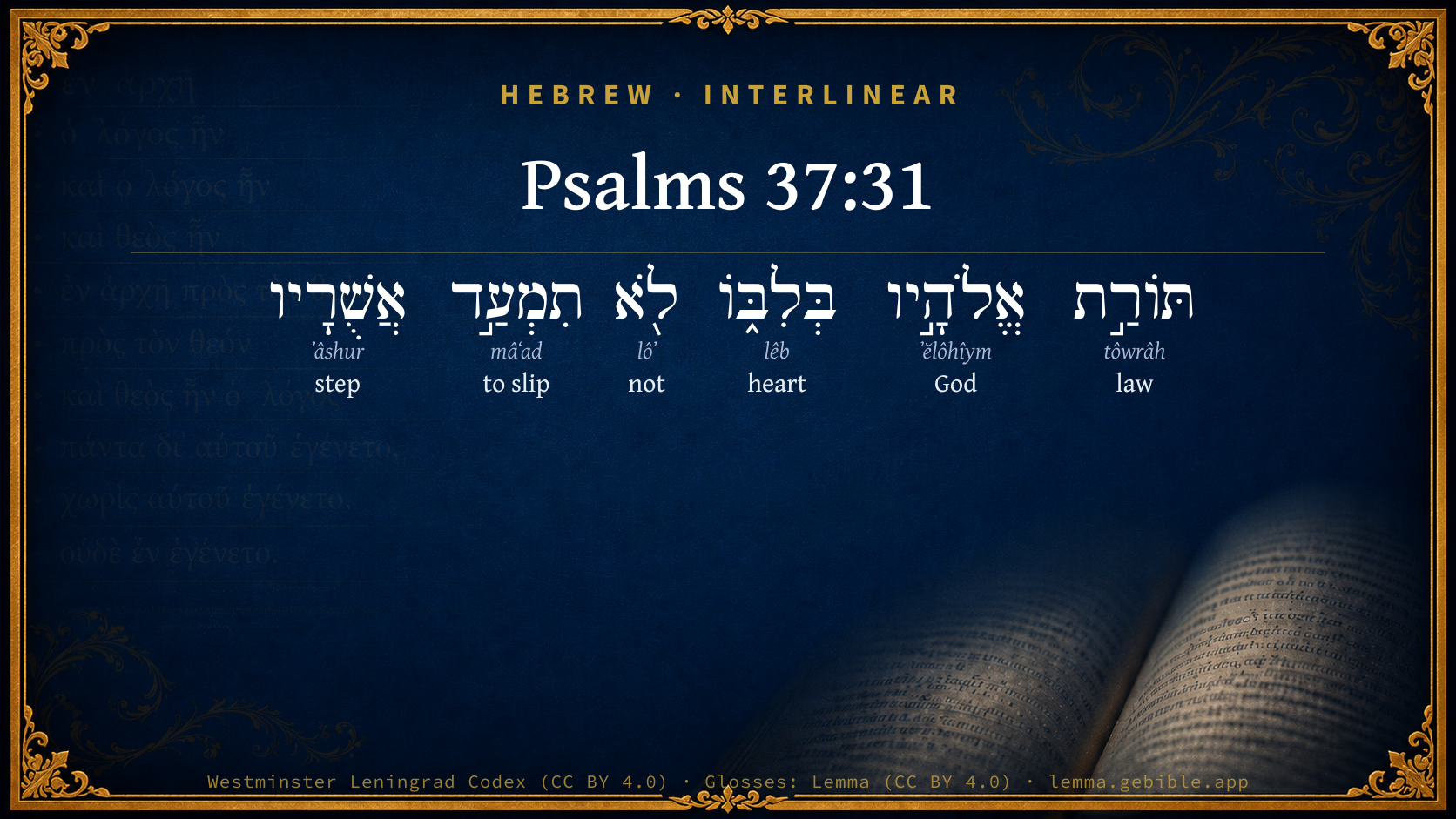
Hebrew (Westminster Leningrad Codex) Psalms 37:31 appears in the Hebrew Old Testament. The text above is from the Westminster Leningrad Codex. Each word links to its Strong’s number, a concise gloss, and parsing drawn from the Open Scriptures Hebrew Bible morphology. Click any word for its full Brown-Driver-Briggs (BDB) entry.
Download image
Cite this verse

Psalms 37:31 (World English Bible). Public Domain. Lemma interlinear Bible study tool, https://lemma.gebible.app/v/psalms/37/31.

Show BibTeX & RIS
BibTeX
RIS
English Translation
The law of his God is in his heart. None of his steps shall slide.
World English Bible · Public Domain
Download a study sheet

One document with this verse’s original text, its word-by-word gloss line, the meaning frame, cross-references with their text, attributed commentary, and full source and license credits — printable, and it pastes into notes with its structure intact.

This verse Autodidact and up

Study sheet (.html) Plain text (.txt)

A passage Seminary Student

Up to 50 verses in one chapter. A passage sheet keeps up to 6 commentary sources and 12 cross-references per verse, in the order this page ranks them, and says so on the sheet whenever that leaves anything out. Ask for a single verse and you get the Autodidact verse sheet above.

Everything on this page stays free to read, with no account — the sheet is a download of what is already on screen, not access to it.

Want to remove ads? Support Godless Engineer
Compare translations 3

The same verse in 3 English versions, stacked beneath the original-language interlinear above. Click any original word for its lexicon entry.

Each is an independent rendering of the whole verse — the interlinear is not word-aligned to these translations.

Highlighted words mark where these versions differ — a whole-verse word diff, not a word-by-word alignment.

  • World English Bible Public Domain
    The law of his God is in his heart. None of his steps shall slide.
  • King James Version Public Domain
    The law of his God is in his heart; none of his steps shall slide.
  • unfoldingWord Literal Text CC BY-SA 4.0
    The law of his God in his heart; his steps will not slip.

unfoldingWord Literal Text — © unfoldingWord, licensed CC BY-SA 4.0. Word-aligned USFM3 via Door43 (git.door43.org/unfoldingWord/en_ult).

Versions to compare (up to 4)

3 of 4 selected

Show all 18 translations

Every available English version of this verse, each an independent rendering of the whole verse.

  • World English Bible Public Domain
    The law of his God is in his heart. None of his steps shall slide.
  • Berean Standard Bible Public Domain
    The law of his God is in his heart; his steps do not falter.
  • Majority Standard Bible Public Domain
    The law of his God is in his heart; his steps do not falter.
  • King James Version Public Domain
    The law of his God is in his heart; none of his steps shall slide.
  • American Standard Version (1901) Public Domain
    The law of his God is in his heart; None of his steps shall slide.
  • Revised Version (1885) Public Domain
    The law of his God is in his heart; none of his steps shall slide.
  • Geneva Bible (1599) Public Domain
    For the Lawe of his God is in his heart, and his steppes shall not slide.
  • Douay-Rheims (1899) Public Domain
    The law of his God is in his heart, and his steps shall not be supplanted.
  • Young's Literal Translation Public Domain
    The law of his God `is' his heart, His steps do not slide.
  • Literal Standard Version CC BY-SA 4.0
    The law of his God [is] his heart, || His steps do not slide.
  • Unlocked Literal Bible CC BY-SA 4.0
    The law of his God is in his heart; his feet will not slip.
  • unfoldingWord Literal Text CC BY-SA 4.0
    The law of his God in his heart; his steps will not slip.
  • Darby Bible Public Domain
    the law of his God is in his heart; his goings shall not slide.
  • World Messianic Bible Public Domain
    The law of his God is in his heart. None of his steps shall slide.
  • Webster's Bible Public Domain
    The law of his God is in his heart; none of his steps shall slide.
  • Free Bible Version CC BY-SA 4.0
    God's law lives in their minds, so they will not slip from his way.
  • Bible in Basic English Public Domain
    The law of his God is in his heart; he will never make a false step.
  • JPS Tanakh (1917) Public Domain
    The law of his God is in his heart; none of his steps slide.

Literal Standard Version (2020), Covenant Press — licensed CC BY-SA 4.0. Text via the HelloAO Bible API (eBible.org). Unlocked Literal Bible (unfoldingWord) — licensed CC BY-SA 4.0. Text via the HelloAO Bible API (eBible.org). unfoldingWord Literal Text — © unfoldingWord, licensed CC BY-SA 4.0. Word-aligned USFM3 via Door43 (git.door43.org/unfoldingWord/en_ult). Free Bible Version, Dr. Jonathan Gallagher — licensed CC BY-SA 4.0. Text via the HelloAO Bible API (eBible.org).

Word by word

More ways to search: Search by grammar → Find every occurrence → Compare this word →

Practice this passage: Drill this verse → Learn its vocabulary →

About this verse

These counts appear in no published source. They are computed here, from the morphology-tagged text and Lemma’s own curated glosses. What Lemma adds →

6
words
6
distinct lemmas
Wisdom
section

Notable vocabulary

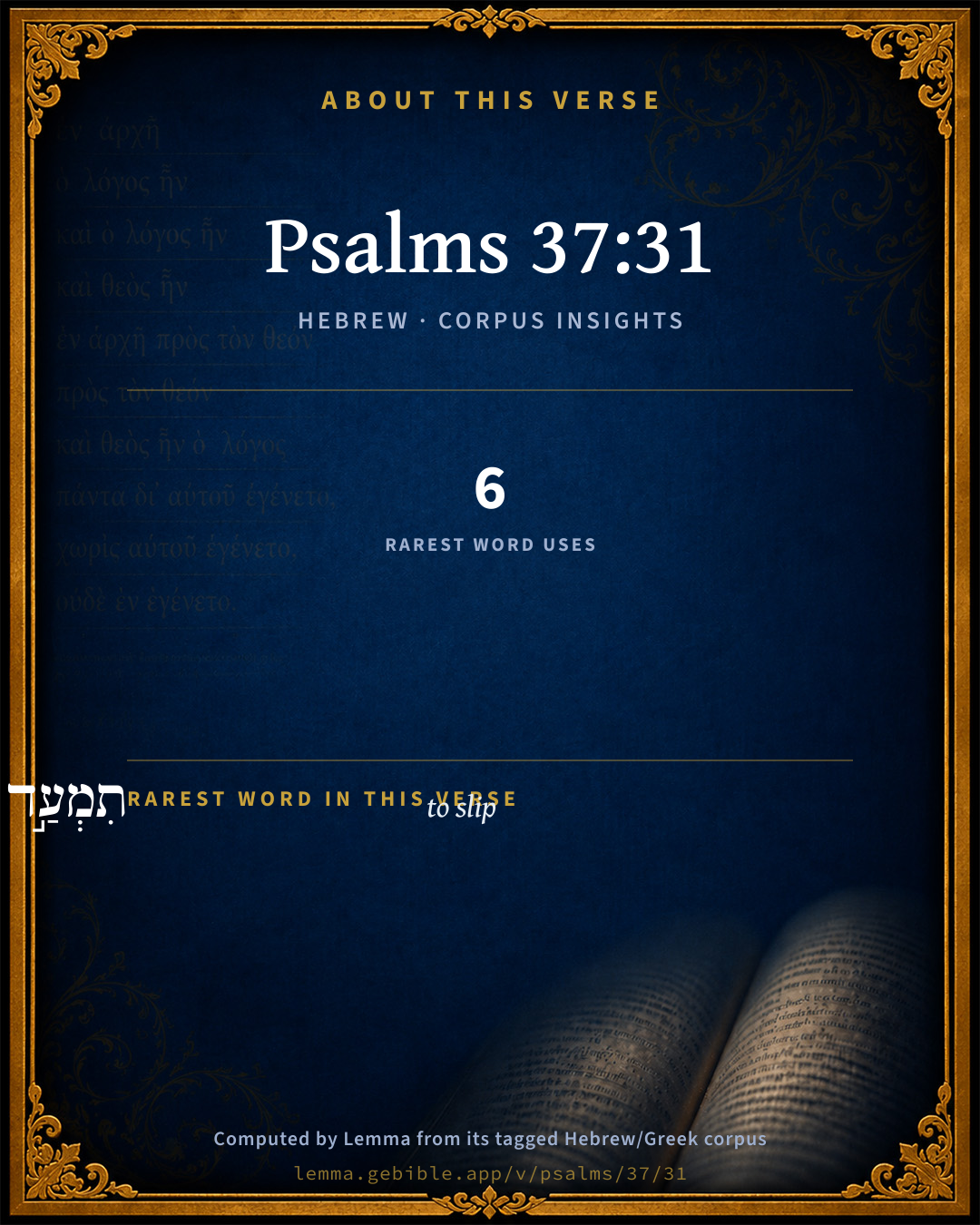
The rarest word here is תִמְעַ֣ד to slip H4571 — appearing just 6 times in the whole Hebrew Bible.

Shared distinctive vocabulary

תִמְעַ֣ד to slip H4571 occurs in 6 verses of the Hebrew Bible. Also found in:

Grammatical profile

  • 1 verb
  • 4 nouns
  • 1 particle

Verb forms

  • תִמְעַ֣ד Qal · Imperfect

Hebrew & Septuagint length

In English translation the verse runs 15 words from the Hebrew and 15 from the Septuagint (LXX English) — the same length.

A rough comparison of the two English renderings, which tokenize alike — not a word-level alignment.

Word counts can differ between the Hebrew and the Greek without any difference in meaning — e.g. the Hebrew direct-object marker אֵת has no separate Greek word, and Greek often adds the article ὁ.

Cross-references

19

Topical passages linked to Psalms 37:31 in the Treasury of Scripture Knowledge — connected by theme and wording, ordered by reader-vote popularity; previews shown in the World English Bible.

  • Psalms 40:8 I delight to do your will, my God. Yes, your law is within my heart."
  • Deuteronomy 6:6 These words, which I command you this day, shall be on your heart;
  • Isaiah 51:7 Listen to me, you who know righteousness, the people in whose heart is my law; don't you fear the reproach of men, neither be you dismayed at their insults.
  • Psalms 119:11 I have hidden your word in my heart, That I might not sin against you.
  • Psalms 37:23 A man's goings are established by Yahweh. He delights in his way.
  • Jeremiah 31:33 But this is the covenant that I will make with the house of Israel after those days, says Yahweh: I will put my law in their inward parts, and in their heart will I write it; and I will be their God, and they shall be my people:
  • Psalms 121:3 He will not allow your foot to be moved. He who keeps you will not slumber.
  • Deuteronomy 11:18–20 Therefore shall you lay up these my words in your heart and in your soul; and you shall bind them for a sign on your hand, and they shall be for symbols between your eyes.
  • Job 23:11 My foot has held fast to his steps. His way have I kept, and not turned aside.
  • Psalms 1:2 But his delight is in Yahweh's law; On his law he meditates day and night.
  • Psalms 40:2–3 He brought me up also out of a horrible pit, Out of the miry clay. He set my feet on a rock, And gave me a firm place to stand.
  • Psalms 44:18 Our heart has not turned back, Neither have our steps strayed from your path,
  • Psalms 119:98 Your commandments make me wiser than my enemies, For your commandments are always with me.
  • Proverbs 4:4 He taught me, and said to me: "Let your heart retain my words. Keep my commandments, and live.
  • Hebrews 8:10 "For this is the covenant that I will make with the house of Israel. After those days," says the Lord; "I will put my laws into their mind, I will also write them on their heart. I will be to them a God, And they will be to me a people.
  • Psalms 17:5 My steps have held fast to your paths, My feet have not slipped.
  • Proverbs 14:15 A simple man believes everything, But the prudent man carefully considers his ways.
  • Psalms 73:2 But as for me, my feet were almost gone. My steps had nearly slipped.
  • Ezekiel 27:6 Of the oaks of Bashan have they made your oars; they have made your benches of ivory inlaid in boxwood, from the isles of Kittim.

Cross-references courtesy of OpenBible.info (CC BY 4.0).

Hebrew and Greek witnesses Masoretic Hebrew ↔ Greek Septuagint

The same verse in the two great witnesses to the Old Testament, shown verse-for-verse.

You’re reading Greek Psalm 36 (Hebrew Psalm 37). The Septuagint counts the superscription, so verse numbers can differ from the Hebrew — chapter-level alignment, not verse-by-verse. Numbering follows Rahlfs.

These are two independent witnesses, not word-aligned to each other, and the Septuagint is shown in lemma (dictionary) form.

Hebrew Psalms 37:31 Masoretic · Westminster Leningrad Codex

תּוֹרַ֣ת אֱלֹהָ֣יו בְּלִבּ֑וֹ לֹ֖א תִמְעַ֣ד אֲשֻׁרָיו

The law of his God is in his heart. None of his steps shall slide.

World English Bible · Public Domain

Greek LXX Greek Psalm 36:31 Septuagint · lemma form

ὁ νόμος ὁ θεός αὐτός ἐν καρδία αὐτός καί οὐ ὑποσκελίζω ὁ διάβημα αὐτός

The law of his God is in his heart; and his steps shall not slide.

LXX2012 (modern English Septuagint) · Public Domain

Hebrew: Westminster Leningrad Codex (CC BY 4.0). Greek: Septuagint (public domain); English from LXX2012 (modern English Septuagint) (Public Domain). How the Septuagint differs from the Hebrew →

Commentary

Notes on Psalms 37:31 from classic Christian and Jewish commentators (each source and its license shown beneath its notes). The classic Christian expositions comment on the surrounding passage and are grouped to its opening verse, so a note may address several verses; the Jewish commentaries on the Tanakh (Rashi and others) are per-verse, so they appear only where the commentator wrote on this verse.

Lemma curates 59 commentaries, every one of them public domain or Creative Commons licensed, each selected and text-cleaned for this edition rather than reprinted as found. About our sources →

Trapp's Complete Commentary

John Trapp

Psa 37:31 The law of his God [is] in his heart; none of his steps shall slide.

Ver. 31. The law of his God is in his heart] He hath a Bible in his head and another in his heart; he hath a good treasure within, and there hence bringeth good things; he speaketh not by rote, and as a bungler, or as a philosopher only; but by proof, and as one that can say, I believed, I have felt it, and therefore have I spoken.

None of his steps shall slide] How should they, when they walk so exactly, and by such a rule? Jeremiah holding to it, durst say, Lord, if I am deceived, thou hast deceived me.

John Trapp, A Commentary or Exposition upon All the Books of the Old and New Testament (1647–1656) — public domain. Text from a community e-Sword module.

The Biblical Illustrator

Joseph S. Exell

Psa_37:31

The law of his God is in his heart; none of his steps shall slide.

--

The law of God in the heart

I. The inward principle which actuates a good man.

1. An acquaintance with the law, considered as the standard of holiness, as the rule of action.

2. An habitual reference to Gods mind and will.

3. A deep sense of the obligation of the law of God, accompanied with a sincere resolution of implicit and unreserved obedience.

4. A love to the law of God after the inner man.

5. In a good man this attachment to the law of God, and to the rules of duty, is progressive, and, with every accession of religious experience, becomes more vigorous and confirmed.

II. Its effects on the character and conduct. None of his steps shall slide. His steps shall not fatally slide; he shall maintain a uniform and consistent deportment.

1. The violence of temptation shall not overpower him.

2. The suddenness of it shall not surprise him.

3. The deceitfulness of it shall not seduce him.

4. The example of the multitude shall not prevail. (Robert Hall, M. A.)

The Divine law in the heart

I. There is a divine law for the regulation of mankind.

1. Its source is love.

2. Its requirement is love.

II. This divine law should become the ruling power within men.

1. The law of peace.

2. The law of life.

3. The law of liberty.

III. This divine law, as a ruling power within men, is a guarantee against errors None of his steps shall slide.

1. This law of love will guard him from theological errors. A God-loving heart is the best interpreter of Scripture.

2. This law of love will guard him from moral errors. He who loves God supremely will delight in doing His will. (Homilist.)

The Divine law in the heart

1. One marked characteristic of this is that it inspires him with the power of an unlimited ideal. A high ideal is the spring of social progress and public enterprise. Who can calculate the souls capabilities, and the mighty sweep of its orbit? It sees in Christ the highest example of excellence, and it goes on becoming more and more like Him, without ever arriving at a point beyond which it cannot pass. The man under the influence of this ideal is the truly practical man, his course of conduct being according to the laws of his being and adapted to the desired end. Christ is formed in him the hope of glory.

2. This develops the individuality of a man. Sensualism destroys individuality. The drunkard, in more senses than one, throws himself away, he unmans himself. But the man described in the text acts under a constant sense of responsibility. He feels that he must act himself and must stand or fall for himself. He knows that an act can only be performed by an individual, and that he must obey the law himself, or there will be no obedience so far as he is concerned.

3. The life of such a man is positive. He does not try to see how near he can go to the edge of the precipice of wrong without falling over. But he goes on. He has a filial love that inclines him in a positive way to his heavenly Father.

4. Harmony of thought and word. The words are the direct expressions of the thoughts, because these are vivified by the hearts warm emotion. The law in the life is not a mere matter of memory. Paul truly says: The law of the spirit of life hath saved me from the law of sin and death. The heart in an important sense in the man--it is the mainspring of action, and gives nob only efficiency, but harmony. (E. H. Chapin, D. D.)

Slippery places

(with Psa_73:18; Psa_94:18):--The slipping or sliding of the foot is used in the Bible as an emblem, chiefly, of three dangers.

I. The danger of falling into sin through temptation. If once you fall into the sin, you may, doubtless, rise again; but ah! you may rise sadly bruised, and perchance you may carry the mark of the bruise all your days! Even though we slip, it is well for us if we do not fall. But it is better still not even to slip, if we can help it. The spirit and the habits of godliness will lessen for us the dangers of temptation.

II. The danger of falling into ruin through sin (Psa_73:18). God has many methods of dealing with sinners. Sometimes He appeals to them by His goodness; at other times by His severity. But if the sinner will not listen, then God lets the man have his own way--for a time! Oh, terrible punishment!

III. The danger of falling into unbelief through adversity (Psa_94:18). There are those who, when they come into these dark and troublous experiences, and their foot is slipping into unbelief, will not lay hold of the supporting arm of God; they nurse a morbid gloom. Is it not enough to lose earthly wealth, without losing also, through our unbelief, the heavenly treasure? Is it not enough to lose by death the conscious companionship of some dear friend, without losing also, through our unbelief, the conscious friendship of Him who is the best of all friends? Let us, then, whenever we come into the slippery places of adversity, seek to grasp by faith the Cross of Calvary, that the mercy of God, revealed in Jesus Christ, may hold us up. (T. C. Finlayson.)

The Biblical Illustrator, edited by Joseph S. Exell (c. 1880s–1900s) — public domain. Text from a community e-Sword module.

Joseph Benson's Commentary

Psa 37:31. The law of his God is in his heart — According to God’s command, Deu 6:6, and promise, Jer 31:33. His thoughts, and meditations, and affections are fixed upon it. He doth not talk religiously with design, or with ostentation, but out of the abundance of his heart, Mat 12:35. None of his steps shall slide — Or, slip, or swerve from the rule of God’s law. His piety and virtue shall continue and increase: or, God will uphold and preserve him from falling into that mischief which wicked men plot against him.

Joseph Benson's Commentary on the Old and New Testaments (1811–1818) — public domain. Text from a community e-Sword module.

J. A. Alexander on Psalms

Joseph Addison Alexander

31. (Psa 37:31) The Law of his God is in his heart, not merely on his lips, and may therefore be expected to keep him in the right way. His steps shall not swerve from the straight path, or waver in it. See above, on Psa 37:23.

Joseph Addison Alexander, The Psalms Translated and Explained (1850) — public domain. Text from a community e-Sword module.

Tyndale Open Study Notes

Tyndale Open Resources

37:31 They have made God’s law their own: The godly internalize God’s wisdom and instructions (see 119:11; Jer 24:7; 31:31-34).

Tyndale Open Study Notes — © Tyndale Open Resources, licensed CC BY-SA 4.0. Text via the HelloAO Bible API.

Jamieson, Fausset & Brown

Robert Jamieson, A. R. Fausset & David Brown

steps--or, "goings"--for conduct which is unwavering (Psa 18:36).

Jamieson, Fausset & Brown — Commentary Critical and Explanatory on the Whole Bible (1871) — public domain (CC PDM 1.0). Text via the HelloAO Bible API.

Adam Clarke's Commentary

Verse 31. The law of his God is in his heart] The Lord promised that a time should come in which he would make a new covenant with the house of Israel; he would put his laws in their minds, and in their hearts he would write them. This is fulfilled in the case above.

None of his steps shall slide.] His holy heart always dictates to his eyes, his mouth, his hands, and his feet. The precepts which direct his conduct are not only written in his Bible, but also in his heart.

Adam Clarke's Commentary on the Bible (1810–1826) — public domain. Text from a community e-Sword/MySword module.

John Calvin's Commentaries

To this there is added integrity of heart: The law of the Lord is in his heart. This, though it should precede in point of order, is not improperly put in the second place here. For the Scriptures are not particular in observing an exact arrangement in the enumeration of virtues and vices. Besides, the source whence this integrity of heart proceeds is, that the Law of God has its seat in the heart; and it is it alone which prescribes the best rule of life, restrains all the depraved affections and lusts, and imbues the minds of men with the love of righteousness. No man will constantly and steadily devote himself to a life of uprightness, exert himself in behalf of others in preference to his own personal interests, renounce covetousness, subdue pride, and maintain a constant warfare with his own nature, unless he is endued with the fear of God. There next follows the third division, which relates to the external conduct: His steps shall not slide Some, indeed, think that this is a promise; but I have no doubt, that in this clause David still continues the definition of righteousness. The meaning therefore is, that although the children of God are tempted in a variety of ways to commit sin, and many things occur urging them to it, — and although men, for the most part, too, endeavor, as far as in them lies, by their maliciousness to turn them aside from the fear of God, — yet, because the Law of God rules and reigns in their hearts, they do not slide, but stand to their purpose with firm and determined resolution, or at least adhere to the right course.

John Calvin's Commentaries (1540-1563) — public domain. Text from the Calvin Translation Society English edition (1840s-50s) via the Christian Classics Ethereal Library (ccel.org). Calvin's coverage is partial (roughly two-thirds of the Bible); uncommented books and verses are honest gaps, never fabricated. The 19th-century editor's footnotes and remarks are omitted so the notes are faithfully Calvin's own voice.

The Cambridge Bible for Schools and Colleges

gen. ed. J. J. S. Perowne

31. Cp. Psa_119:11. God’s law, treasured in his heart, regulates all his conduct. Without wavering or variation he pursues the path of right. Cp. Psa_26:1; Psa_73:2.

The Cambridge Bible for Schools and Colleges (gen. ed. J. J. S. Perowne; Cambridge University Press, 1878–1918) — public domain. Text from a community e-Sword module.

John Gill's Exposition

The wicked watcheth the righteous,.... All his motions and steps, his works and actions; he watches for his halting, and to take all opportunities and advantages against him; see Jer 20:10;

and seeketh to slay him; murder his reputation, destroy his substance, and take away his life: some understand it of the devil, who watches the saints, observes their failings, accuses then, before the throne, and seeks to devour them, Pe1 5:8.

John Gill's Exposition of the Whole Bible (1746–1763) — public domain (CC PDM 1.0). Text via the HelloAO Bible API.

Albert Barnes' Notes on the Bible

The law of his God is in his heart - That is, he loves it; he thinks of it; he makes it the inward rule of his conduct: Deu 6:6; Psa 40:8 The word “law” here is a general term for the truth of God - for all that he has revealed to guide men. As long as that truth is in the heart; as long as it is the object of love; as long as it is suffered to guide and control us, so long will our words and conduct be right.

None of his steps shall slide - Margin, “goings.” The idea is, that his course will be firm and steady. He will not fall into sin, and his life will be prosperous and happy. This is in accordance with the general sentiment in the psalm, that religion tends to promote prosperity, happiness, and length of days on the earth.

Albert Barnes' Notes on the Bible (1834–1885) — public domain. Text from a community e-Sword/MySword module.

Matthew Poole's English Annotations

According to God’s command, Deu 6:6, and promise, Heb 8:10. His thoughts, and meditations, and affections are fixed upon it. He doth not talk religiously in design, or with ostentation, but out of the abundance of his heart, Mat 12:35.

None of his steps shall slide: this passage describes either,

1. His safety, consequent upon his piety; God will uphold and preserve him from falling into that mischief which wicked men plot against him. Or rather,

2. His virtue or piety; which is evidenced by his words, Psa 37:30, by his heart, in the former part of this verse, and by his actions, in these words. His steps or goings (i.e. his actions) shall not (or rather, do not; for this verb, though future, may and should be rendered by the present, as futures frequently are in the Hebrew language, and as the two foregoing future verbs are rendered, Psa 37:30) slide, or slip, or swerve, to wit, from the rule, or from God’s law; which is to be understood as that passage, Psa 99:3, They do no iniquity, and some such expressions, not simply and absolutely, as if all good men were sinless; which is abundantly confuted, both by many scriptures and by universal experience; but comparatively, and in respect of his design, and course, or custom. His conversation is ordinarily regular and unblamable. He not only begins well, but constantly perseveres in God’s ways, and will not be drawn to forsake God and religion upon any terms.

Matthew Poole's English Annotations on the Holy Bible (1683–1685) — public domain. Text from a community e-Sword/MySword module.

The Treasury of David

Charles H. Spurgeon

Ver. 31. The law of his God is in his heart; none of his steps shall slide. The best thing in the best place, producing the best results. Well might the man's talk be so admirable when his heart was so well stored. To love holiness, to have the motives and desires sanctified, to be in one's inmost nature obedient to the Lordthis is the surest method of making the whole run of our life efficient for its great ends, and even for securing the details of it, our steps from any serious mistake. To keep the even tenor of one's way, in such times as these, is given only to those whose hearts are sound towards God, who can, as in the text, call God their God. Policy slips and trips, it twists and tacks, and after all is worsted in the long run, but sincerity plods on its plain pathway and reaches the goal.

Ver. 31. The law of his God is in his heart, etc. The flock of sheep that's indisposed and unwilling to drive, start out of the way into every lane's end, one this way and another that; and just so is it with an unwilling heart; one thought starts this way, and another that, and it's a piece of skill to drive them through. But a willing heart, a heart prepared and ready to every good work, it flies quite up an end, and delights itself in the Lord. Richard Steele.

Ver. 31. (first clause). He hath a Bible in his head, and another in his heart; he hath a good treasure within, and there hence bringeth good things. John Trapp.

Ver. 31.

1. The best thing.

2. In the best place.

3. With the best of results.

Psalms 37:32*

Charles H. Spurgeon's The Treasury of David (1869–1885) — public domain. Psalms only. Text from a community e-Sword/MySword module.

The Pulpit Commentary

The Law of his God is in his heart. (comp. Deu_6:6 Psa_40:8 Psa_119:11 Isa_51:7) None of his steps shall slide. The two facts are associated as cause and effect. The having the Law of God in his heart prevents his sliding or going astray.

The Pulpit Commentary (1880–1919), ed. H.D.M. Spence-Jones & Joseph S. Exell — public domain. Text from a community e-Sword module.

John Wesley's Explanatory Notes

Heart - His thoughts, meditations and affections are fixed upon it. Slide - Slide, or swerve, from the rule, from God's law.

John Wesley, Explanatory Notes Upon the Whole Bible (1754–1765) — public domain. Text via the GEBible commentary corpus.

unfoldingWord translationNotes

Door43 World Missions Community

The law of his God is in his heart

Here "in his heart" refers to his deepest inner being. AT: "He treasures the commands of his God in his inner being" (See: Metonymy)

his feet will not slip

Here failure to obey Yahweh is spoken of as slipping off a safe path and falling. AT: "he will walk safely in the way God wants him to walk" or "he will safely do the things God wants him to do" (See: Metaphor)

The wicked person ... the righteous person ... the evil person

These are not specific people. They refer to these kinds of people in general. (See: Generic Noun Phrases)

watches the righteous person

Here the watching implies observing the righteous in order to do them harm. AT: "waits in ambush for the righteous person" (See: Assumed Knowledge and Implicit Information)

the evil person's hand

Here "hand" represents power or control. AT: "the power of the evil person" (See: Metonymy)

when he is judged

This refers to Yahweh judging the righteous man. AT: "When Yahweh judges him" (See: Active or Passive)

translationWords

law

heart

watch

righteous

condemn

judge

unfoldingWord translationNotes — © Distant Shores Media and the Door43 World Missions Community, licensed CC BY-SA 4.0. Source: git.door43.org/Door43/en_tn.

Rashi

Rabbi Shlomo Yitzchaki (Rashi)

his feet do not falter His steps do not slip.

Rashi on the Tanakh — English translations: “The Judaica Press complete Tanach with Rashi, translated by A. J. Rosenberg” (CC BY 4.0); “Pentateuch with Rashi's commentary by M. Rosenbaum and A.M. Silbermann, 1929-1934” (public domain); “The Metsudah Tanach series, Lakewood, N.J” (CC BY 4.0); and “The Book of Joshua, Metsudah Publications, 1997” (CC BY 4.0). Text via Sefaria.

Lesson kit

Teaching starters — assembled from the data on this page, not authored interpretation. Every prompt links to the verse data it draws on. Edit before teaching.

Psalms, in the Wisdom, opens this verse with 6 words (6 distinct Hebrew lemmas). Its most distinctive word is mâʻad (“to slip”). A historical commentator’s framing appears above. Read the whole chapter for the surrounding context.

Discussion questions

  1. The word mâʻad carries the sense “to slip.” How does it shape the verse?
  2. 2 Samuel 22:37 shares the word «to slip» with this verse. How do the two illuminate each other?
  3. The translations on this page render this verse differently — a whole-verse word diff, not a word-by-word alignment. What might account for the different wordings?
  4. The verb «תִמְעַ֣ד» is Qal Imperfect. How does its form color the action?
  5. Reading how Trapp's Complete Commentary and The Biblical Illustrator read this verse, where do the two commentators agree and where do they part?

Things to notice

Reading settings

Reading text

Shown beneath each verse's original-language words.

Old Testament
Old Testament edition

Read the OT as the Masoretic Hebrew (MT) or the Greek Septuagint (LXX).

English shown for the Greek Septuagint (in the Hebrew ↔ Greek comparison).

Comparing translations? Open the Compare panel on any verse page to stack up to four side by side.