
Psalms 119:142

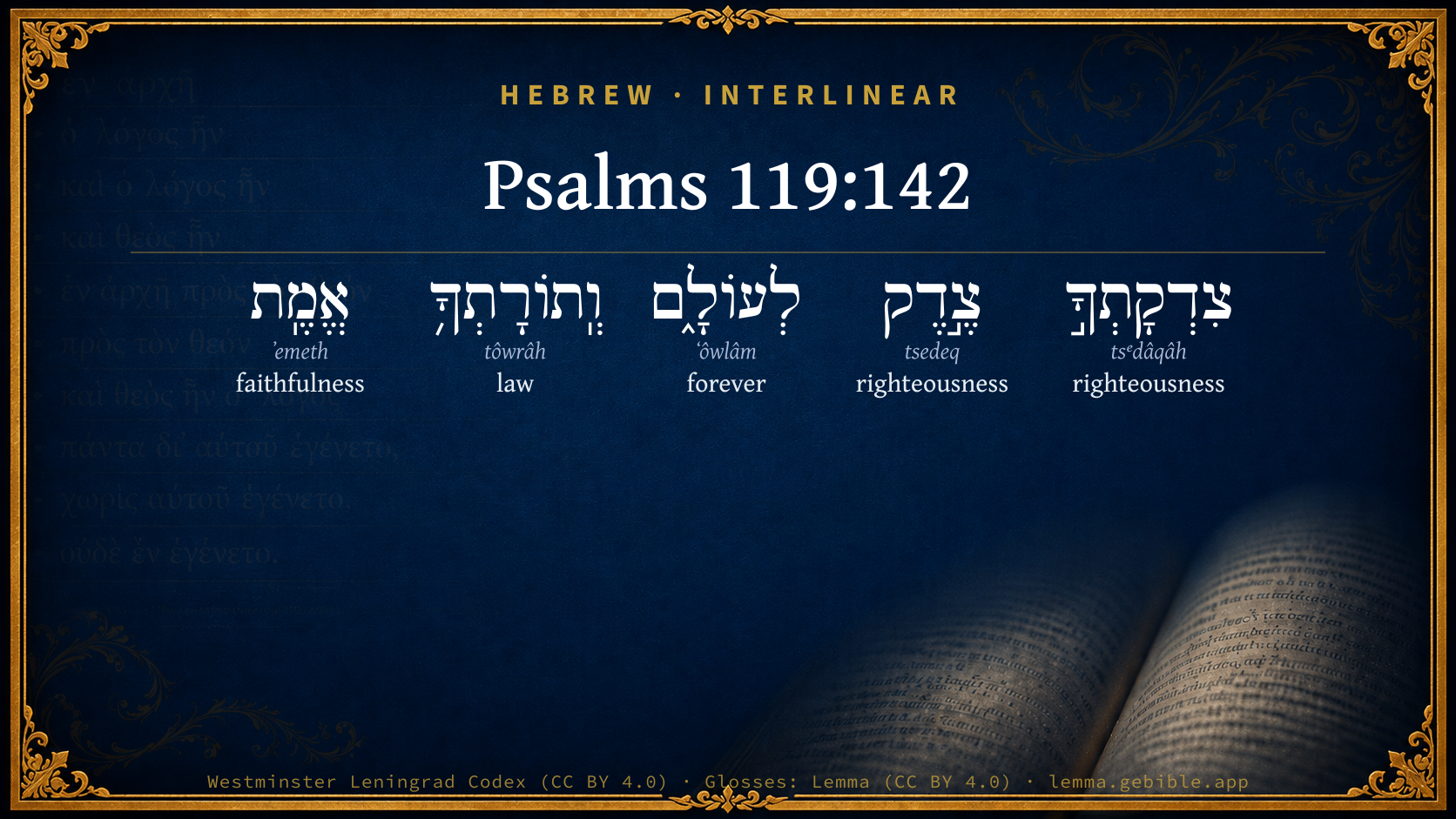
Hebrew (Westminster Leningrad Codex) Psalms 119:142 appears in the Hebrew Old Testament. The text above is from the Westminster Leningrad Codex. Each word links to its Strong’s number, a concise gloss, and parsing drawn from the Open Scriptures Hebrew Bible morphology. Click any word for its full Brown-Driver-Briggs (BDB) entry.
Download image
Cite this verse

Psalms 119:142 (World English Bible). Public Domain. Lemma interlinear Bible study tool, https://lemma.gebible.app/v/psalms/119/142.

Show BibTeX & RIS
BibTeX
RIS
English Translation
Your righteousness is an everlasting righteousness. Your law is truth.
World English Bible · Public Domain
Download a study sheet

One document with this verse’s original text, its word-by-word gloss line, the meaning frame, cross-references with their text, attributed commentary, and full source and license credits — printable, and it pastes into notes with its structure intact.

This verse Autodidact and up

Study sheet (.html) Plain text (.txt)

A passage Seminary Student

Up to 50 verses in one chapter. A passage sheet keeps up to 6 commentary sources and 12 cross-references per verse, in the order this page ranks them, and says so on the sheet whenever that leaves anything out. Ask for a single verse and you get the Autodidact verse sheet above.

Everything on this page stays free to read, with no account — the sheet is a download of what is already on screen, not access to it.

Want to remove ads? Support Godless Engineer
Compare translations 3

The same verse in 3 English versions, stacked beneath the original-language interlinear above. Click any original word for its lexicon entry.

Each is an independent rendering of the whole verse — the interlinear is not word-aligned to these translations.

Highlighted words mark where these versions differ — a whole-verse word diff, not a word-by-word alignment.

  • World English Bible Public Domain
    Your righteousness is an everlasting righteousness. Your law is truth.
  • King James Version Public Domain
    Thy righteousness is an everlasting righteousness, and thy law is the truth.
  • unfoldingWord Literal Text CC BY-SA 4.0
    Your righteousness righteousness forever, and your law truth.

unfoldingWord Literal Text — © unfoldingWord, licensed CC BY-SA 4.0. Word-aligned USFM3 via Door43 (git.door43.org/unfoldingWord/en_ult).

Versions to compare (up to 4)

3 of 4 selected

Show all 17 translations

Every available English version of this verse, each an independent rendering of the whole verse.

  • World English Bible Public Domain
    Your righteousness is an everlasting righteousness. Your law is truth.
  • Berean Standard Bible Public Domain
    Your righteousness is everlasting and Your law is true.
  • Majority Standard Bible Public Domain
    Your righteousness is everlasting and Your law is true.
  • King James Version Public Domain
    Thy righteousness is an everlasting righteousness, and thy law is the truth.
  • American Standard Version (1901) Public Domain
    Thy righteousness is an everlasting righteousness, And thy law is truth.
  • Revised Version (1885) Public Domain
    Thy righteousness is an everlasting righteousness, and thy law is truth.
  • Geneva Bible (1599) Public Domain
    Thy righteousnesse is an euerlasting righteousnes, and thy Lawe is trueth.
  • Young's Literal Translation Public Domain
    Thy righteousness `is' righteousness to the age, And Thy law `is' truth.
  • Literal Standard Version CC BY-SA 4.0
    Your righteousness [is] righteousness for all time, || And Your law [is] truth.
  • Unlocked Literal Bible CC BY-SA 4.0
    Your justice is forever right, and your law is trustworthy.
  • unfoldingWord Literal Text CC BY-SA 4.0
    Your righteousness righteousness forever, and your law truth.
  • Darby Bible Public Domain
    Thy righteousness is an everlasting righteousness, and thy law is truth.
  • World Messianic Bible Public Domain
    Your righteousness is an everlasting righteousness. Your Torah is truth.
  • Webster's Bible Public Domain
    Thy righteousness is an everlasting righteousness, and thy law is the truth.
  • Free Bible Version CC BY-SA 4.0
    Your goodness and justice last forever; and your law is the truth.
  • Bible in Basic English Public Domain
    Your righteousness is an unchanging righteousness, and your law is certain.
  • JPS Tanakh (1917) Public Domain
    Thy righteousness is an everlasting righteousness, and Thy law is the truth.

Literal Standard Version (2020), Covenant Press — licensed CC BY-SA 4.0. Text via the HelloAO Bible API (eBible.org). Unlocked Literal Bible (unfoldingWord) — licensed CC BY-SA 4.0. Text via the HelloAO Bible API (eBible.org). unfoldingWord Literal Text — © unfoldingWord, licensed CC BY-SA 4.0. Word-aligned USFM3 via Door43 (git.door43.org/unfoldingWord/en_ult). Free Bible Version, Dr. Jonathan Gallagher — licensed CC BY-SA 4.0. Text via the HelloAO Bible API (eBible.org).

Word by word

More ways to search: Search by grammar → Find every occurrence → Compare this word →

Practice this passage: Drill this verse → Learn its vocabulary →

צֶ֣דֶק
tsedeq
H6664
“righteousness”
Noun, Common, Masculine, Singular, Absolute
Part of Speech
Noun
Type
Common
Gender
Masculine
Number
Singular
State
Absolute
Full BDB Definition

Origin: from H6663

TWOT: 1879a

justice, rightness, righteousness - what is right or just or normal, rightness, justness (of weights and measures) - righteousness (in government) - of judges, rulers, kings - of law - of Davidic king, Messiah - of Jerusalem as seat of just government - of God's attribute - righteousness, justice (in case or cause) - rightness (in speech) - righteousness (as ethically right) - righteousness (as vindicated), justification (in controversy), deliverance, victory, prosperity - of God as covenant-keeping in redemption - in name of Messianic king - of people enjoying salvation - of Cyrus
  1. צִדְקָתְךָ֣ tsᵉdâqâh H6666 “righteousness · your” Noun, Common, Feminine, Singular, Construct + Suffix, Personal, 2nd Person, Masculine, Singular
  2. לְעוֹלָ֑ם ʻôwlâm H5769 “to/for · forever” Preposition + Noun, Common, Masculine, Singular, Absolute
  3. וְֽתוֹרָתְךָ֥ tôwrâh H8451 “and · law · your” Conjunction + Noun, Common, Feminine, Singular, Construct + Suffix, Personal, 2nd Person, Masculine, Singular
  4. אֱמֶֽת ʼemeth H571 “faithfulness” Noun, Common, Feminine, Singular, Absolute

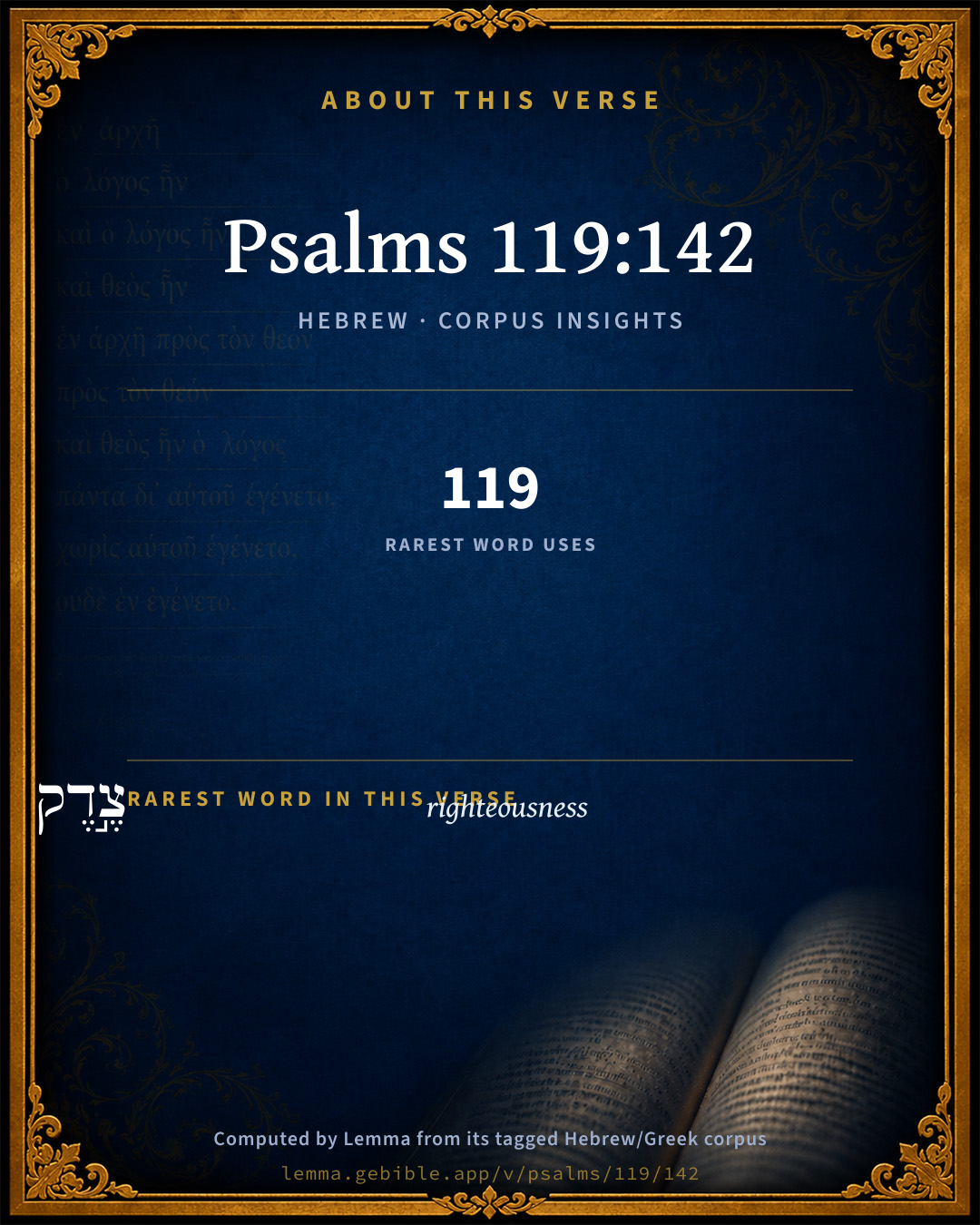
About this verse

These counts appear in no published source. They are computed here, from the morphology-tagged text and Lemma’s own curated glosses. What Lemma adds →

5
words
5
distinct lemmas
Wisdom
section

Grammatical profile

  • 5 nouns

Hebrew & Septuagint length

In English translation the verse runs 10 words from the Hebrew and 11 from the Septuagint (LXX English) — closely comparable.

A rough comparison of the two English renderings, which tokenize alike — not a word-level alignment.

Word counts can differ between the Hebrew and the Greek without any difference in meaning — e.g. the Hebrew direct-object marker אֵת has no separate Greek word, and Greek often adds the article ὁ.

Cross-references

10

Topical passages linked to Psalms 119:142 in the Treasury of Scripture Knowledge — connected by theme and wording, ordered by reader-vote popularity; previews shown in the World English Bible.

  • Psalms 19:9 The fear of Yahweh is clean, enduring forever. Yahweh's ordinances are true, and righteous altogether.
  • Psalms 119:151 You are near, Yahweh. All your commandments are truth.
  • John 17:17 Sanctify them in your truth. Your word is truth.
  • Isaiah 51:8 For the moth shall eat them up like a garment, and the worm shall eat them like wool; but my righteousness shall be forever, and my salvation to all generations.
  • Isaiah 51:6 Lift up your eyes to the heavens, and look on the earth beneath; for the heavens shall vanish away like smoke, and the earth shall wax old like a garment; and those who dwell therein shall die in like manner: but my salvation shall be forever, and my righteousness shall not be abolished.
  • Psalms 119:144 Your testimonies are righteous forever. Give me understanding, that I may live.
  • Psalms 36:6 Your righteousness is like the mountains of God. Your judgments are like a great deep. Yahweh, you preserve man and animal.
  • Ephesians 4:21 if indeed you heard him, and were taught in him, even as truth is in Jesus:
  • Daniel 9:24 Seventy weeks are decreed on your people and on your holy city, to finish disobedience, and to make an end of sins, and to make reconciliation for iniquity, and to bring in everlasting righteousness, and to seal up vision and prophecy, and to anoint the most holy.
  • 2 Thessalonians 1:6–10 Since it is a righteous thing with God to repay affliction to those who afflict you,

Cross-references courtesy of OpenBible.info (CC BY 4.0).

Hebrew and Greek witnesses Masoretic Hebrew ↔ Greek Septuagint

The same verse in the two great witnesses to the Old Testament, shown verse-for-verse.

You’re reading Greek Psalm 118 (Hebrew Psalm 119). The Septuagint counts the superscription, so verse numbers can differ from the Hebrew — chapter-level alignment, not verse-by-verse. Numbering follows Rahlfs.

These are two independent witnesses, not word-aligned to each other, and the Septuagint is shown in lemma (dictionary) form.

Hebrew Psalms 119:142 Masoretic · Westminster Leningrad Codex

צִדְקָתְךָ֣ צֶ֣דֶק לְעוֹלָ֑ם וְֽתוֹרָתְךָ֥ אֱמֶֽת

Your righteousness is an everlasting righteousness. Your law is truth.

World English Bible · Public Domain

Greek LXX Greek Psalm 118:142 Septuagint · lemma form

ὁ δικαιοσύνη σύ δικαιοσύνη εἰς ὁ αἰών καί ὁ νόμος σύ ἀλήθεια

Your righteousness is an everlasting righteousness, and your law is truth.

LXX2012 (modern English Septuagint) · Public Domain

On this verse, Adam Clarke's Commentary discusses the Septuagint’s reading. Read the note in Commentary ↓

Hebrew: Westminster Leningrad Codex (CC BY 4.0). Greek: Septuagint (public domain); English from LXX2012 (modern English Septuagint) (Public Domain). How the Septuagint differs from the Hebrew →

Commentary

Notes on Psalms 119:142 from classic Christian and Jewish commentators (each source and its license shown beneath its notes). The classic Christian expositions comment on the surrounding passage and are grouped to its opening verse, so a note may address several verses; the Jewish commentaries on the Tanakh (Rashi and others) are per-verse, so they appear only where the commentator wrote on this verse.

Lemma curates 59 commentaries, every one of them public domain or Creative Commons licensed, each selected and text-cleaned for this edition rather than reprinted as found. About our sources →

Trapp's Complete Commentary

John Trapp

Psa 119:142 Thy righteousness [is] an everlasting righteousness, and thy law [is] the truth.

Ver. 142. Thy righteousness is an everlasting righteousness] When all other laws and sentences, though engraven in brass or marble, shall decay and determine, thy law lasteth for ever, and so shall they that observe it.

And thy law is the truth] And therefore lasting. Mονιμον η αληθεια, saith Plato. The eternity of Israel cannot lie, 1Sa 15:29.

John Trapp, A Commentary or Exposition upon All the Books of the Old and New Testament (1647–1656) — public domain. Text from a community e-Sword module.

Joseph Benson's Commentary

Psa 119:142-144. Thy righteousness is an everlasting righteousness — Constant and unchangeable, the same in all ages and places, and to all persons; of eternal truth and justice never to be dispensed with, nor to be made void. And thy law is truth — Nothing but truth, or as true as truth itself. Trouble and anguish have taken hold on me — Outward trouble and anguish of spirit; or great anguish and distress. Yet thy commandments are my delights — My trouble and anguish do not take away my taste for the comforts of thy word: but I can still relish them, and find that peace and pleasure in them, which all the calamities of this present life cannot deprive me of. Indeed, the saints have frequently the sweetest enjoyment of the delights which there are in God’s word, when they are in a state of trouble and distress. Give me understanding, and I shall live — I shall be kept from those sins which bring spiritual death, and expose to eternal death: I shall live a life of grace here, and glory hereafter.

Joseph Benson's Commentary on the Old and New Testaments (1811–1818) — public domain. Text from a community e-Sword module.

J. A. Alexander on Psalms

Joseph Addison Alexander

142. (Psa 119:142) Thy righteousness (is) right for ever, and thy law (is) truth. Right is here used as a noun, in order to vary the expression in English as in Hebrew, where two cognate forms are employed. With the first clause compare Psa 103:17; Psa 111:3. The idea here is, that God's rectitude is not capricious or mutable, as might be inferred from the afflictions of his people, but unchangeable and to eternity. Thy law, both in its precepts and its promises, is true, is truth itself.

Joseph Addison Alexander, The Psalms Translated and Explained (1850) — public domain. Text from a community e-Sword module.

Matthew Henry's Commentary

Observe, 1. That God's word is righteousness, and it is an everlasting righteousness. It is the rule of God's judgment, and it is consonant to his counsels from eternity and will direct his sentence for eternity. The word of God will judge us, it will judge us in righteousness, and by it our everlasting state will be determined. This should possess us with a very great reverence for the word of God that it is righteousness itself, the standard of righteousness, and it is everlasting in its rewards and punishments. 2. That God's word is a law, and that law is truth. See the double obligation we are under to be governed by the word of God. We are reasonable creatures, and as such we must be ruled by truth, acknowledging the force and power of it. If the principles be true, the practices must be agreeable to them, else we do not act rationally. We are creatures, and therefore subjects, and must be ruled by our Creator; and whatever he commands we are bound to obey as a law. See how these obligations are here twisted, these cords of a man. Here is truth brought to the understanding, there to sit chief, and direct the motions of the whole man; but, lest the authority of that should become weak through the flesh, here is a law to bind the will and bring that into subjection. God's truth is a law (Joh 18:37) and God's law is the truth; surely we cannot break such words as these asunder.

Matthew Henry's Commentary on the Whole Bible (1708–1710) — public domain (CC PDM 1.0). Text via the HelloAO Bible API.

Adam Clarke's Commentary

Verse 142. Thy righteousness is an everlasting righteousness] The word צדק tsedek is a word of very extensive meaning in the Bible. It signifies, not only God's inherent righteousness and perfection of nature, but also his method of treating others; his plan of redemption; his method of saving others. And the word δικαιοσυνη, which answers to it, in the Septuagint and in the New Testament, is used with the same latitude of meaning, and in the same sense; particularly in that remarkable passage, Ro 3:25-26, where see the notes. Thy merciful method of dealing with sinners and justifying the ungodly will last as long as the earth lasts; and thy law that witnesses this, in all its pages, is the truth.

Adam Clarke's Commentary on the Bible (1810–1826) — public domain. Text from a community e-Sword/MySword module.

John Calvin's Commentaries

142. Thy righteousness is an everlasting righteousness. Here the law of God is honored by the additional encomium, that it is everlasting righteousness and truth; as if it had been said, that all other rules of life, with whatever attractions they may appear to be recommended, are but a shadow, which quickly vanishes away. The Psalmist, no doubt, indirectly contrasts the doctrine of the law with all the human precepts which were ever delivered, that he may bring all the faithful in subjection to it, since it is the school of perfect wisdom. There may be more of plausibility in the refined and subtle disquisition’s of men; but there is in them nothing firm or solid at bottom, as there is in God’s law. This firmness of the divine law he proves in the following verse from one instance — the continual comfort he found in it when grievously harassed with temptations. And the true test of the profit we have reaped from it is, when we oppose to all the distresses of whatever kind which may straiten us, the consolation derived from the word of God, that thereby all sadness may be effaced from our minds. David here expresses something more than he did in the preceding verse; for there he only said that he reverently served God, although from his rough and hard treatment he might seem to lose his labor; but now when distressed and tormented, he affirms that he finds in the law of God the most soothing delight, which mitigates all grief’s, and not only tempers their bitterness, but also seasons them with a certain sweetness. And assuredly when this taste does not exist to afford us delight, nothing is more natural than for us to be swallowed up of sorrow. Nor ought we to omit noticing the form of expression which the Prophet employs, by which he teaches, that although he was besieged and shut up on all sides, he found a remedy sufficiently powerful in improving the consolation offered him by the word of God. As this could not be true of the bare commandments, which so far from remedying our distresses, rather fill us with anxiety, there is no doubt that under the word commandments there is comprehended by the figure synecdoche, the whole doctrine of the law, in which God not only requires what is right, but in which also calling his elect ones to the hope of eternal salvation, he opens the gate of perfect happiness. Yea, under the term law are comprehended both free adoption, and also the promises which flow from it.

John Calvin's Commentaries (1540-1563) — public domain. Text from the Calvin Translation Society English edition (1840s-50s) via the Christian Classics Ethereal Library (ccel.org). Calvin's coverage is partial (roughly two-thirds of the Bible); uncommented books and verses are honest gaps, never fabricated. The 19th-century editor's footnotes and remarks are omitted so the notes are faithfully Calvin's own voice.

Ellicott's Commentary for English Readers

(142) Thy . . .—Better, Thy righteousness is right for ever, and Thy law is truth.

A Bible Commentary for English Readers, edited by Charles John Ellicott (1878–1897) — public domain. Text from a community e-Sword module.

The Cambridge Bible for Schools and Colleges

gen. ed. J. J. S. Perowne

142. is the truth] Is truth. Cp. Psa_119:151; Psa_119:160; Psa_19:9; Joh_17:17.

The Cambridge Bible for Schools and Colleges (gen. ed. J. J. S. Perowne; Cambridge University Press, 1878–1918) — public domain. Text from a community e-Sword module.

John Gill's Exposition

I cried unto thee; save me,.... In his distress he cried and prayed to the Lord; and this was a principal and leading petition, that he would "save" him out of all his troubles and afflictions, and out of the hands of all his enemies; and with a temporal, spiritual, and eternal salvation which he knew he was able to do, and none else;

and I shall keep thy testimonies; such salvation will affect my heart, and the sense of it influence and engage me to have the utmost regard to the word of God, its truths and doctrines, precepts and ordinances, so as carefully to observe them.

John Gill's Exposition of the Whole Bible (1746–1763) — public domain (CC PDM 1.0). Text via the HelloAO Bible API.

Albert Barnes' Notes on the Bible

Thy righteousness is an everlasting righteousness - It never changes. The principles of thy law, of thy government, and of thy method of saving people, are the same under all dispensations, in every land, in all worlds; and they will remain the same forever. Human governments change. Old dynasties pass away. New laws are enacted under new administrations. Customs change. Opinions change. People change. The world changes. But as God himself never changes, so it is with his law. That law is founded on eternal truth, and can never change.

And thy law is the truth - It is founded on “truth;” on the reality of things. It is so essentially founded on truth, it springs so certainly out of truth, or out of the reality of things, that it may be said to be the truth itself. He who understands the law of God understands what truth is, for it is the expression and the exponent of that which is true.

Albert Barnes' Notes on the Bible (1834–1885) — public domain. Text from a community e-Sword/MySword module.

Matthew Poole's English Annotations

An everlasting righteousness; constant and unchangeable, the same in all ages and places, and to all persons, of eternal truth and justice, never to be dispensed with, nor to be made void.

The truth; nothing but truth; or as true as truth itself.

Matthew Poole's English Annotations on the Holy Bible (1683–1685) — public domain. Text from a community e-Sword/MySword module.

The Treasury of David

Charles H. Spurgeon

Ver. 142. Thy righteousness is an everlasting righteousness. Having in a previous verse ascribed righteousness to God, he now goes on to declare that that righteousness is unchanging and endures from age to age. This is the joy and glory of the saints, that what God is he always will be, and his mode of procedure towards the sons of men is immutable: having kept his promise, and dealt out justice among his people, he will do so world without end. Both the righteousnesses and the unrighteousnesses of men come to an end, but the righteousness of God is without end.

And thy law is the truth. As God is love, so his law is the truth, the very essence of truth, truth applied to ethics, truth in action, truth upon the judgment seat. We hear great disputes about, "What is truth?" The holy Scriptures are the only answer to that question. Note, that they are not only true, but the truth itself. We may not say of them that they contain the truth, but that they are the truth: "thy law is the truth." There is nothing false about the law or preceptory part of Scripture. Those who are obedient thereto shall find that they are walking in a way consistent with fact, while those who act contrary thereto are walking in a vain show.

Ver. 142. Thy righteousness is an everlasting righteousness. Here the law of God is honoured by the additional encomium, that it is everlasting righteousness and truth; as if it had been said, that all other rules of life, with whatever attractions they may appear to be recommended, are but a shadow, which quickly vanishes away. The Psalmist, no doubt, indirectly contrasts the doctrine of the law with all the human precepts which were ever delivered, that he may bring all the faithful in subjection to it, since it is the school of perfect wisdom. There may be more of plausibility in the refined and subtle disquisitions of men; but there is in them nothing firm or solid at bottom, as there is in God's law. This firmness of the divine law he proves in the following verse from one instance the continual comfort he found in it when grievously harassed with temptations. And the true test of the profit we have reaped from it is, when we oppose to all the distresses of whatever kind which may straiten us, the consolation derived from the word of God, that thereby all sadness may be effaced from our minds. David here expresses something more than he did in the preceding verse; for there he only said that he reverently served God, although from his rough and hard treatment he might seem to lose his labour; but now when distressed and tormented, he affirms that he finds in the law of God the most soothing delight, which mitigates all griefs, and not only tempers their bitterness, but also seasons them with a certain sweetness. Assuredly when this taste does not exist to afford us delight, nothing is more natural than for us to be swallowed up of sorrow. John Calvin.

Ver. 142. Thy righteousness is an everlasting righteousness. Not only righteous at the first giving out, but righteous in all ages and times; and should we slight this rule that will hold for ever? In the world, new lords, new laws; men vary and change their designs and purposes; privileges granted today may be repealed tomorrow; but this wold will hold true for ever. Our justification by Christ is irrevocable; that part of righteousness is everlasting. Be sure you are justified now upon terms of the gospel, and you shall be justified for ever: your forgiveness is an everlasting forgiveness, and your peace is an everlasting peace: "I will remember their sin no more": Jer 31:34. So the other righteousness of sanctification, it is for ever; approve yourselves to God now, and you will approve yourselves at the day of judgment. Thomas Manton.

Ver. 142. Thy righteousness is an everlasting righteousness, etc. The original is better expressed thus, "Thy righteousness is righteousness everlastingly, and thy law is truth. "So the Septuagint. The English translation expresses the perpetuity of the righteousness, the original expresses also the character of it...God's righteousness is essentially and eternally righteousness. The expressions are absolute; there is only this righteousness, and only this truth. John Stephen.

Ver. 142. Thy law is the truth. 1. It is the chief truth. There is some truth in the laws of men and the writings of men, even of heathens; but they are but sorry fragments and scraps of truth, that have escaped since the fall. 2. It is the only truth; that is, the only revelation of the mind of God that you can build upon. It is the rule of truth. 3. It is the pure truth. In it there is nothing but the truth, without the mixture of falsehood; every part is true as truth itself. It is true in the promises, threatenings, doctrines, histories, precepts, prohibitions. 4. It is the whole truth. It containeth all things necessary for the salvation of those that yield up themselves to be instructed by it. Thomas Manton.

Ver. 142. Righteousness, immutability, and truth combined in the revelation of God.

Psalms 119:143*

Charles H. Spurgeon's The Treasury of David (1869–1885) — public domain. Psalms only. Text from a community e-Sword/MySword module.

The Pulpit Commentary

Ver. 142. Thy righteousness is an everlasting righteousness. With God there is "no variableness, neither shadow of turning". (Jam_1:27)

His righteousness (hqdx) is pure abstract right (qdx), one and the same always not shifting, like human ideas of justice. And thy Law is the truth. An embodiment of that immutable morality which rests upon a basis of absolute eternal truth.

All-round righteousness.

Thy righteousness is an everlasting righteousness." The psalmist uses the word "everlasting" in a figurative way. He would never take the trouble to say so small, and indeed so unnecessary, a thing as that God"s righteousness would last forever. That is a truism. All righteousness, God"s and man"s, lasts forever: it can do nothing else. There are no forces that can stop it or kill it. Goodness is in its very nature eternal. And everlastingness is but one Of the qualities or attributes of righteousness; but in view of the limitations of human language, it may be used to represent all the qualities of it; or, as we have expressed it, everlasting righteousness may stand for complete, all-round righteousness.

I ALL-ROUND RIGHTEOUSNESS IS THE RIGHTEOUSNESS OF GOD. This is true not only of that abstract idea of righteousness which we connect with God, but also of that practical idea of righteousness which concerns his relations with men and dealings with them. "Shall not the Judge of all the earth do right?" Find God where you may, he is always doing right. You never take him at unawares; you never find him below himself. His righteousness is an always righteousness, and "always" includes "everlasting," but suggests much more than "everlasting." We think of man as a dual being, having an internal life of thought and feeling, and an external life of action and relation. As man is made in the image of God, we may think of God"s righteousness as including himself and his doings. There is no kind of falling harmony, but righteousness all round and quite through. A righteousness that never fails.

II ALL-ROUND RIGHTEOUSNESS IS TO BE THE RIGHTEOUSNESS OF MAN. Can man be satisfied with the assurance that the righteousness he may gain will last forever? Must he not say, "I am: quite willing to leave that, if I can only be assured of the quality of the righteousness"? The man who wants a present righteousness, and must have an all-round one, alone gains what is worthy to receive the everlasting stamp. All-round righteousness is the sublimest conception a man may form. It includes right thinking, right willing, right feeling, right acting. Righteousness within. Right relations. And a bloom on all the Christly bloom wonderful and beautiful as that which lies on autumn fruits. R.T.

The Pulpit Commentary (1880–1919), ed. H.D.M. Spence-Jones & Joseph S. Exell — public domain. Text from a community e-Sword module.

John Wesley's Explanatory Notes

Everlasting - The same in all ages and places.

John Wesley, Explanatory Notes Upon the Whole Bible (1754–1765) — public domain. Text via the GEBible commentary corpus.

Lesson kit

Teaching starters — assembled from the data on this page, not authored interpretation. Every prompt links to the verse data it draws on. Edit before teaching.

Psalms, in the Wisdom, opens this verse with 5 words (5 distinct Hebrew lemmas). Its most distinctive word is tsedeq (“righteousness”). A historical commentator’s framing appears above. Read the whole chapter for the surrounding context.

Discussion questions

  1. The word tsedeq carries the sense “righteousness.” How does it shape the verse?
  2. Psalms 19:9 shares this passage’s theme. How do the two illuminate each other?
  3. These translations render this verse differently; the difference is in the English rendering, not the original. What questions does that raise?
  4. Reading how Trapp's Complete Commentary and Joseph Benson's Commentary read this verse, where do the two commentators agree and where do they part?

Things to notice

Reading settings

Reading text

Shown beneath each verse's original-language words.

Old Testament
Old Testament edition

Read the OT as the Masoretic Hebrew (MT) or the Greek Septuagint (LXX).

English shown for the Greek Septuagint (in the Hebrew ↔ Greek comparison).

Comparing translations? Open the Compare panel on any verse page to stack up to four side by side.