
Ezekiel 44:5

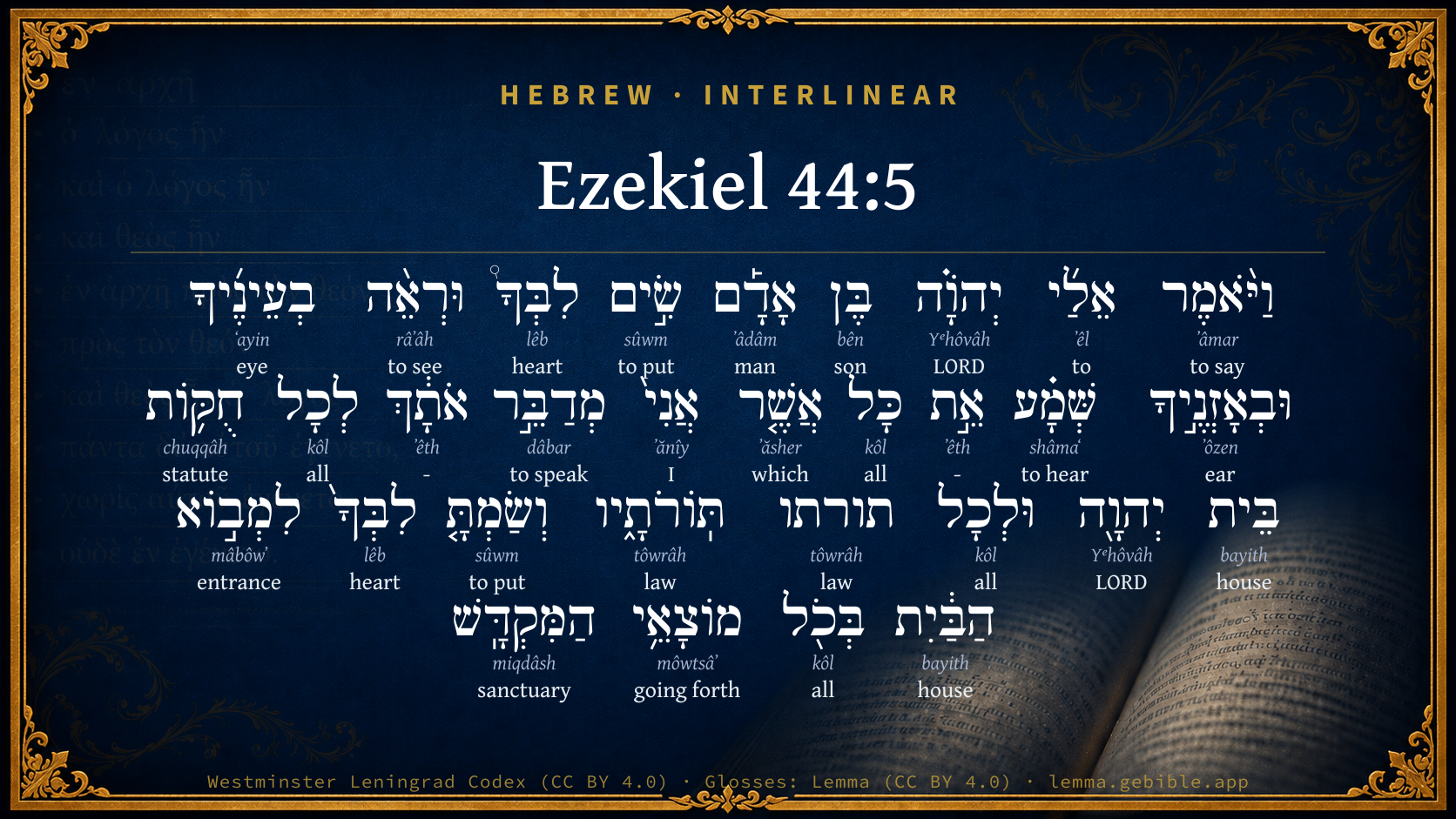
Hebrew (Westminster Leningrad Codex) Ezekiel 44:5 appears in the Hebrew Old Testament. The text above is from the Westminster Leningrad Codex. Each word links to its Strong’s number, a concise gloss, and parsing drawn from the Open Scriptures Hebrew Bible morphology. Click any word for its full Brown-Driver-Briggs (BDB) entry.
Download image
Cite this verse

Ezekiel 44:5 (World English Bible). Public Domain. Lemma interlinear Bible study tool, https://lemma.gebible.app/v/ezekiel/44/5.

Show BibTeX & RIS
BibTeX
RIS
English Translation
Yahweh said to me, Son of man, mark well, and see with your eyes, and hear with your ears all that I tell you concerning all the ordinances of the house of Yahweh, and all the laws of it; and mark well the entrance of the house, with every exit of the sanctuary.
World English Bible · Public Domain
Download a study sheet

One document with this verse’s original text, its word-by-word gloss line, the meaning frame, cross-references with their text, attributed commentary, and full source and license credits — printable, and it pastes into notes with its structure intact.

This verse Autodidact and up

Study sheet (.html) Plain text (.txt)

A passage Seminary Student

Up to 50 verses in one chapter. A passage sheet keeps up to 6 commentary sources and 12 cross-references per verse, in the order this page ranks them, and says so on the sheet whenever that leaves anything out. Ask for a single verse and you get the Autodidact verse sheet above.

Everything on this page stays free to read, with no account — the sheet is a download of what is already on screen, not access to it.

Want to remove ads? Support Godless Engineer
Compare translations 3

The same verse in 3 English versions, stacked beneath the original-language interlinear above. Click any original word for its lexicon entry.

Each is an independent rendering of the whole verse — the interlinear is not word-aligned to these translations.

Highlighted words mark where these versions differ — a whole-verse word diff, not a word-by-word alignment.

  • World English Bible Public Domain
    Yahweh said to me, Son of man, mark well, and see with your eyes, and hear with your ears all that I tell you concerning all the ordinances of the house of Yahweh, and all the laws of it; and mark well the entrance of the house, with every exit of the sanctuary.
  • King James Version Public Domain
    And the LORD said unto me, Son of man, mark well, and behold with thine eyes, and hear with thine ears all that I say unto thee concerning all the ordinances of the house of the LORD, and all the laws thereof; and mark well the entering in of the house, with every going forth of the sanctuary.
  • unfoldingWord Literal Text CC BY-SA 4.0
    Then Yahweh said to me, “Son of man, set your heart and look with your eyes and listen with your ears to all that I am declaring to you, to all the statutes of the house of Yahweh and all its regulations. Think about the house’s entrance and exits.

unfoldingWord Literal Text — © unfoldingWord, licensed CC BY-SA 4.0. Word-aligned USFM3 via Door43 (git.door43.org/unfoldingWord/en_ult).

Versions to compare (up to 4)

3 of 4 selected

Show all 18 translations

Every available English version of this verse, each an independent rendering of the whole verse.

  • World English Bible Public Domain
    Yahweh said to me, Son of man, mark well, and see with your eyes, and hear with your ears all that I tell you concerning all the ordinances of the house of Yahweh, and all the laws of it; and mark well the entrance of the house, with every exit of the sanctuary.
  • Berean Standard Bible Public Domain
    The LORD said to me: “Son of man, pay attention; look carefully with your eyes and listen closely with your ears to everything I tell you concerning all the statutes and laws of the house of the LORD. Take careful note of the entrance to the temple, along with all the exits of the sanctuary.
  • Majority Standard Bible Public Domain
    The LORD said to me: “Son of man, pay attention; look carefully with your eyes and listen closely with your ears to everything I tell you concerning all the statutes and laws of the house of the LORD. Take careful note of the entrance to the temple, along with all the exits of the sanctuary.
  • King James Version Public Domain
    And the LORD said unto me, Son of man, mark well, and behold with thine eyes, and hear with thine ears all that I say unto thee concerning all the ordinances of the house of the LORD, and all the laws thereof; and mark well the entering in of the house, with every going forth of the sanctuary.
  • American Standard Version (1901) Public Domain
    And Jehovah said unto me, Son of man, mark well, and behold with thine eyes, and hear with thine ears all that I say unto thee concerning all the ordinances of the house of Jehovah, and all the laws thereof; and mark well the entrance of the house, with every egress of the sanctuary.
  • Revised Version (1885) Public Domain
    And the LORD said unto me, Son of man, mark well, and behold with thine eyes, and hear with thine ears all that I say unto thee concerning all the ordinances of the house of the LORD, and all the laws thereof; and mark well the entering in of the house, with every going forth of the sanctuary.
  • Geneva Bible (1599) Public Domain
    And the Lord sayd vnto me, Sonne of man, marke well, and behold with thine eyes, and heare with thine eares, all that I say vnto thee, concerning al the ordinances of the house of the Lord, and al the lawes thereof, and marke well the entring in of the house with euery going forth of the Sanctuarie,
  • Douay-Rheims (1899) Public Domain
    And the Lord said to me: Son of man, attend with thy heart, and behold with thy eyes, and hear with thy ears, all that I say to thee concerning all the ceremonies of the house of the Lord, and concerning all the laws thereof: and mark well the ways of the temple, with all the goings out of the sanctuary.
  • Young's Literal Translation Public Domain
    And Jehovah saith unto me, `Son of man, set thy heart, and see with thine eyes, and with thine ears hear, all that I am speaking with thee, of all the statutes of the house of Jehovah, and of all its laws; and thou hast set thy heart to the entrance of the house, with all the outlets of the sanctuary,
  • Literal Standard Version CC BY-SA 4.0
    And YHWH says to me, “Son of man, set your heart, and see with your eyes, and hear with your ears, all that I am speaking with you, all of the statutes of the house of YHWH, and all of its laws; and you have set your heart to the entrance of the house, with all the outlets of the sanctuary,
  • Unlocked Literal Bible CC BY-SA 4.0
    Then Yahweh said to me, “Son of man, set your heart and look with your eyes and listen with your ears to all that I am declaring to you, to all the statutes of the house of Yahweh and all its regulations. Think about the house's entrance and exits.
  • unfoldingWord Literal Text CC BY-SA 4.0
    Then Yahweh said to me, “Son of man, set your heart and look with your eyes and listen with your ears to all that I am declaring to you, to all the statutes of the house of Yahweh and all its regulations. Think about the house’s entrance and exits.
  • Darby Bible Public Domain
    And Jehovah said unto me, Son of man, apply thy heart, and behold with thine eyes, and hear with thine ears all that I say unto thee concerning all the statutes of the house of Jehovah, and all the laws thereof; and mark well the entering in of the house, with every going forth of the sanctuary;
  • World Messianic Bible Public Domain
    The LORD said to me, “Son of man, mark well, and see with your eyes, and hear with your ears all that I tell you concerning all the ordinances of the LORD’s house and all its laws; and mark well the entrance of the house, with every exit of the sanctuary.
  • Webster's Bible Public Domain
    And the LORD said to me, Son of man mark well, and behold with thy eyes, and hear with thy ears all that I say to thee concerning all the ordinances of the house of the LORD, and all its laws; and mark well the entrance of the house, with every going forth of the sanctuary;
  • Free Bible Version CC BY-SA 4.0
    The Lord told me, “Son of man, concentrate! Keep your eyes open! Listen carefully to everything I tell you about all the regulations and laws of the Lord's Temple. Pay close attention to the Temple entrance and all the exits of the sanctuary.
  • Bible in Basic English Public Domain
    And the Lord said to me, Son of man, take to heart, and let your eyes see and your ears be open to everything I say to you about all the rules of the house of the Lord and all its laws; and take note of the ways into the house and all the ways out of the holy place.
  • JPS Tanakh (1917) Public Domain
    And the LORD said unto me: 'Son of man, mark well, and behold with thine eyes, and hear with thine ears all that I say unto thee concerning all the ordinances of the house of the LORD, and all the laws thereof; and mark well the entering in of the house, with every going forth of the sanctuary.

Literal Standard Version (2020), Covenant Press — licensed CC BY-SA 4.0. Text via the HelloAO Bible API (eBible.org). Unlocked Literal Bible (unfoldingWord) — licensed CC BY-SA 4.0. Text via the HelloAO Bible API (eBible.org). unfoldingWord Literal Text — © unfoldingWord, licensed CC BY-SA 4.0. Word-aligned USFM3 via Door43 (git.door43.org/unfoldingWord/en_ult). Free Bible Version, Dr. Jonathan Gallagher — licensed CC BY-SA 4.0. Text via the HelloAO Bible API (eBible.org).

Word by word

More ways to search: Search by grammar → Find every occurrence → Compare this word →

Practice this passage: Drill this verse → Learn its vocabulary →

לִמְב֣וֹא
mâbôwʼ
H3996
“to/for · entrance of”
Preposition + Noun, Common, Masculine, Singular, Construct
Part of Speech
Preposition + Noun
Type
Common
Gender
Masculine
Number
Singular
State
Construct
Full BDB Definition

Origin: from H935

TWOT: 212b

entrance, a coming in, entering - sunset - sunset - sunset, west
  1. וַיֹּ֨אמֶר ʼâmar H559 “and · to say” Conjunction + Verb, Qal, Sequential Imperfect, 3rd Person, Masculine, Singular
  2. אֵלַ֜י ʼêl H413 “to · me” Preposition + Suffix, Personal, 1st Person, Common, Singular
  3. יְהֹוָ֗ה Yᵉhôvâh H3068 “LORD” Noun, Proper
  4. בֶּן bên H1121 “son of” Noun, Common, Masculine, Singular, Construct
  5. אָדָ֡ם ʼâdâm H120 “man” Noun, Common, Masculine, Singular, Absolute
  6. שִׂ֣ים sûwm H7760 “put” Verb, Qal, Imperative, 2nd Person, Masculine, Singular
  7. לִבְּךָ֩ lêb H3820 “heart · your” Noun, Common, Masculine, Singular, Construct + Suffix, Personal, 2nd Person, Masculine, Singular
  8. וּרְאֵ֨ה râʼâh H7200 “and · see” Conjunction + Verb, Qal, Imperative, 2nd Person, Masculine, Singular
  9. בְעֵינֶ֜יךָ ʻayin H5869 “in/at · eyes · your” Preposition + Noun, Common, Both, Dual, Construct + Suffix, Personal, 2nd Person, Masculine, Singular
  10. וּבְאָזְנֶ֣יךָ ʼôzen H241 “and · in/at · ears · your” Conjunction + Preposition + Noun, Common, Feminine, Dual, Construct + Suffix, Personal, 2nd Person, Masculine, Singular
  11. שְּׁמָ֗ע shâmaʻ H8085 “hear” Verb, Qal, Imperative, 2nd Person, Masculine, Singular
  12. אֵ֣ת ʼêth H853 “-” Particle, Direct Object
  13. כָּל kôl H3605 “all of” Noun, Common, Masculine, Singular, Construct
  14. אֲשֶׁ֤ר ʼăsher H834 “which” Particle, Relative
  15. אֲנִי֙ ʼănîy H589 “I” Pronoun, Personal, 1st Person, Common, Singular
  16. מְדַבֵּ֣ר dâbar H1696 “speaking” Verb, Piel, Participle Active, Masculine, Singular, Absolute
  17. אֹתָ֔ךְ ʼêth H853 “- · you” Particle, Direct Object + Suffix, Personal, 2nd Person, Feminine, Singular
  18. לְכָל kôl H3605 “to/for · all of” Preposition + Noun, Common, Masculine, Singular, Construct
  19. חֻקּ֥וֹת chuqqâh H2708 “statutes of” Noun, Common, Both, Plural, Construct
  20. בֵּית bayith H1004 “house of” Noun, Common, Masculine, Singular, Construct
  21. יְהוָ֖ה Yᵉhôvâh H3068 “LORD” Noun, Proper
  22. וּלְכָל kôl H3605 “and · to/for · all of” Conjunction + Preposition + Noun, Common, Masculine, Singular, Construct
  23. תורתו tôwrâh H8451 “laws · his” Noun, Common, Feminine, Plural, Construct + Suffix, Personal, 3rd Person, Masculine, Singular
  24. תּֽוֹרֹתָ֑יו tôwrâh H8451 “laws · his” Noun, Common, Feminine, Plural, Construct + Suffix, Personal, 3rd Person, Masculine, Singular
  25. וְשַׂמְתָּ֤ sûwm H7760 “and · to put” Conjunction + Verb, Qal, Sequential Perfect, 2nd Person, Masculine, Singular
  26. לִבְּךָ֙ lêb H3820 “heart · your” Noun, Common, Masculine, Singular, Construct + Suffix, Personal, 2nd Person, Masculine, Singular
  27. הַבַּ֔יִת bayith H1004 “the · house” Particle, Definite Article + Noun, Common, Masculine, Singular, Absolute
  28. בְּכֹ֖ל kôl H3605 “in/at · all of” Preposition + Noun, Common, Masculine, Singular, Construct
  29. מוֹצָאֵ֥י môwtsâʼ H4161 “goings forth of” Noun, Common, Masculine, Plural, Construct
  30. הַמִּקְדָּֽשׁ miqdâsh H4720 “the · sanctuary” Particle, Definite Article + Noun, Common, Masculine, Singular, Absolute

About this verse

These counts appear in no published source. They are computed here, from the morphology-tagged text and Lemma’s own curated glosses. What Lemma adds →

31
words
22
distinct lemmas
Prophets
section

Notable vocabulary

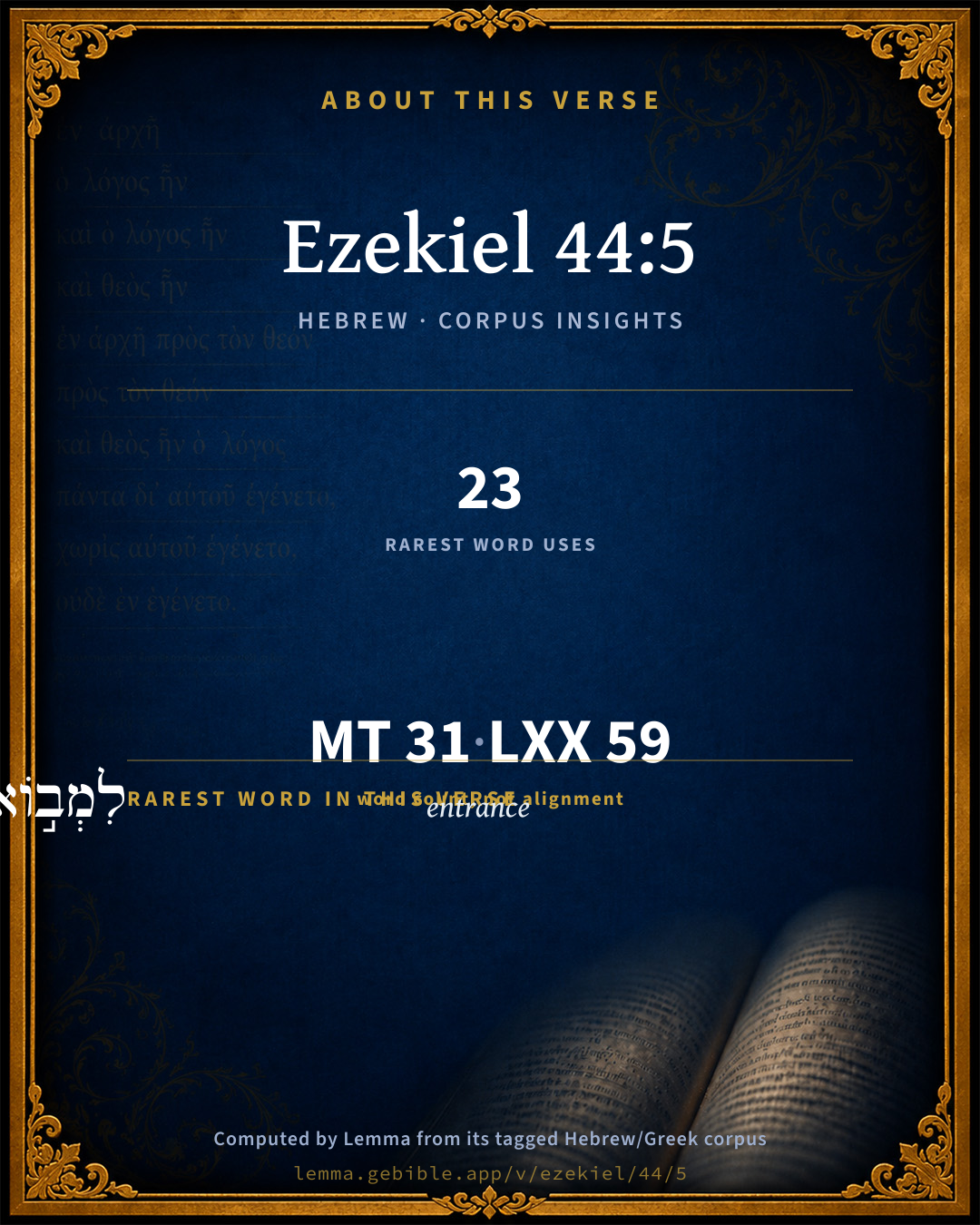
The rarest word here is לִמְב֣וֹא entrance H3996 — appearing just 23 times in the whole Hebrew Bible.

Shared distinctive vocabulary

לִמְב֣וֹא entrance H3996 occurs in 23 verses of the Hebrew Bible. Also found in:

Grammatical profile

  • 6 verbs
  • 20 nouns
  • 1 pronoun
  • 1 preposition
  • 3 particles

Verb forms

  • וַיֹּ֨אמֶר Qal · Sequential Imperfect
  • שִׂ֣ים Qal · Imperative
  • וּרְאֵ֨ה Qal · Imperative
  • שְּׁמָ֗ע Qal · Imperative
  • מְדַבֵּ֣ר Piel · Participle Active
  • וְשַׂמְתָּ֤ Qal · Sequential Perfect

Repetition

Words recur within this verse — often emphatic in Hebrew:

  • כָּל all H3605 ×4
  • יְהֹוָ֗ה LORD H3068 ×2
  • שִׂ֣ים to put H7760 ×2
  • לִבְּךָ֩ heart H3820 ×2
  • בֵּית house H1004 ×2
  • תורתו law H8451 ×2

Hebrew & Septuagint length

In English translation the verse runs 53 words from the Hebrew and 66 from the Septuagint (LXX English) — closely comparable.

A rough comparison of the two English renderings, which tokenize alike — not a word-level alignment.

Word counts can differ between the Hebrew and the Greek without any difference in meaning — e.g. the Hebrew direct-object marker אֵת has no separate Greek word, and Greek often adds the article ὁ.

In the original languages it is 31 Hebrew tokens and 59 Greek tokens — but the two are counted differently (Hebrew bundles its prefixes and suffixes into one token; the Greek is in lemma form), so that isn’t a like-for-like length.

Cross-references

13

Topical passages linked to Ezekiel 44:5 in the Treasury of Scripture Knowledge — connected by theme and wording, ordered by reader-vote popularity; previews shown in the World English Bible.

  • Ezekiel 40:4 The man said to me, Son of man, see with your eyes, and hear with your ears, and set your heart on all that I shall show you; for, to the intent that I may show them to you, are you brought here: declare all that you see to the house of Israel.
  • Ezekiel 43:10–11 You, son of man, show the house to the house of Israel, that they may be ashamed of their iniquities; and let them measure the pattern.
  • Deuteronomy 12:32 Whatever thing I command you, that shall you observe to do: you shall not add thereto, nor diminish from it.
  • Deuteronomy 32:46 He said to them, Set your heart to all the words which I testify to you this day, which you shall command your children to observe to do, [even] all the words of this law.
  • Exodus 9:21 Whoever didn't regard the word of Yahweh left his servants and his cattle in the field.
  • 1 Chronicles 22:19 Now set your heart and your soul to seek after Yahweh your God; arise therefore, and build the sanctuary of Yahweh God, to bring the ark of the covenant of Yahweh, and the holy vessels of God, into the house that is to be built to the name of Yahweh.
  • 2 Chronicles 11:16 After them, out of all the tribes of Israel, such as set their hearts to seek Yahweh, the God of Israel, came to Jerusalem to sacrifice to Yahweh, the God of their fathers.
  • Psalms 96:8–9 Ascribe to Yahweh the glory due to his name. Bring an offering, and come into his courts.
  • Psalms 119:4 You have commanded your precepts, That we should fully obey them.
  • Proverbs 24:32 Then I saw, and considered well. I saw, and received instruction:
  • Daniel 10:12 Then said he to me, Don't be afraid, Daniel; for from the first day that you did set your heart to understand, and to humble yourself before your God, your words were heard: and I am come for your words' sake.
  • Matthew 28:20 teaching them to observe all things that I commanded you. Behold, I am with you always, even to the end of the age." Amen.
  • Acts 8:36 As they went on the way, they came to some water, and the eunuch said, "Behold, here is water. What is keeping me from being baptized?"

Cross-references courtesy of OpenBible.info (CC BY 4.0).

Hebrew and Greek witnesses Masoretic Hebrew ↔ Greek Septuagint

The same verse in the two great witnesses to the Old Testament, shown verse-for-verse.

These are two independent witnesses, not word-aligned to each other, and the Septuagint is shown in lemma (dictionary) form.

Hebrew Ezekiel 44:5 Masoretic · Westminster Leningrad Codex

וַיֹּ֨אמֶר אֵלַ֜י יְהֹוָ֗ה בֶּן אָדָ֡ם שִׂ֣ים לִבְּךָ֩ וּרְאֵ֨ה בְעֵינֶ֜יךָ וּבְאָזְנֶ֣יךָ שְּׁמָ֗ע אֵ֣ת כָּל אֲשֶׁ֤ר אֲנִי֙ מְדַבֵּ֣ר אֹתָ֔ךְ לְכָל חֻקּ֥וֹת בֵּית יְהוָ֖ה וּלְכָל תורתו תּֽוֹרֹתָ֑יו וְשַׂמְתָּ֤ לִבְּךָ֙ לִמְב֣וֹא הַבַּ֔יִת בְּכֹ֖ל מוֹצָאֵ֥י הַמִּקְדָּֽשׁ

Yahweh said to me, Son of man, mark well, and see with your eyes, and hear with your ears all that I tell you concerning all the ordinances of the house of Yahweh, and all the laws of it; and mark well the entrance of the house, with every exit of the sanctuary.

World English Bible · Public Domain

Greek LXX Ezekiel 44:5 Septuagint · lemma form

καί εἶπον κύριος πρός ἐγώ υἱός ἄνθρωπος τάσσω εἰς ὁ καρδία σύ καί ὁράω ὁ ὀφθαλμός σύ καί ὁ οὖς σύ ἀκούω πᾶς ὅσος ἐγώ λαλέω μετά σύ κατά πᾶς ὁ πρόσταγμα οἶκος κύριος καί κατά πᾶς ὁ νόμιμος αὐτός καί τάσσω ὁ καρδία σύ εἰς ὁ εἴσοδος ὁ οἶκος κατά πᾶς ὁ ἔξοδος αὐτός ἐν πᾶς ὁ ἅγιος

And the Lord said to me, Son of man, attend with your heart, and see with your eyes, and hear with your ears all that I say to you, according to all the ordinances of the house of the Lord, and all the regulations thereof; and you shall attend well to the entrance of the house, according to all its outlets, in all the holy things.

LXX2012 (modern English Septuagint) · Public Domain

Hebrew: Westminster Leningrad Codex (CC BY 4.0). Greek: Septuagint (public domain); English from LXX2012 (modern English Septuagint) (Public Domain). How the Septuagint differs from the Hebrew →

Targum (Aramaic paraphrase)

1

The Targum is the ancient Jewish Aramaic paraphrase of the Hebrew Scriptures — an interpretive translation, not the Hebrew text itself. Onkelos (literal) and Pseudo-Jonathan (expansive) render the Torah, and Jonathan the Prophets. Coverage is partial: where no permissively-licensed English translation exists for a verse, only the Aramaic is shown. This is verse-level text, not a word-by-word alignment to the Hebrew.

  1. Targum Jonathan Prophets (Joshua–Malachi)
    וַאֲמַר לִי יְיָ בַּר אָדָם שַׁוִי לִבָּךְ וַחֲזֵי בְעֵינָךְ וּבְאוּדְנָךְ שְׁמַע יַת כָּל דַאֲנָא מְמַלֵיל עִמְךְ לְכָל גְזֵירַת בֵּית מַקְדְשָׁא דַייָ וּלְכָל דַחֲזֵי לֵיהּ וּתְשַׁוֵי לִבָּךְ לְמַעֲלָנֵי בֵיתָא בְכָל מַפְקָנַי מַקְדְשָׁא:

    (no public-domain English translation for this verse)

    Targum Jonathan — Aramaic: “Mikraot Gedolot” (public domain). English: “Sefaria Community Translation” (CC0 1.0 (public-domain dedication)); “London "Chaldee Paraphrase," 1871” (public domain). Text via Sefaria.

Commentary

Notes on Ezekiel 44:5 from classic Christian and Jewish commentators (each source and its license shown beneath its notes). The classic Christian expositions comment on the surrounding passage and are grouped to its opening verse, so a note may address several verses; the Jewish commentaries on the Tanakh (Rashi and others) are per-verse, so they appear only where the commentator wrote on this verse.

Lemma curates 59 commentaries, every one of them public domain or Creative Commons licensed, each selected and text-cleaned for this edition rather than reprinted as found. About our sources →

Trapp's Complete Commentary

John Trapp

Eze 44:5 And the LORD said unto me, Son of man, mark well, and behold with thine eyes, and hear with thine ears all that I say unto thee concerning all the ordinances of the house of the LORD, and all the laws thereof; and mark well the entering in of the house, with every going forth of the sanctuary.

Ver. 5. Mark well, and behold with thine eyes.] Summon the sobriety of thy senses before thine own judgment. See Eze 40:4. The refining of the ministry and discipline of the Church, with the same charge in regard of the excellency of the matter repeated for attention, to Eze 44:17, and laws prescribed to that purpose, Eze 44:17-31.

John Trapp, A Commentary or Exposition upon All the Books of the Old and New Testament (1647–1656) — public domain. Text from a community e-Sword module.

Geneva Bible (1599)

Geneva Bible translators

Hebrew, set thine hearts.

Geneva Bible (1599) marginal notes — public domain. Text via Bolls.life.

Adam Clarke's Commentary

Verse 5. Mark well, and behold] Take notice of every thing; register all so fully that thou shalt be able to give the most minute information to the children of Israel.

Adam Clarke's Commentary on the Bible (1810–1826) — public domain. Text from a community e-Sword/MySword module.

The Cambridge Bible for Schools and Colleges

gen. ed. J. J. S. Perowne

5. He is commanded to give heed to all the ordinances and laws regulating the future service of the house.

entering in of the house] The phrase to the end of the verse is a general designation for all the functions of the house, those who shall be permitted to enter it (Eze_44:10-14), with the manner of their going in and coming out (Eze_44:17-21).

The Cambridge Bible for Schools and Colleges (gen. ed. J. J. S. Perowne; Cambridge University Press, 1878–1918) — public domain. Text from a community e-Sword module.

John Gill's Exposition

And the Lord said unto me, son of man,.... This is still the voice of the Lord speaking out of the house to the prophet, Eze 43:6,

mark well; or, "set thine heart" (f); be attentive to what is about to be said, as being of great concern and importance:

and behold with thine eyes, and hear with thine ears all that I say unto thee; heart, eyes, and ears, are all to be employed in the most diligent manner in regarding the things hereafter delivered; the same expressions exciting attention were used at the first of this vision, Eze 40:4, concerning all the ordinances of the house of the Lord, and all the laws thereof; See Gill on Eze 43:11,

mark well the entering in of the house, with every going forth of the sanctuary; the way of entrance into the Gospel church, and the manner of exclusion from it, and the laws and rules concerning these; the prophet is bid particularly to observe these well, because it was in these things God's professing people chiefly offended, as appears by what follows; they were not so careful as they should have been in the admission of persons among them, or in the exclusion of delinquents.

(f) "pone cor tuum", V. L. Vatablus, Paguinus, Montanus; "pone ad cor tuum", Starckius.

John Gill's Exposition of the Whole Bible (1746–1763) — public domain (CC PDM 1.0). Text via the HelloAO Bible API.

Haydock's Catholic Bible Commentary

Ways, or "the going in," and all that concerns the temple and sacrifices.

George Leo Haydock (1774–1849), Haydock's Catholic Family Bible and Commentary, 1859 edition — public domain. Excludes Psalms (Douay-Rheims chapter numbering differs from Protestant) and Deuterocanonical books (Catholic canon only).

Matthew Poole's English Annotations

The whole of the first part of this verse is found at Eze 40:4, where it is explained.

The ordinances; the prescribed rules for persons and things in and about the temple; these ordinances are called laws in this verse.

Mark well; set thy mind, that thou mayst comprehend them all.

The entering in; not so much the gates and porches, through which the entrance is to the house, as the persons who may, and who may not, enter.

The sanctuary, taken here largely for the holy courts, rather than for the house itself.

Matthew Poole's English Annotations on the Holy Bible (1683–1685) — public domain. Text from a community e-Sword/MySword module.

The Pulpit Commentary

Having fallen on his face before the renewed theophany, the prophet was summoned as once before, (Eze_40:4) but with greater emphasis than before, to mark well, or set his heart to observe, the communications about to be made to him concerning all the ordinances of the house of the Lord, and. all the laws thereof, (see on Eze_43:11) more especially with regard to the persons who should have a right to participate in its services.

The attentive consideration of religious truth.

Ezekiel was to mark well the minute directions which were given to him concerning the temple. He was not a builder, and there is no reason to think that he was expected to consider these matters with a view to carrying out the work of constructing the new temple. But it was important that he should attend to the suggestiveness of every detail, because all that was here set forth was symbolical of spiritual truth. The smallest points of this truth should be considered with exactness, while every effort is made to grasp and comprehend it in its vast length and breadth.

I RELIGIOUS TRUTH IS WORTHY OF ATTENTIVE CONSIDERATION, Great attention is required for a man"s business if that is to be made successful. Politics absorb the thoughts of those who are much engaged in them. Pleasure, and what is called "sport" command earnest attention. Is it right that these things should occupy all a man"s faculties, and that religion should be treated in an off-hand style as not worth much thought? Yet the conduct of multitudes would suggest that this supreme interest could be sufficiently considered by occasional and listless attendance at public worship. But note how important it is.

1. It concerns God. Surely he Maker of all things, Ruler of the universe, "in whom we live and move and have our being," our Father and our God is worthy of some thoughtful attention.

1. It concerns our duty. The chief thing to be thought of is what we ought to do. To give much attention to our worldly interests and pleasures, and to treat our duty with thoughtless indifference, is to show shameful negligence of what is supremely important to us.

2. It concerns our eternal welfare. Religion is a matter of life and death. Its truth embraces eternity. When the petty affairs of this brief life are forgotten, its mighty issues will still proceed to work our highest blessedness or our utter destruction.

II RELIGIOUS TRUTH NEEDS ATTENTIVE CONSIDERATION. It is not to be taken in with indolent ease. A man cannot comprehend his Bible at a glance, as he would his newspaper. Religious truth requires thought for several reasons.

1. It is remote from our common experience. It should not be so; but sin has introduced an entirely different train of ideas. We require an effort to bring thoughts of religion vividly to mind.

2. It is concerned with great mysteries. We can never understand it perfectly; but there is room in it for the explorations of the greatest minds. We must never forget, indeed, that its most precious pearls are for simple, childlike minds; that God has revealed to babes what he has hidden from the wise. (Mat_11:25) But who giver such absorbing attention to what interests them as children? We just need the child"s whole-hearted listening, as when he drinks in a tale, every detail of which he pictures to himself in his fresh imagination.

III RELIGIOUS TRUTH SHOULD RECEIVE ATTENTIVE CONSIDERATION. We now come to the practical point How are we to give full attention to this great subject? Ezekiel suggests three ways.

1. We must fix attention. "Mark well." The mind tends to float away from difficult subjects. The anchor to hold it is some keen interest. The love of truth, or, better, the love of Christ, should serve as such an anchor.

2. We must look into truth. "And behold with thine eyes, and "hear with thine cars." We must, so to speak, visualize truth. To make it real we must see it before us. But first we must look for it. There is a seeing and hearing by experience that is better than all indirect testimony. As soon as we thus come into personal contact with truth it is likely to be interesting to us. Then it is a real thing. Above all, it is well to follow the Greeks, who "would see Jesus," and by living experience to know him for ourselves.

The Pulpit Commentary (1880–1919), ed. H.D.M. Spence-Jones & Joseph S. Exell — public domain. Text from a community e-Sword module.

John Wesley's Explanatory Notes

The entering - The persons who may, and who may not enter. The sanctuary - Taken here for the courts, rather than the house itself.

John Wesley, Explanatory Notes Upon the Whole Bible (1754–1765) — public domain. Text via the GEBible commentary corpus.

Lesson kit

Teaching starters — assembled from the data on this page, not authored interpretation. Every prompt links to the verse data it draws on. Edit before teaching.

Ezekiel, in the Prophets, opens this verse with 31 words (22 distinct Hebrew lemmas). Its most distinctive word is mâbôwʼ (“entrance”). A historical commentator’s framing appears above. Read the whole chapter for the surrounding context.

Discussion questions

  1. The word mâbôwʼ carries the sense “entrance.” How does it shape the verse?
  2. Deuteronomy 11:30 shares the word «entrance» with this verse. How do the two illuminate each other?
  3. “all” occurs 4× in this one verse. What is the effect of the repetition?
  4. These translations render this verse differently. What is at stake in choosing one wording over another?
  5. The verb «וַיֹּ֨אמֶר» is Qal Sequential Imperfect. How does its form color the action?
  6. Reading how Trapp's Complete Commentary and Geneva Bible (1599) read this verse, where do the two commentators agree and where do they part?

Things to notice

Reading settings

Reading text

Shown beneath each verse's original-language words.

Old Testament
Old Testament edition

Read the OT as the Masoretic Hebrew (MT) or the Greek Septuagint (LXX).

English shown for the Greek Septuagint (in the Hebrew ↔ Greek comparison).

Comparing translations? Open the Compare panel on any verse page to stack up to four side by side.