Deuteronomy 29:21

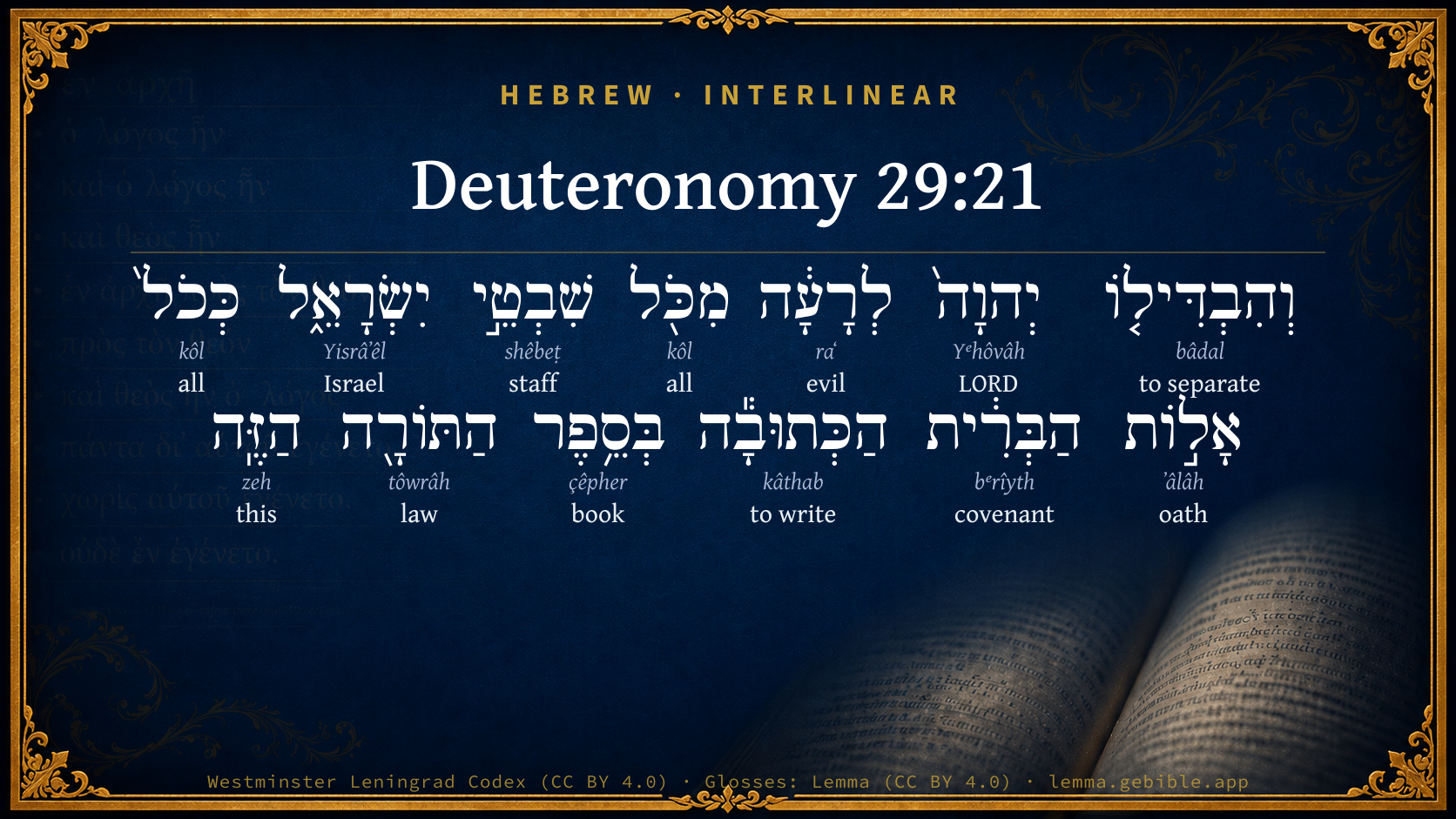
Hebrew (Westminster Leningrad Codex) Deuteronomy 29:21 appears in the Hebrew Old Testament. The text above is from the Westminster Leningrad Codex. Each word links to its Strong’s number, a concise gloss, and parsing drawn from the Open Scriptures Hebrew Bible morphology. Click any word for its full Brown-Driver-Briggs (BDB) entry.
Download image
Cite this verse

Deuteronomy 29:21 (World English Bible). Public Domain. Lemma interlinear Bible study tool, https://lemma.gebible.app/v/deuteronomy/29/21.

Show BibTeX & RIS
BibTeX
RIS
English Translation
Yahweh will set him apart to evil out of all the tribes of Israel, according to all the curses of the covenant that is written in this book of the law.
World English Bible · Public Domain
Download a study sheet

One document with this verse’s original text, its word-by-word gloss line, the meaning frame, cross-references with their text, attributed commentary, and full source and license credits — printable, and it pastes into notes with its structure intact.

This verse Autodidact and up

Study sheet (.html) Plain text (.txt)

A passage Seminary Student

Up to 50 verses in one chapter. A passage sheet keeps up to 6 commentary sources and 12 cross-references per verse, in the order this page ranks them, and says so on the sheet whenever that leaves anything out. Ask for a single verse and you get the Autodidact verse sheet above.

Everything on this page stays free to read, with no account — the sheet is a download of what is already on screen, not access to it.

Want to remove ads? Support Godless Engineer
Compare translations 3

The same verse in 3 English versions, stacked beneath the original-language interlinear above. Click any original word for its lexicon entry.

Each is an independent rendering of the whole verse — the interlinear is not word-aligned to these translations.

Highlighted words mark where these versions differ — a whole-verse word diff, not a word-by-word alignment.

  • World English Bible Public Domain
    Yahweh will set him apart to evil out of all the tribes of Israel, according to all the curses of the covenant that is written in this book of the law.
  • King James Version Public Domain
    And the LORD shall separate him unto evil out of all the tribes of Israel, according to all the curses of the covenant that are written in this book of the law:
  • unfoldingWord Literal Text CC BY-SA 4.0
    And Yahweh will separate him for disaster from all the tribes of Israel, according to all the curses of the covenant written in this book of the law.

unfoldingWord Literal Text — © unfoldingWord, licensed CC BY-SA 4.0. Word-aligned USFM3 via Door43 (git.door43.org/unfoldingWord/en_ult).

Versions to compare (up to 4)

3 of 4 selected

Show all 18 translations

Every available English version of this verse, each an independent rendering of the whole verse.

  • World English Bible Public Domain
    Yahweh will set him apart to evil out of all the tribes of Israel, according to all the curses of the covenant that is written in this book of the law.
  • Berean Standard Bible Public Domain
    and single him out from all the tribes of Israel for disaster, according to all the curses of the covenant written in this Book of the Law.
  • Majority Standard Bible Public Domain
    and single him out from all the tribes of Israel for disaster, according to all the curses of the covenant written in this Book of the Law.
  • King James Version Public Domain
    And the LORD shall separate him unto evil out of all the tribes of Israel, according to all the curses of the covenant that are written in this book of the law:
  • American Standard Version (1901) Public Domain
    And Jehovah will set him apart unto evil out of all the tribes of Israel, according to all the curses of the covenant that is written in this book of the law.
  • Revised Version (1885) Public Domain
    And the LORD shall separate him unto evil out of all the tribes of Israel, according to all the curses of the covenant that is written in this book of the law.
  • Geneva Bible (1599) Public Domain
    And the Lord shall separate him vnto euil out of all the tribes of Israel, according vnto all the curses of the couenant, that is written in the booke of this Lawe.
  • Douay-Rheims (1899) Public Domain
    And utterly destroy him out of all the tribes of Israel, according to the curses that are contained in the book of this law and covenant:
  • Young's Literal Translation Public Domain
    and Jehovah hath separated him for evil, out of all the tribes of Israel, according to all the oaths of the covenant which is written in this book of the law.
  • Literal Standard Version CC BY-SA 4.0
    and YHWH has separated him for calamity out of all the tribes of Israel, according to all the oaths of the covenant which is written in this Scroll of the Law.
  • Unlocked Literal Bible CC BY-SA 4.0
    Yahweh will set him apart for disaster out of all the tribes of Israel, in keeping with all the curses of the covenant that are written in this book of the law.
  • unfoldingWord Literal Text CC BY-SA 4.0
    And Yahweh will separate him for disaster from all the tribes of Israel, according to all the curses of the covenant written in this book of the law.
  • Darby Bible Public Domain
    and Jehovah will separate him for mischief out of all the tribes of Israel, according to all the curses of the covenant that is written in this book of the law.
  • World Messianic Bible Public Domain
    The LORD will set him apart for evil out of all the tribes of Israel, according to all the curses of the covenant written in this scroll of the Torah.
  • Webster's Bible Public Domain
    And the LORD shall separate him to evil out of all the tribes of Israel according to all the curses of the covenant that are written in this book of the law:
  • Free Bible Version CC BY-SA 4.0
    and will punish them as an example to all the Israelite tribes, in accordance with all the curses of the agreement written in this Book of the Law.
  • Bible in Basic English Public Domain
    He will be marked out by the Lord, from all the tribes of Israel, for an evil fate, in keeping with all the curses of the agreement recorded in this book of the law.
  • JPS Tanakh (1917) Public Domain
    (29-20) and the LORD shall separate him unto evil out of all the tribes of Israel, according to all the curses of the covenant that is written in this book of the law.

Literal Standard Version (2020), Covenant Press — licensed CC BY-SA 4.0. Text via the HelloAO Bible API (eBible.org). Unlocked Literal Bible (unfoldingWord) — licensed CC BY-SA 4.0. Text via the HelloAO Bible API (eBible.org). unfoldingWord Literal Text — © unfoldingWord, licensed CC BY-SA 4.0. Word-aligned USFM3 via Door43 (git.door43.org/unfoldingWord/en_ult). Free Bible Version, Dr. Jonathan Gallagher — licensed CC BY-SA 4.0. Text via the HelloAO Bible API (eBible.org).

Word by word

More ways to search: Search by grammar → Find every occurrence → Compare this word →

Practice this passage: Drill this verse → Learn its vocabulary →

אָל֣וֹת
ʼâlâh
H423
“oaths of”
Noun, Common, Feminine, Plural, Construct
Part of Speech
Noun
Type
Common
Gender
Feminine
Number
Plural
State
Construct
Full BDB Definition

Origin: from H422

TWOT: 91a

oath - oath of covenant - curse - from God - from men - execration
  1. וְהִבְדִּיל֤וֹ bâdal H914 “and · to separate · him” Conjunction + Verb, Hiphil, Sequential Perfect, 3rd Person, Masculine, Singular + Suffix, Personal, 3rd Person, Masculine, Singular
  2. יְהוָה֙ Yᵉhôvâh H3068 “LORD” Noun, Proper
  3. לְרָעָ֔ה raʻ H7451 “to/for · evil” Preposition + Noun, Common, Feminine, Singular, Absolute
  4. מִכֹּ֖ל kôl H3605 “from · all of” Preposition + Noun, Common, Masculine, Singular, Construct
  5. שִׁבְטֵ֣י shêbeṭ H7626 “staffs of” Noun, Common, Masculine, Plural, Construct
  6. יִשְׂרָאֵ֑ל Yisrâʼêl H3478 “Israel” Noun, Proper
  7. כְּכֹל֙ kôl H3605 “like/as · all of” Preposition + Noun, Common, Masculine, Singular, Construct
  8. הַבְּרִ֔ית bᵉrîyth H1285 “the · covenant” Particle, Definite Article + Noun, Common, Feminine, Singular, Absolute
  9. הַכְּתוּבָ֕ה kâthab H3789 “the · written” Particle, Definite Article + Verb, Qal, Participle Passive, Feminine, Singular, Absolute
  10. בְּסֵ֥פֶר çêpher H5612 “in/at · book of” Preposition + Noun, Common, Masculine, Singular, Construct
  11. הַתּוֹרָ֖ה tôwrâh H8451 “the · law” Particle, Definite Article + Noun, Common, Feminine, Singular, Absolute
  12. הַזֶּֽה zeh H2088 “the · this” Particle, Definite Article + Pronoun, Demonstrative, Masculine, Singular

About this verse

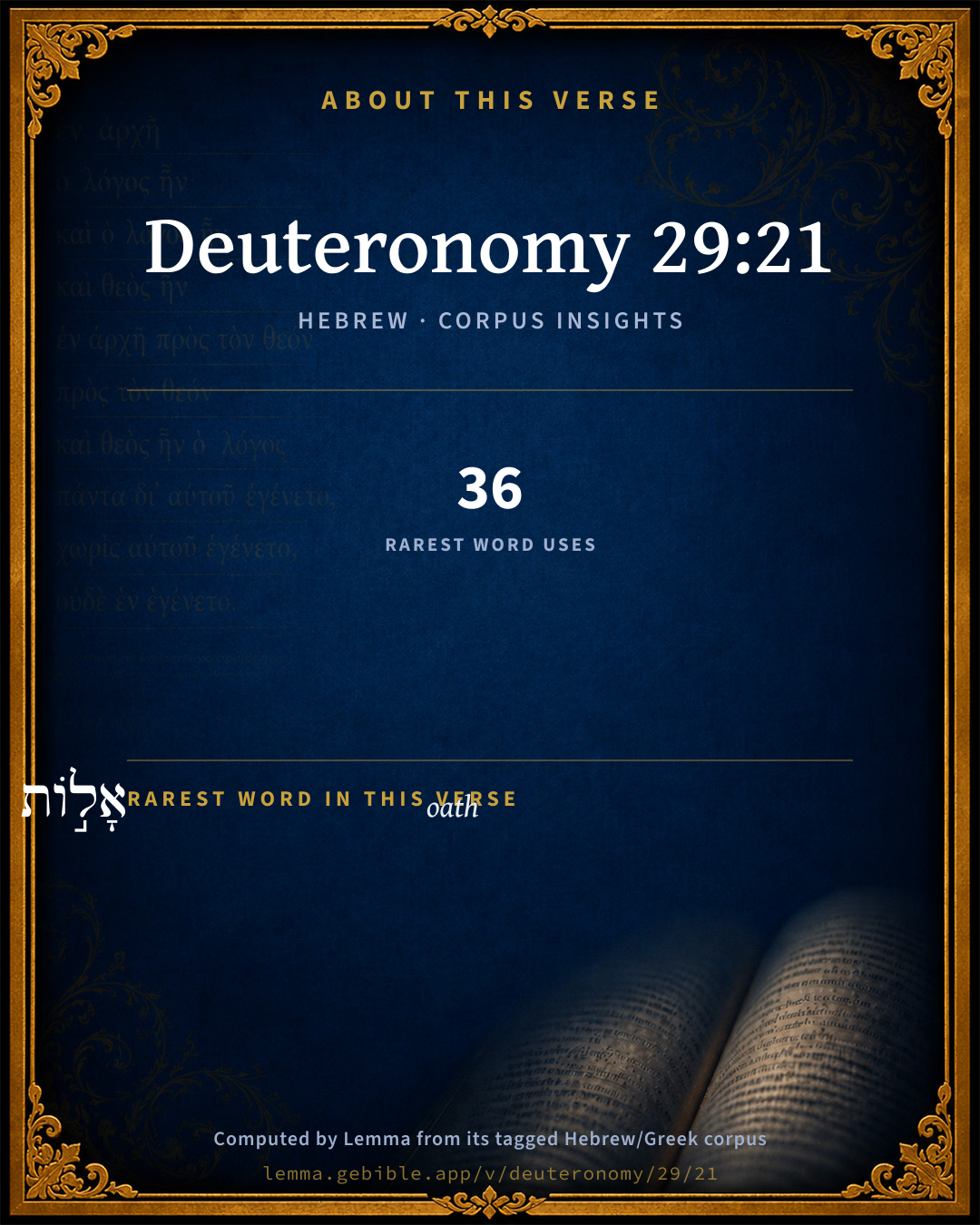
These counts appear in no published source. They are computed here, from the morphology-tagged text and Lemma’s own curated glosses. What Lemma adds →

13
words
12
distinct lemmas
Pentateuch
section

Shared distinctive vocabulary

אָל֣וֹת oath H423 occurs in 32 verses of the Hebrew Bible. Also found in:

Grammatical profile

  • 2 verbs
  • 10 nouns
  • 1 pronoun

Verb forms

  • וְהִבְדִּיל֤וֹ Hiphil · Sequential Perfect
  • הַכְּתוּבָ֕ה Qal · Participle Passive

Repetition

A word recurs within this verse — often emphatic in Hebrew:

  • מִכֹּ֖ל all H3605 ×2

Hebrew & Septuagint length

In English translation the verse runs 31 words from the Hebrew and 32 from the Septuagint (LXX English) — closely comparable.

A rough comparison of the two English renderings, which tokenize alike — not a word-level alignment.

Word counts can differ between the Hebrew and the Greek without any difference in meaning — e.g. the Hebrew direct-object marker אֵת has no separate Greek word, and Greek often adds the article ὁ.

Cross-references

7

Topical passages linked to Deuteronomy 29:21 in the Treasury of Scripture Knowledge — connected by theme and wording, ordered by reader-vote popularity; previews shown in the World English Bible.

  • Joshua 7:1–26 But the children of Israel committed a trespass in the devoted thing; for Achan, the son of Carmi, the son of Zabdi, the son of Zerah, of the tribe of Judah, took of the devoted thing: and the anger of Yahweh was kindled against the children of Israel.
  • Ezekiel 13:9 My hand shall be against the prophets who see false visions, and who divine lies: they shall not be in the council of my people, neither shall they be written in the writing of the house of Israel, neither shall they enter into the land of Israel; and you shall know that I am the Lord Yahweh.
  • Malachi 3:18 Then you shall return and discern between the righteous and the wicked, between him who serves God and him who doesn't serve him.
  • Matthew 24:51 and will cut him in pieces, and appoint his portion with the hypocrites; there is where the weeping and grinding of teeth will be.
  • Matthew 25:32 Before him all the nations will be gathered, and he will separate them one from another, as a shepherd separates the sheep from the goats.
  • Matthew 25:41 Then he will say also to those on the left hand, 'Depart from me, you cursed, into the eternal fire which is prepared for the devil and his angels;
  • Matthew 25:46 These will go away into eternal punishment, but the righteous into eternal life."

Cross-references courtesy of OpenBible.info (CC BY 4.0).

Hebrew and Greek witnesses Masoretic Hebrew ↔ Greek Septuagint

The same verse in the two great witnesses to the Old Testament, shown verse-for-verse.

These are two independent witnesses, not word-aligned to each other, and the Septuagint is shown in lemma (dictionary) form.

Hebrew Deuteronomy 29:21 Masoretic · Westminster Leningrad Codex

וְהִבְדִּיל֤וֹ יְהוָה֙ לְרָעָ֔ה מִכֹּ֖ל שִׁבְטֵ֣י יִשְׂרָאֵ֑ל כְּכֹל֙ אָל֣וֹת הַבְּרִ֔ית הַכְּתוּבָ֕ה בְּסֵ֥פֶר הַתּוֹרָ֖ה הַזֶּֽה

Yahweh will set him apart to evil out of all the tribes of Israel, according to all the curses of the covenant that is written in this book of the law.

World English Bible · Public Domain

Greek LXX Deuteronomy 29:21 Septuagint · lemma form

καί εἶπον ὁ γενεά ὁ ἕτερος ὁ υἱός σύ ὅς ἀναἵστημι μετά σύ καί ὁ ἀλλότριος ὅς ἄν ἔρχομαι ἐκ γῆ μακρόθεν καί ὁράω ὁ πληγή ὁ γῆ ἐκεῖνος καί ὁ νόσος αὐτός ὅς ἀποστέλλω κύριος ἐπί αὐτός

And the Lord shall separate that man for evil of all the children of Israel, according to all the curses of the covenant that are written in the book of this law.

LXX2012 (modern English Septuagint) · Public Domain

Hebrew: Westminster Leningrad Codex (CC BY 4.0). Greek: Septuagint (public domain); English from LXX2012 (modern English Septuagint) (Public Domain). How the Septuagint differs from the Hebrew →

Targum (Aramaic paraphrase)

2

The Targum is the ancient Jewish Aramaic paraphrase of the Hebrew Scriptures — an interpretive translation, not the Hebrew text itself. Onkelos (literal) and Pseudo-Jonathan (expansive) render the Torah, and Jonathan the Prophets. Coverage is partial: where no permissively-licensed English translation exists for a verse, only the Aramaic is shown. This is verse-level text, not a word-by-word alignment to the Hebrew.

  1. Targum Onkelos Torah (Genesis–Deuteronomy)
    וְיֵימַר דָרָא בַתְרָאָה בְּנֵיכוֹן דִי יְקוּמוּן מִבַּתְרֵיכוֹן וּבַר עַמְמִין דִי יֵיתֵי מֵאַרְעָא רְחִיקָא וְיֶחֱזוּן יָת מְחָתָא דְאַרְעָא הַהִיא וְיָת מַרְעָהָא דִי אַמְרַע יְיָ בַּהּ

    (no public-domain English translation for this verse)

    Targum Onkelos — Aramaic: “Onkelos Genesis” (public domain); “Onkelos Exodus” (public domain); “Onkelos Leviticus” (public domain); “Onkelos Numbers” (public domain); “Onkelos Deuteronomy” (public domain). English: “Sefaria Community Translation” (CC0 1.0 (public-domain dedication)); “J.W. Etheridge. The Targums of Onkelos and Jonathan Ben Uzziel on the Pentateuch. London: Longmans, Green, 1862” (public domain). Text via Sefaria.

  2. Targum Pseudo-Jonathan Torah (Genesis–Deuteronomy)
    וְיֵימְרוּן דָרַיָא בַּתְרָאֵי בְּנֵיכוֹן דִי יְקוּמוּן מִן בַּתְרֵיכוֹן וּבַר עַמְמֵי דְיֵיתֵי מֵאַרַע רְחִיקָא וְיֶחְמוּן יַת מַחֲוָותָא דְאַרְעָא הַהִיא וְיַת מַרְעָהָא דְגָרֵי יְיָ בָּהּ

    And the generations of your children who will arise after you, and the stranger who will come from a far-off land, when they see the plagues of that land, and the afflictions which the Lord will have sent upon it,

    Targum Pseudo-Jonathan — Aramaic: “Targum Jonathan on Genesis” (public domain); “Targum Jonathan on Exodus” (public domain); “Targum Jonathan on Leviticus” (public domain); “Targum Jonathan on Numbers” (public domain); “Targum Jonathan on Deuteronomy” (public domain). English: “The Targum of Jonathan ben Uzziel, trans. J. W. Etheridge, London, 1862” (public domain). Text via Sefaria.

Commentary

Notes on Deuteronomy 29:21 from classic Christian and Jewish commentators (each source and its license shown beneath its notes). The classic Christian expositions comment on the surrounding passage and are grouped to its opening verse, so a note may address several verses; the Jewish commentaries on the Tanakh (Rashi and others) are per-verse, so they appear only where the commentator wrote on this verse.

Lemma curates 59 commentaries, every one of them public domain or Creative Commons licensed, each selected and text-cleaned for this edition rather than reprinted as found. About our sources →

John Gill's Exposition

So that the generation to come of your children that shall rise up after you,.... Not the next generation, but in future times, in ages to come, at a great distance, even after the destruction of Judea by the Romans; to which Deu 29:23 seems to refer:

and the stranger that shall come from a far land; on trade and business, or for the sake of travelling, his road either lying through it, or his curiosity leading him to see it:

shall say, when they see the plagues of the land; cities and towns in ruins, fields lie uncultivated, and the whole land depopulated, and all become a barren wilderness, which was once a fruitful country, a land flowing with milk and honey:

and the sicknesses which the Lord hath laid upon it; upon the inhabitants of it, as the pestilence and other diseases, which shall have swept the land of them; see Deu 28:22. This case supposes a general departure from the worship of God to the service of idols; otherwise single individuals are punished in their own persons, as in the Deu 29:21.

John Gill's Exposition of the Whole Bible (1746–1763) — public domain (CC PDM 1.0). Text via the HelloAO Bible API.

Trapp's Complete Commentary

John Trapp

Deu 29:21 And the LORD shall separate him unto evil out of all the tribes of Israel, according to all the curses of the covenant that are written in this book of the law:

Ver. 21. And the Lord shall separate him unto evil.] Shall single him out as an object of his wrath; as the huntsman severeth out from the rest a stag to hunt for that day.

John Trapp, A Commentary or Exposition upon All the Books of the Old and New Testament (1647–1656) — public domain. Text from a community e-Sword module.

Tyndale Open Study Notes

Tyndale Open Resources

29:21 Book of Instruction (literally book of the torah): Here, this phrase refers to all of Deuteronomy, of which the list of curses (ch 28) is a part (see 27:3).

Tyndale Open Study Notes — © Tyndale Open Resources, licensed CC BY-SA 4.0. Text via the HelloAO Bible API.

Ellicott's Commentary for English Readers

(21, 22) And the Lord shall separate him unto evil . . . so that the generation to come . . . shall say . . . of that land.—It is not a little remarkable that the sin of one man is here represented as growing and spreading devastation over the whole land of Israel—the very thing which the man apparently regards as impossible in his inward reasonings, described in Deu_29:19. Yet is not this the true anticipation of what actually occurred? Comp. 1Ki_14:15-16 : “The Lord shall root up Israel out of this good land, which He gave to their fathers . . . and He shall give Israel up because of the sins of Jeroboam, who did sin, and who made Israel to sin” And what Jeroboam was to Israel, Manasseh was to Judah (Jer_15:4): “I will cause them to be removed into all kingdoms of the earth, because of Manasseh the son of Hezekiah, king of Judah, for that which he did in Jerusalem.”

A Bible Commentary for English Readers, edited by Charles John Ellicott (1878–1897) — public domain. Text from a community e-Sword module.

The Cambridge Bible for Schools and Colleges

gen. ed. J. J. S. Perowne

21. separate] See on Deu_4:41. Unto evil, Jer_21:10; Jer_29:11; Jer_38:4; Jer_39:16; Jer_44:11; Jer_44:27; Jer_44:29; but also in Amo_9:4, Jdg_2:15 (deuteronomic).

this book of the law] See Deu_28:61.

22–28 illustrate the last clause of 19 and predict how the whole land and people shall suffer for the sins of the idolaters.

The Cambridge Bible for Schools and Colleges (gen. ed. J. J. S. Perowne; Cambridge University Press, 1878–1918) — public domain. Text from a community e-Sword module.

Matthew Poole's English Annotations

Unto evil, i.e. unto some peculiar and exemplary plague; he will make him a monument of his displeasure to the whole land.

According to all the curses of the covenant; he intimates that the covenant of grace, which God made with them, hath not only blessings belonging to it, as this foolish person imagined, but curses also to the transgressors of it.

Matthew Poole's English Annotations on the Holy Bible (1683–1685) — public domain. Text from a community e-Sword/MySword module.

John Wesley's Explanatory Notes

Unto evil - Unto some peculiar and exemplary plague; he will make him a monument of his displeasure to the whole land.

John Wesley, Explanatory Notes Upon the Whole Bible (1754–1765) — public domain. Text via the GEBible commentary corpus.

Ramban (Nachmanides)

Rabbi Moshe ben Nachman (Ramban / Nachmanides)

AND THE REMOTE GENERATION, YOUR CHILDREN THAT SHALL RISE UP AFTER YOU, SHALL SAY. For the tribes of Israel in the first generation already knew [the cause of the disaster] for they heard the imprecations of the covenant [and therefore he states that the future generation will inquire into the cause of the disaster]. It is possible that this verse refers back to the root that beareth gall and wormwood, that when this occurs in future generations, they will inquire into its cause.

Ramban (Nachmanides) on the Tanakh — English translation: “Commentary on the Torah by Ramban (Nachmanides). Translated and annotated by Charles B. Chavel. New York, Shilo Pub. House, 1971-1976” (CC BY 4.0). Text via Sefaria.

Ibn Ezra

Rabbi Abraham ibn Ezra

The latter generation will say. This refers to both your children, and also the gentiles who see the plagues in your land.

Ibn Ezra on the Tanakh — English translations: “Sefaria Community Translation” (CC0 1.0 (public-domain dedication)); “Yalkut, Sifsei Chachomim Chumash, Metsudah Publications, 2009” (CC BY 4.0); and “Commentary of Ibn Ezra on Isaiah - trans. by M. Friedlander, 1873” (public domain). Text via Sefaria.

Lesson kit

Teaching starters — assembled from the data on this page, not authored interpretation. Every prompt links to the verse data it draws on. Edit before teaching.

Deuteronomy, in the Pentateuch, opens this verse with 13 words (12 distinct Hebrew lemmas). Its most distinctive word is ʼâlâh (“oath”). A historical commentator’s framing appears above. Read the whole chapter for the surrounding context.

Discussion questions

  1. What does “oath” (ʼâlâh) contribute to the verse as a whole?
  2. How does Genesis 24:41, which shares the word «oath», read alongside this verse?
  3. What does the repetition of “all” (2× in this one verse) do in this verse?
  4. The translations on this page render this verse differently — a whole-verse word diff, not a word-by-word alignment. What might account for the different wordings?
  5. «וְהִבְדִּיל֤וֹ» is a Hiphil Sequential Perfect verb. How does that grammatical form shape the action described?
  6. Compare how John Gill's Exposition and Trapp's Complete Commentary read this verse. Where do they agree or differ?

Things to notice

Reading settings

Reading text

Shown beneath each verse's original-language words.

Old Testament
Old Testament edition

Read the OT as the Masoretic Hebrew (MT) or the Greek Septuagint (LXX).

English shown for the Greek Septuagint (in the Hebrew ↔ Greek comparison).

Comparing translations? Open the Compare panel on any verse page to stack up to four side by side.