
Proverbs 6:23

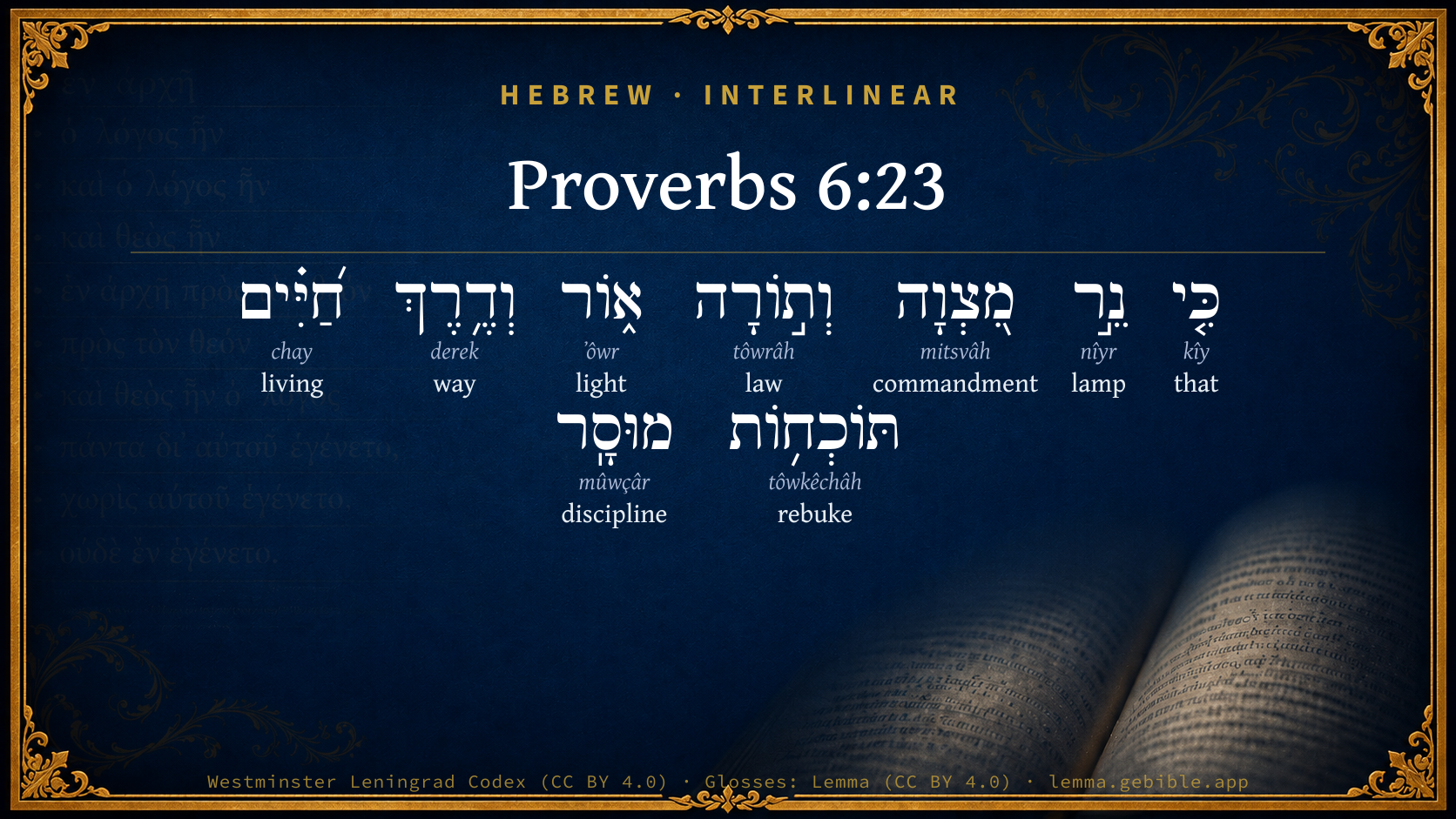
Hebrew (Westminster Leningrad Codex) Proverbs 6:23 appears in the Hebrew Old Testament. The text above is from the Westminster Leningrad Codex. Each word links to its Strong’s number, a concise gloss, and parsing drawn from the Open Scriptures Hebrew Bible morphology. Click any word for its full Brown-Driver-Briggs (BDB) entry.
Download image
Cite this verse

Proverbs 6:23 (World English Bible). Public Domain. Lemma interlinear Bible study tool, https://lemma.gebible.app/v/proverbs/6/23.

Show BibTeX & RIS
BibTeX
RIS
English Translation
For the commandment is a lamp, And the law is light. Reproofs of instruction are the way of life,
World English Bible · Public Domain
Download a study sheet

One document with this verse’s original text, its word-by-word gloss line, the meaning frame, cross-references with their text, attributed commentary, and full source and license credits — printable, and it pastes into notes with its structure intact.

This verse Autodidact and up

Study sheet (.html) Plain text (.txt)

A passage Seminary Student

Up to 50 verses in one chapter. A passage sheet keeps up to 6 commentary sources and 12 cross-references per verse, in the order this page ranks them, and says so on the sheet whenever that leaves anything out. Ask for a single verse and you get the Autodidact verse sheet above.

Everything on this page stays free to read, with no account — the sheet is a download of what is already on screen, not access to it.

Want to remove ads? Support Godless Engineer
Compare translations 3

The same verse in 3 English versions, stacked beneath the original-language interlinear above. Click any original word for its lexicon entry.

Each is an independent rendering of the whole verse — the interlinear is not word-aligned to these translations.

Highlighted words mark where these versions differ — a whole-verse word diff, not a word-by-word alignment.

  • World English Bible Public Domain
    For the commandment is a lamp, And the law is light. Reproofs of instruction are the way of life,
  • King James Version Public Domain
    For the commandment is a lamp; and the law is light; and reproofs of instruction are the way of life:
  • unfoldingWord Literal Text CC BY-SA 4.0
    For commandment a lamp and law a light, and the rebukes of instruction the way of life,

unfoldingWord Literal Text — © unfoldingWord, licensed CC BY-SA 4.0. Word-aligned USFM3 via Door43 (git.door43.org/unfoldingWord/en_ult).

Versions to compare (up to 4)

3 of 4 selected

Show all 18 translations

Every available English version of this verse, each an independent rendering of the whole verse.

  • World English Bible Public Domain
    For the commandment is a lamp, And the law is light. Reproofs of instruction are the way of life,
  • Berean Standard Bible Public Domain
    For this commandment is a lamp, this teaching is a light, and the reproofs of discipline are the way to life,
  • Majority Standard Bible Public Domain
    For this commandment is a lamp, this teaching is a light, and the reproofs of discipline are the way to life,
  • King James Version Public Domain
    For the commandment is a lamp; and the law is light; and reproofs of instruction are the way of life:
  • American Standard Version (1901) Public Domain
    For the commandment is a lamp; and the law is light; And reproofs of instruction are the way of life:
  • Revised Version (1885) Public Domain
    For the commandment is a lamp; and the law is light; and reproofs of instruction are the way of life:
  • Geneva Bible (1599) Public Domain
    For the commandement is a lanterne, and instruction a light: and corrections for instruction are the way of life,
  • Douay-Rheims (1899) Public Domain
    Because the commandment is a lamp, and the law a light, and reproofs of instruction are the way of life:
  • Young's Literal Translation Public Domain
    For a lamp `is' the command, And the law a light, And a way of life `are' reproofs of instruction,
  • Literal Standard Version CC BY-SA 4.0
    For the command [is] a lamp, || And the Law a light, || And a way of life [are] reproofs of instruction,
  • Unlocked Literal Bible CC BY-SA 4.0
    For the commands are a lamp, and the teaching is a light; the corrections that come by instruction are the way of life.
  • unfoldingWord Literal Text CC BY-SA 4.0
    For commandment a lamp and law a light, and the rebukes of instruction the way of life,
  • Darby Bible Public Domain
    For the commandment is a lamp, and the teaching a light, and reproofs of instruction are the way of life:
  • World Messianic Bible Public Domain
    For the commandment is a lamp, and the Torah is light. Reproofs of instruction are the way of life,
  • Webster's Bible Public Domain
    For the commandment is a lamp; and the law is light; and reproofs of instruction are the way of life:
  • Free Bible Version CC BY-SA 4.0
    For the instruction is a lamp, and the teaching is a light. The correction that comes from discipline is the way to life.
  • Bible in Basic English Public Domain
    For the rule is a light, and the teaching a shining light; and the guiding words of training are the way of life.
  • JPS Tanakh (1917) Public Domain
    For the commandment is a lamp, and the teaching is light, and reproofs of instruction are the way of life;

Literal Standard Version (2020), Covenant Press — licensed CC BY-SA 4.0. Text via the HelloAO Bible API (eBible.org). Unlocked Literal Bible (unfoldingWord) — licensed CC BY-SA 4.0. Text via the HelloAO Bible API (eBible.org). unfoldingWord Literal Text — © unfoldingWord, licensed CC BY-SA 4.0. Word-aligned USFM3 via Door43 (git.door43.org/unfoldingWord/en_ult). Free Bible Version, Dr. Jonathan Gallagher — licensed CC BY-SA 4.0. Text via the HelloAO Bible API (eBible.org).

Word by word

More ways to search: Search by grammar → Find every occurrence → Compare this word →

Practice this passage: Drill this verse → Learn its vocabulary →

About this verse

These counts appear in no published source. They are computed here, from the morphology-tagged text and Lemma’s own curated glosses. What Lemma adds →

9
words
9
distinct lemmas
Wisdom
section

Shared distinctive vocabulary

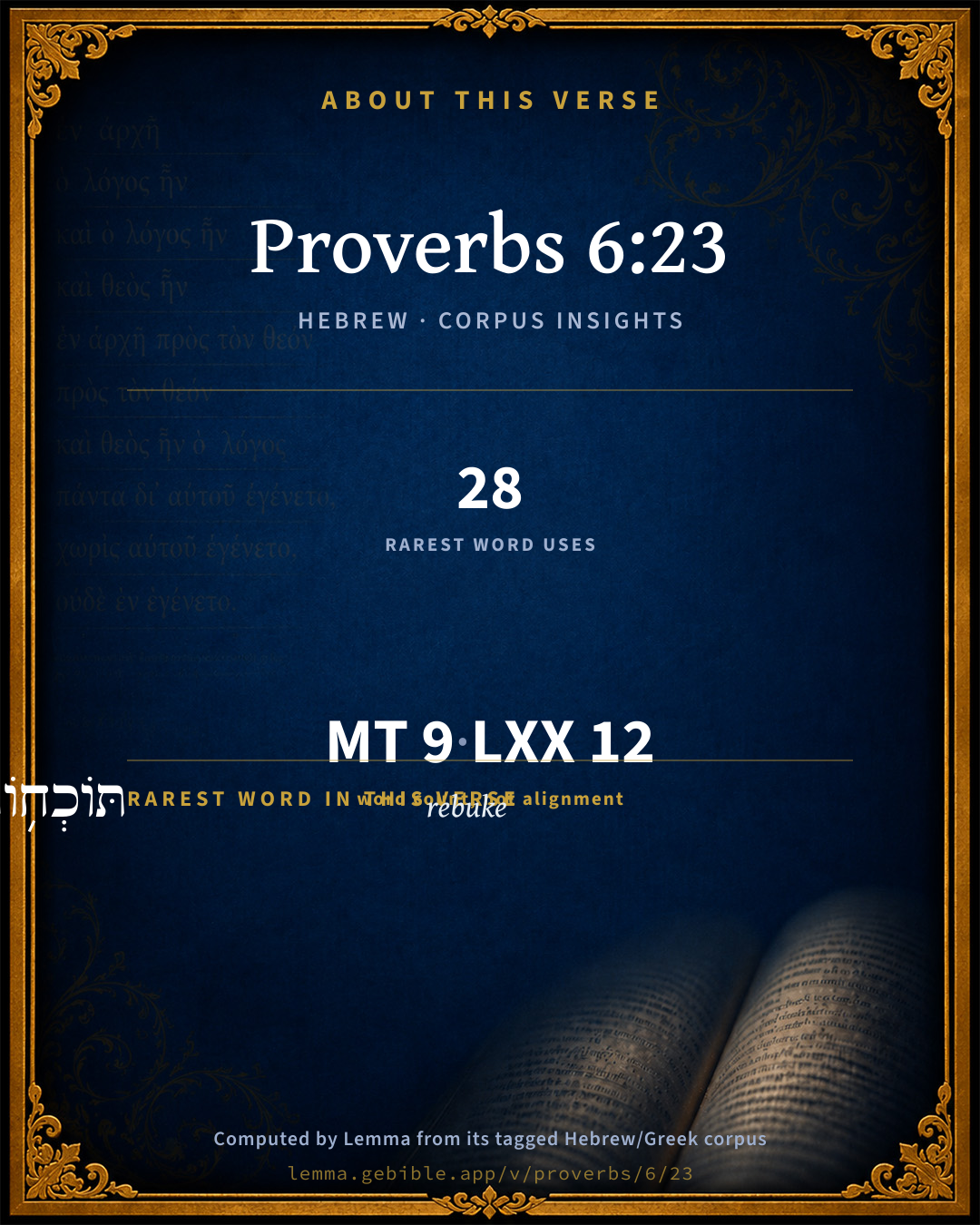
תּוֹכְח֥וֹת rebuke H8433 occurs in 28 verses of the Hebrew Bible. Also found in:

Grammatical profile

  • 8 nouns
  • 1 conjunction

Hebrew & Septuagint length

In English translation the verse runs 19 words from the Hebrew and 20 from the Septuagint (LXX English) — closely comparable.

A rough comparison of the two English renderings, which tokenize alike — not a word-level alignment.

Word counts can differ between the Hebrew and the Greek without any difference in meaning — e.g. the Hebrew direct-object marker אֵת has no separate Greek word, and Greek often adds the article ὁ.

In the original languages it is 9 Hebrew tokens and 12 Greek tokens — but the two are counted differently (Hebrew bundles its prefixes and suffixes into one token; the Greek is in lemma form), so that isn’t a like-for-like length.

Cross-references

16

Topical passages linked to Proverbs 6:23 in the Treasury of Scripture Knowledge — connected by theme and wording, ordered by reader-vote popularity; previews shown in the World English Bible.

  • Psalms 119:105 Your word is a lamp to my feet, And a light for my path.
  • Psalms 19:8 Yahweh's precepts are right, rejoicing the heart. Yahweh's commandment is pure, enlightening the eyes.
  • 2 Peter 1:19 We have the more sure word of prophecy; whereunto you do well that you take heed, as to a lamp shining in a dark place, until the day dawns, and the day star arises in your hearts:
  • Proverbs 15:31 The ear that listens to reproof lives, And will be at home among the wise.
  • Proverbs 4:13 Take firm hold of instruction. Don't let her go. Keep her, for she is your life.
  • Proverbs 4:4 He taught me, and said to me: "Let your heart retain my words. Keep my commandments, and live.
  • Jeremiah 21:8 To this people you shall say, Thus says Yahweh: Behold, I set before you the way of life and the way of death.
  • Psalms 119:98–100 Your commandments make me wiser than my enemies, For your commandments are always with me.
  • Psalms 141:5 Let the righteous strike me, it is kindness; Let him reprove me, it is like oil on the head; Don't let my head refuse it; Yet my prayer is always against evil deeds.
  • Proverbs 15:24 The path of life leads upward for the wise, To keep him from going downward to Sheol.
  • Proverbs 29:15 The rod of correction gives wisdom, But a child left to himself causes shame to his mother.
  • Proverbs 3:18 She is a tree of life to those who lay hold of her. Happy is everyone who retains her.
  • Isaiah 8:20 To the law and to the testimony! if they don't speak according to this word, surely there is no morning for them.
  • Revelation 2:5 Remember therefore from where you have fallen, and repent and do the first works; or else I am coming to you swiftly, and will move your lampstand out of its place, unless you repent.
  • Leviticus 19:17 "'You shall not hate your brother in your heart. You shall surely rebuke your neighbor, and not bear sin because of him.
  • Proverbs 5:12 And say, "How I have hated instruction, And my heart despised reproof;

Cross-references courtesy of OpenBible.info (CC BY 4.0).

Hebrew and Greek witnesses Masoretic Hebrew ↔ Greek Septuagint

The same verse in the two great witnesses to the Old Testament, shown verse-for-verse.

These are two independent witnesses, not word-aligned to each other, and the Septuagint is shown in lemma (dictionary) form.

Hebrew Proverbs 6:23 Masoretic · Westminster Leningrad Codex

כִּ֤י נֵ֣ר מִ֭צְוָה וְת֣וֹרָה א֑וֹר וְדֶ֥רֶךְ חַ֝יִּ֗ים תּוֹכְח֥וֹת מוּסָֽר

For the commandment is a lamp, And the law is light. Reproofs of instruction are the way of life,

World English Bible · Public Domain

Greek LXX Proverbs 6:23 Septuagint · lemma form

ὅτι λύχνος ἐντολή νόμος καί φῶς καί ὁδός ζωή ἔλεγχος καί παιδεία

For the commandment of the law is a lamp and a light; a way of life; reproof also and correction:

LXX2012 (modern English Septuagint) · Public Domain

On this verse, The Pulpit Commentary discusses the Septuagint’s reading. Read the note in Commentary ↓

Hebrew: Westminster Leningrad Codex (CC BY 4.0). Greek: Septuagint (public domain); English from LXX2012 (modern English Septuagint) (Public Domain). How the Septuagint differs from the Hebrew →

Commentary

Notes on Proverbs 6:23 from classic Christian and Jewish commentators (each source and its license shown beneath its notes). The classic Christian expositions comment on the surrounding passage and are grouped to its opening verse, so a note may address several verses; the Jewish commentaries on the Tanakh (Rashi and others) are per-verse, so they appear only where the commentator wrote on this verse.

Lemma curates 59 commentaries, every one of them public domain or Creative Commons licensed, each selected and text-cleaned for this edition rather than reprinted as found. About our sources →

Trapp's Complete Commentary

John Trapp

Pro 6:23 For the commandment [is] a lamp; and the law [is] light; and reproofs of instruction [are] the way of life:

Ver. 23. For the commandment is a lamp.] Or, Candle, whereof there is no small use when men go to bed, or rise early. He that hath the word of Christ richly dwelling in him may lay his hand upon his heart, and say as dying Oecolampadius did, Hic sat lucis; here is plenty of light. Under the law all was in riddles; Moses was veiled; and yet that saying was then verified, Et latet et lucet. There was light enough to light men to Christ, "the end of the law." {Rom 10:4}

And reproofs of instruction.] Or, Corrections of instructions. A lesson set on with a whipping is best remembered. {See Trapp on "Pro 3:13"}

John Trapp, A Commentary or Exposition upon All the Books of the Old and New Testament (1647–1656) — public domain. Text from a community e-Sword module.

The Biblical Illustrator

Joseph S. Exell

Pro_6:23

The law is light

The law is light

The fitness and beauty of this comparison of the law of God with fight are seen immediately.

If we consider the nature of law we find that it is like the nature of sunlight. There is nothing so pure and clean as light, and there is nothing so pure and stainless as the Divine law. There is nothing so ubiquitous as light. It is everywhere. How very like this light in the material universe is the law of God in the rational. The one naturally suggests and symbolises the other. The moral law is the ordinance which establishes and governs the moral universe. The command, Let there be light, founded and sustains the material world; and the command, Let there be supreme love of God, founds and sustains the rational and responsible world. Both commands are universal and all-pervading. Within the rational and reasonable sphere law is everywhere. But there are different degrees of moral light as there are different degrees of natural light. Our object now is to show the similarity between the moral law and the material light by looking at its influences and effects in the soul rather than by analysing its intrinsic nature.

I. The moral law reveals like sunlight. It makes the sin which still remains in the Christian a visible thing. Believers are continually urged in the Scriptures to bring their hearts into the light of Gods law that they may see the sin that is in them. If we would thoroughly understand our intricate and hidden corruption, we must by prayer and reflection intensify the light of the moral law that it may penetrate more deeply into the deep mass, even as the naturalist must concentrate the light of the sun through the lens if he would thoroughly know the plant or the insect. Every Christian who is at all faithful to himself and to God has experienced these illuminating and revelatory influences of the law. But for the believer the law makes its disclosures in a hopeful and salutary manner. The believer has been delivered from the condemning power of the law. The curse of the law Christ, his Surety, has borne for him.

II. The law for the believer in Christ attracts like the light. Light in the material world universally attracts. When the sun rises up and bathes the world in light how all nature rises up to meet it! Just so does the moral law attract the world of holy beings. They love the law for its intrinsic excellence, and seek it with the whole heart. Their very natures are pure like the law, and like always attracts like. If there be in any soul even the least degree of real holiness, there is a point of attraction upon which the law of God will seize and draw. There is a continual tendency and drift of a holy soul towards God. This view of the Divine law as an attractive energy is an encouraging one to the believer. It affords good grounds for the perseverance of the saints.

III. The law for the believer in Christ invigorates like light. This point of resemblance is not quite so obvious. We more commonly think of the air as the invigorating element in nature, yet it is true of the light that its presence is necessary in order that the spirits of a man may be lively and in vigorous action. The plant that grows up in the darkness is a pale and weak thing. Similar is the effect of the moral law upon one who is resting upon Christ. For the disciple of Christ the law is no longer a judge, but only an instructor. The terrors of the law have lost their power. The law also invigorates him, because, by virtue of his union with Christ, it has become an inward and actuating principle. His heart has been so changed by grace that he now really loves the law of God. For the believer the law is the strength of holiness.

IV. The law for the believer in Christ rejoices like the light. It is related in ancient story that the statue of Memnon, when the first rays of the morning gilded it, began to tremble and thrill and send forth music like a sweet harp. And such is the joy-giving influence of righteous law in the heavenly world, and such is its effect in the individual believer. It follows from this unfolding of the subject that the great act of the Christian is the act of faith, and the great work of the Christian is to cultivate and strengthen his faith. The moral law, like the material light, reveals, attracts, invigorates, and rejoices only because the soul sustains a certain special relation to it. (G. T. Shedd, D. D.)

Our lamp and light

Here the adjuncts of good precepts given by godly parents are set down, which show the good to be gotten from them.

I. Godly parents have many ways to guide their children. By commands, laws, wise reproofs, examples.

II. Directions of godly parents are a great help to show us the right paths of life.

1. Godly parents are careful that their directions should agree with Gods Word.

2. And they have walked themselves in the ways which they command.

III. Wise reproofs are very profitable from a wise man.

1. They are useful in the Church and commonwealth and family.

2. Because as instructions keep men from sinful courses, so reproofs bring men out of them and back to good ways again. Then be more careful to give reproofs to your friends. Be patient in bearing reproof, and make a good use of it. (Francis Taylor, B. D.)

The Biblical Illustrator, edited by Joseph S. Exell (c. 1880s–1900s) — public domain. Text from a community e-Sword module.

Geneva Bible (1599)

Geneva Bible translators

By the commandment, he meaneth the word of God: and by the instruction, the preaching and declaration of the same, which is committed to the Church.

And reprehensions when the word is preached bring us to life.

Geneva Bible (1599) marginal notes — public domain. Text via Bolls.life.

Jamieson, Fausset & Brown

Robert Jamieson, A. R. Fausset & David Brown

reproofs-- (Pro 1:23) the convictions of error produced by instruction.

Jamieson, Fausset & Brown — Commentary Critical and Explanatory on the Whole Bible (1871) — public domain (CC PDM 1.0). Text via the HelloAO Bible API.

Adam Clarke's Commentary

Verse 23. For the commandment is a lamp] It illuminates our path. It shows us how we should walk and praise God.

And the law is light] A general light, showing the nature and will of GOD, and the interest and duty of MAN.

And reproofs of instruction] Or, that instruction which reproves us for our sins and errors leads us into the way of life.

Adam Clarke's Commentary on the Bible (1810–1826) — public domain. Text from a community e-Sword/MySword module.

Ellicott's Commentary for English Readers

(23) For the commandment is a lamp . . .—Comp. Psa_19:8, and Psa_119:98-100; Psa_119:104-105. The servant of God may often feel much perplexity as to his duty, darkness may seem to have settled down upon his path. But there is always some “commandment,” or positive order, about which he can have no doubt, calling for his immediate obedience; there is always some “law,” or rather “instruction” in God’s Word offering itself as his guide; there are always some “reproofs of discipline,” that is, he knows he has certain things to shun, others to follow, for the purpose of self-discipline. It is by following out these parts of his duty that he does know, which are, as it were, a “light shining in a dark place “(2Pe_1:19), that man prepares himself for more light and clearer vision; then God “opens his eyes” that he may “behold wondrous things out of His law” (Psa_119:18); because he has some knowledge of God’s will and desire to do it, more is given unto him (Mat_13:12), and his path becomes continually clearer, shining “more and more unto the perfect day” (Pro_4:18).

A Bible Commentary for English Readers, edited by Charles John Ellicott (1878–1897) — public domain. Text from a community e-Sword module.

The Cambridge Bible for Schools and Colleges

gen. ed. J. J. S. Perowne

23. the commandment … the law] or, their commandment … their teaching, R.V. marg. The two renderings are practically the same. See on Pro_6:22.

reproofs of instruction] “Light” is not enough: “all effectual instruction for the sinful children of men includes and implies chastening, or as we are accustomed to say, correction:” per molestias eruditio.

The Cambridge Bible for Schools and Colleges (gen. ed. J. J. S. Perowne; Cambridge University Press, 1878–1918) — public domain. Text from a community e-Sword module.

John Gill's Exposition

To keep thee from the evil woman,.... This is one use of the profit arising from attending to the instructions of parents, and to the law of God, as taught by them; to preserve from fornication and adultery, one of its precepts expressly forbidding adultery and all corporeal uncleanness; and the whole of it directing to an observance of all duties respecting God and our neighbour, which requires diligence and industry, and prevents idleness, that inlet to all sin, and especially to uncleanness (k);

from the flattery of the tongue of a strange woman; the same with the evil woman, the lewd and adulterous one; see Pro 2:16. Jarchi interprets this of idolatry; the character well agrees with the idolatrous church of Rome, or antichrist, represented by a whore, Rev 17:1; as this woman is called "the woman of evil" (l), for so it may be rendered, one very evil, given up and abandoned to sin; so antichrist is called "the man of sin", Th2 2:3; and as this woman is said to have the "smoothness of a strange tongue" (m), as the words may be translated, and are by the Targum; so the religion of this false church is delivered in a strange language the people understand not, by which they are kept in ignorance and deception; now the word of God read and explained in the mother tongue, and especially the Gospel part of it, the doctrine of wisdom, is a means of preserving persons from the errors and heresies, superstition and idolatry, of the church of Rome, and from being carried away with their false glosses, and gaudy worship, and all its deceivable ways of unrighteousness.

(k) "Otia si tollas periere cupidinis arcus", Ovid. de Remed. Amor. l. 1. v. 139. Quaeritur Aegistheus, "quare sit factus adulter?--in promptu causa est, desidiosus erat". Ibid. v. 161, 162. (l) "a muliere mali", Baynus, Mercerus, Cocceius, Gejerus, Michaelis. (m) "a lenitate linguae extraneae", Montanus; "a laevitate linguae peregrinae", Michaelis; "ex lubrica glabritie linguae peregrinae", Schultens.

John Gill's Exposition of the Whole Bible (1746–1763) — public domain (CC PDM 1.0). Text via the HelloAO Bible API.

Albert Barnes' Notes on the Bible

Compare Psa 119:105.

Albert Barnes' Notes on the Bible (1834–1885) — public domain. Text from a community e-Sword/MySword module.

Haydock's Catholic Bible Commentary

Instruction. Given for our improvement, (Haydock) with charity. See Deuteronomy vi. 6., and Psalm xviii. 9.

George Leo Haydock (1774–1849), Haydock's Catholic Family Bible and Commentary, 1859 edition — public domain. Excludes Psalms (Douay-Rheims chapter numbering differs from Protestant) and Deuterocanonical books (Catholic canon only).

Matthew Poole's English Annotations

Is a lamp; it enlightens thy dark mind, and clearly discovers to thee the plain and right way.

Reproofs of instruction; wise and instructive reproofs or admonitions.

The way to life; both to preserve and prolong this life, and to procure eternal life to those that obey them.

Matthew Poole's English Annotations on the Holy Bible (1683–1685) — public domain. Text from a community e-Sword/MySword module.

Whedon's Commentary on the Bible

Daniel D. Whedon

23. Reproofs of instruction — Instructive reproofs, or restraining admonitions. Youth is self-willed, inclined to throw off restraints of law, and to indulge in sensual gratifications. An observance of parental commands, which, it is hinted, are also the law of God, will direct in all dark and dubious cases, and restrain from that which is dangerous.

Way of life — Tend to life. On the first part of the verse compare Psa_19:8, and Psa_119:105.

Daniel D. Whedon (gen. ed.), Commentary on the Old and New Testaments (1874–1909) — public domain. Text from a community e-Sword module.

The Pulpit Commentary

For the commandment is a lamp; and the law is light. The teacher takes up the words "commandment" (Hebrew, mitzrah) and "law" (Hebrew, torah) from ver. 20, which he describes respectively as "a lamp" and "light" The "commandment" is any special or particular commandment which harmonizes with God"s will, and commands what is to be done and forbids what is to be left undone. The "law" is the whole law of God in its entirety; not here the Law of Moses technically, but the whole system of generalized instruction; They stand, therefore, in the same relation to each other as "a lamp" and "light," the one being particular, and the other general. "Light" (Hebrew, or) is light in general, as the light of the day and the sun, while "a lamp" (Hebrew, ner, from nur, "to shine) is a particular light like that of a candle, which is enkindled at some other source. The "commandment" and the "law" alike enlighten the conscience and enable one to walk in his way of life. On this passage Le Clerc remarks, "Ut in tenebris lucerna, aut fax ostendit nobis, qua eundam sit: in ignorantiae humanae caligine, quae nos per hanc totam vitam cingit, revelatio divina nos docet, quid sit faciendum, quid vitandum." So the psalmist says in Psa_19:8, "The commandment of the Lord is pure, enlightening the eyes;" and again in Psa_119:105, "Thy Word is a lamp unto my feet, and a light unto my path;" i.e. they direct and show the true way of faith and life (Gejerus). The "commandment" and the "law" may stand for the whole revelation of God without reference to any particular precept (as Scott), but they have here a specific bearing on a particular form of human conduct, as appears from the following verses. And reproofs of instruction are the way of life. Reproofs of instruction; Hebrew, tok"khoth musar, disciplinary reproofs, i.e. reproofs whose object is the discipline of the soul and the moral elevation of the character. The LXX reads, kai elegcov kai paideia ; thus connecting it with education in its highest sense. Such reproofs are a way of life (Hebrew, derek khayyim), i.e. they lead to life; they conduce to the prolongation of life. This view of the subject, so prominent in the mind of the teacher in other passages, (cf. Pro_3:2, Pro_3:19) must not be lost sight of, though the words are susceptible of another interpretation, as indicating that the severest reproofs, inasmuch as they correct errors and require obedience, conduce to the greatest happiness (Patrick). Or again, it may mean that disciplinary reproofs are necessary to life. The soul to arrive at perfection must undergo them as part of the conditions of its existence, and, consequently, they are to be submitted to with the consciousness that, however irksome they may be, they are imposed for its eventual benefit. (cf. Heb_12:5) But this interpretation is unlikely from what follows.

The object of religious teaching.

I IT IS TO SERVE AS A LIGHT. How much so called religious teaching "darkens counsel with words without knowledge"! We do not give right Christian instruction when we urge upon the belief of people unintelligible dogmas in phrases which are to them meaningless. Like the book Hamlet was reading, very much that is crammed into children is "words, words, words." You cannot teach that which is not understood. The first thing is to open the eyes of the scholar, to throw light on regions of the unknown. Revelation is illumination. Christianity is not a rule of dark superstition, but a religion of light.

II THIS LIGHT GIVES A NEW INTERPRETATION TO ALL THINGS. The light does not create the objects it shines upon, it only makes manifest what was previously hidden, but not the less solidly existent. So religious revelation does not create. The doctrines of Christianity, if they are true at all, represent eternal facts. The New Testament brings these facts to light. Thus Christ has taught us to call God "Father," but he was our Father before the great Teacher came into the world. Earthly facts have new meanings as new lights fall upon them. The light of eternity transforms the whole appearance of life. Under its rays "all things become new." The pleasures, the sorrows, the duties, the gold, the food, the houses, the land, are there still, but they take on quite other hues, and range themselves in strangely altered ranks of interest. When the sun rises, the horrible monsters that loomed on us through the night resolve themselves into homely barns and familiar trees, while the distant mountain range that had been invisible before displays its silent solitudes in all their awful splendour.

III THE MISSION OF THIS LIGHT IS TO GUIDE OUR CONDUCT, "Reproofs of instruction are the way of life." This teaching is not given merely to satisfy our curiosity, nor simply to develop our mental powers. When theology is pursued with the thirst for knowledge only, it eludes our grasp. When it is degraded to the functions of mental gymnastics, it is wrecked and ruined. The end of revelation is practical and momentous. Scripture is to serve as a "lamp to our feet." Religious teaching should not aim at merely exciting intellectual interest, nor at solving abstract problems, nor at inculcating authoritative dogmas, but at guiding men into the way of peace and life. Therefore:

1. Do not be disappointed if it adds as many mysteries as it explains; so long as it sheds light on our path we can afford to find that it makes the darkness in some other regions the more visible.

2. Do not be content with hearing, understanding, assenting to religious instruction. It fails wholly of its object if it does not lead us to Obey it, to walk in its light.

The Pulpit Commentary (1880–1919), ed. H.D.M. Spence-Jones & Joseph S. Exell — public domain. Text from a community e-Sword module.

Keil & Delitzsch

C. F. Keil & F. Delitzsch

Since in היא the idea of wisdom and of wholesome doctrine lie in one another, the author can proceed with proof:

For a lamp is the commandment, and instruction a light (Jerome et lex lux);

And a way of life, disciplinary reproofs.

That תורה has here not the positive, specifically Israelitish sense, but the generalized sense of instruction in conformity with truth regarding the will of God and the duty of man, vid., p. 42. This instruction mediated by man, but of divine origin, is אור, light, which enlightens the man who submits to it; and the commandment, מצוה, which directs men in every case to do what is right, and forbids that which is wrong (including the prohibition Lev 4:2), is נר, a lamp which, kindled at that light, enlightens all the darkness of ignorance with reference to human conduct and its consequences. אור and נר are related to each other as general and particular, primary and derivative. Lwenstein accentuates incorrectly תּורהו אור instead of תּורהו אור (as the Cod. 1294 and the 3 Erfurt Codd.); vid., on the retrogression of the tone, not existing here, under Pro 3:15. The gen. מוּסר denotes the object or character of the admonition: not disciplinary in the external sense of the word, but rather moral, having in view discipline in the sense of education, i.e., moral edification and elevation. Such corrections are דּרך חיּים, the way to true life, direction how to obtain it.

Keil & Delitzsch — Biblical Commentary on the Old Testament (1861–1891) — public domain (CC PDM 1.0). Text via the HelloAO Bible API. (Old Testament only.)

Rashi

Rabbi Shlomo Yitzchaki (Rashi)

For a commandment is a candle, and the Torah is light Just as light always illuminates, so does the merit of the Torah stand for a person forever, but the merit of the commandment is only for a limited time, like the light of a candle. Another explanation: For a commandment is a candle, etc. The command of the father is a candle. Whoever fulfills the command of his father is as though he takes a candle in his hand to light a dark place, and if he loses anything there he finds it by its light; similarly, whoever fulfills his mother’s instruction—it is light to him, and so [Scripture] states (verse 20): “and forsake not the instruction of your mother.” It is certain that this verse speaks of the commands of one’s father and mother, for it is written (20:20): “If one curses his father or mother, his candle will be put out in the blackest darkness.” Now if a person’s candle goes out when he does not fulfill the commandments of his parents, conversely when he fulfills the command, his candle lights up (Rabbi Joseph Kara).

and disciplining rebukes are the way of life Disciplining rebukes incline a person to life. It is found that they are the way of life.

Rashi on the Tanakh — English translations: “The Judaica Press complete Tanach with Rashi, translated by A. J. Rosenberg” (CC BY 4.0); “Pentateuch with Rashi's commentary by M. Rosenbaum and A.M. Silbermann, 1929-1934” (public domain); “The Metsudah Tanach series, Lakewood, N.J” (CC BY 4.0); and “The Book of Joshua, Metsudah Publications, 1997” (CC BY 4.0). Text via Sefaria.

Lesson kit

Teaching starters — assembled from the data on this page, not authored interpretation. Every prompt links to the verse data it draws on. Edit before teaching.

Proverbs, in the Wisdom, opens this verse with 9 words (9 distinct Hebrew lemmas). Its most distinctive word is tôwkêchâh (“rebuke”). A historical commentator’s framing appears above. Read the whole chapter for the surrounding context.

Discussion questions

  1. How does “rebuke” (tôwkêchâh) shape what this verse is saying?
  2. 2 Kings 19:3 shares the word «rebuke» with this verse. How do the two illuminate each other?
  3. These translations render this verse differently. What is at stake in choosing one wording over another?
  4. Reading how Trapp's Complete Commentary and The Biblical Illustrator read this verse, where do the two commentators agree and where do they part?

Things to notice

Reading settings

Reading text

Shown beneath each verse's original-language words.

Old Testament
Old Testament edition

Read the OT as the Masoretic Hebrew (MT) or the Greek Septuagint (LXX).

English shown for the Greek Septuagint (in the Hebrew ↔ Greek comparison).

Comparing translations? Open the Compare panel on any verse page to stack up to four side by side.