
Psalms 119:113

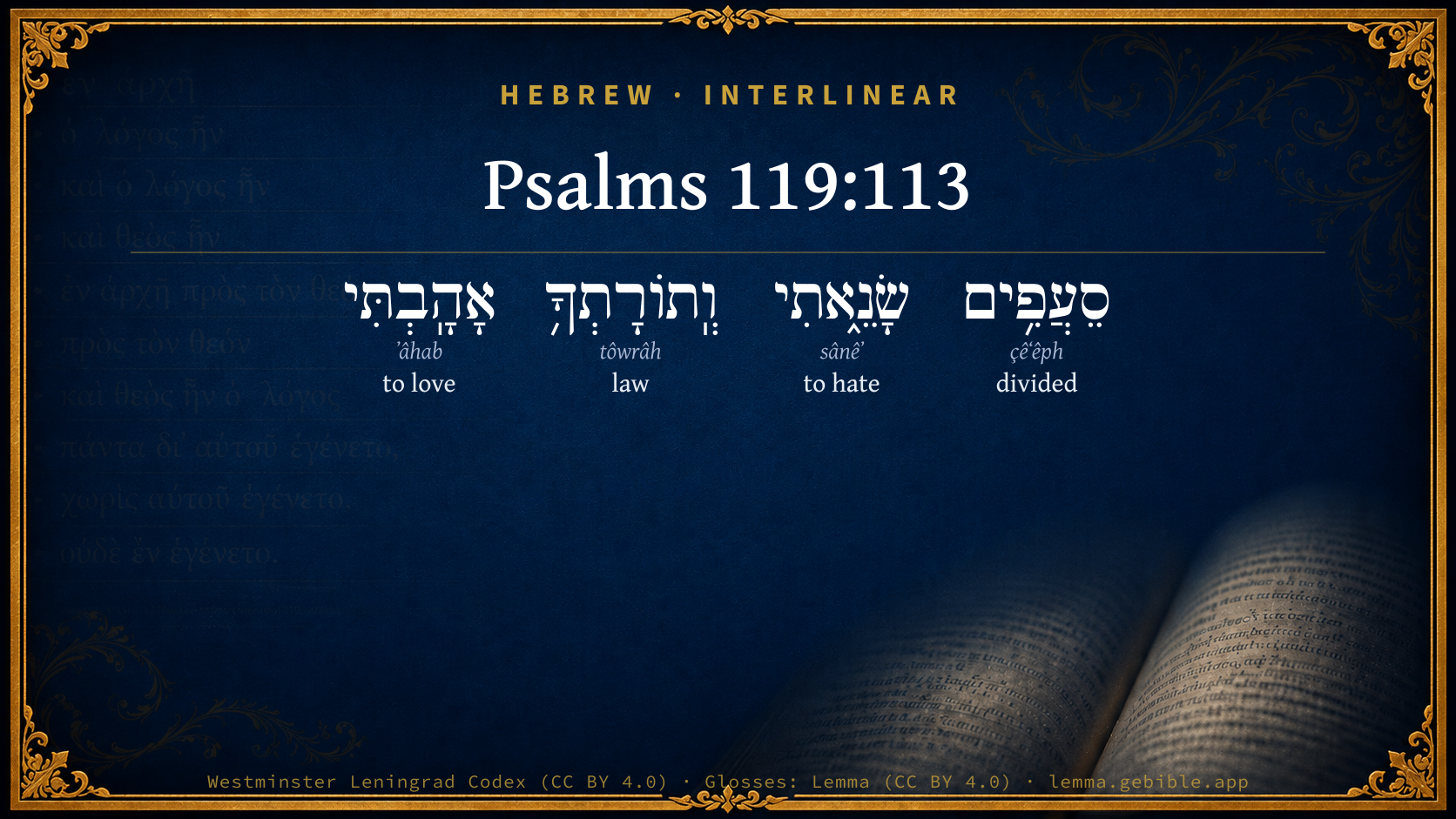
Hebrew (Westminster Leningrad Codex) Psalms 119:113 appears in the Hebrew Old Testament. The text above is from the Westminster Leningrad Codex. Each word links to its Strong’s number, a concise gloss, and parsing drawn from the Open Scriptures Hebrew Bible morphology. Click any word for its full Brown-Driver-Briggs (BDB) entry.
Download image
Cite this verse

Psalms 119:113 (World English Bible). Public Domain. Lemma interlinear Bible study tool, https://lemma.gebible.app/v/psalms/119/113.

Show BibTeX & RIS
BibTeX
RIS
English Translation
I hate double-minded men, But I love your law.
World English Bible · Public Domain
Highlights
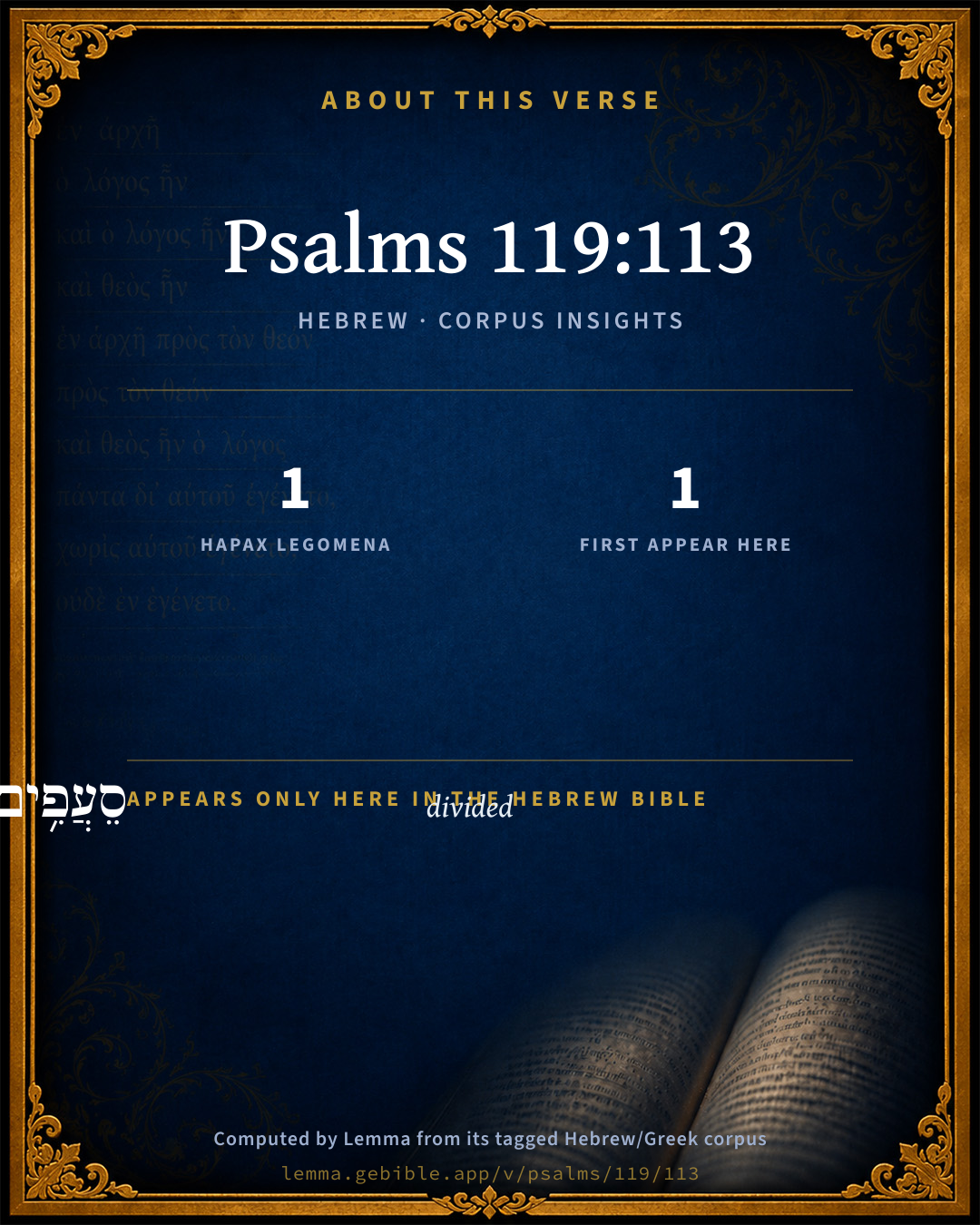
  • 1 hapax legomenon — only here in the Hebrew Bible
  • 1 first appearance in the Hebrew Bible
Full analysis ↓
Download a study sheet

One document with this verse’s original text, its word-by-word gloss line, the meaning frame, cross-references with their text, attributed commentary, and full source and license credits — printable, and it pastes into notes with its structure intact.

This verse Autodidact and up

Study sheet (.html) Plain text (.txt)

A passage Seminary Student

Up to 50 verses in one chapter. A passage sheet keeps up to 6 commentary sources and 12 cross-references per verse, in the order this page ranks them, and says so on the sheet whenever that leaves anything out. Ask for a single verse and you get the Autodidact verse sheet above.

Everything on this page stays free to read, with no account — the sheet is a download of what is already on screen, not access to it.

Want to remove ads? Support Godless Engineer
Compare translations 3

The same verse in 3 English versions, stacked beneath the original-language interlinear above. Click any original word for its lexicon entry.

Each is an independent rendering of the whole verse — the interlinear is not word-aligned to these translations.

Highlighted words mark where these versions differ — a whole-verse word diff, not a word-by-word alignment.

  • World English Bible Public Domain
    I hate double-minded men, But I love your law.
  • King James Version Public Domain
    I hate vain thoughts: but thy law do I love.
  • unfoldingWord Literal Text CC BY-SA 4.0
    The double-minded I have hated, but your teaching I have loved.

unfoldingWord Literal Text — © unfoldingWord, licensed CC BY-SA 4.0. Word-aligned USFM3 via Door43 (git.door43.org/unfoldingWord/en_ult).

Versions to compare (up to 4)

3 of 4 selected

Show all 17 translations

Every available English version of this verse, each an independent rendering of the whole verse.

  • World English Bible Public Domain
    I hate double-minded men, But I love your law.
  • Berean Standard Bible Public Domain
    The double-minded I despise, but Your law I love.
  • Majority Standard Bible Public Domain
    The double-minded I despise, but Your law I love.
  • King James Version Public Domain
    I hate vain thoughts: but thy law do I love.
  • American Standard Version (1901) Public Domain
    SAMEKH. I hate them that are of a double mind; But thy law do I love.
  • Revised Version (1885) Public Domain
    I hate them that are of a double mind; but thy law do I love.
  • Geneva Bible (1599) Public Domain
    SAMECH. I hate vaine inuentions: but thy Lawe doe I loue.
  • Young's Literal Translation Public Domain
    `Samech.' Doubting ones I have hated, And Thy law I have loved.
  • Literal Standard Version CC BY-SA 4.0
    [SAMEKH] I have hated doubting ones, || And I have loved Your law.
  • Unlocked Literal Bible CC BY-SA 4.0
    I hate those who have a double mind, but I love your law.
  • unfoldingWord Literal Text CC BY-SA 4.0
    The double-minded I have hated, but your teaching I have loved.
  • Darby Bible Public Domain
    SAMECH. The double-minded have I hated; but thy law do I love.
  • World Messianic Bible Public Domain
    I hate double-minded men, but I love your Torah.
  • Webster's Bible Public Domain
    SAMECH. I hate vain thoughts: but thy law do I love.
  • Free Bible Version CC BY-SA 4.0
    I hate people who are two-faced, but I love your law.
  • Bible in Basic English Public Domain
    SAMECH I am a hater of men of doubting mind; but I am a lover of your law.
  • JPS Tanakh (1917) Public Domain
    SAMECH. I hate them that are of a double mind; but Thy law do I love.

Literal Standard Version (2020), Covenant Press — licensed CC BY-SA 4.0. Text via the HelloAO Bible API (eBible.org). Unlocked Literal Bible (unfoldingWord) — licensed CC BY-SA 4.0. Text via the HelloAO Bible API (eBible.org). unfoldingWord Literal Text — © unfoldingWord, licensed CC BY-SA 4.0. Word-aligned USFM3 via Door43 (git.door43.org/unfoldingWord/en_ult). Free Bible Version, Dr. Jonathan Gallagher — licensed CC BY-SA 4.0. Text via the HelloAO Bible API (eBible.org).

Word by word

More ways to search: Search by grammar → Find every occurrence → Compare this word →

Practice this passage: Drill this verse → Learn its vocabulary →

About this verse

These counts appear in no published source. They are computed here, from the morphology-tagged text and Lemma’s own curated glosses. What Lemma adds →

4
words
4
distinct lemmas
Wisdom
section

Notable vocabulary

1 hapax legomenon — a word that appears only here in the entire Hebrew Bible:

  • סֵעֲפִ֥ים divided H5588

First appearance in Scripture

This word makes its first canonical appearance in the Hebrew Bible here:

  • סֵעֲפִ֥ים divided H5588

Grammatical profile

  • 2 verbs
  • 1 noun
  • 1 adjective

Verb forms

  • שָׂנֵ֑אתִי Qal · Perfect
  • אָהָֽבְתִּי Qal · Perfect

Hebrew & Septuagint length

In English translation the verse runs 9 words from the Hebrew and 10 from the Septuagint (LXX English) — closely comparable.

A rough comparison of the two English renderings, which tokenize alike — not a word-level alignment.

Word counts can differ between the Hebrew and the Greek without any difference in meaning — e.g. the Hebrew direct-object marker אֵת has no separate Greek word, and Greek often adds the article ὁ.

Cross-references

8

Topical passages linked to Psalms 119:113 in the Treasury of Scripture Knowledge — connected by theme and wording, ordered by reader-vote popularity; previews shown in the World English Bible.

  • James 1:8 He is a double-minded man, unstable in all his ways.
  • Jeremiah 4:14 Jerusalem, wash your heart from wickedness, that you may be saved. How long shall your evil thoughts lodge within you?
  • Isaiah 55:7 let the wicked forsake his way, and the unrighteous man his thoughts; and let him return to Yahweh, and he will have mercy on him; and to our God, for he will abundantly pardon.
  • Psalms 119:97 How love I your law! It is my meditation all day.
  • Mark 7:21 For from within, out of the hearts of men, proceed evil thoughts, adulteries, sexual sins, murders, thefts,
  • 2 Corinthians 10:5 throwing down imaginations and every high thing that is exalted against the knowledge of God, and bringing every thought into captivity to the obedience of Christ;
  • Psalms 94:11 Yahweh knows the thoughts of man, That they are futile.
  • Psalms 119:103 How sweet are your promises to my taste, More than honey to my mouth!

Cross-references courtesy of OpenBible.info (CC BY 4.0).

Hebrew and Greek witnesses Masoretic Hebrew ↔ Greek Septuagint

The same verse in the two great witnesses to the Old Testament, shown verse-for-verse.

You’re reading Greek Psalm 118 (Hebrew Psalm 119). The Septuagint counts the superscription, so verse numbers can differ from the Hebrew — chapter-level alignment, not verse-by-verse. Numbering follows Rahlfs.

These are two independent witnesses, not word-aligned to each other, and the Septuagint is shown in lemma (dictionary) form.

Hebrew Psalms 119:113 Masoretic · Westminster Leningrad Codex

סֵעֲפִ֥ים שָׂנֵ֑אתִי וְֽתוֹרָתְךָ֥ אָהָֽבְתִּי

I hate double-minded men, But I love your law.

World English Bible · Public Domain

Greek LXX Greek Psalm 118:113 Septuagint · lemma form

σαμχ παράνομος μισέω καί ὁ νόμος σύ ἀγαπάω

I have hated transgressors; but I have loved your law.

LXX2012 (modern English Septuagint) · Public Domain

On this verse, Albert Barnes' Notes on the Bible discusses the Septuagint’s reading. Read the note in Commentary ↓

Hebrew: Westminster Leningrad Codex (CC BY 4.0). Greek: Septuagint (public domain); English from LXX2012 (modern English Septuagint) (Public Domain). How the Septuagint differs from the Hebrew →

Commentary

Notes on Psalms 119:113 from classic Christian and Jewish commentators (each source and its license shown beneath its notes). The classic Christian expositions comment on the surrounding passage and are grouped to its opening verse, so a note may address several verses; the Jewish commentaries on the Tanakh (Rashi and others) are per-verse, so they appear only where the commentator wrote on this verse.

Lemma curates 59 commentaries, every one of them public domain or Creative Commons licensed, each selected and text-cleaned for this edition rather than reprinted as found. About our sources →

Trapp's Complete Commentary

John Trapp

Psa 119:113 SAMECH. I hate [vain] thoughts: but thy law do I love.

Ver. 113. I hate vain thoughts] Which, though they may swarm in my head, shall never lodge in my heart, Jer 4:14, for there I have entertained a better guest.

Thy law do I love] All hatred proceedeth from love, and is προς το μενος, against the whole kind, as Aristotle speaketh. True love to God’s law enrageth the hearts of God’s people with a holy hatred of heresies and perverse devices.

John Trapp, A Commentary or Exposition upon All the Books of the Old and New Testament (1647–1656) — public domain. Text from a community e-Sword module.

The Biblical Illustrator

Joseph S. Exell

Psa_119:113

I hate vain thoughts: but Thy law do I love.

The hated and the loved

I. The hated. I hate vain thoughts. The number of these is legion, the variety all but endless. Vain thoughts may include worthless thoughts on true subjects as well as on false. Vain thoughts are--

1. Always worthless. They are empty, vapid, unsatisfactory, and unenduring.

2. Always criminal. Man is endowed with the thinking faculty in order to think accurately, righteously, and devoutly.

3. Always pernicious. Vain thoughts are the weeds, the fungi, the parasites, the mildew of the soul.

II. The loved. Thy law do I love. Why should the Divine law be loved?

1. It is a revelation of the morally beautiful. It is the transcript of the mind, that which is the beauty of holiness.

2. It is a guide to the truly happy. It is a map to guide to the heavenly inheritance, a compass directing to the celestial shore. (Homilist.)

A lust hate and a just love

I. A just hate. Vain thoughts are of two classes.

1. Thoughts on vain subjects.

2. Vain thoughts on true subjects. All such thoughts are evil in themselves and powerful for evil. Thought is the mightiest power in the world. Bad thoughts should be hated as devils; good ones cherished as angels.

II. A just love. The law should be loved--

1. Because it is the expression of the highest moral beauty. It is the transcript of the Divine heart.

2. Because it is a means to the participation in the highest moral beauty. By obedience to the Divine law men come to share in the beauty of God, the beauty of holiness. Love and hate are really one in principle. We must always hate the opposite of what we love. (Homilist.)

On wandering thoughts in religious duties

I. Their nature. Wandering thoughts are the disorderly motions of the soul in the time of Gods worship, by which the mind is diverted or disturbed in the performance of the duty.

1. The time: when engaged in the duties of religion.

2. What draws our thoughts aside.

(1) Sometimes things in themselves evil and sinful.

(2) Sometimes things good in themselves, but evil because they are unseasonable.

II. Their causes or occasions.

1. The depravity of our nature.

2. Allowance of sin.

3. Being over-careful and troubled about many things.

4. Slight thoughts of God and His service.

III. Their bad effects.

1. They render our duties vain and burdensome.

2. They hinder communion with God.

3. They induce us to think hardly of ourselves.

4. They bring guilt upon the soul, and lead to a curse instead of a blessing.

IV. Directions for their prevention or cure.

1. Wash your hearts from wickedness.

2. Endeavour to maintain an habitual spirituality of mind.

3. Attend to religious duties with earnest desires of the presence of God.

4. Depend not upon your own strength.

5. Use means to bring your heart into a suitable temper.

6. Set the Lord always before you. (S. Lavington.)

The government o/ the thoughts

I. What are vain thoughts? Not only all such as are in themselves useless and frivolous, but all such as, though not without their importance at their proper times, are allowed to encroach upon the time and attention due to others of equal or greater importance--all such as, by their connection with improper and hurtful inclinations, tend, when encouraged, to fix and strengthen them--all such as indicate the existence of unkind and unchristian feelings--all such as indispose us to the labours and duties of our stations--and lastly, all such as tend to make us undervalue the principles of a pure morality, or distrust the foundation of religious faith and obedience.

II. How may they be avoided or controlled?

1. The mind must have its attention directed, and its interest awakened to instructive and important subjects,

2. We must acquire a habit of confining our attention to the subjects and employments which we think deserving of our choice.

3. We should make a diligent use of all our opportunities for storing our minds with sound and practical knowledge.

4. We must avoid the sources of all impure or immoral fancies, whether we have reason to apprehend their existence in our usual books or our usual companions.

5. We should acquaint ourselves with the writings, and seek the society of those whom we may consider either as masters, or, at least, as anxious and successful learners, of the same art.

6. The words of the pure, and the lips of knowledge, if it be that knowledge which maketh wise unto salvation, will second with powerful persuasion another direction that may be given for guarding against the influence of vain thoughts. It is this--to rest on firm and deep foundations, and to build up for ourselves, with good and durable materials, a real conviction of religious truths.

7. A well-grounded and hearty belief in Christian truths, beside the awful consideration which it opposes to the encouragement of vain thoughts, disposes the mind to an employment, the recommendation of which is another direction of the right government of the thoughts. That employment is, frequent meditation on the duties and interests which owe a principal part of their sanctions and importance to the doctrines and principles of religion.

8. Frequent, humble, and earnest prayer for deliverance from the evils which we wish to avoid, and assistance to persevere in the pursuit of those things which are pure, lovely, and of good report--prayer for that spirit of wisdom and godly fear, which will keep both our hate and our love directed to their proper objects. (A. R. Beard.)

On vain thoughts

I. The peculiar kind of thoughts alluded to in the text.

1. All thoughts, the indulgence of which is positively sinful.

(1) Some have reference to God. Fretful, discontented, and distrustful thoughts.

(2) Others refer to our fellow-creatures. Suspicious, slanderous, and calumnious thoughts.

(3) Others have reference to ourselves. Proud, ambitious, impure and lascivious thoughts.

2. All thoughts, the cultivation of which is likely to lead to no practical benefit.

3. All thoughts inappropriate to the seasons on which they are cherished.

II. The effort which should be made for suppressing vain thoughts.

1. Such thoughts are the natural and spontaneous choice of the human mind.

2. The powerful influence of the thoughts in regulating the dispositions and conduct.

3. Our responsibility to God for the right exercise of thought.

III. Some means which may tend to counteract vain thoughts.

1. Seek the attainment of a renewed and sanctified heart.

2. Cultivate an habitual remembrance of the divine inspection of the thoughts.

3. Let the mind be occupied as fully as possible with thoughts of an appropriate and useful character.

4. Earnestly implore the assistance of the Holy Spirit to guide and control the thoughts. (Essex Remembrancer.)

The Biblical Illustrator, edited by Joseph S. Exell (c. 1880s–1900s) — public domain. Text from a community e-Sword module.

The Treasury of David

Charles H. Spurgeon

Ver. 113. I hate vain thoughts: but thy law do I love. In this paragraph the Psalmist deals with thoughts and things and persons which are the opposite of God's holy thoughts and ways. He is evidently in great fear of the powers of darkness, and of their allies, and his whole soul is stirred up to stand against them with a determined opposition. Just as he began the octave, Ps 119:97, with "O how I love thy law, "so here he begins with a declaration of hatred against that which breaks the law. The opposite of the fixed and infallible law of God is the wavering, changing opinion of men: David had an utter contempt and abhorrence for this; all his reverence and regard went to the sure word of testimony. In proportion to his love to the law was his hate of man's inventions. The thoughts of men are vanity; but the thoughts of God are verity. We hear much in these days of "men of thought, ""thoughtful preachers, "and "modern thought": what is this but the old pride of the human heart? Vain man would be wise. The Psalmist did not glory in his thoughts; and that which was called "thought" in his day was a thing which he detested. When man thinks his best his highest thoughts are as far below those of divine revelation as the earth is beneath the heavens. Some of our thoughts are specially vain in the sense of vain glory, pride, conceit, and self trust; others in the sense of bringing disappointment, such as fond ambition, sinful dreaming, and confidence in man; others in the sense of emptiness and frivolity, such as the idle thoughts and vacant romancing in which so many indulge; and, yet once more, too many of our thoughts are vain in the sense of being sinful, evil, and foolish. The Psalmist is not indifferent to evil thoughts as the careless are; but upon them he looks with a hate as true as was the love with which he clung to the pure thoughts of God.

The last octave was practical, this is thoughtful; there the man of God attended to his feet, and here to his heart: the emotions of the soul are as important as the acts of the life, for they are the fountain and spring from which the actions proceed. When we love the law it becomes a law of love, and we cling to it with our whole heart.

Ver. 113. I hate vain thoughts or, the evil devices; or, the double hearted imaginations; or, the intermeddling, counter coursing thoughts: that is to say, that kind of practice of some men, that sail with every wind, and seek still to have two strings to their bow. The Hebrew word doth properly signify boughs Or branches, which shoot up perplexedly or confusedly in a tree. Theodore Haak, 1618-1657.

Ver. 113. I hate vain thoughts. In those vacant hours which are spared from business, pleasure, company, and sleep, and which are spent in solitude, at home or abroad; unprofitable, proud, covetous, sensual, envious, or malicious imaginations, occupy the minds of ungodly men, and often infect their very dreams. These are not only sinful in themselves, indicating the state of their hearts, and as such will be brought into the account at the day of judgment; but they excite the dormant corruptions, and lead to more open and gross violations of the holy law. The carnal mind welcomes and delights to dwell upon these congenial imaginations, and to solace itself by ideal indulgences, when opportunity of other gratification is not presented, or when a man dares not commit the actual transgression. But the spiritual mind recoils at them; such thoughts will intrude from time to time, but they are unwelcome and distressing, and are immediately thrust out; while other subjects, from the word of God, are stored up in readiness to occupy the mind more profitably and pleasantly during the hours of leisure and retirement. There is no better test of our true character, than the habitual effect of "vain thoughts" upon our minds whether we love and indulge them, or abhor, and watch and pray against them. Thomas Scott, 1747-1821.

Ver. 113. I hate vain thoughts, A godly man may have roving thoughts in duty. Sad experience proves this; the thoughts will be dancing up and down in prayer. The saints are called stars; but many times in duty they are wandering stars. The heart is like quicksilver which will not fix. It is hard to tie two good thoughts together; we cannot lock our hearts so close, but that distracting thoughts, like wind, will get in. Hierom complains of himself; "Sometimes, "saith he, "when I am about God's service, I am walking in the galleries, or casting up accounts." But these wandering thoughts are not allowed: "I hate vain thoughts, "they come as unwelcome guests, which are no sooner spied, but turned out of doors. Thomas Watson.

Ver. 113. I hate. Every dislike of evil is not sufficient; but perfect hatred is required of us against all sorts and degrees of sin. David Dickson.

Ver. 113. Vain thoughts. The word is used for the opinions of men; and may be applied to all heterodox opinions, human doctrines, damnable heresies; such as are inconsistent with the perfections of God, derogate from his grace, and from the son and offices of Christ; and are contrary to the word, and which are therefore rejected and abhorred by good men. John Gill.

Ver. 113. Vain thoughts. Hebrew, "sedphim", halting between two opinions. See 1Ki 18:21. Hence it signifies sceptical doubts. Christopher Wordsworth.

Ver. 113. Vain thoughts. Our thoughts are set upon trifles and frivolous things, neither tending to our own profit nor the benefit of others: "The heart of the wicked is little worth; "all their debates, conceits, musings, are of no value: for all their thoughts are taken up about childish vanity and foolish conceits. "The thought of foolishness is sin" (Pr 24:9); not only the thought of wickedness, but foolishness. Thoughts are the firstborn of the soul, the immediate issues of the mind; yet we lavish them away upon every trifle. Follow men all the day long, and take account of their thoughts. Oh! what madness and folly are in all the musings they are conscious of: "The Lord knoweth the thoughts of man, that they are vanity" (Ps 94:11). If we did judge as God judges, all the thoughts, reasonings, discourses of the mind, if they were set down in a table, we might write at the bottom, Here is the sum and total account of all, nothing but vanity.

The sins that do most usually engross and take up our thoughts are,

First. Uncleanness. Speculative wickedness makes way for active: "Hath committed adultery...in his heart" (Mt 5:28). There is a polluting ourselves by our thoughts, and this sin usually works that way.

Secondly. Revenge. Liquors are soured when long kept; so, when we dwell upon discontents, they turn to revenge. Purposes of revenge are most sweet and pleasant to carnal nature: "Frowardness is in his heart, he deviseth mischief continually" (Pr 6:14), that is to say, he is full of revengeful and spiteful thoughts.

Thirdly. Envy. It is a sin that feeds upon the mind. Those songs of the women, that Saul had slain his thousands, but David his ten thousands, they ran in Saul's mind, therefore he hated David (1Sa 18:9). Envy is an evil disease that dwelleth in the heart, and betrays itself mostly in thoughts.

Fourthly. Pride. Either pride in the desires or pride in the mind, either vain glory or self conceit; this is entertaining our hearts with whispers of vanity: therefore it is said, "He hath scattered the proud in the imagination of their hearts" (Lu 1:51): proud men are full of imaginations.

Fifthly. Covetousness, which is nothing but vain musings and exercises of the heart: "A heart they have exercised with covetous practices" (2Pe 2:14). And it withdraws the heart in the very time of God's worship: "Their heart goeth after their covetousness" (Eze 33:31).

Sixthly. Distrust is another thing which usually takes up our thoughts distracting motions against God's providence. Thomas Manton.

Ver. 113. Vain thoughts. Let us see what vanity is. Take it in all the acceptances of it, it is true of our thoughts that they are "vain."

1. It is taken for unprofitableness. So, Ec 1:2-3, "All is vain, "because there is "no profit in them under the sun." Such are our thoughts by nature; the wisest of them will not stand us in any stead in time of need, in time of temptation, distress of conscience, day of death or judgment: 1Co 2:6, "All the wisdom of the wise comes to nought"; Pr 10:20. "The heart of the wicked is little worth, "not a penny for them all.

2. Vanity is taken for lightness. "Lighter than vanity, "is a phrase used, Ps 62:9; and whom is it spoken of? Of men; and if anything in them be lighter than other, it is their thoughts, which swim in the uppermost parts, float at the top, are as the scum of the heart. When all the best, and wisest, and deepest, and solidest thoughts in Belshazzar, a prince, were weighed, they were found too light, Da 5:27.

3. Vanity is put for folly. So, Pr 12:11, "vain men" is made all one with men "void of understanding." Such are our thoughts. Among other evils which are said to "come out of the heart" (Mr 7:22), afrosunh is reckoned as one, "foolishness"; that is, thoughts that are such as madmen have, and fools nothing to the purpose, of which there can be made no use.

4. Vanity is put for inconstancy and frailty; therefore vanity and a shadow are made synonymous, Ps 144:4. Such are our thoughts, flitting and perishing, as bubbles: Ps 144:4, "All their thoughts perish."

5. Lastly, they are wicked and sinful. Vanity is Jer 4:14 yoked with wickedness, and vain men and sons of Belial are all one, 2Ch 8:7. And such are our thoughts by nature: Pr 14:9, "The thought of foolishness is sin." And therefore a man is to be humbled for a proud thought. Thomas Goodwin.

Ver. 113. But thy law do I love Ballast your heart with a love to God. Love will, by a pleasing violence bind down our thoughts: if it doth not establish our minds, they will be like a cork, which, with a light breath, and a short curl of water, shall be tossed up and down from its station. Scholars that love learning will be continually hammering upon some notion or other which may further their progress, and as greedily clasp it as the iron will its beloved loadstone. He that is "winged with a divine love" to Christ will have frequent glances and flights toward him, and will start out from his worldly business several times in a day to give him a visit. Love, in the very working, is a settling grace; it increaseth our delight in God, partly by the sight of his amiableness, which is cleared to us in the very act of loving; and partly by the recompences he gives to the affectionate carriage of his creature; both which will prevent the heart's giving entertainment to such loose companions as evil thoughts. Stephen Charnock.

Ver. 113-114. When David was able to vouch his love to the command, he did not question his title to the promise. Here he asserts his sincere affection to the precepts: "I hate vain thoughts: but thy law do I love." Mark he doth not say he is free from vain thoughts, but he "hates" them, he likes their company no better than one would a pack of thieves that break into his house. Neither saith he that he fully kept the law, but he "loved" the law even when he failed of exact obedience to it. Now from this testimony his conscience brought in for his love to the law, his faith acts clearly and strongly on the promise in the next words, "Thou art my hiding place and my shield: I hope in thy word." William Gurnall.

Outlines Upon Keywords of the Psalm, By Pastor C. A. Davis.

Ver. 113-120. Vain thoughts contrasted with God's law. The believer takes sides (Ps 119:113-115); prays for upholding in the law (Ps 119:116-117); contemplates the fate of the followers of vain thoughts (Ps 119:118-119); and expresses the godly fear thereby inspired (Ps 119:120).

Ver. 113. The thought of the age, and the truth of all ages.

Ver. 113.

1. The object of hatred.

2. The object of love.

OR

1. Love the cause of hatred.

2. Hatred the effect of love. G.R.

Ver. 113. Vain thoughts. What they are. Whence they arise. The mischief they cause. How they should be treated. W.H.J.P.

Ver. 113. How the believer

1. Is troubled by vain thoughts. A frequent and painful experience:

2. Does not tolerate vain, thoughts. Some, suffer them to lodge within; he is anxious to expel them.

3. Triumphs over vain thoughts. By his love to the law of God. His prayer is

"With thoughts of Christ and things divine,

Fill up this foolish heart of mine." W.H.J.P.

Psalms 119:114*

Charles H. Spurgeon's The Treasury of David (1869–1885) — public domain. Psalms only. Text from a community e-Sword/MySword module.

Joseph Benson's Commentary

SAMECH.

Psa 119:113-115. I hate vain thoughts — Or, wild imaginations, as some render סעפים, a word which signifies the shootings, or branchings of the mind; namely, all wild, roving fancies, in opposition to the truth and solidity of God’s word. Thou art my hiding-place — See on Psa 32:7. Depart from me, ye evil-doers — I will have no society, friendship, or conversation with you; for I will keep the commandments of my God —

Which your evil counsel or example might hinder me from keeping.

Joseph Benson's Commentary on the Old and New Testaments (1811–1818) — public domain. Text from a community e-Sword module.

J. A. Alexander on Psalms

Joseph Addison Alexander

113. (Psa 119:113) Waverers I hate, and thy law I love. The first word in Hebrew occurs only here. According to the most probable etymology, it means men of divided and unstable minds. See above, on Psa 12:2, and compare Jas 1:8.

Joseph Addison Alexander, The Psalms Translated and Explained (1850) — public domain. Text from a community e-Sword module.

Tyndale Open Study Notes

Tyndale Open Resources

119:113-120 Samekh (ס): The psalmist declares his hatred of evil and his love for God and his ways.

119:113 The godly hate the wicked and their deeds (5:4-6; cp. Ezek 33:11).

Tyndale Open Study Notes — © Tyndale Open Resources, licensed CC BY-SA 4.0. Text via the HelloAO Bible API.

Geneva Bible (1599)

Geneva Bible translators

Whosoever will embrace God’s word aright, must abhor all fantasies and imaginations both of himself and others.

Geneva Bible (1599) marginal notes — public domain. Text via Bolls.life.

Matthew Henry's Commentary

Here we have, 1. David's dread of the risings of sin, and the first beginnings of it: I hate vain thoughts. He does not mean that he hated them in others, for there he could not discern them, but he hated them in his own heart. Every good man makes conscience of his thoughts, for they are words to God. Vain thoughts, how light soever most make of them, are sinful and hurtful, and therefore we should account them hateful and dreadful, for they do not only divert the mind from that which is good, but open the door to all evil, Jer 4:14. Though David could not say that he was free from vain thoughts, yet he could say that he hated them; he did not countenance them, nor give them any entertainment, but did what he could to keep them out, at least to keep them under. The evil I do I allow not. 2. David's delight in the rule of duty: But thy law do I love, which forbids those vain thoughts, and threatens them. The more we love the law of God the more we shall get the mastery of our vain thoughts, the more hateful they will be to us, as being contrary to the whole law, and the more watchful we shall be against them, lest they draw us from that which we love.

Matthew Henry's Commentary on the Whole Bible (1708–1710) — public domain (CC PDM 1.0). Text via the HelloAO Bible API.

Adam Clarke's Commentary

LETTER ס SAMECH. - Fifteenth Division

Verse 113. I hate vain thoughts] I have hated סעפים seaphim, "tumultuous, violent men." I abominate all mobs and insurrections, and troublers of the public peace.

Adam Clarke's Commentary on the Bible (1810–1826) — public domain. Text from a community e-Sword/MySword module.

John Calvin's Commentaries

113. I have hated crooked thoughts. Those who are of opinion that the word סעפום seaphim, the first in the verse, and which is rendered crooked thoughts, is an appellate noun, translate it, those who think evil; but it is more correct to understand it of the thoughts themselves, and this interpretation is very generally adopted. The noun סעף, saeph, properly signifies a branch, but it is applied metaphorically to the thoughts, which, growing out of the heart, as branches from the trunk of a tree, spread themselves in every direction. As there is no doubt that in this passage the term is taken in a bad sense, I have added the epithet, crooked, which the etymology of the word requires. As the branches of a tree shoot out transversely, entangled and intertwined, so the thoughts of the human mind are, in like manner, confusedly mingled together, turning and twisting about in all directions. Some Jewish interpreters understand it of the laws of the heathen, which, they say, were cut off from the law of God, as branches from a tree; but although this is ingenious, it has no solidity. I therefore keep by the more simple explanation, That the crooked inventions of the human heart, and whatever the wicked devise, according to their own perverse understandings, are set in opposition to the law of God, which alone is right. And, assuredly, whoever would truly embrace the law of God, must, necessarily, as his first business, divest himself of all unhallowed and sinful thoughts, or rather go out of his own nature. Such is the meaning, unless, perhaps, preferring another metaphor, we understand סעפום, seaphim, to signify high thoughts, since the verb סעף, saaph, is taken for to lift up. Now we know that no sacrifice is more acceptable to God than obedience, when we entertain low thoughts of ourselves; and thus our docility begins with humility. But as this exposition may seem also far-fetched, I pass from it. Let what I have: said suffice us, That since God acknowledges as the disciples of his law those only who are well purified from all contrary imaginations, which corrupt our understanding, the prophet here protests that he is an enemy to all crooked thoughts, which are wont to draw men hither and thither.

John Calvin's Commentaries (1540-1563) — public domain. Text from the Calvin Translation Society English edition (1840s-50s) via the Christian Classics Ethereal Library (ccel.org). Calvin's coverage is partial (roughly two-thirds of the Bible); uncommented books and verses are honest gaps, never fabricated. The 19th-century editor's footnotes and remarks are omitted so the notes are faithfully Calvin's own voice.

Ellicott's Commentary for English Readers

SAMECH.

(113) I hate vain thoughts.—Rather, I hate men who halt between two opinions, following 1Ki_18:21, where the cognate noun from the same root, to divide, appears. Probably we are to think of those among the Jews who were for political reasons favourably inclined towards foreign customs and ideas, and who would not throw in their lot frankly and courageously with the national party.

A Bible Commentary for English Readers, edited by Charles John Ellicott (1878–1897) — public domain. Text from a community e-Sword module.

The Cambridge Bible for Schools and Colleges

gen. ed. J. J. S. Perowne

113. vain thoughts] Rather as R.V., them that are of a double mind, unstable waverers, half Israelites, half heathen. Cp. 1Ki_18:21; Jas_1:8.

113–120. Samech. The loyalty of the Psalmist and his hope contrasted with the faithlessness of the wicked and their fate.

The Cambridge Bible for Schools and Colleges (gen. ed. J. J. S. Perowne; Cambridge University Press, 1878–1918) — public domain. Text from a community e-Sword module.

John Gill's Exposition

Hold thou me up, and I shall be safe,.... As all are, and none but such, who are in the hands of Christ; enclosed in the arms of everlasting love, upheld with the right hand of Jehovah, supported by his promises and grace, surrounded by his power, sustained by his love, and preserved in Christ Jesus;

and I will have respect unto thy statutes continually; for nothing can more strongly engage a constant regard unto them than a sense of divine love, and a view of safety and security in the arms of it; or better enable to keep them than fresh communications of grace and strength: being upheld, saints hold on and out to the end; they go from strength to strength, run and are not weary, walk and faint not; and, having a supply of the Spirit, walk on in the judgments of the Lord, and keep his statutes, and do them. Or, "and I will rejoice" (l) in them, as Aben Ezra and Kimchi; or, "employ myself" in them, as Jarchi.

(l) "solatiabor", Montanus; "delectabor", Pagninus, Musculus; so Ainsworth; "voluptatem capiam", Tigurine version.

John Gill's Exposition of the Whole Bible (1746–1763) — public domain (CC PDM 1.0). Text via the HelloAO Bible API.

Albert Barnes' Notes on the Bible

I hate vain thoughts - This commences a new portion of the psalm, distinguished by the Hebrew letter Samech (ס s), answering to our “s.” The word rendered “vain thoughts” occurs only in this place. It is rendered by the Septuagint, παρανόμους paranomous - transgressors. So the Latin Vulgate. Luther renders it “die Flattergeister,” the frivolous-minded. The word means divided; a man of a divided mind; a man who has no sure faith in regard to divine things, but is driven here and there; a sceptic; a doubter. Compare Jam 1:8. Thus it refers not to his own thoughts primarily, as being “vain” or worthless, but to a state of mind or heart in general, where there is no firmness, no stability, no settled view: a state of mind wavering, doubtful, skeptical, in regard to religion. What is implied here in reference to what he loved - by stating (in the way of contrast) what he “hated,” - would be a mind which was settled in its convictions of truth, and firm in its adherence to truth; a mind which was steadfast in religion, and not vacillating, skeptical, or uncertain on the subject. This denotes that the psalmist sought such a state of mind for himself, and that he valued it in others.

But thy law do I love - I have no “divided” or unsettled feelings in regard to that. I am conscious of a firm attachment to it. This thought he has repeatedly expressed in the psalm.

Albert Barnes' Notes on the Bible (1834–1885) — public domain. Text from a community e-Sword/MySword module.

Matthew Poole's English Annotations

SAMECH

Thoughts -this word signifies thoughts, Job 4:13; 20:2, or opinions, 1Ki 18:21; which being indifferent to good and evil, is here taken in an evil sense, for vain thoughts, as we render it, or for thoughts, or opinions, or devices of men differing from or opposite to God’s law, as may be gathered from the next clause, where God’s law is opposed to these, and as some both Jewish and Christian expositors understand it. Nor is it unusual in the Hebrew text for one and the same word to be taken both in a good and an ill sense in several places; whereof we have one instance in a word of the same signification with this, mezimmah, which signifies a thought, and is sometimes taken in a good sense, as Pro 1:4; 3:8; 8:12; 13:16; Jer 51:11; but elsewhere in a bad sense, as Job 21:27; Psa 10:2,4; Pr 12:2; 14:17. The like hath been observed concerning another Hebrew word of the same or near signification, hormah which is taken in a good sense, Pro 1:4; 13:16, &c., and in an ill sense, as Exo 21:14; Jos 9:4; Job 5:13. And the like may be said concerning this word also. But the ancient interpreters understand this word not of things, but of persons, and so it may be understood of men that think evil, that devise wicked devices, or that have false and evil opinions, opposite to God’s law, or tending to seduce men from it.

Matthew Poole's English Annotations on the Holy Bible (1683–1685) — public domain. Text from a community e-Sword/MySword module.

Whedon's Commentary on the Bible

Daniel D. Whedon

ס, Samek.

113-120. My hiding place and my shield—The psalmist’s experience of perils has increased his confidence and strength. He now declares how little he is influenced by the example of evil doers. His heart is fixed. He knows in whom he has believed. Yet when he thinks of the power that puts away, “like rubbish in the void,” the wicked, be they ever so mighty, he trembles, even in his safety. The Jews of the captivity had seen great nations go down as into a chasm before the divine wrath.

Daniel D. Whedon (gen. ed.), Commentary on the Old and New Testaments (1874–1909) — public domain. Text from a community e-Sword module.

The Pulpit Commentary

sSAMECH

I hate vain thoughts; rather, unstable or double-minded men (Kay, Cheyne, Revised Version); i.e. "those who are undecided in religion" (Cheyne). But thy Law do I love (comp. vers. 97, 119, 127, 159, 163). There is nothing "unstable" or ", double-minded" in thy Law. It is clear direct, unmistakable.

Vers. 113-120. Deceit denounced and detested.

The thoughts spoken of here are not mere idle thoughts, but deceitful and double-minded ones. We learn

I HOLY SOULS HATE THEM. (Ver. 113) They constitute and create that lukewarmness which is so nauseous in the esteem of Christ. (Rev_3:16) He would prefer that men were cold altogether rather than this. (cf. also Elijah, 1Ki_18:21) This double-mindedness, ever seeking to serve God and mammon, compromising and tampering with truth, well may it excite the hate of holy souls. For:

1. It dishonors God. The man makes profession of religion, and men judge by what they see in him, and, instead of God being glorified, he is dishonored day by day.

2. The Church of God is weakened. Such men spread an awful contagion in a Church; they chili the ardor of fervent souls, they encourage those who are like themselves.

3. The man himself is in fearful peril. He is forever saying, "Peace, peace," when there is no peace. The publicans and harlots go into the kingdom of heaven before him. And who is to arouse and waken him?

4. He enjoys none of the great blessedness which ever accompanies real religion and single-minded service of God. Such as peace of conscience: the Spirit never beareth witness to such that they are saved, and there is often a terrible misgiving, especially at the hour of death. Purity of heart: that cannot be theirs. Calm amid trouble. Power to bless others, etc. For all these and other reasons such double-mindedness cannot but be hateful to all holy souls.

II BUT IT IS A CONDITION VERY PREVALENT, NEVERTHELESS. Men like it: it avoids extremes; they would not be altogether without religion that would be very sad; but yet they do not want to be considered as enthusiastic or fanatical; it enables them to get on very well with the world, and to maintain a pleasant religious reputation at the same time. No wonder, therefore, that it is common.

III WE ARE SHOWS HERE HOW TO GAIN DELIVERANCE FROM IT.

1. Let God be our Hiding-place and our Shield. When such thoughts assail us, as they often will, let us turn to God. It is not enough to drive away the wrong; we must bring in the right. Therefore "with thoughts of God and things Divine" let us occupy our minds, and so will deliverance come. And we should habitually cherish such thoughts, for so they will serve as a shield to ward off thoughts of an opposite nature.

2. Keep away from evildoers. (Ver. 115) For they are ever tempting us to such deceitful serving of God: they will inevitably, if we make companions of them, lower the tone and sap the fidelity of our thoughts.

3. Commit yourselves to the Lord for safety, so that you may not be ashamed. Ask him day by day and hour by hour to uphold you and keep you true (vers. 116, 117).

4. Call to mind the dreadful end of such double-mindedness. (Vers. 118, 119) They are trampled down, they are rejected like dross.

5. Cherish a holy fear lest you should incur a like doom. (Ver. 120) Therefore bare your heart before him, and pray him to help you always and everywhere to hate all such deceitful and double-minded thoughts. S.C.

The offense of the insincere.

"I hate them that are of a double mind" men who "halt between two opinions". (1Ki_18:2) "Perhaps we are to think of those among the Jews who were for political reasons favorably inclined towards foreign customs and ideas, and who would not throw in their lot frankly and courageously with the national party." Compare St. James"s "double-minded man". (Jam_1:8) The good man has a natural repugnance to the "two-faced" man. He revolts from him. He cannot trust him. He shrinks from him as from the serpent, which is the type of subtlety in a bad and perilous sense. When the ideal Man moved to and fro among men, this characteristic of the good man was most marked in him. He was keenly sensitive to insincerity; he most vigorously denounced the hypocrite; the two-faced man was ever an unendurable offence to him.

I THE INSINCERE ARE AN OFFENSE TO EVERY MAN. Genuineness is the basis of all human trust. The schemer undermines society. We can only deal with our fellow-men on the assumption that they are what they seem to be. Home, friendship, business, society, nations, Churches, all are so seriously injured by the influence of the insincere, that they are always on the watch for them. To stand in any relation in this world, a man must be true to himself.

II THE INSINCERE ARE AN OFFENSE TO THE GOOD MAN. Everything that is characteristic of man is sharpened and polished (furbished) by his becoming a good man. And this may especially be observed in relation to truth and truthfulness. To apprehend and know God is to gain an altogether higher estimate of sincerity; for he "desireth truth in the inward parts." And to endeavor to live a godly life is to establish and confirm truth as the basis of character and relationships; and the man of truth requires truth in others. And he is keen to detect and to renounce that almost unconscious insincerity into which men fall whose lives are not ruled by high and noble principles. Their "permissions" are an offence to him.

III THE INSINCERE ARE AN OFFENSE TO GOD. This can be illustrated from Old Testament character-studies, from Psalms, Proverbs, and Prophets; but more fully from the relations of the God-Man, the Lord Jesus, with the hypocrite and the insincere. (Mt 23) R.T.

The Pulpit Commentary (1880–1919), ed. H.D.M. Spence-Jones & Joseph S. Exell — public domain. Text from a community e-Sword module.

Keil & Delitzsch

C. F. Keil & F. Delitzsch

The eightfold Samech. His hope rests on God's word, without allowing itself to be led astray by doubters and apostates. סעפים (the form of nouns which indicate defects or failings) are those inwardly divided, halting between two opinions (סעפּים), Kg1 18:21, who do homage partly to the worship of Jahve, partly to heathenism, and therefore are trying to combine faith and naturalism. In contrast to such, the poet's love, faith, and hope are devoted entirely to the God of revelation; and to all those who are desirous of drawing him away he addresses in Psa 119:115 (cf. Psa 6:9) an indignant "depart." He, however, stands in need of grace in order to persevere and to conquer. For this he prays in Psa 119:116-117. The מן in משּׁברי is the same as in בּושׁ מן. The ah of ואשׁעה is the intentional ah (Ew. 228, c), as in Isa 41:23. The statement of the ground of the סלית, vilipendis, does not mean: unsuccessful is their deceit (Hengstenberg, Olshausen), but falsehood without the consistency of truth is their self-deceptive and seductive tendency. The lxx and Syriac read תּרעיתם, "their sentiment;" but this is an Aramaic word that is unintelligible in Hebrew, which the old translators have conjured into the text only on account of an apparent tautology. The reading השּׁבתּ or חשׁבתּ (Aquila, Symmachus, and Jerome; lxx ἐλογισάμην, therefore חשׁבתי) instead of חשׁבתּ might more readily be justified in Psa 119:119; but the former gives too narrow a meaning, and the reading rests on a mistaking of the construction of השׁבית with an accusative of the object and of the effect: all the wicked, as many of them as are on the earth, dost Thou put away as dross (סגים( ssor). Accordingly משׁפטיך in Psa 119:120 are God's punitive judgments, or rather (cf. Psa 119:91) God's laws (judgments) according to which He judges. What is meant are sentences of punishment, as in Lev. 26, Deut. 28. Of these the poet is afraid, for omnipotence can change words into deeds forthwith. In fear of the God who has attested Himself in Exo 34:7 and elsewhere, his skin shudders and his hair stands on end.

Keil & Delitzsch — Biblical Commentary on the Old Testament (1861–1891) — public domain (CC PDM 1.0). Text via the HelloAO Bible API. (Old Testament only.)

Kretzmann's Popular Commentary

Paul E. Kretzmann

Samech. The Need of a Firm Stand for the Truth of God’s Word. —

v. 113. I hate vain thoughts, literally, "wavering ones I hate," that is, those who are divided between two beliefs, those who waver in their loyalty, not knowing whether to turn to God or to false gods; but Thy Law do I love. People who are irresolute in their belief are, in away, more dangerous than out-and-out enemies of the truth; for their unionistic attitude is apt to influence such as are weak in faith. The best plan, therefore, is to have nothing to do with such spirits, but cling to the Word of God alone.

v. 114. Thou art my Hiding place, affording him protection against the attacks of the enemies, and my Shield; I hope in Thy Word, confidently resting on its teachings and promises of grace and mercy.

v. 115. Depart from me, ye evil-doers, he wants nothing to do with such as deliberately indulge in wickedness; for I will keep the commandments of my God; resolved to do the will of God, he is sure of the Lord’s protection in taking such a decided stand for the truth.

v. 116. Uphold me according unto Thy Word, in agreement with the many promises of grace which are found in Scripture, that I may live, constantly drawing new life and strength from the Source of all life, through the agency of the Word; and let me not be ashamed of my hope, since, if the Lord would forsake His servant and not vindicate his cause, the enemies would have reason to sneer at him as being a fool on account of his trust.

v. 117. Hold Thou me up, sustaining him in the natural weakness with which even believers are obliged to battle, and I shall be safe, sure of deliverance and salvation; and I will have respect unto Thy statutes continually, his faith receiving new nourishment with every new manifestation of God’s help.

v. 118. Thou hast trodden down all them that err from Thy statutes, rather, the Lord despises people of this kind who wander away from the truth of the Word, seeking to establish their own philosophy of religion; for their deceit is falsehood, that is, their net, which they weave in order to entrap the godly, is woven of deceit, and yet their expectation is vain.

v. 119. Thou put test away all the wicked of the earth like dross, the slag, or refuse, left in the smelters after the pure metals have been gained from the ore, such dross being discarded and dumped out; therefore I love Thy testimonies, for the very fulfillment of God’s threat of punishment upon the ungodly draws the believer more closely to the Word.

v. 120. My flesh trembleth for fear of Thee, particularly when he witnesses the punishment of the Lord upon the wicked, and I am afraid of Thy judgments, this same holy awe and reverence of the righteous God serving the Christians of all times to keep their flesh in bounds and to shun evil in every form.

Paul E. Kretzmann, Popular Commentary of the Bible (1921–1924) — public domain. Text from a community e-Sword module.

unfoldingWord translationNotes

Door43 World Missions Community

SAMEKH

This is the name of the fifteenth letter of the Hebrew alphabet. In the Hebrew language, each line of verses 113-120 begins with this letter.

who have a double mind

A person who is not sincere and not fully committed to obeying God is spoken of as if the person has two minds. AT: "who are not completely committed to obeying you" or "who are insincere" (See: Metaphor)

my hiding place

God making the writer safe is spoken of as if God were a place where the writer could go and hide. (See: Metaphor)

my shield

God protecting the writer is spoken of as if God were the writer's shield. (See: Metaphor)

I hope in your word

Here "wait" means to wait expectantly. This has the idea of hope and trust. AT: "I trust in your word"

your word

Here "word" represents what God communicates to people.

translationWords

mind

love

law

shield

unfoldingWord translationNotes — © Distant Shores Media and the Door43 World Missions Community, licensed CC BY-SA 4.0. Source: git.door43.org/Door43/en_tn.

Rashi

Rabbi Shlomo Yitzchaki (Rashi)

I hate those who harbor iniquitous thoughts Those who think thoughts of iniquity, like (Job 20: 2): “Therefore, my thoughts (סעפי) answer me”; (I Kings 18:21), “between two ideas (הסעפים).” When you read סְעִפִים, it concerns the thought, but when you read סֵעֲפִים, the language refers to those who think it.

Rashi on the Tanakh — English translations: “The Judaica Press complete Tanach with Rashi, translated by A. J. Rosenberg” (CC BY 4.0); “Pentateuch with Rashi's commentary by M. Rosenbaum and A.M. Silbermann, 1929-1934” (public domain); “The Metsudah Tanach series, Lakewood, N.J” (CC BY 4.0); and “The Book of Joshua, Metsudah Publications, 1997” (CC BY 4.0). Text via Sefaria.

Lesson kit

Teaching starters — assembled from the data on this page, not authored interpretation. Every prompt links to the verse data it draws on. Edit before teaching.

Psalms, in the Wisdom, opens this verse with 4 words (4 distinct Hebrew lemmas). Its most distinctive word is çêʻêph (“divided”). A historical commentator’s framing appears above. Read the whole chapter for the surrounding context.

Discussion questions

  1. The word çêʻêph carries the sense “divided.” How does it shape the verse?
  2. This verse holds 1 word here found nowhere else in the Hebrew Bible. What might the rare word draw attention to?
  3. The word “divided” first appears here in Scripture. What is being introduced at this debut?
  4. James 1:8 shares this passage’s theme. How do the two illuminate each other?
  5. These translations render this verse differently; the difference is in the English rendering, not the original. What questions does that raise?
  6. The verb «שָׂנֵ֑אתִי» is Qal Perfect. How does its form color the action?
  7. Reading how Trapp's Complete Commentary and The Biblical Illustrator read this verse, where do the two commentators agree and where do they part?

Things to notice

  • 1 word in this verse appears nowhere else in the Hebrew Bible.
  • 1 word makes its first canonical appearance in Scripture here.
  • These translations choose different wording for 12 words in this verse.
  • 4 distinct Hebrew lemmas span 4 words in this verse.

Reading settings

Reading text

Shown beneath each verse's original-language words.

Old Testament
Old Testament edition

Read the OT as the Masoretic Hebrew (MT) or the Greek Septuagint (LXX).

English shown for the Greek Septuagint (in the Hebrew ↔ Greek comparison).

Comparing translations? Open the Compare panel on any verse page to stack up to four side by side.