
2 Kings 22:11

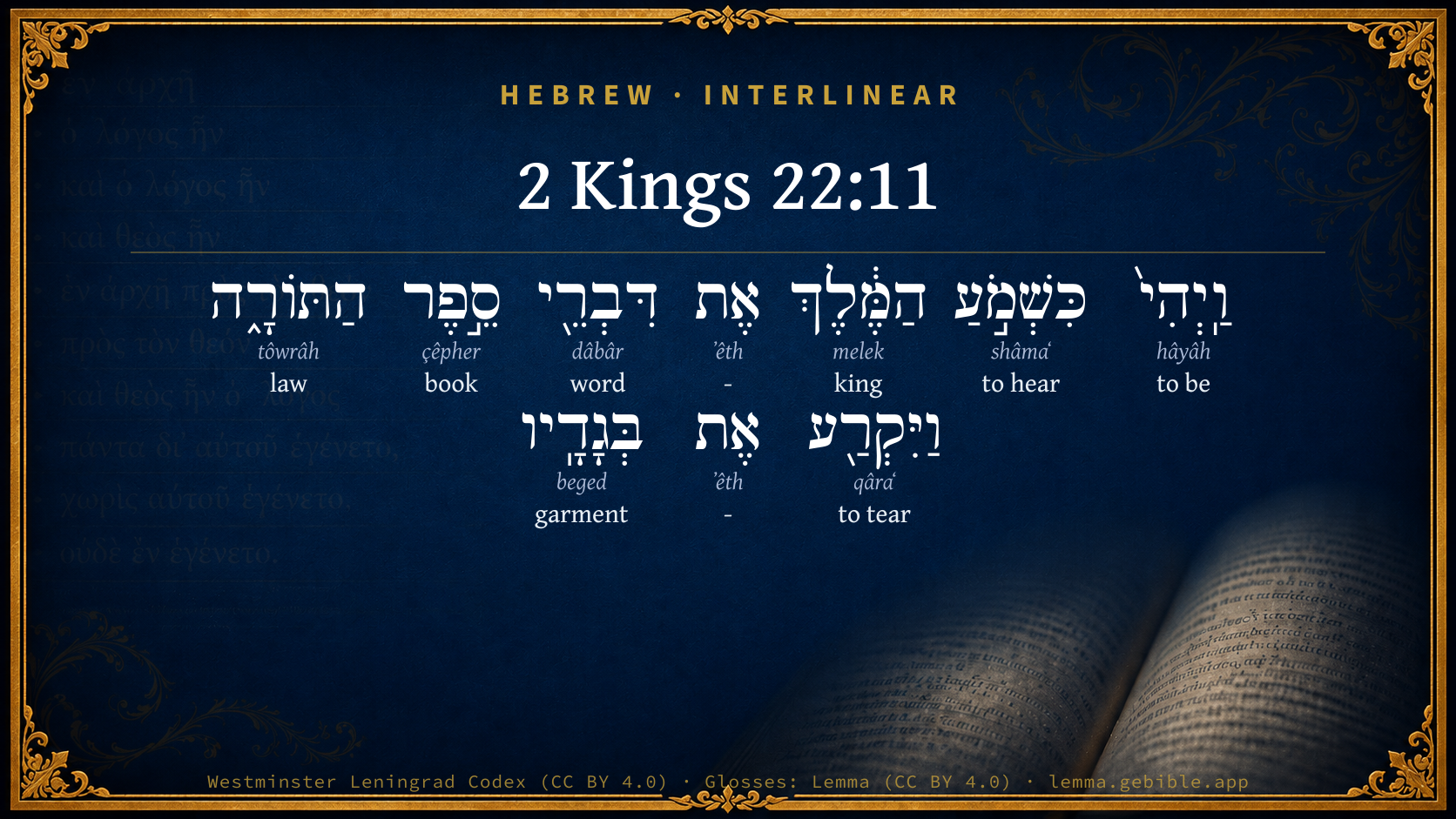
Hebrew (Westminster Leningrad Codex) 2 Kings 22:11 appears in the Hebrew Old Testament. The text above is from the Westminster Leningrad Codex. Each word links to its Strong’s number, a concise gloss, and parsing drawn from the Open Scriptures Hebrew Bible morphology. Click any word for its full Brown-Driver-Briggs (BDB) entry.
Download image
Cite this verse

2 Kings 22:11 (World English Bible). Public Domain. Lemma interlinear Bible study tool, https://lemma.gebible.app/v/2-kings/22/11.

Show BibTeX & RIS
BibTeX
RIS
English Translation
It happened, when the king had heard the words of the book of the law, that he tore his clothes.
World English Bible · Public Domain
Download a study sheet

One document with this verse’s original text, its word-by-word gloss line, the meaning frame, cross-references with their text, attributed commentary, and full source and license credits — printable, and it pastes into notes with its structure intact.

This verse Autodidact and up

Study sheet (.html) Plain text (.txt)

A passage Seminary Student

Up to 50 verses in one chapter. A passage sheet keeps up to 6 commentary sources and 12 cross-references per verse, in the order this page ranks them, and says so on the sheet whenever that leaves anything out. Ask for a single verse and you get the Autodidact verse sheet above.

Everything on this page stays free to read, with no account — the sheet is a download of what is already on screen, not access to it.

Want to remove ads? Support Godless Engineer
Compare translations 3

The same verse in 3 English versions, stacked beneath the original-language interlinear above. Click any original word for its lexicon entry.

Each is an independent rendering of the whole verse — the interlinear is not word-aligned to these translations.

Highlighted words mark where these versions differ — a whole-verse word diff, not a word-by-word alignment.

  • World English Bible Public Domain
    It happened, when the king had heard the words of the book of the law, that he tore his clothes.
  • King James Version Public Domain
    And it came to pass, when the king had heard the words of the book of the law, that he rent his clothes.
  • unfoldingWord Literal Text CC BY-SA 4.0
    And it happened when the king heard the words of the scroll of the Law that he tore his clothes.

unfoldingWord Literal Text — © unfoldingWord, licensed CC BY-SA 4.0. Word-aligned USFM3 via Door43 (git.door43.org/unfoldingWord/en_ult).

Versions to compare (up to 4)

3 of 4 selected

Show all 18 translations

Every available English version of this verse, each an independent rendering of the whole verse.

  • World English Bible Public Domain
    It happened, when the king had heard the words of the book of the law, that he tore his clothes.
  • Berean Standard Bible Public Domain
    When the king heard the words of the Book of the Law, he tore his clothes
  • Majority Standard Bible Public Domain
    When the king heard the words of the Book of the Law, he tore his clothes
  • King James Version Public Domain
    And it came to pass, when the king had heard the words of the book of the law, that he rent his clothes.
  • American Standard Version (1901) Public Domain
    And it came to pass, when the king had heard the words of the book of the law, that he rent his clothes.
  • Revised Version (1885) Public Domain
    And it came to pass, when the king had heard the words of the book of the law, that he rent his clothes.
  • Geneva Bible (1599) Public Domain
    And when the King had heard the wordes of the booke of the Law, he rent his clothes.
  • Douay-Rheims (1899) Public Domain
    And the king had heard the words of the law of the Lord, he rent his garments.
  • Young's Literal Translation Public Domain
    And it cometh to pass, at the king's hearing the words of the book of the law, that he rendeth his garments,
  • Literal Standard Version CC BY-SA 4.0
    And it comes to pass, at the king’s hearing the words of the Scroll of the Law, that he tears his garments,
  • Unlocked Literal Bible CC BY-SA 4.0
    It came about that when the king had heard the words of the law, he tore his clothes.
  • unfoldingWord Literal Text CC BY-SA 4.0
    And it happened when the king heard the words of the scroll of the Law that he tore his clothes.
  • Darby Bible Public Domain
    And it came to pass when the king heard the words of the book of the law, that he rent his garments.
  • World Messianic Bible Public Domain
    When the king had heard the words of the scroll of the Torah, he tore his clothes.
  • Webster's Bible Public Domain
    And it came to pass, when the king had heard the words of the book of the law, that he rent his clothes.
  • Free Bible Version CC BY-SA 4.0
    When the king heard what was in the book of the Law, he tore his clothes.
  • Bible in Basic English Public Domain
    And the king, hearing the words of the book of the law, took his robe in his hands, violently parting it as a sign of his grief;
  • JPS Tanakh (1917) Public Domain
    And it came to pass, when the king had heard the words of the book of the Law, that he rent his clothes.

Literal Standard Version (2020), Covenant Press — licensed CC BY-SA 4.0. Text via the HelloAO Bible API (eBible.org). Unlocked Literal Bible (unfoldingWord) — licensed CC BY-SA 4.0. Text via the HelloAO Bible API (eBible.org). unfoldingWord Literal Text — © unfoldingWord, licensed CC BY-SA 4.0. Word-aligned USFM3 via Door43 (git.door43.org/unfoldingWord/en_ult). Free Bible Version, Dr. Jonathan Gallagher — licensed CC BY-SA 4.0. Text via the HelloAO Bible API (eBible.org).

Word by word

More ways to search: Search by grammar → Find every occurrence → Compare this word →

Practice this passage: Drill this verse → Learn its vocabulary →

וַיִּקְרַ֖ע
qâraʻ
H7167
“and · to tear”
Conjunction + Verb, Qal, Sequential Imperfect, 3rd Person, Masculine, Singular
Part of Speech
Conjunction + Verb
Stem
Qal
Form
Sequential Imperfect
Person
3rd Person
Gender
Masculine
Number
Singular
Full BDB Definition

Origin: a primitive root

TWOT: 2074

to tear, tear in pieces - (Qal) - to tear, rend - to tear away or out - to tear, rend asunder - to make wide or large (of eyes) - to rend open (of heavens) - to tear, rend (of wild beasts) - (Niphal) to be rent, be split asunder
  1. וַֽיְהִי֙ hâyâh H1961 “and · to be” Conjunction + Verb, Qal, Sequential Imperfect, 3rd Person, Masculine, Singular
  2. כִּשְׁמֹ֣עַ shâmaʻ H8085 “like/as · to hear” Preposition + Verb, Qal, Infinitive Construct
  3. הַמֶּ֔לֶךְ melek H4428 “the · king” Particle, Definite Article + Noun, Common, Masculine, Singular, Absolute
  4. אֶת ʼêth H853 “-” Particle, Direct Object
  5. דִּבְרֵ֖י dâbâr H1697 “words of” Noun, Common, Masculine, Plural, Construct
  6. סֵ֣פֶר çêpher H5612 “book of” Noun, Common, Masculine, Singular, Construct
  7. הַתּוֹרָ֑ה tôwrâh H8451 “the · law” Particle, Definite Article + Noun, Common, Feminine, Singular, Absolute
  8. אֶת ʼêth H853 “-” Particle, Direct Object
  9. בְּגָדָֽיו beged H899 “garments · his” Noun, Common, Masculine, Plural, Construct + Suffix, Personal, 3rd Person, Masculine, Singular

About this verse

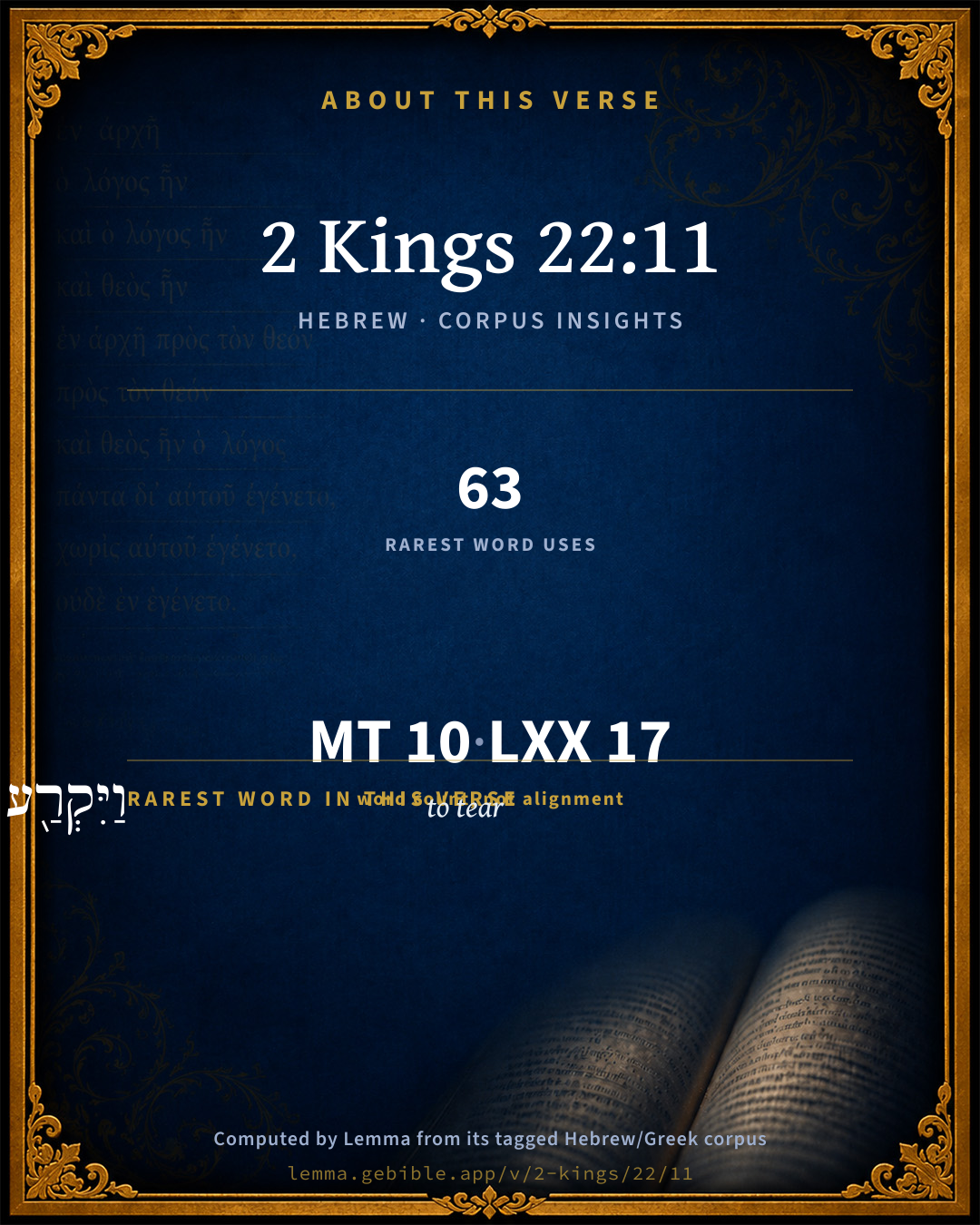
These counts appear in no published source. They are computed here, from the morphology-tagged text and Lemma’s own curated glosses. What Lemma adds →

10
words
9
distinct lemmas
Historical
section

Grammatical profile

  • 3 verbs
  • 5 nouns
  • 2 particles

Verb forms

  • וַֽיְהִי֙ Qal · Sequential Imperfect
  • כִּשְׁמֹ֣עַ Qal · Infinitive Construct
  • וַיִּקְרַ֖ע Qal · Sequential Imperfect

Hebrew & Septuagint length

In English translation the verse runs 20 words from the Hebrew and 22 from the Septuagint (LXX English) — closely comparable.

A rough comparison of the two English renderings, which tokenize alike — not a word-level alignment.

Word counts can differ between the Hebrew and the Greek without any difference in meaning — e.g. the Hebrew direct-object marker אֵת has no separate Greek word, and Greek often adds the article ὁ.

In the original languages it is 10 Hebrew tokens and 17 Greek tokens — but the two are counted differently (Hebrew bundles its prefixes and suffixes into one token; the Greek is in lemma form), so that isn’t a like-for-like length.

Cross-references

6

Topical passages linked to 2 Kings 22:11 in the Treasury of Scripture Knowledge — connected by theme and wording, ordered by reader-vote popularity; previews shown in the World English Bible.

  • 2 Chronicles 34:19 It happened, when the king had heard the words of the law, that he tore his clothes.
  • Joel 2:13 Tear your heart, and not your garments, And turn to Yahweh, your God; For he is gracious and merciful, Slow to anger, and abundant in loving kindness, And relents from sending calamity.
  • Jonah 3:6–7 The news reached the king of Nineveh, and he arose from his throne, and took off his royal robe, covered himself with sackcloth, and sat in ashes.
  • Joshua 7:6 Joshua tore his clothes, and fell to the earth on his face before the ark of Yahweh until the evening, he and the elders of Israel; and they put dust on their heads.
  • 2 Kings 22:19 because your heart was tender, and you did humble yourself before Yahweh, when you heard what I spoke against this place, and against the inhabitants of it, that they should become a desolation and a curse, and have torn your clothes, and wept before me; I also have heard you, says Yahweh.
  • Jeremiah 36:24 They were not afraid, nor tore their garments, neither the king, nor any of his servants who heard all these words.

Cross-references courtesy of OpenBible.info (CC BY 4.0).

Hebrew and Greek witnesses Masoretic Hebrew ↔ Greek Septuagint

The same verse in the two great witnesses to the Old Testament, shown verse-for-verse.

These are two independent witnesses, not word-aligned to each other, and the Septuagint is shown in lemma (dictionary) form.

Hebrew 2 Kings 22:11 Masoretic · Westminster Leningrad Codex

וַֽיְהִי֙ כִּשְׁמֹ֣עַ הַמֶּ֔לֶךְ אֶת דִּבְרֵ֖י סֵ֣פֶר הַתּוֹרָ֑ה וַיִּקְרַ֖ע אֶת בְּגָדָֽיו

It happened, when the king had heard the words of the book of the law, that he tore his clothes.

World English Bible · Public Domain

Greek LXX 2 Kings 22:11 Septuagint · lemma form

καί γίγνομαι ὡς ἀκούω ὁ βασιλεύς ὁ λόγος ὁ βιβλίον ὁ νόμος καί διαῥήγνυμι ὁ ἱμάτιον ἑαυτοῦ

And it came to pass, when the king heard the words of the book of the law, that he tore his garments.

LXX2012 (modern English Septuagint) · Public Domain

Hebrew: Westminster Leningrad Codex (CC BY 4.0). Greek: Septuagint (public domain); English from LXX2012 (modern English Septuagint) (Public Domain). How the Septuagint differs from the Hebrew →

Targum (Aramaic paraphrase)

1

The Targum is the ancient Jewish Aramaic paraphrase of the Hebrew Scriptures — an interpretive translation, not the Hebrew text itself. Onkelos (literal) and Pseudo-Jonathan (expansive) render the Torah, and Jonathan the Prophets. Coverage is partial: where no permissively-licensed English translation exists for a verse, only the Aramaic is shown. This is verse-level text, not a word-by-word alignment to the Hebrew.

  1. Targum Jonathan Prophets (Joshua–Malachi)
    וַהֲוָה כַּד שְׁמַע מַלְכָּא יַת פִּתְגָמֵי סִפְרָא דְאוֹרַיְתָא וּבְזַע יַת לְבוּשׁוֹהִי:

    (no public-domain English translation for this verse)

    Targum Jonathan — Aramaic: “Mikraot Gedolot” (public domain). English: “Sefaria Community Translation” (CC0 1.0 (public-domain dedication)); “London "Chaldee Paraphrase," 1871” (public domain). Text via Sefaria.

Commentary

Notes on 2 Kings 22:11 from classic Christian and Jewish commentators (each source and its license shown beneath its notes). The classic Christian expositions comment on the surrounding passage and are grouped to its opening verse, so a note may address several verses; the Jewish commentaries on the Tanakh (Rashi and others) are per-verse, so they appear only where the commentator wrote on this verse.

Lemma curates 59 commentaries, every one of them public domain or Creative Commons licensed, each selected and text-cleaned for this edition rather than reprinted as found. About our sources →

Trapp's Complete Commentary

John Trapp

2Ki 22:11 And it came to pass, when the king had heard the words of the book of the law, that he rent his clothes.

Ver. 11. When the king had heard the words.] Which the wicked account to be but wind, {Jer 5:13} and spoken in terrorem only; though God threaten to make them fire, {Jer 5:14} and as he gave his law in fire, so in fire to require it.

John Trapp, A Commentary or Exposition upon All the Books of the Old and New Testament (1647–1656) — public domain. Text from a community e-Sword module.

Tyndale Open Study Notes

Tyndale Open Resources

22:11-13 Like Hezekiah before him (19:1), Josiah tore his clothes in genuine grief for his own spiritual condition and that of the people of Judah. • have not obeyed the words in this scroll: The portion that Shaphan read to Josiah apparently reminded him of God’s claim upon his people, the need for faithfulness to the covenant, and the penalties for infidelity (see Deut 28). Recognizing that Judah had failed to obey the law, Josiah rightly feared the Lord’s great anger.

Tyndale Open Study Notes — © Tyndale Open Resources, licensed CC BY-SA 4.0. Text via the HelloAO Bible API.

Matthew Henry's Commentary

We hear no more of the repairing of the temple: no doubt that good work went on well; but the book of the law that was found in it occupies us now, and well it may. It is not laid up in the king's cabinet as a piece of antiquity, a rarity to be admired, but it is read before the king. Those put the truest honour upon their Bibles that study them and converse with them daily, feed on that bread and walk by that light. Men of honour and business must look upon an acquaintance with God's word to be their best business and honour. Now here we have,

I. The impressions which the reading of the law made upon Josiah. He rent his clothes, as one ashamed of the sin of his people and afraid of the wrath of God; he had long thought the case of his kingdom bad, by reason of the idolatries and impieties that had been found among them, but he never thought it so bad as he perceived it to be by the book of the law now read to him. The rending of his clothes signified the rending of his heart for the dishonour done to God, and the ruin he saw coming upon his people.

II. The application he made to God hereupon: Go, enquire of the Lord for me, Kg2 22:13.

1. Two things we may suppose he desired to know: - "Enquire, (1.) What we shall do; what course we shall take to turn away God's wrath and prevent the judgments which our sins have deserved." Convictions of sin and wrath should put us upon this enquiry, What shall we do to be saved? Wherewithal shall we come before the Lord? If you will thus enquire, enquire quickly, before it be too late. (2.) "What we may expect and must provide for." He acknowledges, "Our fathers have not hearkened to the words of this book; if this be the rule of right, certainly our fathers have been much in the wrong." Now that the commandment came sin revived, and appeared sin; in the glass of the law, he saw the sins of his people more numerous and more heinous than he had before seen them, and more exceedingly sinful. He infers hence, "Certainly great is the wrath that is kindled against us; if this be the word of God, as no doubt it is, and he will be true to his word, as no doubt he will be, we are all undone. I never thought the threatenings of the law so severe, and the curses of the covenant so terrible, as now I find them to be; it is time to look about us if these be in force against us." Note, Those who are truly apprehensive of the weight of God's wrath cannot but be very solicitous to obtain his favour, and inquisitive how they may make their peace with him. Magistrates should enquire for their people, and study how to prevent the judgments of God that they see hanging over them.

2. This enquiry Josiah sent, (1.) By some of his great men, who are named Kg2 22:12, and again Kg2 22:14. Thus he put an honour upon the oracle, by employing those of the first rank to attend it. (2.) To Huldah the prophetess, Kg2 22:14. The spirit of prophecy, that inestimable treasure, was sometimes put not only into earthen vessels, but into the weaker vessels, that the excellency of the power might be of God. Miriam helped to lead Israel out of Egypt (Mic 6:4), Deborah judged them, and now Huldah instructed them in the mind of God, and her being a wife was no prejudice at all to her being a prophetess; marriage is honourable in all. It was a mercy to Jerusalem that when Bibles were scarce they had prophets, as afterwards, when prophecy ceased, that they had more Bibles; for God never leaves himself without witness, because he will leave sinners without excuse. Jeremiah and Zephaniah prophesied at this time, yet the king's messengers made Huldah their oracle, probably because her husband having a place at court (for he was keeper of the wardrobe) they had had more and longer acquaintance with her and greater assurances of her commission than of any other; they had, it is likely, consulted her upon other occasions, and had found that the word of God in her mouth was truth. She was near, for she dwelt at Jerusalem, in a place called Mishneh, the second rank of buildings from the royal palace. The Jews say that she prophesied among the women, the court ladies, being herself one of them, who it is probable had their apartments in that place. Happy the court that had a prophetess within the verge of it, and knew how to value her.

III. The answer he received from God to his enquiry. Huldah returned it not in the language of a courtier - "Pray give my humble service to his Majesty, and let him know that this is the message I have for him from the God of Israel;" but in the dialect of a prophetess, speaking from him before whom all stand upon the same level - Tell the man that sent you to me, Kg2 22:15. Even kings, though gods to us, are men to God, and shall so be dealt with; for with him there is no respect of persons.

1. She let him know what judgments God had in store for Judah and Jerusalem (Kg2 22:16, Kg2 22:17): My wrath shall be kindled against this place; and what is hell itself but the fire of God's wrath kindled against sinners? Observe, (1.) The degree and duration of it. It is so kindled that it shall not be quenched; the decree has gone forth; it is too late now to think of preventing it; the iniquity of Jerusalem shall not be purged with sacrifice or offering. Hell is unquenchable fire. (2.) The reference it has, [1.] To their sins: "They have committed them, as it were, with design, and on purpose to provoke me to anger. It is a fire of their own kindling; they would provoke me, and at length I am provoked." [2.] To God's threatenings: "The evil I bring is according to the words of the book which the king of Judah has read; the scripture is fulfilled in it. Those that would not be bound by the precept shall be bound by the penalty." God will be found no less terrible to impenitent sinners than his word makes him to be.

2. She let him know what mercy God had in store for him. (1.) Notice is taken of his great tenderness and concern for the glory of God and the welfare of his kingdom (Kg2 22:19): Thy heart was tender. Note, God will distinguish those that distinguish themselves. The generality of the people were hardened and their hearts unhumbled, so were the wicked kings his predecessors, but Josiah's heart was tender. He received the impressions of God's word, trembled at it and yielded to it; he was exceedingly grieved for the dishonour done to God by the sins of his fathers and of his people; he was afraid of the judgments of God, which he saw coming upon Jerusalem, and earnestly deprecated them. This is tenderness of heart, and thus he humbled himself before the Lord, and expressed these pious affections by rending his clothes and weeping before God, probably in his closet; but he that sees in secret says it was before him, and he heard it, and put every tear of tenderness into his bottle. Note, Those that most fear God's wrath are least likely to feel it. It should seem that those words (Lev 26:32) much affected Josiah, I will bring the land into desolation; for when he heard of the desolation and of the curse, that is, that God would forsake them and separate them to evil (for till it came to that they were neither desolate nor accursed), then he rent his clothes: the threatening went to his heart. (2.) A reprieve is granted till after his death (Kg2 22:20): I will gather thee to thy fathers. The saints then, no doubt, had a comfortable prospect of happiness on the other side death, else being gathered to their fathers would not have been so often made the matter of a promise as we find it was. Josiah could not prevail to prevent the judgment itself, but God promised him he should not live to see it, which (especially considering that he died in the midst of his days, before he was forty years old) would have been but a small reward for his eminent piety if there had not been another world in which he should be abundantly recompensed, Heb 11:16. When the righteous is taken away from the evil to come he enters into peace, Isa 57:1, Isa 57:2. This is promised to Josiah here: Thou shalt go to thy grave in peace, which refers not to the manner of his death (for he was killed in a battle), but to the time of it; it was a little before the captivity in Babylon, that great trouble, in comparison with which the rest were as nothing, so that he might be truly said to die in peace that did not live to share in that. He died in the love and favour of God, which secure such a peace as no circumstances of dying, no, not dying in the field of war, could alter the nature of, or break in upon.

Matthew Henry's Commentary on the Whole Bible (1708–1710) — public domain (CC PDM 1.0). Text via the HelloAO Bible API.

The Cambridge Bible for Schools and Colleges

gen. ed. J. J. S. Perowne

11. he rent his clothes] From what is said afterwards in verse 19, we can see that the portions which affected the king were such passages as Deuteronomy 28. There in verse 15, it is said, ‘If thou wilt not hearken unto the voice of the Lord thy God … all these curses shall come upon thee’. And in verse 45 ‘all these curses shall come upon thee, and shall pursue thee and overtake thee till thou be destroyed’. And in verse 37, ‘Thou shalt become an astonishment, a proverb and a byword among all nations whither the Lord shall lead thee’.

The Cambridge Bible for Schools and Colleges (gen. ed. J. J. S. Perowne; Cambridge University Press, 1878–1918) — public domain. Text from a community e-Sword module.

John Gill's Exposition

And it came to pass, when the king had heard the words of the book of the law,.... From whence it appears that he had never wrote out a copy of it, as the kings of Israel were ordered to do, when they came to the throne, Deu 17:18 nor had read it, at least not the whole of it; and yet it seems strange that he should be twenty six years of age, as he now was, and had proceeded far in the reformation of worship, and yet be without the book of the law, and the high priest also; it looks as if it was, as some have thought, that they had till now only some abstracts of the law, and not the whole: and perhaps the reformation hitherto carried on chiefly lay in abolishing idolatry, and not so much in restoring the ordinances of worship to their purity; for it was after this that the ordinance of the passover was ordered to be kept; and when the king observed, on hearing the law read, that it had not been kept as it should, that such severe threatenings were denounced against the transgressors of it;

that he rent his clothes; as expressive of the rending of his heart, and of his humiliation and sorrow for the sins he and his people were guilty of.

John Gill's Exposition of the Whole Bible (1746–1763) — public domain (CC PDM 1.0). Text via the HelloAO Bible API.

Albert Barnes' Notes on the Bible

He rent his clothes - Partly grief and horror, like Reuben Gen 37:29 and Job Job 1:20, partly in repentance, like Ahab 1Ki 21:27.

Albert Barnes' Notes on the Bible (1834–1885) — public domain. Text from a community e-Sword/MySword module.

Haydock's Catholic Bible Commentary

Garments, through zeal for God’s honour, and fear of his indignation. (Menochius)

George Leo Haydock (1774–1849), Haydock's Catholic Family Bible and Commentary, 1859 edition — public domain. Excludes Psalms (Douay-Rheims chapter numbering differs from Protestant) and Deuterocanonical books (Catholic canon only).

Matthew Poole's English Annotations

The words of the book of the law, i. e. the dreadful comminations against them for the sins still reigning among the people.

Quest. Did Josiah never see and read a copy of this book before this time? If he did not, how could he do so much towards the reformation of religion, as he did before? if he did, why was he not sooner convinced and humbled by it?

Answ. If Josiah had not yet seen a copy of this book, (which is not impossible,) yet there was so much of the law left in the minds and memories of many of the people, as might easily persuade and direct him to all that he did till this time; or if Josiah had seen and read it before, which seems more probable, yet the great reverence which he justly bore to the original book, and the strange, and remarkable, and seasonable finding of it, had very much awakened and quickened him to a more serious and diligent reading, and attentive consideration, of all the passages contained in it, than he used before.

Matthew Poole's English Annotations on the Holy Bible (1683–1685) — public domain. Text from a community e-Sword/MySword module.

Whedon's Commentary on the Bible

Daniel D. Whedon

11. Rent his clothes — So sudden and profound was his grief and terror on fully realizing the extent and fear-fulness of the nation’s apostasy from the law of Jehovah.

Daniel D. Whedon (gen. ed.), Commentary on the Old and New Testaments (1874–1909) — public domain. Text from a community e-Sword module.

The Pulpit Commentary

And it came to pass, when the king had heard the words of the book of the Law, that he rent his clothes. To Josiah the book was evidently, as to Hilkiah, in some sort a discovery. It was not, however, a wholly new thing; rather, he accepted it as the recovery of a thing that was known to have been lost, and was now happily found. And in accepting it he regarded it as authoritative. It was not to him "a book of Law" (Ewald), but "the book of the Law." We can well imagine that, although the book may have been lost early in Manasseh"s reign, yet echoes of it had lingered on

(1) in the liturgies of the Jehovistic worship;

(2) in the teachings of the prophets;

(3) in the traditional teaching of religious families; so that the pious ear recognized its phrases as familiar.

It is also probable that there were external tokens about the book indicative of its character, which caused its ready acceptance.

The Pulpit Commentary (1880–1919), ed. H.D.M. Spence-Jones & Joseph S. Exell — public domain. Text from a community e-Sword module.

John Wesley's Explanatory Notes

The words - The dreadful comminations against them for the sins still reigning among the people. If Josiah had seen and read it before, which seems more probable, yet the great reverence which he justly bare to the original book, and the strange, and remarkable, and seasonable finding of it, had awakened and quickened him to a more serious and diligent consideration of all the passages contained in it. And what a providence was this, that it was still preserved! Yea, what a providence, that the whole book of God is preserved to us. If the holy scriptures had not been of God, they had not been in being at this day. God's care of the bible, is a plain proof of his interest in it. It was a great instance of God's favour, that the book of the law was thus seasonably brought to light, to direct and quicken that blessed reformation, which Joash had begun. And it is observable, they were about a good work, repairing the temple, when it was found. They that do their duty according to their knowledge, shall have their knowledge increased.

John Wesley, Explanatory Notes Upon the Whole Bible (1754–1765) — public domain. Text via the GEBible commentary corpus.

Keil & Delitzsch

C. F. Keil & F. Delitzsch

In his alarm at the words of the book of the law that had been read to him, Josiah rent his clothes, and sent a deputation to the prophetess Huldah, to make inquiry of Jehovah through her concerning the things which he had heard from the law. The deputation consisted of the high priest Hilkiah, Ahikam the supporter of Jeremiah (Jer 26:24) and the father of Gedaliah the governor (Kg2 25:22; Jer 39:14, etc.), Achbor the son of Michaiah, Shaphan the state-secretary (Kg2 22:3), and Asahiah the servant (i.e., an officer) of the king.

Keil & Delitzsch — Biblical Commentary on the Old Testament (1861–1891) — public domain (CC PDM 1.0). Text via the HelloAO Bible API. (Old Testament only.)

unfoldingWord translationNotes

Door43 World Missions Community

It came about that

If your language has a way to mark the beginning of a new part of the story, consider using it here.

had heard the words of the law

Here "words" represents the message of the law. AT: "had heard the laws that were written in the book" or "had heard the laws that were written in the scroll" (See: Metonymy)

he tore his clothes

This is a symbolic action that indicates intense grief or sadness. (See: Symbolic Action)

Ahikam ... Shaphan ... Akbor ... Micaiah ... Asaiah

These are names of men. (See: How to Translate Names)

Go and consult with Yahweh

It is made clear in 2Ki 22:14 that the king means for the men to go to the prophetess of Yahweh to determine Yahweh's will.

consult

to go to someone to ask for advice

the words of this book that has been found

Here "words" represents the laws. This can be stated in active form. AT: "the laws in this book that Hilkiah has found" (See:Synecdoche and Active or Passive)

For great is the anger of Yahweh that has been kindled against us

Yahweh's anger is spoken of as if it were a fire that was lit. AT: "For Yahweh is very angry with us" (See: Metaphor)

all that was written concerning us

This refers to the law that was given to Israel. This can be stated in active form. AT: "all that Moses wrote in the law that we should do" or "all the laws that God gave through Moses to the people of Israel" (See: Active or Passive)

translationWords

word

command

priest

kingdom of Judah

anger

obey

written

unfoldingWord translationNotes — © Distant Shores Media and the Door43 World Missions Community, licensed CC BY-SA 4.0. Source: git.door43.org/Door43/en_tn.

Lesson kit

Teaching starters — assembled from the data on this page, not authored interpretation. Every prompt links to the verse data it draws on. Edit before teaching.

2 Kings, in the Historical, opens this verse with 10 words (9 distinct Hebrew lemmas). Its most distinctive word is qâraʻ (“to tear”). A historical commentator’s framing appears above. Read the whole chapter for the surrounding context.

Discussion questions

  1. What does “to tear” (qâraʻ) contribute to the verse as a whole?
  2. 2 Chronicles 34:19 shares this passage’s theme. How do the two illuminate each other?
  3. These translations render this verse differently; the difference is in the English rendering, not the original. What questions does that raise?
  4. The verb «וַֽיְהִי֙» is Qal Sequential Imperfect. How does its form color the action?
  5. Reading how Trapp's Complete Commentary and Tyndale Open Study Notes read this verse, where do the two commentators agree and where do they part?

Things to notice

Reading settings

Reading text

Shown beneath each verse's original-language words.

Old Testament
Old Testament edition

Read the OT as the Masoretic Hebrew (MT) or the Greek Septuagint (LXX).

English shown for the Greek Septuagint (in the Hebrew ↔ Greek comparison).

Comparing translations? Open the Compare panel on any verse page to stack up to four side by side.