
Isaiah 1:10

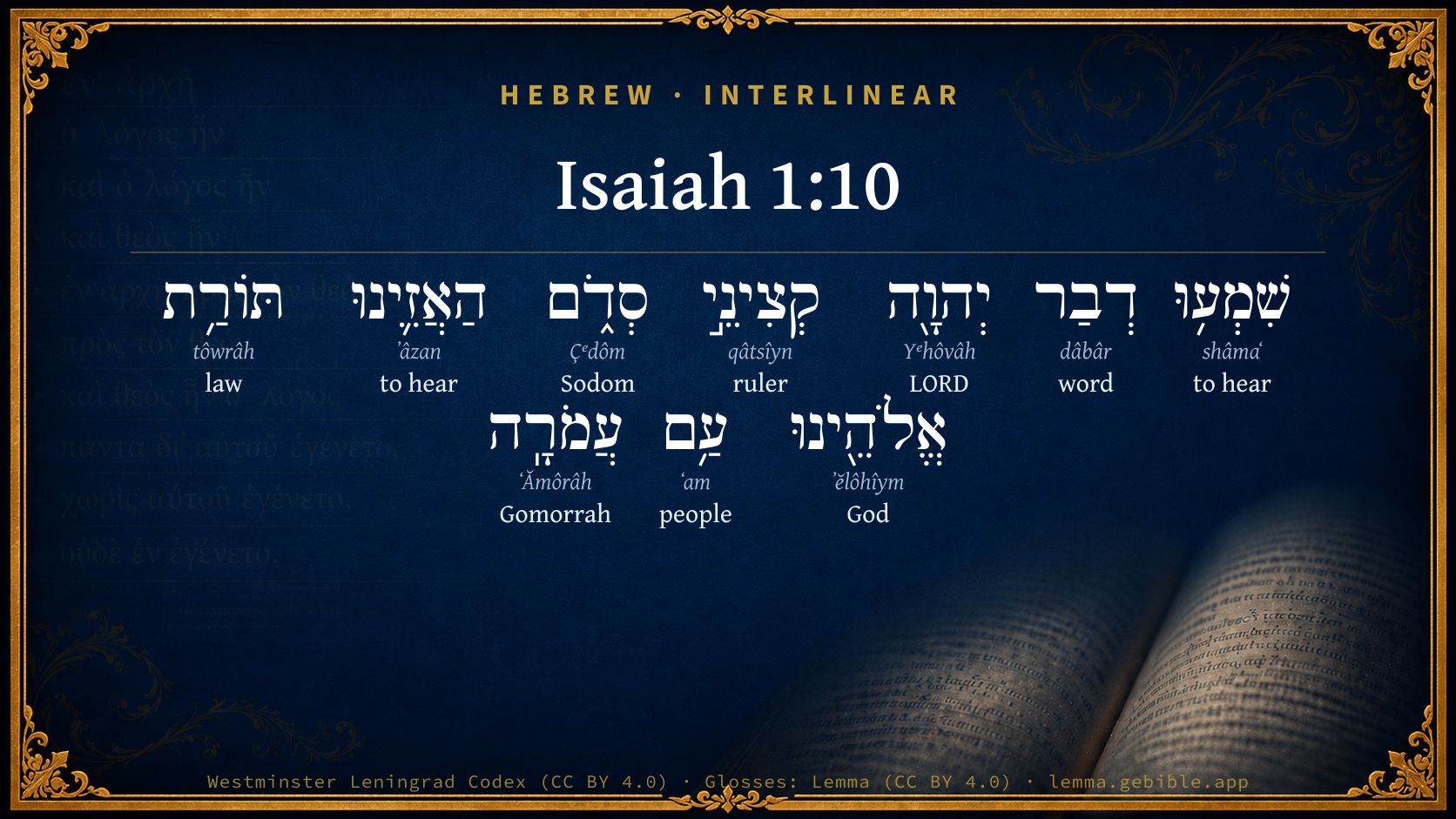
Hebrew (Westminster Leningrad Codex) Isaiah 1:10 appears in the Hebrew Old Testament. The text above is from the Westminster Leningrad Codex. Each word links to its Strong’s number, a concise gloss, and parsing drawn from the Open Scriptures Hebrew Bible morphology. Click any word for its full Brown-Driver-Briggs (BDB) entry.
Download image
Cite this verse

Isaiah 1:10 (World English Bible). Public Domain. Lemma interlinear Bible study tool, https://lemma.gebible.app/v/isaiah/1/10.

Show BibTeX & RIS
BibTeX
RIS
English Translation
Hear the word of Yahweh, you rulers of Sodom! Listen to the law of our God, you people of Gomorrah!
World English Bible · Public Domain
Download a study sheet

One document with this verse’s original text, its word-by-word gloss line, the meaning frame, cross-references with their text, attributed commentary, and full source and license credits — printable, and it pastes into notes with its structure intact.

This verse Autodidact and up

Study sheet (.html) Plain text (.txt)

A passage Seminary Student

Up to 50 verses in one chapter. A passage sheet keeps up to 6 commentary sources and 12 cross-references per verse, in the order this page ranks them, and says so on the sheet whenever that leaves anything out. Ask for a single verse and you get the Autodidact verse sheet above.

Everything on this page stays free to read, with no account — the sheet is a download of what is already on screen, not access to it.

Want to remove ads? Support Godless Engineer
Compare translations 3

The same verse in 3 English versions, stacked beneath the original-language interlinear above. Click any original word for its lexicon entry.

Each is an independent rendering of the whole verse — the interlinear is not word-aligned to these translations.

Highlighted words mark where these versions differ — a whole-verse word diff, not a word-by-word alignment.

  • World English Bible Public Domain
    Hear the word of Yahweh, you rulers of Sodom! Listen to the law of our God, you people of Gomorrah!
  • King James Version Public Domain
    Hear the word of the LORD, ye rulers of Sodom; give ear unto the law of our God, ye people of Gomorrah.
  • unfoldingWord Literal Text CC BY-SA 4.0
    Hear the word of Yahweh, rulers of Sodom! Listen the instruction of our God, people of Gomorrah!

unfoldingWord Literal Text — © unfoldingWord, licensed CC BY-SA 4.0. Word-aligned USFM3 via Door43 (git.door43.org/unfoldingWord/en_ult).

Versions to compare (up to 4)

3 of 4 selected

Show all 18 translations

Every available English version of this verse, each an independent rendering of the whole verse.

  • World English Bible Public Domain
    Hear the word of Yahweh, you rulers of Sodom! Listen to the law of our God, you people of Gomorrah!
  • Berean Standard Bible Public Domain
    Hear the word of the LORD, you rulers of Sodom; listen to the instruction of our God, you people of Gomorrah!
  • Majority Standard Bible Public Domain
    Hear the word of the LORD, you rulers of Sodom; listen to the instruction of our God, you people of Gomorrah!
  • King James Version Public Domain
    Hear the word of the LORD, ye rulers of Sodom; give ear unto the law of our God, ye people of Gomorrah.
  • American Standard Version (1901) Public Domain
    Hear the word of Jehovah, ye rulers of Sodom; give ear unto the law of our God, ye people of Gomorrah.
  • Revised Version (1885) Public Domain
    Hear the word of the LORD, ye rulers of Sodom; give ear unto the law of our God, ye people of Gomorrah.
  • Geneva Bible (1599) Public Domain
    Heare the worde of the Lord, O princes of Sodom: hearken vnto the Law of our God, O people of Gomorah.
  • Douay-Rheims (1899) Public Domain
    Hear the word of the Lord, ye rulers of Sodom, give ear to the law of our God, ye people of Gomorrha.
  • Young's Literal Translation Public Domain
    Hear the word of Jehovah, ye rulers of Sodom, Give ear to the law of our God, ye people of Gomorrah,
  • Literal Standard Version CC BY-SA 4.0
    Hear the word of YHWH, you rulers of Sodom, || Give ear to the Law of our God, you people of Gomorrah,
  • Unlocked Literal Bible CC BY-SA 4.0
    Hear the word of Yahweh, you rulers of Sodom; listen to the law of our God, you people of Gomorrah:
  • unfoldingWord Literal Text CC BY-SA 4.0
    Hear the word of Yahweh, rulers of Sodom! Listen the instruction of our God, people of Gomorrah!
  • Darby Bible Public Domain
    Hear the word of Jehovah, rulers of Sodom; give ear unto the law of our God, people of Gomorrah!
  • World Messianic Bible Public Domain
    Hear the LORD’s word, you rulers of Sodom! Listen to the law of our God, you people of Gomorrah!
  • Webster's Bible Public Domain
    Hear the word of the LORD, ye rulers of Sodom; give ear to the law of our God, ye people of Gomorrah.
  • Free Bible Version CC BY-SA 4.0
    Listen to what the Lord has to say, you rulers of Sodom! Pay attention to the instructions of our God, you people of Gomorrah!
  • Bible in Basic English Public Domain
    Give ear to the word of the Lord, you rulers of Sodom; let your hearts be turned to the law of our God, you people of Gomorrah.
  • JPS Tanakh (1917) Public Domain
    Hear the word of the LORD, ye rulers of Sodom; give ear unto the law of our God, ye people of Gomorrah.

Literal Standard Version (2020), Covenant Press — licensed CC BY-SA 4.0. Text via the HelloAO Bible API (eBible.org). Unlocked Literal Bible (unfoldingWord) — licensed CC BY-SA 4.0. Text via the HelloAO Bible API (eBible.org). unfoldingWord Literal Text — © unfoldingWord, licensed CC BY-SA 4.0. Word-aligned USFM3 via Door43 (git.door43.org/unfoldingWord/en_ult). Free Bible Version, Dr. Jonathan Gallagher — licensed CC BY-SA 4.0. Text via the HelloAO Bible API (eBible.org).

Word by word

More ways to search: Search by grammar → Find every occurrence → Compare this word →

Practice this passage: Drill this verse → Learn its vocabulary →

About this verse

These counts appear in no published source. They are computed here, from the morphology-tagged text and Lemma’s own curated glosses. What Lemma adds →

10
words
10
distinct lemmas
Prophets
section

Notable vocabulary

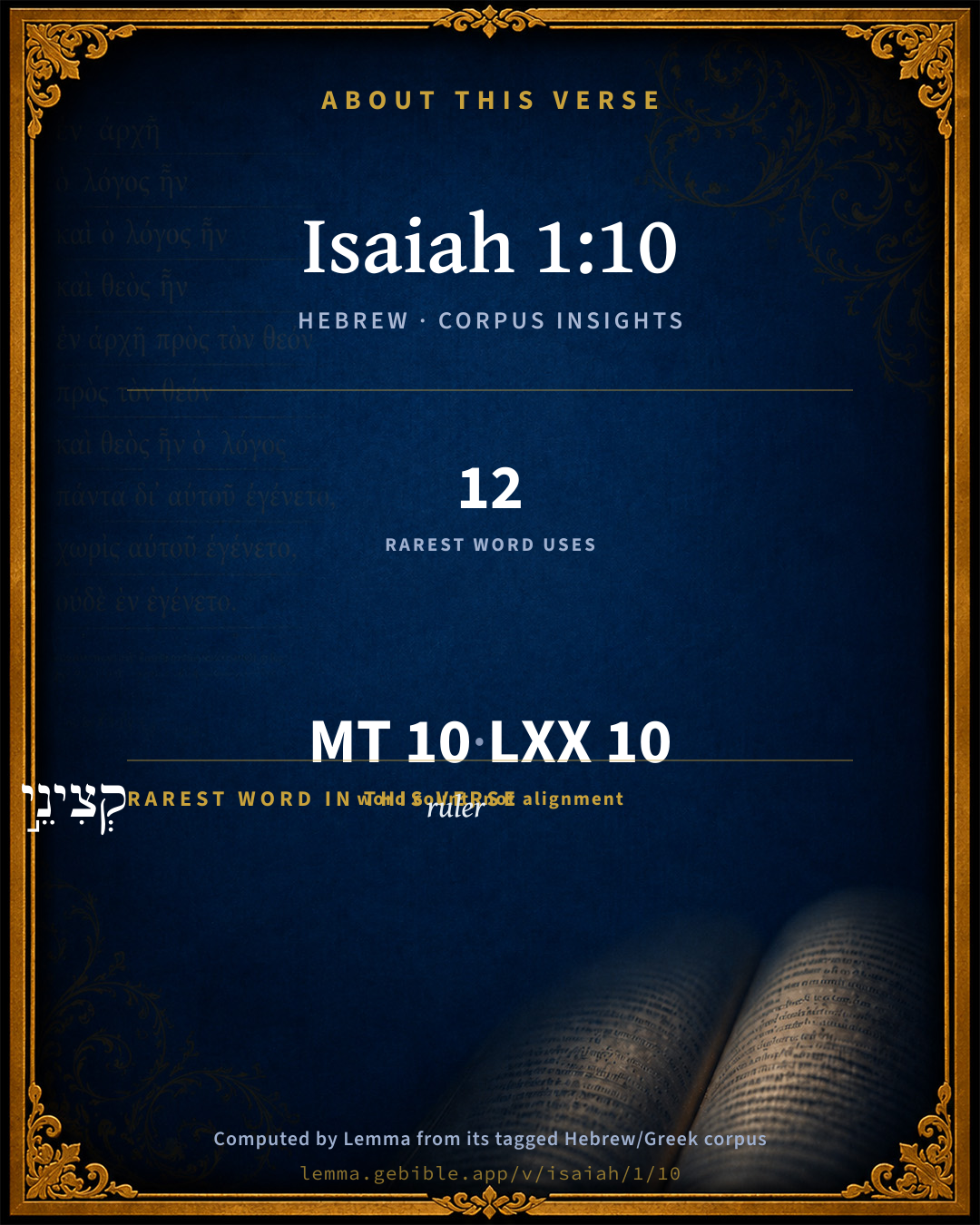
The rarest word here is קְצִינֵ֣י ruler H7101 — appearing just 12 times in the whole Hebrew Bible.

Shared distinctive vocabulary

קְצִינֵ֣י ruler H7101 occurs in 12 verses of the Hebrew Bible. Also found in:

Grammatical profile

  • 2 verbs
  • 8 nouns

Verb forms

  • שִׁמְע֥וּ Qal · Imperative
  • הַאֲזִ֛ינוּ Hiphil · Imperative

Hebrew & Septuagint length

In English translation the verse runs 20 words from the Hebrew and 20 from the Septuagint (LXX English) — the same length.

A rough comparison of the two English renderings, which tokenize alike — not a word-level alignment.

Word counts can differ between the Hebrew and the Greek without any difference in meaning — e.g. the Hebrew direct-object marker אֵת has no separate Greek word, and Greek often adds the article ὁ.

In the original languages it is 10 Hebrew tokens and 10 Greek tokens — but the two are counted differently (Hebrew bundles its prefixes and suffixes into one token; the Greek is in lemma form), so that isn’t a like-for-like length.

Cross-references

16

Topical passages linked to Isaiah 1:10 in the Treasury of Scripture Knowledge — connected by theme and wording, ordered by reader-vote popularity; previews shown in the World English Bible.

  • Deuteronomy 32:32 For their vine is of the vine of Sodom, Of the fields of Gomorrah: Their grapes are grapes of gall, Their clusters are bitter:
  • Isaiah 3:9 The look of their faces testify against them. They parade their sin like Sodom. They don't hide it. Woe to their soul! For they have brought disaster upon themselves.
  • Ezekiel 16:49 Behold, this was the iniquity of your sister Sodom: pride, fullness of bread, and prosperous ease was in her and in her daughters; neither did she strengthen the hand of the poor and needy.
  • Revelation 11:8 Their dead bodies will be in the street of the great city, which spiritually is called Sodom and Egypt, where also their Lord was crucified.
  • Genesis 13:13 Now the men of Sodom were exceedingly wicked and sinners against Yahweh.
  • 1 Kings 22:19–23 [Micaiah] said, Therefore hear you the word of Yahweh: I saw Yahweh sitting on his throne, and all the host of heaven standing by him on his right hand and on his left.
  • Isaiah 8:20 To the law and to the testimony! if they don't speak according to this word, surely there is no morning for them.
  • Isaiah 28:14 Why hear the word of Yahweh, you scoffers, that rule this people that is in Jerusalem:
  • Jeremiah 9:26 Egypt, and Judah, and Edom, and the children of Ammon, and Moab, and all that have the corners [of their hair] cut off, who dwell in the wilderness; for all the nations are uncircumcised, and all the house of Israel are uncircumcised in heart.
  • Jeremiah 23:14 In the prophets of Jerusalem also I have seen a horrible thing: they commit adultery, and walk in lies; and they strengthen the hands of evil-doers, so that none does return from his wickedness: they are all of them become to me as Sodom, and the inhabitants of it as Gomorrah.
  • Ezekiel 16:46 Your elder sister is Samaria, who dwells at your left hand, she and her daughters; and your younger sister, who dwells at your right hand, is Sodom and her daughters.
  • Amos 9:7 Are you not like the children of the Ethiopians to me, children of Israel?" says Yahweh. "Haven't I brought up Israel out of the land of Egypt, and the Philistines from Caphtor, and the Syrians from Kir?
  • Amos 3:1 Hear this word that Yahweh has spoken against you, children of Israel, against the whole family which I brought up out of the land of Egypt, saying:
  • Amos 3:8 The lion has roared. Who will not fear? The Lord Yahweh has spoken. Who can but prophesy?
  • Micah 3:8–12 But as for me, I am full of power by the Spirit of Yahweh, And of judgment, and of might, To declare to Jacob his disobedience, And to Israel his sin.
  • Romans 9:29 As Isaiah has said before, "Unless the Lord of Hosts had left us a seed, We would have become like Sodom, And would have been made like Gomorrah."

Cross-references courtesy of OpenBible.info (CC BY 4.0).

Hebrew and Greek witnesses Masoretic Hebrew ↔ Greek Septuagint

The same verse in the two great witnesses to the Old Testament, shown verse-for-verse.

These are two independent witnesses, not word-aligned to each other, and the Septuagint is shown in lemma (dictionary) form.

Hebrew Isaiah 1:10 Masoretic · Westminster Leningrad Codex

שִׁמְע֥וּ דְבַר יְהוָ֖ה קְצִינֵ֣י סְדֹ֑ם הַאֲזִ֛ינוּ תּוֹרַ֥ת אֱלֹהֵ֖ינוּ עַ֥ם עֲמֹרָֽה

Hear the word of Yahweh, you rulers of Sodom! Listen to the law of our God, you people of Gomorrah!

World English Bible · Public Domain

Greek LXX Isaiah 1:10 Septuagint · lemma form

ἀκούω λόγος κύριος ἄρχων σοδομα προςἔχω νόμος θεός λαός γομορρα

Hear the word of the Lord, you⌃ rulers of Sodoma; attend to the law of God, you people of Gomorrha.

LXX2012 (modern English Septuagint) · Public Domain

Hebrew: Westminster Leningrad Codex (CC BY 4.0). Greek: Septuagint (public domain); English from LXX2012 (modern English Septuagint) (Public Domain). How the Septuagint differs from the Hebrew →

Targum (Aramaic paraphrase)

1

The Targum is the ancient Jewish Aramaic paraphrase of the Hebrew Scriptures — an interpretive translation, not the Hebrew text itself. Onkelos (literal) and Pseudo-Jonathan (expansive) render the Torah, and Jonathan the Prophets. Coverage is partial: where no permissively-licensed English translation exists for a verse, only the Aramaic is shown. This is verse-level text, not a word-by-word alignment to the Hebrew.

  1. Targum Jonathan Prophets (Joshua–Malachi)
    קַבִּילוּ פִּתְגָמָא דַייָ שִׁלְטוֹנַיָא דְעוֹבָדֵיהוֹן בִּישִׁין כְּשִׁלְטוֹנֵי סְדוֹם אֲצִיתוּ לְאוֹרַיְתָא דֶאֱלָהָנָא עַמָא דְעָבְדֵיהוֹן דָמְיָן לְעַם עֲמוֹרָה:

    Hear ye the word of the Lord, ye rulers, whose works are evil, as of the rulers of Sodom; give ear to the law of our God, O people, whose works are evil like those of the people of Gomorrah.

    Targum Jonathan — Aramaic: “Mikraot Gedolot” (public domain). English: “Sefaria Community Translation” (CC0 1.0 (public-domain dedication)); “London "Chaldee Paraphrase," 1871” (public domain). Text via Sefaria.

Commentary

Notes on Isaiah 1:10 from classic Christian and Jewish commentators (each source and its license shown beneath its notes). The classic Christian expositions comment on the surrounding passage and are grouped to its opening verse, so a note may address several verses; the Jewish commentaries on the Tanakh (Rashi and others) are per-verse, so they appear only where the commentator wrote on this verse.

Lemma curates 59 commentaries, every one of them public domain or Creative Commons licensed, each selected and text-cleaned for this edition rather than reprinted as found. About our sources →

Matthew Henry's Commentary

Here, I. God calls to them (but calls in vain) to hear his word, Isa 1:10. 1. The title he gives them is very strange; You rulers of Sodom, and people of Gomorrah. This intimates what a righteous thing it would have been with God to make them like Sodom and Gomorrah in respect of ruin (Isa 1:9), because that had made themselves like Sodom and Gomorrah in respect of sin. The men of Sodom were wicked, and sinners before the Lord exceedingly (Gen 13:13), and so were the men of Judah. When the rulers were bad, no wonder the people were so. Vice overpowered virtue, for it had the rulers, the men of figure, on its side; and it out-polled it, for it had the people, the men of number, on its side. The streams being thus strong, no less a power than that of the Lord of hosts could secure a remnant, Isa 1:9. The rulers are boldly attacked here by the prophet as rulers of Sodom; for he knew not how to give flattering titles. The tradition of the Jews is that for this he was impeached long after, and put to death, as having cursed the gods and spoken evil of the ruler of his people. 2. His demand upon them is very reasonable: "Hear the word of the Lord, and give ear to the law of our God; attend to that which God has to say to you, and let his word be a law to you." The following declaration of dislike to their sacrifices would be a kind of new law to them, though really it was but an explication of the old law; but special regard is to be had to it, as is required to the like, Psa 50:7, Psa 50:8. "Hear this, and tremble; hear it, and take warning."

II. He justly refuses to hear their prayers and accept their services, their sacrifices and burnt-offerings, the fat and blood of them (Isa 1:11), their attendance in his courts (Isa 1:12), their oblations, their incense, and their solemn assemblies (Isa 1:13), their new moons and their appointed feasts (Isa 1:14), their devoutest addresses (Isa 1:15); they are all rejected, because their hands were full of blood. Now observe,

1. There are many who are strangers, nay, enemies, to the power of religion, and yet seem very zealous for the show and shadow and form of it. This sinful nation, this seed of evil-doers, these rulers of Sodom and people of Gomorrah, brought, not to the altars of false gods (they are not here charged with that), but to the altar of the God of Israel, sacrifices, a multitude of them, as many as the law required and rather more - not only peace-offerings, which they themselves had their share of, but burnt-offerings, which were wholly consumed to the honour of God; nor did they bring the torn, and lame, and sick, but fed beasts, and the fat of them, the best of the kind. They did not send others to offer their sacrifices for them, but came themselves to appear before God. They observed the instituted places (not in high places or groves, but in God's own courts), and the instituted time, the new moons, and sabbaths, and appointed feasts, none of which they omitted. Nay, it should seem, they called extraordinary assemblies, and held solemn meetings for religious worship, besides those that God had appointed. Yet this was not all: they applied to God, not only with their ceremonial observances, but with the exercises of devotion. They prayed, prayed often, made many prayers, thinking they should be heard for their much speaking; nay, they were fervent and importunate in prayer, they spread forth their hands as men in earnest. Now we should have thought these, and, no doubt, they thought themselves, a pious religious people; and yet they were far from being so, for (1.) Their hearts were empty of true devotion. They came to appear before God (Isa 1:12), to be seen before him (so the margin reads it); they rested in the outside of the duties; they looked no further than to be seen of men, and went no further than that which men see. (2.) Their hands were full of blood. They were guilty of murder, rapine, and oppression, under colour of law and justice. The people shed blood, and the rulers did not punish them for it; the rulers shed blood, and the people were aiding and abetting, as the elders of Jezreel were to Jezebel in shedding Naboth's blood. Malice is heart-murder in the account of God; he that hates his brother in his heart has, in effect, his hands full of blood.

2. When sinners are under the judgments of God they will more easily be brought to fly to their devotions than to forsake their sins and reform their lives. Their country was now desolate, and their cities were burnt (Isa 1:7), which awakened them to bring their sacrifices and offerings to God more constantly than they had done, as if they would bribe God Almighty to remove the punishment and give them leave to go on in the sin. When he slew them, then they sought him, Psa 78:34. Lord, in trouble have they visited thee, Isa 26:16. Many that will readily part with their sacrifices will not be persuaded to part with their sins.

3. The most pompous and costly devotions of wicked people, without a thorough reformation of the heart and life, are so far from being acceptable to God that really they are an abomination to him. It is here shown in a great variety of expressions that to obey is better than sacrifice; nay, that sacrifice, without obedience, is a jest, an affront and provocation to God. The comparative neglect which God here expresses of ceremonial observance was a tacit intimation of what they would come to at last, when they would all be done away by the death of Christ. What was now made little of would in due time be made nothing of. "Sacrifice and offering, and prayer made in the virtue of them, thou wouldest not; then said I, Lo, I come." Their sacrifices are here represented,

(1.) As fruitless and insignificant; To what purpose is the multitude of your sacrifices? Isa 1:11. They are vain oblations, Isa 1:13. In vain do they worship me, Mat 15:9. Their attention to God's institutions was all lost labour, and served not to answer any good intention; for, [1.] It was not looked upon as any act of duty or obedience to God: Who has required these things at your hands? Isa 1:12. Not that God disowns his institutions, or refuses to stand by his own warrants; but in what they did they had not an eye to him that required it, nor indeed did he require it of those whose hands were full of blood and who continued impenitent. [2.] It did not recommend them to God's favour. He delighted not in the blood of their sacrifices, for he did not look upon himself as honoured by it. [3.] It would not obtain any relief for them. They pray, but God will not hear, because they regard iniquity (Psa 66:18); he will not deliver them, for, though they make many prayers, none of them come from an upright heart. All their religious service turned to no account to them. Nay,

(2.) As odious and offensive. God did not only not accept them, but he did detest and abhor them. "They are your sacrifices, they are none of mine; I am full of them, even surfeited with them." He needed them not (Psa 50:10), did not desire them, had had enough of them, and more than enough. Their coming into his courts he calls treading them, or trampling upon them; their very attendance on his ordinances was construed into a contempt of them. Their incense, though ever so fragrant, was an abomination to him, for it was burnt in hypocrisy and with an ill design. Their solemn assemblies he could not away with, could not see them with any patience, nor bear the affront they gave him. The solemn meeting is iniquity; though the thing itself was not, yet, as they managed it, it became so. It is a vexation (so some read it), a provocation, to God, to have ordinances thus prostituted, not only by wicked people, but to wicked purposes: "My soul hates them; they are a trouble to me, a burden, an incumbrance; I am perfectly sick of them, and weary of bearing them." God is never weary of hearing the prayers of the upright, but soon weary of the costly sacrifices of the wicked. He hides his eyes from their prayers, as that which he has an aversion to and is angry at. All this is to show, [1.] That sin is very hateful to God, so hateful that it makes even men's prayers and their religious services hateful to him. [2.] That dissembled piety is double iniquity. Hypocrisy in religion is of all things most abominable to the God of heaven. Jerome applies the passage to the Jews in Christ's time, who pretended a great zeal for the law and the temple, but made themselves and all their services abominable to God by filling their hands with the blood of Christ and his apostles, and so filling up the measure of their iniquities.

Matthew Henry's Commentary on the Whole Bible (1708–1710) — public domain (CC PDM 1.0). Text via the HelloAO Bible API.

Trapp's Complete Commentary

John Trapp

Isa 1:10 Hear the word of the LORD, ye rulers of Sodom; give ear unto the law of our God, ye people of Gomorrah.

Ver. 10. Hear the word of the Lord, ye princes of Sodom.] Having mentioned Sodom and Gomorrah, {Isa 1:9} he maketh further use thereof, probrosa hac appellatione auditores suos conveniens; sharping up his hearers in this sort, whom he knew he should not wrong at all by so calling them. {see Eze 16:46; Eze 16:48} Non tam ovum ovo simile; like they were, both princes and people, to those of Sodom and Gomorrah; (1.) In their ingratitude toward God; (2) In their cruelty toward men. Our prophet, therefore, is "very bold," as St Paul also testifieth of him, {Rom 10:20} fearing no colours, although for his boldness he lost his life, if at least that be true which Jerome {a} out of the Rabbis telleth us - viz., that this prophet Isaiah was sawn asunder, first, Because he said he had seen the Lord; {Isa 6:1} secondly, Because he called the great ones of Judah princes of Sodom, &c., giving them a title agreeable to their wicked practices. The like liberty of speech used Athanasius toward Constantius; Agapetus toward Justinian; Johannes Sarisburiensis toward the Pope, &c.

{a} Jerome in Isa. i.

John Trapp, A Commentary or Exposition upon All the Books of the Old and New Testament (1647–1656) — public domain. Text from a community e-Sword module.

The Biblical Illustrator

Joseph S. Exell

Isa_1:10

Hear the word of the Lord, ye rulers of Sodom

The true prophet deals with the needs of the present

It is a very miserable thing for a preacher when he lives wholly either in the past or in the future, and so allows either the one or the other to divert him from the duty he owes to God in the present.

What is more pitiful, more unlike the idea of a true prophet, than to find one whose work is to preach to men of the twentieth century occupying his time in discoursing of the sins of the Jews centuries before Christ, or even of those sinners of Jerusalem who crucified the Lord, unless his first care be to warn them lest they fall after the same example of unbelief? And Isaiah would have done a very poor service to the Jews at that time if, instead of holding out to them light for their present guidance and wisdom to direct them in the emergencies of the terrible crisis through which they were passing, he had simply been forever inviting them to contemplate the glories of a future into which they would never enter. He was there to tell men what Gods will was in relation to themselves, to deal with their own difficulties, to answer the problems by which their hearts were agitated, to cheer them under the reverses by which they were disheartened, to rebuke them for the evil which was separating them from God, and warn them of the judgment which God would bring upon them; but, at the same time, to assure them of His infinite pity and compassion. (J. G. Rogers, B. A.)

Plain speaking

This is plain speaking; but God never sends velvet-tongued men as His messengers. (C. H. Spurgeon.)

Corrupt rulers

The fish stinks first at the head. (Turkish proverb.)

The Biblical Illustrator, edited by Joseph S. Exell (c. 1880s–1900s) — public domain. Text from a community e-Sword module.

Joseph Benson's Commentary

Isa 1:10. Hear the word of the Lord — I bring a message from your Lord and governor, to whom you owe all reverence and obedience; ye rulers of Sodom — So called for their resemblance of them in wickedness. Compare Deu 32:32; Eze 16:46; Eze 16:48. “The incidental mention of Sodom and Gomorrah in the preceding verse, suggested to the prophet this spirited address to the rulers and inhabitants of Jerusalem, under the character of princes of Sodom and people of Gomorrah. Two examples, of an elegant turn, of the like kind, may be observed in St. Paul’s epistle to the Rom 15:4-5; Rom 15:12-13.” — Bishop Lowth. Give ear unto the law of our God — The message which I am now to deliver to you from God, your great lawgiver.

Joseph Benson's Commentary on the Old and New Testaments (1811–1818) — public domain. Text from a community e-Sword module.

Whedon's Commentary on the Bible

Daniel D. Whedon

10, 11. The appeal, continued from Isa_1:10-20, rather supposes the prophet to observe that the people are conscious of their delinquencies, and that to make up for them, they make an extravagant show of ceremonial devotion. Hence this abrupt chiding.

Ye rulers of Sodom… Gomorrah — The prophet had already said, that but for God’s mercy the nation would have been in condition like to those vile cities — utterly destroyed; now he says, they are positively like to them in character.

To what purpose — Denoting unacceptableness and valuelessness, because of the insincerity of the offerers.

I am full — Have had enough of them.

Burnt offerings of rams — Rams, bullocks, lambs, goats, were of-feted on festivals of new moon, passover, feast of weeks, feast of trumpets, day of atonement, and feast of tabernacles, the first three as “burnt offerings,” (Num_28:13; Num_28:24,) the last as a sin offering. Num_28:15; Num_28:22.

Moses instituted Jehovah-worship on the new moon to extinguish heathen superstitions on that occasion among his people. The feast of the new moon was the moon of Tisri, our October, the opening of the civil year, announced by the blowing of silver trumpets and other ceremonies.

Daniel D. Whedon (gen. ed.), Commentary on the Old and New Testaments (1874–1909) — public domain. Text from a community e-Sword module.

The Preacher's Complete Homiletical Commentary

Joseph S. Exell (gen. ed.)

THE SUMMONS TO JERUSALEM

Isa_1:10. Hear the word of the Lord, ye rulers of Sodom; give ear unto the law of our God, ye people of Gomorrah.

The prophet being about to make a still more terrible announcement, puts forth a renewed call for attention. It is well worthy of our study. We find in it—

I. A STARTLING DESCRIPTION. “Rulers of Sodom, … people of Gomorrah.” What an astonishing declaration is this, that Sodom, Gomorrah, and Jerusalem are synonymous terms! It reminds us—

1. That men may be morally alike to those from whom they think themselves the furthest removed. Many a Protestant who hates the very name of Rome is himself a little Pope: he never doubts his own infallibility, and is ready to anathematise all who dare to dissent from him. Many a man who has never stood in the felon’s dock is a thief at heart [243] The people of Jerusalem were ready to thank God that they were not as Sodom and Gomorrah, whereas they really resembled the people they despised. For, like the inhabitants of those guilty cities, they had been living—

(1) In habitual self-indulgence. Self-indulgence may vary in its forms, but in its essential nature it is ever the same. The inhabitants of Sodom and Gomorrah had pandered to the lusts of the body, the inhabitants of Jerusalem to the lusts of the mind (see Isa_1:17; Isa_1:23; Isa_3:16, &c.)

(2) In habitual defiance of God. The sins of which they were guilty were as plainly condemned in God’s Word as were those by which the inhabitants of Sodom and Gomorrah polluted themselves. All sin is rebellion against God [246] and the manner in which we sin is comparatively unimportant (Jas_2:10). If we rebel against God, it does not matter much with what weapons we fight against Him.

2. That men may be utterly unconscious of their own real character. Self-delusion as to character is almost universal. Man can live in the practice of gross sin without any compunction of conscience. Laodicea and the foul criminal David are at peace until the rebukes of God begin to crash like thunders over their heads (Rev_3:17; 2Sa_12:7). As such delusion is most common, so also it is most disastrous. It renders reform impossible. It sends men blindfolded into eternity to the most appalling surprises [249] The remedy for it is earnest, searching, prayerful self-examination, conducted in the light of God’s Word [252]

3. That God describes men according to their essential character. He does not take men according to their own estimates of their character and conduct, and ticket them accordingly. His description of men is often precisely the opposite of that which they would give of themselves, and even of what men would give of them. His neighbours as well as himself would doubtless have described the prosperous farmer (Luk_12:16) as a shrewd and wise man, but God pronounced him to be a fool. So here, these men who prided themselves that they were rulers of Jerusalem, the holy city, were declared to be “rulers of Sodom,” the vilest of cities. Are we quite sure that God describes us as we have been accustomed to describe ourselves?

[243] To us there seems a wide difference between the judge, with the robes of office on his back, mind in his eye, and dignity in his mien, and that poor, pale, haggard wretch at the bar, who throws stealthy glances around, and hangs his head with shame. Yet the difference that looks so great to man may be very small in the eyes of God; and would look small in ours if we knew the different upbringing and history of both. The judge never knew what it was to want a meal; the felon often went cold and hungry to bed. The one, sprung of wise, kind, reputable, and perhaps pious parents, was early trained to good, and launched, with all the advantages of school and college, on an honourable and high career; while the other, bred up a stranger to the amenities of cultivated and Christian society, had no such advantages. Born to misery, his struggles with misfortune and evil began at the cradle. None ever took him by the hand to lead him to church or school. A child of poverty, and the offspring of abandoned parents, he was taught no lessons but how to swear, and lie, and drink, and cheat, and steal. The fact is, it is just as difficult for some to be honest as it is easy for others. What merit has that judge in his honesty? None. He had no temptation to be else than honest. And so, I suspect, much of the morality of that unblemished character and decent life in which many trust, saying to some poor guilty thing, “Stand aside, I am holier than thou,” and pluming themselves on this, that they have not sinned as others have done—is due, less to their superior virtue, than to their more favourable circumstances. Have they not sinned as others have done? I reply, They have not been tempted as others have been. And so the difference between many honest men and decent women on the one hand, and those on the other hand on whom a brand of infamy has been burned, and the key of a prison turned, may be just the difference between the green branch on the tree and the white ashes on the hearth. This is bathed in the dews of night and fanned by the breath of heaven, while that, once as green, has been thrust into the burning fire—the one has been tried in a way that the other has not.—Guthrie.

[246] As every sin is a violation of a law, so every violation of a law reflects upon the lawmaker. It is the same offence to coin a penny and a piece; the same to counterfeit the seal of a subpœna, as of a pardon. The second table was writ by the hand of God as well as the first, and the majesty of God, as He is the lawgiver, is wounded in an adultery and a theft as well as in an idolatry or a blasphemy.—Donne, 1573–1631.

[249] Is there anything more terrible than a false confidence? It is an awful thing to wake up and find that what we have been trusting in is rotten. To embark gaily in a ship that on mid-ocean proves to be worm-eaten and leaky; for a man who believed himself to be wealthy to receive tidings that the failure of a bank has made him a beggar; for a sick man rejoicing in the cessation of his pain to be told by his physician that that is due only to the setting in of mortification that precedes death;—what horrible disappointments are these! But what poor and faint images they furnish of the horror of that man who lives in a state of delusion as to his spiritual condition, who dies in peace, imagining falsely that he is Christ’s, and who, when he has traversed the valley of the shadow of death—when he has reached that point from which there is no return, finds that the doors of heaven are shut against him, discovers that he is shrouded by thick darkness, and begins to feel the fires of hell kindling upon him! Can you picture to yourself his astonishment, his terror, his despair? Do not tell me that such a case is not conceivable—Christ declares that such cases are frequent (Mat_7:21-25).

[252] “Examine yourselves:” a metaphor from metal, that is pierced through to see if it be gold within. Self-examination is a spiritual inquisition set up in one’s soul: a man must search his heart for sin as one would search a house for a traitor: or as Israel sought for leaven to burn it.—Watson, 1696.

This duty of examining and proving supposes that there is some sure standard, which if we go by, we are sure not to be deceived. Now that rule is the Word of God. But as in matters of doctrine men have left the Scripture, the sure rule, and taken up antiquity, universality, tradition, and the like for their pride, and by this means have fallen into the ditch; so in matters of godliness, when we should try ourselves according to the characters and signs that the Scripture deciphers, we take up principles in the world, the applause of others, the conversation of most in the world. And thus it is with us as men in an hospital, because every one is either wounded or lame, or some way diseased, therefore none are offensive to each other.—Burgess.

Men compare themselves with men, and readily with the worst, and flatter themselves with that comparative betterness. This is not the way to see spots, to look into the muddy streams of profane men’s lives; but look into the clear fountain of the Word, and there we may both discern and wash them; and consider the infinite holiness of God, and this will humble us to the dust.—Leighton, 1611–1684.

II. A SOLEMN SUMMONS. “Hear the word of the Lord; … give ear unto the law of our God.” What is the law to which attention is thus emphatically called? It is the great truth announced in the following verses (11–15), that worship offered by ungodly men is not only without value, but is positively hateful in the sight of God. The most flaming zeal concerning the externals of religion is often found in men of unholy life [255] Judas was evidently so zealous in such matters as completely to delude his fellow-disciples: even when Christ announced that there was a traitor in their midst, no suspicion turned towards him; the eleven were more ready to suspect themselves than him (Mat_26:21). Attention to the externals of religion is in itself a good thing; but unless it be conjoined with integrity and benevolence, it will secure for us at the last not the commendation but the condemnation of the Judge (Mat_23:23).

[255] Fruit-trees that bring forth the fairest and most beautiful blossoms, leaves, and shoots, usually bring forth the fewest and least fruits; because where nature is intent and vigorously pressing to do one work, spending its strength there, it is at the same time weak about other works; but distinct and several works of nature, in moderate and remiss degree, are all promoted at the same time. Generally those persons who are excessive and most curious about the forms of duties, have least of the power of godliness. The Pharisees were excessively careful about the outside of God’s worship. So it was among us of late years; bowing at the name of Jesus, the communion-table, surplice, common prayer, &c.,—those and suchlike were pressed with all eagerness and strictness. The body of religion was large and monstrous, but without a soul; or, if any, it was lean and feeble. These persons are like the Indian fig-tree that Pliny speaks of, which had leaves as broad as targets, but fruits no bigger than a bean. This is a foul fault among us at this day: men stand more about the forms of worship than about the power of it: they look so much after the way, manner, and circumstances that they almost lose the substance; things which are but as husks or shells to the kernels, or as leaves in respect of fruits.—Austen, 1656.

Many are set upon excess of ceremonies, because they are defective in the vital parts, and should have no religion if they had not this. All sober Christians are friends to outward decency and order; but it is the empty self-deceiver that is most for the unwarrantable inventions of man, and useth the worship of God but as a masque or puppet-show, where there are great doings with little life, and to little purpose. The chastest woman will wash her face; but it is the harlot, or wanton, or deformed, that will paint it. The soberest and the comeliest will avoid a nasty or ridiculous habit, which may make them seem uncomely where they are not; but a curious dress and excessive care doth signify a crooked or deformed body, or a filthy skin, or, which is worst, an empty soul, that hath need of such a covering. Consciousness of such greater want doth cause them to seek those poor supplies. The gaudiness of men’s religion is not the best sign that it is sincere. Simplicity is the ordinary attendant of sincerity. It hath long been a proverb, “The more ceremony, the less substance; and the more compliment, the more craft.”—Baxter, 1615–1691.

The Preacher's Complete Homiletical Commentary (gen. ed. Joseph S. Exell; Funk & Wagnalls, c. 1892) — public domain (pre-1929). A full-Bible homiletical/sermon-outline anthology covering 65 of 66 books (2 John is absent from the source module). Text from a community e-Sword module.

Keil & Delitzsch

C. F. Keil & F. Delitzsch

The prophet's address has here reached a resting-place. The fact that it is divided at this point into two separate sections, is indicated in the text by the space left between Isa 1:9 and Isa 1:10. This mode of marking larger or smaller sections, either by leaving spaces of by breaking off the line, is older than the vowel points and accents, and rests upon a tradition of the highest antiquity (Hupfeld, Gram. p. 86ff.). The space is called pizka; the section indicated by such a space, a closed parashah (sethumah); and the section indicated by breaking off the line, an open parashah (petuchah). The prophet stops as soon as he has affirmed, that nothing but the mercy of God has warded off from Israel the utter destruction which it so well deserved. He catches in spirit the remonstrances of his hearers. They would probably declare that the accusations which the prophet had brought against them were utterly groundless, and appeal to their scrupulous observance of the law of God. In reply to this self-vindication which he reads in the hearts of the accused, the prophet launches forth the accusations of God. In Isa 1:10, Isa 1:11, he commences thus: "Hear the word of Jehovah, ye Sodom judges; give ear to the law of our God, O Gomorrah nation! What is the multitude of your slain-offerings to me? saith Jehovah. I am satiated with whole offerings of rams, and the fat of stalled calves; and blood of bullocks and sheep and he-goats I do not like." The second start in the prophet's address commences, like the first, with "hear" and "give ear." The summons to hear is addressed in this instances (as in the case of Isaiah's contemporary Micah, Mic 3:1-12) to the kezinim (from kâzâh, decidere, from which comes the Arabic el-Kadi, the judge, with the substantive termination in: see Jeshurun, p. 212 ss.), i.e., to the men of decisive authority, the rulers in the broadest sense, and to the people subject to them. It was through the mercy of God that Jerusalem was in existence still, for Jerusalem was "spiritually Sodom," as the Revelation (Rev 11:8) distinctly affirms of Jerusalem, with evident allusion to this passage of Isaiah. Pride, lust of the flesh, and unmerciful conduct, were the leading sins of Sodom, according to Eze 16:49; and of these, the rulers of Jerusalem, and the crowd that was subject to them and worthy of them, were equally guilty now. But they fancied that they could not possibly stand in such evil repute with God, inasmuch as they rendered outward satisfaction to the law. The prophet therefore called upon them to hear the law of the God of Israel, which he would announce to them: for the prophet was the appointed interpreter of the law, and prophecy the spirit of the law, and the prophetic institution the constant living presence of the true essence of the law bearing its own witness in Israel. "To what purpose is the multitude of your sacrifices unto me? saith Jehovah." The prophet intentionally uses the word יאמר, not אמר: this was the incessant appeal of God in relation to the spiritless, formal worship offered by the hypocritical, ceremonial righteousness of Israel (the future denoting continuous actions, which is ever at the same time both present and future). The multitude of zebâchim, i.e., animal sacrifices, had no worth at all to Him. As the whole worship is summed up here in one single act, zebâchim appears to denote the shelamim, peace-offerings (or better still, communion offerings), with which a meal was associated, after the style of a sacrificial festival, and Jehovah gave the worshipper a share in the sacrifice offered. It is better, however, to take zebâchim as the general name for all the bleeding sacrifices, which are then subdivided into 'oloth and Cheleb, as consisting partly of whole offerings, or offerings the whole of which was placed upon the altar, though in separate pieces, and entirely consumed, and partly of those sacrifices in which only the fat was consumed upon the altar, namely the sin-offerings, trespass-offerings, and pre-eminently the shelâmim offerings. Of the sacrificial animals mentioned, the bullocks (pârim) and fed beasts (meri'im, fattened calves) are species of oxen (bakar); and the lambs (Cebashim) and he-goats (atturim, young he-goats, as distinguished from se'ir, the old long-haired he-goat, the animal used as a sin-offering), together with the ram (ayil, the customary whole offering of the high priest, of the tribe prince, and of the nation generally on all the high feast days), were species of the flock. The blood of these sacrificial animals - such, for example, as the young oxen, sheep, and he-goats - was thrown all round the altar in the case of the whole offering, the peace-offering, and the trespass-offering; in that of the sin-offering it was smeared upon the horns of the altar, poured out at the foot of the altar, and in some instances sprinkled upon the walls of the altar, or against the vessels of the inner sanctuary. Of such offerings as these Jehovah was weary, and He wanted no more (the two perfects denote that which long has been and still is: Ges. 126, 3); in fact, He never had desired anything of the kind.

Keil & Delitzsch — Biblical Commentary on the Old Testament (1861–1891) — public domain (CC PDM 1.0). Text via the HelloAO Bible API. (Old Testament only.)

Tyndale Open Study Notes

Tyndale Open Resources

1:10 Listen to (literally listen to the word of) the Lord: In this context, listen means to respond in obedience to the law (or teaching; Hebrew torah) of our God (see 2:3; 5:24). • leaders . . . people: All levels of society were guilty. • Like Sodom and Gomorrah, Jerusalem had come under divine judgment for its rebellion against God’s laws. Jerusalem might have been utterly destroyed like those cities were it not for God’s grace (1:9; see Gen 19).

Tyndale Open Study Notes — © Tyndale Open Resources, licensed CC BY-SA 4.0. Text via the HelloAO Bible API.

Geneva Bible (1599)

Geneva Bible translators

Ye that for your vices deserved all to be destroyed, as they of Sodom, save that God of his mercy reserved a little number, Lam. 3:22.

Geneva Bible (1599) marginal notes — public domain. Text via Bolls.life.

Jamieson, Fausset & Brown

Robert Jamieson, A. R. Fausset & David Brown

Sodom--spiritually (Gen 19:24; Jer 23:14; Eze 16:46; Rev 11:8).

Jamieson, Fausset & Brown — Commentary Critical and Explanatory on the Whole Bible (1871) — public domain (CC PDM 1.0). Text via the HelloAO Bible API.

Adam Clarke's Commentary

Verse 10. Ye rulers of Sodom - "Ye princes of Sodom"] The incidental mention of Sodom and Gomorrah in the preceding verse suggested to the prophet this spirited address to the rulers and inhabitants of Jerusalem, under the character of princes of Sodom and people of Gomorrah. Two examples of a sort of elegant turn of the like kind may be observed in St. Paul's Epistle to the Romans, Ro 15:4-5; Ro 15:12-13. See Locke on the place; and see Isa 1:29; Isa 1:30, of this chapter, which gives another example of the same.

AND - like unto Gomorrah. - The ו vau is added by thirty-one of Kennicott's MSS., twenty-nine of De Rossi's and one, very ancient, of my own. See on Isa 1:6.

Adam Clarke's Commentary on the Bible (1810–1826) — public domain. Text from a community e-Sword/MySword module.

Ellicott's Commentary for English Readers

(10) Hear the word of the Lord, ye rulers of Sodom.—The Hebrew text, by leaving a space between the two verses, indicates the beginning of a new section. It is noticeable that the prophet does not address the king. It may be that he trusted him, but not his ministers. We have to remember that the rulers (better, judges; same word as kadi) thus addressed were probably those who were outwardly active in Hezekiah’s work of reformation, or had taken part in the older routine worship under Uzziah. For princes and people alike that reformation was but superficial. The priestly writer of the Book of Chronicles might dwell only on the apparent good in either reign (2Ch_27:2; 2 Chronicles 29-31); but the eye of Isaiah saw below the surface. In “the word of the Lord,” and “the law of our God,” we have two different aspects of the revelation of the Divine will, the first being the prophetic message of the prophet, the second pointing primarily, perhaps, to the law given by Moses, but including also, as in Psa_19:7; Psa_119:1; Isa_42:4; Isa_42:24; Isa_51:7, all forms of direct ethical teaching, especially, perhaps, such as were actually based upon the law or Torah as a text.

A Bible Commentary for English Readers, edited by Charles John Ellicott (1878–1897) — public domain. Text from a community e-Sword module.

The Cambridge Bible for Schools and Colleges

gen. ed. J. J. S. Perowne

10. rulers of Sodom … people of Gomorrah] Note the singularly effective transition from the last words of Isa_1:9. The word for “ruler” is the same as the Arabic kadi (found again in Isa_3:6, Isa_22:3) and means strictly “decider,” i.e. judge.

law of our God] Parallel to word of the Lord, as in Isa_2:3. The reference is not to the Mosaic Law, but to the prophetic revelation which follows (cf. Isa_5:24, Isa_8:16, Isa_30:9). The word Tôrâh (primarily “direction,” then “instruction” or “teaching”) was perhaps originally employed of the oral directions given by the priests on points of ritual or ethics (see esp. Hag_2:11; Jer_2:8; Jer_8:8; Jer_18:18; Eze_7:26); but is frequently used of the prophetic teaching (Jer_31:33; Isa_42:4, &c.). It appears always to denote religious instruction, even in such cases as Pro_1:8; Pro_3:1; Pro_13:14, &c. Of the Mosaic Law, Deu_1:5; Deu_4:8, and very often.

10–17. “The false and the true way of seeking God’s favour” (Dillmann). The threatening aspect of public affairs had probably led to an unwonted display of zeal in the performance of the Temple ritual. Although the underlying thought of the people is that the bond between them and their God is maintained by sacrifice, &c., there is no reason to suppose that they are here conceived as consciously entering this plea in arrest of judgment. It is not till Isa_1:18 that Jehovah calls the nation to answer His indictment.—It is to be noted that in these verses there is a progression from the cruder and more external to the more spiritual expressions of religious homage: sacrifice, solemn assemblies, prayer. This shews that what the prophet repudiates is not cultus as such, but the unholy combination of ritual worship with immoral conduct.

The Cambridge Bible for Schools and Colleges (gen. ed. J. J. S. Perowne; Cambridge University Press, 1878–1918) — public domain. Text from a community e-Sword module.

John Gill's Exposition

Hear the word of the Lord, ye rulers of Sodom,.... Not literally, but mystically, meaning the governors of Judea; they and their people having sinned in like manner, and as openly, as the rulers of Sodom, and the inhabitants thereof; see Isa 3:9 and so the Targum paraphrases the words,

"receive the word of the Lord, ye governors, whose works are evil like the governors of Sodom.''

These are called to attend to the word of the Lord; either the Scriptures, which should be the rule of faith and practice, from which they had swerved; or to the word which now came to them by the prophet, and is contained in the following verses; or rather to the Gospel preached to them by John the Baptist, Christ, and his apostles, see Isa 2:3 which being rejected by them as it was, it is declared that it would be more tolerable for the land of Sodom, in the day of judgment, than for them, Mat 11:24.

give ear unto the law of our God, ye people of Gomorrah; the inhabitants of Judea; for as were both the civil and ecclesiastical rulers, so were the people both in Isaiah's time, and in the times of Christ and his apostles. The Targum is,

"hearken to the law of our God, ye people whose works are like to the people of Gomorrah.''

And by "the law of our God" is meant, not so much the law of Moses, which these people had not hearkened to, but had broken it, and cast it away from them, as the doctrine of the grace of God, the Gospel of our Lord Jesus Christ, who is our God; which was first sent and preached to this wicked people, for the sake of the small remnant, according to the election of grace left among them; see Isa 2:3.

John Gill's Exposition of the Whole Bible (1746–1763) — public domain (CC PDM 1.0). Text via the HelloAO Bible API.

Albert Barnes' Notes on the Bible

Hear the word of the Lord - The message of God. Having stated the calamities under which the nation was groaning, the prophet proceeds to address the rulers, and to state the cause of all these woes.

Ye rulers of Sodom - The incidental mention Sodom in the previous verse gives occasion for this beautiful transition, and abrupt and spirited address. Their character and destiny were almost like those of Sodom, and the prophet therefore openly addresses the rulers as being called to preside over a people like those in Sodom. There could have been no more severe or cutting reproof of their wickedness than to address them as resembling the people whom God overthrew for their enormous crimes.

Albert Barnes' Notes on the Bible (1834–1885) — public domain. Text from a community e-Sword/MySword module.

Haydock's Catholic Bible Commentary

Sodom. Juda is so styled reproachfully, (Calmet) because the princes imitated the crimes of that devoted city, Ezechiel xvi. 49., and infra[Isaias] chap. ii. 6., and iii. 9. (Menochius)

George Leo Haydock (1774–1849), Haydock's Catholic Family Bible and Commentary, 1859 edition — public domain. Excludes Psalms (Douay-Rheims chapter numbering differs from Protestant) and Deuterocanonical books (Catholic canon only).

Matthew Poole's English Annotations

Hear the word of the Lord; I speak not my own fancies or passions, but the message of your Lord and Governor, to whom you owe all reverence and obedience.

Rulers of Sodom; so called for their resemblance of them in wickedness: compare Deu 32:32; Eze 16:46,48.

The law; or, doctrine, as this word is commonly used; the message which I am now to deliver to you from God, your great Lawgiver, which ought to have the force of a law, with you.

Matthew Poole's English Annotations on the Holy Bible (1683–1685) — public domain. Text from a community e-Sword/MySword module.

The Pulpit Commentary

THE PEOPLE"S PLEA NO EXCUSE, BUT AN AGGRAVATION OF THEIR GUILT. The prophet supposes the people, by the mouth of their rulers, to meet the charge of rebellion with an appeal to the fact that they maintain all the outward ordinances of religion, as required by the Lawn and are therefore blameless. This draws from him a burst of indignant eloquence, which the Holy Spirit directs him to put, mainly, into the mouth of God (vers. 11-15), denouncing such a pretence of religion as an aggravation of their sin, and characterizing their whole worship as an "abomination.

Hear the word of the Lord; i.e. "Do not speak to no purpose, but hear." The rulers are supposed to have begun their plea, but the prophet stops them. Ye rulers of Sodom. Having said in the preceding verse how nearly Jerusalem had suffered the fate of Sodom and Gomorrah, the writer grows more bold, and proceeds to give Jerusalem the obnoxious names. Her "rulers, "literally, judges (katsin in Hebrew corresponding to kadi in Arabic), are "rulers of Sodom;" her people are the "people of Gomorrah." There is as much wickedness, though it may be not the same wickedness, in "the daughter of Zion" at the existing time, as in the cities of the plain when God destroyed them. The law of our God. Not the Levitical Law, though the word used has generally that sense, but the "instruction" or "direction" that was about to be uttered. (comp. Psa_78:1; and see below, Isa_2:3 and Isa_51:4) See Mr. Cheyne"s note on the passage.

Vers. 10-17. The people"s plea considered.

The leading men of Jerusalem are supposed to reply to the charge of Jehovah, pointing to the elaborate manner in which his worship is kept up. And Jehovah rejects their plea with scorn.

I THE DIVINE INDIGNATION AGAINST WICKEDNESS. No more scathing denunciation could there be than to term the rulers of the holy city "chiefs of Sodom," and the people in general "people of Gomorrah." Those were names of horror and shame. Christ used them in the same manner of extreme denunciation. Three forms of sin were prevalent luxury, violence, and oppression. The widow and the orphan stand out especially as victims of greed and hard-hearted, grasping selfishness. As nothing could be more humane and gentle than the spirit of the Law, so nothing could be more wicked than the disregard of it. The Talmud, no less than the prophets, said the strongest things against injustice. The judge is particularly cautioned not to be biased in favor of the poor against the rich. What a light does this throw upon the fine education of the conscience! How much more flagrant the opposite fault! "He who unjustly hands over one man"s goods to another, he shall pay God for it with his own soul. In the hour when the judge sits in judgment over his fellow-man, he shall feel as it were a sword pointed at his own heart." So says the Talmud. Jerusalem had evidently, in the earlier time of Isaiah, been obscuring its highest conscience.

II DIVINE CONTEMPT FOE SACRIFICES AND RITUAL.

1. These things were never beautiful nor acceptable unless as expressions of piety. If the piety were not existent, the streams of blood, the reek of incense, became a spiritual disgust. The beasts chosen for sacrifice were from the meeker and pursued animals: how horrible a lie for the persecutor and the proud to bring such symbols to God! Says the Talmud, "Look at, Scripture: there is not a single bird more persecuted than the dove; yet God has chosen her to be offered up on his altar. The bull is hunted by the lion, the sheep by the wolf, the goat by the tiger. And God said, "Bring me a sacrifice, not from them that persecute, but from them that are persecuted.

2. Mere attendance on public worship is not acceptable. Who has required them, Jehovah asks, to "wear out" his courts? Their thronging and their noise is offensive to him. Their meat offerings are vanity; meaning nothing spiritual, they have no value whatever. The incense itself, the finest flavor and aroma of the offering, stinks as it were in the nostrils of God. New moon and sabbath, and all the innumerable solemnities, they are hateful and burdensome to Jehovah. He cannot endure the contradiction wickedness and worship quantity goes for nothing, quality is everything in the service of God. There is only one act of true worship, but it fills a lifetime. Repetitions of unmeaning acts harden the heart, dull the perceptions, accumulate guilt. Homer spoke of the crimes of men "going up to the iron heaven." So here the heaven is like an iron bound, not suffering the prayers of the wicked to pass through.

III THE TRUE DIVINE SERVICE.

1. It consists in moral, as distinguished from ritual acts. In making the "inside of the cup and platter clean. It is a "washing" of the soul from those thoughts and passions which lead to sin. It is a giving of one"s self up to the godly sorrow that works repentance. "When the gates of prayer in heaven are shut, that of tears is open, "says the Talmud. What more blessed than the tears of the sinner over his sin? The rainbow of hope never fails to overarch them.

2. It has a negative side. Self must be denied in every evil meaning that self bears. The evil lusts and habits in the embrace of which we have been locked, must now be held at arm"s length, and a divorce a mensa et tore be effected. Every true learning must be preceded by an unlearning; there must be a pause and a turning of the whole person, in short, a conversion, before we can start on a new course. God"s voice says to us, "Hold! Leave off!" as often as it says, "Go forward!" Habits form unconsciously. It is, perhaps, a question more important to ask, because easier to be answered and dealt with Are we doing anything to break off bad habits? It is God"s part to weave and form the good in us. We should make space and room for him to operate in our souls.

3. It has a positive side. We are to learn to inquire, to seek, in order to act rightly. Thought is the soul of act. We learn to do well by looking to good examples. The "consideration" of Christ is the life-business and art of the Christian. "Why do I tell you incessantly to study the old masters?" asked a great painter of his pupils. "Because the great masters are nearest to nature" (Ingres). So Christ is nearest to. God, to the nature and soul of all goodness. "Learn of me!" Nor can we approximate to right living without much seeking, much thought, comparison of experiences, much earnest prayer. "Show me thy ways, teach me thy paths!" Note the stress laid upon justice. This is the basis of character. Love is a vague sentiment without it, and may work as much harm as good. Love strengthened and purified by justice; this is the ideal of the good man"s character. It is the imitation of God. And to seek to resemble the revealed Divine in temper and in life, this is the essence of worship, the heart of piety. J.

Vers. 10-20. The prophetic strain.

Isaiah had gone only a very little way in his testimony when he broke into the true prophetic strain. The prophets were God"s witnesses against the mere shows and semblances of piety, and for the reality of godliness and virtue; they lived to expose the false and to expound the true, to pierce with keen edged sword that which was hollow and rotten, and to commend with glowing zeal that which was sound and good. Here we have a deliverance which evidently came hot from a heart that burned with fiery indignation.

I THE UTTER INSUFFICIENCY OF MERE RITUAL TO COMMAND THE DIVINE FAVOR. "To what purpose is the multitude of your sacrifices unto me?" etc. (vers. 11-13). These various offerings were all according to the commandment, correct, scriptural; but they were unacceptable; they were "vain oblations, "all of them. They were ineffectual, because they came from hands that were unclean, from hearts that were unholy. It is a significant and solemn fact that men may be engaged in doing those very things, using those very words which God has plainly prescribed, and yet they may be utterly failing to win his Divine favor. The services of the sanctuary, the "eating of that bread and drinking of that cup, "the ministries of the pulpit and the study, all these may be unimpeachably correct, but yet wholly unacceptable. If the heart be not right, if the life be not pure, they are unacceptable.

II ITS POSSIBLE ODIOUSNESS IN THE SIGHT OF GOD. Those who are rendering an abundance of formal devotion are actually denominated by a term which indicates the last extremity of wrong-doing: "Ye rulers of Sodom," "ye people of Gomorrah;" they are addressed as if they were responsible citizens of those infamous cities. Jehovah not only does "not delight in the blood of bullocks" (ver. 11), and not only does not rear, ire this kind of service (ver. 12); not only does he call the oblations "vain," but he declares incense to be an abomination to him (ver. 13).

"Your new moons... my soul hateth: they are a trouble unto me; I am weary to bear them" (ver. 14). The thought is positively terrible that the very things we are doing with a view to gain God"s pleasure may be bringing down upon us his awful anger; that the very means we are taking to avert his wrath may be only adding to its weight. It is certain that the offerings of the hypocrite are of this kind. This prophetic strain is not only applicable to the specialties of the Hebrew ritual; it includes all the ordinary approaches of the human soul to the Divine Father; it embraces that which we call "prayer" (see ver. 15). And we have to face the fact that the most devout utterances of our lips, in the most approved or even in biblical phraseology, may be worse than worthless in the sight of God.

III THE PRIMARY DUTY OF REPENTANCE. "Wash you, make you clean; put away the evil of your doings," etc. (vers. 16, 17). When men are loving and practicing unrighteousness, the first thing they have to do is to "put it away," both from their minds and from their lives. The drunkard must first dash down his cup, the untruthful man must at once give up his falsehoods, the licentious man his impurities, the dishonest man his rogueries; it is a vain and even guilty thing for a man to kneel in prayer or to sit down at the Lord"s table when he is deliberately intending to go on in his sin: that is nothing less than mockery; it is defiance assuming the attitude of devotion. "Let the wicked forsake his way," etc. (Isa_55:7)

IV THE READINESS OF GOD TO PARDON THE PENITENT. (Ver. 18.)

V THE ALTERNATIVE WHICH GOD PLACES BEFORE ALL HIS CHILDREN OBEY AND PROSPER, OR REFUSE AND SUFFER. (Vers. 19, 20.) They who now return unto the Lord from the state of sin in which they are found from crime, from vice, from ungodliness, from indecision and who attach themselves to the service of Jesus Christ, shall "eat the good of the land;" to them shall be granted the sunshine of God"s favor, the blessedness of Christ"s friendship and service, the hope of a heavenly heritage. But they who remain apart and afar from God, who will not have the Man Christ Jesus to reign over them they must abide under the condemnation of the Holy and the Just. C.

The Pulpit Commentary (1880–1919), ed. H.D.M. Spence-Jones & Joseph S. Exell — public domain. Text from a community e-Sword module.

John Wesley's Explanatory Notes

Of Sodom - So called for their resemblance of them in wickedness. The law - The message which I am now to deliver to you from God, your great lawgiver. 11. To me - Who am a spirit, and therefore cannot be satisfied with such carnal oblations, but expect to have your hearts and lives, as well as your bodies and sacrifices, presented unto me. Blood - He mentions the fat and blood, because these were in a peculiar manner reserved for God, to intimate that even the best of their sacrifices were rejected by him.

John Wesley, Explanatory Notes Upon the Whole Bible (1754–1765) — public domain. Text via the GEBible commentary corpus.

J. A. Alexander on Isaiah

Joseph Addison Alexander

Having assigned the corruption of the people as the cause of their calamities, the Prophet now guards against the error of supposing that the sin thus visited was that of neglecting the external duties of religion, which were in fact punctiliously performed, but unavailing because joined with the practice of iniquity, vs. 10-15. This part of the chapter is connected with what goes before by repeating the allusion to Sodom and Gomorrah. Having just said that God’s sparing mercy had alone prevented their resembling Sodom and Gomorrah in condition, he now reminds them that they do resemble Sodom and Gomorrah in iniquity. The reference is not to particular vices, but to general character, as Jerusalem, when reproached for her iniquities, ‘is spiritually called Sodom’ (Rev 11:8). The comparison is here made by the form of address. “Hear the word of Jehovah, ye judges (or rulers) of Sodom, give ear to the law of our God, ye people of Gomorrah.” Word and law both denote the revelation of God’s will as a rule of faith and duty. The particular exhibition of it meant, is that which follows, and to which this verse invites attention like that frequent exhortation of our Saviour, ‘He that hath ears to hear, let him hear.’

Joseph Addison Alexander, The Prophecies of Isaiah (1846–1847; New York: Scribner, 1870–1878) — public domain. Text from a community e-Sword module.

Kretzmann's Popular Commentary

Paul E. Kretzmann

Rebuke of Hypocritical Worship

v. 10. Hear the Word of the Lord, ye rulers of Sodom, for as such Jehovah addresses the princes of Jerusalem; give ear unto the Law of our God, ye people of Gomorrah, whose conduct was characterized by pride, the lust of the flesh, and lack of mercy. The thought underlying this turn of the prophet’s solemn appeal is this, that the Jews might have desired to object to his rebuke by pointing to the apparent splendor of the Temple-worship.

v. 11. To what purpose is the multitude of your sacrifices unto Me? saith the Lord, for the people were still observing the letter of the Law with great exactness, depending upon this outward fulfillment of God’s command as sufficient to gain and retain His good will toward them. I am full of the burnt offerings of rams, He is surfeited with their dead worship, and the fat of fed beasts; and I delight not in the blood of bullocks, or of lambs, or of he-goats, such sacrifices indeed having been commanded by the Lord, but not in a lifeless, mechanical form of worship, for such hypocritical conduct is ever an abomination to the Lord.

v. 12. When ye come to appear before Me, namely, in person, to attend any of the festivals of the Jewish Church, who hath required this at your hand to tread My courts? The presence of a person’s body in the place of worship, without worship in spirit and in truth, is of no value, for all hypocrites and Christians in name only trample the Lord’s courts and waste the Church’s property without benefit to themselves.

v. 13. Bring no more vain oblations, offerings of vanity and lying, the reference being to such as were made of flour, principally in the form of fried and boiled cakes; Incense is an abomination unto Me, namely, if brought by a mere mechanical act; the new moons and Sabbaths, the calling of assemblies, as it was solemnly done at the direction of the priests and rulers, I cannot away with; it is iniquity, even the solemn meeting, rather, "I cannot endure iniquity and solemn assembly," namely, as practiced by these people.

v. 14. Your new moons and your appointed feasts My soul hateth, they are a matter of loathing to Him on account of the total lack of spirituality in the people; they are a trouble, a grievous burden, unto Me; I am weary to bear them, He must soon shake them off and reward the hypocrites according to their deserts.

v. 15. And when ye spread forth your hands, in a gesture which is a caricature of true prayer, I will hide Mine eyes from you, His eyes, as it were, finding themselves unable to look upon such hypocrisy; yea, when ye make many prayers, in the foolish belief that mere lip-service is sufficient before Him, I will not hear; your hands are full of blood, for the people of Jerusalem and Judah were guilty of violence and injustice before God, by which they had become murderers in His eyes. Those who do not serve the Lord in spirit and in truth also lose all true love and mercy over against their neighbor, and therefore the sighing of the afflicted becomes an obstruction between them and the Lord and hinders the effect of their prayers.

Paul E. Kretzmann, Popular Commentary of the Bible (1921–1924) — public domain. Text from a community e-Sword module.

unfoldingWord translationNotes

Door43 World Missions Community

General Information:

Isaiah speaks to the people of Judah in the form of a poem. (See: Parallelism)

you rulers of Sodom ... you people of Gomorrah

Isaiah is comparing the people of Judah to Sodom and Gomorrah to emphasize how sinful they have become. AT: "you rulers who are as sinful as the people of Sodom ... you people who are as wicked as those who lived in Gomorrah" (See: Metaphor)

What is the multitude of your sacrifices to me?

God is using a question to scold the people. This rhetorical question can be translated as a statement. AT: "Your many sacrifices mean nothing to me!" (See: Rhetorical Question)

translationWords

word of God

Sodom

law

Gomorrah

sacrifice

burnt offering

ewe

blood

lamb

goat

unfoldingWord translationNotes — © Distant Shores Media and the Door43 World Missions Community, licensed CC BY-SA 4.0. Source: git.door43.org/Door43/en_tn.

Rashi

Rabbi Shlomo Yitzchaki (Rashi)

rulers of Sodom Princes whose deeds are like those of Sodom. From here, [the Rabbis] deduced that a person should not open his mouth to Satan.

Rashi on the Tanakh — English translations: “The Judaica Press complete Tanach with Rashi, translated by A. J. Rosenberg” (CC BY 4.0); “Pentateuch with Rashi's commentary by M. Rosenbaum and A.M. Silbermann, 1929-1934” (public domain); “The Metsudah Tanach series, Lakewood, N.J” (CC BY 4.0); and “The Book of Joshua, Metsudah Publications, 1997” (CC BY 4.0). Text via Sefaria.

Ibn Ezra

Rabbi Abraham ibn Ezra

Hear the word of the Lord, etc. The prophet replies to their complaint, We are like Sodom, by saying, If you were so, it would be but just, for your princes are like the princes of Sodom,—this is meant by the address, Ye rulers of Sodom—and the people is like the people of Gomorrah.

Ibn Ezra on the Tanakh — English translations: “Sefaria Community Translation” (CC0 1.0 (public-domain dedication)); “Yalkut, Sifsei Chachomim Chumash, Metsudah Publications, 2009” (CC BY 4.0); and “Commentary of Ibn Ezra on Isaiah - trans. by M. Friedlander, 1873” (public domain). Text via Sefaria.

Lesson kit

Teaching starters — assembled from the data on this page, not authored interpretation. Every prompt links to the verse data it draws on. Edit before teaching.

Isaiah, in the Prophets, opens this verse with 10 words (10 distinct Hebrew lemmas). Its most distinctive word is qâtsîyn (“ruler”). A historical commentator’s framing appears above. Read the whole chapter for the surrounding context.

Discussion questions

  1. How does “ruler” (qâtsîyn) shape what this verse is saying?
  2. How does Joshua 10:24, which shares the word «ruler», read alongside this verse?
  3. The translations on this page render this verse differently — a whole-verse word diff, not a word-by-word alignment. What might account for the different wordings?
  4. «שִׁמְע֥וּ» is a Qal Imperative verb. How does that grammatical form shape the action described?
  5. Compare how Matthew Henry's Commentary and Trapp's Complete Commentary read this verse. Where do they agree or differ?

Things to notice

Reading settings

Reading text

Shown beneath each verse's original-language words.

Old Testament
Old Testament edition

Read the OT as the Masoretic Hebrew (MT) or the Greek Septuagint (LXX).

English shown for the Greek Septuagint (in the Hebrew ↔ Greek comparison).

Comparing translations? Open the Compare panel on any verse page to stack up to four side by side.