
Joshua 24:26

Hebrew (Westminster Leningrad Codex) Joshua 24:26 appears in the Hebrew Old Testament. The text above is from the Westminster Leningrad Codex. Each word links to its Strong’s number, a concise gloss, and parsing drawn from the Open Scriptures Hebrew Bible morphology. Click any word for its full Brown-Driver-Briggs (BDB) entry.
Download image
Cite this verse

Joshua 24:26 (World English Bible). Public Domain. Lemma interlinear Bible study tool, https://lemma.gebible.app/v/joshua/24/26.

Show BibTeX & RIS
BibTeX
RIS
English Translation
Joshua wrote these words in the book of the law of God; and he took a great stone, and set it up there under the oak that was by the sanctuary of Yahweh.
World English Bible · Public Domain
Highlights
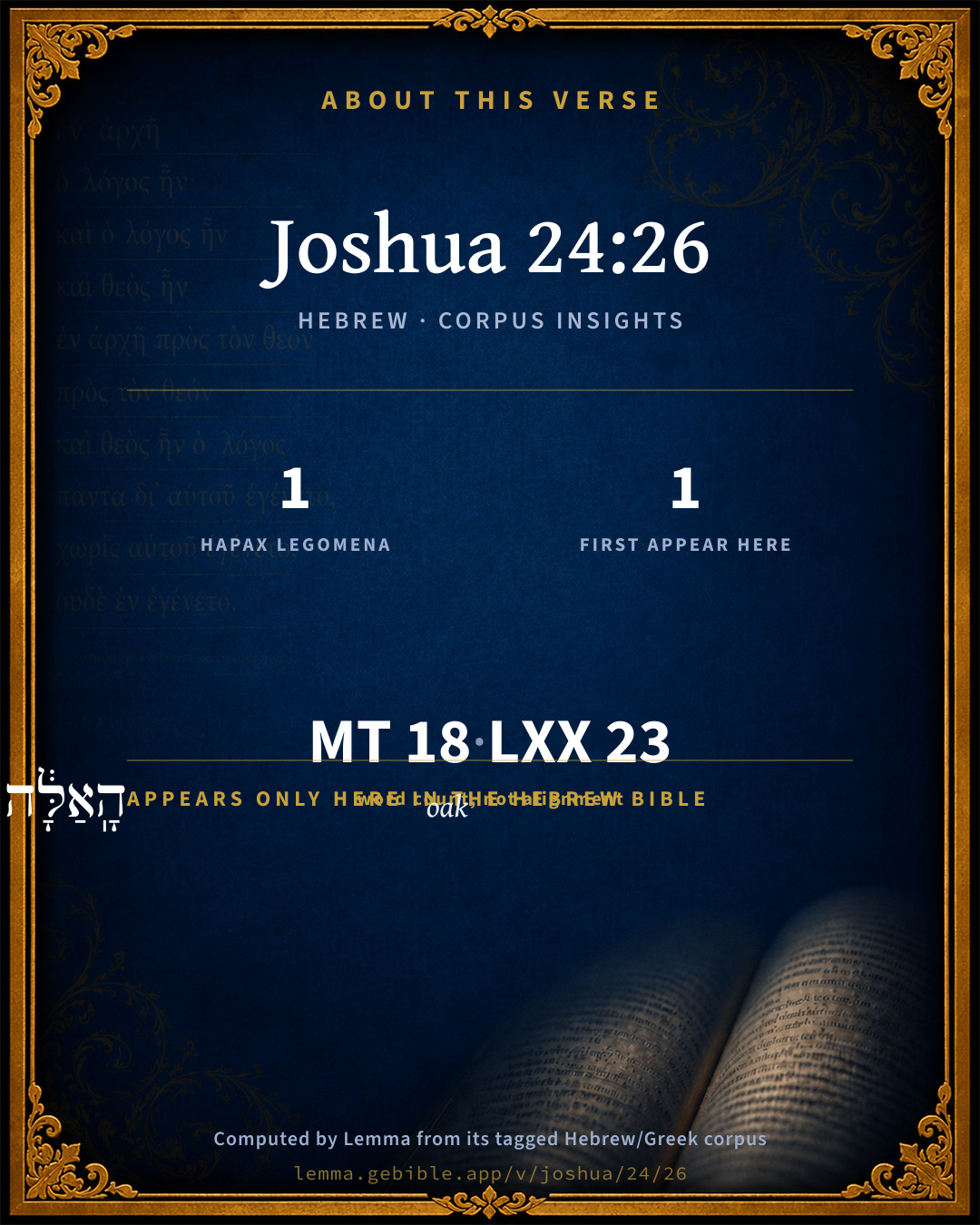
  • 1 hapax legomenon — only here in the Hebrew Bible
  • 1 first appearance in the Hebrew Bible
Full analysis ↓
Download a study sheet

One document with this verse’s original text, its word-by-word gloss line, the meaning frame, cross-references with their text, attributed commentary, and full source and license credits — printable, and it pastes into notes with its structure intact.

This verse Autodidact and up

Study sheet (.html) Plain text (.txt)

A passage Seminary Student

Up to 50 verses in one chapter. A passage sheet keeps up to 6 commentary sources and 12 cross-references per verse, in the order this page ranks them, and says so on the sheet whenever that leaves anything out. Ask for a single verse and you get the Autodidact verse sheet above.

Everything on this page stays free to read, with no account — the sheet is a download of what is already on screen, not access to it.

Want to remove ads? Support Godless Engineer
Compare translations 3

The same verse in 3 English versions, stacked beneath the original-language interlinear above. Click any original word for its lexicon entry.

Each is an independent rendering of the whole verse — the interlinear is not word-aligned to these translations.

Highlighted words mark where these versions differ — a whole-verse word diff, not a word-by-word alignment.

  • World English Bible Public Domain
    Joshua wrote these words in the book of the law of God; and he took a great stone, and set it up there under the oak that was by the sanctuary of Yahweh.
  • King James Version Public Domain
    And Joshua wrote these words in the book of the law of God, and took a great stone, and set it up there under an oak, that was by the sanctuary of the LORD.
  • unfoldingWord Literal Text CC BY-SA 4.0
    And Joshua wrote these words in the book of the instruction of God. And he took a great stone and set it up there beneath the oak tree that at the Holy Place of Yahweh.

unfoldingWord Literal Text — © unfoldingWord, licensed CC BY-SA 4.0. Word-aligned USFM3 via Door43 (git.door43.org/unfoldingWord/en_ult).

Versions to compare (up to 4)

3 of 4 selected

Show all 18 translations

Every available English version of this verse, each an independent rendering of the whole verse.

  • World English Bible Public Domain
    Joshua wrote these words in the book of the law of God; and he took a great stone, and set it up there under the oak that was by the sanctuary of Yahweh.
  • Berean Standard Bible Public Domain
    Joshua recorded these things in the Book of the Law of God. Then he took a large stone and set it up there under the oak that was near the sanctuary of the LORD.
  • Majority Standard Bible Public Domain
    Joshua recorded these things in the Book of the Law of God. Then he took a large stone and set it up there under the oak that was near the sanctuary of the LORD.
  • King James Version Public Domain
    And Joshua wrote these words in the book of the law of God, and took a great stone, and set it up there under an oak, that was by the sanctuary of the LORD.
  • American Standard Version (1901) Public Domain
    And Joshua wrote these words in the book of the law of God; and he took a great stone, and set it up there under the oak that was by the sanctuary of Jehovah.
  • Revised Version (1885) Public Domain
    And Joshua wrote these words in the book of the law of God; and he took a great stone, and set it up there under the oak that was by the sanctuary of the LORD.
  • Geneva Bible (1599) Public Domain
    And Ioshua wrote these woordes in the booke of the Lawe of God, and tooke a great stone, and pitched it there vnder an oke that was in the Sanctuarie of the Lord.
  • Douay-Rheims (1899) Public Domain
    And he wrote all these things in the volume of the law of the Lord: and he took a great stone, and set it under the oak that was in the sanctuary of the Lord.
  • Young's Literal Translation Public Domain
    And Joshua writeth these words in the Book of the Law of God, and taketh a great stone, and raiseth it up there under the oak which `is' in the sanctuary of Jehovah.
  • Literal Standard Version CC BY-SA 4.0
    And Joshua writes these words in the Scroll of the Law of God, and takes a great stone, and raises it up there under the oak which [is] in the sanctuary of YHWH.
  • Unlocked Literal Bible CC BY-SA 4.0
    Joshua wrote these words in the book of the law of God. He took a large stone and set it up there beneath the oak tree that was beside Yahweh's sanctuary.
  • unfoldingWord Literal Text CC BY-SA 4.0
    And Joshua wrote these words in the book of the instruction of God. And he took a great stone and set it up there beneath the oak tree that at the Holy Place of Yahweh.
  • Darby Bible Public Domain
    And Joshua wrote these words in the book of the law of God, and took a great stone, and set it up there under the oak that was by the sanctuary of Jehovah.
  • World Messianic Bible Public Domain
    Joshua wrote these words in the scroll of the Torah of God; and he took a great stone, and set it up there under the oak that was by the sanctuary of the LORD.
  • Webster's Bible Public Domain
    And Joshua wrote these words in the book of the law of God, and took a great stone, and set it up there under an oak that was by the sanctuary of the LORD.
  • Free Bible Version CC BY-SA 4.0
    Joshua recorded this in the Book of the Law of God, and he set up a large stone under the oak tree near the Lord's sanctuary.
  • Bible in Basic English Public Domain
    And Joshua put these words on record, writing them in the book of the law of God; and he took a great stone, and put it up there under the oak-tree which was in the holy place of the Lord.
  • JPS Tanakh (1917) Public Domain
    And Joshua wrote these words in the book of the law of God; and he took a great stone, and set it up there under the oak that was by the sanctuary of the LORD.

Literal Standard Version (2020), Covenant Press — licensed CC BY-SA 4.0. Text via the HelloAO Bible API (eBible.org). Unlocked Literal Bible (unfoldingWord) — licensed CC BY-SA 4.0. Text via the HelloAO Bible API (eBible.org). unfoldingWord Literal Text — © unfoldingWord, licensed CC BY-SA 4.0. Word-aligned USFM3 via Door43 (git.door43.org/unfoldingWord/en_ult). Free Bible Version, Dr. Jonathan Gallagher — licensed CC BY-SA 4.0. Text via the HelloAO Bible API (eBible.org).

Word by word

More ways to search: Search by grammar → Find every occurrence → Compare this word →

Practice this passage: Drill this verse → Learn its vocabulary →

הָֽאַלָּ֔ה
ʼallâh
H427
“the · oak”
Particle, Definite Article + Noun, Common, Feminine, Singular, Absolute
Part of Speech
Particle + Noun
Type
Common
Gender
Feminine
Number
Singular
State
Absolute
Full BDB Definition

Origin: variation of H424

TWOT: 100a

oak - terebinth
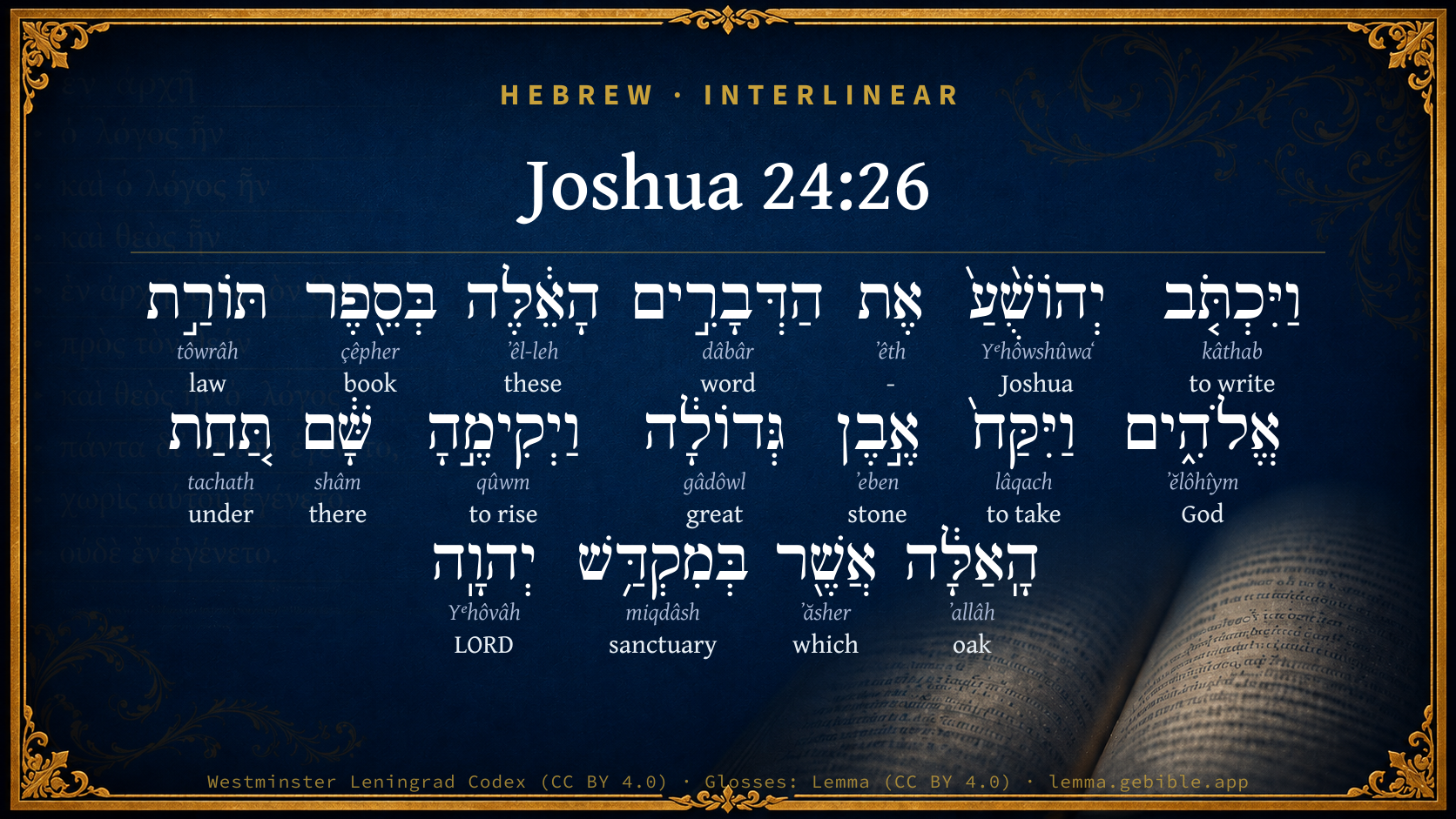
  1. וַיִּכְתֹּ֤ב kâthab H3789 “and · to write” Conjunction + Verb, Qal, Sequential Imperfect, 3rd Person, Masculine, Singular
  2. יְהוֹשֻׁ֨עַ֙ Yᵉhôwshûwaʻ H3091 “Joshua” Noun, Proper
  3. אֶת ʼêth H853 “-” Particle, Direct Object
  4. הַדְּבָרִ֣ים dâbâr H1697 “the · words” Particle, Definite Article + Noun, Common, Masculine, Plural, Absolute
  5. הָאֵ֔לֶּה ʼêl-leh H428 “the · these” Particle, Definite Article + Pronoun, Demonstrative, Common, Plural
  6. בְּסֵ֖פֶר çêpher H5612 “in/at · book of” Preposition + Noun, Common, Masculine, Singular, Construct
  7. תּוֹרַ֣ת tôwrâh H8451 “law of” Noun, Common, Feminine, Singular, Construct
  8. אֱלֹהִ֑ים ʼĕlôhîym H430 “God(s)” Noun, Common, Masculine, Plural, Absolute
  9. וַיִּקַּח֙ lâqach H3947 “and · to take” Conjunction + Verb, Qal, Sequential Imperfect, 3rd Person, Masculine, Singular
  10. אֶ֣בֶן ʼeben H68 “stone” Noun, Common, Feminine, Singular, Absolute
  11. גְּדוֹלָ֔ה gâdôwl H1419 “great” Adjective, Adjective, Feminine, Singular, Absolute
  12. וַיְקִימֶ֣הָ qûwm H6965 “and · to rise · her” Conjunction + Verb, Hiphil, Sequential Imperfect, 3rd Person, Masculine, Singular + Suffix, Personal, 3rd Person, Feminine, Singular
  13. שָּׁ֔ם shâm H8033 “there” Adverb
  14. תַּ֚חַת tachath H8478 “under” Preposition
  15. אֲשֶׁ֖ר ʼăsher H834 “which” Particle, Relative
  16. בְּמִקְדַּ֥שׁ miqdâsh H4720 “in/at · sanctuary of” Preposition + Noun, Common, Masculine, Singular, Construct
  17. יְהוָֽה Yᵉhôvâh H3068 “LORD” Noun, Proper

About this verse

These counts appear in no published source. They are computed here, from the morphology-tagged text and Lemma’s own curated glosses. What Lemma adds →

18
words
18
distinct lemmas
Historical
section

Notable vocabulary

1 hapax legomenon — a word that appears only here in the entire Hebrew Bible:

  • הָֽאַלָּ֔ה oak H427

First appearance in Scripture

This word makes its first canonical appearance in the Hebrew Bible here:

  • הָֽאַלָּ֔ה oak H427

Grammatical profile

  • 3 verbs
  • 9 nouns
  • 1 adjective
  • 1 pronoun
  • 1 preposition
  • 1 adverb
  • 2 particles

Verb forms

  • וַיִּכְתֹּ֤ב Qal · Sequential Imperfect
  • וַיִּקַּח֙ Qal · Sequential Imperfect
  • וַיְקִימֶ֣הָ Hiphil · Sequential Imperfect

Hebrew & Septuagint length

In English translation the verse runs 33 words from the Hebrew and 29 from the Septuagint (LXX English) — closely comparable.

A rough comparison of the two English renderings, which tokenize alike — not a word-level alignment.

Word counts can differ between the Hebrew and the Greek without any difference in meaning — e.g. the Hebrew direct-object marker אֵת has no separate Greek word, and Greek often adds the article ὁ.

In the original languages it is 18 Hebrew tokens and 23 Greek tokens — but the two are counted differently (Hebrew bundles its prefixes and suffixes into one token; the Greek is in lemma form), so that isn’t a like-for-like length.

Cross-references

8

Topical passages linked to Joshua 24:26 in the Treasury of Scripture Knowledge — connected by theme and wording, ordered by reader-vote popularity; previews shown in the World English Bible.

  • Judges 9:6 All the men of Shechem assembled themselves together, and all the house of Millo, and went and made Abimelech king, by the oak of the pillar that was in Shechem.
  • Genesis 35:4 They gave to Jacob all the foreign gods which were in their hands, and the rings which were in their ears; and Jacob hid them under the oak which was by Shechem.
  • Genesis 28:18–22 Jacob rose up early in the morning, and took the stone that he had put under his head, and set it up for a pillar, and poured oil on the top of it.
  • Genesis 35:8 Deborah, Rebekah's nurse, died, and she was buried below Bethel under the oak; and the name of it was called Allon Bacuth.
  • Exodus 24:4 Moses wrote all the words of Yahweh, and rose up early in the morning, and built an altar under the mountain, and twelve pillars for the twelve tribes of Israel.
  • Deuteronomy 31:24–26 It happened, when Moses had made an end of writing the words of this law in a book, until they were finished,
  • Joshua 4:20–24 Those twelve stones, which they took out of the Jordan, did Joshua set up in Gilgal.
  • Joshua 4:3–9 and command you them, saying, Take hence out of the midst of the Jordan, out of the place where the priests' feet stood firm, twelve stones, and carry them over with you, and lay them down in the lodging-place, where you shall lodge this night.

Cross-references courtesy of OpenBible.info (CC BY 4.0).

Hebrew and Greek witnesses Masoretic Hebrew ↔ Greek Septuagint

The same verse in the two great witnesses to the Old Testament, shown verse-for-verse.

These are two independent witnesses, not word-aligned to each other, and the Septuagint is shown in lemma (dictionary) form.

Hebrew Joshua 24:26 Masoretic · Westminster Leningrad Codex

וַיִּכְתֹּ֤ב יְהוֹשֻׁ֨עַ֙ אֶת הַדְּבָרִ֣ים הָאֵ֔לֶּה בְּסֵ֖פֶר תּוֹרַ֣ת אֱלֹהִ֑ים וַיִּקַּח֙ אֶ֣בֶן גְּדוֹלָ֔ה וַיְקִימֶ֣הָ שָּׁ֔ם תַּ֚חַת הָֽאַלָּ֔ה אֲשֶׁ֖ר בְּמִקְדַּ֥שׁ יְהוָֽה

Joshua wrote these words in the book of the law of God; and he took a great stone, and set it up there under the oak that was by the sanctuary of Yahweh.

World English Bible · Public Domain

Greek LXX Joshua 24:26 Septuagint · lemma form

καί γράφω ὁ ῥῆμα οὗτος εἰς βιβλίον νόμος ὁ θεός καί λαμβάνω λίθος μέγας καί ἵστημι αὐτός ἰησοῦς ὑπό ὁ τερέβινθος ἀπέναντι κύριος

And he wrote these words in the book of the laws of God: and Joshua took a great stone, and set it up under the oak before the Lord.

LXX2012 (modern English Septuagint) · Public Domain

On this verse, Haydock's Catholic Bible Commentary discusses the Septuagint’s reading. Read the note in Commentary ↓

Hebrew: Westminster Leningrad Codex (CC BY 4.0). Greek: Septuagint (public domain); English from LXX2012 (modern English Septuagint) (Public Domain). How the Septuagint differs from the Hebrew →

Targum (Aramaic paraphrase)

1

The Targum is the ancient Jewish Aramaic paraphrase of the Hebrew Scriptures — an interpretive translation, not the Hebrew text itself. Onkelos (literal) and Pseudo-Jonathan (expansive) render the Torah, and Jonathan the Prophets. Coverage is partial: where no permissively-licensed English translation exists for a verse, only the Aramaic is shown. This is verse-level text, not a word-by-word alignment to the Hebrew.

  1. Targum Jonathan Prophets (Joshua–Malachi)
    וּכְתַב יְהוֹשֻׁעַ יַת פִּתְגָמַיָא הָאִלֵין וְאַצְנְעִינוּן בְּסֵפֶר אוֹרַיְתָא דַייָ וּנְסִיב אַבְנָא רַבְּתָא וַאֲקִימָהּ תַּמָן תְּחוֹת אַלְתָא דִי בְּבֵית מַקְדְשָׁא דַיָי:

    (no public-domain English translation for this verse)

    Targum Jonathan — Aramaic: “Mikraot Gedolot” (public domain). English: “Sefaria Community Translation” (CC0 1.0 (public-domain dedication)); “London "Chaldee Paraphrase," 1871” (public domain). Text via Sefaria.

Commentary

Notes on Joshua 24:26 from classic Christian and Jewish commentators (each source and its license shown beneath its notes). The classic Christian expositions comment on the surrounding passage and are grouped to its opening verse, so a note may address several verses; the Jewish commentaries on the Tanakh (Rashi and others) are per-verse, so they appear only where the commentator wrote on this verse.

Lemma curates 59 commentaries, every one of them public domain or Creative Commons licensed, each selected and text-cleaned for this edition rather than reprinted as found. About our sources →

Trapp's Complete Commentary

John Trapp

Jos 24:26 And Joshua wrote these words in the book of the law of God, and took a great stone, and set it up there under an oak, that [was] by the sanctuary of the LORD.

Ver. 26. And Joshua wrote these words.] This whole book, or the most part of it, {see Jos 1:1} and particularly the Acts of this present Parliament.

Under an oak.] Which was therehence called The Oak or Plain of the Pillar. {Jdg 9:6}

John Trapp, A Commentary or Exposition upon All the Books of the Old and New Testament (1647–1656) — public domain. Text from a community e-Sword module.

The Biblical Illustrator

Joseph S. Exell

Jos_24:26-27

Joshua . . . took a great stone, and set it up there under an oak, that was by the sanctuary of the Lord.

The devout soul and nature

Solemnity of occasion. Joshua, dying, calls upon the nation to choose whom you will serve. Here we have--

1. A wise effort to impress and perpetuate religious resolutions.

2. A fine impersonation of material nature.

I. the importance of religious resolutions. They are worthy of perpetual remembrance. The world has monuments of earthquakes, wars, deaths; but how few of devout resolutions!

II. The highest use of material objects. Without actually setting up material objects, nature might be appropriated in her different manifestations as types of Gods character, and as mementos of events in the religious history of an individual or a family.

III. The most solemn aspects of nature. Who dares to say that nature cannot hear or speak? Who shall say, at the last, what nature, after her long silence, shall reveal? Take heed what you do and say: stones may hear without a Joshuas invocation. (Homilist.)

The Christian use of churches

We can easily conceive the association of thought with which Joshua and Israel contemplated the stone which they set up in Shechem. However rough it might be and shapeless, it had for them a solemn character; it had something approaching to personality and the power of testimony. It, said Joshua, hath heard all the words of the Lord which He spake unto us; not, of course, literally, but in the minds and recollections of those who regarded it as a pledge and token of the vow and covenant made betwixt them and God. And we may well conceive that such a silent, unchangeable witness retained for years, and perhaps for generations, its effect on the people of Israel, even in their downward course which, we too well know, shortly followed. To it the servants of God, struggling against the idolatry and pollution of their age, would bring their little ones, and teach them the words which it heard, and of which it was a testimony, and repeat each for himself their dying captains confession, As for me and my house, we will serve the Lord. Many a tender hand, laid on its cool surface, may have throbbed with generous emotion and holy zeal; many a thoughtful youth and maiden of Israel may have heard from it a sermon, which issued in holy endurance and heroic resolve. And we, have not we too set up our stone of testimony? have not these walls, dead materials gathered from the slime of the earth and the bosom of the rock, within these few days assumed for us a solemnity of which, in the laws of our thought, they can never be divested? Have they not heard all the words which the Lord our God hath spoken to us, and all that we have spoken to Him? Have we not begun a new course, entered on a fresh iteration of our covenant with God, of which these stones are a witness, a silent but ineffaceable witness--a witness through the ages of time--a witness at the solemn day of judgment? If this pillar of testimony, set up in the midst of our homes, raised with so much self-denying effort, inaugurated with so many tears of joy, is to witness only cold hearts and feeble hands, and formal Sundays, and ungodly weeks, oh shame unto us henceforward--nay, woe unto us, for God will look upon it and judge; and as we have received, so will He at last require of us. These latter words--as a note of passage--lead me on to speak of not only the similarity, but the difference also, between Joshuas stone of witness and ours. I deeply feel that this your church is, as the stone in Shechem was, a witness between you and God. But it is so in a far more solemn sense, in far wider and deeper meaning, than that could ever be. That stone was a mere passive witness; by standing where it did, it gave a permanence to the fact of the covenant there made. It was merely, as our Nelsons pillar or our Wellington statues, a memorial. And this our church is likewise; a memorial of His great mercies and of our feeble gratitude; a memorial that a Christian congregation has in it anew entered into covenant with Him. But it is also far more than this. It is an active witness between you and God. The sermons which it preaches are not merely those which associations of thought might suggest; they are active, positive, spoken declarations of Gods will, ever renewed and energising. Its testimony is not only that of a memorial of the past; it is an ever-welling fountain of Divine knowledge, telling of Christ and His salvation. Thus considered, then, what is the use, what is the office, of this our Church? Briefly (but how much is contained in these words) to provide those who dwell in this thickly-peopled neighbourhood with the public means of grace. Undoubtedly, the first means of grace are, prayer and praise. But there are others, standing in the very first rank of importance, viz., the Word and the Sacraments. Nor should I omit, in speaking of our new church as a witness for God, the important testimony which is borne by every church in the succession of her services throughout the Christian year. Here you will each year accompany our blessed Lord from His poor cradle to His bitter cross; here you will witness His burial, and His glorious resurrection and ascension, and the fulfilment of the promise of the Father in the descent of the Spirit, and will adore with holy joy on that crowning festival of Trinity the whole Three Persons in the One Godhead, covenanted in the work of our salvation. Such are some few of the blessings which you may expect from your church; such some few of the testimonies which it will lift up among you for God and His work. Can I pass on without a word of exhortation to you that you thwart not such blessings--that you let not such testimonies be given against yourselves? Oh, love your church! Throng its aisles from week to week, as to-day. (Dean Alford.)

The Biblical Illustrator, edited by Joseph S. Exell (c. 1880s–1900s) — public domain. Text from a community e-Sword module.

Joseph Benson's Commentary

Jos 24:26. Joshua wrote these words — Namely, this covenant, or agreement of the people with the Lord. In the book of the law of God — That is, in the volume which was kept in the ark, (Deu 31:9; Deu 31:26,) whence it was taken and put into this book of Joshua; this he did for the perpetual remembrance of this great and solemn action, to lay the greater obligation upon the people to be true to their engagement; and as a witness for God against the people, if afterward he punished them for their defection from him, to whom they had so solemnly and freely obliged themselves. Set it up — As a witness and monument of this great transaction, according to the custom of those ancient times. Possibly this agreement was written upon this stone, as was then usual; under an oak that was by the sanctuary — That is, near the place where the ark and tabernacle then were; for though they were forbidden to plant a grove of trees near unto the altar, as the Gentiles did, yet they might for a time set up an altar, or place the ark, near a great tree which had been planted there before.

Joseph Benson's Commentary on the Old and New Testaments (1811–1818) — public domain. Text from a community e-Sword module.

Tyndale Open Study Notes

Tyndale Open Resources

24:26 The Book of God’s Instructions was a scroll containing the writings of Moses (see study note on 1:8). It was probably carried to Shiloh and stored with other documents of national importance. • The huge stone was probably a stela, a standing stone monument. Joshua might have had a memorial inscription chiseled into this stone monument.

Tyndale Open Study Notes — © Tyndale Open Resources, licensed CC BY-SA 4.0. Text via the HelloAO Bible API.

Geneva Bible (1599)

Geneva Bible translators

Or, elm.

Geneva Bible (1599) marginal notes — public domain. Text via Bolls.life.

Jamieson, Fausset & Brown

Robert Jamieson, A. R. Fausset & David Brown

Joshua wrote these words in the book of the law of God--registered the engagements of that solemn covenant in the book of sacred history.

took a great stone--according to the usage of ancient times to erect stone pillars as monuments of public transactions.

set it up there under an oak--or terebinth, in all likelihood, the same as that at the root of which Jacob buried the idols and charms found in his family.

that was by the sanctuary of the Lord--either the spot where the ark had stood, or else the place around, so called from that religious meeting, as Jacob named Beth-el the house of God.

Jamieson, Fausset & Brown — Commentary Critical and Explanatory on the Whole Bible (1871) — public domain (CC PDM 1.0). Text via the HelloAO Bible API.

John Calvin's Commentaries

26. And Joshua wrote these words, etc Understand that authentic volume which was kept near the ark of the covenant, as if it contained public records deposited for perpetual remembrance. And there is no doubt that when the Law was read, the promulgation of this covenant was also added. But as it often happens, that that which is written remains concealed in unopened books, another aid is given to the memory, one which should always be exposed to the eye, namely, the stone under the ark, near the sanctuary. Not that the perpetual station of the ark was there, but because it had been placed there, in order that they might appear in the presence of God. Therefore, as often as they came into his presence, the testimony or memorial of the covenant which had been struck was in their view, that they might be the better kept in the faith.

Joshua’s expression, that the stone heard the words, is indeed hyperbolical, but is not inapt to express the efficacy and power of the divine word, as if it had been said that it pierces inanimate rocks and stones; so that if men are deaf, their condemnation is echoed in all the elements. To lie is here used, as it frequently is elsewhere, for acting cunningly and deceitfully, for frustrating and violating a promise that has been given. Who would not suppose that a covenant so well established would be firm and sacred to posterity for many ages? But all that Joshua gained by his very great anxiety was to secure its rigorous observance for a few years.

John Calvin's Commentaries (1540-1563) — public domain. Text from the Calvin Translation Society English edition (1840s-50s) via the Christian Classics Ethereal Library (ccel.org). Calvin's coverage is partial (roughly two-thirds of the Bible); uncommented books and verses are honest gaps, never fabricated. The 19th-century editor's footnotes and remarks are omitted so the notes are faithfully Calvin's own voice.

Ellicott's Commentary for English Readers

(26) And Joshua wrote these words in the book of the law of God.—Primarily “these words” appear to refer to the transaction just recorded. But it must be observed that this is also the second signature among the sacred writers of the Old Testament. The first is that of Moses, in Deu_31:9 : “Moses wrote this law, and delivered it unto the priests,” &c. The next signature after Joshua’s is that of Samuel (1Sa_10:25): “Samuel told the people the manner of the kingdom, and wrote it in the [not a] book, and laid it up before the Lord.” We have here a clue to the authorship of the Old Testament, and to the view of the writers who succeeded Moses in what they did. They did not look upon themselves as writers of distinct books, but as authorised to add their part to the book already written, to write what was assigned to them “in the book of the law of God.” The unity of Holy Scripture is thus seen to have been an essential feature of the Bible from the very first.

A Bible Commentary for English Readers, edited by Charles John Ellicott (1878–1897) — public domain. Text from a community e-Sword module.

The Cambridge Bible for Schools and Colleges

gen. ed. J. J. S. Perowne

26. And Joshua wrote] As Moses at Sinai wrote all the words that Jehovah had spoken in a book, probably a papyrus-roll (Exo_24:4), so Joshua now inscribed “minutes” of the transactions connected with this renewal of the covenant at Shechem.

in the book of the law of God] This protocol he placed inside the roll of the Law of Moses.

and took a great stone] Like

(a) The stone which Jacob set up at Bethel (Gen_28:18);

(b) The pillar of stones which the same patriarch set up on his return from Padan-aram (Gen_31:44-46);

(c) The twelve pillars which Moses set up at Sinai (Exo_24:4);

(d) The twelve stones set up to mark the passage of the Jordan (Jos_4:3).

under an oak] Or rather, under the oak which was in the sanctuary of Jehovah. See above, ch. Jos_24:1. “This spot, called in Gen_12:6 and Gen_35:4, ‘Allon-Moreh,’ ‘the oak of Moreh’ or of Shechem, is called by the Samaritans Ahron-Moreh, ‘the Ark of Moreh,’ from a supposition that in a vault underneath is buried the Ark. The Mussulmans call it ‘Rigad el Amad,’ ‘the place of the Pillar,’ or ‘Sheykh-el-Amad,’ ‘the Saint of the Pillar.’ ” Stanley’s Lectures, i. 280, n. Possibly beside the old consecrated oak of Abraham and Jacob their altar was still remaining, and it is to be remembered that Joshua himself had built an altar on Mount Ebal, and therefore close to Shechem (Jos_8:30). Thus many reasons conspired to give a sacred character to “the border of the sanctuary,” the mountain “which the right hand of the Lord had purchased” (Psa_78:54) at Shechem.

The Cambridge Bible for Schools and Colleges (gen. ed. J. J. S. Perowne; Cambridge University Press, 1878–1918) — public domain. Text from a community e-Sword module.

John Gill's Exposition

And Joshua wrote these words,.... Which had passed between him and the people:

in the book of the law of God; written by Moses, and which he ordered to be put in the side of the ark, and that being now present, the book could be easily taken out, and these words inserted in it, Deu 31:26,

and took a great stone: on which also might be inscribed the same words:

and set it up there under an oak, that was by the sanctuary of the Lord; or "in it" (a); that is, in the field or place where the ark was, which made it sacred, and upon which account the place was called a sanctuary, or an holy place; for there is no need to say that the tabernacle or sanctuary itself was brought hither, only the ark; and much less can it be thought that an oak should be in it; though it was not improbable, that had it been thither brought, it might have been placed under, or by an oak, as we render it; and it is a tradition of the Jews, which both Jarchi and Kimchi make mention of, that this was the same oak under which Jacob hid the strange gods of his family in Shechem, Gen 35:4; Mr. Mede (b) is of opinion that neither ark nor tabernacle were here, but that by "sanctuary" is meant a "proseucha", or place for prayer; such an one as in later times was near Shechem, as Epiphanius (c) relates, built by the Samaritans in imitation of the Jews; but it is a question whether there were any such places so early as the times of Joshua, nor is it clear that such are ever called sanctuaries.

(a) "in sanctuario", V. L. Pagninus, Montanus, Tigurine version, Vatasblus, Junius & Tremellius. (b) Discourse 18. p. 66. (c) Contr. Haeres. l. 3. tom. 2. Haeres. 80.

John Gill's Exposition of the Whole Bible (1746–1763) — public domain (CC PDM 1.0). Text via the HelloAO Bible API.

Albert Barnes' Notes on the Bible

Consult the marginal references.

That was by the sanctuary of the Lord - i. e. the spot where Abraham and Jacob had sacrificed and worshipped, and which might well be regarded by their posterity as a holy place or sanctuary. Perhaps the very altar of Abraham and Jacob was still remaining.

Albert Barnes' Notes on the Bible (1834–1885) — public domain. Text from a community e-Sword/MySword module.

Haydock's Catholic Bible Commentary

Lord, particularly what related to the ratification of the covenant, which was the last public act of this great man. He placed it in its proper order in the continuation of the sacred history, which Moses had commenced. (Haydock) --- Stone unpolished, except where there was an inscription, relating what had taken place. (Menochius) --- This monument of religion was not forbidden, Deuteronomy xvi. 22. (Calmet) --- Oak. Hebrew alla, is translated a turpentine tree, Genesis xxxv. 4., (Haydock) and by the Septuagint here. But most people translate the oak. (Chaldean; Aquila; &c.) Under it Jacob buried the idols of Laban, and Abimelech was chosen king; (Judges ix. 6,) as Abraham had entertained the angels under the same tree, Genesis xviii. 1., (Calmet) and had sat under it when he first came into Sichem, Genesis xii. 6. On which supposition it must have subsisted about 500 years. (Menochius) --- It was even shewn some ages after Christ. But it is hardly credible that the same tree should have continued for such a length of time. --- Sanctuary, or tent, where the ark was placed on this occasion under the oak. (Calmet; Bonfrere) --- Some think it was at Silo. (Menochius; ver. 1.) --- Kennicott denies that the ark was present, and supposes that they offered sacrifices upon the very altar which Josue had erected on Garizim, between 20 and 30 years before; and that this mountain is here called the sanctuary or "holy place." Upon it the oak might very well grow, and Josue might "with great propriety take some large stone, and set it up for a witness, making at the same time this striking remark, that this stone had heard all the words of the Lord, or had been present when his law was inscribed and read to the people at their former solemn convention." Hence he infers against Collins, "that the Jews had thoughts of worshipping, and did worship at Gerizim long before the separation of Israel from Juda;" and it was probably for fear of the Israelites returning to a sense of their duty, by the sight of these monuments of the old religion, that Jeroboam refrained from setting up his golden calves in the vicinity. (Diss. ii. p. 119.) (Haydock)

George Leo Haydock (1774–1849), Haydock's Catholic Family Bible and Commentary, 1859 edition — public domain. Excludes Psalms (Douay-Rheims chapter numbering differs from Protestant) and Deuterocanonical books (Catholic canon only).

Matthew Poole's English Annotations

These words, i.e. this covenant or agreement of the people with the Lord. In the book of the law of God, i. e. in that volume which was kept in the ark, Deu 31:9,26, whence it was taken and put into this book of Joshua. This he did, partly, for the perpetual remembrance of this great and solemn action; partly, to lay the greater obligation upon the people to be true to their engagement; and partly, as a witness for God, and against the people, if afterwards he severely punished them for their detection from God, to whom they had so solemnly and freely obliged themselves.

Set it up there, as a witness and monument of this great transaction, according to the custom of those ancient times, as Gen 28:18; 31:45; 35:14; Exo 24:4; Deu 27:2; Jos 4:3; 8:32. Possibly this agreement was written upon this stone, as was then usual.

Under an oak that was by the sanctuary of the Lord, i.e. near to the place where the ark and tabernacle then were; for though they were forbidden to plant a grove of trees near unto the altar, Deu 16:21, as the Gentiles did, yet they might for a time set up an altar, or the ark, near a great tree which had been planted there before.

Matthew Poole's English Annotations on the Holy Bible (1683–1685) — public domain. Text from a community e-Sword/MySword module.

Whedon's Commentary on the Bible

Daniel D. Whedon

26. Joshua wrote these words — A description of all that occurred at Shechem in this solemn renewal of the covenant. This was done in order that a written document might be preserved as a witness against the people should they ever transgress the divine law. This chapter contains, probably, the substance of that ancient document.

A great stone — Which long stood a monumental witness of this solemn transaction. See Jdg_9:6, note.

Sanctuary of the Lord — The holy place first consecrated by Abraham in Canaan. Gen_12:7. Here he builded an altar and worshipped, by the tree, which was perhaps still standing in the time of Joshua. [Some understand the sanctuary of the Lord to mean, here, the tabernacle and ark, which had been brought from Shiloh for this occasion. Others think it refers to the spot where the ark had formerly stood. But the word rendered sanctuary may mean any holy place, and is not always used of the place where the ark was kept. In Amo_7:13, it is applied to the place of corrupt worship at Bethel.]

27. For it hath heard all the words — By a striking figure the stone is spoken of as hearing. In the same sense, as a witness it would testify against their transgressions whenever their eyes should rest upon it or their thoughts revert to it. How interesting the thought that upon this very spot, centuries afterwards, stood THE STONE, THE CORNER STONE, THE TRUE AND FAITHFUL WITNESS. Says Augustine on this passage, “By this stone he certainly signified HIM who was the rock of offence to the unbelieving Jews, and was made the Head of the corner.”

JOSHUA’S DEATH AND BURIAL, Jos_24:29-30.

[29. Joshua… died — Probably soon after the events just related above. It is noticeable that no mention is made of Israel’s weeping for Joshua, as they did for Moses. Comp. Deu_34:8. In Jos_1:1, Moses is called the servant of the Lord; here that title is given to Joshua. He who was then only Moses’ minister, attained at length the office of his master, and became, like him, the servant of the Lord.

A hundred and ten years old — Just the age of Joseph when he died. Gen_50:26.]

30. Timnath-serah — See note on Jos_19:50. The LXX here add the following legend of the stone knives: “They deposited with him there, in the tomb in which they buried him, the stone knives with which he circumcised the children of Israel in Gilgal, when he had led them out of Egypt according as the Lord commanded. And there they are unto the present day.” See also on Jos_21:42.

CONCLUDING STATEMENTS, Jos_24:31-33.

[31. All the days of the elders that overlived Joshua — So the holy life and example of a great and good man exerts an influence after he is gone. Though dead he yet speaks, and the surviving generation feels his power.]

32. The bones of Joseph… buried they — Since the Hebrew has no pluperfect for the accurate expression of time, this may justly be rendered they had buried, in Shechem previous to the death of Joshua, either at the first solemn convocation at that place, (Jos_8:30-35,) or at the second, the occasion of Joshua’s valedictory to the nation. The fact is mentioned here because of its association with the spot of Joshua’s last address to Israel. This burial was in obedience to the charge given by Joseph in Gen_50:25, whose faith grasped the land of promise for his last resting place. Heb_11:22. [The traditional site of Joseph’s tomb is marked by a little chapel at the southeastern base of Mount Ebal, and a few rods from Jacob’s well. “There is nothing remarkable in the appearance of this little whited sepulchre,” says Tristram, “yet there seems little reason to question the identity of the spot. It has been preserved from molestation from age to age by the common reverence in which the patriarch is held by Jew, Samaritan, Christian, and Moslem alike, while the fact of his name being the common property of all has prevented any one of them from appropriating and disfiguring by a temple the primitive simplicity of his resting place.

33. Eleazar… died — Probably about the same time, (as Josephus says,) and his death and burial are mentioned here because of their association both in time and place with those of Joshua. In a hill — Rather, in Gibeah of Phinehas. Josephus says, “His monument and sepulchre are in the city of Gabatha.” Dr. Robinson inclined to locate it at the modern Jibea, about half way between Jerusalem and Shechem. This would be not far from the place of Joshua’s death and burial. The presentation of the place to Phinehas was a token of Israel’s high regard for him and his father.

Beautifully says Wordsworth here: “Eleazar and Joshua together make a type of the union of the priesthood and government in Christ. The types die, because they are types; but the DIVINE ANTITYPE liveth forever; to whom be all praise, and glory, and dominion, world without end.”

Daniel D. Whedon (gen. ed.), Commentary on the Old and New Testaments (1874–1909) — public domain. Text from a community e-Sword module.

The Pulpit Commentary

And Joshua wrote these words. Or, these things, since the word (see note on Jos_22:24 Jos_23:15) has often this signification. Joshua no doubt recorded, not the whole history of his campaigns and the rest of the contents of what is now called the Book of Joshua, but the public ratification of the Mosaic covenant which had now been made. This he added to his copy of the book of the law, as a memorial to later times. The covenant had been ratified with solemn ceremonies at its first promulgation. (Exo_24:3-8) At the end of Moses" ministry he once more reaffirmed its provisions, reminding them of the curses pronounced on all who should disobey its provisions, and adding, as an additional memorial of the occasion, the sublime song contained in De 32. (see Deu_21:19, Deu_21:22) Joshua was present on this occasion, and the dying lawgiver charged him to undertake the conquest of the premised land, and to maintain the observance of the law among the people of God. Hitherto, however, God"s promise had not been fulfilled. It seems only natural that when Israel had obtained peaceful possession of the land sworn unto their fathers, and before they were left to His unseen guidance, they should once more be publicly reminded of the conditions on which they enjoyed the inheritance. It may be remarked that, although Joshua"s addendum to the book of the law has not come down to us, yet that it covers the principle of such additions, and explains how, at the death of Moses, a brief account of his death and burial should be appended by authority to the volume containing the law itself. The last chapter of Deuteronomy is, in fact, the official seal set upon the authenticity of the narrative, as the words added here were the official record of the law of Moses, having been adopted as the code of jurisprudence in the land. And took a great stone. (see notes on Jos_4:2, Jos_4:9) An oak. Perhaps the terebinth. So the LXX (see note on ver. 1). The tree, no doubt, under which Jacob had hid the teraphim of his household. This was clearly one of the reasons for which the place was chosen. By the sanctuary. Keil denies that B ever means near. It is difficult to understand how he can do this with so many passages against him. (see Jos_5:13 1Sa_29:1 Eze_10:15) He wishes to avoid the idea of the sanctuary being at Shechem.

The Pulpit Commentary (1880–1919), ed. H.D.M. Spence-Jones & Joseph S. Exell — public domain. Text from a community e-Sword module.

John Wesley's Explanatory Notes

These words - That is, this covenant or agreement of the people with the Lord. In the book - That is, in the volume which was kept in the ark, Deut. xxxi, 9, 26, whence it was taken and put into this book of Joshua: this he did for the perpetual remembrance of this great and solemn action, to lay the greater obligation upon the people to be true to their engagement; and as a witness for God, against the people, if afterward he punished them for their defection from God, to whom they had so solemnly and freely obliged themselves. Set it up - As a witness and monument of this great transaction, according to the custom of those ancient times. Possibly this agreement was written upon this stone, as was then usual. By the sanctuary - That is, near the place where the ark and tabernacle then were; for tho' they were forbidden to plant a grove of trees near unto the altar, as the Gentiles did, yet they might for a time set up an altar, or the ark, near a great tree which had been planted there before.

John Wesley, Explanatory Notes Upon the Whole Bible (1754–1765) — public domain. Text via the GEBible commentary corpus.

Keil & Delitzsch

C. F. Keil & F. Delitzsch

All these things (האלּה הדּברים are not merely the words spoken on both sides, but the whole ceremony of renewing the covenant) Joshua wrote in the law-book of God, i.e., he wrote them in a document which he placed in the law-book of Moses, and then set up a large stone, as a permanent memorial of what had taken place, on the spot where the meeting had been held, "under the oak that was in the sanctuary of Jehovah." As בּמקדּשׁ neither means "at the sanctuary," nor near the sanctuary, nor "in the place where the sanctuary was set up;' the "sanctuary of Jehovah" cannot signify "the ark of the covenant, which had been brought from the tabernacle to Shechem, for the ceremony of renewing the covenant." Still less can we understand it as signifying the tabernacle itself, since this was not removed from place to place for particular sacred ceremonies; nor can it mean an altar, in which an oak could not possibly be said to stand; nor some other illegal sanctuary of Jehovah, since there were none in Israel at that time. The sanctuary of Jehovah under the oak at Shechem was nothing else than the holy place under the oak, where Abraham had formerly built an altar and worshipped the Lord, and where Jacob had purified his house from the strange gods, which he buried under this oak, or rather terebinth tree (Gen 12:6-7; Gen 35:2, Gen 35:4). This is the explanation adopted by Masius, J. D. Michaelis, and Hengstenberg (Diss. ii. p. 12). In Jos 24:27 Joshua explains to the people the meaning of the stone which he had set up. The stone would be a witness against the people if they should deny their God. As a memorial of what had taken place, the stone had heard all the words which the Lord had addressed to Israel, and could bear witness against the people, that they might not deny their God. "Deny your God," viz., in feeling, word, or deed.

Keil & Delitzsch — Biblical Commentary on the Old Testament (1861–1891) — public domain (CC PDM 1.0). Text via the HelloAO Bible API. (Old Testament only.)

Kretzmann's Popular Commentary

Paul E. Kretzmann

Joshua’s Death and Burial

v. 26. And Joshua wrote these words, the entire account of the renewal of the covenant, in the Book of the Law of God, as an addition to the law-book of Moses, and took a great stone, and set it up there under an oak that was by the Sanctuary of the Lord, in the space consecrated by the altars of Abraham and Jacob, Gen 12:7; Gen 33:20, and by the solemn service which had been held there shortly after the coming of Israel into the Land of Promise.

v. 27. And Joshua said unto all the people, Behold, this stone shall be a witness, a monument and memorial, unto us; for it hath heard all the words of the Lord which He spake unto us, during the meeting which had gone before; it shall be therefore a witness unto you, lest ye deny your God, it would always serve to remind them of their solemn promise, lest they deny Jehovah by thought, word, or deed.

v. 28. So Joshua let the people depart; every man unto his inheritance, to his possession in the section of the country allotted to his tribe.

v. 29. And it came to pass after these things that Joshua, the son of Nun, the servant of the Lord, as he is now also called in recognition of his loyalty to Jehovah, died, being an hundred and ten years old, as his progenitor, the patriarch Joseph, before him.

v. 30. And they buried him in the border of his inheritance in Timnath-serah, which is in Mount Ephraim, on the north side of the hill of Gaash, evidently a well-known hill at that time, Jdg 2:9; 2Sa 23:30.

v. 31. And Israel served the Lord all the days of Joshua, and all the days of the elders that overlived Joshua, literally, "whose days extended beyond those of Joshua," and which had known all the works of the Lord that He had done for Israel. The experiences which these men had gone through in their youth and early manhood served to keep them loyal to the covenant God, and their example influenced the people accordingly.

v. 32. And the bones of Joseph which the children of Israel brought up out of Egypt buried they in Shechem, Gen 50:25. in a parcel of ground which Jacob bought of the sons of Hamor, the father of Shechem, for an hundred pieces of silver, Gen 33:19; and it became the inheritance of the children of Joseph. This was in their territory, on the boundary between Manasseh and Ephraim, and thus belonged to them in a twofold sense of the word, by inheritance and by allotment.

v. 33. And Eleazar, the son of Aaron, died, the second high priest whom Israel had had; and they burled him in a hill that pertained to Phinehas, his son, that is, at Gibeah-Phinehas, a city in central Canaan, which was given him in Mount Ephraim. Thus the righteous, enter into their reward and rest in the security of their tombs to the great day of resurrection.

Paul E. Kretzmann, Popular Commentary of the Bible (1921–1924) — public domain. Text from a community e-Sword module.

Rashi

Rabbi Shlomo Yitzchaki (Rashi)

And Yehoshua wrote, etc. According to Targum Yonasan— And Yehoshua wrote these words, and concealed them in the Sefer Torah of God. In Maseches Makos, two Amoraim argue [about what Yehoshua wrote]. One says that it refers to the eight verses from ‘And Moshe died’ until ‘in view of all of Yisroel,’ for the Sefer Torah was incomplete and he [Yehoshua] completed it. says therefore that the final eight verses were written by Yehoshua. The other one says that this refers to the chapter of the cities of refuge which he wrote in his book [Sefer Yehoshua] as they were written in the Sefer Torah.

Under the doorpost. This is translated according to Targum Yonasan, תְּחוֹת אַלְתָא. הָאַלָה refers to the door post of the entrance, as it is said, “the doorposts were a fifth, and the doorposts had one measure.” Other say that [הָאַלָה means ‘the oak tree’] and it refers to the oak near Shechem which is written regarding Yaakov, “And Yaakov hid them beneath the oak.”

Which is in the Sanctuary of Adonoy. Since the Ark was brought there [it is referred to as the Sanctuary] as it stated above, ‘And they stood before God.

Rashi on the Tanakh — English translations: “The Judaica Press complete Tanach with Rashi, translated by A. J. Rosenberg” (CC BY 4.0); “Pentateuch with Rashi's commentary by M. Rosenbaum and A.M. Silbermann, 1929-1934” (public domain); “The Metsudah Tanach series, Lakewood, N.J” (CC BY 4.0); and “The Book of Joshua, Metsudah Publications, 1997” (CC BY 4.0). Text via Sefaria.

Lesson kit

Teaching starters — assembled from the data on this page, not authored interpretation. Every prompt links to the verse data it draws on. Edit before teaching.

Joshua, in the Historical, opens this verse with 18 words (18 distinct Hebrew lemmas). Its most distinctive word is ʼallâh (“oak”). A historical commentator’s framing appears above. Read the whole chapter for the surrounding context.

Discussion questions

  1. The word ʼallâh carries the sense “oak.” How does it shape the verse?
  2. This verse holds 1 word here found nowhere else in the Hebrew Bible. What might the rare word draw attention to?
  3. The word “oak” first appears here in Scripture. What is being introduced at this debut?
  4. Judges 9:6 shares this passage’s theme. How do the two illuminate each other?
  5. These translations render this verse differently; the difference is in the English rendering, not the original. What questions does that raise?
  6. The verb «וַיִּכְתֹּ֤ב» is Qal Sequential Imperfect. How does its form color the action?
  7. Reading how Trapp's Complete Commentary and The Biblical Illustrator read this verse, where do the two commentators agree and where do they part?

Things to notice

Reading settings

Reading text

Shown beneath each verse's original-language words.

Old Testament
Old Testament edition

Read the OT as the Masoretic Hebrew (MT) or the Greek Septuagint (LXX).

English shown for the Greek Septuagint (in the Hebrew ↔ Greek comparison).

Comparing translations? Open the Compare panel on any verse page to stack up to four side by side.