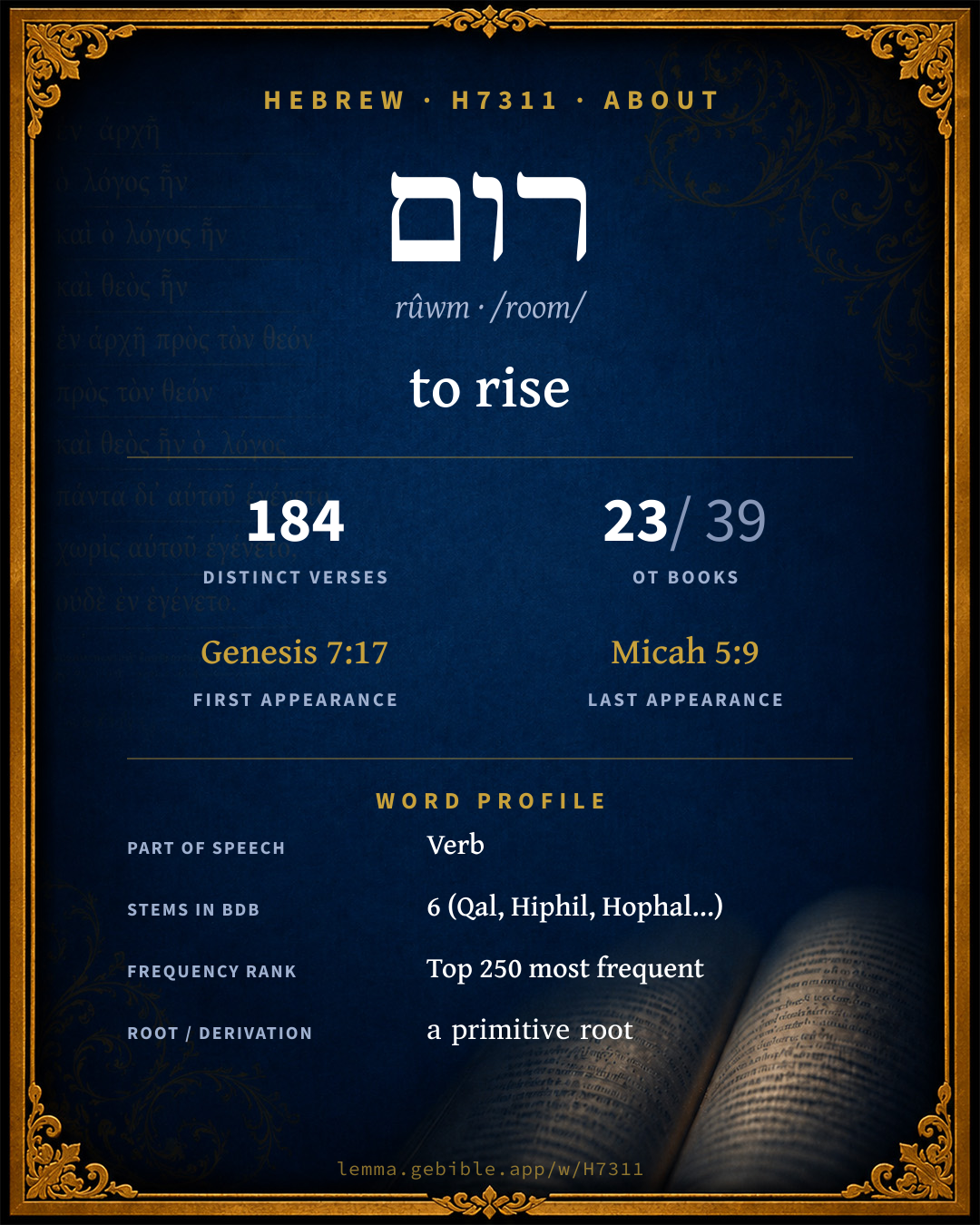
רוּם
to rise
also: rise up, be high, be lofty, be exalted fuller range ↓
Full lexicon entry — Brown-Driver-Briggs (BDB)
From Brown-Driver-Briggs (BDB)
Where this word appears
See every Hiphil verb in the Hebrew Bible →
Grammar key — what these labels mean
Part of speech
- Verb
- An action or state-of-being word.
Stem
- Hiphil
- The causative active stem (“he caused / brought about”). Here: ‘lift up voice Gn 39’
- Qal
- The basic, simple active stem — the plain form of the verb (“he wrote”). Here: ‘be high’
- Polel
- A stem of hollow/geminate roots functioning like the Piel — intensive active. Here: ‘exalt’
- Hophal
- The passive counterpart of the Hiphil (“he was caused to…”).
- Polal
- The passive counterpart of the Polel.
- Hithpolel
- The reflexive counterpart of the Polel.
Form
- Imperfect
- An incomplete, ongoing, or future action (“he will / would write”).
- Sequential Imperfect
- An imperfect with prefixed waw — the standard past-narrative form (waw-consecutive imperfect).
- Participle Active
- A verbal adjective expressing ongoing or characteristic action (“writing / one who writes”).
- Infinitive Construct
- A bound verbal noun, frequently with prepositions (“to write / in writing”).
- Perfect
- A completed action or state — Hebrew marks aspect (completeness) more than strict tense (“he wrote”).
- Imperative
- A direct command (“write!”).
- Sequential Perfect
- A perfect with prefixed waw continuing a preceding imperfect or command (waw-consecutive perfect).
- Jussive
- A third- or second-person volitional form expressing wish or command (“let him write”).
- Participle Passive
- A verbal adjective expressing action received (“written”).
- Cohortative
- A first-person volitional form expressing wish or resolve (“let me / let us write”).
State
- Absolute
- The independent form of a noun, not bound to a following word.
- Construct
- A noun bound to a following noun in a possessive / “of” relationship (the construct chain).
Person
- 2nd Person
- The one addressed (“you”).
- 3rd Person
- The one spoken about (“he / she / it / they”).
- 1st Person
- The speaker (“I / we”).
Gender
- Masculine
- Grammatically masculine.
- Feminine
- Grammatically feminine.
- Common
- Either gender — not distinguished for this form.
Number
- Plural
- More than one (in Hebrew, generally three or more).
- Singular
- One.
Grammatical forms 62 distinct
- Verb, Qal, Participle Active, Masculine, Singular, Absolute 11 times (6%)
- Verb, Hiphil, Infinitive Construct 11 times (6%)
- Verb, Hiphil, Imperfect, 2nd Person, Masculine, Plural 10 times (5%)
- Verb, Hiphil, Imperfect, 3rd Person, Masculine, Singular 10 times (5%)
- Verb, Hiphil, Sequential Imperfect, 3rd Person, Masculine, Singular 9 times (5%)
- Verb, Qal, Imperfect, 3rd Person, Masculine, Singular 7 times (4%)
- Verb, Qal, Participle Active, Feminine, Singular, Absolute 7 times (4%)
- Verb, Qal, Imperfect, 3rd Person, Feminine, Singular 6 times (3%)
+54 more forms (122 occurrences)
Parsed forms decoded from the imported morphology (morphhb / Westminster Leningrad Codex — WLC text public domain, morphhb tagging CC BY 4.0), counted across 193 parsed occurrences — not distinct verses.
Every verse where H7311 appears — 184 distinct verses across 23 books. Click any verse to open its interlinear word-by-word view. Verse text shown in the World English Bible for context — . Each verse’s Hebrew form is shown with its reference; the English is not keyword-highlighted, since the data carries no word-level English alignment. Use “Compare translations” on any verse to read it across multiple English versions. This concordance covers the Hebrew Bible; Septuagint (Greek Old Testament) occurrences are not indexed here.
Genesis 6 verses
- Genesis 7:17 וַ/תָּ֖רָם conj + Qal wimpf 3fs The flood was forty days on the earth. The waters increased, and lifted up the ark, and it was lifted up above the earth.
- Genesis 14:22 הֲרִימֹ֨תִי Hiphil pf 1cs Abram said to the king of Sodom, "I have lifted up my hand to Yahweh, God Most High, possessor of heaven and earth,
- Genesis 31:45 וַ/יְרִימֶ֖/הָ conj + Hiphil wimpf 3ms + sfx pers 3fs Jacob took a stone, and set it up for a pillar.
- Genesis 39:15 הֲרִימֹ֥תִי Hiphil pf 1cs It happened, when he heard that I lifted up my voice and cried, that he left his garment by me, and ran outside."
- Genesis 39:18 כַּ/הֲרִימִ֥/י prep + Hiphil inf.cs + sfx pers 1cs and it happened, as I lifted up my voice and cried, that he left his garment by me, and ran outside."
- Genesis 41:44 יָרִ֨ים Hiphil impf 3ms Pharaoh said to Joseph, "I am Pharaoh, and without you shall no man lift up his hand or his foot in all the land of Egypt."
Exodus 8 verses
- Exodus 7:20 וַ/יָּ֤רֶם conj + Hiphil wimpf 3ms Moses and Aaron did so, as Yahweh commanded; and he lifted up the rod, and struck the waters that were in the river, in the sight of Pharaoh, and in the sight of his servants; and all the waters that were in the river were turned to blood.
- Exodus 14:8 רָמָֽה Qal ptcp.act fs Yahweh hardened the heart of Pharaoh king of Egypt, and he pursued after the children of Israel; for the children of Israel went out with a high hand.
- Exodus 14:16 הָרֵ֣ם Hiphil impv 2ms Lift up your rod, and stretch out your hand over the sea, and divide it: and the children of Israel shall go into the midst of the sea on dry ground.
- Exodus 15:2 וַ/אֲרֹמְמֶֽ/נְהוּ conj + Polel impf 1cs + sfx pers 3ms Yah is my strength and song, He has become my salvation: This is my God, and I will praise him; My father's God, and I will exalt him.
- Exodus 16:20 וַ/יָּ֥רֻם conj + Qal wimpf 3ms Notwithstanding they didn't listen to Moses, but some of them left of it until the morning, and it bred worms, and became foul: and Moses was angry with them.
- Exodus 17:11 יָרִ֥ים Hiphil impf 3ms It happened, when Moses held up his hand, that Israel prevailed; and when he let down his hand, Amalek prevailed.
- Exodus 29:27 הוּרָ֑ם Hophal pf 3ms You shall sanctify the breast of the wave-offering, and the thigh of the heave-offering, which is waved, and which is heaved up, of the ram of consecration, even of that which is for Aaron, and of that which is for his sons:
- Exodus 35:24 מֵרִ֗ים Hiphil ptcp.act ms Everyone who did offer an offering of silver and brass brought Yahweh's offering; and everyone, with whom was found acacia wood for any work of the service, brought it.
Leviticus 7 verses
- Leviticus 2:9 וְ/הֵרִ֨ים conj + Hiphil wpf 3ms The priest shall take from the meal offering its memorial, and shall burn it on the altar, an offering made by fire, of a sweet savor to Yahweh.
- Leviticus 4:8 יָרִ֣ים Hiphil impf 3ms He shall take all the fat of the bull of the sin offering off of it; the fat that covers the innards, and all the fat that is on the innards,
- Leviticus 4:10 יוּרַ֔ם Hophal impf 3ms as it is taken off of the ox of the sacrifice of peace offerings. The priest shall burn them on the altar of burnt offering.
- Leviticus 4:19 יָרִ֣ים Hiphil impf 3ms All its fat he shall take from it, and burn it on the altar.
- Leviticus 6:10 וְ/הֵרִ֣ים conj + Hiphil wpf 3ms The priest shall put on his linen garment, and he shall put on his linen breeches upon his body; and he shall remove the ashes from where the fire has consumed the burnt offering on the altar, and he shall put them beside the altar.
- Leviticus 6:15 וְ/הֵרִ֨ים conj + Hiphil wpf 3ms He shall take from there his handful of the fine flour of the meal offering, and of its oil, and all the frankincense which is on the meal offering, and shall burn it on the altar for a sweet savor, as its memorial, to Yahweh.
- Leviticus 22:15 יָרִ֖ימוּ Hiphil impf 3mp The priests shall not profane the holy things of the children of Israel, which they offer to Yahweh,
Numbers 15 verses
- Numbers 15:19 תָּרִ֥ימוּ Hiphil impf 2mp then it shall be that when you eat of the bread of the land, you shall offer up a heave-offering to Yahweh.
- Numbers 15:20 תָּרִ֣ימוּ תָּרִ֥ימוּ Hiphil impf 2mp Hiphil impf 2mp Of the first of your dough you shall offer up a cake for a heave-offering: as the heave-offering of the threshing floor, so shall you heave it.
- Numbers 16:37 וְ/יָרֵ֤ם conj + Hiphil juss 3ms Speak to Eleazar the son of Aaron the priest, that he take up the censers out of the burning, and scatter you the fire yonder; for they are holy,
- Numbers 18:19 יָרִ֥ימוּ Hiphil impf 3mp All the heave-offerings of the holy things, which the children of Israel offer to Yahweh, have I given you, and your sons and your daughters with you, as a portion forever: it is a covenant of salt forever before Yahweh to you and to your seed with you.
- Numbers 18:24 יָרִ֤ימוּ Hiphil impf 3mp For the tithe of the children of Israel, which they offer as a heave-offering to Yahweh, I have given to the Levites for an inheritance: therefore I have said to them, Among the children of Israel they shall have no inheritance.
- Numbers 18:26 וַ/הֲרֵמֹתֶ֤ם conj + Hiphil wpf 2mp Moreover you shall speak to the Levites, and tell them, When you take of the children of Israel the tithe which I have given you from them for your inheritance, then you shall offer up a heave-offering of it for Yahweh, a tithe of the tithe.
- Numbers 18:28 תָּרִ֤ימוּ Hiphil impf 2mp Thus you also shall offer a heave-offering to Yahweh of all your tithes, which you receive of the children of Israel; and of it you shall give Yahweh's heave-offering to Aaron the priest.
- Numbers 18:29 תָּרִ֕ימוּ Hiphil impf 2mp Out of all your gifts you shall offer every heave-offering of Yahweh, of all the best of it, even the holy part of it out of it.
- Numbers 18:30 בַּ/הֲרִֽימְ/כֶ֤ם prep + Hiphil inf.cs + sfx pers 2mp Therefore you shall tell them, When you heave the best of it from it, then it shall be reckoned to the Levites as the increase of the threshing floor, and as the increase of the wine-press.
- Numbers 18:32 בַּ/הֲרִֽימְ/כֶ֥ם prep + Hiphil inf.cs + sfx pers 2mp You shall bear no sin by reason of it, when you have heaved from it the best of it: and you shall not profane the holy things of the children of Israel, that you not die.
- Numbers 20:11 וַ/יָּ֨רֶם conj + Hiphil wimpf 3ms Moses lifted up his hand, and struck the rock with his rod twice: and water came forth abundantly, and the congregation drank, and their cattle.
- Numbers 24:7 וְ/יָרֹ֤ם conj + Qal juss 3ms Water shall flow from his buckets, His seed shall be in many waters, His king shall be higher than Agag, His kingdom shall be exalted.
- Numbers 31:28 וַ/הֲרֵמֹתָ֨ conj + Hiphil wpf 2ms Levy a tribute to Yahweh of the men of war who went out to battle: one soul of five hundred, [both] of the persons, and of the oxen, and of the donkeys, and of the flocks:
- Numbers 31:52 הֵרִ֨ימוּ֙ Hiphil pf 3cp All the gold of the heave-offering that they offered up to Yahweh, of the captains of thousands, and of the captains of hundreds, was sixteen thousand seven hundred fifty shekels.
- Numbers 33:3 רָמָ֔ה Qal ptcp.act fs They traveled from Rameses in the first month, on the fifteenth day of the first month; on the next day after the Passover the children of Israel went out with a high hand in the sight of all the Egyptians,
Deuteronomy 9 verses
- Deuteronomy 1:28 וָ/רָם֙ conj + Qal ptcp.act ms Where are we going up? our brothers have made our heart to melt, saying, The people are greater and taller than we; the cities are great and fortified up to the sky; and moreover we have seen the sons of the Anakim there.
- Deuteronomy 2:10 וָ/רָ֖ם conj + Qal ptcp.act ms (The Emim lived therein before, a people great, and many, and tall, as the Anakim:
- Deuteronomy 2:21 וָ/רָ֖ם conj + Qal ptcp.act ms a people great, and many, and tall, as the Anakim; but Yahweh destroyed them before them; and they succeeded them, and lived in their place;
- Deuteronomy 8:14 וְ/רָ֖ם conj + Qal wpf 3ms then your heart be lifted up, and you forget Yahweh your God, who brought you forth out of the land of Egypt, out of the house of bondage;
- Deuteronomy 9:2 וָ/רָ֖ם conj + Qal ptcp.act ms a people great and tall, the sons of the Anakim, whom you know, and of whom you have heard say, Who can stand before the sons of Anak?
- Deuteronomy 12:2 הָֽ/רָמִים֙ ptcl def.art + Qal ptcp.act mp You shall surely destroy all the places in which the nations that you shall dispossess served their gods, on the high mountains, and on the hills, and under every green tree:
- Deuteronomy 17:20 רוּם Qal inf.cs that his heart not be lifted up above his brothers, and that he not turn aside from the commandment, to the right hand, or to the left: to the end that he may prolong his days in his kingdom, he and his children, in the midst of Israel.
- Deuteronomy 27:14 רָֽם Qal ptcp.act ms The Levites shall answer, and tell all the men of Israel with a loud voice,
- Deuteronomy 32:27 רָ֔מָה Qal pf 3fs Were it not that I feared the provocation of the enemy, Lest their adversaries should judge wrongly, Lest they should say, Our hand is exalted, Yahweh has not done all this.
Joshua 1 verse
1 Samuel 5 verses
- 1 Samuel 2:1 רָ֥מָה Qal pf 3fs Hannah prayed, and said: My heart exults in Yahweh; My horn is exalted in Yahweh; My mouth is enlarged over my enemies; Because I rejoice in your salvation.
- 1 Samuel 2:7 מְרוֹמֵֽם Polel ptcp.act ms Yahweh makes poor, and makes rich: He brings low, he also lifts up.
- 1 Samuel 2:8 יָרִ֣ים Hiphil impf 3ms He raises up the poor out of the dust, He lifts up the needy from the dunghill, To make them sit with princes, Inherit the throne of glory: For the pillars of the earth are Yahweh's, He has set the world on them.
- 1 Samuel 2:10 וְ/יָרֵ֖ם conj + Hiphil impf 3ms Those who strive with Yahweh shall be broken to pieces; Against them will he thunder in the sky: Yahweh will judge the ends of the earth; He will give strength to his king, Exalt the horn of his anointed.
- 1 Samuel 9:24 וַ/יָּ֣רֶם conj + Hiphil wimpf 3ms The cook took up the thigh, and that which was on it, and set it before Saul. [Samuel] said, Behold, that which has been reserved! set it before you and eat; because to the appointed time has it been kept for you, for I said, I have invited the people. So Saul ate with Samuel that day.
2 Samuel 3 verses
- 2 Samuel 22:28 רָמִ֥ים Qal ptcp.act mp The afflicted people you will save; But your eyes are on the haughty, that you may bring them down.
- 2 Samuel 22:47 וְ/יָרֻ֕ם conj + Qal juss 3ms Yahweh lives; Blessed be my rock; Exalted be God, the rock of my salvation,
- 2 Samuel 22:49 תְּר֣וֹמְמֵ֔/נִי Polel impf 2ms + sfx pers 1cs Who brings me forth from my enemies: Yes, you lift me up above those who rise up against me; You deliver me from the violent man.
1 Kings 4 verses
- 1 Kings 11:26 וַ/יָּ֥רֶם conj + Hiphil wimpf 3ms Jeroboam the son of Nebat, an Ephraimite of Zeredah, a servant of Solomon, whose mother's name was Zeruah, a widow, he also lifted up his hand against the king.
- 1 Kings 11:27 הֵרִ֥ים Hiphil pf 3ms This was the reason why he lifted up his hand against the king: Solomon built Millo, and repaired the breach of the city of David his father.
- 1 Kings 14:7 הֲרִימֹתִ֖י/ךָ Hiphil pf 1cs + sfx pers 2ms Go, tell Jeroboam, Thus says Yahweh, the God of Israel: Because I exalted you from among the people, and made you prince over my people Israel,
- 1 Kings 16:2 הֲרִימֹתִ֨י/ךָ֙ Hiphil pf 1cs + sfx pers 2ms Because I exalted you out of the dust, and made you prince over my people Israel, and you have walked in the way of Jeroboam, and have made my people Israel to sin, to provoke me to anger with their sins;
2 Kings 3 verses
- 2 Kings 2:13 וַ/יָּ֨רֶם֙ conj + Hiphil wimpf 3ms He took up also the mantle of Elijah that fell from him, and went back, and stood by the bank of the Jordan.
- 2 Kings 6:7 הָ֣רֶם Hiphil impv 2ms He said, Take it up to you. So he put out his hand, and took it.
- 2 Kings 19:22 הֲרִימ֣וֹתָ Hiphil pf 2ms Whom have you defied and blasphemed? and against whom have you exalted your voice and lifted up your eyes on high? [even] against the Holy One of Israel.
1 Chronicles 2 verses
- 1 Chronicles 15:16 לְ/הָרִֽים prep + Hiphil inf.cs David spoke to the chief of the Levites to appoint their brothers the singers, with instruments of music, psalteries and harps and cymbals, sounding aloud and lifting up the voice with joy.
- 1 Chronicles 25:5 לְ/הָרִ֣ים prep + Hiphil inf.cs All these were the sons of Heman the king's seer in the words of God, to lift up the horn. God gave to Heman fourteen sons and three daughters.
2 Chronicles 5 verses
- 2 Chronicles 5:13 וּ/כְ/הָרִ֣ים conj + prep + Hiphil inf.cs it happened, when the trumpeters and singers were as one, to make one sound to be heard in praising and thanking Yahweh; and when they lifted up their voice with the trumpets and cymbals and instruments of music, and praised Yahweh, [saying], For he is good; for his loving kindness endures forever; that then the house was filled with a cloud, even the house of Yahweh,
- 2 Chronicles 30:24 הֵרִ֨ים הֵרִ֤ימוּ Hiphil pf 3ms Hiphil pf 3cp For Hezekiah king of Judah did give to the assembly for offerings one thousand bulls and seven thousand sheep; and the princes gave to the assembly a thousand bulls and ten thousand sheep: and a great number of priests sanctified themselves.
- 2 Chronicles 35:7 וַ/יָּ֣רֶם conj + Hiphil wimpf 3ms Josiah gave to the children of the people, of the flock, lambs and kids, all of them for the Passover offerings, to all who were present, to the number of thirty thousand, and three thousand bulls: these were of the king's substance.
- 2 Chronicles 35:8 הֵרִ֑ימוּ Hiphil pf 3cp His princes gave for a freewill-offering to the people, to the priests, and to the Levites. Hilkiah and Zechariah and Jehiel, the rulers of the house of God, gave to the priests for the Passover offerings two thousand and six hundred [small cattle], and three hundred oxen.
- 2 Chronicles 35:9 הֵרִ֨ימוּ Hiphil pf 3cp Conaniah also, and Shemaiah and Nethanel, his brothers, and Hashabiah and Jeiel and Jozabad, the chiefs of the Levites, gave to the Levites for the Passover offerings five thousand [small cattle], and five hundred oxen.
Ezra 4 verses
- Ezra 3:12 לְ/הָרִ֥ים prep + Hiphil inf.cs But many of the priests and Levites and heads of fathers' [houses], the old men who had seen the first house, when the foundation of this house was laid before their eyes, wept with a loud voice; and many shouted aloud for joy:
- Ezra 8:25 הַ/הֵרִ֨ימוּ֙ ptcl def.art + Hiphil pf 3cp and weighed to them the silver, and the gold, and the vessels, even the offering for the house of our God, which the king, and his counselors, and his princes, and all Israel there present, had offered:
- Ezra 9:6 לְ/הָרִ֧ים prep + Hiphil inf.cs and I said, my God, I am ashamed and blush to lift up my face to you, my God; for our iniquities are increased over our head, and our guiltiness is grown up to the heavens.
- Ezra 9:9 לְ/רוֹמֵ֞ם prep + Poel inf.cs For we are bondservants; yet our God has not forsaken us in our bondage, but has extended loving kindness to us in the sight of the kings of Persia, to give us a reviving, to set up the house of our God, and to repair the ruins of it, and to give us a wall in Judah and in Jerusalem.
Nehemiah 1 verse
Job 6 verses
- Job 17:4 תְרֹמֵֽם Polel impf 2ms For you have hidden their heart from understanding, Therefore shall you not exalt them.
- Job 21:22 רָמִ֥ים Qal ptcp.act mp "Shall any teach God knowledge, Seeing he judges those who are high?
- Job 22:12 רָֽמּוּ Qal pf 3cp "Isn't God in the heights of heaven? See the height of the stars, how high they are!
- Job 38:15 רָ֝מָ֗ה Qal ptcp.act fs From the wicked, their light is withheld, The high arm is broken.
- Job 38:34 הֲ/תָרִ֣ים ptcl inter + Hiphil impf 2ms "Can you lift up your voice to the clouds, That abundance of waters may cover you?
- Job 39:27 יָרִ֥ים Hiphil impf 3ms Is it at your command that the eagle mounts up, And makes his nest on high?
Psalms 48 verses
- Psalms 3:3 וּ/מֵרִ֥ים conj + Hiphil ptcp.act ms But you, Yahweh, are a shield around me, My glory, and the one who lifts up my head.
- Psalms 9:13 מְ֝רוֹמְמִ֗/י Polel ptcp.act ms cs + sfx pers 1cs Have mercy on me, Yahweh. See my affliction by those who hate me, And lift me up from the gates of death;
- Psalms 12:8 כְּ/רֻ֥ם prep + Qal inf.cs The wicked walk on every side, When what is vile is exalted among the sons of men.
- Psalms 13:2 יָר֖וּם Qal impf 3ms How long shall I take counsel in my soul, Having sorrow in my heart every day? How long shall my enemy triumph over me?
- Psalms 18:27 רָמ֣וֹת Qal ptcp.act fp For you will save the afflicted people, But the haughty eyes you will bring down.
- Psalms 18:46 וְ֝/יָר֗וּם conj + Qal impf 3ms Yahweh lives; and blessed be my rock. Exalted be the God of my salvation,
- Psalms 18:48 תְּרוֹמְמֵ֑/נִי Polel impf 2ms + sfx pers 1cs He rescues me from my enemies. Yes, you lift me up above those who rise up against me. You deliver me from the violent man.
- Psalms 21:13 ר֣וּמָ/ה Qal impv 2ms + sfx h Be exalted, Yahweh, in your strength, So we will sing and praise your power.
- Psalms 27:5 יְרוֹמְמֵֽ/נִי Polel impf 3ms + sfx pers 1cs For in the day of trouble he will keep me secretly in his pavilion. In the covert of his tent he will hide me. He will lift me up on a rock.
- Psalms 27:6 יָר֪וּם Qal impf 3ms Now my head will be lifted up above my enemies around me. I will offer sacrifices of joy in his tent. I will sing, yes, I will sing praises to Yahweh.
- Psalms 30:1 אֲרוֹמִמְ/ךָ֣ Polel impf 1cs + sfx pers 2ms I will extol you, Yahweh, for you have raised me up, And have not made my foes to rejoice over me.
- Psalms 34:3 וּ/נְרוֹמְמָ֖ה conj + Polel coh 1cp Oh magnify Yahweh with me. Let us exalt his name together.
- Psalms 37:34 וִֽ֭/ירוֹמִמְ/ךָ conj + Polel impf 3ms + sfx pers 2ms Wait for Yahweh, and keep his way, And he will exalt you to inherit the land. When the wicked are cut off, you shall see it.
- Psalms 46:10 אָר֥וּם אָר֥וּם Qal impf 1cs Qal impf 1cs "Be still, and know that I am God. I will be exalted among the nations. I will be exalted in the earth."
- Psalms 57:5 ר֣וּמָ/ה Qal impv 2ms + sfx h Be exalted, God, above the heavens! Let your glory be above all the earth!
- Psalms 57:11 ר֣וּמָ/ה Qal impv 2ms + sfx h Be exalted, God, above the heavens. Let your glory be over all the earth.
- Psalms 61:2 יָר֖וּם Qal impf 3ms From the end of the earth, I will call to you, when my heart is overwhelmed. Lead me to the rock that is higher than I.
- Psalms 66:7 ירימו יָר֖וּמוּ Hiphil juss 3mp Qal juss 3mp He rules by his might forever. His eyes watch the nations. Don't let the rebellious rise up against him. Selah.
- Psalms 74:3 הָרִ֣ימָ/ה Hiphil impv 2ms + sfx h Lift up your feet to the perpetual ruins, All the evil that the enemy has done in the sanctuary.
- Psalms 75:4 תָּרִ֥ימוּ Hiphil juss 2mp I said to the arrogant, "Don't boast;" To the wicked, "Don't lift up the horn.
- Psalms 75:5 תָּרִ֣ימוּ Hiphil juss 2mp Don't lift up your horn on high. Don't speak with a stiff neck."
- Psalms 75:6 הָרִֽים Hiphil inf.cs For neither from the east, nor from the west, Nor yet from the south, comes exaltation.
- Psalms 75:7 יָרִֽים Hiphil impf 3ms But God is the judge. He puts down one, and lifts up another.
- Psalms 75:10 תְּ֝רוֹמַ֗מְנָה Polal impf 3fp I will cut off all the horns of the wicked, But the horns of the righteous shall be lifted up.
- Psalms 78:69 רָ֭מִים Qal ptcp.act mp He built his sanctuary like the heights, Like the earth which he has established forever.
- Psalms 89:13 תָּר֥וּם Qal impf 3fs You have a mighty arm. Your hand is strong, and your right hand is exalted.
- Psalms 89:16 יָרֽוּמוּ Qal impf 3mp In your name they rejoice all day. In your righteousness, they are exalted.
- Psalms 89:17 תרים תָּר֥וּם Hiphil impf 2ms Qal impf 3fs For you are the glory of their strength. In your favor, our horn will be exalted.
- Psalms 89:19 הֲרִימ֖וֹתִי Hiphil pf 1cs Then you spoke in vision to your saints, And said, "I have bestowed strength on the warrior. I have exalted a young man from the people.
- Psalms 89:24 תָּר֥וּם Qal impf 3fs But my faithfulness and my loving kindness will be with him. In my name, his horn will be exalted.
- Psalms 89:42 הֲ֭רִימוֹתָ Hiphil pf 2ms You have exalted the right hand of his adversaries. You have made all of his enemies rejoice.
- Psalms 92:10 וַ/תָּ֣רֶם conj + Hiphil wimpf 2ms But you have exalted my horn like that of the wild ox. I am anointed with fresh oil.
- Psalms 99:2 וְ/רָ֥ם conj + Qal ptcp.act ms Yahweh is great in Zion. He is high above all the peoples.
- Psalms 99:5 רֽוֹמְמ֡וּ Polel impv 2mp Exalt Yahweh our God. Worship at his footstool. He is Holy!
- Psalms 99:9 רֽוֹמְמ֡וּ Polel impv 2mp Exalt Yahweh, our God. Worship at his holy hill, For Yahweh, our God, is holy!
- Psalms 107:25 וַ/תְּרוֹמֵ֥ם conj + Polel wimpf 3fs For he commands, and raises the stormy wind, Which lifts up its waves.
- Psalms 107:32 וִֽ֭/ירֹמְמוּ/הוּ conj + Polel impf 3mp + sfx pers 3ms Let them exalt him also in the assembly of the people, And praise him in the seat of the elders.
- Psalms 108:5 ר֣וּמָ/ה Qal impv 2ms + sfx h Be exalted, God, above the heavens, Let your glory be over all the earth.
- Psalms 110:7 יָרִ֥ים Hiphil impf 3ms He will drink of the brook in the way; Therefore he will lift up his head.
- Psalms 112:9 תָּר֥וּם Qal impf 3fs He has dispersed, he has given to the poor. His righteousness endures forever. His horn will be exalted with honor.
- Psalms 113:4 רָ֖ם Qal ptcp.act ms Yahweh is high above all nations, His glory above the heavens.
- Psalms 113:7 יָרִ֥ים Hiphil impf 3ms He raises up the poor out of the dust. Lifts up the needy from the ash heap;
- Psalms 118:28 אֲרוֹמְמֶֽ/ךָּ Polel impf 1cs + sfx pers 2ms You are my God, and I will give thanks to you. You are my God, I will exalt you.
- Psalms 131:1 רָמ֣וּ Qal pf 3cp Yahweh, my heart isn't haughty, nor my eyes lofty; Nor do I concern myself with great matters, Or things too wonderful for me.
- Psalms 138:6 רָ֣ם Qal ptcp.act ms For though Yahweh is high, yet he looks after the lowly; But the proud, he knows from afar.
- Psalms 140:8 יָר֥וּמוּ Qal impf 3mp Yahweh, don't grant the desires of the wicked. Don't let their evil plans succeed, or they will become proud. Selah.
- Psalms 145:1 אֲרוֹמִמְ/ךָ֣ Polel coh 1cs + sfx pers 2ms I will exalt you, my God, the King. I will praise your name forever and ever.
- Psalms 148:14 וַ/יָּ֤רֶם conj + Hiphil wimpf 3ms He has lifted up the horn of his people, The praise of all his saints; Even of the children of Israel, a people near to him. Praise Yah!
Proverbs 8 verses
- Proverbs 3:35 מֵרִ֥ים Hiphil ptcp.act ms The wise will inherit glory, But shame will be the promotion of fools.
- Proverbs 4:8 וּֽ/תְרוֹמְמֶ֑/ךָּ conj + Polel impf 3fs + sfx pers 2ms Esteem her, and she will exalt you. She will bring you to honor, when you embrace her.
- Proverbs 6:17 רָ֭מוֹת Qal ptcp.act fp Haughty eyes, a lying tongue, Hands that shed innocent blood;
- Proverbs 11:11 תָּר֣וּם Qal impf 3fs By the blessing of the upright, the city is exalted, But it is overthrown by the mouth of the wicked.
- Proverbs 14:29 מֵרִ֥ים Hiphil ptcp.act ms He who is slow to anger has great understanding, But he who has a quick temper displays folly.
- Proverbs 14:34 תְרֽוֹמֵֽם Polel impf 3fs Righteousness exalts a nation, But sin is a disgrace to any people.
- Proverbs 24:7 רָאמ֣וֹת Qal ptcp.act fp Wisdom is too high for a fool: He doesn't open his mouth in the gate.
- Proverbs 30:13 רָמ֣וּ Qal pf 3cp There is a generation, oh how lofty are their eyes! Their eyelids are lifted up.
Isaiah 23 verses
- Isaiah 1:2 וְ/רוֹמַ֔מְתִּי conj + Polel pf 1cs Hear, heavens, And listen, earth; for Yahweh has spoken: I have nourished and brought up children, And they have rebelled against me.
- Isaiah 2:12 וָ/רָ֑ם conj + Qal ptcp.act ms For there will be a day of Yahweh of Hosts for all that is proud and haughty, And for all that is lifted up; And it shall be brought low:
- Isaiah 2:13 הָ/רָמִ֖ים ptcl def.art + Qal ptcp.act mp For all the cedars of Lebanon, that are high and lifted up, For all the oaks of Bashan,
- Isaiah 2:14 הָ/רָמִ֑ים ptcl def.art + Qal ptcp.act mp For all the high mountains, For all the hills that are lifted up,
- Isaiah 6:1 רָ֣ם Qal ptcp.act ms In the year that king Uzziah died, I saw the Lord sitting on a throne, high and lifted up; and his train filled the temple.
- Isaiah 10:15 מְרִימָ֔י/ו כְּ/הָרִ֥ים Hiphil ptcp.act mp cs + sfx pers 3ms prep + Hiphil inf.cs Shall the axe boast itself against him who hews therewith? Shall the saw magnify itself against him who wields it? as if a rod should wield those who lift it up, [or] as if a staff should lift up [him who is] not wood.
- Isaiah 10:33 וְ/רָמֵ֤י conj + Qal ptcp.act mp cs Behold, the Lord, Yahweh of Hosts, will lop the boughs with terror: and the high of stature shall be hewn down, and the lofty shall be brought low.
- Isaiah 13:2 הָרִ֥ימוּ Hiphil impv 2mp Set up an ensign on the bare mountain, lift up the voice to them, wave the hand, that they may go into the gates of the nobles.
- Isaiah 14:13 אָרִ֣ים Hiphil impf 1cs You said in your heart, I will ascend into heaven, I will exalt my throne above the stars of God; and I will sit on the mountain of congregation, in the uttermost parts of the north;
- Isaiah 23:4 רוֹמַ֥מְתִּי Polel pf 1cs Be ashamed, Sidon; for the sea has spoken, the stronghold of the sea, saying, I have not travailed, nor brought forth, neither have I nourished young men, nor brought up virgins.
- Isaiah 25:1 אֲרֽוֹמִמְ/ךָ֙ Polel impf 1cs + sfx pers 2ms Yahweh, you are my God; I will exalt you, I will praise your name; for you have done wonderful things, [even] counsels of old, in faithfulness [and] truth.
- Isaiah 26:11 רָ֥מָה Qal pf 3fs Yahweh, your hand is lifted up, yet they don't see: but they shall see [your] zeal for the people, and be disappointed; yes, fire shall devour your adversaries.
- Isaiah 30:18 יָר֖וּם Qal impf 3ms Therefore will Yahweh wait, that he may be gracious to you; and therefore will he be exalted, that he may have mercy on you: for Yahweh is a God of justice; blessed are all those who wait for him.
- Isaiah 33:10 אֵֽרוֹמָ֔ם Hithpolel impf 1cs Now will I arise, says Yahweh; now will I lift up myself; now will I be exalted.
- Isaiah 37:23 הֲרִימ֣וֹתָה Hiphil pf 2ms Whom have you defied and blasphemed? and against whom have you exalted your voice and lifted up your eyes on high? [even] against the Holy One of Israel.
- Isaiah 40:9 הָרִ֤ימִי הָרִ֨ימִי֙ Hiphil impv 2fs Hiphil impv 2fs You who tell good news to Zion, go up on a high mountain; you who tell good news to Jerusalem, lift up your voice with strength; lift it up, don't be afraid; say to the cities of Judah, Behold, your God!
- Isaiah 49:11 יְרֻמֽוּ/ן Qal impf 3mp + sfx n I will make all my mountains a way, and my highways shall be exalted.
- Isaiah 49:22 אָרִ֣ים Hiphil impf 1cs Thus says the Lord Yahweh, Behold, I will lift up my hand to the nations, and set up my ensign to the peoples; and they shall bring your sons in their bosom, and your daughters shall be carried on their shoulders.
- Isaiah 52:13 יָר֧וּם Qal impf 3ms Behold, my servant shall deal wisely, he shall be exalted and lifted up, and shall be very high.
- Isaiah 57:14 הָרִ֥ימוּ Hiphil impv 2mp He will say, Cast up, cast up, prepare the way, take up the stumbling-block out of the way of my people.
- Isaiah 57:15 רָ֣ם Qal ptcp.act ms For thus says the high and lofty One who inhabits eternity, whose name is Holy: I dwell in the high and holy place, with him also who is of a contrite and humble spirit, to revive the spirit of the humble, and to revive the heart of the contrite.
- Isaiah 58:1 הָרֵ֣ם Hiphil impv 2ms Cry aloud, don't spare, lift up your voice like a trumpet, and declare to my people their disobedience, and to the house of Jacob their sins.
- Isaiah 62:10 הָרִ֥ימוּ Hiphil impv 2mp Go through, go through the gates; prepare you the way of the people; cast up, cast up the highway; gather out the stones; lift up an ensign for the peoples.
Lamentations 1 verse
Ezekiel 17 verses
- Ezekiel 6:13 רָמָ֜ה Qal ptcp.act fs You shall know that I am Yahweh, when their slain men shall be among their idols round about their altars, on every high hill, on all the tops of the mountains, and under every green tree, and under every thick oak, the places where they offered sweet savor to all their idols.
- Ezekiel 10:4 וַ/יָּ֤רָם conj + Qal wimpf 3ms The glory of Yahweh mounted up from the cherub, [and stood] over the threshold of the house; and the house was filled with the cloud, and the court was full of the brightness of Yahweh's glory.
- Ezekiel 10:16 לָ/רוּם֙ prep + Qal inf.cs When the cherubim went, the wheels went beside them; and when the cherubim lifted up their wings to mount up from the earth, the wheels also didn't turn from beside them.
- Ezekiel 10:17 וּ/בְ/רוֹמָ֖/ם conj + prep + Qal inf.cs + sfx pers 3mp When they stood, these stood; and when they mounted up, these mounted up with them: for the spirit of the living creature was in them.
- Ezekiel 17:22 הָ/רָמָ֖ה ptcl def.art + Qal ptcp.act fs Thus says the Lord Yahweh: I will also take of the lofty top of the cedar, and will set it; I will crop off from the topmost of its young twigs a tender one, and I will plant it on a high and lofty mountain:
- Ezekiel 20:28 רָמָ֜ה Qal ptcp.act fs For when I had brought them into the land, which I swore to give to them, then they saw every high hill, and every thick tree, and they offered there their sacrifices, and there they presented the provocation of their offering; there also they made their sweet savor, and they poured out there their drink-offerings.
- Ezekiel 21:22 לְ/הָרִ֥ים prep + Hiphil inf.cs In his right hand was the divination [for] Jerusalem, to set battering rams, to open the mouth in the slaughter, to lift up the voice with shouting, to set battering rams against the gates, to cast up mounds, to build forts.
- Ezekiel 21:26 וְ/הָרִ֖ים conj + Hiphil impv 2ms thus says the Lord Yahweh: Remove the turban, and take off the crown; this [shall be] no more the same; exalt that which is low, and abase that which is high.
- Ezekiel 31:4 רֹֽמְמָ֑תְ/הוּ Polel pf 3fs + sfx pers 3ms The waters nourished it, the deep made it to grow: the rivers of it ran round about its plantation; and it sent out its channels to all the trees of the field.
- Ezekiel 31:10 וְ/רָ֥ם conj + Qal pf 3ms Therefore thus said the Lord Yahweh: Because you are exalted in stature, and he has set his top among the thick boughs, and his heart is lifted up in his height;
- Ezekiel 34:6 רָמָ֑ה Qal ptcp.act fs My sheep wandered through all the mountains, and on every high hill: yes, my sheep were scattered on all the surface of the earth; and there was none who searched or sought.
- Ezekiel 45:1 תָּרִימוּ֩ Hiphil impf 2mp Moreover, when you shall divide by lot the land for inheritance, you shall offer an offering to Yahweh, a holy portion of the land; the length shall be the length of twenty-five thousand [reeds], and the breadth shall be ten thousand: it shall be holy in all the border of it round about.
- Ezekiel 45:9 הָרִ֤ימוּ Hiphil impv 2mp Thus says the Lord Yahweh: Let it suffice you, princes of Israel: remove violence and spoil, and execute justice and righteousness; dispossessing my people, says the Lord Yahweh.
- Ezekiel 45:13 תָּרִ֑ימוּ Hiphil impf 2mp This is the offering that you shall offer: the sixth part of an ephah from a homer of wheat; and you shall give the sixth part of an ephah from a homer of barley;
- Ezekiel 48:8 תָּרִ֡ימוּ Hiphil impf 2mp By the border of Judah, from the east side to the west side, shall be the offering which you shall offer, twenty-five thousand [reeds] in breadth, and in length as one of the portions, from the east side to the west side: and the sanctuary shall be in the midst of it.
- Ezekiel 48:9 תָּרִ֖ימוּ Hiphil impf 2mp The offering that you shall offer to Yahweh shall be twenty-five thousand [reeds] in length, and ten thousand in breadth.
- Ezekiel 48:20 תָּרִ֨ימוּ֙ Hiphil impf 2mp All the offering shall be twenty-five thousand by twenty-five thousand: you shall offer the holy offering four-square, with the possession of the city.
Daniel 4 verses
- Daniel 8:11 הרים הוּרַ֣ם Hiphil pf 3ms Hophal pf 3ms Yes, it magnified itself, even to the prince of the host; and it took away from him the continual [burnt offering], and the place of his sanctuary was cast down.
- Daniel 11:12 ירום וְ/רָ֣ם Qal impf 3ms conj + Qal wpf 3ms The multitude shall be lifted up, and his heart shall be exalted; and he shall cast down tens of thousands, but he shall not prevail.
- Daniel 11:36 וְ/יִתְרוֹמֵ֤ם conj + Hithpolel impf 3ms The king shall do according to his will; and he shall exalt himself, and magnify himself above every god, and shall speak marvelous things against the God of gods; and he shall prosper until the indignation be accomplished; for that which is determined shall be done.
- Daniel 12:7 וַ/יָּ֨רֶם conj + Hiphil wimpf 3ms I heard the man clothed in linen, who was above the waters of the river, when he held up his right hand and his left hand to heaven, and swore by him who lives forever that it shall be for a time, times, and a half; and when they have made an end of breaking in pieces the power of the holy people, all these things shall be finished.
Hosea 3 verses
- Hosea 11:4 כִּ/מְרִ֥ימֵי prep + Hiphil ptcp.act mp cs I drew them with cords of a man, with ties of love; And I was to them like those who lift up the yoke on their necks; And I bent down to him and I fed him.
- Hosea 11:7 יְרוֹמֵם Polel impf 3ms My people are determined to turn from me. Though they call to the Most High, He certainly won't exalt them.
- Hosea 13:6 וַ/יָּ֣רָם conj + Qal wimpf 3ms According to their pasture, so were they filled; They were filled, and their heart was exalted. Therefore they have forgotten me.
Micah 1 verse
About this entry
At a glance — auto-summarized from this page’s data, not written by a person. Every figure links to its source below. This summary describes the numbers; it doesn’t interpret them.
רום (rûwm) is a Hebrew verb most often rendered “to rise.” Translators differ — “high” in the King James Version, then “be exalted” (Berean Standard Bible), as the renderings breakdown shows. With 184 verses in 23 books, it is a common word in the Hebrew Bible. It concentrates in Psalms, which alone accounts for 26% of its uses. Across 6 stems, its meaning turns on the binyan (Qal, Hiphil). The sections below give every sense, occurrence, and version rendering.
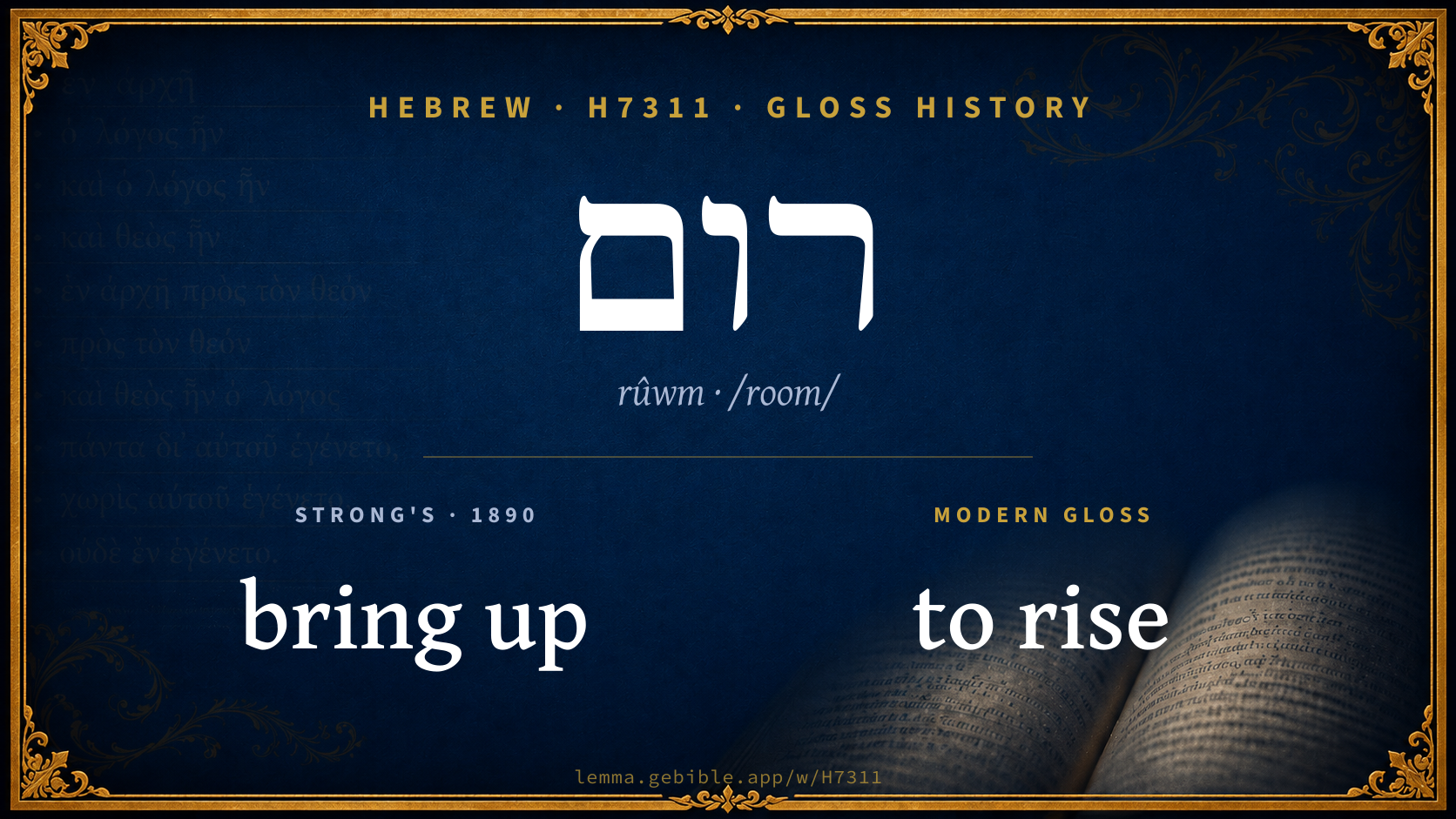
Gloss history
Strong's 1890 vs modern scholarship
About this word
Strong's H7311 catalogs a Hebrew word from the Hebrew Old Testament.
These counts are not copied from any lexicon or concordance. They are computed here, from the morphology-tagged Hebrew Old Testament. What Lemma adds →
- 184
- distinct verses
- The word appears in 184 distinct verses.
- 23 / 39
- OT books
- The word appears in 23 of 39 Old Testament books.
- #243
- by frequency
- Top 250 most frequent Hebrew words (rank 243 of 8,640 Hebrew words by occurrence).
View all 184 occurrences in the concordance →
By section of the Old Testament
By traditional corpus
Conventional, traditional groupings — biblical authorship is debated, so this is a traditional corpus grouping, not an authorship claim. Each share is this word’s portion of its verses in that division of the Hebrew canon. Each figure is a share of the word’s 184 distinct verses.
- Writings (Ketuvim) 79 verses · 43%
- Prophets (Nevi'im) 60 verses · 33%
- Torah (Pentateuch) 45 verses · 24%
How translations render this word
Counts come from each version’s own published word-to-Strong’s tagging or interlinear alignment — an approximate guide to how each version renders this word, not a word-level alignment the data otherwise carries. Because each total is that version’s own tagged count, the per-version totals vary from one another and need not match the appearance or distinct-verse counts above. These counts may also differ from a printed concordance because Lemma counts each distinctly tagged rendering and does not collapse phrase taggings into a single head-word total. This is a fixed set of word-tagged versions (KJV, ASV, BSB, ULT) and does not change with the reading translation you choose elsewhere. Each version’s license is shown beside its name below (and on Sources).
BDB lists this Strong’s number as 4 distinct words (homographs). Each count above pools all of them and is not split by sense — see the Senses section below. A low-frequency rendering may belong to a different one of those words, not the primary meaning.
- King James Version†: High 10×, Lift up 7×, Ye shall offer 7×
- American Standard Version†: High 9×, Lift up 8×, Ye shall offer 7×
- Berean Standard Bible†: Be exalted 7×, High 7×, Is exalted 6×
- unfoldingWord Literal Text†: High 10×, Raise 10×, And 8×
King James Version Public Domain
Renders H7311 across 191† tagged occurrences — most commonly:
Plus other, less common renderings. Plus 94 renderings that appear only once — usually multi-word phrases or single function words the recovered tagging swept in, not distinct renderings. Not rendered by a distinct English word in 4 further occurrences.
American Standard Version Public Domain
Renders H7311 across 191† tagged occurrences — most commonly:
Plus other, less common renderings. Plus 95 renderings that appear only once — usually multi-word phrases or single function words the recovered tagging swept in, not distinct renderings.
Berean Standard Bible Public Domain
Renders H7311 across 185† tagged occurrences — most commonly:
Plus other, less common renderings. Plus 101 renderings that appear only once — usually multi-word phrases or single function words the recovered tagging swept in, not distinct renderings. Not rendered by a distinct English word in 5 further occurrences.
unfoldingWord Literal Text CC BY-SA 4.0
Renders H7311 across 215† tagged occurrences — most commonly:
Plus other, less common renderings. Plus 85 renderings that appear only once — usually multi-word phrases or single function words the recovered tagging swept in, not distinct renderings.
38 senses and sub-senses in the full BDB
Hebrew verbs can shift meaning by stem (binyan): Qal is the basic action, Niphal is often passive or reflexive, Piel often intensifies or makes it factitive, and Hiphil is typically causative. The senses below are grouped under the stem BDB assigns to each. This entry also uses Hophal (the passive of Hiphil) and one or more reduplicated stems (the Pōlēl/Pilpēl type), which for hollow or geminate roots behave much like Piel — often intensive or iterative.
What do BDB’s symbols mean?
BDB uses these scholarly abbreviations:
| Symbol | Meaning |
|---|---|
| 𝔊 | the Septuagint (the ancient Greek translation, LXX) |
| 𝔙 | the Vulgate (the Latin translation) |
| 𝔖 | the Syriac version (the Peshitta) |
| 𝔗 | the Targum (the Aramaic translation) |
| ψ | the Psalms |
| √ | root (the underlying root or stem) |
| ‖ | parallel passage (a synonymous or contrasted parallel) |
| † | the dagger: every passage where the word occurs is cited |
The 38 senses and sub-senses the full Brown-Driver-Briggs lexicon distinguishes for this word, in lexicon order (not ranked by frequency), with BDB’s own verbatim wording and sub-sense lettering. Shown in Hebrew script with BDB’s own scholarly abbreviations. The condensed entry is in the Lexicon Entry tab. See also the Forms in the corpus table below.
רום I be high, exalted, rise (OHeb, Ph., Old Aramaic, Palm., all in n.pr.
Qal
- Pf. 3 ms. consec. וְרָם Dt 8:14 +; 3 fs. רָ֫מָה 1 S 2:1 +; וְרָאֲמָה Zc 14:10 v. רָאַם; 3 pl. רָמוּ Pr 30:13 ψ 131:1, רָ֑מּוּ Jb 22:12 (Baer Gi; Ges§ 20 l); Impf. יָרוּם Is 30:18 +, juss. יָרֹם Nu 24:7, וַיָּ֫רָם Ho 13:6 Ez 10:4 [וַיָּרֻם Ex 16:20 v. רמם]; 3 mpl. יְרֻמ֑וּן Is 49:11, etc.; Imv. ms. ר֫וּמָה ψ 21:14 +; Inf. cstr. רוּם Dt 17:20 Ez 10:16, כְּרֻם ψ 12:9 [Bae conj. כֶּרֶם, sf. רוֹמָם Ez 10:17 (Ges§ 72 q); Pt. רָם Is 6:1 +, pl. רָמִים 2:13 +, cstr. רָמֵי 10:33, etc.;— e.g. Deuteronomy 8:14
- 1.
- a. be high, lit. rock (in fig.) ψ 61:3 (מִן comp.); be (set on) high, רָ֑מּוּ Jb 22:12 (of stars), especially pt., = adj., in gen. Is 2:12 (+ גֵּאֶה), of mts. v 14; Dt 12:2, hill Ez 6:13, 20:28; 34:6, throne Is 6:1, trees = tall 2:13 Ez 17:22, cf. (in fig.) Is 10:33 (רָמֵי הַקּוֹמָה); human stature Dt 1:28 (מִן comp.), 2:10, 21; 9:2; רָמִים ψ 78:69 heights (of heaven; ‖ אֶרֶץ); רָמִים of inhab. of heavens Jb 21:22. e.g. Psalms 61:3
- b. especially of י׳, רָם וְנִשָּׂא Is 57:15, cf. ψ 138:6, + עַל־כַּל־הָעַמִּים 99:2, גּוֹיִם 113:4. e.g. Isaiah 57:15
- 2. be raised, uplifted:
- a. of highway Is 49:11 (made high, put in order); voice, Dt 27:14 (pt. = adj.) uplifted. e.g. Isaiah 49:11
- b. fig.: of hand, symbol of might, Dt 32:27, + עַל pers. Mi 5:8; of Isr. in Exodus בְּיָד רָמָה Ex 14:8; Nu 33:3 (both P); of י׳’s hand Is 26:11 ψ 89:14 (‖ תָּעֹז); fig. of presumption Nu 15:30 (P); זְרוֹעַ רָמָה of might Jb 38:15; of eyes, fig. of arrogance Pr 6:17; 30:13 ψ 131:1 (‖ גָּבַהּ לִבִּי), so 18:28, but ‖ 2 S 22:28 of pers.; of heart, fig. of reckless elation, Ho 13:6; Dt 8:14; Ez 31:10 (בְּגָבְהוֹ, ‖ גָּבַהְתָּ בְּקוֹמָה) Dn 11:12, + מִן pers. Dt 17:20; of horn, fig. of triumph 1 S 2:1 (song), ψ 89:25 (v 18 see Hiph.), 112:9, so head 27:6 (+ עַל pers.), 140:9 (join ירומו to v 10, but read יָרִימוּ Che, cf. Hup-Now). e.g. Deuteronomy 32:27
- c. of pers., be exalted (in fig.), king Nu 24:7 (JE; + מִן comp.; ‖ תִּנַּשֵּׂא); of God (י׳, i.e. shew his exaltation) Is 30:18; 2 S 22:47 = ψ 18:47, ψ 21:14; 46:11(×2), + עַל־(הַ)שָּׁמַיִם 57:6, 12; 108:6; עֶבֶד י׳ Is 52:13, י׳’s people ψ 89:17; rebellious 66:7 (Qr; Kt Hiph.: shew exaltation); worthlessness (personif.) ψ 12:9; foe 13:3; city Pr 11:11. e.g. Numbers 24:7
- 3. be lifted, rise, of ark, מֵעַל־הארץ Gn 7:17 (J), so of cherubim Ez 10:16, cf. v 17; כְּבוֹד י׳ v 4 (מֵעַל הַכְּרוּב).—Pr 24:7 v. i. רָאמוֹת p. 910b. e.g. Genesis 7:17
Pōʿlēl
- Pf. 3 fs. sf. רֹמְמָ֑תְהוּ Ez 31:4; 1 s. רוֹמַמְתִּי Is 1:2; 23:4; Impf. 3 ms. יְרוֹמֵם Ho 11:7, sf. יְרוֹמְמֵנִי ψ 27:5, וִירוֹמִמְךָ 37:34; 1 s. sf. וַאֲרֹמְמֶ֑נְהוּ Ex 15:2 (Ges§ 58 i), etc. (אֵרוֹמָם v. Hithpōʿl.); Imv. mpl. רוֹמְמוּ ψ 99:5, 9; Inf. cstr. לְרוֹמֵם Ezr 9:9; Pt. מְרוֹמֵם 1 S 2:7, sf. מְרוֹמְמִי ψ 9:14, f. רוֹמֵמָה 118:16 (מ om., Hup-Now Bae; cf. Köi. 454);— e.g. Ezekiel 31:4
- 1.
- a. raise, rear, children Is 1:2; 23:4 (both ‖ גִּדֵּל). e.g. Isaiah 1:2
- b. cause tree to grow, subj. תְּהוֹם Ez 31:4 (‖ גִּדֵּל). e.g. Ezekiel 31:4
- c. rear, erect, temple Ezr 9:9. e.g. Ezra 9:9
- 2. lift up:
- a. in fig., acc. pers., subj. י׳ ψ 27:5 (+ בְּצוּר); + מִן comp. 2 S 22:49 = ψ 18:49, + מִן from 9:14; acc. om. Ho 11:7 (si vera l., cf. We Now). e.g. Psalms 27:5
- b. raise waves of sea, subj. wind, ψ 107:25. e.g. Psalms 107:25
- c. exalt, acc. pers., subj. י׳ Jb 17:4 (read perhaps תְּרִמֵם, so Bu, cf. Di), ψ 37:34 (+ לָרֶשֶׁת אָ֑רֶץ); acc. om. 1 S 2:7 ψ 118:16 (in victory); subj. wisdom, acc. pers. Pr 4:8, cf. צְדָקָה תְּרוֹמֵם־גּוֹי 14:34. e.g. Job 17:4
- 3. exalt, extol, acc. י׳, ψ 30:2, ‖ אוֹדֶה Is 25:1 ψ 118:28, ‖ הִשְׁתַּחֲווּ 99:5, 9, ‖ הִלֵּל 107:32, ‖ בֵּרַךְ 145:1, ‖ אַנְוֵהוּ Ex 15:2; acc. שֵׁם י׳ ψ 34:4 (‖ גִּדֵּל). e.g. Psalms 30:2
Pōʿlal
- Impf. 3 fpl. תְּרוֹמַמְנָה ψ 75:11 be lifted up, of horns (cf. Qal 2 b); Pf. 3 ms. וְרוֹמַם 66:17 and he was extolled (so Ki al.; but v. רוֹמָם infr.); Pt. מְרוֹמַם Ne 9:5 extolled, of י׳’s name (cf. Pōʿlēl 3), + עַל־בְּרָכָה וג׳. e.g. Psalms 75:11
Hiphil
- Pf. 3 ms. הֵרִים 1 K 11:27 +; 2 ms. הֲרִימוֹתָ 2 K 19:22 ψ 89:43, וַהֲרֵמֹתָ֫ Nu 31:28; 2 mpl. consec. וַהֲרֵמֹתֶם 18:26, etc.; Impf. 3 ms. יָרִים Gn 41:44 +, juss. יָרֵם Nu 17:2; 1 S 2:10, וַיָּ֫רֶם Ex 7:20 +, sf. וַיְרִימֶהָ Gn 31:45, etc.; Imv. ms. הָרֵם Ex 14:16; Is 58:1, הָרִימָה ψ 74:3, etc.; Inf. cstr. הָרִים Is 10:15 +, sf. הֲרִימִי Gn 39:18, etc.; Pt. מֵרִים Ex 35:24 +, etc.;— e.g. 1 Kings 11:27
- 1.
- a. (1) raise, lift, c. acc., hand Ex 17:11 (E), Nu 20:11 (P), + אֶל־י׳ (in oath) Gn 14:22 cf. (אֶל־הַשָּׁמַיִם) Dn 12:7, + ב pers. against 1 K 11:26, 27; feet; פְּעָמִים ψ 74:3, i.e. run (+ ל dir.); hand or foot Gn 41:44 (E), i.e. make any movement (hyperb.); head ψ 110:7 (Assyrian ullû rêšu DlHWB 62a), cf. יָרִימוּ 140:9 (so read, v. Qal 2 b); face, אֶל־י׳ Ezr 9:6; hand of another, subj. י׳, fig. of giving strength to, ψ 89:43, so head 3:4; c. acc. of rod Is 10:15; Ex 14:16 (P), הֵרִים בַּמַּטֶּה 7:20 (E); rod subj., c. acc. rei Is 10:15. (2) raise poor אֶבְיוֹן, c. מִן loc. 1 S 2:8 ψ 113:7. e.g. Exodus 17:11
- b. lift up voice Gn 39:15, 18 (J; both + קָרָא), Is 40:9(×2) (acc. om.), 58:1; Ezr 3:12; + בִּתְרוּעָה Ez 21:27, בַּחֲצֹצְרוֹת 2 Ch 5:13; + ל pers. Is 13:2, לָעָב Jb 38:34, + עָל pers. against 2 K 19:22 = Is 37:23; הֵרִים בְּקוֹל 1 Ch 15:16. e.g. Genesis 39:15
- c. (take into one’s hand and) lift, take up, stone Jos 4:5 (JE; עַל־שִׁכְמוֹ), leg (of sacrif. meal) 1 S 9:24, mantle 2 K 2:13, axe 67 (acc. om.), yoke Ho 11:4 (עַל־לְחֵיהֶם), censers Nu 17:2 (P; + מִבֵּין), ashes Lv 6:3. e.g. Joshua 4:5
- d. set up, erect, stone as מַצֵּבָה Gn 31:45 (E); standard, + אֶל of people Is 49:22, עַל 62:10. e.g. Genesis 31:45
- e. set on high, throne, מִמַּעַל לְכוֹכְבֵי אֵל Is 14:13; nest (subj. נֶשֶׁר) Jb 39:27. e.g. Isaiah 14:13
- f. lift up, exalt, c. acc. pers., subj. י׳ 1 K 14:7; 16:2 ψ 89:20 (all c. מִן), ψ 75:8 (opp. יַשְׁפִּיל); subj. קָלוֹן Pr 3:35, cf. 14:29; c. acc. קֶרֶן, in both good and bad sense (cf. Qal 2 b) 1 S 2:10; La 2:17 (לַמָּרוֹם), ψ 89:18 (Kt; Qr Qal), 92:11; 148:14 ψ 75:5, 6; but 1 Ch 25:5 sound the horn; inf. = exaltation ψ 75:7; 66:7 v. Qal 2 c. e.g. 1 Kings 14:7
- 2. lift up and take away, remove, c. acc. הָעֲטָרָה Ez 21:31; acc. rei + מִן loc. Is 57:14, Lv 2:9; 4:8, 19; 6:8 Nu 18:30, 32; = do away with, גְּרֻשֹׁתֵיכֶם Ez 45:9 (מֵעַל of people), הַתָּמִיד Dn 8:11 (Kt; Qr Hoph.); = set apart, מֶכֶס Nu 31:28 (מִן pers.). e.g. Ezekiel 21:31
- 3. lift off and present, contribute, offer:
- a. to י׳, c. acc. cogn. תְּרוּמָה, Ez 45:13; 48:8, 20; Nu 15:20(×2) (P), Ex 35:24 (P); + לי׳ Ez 45:1; 48:9; Nu 15:19; 18:19, 24; 31:52; תְּרוּמַת י׳ 18:26 (+ מִן rei), v 28, 29 (all P); ת׳ בֵּית־א׳ Ezr 8:25. e.g. Ezekiel 45:13
- b. c. acc. rei, + לְי׳ Lv 22:15. e.g. Leviticus 22:15
- c. contribute, acc. rei, ל pers. (for sacrif.), 2 Ch 30:24(×2;) 35:7, 8 (acc. om.), v 9. e.g. 2 Chronicles 30:24
Hophal
- Pf. 3 ms. הוּרָ֑ם Ex 29:27, הֻרַם Dn 8:11 Qr (Kt Hiph.); Impf. 3 ms. יוּרָם Lv 4:10;—be taken off from (מִן) Lv 4:10 (P), cf. Ex 29:27 (P; ‖ הוּנַף); be abolished Dn 8:11 Qr (cf. Hiph. 2); Bev (after 𝔊) ins. Pt. מוּרָם after הַתָּמִיד v 13. e.g. Exodus 29:27
Hithpōʿl
- Impf. 3 ms. וַיִתְרוֹמֵם וַיִתְגַּדֵּל עַל־כָּל־אֵל Dn 11:36 and he shall exalt and magnify himself above, etc.; 1 s. (ת assim.) אֵרוֹמָ֔ם Is 33:10 (Ges§ 54c Köi. 454) I will raise myself (+ אָקוּם, אֶנָּשֵׂא). e.g. Daniel 11:36
רום II [m.] height, haughtiness (proposes inf.)
- 1. height, loftiness, שָׁמַיִם לָר׳ וָאָרֶץ לָעֹמֶק Pr 25:3; cstr. רוּם עֵינַיִם fig. of haughtiness Is 10:12 (‖ גֹּדֶל לֵבָב), Pr 21:4 (‖ רְחַב־לֵב); so רֻם לִבּוֹ Je 48:29 (‖ גַּאֲוָה, גָּאוֹן, גֹּבַתּ); then alone: e.g. Proverbs 25:3
- 2. haughtiness, רוּם אֲנָשִׁים Is 2:11, 17 (both ‖ גַּבְהוּת). e.g. Isaiah 2:11
רום III
- 1.
- a. an ancestor of David, Ru 4:19(×2), brother of Jerachmeel 1 Ch 2:9, 10. e.g. Ruth 4:19
- b. son of J. 1 Ch 2:25, 27.—Αρραν, Ραμ, etc. e.g. 1 Chronicles 2:25
- 2. name of Elihu’s family, Jb 32:2 (Ραμ[α], Αραμ), dub., cf. Bu. e.g. Job 32:2
רום IV denom. be wormy
Qal
- Impf. 3 ms. (c. acc. result, Ges§ 121 d N) וַיָּ֫רֻם תּוֹלָעִים Ex 16:20 (Ges§ 67 n; + וַיִּבְאַשׁ). e.g. Exodus 16:20
Senses from the full Brown-Driver-Briggs lexicon (Brown, Driver, Briggs; Oxford 1906 — public domain), digitized via Sefaria, supplemented by the OpenScriptures HebrewLexicon (CC BY 4.0). Full attribution on Sources.
Word origin
I. vb. be high, exalted, rise (OHeb, Ph., Old Aramaic, Palm., all in n.pr.; Sab. in רים epith. dei et regis Fell ZMG liv (1900), 25f. also in n.pr. Mordtm ib. xxx (1876), 36 SabDenkm No. 14, 1. 1; Arabic رام be high, dial. of Oman (JayakarJA xxi. 813, 875) and Zanzibar (PräZMG xxxiv (1880), 218); Ethiopic in deriv.; Aramaic רָם ܪܘܡ (very often in der. spec. and deriv.));—
II. n.[m.] height, haughtiness (proposes inf.);—abs. ר׳,
I. vb. denom. be wormy;—
— Brown-Driver-Briggs (Oxford 1906, public domain), digitized via Sefaria, supplemented by the OpenScriptures HebrewLexicon (CC BY 4.0). See Sources.
Origin: a primitive root
Jastrow Dictionary
A second Hebrew/Aramaic lexicon for comparison, covering Aramaic and post-biblical (Talmudic, Targumic, Midrashic) usage that the biblical-Hebrew BDB does not. Matched by lemma rather than by Strong’s number, so a lemma may carry more than one Jastrow headword (shown separately below), and the entries cover usage well beyond the Bible.
רוּם
- (b. h.) [to swing,] to be high, lifted up; to rise. Ab. Zar. 24ᵇ רוֹמִי רומי השיטה Ar. (ed. רוני) rise, rise, acacia (holy ark)!; Gen. R. s. 54 רומי השטה.
- 1. to lift up, raise. Cant. R. to III, 4 (ref. to Ps. LXXV, 8) ישפיל … ויָרִים לכרש וכ׳ he shall lower Belshazzar, and lift up Cyrus and Darius; Yalk. Ps. 812 אני הוא משפיל ומֵרִים I lower and raise; מלכות … מרים he lays low one empire and raises another empire &c.; a. e. e.g. Psalms 75:8
- 2. to take off, remove. Ruth R. to I, 17 (ref. to Ez. XXI, 31) הסר … והָרִים העטרה וכ׳ remove the bonnet from our teachers, and take the crown off the nations; a. e. e.g. Ezekiel 21:31
- to be taken off, esp. to be separated as an offering, priest’s share &c.; to be consecrated. Ḥall. II, 8 שלא הוּרְמָה חלתה (not הורם), v. חַלָּה. Sifré Num. 110 (ref. to Num. IV, 20) את שמוּרָם קודש וכ׳ that which is separated is to be sacred, and the remainder secular, but (no Ḥallah is to be taken,) when both would be sacred. Zeb. V, 6 המורם מהם וכ׳ the same rules apply to what is taken off them for the priest; a. fr. e.g. Numbers 4:20
- to lift up, elevate. Tanḥ. Matt. 6; Num. R. s. 22, end (ref. to Num. XXXI, 9 and XXXII, 1) הא שהשפיל … ור׳ וכ׳ here you see that the Lord lowered the Midianites, and raised the Israelites. Ib. (ref. to I Sam. II, 7) אף … מְרוֹמֵם את זה in the anger which he brings to bear on one, he raises the other. Pesik. R. s. 10 (ref. to Ps. LXXV, 8) משפיל לכל … ומרומם וכ׳ he lowered every one that had part in the worship of the golden calf, and elevated every one that had no part &c. Ib. ועכשיו … אף כך רוֹמֵם ראשם and now that thou hast lifted up my head, lift thou up their head likewise; לך ר׳ ראשם go and lift up their heads (announce to them the divine pardon). Ib. (ref. to Ex. XXX, 12) כל מה שאתה יכול לרוֹמֵם … רוֹמְמָהּ שבאילו לי אתה מְרוֹמֵם (not רומם) in whatever way thou canst elevate that nation elevate it, for by this thou elevatest me. Ex. R. s. 25 ורִימְּמָן הקב"ה וכ׳ (fr. רָמַם) and the Lord raised them above all; a. fr. e.g. Numbers 31:9
- , Nithpol. נִתְרוֹמֵם to be lifted up; to pride one’s self. Y. Ber. IX, 14ᵃ top יתגדל … ויתברך ויִתְרוֹמַם שמך וכ׳ thy Name be magnified … and blessed and lifted up (praised) for &c.; Y. Taan. I, 64ᵃ top; Gen. R. s. 13. Meg. 17ᵇ כיון … מִתְרוֹמֶמֶת קרן וכ׳ when the transgressors cease to exist, the horn of the righteous will be uplifted. Num. R. s. 22; Tanḥ. Matt. 6, a. e. אין אדם מִתְרוֹמֵם, v. רוֹמֵמוּת. Tanḥ. Mick. 3 ונִתְרוֹמְמוּ and they were raised (to power); a. e.—[Yalk. Gen. 79 מתרוממות, read: מְתַמְּרִין, v. תָּמַר.]
רוּם ²
- , to be high. Targ. Ps. LXXXIX, 14. Targ. O. Deut. VIII, 14 וִירַם ed. Berl. (oth. ed. וִירִים, וְרִים); a. fr.—2) to lift; to remove. Targ. Ps. LXXXIX, 18 תְּרִים.—Y. Bets. I, 60ᶜ bot. ורִימוּנָהּ and they lifted it. Y. Snh. X, 29ᵃ bot. כיון דרִימֵיה when he had removed it. Y. Ab. Zar. IV, 43ᵈ מן דרִימוֹן when he had removed them (the stones); a. e.
- 1. to swing; to wave an offering; to uplift. Targ. Ex. VII, 20. Targ. O. ib. XVII, 11 מַרִים ed. Berl. (ed. Vien. יְרִים). Targ. Is. XXX, 28 (h. text להנפה). Targ. Lev. XXIII, 11 (h. text והניף); a. fr.—Part. pass. מְרִים; f. pl. מְרִימָן. Targ. Is. III, 16 (h. text נטויות).
- 2. to lift take off, remove. Lam. R. to V, 5 אֲרִימוּן ראשיה מיניה cut his head off. Y. Ab. Zar. l. c. בחייך דאת מֵרִים אילין וכ׳ by thy life! thou must remove these stones; a. e.
- 1. to be uplifted, rise. Targ. Gen. VII, 17; a. e.
- 2. to be swung, waved (as an offering). Targ. Ex. XXIX, 27 (h. text הונף); a. e.
- 3. to be taken off, removed. Lam. R. to V, 16 והא ניחא ליה דאיתרים רישיה וכ׳ it would have been better for him that his head be cut off rather than do this; Koh. R. to X, 5 נייח הוה דיִיתְּרִים וכ׳; Y. Sot. IX, 24ᵇ sq. נייח ליה אילו איתרים וכ׳.
- to elevate, extol. Targ. Ps. XXXVII, 34. Ib. CXLV, 1. Targ. Y. I Deut. XXXII, 3; a. e.—Part. pass. מְרוֹמַם. Targ. Ps. XVIII, 47 (not מרומֵם); Targ. II Sam. XXII, 47; a. e.—V. מְרָמַם.
- to be lifted up; to be extolled. Targ. Ps. CVII, 25. Ib. LXXV, 11. Ib. CVIII, 6; a. e.—Y. Maas. Sh. IV, end, 55ᶜ את מִתְרוֹמְמָא, v. הֲדָרָא.
- , contr. רוֹרֵם, רָרֵם to elevate. Targ. Ps. IX, 14 מְרוֹרֵם Ms. (ed. מְרוֹמֵם). Ib. XXVII, 5. Targ. Prov. XVII, 19 מְרָרֵים Ms. (ed. מרים, מורים). Ib. XIV, 34.
- , contr. אִתְרוֹרַם, אִתְרָרַם
- 1. to be elevated, rise. Targ. Ps. LVII, 6; 12. Targ. Prov. XI, 11; a. e.
- 2. to be haughty, proud. Ib. XVIII, 12.—Apocopated form: אִתְרַמַּר. Ib. VI, 30 לא למִתְרַמָרוּ וכ׳ ed. (h. text יבוזו) let them not look haughtily down on the thief &c.; v. דְּמַר.
רוּם II
- preced.) height. Ber. 6ᵇ (ref. to כרם זלות, Ps. XII, 9) אלו דברים … ברוֹמוֹ וכ׳ this means the things which stand on the height of the world (sublime things like prayer &c.) and which men treat lightly. Meg. 14ᵃ בני אדם שעומדין ברומו וכ׳ men that stood very high. Midd. II, 3; III, 6 ר׳ מעלה וכ׳ the height of each step was &c. Sifré Deut. 199 גדול השלום שדרי ר׳ וכ׳ peace is something great, for the dwellers on high (angels) need peace; Yalk. ib. 923; a. e. e.g. Psalms 12:9
רוּם ³
- 1. height. Targ. Y. Deut. XI, 18 על ר׳ ידכון on the highest point of your arm (v. גּוֹבַהּ). Targ. Is. XIV, 12, sq. Targ. O. Num. XXIII, 22; a. fr.—Y. Snh. X, 29ᵃ הוה ארונא … לר׳ וכ׳ the ark carried the priests high up and cast them down to the ground. B. Bath. IV, 2; ib. 61ᵃ, v. עוּמְקָא I. Lam. R. to IV, 15 ברוּמְהוֹן (some ed. ברוֹמֵיהֶן, pl.) of their high stature, v. שׁוּף I ch.; Lev. R. s. 16 ברומחין (corr. acc.); a. e.—Pl. רוֹמִין, רוֹמֵי. Sot. 48ᵇ, v. שׁוּט I ch.—V. מְרוֹמָא I.
- 2. haughtiness. Targ. Ps. LXXIII, 8.—V. רָמוּתָא.
A Dictionary of the Targumim, the Talmud Babli and Yerushalmi, and the Midrashic Literature (Marcus Jastrow; London, Luzac, 1903) — Public Domain. Digitized via Sefaria. Digitized via Sefaria. Full attribution on Sources.
Forms in the corpus
The 155 distinct written forms H7311 takes in the Hebrew Bible, most frequent first — each parse links to that stem’s occurrences in the concordance. Hebrew forms include their vowel points and cantillation, so a single lemma takes many written forms.
The 60 most common forms are shown; 95 rarer forms follow in the full concordance.
Same root — word family
Other BDB entries built from the same root as H7311, grouped by Strong’s listed origin. These share a root / origin per the lexicon — not necessarily a shared meaning. Each links to that word’s own entry.
Derived from this word
- מרום mârôwm H4791 height
- רום rûwm H7312 haughtiness
- רום rûwm H7313 to rise
- רום rôwm H7315 on high
- רמה râmâh H7413 high place
- רמות râmûwth H7419 height
- תרומה tᵉrûwmâh H8641 offering
Proper names from this root
People and places named from this root — a name, not an additional meaning of the word.
- ירימות Yᵉrîymôwth H3406 Jerimoth
- ירמות Yarmûwth H3412 Jarmuth
- ירמי Yᵉrêmay H3413 Jeremai
- ירמיה Yirmᵉyâh H3414 Jeremiah
- מרמות Mᵉrêmôwth H4822 Meremoth
- רומה Rûwmâh H7316 height
- רוממתי עזר Rôwmamtîy ʻEzer H7320 Romamti-ezer
- רם Râm H7410 Ram
- רמיה Ramyâh H7422 Ramiah
Compare all same-root words → Showing 4 of 17 — not the complete family. 9 of the same-root words are proper names (people or places). They share a root, not necessarily a meaning.
Septuagint verse parallels
This word appears in 169 verses that also exist in the Greek Old Testament (Septuagint), out of the 184 Hebrew verses it occurs in. You can read those verses in Greek by switching the Old Testament edition to the Septuagint.
Read these verses in the Septuagint
- Genesis 7:17
- Exodus 7:20
- Leviticus 2:9
- Numbers 15:19
- Deuteronomy 1:28
- Joshua 4:5
- 1 Samuel 2:1
- 2 Samuel 22:28
- 1 Kings 11:26
- 2 Kings 2:13
- 1 Chronicles 15:16
- 2 Chronicles 5:13
This is a verse-level parallel only — the same verses exist in both the Hebrew and Greek Old Testaments. No word-level Hebrew↔Greek correspondence is claimed: the data carries no such alignment, so no Greek word is shown as this Hebrew word’s translation. Coverage is not total — the Septuagint omits the deuterocanon and renumbers the Psalms, so some Hebrew verses have no direct Greek parallel.