
Psalms 118:28

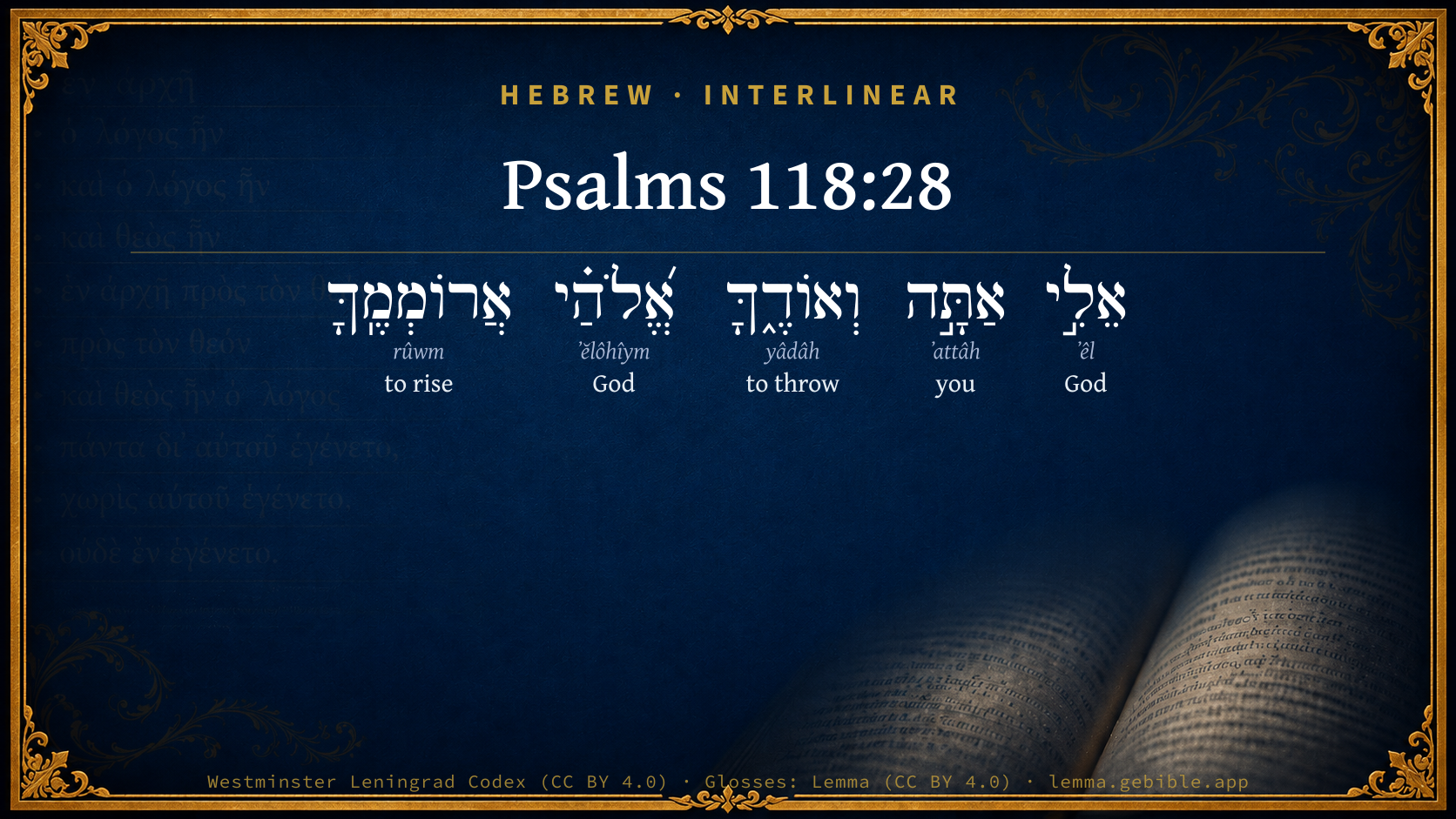
Hebrew (Westminster Leningrad Codex) Psalms 118:28 appears in the Hebrew Old Testament. The text above is from the Westminster Leningrad Codex. Each word links to its Strong’s number, a concise gloss, and parsing drawn from the Open Scriptures Hebrew Bible morphology. Click any word for its full Brown-Driver-Briggs (BDB) entry.
Download image
Cite this verse

Psalms 118:28 (World English Bible). Public Domain. Lemma interlinear Bible study tool, https://lemma.gebible.app/v/psalms/118/28.

Show BibTeX & RIS
BibTeX
RIS
English Translation
You are my God, and I will give thanks to you. You are my God, I will exalt you.
World English Bible · Public Domain
Download a study sheet

One document with this verse’s original text, its word-by-word gloss line, the meaning frame, cross-references with their text, attributed commentary, and full source and license credits — printable, and it pastes into notes with its structure intact.

This verse Autodidact and up

Study sheet (.html) Plain text (.txt)

A passage Seminary Student

Up to 50 verses in one chapter. A passage sheet keeps up to 6 commentary sources and 12 cross-references per verse, in the order this page ranks them, and says so on the sheet whenever that leaves anything out. Ask for a single verse and you get the Autodidact verse sheet above.

Everything on this page stays free to read, with no account — the sheet is a download of what is already on screen, not access to it.

Want to remove ads? Support Godless Engineer
Compare translations 3

The same verse in 3 English versions, stacked beneath the original-language interlinear above. Click any original word for its lexicon entry.

Each is an independent rendering of the whole verse — the interlinear is not word-aligned to these translations.

Highlighted words mark where these versions differ — a whole-verse word diff, not a word-by-word alignment.

  • World English Bible Public Domain
    You are my God, and I will give thanks to you. You are my God, I will exalt you.
  • King James Version Public Domain
    Thou art my God, and I will praise thee: thou art my God, I will exalt thee.
  • unfoldingWord Literal Text CC BY-SA 4.0
    You my God, and I will thank you; my God, I will exalt you.

unfoldingWord Literal Text — © unfoldingWord, licensed CC BY-SA 4.0. Word-aligned USFM3 via Door43 (git.door43.org/unfoldingWord/en_ult).

Versions to compare (up to 4)

3 of 4 selected

Show all 18 translations

Every available English version of this verse, each an independent rendering of the whole verse.

  • World English Bible Public Domain
    You are my God, and I will give thanks to you. You are my God, I will exalt you.
  • Berean Standard Bible Public Domain
    You are my God, and I will give You thanks. You are my God, and I will exalt You.
  • Majority Standard Bible Public Domain
    You are my God, and I will give You thanks. You are my God, and I will exalt You.
  • King James Version Public Domain
    Thou art my God, and I will praise thee: thou art my God, I will exalt thee.
  • American Standard Version (1901) Public Domain
    Thou art my God, and I will give thanks unto thee: Thou art my God, I will exalt thee.
  • Revised Version (1885) Public Domain
    Thou art my God, and I will give thanks unto thee: thou art my God, I will exalt thee.
  • Geneva Bible (1599) Public Domain
    Thou art my God, and I will praise thee, euen my God: therefore I will exalt thee.
  • Douay-Rheims (1899) Public Domain
    Thou art my God, and I will praise thee: thou art my God, and I will exalt thee. I will praise thee, because thou hast heard me, and art become my salvation.
  • Young's Literal Translation Public Domain
    My God Thou `art', and I confess Thee, My God, I exalt Thee.
  • Literal Standard Version CC BY-SA 4.0
    You [are] my God, and I confess You, || My God, I exalt You.
  • Unlocked Literal Bible CC BY-SA 4.0
    You are my God, and I will give thanks to you; you are my God; I will exalt you.
  • unfoldingWord Literal Text CC BY-SA 4.0
    You my God, and I will thank you; my God, I will exalt you.
  • Darby Bible Public Domain
    Thou art my ùGod, and I will give thee thanks; my God, I will exalt thee.
  • World Messianic Bible Public Domain
    You are my God, and I will give thanks to you. You are my God, I will exalt you.
  • Webster's Bible Public Domain
    Thou art my God, and I will praise thee: thou art my God, I will exalt thee.
  • Free Bible Version CC BY-SA 4.0
    You are my God, and I will thank you! You are my God, and I will praise you!
  • Bible in Basic English Public Domain
    You are my God, and I will give you praise; my God, and I will give honour to your name.
  • JPS Tanakh (1917) Public Domain
    Thou art my God, and I will give thanks unto Thee; Thou art my God, I will exalt Thee.

Literal Standard Version (2020), Covenant Press — licensed CC BY-SA 4.0. Text via the HelloAO Bible API (eBible.org). Unlocked Literal Bible (unfoldingWord) — licensed CC BY-SA 4.0. Text via the HelloAO Bible API (eBible.org). unfoldingWord Literal Text — © unfoldingWord, licensed CC BY-SA 4.0. Word-aligned USFM3 via Door43 (git.door43.org/unfoldingWord/en_ult). Free Bible Version, Dr. Jonathan Gallagher — licensed CC BY-SA 4.0. Text via the HelloAO Bible API (eBible.org).

Word by word

More ways to search: Search by grammar → Find every occurrence → Compare this word →

Practice this passage: Drill this verse → Learn its vocabulary →

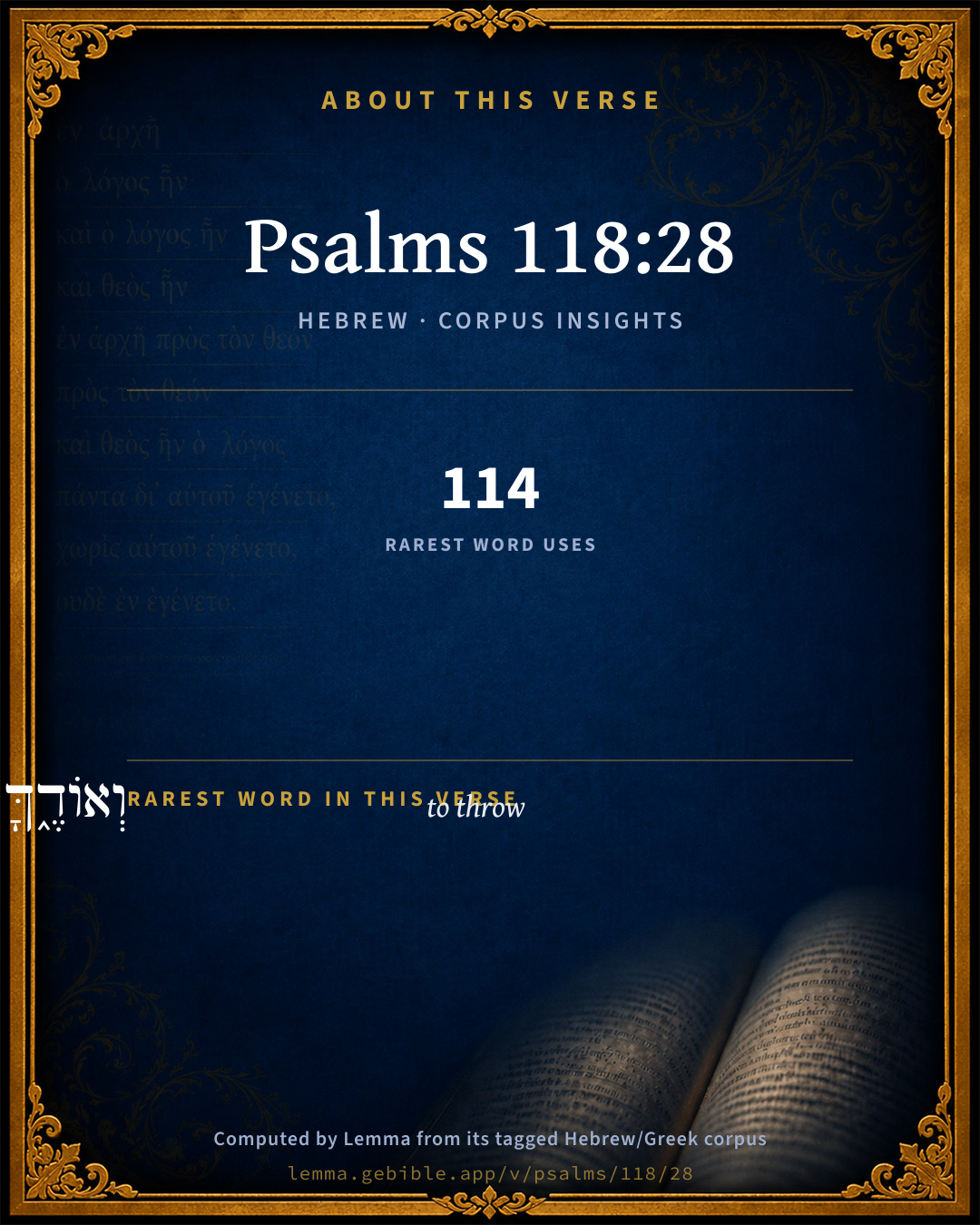
וְאוֹדֶ֑ךָּ
yâdâh
H3034
“and · to throw · you”
Conjunction + Verb, Hiphil, Imperfect, 1st Person, Common, Singular + Suffix, Personal, 2nd Person, Masculine, Singular
Part of Speech
Conjunction + Verb
Stem
Hiphil
Form
Imperfect
Person
1st Person
Gender
Common
Number
Singular
Full BDB Definition

Origin: a primitive root; used only as denominative from H3027

TWOT: 847

to throw, shoot, cast - (Qal) to shoot (arrows) - (Piel) to cast, cast down, throw down - (Hiphil) - to give thanks, laud, praise - to confess, confess (the name of God) - (Hithpael) - to confess (sin) - to give thanks
  1. אֵלִ֣י ʼêl H410 “God · my” Noun, Common, Masculine, Singular, Construct + Suffix, Personal, 1st Person, Common, Singular
  2. אַתָּ֣ה ʼattâh H859 “you” Pronoun, Personal, 2nd Person, Masculine, Singular
  3. אֱ֝לֹהַ֗י ʼĕlôhîym H430 “God(s) · my” Noun, Common, Masculine, Plural, Construct + Suffix, Personal, 1st Person, Common, Singular
  4. אֲרוֹמְמֶֽךָּ rûwm H7311 “to rise · you” Verb, Polel, Imperfect, 1st Person, Common, Singular + Suffix, Personal, 2nd Person, Masculine, Singular

About this verse

These counts appear in no published source. They are computed here, from the morphology-tagged text and Lemma’s own curated glosses. What Lemma adds →

5
words
5
distinct lemmas
Wisdom
section

Grammatical profile

  • 2 verbs
  • 2 nouns
  • 1 pronoun

Verb forms

  • וְאוֹדֶ֑ךָּ Hiphil · Imperfect
  • אֲרוֹמְמֶֽךָּ Polel · Imperfect

Hebrew & Septuagint length

In English translation the verse runs 19 words from the Hebrew and 35 from the Septuagint (LXX English) — closely comparable.

A rough comparison of the two English renderings, which tokenize alike — not a word-level alignment.

Word counts can differ between the Hebrew and the Greek without any difference in meaning — e.g. the Hebrew direct-object marker אֵת has no separate Greek word, and Greek often adds the article ὁ.

Cross-references

6

Topical passages linked to Psalms 118:28 in the Treasury of Scripture Knowledge — connected by theme and wording, ordered by reader-vote popularity; previews shown in the World English Bible.

  • Isaiah 25:1 Yahweh, you are my God; I will exalt you, I will praise your name; for you have done wonderful things, [even] counsels of old, in faithfulness [and] truth.
  • Psalms 146:2 While I live, I will praise Yahweh. I will sing praises to my God as long as I exist.
  • Exodus 15:2 Yah is my strength and song, He has become my salvation: This is my God, and I will praise him; My father's God, and I will exalt him.
  • Isaiah 12:2 Behold, God is my salvation. I will trust, and will not be afraid; for Yah, Yahweh, is my strength and song; and he has become my salvation."
  • Isaiah 25:9 It shall be said in that day, Behold, this is our God; we have waited for him, and he will save us: this is Yahweh; we have waited for him, we will be glad and rejoice in his salvation.
  • Psalms 145:1 I will exalt you, my God, the King. I will praise your name forever and ever.

Cross-references courtesy of OpenBible.info (CC BY 4.0).

Hebrew and Greek witnesses Masoretic Hebrew ↔ Greek Septuagint

The same verse in the two great witnesses to the Old Testament, shown verse-for-verse.

You’re reading Greek Psalm 117 (Hebrew Psalm 118). The Septuagint counts the superscription, so verse numbers can differ from the Hebrew — chapter-level alignment, not verse-by-verse. Numbering follows Rahlfs.

These are two independent witnesses, not word-aligned to each other, and the Septuagint is shown in lemma (dictionary) form.

Hebrew Psalms 118:28 Masoretic · Westminster Leningrad Codex

אֵלִ֣י אַתָּ֣ה וְאוֹדֶ֑ךָּ אֱ֝לֹהַ֗י אֲרוֹמְמֶֽךָּ

You are my God, and I will give thanks to you. You are my God, I will exalt you.

World English Bible · Public Domain

Greek LXX Greek Psalm 117:28 Septuagint · lemma form

θεός ἐγώ εἰμί σύ καί ἐκὁμολογέω σύ θεός ἐγώ εἰμί σύ καί ὑψόω σύ ἐκὁμολογέω σύ ὅτι ἐπιἀκούω ἐγώ καί γίγνομαι ἐγώ εἰς σωτηρία

You are my God, and I will give you thanks: you are my God, and I will exalt you. I will give thanks to you, for you have heard me, and are become my salvation.

LXX2012 (modern English Septuagint) · Public Domain

On this verse, The Cambridge Bible for Schools and Colleges discusses the Septuagint’s reading. Read the note in Commentary ↓

Hebrew: Westminster Leningrad Codex (CC BY 4.0). Greek: Septuagint (public domain); English from LXX2012 (modern English Septuagint) (Public Domain). How the Septuagint differs from the Hebrew →

Commentary

Notes on Psalms 118:28 from classic Christian and Jewish commentators (each source and its license shown beneath its notes). The classic Christian expositions comment on the surrounding passage and are grouped to its opening verse, so a note may address several verses; the Jewish commentaries on the Tanakh (Rashi and others) are per-verse, so they appear only where the commentator wrote on this verse.

Lemma curates 59 commentaries, every one of them public domain or Creative Commons licensed, each selected and text-cleaned for this edition rather than reprinted as found. About our sources →

Trapp's Complete Commentary

John Trapp

Psa 118:28 Thou [art] my God, and I will praise thee: [thou art] my God, I will exalt thee.

Ver. 28. Thou art my God, and I will praise thee] The people are taught to say thus; and the Greek, Arabic, and Latin translations repeat here, Psa 118:21, "I will praise thee, for thou hast heard me; and art become my salvation." People can never be sufficiently thankful for their salvation by Christ. It is their duty, and should be their desire.

John Trapp, A Commentary or Exposition upon All the Books of the Old and New Testament (1647–1656) — public domain. Text from a community e-Sword module.

Joseph Benson's Commentary

Psa 118:28-29. Thou art my God, and I will praise thee, &c. — In these verses the psalmist subjoins his own thankful acknowledgments of divine goodness, in which he calls upon others to join with him, and give thanks unto the Lord, because his mercy endureth for ever — Thus he concludes the Psalm as he began it, Psa 118:1, for God’s glory must be the Alpha and Omega, the beginning and the end, of all our addresses to him.

Joseph Benson's Commentary on the Old and New Testaments (1811–1818) — public domain. Text from a community e-Sword module.

J. A. Alexander on Psalms

Joseph Addison Alexander

28. (Psa 118:28) My God art thou, and I will thank thee; my God, I will exalt thee. The Hebrew words for God are not the same. The second is that commonlyso rendered, while the first is that used in Psa 118:27, and denoting the divine omnipotence.

Joseph Addison Alexander, The Psalms Translated and Explained (1850) — public domain. Text from a community e-Sword module.

The Cambridge Bible for Schools and Colleges

gen. ed. J. J. S. Perowne

28. I will praise thee] Rather, I will give thanks unto thee, as in Psa_118:29. The verse is another echo of Exo_15:2.

thou art my God] So the LXX. The Heb. text has, O my God. The word for ‘God’ in the preceding line is El, here it is Elôhîm. At the end of the verse the LXX repeats Psa_118:21.

The Cambridge Bible for Schools and Colleges (gen. ed. J. J. S. Perowne; Cambridge University Press, 1878–1918) — public domain. Text from a community e-Sword module.

Albert Barnes' Notes on the Bible

Thou art my God, and I will praise thee - This is the language of the author of the psalm - his solemn profession before the sanctuary and the altar; his response to the priesthood. In Psa 118:27, they had declared that “Jehovah alone was God;” to this he now replies, that he acknowledges, it; he recognizes him as the true God, and as his God; he comes to praise him; and he professes his purpose always to exalt him as his God.

Thou art my God, I will exalt thee - Repeating the solemn declaration that Yahweh alone was the God whom he worshipped, and that it was his purpose always to magnify his name.

Albert Barnes' Notes on the Bible (1834–1885) — public domain. Text from a community e-Sword/MySword module.

The Treasury of David

Charles H. Spurgeon

Ver. 28. Thou art my God, and I will praise thee, my mighty God who hath done this mighty and marvellous thing. Thou shalt be mine, and all the praise my soul is capable of shall be poured forth at thy feet.

Thou art my God, I will exalt thee. Thou hast exalted me, and as far as my praises can do it, I will exalt thy name. Jesus is magnified, and he magnifies the Father according to his prayer, "Father, the hour is come; glorify thy Son, that thy Son also may glorify thee." God hath given us grace and promised us glory, and we are constrained to ascribe all grace to him, and all the glory of it also. The repetition indicates a double determination, and sets forth the firmness of the resolution, the heartiness of the affection, the intensity of the gratitude. Our Lord Jesus himself saith, "I will praise thee"; and well may each one of us, humbly and with confidence in divine grace, add, on his own account, the same declaration, "I will praise thee." However others may blaspheme thee, I will exalt thee; however dull and cold I may sometimes feel myself, yet will I rouse up my nature, and determine that as long as I have any being that being shall be spent to thy praise. For ever thou art my God, and for ever I will give thee thanks.

Ver. 28. God. The original for "God" gives force to this passage: Them art my "El" The Mighty One; therefore will I praise thee: my "Eloah" a varied form with substantially the same sense, "and I will extol thee" lift thee high in glory and honour. Henry Cowles.

Ver. 28. This "extolling the Lord" will accomplish one of the great ends of praise, viz., his exaltation. It is true that God both can and will exalt himself, but it is at once the duty and the privilege of his people to exalt him. His name should be borne up and magnified by them; the glory of that name is now, as it were, committed to them: what use are we making of the opportunity and the privilege? Philip Bennet Power.

Ver. 28.

1. The gladdest fact in all the world: "Thou art my God."

2. The fittest spirit in which to enjoy it: "Praise thee"

Ver. 28.

1. The effect of Christ being sacrificed for us: "Thou art my God."

2. The effect of our being offered as an acceptable sacrifice to him: "I will praise thee, I will exalt thee." Or,

(a) The covenant blessing: "Thou art my

God."

(b) The covenant obligation: "I will praise thee." G.R.

Psalms 118:29*

Charles H. Spurgeon's The Treasury of David (1869–1885) — public domain. Psalms only. Text from a community e-Sword/MySword module.

The Pulpit Commentary

Thou art my God, and I will praise thee: thou art my God, I will exalt thee. This is the acknowledgment made by each and all, and probably repeated many times, while the sacrifice is being consumed upon the altar.

The Pulpit Commentary (1880–1919), ed. H.D.M. Spence-Jones & Joseph S. Exell — public domain. Text from a community e-Sword module.

Lesson kit

Teaching starters — assembled from the data on this page, not authored interpretation. Every prompt links to the verse data it draws on. Edit before teaching.

Psalms, in the Wisdom, opens this verse with 5 words (5 distinct Hebrew lemmas). Its most distinctive word is yâdâh (“to throw”). A historical commentator’s framing appears above. Read the whole chapter for the surrounding context.

Discussion questions

  1. What does “to throw” (yâdâh) contribute to the verse as a whole?
  2. Isaiah 25:1 shares this passage’s theme. How do the two illuminate each other?
  3. These translations render this verse differently. What is at stake in choosing one wording over another?
  4. The verb «וְאוֹדֶ֑ךָּ» is Hiphil Imperfect. How does its form color the action?
  5. Reading how Trapp's Complete Commentary and Joseph Benson's Commentary read this verse, where do the two commentators agree and where do they part?

Things to notice

Reading settings

Reading text

Shown beneath each verse's original-language words.

Old Testament
Old Testament edition

Read the OT as the Masoretic Hebrew (MT) or the Greek Septuagint (LXX).

English shown for the Greek Septuagint (in the Hebrew ↔ Greek comparison).

Comparing translations? Open the Compare panel on any verse page to stack up to four side by side.