Isaiah 37:23

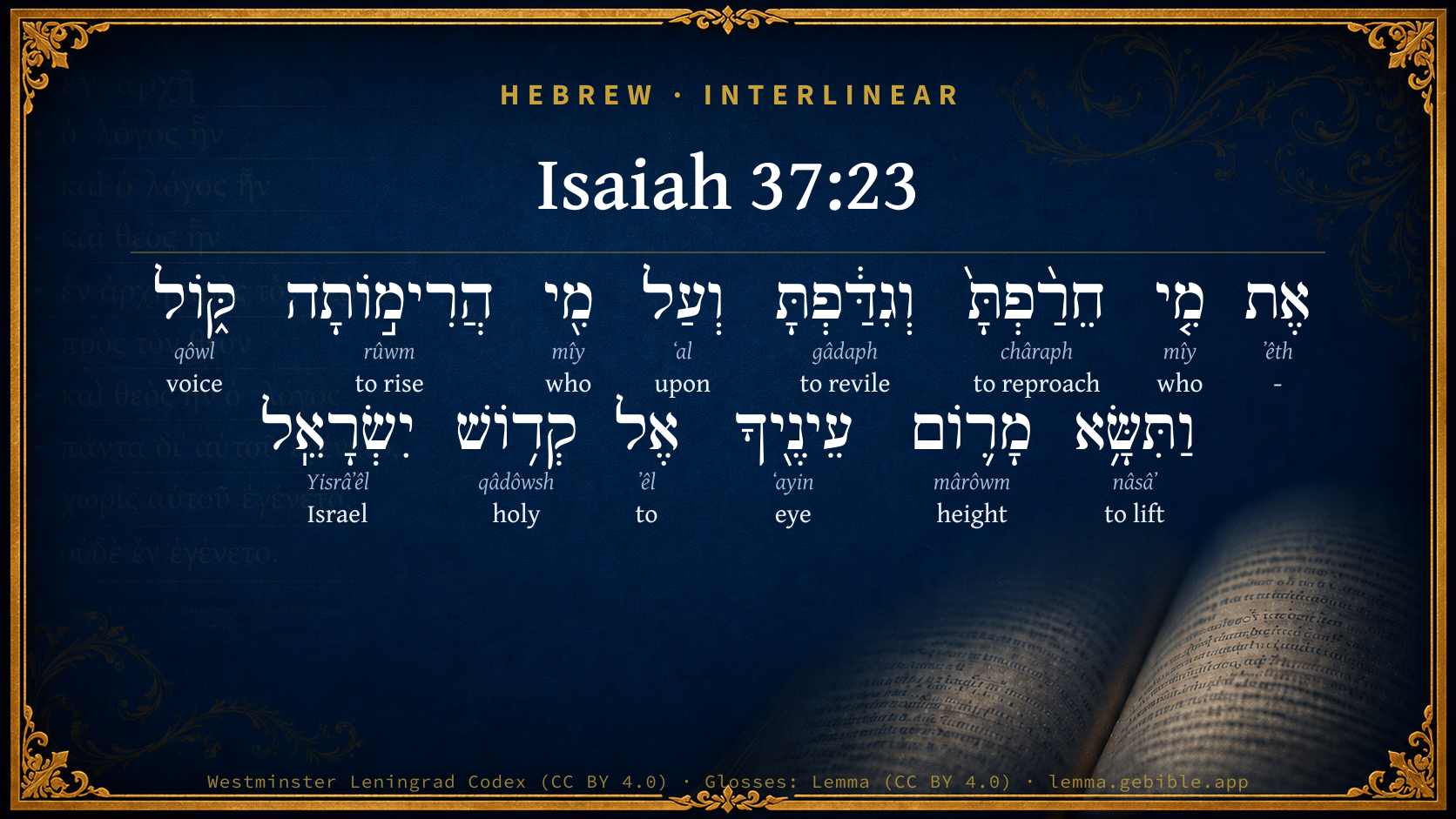
Hebrew (Westminster Leningrad Codex) Isaiah 37:23 appears in the Hebrew Old Testament. The text above is from the Westminster Leningrad Codex. Each word links to its Strong’s number, a concise gloss, and parsing drawn from the Open Scriptures Hebrew Bible morphology. Click any word for its full Brown-Driver-Briggs (BDB) entry.
Download image
Cite this verse

Isaiah 37:23 (World English Bible). Public Domain. Lemma interlinear Bible study tool, https://lemma.gebible.app/v/isaiah/37/23.

Show BibTeX & RIS
BibTeX
RIS
English Translation
Whom have you defied and blasphemed? and against whom have you exalted your voice and lifted up your eyes on high? [even] against the Holy One of Israel.
World English Bible · Public Domain
Download a study sheet

One document with this verse’s original text, its word-by-word gloss line, the meaning frame, cross-references with their text, attributed commentary, and full source and license credits — printable, and it pastes into notes with its structure intact.

This verse Autodidact and up

Study sheet (.html) Plain text (.txt)

A passage Seminary Student

Up to 50 verses in one chapter. A passage sheet keeps up to 6 commentary sources and 12 cross-references per verse, in the order this page ranks them, and says so on the sheet whenever that leaves anything out. Ask for a single verse and you get the Autodidact verse sheet above.

Everything on this page stays free to read, with no account — the sheet is a download of what is already on screen, not access to it.

Want to remove ads? Support Godless Engineer
Compare translations 3

The same verse in 3 English versions, stacked beneath the original-language interlinear above. Click any original word for its lexicon entry.

Each is an independent rendering of the whole verse — the interlinear is not word-aligned to these translations.

Highlighted words mark where these versions differ — a whole-verse word diff, not a word-by-word alignment.

  • World English Bible Public Domain
    Whom have you defied and blasphemed? and against whom have you exalted your voice and lifted up your eyes on high? [even] against the Holy One of Israel.
  • King James Version Public Domain
    Whom hast thou reproached and blasphemed? and against whom hast thou exalted thy voice, and lifted up thine eyes on high? even against the Holy One of Israel.
  • unfoldingWord Literal Text CC BY-SA 4.0
    Whom have you mocked and taunted? And against whom have you raised a voice and lifted your eyes upward? Against the Holy of Israel!

unfoldingWord Literal Text — © unfoldingWord, licensed CC BY-SA 4.0. Word-aligned USFM3 via Door43 (git.door43.org/unfoldingWord/en_ult).

Versions to compare (up to 4)

3 of 4 selected

Show all 18 translations

Every available English version of this verse, each an independent rendering of the whole verse.

  • World English Bible Public Domain
    Whom have you defied and blasphemed? and against whom have you exalted your voice and lifted up your eyes on high? [even] against the Holy One of Israel.
  • Berean Standard Bible Public Domain
    Whom have you taunted and blasphemed? Against whom have you raised your voice and lifted your eyes in pride? Against the Holy One of Israel!
  • Majority Standard Bible Public Domain
    Whom have you taunted and blasphemed? Against whom have you raised your voice and lifted your eyes in pride? Against the Holy One of Israel!
  • King James Version Public Domain
    Whom hast thou reproached and blasphemed? and against whom hast thou exalted thy voice, and lifted up thine eyes on high? even against the Holy One of Israel.
  • American Standard Version (1901) Public Domain
    Whom hast thou defied and blasphemed? and against whom hast thou exalted thy voice and lifted up thine eyes on high? `even' against the Holy One of Israel.
  • Revised Version (1885) Public Domain
    Whom hast thou reproached and blasphemed? and against whom hast thou exalted thy voice and lifted up thine eyes on high? even against the Holy One of Israel.
  • Geneva Bible (1599) Public Domain
    Whome hast thou railed on and blasphemed? and against whome hast thou exalted thy voyce, and lifted vp thine eyes on hie? euen against the holy one of Israel.
  • Douay-Rheims (1899) Public Domain
    Whom hast thou reproached, and whom hast thou blasphemed, and against whom hast thou exalted thy voice, and lifted up thy eyes on high? Against the Holy One of Israel.
  • Young's Literal Translation Public Domain
    Whom hast thou reproached and reviled? And against whom lifted up the voice? Yea, thou dost lift up on high thine eyes Against the Holy One of Israel.
  • Literal Standard Version CC BY-SA 4.0
    Whom have you reproached and reviled? And against whom—lifted up the voice? Indeed, you lift up your eyes on high || Against the Holy One of Israel.
  • Unlocked Literal Bible CC BY-SA 4.0
    Whom have you defied and insulted? Against whom have you exalted your voice and lifted up your eyes in pride? Against the Holy One of Israel.
  • unfoldingWord Literal Text CC BY-SA 4.0
    Whom have you mocked and taunted? And against whom have you raised a voice and lifted your eyes upward? Against the Holy of Israel!
  • Darby Bible Public Domain
    Whom hast thou reproached and blasphemed? and against whom hast thou exalted the voice? Against the Holy One of Israel hast thou lifted up thine eyes on high.
  • World Messianic Bible Public Domain
    Whom have you defied and blasphemed? Against whom have you exalted your voice and lifted up your eyes on high? Against the Holy One of Israel.
  • Webster's Bible Public Domain
    Whom hast thou reproached and blasphemed; and against whom hast thou exalted thy voice, and lifted thy eyes on high? even against the Holy One of Israel.
  • Free Bible Version CC BY-SA 4.0
    Who have you been insulting and ridiculing? Who did you raise your voice against? Who did you look at with so proud eyes? It was against the Holy One of Israel!
  • Bible in Basic English Public Domain
    Against whom have you said evil and bitter things? and against whom has your voice been loud and your eyes lifted up? even against the Holy One of Israel.
  • JPS Tanakh (1917) Public Domain
    Whom hast thou taunted and blasphemed? And against whom hast thou exalted thy voice? Yea, thou hast lifted up thine eyes on high, even against the Holy One of Israel!

Literal Standard Version (2020), Covenant Press — licensed CC BY-SA 4.0. Text via the HelloAO Bible API (eBible.org). Unlocked Literal Bible (unfoldingWord) — licensed CC BY-SA 4.0. Text via the HelloAO Bible API (eBible.org). unfoldingWord Literal Text — © unfoldingWord, licensed CC BY-SA 4.0. Word-aligned USFM3 via Door43 (git.door43.org/unfoldingWord/en_ult). Free Bible Version, Dr. Jonathan Gallagher — licensed CC BY-SA 4.0. Text via the HelloAO Bible API (eBible.org).

Word by word

More ways to search: Search by grammar → Find every occurrence → Compare this word →

Practice this passage: Drill this verse → Learn its vocabulary →

וְגִדַּ֔פְתָּ
gâdaph
H1442
“and · to revile”
Conjunction + Verb, Piel, Perfect, 2nd Person, Masculine, Singular
Part of Speech
Conjunction + Verb
Stem
Piel
Form
Perfect
Person
2nd Person
Gender
Masculine
Number
Singular
Full BDB Definition

Origin: a primitive root

TWOT: 317

to revile men, blaspheme God - (Piel) - to revile (between men) - to blaspheme (God)
  1. אֶת ʼêth H853 “-” Particle, Direct Object
  2. מִ֤י mîy H4310 “who” Particle, Interrogative
  3. חֵרַ֨פְתָּ֙ châraph H2778 “to reproach” Verb, Piel, Perfect, 2nd Person, Masculine, Singular
  4. וְעַל ʻal H5921 “and · upon” Conjunction + Preposition
  5. מִ֖י mîy H4310 “who” Particle, Interrogative
  6. הֲרִימ֣וֹתָה rûwm H7311 “to rise” Verb, Hiphil, Perfect, 2nd Person, Masculine, Singular
  7. קּ֑וֹל qôwl H6963 “voice” Noun, Common, Masculine, Singular, Absolute
  8. וַתִּשָּׂ֥א nâsâʼ H5375 “and · to lift” Conjunction + Verb, Qal, Sequential Imperfect, 2nd Person, Masculine, Singular
  9. מָר֛וֹם mârôwm H4791 “height” Noun, Common, Masculine, Singular, Absolute
  10. עֵינֶ֖יךָ ʻayin H5869 “eyes · your” Noun, Common, Both, Dual, Construct + Suffix, Personal, 2nd Person, Masculine, Singular
  11. אֶל ʼêl H413 “to” Preposition
  12. קְד֥וֹשׁ qâdôwsh H6918 “holy of” Adjective, Adjective, Masculine, Singular, Construct
  13. יִשְׂרָאֵֽל Yisrâʼêl H3478 “Israel” Noun, Proper

About this verse

These counts appear in no published source. They are computed here, from the morphology-tagged text and Lemma’s own curated glosses. What Lemma adds →

14
words
13
distinct lemmas
Prophets
section

Notable vocabulary

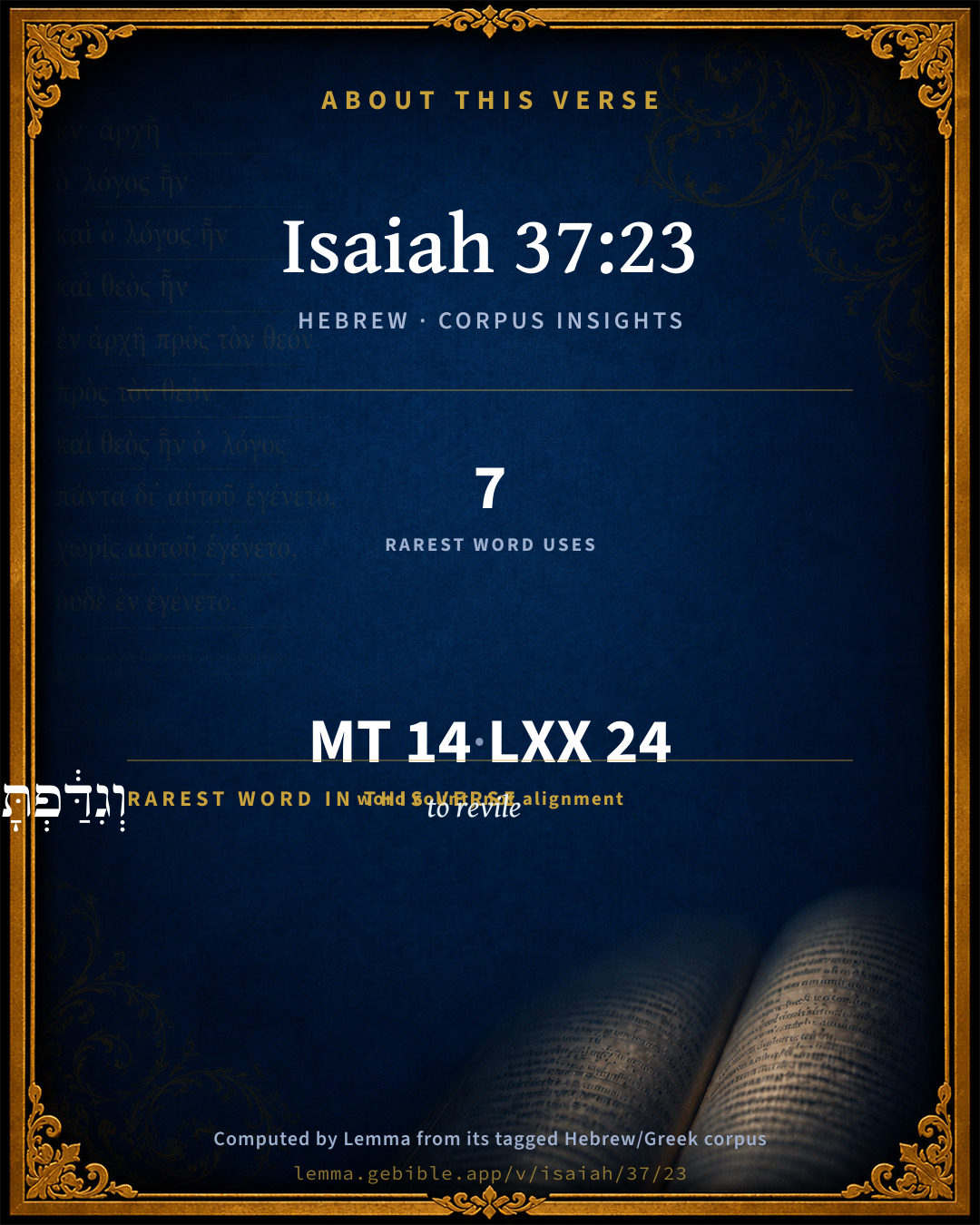
The rarest word here is וְגִדַּ֔פְתָּ to revile H1442 — appearing just 7 times in the whole Hebrew Bible.

Shared distinctive vocabulary

וְגִדַּ֔פְתָּ to revile H1442 occurs in 7 verses of the Hebrew Bible. Also found in:

Grammatical profile

  • 4 verbs
  • 4 nouns
  • 1 adjective
  • 2 prepositions
  • 3 particles

Verb forms

  • חֵרַ֨פְתָּ֙ Piel · Perfect
  • וְגִדַּ֔פְתָּ Piel · Perfect
  • הֲרִימ֣וֹתָה Hiphil · Perfect
  • וַתִּשָּׂ֥א Qal · Sequential Imperfect

Repetition

A word recurs within this verse — often emphatic in Hebrew:

Hebrew & Septuagint length

In English translation the verse runs 28 words from the Hebrew and 31 from the Septuagint (LXX English) — closely comparable.

A rough comparison of the two English renderings, which tokenize alike — not a word-level alignment.

Word counts can differ between the Hebrew and the Greek without any difference in meaning — e.g. the Hebrew direct-object marker אֵת has no separate Greek word, and Greek often adds the article ὁ.

In the original languages it is 14 Hebrew tokens and 24 Greek tokens — but the two are counted differently (Hebrew bundles its prefixes and suffixes into one token; the Greek is in lemma form), so that isn’t a like-for-like length.

Cross-references

32

Topical passages linked to Isaiah 37:23 in the Treasury of Scripture Knowledge — connected by theme and wording, ordered by reader-vote popularity; previews shown in the World English Bible.

  • Ezekiel 39:7 My holy name will I make known in the midst of my people Israel; neither will I allow my holy name to be profaned any more: and the nations shall know that I am Yahweh, the Holy One in Israel.
  • Daniel 5:20–23 But when his heart was lifted up, and his spirit was hardened so that he dealt proudly, he was deposed from his kingly throne, and they took his glory from him:
  • Isaiah 17:7 In that day shall men look to their Maker, and their eyes shall have respect to the Holy One of Israel.
  • Isaiah 41:16 You shall winnow them, and the wind shall carry them away, and the whirlwind shall scatter them; and you shall rejoice in Yahweh, you shall glory in the Holy One of Israel.
  • Ezekiel 28:9 Will you yet say before him who kills you, I am God? but you are man, and not God, in the hand of him who wounds you.
  • Daniel 7:25 He shall speak words against the Most High, and shall wear out the saints of the Most High; and he shall think to change the times and the law; and they shall be given into his hand until a time and times and half a time.
  • 2 Thessalonians 2:4 he who opposes and exalts himself against all that is called God or that is worshiped; so that he sits as God in the temple of God, setting himself up as God.
  • Exodus 5:2 Pharaoh said, "Who is Yahweh, that I should listen to his voice to let Israel go? I don't know Yahweh, and moreover I will not let Israel go."
  • Exodus 9:17 as you still exalt yourself against my people, that you won't let them go.
  • Exodus 15:11 Who is like you, Yahweh, among the gods? Who is like you, glorious in holiness, Fearful in praises, doing wonders?
  • 2 Kings 19:4 It may be Yahweh your God will hear all the words of Rabshakeh, whom the king of Assyria his master has sent to defy the living God, and will rebuke the words which Yahweh your God has heard. Therefore lift up your prayer for the remnant that is left.
  • 2 Kings 19:22 Whom have you defied and blasphemed? and against whom have you exalted your voice and lifted up your eyes on high? [even] against the Holy One of Israel.
  • 2 Chronicles 32:17 He wrote also letters, to rail on Yahweh, the God of Israel, and to speak against him, saying, As the gods of the nations of the lands, which have not delivered their people out of my hand, so shall the God of Hezekiah not deliver his people out of my hand.
  • Psalms 44:16 At the taunt of one who reproaches and verbally abuses, Because of the enemy and the avenger.
  • Psalms 73:9 They have set their mouth in the heavens. Their tongue walks through the earth.
  • Psalms 74:18 Remember this, that the enemy has mocked you, Yahweh. Foolish people have blasphemed your name.
  • Psalms 74:23 Don't forget the voice of your adversaries. The tumult of those who rise up against you ascends continually.
  • Proverbs 30:13 There is a generation, oh how lofty are their eyes! Their eyelids are lifted up.
  • Isaiah 2:11 The lofty looks of man will be brought low, The haughtiness of men will be bowed down, And Yahweh alone will be exalted in that day.
  • Isaiah 10:13–15 For he has said, By the strength of my hand I have done it, and by my wisdom; for I have understanding: and I have removed the bounds of the peoples, and have robbed their treasures, and like a valiant man I have brought down those who sit [on thrones]:
  • Isaiah 10:20 It shall come to pass in that day, that the remnant of Israel, and those who are escaped of the house of Jacob, shall no more again lean on him who struck them, but shall lean on Yahweh, the Holy One of Israel, in truth.
  • Isaiah 12:6 Cry aloud and shout, you inhabitant of Zion; for great in the midst of you is the Holy One of Israel!"
  • Isaiah 14:13–14 You said in your heart, I will ascend into heaven, I will exalt my throne above the stars of God; and I will sit on the mountain of congregation, in the uttermost parts of the north;
  • Isaiah 30:11–12 get out of the way, turn aside out of the path, cause the Holy One of Israel to cease from before us."
  • Isaiah 37:4 It may be Yahweh your God will hear the words of Rabshakeh, whom the king of Assyria his master has sent to defy the living God, and will rebuke the words which Yahweh your God has heard. Therefore lift up your prayer for the remnant that is left.
  • Isaiah 37:10–13 Thus shall you speak to Hezekiah king of Judah, saying, Don't let your God in whom you trust deceive you, saying, Jerusalem shall not be given into the hand of the king of Assyria.
  • Isaiah 41:14 Don't be afraid, you worm Jacob, and you men of Israel; I will help you, says Yahweh, and your Redeemer is the Holy One of Israel.
  • Isaiah 43:3 For I am Yahweh your God, the Holy One of Israel, your Savior; I have given Egypt as your ransom, Ethiopia and Seba in your place.
  • Isaiah 43:14 Thus says Yahweh, your Redeemer, the Holy One of Israel: For your sake I have sent to Babylon, and I will bring down all of them as fugitives, even the Chaldeans, in the ships of their rejoicing.
  • Ezekiel 28:2 Son of man, tell the prince of Tyre, Thus says the Lord Yahweh: Because your heart is lifted up, and you have said, I am a god, I sit in the seat of God, in the midst of the seas; yet you are man, and not God, though you did set your heart as the heart of God;-
  • Habakkuk 1:12–13 Aren't you from everlasting, Yahweh my God, my Holy One? We will not die. Yahweh, you have appointed him for judgment. You, Rock, have established him to punish.
  • Revelation 13:1–6 Then I stood on the sand of the sea. I saw a beast coming up out of the sea, having ten horns and seven heads. On his horns were ten crowns, and on his heads, blasphemous names.

Cross-references courtesy of OpenBible.info (CC BY 4.0).

Hebrew and Greek witnesses Masoretic Hebrew ↔ Greek Septuagint

The same verse in the two great witnesses to the Old Testament, shown verse-for-verse.

These are two independent witnesses, not word-aligned to each other, and the Septuagint is shown in lemma (dictionary) form.

Hebrew Isaiah 37:23 Masoretic · Westminster Leningrad Codex

אֶת מִ֤י חֵרַ֨פְתָּ֙ וְגִדַּ֔פְתָּ וְעַל מִ֖י הֲרִימ֣וֹתָה קּ֑וֹל וַתִּשָּׂ֥א מָר֛וֹם עֵינֶ֖יךָ אֶל קְד֥וֹשׁ יִשְׂרָאֵֽל

Whom have you defied and blasphemed? and against whom have you exalted your voice and lifted up your eyes on high? [even] against the Holy One of Israel.

World English Bible · Public Domain

Greek LXX Isaiah 37:23 Septuagint · lemma form

τίς ὀνειδίζω καί παραὀξύνω ἤ πρός τίς ὑψόω ὁ φωνή σύ καί οὐ αἴρω εἰς ὕψος ὁ ὀφθαλμός σύ εἰς ὁ ἅγιος ὁ ἰσραήλ

Whom have you reproached and provoked? and against whom have you lifted up your voice? and have you not lifted up your eyes on high against the Holy One of Israel?

LXX2012 (modern English Septuagint) · Public Domain

Hebrew: Westminster Leningrad Codex (CC BY 4.0). Greek: Septuagint (public domain); English from LXX2012 (modern English Septuagint) (Public Domain). How the Septuagint differs from the Hebrew →

Targum (Aramaic paraphrase)

1

The Targum is the ancient Jewish Aramaic paraphrase of the Hebrew Scriptures — an interpretive translation, not the Hebrew text itself. Onkelos (literal) and Pseudo-Jonathan (expansive) render the Torah, and Jonathan the Prophets. Coverage is partial: where no permissively-licensed English translation exists for a verse, only the Aramaic is shown. This is verse-level text, not a word-by-word alignment to the Hebrew.

  1. Targum Jonathan Prophets (Joshua–Malachi)
    יַת מַן חַסַדְתָּא וְיַת מַן אִתְרָחַבְתָּא וְקָדָם מַן אֲרֵימָתָא קָלָא וּזְקֵפְתָּא לְרוּמָא עֵינָךְ וַאֲמַרְתָּא מִלִין דְלָא כַּשְׁרִין קֳדָם קַדִישָׁא דְיִשְׂרָאֵל:

    Whom hast thou reproached, and against whom hast thou exalted thyself? and before whom hast thou lifted up thy voice? Yea, thou hast lifted up thine eyes on high; because thou hast spoken words which are not right before the Holy One of Israel.

    Targum Jonathan — Aramaic: “Mikraot Gedolot” (public domain). English: “Sefaria Community Translation” (CC0 1.0 (public-domain dedication)); “London "Chaldee Paraphrase," 1871” (public domain). Text via Sefaria.

Commentary

Notes on Isaiah 37:23 from classic Christian and Jewish commentators (each source and its license shown beneath its notes). The classic Christian expositions comment on the surrounding passage and are grouped to its opening verse, so a note may address several verses; the Jewish commentaries on the Tanakh (Rashi and others) are per-verse, so they appear only where the commentator wrote on this verse.

Lemma curates 59 commentaries, every one of them public domain or Creative Commons licensed, each selected and text-cleaned for this edition rather than reprinted as found. About our sources →

The Biblical Illustrator

Joseph S. Exell

Isa_37:23

Whom hast thou reproached and blasphemed?

--

Isaiahs saving idea of God

Isaiah in his day saved Jerusalem by teaching the people a better idea of their God. For forty years he had been witnessing to a truer thought of God, and at last the crisis and the triumph of his religious statesmanship came. Jerusalem would have surrendered to Assyria had not Isaiah at last brought king and people, in their despair, to the faith in God to which for forty years he had borne witness. At an hour when the Assyrian was making his rapid march towards the city, two props of the peoples confidence had entirely given way: their reliance upon Egypt, and their confidence in their religion. Isaiah had told them over and over again that these supports were rotten, and would give way when the crash came. And they did when at last came the scourge of the nations which had swept other cities before it reached Jerusalem. For a moment the luridness of the popular despair was lit up by a wild light of passion and revelry: Let us eat and drink, they said, for to-morrow we shall die. Then the hour for the triumph of the prophets lifelong truth was come. He led a sobered people and a humbled king to the Holy One of Israel (Newman Smyth, D. D.)

The Divine holiness and Fatherhood

The historic truth is that wherever a better idea of God prevails men are delivered. The deep, permanent, at all times greatly needed lesson is, that the prophets truer teaching of God is for the salvation of a city. The subject for us to inquire concerning is, whether we are being saved by any truer, stronger ideas of our God? Are we saving our society, our neighbour-hood, our city, our land by nobler knowledge of God?

1. Do you hope to work out the redemption of men by education? It is a means, a sharp instrument for good or evil, but Rabshakeh could blaspheme in two languages. We have to face the question: What leaven is to keep the school itself from moral corruption?

2. But much, it is said, may be accomplished through sanitary and political science. Undoubtedly. Even Ahaz did a good thing when he looked after the water supply of Jerusalem in fear of a siege, although he would not hear a word that Isaiah was saying to him by the upper pool in the fullers field. But if Isaiah had not been the heart and the soul of the city in its critical hour, all the work that the kings had done in repairing the walls and looking after the watercourses, would never have kept the Assyrian out. Sooner or later we shall have to go down to the God on whom we depend, if we are to build anything of permanent worth.

3. What, then, is our better saving thought of God?

(1) We are coming to know better the Divine Fatherhood of men.

(2) Yet, this first truth of the Divine Fatherhood of men, and His special Fatherhood towards the son of His trust and love, does not exhaust our redeeming knowledge of God. Our text exalts the Holy One of Israel. Isaiahs vision of Him whose glory fills the whole earth was the vision of the Holy One. In the holiness of the prophet saw the falsehoods of the court and the people burning as with everlasting fire. And when Jesus Christ in that sublime moment to which St. John has borne witness in the seventeenth chapter of his Gospel, summed up His whole lifelong teaching in His last prayer for the disciples, He lifted up His eyes to heaven, and said, Father, Holy Father, O righteous Father.

(3) There is one way in particular by which we, with all our worldliness, may be brought more fully into the saving power of these truths of God. It is through our increasing sense of Gods omnipresence, of the Divine immanence, of Immanuel, God with us. (Newman Smyth, D. D.)

God His peoples defence

A magistrate in Hamburg once held up his finger and said to Mr. Oncken, the Baptist preacher: Do you see that finger, sir? As long as I can hold up that finger I shall put you down. I can see, said Mr. Oncken, what you cannot see; I can see the mighty arm of God, and as long as that arm is held up for my defence, you will never be able to put me down. (Christian Age.)

The Biblical Illustrator, edited by Joseph S. Exell (c. 1880s–1900s) — public domain. Text from a community e-Sword module.

Tyndale Open Study Notes

Tyndale Open Resources

37:23 Whom . . . Against whom: Sennacherib’s speech was not so much an insult against Judah as it was against the Lord.

Tyndale Open Study Notes — © Tyndale Open Resources, licensed CC BY-SA 4.0. Text via the HelloAO Bible API.

Geneva Bible (1599)

Geneva Bible translators

Declaring hereby that they that are enemies to God’s Church, fight against him whose quarrel his Church only maintaineth.

Geneva Bible (1599) marginal notes — public domain. Text via Bolls.life.

Jamieson, Fausset & Brown

Robert Jamieson, A. R. Fausset & David Brown

Whom--not an idol.

Jamieson, Fausset & Brown — Commentary Critical and Explanatory on the Whole Bible (1871) — public domain (CC PDM 1.0). Text via the HelloAO Bible API.

Adam Clarke's Commentary

Verse 23. Against the Holy One of Israel.] For אל el, to, the other copy has על al, against, rather more properly.

Adam Clarke's Commentary on the Bible (1810–1826) — public domain. Text from a community e-Sword/MySword module.

Ellicott's Commentary for English Readers

(23) Whom hast thou reproached . . .—The manifold iteration of the question emphasises the force of the answer. The “Holy One of Israel,” at whom the scornful revellers had sneered (Isa_30:11), was now seen to be the one mighty deliverer.

A Bible Commentary for English Readers, edited by Charles John Ellicott (1878–1897) — public domain. Text from a community e-Sword module.

The Cambridge Bible for Schools and Colleges

gen. ed. J. J. S. Perowne

23. “What sort of being is He whom thou hast defied?” The first two sentences are rhetorical questions, and require no answer. The last sentence is to be read as an affirmation: Yea, thou hast lifted up thine eyes to the height against the Holy One of Israel. To “lift up the voice” means here to speak proudly, not as often to cry aloud (e.g. ch. Isa_13:2).

The Cambridge Bible for Schools and Colleges (gen. ed. J. J. S. Perowne; Cambridge University Press, 1878–1918) — public domain. Text from a community e-Sword module.

John Gill's Exposition

I have digged, and drunk water,.... In places where he came, and found no water for his army, he set his soldiers to work, to dig cisterns, as the Targum, or wells, so that they had water sufficient to drink; in Kg2 19:24, it is "strange waters", which were never known before:

and with the sole of my feet have I dried up all the rivers of the besieged places; or, as the Targum,

"with the soles of the feet of the people that are with me;''

the Syriac version, "with the hoofs of my horses": with which he trampled down banks of rivers, and pools, and cisterns of water; signifying the vast numbers of his soldiers, who could drink up a river, or carry it away with them, or could turn the streams of rivers that ran by the sides, or round about, cities besieged, and so hindered the carrying on of a siege, and the taking of the place; but he had ways and means very easily to drain them, and ford them; or to cut off all communication of the water from the besieged. Some render it, "I have dried up all the rivers of Egypt" (s), as Kimchi, on Kg2 19:24, observes, and to be understood hyperbolically; see Isa 19:6, so Ben Melech observes.

(s) "omnes rivos Aegypti", Vitringa.

John Gill's Exposition of the Whole Bible (1746–1763) — public domain (CC PDM 1.0). Text via the HelloAO Bible API.

Albert Barnes' Notes on the Bible

When hast thou reproached? - Not an idol. Not one who has no power to take vengeance, or to defend the city under his protection, but the living God.

Exalted thy voice - That is, by thy messenger. Thou hast spoken in a loud, confident tone; in the language of reproach and threatening.

And lifted up thine eyes on high - To lift up the eyes is an indication of haughtiness and pride. He had evinced arrogance in his manner, and he was yet to learn that it was against the living and true God.

Albert Barnes' Notes on the Bible (1834–1885) — public domain. Text from a community e-Sword/MySword module.

Whedon's Commentary on the Bible

Daniel D. Whedon

23. Whom… blasphemed — Not a senseless idol, like the gods you boast of as being superior to Him, as you will soon know to your harm.

Against whom… exalted thy voice — That is, by Rabshakeh’s speaking to the people on the walls, in a loud and confident tone.

Lifted up thine eyes on high — Descriptive of the haughty and arrogant air assumed against the living and true God.

Daniel D. Whedon (gen. ed.), Commentary on the Old and New Testaments (1874–1909) — public domain. Text from a community e-Sword module.

The Pulpit Commentary

Even against the Holy One of Israel. A specially Isaiah phrase, employed by Isaiah twenty-eight times, and only five times in all the rest of Scripture. A strong proof, if any proof beyond the unmistakable Isaiah spirit of the entire prophecy were needed, of the genuineness of the present passage.

"Holy One of Israel.

It is singular to find the holiness of God introduced here rather than his majesty or his power. Yet it is significant. The sublime greatness of God is his character, and this is expressed in the word "Holy One." The insults of Assyria are not levelled so much against God"s throne, or God"s rule, as against God himself. It is the insult offered to the Divine Name. The contrast between Jehovah and the gods created by heathen imaginations is very striking in this particular they are embodiments of powers; he is a moral Being. They imply force; his Name involves character. Our security lies in this. The possibility of a reasonable trust lies in this. Our conviction of Jehovah"s sensitiveness to what troubles us lies in this. The full suggestions of this most suggestive name for God may be drawn out under these divisions.

I THE GOD WHO ALWAYS DOES THE MORALLY RIGHT.

II THE GOD WHO ALWAYS RESPONDS TO TRUST.

III THE GOD WHO IS EVER FAITHFUL TO HIS PROMISE.

IV THE GOD WHO IS JEALOUS OF HIS PERSONAL HONOUR.

V THE GOD WHO REQUIRES TO BE SERVED WITH OUR GOODNESS.

On the jealousy of the Divine Name, see Eze_36:22, Eze_36:23; and show how the views of God, thus unfolded, become the basis for the great atonement, whereby the world is redeemed. The "just God" is also the "Saviour. R.T.

The Pulpit Commentary (1880–1919), ed. H.D.M. Spence-Jones & Joseph S. Exell — public domain. Text from a community e-Sword module.

J. A. Alexander on Isaiah

Joseph Addison Alexander

“Whom hast thou reproached and reviled, and against Whom hast thou raised (thy) voice, and lifted thine eyes (on) high towards (or against) the Holy One of Israel?” This is equivalent to saying, dost thou know Who it is that thou revilest? To raise the voice may simply mean to speak, or more emphatically to speak boldly, perhaps with an allusion to the literal loudness of Rabshakeh’s address to the people on the wall (Isa 36:13). The construction loftiness of eyes (meaning pride) is inconsistent both with the pointing and accentuation. The English and many other versions make the last words of the second clause an answer to the foregoing question. (Against whom? Against the Holy One of Israel.) But the other construction is more natural.

Joseph Addison Alexander, The Prophecies of Isaiah (1846–1847; New York: Scribner, 1870–1878) — public domain. Text from a community e-Sword module.

Lesson kit

Teaching starters — assembled from the data on this page, not authored interpretation. Every prompt links to the verse data it draws on. Edit before teaching.

Isaiah, in the Prophets, opens this verse with 14 words (13 distinct Hebrew lemmas). Its most distinctive word is gâdaph (“to revile”). A historical commentator’s framing appears above. Read the whole chapter for the surrounding context.

Discussion questions

  1. What does “to revile” (gâdaph) contribute to the verse as a whole?
  2. Numbers 15:30 shares the word «to revile» with this verse. How do the two illuminate each other?
  3. “who” occurs 2× in this one verse. What is the effect of the repetition?
  4. These translations render this verse differently. What is at stake in choosing one wording over another?
  5. The verb «חֵרַ֨פְתָּ֙» is Piel Perfect. How does its form color the action?
  6. Reading how The Biblical Illustrator and Tyndale Open Study Notes read this verse, where do the two commentators agree and where do they part?

Things to notice

Reading settings

Reading text

Shown beneath each verse's original-language words.

Old Testament
Old Testament edition

Read the OT as the Masoretic Hebrew (MT) or the Greek Septuagint (LXX).

English shown for the Greek Septuagint (in the Hebrew ↔ Greek comparison).

Comparing translations? Open the Compare panel on any verse page to stack up to four side by side.