
Ezekiel 10:16

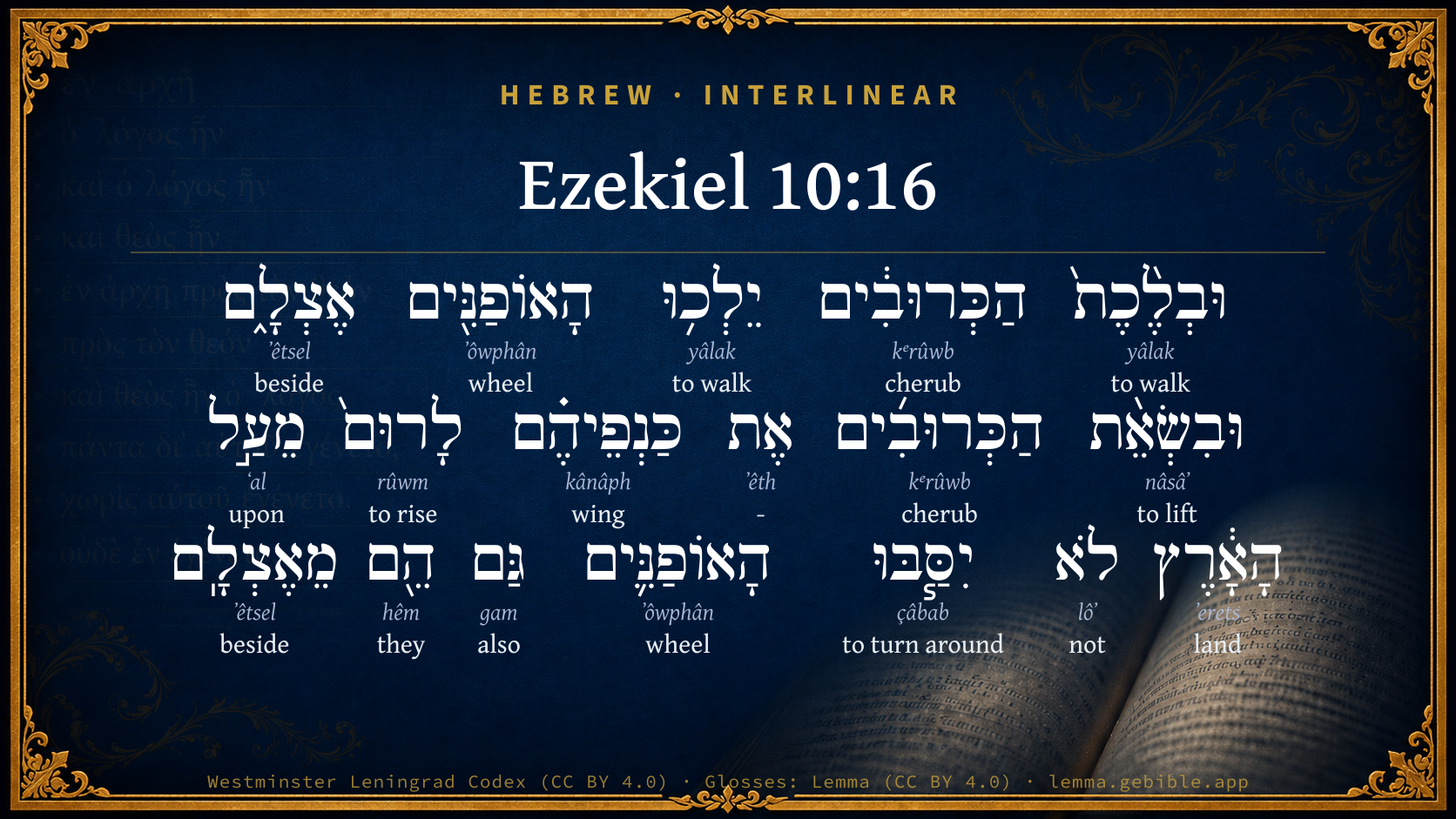
Hebrew (Westminster Leningrad Codex) Ezekiel 10:16 appears in the Hebrew Old Testament. The text above is from the Westminster Leningrad Codex. Each word links to its Strong’s number, a concise gloss, and parsing drawn from the Open Scriptures Hebrew Bible morphology. Click any word for its full Brown-Driver-Briggs (BDB) entry.
Download image
Cite this verse

Ezekiel 10:16 (World English Bible). Public Domain. Lemma interlinear Bible study tool, https://lemma.gebible.app/v/ezekiel/10/16.

Show BibTeX & RIS
BibTeX
RIS
English Translation
When the cherubim went, the wheels went beside them; and when the cherubim lifted up their wings to mount up from the earth, the wheels also didn't turn from beside them.
World English Bible · Public Domain
Download a study sheet

One document with this verse’s original text, its word-by-word gloss line, the meaning frame, cross-references with their text, attributed commentary, and full source and license credits — printable, and it pastes into notes with its structure intact.

This verse Autodidact and up

Study sheet (.html) Plain text (.txt)

A passage Seminary Student

Up to 50 verses in one chapter. A passage sheet keeps up to 6 commentary sources and 12 cross-references per verse, in the order this page ranks them, and says so on the sheet whenever that leaves anything out. Ask for a single verse and you get the Autodidact verse sheet above.

Everything on this page stays free to read, with no account — the sheet is a download of what is already on screen, not access to it.

Want to remove ads? Support Godless Engineer
Compare translations 3

The same verse in 3 English versions, stacked beneath the original-language interlinear above. Click any original word for its lexicon entry.

Each is an independent rendering of the whole verse — the interlinear is not word-aligned to these translations.

Highlighted words mark where these versions differ — a whole-verse word diff, not a word-by-word alignment.

  • World English Bible Public Domain
    When the cherubim went, the wheels went beside them; and when the cherubim lifted up their wings to mount up from the earth, the wheels also didn't turn from beside them.
  • King James Version Public Domain
    And when the cherubims went, the wheels went by them: and when the cherubims lifted up their wings to mount up from the earth, the same wheels also turned not from beside them.
  • unfoldingWord Literal Text CC BY-SA 4.0
    Whenever the cherubim moved, the wheels would go beside them, and whenever the cherubim lifted up their wings to rise up from the earth, the wheels did not turn. They still stayed beside them.

unfoldingWord Literal Text — © unfoldingWord, licensed CC BY-SA 4.0. Word-aligned USFM3 via Door43 (git.door43.org/unfoldingWord/en_ult).

Versions to compare (up to 4)

3 of 4 selected

Show all 18 translations

Every available English version of this verse, each an independent rendering of the whole verse.

  • World English Bible Public Domain
    When the cherubim went, the wheels went beside them; and when the cherubim lifted up their wings to mount up from the earth, the wheels also didn't turn from beside them.
  • Berean Standard Bible Public Domain
    When the cherubim moved, the wheels moved beside them, and even when they spread their wings to rise from the ground, the wheels did not veer away from their side.
  • Majority Standard Bible Public Domain
    When the cherubim moved, the wheels moved beside them, and even when they spread their wings to rise from the ground, the wheels did not veer away from their side.
  • King James Version Public Domain
    And when the cherubims went, the wheels went by them: and when the cherubims lifted up their wings to mount up from the earth, the same wheels also turned not from beside them.
  • American Standard Version (1901) Public Domain
    And when the cherubim went, the wheels went beside them; and when the cherubim lifted up their wings to mount up from the earth, the wheels also turned not from beside them.
  • Revised Version (1885) Public Domain
    And when the cherubim went, the wheels went beside them: and when the cherubim lifted up their wings to mount up from the earth, the wheels also turned not from beside them.
  • Geneva Bible (1599) Public Domain
    And when ye Cherubims went, the wheeles went by them: and when the Cherubims lift vp their wings to mount vp from the earth, the same wheeles also turned not from beside them.
  • Douay-Rheims (1899) Public Domain
    And when the cherubims went, the wheels also went by them: and when the cherubims lifted up their wings, to mount up from the earth, the wheels stayed not behind, but were by them.
  • Young's Literal Translation Public Domain
    And in the going of the cherubs, the wheels go beside them; and in the cherubs lifting up their wings to be high above the earth, the wheels turn not round, even they, from being beside them.
  • Literal Standard Version CC BY-SA 4.0
    And in the going of the cherubim, the wheels go beside them; and in the cherubim lifting up their wings to be high above the earth, the wheels do not turn around, even they, from being beside them.
  • Unlocked Literal Bible CC BY-SA 4.0
    Whenever the cherubim moved, the wheels would go beside them, and whenever the cherubim lifted up their wings to rise up from the earth, the wheels did not turn. They still stayed beside them.
  • unfoldingWord Literal Text CC BY-SA 4.0
    Whenever the cherubim moved, the wheels would go beside them, and whenever the cherubim lifted up their wings to rise up from the earth, the wheels did not turn. They still stayed beside them.
  • Darby Bible Public Domain
    And when the cherubim went, the wheels went beside them; and when the cherubim lifted up their wings to mount up from the earth, the same wheels also turned not from beside them.
  • World Messianic Bible Public Domain
    When the cherubim went, the wheels went beside them; and when the cherubim lifted up their wings to mount up from the earth, the wheels also didn’t turn from beside them.
  • Webster's Bible Public Domain
    And when the cherubim went, the wheels went by them: and when the cherubim lifted up their wings to mount up from the earth, the same wheels also turned not from beside them.
  • Free Bible Version CC BY-SA 4.0
    When the cherubim moved, the wheels moved alongside them. Even when they opened their wings to take off, the wheels stayed beside them.
  • Bible in Basic English Public Domain
    And when the winged ones went, the wheels went by their side: and when their wings were lifted to take them up from the earth, the wheels were not turned from their side.
  • JPS Tanakh (1917) Public Domain
    And when the cherubim went, the wheels went beside them; and when the cherubim lifted up their wings to mount up from the earth, the same wheels also turned not from beside them.

Literal Standard Version (2020), Covenant Press — licensed CC BY-SA 4.0. Text via the HelloAO Bible API (eBible.org). Unlocked Literal Bible (unfoldingWord) — licensed CC BY-SA 4.0. Text via the HelloAO Bible API (eBible.org). unfoldingWord Literal Text — © unfoldingWord, licensed CC BY-SA 4.0. Word-aligned USFM3 via Door43 (git.door43.org/unfoldingWord/en_ult). Free Bible Version, Dr. Jonathan Gallagher — licensed CC BY-SA 4.0. Text via the HelloAO Bible API (eBible.org).

Word by word

More ways to search: Search by grammar → Find every occurrence → Compare this word →

Practice this passage: Drill this verse → Learn its vocabulary →

הָאוֹפַנִּ֖ים
ʼôwphân
H212
“the · wheels”
Particle, Definite Article + Noun, Common, Masculine, Plural, Absolute
Part of Speech
Particle + Noun
Type
Common
Gender
Masculine
Number
Plural
State
Absolute
Full BDB Definition

Origin: from an unused root meaning to revolve

TWOT: 146a

wheel - chariot wheel - wheel in Ezekiel's vision - wheels of the ten bases beneath the lavers in Solomon's temple
  1. וּבְלֶ֨כֶת֙ yâlak H3212 “and · in/at · to walk” Conjunction + Preposition + Verb, Qal, Infinitive Construct
  2. הַכְּרוּבִ֔ים kᵉrûwb H3742 “the · cherubim” Particle, Definite Article + Noun, Common, Masculine, Plural, Absolute
  3. יֵלְכ֥וּ yâlak H3212 “to walk” Verb, Qal, Imperfect, 3rd Person, Masculine, Plural
  4. אֶצְלָ֑ם ʼêtsel H681 “beside · them” Preposition + Suffix, Personal, 3rd Person, Masculine, Plural
  5. וּבִשְׂאֵ֨ת nâsâʼ H5375 “and · in/at · to lift” Conjunction + Preposition + Verb, Qal, Infinitive Construct
  6. הַכְּרוּבִ֜ים kᵉrûwb H3742 “the · cherubim” Particle, Definite Article + Noun, Common, Masculine, Plural, Absolute
  7. אֶת ʼêth H853 “-” Particle, Direct Object
  8. כַּנְפֵיהֶ֗ם kânâph H3671 “wings · their” Noun, Common, Feminine, Dual, Construct + Suffix, Personal, 3rd Person, Masculine, Plural
  9. לָרוּם֙ rûwm H7311 “to rise” Preposition + Verb, Qal, Infinitive Construct
  10. מֵעַ֣ל ʻal H5921 “from · upon” Preposition + Preposition
  11. הָאָ֔רֶץ ʼerets H776 “the · land” Particle, Definite Article + Noun, Common, Both, Singular, Absolute
  12. לֹא lôʼ H3808 “not” Particle, Negative
  13. יִסַּ֧בּוּ çâbab H5437 “to turn around” Verb, Niphal, Imperfect, 3rd Person, Masculine, Plural
  14. הָאוֹפַנִּ֛ים ʼôwphân H212 “the · wheels” Particle, Definite Article + Noun, Common, Masculine, Plural, Absolute
  15. גַּם gam H1571 “also” Particle, Accusative
  16. הֵ֖ם hêm H1992 “they” Pronoun, Personal, 3rd Person, Masculine, Plural
  17. מֵאֶצְלָֽם ʼêtsel H681 “from · beside · them” Preposition + Preposition + Suffix, Personal, 3rd Person, Masculine, Plural

About this verse

These counts appear in no published source. They are computed here, from the morphology-tagged text and Lemma’s own curated glosses. What Lemma adds →

18
words
14
distinct lemmas
Prophets
section

Shared distinctive vocabulary

הָאוֹפַנִּ֖ים wheel H212 occurs in 21 verses of the Hebrew Bible. Also found in:

Grammatical profile

  • 5 verbs
  • 6 nouns
  • 1 pronoun
  • 3 prepositions
  • 3 particles

Verb forms

  • וּבְלֶ֨כֶת֙ Qal · Infinitive Construct
  • יֵלְכ֥וּ Qal · Imperfect
  • וּבִשְׂאֵ֨ת Qal · Infinitive Construct
  • לָרוּם֙ Qal · Infinitive Construct
  • יִסַּ֧בּוּ Niphal · Imperfect

Repetition

Words recur within this verse — often emphatic in Hebrew:

  • וּבְלֶ֨כֶת֙ to walk H3212 ×2
  • הַכְּרוּבִ֔ים cherub H3742 ×2
  • הָאוֹפַנִּ֖ים wheel H212 ×2
  • אֶצְלָ֑ם beside H681 ×2

Hebrew & Septuagint length

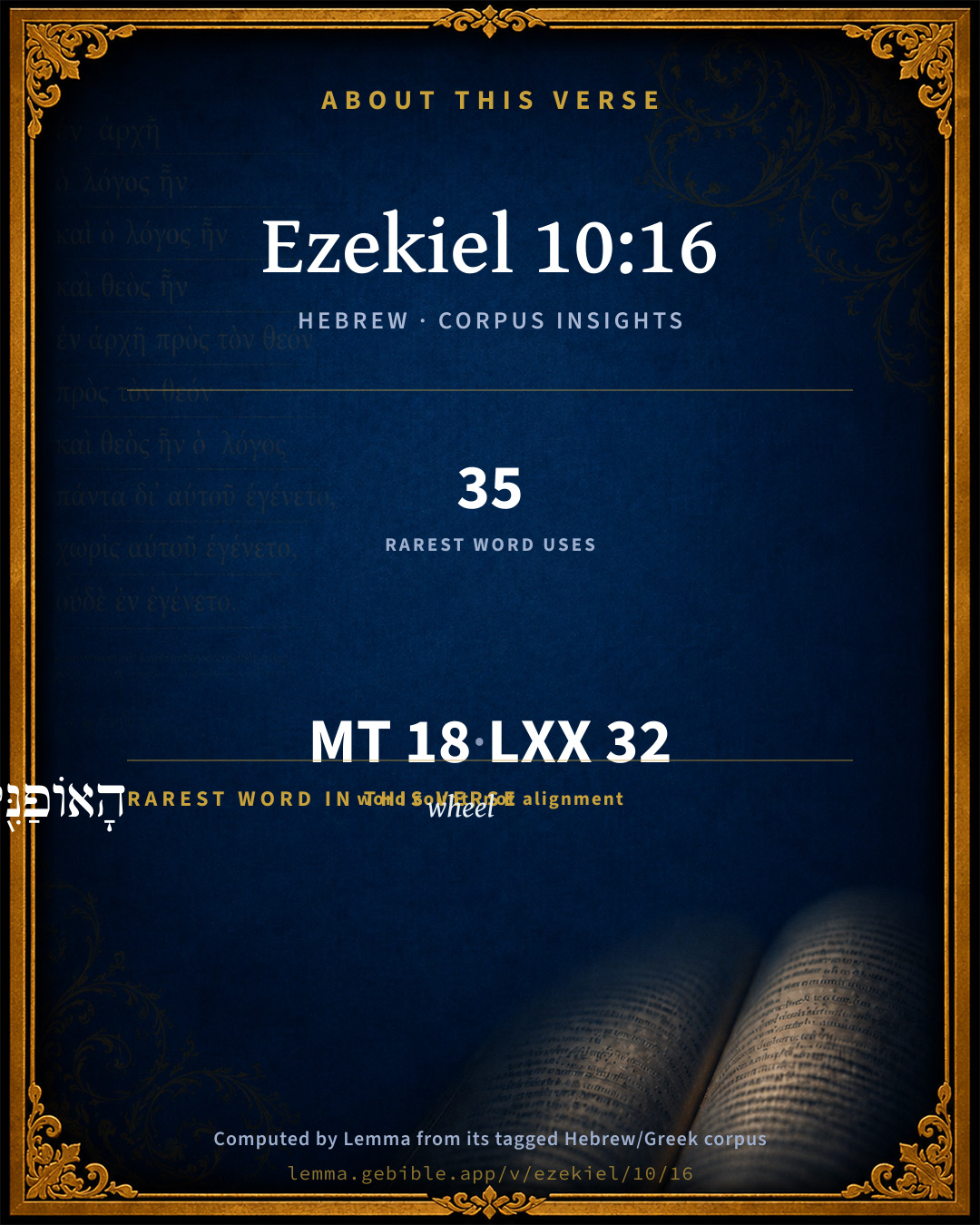
In English translation the verse runs 31 words from the Hebrew and 32 from the Septuagint (LXX English) — closely comparable.

A rough comparison of the two English renderings, which tokenize alike — not a word-level alignment.

Word counts can differ between the Hebrew and the Greek without any difference in meaning — e.g. the Hebrew direct-object marker אֵת has no separate Greek word, and Greek often adds the article ὁ.

In the original languages it is 18 Hebrew tokens and 32 Greek tokens — but the two are counted differently (Hebrew bundles its prefixes and suffixes into one token; the Greek is in lemma form), so that isn’t a like-for-like length.

Cross-references

1

Topical passages linked to Ezekiel 10:16 in the Treasury of Scripture Knowledge — connected by theme and wording, ordered by reader-vote popularity; previews shown in the World English Bible.

  • Ezekiel 1:19–21 When the living creatures went, the wheels went beside them; and when the living creatures were lifted up from the earth, the wheels were lifted up.

Cross-references courtesy of OpenBible.info (CC BY 4.0).

Hebrew and Greek witnesses Masoretic Hebrew ↔ Greek Septuagint

The same verse in the two great witnesses to the Old Testament, shown verse-for-verse.

These are two independent witnesses, not word-aligned to each other, and the Septuagint is shown in lemma (dictionary) form.

Hebrew Ezekiel 10:16 Masoretic · Westminster Leningrad Codex

וּבְלֶ֨כֶת֙ הַכְּרוּבִ֔ים יֵלְכ֥וּ הָאוֹפַנִּ֖ים אֶצְלָ֑ם וּבִשְׂאֵ֨ת הַכְּרוּבִ֜ים אֶת כַּנְפֵיהֶ֗ם לָרוּם֙ מֵעַ֣ל הָאָ֔רֶץ לֹא יִסַּ֧בּוּ הָאוֹפַנִּ֛ים גַּם הֵ֖ם מֵאֶצְלָֽם

When the cherubim went, the wheels went beside them; and when the cherubim lifted up their wings to mount up from the earth, the wheels also didn't turn from beside them.

World English Bible · Public Domain

Greek LXX Ezekiel 10:16 Septuagint · lemma form

καί ἐν ὁ πορεύομαι ὁ χερουβείμ πορεύομαι ὁ τροχός καί οὗτος ἔχω αὐτός καί ἐν ὁ ἐκαἴρω ὁ χερουβείμ ὁ πτέρυξ αὐτός ὁ μετεωρίζω ἀπό ὁ γῆ οὐ ἐπιστρέφω ὁ τροχός αὐτός

And when the cherubs went, the wheels went, and they were close to them: and when the cherubs lifted up their wings to mount up from the earth, their wheels turned not.

LXX2012 (modern English Septuagint) · Public Domain

Hebrew: Westminster Leningrad Codex (CC BY 4.0). Greek: Septuagint (public domain); English from LXX2012 (modern English Septuagint) (Public Domain). How the Septuagint differs from the Hebrew →

Targum (Aramaic paraphrase)

1

The Targum is the ancient Jewish Aramaic paraphrase of the Hebrew Scriptures — an interpretive translation, not the Hebrew text itself. Onkelos (literal) and Pseudo-Jonathan (expansive) render the Torah, and Jonathan the Prophets. Coverage is partial: where no permissively-licensed English translation exists for a verse, only the Aramaic is shown. This is verse-level text, not a word-by-word alignment to the Hebrew.

  1. Targum Jonathan Prophets (Joshua–Malachi)
    וּבְמֵיזַל כְּרוּבַיָא אָזְלִין גַלְגְלַיָא לְקִבְלֵיהוֹן וּבְמִטַל כְּרוּבַיָא יַת גַפֵּיהוֹן לְאִתְרָמָא כְּמִלְרַע לְרוּם שְׁמַיָא לָא מִתְחַזְרִין גַלְגְלַיָא אַף אִינוּן מִקִבְלֵיהוֹן:

    (no public-domain English translation for this verse)

    Targum Jonathan — Aramaic: “Mikraot Gedolot” (public domain). English: “Sefaria Community Translation” (CC0 1.0 (public-domain dedication)); “London "Chaldee Paraphrase," 1871” (public domain). Text via Sefaria.

Commentary

Notes on Ezekiel 10:16 from classic Christian and Jewish commentators (each source and its license shown beneath its notes). The classic Christian expositions comment on the surrounding passage and are grouped to its opening verse, so a note may address several verses; the Jewish commentaries on the Tanakh (Rashi and others) are per-verse, so they appear only where the commentator wrote on this verse.

Lemma curates 59 commentaries, every one of them public domain or Creative Commons licensed, each selected and text-cleaned for this edition rather than reprinted as found. About our sources →

Trapp's Complete Commentary

John Trapp

Eze 10:16 And when the cherubims went, the wheels went by them: and when the cherubims lifted up their wings to mount up from the earth, the same wheels also turned not from beside them.

Ver. 16. And when the cherubims went.] Angels have a great stroke in ordering the affairs of the world, as hath already been noted. {See Trapp on "Eze 1:6"} Quod vero eandem rem saepe repeto, lectori molestum esse non debet, saith Lavater, in his preface to this prophet.

John Trapp, A Commentary or Exposition upon All the Books of the Old and New Testament (1647–1656) — public domain. Text from a community e-Sword module.

Jamieson, Fausset & Brown

Robert Jamieson, A. R. Fausset & David Brown

(See on Eze 10:11; Eze 1:19).

lifted up . . . wings--to depart, following "the glory of the Lord" which was on the point of departing (Eze 10:18).

Jamieson, Fausset & Brown — Commentary Critical and Explanatory on the Whole Bible (1871) — public domain (CC PDM 1.0). Text via the HelloAO Bible API.

John Calvin's Commentaries

The Prophet here confirms what he had said before, namely, that there was no intrinsic motion in the wheels, but that they were drawn by a secret instinct wherever the cherubim moved themselves. Hence we gather that the events of things are not accidental, nor excited in various directions by any blind impulse, but directed by the hidden energy of God, and that too by means of angels. First he says, when the cherubim set out, the wheels set out at the same time: then when the cherubim raised their wings upwards, the wheels followed the same course, and did not return; that is, were not drawn aside from that agreement of which he had spoken before; but how the wheels were not reversed, we shall explain more clearly to-morrow.

John Calvin's Commentaries (1540-1563) — public domain. Text from the Calvin Translation Society English edition (1840s-50s) via the Christian Classics Ethereal Library (ccel.org). Calvin's coverage is partial (roughly two-thirds of the Bible); uncommented books and verses are honest gaps, never fabricated. The 19th-century editor's footnotes and remarks are omitted so the notes are faithfully Calvin's own voice.

The Cambridge Bible for Schools and Colleges

gen. ed. J. J. S. Perowne

16, 17. Cf. ch. Eze_1:19.

The Cambridge Bible for Schools and Colleges (gen. ed. J. J. S. Perowne; Cambridge University Press, 1878–1918) — public domain. Text from a community e-Sword module.

John Gill's Exposition

And when the cherubim went, the wheels went by them,.... Ministers being guides to the churches in doctrine, worship, devotion, and conversation; See Gill on Eze 1:19;

and when the cherubim lifted up their wings to mount up from the earth,

the same wheels also turned not from beside them; ministers and churches go together; if the one remove, the other do also; they cannot long subsist without each other; and, generally speaking, as are the light, knowledge, zeal, affection, and devotion of the one, such are those of the other; See Gill on Eze 1:19.

John Gill's Exposition of the Whole Bible (1746–1763) — public domain (CC PDM 1.0). Text via the HelloAO Bible API.

Albert Barnes' Notes on the Bible

are a repetition of the general description of the nature and connection of the various parts of the vision, and this is the more appropriate as showing why they were regarded as “one living creature” Eze 10:15. The attributes here assigned to them show that they were pervaded by one will - “the spirit of the living creature” (others, as in the margin, “the spirit of life”) “was in them.”

Albert Barnes' Notes on the Bible (1834–1885) — public domain. Text from a community e-Sword/MySword module.

Lesson kit

Teaching starters — assembled from the data on this page, not authored interpretation. Every prompt links to the verse data it draws on. Edit before teaching.

Ezekiel, in the Prophets, opens this verse with 18 words (14 distinct Hebrew lemmas). Its most distinctive word is ʼôwphân (“wheel”). A historical commentator’s framing appears above. Read the whole chapter for the surrounding context.

Discussion questions

  1. How does “wheel” (ʼôwphân) shape what this verse is saying?
  2. How does Exodus 14:25, which shares the word «wheel», read alongside this verse?
  3. What does the repetition of “to walk” (2× in this one verse) do in this verse?
  4. These translations render this verse differently; the difference is in the English rendering, not the original. What questions does that raise?
  5. «וּבְלֶ֨כֶת֙» is a Qal Infinitive Construct verb. How does that grammatical form shape the action described?
  6. Compare how Trapp's Complete Commentary and Jamieson, Fausset & Brown read this verse. Where do they agree or differ?

Things to notice

Reading settings

Reading text

Shown beneath each verse's original-language words.

Old Testament
Old Testament edition

Read the OT as the Masoretic Hebrew (MT) or the Greek Septuagint (LXX).

English shown for the Greek Septuagint (in the Hebrew ↔ Greek comparison).

Comparing translations? Open the Compare panel on any verse page to stack up to four side by side.