
Ezekiel 10:4

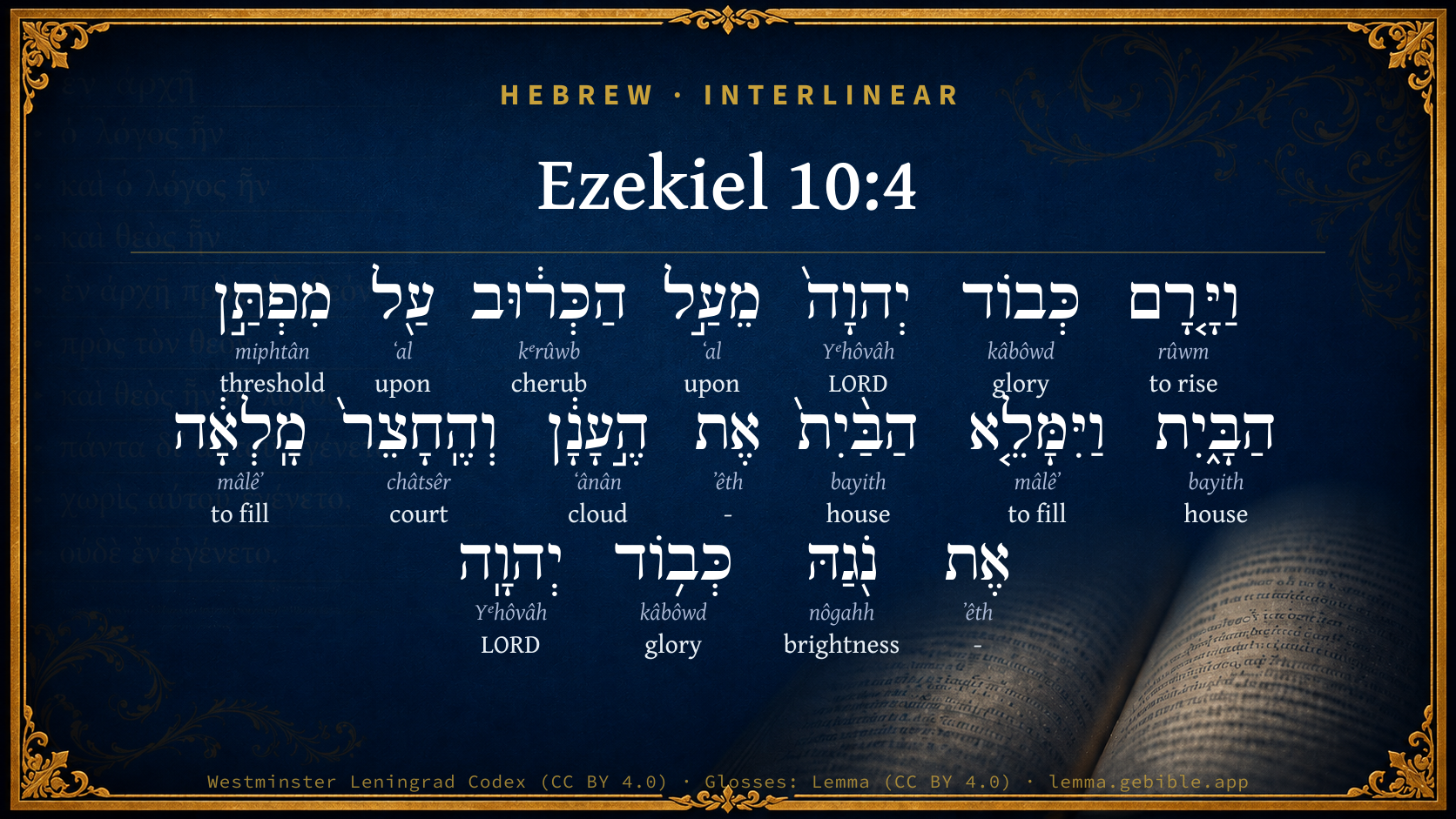
Hebrew (Westminster Leningrad Codex) Ezekiel 10:4 appears in the Hebrew Old Testament. The text above is from the Westminster Leningrad Codex. Each word links to its Strong’s number, a concise gloss, and parsing drawn from the Open Scriptures Hebrew Bible morphology. Click any word for its full Brown-Driver-Briggs (BDB) entry.
Download image
Cite this verse

Ezekiel 10:4 (World English Bible). Public Domain. Lemma interlinear Bible study tool, https://lemma.gebible.app/v/ezekiel/10/4.

Show BibTeX & RIS
BibTeX
RIS
English Translation
The glory of Yahweh mounted up from the cherub, [and stood] over the threshold of the house; and the house was filled with the cloud, and the court was full of the brightness of Yahweh's glory.
World English Bible · Public Domain
Download a study sheet

One document with this verse’s original text, its word-by-word gloss line, the meaning frame, cross-references with their text, attributed commentary, and full source and license credits — printable, and it pastes into notes with its structure intact.

This verse Autodidact and up

Study sheet (.html) Plain text (.txt)

A passage Seminary Student

Up to 50 verses in one chapter. A passage sheet keeps up to 6 commentary sources and 12 cross-references per verse, in the order this page ranks them, and says so on the sheet whenever that leaves anything out. Ask for a single verse and you get the Autodidact verse sheet above.

Everything on this page stays free to read, with no account — the sheet is a download of what is already on screen, not access to it.

Want to remove ads? Support Godless Engineer
Compare translations 3

The same verse in 3 English versions, stacked beneath the original-language interlinear above. Click any original word for its lexicon entry.

Each is an independent rendering of the whole verse — the interlinear is not word-aligned to these translations.

Highlighted words mark where these versions differ — a whole-verse word diff, not a word-by-word alignment.

  • World English Bible Public Domain
    The glory of Yahweh mounted up from the cherub, [and stood] over the threshold of the house; and the house was filled with the cloud, and the court was full of the brightness of Yahweh's glory.
  • King James Version Public Domain
    Then the glory of the LORD went up from the cherub, and stood over the threshold of the house; and the house was filled with the cloud, and the court was full of the brightness of the LORD's glory.
  • unfoldingWord Literal Text CC BY-SA 4.0
    The glory of Yahweh rose up from the cherubim and stood over the threshold of the house. It filled the house with the cloud, and the courtyard was full of the brightness of Yahweh’s glory.

unfoldingWord Literal Text — © unfoldingWord, licensed CC BY-SA 4.0. Word-aligned USFM3 via Door43 (git.door43.org/unfoldingWord/en_ult).

Versions to compare (up to 4)

3 of 4 selected

Show all 18 translations

Every available English version of this verse, each an independent rendering of the whole verse.

  • World English Bible Public Domain
    The glory of Yahweh mounted up from the cherub, [and stood] over the threshold of the house; and the house was filled with the cloud, and the court was full of the brightness of Yahweh's glory.
  • Berean Standard Bible Public Domain
    Then the glory of the LORD rose from above the cherubim and stood over the threshold of the temple. The temple was filled with the cloud, and the court was filled with the brightness of the glory of the LORD.
  • Majority Standard Bible Public Domain
    Then the glory of the LORD rose from above the cherubim and stood over the threshold of the temple. The temple was filled with the cloud, and the court was filled with the brightness of the glory of the LORD.
  • King James Version Public Domain
    Then the glory of the LORD went up from the cherub, and stood over the threshold of the house; and the house was filled with the cloud, and the court was full of the brightness of the LORD's glory.
  • American Standard Version (1901) Public Domain
    And the glory of Jehovah mounted up from the cherub, `and stood' over the threshold of the house; and the house was filled with the cloud, and the court was full of the brightness of Jehovah's glory.
  • Revised Version (1885) Public Domain
    And the glory of the LORD mounted up from the cherub, and stood over the threshold of the house; and the house was filled with the cloud, and the court was full of the brightness of the LORD’S glory.
  • Geneva Bible (1599) Public Domain
    Then the glorie of the Lord went vp from the Cherub, and stoode ouer the doore of the house, and the house was filled with the cloud, and the court was filled with the brightnesse of the Lordes glorie.
  • Douay-Rheims (1899) Public Domain
    And the glory of the Lord was lifted up from above the cherub to the threshold of the house: and the house was filled with the cloud, and the court was filled with the brightness of the glory of the Lord.
  • Young's Literal Translation Public Domain
    and become high doth the honour of Jehovah above the cherub, over the threshold of the house, and the house is filled with the cloud, and the court hath been filled with the brightness of the honour of Jehovah.
  • Literal Standard Version CC BY-SA 4.0
    and the glory of YHWH becomes high above the cherub, over the threshold of the house, and the house is filled with the cloud, and the court has been filled with the brightness of the glory of YHWH.
  • Unlocked Literal Bible CC BY-SA 4.0
    The glory of Yahweh rose up from the cherubim and stood over the threshold of the house. It filled the house with the cloud, and the courtyard was full of the brightness of Yahweh's glory.
  • unfoldingWord Literal Text CC BY-SA 4.0
    The glory of Yahweh rose up from the cherubim and stood over the threshold of the house. It filled the house with the cloud, and the courtyard was full of the brightness of Yahweh’s glory.
  • Darby Bible Public Domain
    And the glory of Jehovah mounted up from the cherub, [and came] over the threshold of the house; and the house was filled with the cloud, and the court was full of the brightness of Jehovah's glory.
  • World Messianic Bible Public Domain
    The LORD’s glory mounted up from the cherub, and stood over the threshold of the house; and the house was filled with the cloud, and the court was full of the brightness of the LORD’s glory.
  • Webster's Bible Public Domain
    Then the glory of the LORD went up from the cherub, and stood over the threshhold of the house; and the house was filled with the cloud, and the court was full of the brightness of the LORD'S glory.
  • Free Bible Version CC BY-SA 4.0
    Then the Lord's glory rose up from above the cherubim and moved to the entrance of the Temple. The cloud filled the Temple, and the brightness of the Lord's glory filled the courtyard.
  • Bible in Basic English Public Domain
    And the glory of the Lord went up from the winged ones and came to rest over the doorstep of the house; and the house was full of the cloud and the open square was full of the shining of the Lord's glory.
  • JPS Tanakh (1917) Public Domain
    And the glory of the LORD mounted up from the cherub to the threshold of the house; and the house was filled with the cloud, and the court was full of the brightness of the LORD'S glory.

Literal Standard Version (2020), Covenant Press — licensed CC BY-SA 4.0. Text via the HelloAO Bible API (eBible.org). Unlocked Literal Bible (unfoldingWord) — licensed CC BY-SA 4.0. Text via the HelloAO Bible API (eBible.org). unfoldingWord Literal Text — © unfoldingWord, licensed CC BY-SA 4.0. Word-aligned USFM3 via Door43 (git.door43.org/unfoldingWord/en_ult). Free Bible Version, Dr. Jonathan Gallagher — licensed CC BY-SA 4.0. Text via the HelloAO Bible API (eBible.org).

Word by word

More ways to search: Search by grammar → Find every occurrence → Compare this word →

Practice this passage: Drill this verse → Learn its vocabulary →

מִפְתַּ֣ן
miphtân
H4670
“threshold of”
Noun, Common, Masculine, Singular, Construct
Part of Speech
Noun
Type
Common
Gender
Masculine
Number
Singular
State
Construct
Full BDB Definition

Origin: from the same as H6620

TWOT: 1858b

threshold
  1. וַיָּ֤רָם rûwm H7311 “and · to rise” Conjunction + Verb, Qal, Sequential Imperfect, 3rd Person, Masculine, Singular
  2. כְּבוֹד kâbôwd H3519 “glory of” Noun, Common, Both, Singular, Construct
  3. יְהוָה֙ Yᵉhôvâh H3068 “LORD” Noun, Proper
  4. מֵעַ֣ל ʻal H5921 “from · upon” Preposition + Preposition
  5. הַכְּר֔וּב kᵉrûwb H3742 “the · cherub” Particle, Definite Article + Noun, Common, Masculine, Singular, Absolute
  6. עַ֖ל ʻal H5921 “upon” Preposition
  7. הַבָּ֑יִת bayith H1004 “the · house” Particle, Definite Article + Noun, Common, Masculine, Singular, Absolute
  8. וַיִּמָּלֵ֤א mâlêʼ H4390 “and · to fill” Conjunction + Verb, Niphal, Sequential Imperfect, 3rd Person, Masculine, Singular
  9. הַבַּ֨יִת֙ bayith H1004 “the · house” Particle, Definite Article + Noun, Common, Masculine, Singular, Absolute
  10. אֶת ʼêth H853 “-” Particle, Direct Object
  11. הֶ֣עָנָ֔ן ʻânân H6051 “the · cloud” Particle, Definite Article + Noun, Common, Masculine, Singular, Absolute
  12. וְהֶֽחָצֵר֙ châtsêr H2691 “and · the · court” Conjunction + Particle, Definite Article + Noun, Common, Both, Singular, Absolute
  13. מָֽלְאָ֔ה mâlêʼ H4390 “to fill” Verb, Qal, Perfect, 3rd Person, Feminine, Singular
  14. אֶת ʼêth H853 “-” Particle, Direct Object
  15. נֹ֖גַהּ nôgahh H5051 “brightness of” Noun, Common, Feminine, Singular, Construct
  16. כְּב֥וֹד kâbôwd H3519 “glory of” Noun, Common, Both, Singular, Construct
  17. יְהוָֽה Yᵉhôvâh H3068 “LORD” Noun, Proper

About this verse

These counts appear in no published source. They are computed here, from the morphology-tagged text and Lemma’s own curated glosses. What Lemma adds →

18
words
12
distinct lemmas
Prophets
section

Notable vocabulary

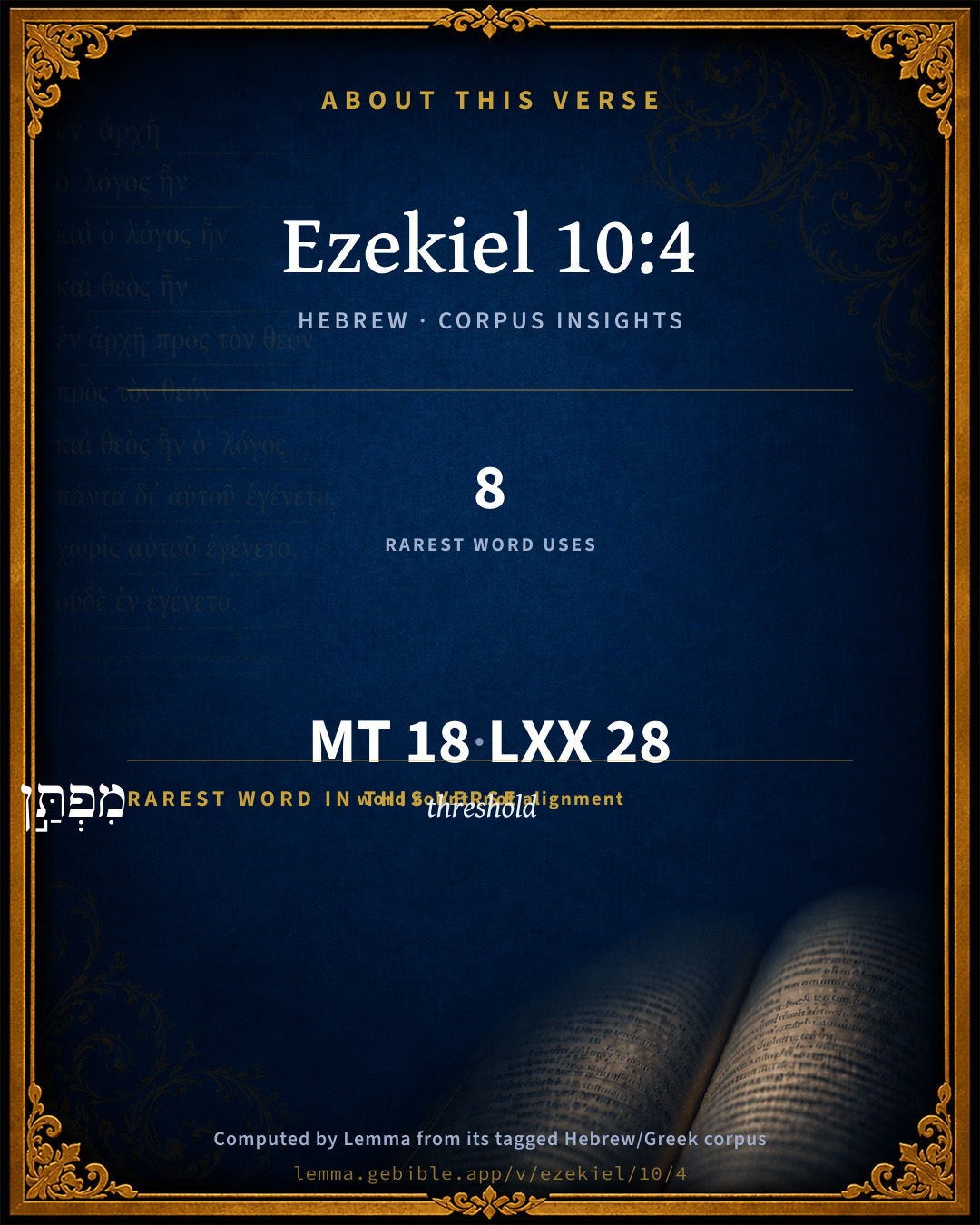
The rarest word here is מִפְתַּ֣ן threshold H4670 — appearing just 8 times in the whole Hebrew Bible.

Shared distinctive vocabulary

מִפְתַּ֣ן threshold H4670 occurs in 8 verses of the Hebrew Bible. Also found in:

Grammatical profile

  • 3 verbs
  • 11 nouns
  • 2 prepositions
  • 2 particles

Verb forms

  • וַיָּ֤רָם Qal · Sequential Imperfect
  • וַיִּמָּלֵ֤א Niphal · Sequential Imperfect
  • מָֽלְאָ֔ה Qal · Perfect

Repetition

Words recur within this verse — often emphatic in Hebrew:

  • כְּבוֹד glory H3519 ×2
  • יְהוָה֙ LORD H3068 ×2
  • מֵעַ֣ל upon H5921 ×2
  • הַבָּ֑יִת house H1004 ×2
  • וַיִּמָּלֵ֤א to fill H4390 ×2

Hebrew & Septuagint length

In English translation the verse runs 36 words from the Hebrew and 36 from the Septuagint (LXX English) — the same length.

A rough comparison of the two English renderings, which tokenize alike — not a word-level alignment.

Word counts can differ between the Hebrew and the Greek without any difference in meaning — e.g. the Hebrew direct-object marker אֵת has no separate Greek word, and Greek often adds the article ὁ.

In the original languages it is 18 Hebrew tokens and 28 Greek tokens — but the two are counted differently (Hebrew bundles its prefixes and suffixes into one token; the Greek is in lemma form), so that isn’t a like-for-like length.

Cross-references

11

Topical passages linked to Ezekiel 10:4 in the Treasury of Scripture Knowledge — connected by theme and wording, ordered by reader-vote popularity; previews shown in the World English Bible.

  • Ezekiel 1:28 As the appearance of the bow that is in the cloud in the day of rain, so was the appearance of the brightness round about. This was the appearance of the likeness of the glory of Yahweh. When I saw it, I fell on my face, and I heard a voice of one that spoke.
  • Ezekiel 9:3 The glory of the God of Israel was gone up from the cherub, whereupon it was, to the threshold of the house: and he called to the man clothed in linen, who had the writer's inkhorn by his side.
  • Revelation 15:8 The temple was filled with smoke from the glory of God, and from his power. No one was able to enter into the temple, until the seven plagues of the seven angels would be finished.
  • Exodus 40:35 Moses wasn't able to enter into the tent of meeting, because the cloud stayed on it, and Yahweh's glory filled the tent.
  • 2 Chronicles 5:13–14 it happened, when the trumpeters and singers were as one, to make one sound to be heard in praising and thanking Yahweh; and when they lifted up their voice with the trumpets and cymbals and instruments of music, and praised Yahweh, [saying], For he is good; for his loving kindness endures forever; that then the house was filled with a cloud, even the house of Yahweh,
  • Ezekiel 10:18 The glory of Yahweh went forth from over the threshold of the house, and stood over the cherubim.
  • Ezekiel 11:22–23 Then did the cherubim lift up their wings, and the wheels were beside them; and the glory of the God of Israel was over them above.
  • Numbers 16:19 Korah assembled all the congregation against them to the door of the tent of meeting: and the glory of Yahweh appeared to all the congregation.
  • 1 Kings 8:10–12 It came to pass, when the priests were come out of the holy place, that the cloud filled the house of Yahweh,
  • Ezekiel 43:5 The Spirit took me up, and brought me into the inner court; and, behold, the glory of Yahweh filled the house.
  • Haggai 2:9 'The latter glory of this house will be greater than the former,' says Yahweh of Hosts; 'and in this place will I give peace,' says Yahweh of Hosts."

Cross-references courtesy of OpenBible.info (CC BY 4.0).

Hebrew and Greek witnesses Masoretic Hebrew ↔ Greek Septuagint

The same verse in the two great witnesses to the Old Testament, shown verse-for-verse.

These are two independent witnesses, not word-aligned to each other, and the Septuagint is shown in lemma (dictionary) form.

Hebrew Ezekiel 10:4 Masoretic · Westminster Leningrad Codex

וַיָּ֤רָם כְּבוֹד יְהוָה֙ מֵעַ֣ל הַכְּר֔וּב עַ֖ל מִפְתַּ֣ן הַבָּ֑יִת וַיִּמָּלֵ֤א הַבַּ֨יִת֙ אֶת הֶ֣עָנָ֔ן וְהֶֽחָצֵר֙ מָֽלְאָ֔ה אֶת נֹ֖גַהּ כְּב֥וֹד יְהוָֽה

The glory of Yahweh mounted up from the cherub, [and stood] over the threshold of the house; and the house was filled with the cloud, and the court was full of the brightness of Yahweh's glory.

World English Bible · Public Domain

Greek LXX Ezekiel 10:4 Septuagint · lemma form

καί ἀποαἴρω ὁ δόξα κύριος ἀπό ὁ χερουβείμ εἰς ὁ αἴθριος ὁ οἶκος καί πίμπλημι ὁ οἶκος ὁ νεφέλη καί ὁ αὐλή πίμπλημι ὁ φέγγος ὁ δόξα κύριος

Then the glory of the Lord departed from the cherubs to the porch of the house; and the cloud filled the house, and the court was filled with the brightness of the glory of the Lord.

LXX2012 (modern English Septuagint) · Public Domain

Hebrew: Westminster Leningrad Codex (CC BY 4.0). Greek: Septuagint (public domain); English from LXX2012 (modern English Septuagint) (Public Domain). How the Septuagint differs from the Hebrew →

Targum (Aramaic paraphrase)

1

The Targum is the ancient Jewish Aramaic paraphrase of the Hebrew Scriptures — an interpretive translation, not the Hebrew text itself. Onkelos (literal) and Pseudo-Jonathan (expansive) render the Torah, and Jonathan the Prophets. Coverage is partial: where no permissively-licensed English translation exists for a verse, only the Aramaic is shown. This is verse-level text, not a word-by-word alignment to the Hebrew.

  1. Targum Jonathan Prophets (Joshua–Malachi)
    וְאִסְתַּלֵק יְקָרָא דַייָ בִּכְרוּבָא דַהֲוָה שָׁרֵי עֲלוֹהִי וּשְׁרָא מֵעֵיל לָקֳבֵיל סְקוּפַת בֵּיתָא וְאִתְמְלִיאַת בֵּיתָא יַת עֲנַן אֲמִיטְתָא וְדַרְתָּא אִתְמְלִיאַת יַת זְהוֹר יְקָרָא דַיָי:

    (no public-domain English translation for this verse)

    Targum Jonathan — Aramaic: “Mikraot Gedolot” (public domain). English: “Sefaria Community Translation” (CC0 1.0 (public-domain dedication)); “London "Chaldee Paraphrase," 1871” (public domain). Text via Sefaria.

Commentary

Notes on Ezekiel 10:4 from classic Christian and Jewish commentators (each source and its license shown beneath its notes). The classic Christian expositions comment on the surrounding passage and are grouped to its opening verse, so a note may address several verses; the Jewish commentaries on the Tanakh (Rashi and others) are per-verse, so they appear only where the commentator wrote on this verse.

Lemma curates 59 commentaries, every one of them public domain or Creative Commons licensed, each selected and text-cleaned for this edition rather than reprinted as found. About our sources →

John Gill's Exposition

Then the glory of the Lord went up from the cherub,.... Or, "cherubim"; those that were upon the mercy seat, between which the Shechinah or glorious majesty of God dwelt, in the most holy place: this is a token and intimation of the Lord's leaving of the temple; and a little before the destruction of Jerusalem by the Romans, to which this vision chiefly, if not together, refers, a voice was heard in the temple,

"let us go hence (b):''

and stood over the threshold of the house; either of the holy of holies, from whence he was removing; or rather of the holy place, the court of the priests, the inward court, and so open to the outward court, and view of the people in it:

and the house was filled with the cloud; the temple, being forsaken of God, was filled with darkness; as an emblem of that blindness which is come upon the Jews, and will continue on them till the fulness of the Gentiles brought in:

and the court was full of the brightness of the Lord's glory; either the inward court, as the glory of the Lord passed through it, from the holy of holies; or rather the outward court, of which mention is made in Eze 10:4; the glory of the Lord being on the threshold Of the house, which looked towards that, and so enlightened it. This outward court signifies the Gentiles; who, when the Lord removed from the Jewish nation and people, were favoured with the glorious light of the Gospel, and ordinances of Christ; whereby they were enlightened, and filled with the knowledge of the Lord; with the knowledge of him, who is the brightness of his father's glory, and the express image of his person; so through the fall of the Jews salvation came to the Gentiles, Rom 11:11.

(b) Josephus de Bello Judaeorum, l. 6. c. 5, sect. 3.

John Gill's Exposition of the Whole Bible (1746–1763) — public domain (CC PDM 1.0). Text via the HelloAO Bible API.

Trapp's Complete Commentary

John Trapp

Eze 10:4 Then the glory of the LORD went up from the cherub, [and stood] over the threshold of the house; and the house was filled with the cloud, and the court was full of the brightness of the LORD’S glory.

Ver. 4. Then the glory of the Lord went up from the cherub,] i.e., From the cherubims; so it had done once before, {Eze 9:3} and returned again, to show that he was even driven out by the people’s impenitence.

And stood over the threshold of the house.] As taking his last leave of it.

And the house was filled with a cloud.] Sublatenter abit a suo loco Dominus. {a} So Isa 6:4; "The house was filled with smoke." Josephus saith, that when God departed, a voice was heard out of the temple, saying, Let us leave these seats; like as, a little before the last desolation of it, there was heard Migremus hinc, Let us go hence. And a heathen writer saith, that a voice greater than man’s was heard, that the gods were thence departing. {b}

{a} Oeoclamp.

{b} Audita maior humana vox, excedere deos. - Tacit.

John Trapp, A Commentary or Exposition upon All the Books of the Old and New Testament (1647–1656) — public domain. Text from a community e-Sword module.

Albert Barnes' Notes on the Bible

A repetition of Eze 9:3. Now the glory of the Lord had gone up from the cherub to the threshold of the house. Eze 10:4-6 describe what had occurred before the “man went in” Eze 10:3.

Albert Barnes' Notes on the Bible (1834–1885) — public domain. Text from a community e-Sword/MySword module.

Joseph Benson's Commentary

Eze 10:4-7. Then the glory of the Lord went up from the cherub — In token of his departure from the temple. The words may be better rendered, For the glory of the Lord had gone up, &c. For the prophet repeats here what he had related before, Eze 9:3. And the house was filled with the cloud — The account here given must strike every reader as to its similarity with the description given of the Shechinah in the books of Moses and the first book of Kings. A bright cloud was the sign of God’s presence, which first filled the tabernacle, Exo 40:35, (afterward the temple, 1Ki 8:10,) where it fixed itself upon the mercy-seat, Lev 16:2. From whence God is said, so often in Scripture, to dwell between the cherubim. This glory now removed from the place where it used to appear in the inner sanctuary, and came down toward the porch of the temple, and stood, or fixed itself, partly in the temple and partly in the inner court adjoining to it: see note on Eze 9:3. The glory stood, to show God’s unwillingness to leave his people, and give them time to return to him, and placed itself where it might be seen, both by priests and people, that both might be moved to repentance. And the sound of the cherubims’ wings, as the voice of the Almighty — As the sound of loud thunder. The cherubim, in the prophet’s vision, seem to have moved to attend upon the Shechinah, which now had taken its station at the threshold of the house. He went and stood beside, rather, between, the wheels.

Joseph Benson's Commentary on the Old and New Testaments (1811–1818) — public domain. Text from a community e-Sword module.

Geneva Bible (1599)

Geneva Bible translators

Meaning, that the glory of God should depart from the Temple.

Geneva Bible (1599) marginal notes — public domain. Text via Bolls.life.

Jamieson, Fausset & Brown

Robert Jamieson, A. R. Fausset & David Brown

The court outside was full of the Lord's brightness, while it was only the cloud that filled the house inside, the scene of idolatries, and therefore of God's displeasure. God's throne was on the threshold. The temple, once filled with brightness, is now darkened with cloud.

Jamieson, Fausset & Brown — Commentary Critical and Explanatory on the Whole Bible (1871) — public domain (CC PDM 1.0). Text via the HelloAO Bible API.

Adam Clarke's Commentary

Verse 4. The glory of the Lord went up] This is repeated from Eze 9:3.

The house was filled with the cloud] This is a fact similar to what occurred frequently at the tabernacle in the wilderness, and in the dedication of the temple by Solomon. What is mentioned here was the Divine shechinah, the symbolical representation of the majesty of God.

Adam Clarke's Commentary on the Bible (1810–1826) — public domain. Text from a community e-Sword/MySword module.

John Calvin's Commentaries

In this verse the Prophet confirms what he lately touched upon, viz., that the temple was filled with blackness, because God had transferred his glory away. He says then, that the brightness of God’s glory appeared above the threshold But the glory of God resided in the sanctuary and in the very ark of the covenant; but now, when it advances to the threshold, it is just as if he should extinguish the splendor of his glory by which the temple was adorned, and transfer it elsewhere. But he says, that the glory of Jehovah was elevated from its place: these words signify change of place: God is everywhere said to dwell between the cherubim, and he wished to be called upon there; but now his glory is said to be removed elsewhere. Hence, therefore, it appears, that the temple was deprived of God’s presence, and was in some sense stripped of its furniture; for without God what remained? Hence that darkness which was formerly mentioned, and is again repeated. The glory of Jehovah then was withdrawn: from whence? from its own place and station, where it dwelt between the cherubim, and came to the threshold of the temple: then he says, all was changed. For the temple in which God’s glory formerly shone forth became full of darkness; but the threshold of the house, which was as it were profane, was full of splendor: not that God dwelt at the threshold, for this vision has another meaning, viz., that God after leaving his temple appeared without it; for by the threshold he signifies a place conspicuous to all. Now therefore we understand the design of the Holy Spirit when he says, the glory of Jehovah was elevated from that seat, which he had chosen as a residence for himself between the cherubim, and was conspicuous above the threshold: whence it happened that the temple itself grew dark, but God’s brightness was conspicuous in the court itself. It follows —

John Calvin's Commentaries (1540-1563) — public domain. Text from the Calvin Translation Society English edition (1840s-50s) via the Christian Classics Ethereal Library (ccel.org). Calvin's coverage is partial (roughly two-thirds of the Bible); uncommented books and verses are honest gaps, never fabricated. The 19th-century editor's footnotes and remarks are omitted so the notes are faithfully Calvin's own voice.

Ellicott's Commentary for English Readers

(4) The glory of the Lord went up from the cherub.—As in Eze_10:2, the singular, cherub, instead of the usual plural. Here it is thought to designate, not the four living creatures of the vision, but the cherubim overshadowing the mercy-seat, and to indicate that the manifestation of the Divine presence now left the Holy of Holies, and went to the threshold of the door of the house, preparatory to leaving it altogether. The expression is obscure, since the place of the manifestation of the Divine presence in the most holy place is usually described as “between the cherubim” (Exo_25:22; Num_7:89; Psa_80:1; Psa_99:1, &c.). Of the main point, however, there can be no doubt—that the Divine presence is represented as in the act of leaving the Temple. “The house was filled with the cloud, and the court was full of the brightness of the Lord’s glory” as He departed, in striking contrast with the similar manifestations (Exo_40:34-35; 1Ki_8:10-11), when God accepted the tabernacle and the Temple as the peculiar place of His abode.

A Bible Commentary for English Readers, edited by Charles John Ellicott (1878–1897) — public domain. Text from a community e-Sword module.

The Cambridge Bible for Schools and Colleges

gen. ed. J. J. S. Perowne

4. Then the glory went up] This can hardly be rendered, and … had gone up; consequently the implication in Eze_10:1 that the glory had returned to the cherubim from the threshold is confirmed.

The Cambridge Bible for Schools and Colleges (gen. ed. J. J. S. Perowne; Cambridge University Press, 1878–1918) — public domain. Text from a community e-Sword module.

Haydock's Catholic Bible Commentary

Lifted up, before chap. ix. 3. (Calmet) --- A man seemed to be on the throne, (Worthington) or rather over the door of the holy place.

George Leo Haydock (1774–1849), Haydock's Catholic Family Bible and Commentary, 1859 edition — public domain. Excludes Psalms (Douay-Rheims chapter numbering differs from Protestant) and Deuterocanonical books (Catholic canon only).

Matthew Poole's English Annotations

The glory of the Lord; either the visible token of the presence of the God of glory; as Eze 1:28; 3:23; 8:4; or Christ, who is the glory of the temple, and of his people, nay, is the brightness of his Father’s glory. Went up, in displeasure, and in token of his departure from the temple.

Stood over the threshold of the house; showing both his unwillingness to leave, and giving them time to bethink themselves, and return by repentance; and he stands where he might be seen both by priests and people, that both might be moved to repentance.

The house; the temple, the most venerable and privileged place.

Was filled; there had been a fulness of sin, there is now a fulness of sufferings.

With the cloud; a very great darkness followed upon Christ’s departure from the house.

The court was full of the brightness; not to reside there, but when Christ did turn his back upon the temple, and was coming through the court, a light of majesty shines before him, Psa 18:12,13.

Matthew Poole's English Annotations on the Holy Bible (1683–1685) — public domain. Text from a community e-Sword/MySword module.

Whedon's Commentary on the Bible

Daniel D. Whedon

4. The glory of the Lord went up — The cherubim remained, but Jehovah once more removed to the threshold (Eze_9:3). Was this in order to view the execution of his commands in the burning of the city? This is wholly conjecture. Perhaps the idea is that otherwise the man could not have had the strength to fulfill his commission. Ezekiel (Eze_1:28; Eze_3:23) could not stand near God’s glory; how much less would he have been able to enter his chariot!

The house was filled with the cloud — “God’s presence without a cloud is to man insupportable.” Even when God appeared to Moses “the glory of the Lord appeared in a cloud,” and of those on the mount of transfiguration it is said “a cloud overshadowed them.”

From the cherub — Or, from the chariot. As in Hebrew the words cherub and chariot are nearly identical it would only require a very slight error to make this substitution. The connection shows that the entire chariot is meant. In the recently discovered Senschirli inscriptions, dating from about Ezekiel’s era, one man is named “Rekub-El,” chariot of God.

Court was full of the brightness of the Lord’s glory — It is here for the first time made perfectly clear that the brightness which from the beginning had impressed the prophet was the shining of the divine One and not of the throne or the chariot.

Daniel D. Whedon (gen. ed.), Commentary on the Old and New Testaments (1874–1909) — public domain. Text from a community e-Sword module.

The Pulpit Commentary

The moving glory.

It is difficult to follow the enraptured prophet through all the mystic mazes of his vision, and catch the meaning of the many gorgeous symbols that he discovers on every hand. But now and again certain points stand out with an individual significance even when their relation to the whole shifting panorama may strike us as somewhat obscure. Here we may take some hints from the moving of the Divine glory. This radiance moved from over the cherub, and stood over the threshold of the house.

I GOD"S GLORY HAS COME FROM HEAVEN TO EARTH. Ezekiel saw the radiance pass from the cherub to the threshold of the house.

1. The glory has visited earth. It is not confined to celestial altitudes. Earth is not yet a godless hell. God, who talked with Adam before the Fall, also talked with Moses after the Fall. There is a Divine halo about every good life. Little children come "trailing clouds of glory," and "of such is the kingdom of heaven." But this glory is most present in Christ. Thus the beloved disciple said, "We beheld his glory, the glory as of the Only Begotten of the Father". (Joh_1:14)

2. The glory has reached common life. There were cherubim in the holy of holies at the temple, and there the Shechinah was said to dwell. But now Ezekiel sees the glory pass to the threshold of the house. It moves from the high priest"s sanctuary to the way of the common people, and seems to look forth from the doorway with cheering radiance and a benediction towards the great world outside. This has certainly happened in the free preaching of the gospel of Christ, and the equal privileges of all Christians. The Shechinah passed from the temple at Jerusalem to the Carpenter"s workshop at Nazareth; and ever since it has dwelt among the familiar haunts of men, consecrating daily toil, making simple lives beautiful with the light of God.

II GOD"S GLORY IS IN MOVEMENT. The fiery pillar of the wilderness moved from place to place. When by the Red Sea, it stood behind the camp and between this and the pursuing army of Egypt. In travel, it went on before the host. The presence of God is not always equally manifest at the same place. There are God-haunted realms, and there are apparently God-deserted regions. Physically, God is equally present everywhere. But morally, the conduct of men does not admit of an equal revelation of the Divine.

1. The glory may depart from its old seat. It left the temple, and it deserted the Jews. Poor down-trodden Palestine is now only to be called a "Holy Land" for the sake of its memories and associations. North Africa and Asia Minor, once the brightest centres of the Christian Church, have been left dark and deserted. This is not owing to God"s changing. His glory is not like the waning moon, or the setting sun, or the flickering lamp. But as men forsake him, "Ichabod!" must be uttered over their most sacred spots.

2. The glory may visit new scenes. It has shone over the martyrs of Madagascar and Uganda, and the native missionaries of the South Seas; it is beginning to dawn in the great dark continent, and among the teeming millions of India and China. There is no dark soul over which it will not shine, if only pardon is penitently sought.

The brightness of the Divine glory.

The Shechinah-cloud in the holiest place was the visible representation and symbol of the presence of the Eternal in the place set apart for special communion between God and man. Appealing primarily to the sense of sight, it did in reality appeal to the intelligence and the conscience of the people. It was the same luminous cloud which Ezekiel beheld in his vision, and in which he recognized the manifestation of the Divine presence and interest.

I THE TRUE GLORY OF THE LORD CONSISTS IN HIS MORAL ATTRIBUTES. The Jews ever required a sign. But whilst the multitude may have rested in the sign, the enlightened and spiritual passed from the sign to the thing signified. True glory is not in material splendour, however dazzling, but in that excellence which is perfected in God, the Source of all goodness. Whilst the less reflecting may be more impressed with the omnipotence and omnipresence of God, which must indeed excite the reverent admiration of all to whom he makes himself known, such as are morally cultivated and susceptible will find the highest and purest glory in the Divine wisdom, righteousness, holiness, and love.

II THIS GLORY IS PECULIARLY IMPRESSIVE WHERE THESE IS SPIRITUAL SUSCEPTIBILITY. As the man is affected by many things which are neither felt nor noticed by the brute, so the spiritually living and earnest are impressed and influenced by the contemplation of the Divine character and attributes. These may have no interest for the worldly and the selfish; but they are felt to be great, sacred, and precious realities by all natures that are brought by spiritual teaching into sympathy with God. "They are spiritually discerned." There is a capacity within us which is only developed and satisfied when brought into contact with the purity and the grace of him who is a Spirit, and who will be worshipped in spirit and in truth.

III THE VISION OF THIS BRIGHTNESS IS A MOTIVE AND STIMULUS TO HUMAN OBEDIENCE AND PRAISE. The hosts of heaven gaze upon the Divine glory, and by the vision are prompted to unceasing adoration, it is the same with the enlightened and spiritual among the sons of men. As the daybreak and the sunrise call forth the glad song of the lark as it soars aloft, so the rising of "the brightness of the Lord"s glory" upon a soul summons it to the glad exercise of exulting adoration. Nor does this term the only response. Man"s active nature renders the service which is due to him who is recognized as the Source of all good, of all blessing. Obedience is acted praise, as praise is uttered obedience.

IV TO THE CHRISTIAN THE LORD JESUS IS THE RICHEST REVELATION OF THE DIVINE GLORY. The evangelist tells us that he and his fellow disciples beheld Christ"s glory, "the glory as of the Only Begotten of the Father, full of grace and truth." And the author of the Epistle to the Hebrews describes the Son of God as "the Emanation from the Divine glory." They who look into Christ"s face behold the moral attributes of Deity in all their resplendent brightness, "They look unto him, and are lightened, and their laces are not ashamed. T.

Vers. 4, 18, 19; and ch. 1Sa_15:23, 26 28:15; 1Ch_28:9; 2Ch_15:2; Psa_78:56-64; Jer_7:8-16.

II THAT GOD WITHDRAWS HIS GRACIOUS PRESENCE FROM A PERSON OR A NATION VERY GRADUALLY. We have an intimation of his leaving the temple in Eze_9:3, where the glory of God departs from the holy of holies to the threshold of the house, by which is meant, says Schroder, "the outermost point, where the exit was from the court of the people into the city." In ver. 4 the prophet beholds the same movement repeated. Then in vers. 18 and 19 the Lord"s complete abandonment of the temple is symbolically exhibited. And in Eze_11:22, 23 the symbol of the gracious presence departs from the city, and makes a temporary sojourn on the Mount of Olives before forsaking the land. Thus step by step the symbol of the glory of the Lord goes away from them. It is as though he forsook them with great reluctance. By his servant Hosea he expresses the same truth: "How shall I give thee up, Ephraim? how shall I deliver thee, Israel?" etc.. (Hos_11:8) It seemed, too, as though he would be entreated by them not to depart from their midst, and moved away so gradually in order that they might so entreat him. And if God withdraws himself, or withholds his gracious influences from any one, he does so, as it were, with measured steps and slow. Men are not left to themselves and their own devices hastily. God waits long to be gracious unto man. He does not depart from any one until he has received great and protracted provocation. He is "the God of patience;" and "he delighteth in mercy.

III THAT WHEN GOD WITHDRAWS HIS GRACIOUS PRESENCE FROM A PERSON OR NATION THEY ARE BEREFT OF HIS PROTECTION. Shortly after Ezekiel had seen the glory of God pass away from the holy of holies to the threshold of the house, (Eze_9:3) the destroying angels began their work of slaughter in the temple. And before the complete destruction of the city, the glory of God departed from it to the Mount of Olives. When the Lord had quite withdrawn his gracious presence they were at the mercy of their enemies, and troubles came upon them test and furiously. "When the sun is in apogee, says Greenhill, "gone from us, we have short days and long nights, little light but much darkness; and when God departs, you have much night, and little day left, your comforts fade suddenly, and miseries come upon you swiftly." What a tragical example of this we have in the case of King Saul! When God had departed from him, and answered him no more, neither by prophets nor by dreams, he was sore distressed, and the terrible end was close at hand. (1Sa_28:15-20, 1Sa 28:31) "This is to be forsaken indeed, when God prepares to forsake us. Lo! then more than ever darkness comes over all the powers of man"s spirit and over his life, and even trusted, loved countenances of friends go into shadow. Good thoughts grow ever fewer, impulses to prayer ever more rare; admonitions of conscience cease; the holy of holies in the man becomes empty down to the four walls and the usual pious furniture" (Schroder).

CONCLUSION. "Take heed, brethren, lest haply there shall be in any one of you an evil heart of unbelief in falling away from the living God: but exhort one another day by day, so long as it is called Today; lest any one of you be hardened by the deceitfulness of sin." And let us pray, "Cast me not away from thy presence; and take not thy Holy Spirit from me. W.J.

The Pulpit Commentary (1880–1919), ed. H.D.M. Spence-Jones & Joseph S. Exell — public domain. Text from a community e-Sword module.

John Wesley's Explanatory Notes

The glory - The visible token of the presence of the God of glory. Went up - In token of his departure from the temple. And stood - Shewing his unwillingness to leave, and giving them time to return to him, he stands where he might he seen, both by priests and people, that both might be moved to repentance.

John Wesley, Explanatory Notes Upon the Whole Bible (1754–1765) — public domain. Text via the GEBible commentary corpus.

Rashi

Rabbi Shlomo Yitzchaki (Rashi)

onto the threshold of the House That is the very [stage of] evacuation mentioned above (9:3).

Rashi on the Tanakh — English translations: “The Judaica Press complete Tanach with Rashi, translated by A. J. Rosenberg” (CC BY 4.0); “Pentateuch with Rashi's commentary by M. Rosenbaum and A.M. Silbermann, 1929-1934” (public domain); “The Metsudah Tanach series, Lakewood, N.J” (CC BY 4.0); and “The Book of Joshua, Metsudah Publications, 1997” (CC BY 4.0). Text via Sefaria.

Lesson kit

Teaching starters — assembled from the data on this page, not authored interpretation. Every prompt links to the verse data it draws on. Edit before teaching.

Ezekiel, in the Prophets, opens this verse with 18 words (12 distinct Hebrew lemmas). Its most distinctive word is miphtân (“threshold”). A historical commentator’s framing appears above. Read the whole chapter for the surrounding context.

Discussion questions

  1. What does “threshold” (miphtân) contribute to the verse as a whole?
  2. 1 Samuel 5:4 shares the word «threshold» with this verse. How do the two illuminate each other?
  3. “glory” occurs 2× in this one verse. What is the effect of the repetition?
  4. These translations render this verse differently; the difference is in the English rendering, not the original. What questions does that raise?
  5. The verb «וַיָּ֤רָם» is Qal Sequential Imperfect. How does its form color the action?
  6. Reading how John Gill's Exposition and Trapp's Complete Commentary read this verse, where do the two commentators agree and where do they part?

Things to notice

Reading settings

Reading text

Shown beneath each verse's original-language words.

Old Testament
Old Testament edition

Read the OT as the Masoretic Hebrew (MT) or the Greek Septuagint (LXX).

English shown for the Greek Septuagint (in the Hebrew ↔ Greek comparison).

Comparing translations? Open the Compare panel on any verse page to stack up to four side by side.