
Psalms 113:4

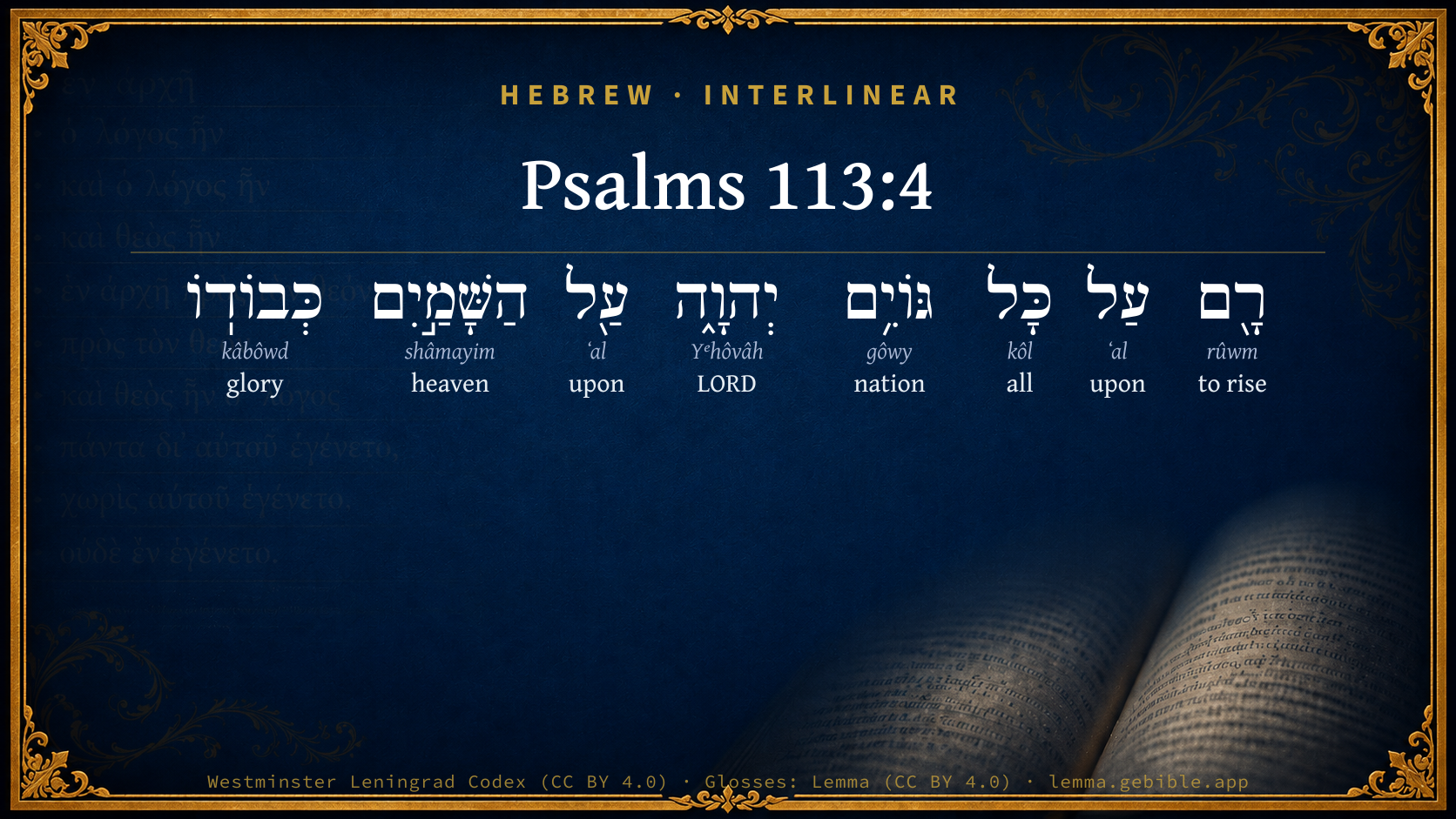
Hebrew (Westminster Leningrad Codex) Psalms 113:4 appears in the Hebrew Old Testament. The text above is from the Westminster Leningrad Codex. Each word links to its Strong’s number, a concise gloss, and parsing drawn from the Open Scriptures Hebrew Bible morphology. Click any word for its full Brown-Driver-Briggs (BDB) entry.
Download image
Cite this verse

Psalms 113:4 (World English Bible). Public Domain. Lemma interlinear Bible study tool, https://lemma.gebible.app/v/psalms/113/4.

Show BibTeX & RIS
BibTeX
RIS
English Translation
Yahweh is high above all nations, His glory above the heavens.
World English Bible · Public Domain
Download a study sheet

One document with this verse’s original text, its word-by-word gloss line, the meaning frame, cross-references with their text, attributed commentary, and full source and license credits — printable, and it pastes into notes with its structure intact.

This verse Autodidact and up

Study sheet (.html) Plain text (.txt)

A passage Seminary Student

Up to 50 verses in one chapter. A passage sheet keeps up to 6 commentary sources and 12 cross-references per verse, in the order this page ranks them, and says so on the sheet whenever that leaves anything out. Ask for a single verse and you get the Autodidact verse sheet above.

Everything on this page stays free to read, with no account — the sheet is a download of what is already on screen, not access to it.

Want to remove ads? Support Godless Engineer
Compare translations 3

The same verse in 3 English versions, stacked beneath the original-language interlinear above. Click any original word for its lexicon entry.

Each is an independent rendering of the whole verse — the interlinear is not word-aligned to these translations.

Highlighted words mark where these versions differ — a whole-verse word diff, not a word-by-word alignment.

  • World English Bible Public Domain
    Yahweh is high above all nations, His glory above the heavens.
  • King James Version Public Domain
    The LORD is high above all nations, and his glory above the heavens.
  • unfoldingWord Literal Text CC BY-SA 4.0
    Yahweh is high above all nations; his glory above the skies.

unfoldingWord Literal Text — © unfoldingWord, licensed CC BY-SA 4.0. Word-aligned USFM3 via Door43 (git.door43.org/unfoldingWord/en_ult).

Versions to compare (up to 4)

3 of 4 selected

Show all 18 translations

Every available English version of this verse, each an independent rendering of the whole verse.

  • World English Bible Public Domain
    Yahweh is high above all nations, His glory above the heavens.
  • Berean Standard Bible Public Domain
    The LORD is exalted over all the nations, His glory above the heavens.
  • Majority Standard Bible Public Domain
    The LORD is exalted over all the nations, His glory above the heavens.
  • King James Version Public Domain
    The LORD is high above all nations, and his glory above the heavens.
  • American Standard Version (1901) Public Domain
    Jehovah is high above all nations, And his glory above the heavens.
  • Revised Version (1885) Public Domain
    The LORD is high above all nations, and his glory above the heavens.
  • Geneva Bible (1599) Public Domain
    The Lord is high aboue all nations, and his glorie aboue the heauens.
  • Douay-Rheims (1899) Public Domain
    The Lord is high above all nations; and his glory above the heavens.
  • Young's Literal Translation Public Domain
    High above all nations `is' Jehovah, Above the heavens `is' his honour.
  • Literal Standard Version CC BY-SA 4.0
    YHWH [is] high above all nations, || His glory [is] above the heavens.
  • Unlocked Literal Bible CC BY-SA 4.0
    Yahweh is exalted above all nations, and his glory reaches above the skies.
  • unfoldingWord Literal Text CC BY-SA 4.0
    Yahweh is high above all nations; his glory above the skies.
  • Darby Bible Public Domain
    Jehovah is high above all nations, his glory above the heavens.
  • World Messianic Bible Public Domain
    The LORD is high above all nations, his glory above the heavens.
  • Webster's Bible Public Domain
    The LORD is high above all nations, and his glory above the heavens.
  • Free Bible Version CC BY-SA 4.0
    The Lord rules supreme over all nations; his glory extends higher than the heavens.
  • Bible in Basic English Public Domain
    The Lord is high over all nations, and his glory is higher than the heavens.
  • JPS Tanakh (1917) Public Domain
    The LORD is high above all nations, His glory is above the heavens.

Literal Standard Version (2020), Covenant Press — licensed CC BY-SA 4.0. Text via the HelloAO Bible API (eBible.org). Unlocked Literal Bible (unfoldingWord) — licensed CC BY-SA 4.0. Text via the HelloAO Bible API (eBible.org). unfoldingWord Literal Text — © unfoldingWord, licensed CC BY-SA 4.0. Word-aligned USFM3 via Door43 (git.door43.org/unfoldingWord/en_ult). Free Bible Version, Dr. Jonathan Gallagher — licensed CC BY-SA 4.0. Text via the HelloAO Bible API (eBible.org).

Word by word

More ways to search: Search by grammar → Find every occurrence → Compare this word →

Practice this passage: Drill this verse → Learn its vocabulary →

רָ֖ם
rûwm
H7311
“rising”
Verb, Qal, Participle Active, Masculine, Singular, Absolute
Part of Speech
Verb
Stem
Qal
Form
Participle Active
Gender
Masculine
Number
Singular
State
Absolute
Full BDB Definition

Origin: a primitive root

TWOT: 2133

to rise, rise up, be high, be lofty, be exalted - (Qal) - to be high, be set on high - to be raised, be uplifted, be exalted - to be lifted, rise - (Polel) - to raise or rear (children), cause to grow up - to lift up, raise, exalt - to exalt, extol - (Polal) to be lifted up - (Hiphil) - to raise, lift, lift up, take up, set up, erect, exalt, set on high - to lift up (and take away), remove - to lift off and present, contribute, offer, contribute - (Hophal) to be taken off, be abolished - (Hithpolel) to exalt oneself, magnify oneself - (Qal) to be rotten, be wormy
  1. עַל ʻal H5921 “upon” Preposition
  2. כָּל kôl H3605 “all of” Noun, Common, Masculine, Singular, Construct
  3. גּוֹיִ֥ם gôwy H1471 “nations” Noun, Common, Masculine, Plural, Absolute
  4. יְהוָ֑ה Yᵉhôvâh H3068 “LORD” Noun, Proper
  5. עַ֖ל ʻal H5921 “upon” Preposition
  6. הַשָּׁמַ֣יִם shâmayim H8064 “the · heaven(s)” Particle, Definite Article + Noun, Common, Masculine, Plural, Absolute
  7. כְּבוֹדֽוֹ kâbôwd H3519 “glory · his” Noun, Common, Both, Singular, Construct + Suffix, Personal, 3rd Person, Masculine, Singular

About this verse

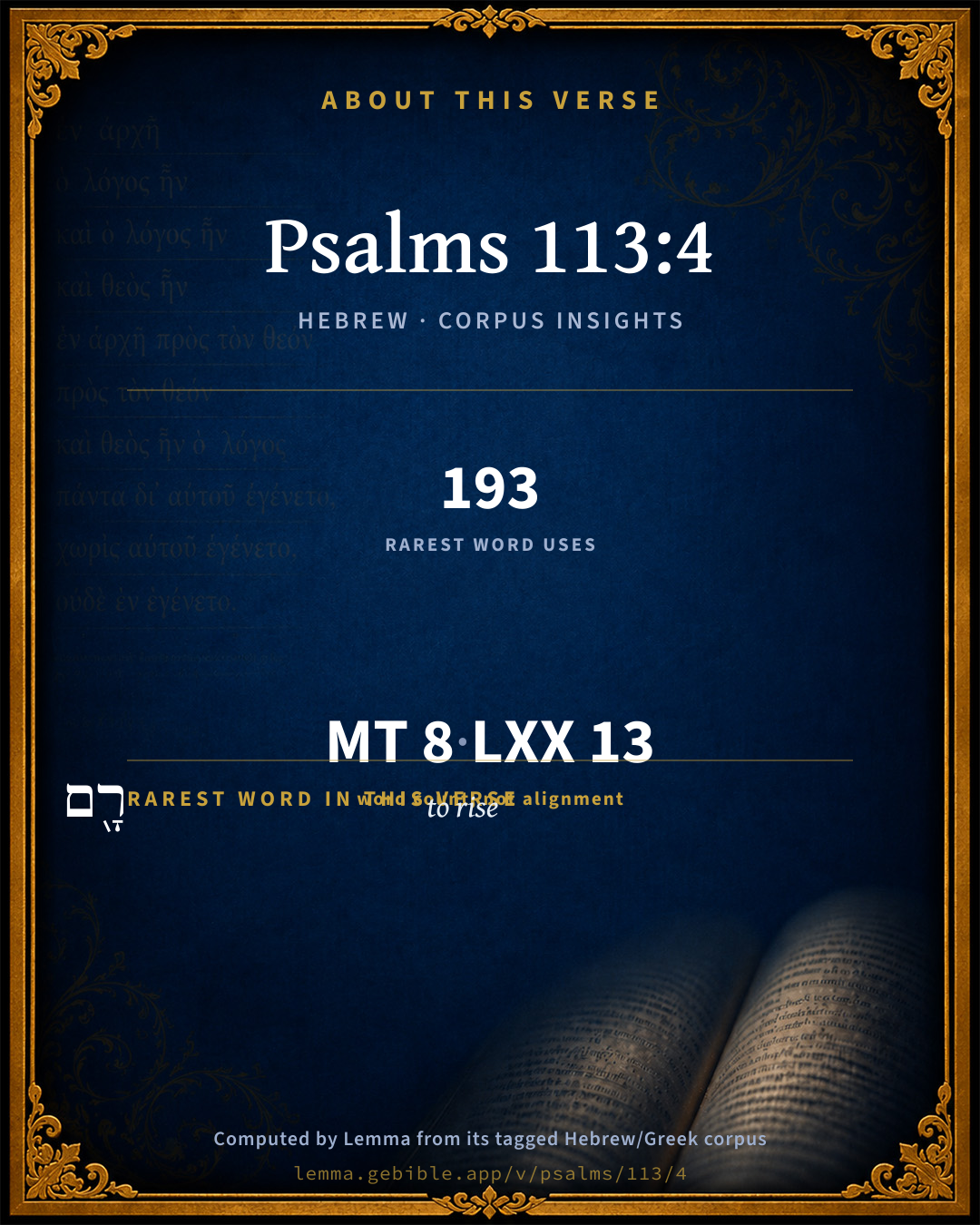
These counts appear in no published source. They are computed here, from the morphology-tagged text and Lemma’s own curated glosses. What Lemma adds →

8
words
7
distinct lemmas
Wisdom
section

Grammatical profile

  • 1 verb
  • 5 nouns
  • 2 prepositions

Verb forms

  • רָ֖ם Qal · Participle Active

Repetition

A word recurs within this verse — often emphatic in Hebrew:

Hebrew & Septuagint length

In English translation the verse runs 11 words from the Hebrew and 14 from the Septuagint (LXX English) — closely comparable.

A rough comparison of the two English renderings, which tokenize alike — not a word-level alignment.

Word counts can differ between the Hebrew and the Greek without any difference in meaning — e.g. the Hebrew direct-object marker אֵת has no separate Greek word, and Greek often adds the article ὁ.

In the original languages it is 8 Hebrew tokens and 13 Greek tokens — but the two are counted differently (Hebrew bundles its prefixes and suffixes into one token; the Greek is in lemma form), so that isn’t a like-for-like length.

Cross-references

10

Topical passages linked to Psalms 113:4 in the Treasury of Scripture Knowledge — connected by theme and wording, ordered by reader-vote popularity; previews shown in the World English Bible.

  • Psalms 8:1 Yahweh, our Lord, how majestic is your name in all the earth, Who has set your glory above the heavens!
  • Psalms 99:2 Yahweh is great in Zion. He is high above all the peoples.
  • Psalms 97:9 For you, Yahweh, are most high above all the earth. You are exalted far above all gods.
  • Psalms 148:13 Let them praise the name of Yahweh, For his name alone is exalted. His glory is above the earth and the heavens.
  • Isaiah 40:17 All the nations are as nothing before him; they are accounted by him as less than nothing, and vanity.
  • Psalms 57:10–11 For your great loving kindness reaches to the heavens, And your truth to the skies.
  • Isaiah 40:15 Behold, the nations are as a drop of a bucket, and are accounted as the small dust of the balance: Behold, he takes up the isles as a very little thing.
  • Isaiah 40:22 [It is] he who sits above the circle of the earth, and the inhabitants of it are as grasshoppers; who stretches out the heavens as a curtain, and spreads them out as a tent to dwell in;
  • Isaiah 66:1 Thus says Yahweh, heaven is my throne, and the earth is my footstool: what manner of house will you build to me? and what place shall be my rest?
  • 1 Kings 8:27 But will God in very deed dwell on the earth? behold, heaven and the heaven of heavens can't contain you; how much less this house that I have built!

Cross-references courtesy of OpenBible.info (CC BY 4.0).

Hebrew and Greek witnesses Masoretic Hebrew ↔ Greek Septuagint

The same verse in the two great witnesses to the Old Testament, shown verse-for-verse.

You’re reading Greek Psalm 112 (Hebrew Psalm 113). The Septuagint counts the superscription, so verse numbers can differ from the Hebrew — chapter-level alignment, not verse-by-verse. Numbering follows Rahlfs.

These are two independent witnesses, not word-aligned to each other, and the Septuagint is shown in lemma (dictionary) form.

Hebrew Psalms 113:4 Masoretic · Westminster Leningrad Codex

רָ֖ם עַל כָּל גּוֹיִ֥ם יְהוָ֑ה עַ֖ל הַשָּׁמַ֣יִם כְּבוֹדֽוֹ

Yahweh is high above all nations, His glory above the heavens.

World English Bible · Public Domain

Greek LXX Greek Psalm 112:4 Septuagint · lemma form

ὑψηλός ἐπί πᾶς ὁ ἔθνος ὁ κύριος ἐπί ὁ οὐρανός ὁ δόξα αὐτός

The Lord is high above all the nations; his glory is above the heavens.

LXX2012 (modern English Septuagint) · Public Domain

Hebrew: Westminster Leningrad Codex (CC BY 4.0). Greek: Septuagint (public domain); English from LXX2012 (modern English Septuagint) (Public Domain). How the Septuagint differs from the Hebrew →

Commentary

Notes on Psalms 113:4 from classic Christian and Jewish commentators (each source and its license shown beneath its notes). The classic Christian expositions comment on the surrounding passage and are grouped to its opening verse, so a note may address several verses; the Jewish commentaries on the Tanakh (Rashi and others) are per-verse, so they appear only where the commentator wrote on this verse.

Lemma curates 59 commentaries, every one of them public domain or Creative Commons licensed, each selected and text-cleaned for this edition rather than reprinted as found. About our sources →

Trapp's Complete Commentary

John Trapp

Psa 113:4 The LORD [is] high above all nations, [and] his glory above the heavens.

Ver. 4. The Lord is high, &c.] He looketh on the earth as on an ant hill. All nations to him are but as a drop of a bucket, Isa 40:15 Quantilla ergo es tu istius guttae particula? (Aug.).

And his glory above the heavens] These are far beneath him in glory as in situation. Angels understand him not fully.

John Trapp, A Commentary or Exposition upon All the Books of the Old and New Testament (1647–1656) — public domain. Text from a community e-Sword module.

Joseph Benson's Commentary

Psa 113:4-6. The Lord is high above all nations — Superior to all princes and bodies of people in the world; and his glory above the heavens — Whereas the glory of earthly monarchs is confined to this lower world, and to small pittances of it, the glory of God doth not only fill the earth, but heaven too, where it is celebrated by thousands and myriads of blessed angels; yea, it is far higher than heaven, being infinite and incomprehensible, Who is like unto the Lord? — Hebrew, Jehovah, who dwelleth on high — Namely, far above all heavens, and is exalted, as in place, so in power and dignity, above all persons and things, visible and invisible. Who humbleth himself, &c. — Who is so high, that it is a wonderful condescension in him to take any notice of his holy and heavenly hosts, and much more of sinful and miserable men upon earth.

Joseph Benson's Commentary on the Old and New Testaments (1811–1818) — public domain. Text from a community e-Sword module.

Keil & Delitzsch

C. F. Keil & F. Delitzsch

This praiseworthiness is now confirmed. The opening reminds one of Psa 99:2. Pasek stands between גוים and יהוה in order to keep them apart. The totality of the nations is great, but Jahve is raised above it; the heavens are glorious, but Jahve's glory is exalted above them. It is not to be explained according to Psa 148:13; but according to Psa 57:6, 12, רם belongs to Psa 113:4 too as predicate. He is the incomparable One who has set up His throne in the height, but at the same time directs His gaze deep downwards (expression according to Ges. ֗142, rem. 1) in the heavens and upon earth, i.e., nothing in all the realm of the creatures that are beneath Him escapes His sight, and nothing is so low that it remains unnoticed by Him; on the contrary, it is just that which is lowly, as the following strophe presents to us in a series of portraits so to speak, that is the special object of His regard. The structure of Psa 113:5-6 militates against the construction of "in the heavens and upon the earth" with the interrogatory "who is like unto Jahve our God?" after Deu 3:24.

Keil & Delitzsch — Biblical Commentary on the Old Testament (1861–1891) — public domain (CC PDM 1.0). Text via the HelloAO Bible API. (Old Testament only.)

J. A. Alexander on Psalms

Joseph Addison Alexander

4. (Psa 113:4) High above all nations (is) Jehovah; above the heavens (is) his (glory). The two clauses are declaratory of his infinite superiority, both to the animate and inanimate creation, each being represented by its noblest part; the former by mankind, and that considered not as individuals but nations; the latter by the heavens. This is certainly more natural, and yields a better sense, than to give the preposition a different meaning in the two clauses, in the first that of above, in the second that of on, in which case it is necessary to explain on heaven as meaning in heaven, just as on the earth and in the earth are convertible expressions. See above, on Psa 57:5.

Joseph Addison Alexander, The Psalms Translated and Explained (1850) — public domain. Text from a community e-Sword module.

Tyndale Open Study Notes

Tyndale Open Resources

113:4 The Lord’s glory reaches to the heavens (57:5, 11; 99:2; 108:5; 138:6; Isa 6:1; 57:15) and throughout the world of human relationships.

Tyndale Open Study Notes — © Tyndale Open Resources, licensed CC BY-SA 4.0. Text via the HelloAO Bible API.

Geneva Bible (1599)

Geneva Bible translators

If God’s glory shine through all the world, and therefore of all ought to be praised, what great condemnation were it to his people, among whom chiefly it shineth, if they should not earnestly extol his Name?

Geneva Bible (1599) marginal notes — public domain. Text via Bolls.life.

Adam Clarke's Commentary

Verse 4. The Lord is high above all nations] He governs all, he provides for all; therefore let all give him praise.

Adam Clarke's Commentary on the Bible (1810–1826) — public domain. Text from a community e-Sword/MySword module.

Ellicott's Commentary for English Readers

(4) Comp. Psa_8:1, &c

A Bible Commentary for English Readers, edited by Charles John Ellicott (1878–1897) — public domain. Text from a community e-Sword module.

The Cambridge Bible for Schools and Colleges

gen. ed. J. J. S. Perowne

4–6. The ground of praise, Jehovah’s exaltation and condescension.

4 a. Cp. Psa_99:2.

4 b. Cp. Psa_57:5; Psa_57:11; Psa_8:1.

5 a. Cp. Exo_15:11; Deu_3:24.

5 b, 6. The structure of these lines—lit. Who exalteth himself to sit, Who humbleth himself to see, in heaven and in earth—makes it probable that in heaven and in earth belong to the two preceding lines respectively. Keble’s paraphrase expresses it excellently,

“Exalting still His holy place,

Low bending still His eye of grace,

In heaven above, in earth below.”

The point is Jehovah’s condescension. Though He sits enthroned on high in heaven, yet He stoops to regard the earth. He is not “careless of mankind,” as heathen gods were often supposed to be. For the thought cp. Psa_138:6; Isa_57:15.

The Cambridge Bible for Schools and Colleges (gen. ed. J. J. S. Perowne; Cambridge University Press, 1878–1918) — public domain. Text from a community e-Sword module.

John Gill's Exposition

The Lord is high above all nations,.... He is the most High in all the earth; he is higher than the highest; he is King of kings and Lord of lords: all nations are made by him, and are under his government and dominion; he is the Governor among the nations; they are in comparison of him as the drop of a bucket, as the small dust of the balance; as nothing, yea, less than nothing, and vanity. Here it seems to respect the time when the Lord shall be more visibly King over all the earth, and the kingdoms of this world shall be the kingdoms of our Lord and of his Christ, Zac 14:9.

And his glory above the heavens; it is above what the heavens do or can declare; they declare something of it, but not all. Christ, who is the brightness of his Father's glory, is made higher than the heavens, and has ascended far above them; and is above the angels in them, both as to nature, name, office, and place, Heb 1:4.

John Gill's Exposition of the Whole Bible (1746–1763) — public domain (CC PDM 1.0). Text via the HelloAO Bible API.

Albert Barnes' Notes on the Bible

The Lord is high above all nations - Hebrew, Exalted above all nations is Yahweh. That is, he rules over all nations; he directs their affairs; he is their sovereign king. As a matter of fact, and from the necessity of the case, he is on a throne which is elevated above all the kings and kingdoms of the world. He is the Sovereign not only of one nation, but of all; and it is meet that this should be acknowledged by them all.

And his glory above the heavens - That which renders him glorious. The manifestations of his glorious character are not confined to the earth; they extend to the heavens; they are not confined to the visible heavens; they extend far beyond, in the regions of illimitable space. The universe - the earth and the starry worlds - all are full of the manifestations of his glory; and far beyond the bounds of created things (if they have a boundary), God is there - without limit - the same God - worthy there of universal praise! Who can comprehend such a God? Compare the notes at Psa 8:1.

Albert Barnes' Notes on the Bible (1834–1885) — public domain. Text from a community e-Sword/MySword module.

Matthew Poole's English Annotations

High above all nations; superior to all princes and bodies of people in the world.

His glory above the heavens: whereas the glory of earthly monarchs is confined to this lower world, and to small pittances of it, the glory of God doth not only fill the earth, but heaven too, where it is celebrated by thousands and myriads of blessed angels, yea, it is far higher than heaven, being infinite and incomprehensible.

Matthew Poole's English Annotations on the Holy Bible (1683–1685) — public domain. Text from a community e-Sword/MySword module.

The Treasury of David

Charles H. Spurgeon

Ver. 4. The Lord is high above all nations. Though the Gentiles knew him not, yet was Jehovah their ruler: their false gods were no gods, and their kings were puppets in his hands. The Lord is high above all the learning, judgment, and imagination of heathen sages, and far beyond the pomp and might of the monarchs of the nations. Like the great arch of the firmament, the presence of the Lord spans all the lands where dwell the varied tribes of men, for his providence is universal: this may well excite our confidence and praise.

And his glory above the heavens: higher than the loftiest part of creation; the clouds are the dust of his feet, and sun, moon, and stars twinkle far below his throne. Even the heaven of heavens cannot contain him. His glory cannot be set forth by the whole visible universe, nor even by the solemn pomp of angelic armies; it is above all conception and imagination, for he is Godinfinite. Let us above all adore him who is above all.

Ver. 4-5. The LORD is high...The LORD our God dwelleth on high. But how high is he? Answer

1. So high, that all creatures bow before him and do homage to him according to their several aptitudes and abilities. John brings them all in, attributing to him the crown of glory, putting it from themselves, but setting it upon his head, as a royalty due only to him. (Re 5:13)

(a) Some by way of subjection, stooping to him: angels

and saints worship him, acknowledging his

highness, by denying their own, but setting up his

will as their supreme law and excellency.

(b) Others acknowledge his eminency by their

consternation upon the least shining forth of his

glory; when he discovers but the emblems of his

greatness, devils tremble, men quake, Jas 2:19;

Isa 33:14.

(c) Thirdly, even inanimate creatures, by compliance

with, and ready subjection to, the impressions of

his power, Hab 3:9-11 Isa 48:13 Da 4:35.

2. He is so high that he surmounts all created capacity to comprehend him, Job 11:7-9. So that indeed, in David's phrase, his greatness is "unsearchable, " Ps 145:3. In a word, he is so high,

(a) That no bodily eye hath ever, or can possibly see

him.

(b) Neither can the eye of the understanding perfectly

reach him. He dwells in inaccessible light that

no mortal eye can attain to. Condensed from a sermon by Thomas Hedges, entitled, "A Glimpse of God's Glory, "1642.

Psalms 113:5*

Charles H. Spurgeon's The Treasury of David (1869–1885) — public domain. Psalms only. Text from a community e-Sword/MySword module.

Whedon's Commentary on the Bible

Daniel D. Whedon

4. The Lord is high—God is not only above the nations, but above the heavens; that is, above every thing that exists. This statement stands alike against polytheism and pantheism. He is a personal God—over all, and ruling all.

Daniel D. Whedon (gen. ed.), Commentary on the Old and New Testaments (1874–1909) — public domain. Text from a community e-Sword module.

The Pulpit Commentary

The Lord is high above all nations. As being "the great King over all the earth". (Psa_47:2) And his glory above the heavens. "The heaven, and heaven of heavens, cannot contain him". (2Ch_6:18) It is a "humbling of himself" to "behold the things that are in heaven and earth" (see ver. 6).

The Pulpit Commentary (1880–1919), ed. H.D.M. Spence-Jones & Joseph S. Exell — public domain. Text from a community e-Sword module.

Lesson kit

Teaching starters — assembled from the data on this page, not authored interpretation. Every prompt links to the verse data it draws on. Edit before teaching.

Psalms, in the Wisdom, opens this verse with 8 words (7 distinct Hebrew lemmas). Its most distinctive word is rûwm (“to rise”). A historical commentator’s framing appears above. Read the whole chapter for the surrounding context.

Discussion questions

  1. The word rûwm carries the sense “to rise.” How does it shape the verse?
  2. How does Psalms 8:1, which shares this passage’s theme, read alongside this verse?
  3. What does the repetition of “upon” (2× in this one verse) do in this verse?
  4. These translations render this verse differently; the difference is in the English rendering, not the original. What questions does that raise?
  5. «רָ֖ם» is a Qal Participle Active verb. How does that grammatical form shape the action described?
  6. Compare how Trapp's Complete Commentary and Joseph Benson's Commentary read this verse. Where do they agree or differ?

Things to notice

Reading settings

Reading text

Shown beneath each verse's original-language words.

Old Testament
Old Testament edition

Read the OT as the Masoretic Hebrew (MT) or the Greek Septuagint (LXX).

English shown for the Greek Septuagint (in the Hebrew ↔ Greek comparison).

Comparing translations? Open the Compare panel on any verse page to stack up to four side by side.