Hosea 13:6

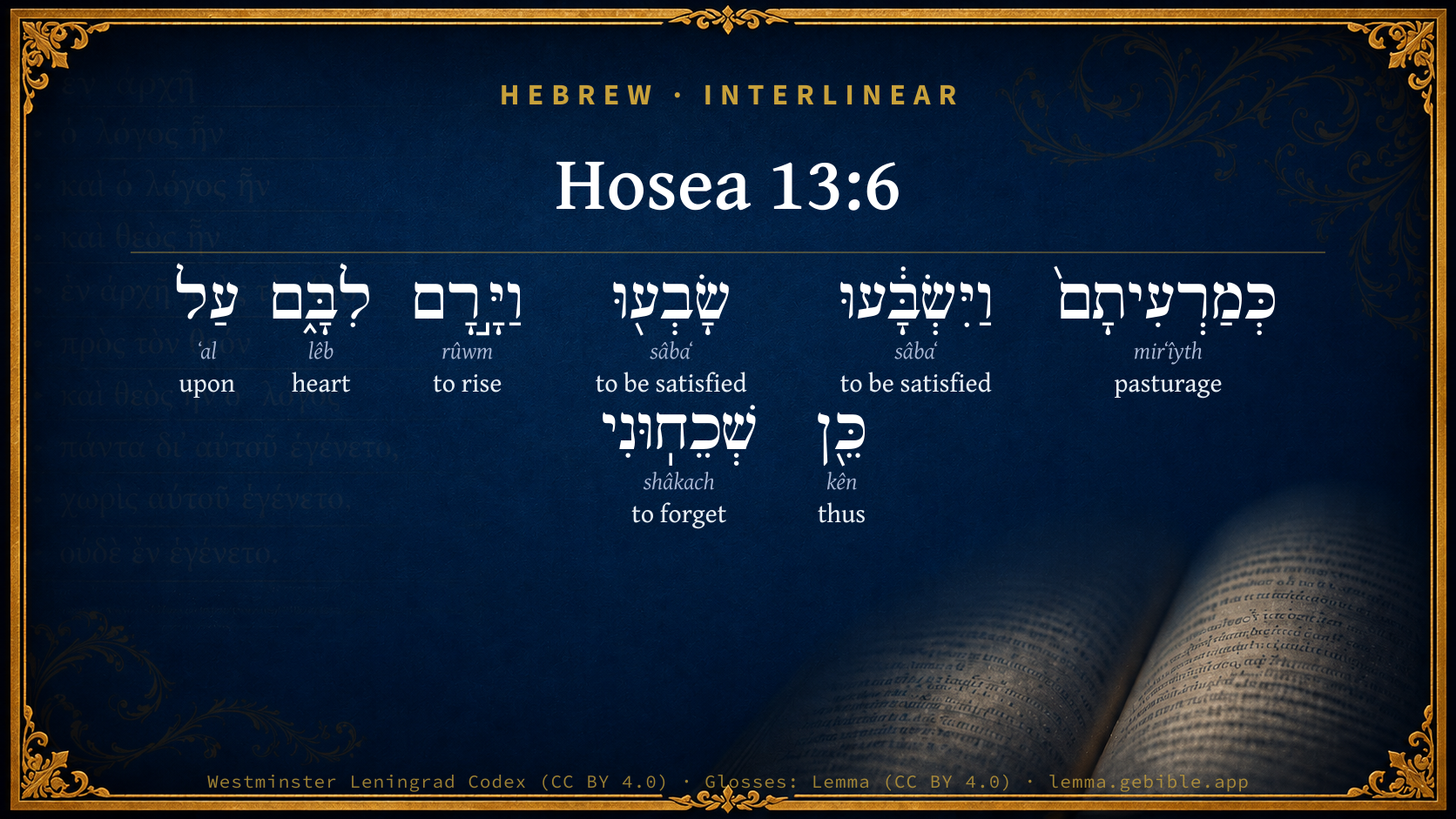
Hebrew (Westminster Leningrad Codex) Hosea 13:6 appears in the Hebrew Old Testament. The text above is from the Westminster Leningrad Codex. Each word links to its Strong’s number, a concise gloss, and parsing drawn from the Open Scriptures Hebrew Bible morphology. Click any word for its full Brown-Driver-Briggs (BDB) entry.
Download image
Cite this verse

Hosea 13:6 (World English Bible). Public Domain. Lemma interlinear Bible study tool, https://lemma.gebible.app/v/hosea/13/6.

Show BibTeX & RIS
BibTeX
RIS
English Translation
According to their pasture, so were they filled; They were filled, and their heart was exalted. Therefore they have forgotten me.
World English Bible · Public Domain
Download a study sheet

One document with this verse’s original text, its word-by-word gloss line, the meaning frame, cross-references with their text, attributed commentary, and full source and license credits — printable, and it pastes into notes with its structure intact.

This verse Autodidact and up

Study sheet (.html) Plain text (.txt)

A passage Seminary Student

Up to 50 verses in one chapter. A passage sheet keeps up to 6 commentary sources and 12 cross-references per verse, in the order this page ranks them, and says so on the sheet whenever that leaves anything out. Ask for a single verse and you get the Autodidact verse sheet above.

Everything on this page stays free to read, with no account — the sheet is a download of what is already on screen, not access to it.

Want to remove ads? Support Godless Engineer
Compare translations 3

The same verse in 3 English versions, stacked beneath the original-language interlinear above. Click any original word for its lexicon entry.

Each is an independent rendering of the whole verse — the interlinear is not word-aligned to these translations.

Highlighted words mark where these versions differ — a whole-verse word diff, not a word-by-word alignment.

  • World English Bible Public Domain
    According to their pasture, so were they filled; They were filled, and their heart was exalted. Therefore they have forgotten me.
  • King James Version Public Domain
    According to their pasture, so were they filled; they were filled, and their heart was exalted; therefore have they forgotten me.
  • unfoldingWord Literal Text CC BY-SA 4.0
    According to their pasturage, then they became satisfied; they were satisfied, and their heart was lifted up. Therefore they forgot me.

unfoldingWord Literal Text — © unfoldingWord, licensed CC BY-SA 4.0. Word-aligned USFM3 via Door43 (git.door43.org/unfoldingWord/en_ult).

Versions to compare (up to 4)

3 of 4 selected

Show all 18 translations

Every available English version of this verse, each an independent rendering of the whole verse.

  • World English Bible Public Domain
    According to their pasture, so were they filled; They were filled, and their heart was exalted. Therefore they have forgotten me.
  • Berean Standard Bible Public Domain
    When they had pasture, they became satisfied; when they were satisfied, their hearts became proud, and as a result they forgot Me.
  • Majority Standard Bible Public Domain
    When they had pasture, they became satisfied; when they were satisfied, their hearts became proud, and as a result they forgot Me.
  • King James Version Public Domain
    According to their pasture, so were they filled; they were filled, and their heart was exalted; therefore have they forgotten me.
  • American Standard Version (1901) Public Domain
    According to their pasture, so were they filled; they were filled, and their heart was exalted: therefore have they forgotten me.
  • Revised Version (1885) Public Domain
    According to their pasture, so were they filled; they were filled, and their heart was exalted: therefore have they forgotten me.
  • Geneva Bible (1599) Public Domain
    As in their pastures, so were they filled: they were filled, and their heart was exalted: therefore haue they forgotten me.
  • Douay-Rheims (1899) Public Domain
    According to their pastures they were filled, and were made full: and they lifted up their heart, and have forgotten me.
  • Young's Literal Translation Public Domain
    According to their feedings they are satiated, They have been satiated, And their heart is lifted up, Therefore they have forgotten Me,
  • Literal Standard Version CC BY-SA 4.0
    They are satiated according to their feedings, || They have been satiated, || And their heart is lifted up, || Therefore they have forgotten Me,
  • Unlocked Literal Bible CC BY-SA 4.0
    When you had pasture, then you became full; and when you were filled, your heart became lifted up. For that reason you forgot me.
  • unfoldingWord Literal Text CC BY-SA 4.0
    According to their pasturage, then they became satisfied; they were satisfied, and their heart was lifted up. Therefore they forgot me.
  • Darby Bible Public Domain
    According to their pasture, they became full; they became full, and their heart was exalted: therefore have they forgotten me.
  • World Messianic Bible Public Domain
    According to their pasture, so were they filled; they were filled, and their heart was exalted. Therefore they have forgotten me.
  • Webster's Bible Public Domain
    According to their pasture, so were they filled; they were filled, and their heart was exalted; therefore have they forgotten me.
  • Free Bible Version CC BY-SA 4.0
    and they were satisfied. But when they were satisfied they became arrogant, and they forgot me.
  • Bible in Basic English Public Domain
    When I gave them food they were full, and their hearts were full of pride, and they did not keep me in mind.
  • JPS Tanakh (1917) Public Domain
    When they were fed, they became full, they were filled, and their heart was exalted; therefore have they forgotten Me.

Literal Standard Version (2020), Covenant Press — licensed CC BY-SA 4.0. Text via the HelloAO Bible API (eBible.org). Unlocked Literal Bible (unfoldingWord) — licensed CC BY-SA 4.0. Text via the HelloAO Bible API (eBible.org). unfoldingWord Literal Text — © unfoldingWord, licensed CC BY-SA 4.0. Word-aligned USFM3 via Door43 (git.door43.org/unfoldingWord/en_ult). Free Bible Version, Dr. Jonathan Gallagher — licensed CC BY-SA 4.0. Text via the HelloAO Bible API (eBible.org).

Word by word

More ways to search: Search by grammar → Find every occurrence → Compare this word →

Practice this passage: Drill this verse → Learn its vocabulary →

כְּמַרְעִיתָם֙
mirʻîyth
H4830
“like/as · pasturage · their”
Preposition + Noun, Common, Feminine, Singular, Construct + Suffix, Personal, 3rd Person, Masculine, Plural
Part of Speech
Preposition + Noun
Type
Common
Gender
Feminine
Number
Singular
State
Construct
Full BDB Definition

Origin: from H7462 in the sense of feeding

TWOT: 2185c

pasturing, pasturage, shepherding - pasturing, shepherding - pasturage - flock (metonymy)
  1. וַיִּשְׂבָּ֔עוּ sâbaʻ H7646 “and · to be satisfied” Conjunction + Verb, Qal, Sequential Imperfect, 3rd Person, Masculine, Plural
  2. שָׂבְע֖וּ sâbaʻ H7646 “to be satisfied” Verb, Qal, Perfect, 3rd Person, Common, Plural
  3. וַיָּ֣רָם rûwm H7311 “and · to rise” Conjunction + Verb, Qal, Sequential Imperfect, 3rd Person, Masculine, Singular
  4. לִבָּ֑ם lêb H3820 “heart · their” Noun, Common, Masculine, Singular, Construct + Suffix, Personal, 3rd Person, Masculine, Plural
  5. עַל ʻal H5921 “upon” Preposition
  6. כֵּ֖ן kên H3651 “thus” Particle, Demonstrative
  7. שְׁכֵחֽוּנִי shâkach H7911 “to forget · me” Verb, Qal, Perfect, 3rd Person, Common, Plural + Suffix, Personal, 1st Person, Common, Singular

About this verse

These counts appear in no published source. They are computed here, from the morphology-tagged text and Lemma’s own curated glosses. What Lemma adds →

8
words
7
distinct lemmas
Prophets
section

Notable vocabulary

The rarest word here is כְּמַרְעִיתָם֙ pasturage H4830 — appearing just 10 times in the whole Hebrew Bible.

Shared distinctive vocabulary

כְּמַרְעִיתָם֙ pasturage H4830 occurs in 10 verses of the Hebrew Bible. Also found in:

Grammatical profile

  • 4 verbs
  • 2 nouns
  • 1 preposition
  • 1 particle

Verb forms

  • וַיִּשְׂבָּ֔עוּ Qal · Sequential Imperfect
  • שָׂבְע֖וּ Qal · Perfect
  • וַיָּ֣רָם Qal · Sequential Imperfect
  • שְׁכֵחֽוּנִי Qal · Perfect

Repetition

A word recurs within this verse — often emphatic in Hebrew:

  • וַיִּשְׂבָּ֔עוּ to be satisfied H7646 ×2

Hebrew & Septuagint length

In English translation the verse runs 21 words from the Hebrew and 18 from the Septuagint (LXX English) — closely comparable.

A rough comparison of the two English renderings, which tokenize alike — not a word-level alignment.

Word counts can differ between the Hebrew and the Greek without any difference in meaning — e.g. the Hebrew direct-object marker אֵת has no separate Greek word, and Greek often adds the article ὁ.

Cross-references

12

Topical passages linked to Hosea 13:6 in the Treasury of Scripture Knowledge — connected by theme and wording, ordered by reader-vote popularity; previews shown in the World English Bible.

  • Deuteronomy 32:13–15 He made him ride on the high places of the earth, He ate the increase of the field; He made him to suck honey out of the rock, Oil out of the flinty rock;
  • Deuteronomy 8:12–14 lest, when you have eaten and are full, and have built goodly houses, and lived therein;
  • Deuteronomy 6:10–12 It shall be, when Yahweh your God shall bring you into the land which he swore to your fathers, to Abraham, to Isaac, and to Jacob, to give you, great and goodly cities, which you didn't build,
  • Deuteronomy 32:18 Of the Rock that became your father, you are unmindful, Have forgotten God who gave you birth.
  • Nehemiah 9:35 For they have not served you in their kingdom, and in your great goodness that you gave them, and in the large and fat land which you gave before them, neither turned they from their wicked works.
  • Psalms 10:4 The wicked, in the pride of his face, Has no room in his thoughts for God.
  • Nehemiah 9:25–26 They took fortified cities, and a fat land, and possessed houses full of all good things, cisterns hewn out, vineyards, and olive groves, and fruit trees in abundance: so they ate, and were filled, and became fat, and delighted themselves in your great goodness.
  • Isaiah 17:10 For you have forgotten the God of your salvation, and have not been mindful of the rock of your strength; therefore you plant pleasant plants, and set it with strange slips.
  • Jeremiah 2:31–32 Generation, see the word of Yahweh. Have I been a wilderness to Israel? or a land of thick darkness? why say my people, We are broken loose; we will come no more to you?
  • Hosea 2:13 I will visit on her the days of the Baals, To which she burned incense, When she decked herself with her earrings and her jewels, And went after her lovers, And forgot me," says Yahweh.
  • Hosea 8:4 They have set up kings, but not by me. They have made princes, and I didn't approve. Of their silver and their gold they have made themselves idols, That they may be cut off.
  • Hosea 10:1 Israel is a luxuriant vine that puts forth his fruit. According to the abundance of his fruit he has multiplied his altars. As their land has prospered, they have adorned their sacred stones.

Cross-references courtesy of OpenBible.info (CC BY 4.0).

Hebrew and Greek witnesses Masoretic Hebrew ↔ Greek Septuagint

The same verse in the two great witnesses to the Old Testament, shown verse-for-verse.

These are two independent witnesses, not word-aligned to each other, and the Septuagint is shown in lemma (dictionary) form.

Hebrew Hosea 13:6 Masoretic · Westminster Leningrad Codex

כְּמַרְעִיתָם֙ וַיִּשְׂבָּ֔עוּ שָׂבְע֖וּ וַיָּ֣רָם לִבָּ֑ם עַל כֵּ֖ן שְׁכֵחֽוּנִי

According to their pasture, so were they filled; They were filled, and their heart was exalted. Therefore they have forgotten me.

World English Bible · Public Domain

Greek LXX Hosea 13:6 Septuagint · lemma form

κατά ὁ νομή αὐτός καί ἐνπίμπλημι εἰς πλησμονή καί ὑψόω ὁ καρδία αὐτός ἕνεκα οὗτος ἐπιλανθάνω ἐγώ

According to their pastures, so they were completely filled; and their hearts were exalted; therefore they forgot me.

LXX2012 (modern English Septuagint) · Public Domain

Hebrew: Westminster Leningrad Codex (CC BY 4.0). Greek: Septuagint (public domain); English from LXX2012 (modern English Septuagint) (Public Domain). How the Septuagint differs from the Hebrew →

Targum (Aramaic paraphrase)

1

The Targum is the ancient Jewish Aramaic paraphrase of the Hebrew Scriptures — an interpretive translation, not the Hebrew text itself. Onkelos (literal) and Pseudo-Jonathan (expansive) render the Torah, and Jonathan the Prophets. Coverage is partial: where no permissively-licensed English translation exists for a verse, only the Aramaic is shown. This is verse-level text, not a word-by-word alignment to the Hebrew.

  1. Targum Jonathan Prophets (Joshua–Malachi)
    כַּד זַנְתִּנוּן סְבַעוּ מִסְבַּע וְרָאֵם לִבְּהוֹן עַל כֵּן שְׁבַקוּ לְהוֹן יַת פּוּלְחָנִי:

    (no public-domain English translation for this verse)

    Targum Jonathan — Aramaic: “Mikraot Gedolot” (public domain). English: “Sefaria Community Translation” (CC0 1.0 (public-domain dedication)); “London "Chaldee Paraphrase," 1871” (public domain). Text via Sefaria.

Commentary

Notes on Hosea 13:6 from classic Christian and Jewish commentators (each source and its license shown beneath its notes). The classic Christian expositions comment on the surrounding passage and are grouped to its opening verse, so a note may address several verses; the Jewish commentaries on the Tanakh (Rashi and others) are per-verse, so they appear only where the commentator wrote on this verse.

Lemma curates 59 commentaries, every one of them public domain or Creative Commons licensed, each selected and text-cleaned for this edition rather than reprinted as found. About our sources →

Trapp's Complete Commentary

John Trapp

Hos 13:6 According to their pasture, so were they filled; they were filled, and their heart was exalted; therefore have they forgotten me.

Ver. 6. According to their pasture so were they filled] Saturity bred security; fulness, forgetfulness. This was a foul fault, and is much complained of, Deu 32:13-14 Psa 78:10-11. God had brought them out of a place of great drought into large and fat pastures, a land flowing with milk and honey, where he filled their "hearts with food and gladness," Act 14:17, where he fed them among the lilies, daily and daintily. But they, as if God had hired them to be wicked, basely abused his bounty to luxury, and having fulness of bread, and abundance of idleness, grew proud as Sodom, and out of measure sinful, Eze 16:49; forgetting God and his will, themselves and their duties, and running out into all excess of riot, though they had been fairly warned and commanded to the contrary, Deu 8:10, &c. Their heart grew fat as grease, and became as a foul stomach, which the more you fill it the more you spill it; or like fed horses, they grew fierce and filthy, Jer 5:7-8, there was no hoe with them, οποσον αν θρεψης μαλλον βλαψης (Hippoc.). See Eze 34:16; Eze 34:18; Eze 34:20. While they were in the wilderness God knew them, yea, he knew their souls in adversity: they both knew God, and were known of him. But now, God neither knew them so much, nor they him; they lived not upon him now, as once in the wilderness; but being "filled, yea, filled," Gal 3:1-2, (you have the word here twice together), to note how they fell upon those allowed delights, and even glutted themselves, gorged themselves; they flew upon them, as those in Saul’s time did upon the spoil of the Philistines; they fed without fear, as those Pseudo-Christians in Jude, Jdg 1:12; they gormandized, as those flesh mongers before the flood, more like beasts than men, as the Greek word signifieth, τρωγοντες, Luk 17:27. And hereupon

their hearts were exalted] Prosperity and plenty will easily blow up such a blab as pride, in the best hearts, if care be not taken to the contrary; as Agur knew, and therefore prayed, Give me a mediocrity, "lest I be full and deny," and proudly ask, "Who is the Lord?" Pro 30:9; and as Solomon felt, whose wealth did him more harm than his wisdom did him good, Ecc 2:1-26; and as Hezekiah experimented to his cost, Isa 39:1-8. Indeed of Jehoshaphat it is noted, 2Ch 17:3, that he walked in the first ways of David his father (for the truth is, David’s first ways were his best ways; neither was he ever so good and tender as when he was hunted as a partridge in the mountains); and of Vespasian it is reported that he was made the better man by being made emperor ( Vespasianus unus accepto imperio melior rectus); but he was a rare bird and had scarce his fellow again. It is the property of prosperity to turn out the heart and ubi uber, ibi tuber. where there is pleny there is a tumor. See Psa 73:3; Psa 73:6 1Ti 6:17, they eat and are swelled, as being poisoned with pride; they are fatted, but it is for the slaughter.

Therefore have they forgotten me] Non tam theoretice quam practice, they remember there is a God, but they honour him not as God; they forget their engagements to him, and through the pride of their countenance, they seek not after him, Psa 10:4, they consider not their distance, their dependence, &c. Now of all things God cannot abide to be forgotten, Isa 1:2-3, it is a sin that he can hardly pardon, Jer 5:7. {See Trapp on "Hos 8:14"}

John Trapp, A Commentary or Exposition upon All the Books of the Old and New Testament (1647–1656) — public domain. Text from a community e-Sword module.

The Biblical Illustrator

Joseph S. Exell

Hos_13:6

According to their pasture, so were they filled . . . therefore have they forgotten Me.

The conjunction of secular prosperity and spiritual perversity

Here are men in good physical circumstances, in rich pastures well fed, getting thereby proud in heart and forgetful of their God.

I. It is a common conjunction. Wealth in the sinful heart tends--

1. To promote self-indulgence- the pampering of appetites and the gratification of sinful lusts.

2. To foster indolence. It weakens and generally destroys the motive to industry.

II. It is an incongruous conjunction. Secular prosperity ought to lead to spiritual devotion.

1. The more temporal good we have, the more means we have for the promotion of spiritual excellence. Property puts us in possession of a power to procure books, leisure, teachers, and all other aids to spiritual improvement.

2. The more temporal good we have, the more motives we have for the cultivation of spiritual excellence. The Bible urges the mercies of God as an incentive to holy life: We beseech you by the mercies of God, etc.

3. The more temporal good we have, the more obligations we have for the cultivation of spiritual improvement. Thus the incongruity of the conjunction.

III. It is a sinful conjunction. The curse of heaven is on it. It is sinful--

1. Because it is an abuse of Gods blessings.

2. It involves an infraction of Gods laws.

He has commanded us in everything, by prayer and supplication, to make known our requests unto Him. (Homilist.)

Poisoned pastures

The grazing land was beautifully green, and appeared most desirable for flocks and herds. A farmer turned his sheep into the meadow, but after a short time some of them fell sick, and eventually all of them were affected. No one could understand the reason, until it was discovered that a flock of diseased sheep had previously occupied the field, the grass of which had become tainted and the pasture poisoned. How careful all should be of the books they read, the companionships they form, and the amusements in which they indulge! Do they taint the mind and poison the soul? For according to their pasture so is their life.

The Biblical Illustrator, edited by Joseph S. Exell (c. 1880s–1900s) — public domain. Text from a community e-Sword module.

Joseph Benson's Commentary

Hos 13:6-8. According to their pasture, &c. — As I was their shepherd, and provided pasture for them, so they were fully fed; they had an abundant plenty of all things. And their heart was exalted — The consequence of their having this plenty was, that from thence they grew proud and high-minded. Therefore they have forgotten me — They so abused my kindness to them, as to make it the occasion of their ingratitude; “for in the pride of their heart, which the miraculous supply of their wants for so long a time produced in them, they forgot their benefactor.” Therefore I will be unto them as a lion — That suddenly seizes upon and tears his prey: that is, I will utterly consume them from being a nation, and give them up into the hands of such enemies as will show them no mercy; as a leopard by the way — That lies in wait by the way; will I observe them — Watch for them, that I may be sure to take them, or watch all opportunities to destroy them. I will meet them as a bear, &c. — In the greatest fury imaginable; bereaved of her whelps — A circumstance which adds a particular degree of fierceness. “They never venture to fire upon a young bear when the mother is near: for if the cub drop, she becomes enraged to a degree little short of madness; and if she get a sight of the enemy, will only quit her revenge with her life.” — Cook’s Voyage, vol. 3. page 307. And will rend the caul of their heart — The seat of the blood, with which wild beasts love to glut themselves. The wild beast shall tear them — The Assyrian shall prove as a wild beast to them. The word תבקעם, here used, signifies, shall cleave them, or rip them. Bishop Horsley renders it, shall tear them limb from limb; observing, “The verb expresses a violent distraction and severing of united parts in any manner: and is to be differently rendered with regard to the particular agent and patient. When the agent is a wild beast, and the patient the beast’s prey, it must be tearing limb from limb: tearing, by itself, is inadequate.”

Joseph Benson's Commentary on the Old and New Testaments (1811–1818) — public domain. Text from a community e-Sword module.

Keil & Delitzsch

C. F. Keil & F. Delitzsch

But prosperity made Israel proud, so that it forgot its God. Hos 13:6. "As they had their pasture, they became full; they became full, and their heart was lifted up: therefore have they forgotten me." This reproof is taken almost word for word from Deu 8:11. (cf. Deu 31:20; Deu 32:15.). כּמרעיתם, answering to their pasture, i.e., because they had such good pasture in the land given them by the Lord. The very thing of which Moses warned the people in Deu 8:11 has come to pass. Therefore are the threats of the law against the rebellious fulfilled upon them.

Keil & Delitzsch — Biblical Commentary on the Old Testament (1861–1891) — public domain (CC PDM 1.0). Text via the HelloAO Bible API. (Old Testament only.)

Tyndale Open Study Notes

Tyndale Open Resources

13:6 you became proud and forgot me: They relied not on the Lord for security, but on their kings, armies, and economic prosperity (see 2:13).

Tyndale Open Study Notes — © Tyndale Open Resources, licensed CC BY-SA 4.0. Text via the HelloAO Bible API.

Jamieson, Fausset & Brown

Robert Jamieson, A. R. Fausset & David Brown

Image from cattle, waxing wanton in abundant pasture (compare Hos 2:5, Hos 2:8; Deu 32:13-15). In proportion as I fed them to the full, they were so satiated that "their heart was exalted"; a sad contrast to the time when, by God's blessing, Ephraim truly "exalted himself in Israel" (Hos 13:1).

therefore have they forgotten me--the very reason why men should remember God (namely, prosperity, which comes from Him) is the cause often of their forgetting Him. God had warned them of this danger (Deu 6:11-12).

Jamieson, Fausset & Brown — Commentary Critical and Explanatory on the Whole Bible (1871) — public domain (CC PDM 1.0). Text via the HelloAO Bible API.

Adam Clarke's Commentary

Verse 6. According to their pasture] They had a rich pasture, and were amply supplied with every good. They became exalted in their heart, forgat their God, and became a prey to their enemies. "He that exalteth himself shall be abased."

Adam Clarke's Commentary on the Bible (1810–1826) — public domain. Text from a community e-Sword/MySword module.

John Calvin's Commentaries

The Prophet shows here that the people were in every way intractable. He has indeed handled this argument in other places; but the repetition is not superfluous. After he had said that the people were ungrateful in not continuing in the service of their Redeemer, by whom they had been so kindly and bountifully treated in the desert, where they must have perished through famine and want, had not the Lord in an unwonted manner brought them help in their great necessity, he now adds, “The Lord would have also allured you by other means, had you not been of a wholly wild and barbarous disposition: but it is hence manifest, that you are utterly disobedient; for after you have been brought out of the desert, you came to rich pastures.” For the land of Israel is here compared to rich and fertile pastures; as though he said, “God has placed you in an inheritance where you might eat to the full, as when a shepherd leads his sheep to a spot especially fertile.” What did take place? To their pastures they came, and were filled; they were filled, and elevated became their heart, and they forgat me

Since, then, the Israelites had extinguished the memory of their redemption, after the Lord had fed them when hungry in the desert, and since in their fulness they rejected God, and shook off his yoke, and, like ferocious horses, kicked against him, it became evident that their nature was so unnameable, that they could by no means be reduced to obedience or submission. We shall defer the rest till tomorrow.

John Calvin's Commentaries (1540-1563) — public domain. Text from the Calvin Translation Society English edition (1840s-50s) via the Christian Classics Ethereal Library (ccel.org). Calvin's coverage is partial (roughly two-thirds of the Bible); uncommented books and verses are honest gaps, never fabricated. The 19th-century editor's footnotes and remarks are omitted so the notes are faithfully Calvin's own voice.

Ellicott's Commentary for English Readers

(6) According to their pasture.—Rather, As they pastured. (Comp. the language of Deu_8:7-18; Deu_31:20; Deu_32:15.) The gifts of Divine love concealing the giver.

A Bible Commentary for English Readers, edited by Charles John Ellicott (1878–1897) — public domain. Text from a community e-Sword module.

The Cambridge Bible for Schools and Colleges

gen. ed. J. J. S. Perowne

6. According to their pasture, &c.] Rather, When they fed, they waxed full. The idea of the verse is that Israel’s apostasy sprang from his enjoying God’s gifts without thinking of the Giver, comp. Hos_2:8, Hos_4:7, Hos_10:1. The expressions were probably prophetic commonplaces; comp. Deu_8:11-15; Deu_31:20; Deu_32:15; Deu_32:18.

The Cambridge Bible for Schools and Colleges (gen. ed. J. J. S. Perowne; Cambridge University Press, 1878–1918) — public domain. Text from a community e-Sword module.

John Gill's Exposition

According to their pasture, so were they filled,.... When they came into the land of Canaan, which was a land flowing with milk and honey, they were like a flock of sheep brought from short commons to a good pasture; and there they tilled themselves to the fail, and indulged to luxury and excess, pampered themselves, and made provision for the flesh to fulfil its lusts, and became carnal and sensual:

they were filled, and their hearts were exalted: they were elated with their plenty, and grew proud and haughty, and attributed their fulness not to the goodness of God, but to their own excellency and merit; and put their trust and confidence in their affluence, and not in the Lord; and thought themselves safe and secure, and out of all danger, and concluded it would never be otherwise with them:

therefore have they forgotten me; the Author of their beings, the Father of their mercies, and God of all their comforts; they forgot to give him praise and glory for their abundance; to place their trust and have their dependence on him, and to serve and worship him; this was the consequence of their luxury and pride. The Targum is,

"therefore they left my worship;''

they waxed fat, and kicked, and lightly esteemed and forsook the God and Rock of their salvation, Deu 32:15.

John Gill's Exposition of the Whole Bible (1746–1763) — public domain (CC PDM 1.0). Text via the HelloAO Bible API.

Albert Barnes' Notes on the Bible

According to their pasture, so were they filled - o: “He implies that their way of being ‘filled’ was neither good nor praiseworthy, in that he says, ‘they were filled according to their pastures.’ What or of what kind were these “their pastures?” What they longed for, what they murmured for, and spoke evil of God. For instance, when they said, ‘who wil give us flesh to eat? We remember the flesh which we did eat in Egypt freely. Our soul is dried up, because our eyes see nothing but this manna’ Num 11:4-6. Since they desired such things in such wise, and, desiring, were filled with them to loathing, well are they called ‘their pastures.’ For they sought God, not for Himself, but for them. They who follow God for Himself, things of this sort are not called ‘their’ pastures, but the word of God is their pasture, according to that, ‘Man shall not live by bread alone, but by every word, which proceedeth out of the mouth of God’ Deu 8:3.

These words, ‘according to their pastures,’ convey strong blame. It is as if he said, ‘in their eating and drinking, they received their whole reward for leaving the land of Egypt and receiving for a time the law of God.’ It is sin, to follow God for such ‘pastures.’ Blaming such in the Gospel, Jesus saith, ‘Verily, verily, I say unto you, ye seek Me, not because ye saw the miracles, but because ye did eat of the loaves and were filled. Labor not for the meat which perisheth, but for that which endureth unto everlasting life’ Joh 6:26-27. In like way, let all think themselves blamed, who attend the altar of Christ, not for the love of the sacraments which they celebrate, but only to ‘live of the altar.’ This fullness is like that of which the Psalmist says, ‘The Lord gave them their desire and sent leanness withal into their bones’ Psa 106:15. For such fullness of the belly generates elation of spirit; such satiety produces forgetfulness of God.” It is more difficult to bear prosperity than adversity. They who, in the waste howling wilderness, had been retained in a certain degree of duty, forgat God altogether in the good land which he had given them. Whence it follows;

They were filled, and their heart was exalted; therefore have they forgotten Me - For they owned not that they had all from Him, therefore they were puffed up with pride, and forgot Him in and by reason of His gifts. This was the aggravation of their sin, with which Hosea often reproaches them Hos 2:5; Hos 4:7; Hos 10:1. They abused God’s gifts, (as Christians do now) against Himself, and did the more evil, the more good God was to them. God had forewarned them of this peril, “When thou shalt have eaten and be full, beware lest thou forget the Lord which brought thee forth out of the land of Egypt, from the house of bondage” (Deu 6:11-12; add Deu 8:11, ...). He pictured it to them with the song of Moses; “Jeshurun waxed fat and kicked; thou art waxen fat; thou art grown thick; thou art covered with fatness; then he forsook God which made him; thou hast forgotten God that formed thee” Deu 32:15, Deu 32:18.

They acted (as in one way or other do most Christians now,) as though God had commanded what he foretold of their evil deeds, or what he warned them against. “As their fathers did, so did they” Act 7:51. “They walked in the statutes of the pagan, whom the Lord cast out from before the children of Israel, and of the kings of Israel which they made. They did wicked things to provoke the Lord to anger. And the Lord testified against Israel and against Judah by all the prophets and by all the seers, saying, turn ye from your evil ways. And they hearkened not, and hardened their necks, like to the neck of their fathers, that did not believe in the Lord their God” 2Ki 17:8, 2Ki 17:11, 2Ki 17:13-14. : “The words are true also of those rich and ungrateful, whom God hath filled with spiritual or temporal goods. But they, ‘being in honor, and having no understanding,’ abuse the gifts of God, and, becoming unworthy of the benefits which they have received, have their hearts uplifted and swollen with pride, despising others, ‘glorying as though they had not received,’ and not obeying the commands of God. Of such the Lord saith in Isaiah, ‘I have nourished and brought up children and they have rebelled against Me. ‘“

Albert Barnes' Notes on the Bible (1834–1885) — public domain. Text from a community e-Sword/MySword module.

Haydock's Catholic Bible Commentary

Pastures: the more they were indulged. (Haydock) (Deuteronomy xxxii. 15.)

George Leo Haydock (1774–1849), Haydock's Catholic Family Bible and Commentary, 1859 edition — public domain. Excludes Psalms (Douay-Rheims chapter numbering differs from Protestant) and Deuterocanonical books (Catholic canon only).

Matthew Poole's English Annotations

According to their pasture, so were they filled; when they were come into Canaan, that land of springs, brooks, and rivers, that land of wheat, barley, vines, olives, and figs, as Deu 8:7-9; when they had abundance of all things for delight, as well as for necessary sustenance; when I had, like a good, careful, and wise shepherd, brought them into this rich pasture; they, like hungry beasts, ate to excess, ran into luxury and riot; epicure like, gorged themselves with sweet wines and delicious fare.

They were filled: either this is a reduplication of the charge to confirm it, I say, they thus luxuriously lived; or else it is elliptical, and to be made out thus,

And so soon as they were filled; and thus it will be parallel to that,

Jeshurun waxed fat, Deu 32:13-15.

Their heart was exalted; grew proud, entertained high thoughts of their progenitors’ worth, their nobleness by descent, their worthiness and righteousness above other people; they thought of God as of man, that he proportioned his blessings to what excellency was found in those he did good to.

Therefore have they forgotten me; so they have forgotten me, who found them in slavery, poverty, reproach, and tears in Egypt, out of which I saved them; and they have most scandalously made them gods, Worshipped them, and with sacrilegious unthankfulness given the praise of all I did for them to dumb idols, though I warned them of it beforehand, Deu 6:11,12; 8:13,14.

Matthew Poole's English Annotations on the Holy Bible (1683–1685) — public domain. Text from a community e-Sword/MySword module.

Whedon's Commentary on the Bible

Daniel D. Whedon

6. Jehovah’s care for Israel and the resulting prosperity failed to inspire gratitude; on the contrary, it made the people proud and arrogant and caused them to forget God.

According to their pasture — The rich blessings bestowed upon them.

They were filled — With prosperity; but they failed to recognize the giver (Hos_2:8; Hos_4:7; Hos_10:1; compare Deu_8:11 ff; Deu_31:20, etc.). The verb is repeated for the sake of emphasis. It is possible, however, that the two verb forms, with a slight change in the second, should be combined to form one expression, “They were completely filled.”

Their heart was exalted — Prosperity caused pride and arrogance.

Forgotten me — Arrogance led to forgetfulness of God (Hos_8:14; Isa_17:10); they felt that they could get along without the divine help.

Daniel D. Whedon (gen. ed.), Commentary on the Old and New Testaments (1874–1909) — public domain. Text from a community e-Sword module.

The Pulpit Commentary

According to their pasture so were they filled. The literal rendering is, according to their pasturing so were they filled. The reference is rather to the care in pasturing than to the pasture-ground. By God"s care to the sheep of his pasture they waxed full. They were filled, and their heart was exalted. Two consequences followed from God"s great goodness to Israel the immediate consequence was pride of heart; the more remote was forgetfulness of God. Perhaps these results should rather be regarded as concurrent, being in point of time simultaneous or nearly so. Therefore have they forgotten me. This forgetfulness of God is identified with the abandonment of his worship in the Chaldee Version, which is, "They have abandoned my service." The metaphor contained in this verse is taken from a domestic animal, which, in a too luxuriant pasture, becomes headstrong and unmanageable. Thus Rash: "As soon as they came into the land of their pasture, they were filled." The last clause of the verse notices the misuse which Israel made of the riches and blessing of Jehovah, by forgetting their gracious Benefactor; this the prophet attributes to the abuse of the blessings so richly bestowed upon them. Aben Ezra identifies the blessings here mentioned with those vouchsafed to them on their entrance into Canaan; thus: "The prophet enumerates the benefits which Jehovah bestowed on their fathers when they came out of the wilderness into the land of Canaan." Kimchi quotes, as a parallel to this passage, Deuteronomy 8, of which it is undoubtedly a reminiscence; he says, "When they entered into the place of their pasture, and it was the land of Canaan, they had all good, and were filled; and their heart was exalted, and they forgot me, as it is said in the Thorah that they were ready to do so. He said, "Lest when thou hast eaten and art full... then thine heart be lifted up, and then forget the Lord thy God, which brought thee forth out of the land of Egypt... who led thee through that great and terrible wilderness... who fed thee in the wilderness.

Forgetting God.

The conduct of Israel in the wilderness was an anticipation and prediction of their national history generally. The parallelism suggested itself to the minds of the prophets, who evidently referred to the books of Moses to find there a description and a censure of their own contemporaries.

I THE CAUSE OF FORGETFULNESS OF GOD.

1. Generally speaking, this sin arises from absorption in earthly pursuits and pleasures.

2. Particularly it may be learned from this passage and the lesson is enforced by daily observation that prosperity is the occasion of irreligion. The more this world"s good is sought and prized, the more it often proves to be the case that the great Giver of all good is forgotten.

II THE SIN AND GUILT OF FORGETTING GOD.

1. This appears from human dependence upon the Maker and Ruler of all.

2. And from the consequent indebtedness of the creature to the Creator. To him men owe all they have, and it is the basest ingratitude to forget the one Divine Benefactor.

3. And from their responsibility to God. Life has to be accounted for, at last, before him who gave it as a sacred trust. If the trust has been abused, such abuse is sin, and sin of the deepest dye.

III THE CONSEQUENCES OF FORGETTING GOD.

1. Moral deterioration will certainly follow. The soul from which God is banished is degraded and ruined by the absence of what alone can dignify and bless.

2. Judgment cannot be escaped. If men forget God he will indeed remember them, but he cannot remember them "for good. T.

The Pulpit Commentary (1880–1919), ed. H.D.M. Spence-Jones & Joseph S. Exell — public domain. Text from a community e-Sword module.

John Wesley's Explanatory Notes

Their pasture - When they were come into Canaan, and had abundance of all things, they ran into luxury. Was exalted - They grew proud.

John Wesley, Explanatory Notes Upon the Whole Bible (1754–1765) — public domain. Text via the GEBible commentary corpus.

Rashi

Rabbi Shlomo Yitzchaki (Rashi)

When they grazed When they entered the land of their pasture and they were sated, then...

they were sated and their heart became haughty (Ex. 7:20) “And he lifted (וַיָרֶם) the staff,” is an expression of lifting something else. “Became haughty (וַיָרָם)” here means that he himself was lifted.

Rashi on the Tanakh — English translations: “The Judaica Press complete Tanach with Rashi, translated by A. J. Rosenberg” (CC BY 4.0); “Pentateuch with Rashi's commentary by M. Rosenbaum and A.M. Silbermann, 1929-1934” (public domain); “The Metsudah Tanach series, Lakewood, N.J” (CC BY 4.0); and “The Book of Joshua, Metsudah Publications, 1997” (CC BY 4.0). Text via Sefaria.

Lesson kit

Teaching starters — assembled from the data on this page, not authored interpretation. Every prompt links to the verse data it draws on. Edit before teaching.

Hosea, in the Prophets, opens this verse with 8 words (7 distinct Hebrew lemmas). Its most distinctive word is mirʻîyth (“pasturage”). A historical commentator’s framing appears above. Read the whole chapter for the surrounding context.

Discussion questions

  1. The word mirʻîyth carries the sense “pasturage.” How does it shape the verse?
  2. Psalms 74:1 shares the word «pasturage» with this verse. How do the two illuminate each other?
  3. “to be satisfied” occurs 2× in this one verse. What is the effect of the repetition?
  4. The translations on this page render this verse differently — a whole-verse word diff, not a word-by-word alignment. What might account for the different wordings?
  5. The verb «וַיִּשְׂבָּ֔עוּ» is Qal Sequential Imperfect. How does its form color the action?
  6. Reading how Trapp's Complete Commentary and The Biblical Illustrator read this verse, where do the two commentators agree and where do they part?

Things to notice

  • These translations choose different wording for 11 words in this verse.
  • “to be satisfied” occurs 2× in this single verse.
  • 7 distinct Hebrew lemmas span 8 words in this verse.

Reading settings

Reading text

Shown beneath each verse's original-language words.

Old Testament
Old Testament edition

Read the OT as the Masoretic Hebrew (MT) or the Greek Septuagint (LXX).

English shown for the Greek Septuagint (in the Hebrew ↔ Greek comparison).

Comparing translations? Open the Compare panel on any verse page to stack up to four side by side.