
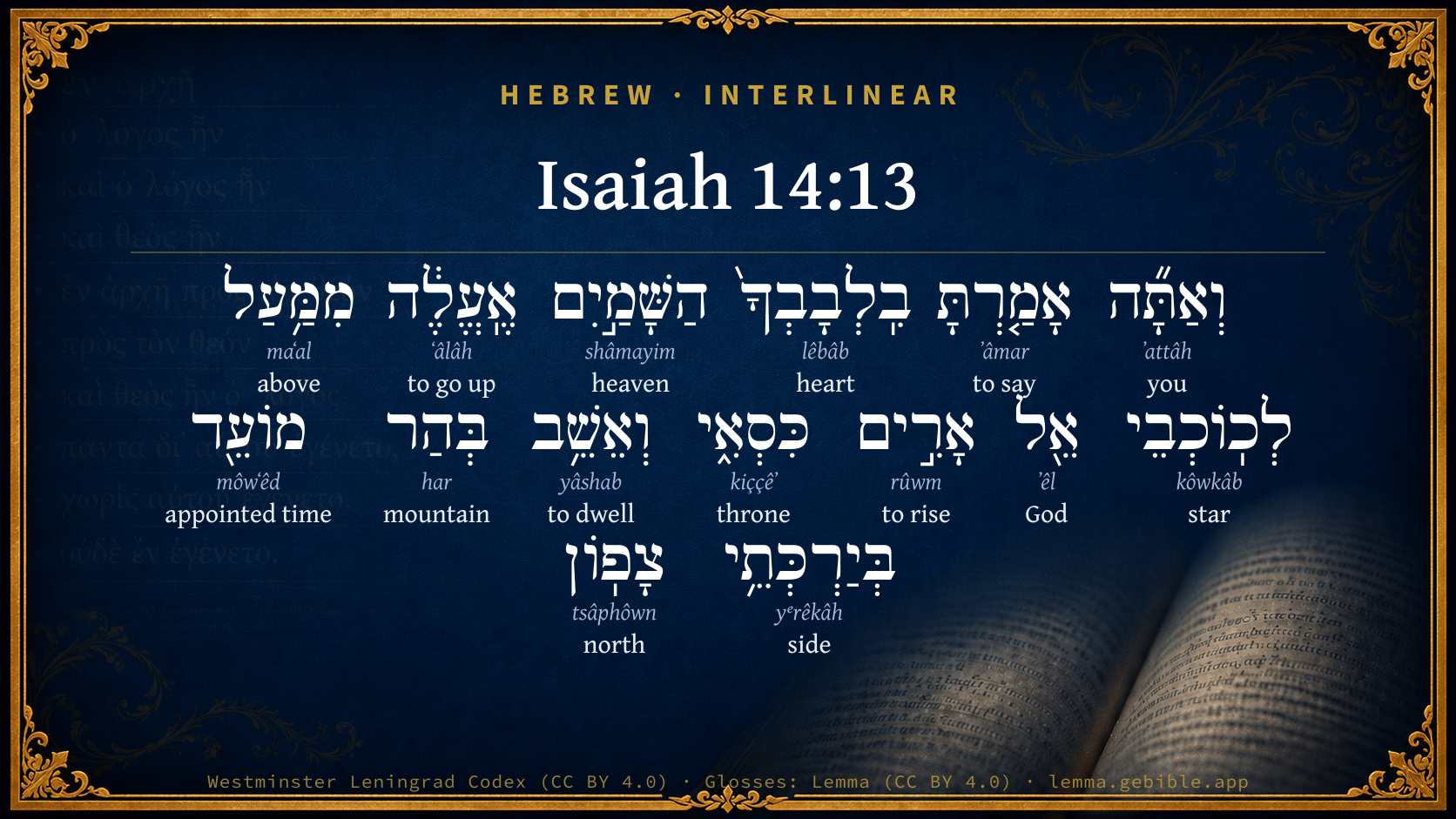
Isaiah 14:13

Hebrew (Westminster Leningrad Codex) Isaiah 14:13 appears in the Hebrew Old Testament. The text above is from the Westminster Leningrad Codex. Each word links to its Strong’s number, a concise gloss, and parsing drawn from the Open Scriptures Hebrew Bible morphology. Click any word for its full Brown-Driver-Briggs (BDB) entry.
Download image
Cite this verse

Isaiah 14:13 (World English Bible). Public Domain. Lemma interlinear Bible study tool, https://lemma.gebible.app/v/isaiah/14/13.

Show BibTeX & RIS
BibTeX
RIS
English Translation
You said in your heart, I will ascend into heaven, I will exalt my throne above the stars of God; and I will sit on the mountain of congregation, in the uttermost parts of the north;
World English Bible · Public Domain
Download a study sheet

One document with this verse’s original text, its word-by-word gloss line, the meaning frame, cross-references with their text, attributed commentary, and full source and license credits — printable, and it pastes into notes with its structure intact.

This verse Autodidact and up

Study sheet (.html) Plain text (.txt)

A passage Seminary Student

Up to 50 verses in one chapter. A passage sheet keeps up to 6 commentary sources and 12 cross-references per verse, in the order this page ranks them, and says so on the sheet whenever that leaves anything out. Ask for a single verse and you get the Autodidact verse sheet above.

Everything on this page stays free to read, with no account — the sheet is a download of what is already on screen, not access to it.

Want to remove ads? Support Godless Engineer
Compare translations 3

The same verse in 3 English versions, stacked beneath the original-language interlinear above. Click any original word for its lexicon entry.

Each is an independent rendering of the whole verse — the interlinear is not word-aligned to these translations.

Highlighted words mark where these versions differ — a whole-verse word diff, not a word-by-word alignment.

  • World English Bible Public Domain
    You said in your heart, I will ascend into heaven, I will exalt my throne above the stars of God; and I will sit on the mountain of congregation, in the uttermost parts of the north;
  • King James Version Public Domain
    For thou hast said in thine heart, I will ascend into heaven, I will exalt my throne above the stars of God: I will sit also upon the mount of the congregation, in the sides of the north:
  • unfoldingWord Literal Text CC BY-SA 4.0
    And you, you said in your heart, ‘I will ascend the heavens; I will raise my throne above the stars of God, and I will sit on the mountain of assembly in the recesses of the north.

unfoldingWord Literal Text — © unfoldingWord, licensed CC BY-SA 4.0. Word-aligned USFM3 via Door43 (git.door43.org/unfoldingWord/en_ult).

Versions to compare (up to 4)

3 of 4 selected

Show all 18 translations

Every available English version of this verse, each an independent rendering of the whole verse.

  • World English Bible Public Domain
    You said in your heart, I will ascend into heaven, I will exalt my throne above the stars of God; and I will sit on the mountain of congregation, in the uttermost parts of the north;
  • Berean Standard Bible Public Domain
    You said in your heart: “I will ascend to the heavens; I will raise my throne above the stars of God. I will sit on the mount of assembly, in the far reaches of the north.
  • Majority Standard Bible Public Domain
    You said in your heart: “I will ascend to the heavens; I will raise my throne above the stars of God. I will sit on the mount of assembly, in the far reaches of the north.
  • King James Version Public Domain
    For thou hast said in thine heart, I will ascend into heaven, I will exalt my throne above the stars of God: I will sit also upon the mount of the congregation, in the sides of the north:
  • American Standard Version (1901) Public Domain
    And thou saidst in thy heart, I will ascend into heaven, I will exalt my throne above the stars of God; and I will sit upon the mount of congregation, in the uttermost parts of the north;
  • Revised Version (1885) Public Domain
    And thou saidst in thine heart, I will ascend into heaven, I will exalt my throne above the stars of God; and I will sit upon the mount of congregation, in the uttermost parts of the north:
  • Geneva Bible (1599) Public Domain
    Yet thou saidest in thine heart, I will ascende into heauen, and exalt my throne aboue beside the starres of God: I will sitte also vpon the mount of the Congregation in the sides of the North.
  • Douay-Rheims (1899) Public Domain
    And thou saidst in thy heart: I will ascend into heaven, I will exalt my throne above the stars of God, I will sit in the mountain of the covenant, in the sides of the north.
  • Young's Literal Translation Public Domain
    And thou saidst in thy heart: the heavens I go up, Above stars of God I raise my throne, And I sit in the mount of meeting in the sides of the north.
  • Literal Standard Version CC BY-SA 4.0
    And you said in your heart: I go up into the heavens, || I raise my throne above the stars of God, || And I sit on the mountain of meeting in the sides of the north.
  • Unlocked Literal Bible CC BY-SA 4.0
    You had said in your heart, 'I will ascend into heaven, I will exalt my throne above the stars of God, and I will sit on the mount of assembly, in the far reaches of the north.
  • unfoldingWord Literal Text CC BY-SA 4.0
    And you, you said in your heart, ‘I will ascend the heavens; I will raise my throne above the stars of God, and I will sit on the mountain of assembly in the recesses of the north.
  • Darby Bible Public Domain
    And thou that didst say in thy heart, I will ascend into the heavens, I will exalt my throne above the stars of ùGod, and I will sit upon the mount of assembly, in the recesses of the north;
  • World Messianic Bible Public Domain
    You said in your heart, “I will ascend into heaven! I will exalt my throne above the stars of God! I will sit on the mountain of assembly, in the far north!
  • Webster's Bible Public Domain
    For thou hast said in thy heart, I will ascend into heaven, I will exalt my throne above the stars of God: I will sit also upon the mount of the congregation, in the sides of the north:
  • Free Bible Version CC BY-SA 4.0
    You said to yourself: ‘I will ascend to heaven. I will raise my throne above the stars of God. I will sit enthroned on the mountain of meeting, the summit of the northern mountain.
  • Bible in Basic English Public Domain
    For you said in your heart, I will go up to heaven, I will make my seat higher than the stars of God; I will take my place on the mountain of the meeting-place of the gods, in the inmost parts of the north.
  • JPS Tanakh (1917) Public Domain
    And thou saidst in thy heart: 'I will ascend into heaven, above the stars of God will I exalt my throne, and I will sit upon the mount of meeting, in the uttermost parts of the north;

Literal Standard Version (2020), Covenant Press — licensed CC BY-SA 4.0. Text via the HelloAO Bible API (eBible.org). Unlocked Literal Bible (unfoldingWord) — licensed CC BY-SA 4.0. Text via the HelloAO Bible API (eBible.org). unfoldingWord Literal Text — © unfoldingWord, licensed CC BY-SA 4.0. Word-aligned USFM3 via Door43 (git.door43.org/unfoldingWord/en_ult). Free Bible Version, Dr. Jonathan Gallagher — licensed CC BY-SA 4.0. Text via the HelloAO Bible API (eBible.org).

Word by word

More ways to search: Search by grammar → Find every occurrence → Compare this word →

Practice this passage: Drill this verse → Learn its vocabulary →

בְּיַרְכְּתֵ֥י
yᵉrêkâh
H3411
“in/at · sides of”
Preposition + Noun, Common, Feminine, Dual, Construct
Part of Speech
Preposition + Noun
Type
Common
Gender
Feminine
Number
Dual
State
Construct
Full BDB Definition

Origin: from H3409

TWOT: 916b

flank, side, extreme parts, recesses - side - sides, recesses (dual)
  1. וְאַתָּ֞ה ʼattâh H859 “and · you” Conjunction + Pronoun, Personal, 2nd Person, Masculine, Singular
  2. אָמַ֤רְתָּ ʼâmar H559 “to say” Verb, Qal, Perfect, 2nd Person, Masculine, Singular
  3. בִֽלְבָבְךָ֙ lêbâb H3824 “in/at · heart · your” Preposition + Noun, Common, Masculine, Singular, Construct + Suffix, Personal, 2nd Person, Masculine, Singular
  4. הַשָּׁמַ֣יִם shâmayim H8064 “the · heaven(s)” Particle, Definite Article + Noun, Common, Masculine, Plural, Absolute
  5. אֶֽעֱלֶ֔ה ʻâlâh H5927 “to go up” Verb, Qal, Imperfect, 1st Person, Common, Singular
  6. מִמַּ֥עַל maʻal H4605 “from · above” Preposition + Adverb
  7. לְכֽוֹכְבֵי kôwkâb H3556 “to/for · stars of” Preposition + Noun, Common, Masculine, Plural, Construct
  8. אֵ֖ל ʼêl H410 “God” Noun, Common, Masculine, Singular, Absolute
  9. אָרִ֣ים rûwm H7311 “to rise” Verb, Hiphil, Imperfect, 1st Person, Common, Singular
  10. כִּסְאִ֑י kiççêʼ H3678 “throne · my” Noun, Common, Masculine, Singular, Construct + Suffix, Personal, 1st Person, Common, Singular
  11. וְאֵשֵׁ֥ב yâshab H3427 “and · to dwell” Conjunction + Verb, Qal, Imperfect, 1st Person, Common, Singular
  12. בְּהַר har H2022 “in/at · mountain of” Preposition + Noun, Common, Masculine, Singular, Construct
  13. מוֹעֵ֖ד môwʻêd H4150 “appointed time” Noun, Common, Masculine, Singular, Absolute
  14. צָפֽוֹן tsâphôwn H6828 “north” Noun, Common, Feminine, Singular, Absolute

About this verse

These counts appear in no published source. They are computed here, from the morphology-tagged text and Lemma’s own curated glosses. What Lemma adds →

15
words
15
distinct lemmas
Prophets
section

Shared distinctive vocabulary

בְּיַרְכְּתֵ֥י side H3411 occurs in 28 verses of the Hebrew Bible. Also found in:

Grammatical profile

  • 4 verbs
  • 9 nouns
  • 1 pronoun
  • 1 adverb

Verb forms

  • אָמַ֤רְתָּ Qal · Perfect
  • אֶֽעֱלֶ֔ה Qal · Imperfect
  • אָרִ֣ים Hiphil · Imperfect
  • וְאֵשֵׁ֥ב Qal · Imperfect

Hebrew & Septuagint length

In English translation the verse runs 36 words from the Hebrew and 36 from the Septuagint (LXX English) — the same length.

A rough comparison of the two English renderings, which tokenize alike — not a word-level alignment.

Word counts can differ between the Hebrew and the Greek without any difference in meaning — e.g. the Hebrew direct-object marker אֵת has no separate Greek word, and Greek often adds the article ὁ.

Cross-references

15

Topical passages linked to Isaiah 14:13 in the Treasury of Scripture Knowledge — connected by theme and wording, ordered by reader-vote popularity; previews shown in the World English Bible.

  • Daniel 8:10–12 It grew great, even to the host of the sky; and some of the host and of the stars it cast down to the ground, and trampled on them.
  • Ezekiel 28:2 Son of man, tell the prince of Tyre, Thus says the Lord Yahweh: Because your heart is lifted up, and you have said, I am a god, I sit in the seat of God, in the midst of the seas; yet you are man, and not God, though you did set your heart as the heart of God;-
  • Ezekiel 28:12–16 Son of man, take up a lamentation over the king of Tyre, and tell him, Thus says the Lord Yahweh: You seal up the sum, full of wisdom, and perfect in beauty.
  • Ezekiel 29:3 speak, and say, Thus says the Lord Yahweh: Behold, I am against you, Pharaoh king of Egypt, the great monster that lies in the midst of his rivers, that has said, My river is my own, and I have made it for myself.
  • Daniel 5:22–23 You his son, Belshazzar, have not humbled your heart, though you knew all this,
  • 2 Thessalonians 2:4 he who opposes and exalts himself against all that is called God or that is worshiped; so that he sits as God in the temple of God, setting himself up as God.
  • Psalms 48:2 Beautiful in elevation, the joy of the whole earth, Is Mount Zion, on the north sides, The city of the great King.
  • Isaiah 2:2 It shall happen in the latter days, that the mountain of Yahweh's house shall be established on the top of the mountains, And shall be raised above the hills; And all nations shall flow to it.
  • Isaiah 47:7–10 You said, I shall be mistress forever; so that you did not lay these things to your heart, neither did remember the latter end of it.
  • Ezekiel 27:3 and tell Tyre, you who dwell at the entry of the sea, who are the merchant of the peoples to many isles, thus says the Lord Yahweh: You, Tyre, have said, I am perfect in beauty.
  • Zephaniah 2:15 This is the joyous city that lived carelessly, that said in her heart, "I am, and there is none besides me." How she has become a desolation, a place for animals to lie down in! Everyone who passes by her will hiss, and shake their fists.
  • Matthew 11:23 You, Capernaum, who are exalted to Heaven, you will go down to Hades. For if the mighty works had been done in Sodom which were done in you, it would have remained until this day.
  • Ezekiel 28:9 Will you yet say before him who kills you, I am God? but you are man, and not God, in the hand of him who wounds you.
  • Daniel 4:30–31 The king spoke and said, Is not this great Babylon, which I have built for the royal dwelling-place, by the might of my power and for the glory of my majesty?
  • Revelation 18:7–8 However much she glorified herself, and grew wanton, so much give her of torment and mourning. For she says in her heart, 'I sit a queen, and am no widow, and will in no way see mourning.'

Cross-references courtesy of OpenBible.info (CC BY 4.0).

Hebrew and Greek witnesses Masoretic Hebrew ↔ Greek Septuagint

The same verse in the two great witnesses to the Old Testament, shown verse-for-verse.

These are two independent witnesses, not word-aligned to each other, and the Septuagint is shown in lemma (dictionary) form.

Hebrew Isaiah 14:13 Masoretic · Westminster Leningrad Codex

וְאַתָּ֞ה אָמַ֤רְתָּ בִֽלְבָבְךָ֙ הַשָּׁמַ֣יִם אֶֽעֱלֶ֔ה מִמַּ֥עַל לְכֽוֹכְבֵי אֵ֖ל אָרִ֣ים כִּסְאִ֑י וְאֵשֵׁ֥ב בְּהַר מוֹעֵ֖ד בְּיַרְכְּתֵ֥י צָפֽוֹן

You said in your heart, I will ascend into heaven, I will exalt my throne above the stars of God; and I will sit on the mountain of congregation, in the uttermost parts of the north;

World English Bible · Public Domain

Greek LXX Isaiah 14:13 Septuagint · lemma form

σύ δέ εἶπον ἐν ὁ διάνοια σύ εἰς ὁ οὐρανός ἀναβαίνω ἐπάνω ὁ ἄστρον ὁ οὐρανός τίθημι ὁ θρόνος ἐγώ καταἵζω ἐν ὄρος ὑψηλός ἐπί ὁ ὄρος ὁ ὑψηλός ὁ πρός βορέας

But you said in your heart, I will go up to heaven, I will set my throne above the stars of heaven: I will sit on a lofty mount, on the lofty mountains toward the north:

LXX2012 (modern English Septuagint) · Public Domain

On this verse, Albert Barnes' Notes on the Bible discusses the Septuagint’s reading. Read the note in Commentary ↓

Hebrew: Westminster Leningrad Codex (CC BY 4.0). Greek: Septuagint (public domain); English from LXX2012 (modern English Septuagint) (Public Domain). How the Septuagint differs from the Hebrew →

Targum (Aramaic paraphrase)

1

The Targum is the ancient Jewish Aramaic paraphrase of the Hebrew Scriptures — an interpretive translation, not the Hebrew text itself. Onkelos (literal) and Pseudo-Jonathan (expansive) render the Torah, and Jonathan the Prophets. Coverage is partial: where no permissively-licensed English translation exists for a verse, only the Aramaic is shown. This is verse-level text, not a word-by-word alignment to the Hebrew.

  1. Targum Jonathan Prophets (Joshua–Malachi)
    וְאַתְּ אֲמַרְתְּ בְּלִבָּךְ לְרוּמָא אֶסַק עֵיל מִן עַמֵיהּ דֵאלָהָא אֲשַׁוֵי כוּרְסֵי מַלְכוּתִי וְאֶתֵּיב בְטוּר זְמַן בִּסְיָפֵי צִפּוּנָא:

    And thou, thou hast said in thy heart, I will climb up the heavens; I will place the throne of my kingdom above the people of God, and I will sit upon the mountain of the solemn assembly upon the ends of the north;

    Targum Jonathan — Aramaic: “Mikraot Gedolot” (public domain). English: “Sefaria Community Translation” (CC0 1.0 (public-domain dedication)); “London "Chaldee Paraphrase," 1871” (public domain). Text via Sefaria.

Commentary

Notes on Isaiah 14:13 from classic Christian and Jewish commentators (each source and its license shown beneath its notes). The classic Christian expositions comment on the surrounding passage and are grouped to its opening verse, so a note may address several verses; the Jewish commentaries on the Tanakh (Rashi and others) are per-verse, so they appear only where the commentator wrote on this verse.

Lemma curates 59 commentaries, every one of them public domain or Creative Commons licensed, each selected and text-cleaned for this edition rather than reprinted as found. About our sources →

Trapp's Complete Commentary

John Trapp

Isa 14:13 For thou hast said in thine heart, I will ascend into heaven, I will exalt my throne above the stars of God: I will sit also upon the mount of the congregation, in the sides of the north:

Ver. 13. For thou hast said in thine heart.] The natural heart is a palace of satanical pride; it is like unto the table of Adonibezek, at which he sat in a chair of state, and made others, even kings, to eat meat like dogs under his feet, with their thumbs cut off.

I will ascend into heaven.] Vide quomodo non satientur honore superbi. {a} Ambition, as the crocodile, grows as long as it lives, and is never satisfied.

Above the stars of God,] i.e., Above all the kings of the earth, or above the saints, {Rev 12:1} those earthly angels.

I will sit also upon the mount of the congregation.] I will sit upon the skirts of God’s Church; yea, I will set my throne upon God’s throne, and take up his room. See the like madness in Pharaoh; {Eze 29:3} that proud prince of Tyre; {Eze 28:2} Antiochus, surnamed Yεος; Herod; {Act 12:21-23} Caligula, Chosroes, Diocletian, Antichrist, of whom and his practices one cries out, O Lucifer out-deviled, &c. {2Th 2:4} One of the Pope’s parasites, Valladerius, saith of Paul V, that he was a god, lived familiarly with the Godhead, heard predestination itself whispering to him, had a place to sit in council with the most blessed Trinity, &c.

In the sides of the north.] In Mount Moriah, where the temple stood.

{a} Oecolamp.

John Trapp, A Commentary or Exposition upon All the Books of the Old and New Testament (1647–1656) — public domain. Text from a community e-Sword module.

Albert Barnes' Notes on the Bible

For thou hast said in thine heart - It was thy purpose or design.

I will ascend into heaven - Nothing could more strikingly show the arrogance of the monarch of Babylon than this impious design. The meaning is, that he intended to set himself up as supreme; he designed that all should pay homage to him; be did not intend to acknowledge the authority of God. It is not to be understood literally; but it means that he intended “not” to acknowledge any superior either in heaven or earth, but designed that himself and his laws should be regarded as supreme.

Above the stars of God - The stars which God has made. This expression is equivalent to the former that he would ascend into heaven.

I will sit also upon the mount of the congregation - The word rendered ‘congregation’ מועד mô‛êd from יעד yâ‛ad “to fix, appoint”), properly means a fixed or definite time; then an “appointed” place of meeting; then a meeting itself; an assembly, a congregation. What is referred to here it is difficult to determine. The Septuagint renders it, ‘On a high mountain, on the lofty regions which lie to the north.’ The Chaldee, ‘I will sit in the mount of covenant, in the regions of the north.’ Grotius supposes that when the king of Babylon said he would ascend into heaven, he meant the land of Judea, which was called heaven because it was dedicated to God; that when he said be would ascend above the stars, he meant to denote those ‘who were learned in the law;’ that by the ‘mount of the congregation,’ he meant mount Moriah where was the temple; and that by the ‘side of the north,’ he meant mount Zion, which, he says, was on the north of Jerusalem. It is remarkable that the usually accurate Grotius should have fallen into this error, as mount Zion was not on the north of Jerusalem, but was south of mount Moriah. Vitringa defends the same interpretation in the main, but supposes that by the ‘mount of the congregation’ is meant mount Zion, and by ‘the sides of the north;’ is meant mount Moriah lying north of Zion. He supposes that mount Zion is called ‘the mount of the congregation,’ not because the congregation of Israel assembled there, but because it was the “appointed place” where God met his people, or where he manifested himself to them, and appeals to the following places where the word which is here lrcndered ‘congregation’ is applied, in various forms, to the manifestation which God thus made Exo 25:22; Exo 29:42-43; Psa 74:8. So Lowth supposes that it refers to the place where God promised to meet with his people Exo 25:22; Exo 29:42-43, and to commune with them, and translates it ‘the mount of the divine presence.’ But to this interpretation there are great objections:

(1) The terms here employed ‘the mount of the congregation,’ ‘the sides of the north,’ are not elsewhere applied to mount Zion, and to mount Moriah.

(2) It does not correspond with the evident design of the king of Babylon. His object was not to make himself master of Zion and Moriah, but it was to exalt himself above the stars; to be elevated above all inferior beings; and to be above the gods.

(3) It is a most forced and unnatural interpretation to call the land of Judea ‘heaven,’ to speak of it as being ‘above the stars of God,’ or as ‘above the heights of the clouds;’ and it is clear that the king of Babylon had a much higher ambition, and much more arrogant pretensions, than the conquest of what to him would be the comparatively limited province of Judea.

However important that land appeared to the Jews as their country and their home; or however important it was as the place of the solemnities of the true religion, yet we are to remember that it had no such consequence in the eyes of the king of Babylon. He had no belief in the truth of the Jewish religion, and all Judea compared with his other vast domains would appear to be a very unimportant province. It is evident, therefore, I think, that the king of Babylon did not refer here to Judea, or to Zion. The leading idea of his heart, which ought to guide our interpretation, was, that he designed “to ascend in authority over all inferior beings, and to be like the Most High.” We are to remember that Babylon was a city of idolatry; and it is most probable that by ‘the mount of the congregation, in the sides of the north,’ there is reference to a belief prevalent in Babylon that the gods had their residence on some mountain of the north.

This was a common opinion among the ancients. The Hindus call that mountain “Meru;” the Persians, who are followers of Zoroaster, “Al Bordsch;” the Arabs, “Kafe;” and the Greeks, “Olympus.” The common opinion was that this mountain was in the center of the world, but the Hindoos speak of it as to the north of themselves in the Himalaya regions; the followers of Zoroaster in the mountains of Caucasus, lying to the north of their country; and the Greeks speak of Olympus, the highest mountain north of them in Thessaly. The Hindoo belief is thus referred to by Ward: ‘In the book of Karma-Vipaka, it is said that the heavenly Vishnu, Brahma, and Siva, are upon the three peaks of the mountain Su-Meru, and that at the foot of this mountain are the heavens of twenty-one other gods.’ (“View of the History, Literature, and Religion of the Hindoos,” vol. i. p. 13.) So Wilford, in a Treatise on the mountain Caucasus, in the “Asiatic Researches,” vol. vi. p. 488, says, ‘The Hindoos regard the mountain Meru as the dwelling-place of the gods.

In the Puranas it is said, that upon the mountain Meru there is eternal day, for a space of fourteen degrees around the mountain Su-Meru, and consequently eternal night for the same space on the opposite side; so the Hindoos are constrained to admit that Su-Meru is directly upon the top of the shadow of the earth, and that from the earth to that peak there is a vast cone-formed hill, dense as other earthly bodies, but invisible, impalpable, and impassable by mortals. On the side of this hill are various abodes, which, the higher one ascends, become the more beautiful, and which are made the dwellings of the blessed, according to the degrees of their desert. God and the most exalted of the divine beings have their abodes on the sides of the north, and on the top of this mountain.’ According to the Zendavesta, the Al Bordsch is the oldest and the highest of the mountains; upon that is the throne of Ormuzd, and the assemblage of the heavenly spirits (Feruer; see Rosenmuller, “Alterthumskunde,” vol. i. pp. 154-157).

Thus in Babylon, some of the mountains north in Armenia may have been supposed to be the special dwelling-place of the gods. Such a mountain would “appear” to be under the north pole, and the constellations would seem to revolve around it. It is not improbable that the Aurora Borealis, playing often as it does in the north with special magnificence, might have contributed to the belief that this was the special abode of the gods. Unable to account - as indeed all moderns are - for these special and magnificent lights in the north, it accorded with the poetic and mythological fancy of the ancients to suppose that they were designed to play around, and to adorn the habitation of the gods. This disposition to make the mountains of the north the seat of the gods, may have arisen also in part from the fact that the country on the north of Babylon was a volcanic region, and that the light emitted from volcanoes was an appropriate manifestation of the glory of superior invisible beings. ‘On the borders of the Caspian (Sea), in the country around the Bakir, there is a tract called The Field of Fire, which continually emits inflammable gas, while springs of naphtha and petroleum occur in the same vicinity, as also mud volcanoes.

In the chain of Elburs, to the south of this sea, is a lofty mountain, which, according to Morier, sometimes emits smoke, and at the base of which there are several craters where sulphur and saltpetre are procured in sufficient abundance to be used in commerce.’ (Lyell’s Geology, vol. i. p. 297.) We find some trades of these ideas in the Scriptures. The north is often mentioned as the seat of the whirlwind, the storm, and especially as the residence of the cherubim. Thus in Ezekiel’s vision of the cherubim, the whole magnificent scene is represented as coming from the north - as if the appropriate abode of the cherubim:

‘I looked, and lo! a whirlwind from the north

Came sweeping onward, a vast cloud that rolled

In volumes, charged with gleaming fire, along,

And east its splendors all around.

Brow from within shone forth, what seemed the glow

Of gold and silver molten in the flame,

And in the midst thereof the form expressed,

As of a fourfold living thing - a shape

That yet contained the semblance of a man.’

Eze 1:4-5, trans. in Marsh’s Herder.

Thus, in Eze 28:14, Tyre is said to be ‘the anointed cherub that covereth,’ and to have been ‘upon the holy mountain of God,’ or “the gods” - evidently meaning, not Zion, but some mountain in the vicinity of Eden (see Isa 14:13). Thus also, in Zec 6:1-8, four chariots are represented as coming out of the mountains, the first chariot with red horses, the second with black horses, the third with white horses, and the fourth with bay horses. The horses that have gone through the earth are Isa 14:8 represented as going to the “north” as their place of rest. These passages, particularly the one from Ezekiel, show that the northern regions were regarded as the seat of striking and special manifestations of the divine glory (compare Job 23:9, note; Job 37:22, note). And it is probable that, in the view of the Babylonians, the northern mountains of Armenia, that seemed to be near the north pole, around which the constellations revolved, and that appeared to be surmounted and encompassed by the splendid light of the Aurora Borealis, were regarded as the special place where the gods held their assemblies, and from where their power went forth through the nations. Over all their power it was the intention of the king of Babylon to ascend, and even to rise above the stars that performed their revolutions around the seats of the gods in the north; to be “supreme” in that assembly of the gods, and to be regarded there as the supreme and incontrollable director of even all the gods. It is probable, says Mitford (“Life of Milton,” vol. i. p. 73), that from this scarcely intelligible hint Milton threw up his palace for his fallen angels: thus:

At length into the limits of the north

They came, and Satan to his royal seat,

High on a hill, far blazing as a mount

Raised on a mount, with pyramids and towers,

From diamond quarries hewn, and rocks of gold.

The palace of great Lucifer, so call

That structure in the dialect of men

Interpreted; which not long after he

Affecting an equality with God,

In imitation of that mount, whereon

Messiah was declared in sight of heaven,

The mountain of the congregation called, etc.

Albert Barnes' Notes on the Bible (1834–1885) — public domain. Text from a community e-Sword/MySword module.

Tyndale Open Study Notes

Tyndale Open Resources

14:13 This verse alludes to the Canaanite belief that the chief god El and the other gods were enthroned on Mount Zaphon, a northern mountain (see Ps 48:2; for a New Testament application, see Matt 11:23; Luke 10:15).

Tyndale Open Study Notes — © Tyndale Open Resources, licensed CC BY-SA 4.0. Text via the HelloAO Bible API.

Geneva Bible (1599)

Geneva Bible translators

Meaning, Jerusalem, whereof the Temple was of the North side, Ps. 48:2, whereby he meaneth that tyrants fight against God, when they persecute his Church, and would set themselves in his place.

Geneva Bible (1599) marginal notes — public domain. Text via Bolls.life.

Jamieson, Fausset & Brown

Robert Jamieson, A. R. Fausset & David Brown

above . . . God--In Dan 8:10, "stars" express earthly potentates. "The stars" are often also used to express heavenly principalities (Job 38:7).

mount of the congregation--the place of solemn meeting between God and His people in the temple at Jerusalem. In Dan 11:37, and Th2 2:4, this is attributed to Antichrist.

sides of the north--namely, the sides of Mount Moriah on which the temple was built; north of Mount Zion (Psa 48:2). However, the parallelism supports the notion that the Babylonian king expresses himself according to his own, and not Jewish opinions (so in Isa 10:10) thus "mount of the congregation" will mean the northern mountain (perhaps in Armenia) fabled by the Babylonians to be the common meeting-place of their gods. "Both sides" imply the angle in which the sides meet; and so the expression comes to mean "the extreme parts of the north." So the Hindus place the Meru, the dwelling-place of their gods, in the north, in the Himalayan mountains. So the Greeks, in the northern Olympus. The Persian followers of Zoroaster put the Ai-bordsch in the Caucasus north of them. The allusion to the stars harmonizes with this; namely, that those near the North Pole, the region of the aurora borealis (compare see on Job 23:9; Job 37:22) [MAURER, Septuagint, Syriac].

Jamieson, Fausset & Brown — Commentary Critical and Explanatory on the Whole Bible (1871) — public domain (CC PDM 1.0). Text via the HelloAO Bible API.

Adam Clarke's Commentary

Verse 13. I will ascend into heaven] I will get the empire of the whole world. I will exalt my throne above the stars of God - above the Israelites, who are here termed the stars of God. So the Targum of Jonathan, and R. D. Kimchi. This chapter speaks not of the ambition and fall of Satan, but of the pride, arrogance, and fall of Nebuchadnezzar.

The mount of the congregation - "The mount of the Divine Presence"] It appears plainly from Ex 25:22, and Ex 29:42-43, where God appoints the place of meeting with Moses, and promises to meet with him before the ark to commune with him, and to speak unto him; and to meet the children of Israel at the door of the tabernacle; that the tabernacle, and afterwards the door of the tabernacle, and Mount Zion, (or Moriah, which is reckoned a part of Mount Zion,) whereon it stood, was called the tabernacle, and the mount of convention or of appointment; not from the people's assembling there to perform the services of their religion, (which is what our translation expresses by calling it the tabernacle of the congregation,) but because God appointed that for the place where he himself would meet with Moses, and commune with him, and would meet with the people. Therefore הר מועד har moed, the "mountain of the assembly," or אהל מועד ohel moed, the "tabernacle of the assembly," means the place appointed by God, where he would present himself; agreeably to which I have rendered it in this place, the mount of the Divine Presence.

Adam Clarke's Commentary on the Bible (1810–1826) — public domain. Text from a community e-Sword/MySword module.

Ellicott's Commentary for English Readers

(13) I will ascend into heaven.—The boast of the Chaldæan king is represented as nothing less than an apotheosis, which they themselves claimed. So Shalmaneser describes himself as “a sun-god” (Records of the Past, iii. 83), Assurbanipal as “lord of all kings” (ib., iii. 78). In contrast with the Sheol into which the Chaldæan king had sunk, the prophet paints the heaven to which he sought to rise. He, the brightest star, would raise his throne above all the stars of God.

I will sit also upon the mount of the congregation . . .—The words have often been interpreted of Jerusalem or the Temple, as the “mountain of assembly” (as the tabernacle was “the tent of the congregation,” or “of meeting”), and “the sides (better, recesses) of the north” have been connected, like the same phrase in Psa_48:2, with the portion of the Temple which the king of Babylon is supposed to threaten. Most modern scholars are, however, agreed that this interpretation is untenable. What is brought before us is the heaven, the “mountain of assembly,” where the great gods in whom the king of Babylon believed sat in council. So Assyrian hymns speak of “the feasts of the silver mountains, the heavenly courts” (as the Greeks spoke of Olympus), where the gods dwell eternally (Records of the Past, iii. 133). And this ideal mountain was for them, like the Meru of Indian legend, in the farthest north. So in the legendary geography of Greece, the Hyperborei, or “people beyond the north wind,” were a holy and blessed race, the chosen servants of Apollo (Herod., ii. 32-36). In Eze_28:14 the prophet recognises an ideal “mountain of God” of like nature, and the vision of the future glory of a transfigured Zion, in chap 2:1-3, implies, as we have seen, an idea of the same kind. Possibly the same thought appears in Ezekiel’s vision, “out of the north” (Isa_1:4).

A Bible Commentary for English Readers, edited by Charles John Ellicott (1878–1897) — public domain. Text from a community e-Sword module.

The Cambridge Bible for Schools and Colleges

gen. ed. J. J. S. Perowne

13. the mount of the congregation, in the sides of the north] Render: the Mount of Assembly in the uttermost north. We have here apparently an allusion to Babylonian mythology which is partly elucidated by Assyrian inscriptions. There the chief gods are spoken of as born in “the house of the mountain-summit of the lands, the mountain of Aralu” (Schrader, Cuneif. Inscr., ad loc.). The conception is very obscure, and it has not been proved that the Babylonians located their world-mountain in the north (like the Hindus and Persians). According to Jensen (Kosmologie der Babylonier, pp. 201 ff.) the idea of the “world-mountain” originated in the conception that the earth is itself a huge hollow mountain, resting on the primeval ocean. However that may be, there is little room for doubt that the “mount of assembly” in this verse is the mountain of Aralu where the great gods assemble. The opinion once prevalent that Zion is denoted was suggested by a similar phrase in Psa_48:2; but the idea is obviously out of place in the present context.

13, 14. Not content with his exalted position the king aspired to equality of rank with the great gods. A similar impiety had already been put by Ezekiel into the mouth of the prince of Tyre (Eze_28:2; Eze_28:6; Eze_28:9; Eze_28:14).

The Cambridge Bible for Schools and Colleges (gen. ed. J. J. S. Perowne; Cambridge University Press, 1878–1918) — public domain. Text from a community e-Sword module.

John Gill's Exposition

For thou hast said in thine heart,.... Which shows the pride and haughtiness that were in his heart; and were the cause and reason of his fall, for pride goes before a fall; it was the cause of the fall of angels, and of Adam, and of many kings and kingdoms; see Pro 16:18 with this compare Rev 18:7,

I will ascend into heaven; be above all men, rule over the whole world; and so the Targum.

"I will ascend on high;''

unless by it is meant the temple at Jerusalem, where Jehovah dwelt, an emblem of heaven, to which sense the following clauses incline; and so the Romish antichrist sits in the temple of God, and on his throne as if he was God, Th2 2:4.

I will exalt my throne above the stars of God; which he has made and set in the heavens, and preserves; meaning either the angels, Job 38:7 or rather the kings and princes of the earth, over whom he placed himself, having subdued them under him. It may be applied to ecclesiastical persons, pastors, and bishops of churches, compared to stars, Rev 1:20 the third part of which the dragon drew with his tail, Rev 12:4 and over whom the bishop of Rome has usurped an universal dominion. The Targum is,

"over the people of God I will put the throne of my kingdom;''

notoriously true of the man of sin:

I will sit also upon the mount of the congregation, in the sides of the north: that is, as some think, in the temple where the tribes of Israel gathered together for worship, which was built upon Mount Zion; which, as Kimchi says, lay north of Jerusalem; see Psa 48:2 so the tabernacle is often called the tabernacle of the congregation; but, as Cocceius and Vitringa observe, Mount Zion was not to the north, but to the south of Jerusalem; wherefore not that mount, but Mount Moriah, which was to the north of Mount Zion, is designed; however, not Babylon is here meant, as R. Joseph Kimchi thought; called, as he supposes, "the mount of the congregation", because all the world were gathered thither to the king of Babylon; and a "mount", because a strong city; and said to be "in the sides of the north", because it lay north east to the continent; but, as one observes, he had no need to boast of sitting there, where he was already. Jarchi thinks the last clause refers to the north side of the altar, in the court, where the sacrifice was killed, Lev 1:11 and may point at the seat of the Romish antichrist, and the sacerdotal power usurped by him, to offer sacrifice for the sins of men, particularly the bloodless sacrifice of the Mass.

John Gill's Exposition of the Whole Bible (1746–1763) — public domain (CC PDM 1.0). Text via the HelloAO Bible API.

Haydock's Catholic Bible Commentary

North. And be adored as God in the temple of Jerusalem, Psalm xlvii. 3. The Assyrian and Persian monarchs claimed divine honours, 4 Kings xviii. 33., and Judith iii. 13.

George Leo Haydock (1774–1849), Haydock's Catholic Family Bible and Commentary, 1859 edition — public domain. Excludes Psalms (Douay-Rheims chapter numbering differs from Protestant) and Deuterocanonical books (Catholic canon only).

Matthew Poole's English Annotations

I will ascend into heaven; I will advance myself above the state of a weak and mortal man. Great monarchs are easily induced, by their own vain imaginations, and the flattery of their courtiers, to entertain an opinion of their own divinity; so far that many of them have received and required Divine worship to be paid to them. Above the stars of God; either,

1. Above all other kings and potentates whom he hath set up; or,

2. Above the most eminent persons of God’s church and people, who are frequently called stars, as Dan 8:10; Rev 1:16,20; 12:1, which sense the next words favour.

I will sit also upon the mount of the congregation; I will establish my royal throne upon Mount Zion, where the Jews meet together to worship God.

In the sides of the north: this is added as a more exact description of the place of the temple, which stood upon Mount Moriah, which was northward from the hill of Zion strictly so called, and was a part of the hill of Zion largely so called. See on Psa 48:2.

Matthew Poole's English Annotations on the Holy Bible (1683–1685) — public domain. Text from a community e-Sword/MySword module.

Whedon's Commentary on the Bible

Daniel D. Whedon

13. Ascend into heaven — Or, I will climb the heaven. Perhaps an allusion to the old time tower of Babel. Gen_11:4.

Above the stars of God — The Babylonians connected the several constellations with minor kingdoms over which they claimed dominion.

Mount of the congregation — Two interpretations have been given to these words. One is, that the mountains of Jerusalem are meant, and that the great eastern world-kingdom strove long to make there its dominion complete. The other is, a reputed widespread eastern notion of a very high mountain in the far north, where gods were believed to reside, as in northern Greece they were thought to have their abode on Mount Olympus. The one makes the words to come as the prophet’s own; the other, as quoted (not endorsed) by the prophet as from the king’s mouth. The latter accords with facts of the Eastern theology as found in the old Zend books, and may be the true explanation. And it more easily explains the remaining words of the verse.

Daniel D. Whedon (gen. ed.), Commentary on the Old and New Testaments (1874–1909) — public domain. Text from a community e-Sword module.

The Pulpit Commentary

For thou hast said; rather, and thou thou saidst; i.e. weak as thou art now shown to have been, it was thou that didst dare to say. I will ascend into heaven, etc..Isaiah (comp. Isa_10:13, 14 37:24, 25) represents rather the thoughts of the Babylonian monarch than his actual words. The Babylonian inscriptions are full of boasting egotism; but they do not contain anything approaching to impiety. The king may regard himself as, in a certain sense, Divine; but still he entertains a deep respect and reverence for those gods whom he regards as the most exalted, as Merodach, Bel, Nebo, Sin, Shamas. He is their worshipper, their devotee, their suppliant (see "Records of the Past," vol. 5. pp. 111-148). The Babylonian monarchs may have believed that after death they would mount up to heaven and join the "assembly of the great gods" (ibid., vol. 3. p. 83); but we scarcely know enough as yet of the religions opinions of the Babylonians to state positively what their belief was on the subject of a future life. I will sit also upon the mount of the congregation. The early commentators explained this of Mount Zion, especially on account of the phrase, in the sides of the north," which is used of the temple-bill in Psa_48:2. But it is well objected that Mount Zion was a place of no grandeur or dignity or holiness to the Babylonians, who had made it a desolation; and that no Babylonian monarch would have desired to sit" there. Moreover, the "mountain" of this passage must be one which is "above the heights of the clouds" and "above the stars of God," which the most imaginative poet could not have said of Mount Zion. A mythic mountain, belonging to the Babylonian theosophy, was therefore seen to be intended, even before the times of cuneiform decipherment (Rosenm Michaelis, Knobel). Now that the Babylonian inscriptions can be read, it is found that there was such a mountain, called Im-Kharsak," or Kharsak-Kurra," which is described as the mighty mountain of Bel, whose head rivals heaven, whose root is the holy deep," and which was regarded as the spot where the ark had rested, and where the gods had their seat" ("Records of the Past," vol. 11. p. 131, with the comment of Mr. Sayce, p. 130). In Babylonian geography this mountain was identified, either with the peak of Rowandiz, or with Mount Elwend, near Ecbatana. In the sides of the north. Both El-wend and Rowandiz are situated to the northeast of Babylou a position which, according to ancient ideas, might be described indifferently as "north" or "east."

The Pulpit Commentary (1880–1919), ed. H.D.M. Spence-Jones & Joseph S. Exell — public domain. Text from a community e-Sword module.

John Wesley's Explanatory Notes

I - I will advance myself above the state of a weak man. Above - Above all other kings and potentates; or, above the most eminent persons of God's church. North - This is added as a more exact description of the place of the temple; it stood upon mount Moriah, which was northward from the hill of Zion strictly so called.

John Wesley, Explanatory Notes Upon the Whole Bible (1754–1765) — public domain. Text via the GEBible commentary corpus.

Keil & Delitzsch

C. F. Keil & F. Delitzsch

"And thou, thou hast said in thy heart, I will ascend into heaven, I will exalt my throne above the stars of God, and sit down on the mount of the assembly of gods in the corner of the north. I will ascend to the heights of the clouds, I will make myself like the Most High. Nevertheless, thou wilt be cast down into the region of the dead, into the corner of the pit." An antithetical circumstantial clause commences with veattah, just as in Isa 14:19, "whilst thou," or "whereas thou." The har hammōēd (mount of assembly) cannot be Zion, as is assumed by Schegg and others, who are led astray by the parallel in Psa 48:3, which has been entirely misunderstood, and has no bearing upon this passage at all. Zion was neither a northern point of the earth, nor was it situated on the north of Jerusalem. The prophet makes the king of Babylon speak according to the general notion of his people, who had not the seat of the Deity in the midst of them, as the Israelites had, but who placed it on the summit of the northern mountains, which were lost in the clouds, just as the Hindus place it on the fabulous mountains of Kailâsa, which lie towards the north beyond the Himalayas (Lassen, i. 34ff.). ירכתים (with an aspirated כ in a loosely closed syllable) are the two sides into which a thing parts, the two legs of an angle, and then the apex at which the legs separate. And so here, צפון ירכּתי (with an unaspirated Caph in a triply closed syllable) is the uttermost extremity of the north, from which the northern mountains stretch fork-like into the land, and yarcethe-bor the interior of the pit into which its two walls slope, and from which it unfolds or widens. All the foolhardy purposes of the Chaldean are finally comprehended in this, "I will make myself like the Most High;" just as the Assyrians, according to Ctesias, and the Persians, according to the Persae of Aeschylus, really called their king God, and the Sassanidae call themselves bag, Theos, upon coins and inscriptions ('eddammeh is hithpael, equivalent to 'ethdammeh, which the usual assimilation of the preformative Tav: Ges. 34, 2, b). By the אך in Psa 48:14, the high-flying pride of the Chaldean is contrasted with his punishment, which hurls him down into the lowest depths. אך, which was originally affirmative, and then restrictive (as rak was originally restrictive and then affirmative), passes over here into an adversative, just as in Psa 49:16; Job 13:15 (a change seen still more frequently in אכן); nevertheless thou wilt be hurled down; nothing but that will occur, and not what you propose. The prophetic tūrad is language that neither befits the inhabitants of Hades, who greet his advent, nor the Israel singing the mashal; but the words of Israel have imperceptibly passed into words of the prophet, who still sees in the distance, and as something future, what the mashal commemorates as already past.

Keil & Delitzsch — Biblical Commentary on the Old Testament (1861–1891) — public domain (CC PDM 1.0). Text via the HelloAO Bible API. (Old Testament only.)

J. A. Alexander on Isaiah

Joseph Addison Alexander

His fall is aggravated by the impious extravagance of his pretensions. “And (yet) thou hadst said in thy heart (or to thyself), the heavens will I mount (or scale), above the stars of God will I raise my throne, and I will sit in the mount of meeting (or assembly), in the sides of the north.” He is here described as aiming at equality with God himself. There are two distinct interpretations of the last clause, one held by the early writers, the other by the moderns. According to the first, it relates to the mountain where God agreed to meet the people, to commune with them, and to make Himself known to them (Exo 25:22; Exo 29:42-43). According to this view of the passage, it describes the king of Babylon as insulting God by threatening to erect his throne upon those consecrated hills, or even affecting to be God, like Antichrist, of whom Paul says, with obvious allusion to this passage, ‘that he opposeth and exalteth himself above all that is called God, or that is worshipped, so that he, as God, sitteth in the temple of God, showing himself that he is God’ (2Th 2:4). Whether the weight of argument preponderates in favour of the old interpretation or against it, that of authority is now altogether on the side of the new one. This makes the Babylonian speak the language of a heathen, and with reference to the old and wide-spread oriental notion of a very high mountain in the extreme north, where the gods were believed to reside, as in the Greek Olympus. This is the Meru of the Hindoo mythology, and the Elborz or Elborj of the old Zen books. The meaning of the clause, as thus explained, is, ‘I will take my seat among or above the gods upon their holy mountain.’ This interpretation is supposed to be obscurely hinted at in the Septuagint version. As the mythological allusion is in this case put into the mouth of a heathen, there is not the same objection to it as in other cases, where it seems to be recognized and sanctioned by the writer. The general meaning of the verse is of course the same on either hypothesis. The expression stars of God does not merely describe them as His creatures, but as being near Him, in the upper world or heaven.

Joseph Addison Alexander, The Prophecies of Isaiah (1846–1847; New York: Scribner, 1870–1878) — public domain. Text from a community e-Sword module.

Rashi

Rabbi Shlomo Yitzchaki (Rashi)

above the stars of God Israel.

on the mount of the assembly The mount where all assemble, i.e., Mount Zion.

in the farthest end of the north In the forecourt, the chosen place, the north side, as the matter is stated (Lev. 1:11): “On the side of the altar to the north.”

Rashi on the Tanakh — English translations: “The Judaica Press complete Tanach with Rashi, translated by A. J. Rosenberg” (CC BY 4.0); “Pentateuch with Rashi's commentary by M. Rosenbaum and A.M. Silbermann, 1929-1934” (public domain); “The Metsudah Tanach series, Lakewood, N.J” (CC BY 4.0); and “The Book of Joshua, Metsudah Publications, 1997” (CC BY 4.0). Text via Sefaria.

Ibn Ezra

Rabbi Abraham ibn Ezra

I will ascend to heaven. An expression indicating the pride of the heart.

Upon the appointed mount. Upon mount Zion, which is the place appointed by the Lord for His sanctuary; comp. מועדי אל the synagogues of God (Ps. 74:8). This explanation is confirmed by the words which follow: in the sides of the north; for Zion was in the north of Jerusalem.

Ibn Ezra on the Tanakh — English translations: “Sefaria Community Translation” (CC0 1.0 (public-domain dedication)); “Yalkut, Sifsei Chachomim Chumash, Metsudah Publications, 2009” (CC BY 4.0); and “Commentary of Ibn Ezra on Isaiah - trans. by M. Friedlander, 1873” (public domain). Text via Sefaria.

Lesson kit

Teaching starters — assembled from the data on this page, not authored interpretation. Every prompt links to the verse data it draws on. Edit before teaching.

Isaiah, in the Prophets, opens this verse with 15 words (15 distinct Hebrew lemmas). Its most distinctive word is yᵉrêkâh (“side”). A historical commentator’s framing appears above. Read the whole chapter for the surrounding context.

Discussion questions

  1. The word yᵉrêkâh carries the sense “side.” How does it shape the verse?
  2. Genesis 49:13 shares the word «side» with this verse. How do the two illuminate each other?
  3. The translations on this page render this verse differently — a whole-verse word diff, not a word-by-word alignment. What might account for the different wordings?
  4. The verb «אָמַ֤רְתָּ» is Qal Perfect. How does its form color the action?
  5. Reading how Trapp's Complete Commentary and Albert Barnes' Notes on the Bible read this verse, where do the two commentators agree and where do they part?

Things to notice

Reading settings

Reading text

Shown beneath each verse's original-language words.

Old Testament
Old Testament edition

Read the OT as the Masoretic Hebrew (MT) or the Greek Septuagint (LXX).

English shown for the Greek Septuagint (in the Hebrew ↔ Greek comparison).

Comparing translations? Open the Compare panel on any verse page to stack up to four side by side.