Isaiah 2:11

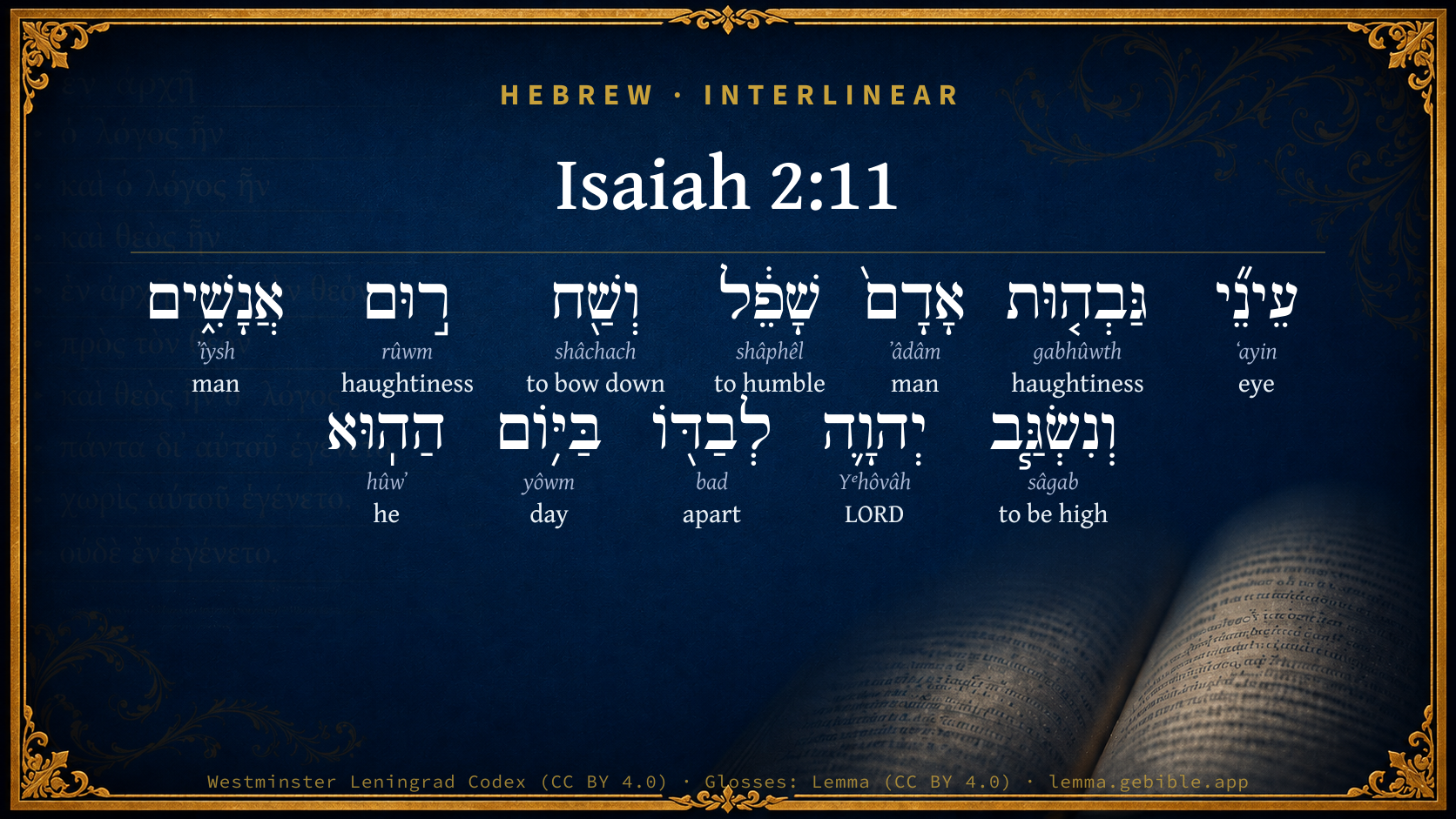
Hebrew (Westminster Leningrad Codex) Isaiah 2:11 appears in the Hebrew Old Testament. The text above is from the Westminster Leningrad Codex. Each word links to its Strong’s number, a concise gloss, and parsing drawn from the Open Scriptures Hebrew Bible morphology. Click any word for its full Brown-Driver-Briggs (BDB) entry.
Download image
Cite this verse

Isaiah 2:11 (World English Bible). Public Domain. Lemma interlinear Bible study tool, https://lemma.gebible.app/v/isaiah/2/11.

Show BibTeX & RIS
BibTeX
RIS
English Translation
The lofty looks of man will be brought low, The haughtiness of men will be bowed down, And Yahweh alone will be exalted in that day.
World English Bible · Public Domain
Highlights
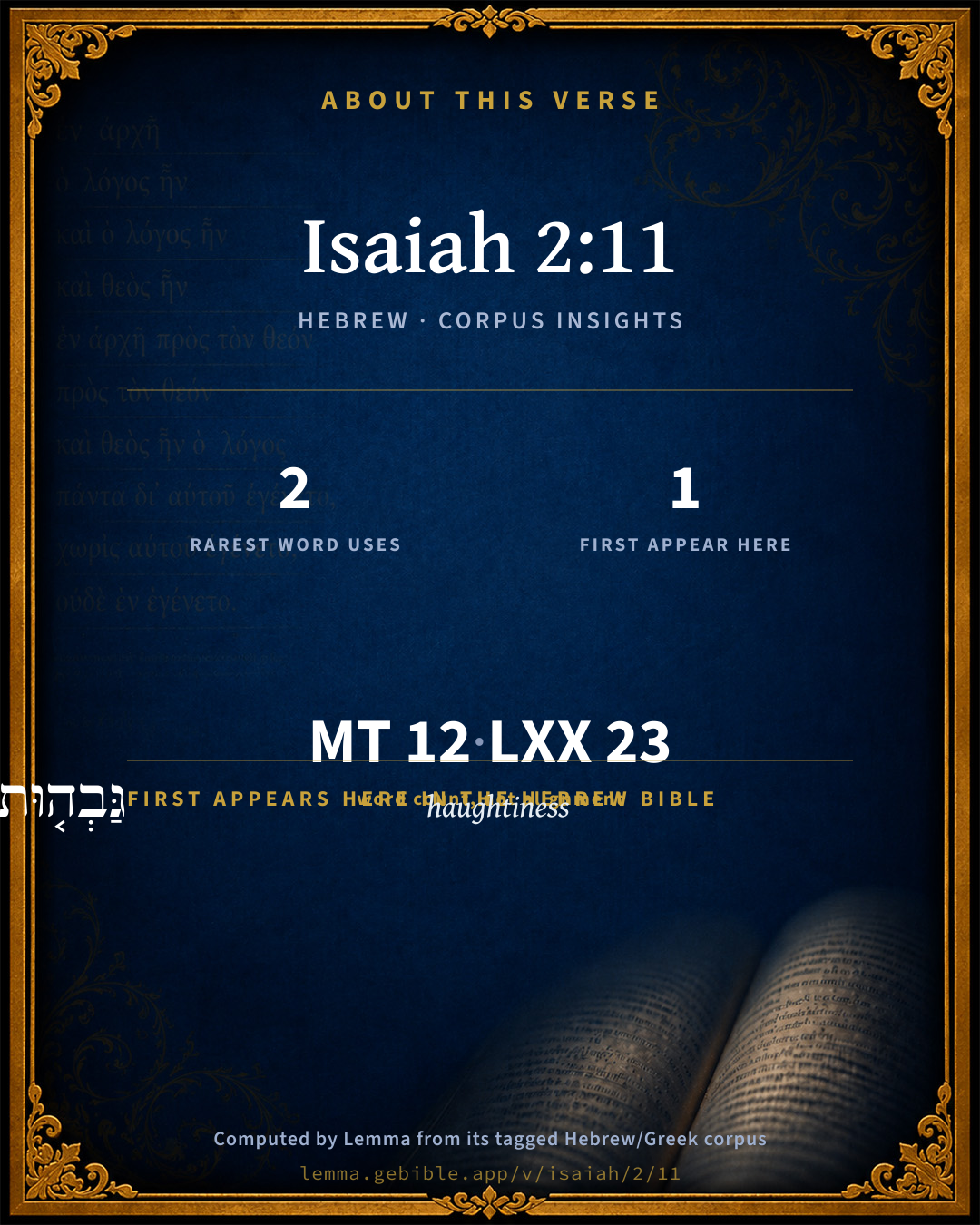
  • 1 first appearance in the Hebrew Bible
Full analysis ↓
Download a study sheet

One document with this verse’s original text, its word-by-word gloss line, the meaning frame, cross-references with their text, attributed commentary, and full source and license credits — printable, and it pastes into notes with its structure intact.

This verse Autodidact and up

Study sheet (.html) Plain text (.txt)

A passage Seminary Student

Up to 50 verses in one chapter. A passage sheet keeps up to 6 commentary sources and 12 cross-references per verse, in the order this page ranks them, and says so on the sheet whenever that leaves anything out. Ask for a single verse and you get the Autodidact verse sheet above.

Everything on this page stays free to read, with no account — the sheet is a download of what is already on screen, not access to it.

Want to remove ads? Support Godless Engineer
Compare translations 3

The same verse in 3 English versions, stacked beneath the original-language interlinear above. Click any original word for its lexicon entry.

Each is an independent rendering of the whole verse — the interlinear is not word-aligned to these translations.

Highlighted words mark where these versions differ — a whole-verse word diff, not a word-by-word alignment.

  • World English Bible Public Domain
    The lofty looks of man will be brought low, The haughtiness of men will be bowed down, And Yahweh alone will be exalted in that day.
  • King James Version Public Domain
    The lofty looks of man shall be humbled, and the haughtiness of men shall be bowed down, and the LORD alone shall be exalted in that day.
  • unfoldingWord Literal Text CC BY-SA 4.0
    The eyes of the loftiness of a human will become low, and the haughtiness of men will bow down, and Yahweh alone will be exalted on that day. q1

unfoldingWord Literal Text — © unfoldingWord, licensed CC BY-SA 4.0. Word-aligned USFM3 via Door43 (git.door43.org/unfoldingWord/en_ult).

Versions to compare (up to 4)

3 of 4 selected

Show all 18 translations

Every available English version of this verse, each an independent rendering of the whole verse.

  • World English Bible Public Domain
    The lofty looks of man will be brought low, The haughtiness of men will be bowed down, And Yahweh alone will be exalted in that day.
  • Berean Standard Bible Public Domain
    The proud look of man will be humbled, and the loftiness of men brought low; the LORD alone will be exalted in that day.
  • Majority Standard Bible Public Domain
    The proud look of man will be humbled, and the loftiness of men brought low; the LORD alone will be exalted in that day.
  • King James Version Public Domain
    The lofty looks of man shall be humbled, and the haughtiness of men shall be bowed down, and the LORD alone shall be exalted in that day.
  • American Standard Version (1901) Public Domain
    The lofty looks of man shall be brought low, and the haughtiness of men shall be bowed down, and Jehovah alone shall be exalted in that day.
  • Revised Version (1885) Public Domain
    The lofty looks of man shall be brought low, and the haughtiness of men shall be bowed down, and the LORD alone shall be exalted in that day.
  • Geneva Bible (1599) Public Domain
    The hie looke of man shall be humbled, and the loftinesse of men shalbe abased, and the Lord onely shall be exalted in that day.
  • Douay-Rheims (1899) Public Domain
    The lofty eyes of man are humbled, and the haughtiness of men shall be made to stoop: and the Lord alone shall be exalted in that day.
  • Young's Literal Translation Public Domain
    The haughty eyes of man have been humbled, And bowed down hath been the loftiness of men, And set on high hath Jehovah alone been in that day.
  • Literal Standard Version CC BY-SA 4.0
    The haughty eyes of man have been humbled, || And the loftiness of men has been bowed down, || And YHWH alone has been set on high in that day.
  • Unlocked Literal Bible CC BY-SA 4.0
    The lofty gaze of man will be brought low, and the pride of men will be brought down, and Yahweh alone will be exalted on that day.
  • unfoldingWord Literal Text CC BY-SA 4.0
    The eyes of the loftiness of a human will become low, and the haughtiness of men will bow down, and Yahweh alone will be exalted on that day. q1
  • Darby Bible Public Domain
    The lofty eyes of man shall be brought low, and the haughtiness of men shall be bowed down, and Jehovah alone shall be exalted in that day.
  • World Messianic Bible Public Domain
    The lofty looks of man will be brought low, the arrogance of men will be bowed down, and the LORD alone will be exalted in that day.
  • Webster's Bible Public Domain
    The lofty looks of man shall be humbled, and the haughtiness of men shall be abased, and the LORD alone shall be exalted in that day.
  • Free Bible Version CC BY-SA 4.0
    Those who look with arrogance will be brought low; those who are proud will be humbled. On that day only the Lord will be lifted high.
  • Bible in Basic English Public Domain
    The high looks of man will be put to shame, and the pride of men will be made low, and only the Lord will be lifted up in that day.
  • JPS Tanakh (1917) Public Domain
    The lofty looks of man shall be brought low, and the haughtiness of men shall be bowed down, and the LORD alone shall be exalted in that day.

Literal Standard Version (2020), Covenant Press — licensed CC BY-SA 4.0. Text via the HelloAO Bible API (eBible.org). Unlocked Literal Bible (unfoldingWord) — licensed CC BY-SA 4.0. Text via the HelloAO Bible API (eBible.org). unfoldingWord Literal Text — © unfoldingWord, licensed CC BY-SA 4.0. Word-aligned USFM3 via Door43 (git.door43.org/unfoldingWord/en_ult). Free Bible Version, Dr. Jonathan Gallagher — licensed CC BY-SA 4.0. Text via the HelloAO Bible API (eBible.org).

Word by word

More ways to search: Search by grammar → Find every occurrence → Compare this word →

Practice this passage: Drill this verse → Learn its vocabulary →

גַּבְה֤וּת
gabhûwth
H1365
“haughtiness of”
Noun, Common, Feminine, Singular, Construct
Part of Speech
Noun
Type
Common
Gender
Feminine
Number
Singular
State
Construct
Full BDB Definition

Origin: from H1361

TWOT: 305c

haughtiness
  1. עֵינֵ֞י ʻayin H5869 “eyes of” Noun, Common, Both, Dual, Construct
  2. אָדָם֙ ʼâdâm H120 “man” Noun, Common, Masculine, Singular, Absolute
  3. שָׁפֵ֔ל shâphêl H8213 “to humble” Verb, Qal, Perfect, 3rd Person, Masculine, Singular
  4. וְשַׁ֖ח shâchach H7817 “and · to bow down” Conjunction + Verb, Qal, Perfect, 3rd Person, Masculine, Singular
  5. ר֣וּם rûwm H7312 “haughtiness of” Noun, Common, Masculine, Singular, Construct
  6. אֲנָשִׁ֑ים ʼîysh H376 “men” Noun, Common, Masculine, Plural, Absolute
  7. וְנִשְׂגַּ֧ב sâgab H7682 “and · to be high” Conjunction + Verb, Niphal, Sequential Perfect, 3rd Person, Masculine, Singular
  8. יְהוָ֛ה Yᵉhôvâh H3068 “LORD” Noun, Proper
  9. לְבַדּ֖וֹ bad H905 “to/for · apart · his” Preposition + Noun, Common, Masculine, Singular, Construct + Suffix, Personal, 3rd Person, Masculine, Singular
  10. בַּיּ֥וֹם yôwm H3117 “in/at the · day” Preposition, Determined + Noun, Common, Masculine, Singular, Absolute
  11. הַהֽוּא hûwʼ H1931 “the · he” Particle, Definite Article + Pronoun, Personal, 3rd Person, Masculine, Singular

About this verse

These counts appear in no published source. They are computed here, from the morphology-tagged text and Lemma’s own curated glosses. What Lemma adds →

12
words
12
distinct lemmas
Prophets
section

Notable vocabulary

The rarest word here is גַּבְה֤וּת haughtiness H1365 — appearing just 2 times in the whole Hebrew Bible.

First appearance in Scripture

This word makes its first canonical appearance in the Hebrew Bible here:

  • גַּבְה֤וּת haughtiness H1365

Shared distinctive vocabulary

גַּבְה֤וּת haughtiness H1365 occurs in 2 verses of the Hebrew Bible. Also found in:

Grammatical profile

  • 3 verbs
  • 8 nouns
  • 1 pronoun

Verb forms

  • שָׁפֵ֔ל Qal · Perfect
  • וְשַׁ֖ח Qal · Perfect
  • וְנִשְׂגַּ֧ב Niphal · Sequential Perfect

Hebrew & Septuagint length

In English translation the verse runs 26 words from the Hebrew and 31 from the Septuagint (LXX English) — closely comparable.

A rough comparison of the two English renderings, which tokenize alike — not a word-level alignment.

Word counts can differ between the Hebrew and the Greek without any difference in meaning — e.g. the Hebrew direct-object marker אֵת has no separate Greek word, and Greek often adds the article ὁ.

In the original languages it is 12 Hebrew tokens and 23 Greek tokens — but the two are counted differently (Hebrew bundles its prefixes and suffixes into one token; the Greek is in lemma form), so that isn’t a like-for-like length.

Cross-references

44

Topical passages linked to Isaiah 2:11 in the Treasury of Scripture Knowledge — connected by theme and wording, ordered by reader-vote popularity; previews shown in the World English Bible.

  • Isaiah 5:15–16 So man is brought low, Mankind is humbled, And the eyes of the arrogant ones are humbled;
  • Psalms 18:27 For you will save the afflicted people, But the haughty eyes you will bring down.
  • Isaiah 2:17 The loftiness of man shall be bowed down, And the haughtiness of men shall be brought low; And Yahweh alone shall be exalted in that day.
  • Isaiah 12:4 In that day you will say, "Give thanks to Yahweh! Call on his name. Declare his doings among the peoples. Proclaim that his name is exalted!
  • Isaiah 13:11 I will punish the world for [their] evil, and the wicked for their iniquity: and I will cause the arrogance of the proud to cease, and will lay low the haughtiness of the terrible.
  • Isaiah 24:21 It shall happen in that day, that Yahweh will punish the host of the high ones on high, and the kings of the earth on the earth.
  • Malachi 4:1 "For, behold, the day comes, it burns as a furnace; and all the proud, and all who work wickedness, will be stubble; and the day that comes will burn them up," says Yahweh of Hosts, "that it shall leave them neither root nor branch.
  • Micah 4:6 "In that day," says Yahweh, "I will assemble that which is lame, And I will gather that which is driven away, And that which I have afflicted;
  • Jeremiah 30:7–8 Alas! for that day is great, so that none is like it: it is even the time of Jacob's trouble; but he shall be saved out of it.
  • Jeremiah 50:31–32 Behold, I am against you, you proud one, says the Lord, Yahweh of Hosts; for your day is come, the time that I will visit you.
  • Ezekiel 38:19 For in my jealousy and in the fire of my wrath have I spoken, Surely in that day there shall be a great shaking in the land of Israel;
  • Ezekiel 39:22 So the house of Israel shall know that I am Yahweh their God, from that day and forward.
  • Hosea 2:18 In that day I will make a covenant for them with the animals of the field, And with the birds of the sky, And with the creeping things of the ground. I will break the bow, the sword, and the battle out of the land, And will make them lie down safely.
  • 2 Corinthians 10:17 But "he who boasts, let him boast in the Lord."
  • Job 40:10–12 "Now deck yourself with excellency and dignity. Array yourself with honor and majesty.
  • Isaiah 4:1 Seven women shall take hold of one man in that day, saying, "We will eat our own bread, and wear our own clothing: only let us be called by your name. Take away our reproach."
  • Isaiah 11:10–11 It shall happen in that day, that the root of Jesse, who stands for an ensign of the peoples, to him shall the nations seek; and his resting-place shall be glorious.
  • Isaiah 12:1 In that day you will say, "I will give thanks to you, Yahweh; for though you were angry with me, your anger has turned away and you comfort me.
  • Isaiah 25:9 It shall be said in that day, Behold, this is our God; we have waited for him, and he will save us: this is Yahweh; we have waited for him, we will be glad and rejoice in his salvation.
  • Isaiah 26:1 In that day shall this song be sung in the land of Judah: we have a strong city; salvation will he appoint for walls and bulwarks.
  • Isaiah 27:1–2 In that day Yahweh with his hard and great and strong sword will punish leviathan the swift serpent, and leviathan the crooked serpent; and he will kill the monster that is in the sea.
  • Isaiah 27:12–13 It shall happen in that day, that Yahweh will beat off [his fruit] from the flood of the River to the brook of Egypt; and you shall be gathered one by one, you children of Israel.
  • Isaiah 28:5 In that day will Yahweh of Hosts become a crown of glory, and a diadem of beauty, to the residue of his people;
  • Isaiah 29:18 In that day shall the deaf hear the words of the book, and the eyes of the blind shall see out of obscurity and out of darkness.
  • Isaiah 30:23 He will give the rain for your seed, with which you shall sow the ground; and bread of the increase of the ground, and it shall be fat and plenteous. In that day shall your cattle feed in large pastures;
  • Isaiah 37:23 Whom have you defied and blasphemed? and against whom have you exalted your voice and lifted up your eyes on high? [even] against the Holy One of Israel.
  • Isaiah 52:6 Therefore my people shall know my name: therefore [they shall know] in that day that I am he who does speak; behold, it is I.
  • Jeremiah 9:24 but let him who glories glory in this, that he has understanding, and knows me, that I am Yahweh who exercises loving kindness, justice, and righteousness, in the earth: for in these things I delight, says Yahweh.
  • Ezekiel 38:14 Therefore, son of man, prophesy, and tell Gog, Thus says the Lord Yahweh: In that day when my people Israel dwells securely, shall you not know it?
  • Ezekiel 39:11 It shall happen in that day, that I will give to Gog a place for burial in Israel, the valley of those who pass through on the east of the sea; and it shall stop those who pass through: and there shall they bury Gog and all his multitude; and they shall call it The valley of Hamon Gog.
  • Hosea 2:16 It will be in that day," says Yahweh, "That you will call me 'my husband,' And no longer call me 'my master.'
  • Hosea 2:21 It will happen in that day, I will respond," says Yahweh, I will respond to the heavens, And they will respond to the earth;
  • Joel 3:18 It will happen in that day, That the mountains will drop down sweet wine, The hills will flow with milk, All the brooks of Judah will flow with waters; And a fountain will come forth from the house of Yahweh, And will water the valley of Shittim.
  • Amos 9:11 In that day I will raise up the tent of David who is fallen, and close up its breaches, and I will raise up its ruins, and I will build it as in the days of old;
  • Obadiah 1:8 "Won't I in that day," says Yahweh, "destroy the wise men out of Edom, and understanding out of the mountain of Esau?
  • Micah 5:10 "It will happen in that day," says Yahweh, "That I will cut off your horses out of the midst of you, And will destroy your chariots.
  • Micah 7:11–12 A day to build your walls-- In that day, he will extend your boundary.
  • Zephaniah 3:11 In that day you will not be disappointed for all your doings, in which you have transgressed against me; for then I will take away out of the midst of you your proudly exulting ones, and you will no more be haughty in my holy mountain.
  • Zephaniah 3:16 In that day, it will be said to Jerusalem, "Don't be afraid, Zion. Don't let your hands be slack."
  • Zechariah 9:16 Yahweh their God will save them in that day as the flock of his people; For they are like the jewels of a crown, Lifted on high over his land.
  • Luke 18:14 I tell you, this man went down to his house justified rather than the other; for everyone who exalts himself will be humbled, but he who humbles himself will be exalted."
  • 1 Corinthians 1:29–31 that no flesh should boast before God.
  • 2 Corinthians 10:5 throwing down imaginations and every high thing that is exalted against the knowledge of God, and bringing every thought into captivity to the obedience of Christ;
  • 1 Peter 5:5 Likewise, you younger ones, be subject to the elder. Yes, all of you gird yourselves with humility, to subject yourselves to one another; for "God resists the proud, but gives grace to the humble."

Cross-references courtesy of OpenBible.info (CC BY 4.0).

Hebrew and Greek witnesses Masoretic Hebrew ↔ Greek Septuagint

The same verse in the two great witnesses to the Old Testament, shown verse-for-verse.

These are two independent witnesses, not word-aligned to each other, and the Septuagint is shown in lemma (dictionary) form.

Hebrew Isaiah 2:11 Masoretic · Westminster Leningrad Codex

עֵינֵ֞י גַּבְה֤וּת אָדָם֙ שָׁפֵ֔ל וְשַׁ֖ח ר֣וּם אֲנָשִׁ֑ים וְנִשְׂגַּ֧ב יְהוָ֛ה לְבַדּ֖וֹ בַּיּ֥וֹם הַהֽוּא

The lofty looks of man will be brought low, The haughtiness of men will be bowed down, And Yahweh alone will be exalted in that day.

World English Bible · Public Domain

Greek LXX Isaiah 2:11 Septuagint · lemma form

ὁ γάρ ὀφθαλμός κύριος ὑψηλός ὁ δέ ἄνθρωπος ταπεινός καί ταπεινόω ὁ ὕψος ὁ ἄνθρωπος καί ὑψόω κύριος μόνος ἐν ὁ ἡμέρα ἐκεῖνος

For the eyes of the Lord are high, but man is low; and the haughtiness of men shall be brought low, and the Lord alone shall be exalted in that day.

LXX2012 (modern English Septuagint) · Public Domain

Hebrew: Westminster Leningrad Codex (CC BY 4.0). Greek: Septuagint (public domain); English from LXX2012 (modern English Septuagint) (Public Domain). How the Septuagint differs from the Hebrew →

Targum (Aramaic paraphrase)

1

The Targum is the ancient Jewish Aramaic paraphrase of the Hebrew Scriptures — an interpretive translation, not the Hebrew text itself. Onkelos (literal) and Pseudo-Jonathan (expansive) render the Torah, and Jonathan the Prophets. Coverage is partial: where no permissively-licensed English translation exists for a verse, only the Aramaic is shown. This is verse-level text, not a word-by-word alignment to the Hebrew.

  1. Targum Jonathan Prophets (Joshua–Malachi)
    עֵינֵי רָמוּת אֱנָשָׁא יִמְאֲכָן וְיֶחֱלַשׁ תְּקוֹף גַבְרִין וּתְקֵיף יְיָ בִּלְחוֹדוֹהִי בְּעִדָנָא הַהִיא:

    The lofty looks of the common man shall be humbled, and the strength of the great men shall become weak, and the Lord alone shall be mighty in that time.

    Targum Jonathan — Aramaic: “Mikraot Gedolot” (public domain). English: “Sefaria Community Translation” (CC0 1.0 (public-domain dedication)); “London "Chaldee Paraphrase," 1871” (public domain). Text via Sefaria.

Commentary

Notes on Isaiah 2:11 from classic Christian and Jewish commentators (each source and its license shown beneath its notes). The classic Christian expositions comment on the surrounding passage and are grouped to its opening verse, so a note may address several verses; the Jewish commentaries on the Tanakh (Rashi and others) are per-verse, so they appear only where the commentator wrote on this verse.

Lemma curates 59 commentaries, every one of them public domain or Creative Commons licensed, each selected and text-cleaned for this edition rather than reprinted as found. About our sources →

Trapp's Complete Commentary

John Trapp

Isa 2:11 The lofty looks of man shall be humbled, and the haughtiness of men shall be bowed down, and the LORD alone shall be exalted in that day.

Ver. 11. The lofty looks of man shall be humbled.] Ipsi antea tumidi et cervicosi Deum ultorem agnoscent. God shall bring down the haughty from their lofty tops where they have perched themselves, and shall take them a link lower, as they say; pride must have a fall, and no wonder; for whereas other sins flee from God, pride lets fly at him, and hence it is he is so utter an enemy to it.

And the Lord alone shall be exalted.] This the heathens also understood; and therefore the Romans would never receive the God of Israel, saith Augustine, {a} because they understood that he would be worshipped alone. Let the gods of the heathens be good fellows; the true God is a jealous God, and will not share his glory with another.

In that day.] Nempe statis quasi comitiis {Isa 2:17} at the set time. It implieth also, saith one, that God will keep his time to a day. We have a like saying ourselves, A day breaks no square; but it is not so with God. {Exo 12:40-41} The firstborn were slain at midnight, because just then the four hundred or four hundred and thirty years of their sojourning in Egypt were expired. "In that night was Belshazzar slain," {Dan 5:30} because then exactly the seventy years of their captivity were ended.

{a} De Consen. Evang., lib. i. cap. 18.

John Trapp, A Commentary or Exposition upon All the Books of the Old and New Testament (1647–1656) — public domain. Text from a community e-Sword module.

The Biblical Illustrator

Joseph S. Exell

Isa_2:11

The lofty looks of man shall be humbled . . . the Lord alone shall be exalted in that day

Man humbled and Christ exalted

The day may be very properly applied to any of those days when the Lord abases the pride of guilty man, or when He makes His presence felt by the power of His Spirit upon the heart; for it is then the lofty looks of man are humbled; it is then the haughtiness of man is bowed down, and the Lord is exalted in the heart.

What other than this is Gods object in the Gospel? It is definitely that self may be humbled, and Christ exalted.

I. Let us look at some points on which MEN ARE APT TO BE LIFTED UP and to bolster themselves up in their pride and self-sufficiency.

1. They hold that they have natural ability to understand the Word of God. What saith the Scripture upon this point? (1Co_2:11, etc.) How many take up the Word of God to read it just as they would any other book, forgetting its character--forgetting its object! They read it merely to know, not in order to be. Whereas the value of the Book is, that it is to tell upon mans character. It is to make him altogether a new creature in Christ Jesus.

2. Another point of deep importance is the opinion which men have with respect to their power to save themselves. It is not that they think that they can actually blot out their sins, or that they can perfectly keep Gods law; but they, in imagination, strike a kind of balance between their good and bad deeds. They think that there is something good in what they do, and that what they fail in Christ will make up; and the consequence is, there is no real humiliation before God while this idea lasts.

3. The foolish thoughts men have of the character of God, as if He were such an one as themselves. You will often hear men speak of what they conceive the justice of God to be, without attending in the smallest degree to the declarations which He makes of Himself in His Holy Word. They speak as though they thought the difference between themselves and God, who is holy, is one of degree merely, and not of nature. They put on one side altogether the fact that God is a Spirit, and that they themselves are carnal, and they speak as if morality would fit a man for heaven, utterly ignoring the words of the Lord, Except a man be born again, he cannot see the kingdom of God. Men, indeed, form their own opinions; but remember the way in which God speaks of it: Thou thoughtest that I was such an one as thyself; but I will reprove thee.

II. Now, all these mistaken views are so many sources of pride in men; but when the Holy Spirit comes into the heart in power, they ARE BOWED DOWN AND HUMBLED BEFORE GOD. One of the effects produced by the Holy Spirit, when He comes upon a mans heart, is to make him consider his ways. He looks to himself and sees nothing but sin; that there is not one single ground of hope; and when the Holy Spirit has graciously brought him to this point, then He shows him the salvation of Christ. And then in this exaltation of the Lord Jesus comes the true abasement of the man himself. Lessons--

1. The object of all Gods dispensations is to humble us, and to bring us down to the feet of Christ.

2. The nature of true faith. It is humility; it is dependence; it is coming down from all self-confidence; it is resting upon another, and that Christ alone. (J. W. Reeve, M. A.)

God exalted

1. By entertaining elevating apprehensions of His infinite majesty, and exercising suitable affections towards Him--fearing Him who pours contempt upon princes, trusting in Him in whom is everlasting strength, and loving Him in whose favour there is life.

2. By celebrating the praises of His Divine excellencies with gratitude and joy.

3. By such conduct as may give the most sensible and lively representation of God--beginning, carrying on, and ending all their businesses in Him; making His love the principle, His law the rule, and His glory the end of all their actions. (R. Macculloch.)

Humility

Life is a long lesson in humility. (J. M. Barrie.)

The Biblical Illustrator, edited by Joseph S. Exell (c. 1880s–1900s) — public domain. Text from a community e-Sword module.

Tyndale Open Study Notes

Tyndale Open Resources

2:11-12 A key theme in Isaiah is that the Lord will be exalted and humble people will be restored (57:15), while proud and mighty people are humbled (26:5). • The day of judgment and the “day of reckoning” are also called the “day of the Lord.” There are seven such references in chs 2–4 (2:11, 17, 20; 3:6, 18; 4:1, 2).

Tyndale Open Study Notes — © Tyndale Open Resources, licensed CC BY-SA 4.0. Text via the HelloAO Bible API.

Geneva Bible (1599)

Geneva Bible translators

Meaning, as soon as God shall begin to execute his judgments.

Geneva Bible (1599) marginal notes — public domain. Text via Bolls.life.

Jamieson, Fausset & Brown

Robert Jamieson, A. R. Fausset & David Brown

lofty looks--literally, "eyes of pride" (Psa 18:27).

humbled--by calamities. God will so vindicate His honor "in that day" of judgments, that none else "shall be exalted" (Zac 14:9).

Jamieson, Fausset & Brown — Commentary Critical and Explanatory on the Whole Bible (1871) — public domain (CC PDM 1.0). Text via the HelloAO Bible API.

Adam Clarke's Commentary

Verse 11. Be humbled] "שפל ושח shaphel veshach, read שפלו שח shaphelu shach." - Dr. Durell. Which rectifies the grammatical construction. No MS. or version confirms this reading.

Adam Clarke's Commentary on the Bible (1810–1826) — public domain. Text from a community e-Sword/MySword module.

Ellicott's Commentary for English Readers

(11) The lofty looks of man . . .—Better, the lofty looks of the mean man . . . the haughtiness of the great man. The self-assertion which is the essential element of pride may be found at the opposite extremes of social life.

The Lord alone shall be exalted . . .—The verb, as in Psa_46:7; Psa_46:11 (see margin and text of Authorised Version), implies the image of a rock-citadel, towering in its strength, and offering the one safe asylum in a time of danger. (Comp. also Psa_61:2.)

A Bible Commentary for English Readers, edited by Charles John Ellicott (1878–1897) — public domain. Text from a community e-Sword module.

The Cambridge Bible for Schools and Colleges

gen. ed. J. J. S. Perowne

11. in that day] The day to be now described in

The Cambridge Bible for Schools and Colleges (gen. ed. J. J. S. Perowne; Cambridge University Press, 1878–1918) — public domain. Text from a community e-Sword module.

John Gill's Exposition

The lofty looks of man shall be humbled,.... Particularly of the man of sin, the son of perdition, who opposeth and exalteth himself above all that is called God, assuming that to himself which belongs to God; looking down with contempt upon, and behaving haughtily and insolently to all below him; blaspheming the name of God, his tabernacle, and them that dwell in heaven; he shall be humbled, consumed, and destroyed with the breath of Christ's mouth, and the brightness of his coming, Th2 2:4.

and the haughtiness of man shall be bowed down; of the followers of antichrist, who have boasted of their wisdom and knowledge, of their number, power, greatness, and authority, of their wealth and riches, and of their merits and works of supererogation; their pride will now be stained, and all their glory laid in the dust:

and the Lord alone shall be exalted in that day: in his divine Person, and in all his offices, and especially in his kingly office; he shall be King over all the earth, the kingdoms of this world will become his, he shall be the one Lord, and his name one, Zac 14:9 this will be in the spiritual reign of Christ, in the latter day, or last day of the Gospel dispensation, when the church will be exalted, as in Isa 2:2 and in the personal reign of Christ it will still more appear, that he, and he alone, will be exalted by and among his people, among whom his tabernacle will be, for then he will have no rivals; not only all rule, power, and authority among men, will be put down, and the beast and false prophet will have been cast alive into the lake of fire; but Satan, the god of this world, will be taken and bound, and cast into the bottomless pit, and so remain during the time of Christ's thousand years' reign with his saints on earth: this passage is referred by the Jews (u) to the end of the six thousand years the world according to them shall stand.

(u) T. Bab. Roshhashana, fol. 31. 1. & Sanhedrin, fol. 92. 2. & 97. 1.

John Gill's Exposition of the Whole Bible (1746–1763) — public domain (CC PDM 1.0). Text via the HelloAO Bible API.

Albert Barnes' Notes on the Bible

The lofty looks - Hebrew ‘The eyes of pride,’ that is, the proud eyes or looks. Pride commonly evinces itself in a lofty carriage and supercilious aspect; Psa 18:27.

Shall be humbled - By the calamities that shall sweep over the land. This does not mean that he shall be brought “to be” humble, or to have a humble heart, but that that on which he so much prided himself would be taken away.

The Lord alone ... - God will so deal with them as to vindicate his honor; to turn the attention entirely on himself, and to secure the reverence of all the people. So terrible shall be his judgments, and so “manifestly” shall they come from “him,” that they shall look away from everything else to “him” alone.

In that day - In the day of which the prophet speaks, when God would punish them for their sins, Reference is probably made to the captivity at Babylon. It may be remarked, that one design of punishment is to lead people to regard and honor God. He will humble the pride of people, and so pass before them in his judgments, that they shall be compelled to “acknowledge” him as their just Sovereign and Judge.

Albert Barnes' Notes on the Bible (1834–1885) — public domain. Text from a community e-Sword/MySword module.

Matthew Poole's English Annotations

Shall be bowed down judicially, as they bowed down voluntarily before their idols. So the punishment is very suitable to the sin.

Shall be exalted in that day; his justice and power shall be magnified, and the vanity and impotency of all other gods shall be detected.

Matthew Poole's English Annotations on the Holy Bible (1683–1685) — public domain. Text from a community e-Sword/MySword module.

Whedon's Commentary on the Bible

Daniel D. Whedon

11. The terror which was approaching, Isa_2:10, is now seen as past. In Hebrew poetry scenes suddenly shift; a spirit of restlessness and non-repose characterizes it; it darts from object to object with lightning rapidity; it is alert with antitheses, and is never to be judged by rules governing the ancient Greek and modern dramatic poetry. The preceding verse sees judgment approaching; this verse describes the effect of it when passed. The haughty airs of men shall be humbled — in the Hebrew, are “humbled” — are brought low. Past, present, and future run into each other to express permanent effect.

In that day — In that sweep of time during which the principles of divine retribution have their full manifestation. No doubt the full result is seen in the overthrow of the State and the captivity at Babylon. It is idle to seek, with laborious literalness, fulfilments of predictions so generally expressed.

Daniel D. Whedon (gen. ed.), Commentary on the Old and New Testaments (1874–1909) — public domain. Text from a community e-Sword module.

The Pulpit Commentary

The effect of the judgment which, in ver. 9, was said to be the humiliation of high and low alike, is here declared with special reference to the high-minded and proud, whom it will humble more than others. The Lord alone shall be exalted; like a lofty and strong tower. (comp. Isa_12:4 Isa_33:5)

Vers. 12-22. THE DESCRIPTION OF THE DAY OF THE LORD. The prophet, now, having announced that God is about to visit his people in anger (vers. 10, 11), proceeds to describe in highly rhetorical language the visitation itself,

(1) as to its object, which is to bring down all that exalts itself against God (ver. 12);

(2) as to its scope it is to be upon trees, mountains, hills, towers, walls, ships, pleasant pictures, idols (vers. 13-18);

(3) as to its practical effect, which will be to alarm and terrify, to make men fly and hide themselves, and to produce contempt of the idols in which they have so long trusted (vers. 19-21).

For the day of the Lord of hosts shall be upon every one; rather, For the Lord of hosts shall have a day upon everything. The passage is exegetical of "that day" in the preceding verse. A "day or time is certainly coming which shall be emphatically "the Lord"s a day on which he will descend to judgment. Proud... lofty... lifted up (comp. ver. 11). "The ideas of eminence, pride, and opposition to God melt into each other in the Old Testament" (Cheyne). And he shall be brought low; rather, that it may be brought low (so Gesenius and Cheyne).

Vers. 12-22. The terrors of the day of the Lord.

Every visitation of man by God is typical of his coming to judgment. "That day" is, in its deepest and truest sense, the day whereon Christ shall come again to judge both the quick and the dead. Of "that day and that hour knoweth no man"; (Mat_24:36) and the terror is increased by the mystery. The prophet sees God descend to judge Israel. The particular features are local; but through them may be discerned without much difficulty the characteristics which are recurrent, and which belong especially to the last and great day, viz.

I ABASEMENT OF THE PROUD. Earthly distinctions come to naught when the earth itself comes to an end. Rank, titles, dignities, fail. The "mean man" and the "great man" (ver. 9), the highest and the lowest in earthly rank, are upon a par, when all have to appear before their Judge. And spiritual pride is equally brought low. None but must then feel himself a miserable sinner, a suppliant for mercy at God"s feet, with hope only through the merits and intercession of the incarnate Son. "The loftiness of man shall be bowed down, and the haughtiness of men shall be made low: and the Lord alone shall be exalted in that day" (ver. 17).

II DESTRUCTION OF THE GRANDEST OF HUMAN WORKS. Towers, walls, palaces, are shattered and overturned at the great seasons of national judgments, and will fall with a crash everywhere at the final judgment-day. The great navies of the world will perish in the "fervent heat;" the works of art, the "pleasant pictures," and all the "delightful works of imagery," will shrivel like parchment scrolls. The accumulated civilization of millennia will be brought to naught. Egypt"s pyramids and temples, Persia"s palaces, Greece"s lovely fades, Rome"s amphitheatres, Christendom"s magnificent cathedrals, all will totter to their base and be overthrown. Nothing will stand that human skill, contrivance, energy, has constructed; all will disappear, and"Like the baseless fabric of a vision, Leave not a wrack behind.

III DESTRUCTION OF GRAND OBJECTS IN NATURE. The taint of man"s sin has passed upon nature itself. Pride and vanity have employed natural products for self-glorification; the precious metals have been prostituted to sinful uses; selfishness has turned natural beauties into private property, and either made a gain of them, or jealously secluded them from the intrusion of ordinary humanity. Therefore Nature, as she now is, has become unfit for the habitation of man in his regenerate condition; and "the first earth" has to "pass away," and to be succeeded by the "new heaven and new earth" of the Apocalyptic vision. (Rev_21:1) What the exact amount of change will be, we do not know. Many features of the existing earth may remain pure snowy summits that the foot of man has never trod; blue glacier caves that have escaped his prying eyes; deep forest glades preserved from the desecration of his presence by thorny jungle or impenetrable wealth of undergrowth; but much of that with which man is most familiar will disappear perhaps all that could recall acts or thoughts of sin and the "new heaven and new earth," that God will create, will to such an extent supersede the old, that "the former shall not be remembered, nor come into mind". (Isa_65:17)

IV GENERAL ALARM, ESPECIALLY OF THE SINNER AND THE WORLDLY. They of Israel fled into "the holes of the rocks, and the caves of the earth, from the terror of the Lord, and from the glory of his majesty" (ver. 19). At the last day, "men shall say to the mountains, Fall on us; and to the hills, Cover us"; (Luk_23:30) "Hide us from the face of him that sitteth upon the throne, and from the wrath of the Lamb". (Rev_6:16) The brightness of his presence will be intolerable to those who have "loved darkness rather than light; "and they will desire, at any rate, to flee from it. Alas! flight will be impossible, concealment will be impossible; no rocks will offer hiding-places to the ungodly from the presence of God. One only refuge is possible that to that men must have fled before, with the heartfelt, earnest cry"Rock of ages, cleft for me, Let me hide myself in thee!

Vers. 12-22. The day of judgment.

Here follows a grand picture, in which a few simple thoughts are set.

I THE DAY OF JEHOVAH. This stands for any and every epoch of clearer light which reveals the relative worth of things. False estimates of life and its objects have become by custom fixed. The imagination has been under a delusion. A false idea of greatness and goodness has become so fixed that nothing but a revolution will subvert it. The criticism of words may be defied; but the criticism of facts, of results, against this there is no appeal. There is no reversal of the judgment of events. A great day of judgment was, for example, the French Revolution of a century ago. The falsehood of generations was then expiated in blood. Social institutions which were bad, inhuman, yet which those who had grown up in them regarded as impossible to alter, were effaced in that terrible outpouring of the wrath of God. The sense amidst great wrong that the judgment of God cannot long be delayed, is expressed in the common saying, "Things must take a turn before long." In the life of the individual, every stopping-point or turning-point at which a false way of life terminates, may be viewed as a day of judgment and a day of Jehovah.

II THE DAY BRINGS WITH IT A SHOCK TO HUMAN IMAGINATION. The prophet piles up images to represent the reversal of all human ideals of greatness and loftiness. The gigantic trees of Lebanon and Bashan, the mountains and hills, the towers and the high ramparts, the tall ships sailing Tarshish-wards, (Psa_48:8) the turrets of villas and houses of pleasure, draw down upon them the violence of the storm. The vast and lofty in nature and in works of art are not of more value in the eyes of God than the small and lowly. They are hints of the greatness of the spirit, and if we give such objects an independent greatness, we are suffering from an illusion. The greatness and the beauty are in the seeing mind. There is not so much to be seen of the work of God in a mountain as in a moth. "Life apparent in the smallest midge is marvelous beyond dead Atlas" self." The palaces, the streets of a great city, are signs of the human soul and its greatness, but not the truest signs. It is a common error to look for the tokens of a people"s greatness in their buildings and mechanical achievements. But from what source does material creation and production come? That is the ultimate question. Our works of art are works of the flesh and of pride, or works of the spirit wrought in humility and the love of truth. A few such works in plastic stuff of stone, or on canvas, or in poetic words, endure through all change. That which is untrue must fall sooner or later beneath the criticism of God and be exposed. And in the downfall of human works the eternal God is again manifested in his supreme greatness and glory. It is our own false imaginations which hide him from us.

III THE ABANDONMENT OF THE IDOLS. For the idols cannot help their worshippers, who must run to hide themselves. Yet at first they cling to them. But soon in alarm they cast them away into any corner, any refuse-heap, any filthy haunt of bats and moles. "To cast to the bats" is as proverbial an expression in the East for throwing clean away as rejected rubbish, as "throwing to the dogs" with us. There comes a time when men will be willing to get rid of their most precious objects so that they may but save themselves. A secret terror haunts the false conscience, which in moments of clear revelation of truth rises to an acme and becomes a panic. The true heart longs for more of God"s light, the false can only exist behind an artificial veil or screen. In every time larger light is appearing, truths for the conduct of life are coming into currency; in short, the Divine Critic of our life is making his censure felt. Alas for those who rush into any cave at hand, plunge into obscurantism rather than face the worst, which thus faced will prove the best!

IV THE MORAL. "Cease ye from man." If in any such day of revelation all the proud ideals of human society may be discovered false, and cast aside as worthless; if the time of revelation shows that we have been resting upon rotten shams; if we have an uneasy consciousness that it is always so; how vain is all confidence in human wit and work! The bitter words seem to cast contempt upon every species of beast and satisfaction. A poet of our time has written a great work to show that our human speech is naught, our human testimony false, our fame and human estimation words and wind" (Browning," Ring and Book"). But how can we cease from man? We can only know the true and the eternal through some form of human experience. The answer is Man merely as man, an independent fact, is naught; he and all his pass away. In living for himself as if there were no truth, no good, beyond, he becomes a lie. If we see man only we see the false; if God working in and through man and his history, we find the true in the false. Working through the false shows of sense, we may reach the spirit of things, the mind of God. We leave our hold on the fugitive human fact, false if we try to stereotype it, that we may plant our foot on the constant. The Divine "Truth is forced To manifest itself through falsehood; whence divorced By the excepted eye, at the rare season, for The happy moment, truth instructs us to abhor The false, and prize the true, obtainable thereby. J.

Vers. 12-17. The Lord"s day for the proud.

Any time of specific judgment or mercy is in the Scriptures called a "day of the Lord." The day of the Lord has come for the antediluvian world, for Sodom, for the Canaanites, for Babylon, for Israel. It is ever coming to nations, in the corruption or the calamity that follow on national sin. It will come as long as the world endures; that is, so long as God needs, by external judgments, to mark the evil of sin. The sin of all others that calls for a "day of the Lord" is pride, self-confidence, rebellious self-assertion; and this was precisely the sin of the times in which Isaiah wrote. Man is made for God; he was ruined when he broke relations with God, and in self-will separated himself from God. And there is no hope of restoration until pride is humbled. Therefore for this humbling of self God pleads, and to secure this God sends judgments. Henderson says, "These verses contain a specification of several of the most distinguished objects of nature and art, in order, metaphorically, to represent the different persons or orders of men elevated by the dignity of orifice, or rendered notable by their riches, or the elegance and luxury of their establishments, whom the judgments of God would, in a more remarkable manner, hurl into ruin." It has been also observed that the emphatic iteration of "lifted up" is noticeable as indicating that the prophet sees in that self-assertion the root-evil of his time, that which was most destructive of the fear of the Lord, and most surely brought down judgment on the offender.

I ONE DAY GOD HUMBLES THE PROUD NATION. Illustrate from Babylon. Nebuchadnezzar exalted himself, and took all the glory to himself, and Belshazzar followed him in the same willfulness; but a day of darkness and terror came for Babylon, of which the handwriting on the wall gave awful warnings. Or take Jerusalem as representing the kingdom of Judah. Puffed up with self-confidence, willfully resisting the Divine lead, a day of vindication and judgment at last came; her enemies poured in like a flood; the holy city lay in ashes, and her people were either slain or captive. And it is not without good reason that we find modern illustration of God"s day for nations in Napoleonic France. Napoleon claiming both to "propose and dispose," and overtaken by God"s avenging day at Moscow and Waterloo.

II GOD"S DAY HUMBLES THE PROUD INDIVIDUAL. That day comes in such forms as these.

1. A slip from integrity brings disgrace and ruin.

2. Masterfulness and arrogance bring hatred, which finds occasion to injure.

3. Riches take to themselves wings and flee away.

4. Mind becomes unsettled, as in the case of Nebuchadnezzar.

5. Sickness and bereavement come in his family. Sooner or later a day dawns in which the haughty, self-reliant, God-despising man is touched on his sorest, tenderest place. No man can ever be permitted to exalt himself against God and permanently prosper. Give instances from modern life of the downfall of pride, such as the closing years of Squire Beckford"s life.

III GOD"S HUMBLINGS, FOR NATIONS OR FOR MEN, MAY BE MELTINGS, OR THEY MAY HAVE TO BE CRUSHINGS. The result of them depends upon the way in which they are met and responded to. That which is designed to melt may harden; and a judgment that bruises only may be so abused, that it must be followed by a judgment that breaks. Israel would not be humbled by calamity after calamity graciously tempered, so it must be made overwhelming; and Samaria was taken, and the distinct life of Israel, as a nation, crushed out forever. It is a thought full of painful seriousness, that the quality and degree of our troubles depend on cur response to those God has sent, as chastenings, in earlier times. God"s hand may be heavy on us, because we have so long resisted his pleadings and his humblings. Judgment is his strange work, mercy is his delight; but if we resist him, further and heavier judgments are demanded by very "mercy. R.T.

The Pulpit Commentary (1880–1919), ed. H.D.M. Spence-Jones & Joseph S. Exell — public domain. Text from a community e-Sword module.

J. A. Alexander on Isaiah

Joseph Addison Alexander

As the Prophet, in the preceding verse, views the terror of Jehovah as approaching, so here he views it as already past, and describes the effect which it has wrought. “The eyes of the loftiness of man (i.e., his haughty looks) are cast down, and the height (or pride) of men is brought low, and Jehovah alone is exalted in that day,” not only in fact, but in the estimation of his creatures, as the passive form here used may intimate.

Joseph Addison Alexander, The Prophecies of Isaiah (1846–1847; New York: Scribner, 1870–1878) — public domain. Text from a community e-Sword module.

Rashi

Rabbi Shlomo Yitzchaki (Rashi)

The haughty eyes of man [This means] the haughty spirit, and so every expression of haughty eyes in the Scriptures, as it is said: “Whoever is haughty of eye, lustful in heart...” (Ps. 101:5).

Rashi on the Tanakh — English translations: “The Judaica Press complete Tanach with Rashi, translated by A. J. Rosenberg” (CC BY 4.0); “Pentateuch with Rashi's commentary by M. Rosenbaum and A.M. Silbermann, 1929-1934” (public domain); “The Metsudah Tanach series, Lakewood, N.J” (CC BY 4.0); and “The Book of Joshua, Metsudah Publications, 1997” (CC BY 4.0). Text via Sefaria.

Ibn Ezra

Rabbi Abraham ibn Ezra

עיני The looks of. עין ‘eye,’ or ‘ look,’ though generally feminine, is sometimes masculine (as e.g. in this verse, since the masculine form שָׁפֵל is joined to עֵינֵי); and עֵינֵי ‘ the looks,’ is identical with כל אחד מעיני ‘ each of the looks’; comp. בנות ‘ each of the branches ’ (Gen. 49:22). in עֵינֵי נבהות אדם שָׁפֵל The lofty looks of man shall be humbled) is explained by giving to the plural the meaning one of, or each of.

Haughtiness. The contrary, lowliness, is meant; comp. He will enlighten my darkness (Ps. 18:29)

Ibn Ezra on the Tanakh — English translations: “Sefaria Community Translation” (CC0 1.0 (public-domain dedication)); “Yalkut, Sifsei Chachomim Chumash, Metsudah Publications, 2009” (CC BY 4.0); and “Commentary of Ibn Ezra on Isaiah - trans. by M. Friedlander, 1873” (public domain). Text via Sefaria.

Lesson kit

Teaching starters — assembled from the data on this page, not authored interpretation. Every prompt links to the verse data it draws on. Edit before teaching.

Isaiah, in the Prophets, opens this verse with 12 words (12 distinct Hebrew lemmas). Its most distinctive word is gabhûwth (“haughtiness”). A historical commentator’s framing appears above. Read the whole chapter for the surrounding context.

Discussion questions

  1. How does “haughtiness” (gabhûwth) shape what this verse is saying?
  2. This is the first place “haughtiness” appears in Scripture (first appears here). What does its debut here establish?
  3. How does Isaiah 2:17, which shares the word «haughtiness», read alongside this verse?
  4. These translations render this verse differently. What is at stake in choosing one wording over another?
  5. «שָׁפֵ֔ל» is a Qal Perfect verb. How does that grammatical form shape the action described?
  6. Compare how Trapp's Complete Commentary and The Biblical Illustrator read this verse. Where do they agree or differ?

Things to notice

Reading settings

Reading text

Shown beneath each verse's original-language words.

Old Testament
Old Testament edition

Read the OT as the Masoretic Hebrew (MT) or the Greek Septuagint (LXX).

English shown for the Greek Septuagint (in the Hebrew ↔ Greek comparison).

Comparing translations? Open the Compare panel on any verse page to stack up to four side by side.