Deuteronomy 8:14

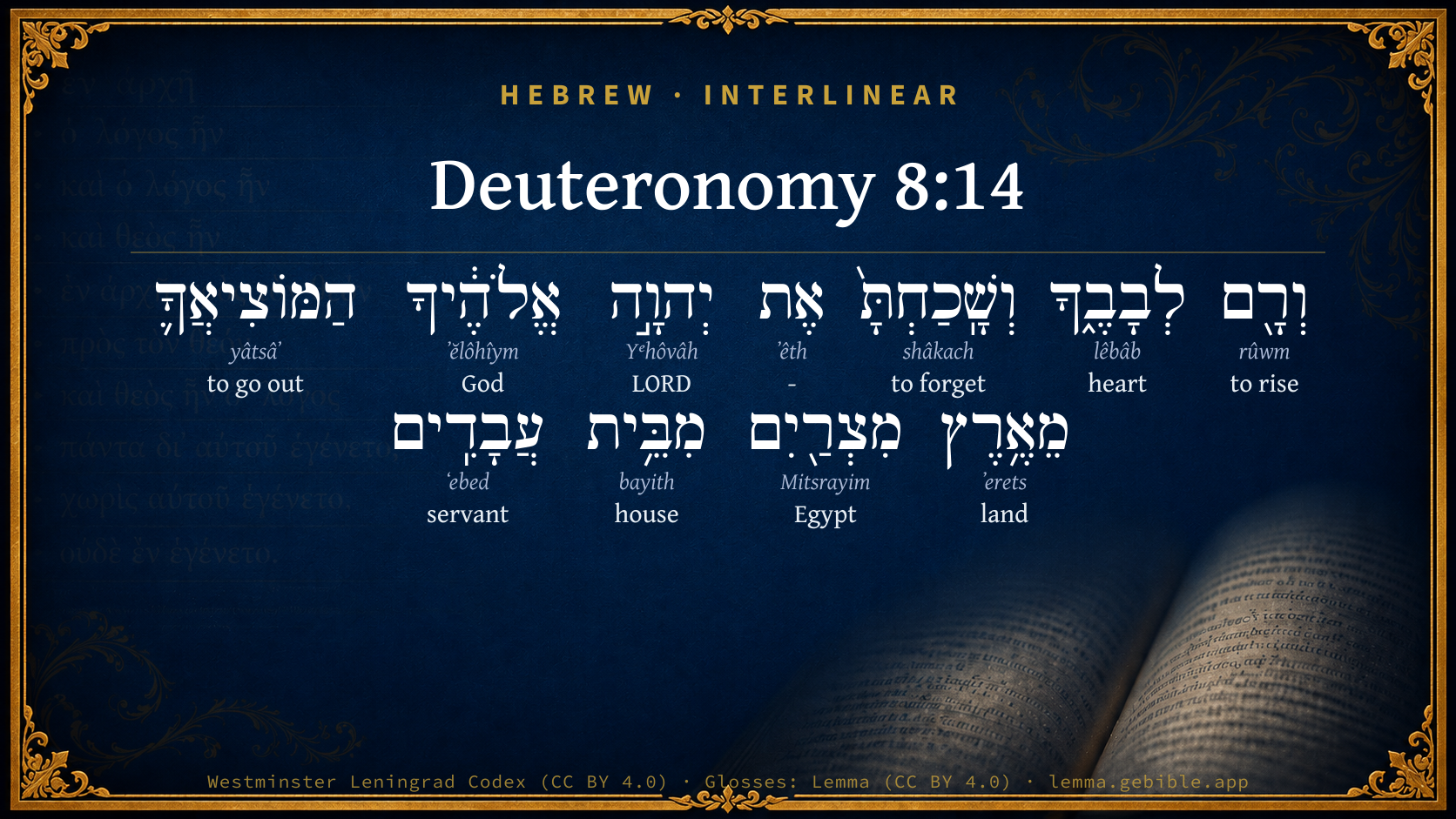
Hebrew (Westminster Leningrad Codex) Deuteronomy 8:14 appears in the Hebrew Old Testament. The text above is from the Westminster Leningrad Codex. Each word links to its Strong’s number, a concise gloss, and parsing drawn from the Open Scriptures Hebrew Bible morphology. Click any word for its full Brown-Driver-Briggs (BDB) entry.
Download image
Cite this verse

Deuteronomy 8:14 (World English Bible). Public Domain. Lemma interlinear Bible study tool, https://lemma.gebible.app/v/deuteronomy/8/14.

Show BibTeX & RIS
BibTeX
RIS
English Translation
then your heart be lifted up, and you forget Yahweh your God, who brought you forth out of the land of Egypt, out of the house of bondage;
World English Bible · Public Domain
Download a study sheet

One document with this verse’s original text, its word-by-word gloss line, the meaning frame, cross-references with their text, attributed commentary, and full source and license credits — printable, and it pastes into notes with its structure intact.

This verse Autodidact and up

Study sheet (.html) Plain text (.txt)

A passage Seminary Student

Up to 50 verses in one chapter. A passage sheet keeps up to 6 commentary sources and 12 cross-references per verse, in the order this page ranks them, and says so on the sheet whenever that leaves anything out. Ask for a single verse and you get the Autodidact verse sheet above.

Everything on this page stays free to read, with no account — the sheet is a download of what is already on screen, not access to it.

Want to remove ads? Support Godless Engineer
Compare translations 3

The same verse in 3 English versions, stacked beneath the original-language interlinear above. Click any original word for its lexicon entry.

Each is an independent rendering of the whole verse — the interlinear is not word-aligned to these translations.

Highlighted words mark where these versions differ — a whole-verse word diff, not a word-by-word alignment.

  • World English Bible Public Domain
    then your heart be lifted up, and you forget Yahweh your God, who brought you forth out of the land of Egypt, out of the house of bondage;
  • King James Version Public Domain
    Then thine heart be lifted up, and thou forget the LORD thy God, which brought thee forth out of the land of Egypt, from the house of bondage;
  • unfoldingWord Literal Text CC BY-SA 4.0
    and your heart is lifted up and you forget Yahweh your God, who brought you out from the land of Egypt, from the house of slaves.

unfoldingWord Literal Text — © unfoldingWord, licensed CC BY-SA 4.0. Word-aligned USFM3 via Door43 (git.door43.org/unfoldingWord/en_ult).

Versions to compare (up to 4)

3 of 4 selected

Show all 18 translations

Every available English version of this verse, each an independent rendering of the whole verse.

  • World English Bible Public Domain
    then your heart be lifted up, and you forget Yahweh your God, who brought you forth out of the land of Egypt, out of the house of bondage;
  • Berean Standard Bible Public Domain
    then your heart will become proud, and you will forget the LORD your God who brought you out of the land of Egypt, out of the house of slavery.
  • Majority Standard Bible Public Domain
    then your heart will become proud, and you will forget the LORD your God who brought you out of the land of Egypt, out of the house of slavery.
  • King James Version Public Domain
    Then thine heart be lifted up, and thou forget the LORD thy God, which brought thee forth out of the land of Egypt, from the house of bondage;
  • American Standard Version (1901) Public Domain
    then thy heart be lifted up, and thou forget Jehovah thy God, who brought thee forth out of the land of Egypt, out of the house of bondage;
  • Revised Version (1885) Public Domain
    then thine heart be lifted up, and thou forget the LORD thy God, which brought thee forth out of the land of Egypt, out of the house of bondage;
  • Geneva Bible (1599) Public Domain
    Then thine heart be lifted vp and thou forget the Lord thy God, which brought thee out of the land of Egypt, from the house of bondage,
  • Douay-Rheims (1899) Public Domain
    Thy heart be lifted up, and thou remember not the Lord thy God, who brought thee out of the land of Egypt, out of the house of bondage:
  • Young's Literal Translation Public Domain
    `And thy heart hath been high, and thou hast forgotten Jehovah thy God (who is bringing thee out of the land of Egypt, out of a house of servants;
  • Literal Standard Version CC BY-SA 4.0
    and your heart has been high, and you have forgotten your God YHWH who is bringing you out of the land of Egypt, out of a house of servants;
  • Unlocked Literal Bible CC BY-SA 4.0
    then your heart becomes lifted up and you forget Yahweh your God, who brought you out of the land of Egypt, out of the house of bondage.
  • unfoldingWord Literal Text CC BY-SA 4.0
    and your heart is lifted up and you forget Yahweh your God, who brought you out from the land of Egypt, from the house of slaves.
  • Darby Bible Public Domain
    then thy heart be lifted up, and thou forget Jehovah thy God, who brought thee forth out of the land of Egypt, out of the house of bondage;
  • World Messianic Bible Public Domain
    then your heart might be lifted up, and you forget the LORD your God, who brought you out of the land of Egypt, out of the house of bondage;
  • Webster's Bible Public Domain
    Then thy heart shall be lifted up, and thou shalt forget the LORD thy God (who brought thee out of the land of Egypt, from the house of bondage;)
  • Free Bible Version CC BY-SA 4.0
    then you will become proud, and you will forget the Lord your God who led you out of Egypt, out of the prison-house of slavery.
  • Bible in Basic English Public Domain
    Take care that your hearts are not lifted up in pride, giving no thought to the Lord your God who took you out of the land of Egypt, out of the prison-house;
  • JPS Tanakh (1917) Public Domain
    then thy heart be lifted up, and thou forget the LORD thy God, who brought thee forth out of the land of Egypt, out of the house of bondage;

Literal Standard Version (2020), Covenant Press — licensed CC BY-SA 4.0. Text via the HelloAO Bible API (eBible.org). Unlocked Literal Bible (unfoldingWord) — licensed CC BY-SA 4.0. Text via the HelloAO Bible API (eBible.org). unfoldingWord Literal Text — © unfoldingWord, licensed CC BY-SA 4.0. Word-aligned USFM3 via Door43 (git.door43.org/unfoldingWord/en_ult). Free Bible Version, Dr. Jonathan Gallagher — licensed CC BY-SA 4.0. Text via the HelloAO Bible API (eBible.org).

Word by word

More ways to search: Search by grammar → Find every occurrence → Compare this word →

Practice this passage: Drill this verse → Learn its vocabulary →

וְשָֽׁכַחְתָּ֙
shâkach
H7911
“and · to forget”
Conjunction + Verb, Qal, Sequential Perfect, 2nd Person, Masculine, Singular
Part of Speech
Conjunction + Verb
Stem
Qal
Form
Sequential Perfect
Person
2nd Person
Gender
Masculine
Number
Singular
Full BDB Definition

Origin: a primitive root

TWOT: 2383

to forget, ignore, wither - (Qal) - to forget - to cease to care - (Niphal) to be forgotten - (Piel) to cause to forget - (Hiphil) to make or cause to forget - (Hithpael) to be forgotten
  1. וְרָ֖ם rûwm H7311 “and · to rise” Conjunction + Verb, Qal, Sequential Perfect, 3rd Person, Masculine, Singular
  2. לְבָבֶ֑ךָ lêbâb H3824 “heart · your” Noun, Common, Masculine, Singular, Construct + Suffix, Personal, 2nd Person, Masculine, Singular
  3. אֶת ʼêth H853 “-” Particle, Direct Object
  4. יְהוָ֣ה Yᵉhôvâh H3068 “LORD” Noun, Proper
  5. אֱלֹהֶ֔יךָ ʼĕlôhîym H430 “God(s) · your” Noun, Common, Masculine, Plural, Construct + Suffix, Personal, 2nd Person, Masculine, Singular
  6. הַמּוֹצִיאֲךָ֛ yâtsâʼ H3318 “the · going out · you” Particle, Definite Article + Verb, Hiphil, Participle Active, Masculine, Singular, Construct + Suffix, Personal, 2nd Person, Masculine, Singular
  7. מֵאֶ֥רֶץ ʼerets H776 “from · land of” Preposition + Noun, Common, Both, Singular, Construct
  8. מִצְרַ֖יִם Mitsrayim H4714 “Egypt” Noun, Proper
  9. מִבֵּ֥ית bayith H1004 “from · house of” Preposition + Noun, Common, Masculine, Singular, Construct
  10. עֲבָדִֽים ʻebed H5650 “servants” Noun, Common, Masculine, Plural, Absolute

About this verse

These counts appear in no published source. They are computed here, from the morphology-tagged text and Lemma’s own curated glosses. What Lemma adds →

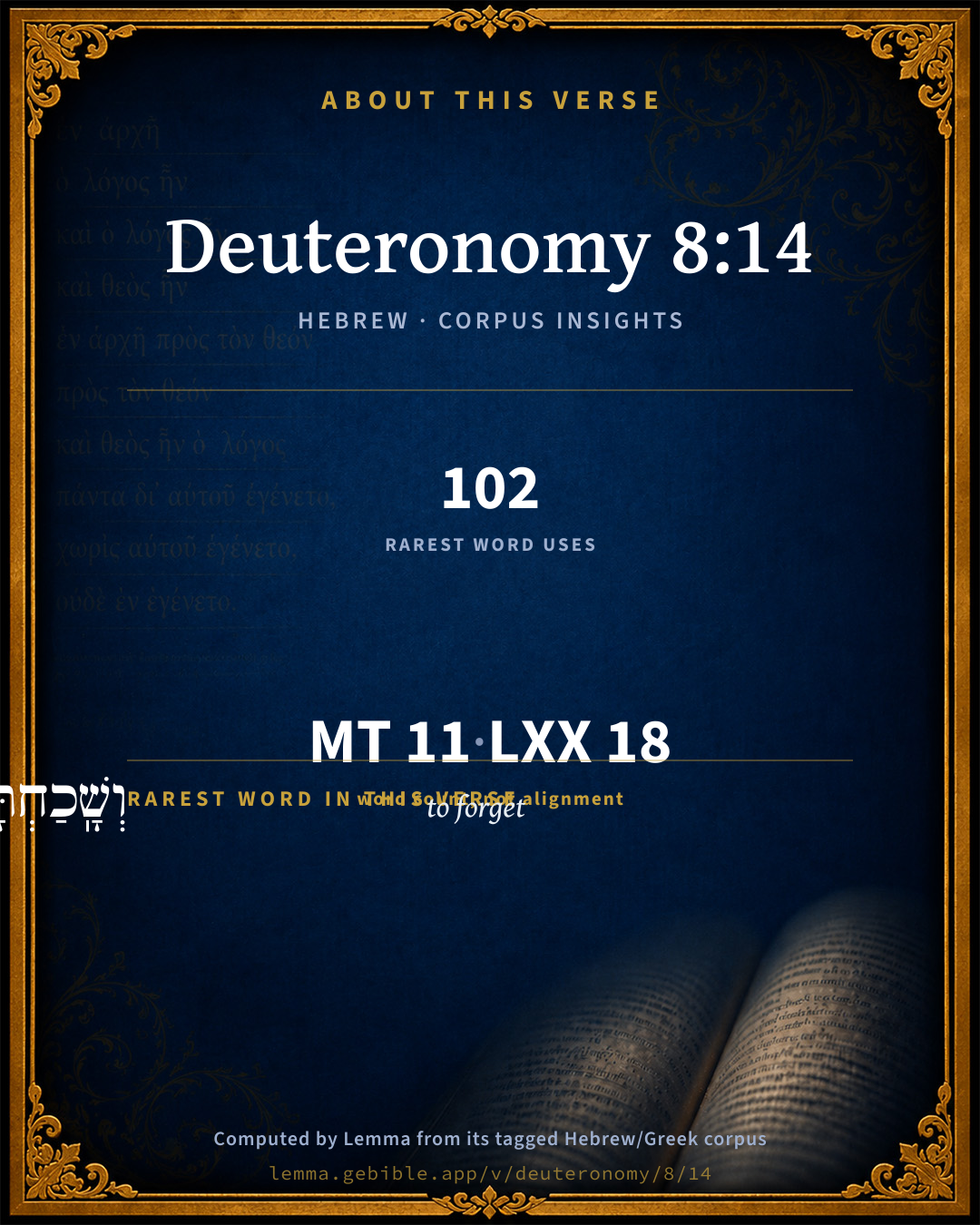
11
words
11
distinct lemmas
Pentateuch
section

Grammatical profile

  • 3 verbs
  • 7 nouns
  • 1 particle

Verb forms

  • וְרָ֖ם Qal · Sequential Perfect
  • וְשָֽׁכַחְתָּ֙ Qal · Sequential Perfect
  • הַמּוֹצִיאֲךָ֛ Hiphil · Participle Active

Hebrew & Septuagint length

In English translation the verse runs 28 words from the Hebrew and 27 from the Septuagint (LXX English) — closely comparable.

A rough comparison of the two English renderings, which tokenize alike — not a word-level alignment.

Word counts can differ between the Hebrew and the Greek without any difference in meaning — e.g. the Hebrew direct-object marker אֵת has no separate Greek word, and Greek often adds the article ὁ.

In the original languages it is 11 Hebrew tokens and 18 Greek tokens — but the two are counted differently (Hebrew bundles its prefixes and suffixes into one token; the Greek is in lemma form), so that isn’t a like-for-like length.

Cross-references

8

Topical passages linked to Deuteronomy 8:14 in the Treasury of Scripture Knowledge — connected by theme and wording, ordered by reader-vote popularity; previews shown in the World English Bible.

  • Psalms 106:21 They forgot God, their Savior, Who had done great things in Egypt,
  • 1 Corinthians 4:7–8 For who makes you different? And what do you have that you didn't receive? But if you did receive it, why do you boast as if you had not received it?
  • Deuteronomy 8:11 Beware lest you forget Yahweh your God, in not keeping his commandments, and his ordinances, and his statutes, which I command you this day:
  • 2 Chronicles 26:16 But when he was strong, his heart was lifted up, so that he did corruptly, and he trespassed against Yahweh his God; for he went into the temple of Yahweh to burn incense on the altar of incense.
  • 2 Chronicles 32:25 But Hezekiah didn't render again according to the benefit done to him; for his heart was lifted up: therefore there was wrath on him, and on Judah and Jerusalem.
  • Deuteronomy 17:20 that his heart not be lifted up above his brothers, and that he not turn aside from the commandment, to the right hand, or to the left: to the end that he may prolong his days in his kingdom, he and his children, in the midst of Israel.
  • Jeremiah 2:6 Neither said they, Where is Yahweh who brought us up out of the land of Egypt, who led us through the wilderness, through a land of deserts and of pits, through a land of drought and of the shadow of death, through a land that none passed through, and where no man lived?
  • Jeremiah 2:31 Generation, see the word of Yahweh. Have I been a wilderness to Israel? or a land of thick darkness? why say my people, We are broken loose; we will come no more to you?

Cross-references courtesy of OpenBible.info (CC BY 4.0).

Hebrew and Greek witnesses Masoretic Hebrew ↔ Greek Septuagint

The same verse in the two great witnesses to the Old Testament, shown verse-for-verse.

These are two independent witnesses, not word-aligned to each other, and the Septuagint is shown in lemma (dictionary) form.

Hebrew Deuteronomy 8:14 Masoretic · Westminster Leningrad Codex

וְרָ֖ם לְבָבֶ֑ךָ וְשָֽׁכַחְתָּ֙ אֶת יְהוָ֣ה אֱלֹהֶ֔יךָ הַמּוֹצִיאֲךָ֛ מֵאֶ֥רֶץ מִצְרַ֖יִם מִבֵּ֥ית עֲבָדִֽים

then your heart be lifted up, and you forget Yahweh your God, who brought you forth out of the land of Egypt, out of the house of bondage;

World English Bible · Public Domain

Greek LXX Deuteronomy 8:14 Septuagint · lemma form

ὑψόω ὁ καρδία καί ἐπιλανθάνω κύριος ὁ θεός σύ ὁ ἐκἄγω σύ ἐκ γῆ αἴγυπτος ἐκ οἶκος δουλεία

you should be exalted in heart, and forget the Lord your God, who brought you out of the land of Egypt, out of the house of bondage:

LXX2012 (modern English Septuagint) · Public Domain

On this verse, John Gill's Exposition discusses the Septuagint’s reading. Read the note in Commentary ↓

Hebrew: Westminster Leningrad Codex (CC BY 4.0). Greek: Septuagint (public domain); English from LXX2012 (modern English Septuagint) (Public Domain). How the Septuagint differs from the Hebrew →

Targum (Aramaic paraphrase)

2

The Targum is the ancient Jewish Aramaic paraphrase of the Hebrew Scriptures — an interpretive translation, not the Hebrew text itself. Onkelos (literal) and Pseudo-Jonathan (expansive) render the Torah, and Jonathan the Prophets. Coverage is partial: where no permissively-licensed English translation exists for a verse, only the Aramaic is shown. This is verse-level text, not a word-by-word alignment to the Hebrew.

  1. Targum Onkelos Torah (Genesis–Deuteronomy)
    וִירִים לִבָּךְ וְתִנְשֵׁי יָת דַחַלְתָּא דַיְיָ אֱלָהָךְ דִי אַפְּקָךְ מֵאַרְעָא דְמִצְרַיִם מִבֵּית עַבְדוּתָא

    (no public-domain English translation for this verse)

    Targum Onkelos — Aramaic: “Onkelos Genesis” (public domain); “Onkelos Exodus” (public domain); “Onkelos Leviticus” (public domain); “Onkelos Numbers” (public domain); “Onkelos Deuteronomy” (public domain). English: “Sefaria Community Translation” (CC0 1.0 (public-domain dedication)); “J.W. Etheridge. The Targums of Onkelos and Jonathan Ben Uzziel on the Pentateuch. London: Longmans, Green, 1862” (public domain). Text via Sefaria.

  2. Targum Pseudo-Jonathan Torah (Genesis–Deuteronomy)
    וְיִתְרָם לִבְּכוֹן וְתִתְנְשׁוּן יַת דַּחַלְתָּא דַיְיָ אֱלָהָכוֹן דְּאַפֵּיקְכוֹן פְּרִיקִין מֵאַרְעָא דְמִצְרַיִם מִבֵּית שִׁעֲבּוּד עַבְדַיָא

    your heart be lifted up, and you forget the fear of the Lord your God, who brought you out free from the land of Mizraim, from the house of the affliction of slaves;

    Targum Pseudo-Jonathan — Aramaic: “Targum Jonathan on Genesis” (public domain); “Targum Jonathan on Exodus” (public domain); “Targum Jonathan on Leviticus” (public domain); “Targum Jonathan on Numbers” (public domain); “Targum Jonathan on Deuteronomy” (public domain). English: “The Targum of Jonathan ben Uzziel, trans. J. W. Etheridge, London, 1862” (public domain). Text via Sefaria.

Commentary

Notes on Deuteronomy 8:14 from classic Christian and Jewish commentators (each source and its license shown beneath its notes). The classic Christian expositions comment on the surrounding passage and are grouped to its opening verse, so a note may address several verses; the Jewish commentaries on the Tanakh (Rashi and others) are per-verse, so they appear only where the commentator wrote on this verse.

Lemma curates 59 commentaries, every one of them public domain or Creative Commons licensed, each selected and text-cleaned for this edition rather than reprinted as found. About our sources →

Trapp's Complete Commentary

John Trapp

Deu 8:14 Then thine heart be lifted up, and thou forget the LORD thy God, which brought thee forth out of the land of Egypt, from the house of bondage;

Ver. 14. Then thy heart be lifted up.] The devil will easily blow up this blab in the rich man’s heart, whose usual diseases are earthly mindedness and high mindedness. Prosperity makes men proud, secure, impatient. {Jer 22:21} In rest they contract much rust.

John Trapp, A Commentary or Exposition upon All the Books of the Old and New Testament (1647–1656) — public domain. Text from a community e-Sword module.

Joseph Benson's Commentary

Deu 8:14. Lifted up — As if thou didst receive and enjoy these things, either by thy own wisdom, and valour, and industry, or by thy own merit.

Joseph Benson's Commentary on the Old and New Testaments (1811–1818) — public domain. Text from a community e-Sword module.

Geneva Bible (1599)

Geneva Bible translators

By attributing God’s benefits to thine own wisdom and labor, or to good fortune.

Geneva Bible (1599) marginal notes — public domain. Text via Bolls.life.

The Cambridge Bible for Schools and Colleges

gen. ed. J. J. S. Perowne

14. thine heart be lifted up] Deu_17:20; Hos_13:6.

house of bondage] Deu_6:12.

The Cambridge Bible for Schools and Colleges (gen. ed. J. J. S. Perowne; Cambridge University Press, 1878–1918) — public domain. Text from a community e-Sword module.

John Gill's Exposition

Who led thee through that great and terrible wilderness,.... The wilderness of Paran, which was great and large, reaching from Sinai to Kadesh, eleven days' journey, and terrible to the sight, nothing being to be seen but dry rocks and barren mountains; see Deu 1:19, and especially for what follows: wherein were fiery serpents and scorpions; fiery serpents, such as bit the Israelites, of which see Num 21:6 and scorpions, a kind of serpents, venomous and mischievous, which have stings in their tails they are continually thrusting out and striking with, as Pliny says (u); and have their name from their great sting; for Aristotle (w) says, this alone of insects has a large sting:

and drought where there was no water; a dry and barren place where no water was to be had; see Psa 63:1 or it may be rather another kind of serpents may be meant, which is called "dipsas"; and so the Vulgate Latin, Septuagint, and Samaritan versions render it; the biting of which produces such a thirst as proves mortal, and which must be intolerable in a wilderness where no water is; and from whence it has its name, which signifies thirsty, as does the Hebrew word here used:

who brought thee forth water out of the rock of flint; which was done both at Horeb and Kadesh, Exo 17:6 and was very extraordinary; by striking flint, fire is ordinarily produced, and not water. Dr. Shaw observes (x), that it may be more properly named, with other sorts of graphite marble here to be met with, "the rock of amethyst", from their reddish or purple colour and complexion.

(u) Nat. Hist. l. 11. c. 25. (w) Hist. Animal. l. 4. c. 7. (x) Travels, p. 317, 442.

John Gill's Exposition of the Whole Bible (1746–1763) — public domain (CC PDM 1.0). Text via the HelloAO Bible API.

Matthew Poole's English Annotations

Thine heart be lifted up; as if thou didst receive and enjoy these things either by thy own wisdom, and valour, and industry, Deu 8:17, or for thy own merit, Deu 9:4. See Hos 13:6; 1Co 4:7.

Matthew Poole's English Annotations on the Holy Bible (1683–1685) — public domain. Text from a community e-Sword/MySword module.

John Wesley's Explanatory Notes

Lifted up - As if thou didst receive and enjoy these things, either, by thy owns wisdom, and valour, and industry, or for thy own merit.

John Wesley, Explanatory Notes Upon the Whole Bible (1754–1765) — public domain. Text via the GEBible commentary corpus.

Lesson kit

Teaching starters — assembled from the data on this page, not authored interpretation. Every prompt links to the verse data it draws on. Edit before teaching.

Deuteronomy, in the Pentateuch, opens this verse with 11 words (11 distinct Hebrew lemmas). Its most distinctive word is shâkach (“to forget”). A historical commentator’s framing appears above. Read the whole chapter for the surrounding context.

Discussion questions

  1. How does “to forget” (shâkach) shape what this verse is saying?
  2. Psalms 106:21 shares this passage’s theme. How do the two illuminate each other?
  3. These translations render this verse differently. What is at stake in choosing one wording over another?
  4. The verb «וְרָ֖ם» is Qal Sequential Perfect. How does its form color the action?
  5. Reading how Trapp's Complete Commentary and Joseph Benson's Commentary read this verse, where do the two commentators agree and where do they part?

Things to notice

Reading settings

Reading text

Shown beneath each verse's original-language words.

Old Testament
Old Testament edition

Read the OT as the Masoretic Hebrew (MT) or the Greek Septuagint (LXX).

English shown for the Greek Septuagint (in the Hebrew ↔ Greek comparison).

Comparing translations? Open the Compare panel on any verse page to stack up to four side by side.