
Numbers 18:30

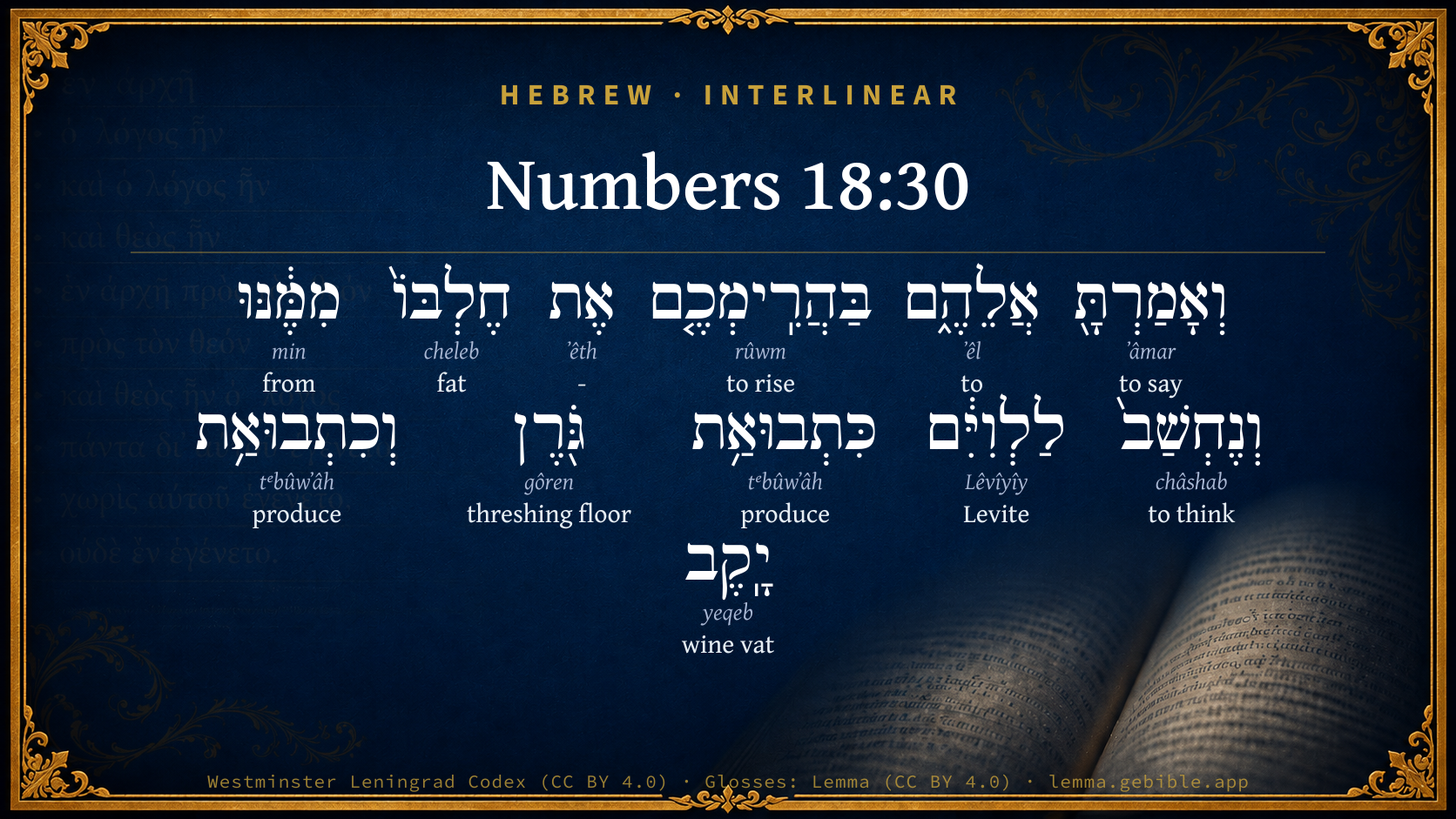
Hebrew (Westminster Leningrad Codex) Numbers 18:30 appears in the Hebrew Old Testament. The text above is from the Westminster Leningrad Codex. Each word links to its Strong’s number, a concise gloss, and parsing drawn from the Open Scriptures Hebrew Bible morphology. Click any word for its full Brown-Driver-Briggs (BDB) entry.
Download image
Cite this verse

Numbers 18:30 (World English Bible). Public Domain. Lemma interlinear Bible study tool, https://lemma.gebible.app/v/numbers/18/30.

Show BibTeX & RIS
BibTeX
RIS
English Translation
Therefore you shall tell them, When you heave the best of it from it, then it shall be reckoned to the Levites as the increase of the threshing floor, and as the increase of the wine-press.
World English Bible · Public Domain
Download a study sheet

One document with this verse’s original text, its word-by-word gloss line, the meaning frame, cross-references with their text, attributed commentary, and full source and license credits — printable, and it pastes into notes with its structure intact.

This verse Autodidact and up

Study sheet (.html) Plain text (.txt)

A passage Seminary Student

Up to 50 verses in one chapter. A passage sheet keeps up to 6 commentary sources and 12 cross-references per verse, in the order this page ranks them, and says so on the sheet whenever that leaves anything out. Ask for a single verse and you get the Autodidact verse sheet above.

Everything on this page stays free to read, with no account — the sheet is a download of what is already on screen, not access to it.

Want to remove ads? Support Godless Engineer
Compare translations 3

The same verse in 3 English versions, stacked beneath the original-language interlinear above. Click any original word for its lexicon entry.

Each is an independent rendering of the whole verse — the interlinear is not word-aligned to these translations.

Highlighted words mark where these versions differ — a whole-verse word diff, not a word-by-word alignment.

  • World English Bible Public Domain
    Therefore you shall tell them, When you heave the best of it from it, then it shall be reckoned to the Levites as the increase of the threshing floor, and as the increase of the wine-press.
  • King James Version Public Domain
    Therefore thou shalt say unto them, When ye have heaved the best thereof from it, then it shall be counted unto the Levites as the increase of the threshingfloor, and as the increase of the winepress.
  • unfoldingWord Literal Text CC BY-SA 4.0
    And you shall say to them, ‘When you lift up its fat from it, then it shall be reckoned to the Levites like produce of a threshing floor and like produce of a winepress.

unfoldingWord Literal Text — © unfoldingWord, licensed CC BY-SA 4.0. Word-aligned USFM3 via Door43 (git.door43.org/unfoldingWord/en_ult).

Versions to compare (up to 4)

3 of 4 selected

Show all 18 translations

Every available English version of this verse, each an independent rendering of the whole verse.

  • World English Bible Public Domain
    Therefore you shall tell them, When you heave the best of it from it, then it shall be reckoned to the Levites as the increase of the threshing floor, and as the increase of the wine-press.
  • Berean Standard Bible Public Domain
    Therefore say to the Levites, ‘When you have presented the best part, it will be reckoned to you as the produce of the threshing floor or winepress.
  • Majority Standard Bible Public Domain
    Therefore say to the Levites, ‘When you have presented the best part, it will be reckoned to you as the produce of the threshing floor or winepress.
  • King James Version Public Domain
    Therefore thou shalt say unto them, When ye have heaved the best thereof from it, then it shall be counted unto the Levites as the increase of the threshingfloor, and as the increase of the winepress.
  • American Standard Version (1901) Public Domain
    Therefore thou shalt say unto them, When ye heave the best thereof from it, then it shall be reckoned unto the Levites as the increase of the threshing-floor, and as the increase of the wine-press.
  • Revised Version (1885) Public Domain
    Therefore thou shalt say unto them, When ye heave the best thereof from it, then it shall be counted unto the Levites as the increase of the threshing-floor, and as the increase of the winepress.
  • Geneva Bible (1599) Public Domain
    Therefore thou shalt say vnto them, When ye haue offred the fat thereof, then it shalbe couted vnto the Leuites, as the encrease of the corne floore, or as the encrease of the wine presse.
  • Douay-Rheims (1899) Public Domain
    And thou shalt say to them: If you offer all the goodly and the better things of the tithes, it shall be reckoned to you as if you had given the firstfruits of the barnfloor and the winepress:
  • Young's Literal Translation Public Domain
    `And thou hast said unto them, In your lifting up its fat out of it, then it hath been reckoned to the Levites, as increase of a threshing-floor, and as increase of a wine-vat;
  • Literal Standard Version CC BY-SA 4.0
    And you have said to them: In your lifting up its fat out of it, then it has been reckoned to the Levites as increase of a threshing-floor and as increase of a wine-vat;
  • Unlocked Literal Bible CC BY-SA 4.0
    Therefore you must say to them, 'When you present the best of it, then it must be credited to the Levites as the product from the threshing floor and the winepress.
  • unfoldingWord Literal Text CC BY-SA 4.0
    And you shall say to them, ‘When you lift up its fat from it, then it shall be reckoned to the Levites like produce of a threshing floor and like produce of a winepress.
  • Darby Bible Public Domain
    And thou shalt say unto them, When ye heave the best thereof from it, then it shall be counted unto the Levites as produce of the threshing-floor, and as produce of the winepress.
  • World Messianic Bible Public Domain
    “Therefore you shall tell them, ‘When you heave its best from it, then it shall be credited to the Levites as the increase of the threshing floor, and as the increase of the wine press.
  • Webster's Bible Public Domain
    Therefore thou shalt say to them, When ye have heaved from it the best of it, then it shall be counted to the Levites as the increase of the threshing-floor, and as the increase of the wine-press.
  • Free Bible Version CC BY-SA 4.0
    So tell the Levites, ‘When you have presented the best part, it will be considered as your contribution produced by your threshing floor or winepress.
  • Bible in Basic English Public Domain
    Say to them, then, When the best of it is lifted up on high, it is to be put to the account of the Levites as the increase of the grain-floor and of the place where the grapes are crushed.
  • JPS Tanakh (1917) Public Domain
    Therefore thou shalt say unto them: When ye set apart the best thereof from it, then it shall be counted unto the Levites as the increase of the threshing-floor, and as the increase of the wine-press.

Literal Standard Version (2020), Covenant Press — licensed CC BY-SA 4.0. Text via the HelloAO Bible API (eBible.org). Unlocked Literal Bible (unfoldingWord) — licensed CC BY-SA 4.0. Text via the HelloAO Bible API (eBible.org). unfoldingWord Literal Text — © unfoldingWord, licensed CC BY-SA 4.0. Word-aligned USFM3 via Door43 (git.door43.org/unfoldingWord/en_ult). Free Bible Version, Dr. Jonathan Gallagher — licensed CC BY-SA 4.0. Text via the HelloAO Bible API (eBible.org).

Word by word

More ways to search: Search by grammar → Find every occurrence → Compare this word →

Practice this passage: Drill this verse → Learn its vocabulary →

יָֽקֶב
yeqeb
H3342
“wine vat”
Noun, Common, Masculine, Singular, Absolute
Part of Speech
Noun
Type
Common
Gender
Masculine
Number
Singular
State
Absolute
Full BDB Definition

Origin: from an unused root meaning to excavate

TWOT: 900a

wine vat, wine-press
  1. וְאָמַרְתָּ֖ ʼâmar H559 “and · to say” Conjunction + Verb, Qal, Sequential Perfect, 2nd Person, Masculine, Singular
  2. אֲלֵהֶ֑ם ʼêl H413 “to · them” Preposition + Suffix, Personal, 3rd Person, Masculine, Plural
  3. בַּהֲרִֽימְכֶ֤ם rûwm H7311 “in/at · to rise · you” Preposition + Verb, Hiphil, Infinitive Construct + Suffix, Personal, 2nd Person, Masculine, Plural
  4. אֶת ʼêth H853 “-” Particle, Direct Object
  5. חֶלְבּוֹ֙ cheleb H2459 “fat · his” Noun, Common, Masculine, Singular, Construct + Suffix, Personal, 3rd Person, Masculine, Singular
  6. מִמֶּ֔נּוּ min H4480 “from · us” Preposition + Suffix, Personal, 1st Person, Common, Plural
  7. וְנֶחְשַׁב֙ châshab H2803 “and · to think” Conjunction + Verb, Niphal, Sequential Perfect, 3rd Person, Masculine, Singular
  8. לַלְוִיִּ֔ם Lêvîyîy H3881 “to/for the · Levites” Preposition, Determined + Noun, Gentilic, Masculine, Plural, Absolute
  9. כִּתְבוּאַ֥ת tᵉbûwʼâh H8393 “like/as · produce of” Preposition + Noun, Common, Feminine, Singular, Construct
  10. גֹּ֖רֶן gôren H1637 “threshing floor” Noun, Common, Both, Singular, Absolute
  11. וְכִתְבוּאַ֥ת tᵉbûwʼâh H8393 “and · like/as · produce of” Conjunction + Preposition + Noun, Common, Feminine, Singular, Construct

About this verse

These counts appear in no published source. They are computed here, from the morphology-tagged text and Lemma’s own curated glosses. What Lemma adds →

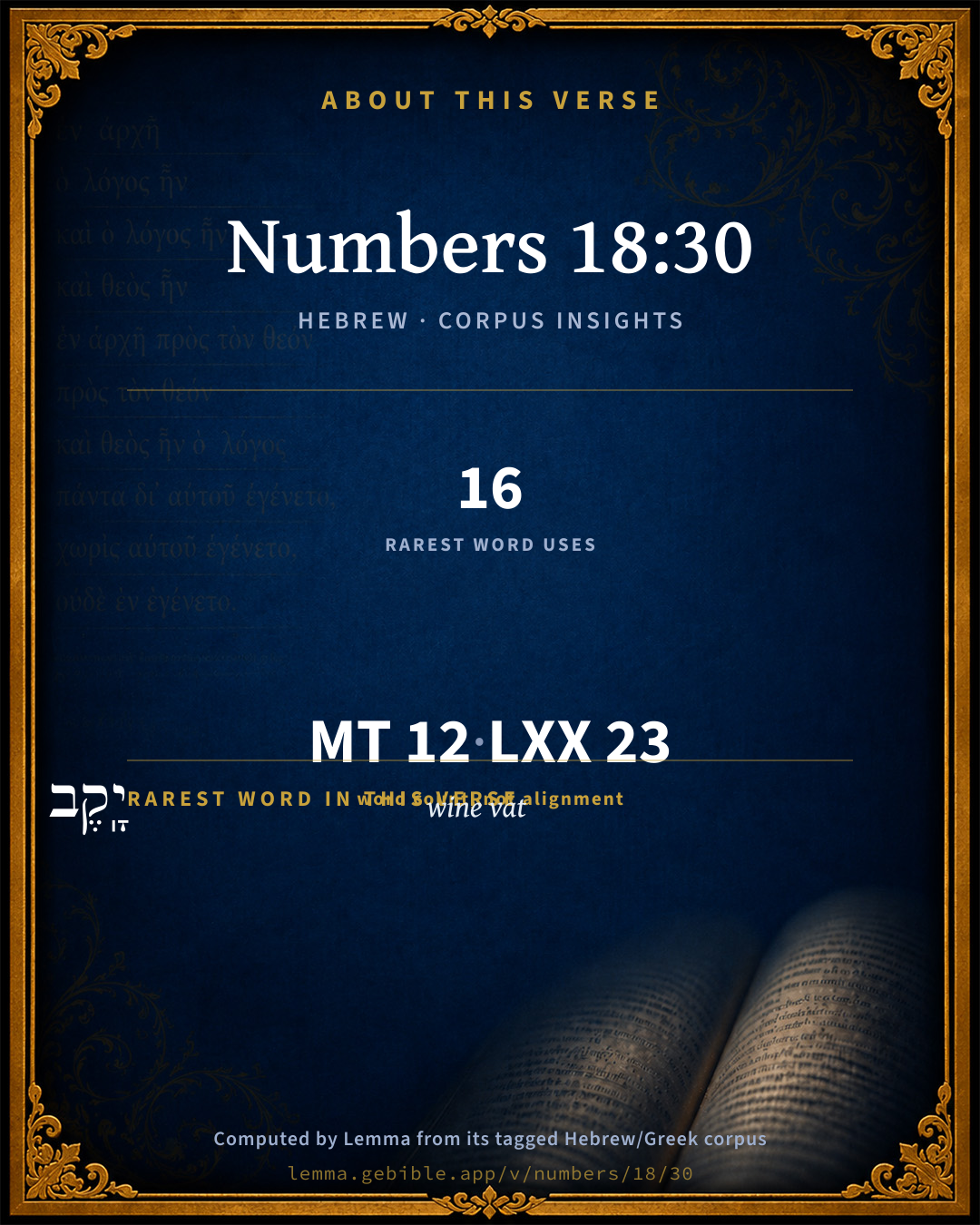
12
words
11
distinct lemmas
Pentateuch
section

Notable vocabulary

The rarest word here is יָֽקֶב wine vat H3342 — appearing just 16 times in the whole Hebrew Bible.

Shared distinctive vocabulary

יָֽקֶב wine vat H3342 occurs in 16 verses of the Hebrew Bible. Also found in:

Grammatical profile

  • 3 verbs
  • 6 nouns
  • 2 prepositions
  • 1 particle

Verb forms

  • וְאָמַרְתָּ֖ Qal · Sequential Perfect
  • בַּהֲרִֽימְכֶ֤ם Hiphil · Infinitive Construct
  • וְנֶחְשַׁב֙ Niphal · Sequential Perfect

Repetition

A word recurs within this verse — often emphatic in Hebrew:

  • כִּתְבוּאַ֥ת produce H8393 ×2

Hebrew & Septuagint length

In English translation the verse runs 36 words from the Hebrew and 35 from the Septuagint (LXX English) — closely comparable.

A rough comparison of the two English renderings, which tokenize alike — not a word-level alignment.

Word counts can differ between the Hebrew and the Greek without any difference in meaning — e.g. the Hebrew direct-object marker אֵת has no separate Greek word, and Greek often adds the article ὁ.

In the original languages it is 12 Hebrew tokens and 23 Greek tokens — but the two are counted differently (Hebrew bundles its prefixes and suffixes into one token; the Greek is in lemma form), so that isn’t a like-for-like length.

Cross-references

8

Topical passages linked to Numbers 18:30 in the Treasury of Scripture Knowledge — connected by theme and wording, ordered by reader-vote popularity; previews shown in the World English Bible.

  • Genesis 43:11 Their father, Israel, said to them, "If it be so now, do this. Take from the choice fruits of the land in your bags, and carry down a present for the man, a little balm, a little honey, spices and myrrh, nuts, and almonds;
  • Numbers 18:27–28 Your heave-offering shall be reckoned to you, as though it were the grain of the threshing floor, and as the fullness of the winepress.
  • Deuteronomy 6:5 and you shall love Yahweh your God with all your heart, and with all your soul, and with all your might.
  • Proverbs 3:9–10 Honor Yahweh with your substance, With the first fruits of all your increase:
  • Malachi 1:8 When you offer the blind for sacrifice, isn't that evil? And when you offer the lame and sick, isn't that evil? Present it now to your governor! Will he be pleased with you? Or will he accept your person?" says Yahweh of Hosts.
  • Matthew 6:33 But seek first God's Kingdom, and his righteousness; and all these things will be given to you as well.
  • Matthew 10:37–39 He who loves father or mother more than me is not worthy of me; and he who loves son or daughter more than me isn't worthy of me.
  • Philippians 3:8–9 Yes most assuredly, and I count all things to be loss for the excellency of the knowledge of Christ Jesus, my Lord, for whom I suffered the loss of all things, and count them nothing but refuse, that I may gain Christ

Cross-references courtesy of OpenBible.info (CC BY 4.0).

Hebrew and Greek witnesses Masoretic Hebrew ↔ Greek Septuagint

The same verse in the two great witnesses to the Old Testament, shown verse-for-verse.

These are two independent witnesses, not word-aligned to each other, and the Septuagint is shown in lemma (dictionary) form.

Hebrew Numbers 18:30 Masoretic · Westminster Leningrad Codex

וְאָמַרְתָּ֖ אֲלֵהֶ֑ם בַּהֲרִֽימְכֶ֤ם אֶת חֶלְבּוֹ֙ מִמֶּ֔נּוּ וְנֶחְשַׁב֙ לַלְוִיִּ֔ם כִּתְבוּאַ֥ת גֹּ֖רֶן וְכִתְבוּאַ֥ת יָֽקֶב

Therefore you shall tell them, When you heave the best of it from it, then it shall be reckoned to the Levites as the increase of the threshing floor, and as the increase of the wine-press.

World English Bible · Public Domain

Greek LXX Numbers 18:30 Septuagint · lemma form

καί εἶπον πρός αὐτός ὅταν ἀποαἱρέω ὁ ἀπαρχή ἀπό αὐτός καί λογίζομαι ὁ λευίτης ὡς γένημα ἀπό ἅλων καί ὡς γένημα ἀπό ληνός

And you shall say to them, When you⌃ shall offer the first fruits from it, then shall it be reckoned to the Levites as produce from the threshing floor, and as produce from the wine-press.

LXX2012 (modern English Septuagint) · Public Domain

Hebrew: Westminster Leningrad Codex (CC BY 4.0). Greek: Septuagint (public domain); English from LXX2012 (modern English Septuagint) (Public Domain). How the Septuagint differs from the Hebrew →

Targum (Aramaic paraphrase)

2

The Targum is the ancient Jewish Aramaic paraphrase of the Hebrew Scriptures — an interpretive translation, not the Hebrew text itself. Onkelos (literal) and Pseudo-Jonathan (expansive) render the Torah, and Jonathan the Prophets. Coverage is partial: where no permissively-licensed English translation exists for a verse, only the Aramaic is shown. This is verse-level text, not a word-by-word alignment to the Hebrew.

  1. Targum Onkelos Torah (Genesis–Deuteronomy)
    וְתֵימַר לְהוֹן בְּאַפְרָשׁוּתְכוֹן יָת שׁוּפְרֵיהּ מִנֵיהּ וְיִתְחַשֵׁב לְלֵּוָאֵי כַּעֲלָלַת אִדְרָא וְכַעֲלָלַת מַעֲצַרְתָּא

    (no public-domain English translation for this verse)

    Targum Onkelos — Aramaic: “Onkelos Genesis” (public domain); “Onkelos Exodus” (public domain); “Onkelos Leviticus” (public domain); “Onkelos Numbers” (public domain); “Onkelos Deuteronomy” (public domain). English: “Sefaria Community Translation” (CC0 1.0 (public-domain dedication)); “J.W. Etheridge. The Targums of Onkelos and Jonathan Ben Uzziel on the Pentateuch. London: Longmans, Green, 1862” (public domain). Text via Sefaria.

  2. Targum Pseudo-Jonathan Torah (Genesis–Deuteronomy)
    וְתֵימַר לְהוֹן לְכַהֲנַיָא בְּאַפְרָשׁוּתְכוֹן יַת שְׁפַר טוּבֵיהּ מִינֵיהּ וּבֵיהּ וְיִתְחַשֵׁב לְלֵיוָאֵי הֵי כְּאַפְרָשׁוּת עִבּוּרָא מִן גוֹ אִידְרָא וְהֵי כְּאַפְרָשׁוּת חַמְרָא מִגוֹ מַעֲצַרְתָּא

    And say thou to the priests, When you have set apart the finest and the best of it and in it, then shall it be reckoned to the Levites as the setting apart of corn from the threshing floor, and of wine from the winepress.

    Targum Pseudo-Jonathan — Aramaic: “Targum Jonathan on Genesis” (public domain); “Targum Jonathan on Exodus” (public domain); “Targum Jonathan on Leviticus” (public domain); “Targum Jonathan on Numbers” (public domain); “Targum Jonathan on Deuteronomy” (public domain). English: “The Targum of Jonathan ben Uzziel, trans. J. W. Etheridge, London, 1862” (public domain). Text via Sefaria.

Commentary

Notes on Numbers 18:30 from classic Christian and Jewish commentators (each source and its license shown beneath its notes). The classic Christian expositions comment on the surrounding passage and are grouped to its opening verse, so a note may address several verses; the Jewish commentaries on the Tanakh (Rashi and others) are per-verse, so they appear only where the commentator wrote on this verse.

Lemma curates 59 commentaries, every one of them public domain or Creative Commons licensed, each selected and text-cleaned for this edition rather than reprinted as found. About our sources →

Ellicott's Commentary for English Readers

(30) As the increase of the threshing-floor.—As the tithe rendered to the priests was to be regarded in the same light as if it had been the produce of their own labour (Num_18:27), so what remained after the heave-offerings had been duly set apart was to be reckoned as much the property of the Levites, and to be treated in the same manner, as the corn of the threshing-floor and the wine of the wine-press of the rest of the Israelites.

A Bible Commentary for English Readers, edited by Charles John Ellicott (1878–1897) — public domain. Text from a community e-Sword module.

The Cambridge Bible for Schools and Colleges

gen. ed. J. J. S. Perowne

30. The regulation may be paraphrased as follows: When ye shall have contributed [as a tithe] the best part from it [i.e. from the tithe which you have received], then it [the remaining nine-tenths] shall be for your own use, just as the rest of Israel use their corn and wine after contributing a tithe of it to you.

The Cambridge Bible for Schools and Colleges (gen. ed. J. J. S. Perowne; Cambridge University Press, 1878–1918) — public domain. Text from a community e-Sword module.

John Gill's Exposition

And ye shall eat it in every place,.... In any of their tents or dwelling houses, not being obliged to eat it in the tabernacle, where the priests, were obliged to eat many of their holy things, and second tithes were only to be eaten at Jerusalem, Deu 14:22; but the Levites might eat theirs any where, in any place, clean or unclean, according to Jarchi; for, he says, it might be eaten even in a graveyard; but Aben Ezra much better, in a clean place, be that where it would:

ye, and your households; they and their wives, their sons and daughters, their servants, whether bought or hired; and they might sell it to strangers, to purchase other necessaries with. The Targum of Jonathan interprets this of the priests; but the Levites only are plainly spoken of:

for it is your reward for your service in the tabernacle of the congregation; which is said to encourage them in their work, and animate them to it, as well as to clear their right to such a maintenance against all objections; for the labourer is worthy of his reward, as those that labour in the word and doctrine are of theirs, Ti1 5:17.

John Gill's Exposition of the Whole Bible (1746–1763) — public domain (CC PDM 1.0). Text via the HelloAO Bible API.

The Pulpit Commentary

Thou shalt say unto them, i.e., to the Levites. When they had dedicated their tithe of the best part, the rest was theirs exactly as if they had grown it and gathered it themselves.

The Pulpit Commentary (1880–1919), ed. H.D.M. Spence-Jones & Joseph S. Exell — public domain. Text from a community e-Sword module.

Keil & Delitzsch

C. F. Keil & F. Delitzsch

They might eat it (the tithe they had received, after taking off the priests' tithe) in any place with their families, as it was the reward for their service at the tabernacle.

Keil & Delitzsch — Biblical Commentary on the Old Testament (1861–1891) — public domain (CC PDM 1.0). Text via the HelloAO Bible API. (Old Testament only.)

unfoldingWord translationNotes

Door43 World Missions Community

Connecting Statement:

God continues speaking to Moses.

the best of it

"the best of what you have received from the people of Israel"

the rest of your gifts

The "gifts" are the offerings that the Israelites give to God and that the Levites receive from them.

You will not incur any guilt by eating and drinking it

"You will not be guilty when you eat and drink it"

translationWords

family

tent of meeting

guilt

profane

people group

Israel

die

unfoldingWord translationNotes — © Distant Shores Media and the Door43 World Missions Community, licensed CC BY-SA 4.0. Source: git.door43.org/Door43/en_tn.

Rashi

Rabbi Shlomo Yitzchaki (Rashi)

בהרימכם את חלבו ממנו WHEN YE HEAVE THE BEST THEREOF FROM IT — i.e. after you have heaved the תרומת מעשר (the priest’s share in the tithe) from it.

ונחשב THEN the remainder MAY BE ACCOUNTED by the Levites as profane (of a non-sacred character) in all respects.

כתבואת גרן AS THE PRODUCE OF THRESHING FLOOR is to the Israelites. [This is not a mere repetition of verse 27 but is stated in order that] you should not say: Since Scripture terms it (the tithe) “Terumah”, — as it is said, (verse 24) “But the tithes of the children of Israel which they heave as a תרומה unto the Lord” — I may conclude that it is all entirely forbidden to the Levites (just as “Terumah” is forbidden to them); Scripture therefore states, “it shall be accounted unto the Levites as the produce of the threshing floor”. How is it with the remainder of the Israelite’s produce after he has set apart the “Terumah”? It is profane (non-holy)! So, too, is the corresponding portion of the Levite’s tithe profane (cf. Sifrei Bamidbar 122).

Rashi on the Tanakh — English translations: “The Judaica Press complete Tanach with Rashi, translated by A. J. Rosenberg” (CC BY 4.0); “Pentateuch with Rashi's commentary by M. Rosenbaum and A.M. Silbermann, 1929-1934” (public domain); “The Metsudah Tanach series, Lakewood, N.J” (CC BY 4.0); and “The Book of Joshua, Metsudah Publications, 1997” (CC BY 4.0). Text via Sefaria.

Lesson kit

Teaching starters — assembled from the data on this page, not authored interpretation. Every prompt links to the verse data it draws on. Edit before teaching.

Numbers, in the Pentateuch, opens this verse with 12 words (11 distinct Hebrew lemmas). Its most distinctive word is yeqeb (“wine vat”). A historical commentator’s framing appears above. Read the whole chapter for the surrounding context.

Discussion questions

  1. How does “wine vat” (yeqeb) shape what this verse is saying?
  2. Numbers 18:27 shares the word «wine vat» with this verse. How do the two illuminate each other?
  3. “produce” occurs 2× in this one verse. What is the effect of the repetition?
  4. These translations render this verse differently; the difference is in the English rendering, not the original. What questions does that raise?
  5. The verb «וְאָמַרְתָּ֖» is Qal Sequential Perfect. How does its form color the action?
  6. Reading how Ellicott's Commentary for English Readers and The Cambridge Bible for Schools and Colleges read this verse, where do the two commentators agree and where do they part?

Things to notice

Reading settings

Reading text

Shown beneath each verse's original-language words.

Old Testament
Old Testament edition

Read the OT as the Masoretic Hebrew (MT) or the Greek Septuagint (LXX).

English shown for the Greek Septuagint (in the Hebrew ↔ Greek comparison).

Comparing translations? Open the Compare panel on any verse page to stack up to four side by side.