
Numbers 18:28

Hebrew (Westminster Leningrad Codex) Numbers 18:28 appears in the Hebrew Old Testament. The text above is from the Westminster Leningrad Codex. Each word links to its Strong’s number, a concise gloss, and parsing drawn from the Open Scriptures Hebrew Bible morphology. Click any word for its full Brown-Driver-Briggs (BDB) entry.
Download image
Cite this verse

Numbers 18:28 (World English Bible). Public Domain. Lemma interlinear Bible study tool, https://lemma.gebible.app/v/numbers/18/28.

Show BibTeX & RIS
BibTeX
RIS
English Translation
Thus you also shall offer a heave-offering to Yahweh of all your tithes, which you receive of the children of Israel; and of it you shall give Yahweh's heave-offering to Aaron the priest.
World English Bible · Public Domain
Download a study sheet

One document with this verse’s original text, its word-by-word gloss line, the meaning frame, cross-references with their text, attributed commentary, and full source and license credits — printable, and it pastes into notes with its structure intact.

This verse Autodidact and up

Study sheet (.html) Plain text (.txt)

A passage Seminary Student

Up to 50 verses in one chapter. A passage sheet keeps up to 6 commentary sources and 12 cross-references per verse, in the order this page ranks them, and says so on the sheet whenever that leaves anything out. Ask for a single verse and you get the Autodidact verse sheet above.

Everything on this page stays free to read, with no account — the sheet is a download of what is already on screen, not access to it.

Want to remove ads? Support Godless Engineer
Compare translations 3

The same verse in 3 English versions, stacked beneath the original-language interlinear above. Click any original word for its lexicon entry.

Each is an independent rendering of the whole verse — the interlinear is not word-aligned to these translations.

Highlighted words mark where these versions differ — a whole-verse word diff, not a word-by-word alignment.

  • World English Bible Public Domain
    Thus you also shall offer a heave-offering to Yahweh of all your tithes, which you receive of the children of Israel; and of it you shall give Yahweh's heave-offering to Aaron the priest.
  • King James Version Public Domain
    Thus ye also shall offer an heave offering unto the LORD of all your tithes, which ye receive of the children of Israel; and ye shall give thereof the LORD's heave offering to Aaron the priest.
  • unfoldingWord Literal Text CC BY-SA 4.0
    Thus you shall raise, you also, the contribution of Yahweh from all your tithes which you take from with the sons of Israel, and you shall give from it the contribution of Yahweh to Aaron the priest.

unfoldingWord Literal Text — © unfoldingWord, licensed CC BY-SA 4.0. Word-aligned USFM3 via Door43 (git.door43.org/unfoldingWord/en_ult).

Versions to compare (up to 4)

3 of 4 selected

Show all 18 translations

Every available English version of this verse, each an independent rendering of the whole verse.

  • World English Bible Public Domain
    Thus you also shall offer a heave-offering to Yahweh of all your tithes, which you receive of the children of Israel; and of it you shall give Yahweh's heave-offering to Aaron the priest.
  • Berean Standard Bible Public Domain
    So you are to present an offering to the LORD from all the tithes you receive from the Israelites, and from these you are to give the LORD’s offering to Aaron the priest.
  • Majority Standard Bible Public Domain
    So you are to present an offering to the LORD from all the tithes you receive from the Israelites, and from these you are to give the LORD’s offering to Aaron the priest.
  • King James Version Public Domain
    Thus ye also shall offer an heave offering unto the LORD of all your tithes, which ye receive of the children of Israel; and ye shall give thereof the LORD's heave offering to Aaron the priest.
  • American Standard Version (1901) Public Domain
    Thus ye also shall offer a heave-offering unto Jehovah of all your tithes, which ye receive of the children of Israel; and thereof ye shall give Jehovah's heave-offering to Aaron the priest.
  • Revised Version (1885) Public Domain
    Thus ye also shall offer an heave offering unto the LORD of all your tithes, which ye receive of the children of Israel; and thereof ye shall give the LORD’S heave offering to Aaron the priest.
  • Geneva Bible (1599) Public Domain
    So ye shall also offer an heaue offring vnto the Lord of all your tithes, which ye shall receiue of the children of Israel, and ye shall giue thereof the Lords heaue offring to Aaron the Priest.
  • Douay-Rheims (1899) Public Domain
    And of all the things of which you receive tithes, offer the firstfruits to the Lord, and give them to Aaron the priest.
  • Young's Literal Translation Public Domain
    so ye do lift up -- ye also -- the heave-offering of Jehovah from all your tithes which ye receive from the sons of Israel; and ye have given from it the heave-offering of Jehovah to Aaron the priest;
  • Literal Standard Version CC BY-SA 4.0
    so you lift up—you also—the raised-offering of YHWH from all your tithes which you receive from the sons of Israel; and you have given the raised-offering of YHWH from it to Aaron the priest;
  • Unlocked Literal Bible CC BY-SA 4.0
    So you also must make a contribution to Yahweh from all the tithes that you receive from the people of Israel. From them you must give his contribution to Aaron the priest.
  • unfoldingWord Literal Text CC BY-SA 4.0
    Thus you shall raise, you also, the contribution of Yahweh from all your tithes which you take from with the sons of Israel, and you shall give from it the contribution of Yahweh to Aaron the priest.
  • Darby Bible Public Domain
    Thus ye also shall offer Jehovah's heave-offering of all your tithes, which ye take of the children of Israel; and ye shall give thereof Jehovah's heave-offering to Aaron the priest.
  • World Messianic Bible Public Domain
    Thus you also shall offer a wave offering to the LORD of all your tithes, which you receive of the children of Israel; and of it you shall give the LORD’s wave offering to Aaron the priest.
  • Webster's Bible Public Domain
    Thus ye also shall offer a heave-offering to the LORD of all your tithes which ye receive of the children of Israel; and ye shall give of them the LORD'S heave-offering to Aaron the priest.
  • Free Bible Version CC BY-SA 4.0
    In this way you are to contribute an offering to the Lord from every tithe you receive from the Israelites, giving the Lord's offering to Aaron the priest.
  • Bible in Basic English Public Domain
    So you are to make an offering lifted up to the Lord from all the tenths which you get from the children of Israel, giving out of it the Lord's lifted offering to Aaron the priest.
  • JPS Tanakh (1917) Public Domain
    Thus ye also shall set apart a gift unto the LORD of all your tithes, which ye receive of the children of Israel; and thereof ye shall give the gift which is set apart unto the LORD to Aaron the priest.

Literal Standard Version (2020), Covenant Press — licensed CC BY-SA 4.0. Text via the HelloAO Bible API (eBible.org). Unlocked Literal Bible (unfoldingWord) — licensed CC BY-SA 4.0. Text via the HelloAO Bible API (eBible.org). unfoldingWord Literal Text — © unfoldingWord, licensed CC BY-SA 4.0. Word-aligned USFM3 via Door43 (git.door43.org/unfoldingWord/en_ult). Free Bible Version, Dr. Jonathan Gallagher — licensed CC BY-SA 4.0. Text via the HelloAO Bible API (eBible.org).

Word by word

More ways to search: Search by grammar → Find every occurrence → Compare this word →

Practice this passage: Drill this verse → Learn its vocabulary →

מַעְשְׂרֹ֣תֵיכֶ֔ם
maʻăsêr
H4643
“tithes · your”
Noun, Common, Masculine, Plural, Construct + Suffix, Personal, 2nd Person, Masculine, Plural
Part of Speech
Noun
Type
Common
Gender
Masculine
Number
Plural
State
Construct
Full BDB Definition

Origin: from H6240

TWOT: 1711h

tithe, tenth part - tenth part - tithe, payment of a tenth part
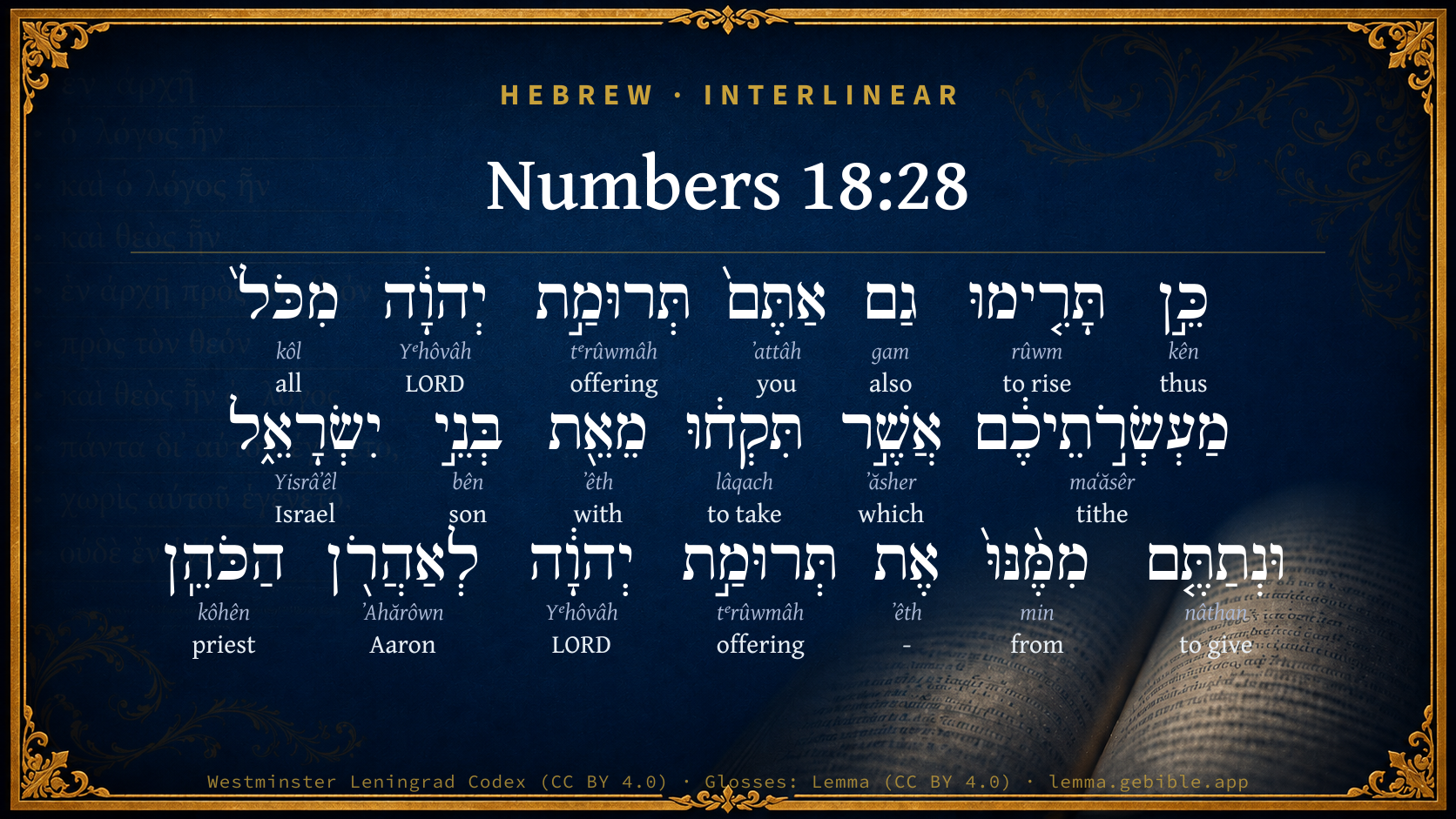
  1. כֵּ֣ן kên H3651 “thus” Particle, Demonstrative
  2. תָּרִ֤ימוּ rûwm H7311 “to rise” Verb, Hiphil, Imperfect, 2nd Person, Masculine, Plural
  3. גַם gam H1571 “also” Adverb
  4. אַתֶּם֙ ʼattâh H859 “you” Pronoun, Personal, 2nd Person, Masculine, Plural
  5. תְּרוּמַ֣ת tᵉrûwmâh H8641 “offering of” Noun, Common, Feminine, Singular, Construct
  6. יְהוָ֔ה Yᵉhôvâh H3068 “LORD” Noun, Proper
  7. מִכֹּל֙ kôl H3605 “from · all of” Preposition + Noun, Common, Masculine, Singular, Construct
  8. אֲשֶׁ֣ר ʼăsher H834 “which” Particle, Relative
  9. תִּקְח֔וּ lâqach H3947 “to take” Verb, Qal, Imperfect, 2nd Person, Masculine, Plural
  10. מֵאֵ֖ת ʼêth H854 “from · with” Preposition + Preposition
  11. בְּנֵ֣י bên H1121 “sons of” Noun, Common, Masculine, Plural, Construct
  12. יִשְׂרָאֵ֑ל Yisrâʼêl H3478 “Israel” Noun, Proper
  13. וּנְתַתֶּ֤ם nâthan H5414 “and · to give” Conjunction + Verb, Qal, Sequential Perfect, 2nd Person, Masculine, Plural
  14. מִמֶּ֨נּוּ֙ min H4480 “from · us” Preposition + Suffix, Personal, 1st Person, Common, Plural
  15. אֶת ʼêth H853 “-” Particle, Direct Object
  16. תְּרוּמַ֣ת tᵉrûwmâh H8641 “offering of” Noun, Common, Feminine, Singular, Construct
  17. יְהוָ֔ה Yᵉhôvâh H3068 “LORD” Noun, Proper
  18. לְאַהֲרֹ֖ן ʼAhărôwn H175 “to/for · Aaron” Preposition + Noun, Proper
  19. הַכֹּהֵֽן kôhên H3548 “the · priest” Particle, Definite Article + Noun, Common, Masculine, Singular, Absolute

About this verse

These counts appear in no published source. They are computed here, from the morphology-tagged text and Lemma’s own curated glosses. What Lemma adds →

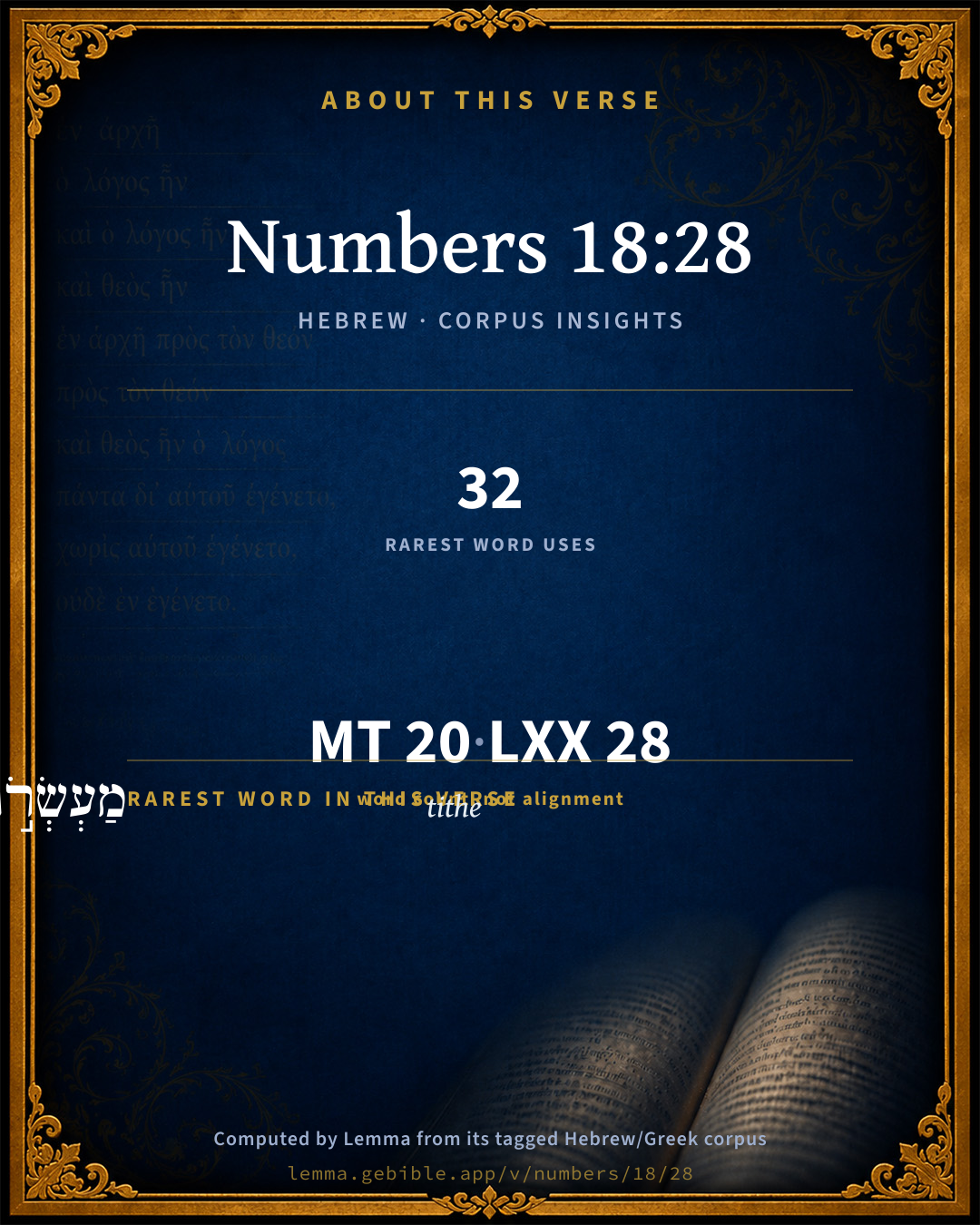
20
words
18
distinct lemmas
Pentateuch
section

Shared distinctive vocabulary

מַעְשְׂרֹ֣תֵיכֶ֔ם tithe H4643 occurs in 27 verses of the Hebrew Bible. Also found in:

Grammatical profile

  • 3 verbs
  • 10 nouns
  • 1 pronoun
  • 2 prepositions
  • 1 adverb
  • 3 particles

Verb forms

  • תָּרִ֤ימוּ Hiphil · Imperfect
  • תִּקְח֔וּ Qal · Imperfect
  • וּנְתַתֶּ֤ם Qal · Sequential Perfect

Repetition

Words recur within this verse — often emphatic in Hebrew:

  • תְּרוּמַ֣ת offering H8641 ×2
  • יְהוָ֔ה LORD H3068 ×2

Hebrew & Septuagint length

In English translation the verse runs 33 words from the Hebrew and 42 from the Septuagint (LXX English) — closely comparable.

A rough comparison of the two English renderings, which tokenize alike — not a word-level alignment.

Word counts can differ between the Hebrew and the Greek without any difference in meaning — e.g. the Hebrew direct-object marker אֵת has no separate Greek word, and Greek often adds the article ὁ.

In the original languages it is 20 Hebrew tokens and 28 Greek tokens — but the two are counted differently (Hebrew bundles its prefixes and suffixes into one token; the Greek is in lemma form), so that isn’t a like-for-like length.

Cross-references

2

Topical passages linked to Numbers 18:28 in the Treasury of Scripture Knowledge — connected by theme and wording, ordered by reader-vote popularity; previews shown in the World English Bible.

  • Genesis 14:18 Melchizedek king of Salem brought forth bread and wine: and he was priest of God Most High.
  • Hebrews 6:20–7:10 where as a forerunner Jesus entered for us, having become a high priest forever after the order of Melchizedek.

Cross-references courtesy of OpenBible.info (CC BY 4.0).

Hebrew and Greek witnesses Masoretic Hebrew ↔ Greek Septuagint

The same verse in the two great witnesses to the Old Testament, shown verse-for-verse.

These are two independent witnesses, not word-aligned to each other, and the Septuagint is shown in lemma (dictionary) form.

Hebrew Numbers 18:28 Masoretic · Westminster Leningrad Codex

כֵּ֣ן תָּרִ֤ימוּ גַם אַתֶּם֙ תְּרוּמַ֣ת יְהוָ֔ה מִכֹּל֙ מַעְשְׂרֹ֣תֵיכֶ֔ם אֲשֶׁ֣ר תִּקְח֔וּ מֵאֵ֖ת בְּנֵ֣י יִשְׂרָאֵ֑ל וּנְתַתֶּ֤ם מִמֶּ֨נּוּ֙ אֶת תְּרוּמַ֣ת יְהוָ֔ה לְאַהֲרֹ֖ן הַכֹּהֵֽן

Thus you also shall offer a heave-offering to Yahweh of all your tithes, which you receive of the children of Israel; and of it you shall give Yahweh's heave-offering to Aaron the priest.

World English Bible · Public Domain

Greek LXX Numbers 18:28 Septuagint · lemma form

οὕτως ἀποαἱρέω καί σύ ἀπό ὁ ἀφαίρεμα κύριος ἀπό πᾶς ἐπιδέκατος σύ ὅσος ἐάν λαμβάνω παρά ὁ υἱός ἰσραήλ καί δίδωμι ἀπό αὐτός ἀφαίρεμα κύριος ἀαρών ὁ ἱερεύς

So shall you⌃ also separate them from all the offerings of the Lord out of all your tithes, whatever you⌃ shall receive from the children of Israel; and you⌃ shall give of them an offering to the Lord to Aaron the priest.

LXX2012 (modern English Septuagint) · Public Domain

Hebrew: Westminster Leningrad Codex (CC BY 4.0). Greek: Septuagint (public domain); English from LXX2012 (modern English Septuagint) (Public Domain). How the Septuagint differs from the Hebrew →

Targum (Aramaic paraphrase)

2

The Targum is the ancient Jewish Aramaic paraphrase of the Hebrew Scriptures — an interpretive translation, not the Hebrew text itself. Onkelos (literal) and Pseudo-Jonathan (expansive) render the Torah, and Jonathan the Prophets. Coverage is partial: where no permissively-licensed English translation exists for a verse, only the Aramaic is shown. This is verse-level text, not a word-by-word alignment to the Hebrew.

  1. Targum Onkelos Torah (Genesis–Deuteronomy)
    כֵּן תַּפְרְשׁוּן אַף אַתּוּן אַפְרָשׁוּתָא קֳדָם יְיָ מִכֹּל מַעַשְׂרָתֵיכוֹן דִי תִסְבוּן מִן בְּנֵי יִשְׂרָאֵל וְתִתְּנוּן מִנֵיהּ יָת אַפְרָשׁוּתָא קֳדָם יְיָ לְאַהֲרֹן כַּהֲנָא

    (no public-domain English translation for this verse)

    Targum Onkelos — Aramaic: “Onkelos Genesis” (public domain); “Onkelos Exodus” (public domain); “Onkelos Leviticus” (public domain); “Onkelos Numbers” (public domain); “Onkelos Deuteronomy” (public domain). English: “Sefaria Community Translation” (CC0 1.0 (public-domain dedication)); “J.W. Etheridge. The Targums of Onkelos and Jonathan Ben Uzziel on the Pentateuch. London: Longmans, Green, 1862” (public domain). Text via Sefaria.

  2. Targum Pseudo-Jonathan Torah (Genesis–Deuteronomy)
    הֵיכְדֵין תִּפְרְשׁוּן לְחוֹד אַתּוּן אַפְרָשׁוּתָא קֳדָם יְיָ מִכָּל מַעַשְרֵיכוֹן דְתִסְבוּן מִן בְּנֵי יִשְרָאֵל וְתִתְּנוּן מִנֵיהּ אַפְרָשׁוּתָא קֳדָם יְיָ לְאַהֲרן כַּהֲנָא

    so shall you set apart your separation before the Lord from all your tenths, which you may receive from the sons of Israel, and give thereof a separation before the Lord unto Aharon the priest.

    Targum Pseudo-Jonathan — Aramaic: “Targum Jonathan on Genesis” (public domain); “Targum Jonathan on Exodus” (public domain); “Targum Jonathan on Leviticus” (public domain); “Targum Jonathan on Numbers” (public domain); “Targum Jonathan on Deuteronomy” (public domain). English: “The Targum of Jonathan ben Uzziel, trans. J. W. Etheridge, London, 1862” (public domain). Text via Sefaria.

Commentary

Notes on Numbers 18:28 from classic Christian and Jewish commentators (each source and its license shown beneath its notes). The classic Christian expositions comment on the surrounding passage and are grouped to its opening verse, so a note may address several verses; the Jewish commentaries on the Tanakh (Rashi and others) are per-verse, so they appear only where the commentator wrote on this verse.

Lemma curates 59 commentaries, every one of them public domain or Creative Commons licensed, each selected and text-cleaned for this edition rather than reprinted as found. About our sources →

Adam Clarke's Commentary

Verse 28. Thus ye also shall offer a heave-offering] As the Levites had the tithe of the whole land, they themselves were obliged to give the tithe of this tithe to the priests, so that this considerably lessened their revenue. And this tithe or tenth they were obliged to select from the best part of the substance they had received, Nu 18:29, &c. A portion of all must be given to God, as an evidence of his goodness, and their dependence on him. See Clarke on Nu 20:28

Adam Clarke's Commentary on the Bible (1810–1826) — public domain. Text from a community e-Sword/MySword module.

John Gill's Exposition

Out of all your gifts ye shall offer every heave offering of the Lord,.... Not only out of their tithes, but out of whatsoever gifts were given by the Israelites to them, and out of the produce of the fields which belonged to their cities, Num 35:4; the Levites were to take a tenth, and bring it to the Lord as an heave offering; that is, they were to give it to the priests, to testify their gratitude for everything they had, and to sanctify the rest unto them, and confirm their right and title to it, and give them the free use of it:

of all the best thereof, even the hallowed part thereof, out of it; which was the tenth part, for that Was holy, as Aben Ezra says, and that was to be the best of it, which was always to be given to the Lord.

John Gill's Exposition of the Whole Bible (1746–1763) — public domain (CC PDM 1.0). Text via the HelloAO Bible API.

Matthew Poole's English Annotations

And to his children, which were one with him, and were all to have their share herein.

Matthew Poole's English Annotations on the Holy Bible (1683–1685) — public domain. Text from a community e-Sword/MySword module.

Whedon's Commentary on the Bible

Daniel D. Whedon

28. To Aaron the priest — To the high priest as the representative of the priesthood.

Daniel D. Whedon (gen. ed.), Commentary on the Old and New Testaments (1874–1909) — public domain. Text from a community e-Sword module.

The Pulpit Commentary

Ye shall give thereof the Lord"s heave offering to Aaron the priest. The Levites tithed the people, the priests tithed the Levites. At this time the other Israelites were nearly fifty times as numerous as the Levites, and therefore they would have been exceptionally well provided for. It must be remembered, however, that the Levites would naturally increase faster than the rest, not being exposed to the same dangers; and still more that tithes are never paid at all fully or generally, even when of strict legal obligation. A glance along the history of Israel after the conquest will satisfy us that at no time could the people at large be trusted to pay their tithes, unless it were during the ascendancy of the Maccabees, and afterwards under the influence of the Pharisees. (cf. Mal_3:9, Mal_3:10) The Levites, indeed, appear in the history of Israel as the reverse of an opulent or influential class. It was no doubt much easier for the sons of Aaron to obtain their tithes from the Levites; and as these were very numerous in proportion, and the tithes themselves were only a part of their revenues, the priests should have been, and in later times certainly were, sufficiently rich. If they were devout they no doubt spent much on the service of the altar and of the sanctuary.

The Pulpit Commentary (1880–1919), ed. H.D.M. Spence-Jones & Joseph S. Exell — public domain. Text from a community e-Sword module.

John Wesley's Explanatory Notes

To Aaron - And to his children, who were all to have their share herein.

John Wesley, Explanatory Notes Upon the Whole Bible (1754–1765) — public domain. Text via the GEBible commentary corpus.

unfoldingWord translationNotes

Door43 World Missions Community

Connecting Statement:

God continues tell Moses what he must tell the Levites.

you must give his contribution to Aaron the priest

Here "his" refers to Yahweh. It was Yahweh's contribution in the sense that they had to give it to Yahweh. AT: "you must give Aaron the priest the contribution that you owe Yahweh"

that have been given to you

This can be stated in active form. AT: "that the people of Israel give to you" (See: Active or Passive)

translationWords

tenth

Aaron

priest

gift

holy

unfoldingWord translationNotes — © Distant Shores Media and the Door43 World Missions Community, licensed CC BY-SA 4.0. Source: git.door43.org/Door43/en_tn.

Rashi

Rabbi Shlomo Yitzchaki (Rashi)

כן תרימו גם אתם THUS YE ALSO SHALL HEAVE AN HEAVE OFFERING just as the ordinary Israelites set apart a heave offering, from the produce of their threshing floors and wine presses, so you Levites, also, shall set apart a heave offering from your tithes, for that is your inheritance (cf. v. 24).

Rashi on the Tanakh — English translations: “The Judaica Press complete Tanach with Rashi, translated by A. J. Rosenberg” (CC BY 4.0); “Pentateuch with Rashi's commentary by M. Rosenbaum and A.M. Silbermann, 1929-1934” (public domain); “The Metsudah Tanach series, Lakewood, N.J” (CC BY 4.0); and “The Book of Joshua, Metsudah Publications, 1997” (CC BY 4.0). Text via Sefaria.

Lesson kit

Teaching starters — assembled from the data on this page, not authored interpretation. Every prompt links to the verse data it draws on. Edit before teaching.

Numbers, in the Pentateuch, opens this verse with 20 words (18 distinct Hebrew lemmas). Its most distinctive word is maʻăsêr (“tithe”). A historical commentator’s framing appears above. Read the whole chapter for the surrounding context.

Discussion questions

  1. The word maʻăsêr carries the sense “tithe.” How does it shape the verse?
  2. How does Genesis 14:20, which shares the word «tithe», read alongside this verse?
  3. What does the repetition of “offering” (2× in this one verse) do in this verse?
  4. These translations render this verse differently. What is at stake in choosing one wording over another?
  5. «תָּרִ֤ימוּ» is a Hiphil Imperfect verb. How does that grammatical form shape the action described?
  6. Compare how Adam Clarke's Commentary and John Gill's Exposition read this verse. Where do they agree or differ?

Things to notice

Reading settings

Reading text

Shown beneath each verse's original-language words.

Old Testament
Old Testament edition

Read the OT as the Masoretic Hebrew (MT) or the Greek Septuagint (LXX).

English shown for the Greek Septuagint (in the Hebrew ↔ Greek comparison).

Comparing translations? Open the Compare panel on any verse page to stack up to four side by side.