
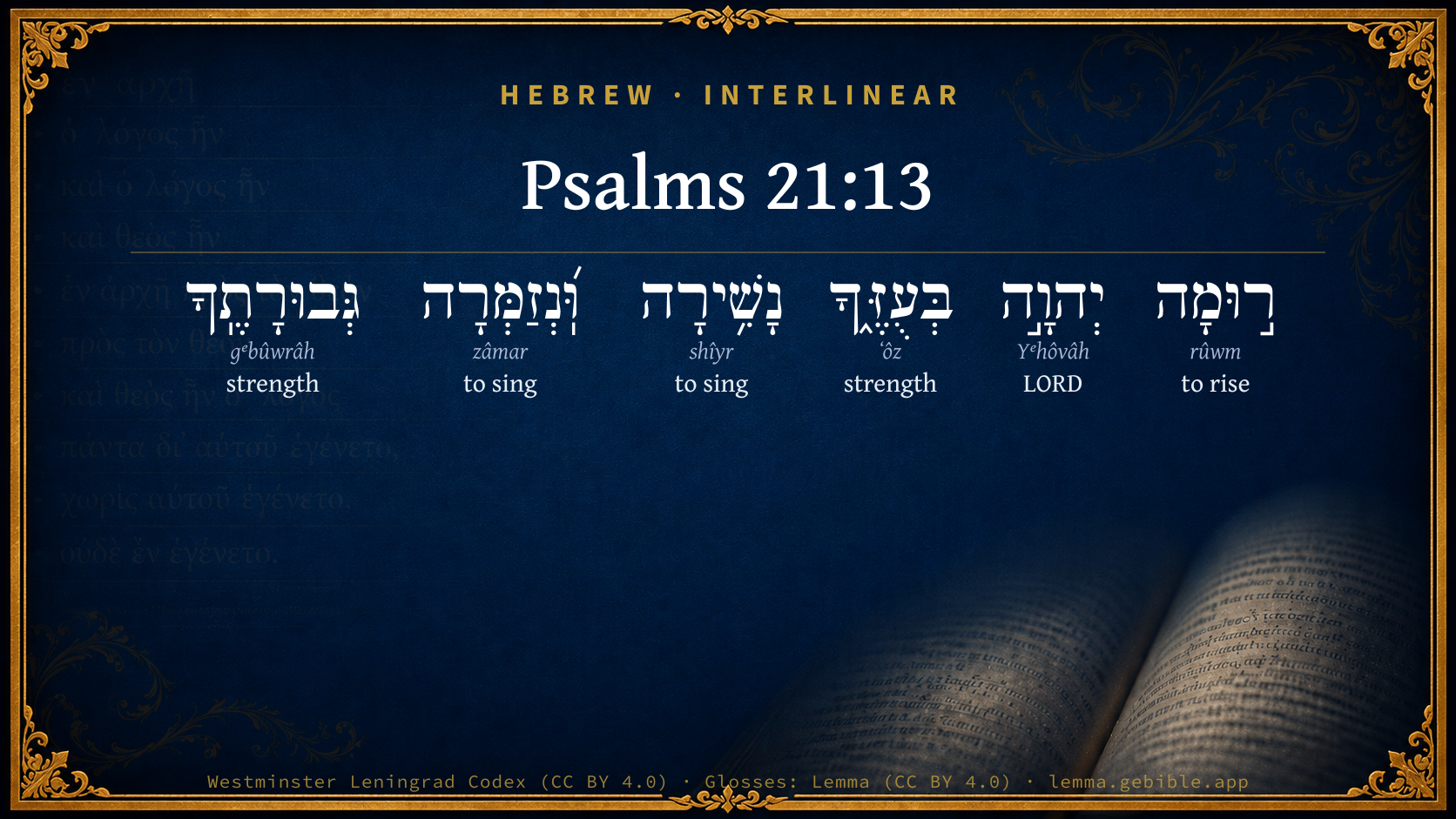
Psalms 21:13

Hebrew (Westminster Leningrad Codex) Psalms 21:13 appears in the Hebrew Old Testament. The text above is from the Westminster Leningrad Codex. Each word links to its Strong’s number, a concise gloss, and parsing drawn from the Open Scriptures Hebrew Bible morphology. Click any word for its full Brown-Driver-Briggs (BDB) entry.
Download image
Cite this verse

Psalms 21:13 (World English Bible). Public Domain. Lemma interlinear Bible study tool, https://lemma.gebible.app/v/psalms/21/13.

Show BibTeX & RIS
BibTeX
RIS
English Translation
Be exalted, Yahweh, in your strength, So we will sing and praise your power.
World English Bible · Public Domain
Download a study sheet

One document with this verse’s original text, its word-by-word gloss line, the meaning frame, cross-references with their text, attributed commentary, and full source and license credits — printable, and it pastes into notes with its structure intact.

This verse Autodidact and up

Study sheet (.html) Plain text (.txt)

A passage Seminary Student

Up to 50 verses in one chapter. A passage sheet keeps up to 6 commentary sources and 12 cross-references per verse, in the order this page ranks them, and says so on the sheet whenever that leaves anything out. Ask for a single verse and you get the Autodidact verse sheet above.

Everything on this page stays free to read, with no account — the sheet is a download of what is already on screen, not access to it.

Want to remove ads? Support Godless Engineer
Compare translations 3

The same verse in 3 English versions, stacked beneath the original-language interlinear above. Click any original word for its lexicon entry.

Each is an independent rendering of the whole verse — the interlinear is not word-aligned to these translations.

Highlighted words mark where these versions differ — a whole-verse word diff, not a word-by-word alignment.

  • World English Bible Public Domain
    Be exalted, Yahweh, in your strength, So we will sing and praise your power.
  • King James Version Public Domain
    Be thou exalted, LORD, in thine own strength: so will we sing and praise thy power.
  • unfoldingWord Literal Text CC BY-SA 4.0
    Be exalted, Yahweh, in your strength; we will sing and we will praise your power.

unfoldingWord Literal Text — © unfoldingWord, licensed CC BY-SA 4.0. Word-aligned USFM3 via Door43 (git.door43.org/unfoldingWord/en_ult).

Versions to compare (up to 4)

3 of 4 selected

Show all 18 translations

Every available English version of this verse, each an independent rendering of the whole verse.

  • World English Bible Public Domain
    Be exalted, Yahweh, in your strength, So we will sing and praise your power.
  • Berean Standard Bible Public Domain
    Be exalted, O LORD, in Your strength; we will sing and praise Your power.
  • Majority Standard Bible Public Domain
    Be exalted, O LORD, in Your strength; we will sing and praise Your power.
  • King James Version Public Domain
    Be thou exalted, LORD, in thine own strength: so will we sing and praise thy power.
  • American Standard Version (1901) Public Domain
    Be thou exalted, O Jehovah, in thy strength: So will we sing and praise thy power. Psalm 22 For the Chief Musician; set to Aijaleth hash-Shahar. A Psalm of David.
  • Revised Version (1885) Public Domain
    Be thou exalted, O LORD, in thy strength: so will we sing and praise thy power.
  • Geneva Bible (1599) Public Domain
    Be thou exalted, O Lord, in thy strength: so will we sing and prayse thy power.
  • Douay-Rheims (1899) Public Domain
    For thou shalt make them turn their back: in thy remnants thou shalt prepare their face.
  • Young's Literal Translation Public Domain
    Be Thou exalted, O Jehovah in, Thy strength, We sing and we praise Thy might!
  • Literal Standard Version CC BY-SA 4.0
    Be exalted, O YHWH, in Your strength, || We sing and we praise Your might!
  • Unlocked Literal Bible CC BY-SA 4.0
    Be exalted, Yahweh, in your strength; we will sing and praise your power.
  • unfoldingWord Literal Text CC BY-SA 4.0
    Be exalted, Yahweh, in your strength; we will sing and we will praise your power.
  • Darby Bible Public Domain
    Be thou exalted, Jehovah, in thine own strength: we will sing and celebrate thy power.
  • World Messianic Bible Public Domain
    Be exalted, LORD, in your strength, so we will sing and praise your power.
  • Webster's Bible Public Domain
    \\21:12\\Therefore shalt thou make them turn their back, when thou shalt make ready thy arrows upon thy strings against the face of them.
  • Free Bible Version CC BY-SA 4.0
    Rise up, Lord, for you are strong! We will sing and praise your power!
  • Bible in Basic English Public Domain
    Be lifted up, O Lord, in your strength; so will we make songs in praise of your power.
  • JPS Tanakh (1917) Public Domain
    (21-14) Be Thou exalted, O LORD, in Thy strength; so will we sing and praise Thy power.

Literal Standard Version (2020), Covenant Press — licensed CC BY-SA 4.0. Text via the HelloAO Bible API (eBible.org). Unlocked Literal Bible (unfoldingWord) — licensed CC BY-SA 4.0. Text via the HelloAO Bible API (eBible.org). unfoldingWord Literal Text — © unfoldingWord, licensed CC BY-SA 4.0. Word-aligned USFM3 via Door43 (git.door43.org/unfoldingWord/en_ult). Free Bible Version, Dr. Jonathan Gallagher — licensed CC BY-SA 4.0. Text via the HelloAO Bible API (eBible.org).

Word by word

More ways to search: Search by grammar → Find every occurrence → Compare this word →

Practice this passage: Drill this verse → Learn its vocabulary →

About this verse

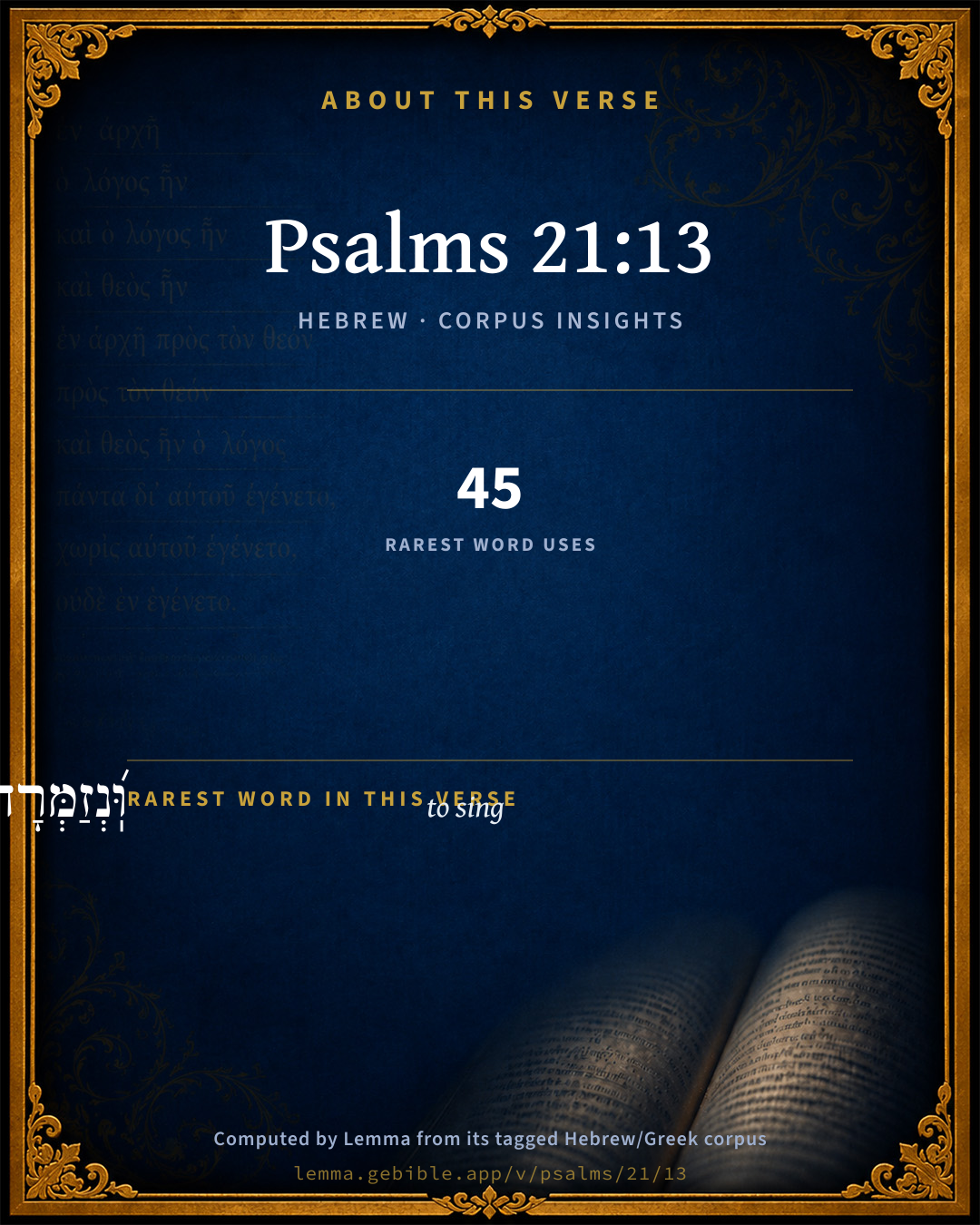
These counts appear in no published source. They are computed here, from the morphology-tagged text and Lemma’s own curated glosses. What Lemma adds →

6
words
6
distinct lemmas
Wisdom
section

Shared distinctive vocabulary

וּֽ֝נְזַמְּרָה to sing H2167 occurs in 41 verses of the Hebrew Bible. Also found in:

Grammatical profile

  • 3 verbs
  • 3 nouns

Verb forms

  • ר֣וּמָה Qal · Imperative
  • נָשִׁ֥ירָה Qal · Cohortative
  • וּֽ֝נְזַמְּרָה Piel · Cohortative

Hebrew & Septuagint length

In English translation the verse runs 14 words from the Hebrew and 16 from the Septuagint (LXX English) — closely comparable.

A rough comparison of the two English renderings, which tokenize alike — not a word-level alignment.

Word counts can differ between the Hebrew and the Greek without any difference in meaning — e.g. the Hebrew direct-object marker אֵת has no separate Greek word, and Greek often adds the article ὁ.

Cross-references

16

Topical passages linked to Psalms 21:13 in the Treasury of Scripture Knowledge — connected by theme and wording, ordered by reader-vote popularity; previews shown in the World English Bible.

  • Revelation 16:5–7 I heard the angel of the waters saying, "You are righteous, who are and who were, you Holy One, because you have judged these things.
  • Revelation 19:1–6 After these things I heard something like a loud voice of a great multitude in heaven, saying, "Hallelujah! Salvation, power, and glory belong to our God:
  • Psalms 57:11 Be exalted, God, above the heavens. Let your glory be over all the earth.
  • Psalms 113:5 Who is like Yahweh, our God, Who has his seat on high,
  • Revelation 15:3–4 They sang the song of Moses, the servant of God, and the song of the Lamb, saying, "Great and marvelous are your works, Lord God, the Almighty; Righteous and true are your ways, you King of the nations.
  • Psalms 57:5 Be exalted, God, above the heavens! Let your glory be above all the earth!
  • Psalms 72:18–19 Praise be to Yahweh God, the God of Israel, Who alone does marvelous deeds.
  • Matthew 6:10 Let your Kingdom come. Let your will be done, as in heaven, so on earth.
  • Revelation 11:17 saying: "We give you thanks, Lord God, the Almighty, the one who is and who was; because you have taken your great power, and reigned.
  • 1 Chronicles 29:11 Yours, Yahweh, is the greatness, the power, the glory, the victory, and the majesty: for all that is in the heavens and in the earth is yours. Yours is the kingdom, Yahweh, and you are exalted as head above all.
  • Job 9:19 If it is a matter of strength, behold, he is mighty! If of justice, 'Who,' says he, 'will summon me?'
  • Psalms 18:46 Yahweh lives; and blessed be my rock. Exalted be the God of my salvation,
  • Psalms 46:10 "Be still, and know that I am God. I will be exalted among the nations. I will be exalted in the earth."
  • Psalms 58:10–11 The righteous shall rejoice when he sees the vengeance. He shall wash his feet in the blood of the wicked;
  • Matthew 6:13 Bring us not into temptation, but deliver us from the evil one. For yours is the Kingdom, the power, and the glory forever. Amen.'
  • Revelation 18:20 Rejoice over her, O heaven, you saints, apostles, and prophets; for God has judged your judgment on her."

Cross-references courtesy of OpenBible.info (CC BY 4.0).

Hebrew and Greek witnesses Masoretic Hebrew ↔ Greek Septuagint

The same verse in the two great witnesses to the Old Testament, shown verse-for-verse.

You’re reading Greek Psalm 20 (Hebrew Psalm 21). The Septuagint counts the superscription, so verse numbers can differ from the Hebrew — chapter-level alignment, not verse-by-verse. Numbering follows Rahlfs.

These are two independent witnesses, not word-aligned to each other, and the Septuagint is shown in lemma (dictionary) form.

Hebrew Psalms 21:13 Masoretic · Westminster Leningrad Codex

ר֣וּמָה יְהוָ֣ה בְּעֻזֶּ֑ךָ נָשִׁ֥ירָה וּֽ֝נְזַמְּרָה גְּבוּרָתֶֽךָ

Be exalted, Yahweh, in your strength, So we will sing and praise your power.

World English Bible · Public Domain

Greek LXX Greek Psalm 20:13 Septuagint · lemma form

ὅτι τίθημι αὐτός νῶτον ἐν ὁ περίλοιπος σύ ἑτοιμάζω ὁ πρόσωπον αὐτός

Be you exalted, O Lord, in your strength: we will sing and praise your mighty acts.

LXX2012 (modern English Septuagint) · Public Domain

Hebrew: Westminster Leningrad Codex (CC BY 4.0). Greek: Septuagint (public domain); English from LXX2012 (modern English Septuagint) (Public Domain). How the Septuagint differs from the Hebrew →

Commentary

Notes on Psalms 21:13 from classic Christian and Jewish commentators (each source and its license shown beneath its notes). The classic Christian expositions comment on the surrounding passage and are grouped to its opening verse, so a note may address several verses; the Jewish commentaries on the Tanakh (Rashi and others) are per-verse, so they appear only where the commentator wrote on this verse.

Lemma curates 59 commentaries, every one of them public domain or Creative Commons licensed, each selected and text-cleaned for this edition rather than reprinted as found. About our sources →

Adam Clarke's Commentary

Verse 13. Be thou exalted] Exalt thyself, O Lord - thy creatures cannot exalt thee. Lift thyself up, and discomfit thy foes by thine own strength! Thou canst give a victory to thy people over the most formidable enemies, though they strike not one blow in their own defence. God's right hand has often given the victory to his followers, while they stood still to see the salvation of God. How little can the strength of man avail when the Lord raiseth up himself to the battle! His children, therefore, may safely trust in him, for the name of the Lord is a strong tower; the righteous flee into it, and are safe.

Praise thy power.] God is to receive praise in reference to that attribute which he has exhibited most in the defence or salvation of his followers. Sometimes he manifests his power, his mercy, his wisdom, his longsuffering, his fatherly care, his good providence, his holiness, his justice, his truth, c. Whatever attribute or perfection he exhibits most, that should be the chief subject of his children's praise. One wants teaching, prays for it, and is deeply instructed: he will naturally celebrate the wisdom of God. Another feels himself beset with the most powerful adversaries, with the weakest of whom he is not able to cope: he cries to the Almighty God for strength he is heard, and strengthened with strength in his soul. He therefore will naturally magnify the all-conquering power of the Lord. Another feels himself lost, condemned, on the brink of hell; he calls for mercy, is heard and saved: mercy, therefore, will be the chief subject of his praise, and the burden of his song.

The old Anglo-Scottish Psalter says, We sal make knowen thi wordes in gude wil and gude werk, for he synges well that wirkes well. For thi, sais he twise, we sal syng; ane tyme for the luf of hert; another, for the schewyng of ryghtwisness, til ensampil.

ANALYSIS OF THE TWENTY-FIRST PSALM

This is the people's Eπινικιον, or triumphal song, after the victory which they prayed for in the former Psalm, when David went out to war. In this they praise God for the conquest which he gave him over his enemies, and for the singular mercies bestowed on himself. It consists of three parts: -

I. The general proposition, Ps 21:1.

II. The narration, which is twofold, from Ps 21:1-4. 1. An enumeration of the blessings bestowed on David, Ps 21:1-6. 2. An account how God would deal with his enemies, Ps 21:6-12.

III. A vow, or acclamation, Ps 21:13, which is the epilogue of the piece.

I. The sum of the Psalm is contained in the first verse: "The king shall joy; the king shall be exceeding glad." Joy is the affection with which the king and people were transported; for all that follows shows but the rise and causes of it.

I. The rise and object of it: "The strength of God; the salvation of God." 1. His strength, by which he subdued his enemies, and contemned dangers. 2. His salvation, by which he escaped dangers, and fell not in battle.

II. 1. The narration of the goodness of God to David's person, the particulars of which are the following: -

1. God granted to him what his heart desired: "Thou hast given him his heart's desire," and what his lips requested: "and hast not withholden the request of his lips."

2. He granted him more than he asked: "Thou preventest him with the blessings of goodness."

3. He chose him to be king: "Thou hast set a crown of pure gold upon his head." In which God prevented him, and chose him when he thought not of it.

4. When David went to war, "he asked life, and thou gavest him even length of days for ever and ever:" which is most true of Christ, the Son of David. In him his life and kingdom are immortal.

5. A great accession of glory, honour, and majesty. Though his glory was great, it was in God's salvation; "Honour and majesty did God lay upon him."

All which are summed up under the word blessing in the next verse. "For thou hast made him most blessed for ever;" and God had added the crown of all, a heart to rejoice in it: "Thou hast made him exceeding glad with thy countenance."

6. The continuance of these blessings, which is another favour, with the cause of it: "For the king trusteth in the Lord, and through the mercy of the Most High he shall not be moved.'' Thus far the first part of the narrative, which concerned David's person particularly.

2. The effects of God's goodness to David in outward things, and to the whole kingdom, in the overthrow of his enemies, (for without God's protection what kingdom is safe?) form the second part.

1. God would make David his instrument in delivering Israel by the overthrow of his enemies: "Thine hand."

2. He would certainly do it, for he could find them out wheresoever they were: "Thine hand shall find out thine enemies."

3. This was easy to be done, as easy as for fire to consume stubble: "Thou shalt make them as a fiery oven."

4. This destruction should be universal; it should reach even to their posterity: "Their fruit shalt thou destroy, and their seed."

5. Their judgment should be fearful and unavoidable. God would set them up as a mark to shoot at: "Thou shalt make them turn their back, when thou shalt make ready thine arrows."

At last the cause is added for these judgments; of the succour he will afford his afflicted, oppressed people; and the revenge he will take upon their enemies: "They intended evil against thee; they imagined a mischievous device."

III. The vow or acclamation. This is properly the epilogue, and has two parts: 1. A petition - "Save the king and the people." 2. A profession: "And we will give thanks to thee."

I. "Be thou exalted, O Lord, in thine own strength." Show thyself more powerful in defending thy Church than men and devils are in their attempts to destroy it.

2. We will be a thankful people; we will show that we have not received this grace of God in vain: "So will we sing, and praise thy power."

Adam Clarke's Commentary on the Bible (1810–1826) — public domain. Text from a community e-Sword/MySword module.

Trapp's Complete Commentary

John Trapp

Psa 21:13 Be thou exalted, LORD, in thine own strength: [so] will we sing and praise thy power.

Ver. 13. Be thou exalted, Lord, in thine own strength] Finit Psalmum cum laude, sicut incepit, saith Aben Ezra. He closeth up the psalm, as he began it, with praise and prayer that God would arise and destroy the rest, as he had already done some of their enemies. God’s power and strength is in itself infinite, and cannot be exalted or amplified; but in respect of us it is said to be exalted when exerted and put forth for the defence of his people.

So will we sing and praise thy power] This they restipulate; as knowing that it would please the Lord better than an ox or bullock that hath horns and hoofs, Psa 69:31.

John Trapp, A Commentary or Exposition upon All the Books of the Old and New Testament (1647–1656) — public domain. Text from a community e-Sword module.

J. A. Alexander on Psalms

Joseph Addison Alexander

14. (Psa 21:13). Be high, Jehovah, in thy strength; we will sing and celebrate thy power. Here the psalm returns to God as its great theme, and gives him all the glory. Be high, exalted, both in thyself and in the praises of thy people. See above, on Psa 18:47 (46). Thy strength and power, as displayed in the strength given to thine anointed. Celebrate by music, as the Hebrew verb always means. There is a beautiful antithesis in this verse, as if he had said: thou hast only to deserve praise, we will give it.

Joseph Addison Alexander, The Psalms Translated and Explained (1850) — public domain. Text from a community e-Sword module.

Tyndale Open Study Notes

Tyndale Open Resources

21:13 Rise up (or be exalted, as in 57:5, 11; 108:5) expresses communal praise and joy in God’s greatness and power.

Tyndale Open Study Notes — © Tyndale Open Resources, licensed CC BY-SA 4.0. Text via the HelloAO Bible API.

Geneva Bible (1599)

Geneva Bible translators

Maintain thy Church against thine adversaries, that we may have ample occasion to praise thy Name.

Geneva Bible (1599) marginal notes — public domain. Text via Bolls.life.

Jamieson, Fausset & Brown

Robert Jamieson, A. R. Fausset & David Brown

The glory of all is ascribable to God alone.

Next: Psalms Chapter 22

Jamieson, Fausset & Brown — Commentary Critical and Explanatory on the Whole Bible (1871) — public domain (CC PDM 1.0). Text via the HelloAO Bible API.

John Calvin's Commentaries

13. Raise thyself, O Jehovah! The psalm is at length concluded with a prayer, which again confirms that the kingdom which is spoken of is so connected with the glory of God, that his power is reflected from it. This was no doubt true with respect to the kingdom of David; for God in old time displayed his power in exalting him to the throne. But what is here stated was only fully accomplished in Christ, who was appointed by the heavenly Father to be King over us, and who is at the same time God manifest in the flesh. As his divine power ought justly to strike terror into the wicked, so it is described as full of the sweetest consolation to us, which ought to inspire us with joy, and incite us to celebrate it with songs of praise and thanksgivings.

John Calvin's Commentaries (1540-1563) — public domain. Text from the Calvin Translation Society English edition (1840s-50s) via the Christian Classics Ethereal Library (ccel.org). Calvin's coverage is partial (roughly two-thirds of the Bible); uncommented books and verses are honest gaps, never fabricated. The 19th-century editor's footnotes and remarks are omitted so the notes are faithfully Calvin's own voice.

Ellicott's Commentary for English Readers

(13) Thou.—Again the song turns to address Jehovah.

So will we sing and praise.—Better, We will both with song and lyre celebrate Thy power.

A Bible Commentary for English Readers, edited by Charles John Ellicott (1878–1897) — public domain. Text from a community e-Sword module.

The Cambridge Bible for Schools and Colleges

gen. ed. J. J. S. Perowne

13. The congregation’s concluding prayer (as in Psa_20:9), returning to the thought of Psa_21:1. Jehovah is exalted when He manifests His strength (Psa_7:6; Psa_46:10; Psa_57:5; Psa_57:11). R.V., in thy strength, for in thine own strength.

thy power] Thy might, made known in mighty acts of salvation (Psa_20:6).

The Cambridge Bible for Schools and Colleges (gen. ed. J. J. S. Perowne; Cambridge University Press, 1878–1918) — public domain. Text from a community e-Sword module.

John Gill's Exposition

Be thou exalted, Lord, in thine own strength,.... Exert thy strength, display thy power in such manner, that thou mayest be exalted and magnified on account of it. This was fulfilled at the destruction of Jerusalem, when the kingdom of God came with power, Mar 9:1; and will be again when Babylon shall be utterly destroyed, because the Lord is strong who judgeth her, Rev 18:8; and finally at the day of judgment, when the wicked will be punished with everlasting destruction from the presence of the Lord, and the glory of his power, Th2 1:9;

so will we sing and praise thy power; forms of such songs of praise may be seen, as Cocceius observes, in Rev 11:15; at the sounding of the seventh trumpet, at the victory over the beast, and his image, and at the destruction of Babylon.

John Gill's Exposition of the Whole Bible (1746–1763) — public domain (CC PDM 1.0). Text via the HelloAO Bible API.

Albert Barnes' Notes on the Bible

Be thou exalted, Lord, in thine own strength - This is the concluding part of the psalm (see the introduction), expressing a desire that God “might” be exalted over all his foes; or that his own strength might he so manifestly put forth that he would be exalted as he ought to be. This is the ultimate and chief desire of all holy created beings, that God might be exalted in the estimation of the universe above all other beings - or that he might so triumph over all his enemies as to reign supreme.

So will we sing and praise thy power - That is, as the result of thy being thus exalted to proper honor, we will unite in celebrating thy glory and thy power. Compare Rev 7:10-12; Rev 12:10; Rev 19:1-3. This will be the result of all the triumphs which God will achieve in the world, that the holy beings of all worlds will gather around his throne and “sing and praise his power.” The “thought” in the psalm is that God will ultimately triumph over all his foes, and that this triumph will be followed by universal rejoicing and praise. Come that blessed day!

Albert Barnes' Notes on the Bible (1834–1885) — public domain. Text from a community e-Sword/MySword module.

Matthew Poole's English Annotations

In thine own strength; by thy own power, or by the manifestation thereof, whereby thou wilt have the whole glory of the work.

Matthew Poole's English Annotations on the Holy Bible (1683–1685) — public domain. Text from a community e-Sword/MySword module.

The Treasury of David

Charles H. Spurgeon

Ver. 13. Be thou exalted, Lord, in thine own strength. A sweet concluding verse. Our hearts shall join in it. It is always right to praise the Lord when we call to remembrance his goodness to his Son, and the overthrow of his foes. The exaltation of the name of God should be the business of every Christian; but since such poor things as we fail to honour him as he deserves, we may invoke his own power to aid us. Be high, O God, but do thou maintain thy loftiness by thine own almightiness, for no other power can worthily do it.

So will we sing and praise thy power. For a time the saints may mourn, but the glorious appearance of their divine Helper awakens their joy. Joy should always flow in the channel of praise. All the attributes of God are fitting subjects to be celebrated by the music of our hearts and voices, and when we observe a display of his power, we must extol it. He wrought our deliverance alone, and he alone shall have the praise.

None.

Ver. 13. A devout Doxology.

1. God exalted.

2. God alone exalted.

3. God exalted by his own strength.

4. His people singing his praise.

Charles H. Spurgeon's The Treasury of David (1869–1885) — public domain. Psalms only. Text from a community e-Sword/MySword module.

Whedon's Commentary on the Bible

Daniel D. Whedon

13. Exalted… in thine own strength—The closing verse is a call upon Jehovah to exalt himself by a manifestation of his own strength in the overthrow of his enemies and the deliverance of his Church. On this, compare Rev_11:17.

Daniel D. Whedon (gen. ed.), Commentary on the Old and New Testaments (1874–1909) — public domain. Text from a community e-Sword module.

The Pulpit Commentary

Be thou exalted, Lord, in thine own strength. The psalm, as already remarked, ends, as it began, with the praise of God. "Be thou exalted" means, "Be thou lifted up, both in thyself, and in the praises of thy people". (comp. Psa_18:46 Psa_46:10) So will we sing and praise thy power. We, at any rate, will do our part to exalt thee. Our tongues shall ever sing of the great deeds thou doest for us.

The Pulpit Commentary (1880–1919), ed. H.D.M. Spence-Jones & Joseph S. Exell — public domain. Text from a community e-Sword module.

John Wesley's Explanatory Notes

Exalted - By thy own power, or by the manifestation thereof.

John Wesley, Explanatory Notes Upon the Whole Bible (1754–1765) — public domain. Text via the GEBible commentary corpus.

Keil & Delitzsch

C. F. Keil & F. Delitzsch

(Heb.: 21:14) After the song has spread abroad its wings in twice three tetrastichs, it closes by, as it were, soaring aloft and thus losing itself in a distich. It is a cry to God for victory in battle, on behalf of the king. "Be Thou exalted," i.e., manifest Thyself in Thy supernal (Psa 57:6, 12) and judicial (Psa 7:7.) sovereignty. What these closing words long to see realised is that Jahve should reveal for world-wide conquest this גּבוּרה, to which everything that opposes Him must yield, and it is for this they promise beforehand a joyous gratitude.

Keil & Delitzsch — Biblical Commentary on the Old Testament (1861–1891) — public domain (CC PDM 1.0). Text via the HelloAO Bible API. (Old Testament only.)

unfoldingWord translationNotes

Door43 World Missions Community

Be exalted, Yahweh, in your strength

Possible meanings are 1) "Yahweh, show us that you are very strong" or 2) "Yahweh, because you are strong we will exalt you"

we will sing and praise your power

The words "sing" and "praise" share similar meanings. Here the word "power" represents God and his power. AT: "with singing we will praise you because you are powerful" (See: Doublet and Metonymy)

translationWords

exalt

Yahweh

praise

power

unfoldingWord translationNotes — © Distant Shores Media and the Door43 World Missions Community, licensed CC BY-SA 4.0. Source: git.door43.org/Door43/en_tn.

Rashi

Rabbi Shlomo Yitzchaki (Rashi)

For You shall place them as a portion For You shall place them as a portion, that Israel will divide their money, as it is stated (in Isa. 23:18): “And her commerce and her hire shall be...”

with Your bowstrings You shall set toward their faces With the strings of Your bows, You shall aim Your arrows at their faces.

Rashi on the Tanakh — English translations: “The Judaica Press complete Tanach with Rashi, translated by A. J. Rosenberg” (CC BY 4.0); “Pentateuch with Rashi's commentary by M. Rosenbaum and A.M. Silbermann, 1929-1934” (public domain); “The Metsudah Tanach series, Lakewood, N.J” (CC BY 4.0); and “The Book of Joshua, Metsudah Publications, 1997” (CC BY 4.0). Text via Sefaria.

Lesson kit

Teaching starters — assembled from the data on this page, not authored interpretation. Every prompt links to the verse data it draws on. Edit before teaching.

Psalms, in the Wisdom, opens this verse with 6 words (6 distinct Hebrew lemmas). Its most distinctive word is zâmar (“to sing”). A historical commentator’s framing appears above. Read the whole chapter for the surrounding context.

Discussion questions

  1. The word zâmar carries the sense “to sing.” How does it shape the verse?
  2. How does Judges 5:3, which shares the word «to sing», read alongside this verse?
  3. These translations render this verse differently; the difference is in the English rendering, not the original. What questions does that raise?
  4. «ר֣וּמָה» is a Qal Imperative verb. How does that grammatical form shape the action described?
  5. Compare how Adam Clarke's Commentary and Trapp's Complete Commentary read this verse. Where do they agree or differ?

Things to notice

Reading settings

Reading text

Shown beneath each verse's original-language words.

Old Testament
Old Testament edition

Read the OT as the Masoretic Hebrew (MT) or the Greek Septuagint (LXX).

English shown for the Greek Septuagint (in the Hebrew ↔ Greek comparison).

Comparing translations? Open the Compare panel on any verse page to stack up to four side by side.