
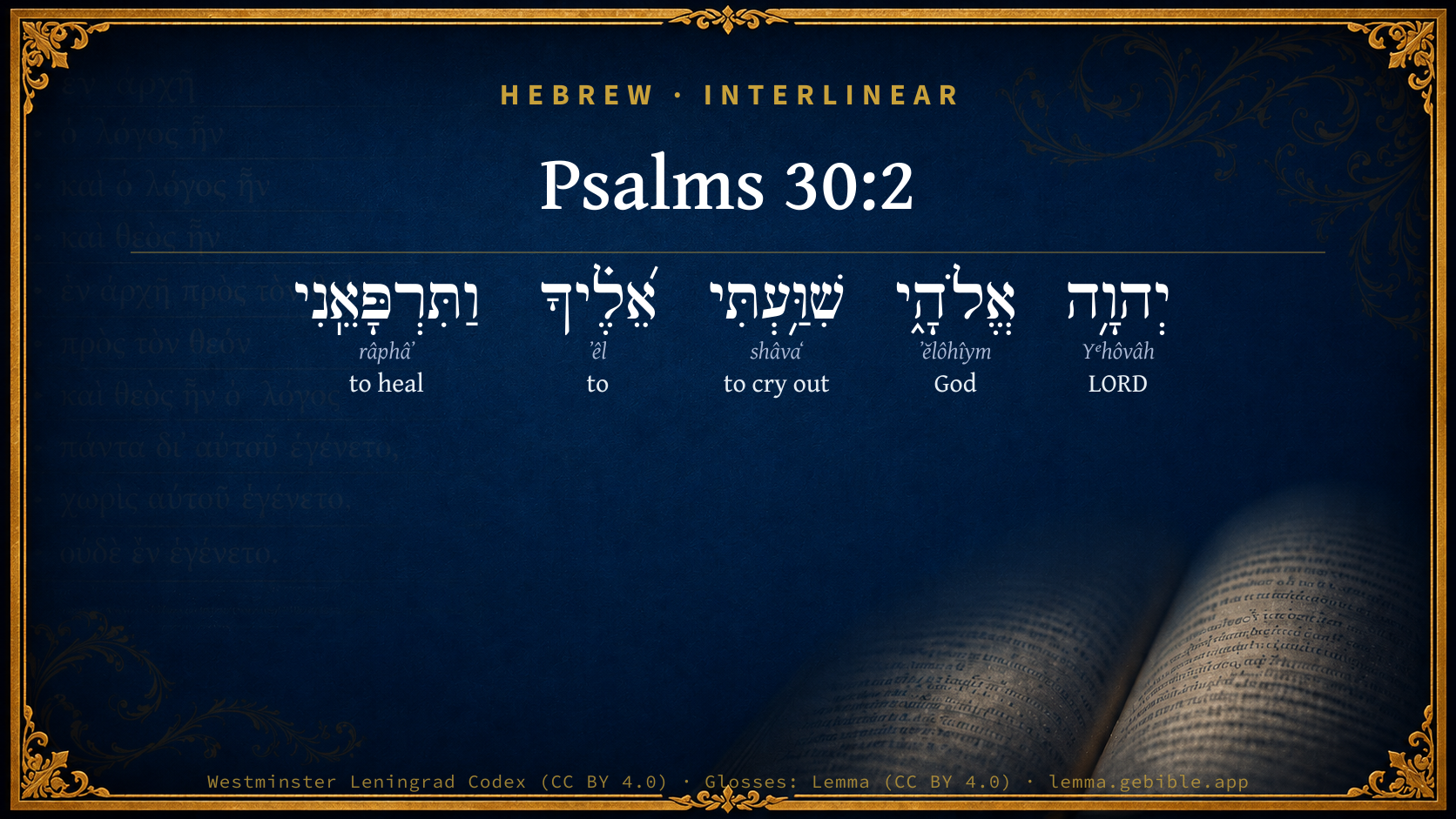
Psalms 30:2

Hebrew (Westminster Leningrad Codex) Psalms 30:2 appears in the Hebrew Old Testament. The text above is from the Westminster Leningrad Codex. Each word links to its Strong’s number, a concise gloss, and parsing drawn from the Open Scriptures Hebrew Bible morphology. Click any word for its full Brown-Driver-Briggs (BDB) entry.
Download image
Cite this verse

Psalms 30:2 (World English Bible). Public Domain. Lemma interlinear Bible study tool, https://lemma.gebible.app/v/psalms/30/2.

Show BibTeX & RIS
BibTeX
RIS
English Translation
Yahweh my God, I cried to you, And you have healed me.
World English Bible · Public Domain
Download a study sheet

One document with this verse’s original text, its word-by-word gloss line, the meaning frame, cross-references with their text, attributed commentary, and full source and license credits — printable, and it pastes into notes with its structure intact.

This verse Autodidact and up

Study sheet (.html) Plain text (.txt)

A passage Seminary Student

Up to 50 verses in one chapter. A passage sheet keeps up to 6 commentary sources and 12 cross-references per verse, in the order this page ranks them, and says so on the sheet whenever that leaves anything out. Ask for a single verse and you get the Autodidact verse sheet above.

Everything on this page stays free to read, with no account — the sheet is a download of what is already on screen, not access to it.

Want to remove ads? Support Godless Engineer
Compare translations 3

The same verse in 3 English versions, stacked beneath the original-language interlinear above. Click any original word for its lexicon entry.

Each is an independent rendering of the whole verse — the interlinear is not word-aligned to these translations.

Highlighted words mark where these versions differ — a whole-verse word diff, not a word-by-word alignment.

  • World English Bible Public Domain
    Yahweh my God, I cried to you, And you have healed me.
  • King James Version Public Domain
    O LORD my God, I cried unto thee, and thou hast healed me.
  • unfoldingWord Literal Text CC BY-SA 4.0
    Yahweh my God, I cried out to you for help, and you healed me.

unfoldingWord Literal Text — © unfoldingWord, licensed CC BY-SA 4.0. Word-aligned USFM3 via Door43 (git.door43.org/unfoldingWord/en_ult).

Versions to compare (up to 4)

3 of 4 selected

Show all 18 translations

Every available English version of this verse, each an independent rendering of the whole verse.

  • World English Bible Public Domain
    Yahweh my God, I cried to you, And you have healed me.
  • Berean Standard Bible Public Domain
    O LORD my God, I cried to You for help, and You healed me.
  • Majority Standard Bible Public Domain
    O LORD my God, I cried to You for help, and You healed me.
  • King James Version Public Domain
    O LORD my God, I cried unto thee, and thou hast healed me.
  • American Standard Version (1901) Public Domain
    O Jehovah my God, I cried unto thee, and thou hast healed me.
  • Revised Version (1885) Public Domain
    O LORD my God, I cried unto thee, and thou hast healed me.
  • Geneva Bible (1599) Public Domain
    O Lord my God, I cried vnto thee, and thou hast restored me.
  • Douay-Rheims (1899) Public Domain
    I will extol thee, O Lord, for thou hast upheld me: and hast not made my enemies to rejoice over me.
  • Young's Literal Translation Public Domain
    Jehovah my God, I have cried to Thee, And Thou dost heal me.
  • Literal Standard Version CC BY-SA 4.0
    My God YHWH, I have cried to You, || And You heal me.
  • Unlocked Literal Bible CC BY-SA 4.0
    Yahweh my God, I cried to you for help, and you healed me.
  • unfoldingWord Literal Text CC BY-SA 4.0
    Yahweh my God, I cried out to you for help, and you healed me.
  • Darby Bible Public Domain
    Jehovah my God, I cried unto thee, and thou hast healed me.
  • World Messianic Bible Public Domain
    LORD my God, I cried to you, and you have healed me.
  • Webster's Bible Public Domain
    \\30:1\\A Psalm and Song, at the dedication of the house of David. I will extol thee, O LORD; for thou hast lifted me up, and hast not made my foes to rejoice over me.
  • Free Bible Version CC BY-SA 4.0
    Lord, my God, I called out to you for help, and you have healed me.
  • Bible in Basic English Public Domain
    O Lord my God, I sent up my cry to you, and you have made me well.
  • JPS Tanakh (1917) Public Domain
    (30-3) O LORD my God, I cried unto Thee, and Thou didst heal me;

Literal Standard Version (2020), Covenant Press — licensed CC BY-SA 4.0. Text via the HelloAO Bible API (eBible.org). Unlocked Literal Bible (unfoldingWord) — licensed CC BY-SA 4.0. Text via the HelloAO Bible API (eBible.org). unfoldingWord Literal Text — © unfoldingWord, licensed CC BY-SA 4.0. Word-aligned USFM3 via Door43 (git.door43.org/unfoldingWord/en_ult). Free Bible Version, Dr. Jonathan Gallagher — licensed CC BY-SA 4.0. Text via the HelloAO Bible API (eBible.org).

Word by word

More ways to search: Search by grammar → Find every occurrence → Compare this word →

Practice this passage: Drill this verse → Learn its vocabulary →

About this verse

These counts appear in no published source. They are computed here, from the morphology-tagged text and Lemma’s own curated glosses. What Lemma adds →

5
words
5
distinct lemmas
Wisdom
section

Notable vocabulary

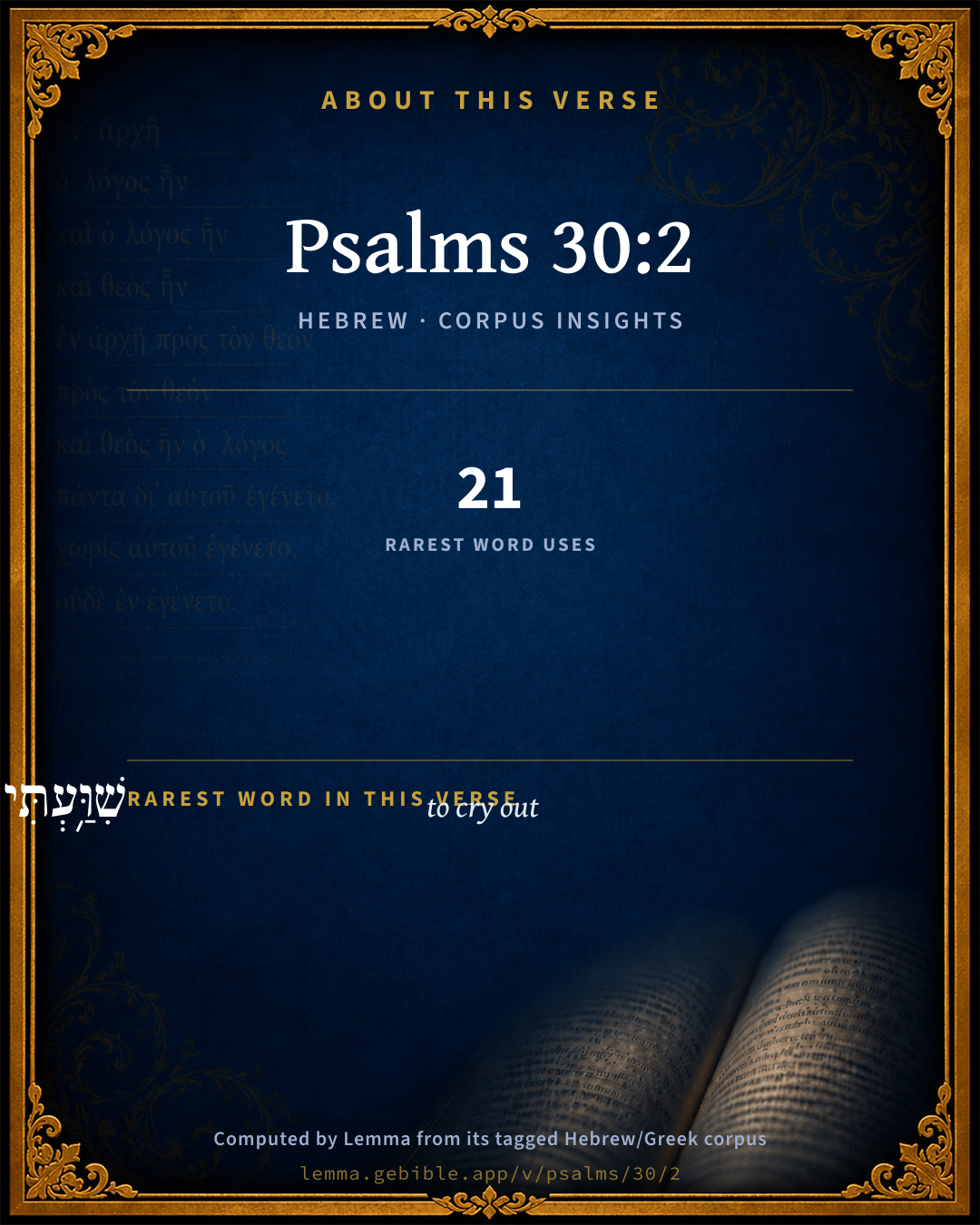
The rarest word here is שִׁוַּ֥עְתִּי to cry out H7768 — appearing just 21 times in the whole Hebrew Bible.

Shared distinctive vocabulary

שִׁוַּ֥עְתִּי to cry out H7768 occurs in 21 verses of the Hebrew Bible. Also found in:

Grammatical profile

  • 2 verbs
  • 2 nouns
  • 1 preposition

Verb forms

  • שִׁוַּ֥עְתִּי Piel · Perfect
  • וַתִּרְפָּאֵֽנִי Qal · Sequential Imperfect

Hebrew & Septuagint length

In English translation the verse runs 12 words from the Hebrew and 13 from the Septuagint (LXX English) — closely comparable.

A rough comparison of the two English renderings, which tokenize alike — not a word-level alignment.

Word counts can differ between the Hebrew and the Greek without any difference in meaning — e.g. the Hebrew direct-object marker אֵת has no separate Greek word, and Greek often adds the article ὁ.

Cross-references

11

Topical passages linked to Psalms 30:2 in the Treasury of Scripture Knowledge — connected by theme and wording, ordered by reader-vote popularity; previews shown in the World English Bible.

  • Psalms 103:3–4 Who forgives all your sins; Who heals all your diseases;
  • 2 Kings 20:5 Turn back, and tell Hezekiah the prince of my people, Thus says Yahweh, the God of David your father, I have heard your prayer, I have seen your tears: behold, I will heal you; on the third day you shall go up to the house of Yahweh.
  • Psalms 6:2 Have mercy on me, Yahweh, for I am faint. Yahweh, heal me, for my bones are troubled.
  • Psalms 147:3 He heals the broken in heart, And binds up their wounds.
  • Exodus 15:26 and he said, "If you will diligently listen to the voice of Yahweh your God, and will do that which is right in his eyes, and will pay attention to his commandments, and keep all his statutes, I will put none of the diseases on you, which I have put on the Egyptians; for I am Yahweh who heals you."
  • Genesis 20:17 Abraham prayed to God. God healed Abimelech, and his wife, and his maid-servants, and they bore children.
  • Psalms 88:13 But to you, Yahweh, I have cried. In the morning, my prayer comes before you.
  • James 5:14–15 Is any among you sick? Let him call for the elders of the assembly, and let them pray over him, anointing him with oil in the name of the Lord,
  • Psalms 51:8 Let me hear joy and gladness, That the bones which you have broken may rejoice.
  • Psalms 107:17–22 Fools are afflicted because of their disobedience, And because of their iniquities.
  • Psalms 118:18 Yah has punished me severely, But he has not given me over to death.

Cross-references courtesy of OpenBible.info (CC BY 4.0).

Hebrew and Greek witnesses Masoretic Hebrew ↔ Greek Septuagint

The same verse in the two great witnesses to the Old Testament, shown verse-for-verse.

You’re reading Greek Psalm 29 (Hebrew Psalm 30). The Septuagint counts the superscription, so verse numbers can differ from the Hebrew — chapter-level alignment, not verse-by-verse. Numbering follows Rahlfs.

These are two independent witnesses, not word-aligned to each other, and the Septuagint is shown in lemma (dictionary) form.

Hebrew Psalms 30:2 Masoretic · Westminster Leningrad Codex

יְהוָ֥ה אֱלֹהָ֑י שִׁוַּ֥עְתִּי אֵ֝לֶ֗יךָ וַתִּרְפָּאֵֽנִי

Yahweh my God, I cried to you, And you have healed me.

World English Bible · Public Domain

Greek LXX Greek Psalm 29:2 Septuagint · lemma form

ὑψόω σύ κύριος ὅτι ὑπολαμβάνω ἐγώ καί οὐ εὐφραίνω ὁ ἐχθρός ἐγώ ἐπί ἐγώ

O Lord my God, I cried to you, and you did heal me.

LXX2012 (modern English Septuagint) · Public Domain

Hebrew: Westminster Leningrad Codex (CC BY 4.0). Greek: Septuagint (public domain); English from LXX2012 (modern English Septuagint) (Public Domain). How the Septuagint differs from the Hebrew →

Commentary

Notes on Psalms 30:2 from classic Christian and Jewish commentators (each source and its license shown beneath its notes). The classic Christian expositions comment on the surrounding passage and are grouped to its opening verse, so a note may address several verses; the Jewish commentaries on the Tanakh (Rashi and others) are per-verse, so they appear only where the commentator wrote on this verse.

Lemma curates 59 commentaries, every one of them public domain or Creative Commons licensed, each selected and text-cleaned for this edition rather than reprinted as found. About our sources →

Trapp's Complete Commentary

John Trapp

Psa 30:2 O LORD my God, I cried unto thee, and thou hast healed me.

Ver. 2. I cried unto thee] In some great sickness, say some, that befell him about the time that he built his house of cedar, 2Sa 5:11, that he might not be overjoyed, and take a surfeit; or rather, when, by my son’s rising up against me, I was likely to have lost my state and kingdom.

And thou hast healed me] That is, helped me, as Jon 2:6, thou hast restored and re-established me in my kingdom. Kimchi senseth it thus, Thou hast delivered my soul from hell, though in this world thou hast grievously afflicted my body.

John Trapp, A Commentary or Exposition upon All the Books of the Old and New Testament (1647–1656) — public domain. Text from a community e-Sword module.

Joseph Benson's Commentary

Psa 30:2-3. Thou hast healed me — That is, delivered me from the fears and troubles of my mind, (which are often compared to diseases,) and from very dangerous distempers of my body. For the original word is used, either of the healing of bodily disorders, Psa 103:3, or to denote the happy alteration of a person’s affairs, either in public or private life, by the removal of any kind of distress, personal or national, Psa 107:20; Isa 19:22. Thou hast brought up my soul from the grave — My deliverance is a kind of resurrection from the grave, on the very brink of which I was. Under Saul he was frequently in the most imminent danger of his life, out of which God wonderfully brought him. Thou hast kept me alive — This he adds, to explain the former phrase, which was ambiguous. That I should not go down to the pit — That is, into the grave, which is often called the pit.

Joseph Benson's Commentary on the Old and New Testaments (1811–1818) — public domain. Text from a community e-Sword module.

J. A. Alexander on Psalms

Joseph Addison Alexander

3. (Psa 30:2) Jehovah, my God, I cried to thee (for help) and thou didst heal me. The address, my God, is never unmeaning or superfluous, but always intimates a covenant relation as the ground of confidence. Any severe suffering is represented in Scripture under the figure of disease, and relief from it as healing. See above, on Psa 6:3 (2), and compare Psa 41:5 (4), Psa 107:20, Jer 14:19; Jer 15:18; Jer 17:14; Jer 30:17. The healing here meant is identical with the help in Psa 30:4 (3) and the joy in Psa 30:12 (11,) and proves nothing therefore as to literal sickness in the Psalmist's case. It is altogether natural, however, to suppose that David may himself have been affected by the prevalent disorder.

Joseph Addison Alexander, The Psalms Translated and Explained (1850) — public domain. Text from a community e-Sword module.

Geneva Bible (1599)

Geneva Bible translators

Restored from the rebellion of Absalom.

Geneva Bible (1599) marginal notes — public domain. Text via Bolls.life.

Jamieson, Fausset & Brown

Robert Jamieson, A. R. Fausset & David Brown

healed me--Affliction is often described as disease (Psa 6:2; Psa 41:4; Psa 107:20), and so relief by healing.

Jamieson, Fausset & Brown — Commentary Critical and Explanatory on the Whole Bible (1871) — public domain (CC PDM 1.0). Text via the HelloAO Bible API.

Adam Clarke's Commentary

Verse 2. Thou hast healed me.] Thou hast removed the plague from my people by which they were perishing in thousands before my eyes.

Adam Clarke's Commentary on the Bible (1810–1826) — public domain. Text from a community e-Sword/MySword module.

The Cambridge Bible for Schools and Colleges

gen. ed. J. J. S. Perowne

2. healed me] Best taken literally of restoration from sickness.

The Cambridge Bible for Schools and Colleges (gen. ed. J. J. S. Perowne; Cambridge University Press, 1878–1918) — public domain. Text from a community e-Sword module.

John Gill's Exposition

O Lord my God, I cried unto thee,.... In the time of his distress and trouble; and whither should he go but unto his covenant God and Father?

and thou hast healed me: either of some bodily disease that attended him; for the Lord is the physician of the body, as well as of the soul; and that either immediately, or by giving a blessing to means used; and the glory of such a mercy should be given to him: or else of soul diseases, which are natural and hereditary, epidemical, nauseous, mortal, and incurable, but by the grace of God and blood of Christ; and the healing: of them either respects the pardon of them at first conversion; for healing diseases, and forgiving iniquities, signify one and the same thing; or else fresh discoveries and applications of pardoning grace, after falls into sin, which are an healing backslidings, and restoring comforts; and this is God's work; none can heal but himself, and he does it effectually, universally, and freely, and which calls for thankfulness, Psa 103:1; or this may be understood in a civil sense, of restoring him to his house, his throne and kingdom, and the peace of it.

John Gill's Exposition of the Whole Bible (1746–1763) — public domain (CC PDM 1.0). Text via the HelloAO Bible API.

Albert Barnes' Notes on the Bible

O Lord my God, I cried unto thee - In the time of trouble and danger.

And thou hast healed me - Thou didst restore me to health. The language here evidently refers to the fact that he had been sick, and had then been restored to health.

Albert Barnes' Notes on the Bible (1834–1885) — public domain. Text from a community e-Sword/MySword module.

Matthew Poole's English Annotations

i.e. Delivered me from the fears and troubles of my mind, which are oft compared to diseases, and from very dangerous distempers of my body.

Matthew Poole's English Annotations on the Holy Bible (1683–1685) — public domain. Text from a community e-Sword/MySword module.

The Treasury of David

Charles H. Spurgeon

Ver. 2. O Lord my God, I cried unto thee, and thou hast healed me. David sent up prayers for himself and for his people when visited with the pestilence. He went at once to head quarters, and not roundabout to fallible means. God is the best physician, even for our bodily infirmities. We do very wickedly and foolishly when we forget God. It was a sin in Asa that he trusted to physicians and not to God. If we must have a physician, let it be so, but still let us go to our God first of all; and, above all, remember that there can be no power to heal in medicine of itself; the healing energy must flow from the divine hand. If our watch is out of order, we take it to the watchmaker; if our body or soul be in an evil plight, let us resort to him who created them, and has unfailing skill to put them in right condition. As for our spiritual diseases, nothing can heal these evils but the touch of the Lord Christ: if we do but touch the hem of his garment, we shall be made whole, while if we embrace all other physicians in our arms, they can do us no service. "O Lord my God." Observe the covenant name which faith uses"my God." Thrice happy is he who can claim the Lord himself to be his portion. Note how David's faith ascends the scale; he sang "O Lord" in the first verse, but it is "O Lord my God, "in the second. Heavenly heart music is an ascending thing, like the pillars of smoke which rose from the altar of incense. I cried unto thee. I could hardly pray, but I cried; I poured out my soul as a little child pours out its desires. I cried to my God: I knew to whom to cry; I did not cry to my friends, or to any arm of flesh. Hence the sure and satisfactory resultThou hast healed me. I know it. I am sure of it. I have the evidence of spiritual health within me now: glory be to thy name! Every humble suppliant with God who seeks release from the disease of sin, shall speed as well as the Psalmists did, but those who will not so much as seek a cure, need not wonder if their wounds putrefy and their soul dies.

Ver. 2. Thou hast healed me. (wnakdt) The verb is used, either for the healing of bodily disorders Ps 103:3, or to denote the happy alteration of any person's affairs, either in private or public life, by the removal of any kind of distress, personal or national. Ps 107:20 Isa 19:22. So in the place before us: "Thou hast healed me, "means, Thou hast brought me out of my distresses, hast restored my health, and rendered me safe and prosperous. Under Saul, he was frequently in the most imminent danger of his life, out of which God wonderfully brought him, which he strongly expresses by saying, "Thou hast brought up my soul from Hades: thou hast kept me alive, that I should not go down to the pit." I thought myself lost, and that nothing could prevent my destruction, and we can scarce help looking on the deliverance thou hast vouchsafed me otherwise than as a kind of restoration from the dead: Thou hast revived me, or recovered me to life, from amongst those who go down to the pit; according to the literal rendering of the latter clause. Samuel Chandler.

Ver. 2. The sick man, the physician, the night bell, the medicine, and the cure; or, a covenant God, a sick saint, a crying heart, a healing hand.

Psalms 30:3*

Charles H. Spurgeon's The Treasury of David (1869–1885) — public domain. Psalms only. Text from a community e-Sword/MySword module.

Whedon's Commentary on the Bible

Daniel D. Whedon

2. Thou hast healed me—The word for “healed” often means, figuratively, to restore to prosperity, whether of a nation, (Psa_60:2; Isa_6:10;) or, morally, of individuals, (Jer_3:22;) or, physically, of bad waters and malarious marshes, (2Ki_2:22; Eze_47:9; Eze_47:11.) David had suffered as the head of the nation, as a king and father for his people, and had been reduced to great distress and perplexity, from which he was now “healed” or restored.

Daniel D. Whedon (gen. ed.), Commentary on the Old and New Testaments (1874–1909) — public domain. Text from a community e-Sword module.

The Pulpit Commentary

O Lord my God, I cried unto thee, and thou hast healed me. "Heal" may be used metaphorically for the removal of mental sufferings; (see Psa_41:4 Psa_147:3) but David"s grief when he saw the sufferings of his people from the plague seems to have wholly prostrated him, both in mind and body. For the nature of the "cry" spoken of, comp. vers. 8-10, which are an expansion of the present verse.

The Pulpit Commentary (1880–1919), ed. H.D.M. Spence-Jones & Joseph S. Exell — public domain. Text from a community e-Sword module.

Rashi

Rabbi Shlomo Yitzchaki (Rashi)

I will exalt You, O Lord, for You have raised me up Heb. דליתני, You have lifted me on high.

and You have not allowed my enemies to rejoice over me Heb. לי, like עלי, over me, for they would say, “David has no share in the world to come,” but when they saw that the doors opened for the Ark because of me, then they knew that the Holy One, blessed be He, had forgiven me for that sin, and the faces of David’s enemies became as black as the bottom of a pot.

Rashi on the Tanakh — English translations: “The Judaica Press complete Tanach with Rashi, translated by A. J. Rosenberg” (CC BY 4.0); “Pentateuch with Rashi's commentary by M. Rosenbaum and A.M. Silbermann, 1929-1934” (public domain); “The Metsudah Tanach series, Lakewood, N.J” (CC BY 4.0); and “The Book of Joshua, Metsudah Publications, 1997” (CC BY 4.0). Text via Sefaria.

Lesson kit

Teaching starters — assembled from the data on this page, not authored interpretation. Every prompt links to the verse data it draws on. Edit before teaching.

Psalms, in the Wisdom, opens this verse with 5 words (5 distinct Hebrew lemmas). Its most distinctive word is shâvaʻ (“to cry out”). A historical commentator’s framing appears above. Read the whole chapter for the surrounding context.

Discussion questions

  1. How does “to cry out” (shâvaʻ) shape what this verse is saying?
  2. How does Job 19:7, which shares the word «to cry out», read alongside this verse?
  3. These translations render this verse differently; the difference is in the English rendering, not the original. What questions does that raise?
  4. «שִׁוַּ֥עְתִּי» is a Piel Perfect verb. How does that grammatical form shape the action described?
  5. Compare how Trapp's Complete Commentary and Joseph Benson's Commentary read this verse. Where do they agree or differ?

Things to notice

Reading settings

Reading text

Shown beneath each verse's original-language words.

Old Testament
Old Testament edition

Read the OT as the Masoretic Hebrew (MT) or the Greek Septuagint (LXX).

English shown for the Greek Septuagint (in the Hebrew ↔ Greek comparison).

Comparing translations? Open the Compare panel on any verse page to stack up to four side by side.