
Ezekiel 45:9

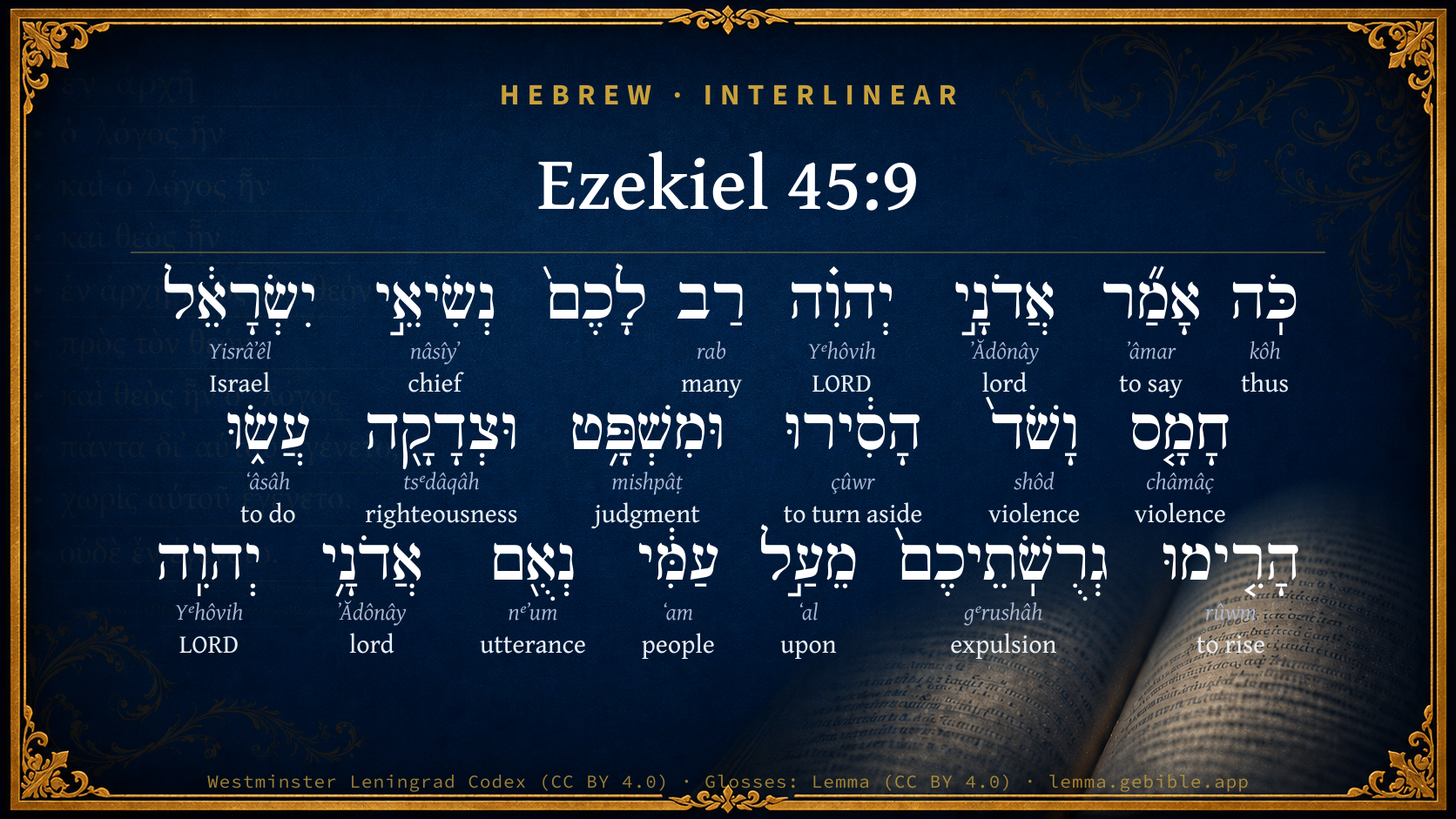
Hebrew (Westminster Leningrad Codex) Ezekiel 45:9 appears in the Hebrew Old Testament. The text above is from the Westminster Leningrad Codex. Each word links to its Strong’s number, a concise gloss, and parsing drawn from the Open Scriptures Hebrew Bible morphology. Click any word for its full Brown-Driver-Briggs (BDB) entry.
Download image
Cite this verse

Ezekiel 45:9 (World English Bible). Public Domain. Lemma interlinear Bible study tool, https://lemma.gebible.app/v/ezekiel/45/9.

Show BibTeX & RIS
BibTeX
RIS
English Translation
Thus says the Lord Yahweh: Let it suffice you, princes of Israel: remove violence and spoil, and execute justice and righteousness; dispossessing my people, says the Lord Yahweh.
World English Bible · Public Domain
Highlights
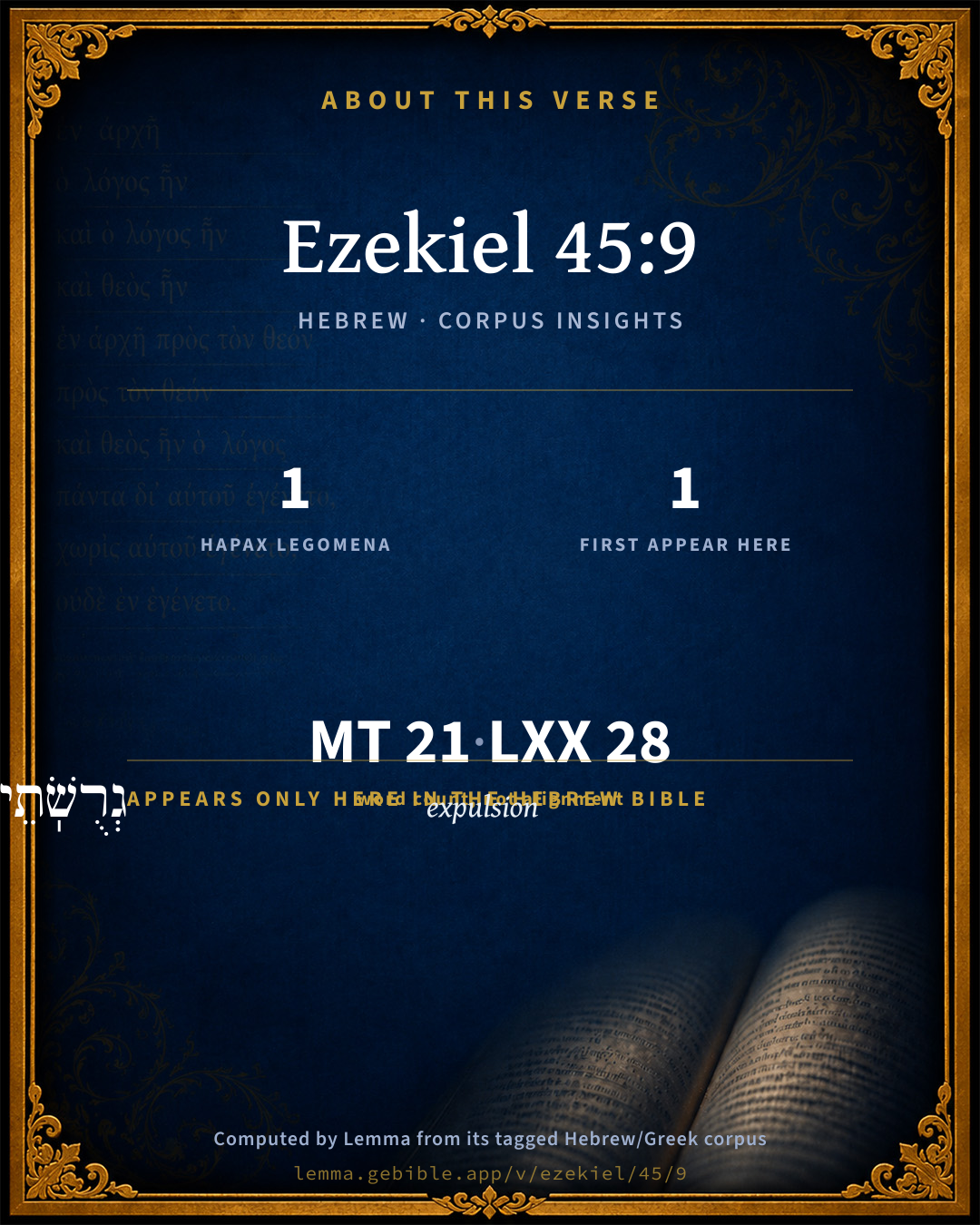
  • 1 hapax legomenon — only here in the Hebrew Bible
  • 1 first appearance in the Hebrew Bible
Full analysis ↓
Download a study sheet

One document with this verse’s original text, its word-by-word gloss line, the meaning frame, cross-references with their text, attributed commentary, and full source and license credits — printable, and it pastes into notes with its structure intact.

This verse Autodidact and up

Study sheet (.html) Plain text (.txt)

A passage Seminary Student

Up to 50 verses in one chapter. A passage sheet keeps up to 6 commentary sources and 12 cross-references per verse, in the order this page ranks them, and says so on the sheet whenever that leaves anything out. Ask for a single verse and you get the Autodidact verse sheet above.

Everything on this page stays free to read, with no account — the sheet is a download of what is already on screen, not access to it.

Want to remove ads? Support Godless Engineer
Compare translations 3

The same verse in 3 English versions, stacked beneath the original-language interlinear above. Click any original word for its lexicon entry.

Each is an independent rendering of the whole verse — the interlinear is not word-aligned to these translations.

Highlighted words mark where these versions differ — a whole-verse word diff, not a word-by-word alignment.

  • World English Bible Public Domain
    Thus says the Lord Yahweh: Let it suffice you, princes of Israel: remove violence and spoil, and execute justice and righteousness; dispossessing my people, says the Lord Yahweh.
  • King James Version Public Domain
    Thus saith the Lord GOD; Let it suffice you, O princes of Israel: remove violence and spoil, and execute judgment and justice, take away your exactions from my people, saith the Lord GOD.
  • unfoldingWord Literal Text CC BY-SA 4.0
    The Lord Yahweh says this: It is enough for you, princes of Israel! Remove violence and strife; do justice and righteousness! Quit your evictions of my people!—this is the Lord Yahweh’s declaration.

unfoldingWord Literal Text — © unfoldingWord, licensed CC BY-SA 4.0. Word-aligned USFM3 via Door43 (git.door43.org/unfoldingWord/en_ult).

Versions to compare (up to 4)

3 of 4 selected

Show all 18 translations

Every available English version of this verse, each an independent rendering of the whole verse.

  • World English Bible Public Domain
    Thus says the Lord Yahweh: Let it suffice you, princes of Israel: remove violence and spoil, and execute justice and righteousness; dispossessing my people, says the Lord Yahweh.
  • Berean Standard Bible Public Domain
    For this is what the Lord GOD says: ‘Enough, O princes of Israel! Cease your violence and oppression, and do what is just and right. Stop dispossessing My people, declares the Lord GOD.’
  • Majority Standard Bible Public Domain
    For this is what the Lord GOD says: ‘Enough, O princes of Israel! Cease your violence and oppression, and do what is just and right. Stop dispossessing My people, declares the Lord GOD.’
  • King James Version Public Domain
    Thus saith the Lord GOD; Let it suffice you, O princes of Israel: remove violence and spoil, and execute judgment and justice, take away your exactions from my people, saith the Lord GOD.
  • American Standard Version (1901) Public Domain
    Thus saith the Lord Jehovah: Let it suffice you, O princes of Israel: remove violence and spoil, and execute justice and righteousness; take away your exactions from my people, saith the Lord Jehovah.
  • Revised Version (1885) Public Domain
    Thus saith the Lord GOD: Let it suffice you, O princes of Israel: remove violence and spoil, and execute judgment and justice; take away your exactions from my people, saith the Lord GOD.
  • Geneva Bible (1599) Public Domain
    Thus saith the Lord God, Let it suffice you, O princes of Israel: leaue off crueltie and oppression, and execute iudgment and iustice: take away your exactions from my people, sayth the Lord God.
  • Douay-Rheims (1899) Public Domain
    Thus saith the Lord God: Let it suffice you, O princes of Israel: cease from iniquity and robberies, and execute judgment and justice, separate your confines from my people, saith the Lord God.
  • Young's Literal Translation Public Domain
    `Thus said the Lord Jehovah: Enough to you -- princes of Israel; violence and spoil turn aside, and judgment and righteousness do; lift up your exactions from off My people -- an affirmation of the Lord Jehovah.
  • Literal Standard Version CC BY-SA 4.0
    Thus said Lord YHWH: “Enough from you—princes of Israel; turn violence and spoil aside, and do judgment and righteousness; lift up your exactions from off My people—a declaration of Lord YHWH.
  • Unlocked Literal Bible CC BY-SA 4.0
    The Lord Yahweh says this: It is enough for you, princes of Israel! Remove violence and strife; do justice and righteousness! Quit your evictions of my people!—this is the Lord Yahweh's declaration.
  • unfoldingWord Literal Text CC BY-SA 4.0
    The Lord Yahweh says this: It is enough for you, princes of Israel! Remove violence and strife; do justice and righteousness! Quit your evictions of my people!—this is the Lord Yahweh’s declaration.
  • Darby Bible Public Domain
    Thus saith the Lord Jehovah: Let it suffice you, princes of Israel! Put away violence and spoil, and execute judgment and justice; take off your exactions from my people, saith the Lord Jehovah.
  • World Messianic Bible Public Domain
    “‘The Lord GOD says: “Enough, you princes of Israel! Remove violence and plunder, and execute justice and righteousness! Stop dispossessing my people!” says the Lord GOD.
  • Webster's Bible Public Domain
    Thus saith the Lord GOD; Let it suffice you, O princes of Israel: remove violence and spoil, and execute judgment and justice, take away your exactions from my people, saith the Lord GOD.
  • Free Bible Version CC BY-SA 4.0
    This is what the Lord God says: You've done enough damage, princes of Israel! Stop using violence and mistreating people! Do what is good and right. Stop evicting people and stealing their property, declares the Lord God.
  • Bible in Basic English Public Domain
    This is what the Lord has said: Let this be enough for you, O rulers of Israel: let there be an end of violent behaviour and wasting; do what is right, judging uprightly; let there be no more driving out of my people, says the Lord.
  • JPS Tanakh (1917) Public Domain
    Thus saith the Lord GOD: Let it suffice you, O princes of Israel; remove violence and spoil, and execute justice and righteousness; take away your exactions from My people, saith the Lord GOD.

Literal Standard Version (2020), Covenant Press — licensed CC BY-SA 4.0. Text via the HelloAO Bible API (eBible.org). Unlocked Literal Bible (unfoldingWord) — licensed CC BY-SA 4.0. Text via the HelloAO Bible API (eBible.org). unfoldingWord Literal Text — © unfoldingWord, licensed CC BY-SA 4.0. Word-aligned USFM3 via Door43 (git.door43.org/unfoldingWord/en_ult). Free Bible Version, Dr. Jonathan Gallagher — licensed CC BY-SA 4.0. Text via the HelloAO Bible API (eBible.org).

Word by word

More ways to search: Search by grammar → Find every occurrence → Compare this word →

Practice this passage: Drill this verse → Learn its vocabulary →

גְרֻשֹֽׁתֵיכֶם֙
gᵉrushâh
H1646
“expulsions · your”
Noun, Common, Feminine, Plural, Construct + Suffix, Personal, 2nd Person, Masculine, Plural
Part of Speech
Noun
Type
Common
Gender
Feminine
Number
Plural
State
Construct
Full BDB Definition

Origin: pass. participle of H1644

TWOT: 388b

expulsion, violence, dispossession, act of expulsion
  1. כֹּֽה kôh H3541 “thus” Adverb
  2. אָמַ֞ר ʼâmar H559 “to say” Verb, Qal, Perfect, 3rd Person, Masculine, Singular
  3. אֲדֹנָ֣י ʼĂdônây H136 “Lord · my” Noun, Common, Masculine, Plural, Construct + Suffix, Personal, 1st Person, Common, Singular
  4. יְהוִ֗ה Yᵉhôvih H3069 “LORD” Noun, Proper
  5. רַב rab H7227 “many” Adjective, Adjective, Masculine, Singular, Absolute
  6. נְשִׂיאֵ֣י nâsîyʼ H5387 “chiefs of” Noun, Common, Masculine, Plural, Construct
  7. יִשְׂרָאֵ֔ל Yisrâʼêl H3478 “Israel” Noun, Proper
  8. חָמָ֤ס châmâç H2555 “violence” Noun, Common, Masculine, Singular, Absolute
  9. וָשֹׁד֙ shôd H7701 “and · violence” Conjunction + Noun, Common, Masculine, Singular, Absolute
  10. הָסִ֔ירוּ çûwr H5493 “turn aside” Verb, Hiphil, Imperative, 2nd Person, Masculine, Plural
  11. וּמִשְׁפָּ֥ט mishpâṭ H4941 “and · judgment” Conjunction + Noun, Common, Masculine, Singular, Absolute
  12. וּצְדָקָ֖ה tsᵉdâqâh H6666 “and · righteousness” Conjunction + Noun, Common, Feminine, Singular, Absolute
  13. עֲשׂ֑וּ ʻâsâh H6213 “do” Verb, Qal, Imperative, 2nd Person, Masculine, Plural
  14. הָרִ֤ימוּ rûwm H7311 “rise” Verb, Hiphil, Imperative, 2nd Person, Masculine, Plural
  15. מֵעַ֣ל ʻal H5921 “from · upon” Preposition + Preposition
  16. עַמִּ֔י ʻam H5971 “people · my” Noun, Common, Masculine, Singular, Construct + Suffix, Personal, 1st Person, Common, Singular
  17. נְאֻ֖ם nᵉʼum H5002 “utterance of” Noun, Common, Masculine, Singular, Construct
  18. אֲדֹנָ֥י ʼĂdônây H136 “Lord · my” Noun, Common, Masculine, Plural, Construct + Suffix, Personal, 1st Person, Common, Singular
  19. יְהוִֽה Yᵉhôvih H3069 “LORD” Noun, Proper

About this verse

These counts appear in no published source. They are computed here, from the morphology-tagged text and Lemma’s own curated glosses. What Lemma adds →

21
words
18
distinct lemmas
Prophets
section

Notable vocabulary

1 hapax legomenon — a word that appears only here in the entire Hebrew Bible:

  • גְרֻשֹֽׁתֵיכֶם֙ expulsion H1646

First appearance in Scripture

This word makes its first canonical appearance in the Hebrew Bible here:

  • גְרֻשֹֽׁתֵיכֶם֙ expulsion H1646

Shared distinctive vocabulary

וָשֹׁד֙ violence H7701 occurs in 24 verses of the Hebrew Bible. Also found in:

Grammatical profile

  • 4 verbs
  • 13 nouns
  • 1 adjective
  • 2 prepositions
  • 1 adverb

Verb forms

  • אָמַ֞ר Qal · Perfect
  • הָסִ֔ירוּ Hiphil · Imperative
  • עֲשׂ֑וּ Qal · Imperative
  • הָרִ֤ימוּ Hiphil · Imperative

Repetition

Words recur within this verse — often emphatic in Hebrew:

  • אֲדֹנָ֣י lord H136 ×2
  • יְהוִ֗ה LORD H3069 ×2

Hebrew & Septuagint length

In English translation the verse runs 28 words from the Hebrew and 31 from the Septuagint (LXX English) — closely comparable.

A rough comparison of the two English renderings, which tokenize alike — not a word-level alignment.

Word counts can differ between the Hebrew and the Greek without any difference in meaning — e.g. the Hebrew direct-object marker אֵת has no separate Greek word, and Greek often adds the article ὁ.

In the original languages it is 21 Hebrew tokens and 28 Greek tokens — but the two are counted differently (Hebrew bundles its prefixes and suffixes into one token; the Greek is in lemma form), so that isn’t a like-for-like length.

Cross-references

15

Topical passages linked to Ezekiel 45:9 in the Treasury of Scripture Knowledge — connected by theme and wording, ordered by reader-vote popularity; previews shown in the World English Bible.

  • Zechariah 8:16 These are the things that you shall do: speak every man the truth with his neighbor. Execute the judgment of truth and peace in your gates,
  • Isaiah 1:17 Learn to do well. Seek justice, Relieve the oppressed, Judge the fatherless, Plead for the widow."
  • Jeremiah 22:3 Thus says Yahweh: Execute you justice and righteousness, and deliver him who is robbed out of the hand of the oppressor: and do no wrong, do no violence, to the foreigner, the fatherless, nor the widow; neither shed innocent blood in this place.
  • Ezekiel 44:6 You shall tell the rebellious, even to the house of Israel, Thus says the Lord Yahweh: you house of Israel, let it suffice you of all your abominations,
  • 1 Peter 4:3 For we have spent enough of our past time doing the desire of the Gentiles, and having walked in lewdness, lusts, drunken binges, orgies, carousings, and abominable idolatries.
  • Nehemiah 5:1–13 Then there arose a great cry of the people and of their wives against their brothers the Jews.
  • Job 20:19 For he has oppressed and forsaken the poor. He has violently taken away a house, and he shall not build it up.
  • Job 22:9 You have sent widows away empty, And the arms of the fatherless have been broken.
  • Job 24:2–12 There are people who remove the landmarks. They violently take away flocks, and feed them.
  • Psalms 82:2–5 "How long will you judge unjustly, And show partiality to the wicked?" Selah.
  • Ezekiel 43:14–16 From the bottom on the ground to the lower ledge shall be two cubits, and the breadth one cubit; and from the lesser ledge to the greater ledge shall be four cubits, and the breadth a cubit.
  • Micah 2:1–2 Woe to those who devise iniquity And work evil on their beds! When the morning is light, they practice it, Because it is in the power of their hand.
  • Micah 2:9 You drive the women of my people out from their pleasant houses; From their young children you take away my blessing forever.
  • Luke 3:14 Soldiers also asked him, saying, "What about us? What must we do?" He said to them, "Extort from no one by violence, neither accuse anyone wrongfully. Be content with your wages."
  • 1 Corinthians 6:7–8 Therefore it is already altogether a defect in you, that you have lawsuits one with another. Why not rather be wronged? Why not rather be defrauded?

Cross-references courtesy of OpenBible.info (CC BY 4.0).

Hebrew and Greek witnesses Masoretic Hebrew ↔ Greek Septuagint

The same verse in the two great witnesses to the Old Testament, shown verse-for-verse.

These are two independent witnesses, not word-aligned to each other, and the Septuagint is shown in lemma (dictionary) form.

Hebrew Ezekiel 45:9 Masoretic · Westminster Leningrad Codex

כֹּֽה אָמַ֞ר אֲדֹנָ֣י יְהוִ֗ה רַב לָכֶם֙ נְשִׂיאֵ֣י יִשְׂרָאֵ֔ל חָמָ֤ס וָשֹׁד֙ הָסִ֔ירוּ וּמִשְׁפָּ֥ט וּצְדָקָ֖ה עֲשׂ֑וּ הָרִ֤ימוּ גְרֻשֹֽׁתֵיכֶם֙ מֵעַ֣ל עַמִּ֔י נְאֻ֖ם אֲדֹנָ֥י יְהוִֽה

Thus says the Lord Yahweh: Let it suffice you, princes of Israel: remove violence and spoil, and execute justice and righteousness; dispossessing my people, says the Lord Yahweh.

World English Bible · Public Domain

Greek LXX Ezekiel 45:9 Septuagint · lemma form

ὅδε λέγω κύριος θεός ἱκανόω σύ ὁ ἀποἡγέομαι ὁ ἰσραήλ ἀδικία καί ταλαιπωρία ἀποαἱρέω καί κρίμα καί δικαιοσύνη ποιέω ἐκαἴρω καταδυναστεία ἀπό ὁ λαός ἐγώ λέγω κύριος θεός

Thus says the Lord God; Let it suffice you, you⌃ princes of Israel: remove injustice and misery, execute judgment and justice; take away oppression from my people, says the Lord God.

LXX2012 (modern English Septuagint) · Public Domain

On this verse, Haydock's Catholic Bible Commentary discusses the Septuagint’s reading. Read the note in Commentary ↓

Hebrew: Westminster Leningrad Codex (CC BY 4.0). Greek: Septuagint (public domain); English from LXX2012 (modern English Septuagint) (Public Domain). How the Septuagint differs from the Hebrew →

Targum (Aramaic paraphrase)

1

The Targum is the ancient Jewish Aramaic paraphrase of the Hebrew Scriptures — an interpretive translation, not the Hebrew text itself. Onkelos (literal) and Pseudo-Jonathan (expansive) render the Torah, and Jonathan the Prophets. Coverage is partial: where no permissively-licensed English translation exists for a verse, only the Aramaic is shown. This is verse-level text, not a word-by-word alignment to the Hebrew.

  1. Targum Jonathan Prophets (Joshua–Malachi)
    כִּדְנַן אֲמַר יְיָ אֱלֹהִים סַגִי לְכוֹן רַבְרְבֵי יִשְׂרָאֵל דַטְפָא וּבִזָא אַעְדוּ וְדִין דִקְשׁוֹט וּזְכוּ עֲבִידוּ סְלִיקוּ תִקְלַתְכוֹן מִגוֹ עַמִי אֲמַר יְיָ אֱלֹהִים:

    (no public-domain English translation for this verse)

    Targum Jonathan — Aramaic: “Mikraot Gedolot” (public domain). English: “Sefaria Community Translation” (CC0 1.0 (public-domain dedication)); “London "Chaldee Paraphrase," 1871” (public domain). Text via Sefaria.

Commentary

Notes on Ezekiel 45:9 from classic Christian and Jewish commentators (each source and its license shown beneath its notes). The classic Christian expositions comment on the surrounding passage and are grouped to its opening verse, so a note may address several verses; the Jewish commentaries on the Tanakh (Rashi and others) are per-verse, so they appear only where the commentator wrote on this verse.

Lemma curates 59 commentaries, every one of them public domain or Creative Commons licensed, each selected and text-cleaned for this edition rather than reprinted as found. About our sources →

Matthew Henry's Commentary

We have here some general rules of justice laid down both for prince and people, the rules of distributive and commutative justice; for godliness without honesty is but a form of godliness, will neither please God nor avail to the benefit of any people. Be it therefore enacted, by the authority of the church's King and God, 1. That princes do not oppress their subjects, but duly and faithfully administer justice among them (Eze 45:9): "Let it suffice you, O princes of Israel! that you have been oppressive to the people and have enriched yourselves by spoil and violence, that you have so long fleeced the flock instead of feeding them, and henceforward do so no more." Note, Even princes and great men that have long done amiss must at length think it time, high time, to reform and amend; for no prescription will justify a wrong. Instead of saying that they have been long accustomed to oppress, and therefore may persist in it, for the custom will bear them out, they should say that they have been long accustomed to it and therefore, as here, Let the time pass suffice, and let them now remove violence and spoil; let them drop wrongful demands, cancel wrongful usages, and turn out those from employments under them that do violence. Let them take away their exactions, ease their subjects of those taxes which they find lie heavily upon them, and let them execute judgment and justice according to the law, as the duty of their place requires. Note, All princes, but especially the princes of Israel, are concerned to do justice; for of their people God says, They are my people, and they in a special manner rule for God. 2. That one neighbour do not cheat another in commerce (Eze 45:10): You shall have just balances, in which to weigh both money and goods, a just ephah for dry measure of corn and flour, a just bath for the measure of liquids, wine, and oil; and the ephah and bath shall be one measure, the tenth part of a chomer, or cor, Eze 45:11. So that the ephah and bath contained (as the learned Dr. Cumberland has computed) seven wine gallons and four pints, and something more. An omer was but the tenth part of an ephah (Exo 16:36) and the one hundredth part of a chomer, or homer, and contained about six pints. The shekel is here settled (Eze 45:13); it is twenty jerahs, just half a Roman ounce, in our money 2s. 4 1/4d. and almost the eighth part of a farthing, as the aforesaid learned man exactly computes it. By the shekels the maneh, or pound, was reckoned, which, when it was set for a mere weight (says bishop Cumberland), without respect to coinage, contained just 100 shekels, as appears by comparing Kg1 10:17, where it is said three manehs, or pounds, of gold, went to one shield, with the parallel place, Ch2 9:16, where it is said 300 shekels of gold went to one shield. But when the maneh is set for a sum of money or coin it contains but sixty shekels, as appears here, where twenty shekels, twenty-five shekels, and fifteen shekels, which in all make sixty, shall be the maneh. But it is thus reckoned because they had one piece of money that weighed twenty shekels, another twenty-five, another fifteen, all of which made up one pound, as a learned writer here observes. Note, It concerns God's Israel to be very honest and just in all their dealings, very punctual and exact in rendering to all their due, and very cautious to do wrong to none, because otherwise they spoil the acceptableness of their profession with God and the reputation of it before men.

Matthew Henry's Commentary on the Whole Bible (1708–1710) — public domain (CC PDM 1.0). Text via the HelloAO Bible API.

Ellicott's Commentary for English Readers

(9) Take away your exactions.—Eze_45:9-12 are an exhortation to the princes to observe justice in all their dealings. (Comp. Jer_22:3.) “Exaction” is, literally, as in the margin, expulsion, or ejection, with allusion to such cases as 1Ki_21:1-16. In the following verses the exhortation to justice is extended to the whole people. (Comp. Lev_19:35-36; Deu_25:13-15.)

A Bible Commentary for English Readers, edited by Charles John Ellicott (1878–1897) — public domain. Text from a community e-Sword module.

The Cambridge Bible for Schools and Colleges

gen. ed. J. J. S. Perowne

9. take away your exactions] Lit. remove your expulsions from my people. Ref. probably to unjust extrusion of persons from their possessions, of which the early prophets often complain, Isa_5:8; Mic_2:9; Mic_3:2-3, and the story of Naboth, 1 Kings 21.

9–17. The dues to be given the prince, and his obligations to provide the materials for the ritual.

Eze_45:9 seq. The former unjust and irregular exactions of the princes shall cease. These exactions had not only been oppressive in their nature, but unjust and arbitrary from want of a fixed standard in weights, measures and currency.

The Cambridge Bible for Schools and Colleges (gen. ed. J. J. S. Perowne; Cambridge University Press, 1878–1918) — public domain. Text from a community e-Sword module.

Trapp's Complete Commentary

John Trapp

Eze 45:9 Thus saith the Lord GOD; Let it suffice you, O princes of Israel: remove violence and spoil, and execute judgment and justice, take away your exactions from my people, saith the Lord GOD.

Ver. 9. Let it suffice you.] Be content with your double portion, your so large a lot; and that ye may be so, hear the laws that I lay upon you: remove violence and spoil, execute judgment and justice; take away your exactions, &c.; see that ye have just balances and a just ephah. Let these things be done, or you will be quickly undone. Is it not enough to be above men, but you must needs be above mankind, as those princes would be that would not be under the law?

John Trapp, A Commentary or Exposition upon All the Books of the Old and New Testament (1647–1656) — public domain. Text from a community e-Sword module.

Joseph Benson's Commentary

Eze 45:9-12. Let it suffice, O ye princes of Israel — This is a reproof of the oppressions of the former kings and their chief officers. The title of princes of Israel is to be understood of such princes as the Jews afterward had of the Asmonæan race; for there were no more princes to reign of the tribe of Judah till Christ came. Ye shall have just balances — Ye shall take care that there be no deceit in private trade: ye shall provide just measures, both for buying and selling, both dry things and liquid: for the ephah was the measure of dry things, as the bath was of liquid. The homer was about ten bushels, which amounts to about eighty gallons in liquid things. And the shekel shall be twenty gerahs. — This is made the standard of the shekel, Exo 30:13, which confutes the common opinion, that the weights of the sanctuary were double to those of common use. The shekel is usually valued at 2 Samuel 6 d. of our money; but some suppose it to be in value 2 Samuel 4½d. of our money, and a little over. Twenty shekels, five and twenty, fifteen shall be your maneh — Maneh is the same with the Greek μνα, and the Latin mina, being both derived from it. A maneh, or mina, consists of sixty shekels, that is, thirty ounces of silver; which, reckoning every shekel at 2 Samuel 6 d. value, amounts to 7l. 10s. The dividing the maneh into twenty, twenty- five, and fifteen shekels, supposes there were coins of these several values, which, taken all together, were to be of the same weight with the mina.

Joseph Benson's Commentary on the Old and New Testaments (1811–1818) — public domain. Text from a community e-Sword module.

Geneva Bible (1599)

Geneva Bible translators

The Prophet showeth that the heads must be first reformed afore any good order can be established among the people.

Geneva Bible (1599) marginal notes — public domain. Text via Bolls.life.

Adam Clarke's Commentary

Verse 9. Take away your exactions from my people] This is the voice of God to all the rulers of the earth.

Take away your exactions; do not oppress the people; they are mine. Abolish all oppressive taxes.

Adam Clarke's Commentary on the Bible (1810–1826) — public domain. Text from a community e-Sword/MySword module.

John Gill's Exposition

Thus saith the Lord, let it suffice you, O princes of Israel,.... Christian kings and princes, for such there shall be in those times; and who will have large and ample salaries provided for them, as they should have to support their dignity; and with which they should be content, as they will be, and not encroach upon the properties of their subjects:

remove violence and spoil; from your administration; the sense is, do not use violence, and exercise rapine and spoil, let these be far from you; seize not on the goods of your subjects, or spoil them of them by heavy taxes and impositions, or by vexatious lawsuits, and unjust sentences:

and execute judgment and justice; between men; let everyone enjoy his own property; and when any matter of controversy arises about it, fairly hear and examine the case, and do justice:

take away your exactions from my people, saith the Lord; such as had been exacted of them in former times by tyrannical and unjust princes: or, "your expulsions" (b); driving them from their houses, estates, fields, and vineyards; either by taking them away from them, and annexing them to their own, as Ahab did; or by levying such taxes upon them they could not pay, and so were obliged to leave their inheritances and possessions. This, and some following verses, contain rules for regulating the civil state of the people of God in the latter day; which did not take place upon the Jews' return from Babylon, as appears from Neh 5:15 but will be strictly observed by Christian princes in the latter day glory; see Isa 40:17.

(b) "delulsiones vestras", Junius & Tremellius, Piscator, Polanus; "expulsiones vestras", Cocceius, Starckius.

John Gill's Exposition of the Whole Bible (1746–1763) — public domain (CC PDM 1.0). Text via the HelloAO Bible API.

Albert Barnes' Notes on the Bible

The princes are exhorted to execute judgment, and abstain from “exaction” (literally “ejection”) such as that of Naboth by Ahab 1Ki 21:19.

Albert Barnes' Notes on the Bible (1834–1885) — public domain. Text from a community e-Sword/MySword module.

Haydock's Catholic Bible Commentary

Confines: encroach not. (Calmet) --- Hebrew and Septuagint, "take away your oppressions;" (Haydock) Chaldean, "scandals." (Calmet)

George Leo Haydock (1774–1849), Haydock's Catholic Family Bible and Commentary, 1859 edition — public domain. Excludes Psalms (Douay-Rheims chapter numbering differs from Protestant) and Deuterocanonical books (Catholic canon only).

Matthew Poole's English Annotations

Princes are here in God’s name, and by advice from him he made them princes, counselled, exhorted, and commanded.

Let it suffice; be content, aim not at more: he who gave no more can make this enough, and he will curse and blast what you indirectly, and by sinful, oppressive crafts, wrest from others.

Remove violence; put it far from yourselves, do not you use it, and so discountenance in others, that neither common subjects dare violate one another, nor your officers violate any of them.

Spoil; either the same as violence, or the effect of it, violent courses; rob the oppressed and spoil them.

Execute judgment; judge righteously, and they look the sentence be executed, for terror to the unjust, and relief of the oppressed.

And justice: this is added for emphasis, though the same thing.

Exactions; heavy taxes and impositions on estates or trade.

My people; whom I must, if you will not, right.

Matthew Poole's English Annotations on the Holy Bible (1683–1685) — public domain. Text from a community e-Sword/MySword module.

Dummelow's Commentary on the Holy Bible

J. R. Dummelow

The Prince's Dues and Obligations

The oppressive exactions of the former rulers were to be unknown in the restored Israel. Weights and measures were to be just and correct. The prince was to receive from the people a sixtieth of their wheat and barley, a hundredth part of their oil, and one in two hundred of their flocks. Out of these supplies the prince was to provide all the regular sacrifices for the Temple.

10. The ephah (dry measure) and the bath (liquid measure) were each the tenth of an homer.

12. Twenty shekels.. maneh] read with LXX, 'five (shekels) shall be five, and ten shekels ten, and fifty shekels shall be your maneh'. A shekel was 20 gerahs, and a maneh 50 shekels or 1,000 gerahs.

13. 1 in 60: see Eze_45:10.

14. Cor] equivalent to 'homer'. The proportion is 1 in 100.

J. R. Dummelow, A Commentary on the Holy Bible (Macmillan, 1909) — public domain. Text from a community e-Sword module.

Whedon's Commentary on the Bible

Daniel D. Whedon

9. Take away your exactions — Or, relieve my people from your [unjust] ejectments (Toy). The history of Israel is full of the oppression of the princes (see Eze_22:25; Ezekiel 34; 1Ki_12:4-11; 2Ki_23:25; Jer_22:17), and the expulsion of the owners from their property (Isa_5:8; Mic_2:9; Mic_3:3).

Daniel D. Whedon (gen. ed.), Commentary on the Old and New Testaments (1874–1909) — public domain. Text from a community e-Sword module.

The Pulpit Commentary

Vers. 9-17. The oblations of the people to the prince for the sanctuary.

In continuation of the foregoing thought, the princes of Israel first are reminded that whatever they should obtain from the people for the sanctuary was not to be extorted from them by violence and spoil (comp. Eze_7:11, 23 8:17; Jer_6:7 Jer_20:8; Hab_1:3) or by exactions literally, expulsions, or drivings of persons out of their possessions, such as had been practiced on Naboth by Ahab (1Ki 21) but levied with judgment and justice, which, besides, should regulate their whole behavior towards their subjects. (comp. 2Sa_8:15; Jer_23:5 Jer_32:25)

HOMILIES BY J.D. DAVIES Vers. 9-12Religion the parent of morality.

It is certain that God feels an active interest in all the covenants of man. The same authority that requires love to God requires love for our neighbors, equal in strength to love for self. True religion is not sublimely indifferent to the details of home and mercantile life. It designs to make every home a nursery for the Church, every shop an arena for the victories of faith. Every commercial transaction bears a testimony either for God or against him.

I RELIGION HAS A MESSAGE FOR EVERY RANK OF HUMAN SOCIETY. Like the sun in the heavens, religion exerts the benignest influence on men of every rank and station. It teaches the monarch humility and self-restraint. It teaches princes to live for others. It teaches magistrates the value of equity and justice. It teaches merchants principles of honesty and truthfulness. It cares for the poorest and the meanest among men; inspires them with the spirit of industry; casts a halo of beauty over the lowliest lot. Nothing that appertains to man is too insignificant for the notice of true religion. For every stage in life, from childhood to old age, religion has some kindly ministration. For every circumstance it affords some succor. It superadds dignity to the prince. It gives a kingly bearing to the peasant. It links all classes (when unhindered) in true and blissful harmony. Tyranny on the one hand, and insubordination on the other, are equally obnoxious to religion.

II RELIGION SHEDS ITS INFLUENCE THROUGH EVERY DEPARTMENT OF HUMAN LIFE. We cannot go into any assembly of men for whatever purpose they meet, where we are excused from manifesting the principles and the spirit of true religion. Whether we meet for gaining knowledge, or for industrial toil, or for political action, or for commercial pursuits, religion claims to preside over all our thoughts and plans and deeds. The shop and the mart are capacious fields for the daily exercise of Christian virtues fields exquisitely suited for the growth and ripening of the noblest qualities. Courage can only be developed in presence of strife and peril; so our religious virtues can only be strengthened in an atmosphere of temptation. If a man is not pious and faithful and truthful in his commercial transactions, he will not be pious and faithful anywhere. This is his test; and woe be to the man who succumbs in the strife!

III RELIGION SETS UP STANDARDS FOR ALL HUMAN ACTIONS. "Ye shall have just balances." The shekel and the homer were to be fixed standards. If fraud be allowed to creep into our commercial scales and measures, the fraud will corrupt every transaction. The very heart of the mercantile system will be poisoned. Villany secreted here would spread as from a center to the whole circumference of commerce. It is supremely important that men establish right standards of speech and conduct. If the exchange is to prosper, it must (like the throne) be established in righteousness. Over the portals of every shop, on the beam of every balance, engraved on every coin, ought the maxim to run in largest capitals, "Whatsoever ye would that men should do to you, do ye even so to them! D.

The Pulpit Commentary (1880–1919), ed. H.D.M. Spence-Jones & Joseph S. Exell — public domain. Text from a community e-Sword module.

John Wesley's Explanatory Notes

Let it suffice - Be content, aim not at more.

John Wesley, Explanatory Notes Upon the Whole Bible (1754–1765) — public domain. Text via the GEBible commentary corpus.

Kretzmann's Popular Commentary

Paul E. Kretzmann

The Portion of the People

v. 9. Thus saith the Lord God, in connecting up this paragraph with the last statement of the previous section, Let it suffice you, O princes of Israel: remove violence and spoil, so that they would no more be guilty of the Oppression formerly practiced, and execute judgment and justice, so as to make righteousness the guiding principle in all their actions; take away your exactions from My people saith the Lord God, for this had been done by expelling lawful possessors from their property, as in the case of Naboth.

v. 10. Ye shall have just balances, for weighing, and a just ephah, for dry measure, and a just hath, a correct measure also for liquids.

v. 11. The ephah and the hath shall be of one measure, of the same cubic content, that the bath may contain the tenth part of an homer and the ephah the tenth part of an homer, the homer thus being the larger standard; the measure thereof shall be after the homer.

v. 12. And the shekel shall be twenty gerahs; twenty shekels, five and twenty shekels, fifteen shekels, shall be your maneh. "The threefold enumeration of shekels, twenty, twenty-five, fifteen, probably refers to coins of different value, representing, respectively, so many shekels, the three collectively making up a maneh. "

v. 13. This is the oblation that ye shall offer, made to the ruler as a gift consecrated to the Lord for purposes of worship: the sixth part of an ephah of an homer of wheat, about ten pints; and ye shall give the sixth part of an ephah of an homer of barley, the same amount of grain in either case.

v. 14. Concerning the ordinance of oil, the regulation concerning the gift of oil, the bath of oil: ye shall offer the tenth part of a bath out of the cor, a homer being equal to about sixty pints, which is an homer of ten baths, for ten baths are an homer;

v. 15. and one lamb out of the flock, out of two hundred, out of the fat pastures of Israel, of the rich blessings given by the Lord, for a meat-offering, and for a burnt offering, and for peace-offerings, also known as thank-offerings, to make reconciliation for them, saith the Lord God, for the making of an atonement for the sins of the people was the chief purpose of the sacrifices. Cf Lev 1:4.

v. 16. All the people of the land shall give this oblation, making it a special point to render it, for the prince in Israel, who would thereby be enabled to provide for the service of worship and also to give evidence of his representation of the people.

v. 17. And it shall be the prince’s part to give burnt offerings, the special duty of his office, and meat-offerings, and drink-offerings, in the feasts, and in the new moons, and in the Sabbaths, in all solemnities, upon all the great festal occasions, of the house of Israel, he furnishing the material for the sacrifices; he shall prepare the sin-offering, and the meat-offering, and the burnt offering, and the peace-offerings to make reconciliation for the house of Israel. In the Church of the New Testament all offerings are gifts of free love to acknowledge the reconciliation made by Jesus Christ.

Paul E. Kretzmann, Popular Commentary of the Bible (1921–1924) — public domain. Text from a community e-Sword module.

unfoldingWord translationNotes

Door43 World Missions Community

this is the Lord Yahweh's declaration

Yahweh speaks of himself by name to express the certainty of what he is declaring. See how you translated this in Ezekiel 5:11. AT: "this is what the Lord Yahweh has declared" or "this is what I, the Lord Yahweh, have declared" (See: First, Second, or Third Person)

It is enough for you

"You have done too many bad things" or "You have been acting badly for far too long"

scales

an instrument that was used to weigh things that people sold or bought

so that a bath will be a tenth of a homer

"so that ten baths will be the same amount as a homer"

homer

about 220 liters (See: Biblical Volume)

shekel

about 11 grams (See: Biblical Weight)

gerahs

about 0.55 grams (See: Biblical Weight)

mina

about 660 grams (See: Biblical Weight)

translationWords

Lord Yahweh

just

righteous

people of God

declare

unfoldingWord translationNotes — © Distant Shores Media and the Door43 World Missions Community, licensed CC BY-SA 4.0. Source: git.door43.org/Door43/en_tn.

Rashi

Rabbi Shlomo Yitzchaki (Rashi)

take away your evictions Take away [your practice] of evicting My people from their inherited property.

Rashi on the Tanakh — English translations: “The Judaica Press complete Tanach with Rashi, translated by A. J. Rosenberg” (CC BY 4.0); “Pentateuch with Rashi's commentary by M. Rosenbaum and A.M. Silbermann, 1929-1934” (public domain); “The Metsudah Tanach series, Lakewood, N.J” (CC BY 4.0); and “The Book of Joshua, Metsudah Publications, 1997” (CC BY 4.0). Text via Sefaria.

Lesson kit

Teaching starters — assembled from the data on this page, not authored interpretation. Every prompt links to the verse data it draws on. Edit before teaching.

Ezekiel, in the Prophets, opens this verse with 21 words (18 distinct Hebrew lemmas). Its most distinctive word is gᵉrushâh (“expulsion”). A historical commentator’s framing appears above. Read the whole chapter for the surrounding context.

Discussion questions

  1. The word gᵉrushâh carries the sense “expulsion.” How does it shape the verse?
  2. 1 word here appears nowhere else in the Hebrew Bible. Why might the author reach for such rare wording?
  3. This is the first place “expulsion” appears in Scripture (first appears here). What does its debut here establish?
  4. How does Job 5:21, which shares the word «violence», read alongside this verse?
  5. What does the repetition of “lord” (2× in this one verse) do in this verse?
  6. These translations render this verse differently. What is at stake in choosing one wording over another?
  7. «אָמַ֞ר» is a Qal Perfect verb. How does that grammatical form shape the action described?
  8. Compare how Matthew Henry's Commentary and Ellicott's Commentary for English Readers read this verse. Where do they agree or differ?

Things to notice

  • 1 word in this verse appears nowhere else in the Hebrew Bible.
  • 1 word makes its first canonical appearance in Scripture here.
  • This verse counts 21 Hebrew ↔ 28 Greek words.
  • These translations choose different wording for 24 words in this verse.
  • “lord” occurs 2× in this single verse.

Reading settings

Reading text

Shown beneath each verse's original-language words.

Old Testament
Old Testament edition

Read the OT as the Masoretic Hebrew (MT) or the Greek Septuagint (LXX).

English shown for the Greek Septuagint (in the Hebrew ↔ Greek comparison).

Comparing translations? Open the Compare panel on any verse page to stack up to four side by side.