
1 Samuel 2:7

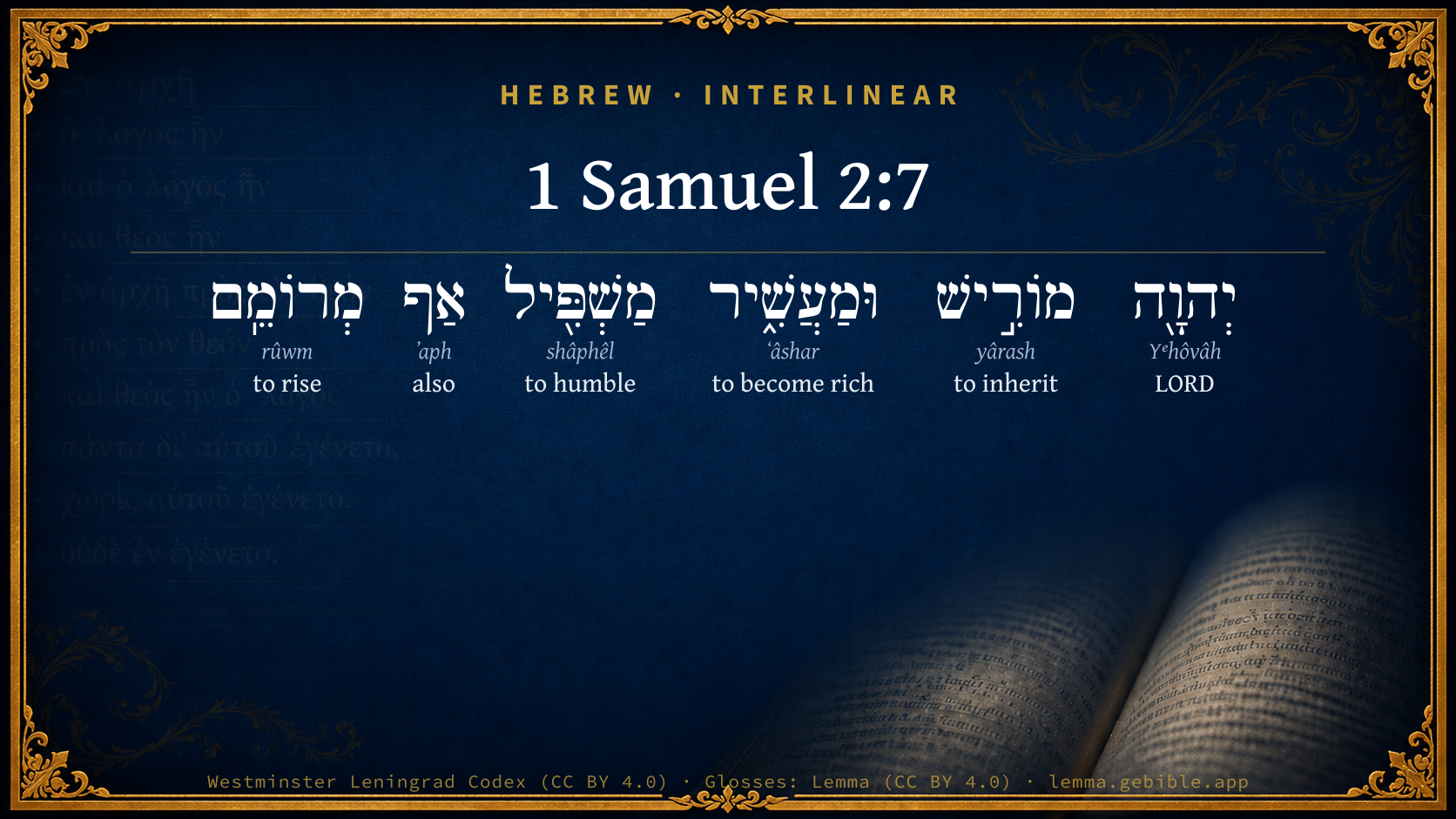
Hebrew (Westminster Leningrad Codex) 1 Samuel 2:7 appears in the Hebrew Old Testament. The text above is from the Westminster Leningrad Codex. Each word links to its Strong’s number, a concise gloss, and parsing drawn from the Open Scriptures Hebrew Bible morphology. Click any word for its full Brown-Driver-Briggs (BDB) entry.
Download image
Cite this verse

1 Samuel 2:7 (World English Bible). Public Domain. Lemma interlinear Bible study tool, https://lemma.gebible.app/v/1-samuel/2/7.

Show BibTeX & RIS
BibTeX
RIS
English Translation
Yahweh makes poor, and makes rich: He brings low, he also lifts up.
World English Bible · Public Domain
Highlights
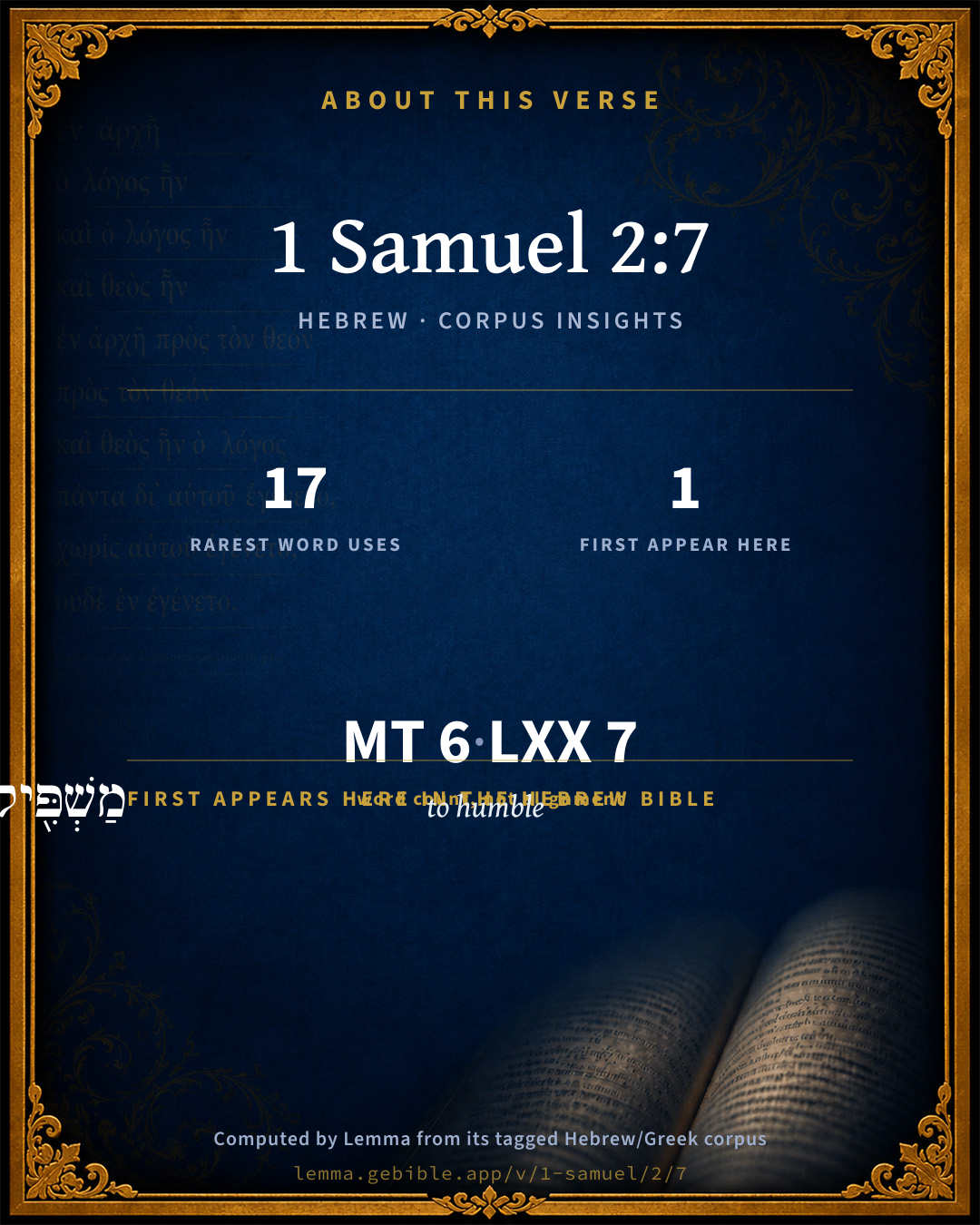
  • 1 first appearance in the Hebrew Bible
Full analysis ↓
Download a study sheet

One document with this verse’s original text, its word-by-word gloss line, the meaning frame, cross-references with their text, attributed commentary, and full source and license credits — printable, and it pastes into notes with its structure intact.

This verse Autodidact and up

Study sheet (.html) Plain text (.txt)

A passage Seminary Student

Up to 50 verses in one chapter. A passage sheet keeps up to 6 commentary sources and 12 cross-references per verse, in the order this page ranks them, and says so on the sheet whenever that leaves anything out. Ask for a single verse and you get the Autodidact verse sheet above.

Everything on this page stays free to read, with no account — the sheet is a download of what is already on screen, not access to it.

Want to remove ads? Support Godless Engineer
Compare translations 3

The same verse in 3 English versions, stacked beneath the original-language interlinear above. Click any original word for its lexicon entry.

Each is an independent rendering of the whole verse — the interlinear is not word-aligned to these translations.

Highlighted words mark where these versions differ — a whole-verse word diff, not a word-by-word alignment.

  • World English Bible Public Domain
    Yahweh makes poor, and makes rich: He brings low, he also lifts up.
  • King James Version Public Domain
    The LORD maketh poor, and maketh rich: he bringeth low, and lifteth up.
  • unfoldingWord Literal Text CC BY-SA 4.0
    Yahweh is making poor and making rich, bringing down yet bringing up.

unfoldingWord Literal Text — © unfoldingWord, licensed CC BY-SA 4.0. Word-aligned USFM3 via Door43 (git.door43.org/unfoldingWord/en_ult).

Versions to compare (up to 4)

3 of 4 selected

Show all 18 translations

Every available English version of this verse, each an independent rendering of the whole verse.

  • World English Bible Public Domain
    Yahweh makes poor, and makes rich: He brings low, he also lifts up.
  • Berean Standard Bible Public Domain
    The LORD sends poverty and wealth; He humbles and He exalts.
  • Majority Standard Bible Public Domain
    The LORD sends poverty and wealth; He humbles and He exalts.
  • King James Version Public Domain
    The LORD maketh poor, and maketh rich: he bringeth low, and lifteth up.
  • American Standard Version (1901) Public Domain
    Jehovah maketh poor, and maketh rich: He bringeth low, he also lifteth up.
  • Revised Version (1885) Public Domain
    The LORD maketh poor, and maketh rich: he bringeth low, he also lifteth up.
  • Geneva Bible (1599) Public Domain
    The Lord maketh poore and maketh rich: bringeth lowe, and exalteth.
  • Douay-Rheims (1899) Public Domain
    The Lord maketh poor and maketh rich, he humbleth and he exalteth.
  • Young's Literal Translation Public Domain
    Jehovah dispossesseth, and He maketh rich, He maketh low, yea, He maketh high.
  • Literal Standard Version CC BY-SA 4.0
    YHWH dispossesses, and He makes rich, || He makes low, indeed, He makes high.
  • Unlocked Literal Bible CC BY-SA 4.0
    Yahweh makes some people poor and some rich. He humbles, but he also lifts up.
  • unfoldingWord Literal Text CC BY-SA 4.0
    Yahweh is making poor and making rich, bringing down yet bringing up.
  • Darby Bible Public Domain
    Jehovah maketh poor, and maketh rich, he bringeth low, also he lifteth up:
  • World Messianic Bible Public Domain
    The LORD makes poor and makes rich. He brings low, he also lifts up.
  • Webster's Bible Public Domain
    The LORD maketh poor, and maketh rich: he bringeth low, and lifteth up.
  • Free Bible Version CC BY-SA 4.0
    The Lord makes some poor, but others rich; he brings some down, but he lifts others up.
  • Bible in Basic English Public Domain
    The Lord gives wealth and takes a man's goods from him: crushing men down and again lifting them up;
  • JPS Tanakh (1917) Public Domain
    The LORD maketh poor, and maketh rich; He bringeth low, He also lifteth up.

Literal Standard Version (2020), Covenant Press — licensed CC BY-SA 4.0. Text via the HelloAO Bible API (eBible.org). Unlocked Literal Bible (unfoldingWord) — licensed CC BY-SA 4.0. Text via the HelloAO Bible API (eBible.org). unfoldingWord Literal Text — © unfoldingWord, licensed CC BY-SA 4.0. Word-aligned USFM3 via Door43 (git.door43.org/unfoldingWord/en_ult). Free Bible Version, Dr. Jonathan Gallagher — licensed CC BY-SA 4.0. Text via the HelloAO Bible API (eBible.org).

Word by word

More ways to search: Search by grammar → Find every occurrence → Compare this word →

Practice this passage: Drill this verse → Learn its vocabulary →

וּמַעֲשִׁ֑יר
ʻâshar
H6238
“and · becoming rich”
Conjunction + Verb, Hiphil, Participle Active, Masculine, Singular, Absolute
Part of Speech
Conjunction + Verb
Stem
Hiphil
Form
Participle Active
Gender
Masculine
Number
Singular
State
Absolute
Full BDB Definition

Origin: a primitive root

TWOT: 1714

to be or become rich or wealthy, enrich, pretend to be rich - (Qal) to be or become rich - (Hiphil) - to make rich - to gain riches - (Hithpael) to enrich oneself, pretend to be rich
  1. יְהוָ֖ה Yᵉhôvâh H3068 “LORD” Noun, Proper
  2. מוֹרִ֣ישׁ yârash H3423 “inheriting” Verb, Hiphil, Participle Active, Masculine, Singular, Absolute
  3. מַשְׁפִּ֖יל shâphêl H8213 “humbling” Verb, Hiphil, Participle Active, Masculine, Singular, Absolute
  4. אַף ʼaph H637 “also” Particle, Accusative
  5. מְרוֹמֵֽם rûwm H7311 “rising” Verb, Polel, Participle Active, Masculine, Singular, Absolute

About this verse

These counts appear in no published source. They are computed here, from the morphology-tagged text and Lemma’s own curated glosses. What Lemma adds →

6
words
6
distinct lemmas
Historical
section

Notable vocabulary

The rarest word here is וּמַעֲשִׁ֑יר to become rich H6238 — appearing just 17 times in the whole Hebrew Bible.

First appearance in Scripture

This word makes its first canonical appearance in the Hebrew Bible here:

  • מַשְׁפִּ֖יל to humble H8213

Shared distinctive vocabulary

וּמַעֲשִׁ֑יר to become rich H6238 occurs in 17 verses of the Hebrew Bible. Also found in:

Grammatical profile

  • 4 verbs
  • 1 noun
  • 1 particle

Verb forms

  • מוֹרִ֣ישׁ Hiphil · Participle Active
  • וּמַעֲשִׁ֑יר Hiphil · Participle Active
  • מַשְׁפִּ֖יל Hiphil · Participle Active
  • מְרוֹמֵֽם Polel · Participle Active

Hebrew & Septuagint length

In English translation the verse runs 13 words from the Hebrew and 13 from the Septuagint (LXX English) — the same length.

A rough comparison of the two English renderings, which tokenize alike — not a word-level alignment.

Word counts can differ between the Hebrew and the Greek without any difference in meaning — e.g. the Hebrew direct-object marker אֵת has no separate Greek word, and Greek often adds the article ὁ.

In the original languages it is 6 Hebrew tokens and 7 Greek tokens — but the two are counted differently (Hebrew bundles its prefixes and suffixes into one token; the Greek is in lemma form), so that isn’t a like-for-like length.

Cross-references

8

Topical passages linked to 1 Samuel 2:7 in the Treasury of Scripture Knowledge — connected by theme and wording, ordered by reader-vote popularity; previews shown in the World English Bible.

  • Psalms 75:7 But God is the judge. He puts down one, and lifts up another.
  • Job 5:11 So that he sets up on high those who are low, Those who mourn are exalted to safety.
  • Deuteronomy 8:17–18 and [lest] you say in your heart, My power and the might of my hand has gotten me this wealth.
  • Job 1:21 He said, "Naked I came out of my mother's womb, and naked shall I return there. Yahweh gave, and Yahweh has taken away. Blessed be the name of Yahweh."
  • James 4:10 Humble yourselves in the sight of the Lord, and he will exalt you.
  • James 1:9–10 But let the brother in humble circumstances glory in his high position;
  • Psalms 102:10 Because of your indignation and your wrath, For you have taken me up, and thrown me away.
  • Isaiah 2:12 For there will be a day of Yahweh of Hosts for all that is proud and haughty, And for all that is lifted up; And it shall be brought low:

Cross-references courtesy of OpenBible.info (CC BY 4.0).

Hebrew and Greek witnesses Masoretic Hebrew ↔ Greek Septuagint

The same verse in the two great witnesses to the Old Testament, shown verse-for-verse.

These are two independent witnesses, not word-aligned to each other, and the Septuagint is shown in lemma (dictionary) form.

Hebrew 1 Samuel 2:7 Masoretic · Westminster Leningrad Codex

יְהוָ֖ה מוֹרִ֣ישׁ וּמַעֲשִׁ֑יר מַשְׁפִּ֖יל אַף מְרוֹמֵֽם

Yahweh makes poor, and makes rich: He brings low, he also lifts up.

World English Bible · Public Domain

Greek LXX 1 Samuel 2:7 Septuagint · lemma form

κύριος πτωχίζω καί πλουτίζω ταπεινόω καί ἀναὑψόω

The Lord makes poor, and makes rich; he brings low, and lifts up.

LXX2012 (modern English Septuagint) · Public Domain

Hebrew: Westminster Leningrad Codex (CC BY 4.0). Greek: Septuagint (public domain); English from LXX2012 (modern English Septuagint) (Public Domain). How the Septuagint differs from the Hebrew →

Targum (Aramaic paraphrase)

1

The Targum is the ancient Jewish Aramaic paraphrase of the Hebrew Scriptures — an interpretive translation, not the Hebrew text itself. Onkelos (literal) and Pseudo-Jonathan (expansive) render the Torah, and Jonathan the Prophets. Coverage is partial: where no permissively-licensed English translation exists for a verse, only the Aramaic is shown. This is verse-level text, not a word-by-word alignment to the Hebrew.

  1. Targum Jonathan Prophets (Joshua–Malachi)
    יְיָ מְמַסְכֵּין וּמְעַתֵּיר מַשְׁפִּיל אַף מֵרִים:

    (no public-domain English translation for this verse)

    Targum Jonathan — Aramaic: “Mikraot Gedolot” (public domain). English: “Sefaria Community Translation” (CC0 1.0 (public-domain dedication)); “London "Chaldee Paraphrase," 1871” (public domain). Text via Sefaria.

Commentary

Notes on 1 Samuel 2:7 from classic Christian and Jewish commentators (each source and its license shown beneath its notes). The classic Christian expositions comment on the surrounding passage and are grouped to its opening verse, so a note may address several verses; the Jewish commentaries on the Tanakh (Rashi and others) are per-verse, so they appear only where the commentator wrote on this verse.

Lemma curates 59 commentaries, every one of them public domain or Creative Commons licensed, each selected and text-cleaned for this edition rather than reprinted as found. About our sources →

Trapp's Complete Commentary

John Trapp

1Sa 2:7 The LORD maketh poor, and maketh rich: he bringeth low, and lifteth up.

Ver. 7. The Lord maketh poor, and maketh rich.] De pauperat et ditat: It is he that stoppeth that hole in the bottom of the bag, those secret drains and issues of expense, at which other men’s estates run out. {Hag 1:6}

He bringeth low, and lifteth up.] Job, for instance; and our Henry VI, in whom it appeared that mortality was but the stage of mutability; for today he was a most potent monarch, tomorrow not the master of a mole hill. How suddenly was Joseph advanced, and David, and Daniel, and Mordecai, and Thomas Cromwell, Earl of Essex, &c.

John Trapp, A Commentary or Exposition upon All the Books of the Old and New Testament (1647–1656) — public domain. Text from a community e-Sword module.

The Biblical Illustrator

Joseph S. Exell

1Sa_2:7

The Lord maketh poor.

The rich and the poor

Everything created is taught by God a lesson of dependence; the earth upon which we tread is subject to continual wants; the sea requires replenishing from its tributary streams. Man is a volume of wants, as is recorded in every page of his history.

I. Let us consider the real wants of the poor and of the rich. For the most cogent reasons, the truths of the Gospel are of unspeakable advantage to the poor man; his mind is as a great field wanting cultivation. The rich man has a certain advantage on this point; by education and literary opportunities, as well as by intercourse with men of information and well-regulated minds, he has the void supplied, and is generally preserved from the ready and fearful consequences to which the ignorant are a prey. But the rich man has this fearful counterpoise upon him:--The more his hand is filled, the more he is likely to forget the Giver of all gifts. The promoters of Socinian, Deistical, end even of Atheistical doctrines, are ever found among the merely intellectual and educated, rather than among the poor. The rich man too often is encircled by a glittering fence refusing entrance to all that have not the key to his heart, or who are not auxiliary to his enjoyments. The rich man does, indeed, want the Gospel: he needs a restraint upon his enjoyments. But if the rich man is thus a pauper in many things, how great a pauper is the poor man! Speaking in a sense, the poor mans mind requires to be occupied with subjects of thought; reasonings connected with morality must be encouraged there, or else, under temptations from lust, he will forget to reason like Joseph (Gen_39:9). When once he has found it easier to gain a shilling by fraud or mendicancy, than by industry and toil, farewell, a long farewell, to honest and painstaking exertion! The poor man needs to feel his true position; the general opinion with regard to the relative condition of the poor man is, in many respects, wrong. The poor man generally feels as if he were hardly dealt with, especially if he cannot trace his privations to any indiscretion of his own. He feels as if the rich man only was happy. He feels as if his condition were altogether disreputable--that he may be utterly and legitimately selfish, and that there is no sympathy demandable save from rich and poor. Assuredly, whatever would correct such mistakes, would teach man his true position--giving him independence amid poverty, peace under privation, and contentment under adversity--such is true philosophy, worthy of being purchased at any price: Man, in poverty and neglect, wants resources. The uncultivated mind is often restless, and the tendency of the heart is, to explore the mysteries of sensual gratification, which, once tasted, are often resistless evermore. He flies to low excitements. Were a mind taught to seek luxury within itself, to be happy from some self-possessed and ever-flowing fountain, what a blessing would be conferred! Resources of a merely intellectual kind fall short of the mark. Higher and holier teachings must be introduced.

II. The adaptation of the Gospel to the poor. The greatest mistake, as concerns this life, into which any man may fall, is that of not knowing or of overlooking his true and indispensable friends. How true is this of the poor man and the Gospel! for, strange to say, there is no want which the Gospel will not either supply, mitigate, or convert into a blessing. A change of a most remarkable kind, and one which requires no little delicacy of delineation, is that which the reception of Gospel knowledge bestows upon the poor man, in unfolding to him the actual position in which he stands with regard to the rich man. He is not his superior, nor his equal, and yet there is a sense in which he is not his inferior. He sees the rich man occupying his proper station before God and man: he sees him in rank or office, and envies him not; he blesses God for every link in the chain, from the monarch on the throne to the beggar at the crossroad. He is not so curious to know in what exact part of the chain he, as a link, may be assigned a place: he knows it is a subordinate place, but he also trusts it is a useful one, and he knows that in the eye of his heavenly Father it is not an obscure or despised one. Vast and varied are the resources which are opened out to the poor in his searching of the Scriptures.

III. Lastly, let us consider the poor mans peculiar blessings. He that must go daily to the fountain, cannot forget that such a fountain exists; and if it be a fountain of purity and pleasantness, it becomes all the dearer, as life extends. And he whose wants send him hourly to the Giver of living waters, is less likely to forget his benefactor. It is not matter of surprise, if the poor be called rich in faith, seeing that they must live by faith. It is to him a blessing to be thus main-rained in a spirit of continual liveliness and dependency. The bruised reed is ever a tender one, end the object of heavenly regard end compassion; so he is not left for a moment to himself. If the poor man is often tried and tempted, yet, his temptations are all of a character of urgency, to drive him to God; whereas, his neighbour, possessed of wealth, is often assailed by temptations, where influence is powerful, to lead him farther and farther from God. Amidst all these things, the heart is wound around the Gospel. Take this away, and whet is life? (Thomas Drew.)

The Biblical Illustrator, edited by Joseph S. Exell (c. 1880s–1900s) — public domain. Text from a community e-Sword module.

Tyndale Open Study Notes

Tyndale Open Resources

2:7-8 Cp. Ps 113:7-9.

Tyndale Open Study Notes — © Tyndale Open Resources, licensed CC BY-SA 4.0. Text via the HelloAO Bible API.

Adam Clarke's Commentary

Verse 7. The Lord maketh poor] For many cannot bear affluence, and if God should continue to trust them with riches, they would be their ruin.

Maketh rich] Some he can trust, and therefore makes them stewards of his secular bounty.

Adam Clarke's Commentary on the Bible (1810–1826) — public domain. Text from a community e-Sword/MySword module.

John Gill's Exposition

The Lord maketh poor, and maketh rich,.... Which is true in a natural sense of the same persons, as might be exemplified in the case of Job; and of different persons, as in the parable of the rich man and Lazarus; for both poverty and riches are of God, see Pro 22:2. Poverty is of God; for though it is sometimes owing to a man's own conduct, yet that there is such a difference among men in general, that some should be poor, and others rich, is owing to the wise providence of God, that men may be dependent on one another. Riches are of God, and are the gifts of his bountiful providence; for though they are oftentimes the fruits of industry and diligence, as means, yet not always; and whenever they are, they are to be ascribed to the blessing of God attending the diligent hand. This is also true in a spiritual sense; for though spiritual poverty is owing to the fall of Adam, and to the actual sins and transgressions of men, whereby they become poor and miserable, yet all this is not without the knowledge and will of God: and it is he that makes men sensible of their poverty, and then makes them rich in spiritual things, with his own grace, and the blessings of it, with the riches of grace here, and of glory hereafter; all which flow from the good will of God, who has laid up much for his people, bestowed much on them, and entitles them to more; and which come to them through the poverty of Christ, who, though he was rich, became poor, that they through his poverty might be made rich, Co2 8:9 he bringeth low, and lifteth up; which has been verified in the same persons, as in Job, Nebuchadnezzar, &c. and in different persons, for he puts down one, and raises up another; so he rejected Saul from being king, and took David from the sheepfold, debased Haman, and raised Mordecai to great dignity: and, in a spiritual sense, the Lord shows men the low estate and condition they are brought into by sin, humbles them under a sense of it, brings down their proud spirits to sit at the feet of Jesus, and to submit to him, and to his righteousness; and he lifts them up by his son out of their fallen, captive, and miserable estate, and by his Spirit and grace brings them out of the horrible pit of nature into the state of grace; sets them upon the rock Christ, and makes their mountain to stand strong by the discoveries of his love, and will at last lift them up to glory, and place them on the same throne with Christ.

he bringeth low, and lifteth up; which has been verified in the same persons, as in Job, Nebuchadnezzar, &c. and in different persons, for he puts down one, and raises up another; so he rejected Saul from being king, and took David from the sheepfold, debased Haman, and raised Mordecai to great dignity: and, in a spiritual sense, the Lord shows men the low estate and condition they are brought into by sin, humbles them under a sense of it, brings down their proud spirits to sit at the feet of Jesus, and to submit to him, and to his righteousness; and he lifts them up by his son out of their fallen, captive, and miserable estate, and by his Spirit and grace brings them out of the horrible pit of nature into the state of grace; sets them upon the rock Christ, and makes their mountain to stand strong by the discoveries of his love, and will at last lift them up to glory, and place them on the same throne with Christ.

1 Samuel 2:8

sa1 2:8

sa1 2:8

sa1 2:8He raiseth up the poor out of the dust, and lifteth up the beggar from the dunghill,.... This is but a further illustration of what is before expressed. Literally; such poor as are beggars, are those that are extremely poor, that sit in the dust and beg, and have nothing but a dunghill to lie on; yet God is able to raise and lift up persons in such an extremely low condition to a very high one: spiritually; such are the poor, who are poor in spirit, and spiritually poor, and are sensible of it, and they, and they only, are beggars. For all that are poor, as they are not sensible of their poverty, so they beg not; but some are and beg; they knock at the door of grace and mercy; their language is petitionary, they entreat the grace and mercy of God; their posture is standing, and waiting till they have an answer; they are importunate, and will not easily take a denial; and they observe all opportunities to get relief, and are thankful for everything that is given then. Their conditions, in which they are, is represented by the "dust" and "dunghill"; which in general denotes that they are in a mean estate, in a sinful one, and in a very polluted and loathsome one; in this condition the Lord finds them, when he calls them by his grace; and from this he raises and lifts them up by his Spirit and grace, out of which they could never have raised themselves; and in which estate of sin and misery they must have lain, had he not exerted his powerful efficacious grace, in bringing them into a glorious one, next described:

to set them among princes the people of God called by grace, who are the sons of the King of kings by adoption, manifested in their regeneration and faith; have a princely spirit, the spirit of adoption, a free, generous, and bountiful one; live and look like princes, are well fed and clothed, and attended; have the riches of princes, and are heirs of a kingdom: and to be set among them, is to be made one, and ranked as such; to have a place and a name in the church, and among the people of God; to sit down with them at the table of the Lord, and have communion with them: and to make them inherit the throne of glory; eternal glory and happiness, which as it is signified by a kingdom and crown, so by a throne, and is the same with Christ's, Rev 3:21 and therefore must be a glorious one: and this is had by way of inheritance; not obtained by industry, nor purchased with money; but comes by adoption grace, and belongs only to children, is a bequest of our heavenly Father, and comes through the death of Christ the testator; and this phrase denotes not barely the right unto, but the possession of his happiness and glory:

for the pillars of the earth are the Lord's, and he hath set the world upon them; the earth has its foundations on which it is laid, and its pillars by which it is supported; but these are no other than the power and providence of God; otherwise the earth is hung upon nothing, in the open circumambient air: and that God can and does do this may well be thought, and to do all the above things in providence and grace, related in the preceding verses; in the support, and for the proof of which, this is observed. Figuratively, the pillars of the earth may design the princes of the world, the supreme rulers of it, and civil magistrates, who are sometimes called cornerstones, and the shields of the earth, Zac 10:4, and so pillars, because they are the means of cementing, supporting, and protecting the people of the earth, and of preserving their peace and property. Likewise good men may be meant in a figurative sense, who, as they are the salt of the earth, are the pillars of it, for whose sake it was made, and is supported, and continued in being; the church is the pillar and ground of truth; and every good man is a pillar in the house of God, and especially ministers of the Gospel; see Rev 3:12.

John Gill's Exposition of the Whole Bible (1746–1763) — public domain (CC PDM 1.0). Text via the HelloAO Bible API.

Haydock's Catholic Bible Commentary

Exalteth. The same instances of God’s power and providence are related, Psalm cxii. 7., and Luke i. 52. (Menochius) --- Hesiod (op.) says, "Jupiter easily gives or takes away power," &c.

George Leo Haydock (1774–1849), Haydock's Catholic Family Bible and Commentary, 1859 edition — public domain. Excludes Psalms (Douay-Rheims chapter numbering differs from Protestant) and Deuterocanonical books (Catholic canon only).

Radak

Rabbi David Kimhi (Radak)

He also raises: The addition ("also") is because ascent [requires] more power and strength than descent.

Radak on the Tanakh — English translations: “Sefaria Community Translation” (CC0 1.0 (public-domain dedication)); “Eliyahu Munk, HaChut Hameshulash” (CC BY 4.0); “Rabbi Mike Feuer, Jerusalem Anthology” (CC BY 4.0); and “R. David Kimhi on the first book of Psalms, Translated by R.G. Finch, London, 1919” (public domain). Text via Sefaria.

Lesson kit

Teaching starters — assembled from the data on this page, not authored interpretation. Every prompt links to the verse data it draws on. Edit before teaching.

1 Samuel, in the Historical, opens this verse with 6 words (6 distinct Hebrew lemmas). Its most distinctive word is ʻâshar (“to become rich”). A historical commentator’s framing appears above. Read the whole chapter for the surrounding context.

Discussion questions

  1. How does “to become rich” (ʻâshar) shape what this verse is saying?
  2. This is the first place “to humble” appears in Scripture (first appears here). What does its debut here establish?
  3. How does Genesis 14:23, which shares the word «to become rich», read alongside this verse?
  4. These translations render this verse differently. What is at stake in choosing one wording over another?
  5. «מוֹרִ֣ישׁ» is a Hiphil Participle Active verb. How does that grammatical form shape the action described?
  6. Compare how Trapp's Complete Commentary and The Biblical Illustrator read this verse. Where do they agree or differ?

Things to notice

Reading settings

Reading text

Shown beneath each verse's original-language words.

Old Testament
Old Testament edition

Read the OT as the Masoretic Hebrew (MT) or the Greek Septuagint (LXX).

English shown for the Greek Septuagint (in the Hebrew ↔ Greek comparison).

Comparing translations? Open the Compare panel on any verse page to stack up to four side by side.