
Ezekiel 45:13

Hebrew (Westminster Leningrad Codex) Ezekiel 45:13 appears in the Hebrew Old Testament. The text above is from the Westminster Leningrad Codex. Each word links to its Strong’s number, a concise gloss, and parsing drawn from the Open Scriptures Hebrew Bible morphology. Click any word for its full Brown-Driver-Briggs (BDB) entry.
Download image
Cite this verse

Ezekiel 45:13 (World English Bible). Public Domain. Lemma interlinear Bible study tool, https://lemma.gebible.app/v/ezekiel/45/13.

Show BibTeX & RIS
BibTeX
RIS
English Translation
This is the offering that you shall offer: the sixth part of an ephah from a homer of wheat; and you shall give the sixth part of an ephah from a homer of barley;
World English Bible · Public Domain
Highlights
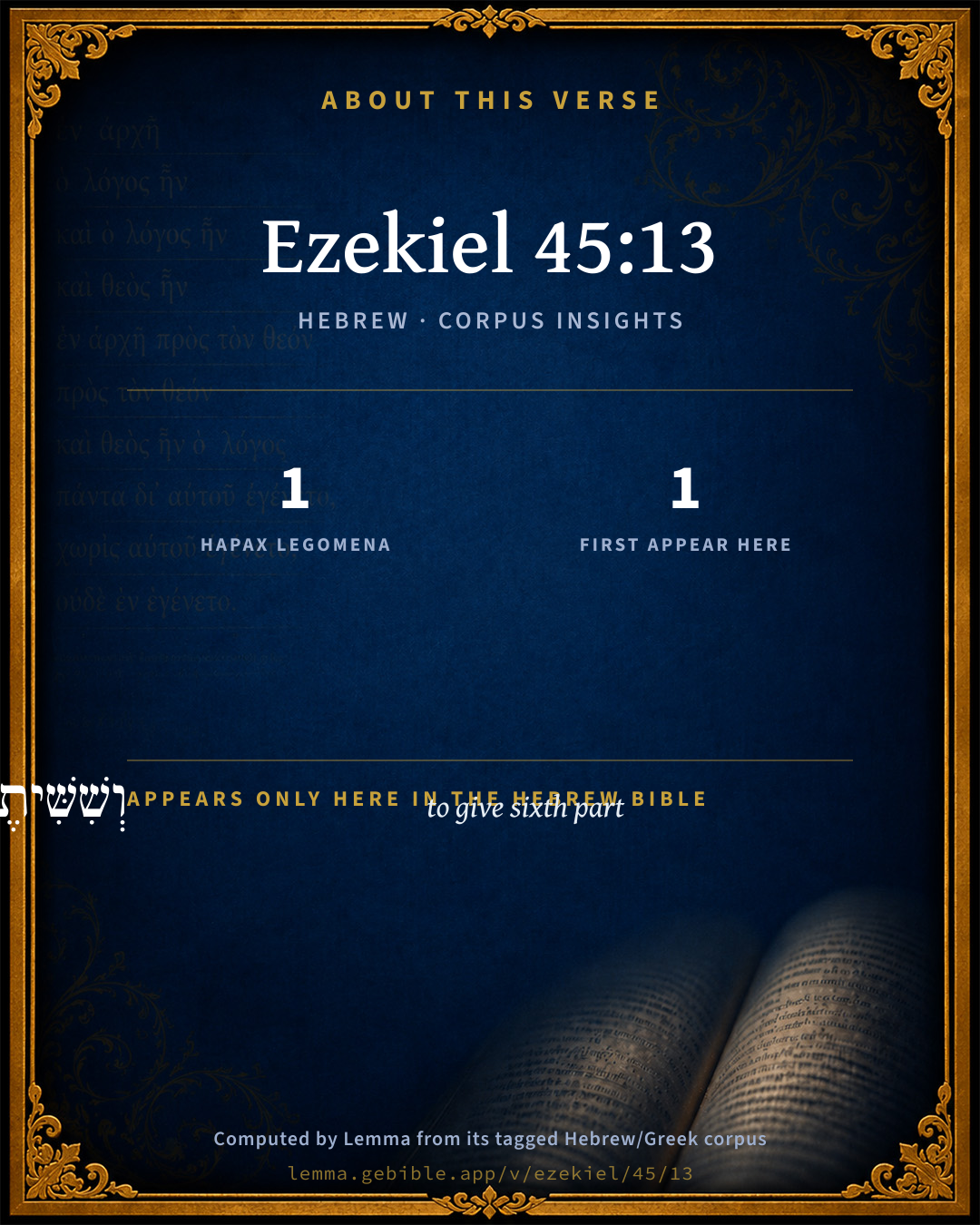
  • 1 hapax legomenon — only here in the Hebrew Bible
  • 1 first appearance in the Hebrew Bible
Full analysis ↓
Download a study sheet

One document with this verse’s original text, its word-by-word gloss line, the meaning frame, cross-references with their text, attributed commentary, and full source and license credits — printable, and it pastes into notes with its structure intact.

This verse Autodidact and up

Study sheet (.html) Plain text (.txt)

A passage Seminary Student

Up to 50 verses in one chapter. A passage sheet keeps up to 6 commentary sources and 12 cross-references per verse, in the order this page ranks them, and says so on the sheet whenever that leaves anything out. Ask for a single verse and you get the Autodidact verse sheet above.

Everything on this page stays free to read, with no account — the sheet is a download of what is already on screen, not access to it.

Want to remove ads? Support Godless Engineer
Compare translations 3

The same verse in 3 English versions, stacked beneath the original-language interlinear above. Click any original word for its lexicon entry.

Each is an independent rendering of the whole verse — the interlinear is not word-aligned to these translations.

Highlighted words mark where these versions differ — a whole-verse word diff, not a word-by-word alignment.

  • World English Bible Public Domain
    This is the offering that you shall offer: the sixth part of an ephah from a homer of wheat; and you shall give the sixth part of an ephah from a homer of barley;
  • King James Version Public Domain
    This is the oblation that ye shall offer; the sixth part of an ephah of an homer of wheat, and ye shall give the sixth part of an ephah of an homer of barley:
  • unfoldingWord Literal Text CC BY-SA 4.0
    This is the contribution that you must present: A sixth of an ephah for every homer of wheat, and you will give a sixth of an ephah for every homer of barley.

unfoldingWord Literal Text — © unfoldingWord, licensed CC BY-SA 4.0. Word-aligned USFM3 via Door43 (git.door43.org/unfoldingWord/en_ult).

Versions to compare (up to 4)

3 of 4 selected

Show all 18 translations

Every available English version of this verse, each an independent rendering of the whole verse.

  • World English Bible Public Domain
    This is the offering that you shall offer: the sixth part of an ephah from a homer of wheat; and you shall give the sixth part of an ephah from a homer of barley;
  • Berean Standard Bible Public Domain
    This is the contribution you are to offer: a sixth of an ephah from each homer of wheat, and a sixth of an ephah from each homer of barley.
  • Majority Standard Bible Public Domain
    This is the contribution you are to offer: a sixth of an ephah from each homer of wheat, and a sixth of an ephah from each homer of barley.
  • King James Version Public Domain
    This is the oblation that ye shall offer; the sixth part of an ephah of an homer of wheat, and ye shall give the sixth part of an ephah of an homer of barley:
  • American Standard Version (1901) Public Domain
    This is the oblation that ye shall offer: the sixth part of an ephah from a homer of wheat; and ye shall give the sixth part of an ephah from a homer of barley;
  • Revised Version (1885) Public Domain
    This is the oblation that ye shall offer; the sixth part of an ephah from an homer of wheat, and ye shall give the sixth part of an ephah from an homer of barley:
  • Geneva Bible (1599) Public Domain
    This is the oblation that ye shall offer, ye sixt part of an Ephah of an Homer of wheat, and ye shall giue the sixt part of an Ephah of an Homer of barley.
  • Douay-Rheims (1899) Public Domain
    And these are the firstfruits, which you shall take: the sixth part of an ephi of a core of wheat, and the sixth part of an ephi of a core of barley.
  • Young's Literal Translation Public Domain
    `This `is' the heave-offering that ye lift up; a sixth part of the ephah of a homer of wheat, also ye have given a sixth part of the ephah of a homer of barley,
  • Literal Standard Version CC BY-SA 4.0
    This [is] the raised-offering that you lift up; a sixth part of the ephah of a homer of wheat, also you have given a sixth part of the ephah of a homer of barley,
  • Unlocked Literal Bible CC BY-SA 4.0
    This is the contribution that you must present: A sixth of an ephah for every homer of wheat, and you will give a sixth of an ephah for every homer of barley.
  • unfoldingWord Literal Text CC BY-SA 4.0
    This is the contribution that you must present: A sixth of an ephah for every homer of wheat, and you will give a sixth of an ephah for every homer of barley.
  • Darby Bible Public Domain
    This is the heave-offering which ye shall offer: the sixth part of an ephah out of a homer of wheat, and ye shall give the sixth part of an ephah out of a homer of barley;
  • World Messianic Bible Public Domain
    “‘“This is the offering that you shall offer: the sixth part of an efah from a homer of wheat, and you shall give the sixth part of an efah from a homer of barley,
  • Webster's Bible Public Domain
    This is the oblation that ye shall offer; the sixth part of an ephah of a homer of wheat, and ye shall give the sixth part of an ephah of a homer of barley;
  • Free Bible Version CC BY-SA 4.0
    These are the taxes you are to contribute: one sixth of an ephah from every homer of wheat or barley.
  • Bible in Basic English Public Domain
    This is the offering you are to give: a sixth of an ephah out of a homer of wheat, and a sixth of an ephah out of a homer of barley;
  • JPS Tanakh (1917) Public Domain
    This is the offering that ye shall set apart: the sixth part of an ephah out of a homer of wheat, and ye shall give the sixth part of an ephah out of a homer of barley;

Literal Standard Version (2020), Covenant Press — licensed CC BY-SA 4.0. Text via the HelloAO Bible API (eBible.org). Unlocked Literal Bible (unfoldingWord) — licensed CC BY-SA 4.0. Text via the HelloAO Bible API (eBible.org). unfoldingWord Literal Text — © unfoldingWord, licensed CC BY-SA 4.0. Word-aligned USFM3 via Door43 (git.door43.org/unfoldingWord/en_ult). Free Bible Version, Dr. Jonathan Gallagher — licensed CC BY-SA 4.0. Text via the HelloAO Bible API (eBible.org).

Word by word

More ways to search: Search by grammar → Find every occurrence → Compare this word →

Practice this passage: Drill this verse → Learn its vocabulary →

וְשִׁשִּׁיתֶם֙
shâshâh
H8341
“and · to give sixth part”
Conjunction + Verb, Piel, Sequential Perfect, 2nd Person, Masculine, Plural
Part of Speech
Conjunction + Verb
Stem
Piel
Form
Sequential Perfect
Person
2nd Person
Gender
Masculine
Number
Plural
Full BDB Definition

Origin: a denominative from H8337

TWOT: 2336d

(Piel) to give the sixth part, give the sixth part of
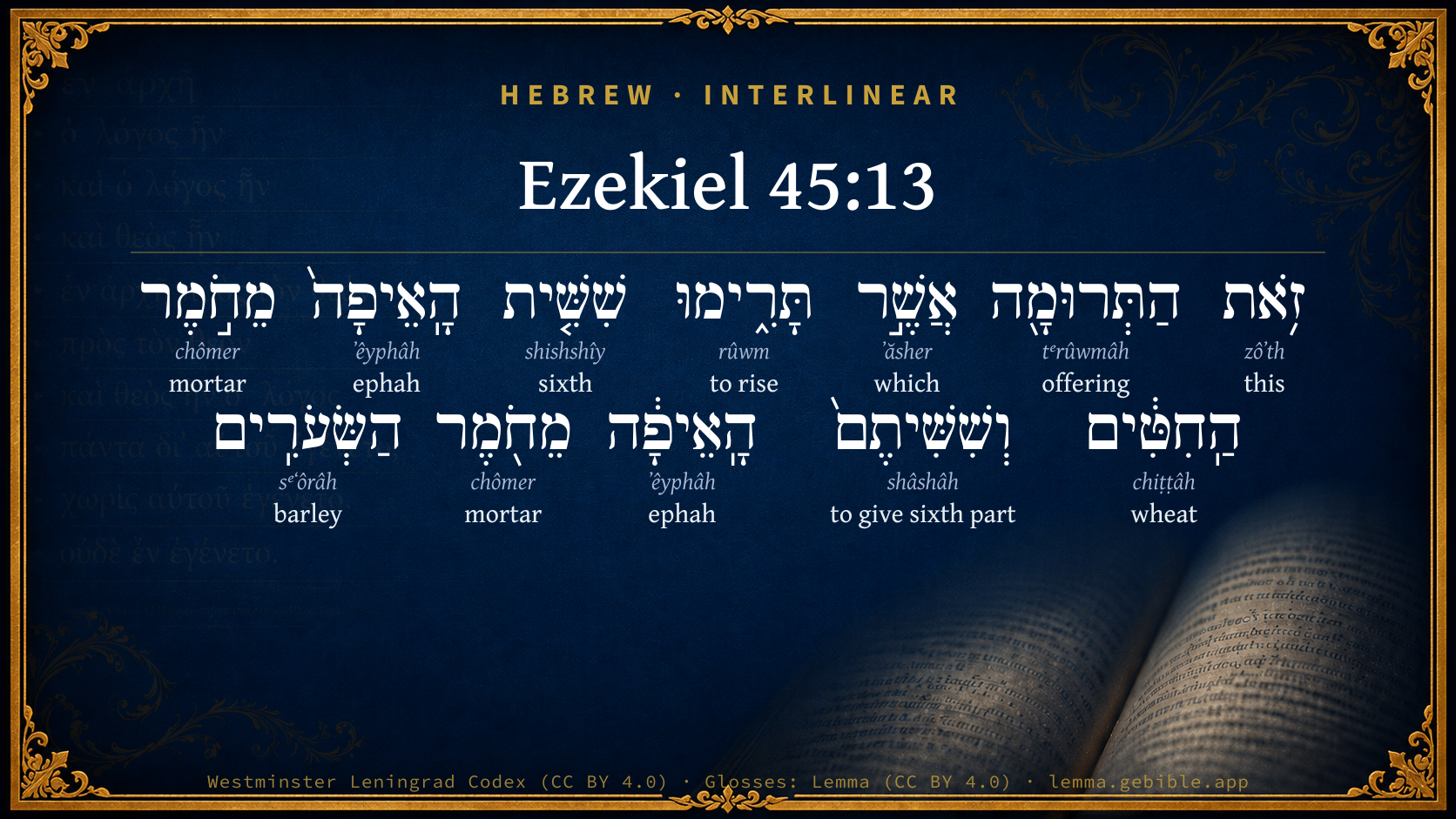
  1. זֹ֥את zôʼth H2063 “this” Pronoun, Demonstrative, Feminine, Singular
  2. הַתְּרוּמָ֖ה tᵉrûwmâh H8641 “the · offering” Particle, Definite Article + Noun, Common, Feminine, Singular, Absolute
  3. אֲשֶׁ֣ר ʼăsher H834 “which” Particle, Relative
  4. תָּרִ֑ימוּ rûwm H7311 “to rise” Verb, Hiphil, Imperfect, 2nd Person, Masculine, Plural
  5. שִׁשִּׁ֤ית shishshîy H8345 “sixth” Adjective, Ordinal number, Feminine, Singular, Construct
  6. הָֽאֵיפָה֙ ʼêyphâh H374 “the · ephah” Particle, Definite Article + Noun, Common, Feminine, Singular, Absolute
  7. מֵחֹ֣מֶר chômer H2563 “from · mortar of” Preposition + Noun, Common, Masculine, Singular, Construct
  8. הַֽחִטִּ֔ים chiṭṭâh H2406 “the · wheat” Particle, Definite Article + Noun, Common, Feminine, Plural, Absolute
  9. הָֽאֵיפָ֔ה ʼêyphâh H374 “the · ephah” Particle, Definite Article + Noun, Common, Feminine, Singular, Absolute
  10. מֵחֹ֖מֶר chômer H2563 “from · mortar of” Preposition + Noun, Common, Masculine, Singular, Construct
  11. הַשְּׂעֹרִֽים sᵉʻôrâh H8184 “the · barley” Particle, Definite Article + Noun, Common, Feminine, Plural, Absolute

About this verse

These counts appear in no published source. They are computed here, from the morphology-tagged text and Lemma’s own curated glosses. What Lemma adds →

12
words
10
distinct lemmas
Prophets
section

Notable vocabulary

1 hapax legomenon — a word that appears only here in the entire Hebrew Bible:

  • וְשִׁשִּׁיתֶם֙ to give sixth part H8341

First appearance in Scripture

This word makes its first canonical appearance in the Hebrew Bible here:

  • וְשִׁשִּׁיתֶם֙ to give sixth part H8341

Shared distinctive vocabulary

שִׁשִּׁ֤ית sixth H8345 occurs in 26 verses of the Hebrew Bible. Also found in:

Grammatical profile

  • 2 verbs
  • 7 nouns
  • 1 adjective
  • 1 pronoun
  • 1 particle

Verb forms

  • תָּרִ֑ימוּ Hiphil · Imperfect
  • וְשִׁשִּׁיתֶם֙ Piel · Sequential Perfect

Repetition

Words recur within this verse — often emphatic in Hebrew:

  • הָֽאֵיפָה֙ ephah H374 ×2
  • מֵחֹ֣מֶר mortar H2563 ×2

Hebrew & Septuagint length

In English translation the verse runs 34 words from the Hebrew and 34 from the Septuagint (LXX English) — the same length.

A rough comparison of the two English renderings, which tokenize alike — not a word-level alignment.

Word counts can differ between the Hebrew and the Greek without any difference in meaning — e.g. the Hebrew direct-object marker אֵת has no separate Greek word, and Greek often adds the article ὁ.

Hebrew and Greek witnesses Masoretic Hebrew ↔ Greek Septuagint

The same verse in the two great witnesses to the Old Testament, shown verse-for-verse.

These are two independent witnesses, not word-aligned to each other, and the Septuagint is shown in lemma (dictionary) form.

Hebrew Ezekiel 45:13 Masoretic · Westminster Leningrad Codex

זֹ֥את הַתְּרוּמָ֖ה אֲשֶׁ֣ר תָּרִ֑ימוּ שִׁשִּׁ֤ית הָֽאֵיפָה֙ מֵחֹ֣מֶר הַֽחִטִּ֔ים וְשִׁשִּׁיתֶם֙ הָֽאֵיפָ֔ה מֵחֹ֖מֶר הַשְּׂעֹרִֽים

This is the offering that you shall offer: the sixth part of an ephah from a homer of wheat; and you shall give the sixth part of an ephah from a homer of barley;

World English Bible · Public Domain

Greek LXX Ezekiel 45:13 Septuagint · lemma form

καί οὗτος ὁ ἀπαρχή ὅς ἀποὁρίζω ἕκτος ὁ μέτρον ἀπό ὁ γομορ ὁ πυρός καί ὁ ἕκτος ὁ οιφι ἀπό ὁ κόρος ὁ κριθή

And these are the first fruits which you⌃ shall offer; a sixth part of a homer of wheat, and the sixth part of it shall consist of an ephah of a core of barley.

LXX2012 (modern English Septuagint) · Public Domain

On this verse, Whedon's Commentary on the Bible discusses the Septuagint’s reading. Read the note in Commentary ↓

Hebrew: Westminster Leningrad Codex (CC BY 4.0). Greek: Septuagint (public domain); English from LXX2012 (modern English Septuagint) (Public Domain). How the Septuagint differs from the Hebrew →

Targum (Aramaic paraphrase)

1

The Targum is the ancient Jewish Aramaic paraphrase of the Hebrew Scriptures — an interpretive translation, not the Hebrew text itself. Onkelos (literal) and Pseudo-Jonathan (expansive) render the Torah, and Jonathan the Prophets. Coverage is partial: where no permissively-licensed English translation exists for a verse, only the Aramaic is shown. This is verse-level text, not a word-by-word alignment to the Hebrew.

  1. Targum Jonathan Prophets (Joshua–Malachi)
    דָא אַפְרָשׁוּתָא דְתִפְרְשׁוּן חַד מָן שִׁתָּא בִמְכִלְתָּא מִכּוֹר חִטִין וְחַד מִן שִׁתָּא בִמְכִלְתָּא מִכּוֹר סַעֲרִין:

    (no public-domain English translation for this verse)

    Targum Jonathan — Aramaic: “Mikraot Gedolot” (public domain). English: “Sefaria Community Translation” (CC0 1.0 (public-domain dedication)); “London "Chaldee Paraphrase," 1871” (public domain). Text via Sefaria.

Commentary

Notes on Ezekiel 45:13 from classic Christian and Jewish commentators (each source and its license shown beneath its notes). The classic Christian expositions comment on the surrounding passage and are grouped to its opening verse, so a note may address several verses; the Jewish commentaries on the Tanakh (Rashi and others) are per-verse, so they appear only where the commentator wrote on this verse.

Lemma curates 59 commentaries, every one of them public domain or Creative Commons licensed, each selected and text-cleaned for this edition rather than reprinted as found. About our sources →

Matthew Henry's Commentary

Having laid down the rules of the righteousness toward men, which is really a branch off true religion, he comes next to give some directions for their religion towards God, which is a branch of universal righteousness.

I. It is required that they offer an oblation to the Lord out of what they have (Eze 45:13): All the people of the land must give an oblation, Eze 45:16. As God's tenants, they must pay a quit-rent to their great landlord. They had offered an oblation out of their real estates (Eze 45:1), a holy portion of their land; now they are directed to offer an oblation out of their personal estates, their goods and chattels, as an acknowledgement of their receivings from him, their dependence on him, and their obligations to him. Note, Whatever our substance is we must honour God with it, by giving him his dues out of it. Not that God has need of or may be benefited by any thing that we can give him, Psa 50:9. No; it is but an oblation; we only offer it to him; the benefit of it returns back to ourselves, to his poor, who, as our neighbours, are ourselves, or to his ministers who serve continually for our good.

II. The proportion of this oblation is here determined, which was not done by the law of Moses. No mention is made of the title, but only of this oblation. And the quantum of this is thus settled: - 1. Out of their corn they were to offer a sixtieth part; out of every homer of wheat and barley, which contained ten ephahs, they were to offer the sixth part of one ephah, which was a sixtieth part of the whole, Eze 45:13. 2. Out of their oil (and probably their wine too) they were to offer a hundredth part, for this oblation; out of every cor, or homer, which contained ten baths they were to offer the tenth part of one bath, Eze 45:14. This was given to the altar; for in eery meat-offering there was flour mingled with oil. 3. Out of their flocks they were to give one lamb out of 200; that was the smallest proportion of all, Eze 45:15. But it must be out of the fat pastures of Israel. They must not offer to God that which was taken up from the common, but the fattest and best they had, for burnt-offerings and peace-offerings: the former were offered for the giving of glory to God, the latter for the fetching in of mercy, grace, and peace, from God, and in our spiritual sacrifices these are our two great errands at the throne of grace; but, in order to the acceptance of both, these sacrifices were to make reconciliation for them. Christ is our sacrifice of atonement, by whom reconciliation is made, and to him we must have an eye in our sacrifices of acknowledgment.

III. This oblation must be given for the prince in Israel, Eze 45:16. Some read it to the prince, and understand it of Christ, who is indeed the prince in Israel, to whom we must offer our oblations, and into whose hands we must put them, to be presented to the Father. Or, They shall give it with the prince; every private person shall bring his oblation, to be offered with that of the prince; for it follows (Eze 45:17). It shall be the prince's part to provide all the offerings, to make reconciliation for the house of Israel. The people were to bring their oblations to him according to the foregoing rules, and he was to bring them to the sanctuary, and to make up what fell short out of his own. Note, It is the duty of rulers to take care of religion, and to see that the duties of it be regularly and carefully performed by those under their charge, and that nothing be wanting that is requisite thereto: the magistrate is the keeper of both tables; and it is a happy thing when those that are above others in power and dignity go before them in the service of God.

IV. Some particular solemnities are here appointed.

1. Here is one in the beginning of the year, which seems to be altogether new, and not instituted by the law of Moses; it is the annual solemnity of cleansing the sanctuary. (1.) On the first day of the first month (upon new-year's day) they were to offer a sacrifice for the cleansing of the sanctuary (Eze 45:18), that is, to make atonement for the iniquity of the holy things the year past, that they might bring none of the guilt of them into the services of the new year, and to implore grace for the preventing of that iniquity, and for the better performance of the service of the sanctuary the ensuing year. And, in token of this, the blood of this sin-offering was to be put upon the posts of the gate of the inner court (Eze 45:19), to signify that by it atonement was intended to be made for the sins of all the servants that attended that house, priests, Levites, and people, even the sins that were found in all their services. Note, Even sanctuaries on earth need cleansing, frequent cleansing; that above needs none. Those what worship God together should often join in renewing their repentance for their manifold defects, and applying the blood of Christ for the pardon of them, and in renewing their covenants to be more careful for the future; and it is very seasonable to begin the year with this work, as Hezekiah did when it had been long neglected, Ch2 29:17. They were here appointed to cleanse the sanctuary upon the first day of the month, because on the fourteenth day of the month they were to eat the passover, an ordinance which, of all Old Testament institutions, had most in it of Christ and gospel grace, and therefore it was very fit that they should begin to prepare for it a fortnight before by cleansing the sanctuary. (2.) This sacrifice was to be repeated on the seventh day of the first month, Eze 45:20. And then it was intended to make atonement for every one that errs, and for him that is simple. Note, He that sins errs and is simple; he mistakes, he goes out of the way, and shows himself to be foolish and unwise. But here it is spoken of those sins which are committed through ignorance, mistake, or inadvertency, whether by any of the priests, or of the Levites, or of the people. Sacrifices were appointed to atone for such sins as men were surprised into, or did before they were aware, which they would not have done if they had known and remembered aright, which they were overtaken in, and for which, afterwards, they condemn themselves. But for presumptuous sins, committed with a high hand, there was no sacrifice appointed, Num 15:30. By these repeated sacrifices you shall reconcile the house, that is, God will be reconciled to it, and continue the tokens of his presence in it, and will let it alone this year also.

2. The passover was to be religiously observed at the time appointed, Eze 45:21. Christ is our passover, that is sacrificed for us. We celebrate the memorial of that sacrifice and feast upon it, triumphing in our deliverance out of the Egyptian slavery of sin and our preservation from the sword of the destroying angel, the sword of divine justice, in the Lord's supper, which is our passover-feast, as the whole Christian life is, and must be, the feast of unleavened bread. It is here appointed that the prince shall prepare a sin-offering, to be offered for himself and the people, a bullock on the first day (Eze 45:22) and a kid of the goats every other day (Eze 45:23), to teach us, in all our attendance upon God for communion with him, to have an eye to the great sin-offering, by which transgression was finished and an everlasting righteousness brought in. On every day of the feast there was to be a burnt-offering, purely for the honour of God, of no less than seven bullocks and seven rams, with their meat-offering, which were wholly consumed upon the altar, and yet no waste, Eze 45:23, Eze 45:24.

3. The feast of tabernacles; that is spoken of next (Eze 45:25), and there is no mention of the feast of pentecost, which came between that of the passover and that of tabernacles. Orders are here given (above what were given by the law of Moses) for the same sacrifices to be offered during the seven days of the passover. See the deficiency of the legal sacrifices for sin; they were therefore often repeated, not only every year, but every feast, every day of the feast, because they could not make the comers thereunto perfect, Heb 10:1, Heb 10:3. See the necessity of our frequently repeating the same religious exercises. Though the sacrifice of atonement is offered once for all, yet the sacrifices of acknowledgement, that of a broken heart, that of a thankful heart, those spiritual sacrifices which are acceptable to God through Christ Jesus, must be every day offered. We should, as here, fall into a method of holy duties, and keep to it.

Matthew Henry's Commentary on the Whole Bible (1708–1710) — public domain (CC PDM 1.0). Text via the HelloAO Bible API.

Ellicott's Commentary for English Readers

(13) The oblation.—Eze_45:13-16 provide for a regular tax to be paid to the prince, in order that he may be able to furnish the required offerings at the sanctuary. This, like the oblation of land (Eze_45:1), is described as a “heave offering,” and was the sixtieth part of the grain, the hundredth of the oil, and the two-hundredth of the flock, all being from the year’s increase.

A Bible Commentary for English Readers, edited by Charles John Ellicott (1878–1897) — public domain. Text from a community e-Sword module.

Trapp's Complete Commentary

John Trapp

Eze 45:13 This [is] the oblation that ye shall offer; the sixth part of an ephah of an homer of wheat, and ye shall give the sixth part of an ephah of an homer of barley:

Ver. 13. This is the oblation.] After order taken that both prince and people might have whereof to make oblations. {Eze 45:9-12} Here follow laws concerning these matters also.

John Trapp, A Commentary or Exposition upon All the Books of the Old and New Testament (1647–1656) — public domain. Text from a community e-Sword module.

Joseph Benson's Commentary

Eze 45:13-16. This is the oblation, &c. — The Hebrew word here translated oblation, distinguished from the first-fruits, (see note on Eze 45:1,) signifies the portion belonging to the Levites out of the fruits of the earth, when they were gathered in: see Eze 44:30. For which reason St. Jerome, upon the place, supposes the following words to express the proportion the people ought to pay the Levites out of the increase of their ground; which by their rabbins was determined to amount to at least a sixtieth part: after which separation a tenth part was to be paid out of the remainder. The portions allotted to the priests and Levites were not intended only for their own maintenance; but likewise to make a constant provision for those sacrifices, both ordinary and extraordinary, which were appointed by the law: see Mal 3:10. And one lamb out of the flock, out of two hundred — This offering is enjoined, besides the setting apart the firstborn for the use of the priests and Levites, for making provision for the daily burnt-offering, Num 28:3, and for burnt-offerings and peace-offerings, or sacrifices of thanksgiving, that were to be made upon proper occasions. Out of the fat pastures of Israel — This implies that these lambs were to be the best and fattest of their kind, as all other tithes and things dedicated to God were to be. To make reconciliation for them — This effect is ascribed to burnt-offerings, as well as to those which were properly sacrificed for sin. All the people, &c., shall give this oblation for the prince — Or, with the prince; that is, the people shall join with the prince in making these oblations; whereas those that follow in the next verse are to be at the sole charge of the prince.

Joseph Benson's Commentary on the Old and New Testaments (1811–1818) — public domain. Text from a community e-Sword module.

Whedon's Commentary on the Bible

Daniel D. Whedon

13-17. The people are to pay the prince 1/60 of their wheat and barley crop (Eze_45:13), 1/100 of their oil (the cor being equal to the homer, which contained ten baths, Eze_45:11), and 1/200 of their lambs. The prince from these gifts furnishes the sacrificial offerings of the temple, “to make atonement for the house of Israel” (Eze_45:17). For “of a homer” (Eze_45:13) read, “out of.” For “the fat pastures” (Eze_45:15) LXX. reads, “out of all the families of Israel.”

Daniel D. Whedon (gen. ed.), Commentary on the Old and New Testaments (1874–1909) — public domain. Text from a community e-Sword module.

Tyndale Open Study Notes

Tyndale Open Resources

45:13-17 The people were to provide for the regular daily offerings that will make atonement at the new Temple by means of a tax paid to the prince. The prince was to provide all of the offerings for special occasions, such as the religious festivals, the new moon celebrations, and the Sabbath days. Both the regular daily offerings and the special festival offerings functioned to purify the people of Israel, making them right with the Lord.

Tyndale Open Study Notes — © Tyndale Open Resources, licensed CC BY-SA 4.0. Text via the HelloAO Bible API.

Jamieson, Fausset & Brown

Robert Jamieson, A. R. Fausset & David Brown

In these oblations there is a progression as to the relation between the kind and the quantity: of the corn, the sixth of a tenth, that is, a sixtieth part of the quantity specified; of the oil, the tenth of a tenth, that is, an hundredth part; and of the flock, one from every two hundred.

Jamieson, Fausset & Brown — Commentary Critical and Explanatory on the Whole Bible (1871) — public domain (CC PDM 1.0). Text via the HelloAO Bible API.

The Cambridge Bible for Schools and Colleges

gen. ed. J. J. S. Perowne

13. oblation … offer] The people are addressed. The due which they shall pay the prince is one sixtieth in grain. For, of an homer, rather: out of an homer.

The Cambridge Bible for Schools and Colleges (gen. ed. J. J. S. Perowne; Cambridge University Press, 1878–1918) — public domain. Text from a community e-Sword module.

John Gill's Exposition

This is the oblation that ye shall offer,.... Not at the dedication of the temple, to be built in time to come, as Kimchi thinks; nor for the daily sacrifices, as others; but for the maintenance of the priests, that is, the ministers of the Gospel; for here begin the rules for the right ordering of ecclesiastical affairs of those times:

the sixth part of an ephah of an homer of wheat, and ye shall give the sixth part of an ephah of an homer of barley: this confirms that an "ephah" was for dry measure, of wheat and barley; and as it was the tenth part of an homer, a sixtieth part of an homer of wheat and barley was to be given for this service; that is, if a man had an homer of wheat or of barley, he was to give a sixtieth part of it for the use of the ministers of the Lord: the meaning is, that the people should give freely and liberally, according to their substance, for their support and maintenance,

John Gill's Exposition of the Whole Bible (1746–1763) — public domain (CC PDM 1.0). Text via the HelloAO Bible API.

Albert Barnes' Notes on the Bible

The offerings. to be made by the people through the prince for the service of the sanctuary. In the Mosaic Law the offerings for the sacrifices of the ordinary festivals were left to the free will of the people. Here they are reduced to regular order and the amounts ordained. In later days there were often shortcomings in these respects Mal 3:8. This is obviated, and regularity ensured in the new order of things. No mention is made of wine for the drink-offering, or of bullocks for the burnt-offering, so that the enumeration is not complete.

Eze 45:14

Cor - Translated “measure” in 1Ki 5:11, ... Here it is a synonym of “homer.”

Eze 45:17

The people’s gifts were to be placed in the hands of the prince, so as to form a common stock, out of which the prince was to provide what was necessary for each sacrifice. Compare 1Ki 8:62; Ezr 7:17. The prince handed the gifts to the priests, whose part it was to sacrifice and offer. But the prominent part assigned to the prince in “making reconciliation for the sins of the people” seems to typify the union of the kingly and priestly offices in the person of the Mediator of the New covenant.

Albert Barnes' Notes on the Bible (1834–1885) — public domain. Text from a community e-Sword/MySword module.

Haydock's Catholic Bible Commentary

Take, for the prince’s revenue. He had the sixtieth part of corn and of oil; or rather (Calmet) he had an exact tithe of the latter, ver. 14. (Chaldean) (Menochius)

George Leo Haydock (1774–1849), Haydock's Catholic Family Bible and Commentary, 1859 edition — public domain. Excludes Psalms (Douay-Rheims chapter numbering differs from Protestant) and Deuterocanonical books (Catholic canon only).

Matthew Poole's English Annotations

In the daily service, the morning and evening sacrifice, there must be wheat and barley flour.

Sixth part of an ephah; sixtieth part of an homer, about one half bushel, and one peck, and one quarter of a peck, and three pints, or near it; so some. Others abate the odd measures, and say the ephah was about our half bushel, as indeed it can be no more; if the homer were thirty bushels, the ephah a tenth part of the homer, that is, three bushels, the sixth part of the ephah amounts to four gallons, or half a bushel.

Matthew Poole's English Annotations on the Holy Bible (1683–1685) — public domain. Text from a community e-Sword/MySword module.

The Pulpit Commentary

Vers. 13-15 The offerings the people" should present are next specified.

(1) Of wheat, the sixth part of an ophah of (out, of, or from) a homer; i.e. the sixtieth part of a homer, equal to about one-tenth of a bushel (ver. 13).

(2) Of barley, the same (ver. 13).

(3) Of oil, a tenth part of a bath out of the cor, or homer of ten Baths, i.e. the hundredth part of every homer, equal to a little more than half a gallon (ver. 14).

(4) Of the flock, one lamb or kid (hc, meaning either) out of the flock, out of two hundred, out of the fat or well-watered. (see Gen_13:10) pastures of Israel, i.e. one of every two hundred, and never the worst, but always the best. These oblations should be made for the maintenance of the necessary sacrificial worship in the new temple, for the meal, burnt, and peace or thank offerings that should there be presented to make reconciliation or atonement for the house of Israel.

Compared with the offerings prescribed by the Law of Moses, these discover important variations.

1. Of flour, the Law demanded one-tenth of an ephah of fine flour, (Exo_29:40) with a ram two-tenths, (Num_15:6) with a bullock three-tenths; (Num_15:9) of wheat and of barley Ezekiel"s Torah re quires one-sixteenth of an ephah for each, i.e. one-third in all.

2. Of oil, the Mosaic ordinance was, with a lamb should be presented one-fourth of a bin, i.e. one-twenty-fourth of a bath; with a ram, one-third of a bin, i.e. one-eighteenth of a bath; with a bullock one-half of a hin, i.e. one-twelfth of a bath. Ezekiel"s ordinance was in every case one-tenth of a bath.

3 Of animals, the Pentateuchal legislation left the necessary victims, whether rams, goats, or bullocks, to be provided by the offerers at their own free-will, stipulating as compulsory only the firstborn of the flocks and (Exo_13:2, 12 22:29, 30; Lev_27:26; Num_3:13 Num_8:17; Deu_15:19) the first ripe fruits of the earth (Exo_22:29; Num_18:12) and the tithes, or tenths, of seed, fruit, the herd and flock; (Lev_27:30-33) the Ezekelian omits the latter, but ordains in lieu of the former that one animal out of every two hundred in every flock shall be obligatory on Jehovah"s worshippers. Thus the demands of Ezekiel"s Torah surpass those of the earlier or Mosaic Torah in quantity as well as quality. That these demands are definitely specified does not prove they should partake rather of the nature of a tax than of a free-will offering. That they were not to be regarded as taxes is shown by the absence of any allusion to penalties for neglect of payment; that they were designed to be looked upon as free-will offerings is plain from the circumstance that Jehovah never supposes for a moment that these generous offerings will be withheld; and perhaps all that is really signified by them is that the liberality of Jehovah"s people in the future age should greatly exceed that which had been practiced at any former time.

Vers. 13-15Systematic giving.

Very elaborate regulations were drawn up to determine the several proportionate gifts of various kinds which were to be made by the Israelites. These regulations were after the manner of the times, and in accordance with the spirit of the Jewish Law. A larger freedom appertains to the Christian era, and we are not now required to make our offerings according to any definite proportion fixed for us by authority. But we are not therefore to conclude that there is to be no system or method in our giving for Christian or charitable objects. We are left to make our own system. No one is to say what his brother should do. But each is responsible to his Master to do what he feels to be right. Thus St. Paul says, "Let every one of you lay by him in store as God hath prospered him". (1Co_16:2)

I SYSTEMATIC GIVING IS LESS DIFFICULT THAN IRREGULAR GIVING. People who live up to if not beyond their incomes find it impossible to spare any considerable amount for objects outside the range of their private expenses. But if the money to be contributed for such objects were set aside from the first, it would be forthcoming, just as the rent money is forthcoming. Christ"s portion is his due, and provision should certainly be made for this, whatever may remain over for other objects. That can be done by a man setting aside a portion of his income as sacred for his Master"s use.

II SYSTEMATIC GIVING IS GENEROUS GIVING. People who give without method or consideration rarely know how little they give. There are pitiable creatures, who feel as though they were being bled every time a coin is extracted from them for some good object. They remember the disagreeable operation long after, and it makes so deep an impression on them that, when it comes to be repeated, they imagine that they are always giving. If they were always giving this would be no hard thing; for are they not always receiving? But if these people deliberately considered the claims of the best objects, and then determined to assign a portion of their income to meet those claims, they could not put down the miserable sum their contributions now amount to, unless they were devoid of all Christian principle.

III SYSTEMATIC GIVING SHOULD BE WISE GIVING. Spasmodic charity may be very generous, but it is likely to be foolish and misdirected. A more thoughtful method would lead to a more just apportioning of the funds that are contributed. It is not right that the cause of Christ should depend on irregular gushes of liberality. There may be less scope for sentiment in a methodical manner of giving, but there will be more practical utility.

IV SYSTEMATIC GIVING WILL BECOME HURTFUL IF IT IS TREATED IN A WRONG SPIRIT. One danger is that it should degenerate into a mechanical routine, like the payment of taxes. Then all heart and soul will vanish out of it. Another danger is that it may generate ostentatiousness, since the left hand may know too well what the right hand does. A third danger is that this system of giving may harden the heart in regard to new claims. The systematic giver often fortifies himself against the most pathetic appeals by the reply that he has reached the end of his charitable fund. Such an answer is unworthy of one who has a Christian heart of sympathy. The remedy is to be found in regarding the fixed amount to be given as a minimum, never as a maximum.

Vers. 13-15Religion a practical thing.

In the infancy of the world outward symbol was more needed for the religious instruction of men than it is today. In the sacred ceremonies of the temple every man had a part to take. Religious truth can better be impressed upon the mind when outward action accompanies inward sentiment. Religion requires the loyalty and service of the entire man; and if convictions of religious duty can be wrought into the soul, it is cheaply purchased by the devotement of our wealth to God. No cost is too great by which we can gain adequate appreciation of our indebtedness to God. God"s requirements and our advantage are identical; they are interwoven like light and heat in solar rays.

I RELIGION EMBRACES MANY ELEMENTS. There were required "meat offerings, and burnt offerings, and peace offerings." Each of these had a distinct meaning, and represented a distinct need of man. In true religion there enters the sentiment of reverential homage, gratitude for gifts received, acknowledgment of transgression, application for larger blessing, vows of fresh service, intercession on behalf of others. Offerings for ourselves, for our household, for the nation, are suitable; and in desiring the good of others, our benevolent nature expands, we get a larger good ourselves. The expansion of the soul is real gain.

II RELIGIOUS WORSHIP IS BEST EXPRESSED BY PERSONAL OFFERINGS. Wheat, barley, lambs, heifers, oil, were to be the staple of the people"s offerings. It is of the first importance that men should feel that God is the Creator and Giver of all good. We are absolutely dependent on his bounty. To live in the hourly realization of this dependence is blessing unspeakable. Nor can any arrangement better promote this end than the regular offering of such things as God has conferred. We owe to him our all, our whole being, our entire possessions. But he graciously accepts a part as acknowledged tribute, and gives in return a substantial blessing upon the remainder. Best of all, he uses our gift as a channel through which to pour new blessing and joy into our own souls. Our spontaneous offerings foster the growth of faith and love and spiritual aspiration. "It is more blessed to give than to receive.

III RELIGIOUS OFFERINGS SHOULD BE PROPORTIONAL TO OUR PROSPERITY. The man that supposes God to be an austere Taskmaster is a precipitant blunderer. He has grossly missed the truth. God does not require gigantic offerings. He requires gifts simply proportionate to our possessions. The gift of ten thousand pounds may be in the balance of righteousness only a paltry and selfish deed. The giver may be seeking only self-interests or human fame. The gift of a farthing may win the smile of Jehovah. The magnitude of our offering is measured by the motive that prompts it, the end sought, and the residue that remains. According to this spiritual calculation, the woman who gave all she had gave transcendently more than the rich donors of golden shekels. The offering of our heart"s warm love is the noblest tribute which God appreciates, and unless our gifts are the outflow and manifestation of our love, they are rejected as worthless, they are like smoke in one"s eyes. "That which is highly esteemed among men is often an abomination in the sight of God.

IV FIDELITY TO GOD BRINGS THE LARGEST BENEFITS TO MEN. The end of such offerings among the Jews was "to make reconciliation for them, saith the Lord God." Yet we shall grossly err if we look upon this as a commercial bargain. Reconciliation with God cannot be purchased with gold, or tithes, or animal sacrifices. Reconciliation is the outcome of God"s grace; but to bestow it upon rebellious men indiscriminately would be a waste and a crime. The grace that has originated reconciliation must prepare men"s hearts to possess it. This omnipotent kindness of God moves the sinner"s heart to repentance. His desire for God"s friendship expresses itself in prayer and in substantial offerings. To obtain such a heavenly boon he is willing to make any sacrifice. Such good does his conscience perceive to dwell in God"s favor that obedience to his will is a delight, a very luxury to the soul. As a child finds a delicious joy in pleasing its parent, and runs cheerfully to do that parent"s will, so the repentant man loyally responds to God"s commands, and at the altar of sacrifice implores to be reconciled. To have God as his Friend is his supreme desire, his supreme good. "In his favor is life, his loving-kindness is better than life. D.

The Pulpit Commentary (1880–1919), ed. H.D.M. Spence-Jones & Joseph S. Exell — public domain. Text from a community e-Sword module.

John Wesley's Explanatory Notes

Offer - In the daily service, the morning and evening sacrifice.

John Wesley, Explanatory Notes Upon the Whole Bible (1754–1765) — public domain. Text via the GEBible commentary corpus.

unfoldingWord translationNotes

Door43 World Missions Community

General Information:

Yahweh continues giving Ezekiel his message to the princes of Israel.

for every homer of wheat

It is implied that this is the amount of wheat that the people harvest. AT: "for every homer of wheat from the harvest" (See: Assumed Knowledge and Implicit Information)

The regulation offering of oil will be a tenth of a bath

"You must offer one tenth of a bath of oil"

the watered regions of Israel

"the parts of Israel that get a good amount of water"

will be used for

This can be translated in active form. AT: "you will use for" (See: Active or Passive)

translationWords

wheat

oil

ewe

goat

flocks

burnt offering

peace offering

atonement

Lord Yahweh

unfoldingWord translationNotes — © Distant Shores Media and the Door43 World Missions Community, licensed CC BY-SA 4.0. Source: git.door43.org/Door43/en_tn.

Rashi

Rabbi Shlomo Yitzchaki (Rashi)

a sixth of an ephah from a homer of wheat This amounts to one out of sixty. Whoever wishes to give little shall not give less than this, and this is what they said (Ter. 4:3): “A stingy person gives one out of sixty.”

and you shall separate a sixth And you shall separate a sixth of an “ephah” for the “terumah” of a “homer” of barley.

Rashi on the Tanakh — English translations: “The Judaica Press complete Tanach with Rashi, translated by A. J. Rosenberg” (CC BY 4.0); “Pentateuch with Rashi's commentary by M. Rosenbaum and A.M. Silbermann, 1929-1934” (public domain); “The Metsudah Tanach series, Lakewood, N.J” (CC BY 4.0); and “The Book of Joshua, Metsudah Publications, 1997” (CC BY 4.0). Text via Sefaria.

Lesson kit

Teaching starters — assembled from the data on this page, not authored interpretation. Every prompt links to the verse data it draws on. Edit before teaching.

Ezekiel, in the Prophets, opens this verse with 12 words (10 distinct Hebrew lemmas). Its most distinctive word is shâshâh (“to give sixth part”). A historical commentator’s framing appears above. Read the whole chapter for the surrounding context.

Discussion questions

  1. What does “to give sixth part” (shâshâh) contribute to the verse as a whole?
  2. This verse holds 1 word here found nowhere else in the Hebrew Bible. What might the rare word draw attention to?
  3. The word “to give sixth part” first appears here in Scripture. What is being introduced at this debut?
  4. Genesis 1:31 shares the word «sixth» with this verse. How do the two illuminate each other?
  5. “ephah” occurs 2× in this one verse. What is the effect of the repetition?
  6. These translations render this verse differently; the difference is in the English rendering, not the original. What questions does that raise?
  7. The verb «תָּרִ֑ימוּ» is Hiphil Imperfect. How does its form color the action?
  8. Reading how Matthew Henry's Commentary and Ellicott's Commentary for English Readers read this verse, where do the two commentators agree and where do they part?

Things to notice

  • 1 word in this verse appears nowhere else in the Hebrew Bible.
  • 1 word makes its first canonical appearance in Scripture here.
  • These translations choose different wording for 11 words in this verse.
  • “ephah” occurs 2× in this single verse.
  • 10 distinct Hebrew lemmas span 12 words in this verse.

Reading settings

Reading text

Shown beneath each verse's original-language words.

Old Testament
Old Testament edition

Read the OT as the Masoretic Hebrew (MT) or the Greek Septuagint (LXX).

English shown for the Greek Septuagint (in the Hebrew ↔ Greek comparison).

Comparing translations? Open the Compare panel on any verse page to stack up to four side by side.