
Psalms 78:69

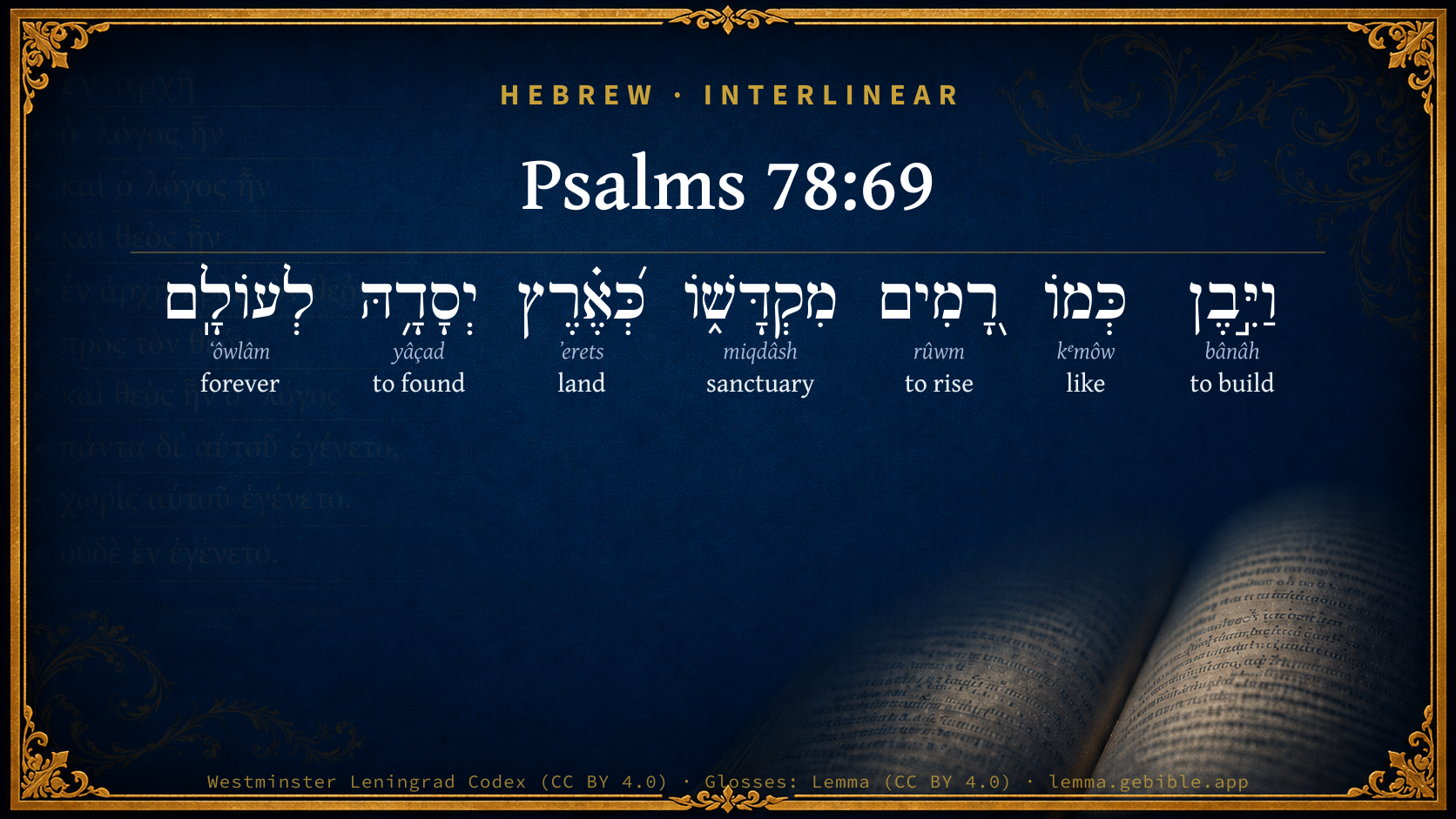
Hebrew (Westminster Leningrad Codex) Psalms 78:69 appears in the Hebrew Old Testament. The text above is from the Westminster Leningrad Codex. Each word links to its Strong’s number, a concise gloss, and parsing drawn from the Open Scriptures Hebrew Bible morphology. Click any word for its full Brown-Driver-Briggs (BDB) entry.
Download image
Cite this verse

Psalms 78:69 (World English Bible). Public Domain. Lemma interlinear Bible study tool, https://lemma.gebible.app/v/psalms/78/69.

Show BibTeX & RIS
BibTeX
RIS
English Translation
He built his sanctuary like the heights, Like the earth which he has established forever.
World English Bible · Public Domain
Download a study sheet

One document with this verse’s original text, its word-by-word gloss line, the meaning frame, cross-references with their text, attributed commentary, and full source and license credits — printable, and it pastes into notes with its structure intact.

This verse Autodidact and up

Study sheet (.html) Plain text (.txt)

A passage Seminary Student

Up to 50 verses in one chapter. A passage sheet keeps up to 6 commentary sources and 12 cross-references per verse, in the order this page ranks them, and says so on the sheet whenever that leaves anything out. Ask for a single verse and you get the Autodidact verse sheet above.

Everything on this page stays free to read, with no account — the sheet is a download of what is already on screen, not access to it.

Want to remove ads? Support Godless Engineer
Compare translations 3

The same verse in 3 English versions, stacked beneath the original-language interlinear above. Click any original word for its lexicon entry.

Each is an independent rendering of the whole verse — the interlinear is not word-aligned to these translations.

Highlighted words mark where these versions differ — a whole-verse word diff, not a word-by-word alignment.

  • World English Bible Public Domain
    He built his sanctuary like the heights, Like the earth which he has established forever.
  • King James Version Public Domain
    And he built his sanctuary like high palaces, like the earth which he hath established for ever.
  • unfoldingWord Literal Text CC BY-SA 4.0
    And he built his sanctuary like the heights, like the earth he founded it forever.

unfoldingWord Literal Text — © unfoldingWord, licensed CC BY-SA 4.0. Word-aligned USFM3 via Door43 (git.door43.org/unfoldingWord/en_ult).

Versions to compare (up to 4)

3 of 4 selected

Show all 18 translations

Every available English version of this verse, each an independent rendering of the whole verse.

  • World English Bible Public Domain
    He built his sanctuary like the heights, Like the earth which he has established forever.
  • Berean Standard Bible Public Domain
    He built His sanctuary like the heights, like the earth He has established forever.
  • Majority Standard Bible Public Domain
    He built His sanctuary like the heights, like the earth He has established forever.
  • King James Version Public Domain
    And he built his sanctuary like high palaces, like the earth which he hath established for ever.
  • American Standard Version (1901) Public Domain
    And he built his sanctuary like the heights, Like the earth which he hath established for ever.
  • Revised Version (1885) Public Domain
    And he built his sanctuary like the heights, like the earth which he hath established for ever.
  • Geneva Bible (1599) Public Domain
    And he built his Sanctuarie as an high palace, like the earth, which he stablished for euer.
  • Douay-Rheims (1899) Public Domain
    And he built his sanctuary as of unicorns, in the land which he founded for ever.
  • Young's Literal Translation Public Domain
    And buildeth His sanctuary as a high place, Like the earth, He founded it to the age.
  • Literal Standard Version CC BY-SA 4.0
    And builds His sanctuary as a high place, || Like the earth, He founded it for all time.
  • Unlocked Literal Bible CC BY-SA 4.0
    He built his sanctuary like the heavens, like the earth that he has established forever.
  • unfoldingWord Literal Text CC BY-SA 4.0
    And he built his sanctuary like the heights, like the earth he founded it forever.
  • Darby Bible Public Domain
    And he built his sanctuary like the heights, like the earth which he hath founded for ever.
  • World Messianic Bible Public Domain
    He built his sanctuary like the heights, like the earth which he has established forever.
  • Webster's Bible Public Domain
    And he built his sanctuary like high palaces, like the earth which he hath established for ever.
  • Free Bible Version CC BY-SA 4.0
    There he built his sanctuary, high like the heavens, on earth that he made to last forever.
  • Bible in Basic English Public Domain
    And he made his holy place like the high heaven, like the earth which is fixed by him for ever.
  • JPS Tanakh (1917) Public Domain
    And He built His sanctuary like the heights, like the earth which He hath founded for ever.

Literal Standard Version (2020), Covenant Press — licensed CC BY-SA 4.0. Text via the HelloAO Bible API (eBible.org). Unlocked Literal Bible (unfoldingWord) — licensed CC BY-SA 4.0. Text via the HelloAO Bible API (eBible.org). unfoldingWord Literal Text — © unfoldingWord, licensed CC BY-SA 4.0. Word-aligned USFM3 via Door43 (git.door43.org/unfoldingWord/en_ult). Free Bible Version, Dr. Jonathan Gallagher — licensed CC BY-SA 4.0. Text via the HelloAO Bible API (eBible.org).

Word by word

More ways to search: Search by grammar → Find every occurrence → Compare this word →

Practice this passage: Drill this verse → Learn its vocabulary →

יְסָדָ֥הּ
yâçad
H3245
“to found · her”
Verb, Qal, Perfect, 3rd Person, Masculine, Singular + Suffix, Personal, 3rd Person, Feminine, Singular
Part of Speech
Verb
Stem
Qal
Form
Perfect
Person
3rd Person
Gender
Masculine
Number
Singular
Full BDB Definition

Origin: a primitive root

TWOT: 875

to found, fix, establish, lay foundation - (Qal) to found, establish, begin - (Niphal) - to fix or seat themselves close together, sit in conclave - to be founded - (Piel) - to found - to establish, appoint, ordain - (Pual) to be founded, be laid - (Hophal) to be founded
  1. וַיִּ֣בֶן bânâh H1129 “and · to build” Conjunction + Verb, Qal, Sequential Imperfect, 3rd Person, Masculine, Singular
  2. כְּמוֹ kᵉmôw H3644 “like” Preposition
  3. רָ֭מִים rûwm H7311 “rising” Verb, Qal, Participle Active, Masculine, Plural, Absolute
  4. מִקְדָּשׁ֑וֹ miqdâsh H4720 “sanctuary · his” Noun, Common, Masculine, Singular, Construct + Suffix, Personal, 3rd Person, Masculine, Singular
  5. כְּ֝אֶ֗רֶץ ʼerets H776 “like/as · land” Preposition + Noun, Common, Both, Singular, Absolute
  6. לְעוֹלָֽם ʻôwlâm H5769 “to/for · forever” Preposition + Noun, Common, Masculine, Singular, Absolute

About this verse

These counts appear in no published source. They are computed here, from the morphology-tagged text and Lemma’s own curated glosses. What Lemma adds →

7
words
7
distinct lemmas
Wisdom
section

Shared distinctive vocabulary

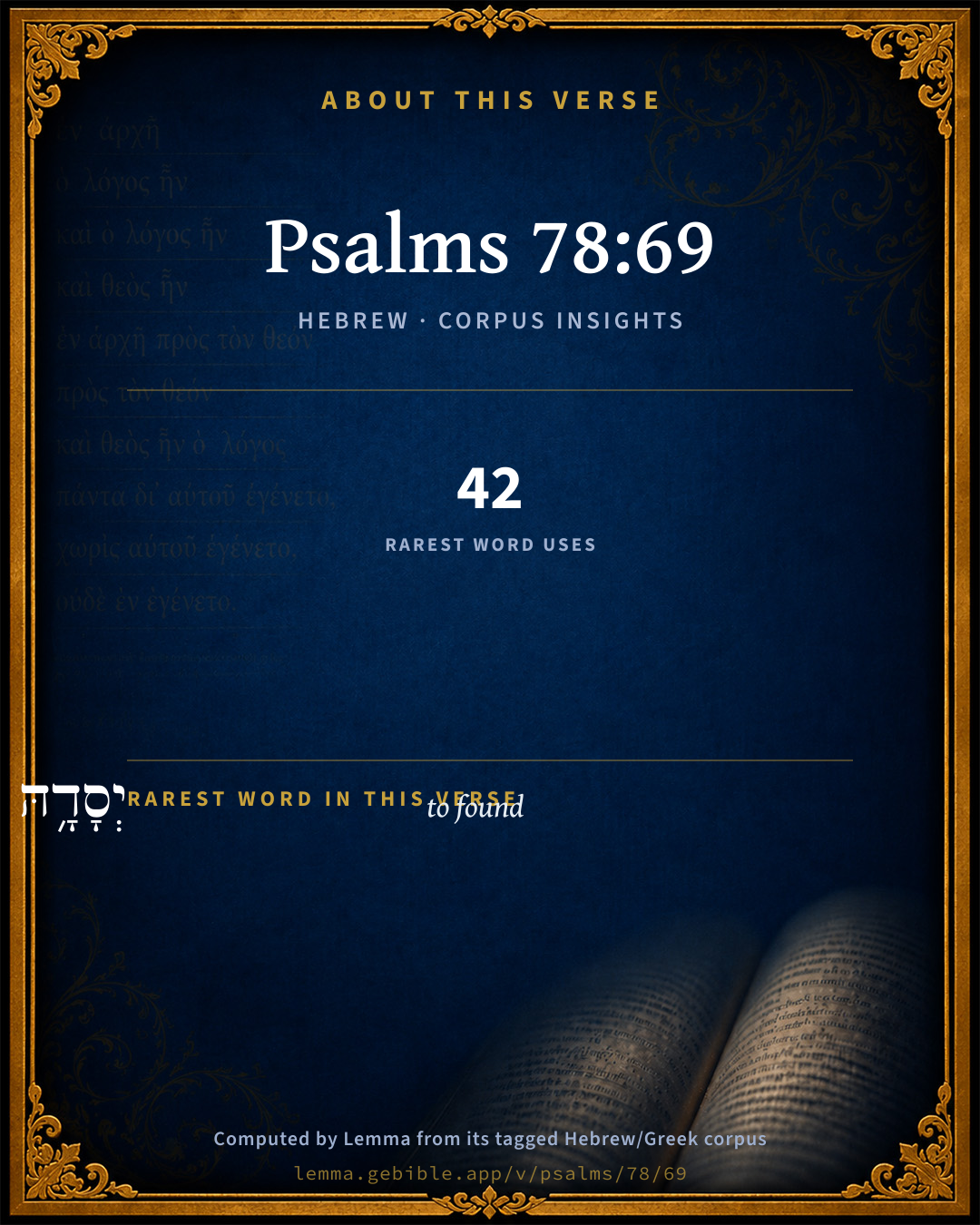
יְסָדָ֥הּ to found H3245 occurs in 41 verses of the Hebrew Bible. Also found in:

Grammatical profile

  • 3 verbs
  • 3 nouns
  • 1 preposition

Verb forms

  • וַיִּ֣בֶן Qal · Sequential Imperfect
  • רָ֭מִים Qal · Participle Active
  • יְסָדָ֥הּ Qal · Perfect

Hebrew & Septuagint length

In English translation the verse runs 15 words from the Hebrew and 18 from the Septuagint (LXX English) — closely comparable.

A rough comparison of the two English renderings, which tokenize alike — not a word-level alignment.

Word counts can differ between the Hebrew and the Greek without any difference in meaning — e.g. the Hebrew direct-object marker אֵת has no separate Greek word, and Greek often adds the article ὁ.

Cross-references

15

Topical passages linked to Psalms 78:69 in the Treasury of Scripture Knowledge — connected by theme and wording, ordered by reader-vote popularity; previews shown in the World English Bible.

  • Isaiah 51:6 Lift up your eyes to the heavens, and look on the earth beneath; for the heavens shall vanish away like smoke, and the earth shall wax old like a garment; and those who dwell therein shall die in like manner: but my salvation shall be forever, and my righteousness shall not be abolished.
  • 1 Samuel 2:8 He raises up the poor out of the dust, He lifts up the needy from the dunghill, To make them sit with princes, Inherit the throne of glory: For the pillars of the earth are Yahweh's, He has set the world on them.
  • 1 Kings 6:1–38 It happened in the four hundred and eightieth year after the children of Israel were come out of the land of Egypt, in the fourth year of Solomon's reign over Israel, in the month Ziv, which is the second month, that he began to build the house of Yahweh.
  • 1 Kings 9:8 Though this house is so high, yet shall everyone who passes by it be astonished, and shall hiss; and they shall say, Why has Yahweh done thus to this land, and to this house?
  • 1 Chronicles 29:1 David the king said to all the assembly, Solomon my son, whom alone God has chosen, is yet young and tender, and the work is great; for the palace is not for man, but for Yahweh God.
  • 1 Chronicles 29:19 and give to Solomon my son a perfect heart, to keep your commandments, your testimonies, and your statutes, and to do all these things, and to build the palace, for which I have made provision.
  • 2 Chronicles 2:9 even to prepare me timber in abundance; for the house which I am about to build shall be great and wonderful.
  • 2 Chronicles 3:4 The porch that was before [the house], the length of it, according to the breadth of the house, was twenty cubits, and the height one hundred twenty; and he overlaid it within with pure gold.
  • Job 26:7 He stretches out the north over empty space, And hangs the earth on nothing.
  • Psalms 102:25 Of old, you laid the foundation of the earth. The heavens are the work of your hands.
  • Psalms 104:5 He laid the foundations of the earth, That it should not be moved forever.
  • Psalms 119:90–91 Your faithfulness is to all generations. You have established the earth, and it remains.
  • Isaiah 48:13 Yes, my hand has laid the foundation of the earth, and my right hand has spread out the heavens: when I call to them, they stand up together.
  • Colossians 1:16–17 For by him were all things created, in the heavens and on the earth, things visible and things invisible, whether thrones or dominions or principalities or powers; all things have been created through him, and for him.
  • Revelation 20:11 I saw a great white throne, and him who sat on it, from whose face the earth and the heaven fled away. There was found no place for them.

Cross-references courtesy of OpenBible.info (CC BY 4.0).

Hebrew and Greek witnesses Masoretic Hebrew ↔ Greek Septuagint

The same verse in the two great witnesses to the Old Testament, shown verse-for-verse.

You’re reading Greek Psalm 77 (Hebrew Psalm 78). The Septuagint counts the superscription, so verse numbers can differ from the Hebrew — chapter-level alignment, not verse-by-verse. Numbering follows Rahlfs.

These are two independent witnesses, not word-aligned to each other, and the Septuagint is shown in lemma (dictionary) form.

Hebrew Psalms 78:69 Masoretic · Westminster Leningrad Codex

וַיִּ֣בֶן כְּמוֹ רָ֭מִים מִקְדָּשׁ֑וֹ כְּ֝אֶ֗רֶץ יְסָדָ֥הּ לְעוֹלָֽם

He built his sanctuary like the heights, Like the earth which he has established forever.

World English Bible · Public Domain

Greek LXX Greek Psalm 77:69 Septuagint · lemma form

καί οἰκοδομέω ὡς μονόκερως ὁ ἁγίασμα αὐτός ἐν ὁ γῆ θεμελιόω αὐτός εἰς ὁ αἰών

And he built his sanctuary as the place of unicorns; he founded it for ever on the earth.

LXX2012 (modern English Septuagint) · Public Domain

Hebrew: Westminster Leningrad Codex (CC BY 4.0). Greek: Septuagint (public domain); English from LXX2012 (modern English Septuagint) (Public Domain). How the Septuagint differs from the Hebrew →

Commentary

Notes on Psalms 78:69 from classic Christian and Jewish commentators (each source and its license shown beneath its notes). The classic Christian expositions comment on the surrounding passage and are grouped to its opening verse, so a note may address several verses; the Jewish commentaries on the Tanakh (Rashi and others) are per-verse, so they appear only where the commentator wrote on this verse.

Lemma curates 59 commentaries, every one of them public domain or Creative Commons licensed, each selected and text-cleaned for this edition rather than reprinted as found. About our sources →

Trapp's Complete Commentary

John Trapp

Psa 78:69 And he built his sanctuary like high [palaces], like the earth which he hath established for ever.

Ver. 69. Like high palaces] Not places, as some books absurdly have it. Like the earth, there shall be a Church to the world’s end.

John Trapp, A Commentary or Exposition upon All the Books of the Old and New Testament (1647–1656) — public domain. Text from a community e-Sword module.

The Biblical Illustrator

Joseph S. Exell

Psa_78:69

He built His sanctuary like high palaces, like the earth which He hath established for ever.

The Gospel palaces

He built His sanctuary like high palaces; look through this very country, compare its palaces with its cathedrals and churches, even in their present state of disadvantage, and say whether these words are not more than accomplished; so that the palaces of England should rather, by way of honour, be compared to the cathedrals, than the cathedrals to the palaces. And rightly so; for our first duty is towards our Lord and His Church, and our second towards our earthly sovereign. And still more strikingly has the promise of permanence been fulfilled to us. For what were the years of Solomons Temple? Four hundred. What of the second Temple? Six hundred. These were long periods, certainly; yet there are Christian temples in some parts of the world which have lasted as much as fourteen hundred years. Surely, then, when Christ multiplied His sacred palaces, He also gave them an extended age, bringing back under the Gospel the days of the antediluvian patriarchs. What a visible, palpable specimen this, of the communion of saints! What a privilege thus to be immediately interested in the deeds of our forefathers! and what a call on us, in like manner, to reach out our own hands towards our posterity! Freely we have received; let us freely give. See what a noble principle faith is. Faith alone lengthens a mans existence, and makes him, in his own feelings, live in the future and in the past. Men of this world are full of plans of the day. Even in religion they are ever coveting immediate results, and will do nothing at all, unless they can do everything--can have their own way, choose their methods, and see the end. But the Christian throws himself fearlessly upon the future, because he believes in Him which is, and which was, and which is to come. He can endure to be one of an everlasting company while in this world, as well as in the next. He is content to begin, and break off; to do his part, and no more; to set about what others must accomplish; to sow where others must reap. None has finished his work, and cut it short in righteousness but He who is One. Thus were our churches raised. One age would build a chancel, and another a nave, and a third would add a chapel, and a fourth a shrine, and a fifth a spire. By little and little the work of grace went forward; and they could afford to take time about it, and be at pains to do it best, who had a promise that the gates of hell should not prevail against it. Thus the temples of God are withal the monuments of His saints, and we call them by their names while we consecrate them to His glory. Their simplicity, grandeur, solidity, elevation, grace, and exuberance of ornament, do but bring to remembrance the patience and purity, the courage, meekness, and great charity, the heavenly affections, the activity in well-doing, the faith and resignation, of men who themselves did but worship in mountains, and in deserts, and in caves and dens of the earth. They laboured, but not in vain, for other men entered into their labours; and, as if by natural consequence, at length their word prospered after them, and made itself a home, even these sacred palaces in which it has so long dwelt, and which are still vouchsafed to us, in token, as we trust, that they too are still with us who spoke that word, and, with them, His presence, who gave them grace to speak it. In heaven is the substance, of which here below we are vouchsafed the image; and thither, if we be worthy, we shall at length attain. There is the holy Jerusalem, whose light is like unto a stone most precious, even like a jasper stone, clear as crystal; and whose wall is great and high, with twelve gates, and an angel at each;--whose glory is the Lord God Almighty, and the Lamb is the light thereof. (J. H. Newman, D. D.)

The Biblical Illustrator, edited by Joseph S. Exell (c. 1880s–1900s) — public domain. Text from a community e-Sword module.

Joseph Benson's Commentary

Psa 78:69. And he built his sanctuary — The temple of Solomon. David, indeed, erected only a tent for the ark, but a temple was then designed, and preparations were made for building it. Like high palaces — A very stately place, magnificent and glorious. It was built like the palaces of princes, and of the great men of the earth. Nay, it excelled them all in splendour and glory. Like the earth which he hath established for ever — A very stable structure, not to be removed from place to place, as the tabernacle was, but as a fixed mansion for the ark’s perpetual residence, unless the people, by their apostacy, should cause its removal.

Joseph Benson's Commentary on the Old and New Testaments (1811–1818) — public domain. Text from a community e-Sword module.

J. A. Alexander on Psalms

Joseph Addison Alexander

69. (Psa 78:69) And built like high (places) his sanctuary, like the earth (which) he founded for ever. Some give the adjective in the first clause the abstract sense of heights, which it never has in usage. Others supply heavens, but the construction most agreeable to usage is that which supplies hills or mountains. The sanctuary is then described as being, not externally but spiritually, lofty as mountains and enduring as the earth.

Joseph Addison Alexander, The Psalms Translated and Explained (1850) — public domain. Text from a community e-Sword module.

Geneva Bible (1599)

Geneva Bible translators

By building the Temple, and established the kingdom, he declareth that the signs of his favor were among them.

Geneva Bible (1599) marginal notes — public domain. Text via Bolls.life.

Adam Clarke's Commentary

Verse 69. He built his sanctuary like high palaces] כמו רמים kemo ramim, which several of the Versions understand of the monoceros or rhinoceros. The temple of God at Jerusalem was the only one in the land, and stood as prominent on Mount Zion as the horn of the unicorn or rhinoceros does upon his snout. And there he established his ark, to go no more out as long as the temple should last. Before this time it was frequently in a migratory state, not only in the wilderness, but afterwards in the promised land. See Clarke on Ps 78:60.

Adam Clarke's Commentary on the Bible (1810–1826) — public domain. Text from a community e-Sword/MySword module.

John Calvin's Commentaries

69. And built his sanctuary like high places. In this verse, what is intimated is simply this, that Mount Zion was singularly beautified; which, however, ought to be referred to the heavenly pattern. It was not the will of God that the minds of his people should be entirely engrossed with the magnificence of the building, or with the pomp of outward ceremonies; but that they should be elevated to Christ, in whom the truth of the figures of the former economy was exhibited. It is, therefore affirmed, that the sanctuary was built like high places; that is to say, it was conspicuous among all the high mountains: even as Isaiah (Isaiah 2:2,) and Micah, (Micah 4:1,) prophesying of the building of the new and spiritual temple, declare that it “shall be established in the tops of the mountains, and shall be exalted above the hills.” And it is well known that fortresses were in those days erected upon high places. Zion is next compared to the entire mass of the globe: He hath built his sanctuary like the earth, which he has established for ever. Some regions of the globe are visited by earthquakes, or perish by the opening of the earth, or are agitated by some violent commotion, or undergo some alteration; but the body of the earth itself continues always stable and unchanged, because it rests upon deep foundations. It is, therefore, here taught that the building spoken of was not temporary, like the sumptuous palaces of kings, which fall into ruins during the lapse of time, or are in danger of being destroyed by other means; but that it was founded to stand entire, even to the end of the world. If it is objected that the temple was destroyed by the Chaldeans and Assyrians, the answer is obvious, That the stability celebrated consists in Christ alone; for, if the ancient sanctuary, which was only a figure, is considered merely in itself, without any regard to that which it typified, it will be only an empty shadow. But as God intended it to be a pledge to show that Christ was to come, perpetuity is justly attributed to it. In like manner it is said, in another place, (Psalm 87:1,) “His foundation is in the holy mountains;” and in Isaiah, (Isaiah 14:32,) “The Lord hath founded Zion;” and again, in Psalm 74:2, God is said “to dwell in mount Zion,” so that it should never be moved.

John Calvin's Commentaries (1540-1563) — public domain. Text from the Calvin Translation Society English edition (1840s-50s) via the Christian Classics Ethereal Library (ccel.org). Calvin's coverage is partial (roughly two-thirds of the Bible); uncommented books and verses are honest gaps, never fabricated. The 19th-century editor's footnotes and remarks are omitted so the notes are faithfully Calvin's own voice.

Ellicott's Commentary for English Readers

(69) He built.—The first clause is vague, but evidently the poet is drawing attention to the grandeur and solidity of the Temple. Perhaps, high as heaven—firm as earth.

A Bible Commentary for English Readers, edited by Charles John Ellicott (1878–1897) — public domain. Text from a community e-Sword module.

The Cambridge Bible for Schools and Colleges

gen. ed. J. J. S. Perowne

69. like high palaces] Rather, like the heights of heaven, which along with the earth are emblems of grandeur and stability.

The Cambridge Bible for Schools and Colleges (gen. ed. J. J. S. Perowne; Cambridge University Press, 1878–1918) — public domain. Text from a community e-Sword module.

John Gill's Exposition

He chose David also his servant,.... To be king of Israel, the youngest of his father's family, when he rejected all the rest; see Sa1 16:6, an eminent type of our Lord Jesus Christ, who is called by his name, Psa 89:3 and the signification of his name "Beloved" agrees with him, who is beloved of God, as his Son, and as man and Mediator; and beloved of men, of all the saints: and so likewise his character as a servant suits with him; who not only frequently has the name of a servant, Psa 89:19, but appeared in the form of one, Phi 2:7, had the work of a servant to do, which he has accomplished, even the great work of our salvation, Joh 17:4, in doing which, and all things leading on and appertaining to it, he took the utmost delight and pleasure, and used the greatest diligence and assiduity, Joh 4:34 and justly acquired the character of a faithful and righteous servant, Isa 53:11, and to this work and office he was chosen and called by his Father, Isa 42:1,

and took him from the sheepfolds; from whence he was fetched when Samuel was sent by the Lord to anoint him, Sa1 16:11, so Moses, while he was feeding his father's sheep, was called to be the saviour and deliverer of Israel, Exo 3:1, and Amos was taken from following the flock to be a prophet of the Lord, Amo 7:13, and as David was a type of Christ, this may express the mean condition of our Lord, in his state of humiliation, previous to his exaltation, and the more open exercise of his kingly office.

John Gill's Exposition of the Whole Bible (1746–1763) — public domain (CC PDM 1.0). Text via the HelloAO Bible API.

Albert Barnes' Notes on the Bible

And he built his sanctuary - His holy place; that is, his tabernacle. The temple was not then built; and, when reared, it was not on Mount Zion, but on Mount Moriah. The name Zion, however, was often given to the whole city.

Like high palaces - The word palaces is not in the original. The Hebrew means simply high places, like hills or mountains. The meaning is, that his sanctuary was exalted, as if it were placed on a high hill. It was a conspicuous object; it could be seen from afar; it was the most prominent thing in the land. See the notes at Isa 2:2.

Like the earth - Permanent and established.

Which he hath established for ever - Margin, as in Hebrew, founded. The earth is often represented as founded or established on a solid basis, and thus becomes an emblem of stability and perpetuity.

Albert Barnes' Notes on the Bible (1834–1885) — public domain. Text from a community e-Sword/MySword module.

Matthew Poole's English Annotations

His sanctuary; the temple of Solomon.

High palaces; magnificent and glorious.

Established for ever; not now to be removed from place to place, as the tabernacle was, but as a fixed place for the ark’s perpetual residence, unless the people by their apostasy should cause its removal.

Matthew Poole's English Annotations on the Holy Bible (1683–1685) — public domain. Text from a community e-Sword/MySword module.

The Treasury of David

Charles H. Spurgeon

Ver. 69. And he built his sanctuary like high palaces. The tabernacle was placed on high, literally and spiritually it was a mountain of beauty. True religion was exalted in the land. For sanctity it was a temple, for majesty it was a palace.

Like the earth which he hath established for ever. Stability was well as stateliness were seen in the temple, and so also in the church of God. The prophets saw both in vision.

None.

Ver. 69. The builder of the church. Its sanctity. Grandeur. Comprehensiveness (like the earth, Mr 11:17). Perpetuity. C. D.

Charles H. Spurgeon's The Treasury of David (1869–1885) — public domain. Psalms only. Text from a community e-Sword/MySword module.

Whedon's Commentary on the Bible

Daniel D. Whedon

69. He built his sanctuary… like the earth—This divine order in respect of his sanctuary is established as the order of the celestial spheres. The three closing verses are inimitably sweet and touching, both as a eulogy of David and a tribute of praise to God. The psalm is a monumental testimony to the reverence which the true Israel paid to the decrees and appointments of God, as the fundamental laws both of Church and State.

Daniel D. Whedon (gen. ed.), Commentary on the Old and New Testaments (1874–1909) — public domain. Text from a community e-Sword module.

The Pulpit Commentary

And he built his sanctuary like high palaces; rather, like the heights. The "heights of heaven" (Job_11:8 Job_22:12) are probably meant. Like the earth which he hath established forever; i.e. lofty as heaven, stable and firmly fixed as earth. The ultimate fate of the sanctuary is mercifully hidden from the psalmist.

The Pulpit Commentary (1880–1919), ed. H.D.M. Spence-Jones & Joseph S. Exell — public domain. Text from a community e-Sword module.

John Wesley's Explanatory Notes

Sanctuary - The temple of Solomon. Palaces - Magnificent and gloriously. Established - Not now to be moved from place to place, as the tabernacle was, but as a fixed place for the ark's perpetual residence.

John Wesley, Explanatory Notes Upon the Whole Bible (1754–1765) — public domain. Text via the GEBible commentary corpus.

Rashi

Rabbi Shlomo Yitzchaki (Rashi)

And He built His Sanctuary like the high heavens, etc. Like the heavens and the earth, about which two hands are mentioned, as it is stated (Isa. 48:13): “Even My hand laid the foundation of the earth, and My right hand measured the heavens with handbreadths.” Also the Temple was with two hands, as it is said (Exod. 15:17): “Your hands established.” (Cf. Mechilta, Shirah 10, Keth. 5a, Rashi to Exod. 15:17.) Another explanation: And He built His Sanctuary like the high heavens, like the earth He established it Just as heaven and earth have no substitute, neither does the Temple have a substitute in which to let the Shechinah rest.

Rashi on the Tanakh — English translations: “The Judaica Press complete Tanach with Rashi, translated by A. J. Rosenberg” (CC BY 4.0); “Pentateuch with Rashi's commentary by M. Rosenbaum and A.M. Silbermann, 1929-1934” (public domain); “The Metsudah Tanach series, Lakewood, N.J” (CC BY 4.0); and “The Book of Joshua, Metsudah Publications, 1997” (CC BY 4.0). Text via Sefaria.

Lesson kit

Teaching starters — assembled from the data on this page, not authored interpretation. Every prompt links to the verse data it draws on. Edit before teaching.

Psalms, in the Wisdom, opens this verse with 7 words (7 distinct Hebrew lemmas). Its most distinctive word is yâçad (“to found”). A historical commentator’s framing appears above. Read the whole chapter for the surrounding context.

Discussion questions

  1. What does “to found” (yâçad) contribute to the verse as a whole?
  2. Exodus 9:18 shares the word «to found» with this verse. How do the two illuminate each other?
  3. These translations render this verse differently; the difference is in the English rendering, not the original. What questions does that raise?
  4. The verb «וַיִּ֣בֶן» is Qal Sequential Imperfect. How does its form color the action?
  5. Reading how Trapp's Complete Commentary and The Biblical Illustrator read this verse, where do the two commentators agree and where do they part?

Things to notice

Reading settings

Reading text

Shown beneath each verse's original-language words.

Old Testament
Old Testament edition

Read the OT as the Masoretic Hebrew (MT) or the Greek Septuagint (LXX).

English shown for the Greek Septuagint (in the Hebrew ↔ Greek comparison).

Comparing translations? Open the Compare panel on any verse page to stack up to four side by side.