
Isaiah 23:4

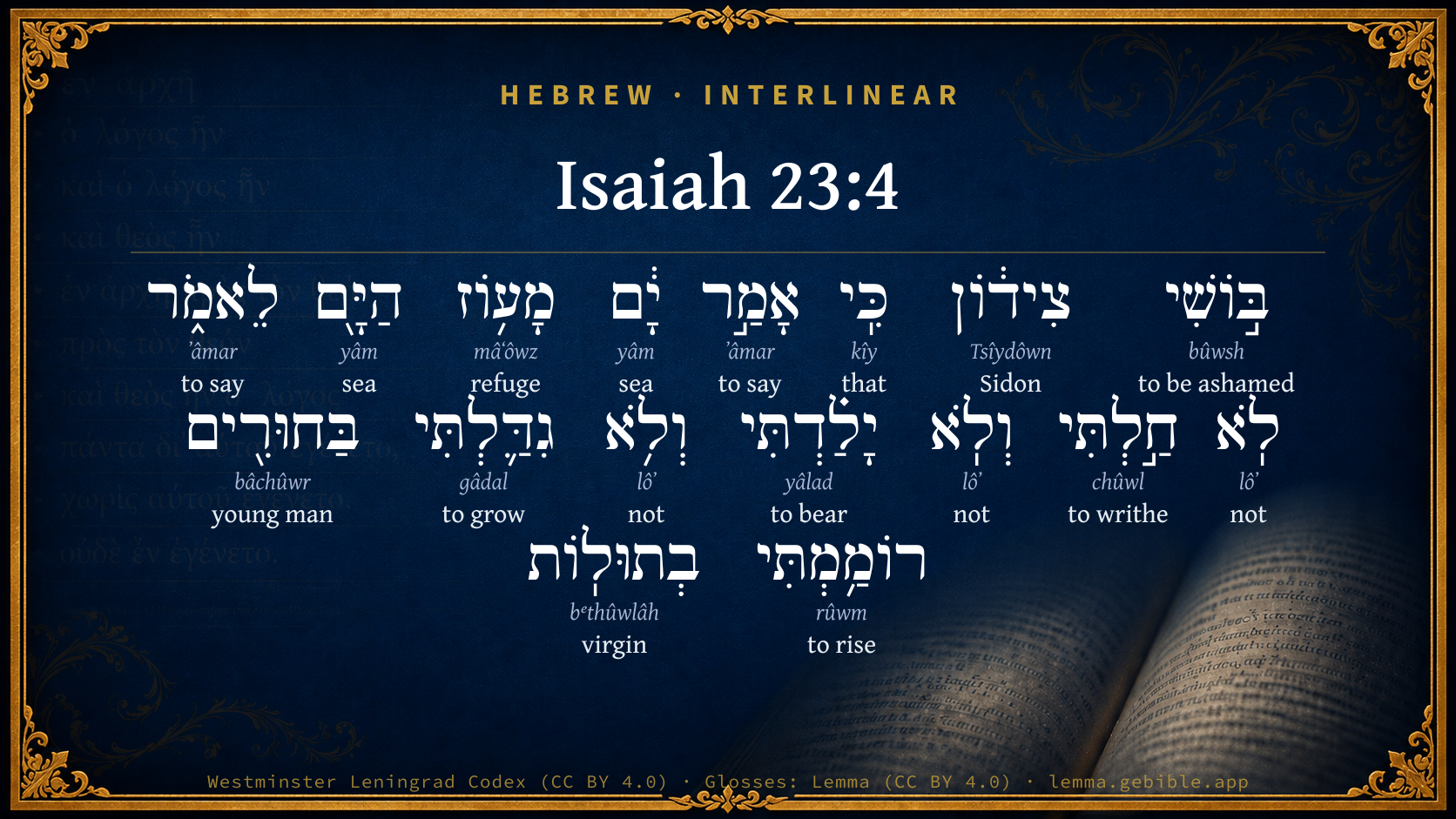
Hebrew (Westminster Leningrad Codex) Isaiah 23:4 appears in the Hebrew Old Testament. The text above is from the Westminster Leningrad Codex. Each word links to its Strong’s number, a concise gloss, and parsing drawn from the Open Scriptures Hebrew Bible morphology. Click any word for its full Brown-Driver-Briggs (BDB) entry.
Download image
Cite this verse

Isaiah 23:4 (World English Bible). Public Domain. Lemma interlinear Bible study tool, https://lemma.gebible.app/v/isaiah/23/4.

Show BibTeX & RIS
BibTeX
RIS
English Translation
Be ashamed, Sidon; for the sea has spoken, the stronghold of the sea, saying, I have not travailed, nor brought forth, neither have I nourished young men, nor brought up virgins.
World English Bible · Public Domain
Download a study sheet

One document with this verse’s original text, its word-by-word gloss line, the meaning frame, cross-references with their text, attributed commentary, and full source and license credits — printable, and it pastes into notes with its structure intact.

This verse Autodidact and up

Study sheet (.html) Plain text (.txt)

A passage Seminary Student

Up to 50 verses in one chapter. A passage sheet keeps up to 6 commentary sources and 12 cross-references per verse, in the order this page ranks them, and says so on the sheet whenever that leaves anything out. Ask for a single verse and you get the Autodidact verse sheet above.

Everything on this page stays free to read, with no account — the sheet is a download of what is already on screen, not access to it.

Want to remove ads? Support Godless Engineer
Compare translations 3

The same verse in 3 English versions, stacked beneath the original-language interlinear above. Click any original word for its lexicon entry.

Each is an independent rendering of the whole verse — the interlinear is not word-aligned to these translations.

Highlighted words mark where these versions differ — a whole-verse word diff, not a word-by-word alignment.

  • World English Bible Public Domain
    Be ashamed, Sidon; for the sea has spoken, the stronghold of the sea, saying, I have not travailed, nor brought forth, neither have I nourished young men, nor brought up virgins.
  • King James Version Public Domain
    Be thou ashamed, O Zidon: for the sea hath spoken, even the strength of the sea, saying, I travail not, nor bring forth children, neither do I nourish up young men, nor bring up virgins.
  • unfoldingWord Literal Text CC BY-SA 4.0
    Have shame, Sidon, for the sea has spoken, the stronghold of the sea, saying, “I have not writhed and I have not birthed, and I have not raised young men, brought up virgins.”

unfoldingWord Literal Text — © unfoldingWord, licensed CC BY-SA 4.0. Word-aligned USFM3 via Door43 (git.door43.org/unfoldingWord/en_ult).

Versions to compare (up to 4)

3 of 4 selected

Show all 18 translations

Every available English version of this verse, each an independent rendering of the whole verse.

  • World English Bible Public Domain
    Be ashamed, Sidon; for the sea has spoken, the stronghold of the sea, saying, I have not travailed, nor brought forth, neither have I nourished young men, nor brought up virgins.
  • Berean Standard Bible Public Domain
    Be ashamed, O Sidon, the stronghold of the sea, for the sea has spoken: “I have not been in labor or given birth. I have not raised young men or brought up young women.”
  • Majority Standard Bible Public Domain
    Be ashamed, O Sidon, the stronghold of the sea, for the sea has spoken: “I have not been in labor or given birth. I have not raised young men or brought up young women.”
  • King James Version Public Domain
    Be thou ashamed, O Zidon: for the sea hath spoken, even the strength of the sea, saying, I travail not, nor bring forth children, neither do I nourish up young men, nor bring up virgins.
  • American Standard Version (1901) Public Domain
    Be thou ashamed, O Sidon; for the sea hath spoken, the stronghold of the sea, saying, I have not travailed, nor brought forth, neither have I nourished young men, nor brought up virgins.
  • Revised Version (1885) Public Domain
    Be thou ashamed, O Zidon: for the sea hath spoken, the strong hold of the sea; saying, I have not travailed, nor brought forth, neither have I nourished young men, nor brought up virgins.
  • Geneva Bible (1599) Public Domain
    Be ashamed, thou Zidon: for the sea hath spoken, euen the strength of the sea, saying, I haue not trauailed, nor brought forth children, neither nourished yong men, nor brought vp virgins.
  • Douay-Rheims (1899) Public Domain
    Be thou ashamed, O Sidon: for the sea speaketh, even the strength of the sea, saying: I have not been in labour, nor have I brought forth, nor have I nourished up young men, nor brought up virgins.
  • Young's Literal Translation Public Domain
    Be ashamed, O Zidon; for the sea spake, The strength of the sea, saying: `I have not been pained, nor have I brought forth, Nor have I nourished young men, `nor' brought up virgins.'
  • Literal Standard Version CC BY-SA 4.0
    Be ashamed, O Sidon; for the sea spoke, || The strength of the sea, saying, “I have not been pained, nor have I brought forth, || Nor have I nourished young men, [nor] brought up virgins.”
  • Unlocked Literal Bible CC BY-SA 4.0
    Be ashamed, Sidon; for the sea has spoken, the mighty one of the sea. He says, “I have not labored nor given birth, nor have I raised young men nor brought up young women.”
  • unfoldingWord Literal Text CC BY-SA 4.0
    Have shame, Sidon, for the sea has spoken, the stronghold of the sea, saying, “I have not writhed and I have not birthed, and I have not raised young men, brought up virgins.”
  • Darby Bible Public Domain
    Be thou ashamed, Sidon, for the sea hath spoken, the strength of the sea, saying, I have not travailed nor brought forth, neither have I nourished young men [nor] brought up virgins.
  • World Messianic Bible Public Domain
    Be ashamed, Sidon; for the sea has spoken, the stronghold of the sea, saying, “I have not travailed, nor given birth, neither have I nourished young men, nor brought up virgins.”
  • Webster's Bible Public Domain
    Be thou ashamed, O Zidon: for the sea hath spoken, even the strength of the sea, saying, I travail not, nor bring forth children, neither do I nourish young men, nor bring up virgins.
  • Free Bible Version CC BY-SA 4.0
    Feel the shame, Sidon! For the fortress of the sea says, “I have no children, having never been in labor or given birth. I have not brought up young men or brought up young women.”
  • Bible in Basic English Public Domain
    Be shamed, O Zidon: for the sea, the strong place of the sea has said, I have not been with child, or given birth; I have not taken care of young men, or kept watch over the growth of virgins.
  • JPS Tanakh (1917) Public Domain
    Be thou ashamed, O Zidon; for the sea hath spoken, the stronghold of the sea, saying: 'I have not travailed, nor brought forth, neither have I reared young men, nor brought up virgins.'

Literal Standard Version (2020), Covenant Press — licensed CC BY-SA 4.0. Text via the HelloAO Bible API (eBible.org). Unlocked Literal Bible (unfoldingWord) — licensed CC BY-SA 4.0. Text via the HelloAO Bible API (eBible.org). unfoldingWord Literal Text — © unfoldingWord, licensed CC BY-SA 4.0. Word-aligned USFM3 via Door43 (git.door43.org/unfoldingWord/en_ult). Free Bible Version, Dr. Jonathan Gallagher — licensed CC BY-SA 4.0. Text via the HelloAO Bible API (eBible.org).

Word by word

More ways to search: Search by grammar → Find every occurrence → Compare this word →

Practice this passage: Drill this verse → Learn its vocabulary →

צִיד֔וֹן
Tsîydôwn
H6721
“Sidon”
Noun, Proper
Part of Speech
Noun
Type
Proper
Full BDB Definition

Origin: from H6679 in the sense of catching fish

TWOT: None

Sidon = "hunting" - ancient Phoenician city, on Mediterranean coast north of Tyre
  1. בּ֣וֹשִׁי bûwsh H954 “be ashamed” Verb, Qal, Imperative, 2nd Person, Feminine, Singular
  2. כִּֽי kîy H3588 “that” Conjunction
  3. אָמַ֣ר ʼâmar H559 “to say” Verb, Qal, Perfect, 3rd Person, Masculine, Singular
  4. יָ֔ם yâm H3220 “sea” Noun, Common, Masculine, Singular, Absolute
  5. מָע֥וֹז mâʻôwz H4581 “refuge of” Noun, Common, Masculine, Singular, Construct
  6. הַיָּ֖ם yâm H3220 “the · sea” Particle, Definite Article + Noun, Common, Masculine, Singular, Absolute
  7. לֵאמֹ֑ר ʼâmar H559 “to say” Preposition + Verb, Qal, Infinitive Construct
  8. לֹֽא lôʼ H3808 “not” Particle, Negative
  9. חַ֣לְתִּי chûwl H2342 “to writhe” Verb, Qal, Perfect, 1st Person, Common, Singular
  10. וְלֹֽא lôʼ H3808 “and · not” Conjunction + Particle, Negative
  11. יָלַ֗דְתִּי yâlad H3205 “to bear” Verb, Qal, Perfect, 1st Person, Common, Singular
  12. וְלֹ֥א lôʼ H3808 “and · not” Conjunction + Particle, Negative
  13. גִדַּ֛לְתִּי gâdal H1431 “to grow” Verb, Piel, Perfect, 1st Person, Common, Singular
  14. בַּחוּרִ֖ים bâchûwr H970 “young men” Noun, Common, Masculine, Plural, Absolute
  15. רוֹמַ֥מְתִּי rûwm H7311 “to rise” Verb, Polel, Perfect, 1st Person, Common, Singular
  16. בְתוּלֽוֹת bᵉthûwlâh H1330 “virgins” Noun, Common, Feminine, Plural, Absolute

About this verse

These counts appear in no published source. They are computed here, from the morphology-tagged text and Lemma’s own curated glosses. What Lemma adds →

17
words
13
distinct lemmas
Prophets
section

Notable vocabulary

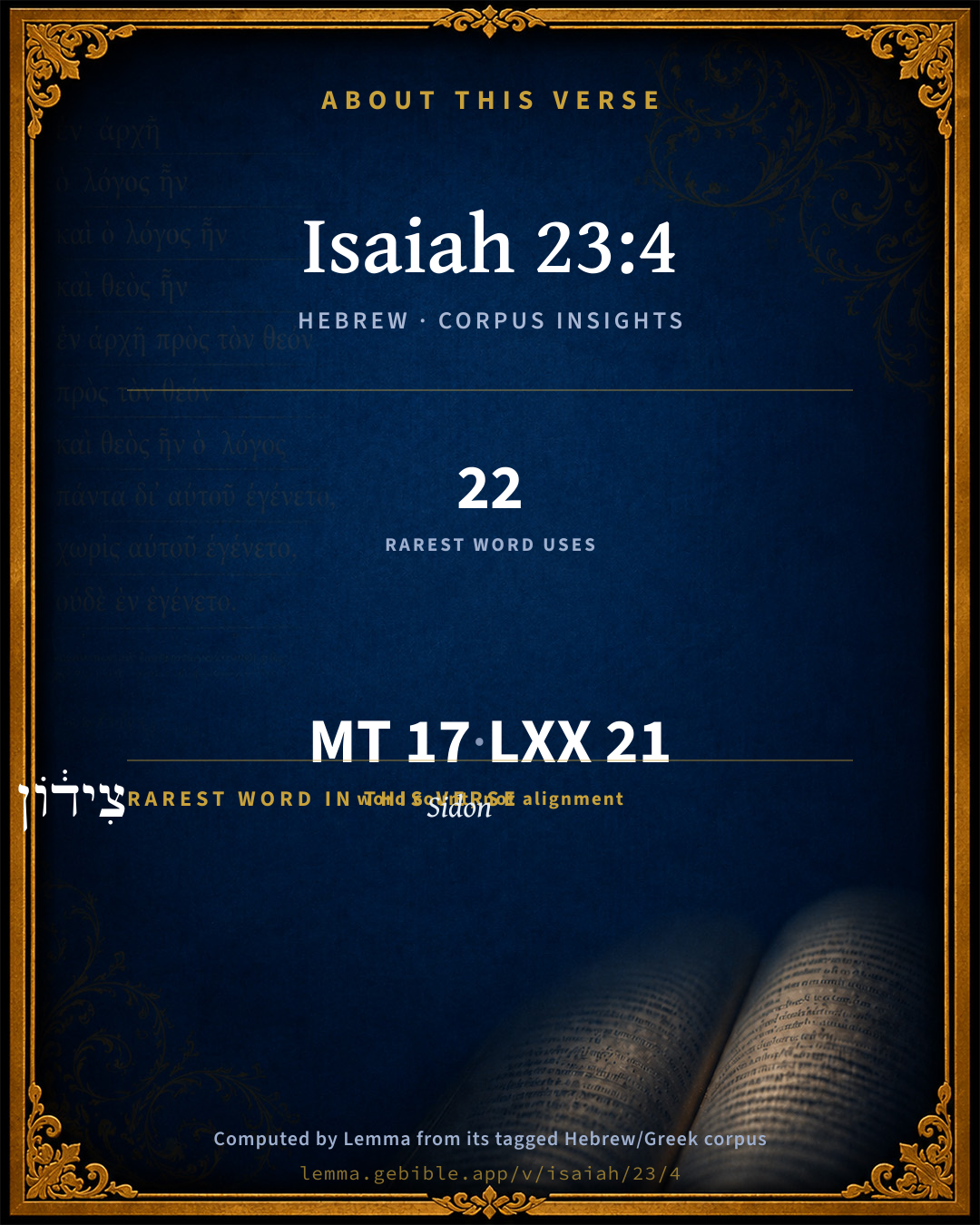
The rarest word here is צִיד֔וֹן Sidon H6721 — appearing just 22 times in the whole Hebrew Bible.

Shared distinctive vocabulary

צִיד֔וֹן Sidon H6721 occurs in 22 verses of the Hebrew Bible. Also found in:

Grammatical profile

  • 7 verbs
  • 6 nouns
  • 1 conjunction
  • 3 particles

Verb forms

  • בּ֣וֹשִׁי Qal · Imperative
  • אָמַ֣ר Qal · Perfect
  • לֵאמֹ֑ר Qal · Infinitive Construct
  • חַ֣לְתִּי Qal · Perfect
  • יָלַ֗דְתִּי Qal · Perfect
  • גִדַּ֛לְתִּי Piel · Perfect
  • רוֹמַ֥מְתִּי Polel · Perfect

Repetition

Words recur within this verse — often emphatic in Hebrew:

  • אָמַ֣ר to say H559 ×2
  • יָ֔ם sea H3220 ×2
  • לֹֽא not H3808 ×3

Hebrew & Septuagint length

In English translation the verse runs 31 words from the Hebrew and 33 from the Septuagint (LXX English) — closely comparable.

A rough comparison of the two English renderings, which tokenize alike — not a word-level alignment.

Word counts can differ between the Hebrew and the Greek without any difference in meaning — e.g. the Hebrew direct-object marker אֵת has no separate Greek word, and Greek often adds the article ὁ.

In the original languages it is 17 Hebrew tokens and 21 Greek tokens — but the two are counted differently (Hebrew bundles its prefixes and suffixes into one token; the Greek is in lemma form), so that isn’t a like-for-like length.

Cross-references

6

Topical passages linked to Isaiah 23:4 in the Treasury of Scripture Knowledge — connected by theme and wording, ordered by reader-vote popularity; previews shown in the World English Bible.

  • Revelation 18:23 The light of a lamp will shine no more at all in you. The voice of the bridegroom and of the bride will be heard no more at all in you; for your merchants were the princes of the earth; for with your sorcery all the nations were deceived.
  • Genesis 10:15 Canaan became the father of Sidon (his firstborn), Heth,
  • Genesis 10:19 The border of the Canaanites was from Sidon, as you go toward Gerar, to Gaza; as you go toward Sodom, Gomorrah, Admah, and Zeboiim, to Lasha.
  • Jeremiah 47:3–4 At the noise of the stamping of the hoofs of his strong ones, at the rushing of his chariots, at the rumbling of his wheels, the fathers don't look back to their children for feebleness of hands;
  • Ezekiel 26:3–6 therefore thus says the Lord Yahweh, Behold, I am against you, Tyre, and will cause many nations to come up against you, as the sea causes its waves to come up.
  • Hosea 9:11–14 As for Ephraim, their glory will fly away like a bird. There will be no birth, none with child, and no conception.

Cross-references courtesy of OpenBible.info (CC BY 4.0).

Hebrew and Greek witnesses Masoretic Hebrew ↔ Greek Septuagint

The same verse in the two great witnesses to the Old Testament, shown verse-for-verse.

These are two independent witnesses, not word-aligned to each other, and the Septuagint is shown in lemma (dictionary) form.

Hebrew Isaiah 23:4 Masoretic · Westminster Leningrad Codex

בּ֣וֹשִׁי צִיד֔וֹן כִּֽי אָמַ֣ר יָ֔ם מָע֥וֹז הַיָּ֖ם לֵאמֹ֑ר לֹֽא חַ֣לְתִּי וְלֹֽא יָלַ֗דְתִּי וְלֹ֥א גִדַּ֛לְתִּי בַּחוּרִ֖ים רוֹמַ֥מְתִּי בְתוּלֽוֹת

Be ashamed, Sidon; for the sea has spoken, the stronghold of the sea, saying, I have not travailed, nor brought forth, neither have I nourished young men, nor brought up virgins.

World English Bible · Public Domain

Greek LXX Isaiah 23:4 Septuagint · lemma form

αἰσχύνω σιδών εἶπον ὁ θάλασσα ὁ δέ ἰσχύς ὁ θάλασσα εἶπον οὐ ὠδίνω οὐδέ τίκτω οὐδέ ἐκτρέφω νεανίσκος οὐδέ ὑψόω παρθένος

Be ashamed, O Sidon: the sea has said, yes, the strength of the sea has said, I have not travailed, nor brought forth, nor have I brought up young men, nor reared virgins.

LXX2012 (modern English Septuagint) · Public Domain

On this verse, Haydock's Catholic Bible Commentary discusses the Septuagint’s reading. Read the note in Commentary ↓

Hebrew: Westminster Leningrad Codex (CC BY 4.0). Greek: Septuagint (public domain); English from LXX2012 (modern English Septuagint) (Public Domain). How the Septuagint differs from the Hebrew →

Targum (Aramaic paraphrase)

1

The Targum is the ancient Jewish Aramaic paraphrase of the Hebrew Scriptures — an interpretive translation, not the Hebrew text itself. Onkelos (literal) and Pseudo-Jonathan (expansive) render the Torah, and Jonathan the Prophets. Coverage is partial: where no permissively-licensed English translation exists for a verse, only the Aramaic is shown. This is verse-level text, not a word-by-word alignment to the Hebrew.

  1. Targum Jonathan Prophets (Joshua–Malachi)
    בְּהִיתוּ צִידוֹנָאֵי אֲרֵי אֲמַר מְעַרְבָאָה דִי יָתֵיב בִּתְקוֹף יַמָא לְמֵימָר לְוַי לָא מַרְעֵית לָא אַעְדֵיתִי וְלָא רַבֵּיתִי עוּלֵמִין פַּנְקֵית בְּתוּלָן:

    The Sidonians are confounded, because the west hath spoken, which dwells in the strength of the sea, saying, O that I had never travailed, never conceived, and never nourished up young men, never brought up virgins delicately!

    Targum Jonathan — Aramaic: “Mikraot Gedolot” (public domain). English: “Sefaria Community Translation” (CC0 1.0 (public-domain dedication)); “London "Chaldee Paraphrase," 1871” (public domain). Text via Sefaria.

Commentary

Notes on Isaiah 23:4 from classic Christian and Jewish commentators (each source and its license shown beneath its notes). The classic Christian expositions comment on the surrounding passage and are grouped to its opening verse, so a note may address several verses; the Jewish commentaries on the Tanakh (Rashi and others) are per-verse, so they appear only where the commentator wrote on this verse.

Lemma curates 59 commentaries, every one of them public domain or Creative Commons licensed, each selected and text-cleaned for this edition rather than reprinted as found. About our sources →

Trapp's Complete Commentary

John Trapp

Isa 23:4 Be thou ashamed, O Zidon: for the sea hath spoken, [even] the strength of the sea, saying, I travail not, nor bring forth children, neither do I nourish up young men, [nor] bring up virgins.

Ver. 4. Be ashamed, O Zidon,] sc., Of Tyre, thy daughter and confederate.

For the sea hath spoken, even the strength of the sea.] Or, The seaport. By the sea and seaport we are to understand Tyre, who sat in the sea, as now Venice doth, and sovereigned it.

I travail not, nor bring forth children.] I send forth no colonies, as sometimes I have done. Pliny saith of Tyre, Olim partu clara urbibus genitis, Lepti, Utica, Carthagine, etiam Gadibus extra orbem conditis. {a} But now it was past that time of day with her.

{a} Plin., lib. v. cap. 19.

John Trapp, A Commentary or Exposition upon All the Books of the Old and New Testament (1647–1656) — public domain. Text from a community e-Sword module.

The Biblical Illustrator

Joseph S. Exell

Isa_23:4

The sea hath spoken, even the strength of the sea

The voice of the sea

God, through the wildly wailing winds, and loudly surging waves, has often uttered a voice of warning and of woe to cities filled with corruption and vice.

And how, too, through these winds and waves, has the sea spoken in its strength to crushed and broken hearts, when its surface has been thickly strewn with shattered wrecks, and the floating and sinking bodies of its helpless victims.

I. But the sea often speaks to us in other language than this, addressing us, as it does, through the eye as well as the ear, and CALLING UPON US TO ADORE AND LOVE GOD for the beauty with which He clothes and overhangs it, and for the blessings which, by means of the sea, He conveys to us, no less than to tremble and bow down before Him in view of the vastness and the majestic grandeur of the ocean in its more excited and terrific moods.

II. The sea hath spoken, even the strength of the sea, by ITS VASTNESS AND FORCE AND GRANDEUR OF ITS MOVEMENTS.

III. The sea hath spoken, too, and will, we trust, thus ever speak, through THE ELECTRIC WIRE, which here and there lies far down in its lowest depths, and which, in coming years, will be more widely extended abroad.

IV. Yet again the sea hath spoken, in that IT APPEALS TO OUR KIND CHRISTIAN SYMPATHY AND INTEREST in behalf of those who, as seamen, go forth upon the deep.

V. When the sea in its strength thus speaks to us, with the voice of wailing, lamentation, and woe, HOW OUGHT WE TO PRAY FOR SEAMEN AND THOSE CONNECTED WITH THEM, with all the power of faith which God shall give us, that He would save them from a watery grave, or, if they thus perish, that He would comfort those who mourn their loss, and that in the day in which the earth and the sea shall give up the dead that are in them, they may all together enter the haven of eternal rest. So, too, should we ever pray that the time may soon come when the abundance of the sea shall be converted unto God, and the isles shall wait for His law. (C. Rockwell.)

The violent in the serene

The sea, as a rule, is tranquil. Yet what awful power it possesses when it is aroused to fury! Blocks of stone weighing over thirteen tons have been known to be hurled by it a distance of more than thirty feet, and blocks of three tons to more than one hundred yards. Jetties and bridges are dashed about like toys. The entire harbour of Fecamp was destroyed by its rage, and the mass of earth torn from the north side of Cape la Heve was estimated at more than 300,000 square yards. Yet these are only among the trifling achievements of the sea when it passes from its peaceful to its furious mood. Violence often slumbers under an appearance of serenity. A crowd of joyous holiday makers today may become tomorrow a foaming mob of insurrectionists! (Scientific Illustrations and Symbols.)

Power of the sea

That part of Hey Head; in Orkney, which is called the Brow of the Brae, is one sheer unbroken crag of 1150 feet. The Orcadians told me that in a hurricane they have seen an Atlantic wave strike this headland in such volume and with such power, that it has rushed half-way up the cliff, throwing itself in its great but impotent rage to the height of nearly 600 feet. Hurled by such a sea against such a crag, a man-of-war, though built of the strongest oak, and bound with the toughest iron, would be shattered like a ship of glass. (T. Guthrie, D. D.)

The sea

He that will learn to pray, let him go to sea. (George Herbert.)

The Biblical Illustrator, edited by Joseph S. Exell (c. 1880s–1900s) — public domain. Text from a community e-Sword module.

Joseph Benson's Commentary

Isa 23:4. Be thou ashamed, O Zidon — Tyre is called the daughter of Zidon, Isa 23:12, being built and first inhabited by a colony of the Zidonians. Or, rather, as Justin says, “The Zidonians, when their city was taken by the king of Ascalon, betook themselves to their ships, and landed and built Tyre.” Zidon, therefore, as the mother city, is here supposed to be deeply afflicted with the calamity of her daughter. For the sea hath spoken — That part of the sea in which Tyre was, and from which ships and men were sent into all countries; even the strength of the sea — This is added to explain what he meant by the sea, even Tyre, which might be called the strength of the sea, because it was strong at sea, both by its situation, and the strength of its naval forces; saying, I travail not, &c. — I, who was so fruitful that I sent forth colonies into other countries, (of which Carthage was one,) am now barren and desolate.

Joseph Benson's Commentary on the Old and New Testaments (1811–1818) — public domain. Text from a community e-Sword module.

Keil & Delitzsch

C. F. Keil & F. Delitzsch

The address to the whole of the coast-land now passes into an address to the ancestral city. Isa 23:4 "Shudder, O Sidon; for the sea speaketh, the fortress of the sea, thus: I have not travailed, nor given birth, nor trained up young men, brought up maidens." The sea, or more closely considered, the fortress of the sea, i.e., the rock-island on which Neo-tyrus stood with its strong and lofty houses, lifts up its voice in lamentation. Sidon, the ancestress of Canaan, must hear with overwhelming shame how Tyre mourns the loss of her daughters, and complains that, robbed as she has been of her children, she is like a barren women. For the war to have murdered her young men and maidens, was exactly the same as if she had never given birth to them or brought them up. Who is there that does not recognise in this the language of Isaiah (compare Isa 1:2)? - Even in Egypt the fate of Phoenicia produces alarm. Isa 23:5 "When the report cometh to Egypt, they tremble at the report from Tzor." In the protasis (Isa 23:5) lemitzraim (to Egypt) the verb "cometh" is implied; the Caph in Isa 23:5 signifies simultaneousness, as in Isa 18:4 and Isa 30:19 (Ges. Thes. p. 650). The news of the fall of Tyre spreads universal terror in Egypt, because its own prosperity depended upon Tyre, which was the great market for its corn; and when such a bulwark had fallen, a similar fate awaited itself.

Keil & Delitzsch — Biblical Commentary on the Old Testament (1861–1891) — public domain (CC PDM 1.0). Text via the HelloAO Bible API. (Old Testament only.)

Tyndale Open Study Notes

Tyndale Open Resources

23:4 Part of the great port city of Tyre was on an island. The island city was a fortress of the sea, but it fell in 332 BC. • I am childless; I have no sons or daughters: This metaphor was a judgment on Tyre’s colonial ports around the Mediterranean Sea. In the ancient world, to reach old age without having children was considered a terrible fate (see 49:21; 54:1).

Tyndale Open Study Notes — © Tyndale Open Resources, licensed CC BY-SA 4.0. Text via the HelloAO Bible API.

Geneva Bible (1599)

Geneva Bible translators

That is, Tyre, which was the chief part of the sea.

I have no people left in me, and am as a barren woman that never had children.

Geneva Bible (1599) marginal notes — public domain. Text via Bolls.life.

Jamieson, Fausset & Brown

Robert Jamieson, A. R. Fausset & David Brown

Zidon--called on, as being the parent country of Tyre (Isa 23:12), and here equivalent to Phœnicia in general, to feel the shame (as it was esteemed in the East) of being now as childless as if she never had any. "I (no more now) travail, nor bring forth," &c. "Strength of the sea," that is, stronghold, namely, New Tyre, on a rock (as "Tyre" means) surrounded by the sea (Eze 26:4, Eze 26:14-17; so Venice was called "Bride of the sea"; Zac 9:3).

Jamieson, Fausset & Brown — Commentary Critical and Explanatory on the Whole Bible (1871) — public domain (CC PDM 1.0). Text via the HelloAO Bible API.

Adam Clarke's Commentary

Verse 4. Be thou ashamed, O Zidon] Tyre is called Isa 23:12, the daughter of Sidon. "The Sidonians," says Justin, xviii. 3, "when their city was taken by the king of Ascalon, betook themselves to their ships, and landed, and built by Tyre." Sidon, as the mother city is supposed to be deeply affected with the calamity of her daughter.

Nor bring up virgins - "Nor educated virgins."] ורוממתי veromamti; so an ancient MS. Of Dr. Kennicott's prefixing the ו vau, which refers to the negative preceding, and is equivalent to ולא velo. See De 23:6; Pr 30:3. Two of my own MSS. have ו vau in the margin.

Adam Clarke's Commentary on the Bible (1810–1826) — public domain. Text from a community e-Sword/MySword module.

Ellicott's Commentary for English Readers

(4) Be thou ashamed, O Zidon . . .—Zidon is addressed as the mother-city of Tyre. The “strength” (or fortress) of the sea is the rock-island on which the new Tyre was built. She sits as a widow bereaved of her children, with no power to renew the population which once crowded her streets. (Comp. Lam_1:1.)

A Bible Commentary for English Readers, edited by Charles John Ellicott (1878–1897) — public domain. Text from a community e-Sword module.

The Cambridge Bible for Schools and Colleges

gen. ed. J. J. S. Perowne

4. even the strength of the sea] Better as R.V. the stronghold of the sea. The fine figure of the lonely sea denying that she ever had children is somewhat marred by the introduction of this clause, as if the poet had corrected himself by an afterthought, and changed the subject of personification from the sea to Tyre. One is tempted to remove the words as a gloss.

I travail not, nor bring forth, &c.] Render with R.V. I have not travailed, nor brought forth, neither have I nourished young men, nor brought up (cf. ch. Isa_1:2) virgins.

The Cambridge Bible for Schools and Colleges (gen. ed. J. J. S. Perowne; Cambridge University Press, 1878–1918) — public domain. Text from a community e-Sword module.

John Gill's Exposition

Be thou ashamed, O Zidon,.... A city near to Tyre, about twenty five miles from it; Jarchi says it was within a day's walk of it; these two cities, as they were near to each other, so they were closely allied together, and traded much with one another, so that the fall of Tyre must be distressing and confounding to Zidon; and besides, Tyre was a colony of the Zidonians, and therefore, Isa 23:12, is called the daughter of Zidon, and could not but be affected with its ruin, and the more, as it might fear the same would soon be its case:

for the sea hath spoken; which washed the city of Tyre; or those that sailed in it; or rather Tyre itself, so called because its situation was by the sea, the island was encompassed with it:

even the strength of the sea; which was enriched by what was brought by sea to it, and was strengthened by it, being surrounded with the waters of it as with a wall, and had the sovereignty over it:

saying, I travail not, nor bring forth children, neither do I nourish up young men, nor bring up virgins; either the sea itself, which now no more brought great numbers of young people to Tyre, children to be educated, young men to be instructed in trade and business, and virgins to be given in marriage, the city being destroyed; or Tyre, which before was very populous, full of children, young men, and maidens, but now desolate; and which formerly sent out colonies abroad, and was a mother city to many, as Pliny says (s); it was famous for the birth of many cities, as Lepti, Utica, Carthage, and Gades or Cales; but now it was all over with her. Some render it as a wish, "O that I had never travailed", &c. and so the Targum.

(s) Nat. Hist. l. 5. c. 19.

John Gill's Exposition of the Whole Bible (1746–1763) — public domain (CC PDM 1.0). Text via the HelloAO Bible API.

Albert Barnes' Notes on the Bible

Be thou ashamed, O Zidon - Tyre was a colony of Sidon. Sidon is here addressed as the mother of Tyre, and is called on to lament over her daughter that was destroyed. In Isa 23:12, Tyre is called the ‘daughter of Sidon;’ and such appellations were commonly given to cities (see the note at Isa 1:8). Sidon is here represented as ashamed, or grieved - as a mother is who is bereft of all her children.

The sea hath spoken - New Tyre was on a rock at some distance from the land, and seemed to rise out of the sea, somewhat as Venice does It is described here as a production of the sea, and the sea is represented as speaking by her.

Even the strength of the sea - The fortress, or strong place (מעוז mā‛ôz) of the sea. Tyre, on a rock, might be regarded as the strong place, or the defense of the Mediterranean. Thus Zechariah Zec 9:3 says of it. ‘And Tyrus did build herself a stronghold’ (מצור mâtsôr).

Saying, I travail not - The expresssions which follow are to be regarded as the language of Tyre - the founder of colonies and cities. The sense is, ‘My wealth and resources are gone. My commerce is annihilated. I cease to plant cities and colonies, and to nourish and foster them, as I once did, by my trade.’ The idea of the whole verse is, that the city which had been the mistress of the commercial world, and distinguished for founding other cities and colonies, was about to lose her importance, and to cease to extend her colonies and her influence over other countries. Over this fact, Sidon, the mother and founder of Tyre herself, would be humbled and grieved that her daughter, so proud, so rich, and so magnificent, was brought so low.

Albert Barnes' Notes on the Bible (1834–1885) — public domain. Text from a community e-Sword/MySword module.

Haydock's Catholic Bible Commentary

Strength: people who sail. Septuagint, "but the strength....replied: I," &c. Sidon will not be concerned for the fall of her rival. She alleges that she has nothing to do with Tyre. That city would not allow that it was a colony of Sidon, ver. 12. (Calmet)

George Leo Haydock (1774–1849), Haydock's Catholic Family Bible and Commentary, 1859 edition — public domain. Excludes Psalms (Douay-Rheims chapter numbering differs from Protestant) and Deuterocanonical books (Catholic canon only).

Matthew Poole's English Annotations

Be thou ashamed, O Zidon; for Zidon was a great city near Tyre, and strongly united to her by commerce and league, and called by some the mother of Tyre, which they say was built and first inhabited by a colony of the Sidonians; and therefore she must needs be greatly concerned in the destruction of Tyrus.

The sea; that part of the sea in which Tyrus was, and from which ships and men were sent into all countries.

The strength of the sea: this is added to explain what he meant by the sea, even Tyrus, who might be called the strength of the sea, either actively, because it defended that part of the sea from piracies and injuries; or passively, because it was defended and strengthened by the sea, which encompassed it. And this title is here given to Tyrus, to show what great cause of confusion and fear Zidon had from this example, which for strength was much inferior to Tyrus.

I travail not, nor bring forth children, & c.; I, who was so exceeding fruitful and populous, that I sent forth colonies into other countries, (of which the famous city of Carthage was one,) am now become barren and desolate.

Matthew Poole's English Annotations on the Holy Bible (1683–1685) — public domain. Text from a community e-Sword/MySword module.

Whedon's Commentary on the Bible

Daniel D. Whedon

4. Ashamed — Zidon, or the whole Zidonian coast, is called to be confounded, mortified, because the sea… the strength of the sea, or Tyre — the rock fortress of the sea, the sea’s objective point in commerce — has waned in population because of wars, and she is for the future as good as barren.

Daniel D. Whedon (gen. ed.), Commentary on the Old and New Testaments (1874–1909) — public domain. Text from a community e-Sword module.

The Pulpit Commentary

Be thou ashamed, O Zidon. Zidon, the most ancient and venerable of the Phoenician cities, (Gen_10:15 Jos_11:8 Jud_1:18:7; Justin, 18:3, etc.) is called upon to feel shame because Tyre is captured. The ruin of the metropolitan city would be felt as a disgrace by all the lesser towns, and by Zidon especially. The sea... even the strength of the sea; rather, the stronghold of the sea; i.e. Tyre herself. Tyre declares that she is childless, has neither son nor daughter, is as if she had never travailed nor brought forth children. I travail not, etc.; rather, I have not travailed, nor brought forth, nor nourished up, etc. My children being dead or taken from me, it is as if I had never borne them.

The Pulpit Commentary (1880–1919), ed. H.D.M. Spence-Jones & Joseph S. Exell — public domain. Text from a community e-Sword module.

John Wesley's Explanatory Notes

Zidon - Zidon was a great city near Tyre, strongly united to her by commerce and league, and called by some the mother of Tyre, which they say, was built and first inhabited by a colony of the Sidonians. The sea - That part of the sea in which Tyre was, and from which ships and men were sent into all countries. The strength - Tyre might be called the strength of the sea, because it defendeth that part of the sea from piracies and injuries. I travel not - I, who was so fruitful, that I sent forth colonies into other countries (of which Carthage was one), am now barren and desolate.

John Wesley, Explanatory Notes Upon the Whole Bible (1754–1765) — public domain. Text via the GEBible commentary corpus.

J. A. Alexander on Isaiah

Joseph Addison Alexander

“Be ashamed (or confounded) Zidon, for the sea saith, the strength of the sea, saying, I have not travailed, and I have not borne, and I have not reared young men (or) brought up virgins.” One of the great cities of Phoenicia is here called upon to be confounded at the desolation of the other; or Zidon may be put for the whole country, as in the preceding verse. The Prophet hears a voice from the sea, which he then describes more exactly as coming from the stronghold or fortress of the sea, (i.e., insular Tyre as viewed from the mainland). The rest of the verse is intended to express the idea that the city thus personified was childless, was as if she had never borne children. The whole metaphor is clearly intended to express the idea of depopulation.

Joseph Addison Alexander, The Prophecies of Isaiah (1846–1847; New York: Scribner, 1870–1878) — public domain. Text from a community e-Sword module.

unfoldingWord translationNotes

Door43 World Missions Community

for the sea has spoken, the mighty one of the sea ... nor brought up young women

Possible meanings are 1) Yahweh describes the city of Tyre as a mother who speaks about the people who live in the city as her children, or 2) Yahweh is describing the Mediterranean Sea as speaking. The people of Tyre considered the sea their god and father. In either meaning the speaker mourns because its children are destroyed. (See: Personification)

translationWords

shame

Sidon

might

labor

raise

report

Egypt

Tyre

unfoldingWord translationNotes — © Distant Shores Media and the Door43 World Missions Community, licensed CC BY-SA 4.0. Source: git.door43.org/Door43/en_tn.

Rashi

Rabbi Shlomo Yitzchaki (Rashi)

Be ashamed, Zidon which was secondary to Tyre.

for the sea said For Tyre, that was situated in the stronghold of the sea, who was the main head of the kingdom, said, “I am as though I have not travailed, nor have I borne young men, for they all were slain, and I am as though I have not raised virgins.” And so did Jonathan render it. And our Sages said in the Aggadah: Be ashamed, Zidon, for the sea has spoken, “If I, who have no sons and daughters about whom to worry that they not be seized for my iniquity, do not deviate from the commandment of my Maker, by crossing the boundary of sand which He placed for me, how much more should you be ashamed, Zidon, since you have to worry about all these!”

Rashi on the Tanakh — English translations: “The Judaica Press complete Tanach with Rashi, translated by A. J. Rosenberg” (CC BY 4.0); “Pentateuch with Rashi's commentary by M. Rosenbaum and A.M. Silbermann, 1929-1934” (public domain); “The Metsudah Tanach series, Lakewood, N.J” (CC BY 4.0); and “The Book of Joshua, Metsudah Publications, 1997” (CC BY 4.0). Text via Sefaria.

Ibn Ezra

Rabbi Abraham ibn Ezra

The sea. She that had the greatest power on the sea, that is Tyre. I travailed not, etc. It is as if there were no people in the isle of Tyre.

Ibn Ezra on the Tanakh — English translations: “Sefaria Community Translation” (CC0 1.0 (public-domain dedication)); “Yalkut, Sifsei Chachomim Chumash, Metsudah Publications, 2009” (CC BY 4.0); and “Commentary of Ibn Ezra on Isaiah - trans. by M. Friedlander, 1873” (public domain). Text via Sefaria.

Lesson kit

Teaching starters — assembled from the data on this page, not authored interpretation. Every prompt links to the verse data it draws on. Edit before teaching.

Isaiah, in the Prophets, opens this verse with 17 words (13 distinct Hebrew lemmas). Its most distinctive word is Tsîydôwn (“Sidon”). A historical commentator’s framing appears above. Read the whole chapter for the surrounding context.

Discussion questions

  1. The word Tsîydôwn carries the sense “Sidon.” How does it shape the verse?
  2. Genesis 10:15 shares the word «Sidon» with this verse. How do the two illuminate each other?
  3. “to say” occurs 2× in this one verse. What is the effect of the repetition?
  4. These translations render this verse differently; the difference is in the English rendering, not the original. What questions does that raise?
  5. The verb «בּ֣וֹשִׁי» is Qal Imperative. How does its form color the action?
  6. Reading how Trapp's Complete Commentary and The Biblical Illustrator read this verse, where do the two commentators agree and where do they part?

Things to notice

Reading settings

Reading text

Shown beneath each verse's original-language words.

Old Testament
Old Testament edition

Read the OT as the Masoretic Hebrew (MT) or the Greek Septuagint (LXX).

English shown for the Greek Septuagint (in the Hebrew ↔ Greek comparison).

Comparing translations? Open the Compare panel on any verse page to stack up to four side by side.