
1 Chronicles 25:5

Hebrew (Westminster Leningrad Codex) 1 Chronicles 25:5 appears in the Hebrew Old Testament. The text above is from the Westminster Leningrad Codex. Each word links to its Strong’s number, a concise gloss, and parsing drawn from the Open Scriptures Hebrew Bible morphology. Click any word for its full Brown-Driver-Briggs (BDB) entry.
Download image
Cite this verse

1 Chronicles 25:5 (World English Bible). Public Domain. Lemma interlinear Bible study tool, https://lemma.gebible.app/v/1-chronicles/25/5.

Show BibTeX & RIS
BibTeX
RIS
English Translation
All these were the sons of Heman the king's seer in the words of God, to lift up the horn. God gave to Heman fourteen sons and three daughters.
World English Bible · Public Domain
Download a study sheet

One document with this verse’s original text, its word-by-word gloss line, the meaning frame, cross-references with their text, attributed commentary, and full source and license credits — printable, and it pastes into notes with its structure intact.

This verse Autodidact and up

Study sheet (.html) Plain text (.txt)

A passage Seminary Student

Up to 50 verses in one chapter. A passage sheet keeps up to 6 commentary sources and 12 cross-references per verse, in the order this page ranks them, and says so on the sheet whenever that leaves anything out. Ask for a single verse and you get the Autodidact verse sheet above.

Everything on this page stays free to read, with no account — the sheet is a download of what is already on screen, not access to it.

Want to remove ads? Support Godless Engineer
Compare translations 3

The same verse in 3 English versions, stacked beneath the original-language interlinear above. Click any original word for its lexicon entry.

Each is an independent rendering of the whole verse — the interlinear is not word-aligned to these translations.

Highlighted words mark where these versions differ — a whole-verse word diff, not a word-by-word alignment.

  • World English Bible Public Domain
    All these were the sons of Heman the king's seer in the words of God, to lift up the horn. God gave to Heman fourteen sons and three daughters.
  • King James Version Public Domain
    All these were the sons of Heman the king's seer in the words of God, to lift up the horn. And God gave to Heman fourteen sons and three daughters.
  • unfoldingWord Literal Text CC BY-SA 4.0
    All of these sons of Heman, the seer of the king, by the words of God to lift up horn. For God gave to Heman fourteen sons and three daughters.

unfoldingWord Literal Text — © unfoldingWord, licensed CC BY-SA 4.0. Word-aligned USFM3 via Door43 (git.door43.org/unfoldingWord/en_ult).

Versions to compare (up to 4)

3 of 4 selected

Show all 18 translations

Every available English version of this verse, each an independent rendering of the whole verse.

  • World English Bible Public Domain
    All these were the sons of Heman the king's seer in the words of God, to lift up the horn. God gave to Heman fourteen sons and three daughters.
  • Berean Standard Bible Public Domain
    All these sons of Heman the king’s seer were given him through the promises of God to exalt him, for God had given Heman fourteen sons and three daughters.
  • Majority Standard Bible Public Domain
    All these sons of Heman the king’s seer were given him through the promises of God to exalt him, for God had given Heman fourteen sons and three daughters.
  • King James Version Public Domain
    All these were the sons of Heman the king's seer in the words of God, to lift up the horn. And God gave to Heman fourteen sons and three daughters.
  • American Standard Version (1901) Public Domain
    All these were the sons of Heman the king's seer in the words of God, to lift up the horn. And God gave to Heman fourteen sons and three daughters.
  • Revised Version (1885) Public Domain
    All these were the sons of Heman the king’s seer in the words of God, to lift up the horn. And God gave to Heman fourteen sons and three daughters.
  • Geneva Bible (1599) Public Domain
    All these were the sonnes of Heman, the Kings Seer in the wordes of God to lift vp the horne: and God gaue to Heman fourtene sonnes and three daughters.
  • Douay-Rheims (1899) Public Domain
    All these were the sons of Heman the seer of the king in the words of God, to lift up the horn: and God gave to Heman fourteen sons and three daughters.
  • Young's Literal Translation Public Domain
    all these `are' sons of Heman -- seer of the king in the things of God -- to lift up a horn; and God giveth to Heman fourteen sons and three daughters.
  • Literal Standard Version CC BY-SA 4.0
    all these [are] sons of Heman, seer of the king in the things of God, to lift up a horn; and God gives fourteen sons and three daughters to Heman.
  • Unlocked Literal Bible CC BY-SA 4.0
    All these were the sons of Heman the king's prophet. God gave Heman fourteen sons and three daughters to lift up his horn.
  • unfoldingWord Literal Text CC BY-SA 4.0
    All of these sons of Heman, the seer of the king, by the words of God to lift up horn. For God gave to Heman fourteen sons and three daughters.
  • Darby Bible Public Domain
    all these were sons of Heman the king's seer in the words of God, to exalt his power; and God had given to Heman fourteen sons and three daughters.
  • World Messianic Bible Public Domain
    All these were the sons of Heman the king’s seer in the words of God, to lift up the horn. God gave to Heman fourteen sons and three daughters.
  • Webster's Bible Public Domain
    All these were the sons of Heman the king's seer in the words of God, to lift up the horn. And God gave to Heman fourteen sons and three daughters.
  • Free Bible Version CC BY-SA 4.0
    All these sons of Heman, the king's seer, were given to him through the promises of God to honor him, for God gave Heman fourteen sons and three daughters.
  • Bible in Basic English Public Domain
    All these were sons of Heman, the king's seer in the words of God. And to make great his power God gave Heman fourteen sons and three daughters.
  • JPS Tanakh (1917) Public Domain
    all these were the sons of Heman the king's seer in the things pertaining to God, to lift up the horn. And God gave to Heman fourteen sons and three daughters.

Literal Standard Version (2020), Covenant Press — licensed CC BY-SA 4.0. Text via the HelloAO Bible API (eBible.org). Unlocked Literal Bible (unfoldingWord) — licensed CC BY-SA 4.0. Text via the HelloAO Bible API (eBible.org). unfoldingWord Literal Text — © unfoldingWord, licensed CC BY-SA 4.0. Word-aligned USFM3 via Door43 (git.door43.org/unfoldingWord/en_ult). Free Bible Version, Dr. Jonathan Gallagher — licensed CC BY-SA 4.0. Text via the HelloAO Bible API (eBible.org).

Word by word

More ways to search: Search by grammar → Find every occurrence → Compare this word →

Practice this passage: Drill this verse → Learn its vocabulary →

לְהֵימָ֗ן
Hêymân
H1968
“to/for · Heman”
Preposition + Noun, Proper
Part of Speech
Preposition + Noun
Type
Proper
Full BDB Definition

Origin: probably from H539

TWOT: None

Heman = "faithful" - a wise man to whom Solomon was compared - son of Joel, grandson of Samuel, and a Levitical singer and author of PS 88 - a seer
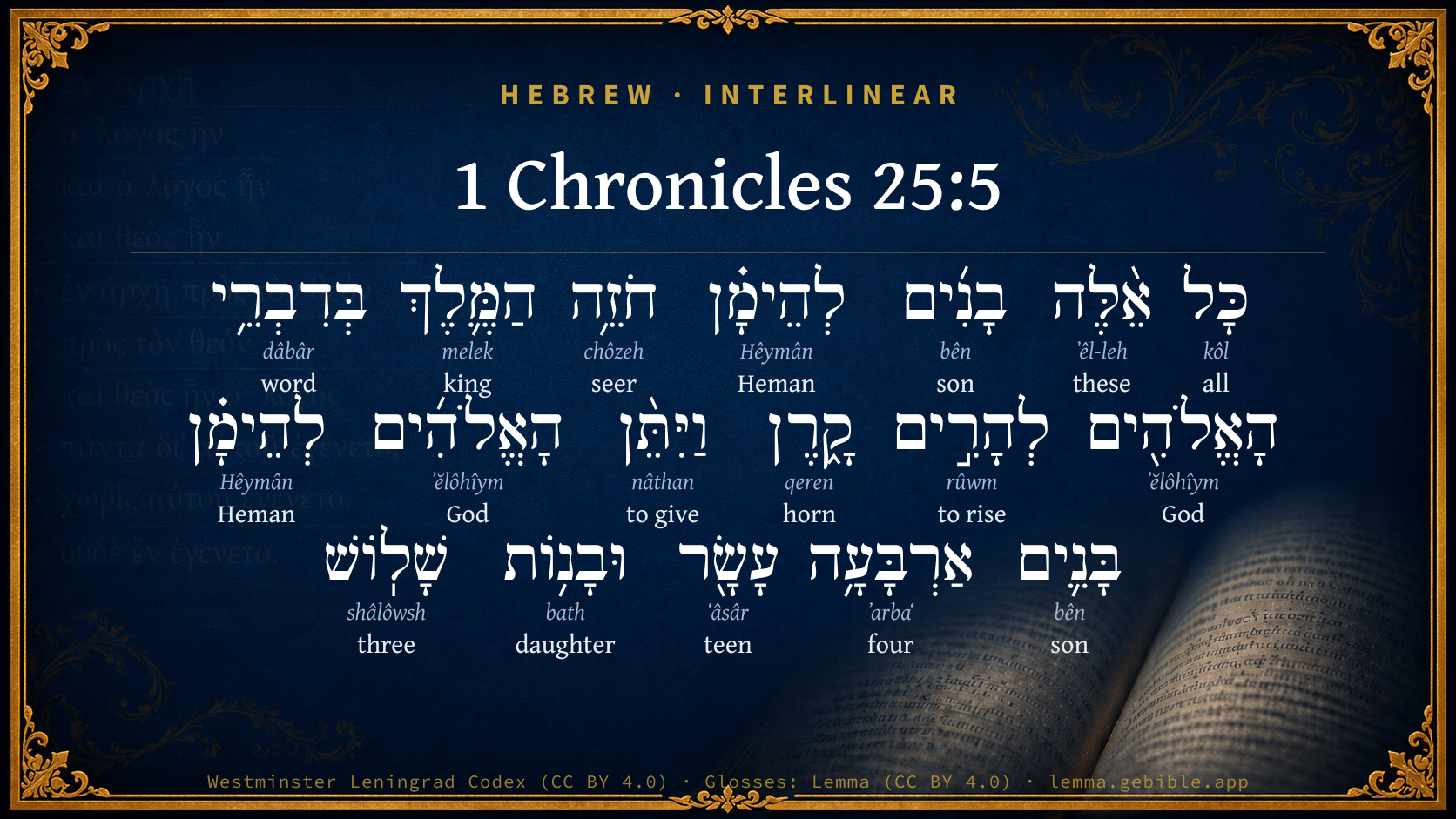
  1. כָּל kôl H3605 “all of” Noun, Common, Masculine, Singular, Construct
  2. אֵ֨לֶּה ʼêl-leh H428 “these” Pronoun, Demonstrative, Common, Plural
  3. בָנִ֜ים bên H1121 “sons” Noun, Common, Masculine, Plural, Absolute
  4. חֹזֵ֥ה chôzeh H2374 “seer of” Noun, Common, Masculine, Singular, Construct
  5. הַמֶּ֛לֶךְ melek H4428 “the · king” Particle, Definite Article + Noun, Common, Masculine, Singular, Absolute
  6. בְּדִבְרֵ֥י dâbâr H1697 “in/at · words of” Preposition + Noun, Common, Masculine, Plural, Construct
  7. הָאֱלֹהִ֖ים ʼĕlôhîym H430 “the · God(s)” Particle, Definite Article + Noun, Common, Masculine, Plural, Absolute
  8. לְהָרִ֣ים rûwm H7311 “to rise” Preposition + Verb, Hiphil, Infinitive Construct
  9. קָ֑רֶן qeren H7161 “horn” Noun, Common, Both, Singular, Absolute
  10. וַיִּתֵּ֨ן nâthan H5414 “and · to give” Conjunction + Verb, Qal, Sequential Imperfect, 3rd Person, Masculine, Singular
  11. הָאֱלֹהִ֜ים ʼĕlôhîym H430 “the · God(s)” Particle, Definite Article + Noun, Common, Masculine, Plural, Absolute
  12. לְהֵימָ֗ן Hêymân H1968 “to/for · Heman” Preposition + Noun, Proper
  13. בָּנִ֛ים bên H1121 “sons” Noun, Common, Masculine, Plural, Absolute
  14. אַרְבָּעָ֥ה ʼarbaʻ H702 “four” Adjective, Cardinal number, Masculine, Singular, Absolute
  15. עָשָׂ֖ר ʻâsâr H6240 “teen” Adjective, Cardinal number, Masculine, Singular, Absolute
  16. וּבָנ֥וֹת bath H1323 “and · daughters” Conjunction + Noun, Common, Feminine, Plural, Absolute
  17. שָׁלֽוֹשׁ shâlôwsh H7969 “three” Adjective, Cardinal number, Feminine, Singular, Absolute

About this verse

These counts appear in no published source. They are computed here, from the morphology-tagged text and Lemma’s own curated glosses. What Lemma adds →

18
words
15
distinct lemmas
Historical
section

Notable vocabulary

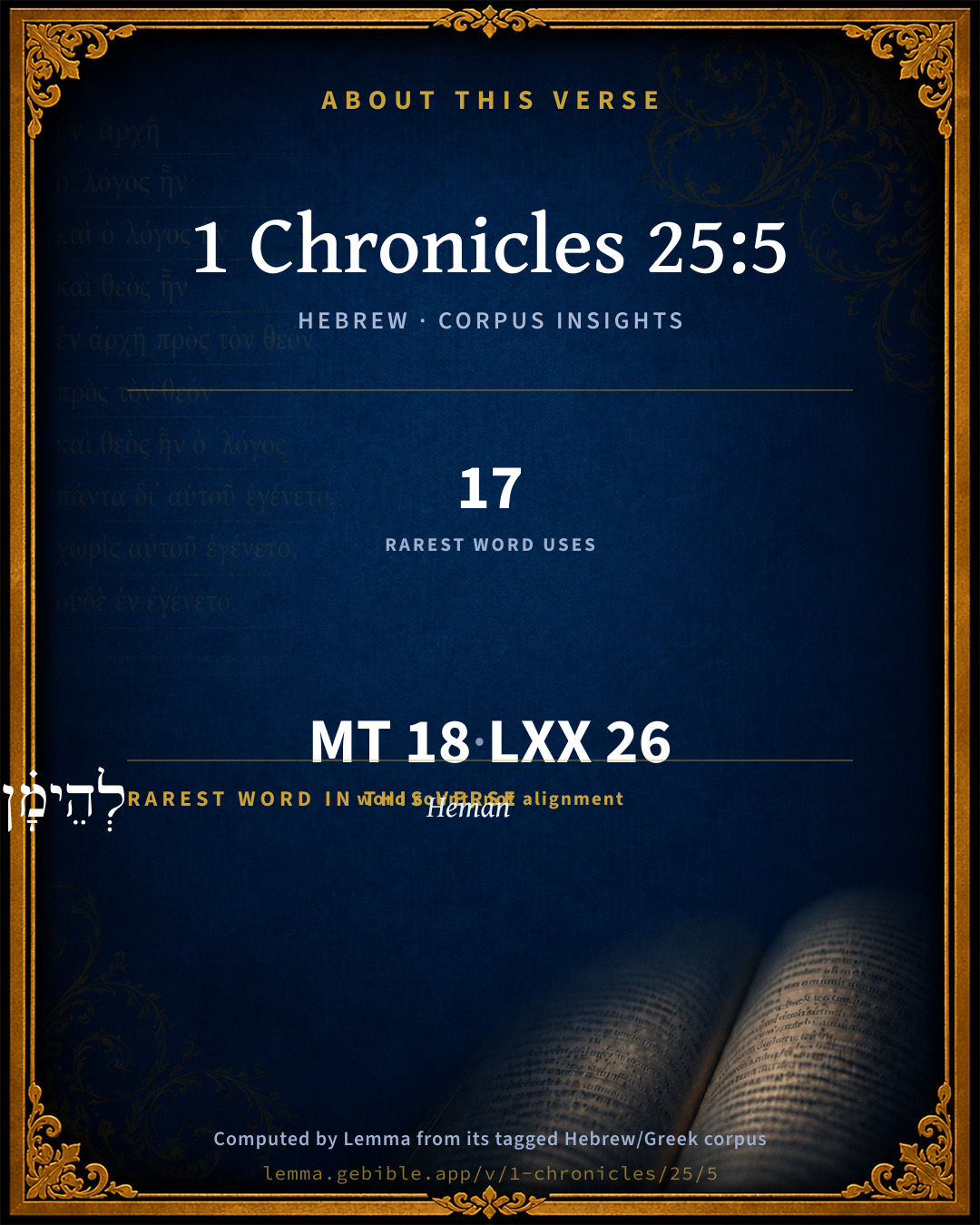
The rarest word here is לְהֵימָ֗ן Heman H1968 — appearing just 17 times in the whole Hebrew Bible.

Shared distinctive vocabulary

לְהֵימָ֗ן Heman H1968 occurs in 15 verses of the Hebrew Bible. Also found in:

Grammatical profile

  • 2 verbs
  • 12 nouns
  • 3 adjectives
  • 1 pronoun

Verb forms

  • לְהָרִ֣ים Hiphil · Infinitive Construct
  • וַיִּתֵּ֨ן Qal · Sequential Imperfect

Repetition

Words recur within this verse — often emphatic in Hebrew:

  • בָנִ֜ים son H1121 ×2
  • לְהֵימָ֗ן Heman H1968 ×2
  • הָאֱלֹהִ֖ים God H430 ×2

Hebrew & Septuagint length

In English translation the verse runs 29 words from the Hebrew and 31 from the Septuagint (LXX English) — closely comparable.

A rough comparison of the two English renderings, which tokenize alike — not a word-level alignment.

Word counts can differ between the Hebrew and the Greek without any difference in meaning — e.g. the Hebrew direct-object marker אֵת has no separate Greek word, and Greek often adds the article ὁ.

In the original languages it is 18 Hebrew tokens and 26 Greek tokens — but the two are counted differently (Hebrew bundles its prefixes and suffixes into one token; the Greek is in lemma form), so that isn’t a like-for-like length.

Cross-references

7

Topical passages linked to 1 Chronicles 25:5 in the Treasury of Scripture Knowledge — connected by theme and wording, ordered by reader-vote popularity; previews shown in the World English Bible.

  • 1 Chronicles 21:9 Yahweh spoke to Gad, David's seer, saying,
  • 1 Samuel 9:9 (In earlier times in Israel, when a man went to inquire of God, thus he said, Come, and let us go to the seer; for he who is now called a Prophet was before called a Seer.)
  • 2 Samuel 24:11 When David rose up in the morning, the word of Yahweh came to the prophet Gad, David's seer, saying,
  • 1 Chronicles 28:5 Of all my sons (for Yahweh has given me many sons), he has chosen Solomon my son to sit on the throne of the kingdom of Yahweh over Israel.
  • Psalms 127:3 Behold, children are a heritage of Yahweh. The fruit of the womb is his reward.
  • Isaiah 8:18 Behold, I and the children whom Yahweh has given me are for signs and for wonders in Israel from Yahweh of Hosts, who dwells in Mount Zion.
  • Genesis 33:5 He lifted up his eyes, and saw the women and the children; and said, "Who are these with you?" He said, "The children whom God has graciously given your servant."

Cross-references courtesy of OpenBible.info (CC BY 4.0).

Hebrew and Greek witnesses Masoretic Hebrew ↔ Greek Septuagint

The same verse in the two great witnesses to the Old Testament, shown verse-for-verse.

These are two independent witnesses, not word-aligned to each other, and the Septuagint is shown in lemma (dictionary) form.

Hebrew 1 Chronicles 25:5 Masoretic · Westminster Leningrad Codex

כָּל אֵ֨לֶּה בָנִ֜ים לְהֵימָ֗ן חֹזֵ֥ה הַמֶּ֛לֶךְ בְּדִבְרֵ֥י הָאֱלֹהִ֖ים לְהָרִ֣ים קָ֑רֶן וַיִּתֵּ֨ן הָאֱלֹהִ֜ים לְהֵימָ֗ן בָּנִ֛ים אַרְבָּעָ֥ה עָשָׂ֖ר וּבָנ֥וֹת שָׁלֽוֹשׁ

All these were the sons of Heman the king's seer in the words of God, to lift up the horn. God gave to Heman fourteen sons and three daughters.

World English Bible · Public Domain

Greek LXX 1 Chronicles 25:5 Septuagint · lemma form

πᾶς οὗτος υἱός ὁ αιμαν ὁ ἀνακρούω ὁ βασιλεύς ἐν λόγος θεός ὑψόω κέρας καί δίδωμι ὁ θεός ὁ αιμαν υἱός δέκα τέσσαρες καί θυγάτηρ τρεῖς

All these were the sons of Aeman the king's chief player in the praises of God, to lift up the horn. And God gave to Aeman fourteen sons, and three daughters.

LXX2012 (modern English Septuagint) · Public Domain

On this verse, The Cambridge Bible for Schools and Colleges discusses the Septuagint’s reading. Read the note in Commentary ↓

Hebrew: Westminster Leningrad Codex (CC BY 4.0). Greek: Septuagint (public domain); English from LXX2012 (modern English Septuagint) (Public Domain). How the Septuagint differs from the Hebrew →

Commentary

Notes on 1 Chronicles 25:5 from classic Christian and Jewish commentators (each source and its license shown beneath its notes). The classic Christian expositions comment on the surrounding passage and are grouped to its opening verse, so a note may address several verses; the Jewish commentaries on the Tanakh (Rashi and others) are per-verse, so they appear only where the commentator wrote on this verse.

Lemma curates 59 commentaries, every one of them public domain or Creative Commons licensed, each selected and text-cleaned for this edition rather than reprinted as found. About our sources →

Trapp's Complete Commentary

John Trapp

1Ch 25:5 All these [were] the sons of Heman the king’s seer in the words of God, to lift up the horn. And God gave to Heman fourteen sons and three daughters.

Ver. 5. The king’s seer.] And, as some think, a psalmographer.

To lift up the horn.] Whereas Asaph and Jeduthun’s task was to sing such psalms chiefly as tended to the instruction and comfort of the people: Heman was appointed to sing such as did set forth the exaltation of David’s, but especially of Christ’s, kingdom: Ad exaltandam potentiam et dignitatem regiam. {a}

{a} Vatab.

John Trapp, A Commentary or Exposition upon All the Books of the Old and New Testament (1647–1656) — public domain. Text from a community e-Sword module.

Joseph Benson's Commentary

1Ch 25:5. The king’s seer — Or prophet. Either he was a prophet as well as a singer; or he is thus called because he prophesied, or praised God, in the sense designed 1Ch 25:1. And he is called the king’s seer, because the king took special delight in him; or because he frequently attended the king in his palace, executing his sacred office there, while the rest were employed in the tabernacle. In the words of God — To sing such divine songs as were inspired by God to the prophets or holy men of God. To lift up the horn — To praise God with the sound of a trumpet, or some other musical instrument made of horn, which, being a martial kind of music, might be most grateful to David’s martial spirit: though he was also skilled in other instruments of music which he used in the house of God.

Joseph Benson's Commentary on the Old and New Testaments (1811–1818) — public domain. Text from a community e-Sword module.

Geneva Bible (1599)

Geneva Bible translators

Or, Prophet.

Or, power, meaning of the king.

Geneva Bible (1599) marginal notes — public domain. Text via Bolls.life.

Jamieson, Fausset & Brown

Robert Jamieson, A. R. Fausset & David Brown

Heman the king's seer--The title of "seer" or "prophet of David" is also given to Gad (Ch1 21:9), and to Jeduthun (Ch2 29:14-15), in the words (Margin, "matters") of God.

to lift up the horn--that is, to blow loudly in the worship of God; or perhaps it means nothing more than that he presided over the wind instruments, as Jeduthun over the harp. Heman had been appointed at first to serve at Gibeon (Ch1 16:41). But his destination seems to have been changed at a subsequent period.

God gave to Heman fourteen sons and three daughters--The daughters are mentioned, solely because from their musical taste and talents they formed part of the choir (Psa 68:25).

Jamieson, Fausset & Brown — Commentary Critical and Explanatory on the Whole Bible (1871) — public domain (CC PDM 1.0). Text via the HelloAO Bible API.

Adam Clarke's Commentary

Verse 5. To lift up the horn] "The horn of prophecy," says Jarchi; "to sound with the trumpet in the words of prophecy before the Lord."-T.

Three daughters.] These also were employed among the singers.

Adam Clarke's Commentary on the Bible (1810–1826) — public domain. Text from a community e-Sword/MySword module.

Ellicott's Commentary for English Readers

(5) All these were the sons of Heman.—Literally, Were sons to Heman.

The king’s seer in the words of God.—Or, in the things of God, in Divine (that is, liturgical) matters. Heman was a prophet as well as a minstrel. (For the connection between music and prophecy, comp. 1Sa_10:5-6; 2Ki_3:15; Exo_15:20.) Comp. also Note on 1Ch_25:1, above.

Seer.—Heb., hôzèh. Literally, gazer. The word rendered “seer” in 1Ch_26:28 and 1Sa_9:9 is different (rô’èh). Gad was called “David’s seer” (1Ch_21:9); so also Jeduthun is “the king’s seer” (2Ch_35:15).

To lift up the horn.—That is, according to Bertheau, “to blow the horns loudly.” With this he connects the preceding phrase, which he renders “by God’s commands.” (Comp. 2Ch_29:15.) But the horn does not appear elsewhere among the instruments of the Temple musicians, and the phrase “to lift up the horn” of a person is a well-known Hebrew metaphor. (Comp. 1Sa_2:10 : “May he give strength to his king, and lift up the horn of his anointed.”) Thus it seems that the meaning is that God gave all these “sons”—i.e., proficient disciples—to Heman in order to strengthen him for his work by providing him with a strong body of able assistants.

And three daughters.—The mention of “three daughters” is interesting, as an indication that women sustained a part in the service of song. (Comp. Exo_15:20; Jdg_11:34; 1Sa_18:6.) The Syriac omits the whole verse.

A Bible Commentary for English Readers, edited by Charles John Ellicott (1878–1897) — public domain. Text from a community e-Sword module.

The Cambridge Bible for Schools and Colleges

gen. ed. J. J. S. Perowne

5. the king’s seer] This title is given to Gad in 1Ch_21:9, and to Asaph, Heman and Jeduthun, all three in 2Ch_35:15 (LXX. not Heb.).

in the words of God] The exact meaning of this is uncertain; it may either mean “in divine things” (i.e. arrangements for worship), or “by divine appointment” (cp. 2Ch_29:15 “by the words of the Lord”).

to lift up the horn] i.e. to make loud blasts upon the horn.

fourteen sons] Corresponding with the fourteen names given in 1Ch_25:4.

The Cambridge Bible for Schools and Colleges (gen. ed. J. J. S. Perowne; Cambridge University Press, 1878–1918) — public domain. Text from a community e-Sword module.

John Gill's Exposition

All these were the sons of Heman, the king's seer,.... The prophet of the king, as the Targum, who was frequently with him, assisting him

in the words of God: in divine things:

to lift up the horn; to blow with the hornpipe or trumpet, and to magnify and set forth the greatness of the kingdom of Israel, and especially of the King Messiah, the horn of salvation, that would be raised up in the house of David:

and God gave to Heman fourteen sons; whose names are before mentioned:

and three daughters; of whom we have no more account, only may observe, that both are the gifts of God, and an heritage from him, Psa 127:3.

John Gill's Exposition of the Whole Bible (1746–1763) — public domain (CC PDM 1.0). Text via the HelloAO Bible API.

Albert Barnes' Notes on the Bible

To lift up the horn - Some take this literally, and consider that Heman and his sons played on the born in the musical services; but there is no other evidence that the horn was so employed. Perhaps the most probable explanation is that it has been transferred from the next clause, where (as here) it followed the word “God,” with the sense that “God, to exalt Heman’s horn (or, increase his dignity), gave him fourteen sons and three daughters.”

Albert Barnes' Notes on the Bible (1834–1885) — public domain. Text from a community e-Sword/MySword module.

Haydock's Catholic Bible Commentary

Seer; a title usually given to the real prophets, who foresee future things. (Menochius) --- Gad has this title, 2 Paralipomenon xxiv. 11. But Heman’s office was to proclaim the words of God, with the sound of the horn. This musician had formerly been fixed at Gabaon, chap. xvi. 41. (Calmet) --- To lift up the horn, or to sing those psalms, which regarded the kingdom of David, and of Christ, as others were composed for the instruction of the people. (Tirinus) --- Daughters. These are specified, only because they joined with their brethren, in singing in the temple. (Abulensis, q. 14.) (Menochius) --- At least, we find that there were bands of young women, in the solemn procession. (Haydock) (Chap. xv. 20., and Psalm lxvii. 26.) (Calmet)

George Leo Haydock (1774–1849), Haydock's Catholic Family Bible and Commentary, 1859 edition — public domain. Excludes Psalms (Douay-Rheims chapter numbering differs from Protestant) and Deuterocanonical books (Catholic canon only).

Matthew Poole's English Annotations

The king’s seer, or prophet, which is the same thing, 1Sa 9:9. Either he was a prophet as well as a singer; or he is thus called because he prophesied in the sense designed, 1Ch 25:1. And he is called the king’s seer, either because the king took special delight in him, or because he frequently attended upon the king in his palace, executing his sacred office there, while the rest were constantly employed in the tabernacle. In the words of God, i.e. to sing such Divine songs as were inspired by God to the prophets or holy men of God. To lift up the horn; either,

1. Metaphorically, to extol and praise God for exalting

the horn (i.e. the power and kingdom) of David; of which phrase see Psa 92:10; Psa 132:17. Or rather,

2. Properly, to praise God with the sound of a trumpet, (as was usual, as 2Ch 5:12; 13:12) or some other musical instrument made of horn, which being a martial kind of music, might be most grateful to David’s martial spirit; though he was also skilled in other instruments of music, which he used in the house of God, as is expressed in the next verse.

Matthew Poole's English Annotations on the Holy Bible (1683–1685) — public domain. Text from a community e-Sword/MySword module.

Whedon's Commentary on the Bible

Daniel D. Whedon

5. Heman the king’s seer in the words of God — Besides his musical talent, Heman had also the gift of revelation, to make known to the king the things of God. Asaph and Jeduthun were also seers. 2Ch_29:30; 2Ch_35:15.

To lift up the horn — The expression is obscure as it stands in the present text. Some understand it of the use of the horn in the musical service, but as the horn is not named among the instruments used by these Levites, some of the best expositors connect the phrase with what follows, and explain it in the metaphorical sense of increasing one’s power. For this sense of the words comp. 1Sa_2:10; Psa_148:14; Lam_2:17. So, to increase Heman’s power and honour God “gave” him “fourteen sons and three daughters.”

Daniel D. Whedon (gen. ed.), Commentary on the Old and New Testaments (1874–1909) — public domain. Text from a community e-Sword module.

The Pulpit Commentary

For the expression, the king"s seer, and as other instances of the office, see 1Ch_21:9; 2Ch_35:15, in neither of which places, however, have we the attendant phrase, in the words of God. Yet we have the same sense strictly implied in 1Ch_21:9, 1Ch_21:19. The expression needs not to be generalized into "in the matters ofGod," but evidently describes the seer (Heman, Gad, or Jeduthun) as the authorized medium of verbal communication between God and the king. There is difficulty in assigning the right place of the clause, to lift up the horn. There can be no doubt at all that it contains no allusion whatever to the horn as an instrument of sound (the almost solitary approach to which use of the word is found in, Jos_6:5) but that it falls in with the very frequent figurative use of the phrase as it occurs in the very same words (Psa_75:5, 6 89:18, 25 92:12 112:9; 1Sa_2:1, 1Sa_2:10, etc.) and which means "to add to the strength" or "honour" of any one. The allusion is to the number of Heman"s children being a mark of the honour God set on him. The words cannot go with the latter part of the verse, while the conjunction (vav) in TeYiw opens it. The possible order may be,

All these sons were to Heman, the kings seer, by the words of God, to lift up the horn. The absence of the third personal pronoun suffix to rq, is noticeable, place the clause where we will The statement of the fourteen sons and three daughters belonging to Heman, in this verse, shows that up to this point the word "sons" is used in its stricter sense, however true it may be that the sense is amplified in vers. 10-31.

The Pulpit Commentary (1880–1919), ed. H.D.M. Spence-Jones & Joseph S. Exell — public domain. Text from a community e-Sword module.

John Wesley's Explanatory Notes

The king's seer - He is called the king's seer, either because the king took special delight in him; or because he frequently attended the king in his palace, executing his sacred office there, while the rest were employed in the tabernacle. In the words - To sing Divine songs as were inspired by God to the prophets or holy men of God. The horn - To praise God with the sound of a trumpet or some other musical instrument made of horn, which being a martial kind of music, might be most grateful to David's martial spirit: tho' he was also skilled in other instruments of music which he used in the house of God.

John Wesley, Explanatory Notes Upon the Whole Bible (1754–1765) — public domain. Text via the GEBible commentary corpus.

Keil & Delitzsch

C. F. Keil & F. Delitzsch

All these were the sons of Heman, the king's seer,.... The prophet of the king, as the Targum, who was frequently with him, assisting him

in the words of God: in divine things:

to lift up the horn; to blow with the hornpipe or trumpet, and to magnify and set forth the greatness of the kingdom of Israel, and especially of the King Messiah, the horn of salvation, that would be raised up in the house of David:

and God gave to Heman fourteen sons; whose names are before mentioned:

and three daughters; of whom we have no more account, only may observe, that both are the gifts of God, and an heritage from him, Psa 127:3.

Keil & Delitzsch — Biblical Commentary on the Old Testament (1861–1891) — public domain (CC PDM 1.0). Text via the HelloAO Bible API. (Old Testament only.)

Rashi

Rabbi Shlomo Yitzchaki (Rashi)

the king’s seer, in words of God to raise the horn the horn of the prophecy, for he would prophesy for the king. A similar instance of this is (I Sam. 2:10): “... and raise the horn of His anointed one.”

and God gave Heman Had not God given him children, it would have been impossible for him to have fourteen sons and three daughters, with all of them fit to be chiefs of watches. A similar case is (Ruth 4:13): “... and the Lord gave her conception, and she bore a son.” Had not this been a gift from the Lord, it would have been impossible for Boaz to father a son, because he was old. Similarly, (Deut. 34:1): “and the Lord showed him all the land.” Had this vision not been from the Lord, it would have been impossible to see so far.

Rashi on the Tanakh — English translations: “The Judaica Press complete Tanach with Rashi, translated by A. J. Rosenberg” (CC BY 4.0); “Pentateuch with Rashi's commentary by M. Rosenbaum and A.M. Silbermann, 1929-1934” (public domain); “The Metsudah Tanach series, Lakewood, N.J” (CC BY 4.0); and “The Book of Joshua, Metsudah Publications, 1997” (CC BY 4.0). Text via Sefaria.

Lesson kit

Teaching starters — assembled from the data on this page, not authored interpretation. Every prompt links to the verse data it draws on. Edit before teaching.

1 Chronicles, in the Historical, opens this verse with 18 words (15 distinct Hebrew lemmas). Its most distinctive word is Hêymân (“Heman”). A historical commentator’s framing appears above. Read the whole chapter for the surrounding context.

Discussion questions

  1. What does “Heman” (Hêymân) contribute to the verse as a whole?
  2. How does 1 Kings 4:31, which shares the word «Heman», read alongside this verse?
  3. What does the repetition of “son” (2× in this one verse) do in this verse?
  4. The translations on this page render this verse differently — a whole-verse word diff, not a word-by-word alignment. What might account for the different wordings?
  5. «לְהָרִ֣ים» is a Hiphil Infinitive Construct verb. How does that grammatical form shape the action described?
  6. Compare how Trapp's Complete Commentary and Joseph Benson's Commentary read this verse. Where do they agree or differ?

Things to notice

Reading settings

Reading text

Shown beneath each verse's original-language words.

Old Testament
Old Testament edition

Read the OT as the Masoretic Hebrew (MT) or the Greek Septuagint (LXX).

English shown for the Greek Septuagint (in the Hebrew ↔ Greek comparison).

Comparing translations? Open the Compare panel on any verse page to stack up to four side by side.