Psalms 89:19

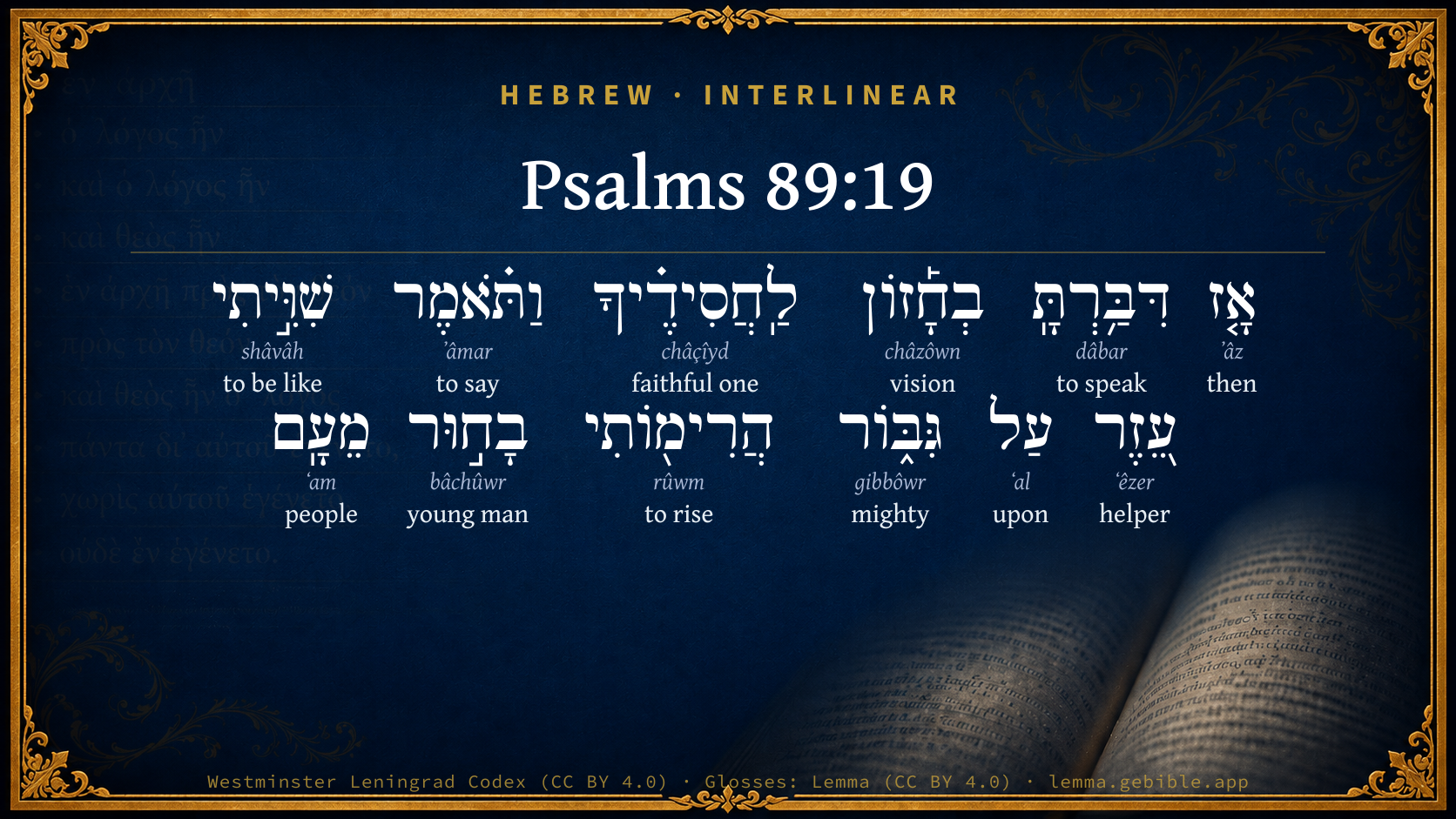
Hebrew (Westminster Leningrad Codex) Psalms 89:19 appears in the Hebrew Old Testament. The text above is from the Westminster Leningrad Codex. Each word links to its Strong’s number, a concise gloss, and parsing drawn from the Open Scriptures Hebrew Bible morphology. Click any word for its full Brown-Driver-Briggs (BDB) entry.
Download image
Cite this verse

Psalms 89:19 (World English Bible). Public Domain. Lemma interlinear Bible study tool, https://lemma.gebible.app/v/psalms/89/19.

Show BibTeX & RIS
BibTeX
RIS
English Translation
Then you spoke in vision to your saints, And said, "I have bestowed strength on the warrior. I have exalted a young man from the people.
World English Bible · Public Domain
Download a study sheet

One document with this verse’s original text, its word-by-word gloss line, the meaning frame, cross-references with their text, attributed commentary, and full source and license credits — printable, and it pastes into notes with its structure intact.

This verse Autodidact and up

Study sheet (.html) Plain text (.txt)

A passage Seminary Student

Up to 50 verses in one chapter. A passage sheet keeps up to 6 commentary sources and 12 cross-references per verse, in the order this page ranks them, and says so on the sheet whenever that leaves anything out. Ask for a single verse and you get the Autodidact verse sheet above.

Everything on this page stays free to read, with no account — the sheet is a download of what is already on screen, not access to it.

Want to remove ads? Support Godless Engineer
Compare translations 3

The same verse in 3 English versions, stacked beneath the original-language interlinear above. Click any original word for its lexicon entry.

Each is an independent rendering of the whole verse — the interlinear is not word-aligned to these translations.

Highlighted words mark where these versions differ — a whole-verse word diff, not a word-by-word alignment.

  • World English Bible Public Domain
    Then you spoke in vision to your saints, And said, "I have bestowed strength on the warrior. I have exalted a young man from the people.
  • King James Version Public Domain
    Then thou spakest in vision to thy holy one, and saidst, I have laid help upon one that is mighty; I have exalted one chosen out of the people.
  • unfoldingWord Literal Text CC BY-SA 4.0
    Then you spoke in a vision to your faithful ones and said, “I have placed help on a warrior; I have raised up a chosen one from the people.

unfoldingWord Literal Text — © unfoldingWord, licensed CC BY-SA 4.0. Word-aligned USFM3 via Door43 (git.door43.org/unfoldingWord/en_ult).

Versions to compare (up to 4)

3 of 4 selected

Show all 18 translations

Every available English version of this verse, each an independent rendering of the whole verse.

  • World English Bible Public Domain
    Then you spoke in vision to your saints, And said, "I have bestowed strength on the warrior. I have exalted a young man from the people.
  • Berean Standard Bible Public Domain
    You once spoke in a vision; to Your godly ones You said, “I have bestowed help on a warrior; I have exalted one chosen from the people.
  • Majority Standard Bible Public Domain
    You once spoke in a vision; to Your godly ones You said, “I have bestowed help on a warrior; I have exalted one chosen from the people.
  • King James Version Public Domain
    Then thou spakest in vision to thy holy one, and saidst, I have laid help upon one that is mighty; I have exalted one chosen out of the people.
  • American Standard Version (1901) Public Domain
    Then thou spakest in vision to thy saints, And saidst, I have laid help upon one that is mighty; I have exalted one chosen out of the people.
  • Revised Version (1885) Public Domain
    Then thou spakest in vision to thy saints, and saidst, I have laid help upon one that is mighty; I have exalted one chosen out of the people.
  • Geneva Bible (1599) Public Domain
    Thou spakest then in a vision vnto thine Holy one, and saydest, I haue layde helpe vpon one that is mightie: I haue exalted one chosen out of the people.
  • Douay-Rheims (1899) Public Domain
    For our protection is of the Lord, and of our king the holy one of Israel.
  • Young's Literal Translation Public Domain
    Then Thou hast spoken in vision, To Thy saint, yea, Thou sayest, I have placed help upon a mighty one, Exalted a chosen one out of the people,
  • Literal Standard Version CC BY-SA 4.0
    Then You have spoken in vision, || To Your saint, indeed, || You say, I have placed help on a mighty one, || Exalted a chosen one out of the people,
  • Unlocked Literal Bible CC BY-SA 4.0
    Long ago you spoke in a vision to your faithful ones; you said, “I have set a crown on a mighty one.” I have raised up one chosen from among the people.
  • unfoldingWord Literal Text CC BY-SA 4.0
    Then you spoke in a vision to your faithful ones and said, “I have placed help on a warrior; I have raised up a chosen one from the people.
  • Darby Bible Public Domain
    Then thou spakest in vision of thy Holy One, and saidst, I have laid help upon a mighty one; I have exalted one chosen out of the people.
  • World Messianic Bible Public Domain
    Then you spoke in vision to your holy ones, and said, “I have given strength to the warrior. I have exalted a young man from the people.
  • Webster's Bible Public Domain
    \\89:18\\For the LORD is our defense; and the Holy One of Israel is our king.
  • Free Bible Version CC BY-SA 4.0
    Once you spoke in a vision to your faithful servant and said, “I have given strength to the warrior I have chosen from the people to become king.
  • Bible in Basic English Public Domain
    Then your voice came to your holy one in a vision, saying, I have put the crown on a strong one, lifting up one taken from among the people.
  • JPS Tanakh (1917) Public Domain
    (89-20) Then Thou spokest in vision to Thy godly ones, and saidst: 'I have laid help upon one that is mighty; I have exalted one chosen out of the people.

Literal Standard Version (2020), Covenant Press — licensed CC BY-SA 4.0. Text via the HelloAO Bible API (eBible.org). Unlocked Literal Bible (unfoldingWord) — licensed CC BY-SA 4.0. Text via the HelloAO Bible API (eBible.org). unfoldingWord Literal Text — © unfoldingWord, licensed CC BY-SA 4.0. Word-aligned USFM3 via Door43 (git.door43.org/unfoldingWord/en_ult). Free Bible Version, Dr. Jonathan Gallagher — licensed CC BY-SA 4.0. Text via the HelloAO Bible API (eBible.org).

Word by word

More ways to search: Search by grammar → Find every occurrence → Compare this word →

Practice this passage: Drill this verse → Learn its vocabulary →

שִׁוִּ֣יתִי
shâvâh
H7737
“to be like”
Verb, Piel, Perfect, 1st Person, Common, Singular
Part of Speech
Verb
Stem
Piel
Form
Perfect
Person
1st Person
Gender
Common
Number
Singular
Full BDB Definition

Origin: a primitive root

TWOT: 2342 , 2343

to agree with, be or become like, level, resemble - (Qal) - to be like - equivalent (participle) - to set, place - setting (participle) - (Piel) to level, smooth, still - (Hiphil) to make like - (Nithpael) to be alike - (Piel) to set, place
  1. אָ֤ז ʼâz H227 “then” Adverb
  2. דִּבַּ֥רְתָּֽ dâbar H1696 “to speak” Verb, Piel, Perfect, 2nd Person, Masculine, Singular
  3. בְחָ֡זוֹן châzôwn H2377 “in/at · vision” Preposition + Noun, Common, Masculine, Singular, Absolute
  4. לַֽחֲסִידֶ֗יךָ châçîyd H2623 “to/for · faithful one · your” Preposition + Adjective, Adjective, Masculine, Plural, Construct + Suffix, Personal, 2nd Person, Masculine, Singular
  5. וַתֹּ֗אמֶר ʼâmar H559 “and · to say” Conjunction + Verb, Qal, Sequential Imperfect, 2nd Person, Masculine, Singular
  6. עֵ֭זֶר ʻêzer H5828 “helper” Noun, Common, Masculine, Singular, Absolute
  7. עַל ʻal H5921 “upon” Preposition
  8. גִּבּ֑וֹר gibbôwr H1368 “mighty” Adjective, Adjective, Masculine, Singular, Absolute
  9. הֲרִימ֖וֹתִי rûwm H7311 “to rise” Verb, Hiphil, Perfect, 1st Person, Common, Singular
  10. בָח֣וּר bâchûwr H970 “young man” Verb, Qal, Participle Passive, Masculine, Singular, Absolute
  11. מֵעָֽם ʻam H5971 “from · people” Preposition + Noun, Common, Masculine, Singular, Absolute

About this verse

These counts appear in no published source. They are computed here, from the morphology-tagged text and Lemma’s own curated glosses. What Lemma adds →

12
words
12
distinct lemmas
Wisdom
section

Notable vocabulary

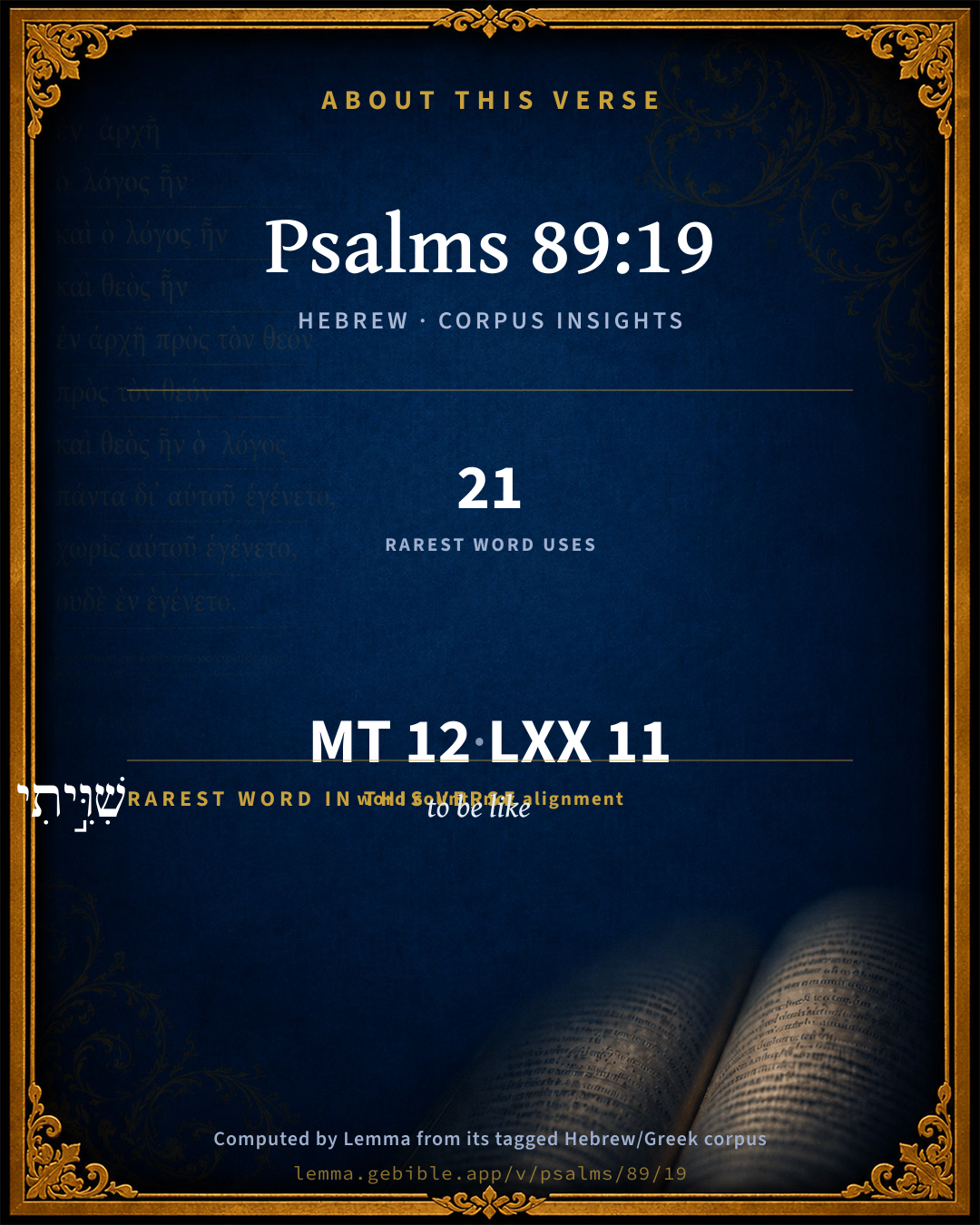
The rarest word here is שִׁוִּ֣יתִי to be like H7737 — appearing just 21 times in the whole Hebrew Bible.

Shared distinctive vocabulary

שִׁוִּ֣יתִי to be like H7737 occurs in 21 verses of the Hebrew Bible. Also found in:

Grammatical profile

  • 5 verbs
  • 3 nouns
  • 2 adjectives
  • 1 preposition
  • 1 adverb

Verb forms

  • דִּבַּ֥רְתָּֽ Piel · Perfect
  • וַתֹּ֗אמֶר Qal · Sequential Imperfect
  • שִׁוִּ֣יתִי Piel · Perfect
  • הֲרִימ֖וֹתִי Hiphil · Perfect
  • בָח֣וּר Qal · Participle Passive

Hebrew & Septuagint length

In English translation the verse runs 26 words from the Hebrew and 27 from the Septuagint (LXX English) — closely comparable.

A rough comparison of the two English renderings, which tokenize alike — not a word-level alignment.

Word counts can differ between the Hebrew and the Greek without any difference in meaning — e.g. the Hebrew direct-object marker אֵת has no separate Greek word, and Greek often adds the article ὁ.

In the original languages it is 12 Hebrew tokens and 11 Greek tokens — but the two are counted differently (Hebrew bundles its prefixes and suffixes into one token; the Greek is in lemma form), so that isn’t a like-for-like length.

Cross-references

16

Topical passages linked to Psalms 89:19 in the Treasury of Scripture Knowledge — connected by theme and wording, ordered by reader-vote popularity; previews shown in the World English Bible.

  • 1 Samuel 16:18 Then answered one of the young men, and said, Behold, I have seen a son of Jesse the Bethlehemite, who is skillful in playing, and a mighty man of valor, and a man of war, and prudent in speech, and a comely person; and Yahweh is with him.
  • 1 Kings 11:34 However I will not take the whole kingdom out of his hand; but I will make him prince all the days of his life, for David my servant's sake whom I chose, who kept my commandments and my statutes;
  • Psalms 89:3 "I have made a covenant with my chosen one, I have sworn to David, my servant,
  • Isaiah 9:6 For to us a child is born, to us a son is given; and the government shall be on his shoulder: and his name shall be called Wonderful, Counselor, Mighty God, Everlasting Father, Prince of Peace.
  • Philippians 2:6–11 who, existing in the form of God, didn't consider it robbery to be equal with God,
  • Hebrews 2:9–17 But we see him who has been made a little lower than the angels, Jesus, because of the suffering of death crowned with glory and honor, that by the grace of God he should taste of death for everyone.
  • 1 Samuel 16:1 Yahweh said to Samuel, How long will you mourn for Saul, seeing I have rejected him from being king over Israel? fill your horn with oil, and go: I will send you to Jesse the Bethlehemite; for I have provided me a king among his sons.
  • 2 Samuel 7:8–17 Now therefore thus shall you tell my servant David, Thus says Yahweh of Hosts, I took you from the sheep pen, from following the sheep, that you should be prince over my people, over Israel;
  • 2 Samuel 17:10 Even he who is valiant, whose heart is as the heart of a lion, will utterly melt; for all Israel knows that your father is a mighty man, and those who are with him are valiant men.
  • Psalms 42:3 My tears have been my food day and night, While they continually ask me, "Where is your God?"
  • Jeremiah 30:21 Their prince shall be of themselves, and their ruler shall proceed from the midst of them; and I will cause him to draw near, and he shall approach to me: for who is he who has had boldness to approach to me? says Yahweh.
  • Mark 1:24 saying, "Ha! What do we have to do with you, Jesus, you Nazarene? Have you come to destroy us? I know you who you are: the Holy One of God!"
  • Luke 1:70 (As he spoke by the mouth of his holy prophets who have been from of old),
  • 2 Peter 1:21 For no prophecy ever came by the will of man: but holy men of God spoke, being moved by the Holy Spirit.
  • 2 Peter 3:2 that you should remember the words which were spoken before by the holy prophets, and the commandments of us, the apostles of the Lord and Savior:
  • Revelation 3:7 "To the angel of the assembly in Philadelphia write: "He who is holy, he who is true, he who has the key of David, he who opens and no one can shut, and who shuts and no one opens, says these things:

Cross-references courtesy of OpenBible.info (CC BY 4.0).

Hebrew and Greek witnesses Masoretic Hebrew ↔ Greek Septuagint

The same verse in the two great witnesses to the Old Testament, shown verse-for-verse.

You’re reading Greek Psalm 88 (Hebrew Psalm 89). The Septuagint counts the superscription, so verse numbers can differ from the Hebrew — chapter-level alignment, not verse-by-verse. Numbering follows Rahlfs.

These are two independent witnesses, not word-aligned to each other, and the Septuagint is shown in lemma (dictionary) form.

Hebrew Psalms 89:19 Masoretic · Westminster Leningrad Codex

אָ֤ז דִּבַּ֥רְתָּֽ בְחָ֡זוֹן לַֽחֲסִידֶ֗יךָ וַתֹּ֗אמֶר שִׁוִּ֣יתִי עֵ֭זֶר עַל גִּבּ֑וֹר הֲרִימ֖וֹתִי בָח֣וּר מֵעָֽם

Then you spoke in vision to your saints, And said, "I have bestowed strength on the warrior. I have exalted a young man from the people.

World English Bible · Public Domain

Greek LXX Greek Psalm 88:19 Septuagint · lemma form

ὅτι ὁ κύριος ὁ ἀντίληψις καί ὁ ἅγιος ἰσραήλ βασιλεύς ἐγώ

Then you spoke in vision to your children, and said, I have laid help on a mighty one; I have exalted one chosen out of my people.

LXX2012 (modern English Septuagint) · Public Domain

On this verse, Ellicott's Commentary for English Readers discusses the Septuagint’s reading. Read the note in Commentary ↓

Hebrew: Westminster Leningrad Codex (CC BY 4.0). Greek: Septuagint (public domain); English from LXX2012 (modern English Septuagint) (Public Domain). How the Septuagint differs from the Hebrew →

Commentary

Notes on Psalms 89:19 from classic Christian and Jewish commentators (each source and its license shown beneath its notes). The classic Christian expositions comment on the surrounding passage and are grouped to its opening verse, so a note may address several verses; the Jewish commentaries on the Tanakh (Rashi and others) are per-verse, so they appear only where the commentator wrote on this verse.

Lemma curates 59 commentaries, every one of them public domain or Creative Commons licensed, each selected and text-cleaned for this edition rather than reprinted as found. About our sources →

Matthew Henry's Commentary

The covenant God made with David and his seed was mentioned before (Psa 89:3, Psa 89:4); but in these verses it is enlarged upon, and pleaded with God, for favour to the royal family, now almost sunk and ruined; yet certainly it looks at Christ, and has its accomplishment in him much more than in David; nay, some passages here are scarcely applicable at all to David, but must be understood of Christ only (who is therefore called David our king, Hos 3:5), and very great and precious promises they are which are here made to the Redeemer, which are strong foundations for the faith and hope of the redeemed to build upon. The comforts of our redemption flow from the covenant of redemption; all our springs are in that, Isa 55:3. I will make an everlasting covenant with you, even the sure mercies of David, Act 13:34. Now here we have an account of those sure mercies. Observe,

I. What assurance we have of the truth of the promise, which may encourage us to build upon it. We are here told, 1. How it was spoken (Psa 89:19): Thou didst speak in vision to thy Holy One. God's promise to David, which is especially referred to here, was spoken in vision to Nathan the prophet, Sa2 7:12-17. Then, when the Holy One of Israel was their king (Psa 89:18), he appointed David to be his viceroy. But to all the prophets, those holy ones, he spoke in vision concerning Christ, and to him himself especially, who had lain in his bosom from eternity, and was made perfectly acquainted with the whole design of redemption, Mat 11:27. 2. How it was sworn to and ratified (Psa 89:35): Once have I sworn by my holiness, that darling attribute. In swearing by his holiness, he swore by himself; for he will as soon cease to be as be otherwise than holy. His swearing once is enough; he needs not swear again, as David did (Sa1 20:17); for his word and oath are two immutable things. As Christ was made a priest, so he was made a king, by an oath (Heb 7:21); for his kingdom and priesthood are both unchangeable.

II. The choice made of the person to whom the promise is given, Psa 89:19, Psa 89:20. David was a king of God's own choosing, so is Christ, and therefore both are called God's kings, Psa 2:6. David was mighty, a man of courage and fit for business; he was chosen out of the people, not out of the princes, but the shepherds. God found him out, exalted him, laid help upon him, and ordered Samuel to anoint him. But this is especially to be applied to Christ. 1. He is one that is mighty, every way qualified for the great work he was to undertake, able to save to the uttermost - mighty in strength, for he is the Son of God - mighty in love, for he is able experimentally to compassionate those that are tempted. He is the mighty God, Isa 9:6. 2. He is chosen out of the people, one of us, bone of our bone, that takes part with us of flesh and blood. Being ordained for men, he is taken from among men, that his terror might not make us afraid. 3. God has found him. He is a Saviour of God's own providing; for the salvation, from first to last, is purely the Lord's doing. He has found the ransom, Job 33:24. We could never have found a person fit to undertake this great work, Rev 5:3, Rev 5:4. 4. God has laid help upon him, not only helped him, but treasured up help in him for us, laid it as a charge upon him to help fallen man up again, to help the chosen remnant to heaven. In me is thy help, Hos 13:9. 5. He has exalted him, by constituting him the prophet, priest, and king of his church, clothing him with power, raising him from the dead, and setting him at his own right hand. Whom God chooses and uses he will exalt. 6. He has anointed him, has qualified him for his office, and so confirmed him in it, by giving him the Spirit, not by measure, but without measure, infinitely above his fellows. He is called Messiah, or Christ, the Anointed. 7. In all this he designed him to be his own servant, for the accomplishing of his eternal purpose and the advancement of the interests of his kingdom among men.

III. The promises made to this chosen one, to David in the type and the Son of David in the antitype, in which not only gracious, but glorious things are spoken of him.

1. With reference to himself, as king and God's servant: and what makes for him makes for all his loving subjects. It is here promised, (1.) That God would stand by him and strengthen him in his undertaking (Psa 89:21): With him my hand not only shall be, but shall be established, by promise, shall be so established that he shall by it be established and confirmed in all his offices, so that none of them shall be undermined and overthrown, though by the man of sin they shall all be usurped and fought against. Christ had a great deal of hard work to do and hard usage to go through; but he that gave him commission gave him forces sufficient for the execution of his commission: "My arm also shall strengthen him to break through and bear up under all his difficulties." No good work can miscarry in the hand of those whom God himself undertakes to strengthen. (2.) That he should be victorious over his enemies, that they should not encroach upon him (Psa 89:22): The son of wickedness shall not exact upon him, nor afflict him. He that at first broke the peace would set himself against him that undertook to make peace, and do what he could to blast his design: but he could only reach to bruise his heel; further he could not exact upon him nor afflict him. Christ became a surety for our debt, and thereby Satan and death thought to gain advantage against him; but he satisfied the demands of God's justice, and then they could not exact upon him. The prince of this world cometh, but he has nothing in me, Joh 14:30. Nay, they not only shall not prevail against him, but they shall fall before him (Psa 89:23): I will bend down his foes before his face; the prince of this world shall be cast out, principalities and powers spoiled, and he shall be the death of death itself, and the destruction of the grave, Hos 13:14. Some apply this to the ruin which God brought upon the Jewish nation, that persecuted Christ and put him to death. But all Christ's enemies, who hate him and will not have him to reign over them, shall be brought forth and slain before him, Luk 19:27. (3.) That he should be the great trustee of the covenant between God and men, that God would be gracious and true to us (Psa 89:24): My faithfulness and my mercy shall be with him. They were with David; God continued merciful to him, and so approved himself faithful. They were with Christ; God made good all his promises to him. But that is not all; God's mercy to us, and his faithfulness to us, are with Christ; he is not only pleased with him, but with us in him; and it is in him that all the promises of God are yea and amen. So that if any poor sinners hope for benefit by the faithfulness and mercy of God, let them know it is with Christ; it is lodged in his hand, and to him they must apply for it (Psa 89:28): My mercy will I keep for him, to be disposed of by him, for evermore; in the channel of Christ's mediation all the streams of divine goodness will for ever run. Therefore it is the mercy of our Lord Jesus Christ which we look for unto eternal life, Jde 1:21; Joh 17:2. And, as the mercy of God flows to us through him, so the promise of God is, through him, firm to us: My covenant shall stand fast with him, both the covenant of redemption made with him and the covenant of grace made with us in him. The new covenant is therefore always new, and firmly established, because it is lodged in the hands of a Mediator, Heb 8:6. The covenant stands fast, because it stands upon this basis. And this redounds to the everlasting honour of the Lord Jesus, that to him the great cause between God and man is entirely referred and the Father has committed all judgment to him, that all men might honour him (Joh 5:22, Joh 5:23); therefore it is here said, In my name shall his horn be exalted; this shall be his glory, that God's name is in him (Exo 23:21), and that he acts in God's name. As the Father gave me commandment, so I do. (4.) That his kingdom should be greatly enlarged (Psa 89:25): I will set his hand in the sea (he shall have the dominion of the seas, and the isles of the sea), and his right hand in the rivers, the inland countries that are watered with rivers. David's kingdom extended itself to the Great Sea, and the Red Sea, to the river of Egypt and the river Euphrates. But it is in the kingdom of the Messiah that this has its full accomplishment, and shall have more and more, when the kingdoms of this world shall become the kingdoms of the Lord and of his Christ (Rev 11:15), and the isles shall wait for his law. (5.) That he should own God as his Father, and God would own him as his Son, his firstborn, Psa 89:26, Psa 89:27. This is a comment upon these words in Nathan's message concerning Solomon (for he also was a type of Christ as well as David), I will be his Father and he shall be my Son (Sa2 7:14), and the relation shall be owned on both sides. [1.] He shall cry unto me, Thou art my Father. It is probable that Solomon did so; but we are sure Christ did so, in the days of his flesh, when he offered up strong cries to God, and called him holy Father, righteous Father, and taught us to address ourselves to him as our Father in heaven. Christ, in his agony, cried unto God, Thou art my Father (Mat 26:39, Mat 26:42, O my Father), and, upon the cross, Father, forgive them; Father, into thy hands I commend my spirit. He looked upon him likewise as his God, and therefore he perfectly obeyed him, and submitted to his will in his whole undertaking (he ismy God and your God, Joh 20:17), and as the rock of his salvation, who would bear him up and bear him out in his undertaking, and make him more than a conqueror, even a complete Saviour; and therefore with an undaunted resolution he endured the cross, despising the shame, for he knew he should be both justified and glorified. [2.] I will make him my firstborn. I see not how this can be applied to David; it is Christ's prerogative to be the firstborn of every creature, and, as such, the heir of all things, Col 1:15; Heb 1:2, Heb 1:6. When all power was given to Christ both in heaven and in earth, and all things were delivered unto him by the Father, then god made him his firstborn, and far higher, more great and honourable, than the kings of the earth; for he is the King of kings, angels, authorities, and powers, being made subject to him, Pe1 3:22.

2. With reference to his seed. God's covenants always took in the seed of the covenanters; this does so (Psa 89:29, Psa 89:36): His seed shall endure for ever, and with it his throne. Now this will be differently understood according as we apply it to Christ or David.

(1.) If we apply it to David, by his seed we are to understand his successors, Solomon and the following kings of Judah, who descended from the loins of David. It is supposed that they might degenerate, and not walk in the spirit and steps of their father David; in such a case they must expect to come under divine rebukes, such as the house of David was at this time under, Psa 89:38. But let this encourage them, that, though they were corrected, they should not be abandoned or disinherited. This refers to that part of Nathan's message (Sa2 7:14, Sa2 7:15), If he commit iniquity, I will chasten him, but my mercy shall not depart from him. Thus far David's seed and throne did endure for ever, that, notwithstanding the wickedness of many of his posterity, who were the scandals of his house, yet his family continued, and continued in the imperial dignity, a very long time, - that, as long as Judah continued a kingdom, David's posterity were kings of it, and the royalty of that kingdom was never in any other family, as that of the ten tribes was, in Jeroboam's first, then in Baasha's, etc., - and that the family of David continued a family of distinction till that Son of David came whose throne should endure for ever; see Luk 1:27, Luk 1:32; Luk 2:4, Luk 2:11. If David's posterity, in after-times, should forsake God and their duty and revolt to the ways of sin, God would bring desolating judgments upon them and ruin the family; and yet he would not take away his lovingkindness from David, nor break his covenant with him; for, in the Messiah, who should come out of his loins, all these promises shall have their accomplishment to the full. Thus, when the Jews were rejected, the apostle shows that God's covenant with Abraham was not broken, because it was fulfilled in his spiritual seed, the heirs of the righteousness of faith, Rom 11:7.

(2.) If we apply it to Christ, by his seed we are to understand his subjects, all believers, his spiritual seed, the children which God has given him, Heb 2:13. This is that seed which shall be made to endure for ever, and his throne in the midst of them, in the church in the heart, as the days of heaven. To the end Christ shall have a people in the world to serve and honour him. He shall see his seed; he shall prolong his days. This holy seed shall endure for ever in a glorified state, when time and days shall be no more; and thus Christ's throne and kingdom shall be perpetuated: the kingdom of his grace shall continue through all the ages of time and the kingdom of his glory to the endless ages of eternity.

[1.] The continuance of Christ's kingdom is here made doubtful by the sins and afflictions of his subjects; their iniquities and calamities threaten the ruin of it. This case is here put, that we may not be offended when it comes to be a case in fact, but that we may reconcile it with the stability of the covenant and be assured of that notwithstanding. First, It is here supposed that there will be much amiss in the subjects of Christ's kingdom. His children may forsake God's law (Psa 89:30) by omissions, and break his statutes (Psa 89:31) by commissions. There are spots which are the spots of God's children, Deu 32:5. Many corruptions there are in the bowels of the church, as well as in the hearts of those who are the members of it, and these corruptions break out. Secondly, They are here told that they must smart for it (Psa 89:32): I will visit their transgression with a rod, their transgression sooner than that of others. You only have I known, and therefore I will punish you, Amo 3:2. Their being related to Christ shall not excuse them from being called to an account. But observe what affliction is to God's people. 1. It is but a rod, not an axe, not a sword; it is for correction, not for destruction. This denotes gentleness in the affliction; it is the rod of men, such a rod as men use in correcting their children; and it denotes a design of good in and by the affliction, such a rod as yields the peaceable fruit of righteousness. 2. It is a rod on the hand of God (I will visit them), he who is wise, and knows what he does, gracious, and will do what is best. 3. It is a rod which they shall never feel the smart of but when there is great need: If they break my law, then I will visit their transgression with the rod, but not else. Then it is requisite that God's honour be vindicated, and that they be humbled and reduced.

[2.] The continuance of Christ's kingdom is made certain by the inviolable promise and oath of God, notwithstanding all this (Psa 89:33): Nevertheless, my kindness will I not totally and finally take from him. First, "Notwithstanding their provocations, yet my covenant shall not be broken." Note, Afflictions are not only consistent with covenant-love, but to the people of God they flow from it. Though David's seed be chastened, it does not follow that they are disinherited; they may be cast down, but they are not cast off. God's favour is continued to his people, 1. For Christ's sake; in him the mercy is laid up for us, and God says, I will not take it from him (Psa 89:33), I will not lie unto David, Psa 89:35. We are unworthy, but he is worthy. 2. For the covenant's sake: My faithfulness shall not fail, my covenant will I not break. It was supposed that they had broken God's statutes, profaned and polluted them (so the word signifies); "But," says God, "I will not break, I will not profane and pollute, my covenant;" it is the same word. That which is said and sworn is that God will have a church in the world as long as sun and moon endure, Psa 89:36, Psa 89:37. The sun and moon are faithful witnesses in heaven of the wisdom, power, and goodness of the Creator, and shall continue while time lasts, which they are the measurers of; but the seed of Christ shall be established for ever, as lights of the world while the world stands, to shine in it, and, when it is at an end, they shall be established lights shining in the firmament of the Father.

Matthew Henry's Commentary on the Whole Bible (1708–1710) — public domain (CC PDM 1.0). Text via the HelloAO Bible API.

Ellicott's Commentary for English Readers

(19) The mention of the king allows the poet to bring still more into prominence the special promises made to Israel. The piece, which is couched in oracular language, is introduced by a prose statement recalling the sentences in Job which introduce a fresh speaker.

Holy one.—See Note, Psa_16:10. Some MSS. (comp. LXX. and Vulg.) have the plural. The singular is correct, referring no doubt to Nathan, as is seen from 2Sa_7:17; 1Ch_17:15. The oracular piece that follows (Psa_89:19-37) is like Psa_132:11-12, founded on this old prophetic passage; but while the original reference is to Solomon, here it is extended to all David’s posterity.

I have . . .—Better, I have placed help in a hero—i.e., I have chosen a hero as a champion for Israel.

A Bible Commentary for English Readers, edited by Charles John Ellicott (1878–1897) — public domain. Text from a community e-Sword module.

Trapp's Complete Commentary

John Trapp

Psa 89:19 Then thou spakest in vision to thy holy one, and saidst, I have laid help upon [one that is] mighty; I have exalted [one] chosen out of the people.

Ver. 19. Then thou spakest in vision to thy holy one] i.e. To Samuel, thy priest and prophet, 1Sa 16:12, one of those few that lived and died with glory.

I have laid help upon one that is’ mighty] I have called David to the kingdom, and qualified him for the purpose; but the person chiefly intended here is Christ, ‘able to save them to the uttermost who come to God by him,’ Heb 7:25.

I have exalted one chosen out of the people] One of mean parentage, or one of singular parts, drained from the dregs, and sifted from the brans of the vulgar.

John Trapp, A Commentary or Exposition upon All the Books of the Old and New Testament (1647–1656) — public domain. Text from a community e-Sword module.

The Biblical Illustrator

Joseph S. Exell

Psa_89:19

I have laid help upon One that is mighty.

Our helper

I. We need help. Christianity does three things for us, which Deism does not.

1. It tells us that this was not our original state; that God made man upright, but he sought out many inventions.

2. It checks much of the evil now: by its direct influence in many cases, and by its indirect influence in many more; in humanizing war, in abolishing slavery, in taming the human passions; it has been the harbinger of peace, and has done more for man than all human institutions in the aggregate beside.

3. It tells us of a remedy for all this, and this is placed within our reach, if we would avail ourselves of it; and therefore if we perish in this state, the blame will be our own.

II. God has provided help for us.

1. This help includes redemption. With the Lord there is plenteous redemption. Christ hath redeemed us from the curse of the law, being made a curse for us. Thus the burden too heavy to be borne is rolled off the conscience, and we now joy in God through our Lord Jesus Christ, through whom also we have received the Atonement.

2. It includes justification. We must have a title to heaven before we can obtain it; and from whence is this to be derived but from the righteousness of Christ by faith, which is unto all and upon all them that believe?

3. It takes in renovation. Man is not only guilty but depraved. Therefore he cannot be happy while in his natural state and under the dominion and love of sin.

4. It takes in strength. His duties are arduous; they are numerous and various; and he is inadequate to any one; but says the Saviour, My strength is made perfect in weakness. As thy day so shall thy strength be. Here is the blessed spirit of promise also enjoyed, and now the man lives in the Spirit, and walks in the Spirit, and prays in the Holy Ghost, and the Spirit helpeth his infirmities.

5. It takes in persevering grace, for he only that endureth to the end shall be saved.

III. God lays this help upon another. We may observe two principles upon which this dispensation is founded, and by which it is justified.

1. It is an honour to Christ, it being a part of the reward for His doings and sufferings.

2. It is for our encouragement and comfort. The grandeur of the Supreme Being so terrified the Jews that they desired Moses to be their mediator, and said, Speak thou with us; but let not God speak with us, lest we die. So we are encouraged to go to God through Christ, and we have boldness and access with confidence through the faith of Him.

IV. He on whom help is laid is equal to the engagement. He is not only human, but Divine--able to save to the uttermost. He can by His influences, so mighty is He, penetrate and enlighten the darkest understanding; He can subdue the most rebellious will; He can take away the stony heart and give you a heart of flesh. Conclusion:--

1. See the importance of knowing your spiritual state. Without this knowledge it would be impossible for you ever to see the beauty of the Gospel, ever to appreciate the evil of sin, or the excellence of purity, or to relish the privileges of the righteous.

2. See the folly of every other dependence but upon that rock which God has laid in Zion. Christ is the only ark in which you can be preserved; if you enter into this, you may be safe. (W. Jay.)

The mighty man

This refers to David, whom God had raised as a stripling out of the people, raised to be the leader and the ruler of the Jewish nation.

I. The sovereignty of God amongst men. Why was David selected--a shepherd youth--from the millions of Israel to this high position? Because it was according to the counsel of the Eternal will. The positions of all mankind are determined by His will. Some high and some low, etc.

II. The Divine method of helping man. The Jewish people wanted help, and David is raised up to help them. God helps man by man. Thus--

1. He honours human nature.

2. He links men together by the bonds of interdependence.

III. The superiority of one man over many. David was made the greatest man of his age, greater, perhaps, than any thousand ordinary men. Whilst all men have the same common nature and responsibilities, all men are not alike valuable. There is often one man in a generation, a Plato, a Luther, a Bacon, a Cromwell, of more worth than ten millions of others--one whom God has made mighty to help, mighty in intellect, in genius, in power, in philanthropy, in force of character, in consecration to truth. (Homilist.)

I have exalted one chosen out of the people.

The peoples Christ

I. Our Saviours extraction.

1. Christ, by His very birth, was one of the people. True, he was born of a royal ancestry. Mary and Joseph were both of them descendants of a kingly race, but the glory had departed; a stranger sat on the throne of Judah; while the lawful heir grasped the hammer and the adze.

2. His education, too, demands our attention. He was not taken, as Moses was, from his mothers breast, to be educated in the halls of a monarch. He was not brought up as the lordling, to look with disdain on every one; but His father being a carpenter, doubtless He toiled in His fathers workshop.

3. When our Lord entered into public life, still He was the same. What was His rank? He was a poor man--one of the people.

II. His election. God chooses sovereignty, but He always chooses wisely.

1. First, we see that justice is thereby fully, satisfied by the choice of one out of the people.

2. Thereby the whole race receives honour. He made us, originally, a little lower than the angels, and now, despite our fall in Adam, He hath crowned us with glory and honour.

3. But let us take a sweeter view than that. Why was He chosen out of the people? Here, Christian: what dost thou think is the sweet reason for the election of thy Lord, He being one of the people? Was it not this--that He might be able to be thy brother, in the blest tie of kindred blood?

4. Christ was chosen out of the people that He might know our wants and sympathize with us.

III. His exaltation.

1. It was exaltation for the body of Christ to be exalted into union with the Divinity. That was honour which none of us can ever receive. Of no other man shall it be said that the Deity tabernacled in him, and that God was manifest in His flesh, seen of angels, justified of the spirit, and carried up to glory.

2. Christ was exalted by His resurrection. Out He came, and the watchmen fled away. Startling with glory, radiant with light, effulgent with divinity, He stood before them. Christ was then exalted in His resurrection.

3. But how exalted was He in His ascension! Up He climbs to that high throne, side by side with the Paternal Deity. I have exalted one chosen out of the people.

4. The last exaltation of Christ which I shall mention is that which is to come, when He shall sit upon the throne of His Father David, and shall judge all nations. (C. H. Spurgeon.)

The Biblical Illustrator, edited by Joseph S. Exell (c. 1880s–1900s) — public domain. Text from a community e-Sword module.

Joseph Benson's Commentary

Psa 89:19-22. Then — That is, of old; thou spakest in vision — Which then was the usual way by which God spake to the prophets; to thy Holy One — To thy holy prophets, the singular number being put for the plural; especially to Samuel and Nathan; for part of the following message was delivered to the former: and part to the latter; I have laid help upon one that is mighty — I have provided help and relief for my people through a person of singular courage and wisdom, whom I have properly qualified for so great an undertaking. I have exalted one chosen out of the people —

One whom I have singled out as the fittest of all others for the kingly office. I have found David my servant — In saying I have found, God speaks after the manner of men, to intimate the great scarcity of such persons and the difficulty of finding them; with my holy oil I have anointed him — Both with material oil, (1Sa 16:13; 2Sa 5:3,) and with the gifts and graces of my Holy Spirit, which are often signified by oil or unction, as Psa 45:7, compared with Isa 61:1; 1Jn 2:20; 1Jn 2:27. With whom my hand shall be established — That is, constantly abide to protect and assist him. The enemy shall not exact upon him — Not conquer him to make him tributary. Hebrew, לא ישׁיא, lo jashi, shall not deceive, or circumvent him, as this word is often rendered; nor the son of wickedness afflict him — Namely, so as to overthrow or destroy him.

Joseph Benson's Commentary on the Old and New Testaments (1811–1818) — public domain. Text from a community e-Sword module.

Whedon's Commentary on the Bible

Daniel D. Whedon

19. Then thou spakest—Either read, Then, at that time, thou spakest, which connects with Psa_89:3-4; or, Once, of old, “thou spakest.”

I have laid help—I have delegated power, commissioned.

Mighty—A strong man, a warrior. See 2Sa_17:10.

Chosen… of the people— Literally, A young man, one full of vigour—one fit for war. Psa_78:31. These are designations of the kingly qualities of David, at once a mighty man and a youth, (1Sa_16:11-12;) but there is also a foregleam of Christ as the prototype. From Psa_89:19-37 the covenant of God with David (2 Samuel 7) is particularly rehearsed as the ground of the nation’s hope, now in their extremity.

Daniel D. Whedon (gen. ed.), Commentary on the Old and New Testaments (1874–1909) — public domain. Text from a community e-Sword module.

J. A. Alexander on Psalms

Joseph Addison Alexander

20. (Psa 89:19). Then thou spakest in vision to thy gracious one and saidst, I have laid help on a Mighty (Man); I have raised one chosen from (among) the people. The Psalmist here returns to the vocation by David and the promise made to him. See 2Sa 7:17 (compare 1Ch 17:9), where the divine communication made through Nathan to David is called a vision. Thy saint or gracious one may signify either of these persons. The ancient versions, followed by the Prayer-Book and some eminent interpreters, have the plural form instead of the singular, thy saints, meaning Israel at large, to whom the promise was truly addressed. See 2 Sam. vii. 10, 1Ch 17:9. To lay help upon one is to impart it to him, with a strong implication of descent from above. See above, on Psa 21:5. The gift in this case was not merely for himself, but for others through his agency. God helped him to help the people. Chosen has here its strict sense, but not without allusion to its specific use as signifying a young warrior. See above, on Psa 78:31; Psa 78:63.

Joseph Addison Alexander, The Psalms Translated and Explained (1850) — public domain. Text from a community e-Sword module.

Tyndale Open Study Notes

Tyndale Open Resources

89:19-37 The Lord chose David as his son and as king of Israel (see 2:4-6; 2 Sam 7:8-16) to provide protection for his people.

Tyndale Open Study Notes — © Tyndale Open Resources, licensed CC BY-SA 4.0. Text via the HelloAO Bible API.

Geneva Bible (1599)

Geneva Bible translators

To Samuel and to others, to assure that David was thy chosen one.

Whom I have both chosen and given him strength to execute his office, as verse 21.

Geneva Bible (1599) marginal notes — public domain. Text via Bolls.life.

Adam Clarke's Commentary

Verse 19. Then thou spakest in vision to thy holy one] Instead of חסידך chasidecha, "thy holy one," חסידיך chasideycha, "thy holy ones," is the reading of sixty-three of Kennicott's and seventy-one of De Rossi's MSS., and a great number of editions besides.

If we take it in the singular, it most probably means Samuel, and refers to the revelation God gave to him relative to his appointment of David to be king in the stead of Saul. If we take it in the plural, it may mean not only Samuel, but also Nathan and Gad.

For what God revealed to Samuel relative to David, see 2Sa 7:5, c. 1Ch 11:2-3; and for what he said to Nathan on the same subject, see 1Ch 17:3; 1Ch 17:7-15. All the Versions have the word in the plural.

Adam Clarke's Commentary on the Bible (1810–1826) — public domain. Text from a community e-Sword/MySword module.

John Calvin's Commentaries

19. Then thou spakest in vision to thy meek ones. The Psalmist now declares at greater length why he said that the king, set over the chosen people for the preservation of the public good, was given them from heaven; namely, because he was not chosen by the suffrages of men, nor usurped at his own hand the supreme power, nor insinuated himself into it by corrupt arts, but was elected by God to be the instrument of maintaining the public good, and performed the duties of his office under the auspices and conduct of God. The design of the prophet, as we shall shortly see more clearly, is to distinguish this Divinely-appointed king from all other kings. Although what Paul teaches in Romans 13:1, is true, “There is no power but of God;” yet there was a great difference between David and all earthly kings who have acquired sovereign power by worldly means. God had delivered the scepter to his servant David immediately with his own hand, so to speak, and had seated him on the royal throne by his own authority. The particle אז, az, which properly signifies then, is taken also for long since, or in old time. The meaning, therefore, is, that whereas some are born kings, succeeding their fathers by right of inheritance, and some are elevated to the royal dignity by election, while others acquire it for themselves by violence and force of arms, God was the founder of this kingdom, having chosen David to the throne by his own voice. Farther, although he revealed his purpose to Samuel, yet as the plural number is here used, implying, that the same oracle had been delivered to others, we may certainly conclude that it had been communicated to other prophets that they might be able, with one consent, to bear testimony that David was created king by the Divine appointment. And, indeed, as other distinguished and celebrated prophets lived at that time, it is not very probable that a matter of so great importance was concealed from them. But Samuel alone is named in this business, because he was the publisher of the Divine oracle and the minister of the royal anointing. As God in those days spake to his prophets either by dreams or by visions, this last mode of revelation is here mentioned.

There next follows the substance or amount of the Divine oracle, That God had furnished with help the strong or mighty one whom he had chosen to be the supreme head and governor of the kingdom. David is called strong, not because naturally and in himself he excelled in strength, (for, as is well known, he was of small stature, and despised among his brethren, so that even Samuel passed him over with neglects) but because God, after having chosen him, endued him with new strength, and other distinguished qualities suitable for a king; even as in a parallel case, when Christ chose his apostles, he not only honored them with the title, but at the same time bestowed the gifts which were necessary for executing their office. And at the present day he imparts to his ministers the same grace of his Spirit. The strength of David, then, of which mention is here made, was the effect of his election; for God, in creating him king, furnished him at the same time with strength adequate for the preservation of the people. This appears still more distinctly from the second clause, where this invincible strength is traced to its source: I have exalted one chosen from among the people. All the words are emphatic. When God declares that he exalted him, it is to intimate the low and mean condition in which David lived, unknown and obscure, before God stretched out his hand to him. To the same effect is the expression which follows, from among the people. The meaning is, that he was at that time unnoted, and belonged to the lowest class of the people, and gave no indications of superior excellence, being the least esteemed of his father’s children, in whose country cottage he held the humble office of a herdsman. By the word chosen, God calls us back to the consideration of his own free will, as if he forbade us to seek for any other cause of David’s exaltation than his own good pleasure.

John Calvin's Commentaries (1540-1563) — public domain. Text from the Calvin Translation Society English edition (1840s-50s) via the Christian Classics Ethereal Library (ccel.org). Calvin's coverage is partial (roughly two-thirds of the Bible); uncommented books and verses are honest gaps, never fabricated. The 19th-century editor's footnotes and remarks are omitted so the notes are faithfully Calvin's own voice.

The Cambridge Bible for Schools and Colleges

gen. ed. J. J. S. Perowne

19. Then] On the well-known occasion already referred to in Psa_89:3-4. in vision] See 2Sa_7:17.

to thy holy one] Nathan, or more probably David, as the principal recipient of the message. So some MSS. But the traditional text, supported apparently by all the Ancient Versions, reads the plural, to thy saints, or rather to thy beloved; i.e. the people of Israel, for whom the promise made through David to Nathan was intended. The word rendered thy beloved denotes Israel as the object of that lovingkindness which the Psalmist is celebrating. See Psa_50:5, and Appendix, Note I.

I have laid help] Endowed him with the power and assigned to him the office of helping My people in their need. For laid = ‘conferred,’ of the Divine endowment of the king, see Psa_21:5; and for help as a Divine gift to the king, see Psa_20:2. The phrase is unusual, but the conjectures a diadem (cp. Psa_89:39) or strength are unnecessary.

one that is mighty] Cp. 2Sa_17:10. The word is chosen with reference to the Divine ‘might’ of which he was the representative, Psa_89:13 : cp. Psa_20:6; Psa_21:13.

one chosen] Cp. Psa_89:3; Psa_78:70; 1Ki_8:16.

19–37. The mention of the king in Psa_89:18 naturally leads up to the covenant with David which was briefly alluded to in Psa_89:3-4. The Psalmist now recites the promise in detail in a poetical expansion of the narrative in 2 Samuel 7.

The Cambridge Bible for Schools and Colleges (gen. ed. J. J. S. Perowne; Cambridge University Press, 1878–1918) — public domain. Text from a community e-Sword module.

John Gill's Exposition

I have found David my servant,.... Not David literally; but his Son and antitype, the Messiah, who is sometimes called by his name; See Gill on Psa 89:3, and his "finding" him does not suppose any ignorance of him, nor anxious solicitude in seeking him, nor any

fortuitous event; but is attributed to God by an anthropopathy, or speaking after the manner of men; for it is an act of the highest wisdom, and richest grace, to find out, that is, to pick and appoint, in council and covenant, his own Son to be his servant, to be the Redeemer and Saviour of sinners, and to be a ransom for them, Job 33:24. The Apostle Paul seems to refer to this passage in Act 13:22.

with my holy oil have I anointed him: not with material oil, as David, his type, Sa1 16:13 but with the Holy Ghost, which may well be called holy oil, in allusion to the holy anointing oil under the law; the oil of gladness with which Christ was anointed above his fellows, and without measure, at the time of his conception and birth, at his baptism and ascension to heaven, and even, in some sense, from all eternity; for so early is he said to be anointed, and to be possessed with all fulness of grace, being invested with and installed into his office as Mediator; and from this anointing he has the name of Messiah and Christ, both which signify anointed, Act 10:38.

John Gill's Exposition of the Whole Bible (1746–1763) — public domain (CC PDM 1.0). Text via the HelloAO Bible API.

Albert Barnes' Notes on the Bible

Then thou spakest in vision - Or, by a vision. See this word explained in the notes at Isa 1:1. The meaning is, that God had spoken this by means of visions, or by communications made to his people by the prophets. This “vision” was especially made known to Nathan, and through him to David. See 2Sa 7:4-17. The substance of what is here said is found in that passage in Samuel. In 2Sa 7:17, it is expressly called a “vision.”

To thy holy one - The vision was addressed particularly to David, but was made through him to the people of Israel. The ancient versions render this in the plural, as referring to the people of Israel. The Hebrew is in the singular number.

I have laid help upon one that is mighty - I have so endowed him that he shall be the protector and defender of my people. He is qualified for the office entrusted to him, and in his hands the interests of the nation will be safe. This was not expressly said in the vision; but this was the substance of what was said. See 2Sa 7:9.

I have exalted one chosen out of the people - One not of exalted rank; one not descended from kings and conquerors; but one that had grown up among the people; one called from the ranks of common life; one chosen from among those engaged in humble occupations. In this way it was the more apparent that the power really came from God. Compare 2Sa 7:8; see also the notes at Psa 78:70-72.

Albert Barnes' Notes on the Bible (1834–1885) — public domain. Text from a community e-Sword/MySword module.

Matthew Poole's English Annotations

Then, i.e. of old; for this particle is sometimes put indefinitely. Or, then, when thou didst set David in the throne.

In vision; which then was the usual way by which God spake to the prophets, Num 12:6.

To thy holy one: to thy holy prophets; the singular number being put for the plural; especially to Samuel and Nathan; for part of the following message was delivered to the former, and part to the latter. I have laid help; I have provided help and relief for my people, which I have put into safe hands.

Upon one that is mighty; upon a person of singular courage and wisdom, and every way fit for so great a charge.

One chosen out of the people; one whom I have picked and chosen out of all the people, as the fittest for the kingly office, one enriched with eminent gifts and graces, &c.

Matthew Poole's English Annotations on the Holy Bible (1683–1685) — public domain. Text from a community e-Sword/MySword module.

The Treasury of David

Charles H. Spurgeon

Ver. 19. Then thou spakest in vision to thy holy one. The Psalmist returns to a consideration of the covenant made with David. The holy one here meant may be either David or Nathan the prophet, but most probably the latter, for it was to him that the word of the Lord came by night. 2Sa 7:4-5. God condescends to employ his gracious ministers to be the means of communication between himself and his favoured ones, even to King David the covenant was revealed by Nathan the prophet; thus the Lord puts honour upon his ministers.

I have laid help upon one that is mighty. The Lord had made David a mighty man of valour, and now he covenants to make him the helper and defender of the Jewish state. In a far fuller sense the Lord Jesus is essentially and immeasurably mighty, and on him the salvation of his people rests by divine appointment, while his success is secured by divine strength being engaged to be with him. Let us lay our faith where God has laid our help.

I have exalted one chosen out of the people. David was God's elect, elect out of the people, as one of themselves, and elect to the highest position in the state. In his extraction, election, and exaltation, he was an eminent type of the Lord Jesus, who is the man of the people, the chosen of God, and the king of his church. Whom God exalts let us exalt. Woe unto those who despise him, they are guilty of contempt of court before the Lord of Hosts, as well as of rejecting the Son of God.

Ver. 19 (second clause). (New Translation) A mighty chief have I supplied with help. Literally, "I have equalized help", that is, I have laid or given sufficient help, "upon a mighty one". The verb denotes "to equalize", or "make one thing equal or equiponderant to another", as a means to the end, or vice versa. Richard Mant.

Ver. 19. Chosen has here its strict sense, but not without allusion to its specific use as signifying a young warrior. J. A. Alexander.

Ver. 19.

1. The work required. "Help." (a) By whom? By God himself. (b) For what? To reconcile God to man, and man to God.

2. The persons selected for this work. (a) Human. "Chosen out of the people." (b) Divine. "Thy Holy One."

3. His qualifications for the work. (a) His own ability for the office. "One that is mighty." (b) His appointment to it by God. "I have laid." etc. "I have chosen", etc.

Ver. 19. (last clause). Election, extraction, exaltation.

Psalms 89:20*

Charles H. Spurgeon's The Treasury of David (1869–1885) — public domain. Psalms only. Text from a community e-Sword/MySword module.

The Pulpit Commentary

Then thou spakest; rather, once, or "once upon a time," as Professor Cheyne suggests. The allusion is to the occurrence related in 2Sa_7:4-17. In vision. (see 2Sa_7:7) To thy holy one; i.e. to Nathan the prophet. And saidst. The psalmist reports the words of the vision very freely, interweaving with them thoughts drawn from various psalms; expanding them, and sometimes heightening the colours. I have laid help upon one that is mighty; I have exalted one chosen out of the people. (comp. 1Sa_16:1-13) David was "mighty" from his youth own before he slew Goliath, as appears from his slaughter of the lion and the bear. (1Sa_17:34-36)

"Chosen out of the people.

This declaration, besides its main theme, teaches us much concerning God"s exaltations of men. As:

1. Wherefore God exalts men. It certainly is not to gratify mere selfish ambition. Those who climb up to high places from such motives are certainly not set there by God, and will soon have to climb down again. All history teaches the short-lived power of mere selfish ambition. But one motive we may regard as moving the Divine mind would be his love for the exalted one. Now, there is no greater joy that ever comes to a good man than that of being the means of great good. to others. It is a pure delight, and of intense kind. The love of God would, therefore, bestow such delight on his chosen ones. His chief motive, however, is the good of others. What would have become of Israel but for David? Saul"s rule was but another name for shipwreck of the state. David saved it from such ruin. And the good of others, the people at large, is the motive of all God"s exaltations; other ends may be proposed and secured, but this is assuredly the chief. The possession of power is, therefore, a tremendous responsibility, and happy are the peoples whose rulers ever remember and practically recognize this. And it is true of all power whatsoever, whether little or great. "No man liveth to himself.

2. Such exaltation generally means great suffering. He who is the supreme illustration of the truth of our text was "made perfect through suffering." And it is ever so. What a terrible discipline David went through ere he attained the throne! Moses too, and Paul, and God"s heroes generally. Let us, then, remember wherefore suffering is sent to any of us that it is for our uplifting; let us take care not to hinder this purpose.

3. How God exalts by choosing those whom he exalts not by, but out of, the people. The people can rarely be trusted. Go over the list of mankind"s greatest helpers and saviours, right up to our Saviour himself. Would the people have chosen them? They would far more likely have crucified them, as they did the greatest of them all. The vox populi is the vox Dei only when it endorses the previous choice of God. For men have seen that God has chosen for them, and they willingly accept his choice. But the main theme of our text concerns:

4. Whom God chooses from "out of the people." Now, consider in this statement

I ITS TRUTH. See this:

1. In the history of David. (Psa_78:70, Psa_78:71)

2. In well nigh all deliverers of the people, from Moses downwards, from Gideon to Garibaldi they have been ever "chosen out of the people.

3. In Christ our Lord. He was indeed thus chosen. His royal descent from David availed him not, for the glory of that race had utterly disappeared.

Hence he was altogether of the people by birth; associates; social rank; habits; education; by his teaching, which was not at all "as the scribes," but understood and welcomed by "the common people;" by his life of poverty; by his death; all the way along, from "the bare manger to the bitter cross," he was one of the people. It was a slave"s death that he died. "He was rich, yet for our sakes," etc.

II THE REASONS OF THIS CHOICE.

1. "The people" were the mass of mankind, who needed to be saved.

2. One from themselves would better understand them.

3. More readily sympathize.

4. God is wont to choose the foolish things of this world. (1Co_1:27)

5. Christ"s sharing the people"s lot assured them of the love of God, and soled them to turn to him, which is salvation. They learned so that "God is love.

III ITS LESSONS. They are such as these:

1. The approachableness of God. Christ has shown us that he keeps no state to frighten us from his presence. Everybody came to him, and may come to God.

2. The indispensable condition of rendering real help. (See Mar_10:43-45) We must go down among those whom we would bless.

3. How little worth are the great things of the world! Power, wealth, rank God chose none of them.

4. Christ knows all about me; for he, too, was one of the people. I need not keep away.

5. Adore him. Does he not deserve it? O thou ever-blessed Lord!

6. Help in the exaltation. For his throne, the throne of his exaltation and which he delights in, is made of human hearts. Enthrone him, then, in your heart. "Take my heart, it is thine own; It shall be thy royal throne. S.C.

The Pulpit Commentary (1880–1919), ed. H.D.M. Spence-Jones & Joseph S. Exell — public domain. Text from a community e-Sword module.

John Wesley's Explanatory Notes

Vision - Which then was the usual way by which God spake to the prophets. Holy one - To thy holy prophets; the singular number being put for the plural; especially to Samuel and Nathan. Laid help - I have provided help for my people. Upon - Upon a person of singular courage and wisdom.

John Wesley, Explanatory Notes Upon the Whole Bible (1754–1765) — public domain. Text via the GEBible commentary corpus.

Keil & Delitzsch

C. F. Keil & F. Delitzsch

Having thus again come to refer to the king of Israel, the poet now still further unfolds the promise given to the house of David. The present circumstances are a contradiction to it. The prayer to Jahve, for which the way is thus prepared, is for the removal of this contradiction. A long line, extending beyond the measure of the preceding lines, introduces the promises given to David. With אז the respective period of the past is distinctly defined. The intimate friend of Jahve (חסיד) is Nathan (Ch1 17:15) or David, according as we translate בחזון "in a vision" or "by means of a vision." But side by side with the לחסידך we also find the preferable reading לחסידיך, which is followed in the renderings of the lxx, Syriac, Vulgate, Targum, Aquila, Symmachus, and the Quarta, and is adopted by Rashi, Aben-Ezra, and others, and taken up by Heidenheim and Baer. The plural refers to Samuel and Nathan, for the statement brings together what was revealed to these two prophets concerning David. עזר is assistance as a gift, and that, as the designation of the person succoured by it (שׁוּה על as in Psa 21:6) with גּבּור shows, aid in battle. בּחוּר (from בּחר = בּגר in the Mishna: to ripen, to be manly or of marriageable age, distinct from בּחיר in Psa 89:4) is a young man, adolescens: while yet a young man David was raised out of his humble lowly condition (Psa 78:71) high above the people. When he received the promise (2 Sam. 7) he had been anointed and had attained to the lordship over all Israel. Hence the preterites in Psa 89:20-21, which are followed by promissory futures from Psa 89:22 onwards. תּכּון is fut. Niph., to be established, to prove one's self to be firm, unchangeable (Psa 78:37), a stronger expression than תּהיה, Sa1 18:12, Sa1 18:14; Sa2 3:10. The Hiph. השּׁיא, derived from נשׁא = נשׁה, to credit (vid., on Isa 24:2; Gesenius, Hengstenberg), does not give any suitable sense; it therefore signifies here as elsewhere, "to impose upon, surprise," with בּ, as in Psa 55:16 with על. Psa 89:23 is the echo of Sa2 7:10.

Keil & Delitzsch — Biblical Commentary on the Old Testament (1861–1891) — public domain (CC PDM 1.0). Text via the HelloAO Bible API. (Old Testament only.)

Kretzmann's Popular Commentary

Paul E. Kretzmann

The Rule of the Messiah

v. 19. Then Thou spakest in vision to Thy holy one, to His saint and servant, namely, the prophet Nathan, who acted as God’s representative in dealing with David, 2 Samuel 7, and saidst, I have laid help upon one that is mighty, upon a great champion; I have exalted one chosen out of the people, the immediate reference being to David, the son of Jesse, but the implied reference to David’s Son and David’s Lord, the Messiah. It is a distinguishing mark of prophecy often to identify events and persons near at hand with those at a far distance according to human understanding. We must always remember that with the Lord there are no reckonings of time, that all events, as far as He is concerned, happen in an everlasting now.

v. 20. I have found David, My Servant; with My holy oil have I anointed Him.

v. 21. with whom My hand shall be established; Mine arm also shall strengthen Him. The Messiah, anointed with the oil of holiness, with the Holy Ghost, with the fullness of God’s divinity, would be sustained throughout His ministry in His state of humiliation by the almighty power of God communicated to His human nature.

v. 22. The enemy shall not exact upon Him, gaining power over Him, nor the son of wickedness afflict Him; although the son of iniquity, Satan, with his host, would attack the Messiah, he would not succeed in humbling Him, in gaining the victory over Him.

v. 23. And I will beat down His foes before His face and plague, strike down, them that hate Him; all those who take the part of the arch-enemy of Christ and show lasting signs of hatred against the atonement of the Messiah would share the fate of their champion, of the murderer and liar from the beginning.

v. 24. But My faithfulness, in fulfillment of all the promises of old, and My mercy, the merciful kindness by which the redemption of mankind would be effected, shall be with Him; and in My name shall His horn, emblem of aggressive strength, be exalted, as the Father would lay all His enemies at His footstool.

v. 25. I will set His hand also in the sea, in the almighty power of the Deity communicated to His human nature, and His right hand in the rivers, imparting to Him the unlimited authority of divine power. Jesus Christ, even in the state of His humiliation, was the almighty God, the Creator and Preserver of the world.

v. 26. He shall cry unto Me, the Messiah expressly calling God by this name, Thou art My Father, My God, and the Rock of My salvation, His Father by virtue of His eternal generation out of the essence of God, His God by virtue of His true humanity, and in this capacity also the Rock of His salvation, to whom He addressed Himself again and again in a plea for assistance in His work of expiating the sins of mankind.

v. 27. Also I will make Him My First-born, God’s only-begotten Son, Psa 2:7, higher than the kings of the earth; for the Messiah, as the almighty Ruler of the universe, is above them all.

v. 28. My mercy will I keep for Him forevermore, preserving it for the Messiah as a treasure which He should enjoy in due time, with the completion of His work, and My covenant shall stand fast with Him, firm and unshakable.

v. 29. His seed also, His spiritual offspring, those born again by faith in His atonement, will I make to endure forever and His throne as the days of heaven, the kingdom of His mercy and glory lasting through eternity. In the next section the close parallelism between this psalm and 2Sa 7:12-29 is again apparent.

v. 30. If His children forsake My Law, if the Messiah’s spiritual offspring, those who have once accepted Jesus as their Savior, will then again reject His Word. and walk not in My judgments, in refusing to lead a life in conformity with the rules of sanctification established by Him;

v. 31. if they break, profane, My statutes, the precepts of His covenant, and keep not My commandments, the general obligations laid upon all men;

v. 32. then will I visit their transgression with the rod, with a severe punishment for their defection, and their iniquity with stripes, His intention being to bring them to a realization of their sins. But this apostasy on the part of some believers will not change the counsel of God’s love.

v. 33. Nevertheless My loving-kindness, His merciful favor, will I not utterly take from Him, nor suffer My faithfulness to fail, the truth of His promises concerning the imparting of the blessings to all who believe in the Messiah would stand secure.

v. 34. My covenant will I not break, that contained even in the first proclamation of the Gospel in the Garden of Eden and repeated so often since, nor alter the thing that is gone out of My lips, in setting forth before men the salvation in the Messiah.

v. 35. Once have I sworn by My holiness, in a solemn oath by the essential purity of His essence, that I will not lie unto David, to whom this great Messianic promise had been given,

v. 36. His seed, in the person of the Messiah, shall endure forever, and His throne as the sun before Me, that is, throughout eternity.

v. 37. It shall be established forever as the moon and as a faithful witness in heaven, for steadfast testimony. Selah. This is a glorious assurance of the unchangeable nature of God’s covenant with men, that He will never alter His Gospel promises.

Paul E. Kretzmann, Popular Commentary of the Bible (1921–1924) — public domain. Text from a community e-Sword module.

unfoldingWord translationNotes

Door43 World Missions Community

General Information:

The writer assumes that the reader knows the history of how David became the chosen king. (See: Assumed Knowledge and Implicit Information)

I have set a crown on a mighty one

To place a crown on a person's head is a sign of making him king. AT: "I have made a mighty man king" (See: Symbolic Action)

set a crown on a mighty one

Some Bible translations have "given strength to a mighty one" or "helped a mighty one."

I have raised up one chosen from among the people

Here "raised up" means appointed. It is implied that God chose this person to be king. AT: "I have chosen one from among the people to be king" (See: Idiom and Assumed Knowledge and Implicit Information)

with my holy oil have I anointed him

Here to pour oil on someone's head is a sign that God is appointing the person to be king. (See: Symbolic Action)

My hand will support him; my arm will strengthen him

Here "hand" and "arm" both means the power and control of Yahweh. AT: "I will support him and make him strong" (See: Metonymy and Parallelism)

son of wickedness

The writer refers to those who have the nature or character of wickedness as "sons of wickedness." AT: "wicked person" (See: Metonymy)

translationWords

vision

faithful

crown

might

raise

chosen one

David

servant

holy

oil

anoint

hand

deceive

evil

oppress

unfoldingWord translationNotes — © Distant Shores Media and the Door43 World Missions Community, licensed CC BY-SA 4.0. Source: git.door43.org/Door43/en_tn.

Lesson kit

Teaching starters — assembled from the data on this page, not authored interpretation. Every prompt links to the verse data it draws on. Edit before teaching.

Psalms, in the Wisdom, opens this verse with 12 words (12 distinct Hebrew lemmas). Its most distinctive word is shâvâh (“to be like”). A historical commentator’s framing appears above. Read the whole chapter for the surrounding context.

Discussion questions

  1. How does “to be like” (shâvâh) shape what this verse is saying?
  2. How does 2 Samuel 22:34, which shares the word «to be like», read alongside this verse?
  3. These translations render this verse differently; the difference is in the English rendering, not the original. What questions does that raise?
  4. «דִּבַּ֥רְתָּֽ» is a Piel Perfect verb. How does that grammatical form shape the action described?
  5. Compare how Matthew Henry's Commentary and Ellicott's Commentary for English Readers read this verse. Where do they agree or differ?

Things to notice

Reading settings

Reading text

Shown beneath each verse's original-language words.

Old Testament
Old Testament edition

Read the OT as the Masoretic Hebrew (MT) or the Greek Septuagint (LXX).

English shown for the Greek Septuagint (in the Hebrew ↔ Greek comparison).

Comparing translations? Open the Compare panel on any verse page to stack up to four side by side.