
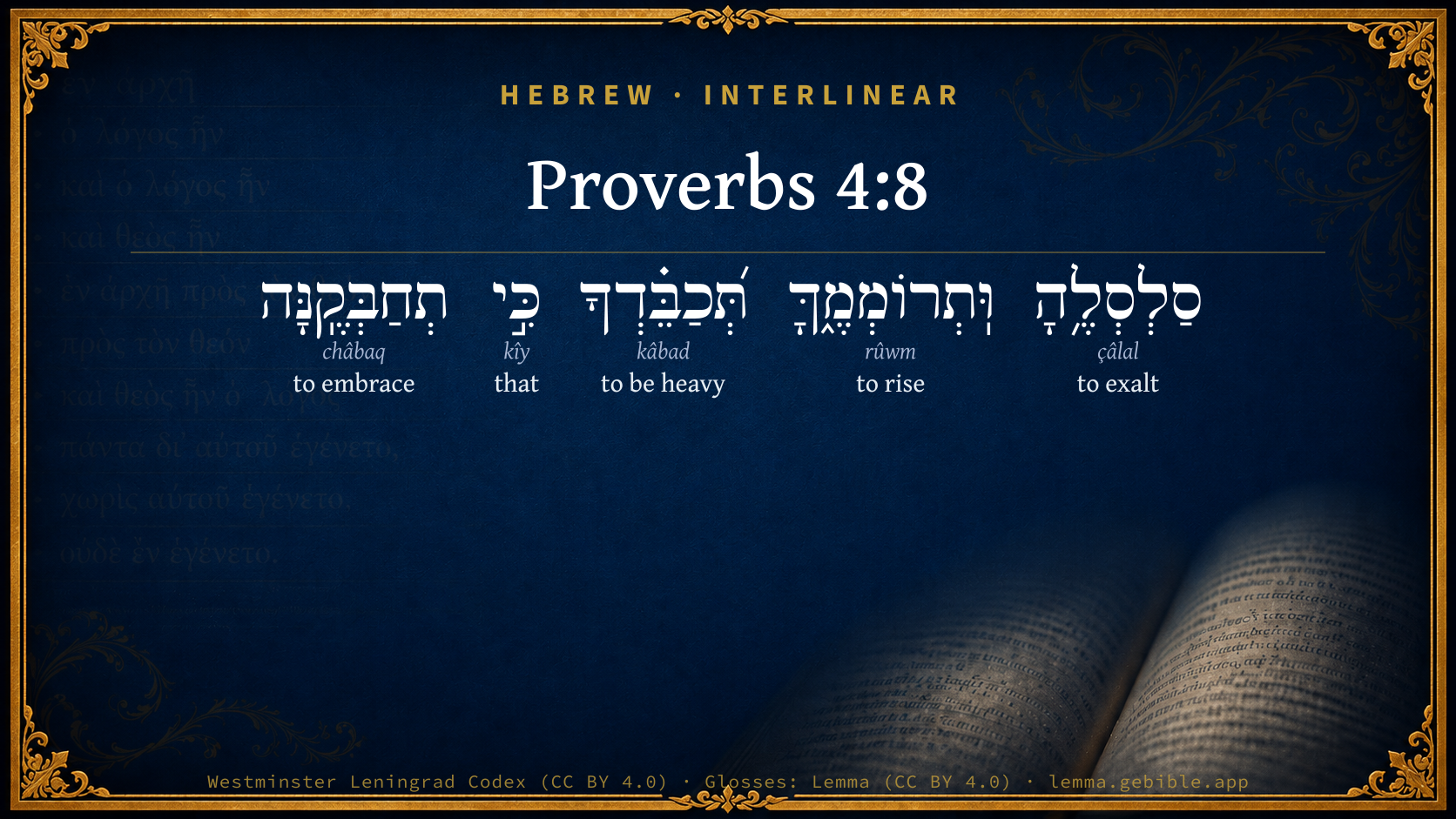
Proverbs 4:8

Hebrew (Westminster Leningrad Codex) Proverbs 4:8 appears in the Hebrew Old Testament. The text above is from the Westminster Leningrad Codex. Each word links to its Strong’s number, a concise gloss, and parsing drawn from the Open Scriptures Hebrew Bible morphology. Click any word for its full Brown-Driver-Briggs (BDB) entry.
Download image
Cite this verse

Proverbs 4:8 (World English Bible). Public Domain. Lemma interlinear Bible study tool, https://lemma.gebible.app/v/proverbs/4/8.

Show BibTeX & RIS
BibTeX
RIS
English Translation
Esteem her, and she will exalt you. She will bring you to honor, when you embrace her.
World English Bible · Public Domain
Download a study sheet

One document with this verse’s original text, its word-by-word gloss line, the meaning frame, cross-references with their text, attributed commentary, and full source and license credits — printable, and it pastes into notes with its structure intact.

This verse Autodidact and up

Study sheet (.html) Plain text (.txt)

A passage Seminary Student

Up to 50 verses in one chapter. A passage sheet keeps up to 6 commentary sources and 12 cross-references per verse, in the order this page ranks them, and says so on the sheet whenever that leaves anything out. Ask for a single verse and you get the Autodidact verse sheet above.

Everything on this page stays free to read, with no account — the sheet is a download of what is already on screen, not access to it.

Want to remove ads? Support Godless Engineer
Compare translations 3

The same verse in 3 English versions, stacked beneath the original-language interlinear above. Click any original word for its lexicon entry.

Each is an independent rendering of the whole verse — the interlinear is not word-aligned to these translations.

Highlighted words mark where these versions differ — a whole-verse word diff, not a word-by-word alignment.

  • World English Bible Public Domain
    Esteem her, and she will exalt you. She will bring you to honor, when you embrace her.
  • King James Version Public Domain
    Exalt her, and she shall promote thee: she shall bring thee to honour, when thou dost embrace her.
  • unfoldingWord Literal Text CC BY-SA 4.0
    Cherish her, and she will raise you up; she will honor you when you embrace her.

unfoldingWord Literal Text — © unfoldingWord, licensed CC BY-SA 4.0. Word-aligned USFM3 via Door43 (git.door43.org/unfoldingWord/en_ult).

Versions to compare (up to 4)

3 of 4 selected

Show all 18 translations

Every available English version of this verse, each an independent rendering of the whole verse.

  • World English Bible Public Domain
    Esteem her, and she will exalt you. She will bring you to honor, when you embrace her.
  • Berean Standard Bible Public Domain
    Prize her, and she will exalt you; if you embrace her, she will honor you.
  • Majority Standard Bible Public Domain
    Prize her, and she will exalt you; if you embrace her, she will honor you.
  • King James Version Public Domain
    Exalt her, and she shall promote thee: she shall bring thee to honour, when thou dost embrace her.
  • American Standard Version (1901) Public Domain
    Exalt her, and she will promote thee; She will bring thee to honor, when thou dost embrace her.
  • Revised Version (1885) Public Domain
    Exalt her, and she shall promote thee: she shall bring thee to honour, when thou dost embrace her.
  • Geneva Bible (1599) Public Domain
    Exalt her, and she shall exalt thee: she shall bring thee to honour, if thou embrace her.
  • Douay-Rheims (1899) Public Domain
    Take hold on her, and she shall exalt thee: thou shalt be glorified by her, when thou shalt embrace her.
  • Young's Literal Translation Public Domain
    Exalt her, and she doth lift thee up, She honoureth thee, when thou dost embrace her.
  • Literal Standard Version CC BY-SA 4.0
    Exalt her and she lifts you up, || She honors you when you embrace her.
  • Unlocked Literal Bible CC BY-SA 4.0
    Cherish wisdom and she will exalt you; she will honor you when you embrace her.
  • unfoldingWord Literal Text CC BY-SA 4.0
    Cherish her, and she will raise you up; she will honor you when you embrace her.
  • Darby Bible Public Domain
    Exalt her, and she shall promote thee; she shall bring thee to honour when thou dost embrace her.
  • World Messianic Bible Public Domain
    Esteem her, and she will exalt you. She will bring you to honor when you embrace her.
  • Webster's Bible Public Domain
    Exalt her, and she shall promote thee: she shall bring thee to honor, when thou dost embrace her.
  • Free Bible Version CC BY-SA 4.0
    Treasure wisdom, and she will praise you; embrace her, and she will honor you.
  • Bible in Basic English Public Domain
    Put her in a high place, and you will be lifted up by her; she will give you honour, when you give her your love.
  • JPS Tanakh (1917) Public Domain
    Extol her, and she will exalt thee; she will bring thee to honour, when thou dost embrace her.

Literal Standard Version (2020), Covenant Press — licensed CC BY-SA 4.0. Text via the HelloAO Bible API (eBible.org). Unlocked Literal Bible (unfoldingWord) — licensed CC BY-SA 4.0. Text via the HelloAO Bible API (eBible.org). unfoldingWord Literal Text — © unfoldingWord, licensed CC BY-SA 4.0. Word-aligned USFM3 via Door43 (git.door43.org/unfoldingWord/en_ult). Free Bible Version, Dr. Jonathan Gallagher — licensed CC BY-SA 4.0. Text via the HelloAO Bible API (eBible.org).

Word by word

More ways to search: Search by grammar → Find every occurrence → Compare this word →

Practice this passage: Drill this verse → Learn its vocabulary →

About this verse

These counts appear in no published source. They are computed here, from the morphology-tagged text and Lemma’s own curated glosses. What Lemma adds →

5
words
5
distinct lemmas
Wisdom
section

Notable vocabulary

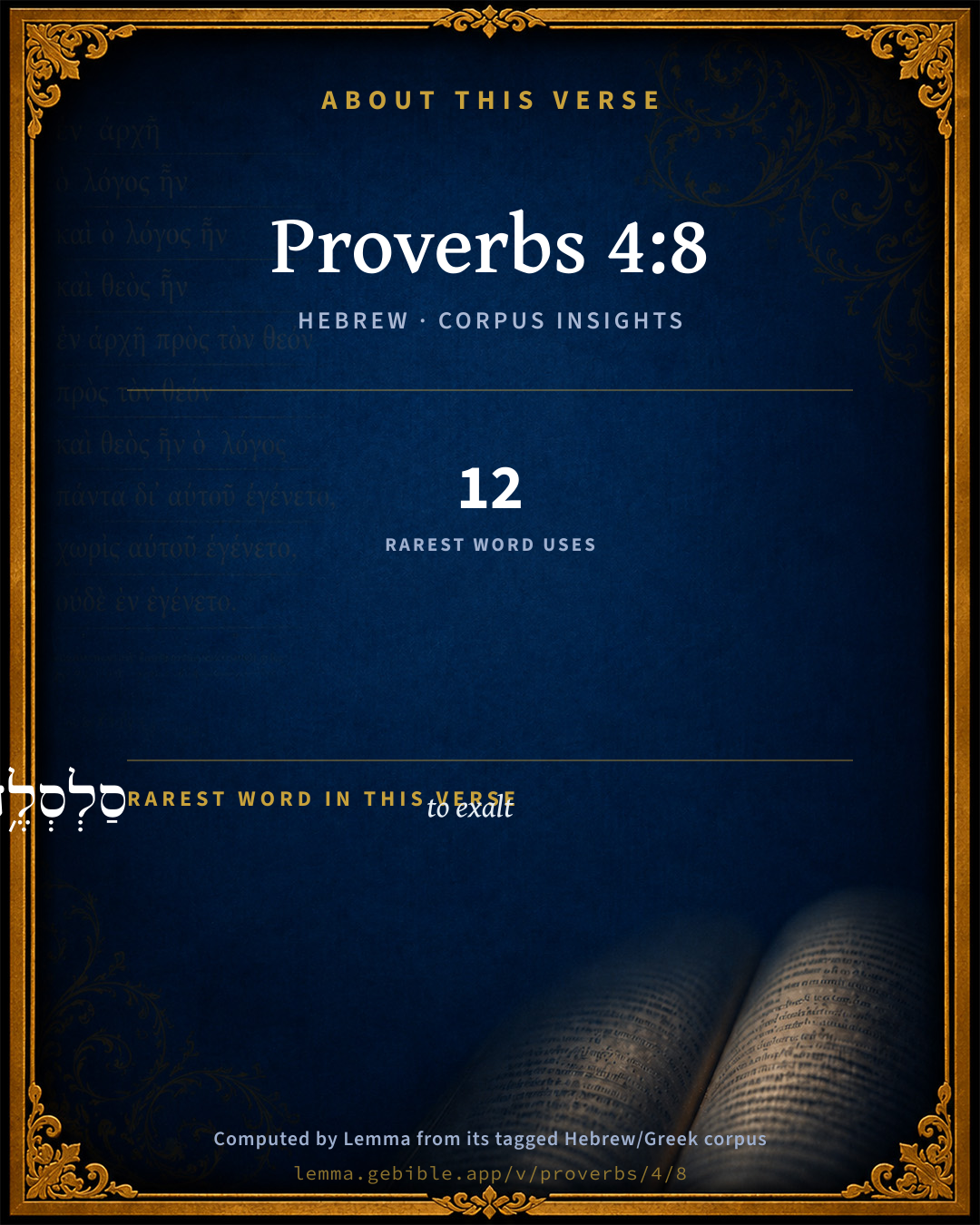
The rarest word here is סַלְסְלֶ֥הָ to exalt H5549 — appearing just 12 times in the whole Hebrew Bible.

Shared distinctive vocabulary

סַלְסְלֶ֥הָ to exalt H5549 occurs in 10 verses of the Hebrew Bible. Also found in:

Grammatical profile

  • 4 verbs
  • 1 conjunction

Verb forms

  • סַלְסְלֶ֥הָ Pilpel · Imperative
  • וּֽתְרוֹמְמֶ֑ךָּ Polel · Imperfect
  • תְּ֝כַבֵּ֗דְךָ Piel · Imperfect
  • תְחַבְּקֶֽנָּה Piel · Imperfect

Hebrew & Septuagint length

In English translation the verse runs 17 words from the Hebrew and 14 from the Septuagint (LXX English) — closely comparable.

A rough comparison of the two English renderings, which tokenize alike — not a word-level alignment.

Word counts can differ between the Hebrew and the Greek without any difference in meaning — e.g. the Hebrew direct-object marker אֵת has no separate Greek word, and Greek often adds the article ὁ.

Cross-references

5

Topical passages linked to Proverbs 4:8 in the Treasury of Scripture Knowledge — connected by theme and wording, ordered by reader-vote popularity; previews shown in the World English Bible.

  • Daniel 12:3 Those who are wise shall shine as the brightness of the expanse; and those who turn many to righteousness as the stars forever and ever.
  • 1 Samuel 2:30 Therefore Yahweh, the God of Israel, says, I said indeed that your house, and the house of your father, should walk before me forever: but now Yahweh says, Be it far from me; for those who honor me I will honor, and those who despise me shall be lightly esteemed.
  • Proverbs 3:35 The wise will inherit glory, But shame will be the promotion of fools.
  • 1 Kings 3:5–13 In Gibeon Yahweh appeared to Solomon in a dream by night; and God said, Ask what I shall give you.
  • Proverbs 22:4 The result of humility and the fear of Yahweh Is wealth, honor, and life.

Cross-references courtesy of OpenBible.info (CC BY 4.0).

Hebrew and Greek witnesses Masoretic Hebrew ↔ Greek Septuagint

The same verse in the two great witnesses to the Old Testament, shown verse-for-verse.

These are two independent witnesses, not word-aligned to each other, and the Septuagint is shown in lemma (dictionary) form.

Hebrew Proverbs 4:8 Masoretic · Westminster Leningrad Codex

סַלְסְלֶ֥הָ וּֽתְרוֹמְמֶ֑ךָּ תְּ֝כַבֵּ֗דְךָ כִּ֣י תְחַבְּקֶֽנָּה

Esteem her, and she will exalt you. She will bring you to honor, when you embrace her.

World English Bible · Public Domain

Greek LXX Proverbs 4:8 Septuagint · lemma form

περιχαρακόω αὐτός καί ὑψόω σύ τιμάω αὐτός ἵνα σύ περιλαμβάνω

Secure it, and it shall exalt you: honor it, that it may embrace you;

LXX2012 (modern English Septuagint) · Public Domain

On this verse, John Gill's Exposition discusses the Septuagint’s reading. Read the note in Commentary ↓

Hebrew: Westminster Leningrad Codex (CC BY 4.0). Greek: Septuagint (public domain); English from LXX2012 (modern English Septuagint) (Public Domain). How the Septuagint differs from the Hebrew →

Commentary

Notes on Proverbs 4:8 from classic Christian and Jewish commentators (each source and its license shown beneath its notes). The classic Christian expositions comment on the surrounding passage and are grouped to its opening verse, so a note may address several verses; the Jewish commentaries on the Tanakh (Rashi and others) are per-verse, so they appear only where the commentator wrote on this verse.

Lemma curates 59 commentaries, every one of them public domain or Creative Commons licensed, each selected and text-cleaned for this edition rather than reprinted as found. About our sources →

Trapp's Complete Commentary

John Trapp

Pro 4:8 Exalt her, and she shall promote thee: she shall bring thee to honour, when thou dost embrace her.

Ver. 8. Exalt her, and she shall.] Have a high and honourable esteem of her and her children. Rabbi Solomon, out of the Talmudists, renders it, Search for her, minutatim in ea singula consectans, do it diligently, as holding every parcel of her precious, as men do the very filings of gold.

John Trapp, A Commentary or Exposition upon All the Books of the Old and New Testament (1647–1656) — public domain. Text from a community e-Sword module.

The Biblical Illustrator

Joseph S. Exell

Pro_4:8

Exalt her, and she shall promote thee.

Man and religion mutually exalted

True wisdom includes two things--first, the choice of the highest possible good; secondly, the adoption of the best possible means for the attainment of that good.

I. Man exalting religion. There is a sense in which it may be said that man cannot exalt religion. But--

1. Man may exalt it into his heart as a supreme passion. Abounding around us are organisations which have for their object the reformation of morals, the correcting or suppressing certain evil habits, social and national. But mere external reformation without inward renewal will leave the man lost and perishing. When man proposes to improve the condition of humanity he begins outside, whereas God always begins inside. Man works from circumference to centre, God works from centre to circumference. You must place religion on the throne of your heart, give her supremacy, and the effect will be seen in the temper, conversation, and life.

2. Man may exalt it into his will as the all-controlling force, the life-principle. Tell me what the ruling force in the man is and I will tell you his character. All intelligent beings in the universe are under the dominion of either selfishness or benevolence. There is no sin apart from selfishness; there is no virtue apart from benevolence. When Christ takes possession of the heart the usurper is overthrown. Sin is no longer in the ascendancy, Christ becomes king; but although the power, the supremacy, of sin is broken, evil in a subordinate state may exist within. Christ can also expel His rivals.

3. Man may exalt it in his practice by living its lofty precepts. Christianity is not a creed, it is a life. The morals of Christianity are the purest the world has ever known, our enemies being judges. We want living epistles, men and women sanctified to God, embodying in their daily life and conversation the lofty precepts of the New Testament.

II. Christianity exalting man.

1. It will promote your honour. Men everywhere yearn for a twofold immortality--the immortality of the life in the world beyond, and the immortality of posthumous fame in this world. Men have obtained honour in other ways than by religion. But where is the man who will match for:honour the men of faith mentioned in Heb_11:1-40?

2. It will promote your happiness. One of the strongest instincts of the human soul is the instinct for happiness. All men covet it. In order to gain this coveted prize man must be brought into harmony with himself. Man is a being of strange contrarieties. Within him are forces of evil which drive him into wrong courses; there is also a power of conscience which meets him in these evil ways, denounces, condemns, and punishes him. You cannot secure peace by forgetting the past. In order to peace and contentment you must be in harmony with your surroundings.

3. Religion will promote your prospects. It supplies man with blessed hopes, cheerful prospects, and a glorious future. (R. Roberts.)

Wisdoms bargain

I. Exalt wisdom.

1. By entertaining lofty thoughts about her.

2. By making earnest efforts to obtain her.

3. By giving her the highest place in our affections.

4. By placing her upon the seat of government within the soul.

5. By helping her to reach her throne of universal dominion.

II. Wisdom shall promote thee--

1. To the favour and fellowship of God on earth.

2. To a place of safety aria comfort among the trials and dangers of life.

3. To a position of usefulness and honour amongst men.

4. To a throne of glory in the skies. (T. Whitelaw, M. A.)

She shall bring thee to honour.

The true honour of man

The love of honour is one of the strongest passions in the human heart. All wish, by some means or other, to acquire respect from those among whom they live. Among the advantages which attend religion and virtue, the honour which they confer on man is frequently mentioned in Scripture. By the true honour of man is to be understood, not what merely commands external respect, but what commands the respect of the heart, what raises one to acknowledged eminence above others of the same species. From what cause does this eminence arise?

1. Not from riches.

2. Not from rank or office.

3. Not from splendid actions and abilities which excite high admiration.

4. Not in reputation derived from civil accomplishments.

5. Not from any adventitious circumstances of fortune.

We must look to the mind and the soul. The honour which man acquires by religion and virtue is more independent and more complete than what can be acquired by any other means. The universal consent of mankind in honouring real virtue is sufficient to show what the genuine sense of human nature is on this subject. The honour acquired by religion and virtue is honour Divine and immortal. (Hugh Blair, D. D.)

The Biblical Illustrator, edited by Joseph S. Exell (c. 1880s–1900s) — public domain. Text from a community e-Sword module.

Jamieson, Fausset & Brown

Robert Jamieson, A. R. Fausset & David Brown

As you highly esteem her, she will raise you to honor.

embrace her--with fond affection.

Jamieson, Fausset & Brown — Commentary Critical and Explanatory on the Whole Bible (1871) — public domain (CC PDM 1.0). Text via the HelloAO Bible API.

Adam Clarke's Commentary

Verse 8. She shall bring thee to honour] There is nothing, a strict life of piety and benevolence excepted, that has such a direct tendency to reflect honour upon a man, as the careful cultivation of his mind. One of Bacon's aphorisms was, Knowledge is power; and it is truly astonishing to see what influence true learning has. Nothing is so universally respected, provided the learned man be a consistent moral character, and be not proud and overbearing; which is a disgrace to genuine literature.

Adam Clarke's Commentary on the Bible (1810–1826) — public domain. Text from a community e-Sword/MySword module.

Ellicott's Commentary for English Readers

(8) Exalt her, and she shall promote thee.—Comp. 1Sa_2:30, “Them that honour me I will honour.”

A Bible Commentary for English Readers, edited by Charles John Ellicott (1878–1897) — public domain. Text from a community e-Sword module.

John Gill's Exposition

Exalt her, and she shall promote thee,.... Christ is to be exalted in his person, by asserting his proper deity; by ascribing all divine perfections to him; by allowing him to be the author of all divine works; by giving him divine worship and homage; by owning his divine and eternal sonship, and distinct personality: he is to be exalted in all his offices of Prophet, Priest, and King, and as the only Redeemer and Saviour; by trusting in him, embracing his Gospel, and submitting to his ordinances, and such that exalt him, he will "promote" them here and hereafter; of which more in the next clause. According to the Talmudists (u), the word for "exalt" signifies a diligent search, by turning things about to find out what is sought; and so the Septuagint interpret the word in the sense of "searching", Jer 50:26;

she shall bring thee to honour, when thou dost embrace her: by faith: for this is an act of faith, and a very considerable one, and is expressive of great nearness to Christ, of much intimacy and familiarity with him, of strong love and affection to him, of a good degree of boldness used with him, and of joy and exaltation in him; for such an action is used by persons near akin, and are very familiar with, and have a very great affection for one another, and use much freedom with each other, and rejoice at meeting together. Now such who embrace Christ, in the arms of their faith, as their alone Saviour, such he promotes and "brings to honour"; not to honour among men, for to embrace Christ and exalt him is the way to disgrace, though the disgrace is an honour, and will be before long rolled off; but to honour hereafter. Such will be set at his right hand, and be owned by him before his Father and his angels; and they will be placed on the same throne with him, and will reign with him for ever and ever; see Sa1 2:30.

(u) T. Bab. Roshhashanah, fol. 26. 2.

John Gill's Exposition of the Whole Bible (1746–1763) — public domain (CC PDM 1.0). Text via the HelloAO Bible API.

Matthew Poole's English Annotations

Exalt her; let her have thine highest esteem and affection.

To honour, both with God and men; which Solomon knew by experience.

Matthew Poole's English Annotations on the Holy Bible (1683–1685) — public domain. Text from a community e-Sword/MySword module.

Whedon's Commentary on the Bible

Daniel D. Whedon

8. Bring thee to honour — Or, “load thee with honour.”

When (or because) thou dost embrace her — Honour will follow as a consequence. Embracing is expressive of affectionate attachment, love. Nothing is more honourable than a highly cultivated mind. Knowledge not only imparts power, but obtains for its possessor respect and admiration, especially when his intellectual acquirements are accompanied, as is supposed in this case, with high moral endowments.

Daniel D. Whedon (gen. ed.), Commentary on the Old and New Testaments (1874–1909) — public domain. Text from a community e-Sword module.

The Pulpit Commentary

Exalt her, and she shall promote thee. The father here proceeds to point out some of the benefits which follow from the pursuit of Wisdom. Exalt her (sal"s"leah); Vulgate, arripe illam; LXX, pericarakwson authn ; Targum, dilige eam; Syriac, blandire illi; Arabic, circumsepi eam. The Hebrew, sal"s"leah, is the pilpel imperative of salal, "to lift up, exalt." It is equivalent to the kal form. The pilpel form only occurs here, but the kal participle is met with in Pro_15:19, where it has the meaning of "to raise up as a causeway" (see marginal reading in loc. ). Gesenius renders, "exalt her," sc. with praises. The meaning of the verb, as Delitzsch says, is to be determined, by the corresponding "she shall promote thee" (th"rom"mek), and this verb romem is

(1) to raise or make high;

(2) to exalt by bestowing honours upon one of low estate, i.e. raising them in general estimation; it is so used in 1Sa_2:7 by Hannah, in her song of thankfulness, "He (Jehovah) bringeth low and lifteth up ( m"romem);

(3) to extol by praises, as in Psa_30:2. The radical meaning of salal seems to be "to heap up," as a road is prepared by embankments, and by the filling up of inequalities. (cf. Isa_62:10) In this sense the passage before us is explained by Levi ben Gersom, "Prepare the way of Wisdom, and walk assiduously in it." But the context, wherein the idea of buying is evidently used. favours Bottcher"s interpretation, "Hold it or her high in price, bid high for her as a purchaser who makes offer upon offer, to secure what he wants." So Pi, in pretio habe. The LXX rendering, "Circumvallate her, enclose her with a wall or hedge," which is reproduced in the Arabic, circumsepi eam, "hedge her around," seems out of place with the context. The Talmudists understand the verb as signifying "to examine closely," "to scrutinize, meditate, or reflect" upon Wisdom constantly, just as the Roman, poet says, "Nocturna versate manu, versate diurna exalt Wisdom when we follow her precepts," i.e. when we esteem her the idea which is presented to us in the Targum and Syriac cited above. The sentiment of the verse agrees with what Jehovah says in the message of the man of God to Eli, in 1Sa_2:30, "Them that honour me I will honour." She shall bring thee to honour, when thou dost embrace her. The LXX reverses the order of ideas, "Honour her in order that she may embrace thee." Embrace her ; i.e. in a loving and affectionate manner, as a husband does his wife, or a son his mother. (For the verb khavak, see Pro_5:20 Son_2:6 Son_8:3) There are only three other instances where this verb occurs in the pilel form, khibbek. Esteem and honour, the confidence of others, elevation to offices of trust and consequence, are some of the rewards with which Wisdom repays those who esteem and love her. Others follow in the next verse.

The Pulpit Commentary (1880–1919), ed. H.D.M. Spence-Jones & Joseph S. Exell — public domain. Text from a community e-Sword module.

John Wesley's Explanatory Notes

Exalt - Let her have thine highest esteem and affection.

John Wesley, Explanatory Notes Upon the Whole Bible (1754–1765) — public domain. Text via the GEBible commentary corpus.

Keil & Delitzsch

C. F. Keil & F. Delitzsch

The meaning of the ἁπ. γεγρ. סלסל is determined by רומם in the parallel clause; סלל signifies to raise, exalt, as a way or dam by heaping up; the Pilpel, here tropical: to value or estimate highly. Bttcher interprets well: hold it high in price, raise it (as a purchaser) always higher, make offer for it upon offer. The lxx (approved by Bertheau), περιχαράκωσον αὐτήν, circumvallate it, i.e., surround it with a wall (סללה) - a strange and here unsuitable figure. Hold it high, says the author, and so it will reward

(Note: Lwenstein has rightly ותרוממך, vid., my preface to Baer's Genesis, p. vii.)

thee with a high place, and (with chiastic transposition of the performance and the consequence) she will honour

(Note: We read תכבּדך, not תכבּרך (Hahn) or תכבּדך (Lwenstein); the tone lies on the penult., and the tone-syllable has the point Tsere, as in ויגּדך, Deu 32:7; vid., Michlol 66b.)

thee if (ἐάν) thou lovingly embracest her. חבּק is used of embracing in the pressure of tender love, as in Sol 2:6; Sol 8:3; the Piel is related to the Kal as amplexari to amplecti. Wisdom exalts her admirers, honours her lovers, and makes a man's appearance pleasant, causing him to be reverenced when he approaches. Regarding לוית־חן, vid., Pro 1:9. מגּן, to deliver up (Gen 14:20), to give up (Hos 11:8), is connected in the free poetic manner with two accusatives, instead of with an accus. and dat. lxx has ὑπερασπίσῃ, but one does not defend himself (as with a shield) by a wreath or crown.

Keil & Delitzsch — Biblical Commentary on the Old Testament (1861–1891) — public domain (CC PDM 1.0). Text via the HelloAO Bible API. (Old Testament only.)

Rashi

Rabbi Shlomo Yitzchaki (Rashi)

Search for her Heb. סלסלה search for her. Review it to examine it minutely, as in (Jer. 6:9): “as a vintager over the searchings (סלסלות)” who goes repeatedly through the vineyard and brings back his hand to search for the single grapes. In the expression of the Sages (Rosh Hashanah 26b), curls (מסלסל) his hair.

Rashi on the Tanakh — English translations: “The Judaica Press complete Tanach with Rashi, translated by A. J. Rosenberg” (CC BY 4.0); “Pentateuch with Rashi's commentary by M. Rosenbaum and A.M. Silbermann, 1929-1934” (public domain); “The Metsudah Tanach series, Lakewood, N.J” (CC BY 4.0); and “The Book of Joshua, Metsudah Publications, 1997” (CC BY 4.0). Text via Sefaria.

Lesson kit

Teaching starters — assembled from the data on this page, not authored interpretation. Every prompt links to the verse data it draws on. Edit before teaching.

Proverbs, in the Wisdom, opens this verse with 5 words (5 distinct Hebrew lemmas). Its most distinctive word is çâlal (“to exalt”). A historical commentator’s framing appears above. Read the whole chapter for the surrounding context.

Discussion questions

  1. What does “to exalt” (çâlal) contribute to the verse as a whole?
  2. How does Exodus 9:17, which shares the word «to exalt», read alongside this verse?
  3. The translations on this page render this verse differently — a whole-verse word diff, not a word-by-word alignment. What might account for the different wordings?
  4. «סַלְסְלֶ֥הָ» is a Pilpel Imperative verb. How does that grammatical form shape the action described?
  5. Compare how Trapp's Complete Commentary and The Biblical Illustrator read this verse. Where do they agree or differ?

Things to notice

Reading settings

Reading text

Shown beneath each verse's original-language words.

Old Testament
Old Testament edition

Read the OT as the Masoretic Hebrew (MT) or the Greek Septuagint (LXX).

English shown for the Greek Septuagint (in the Hebrew ↔ Greek comparison).

Comparing translations? Open the Compare panel on any verse page to stack up to four side by side.