
Proverbs 3:35

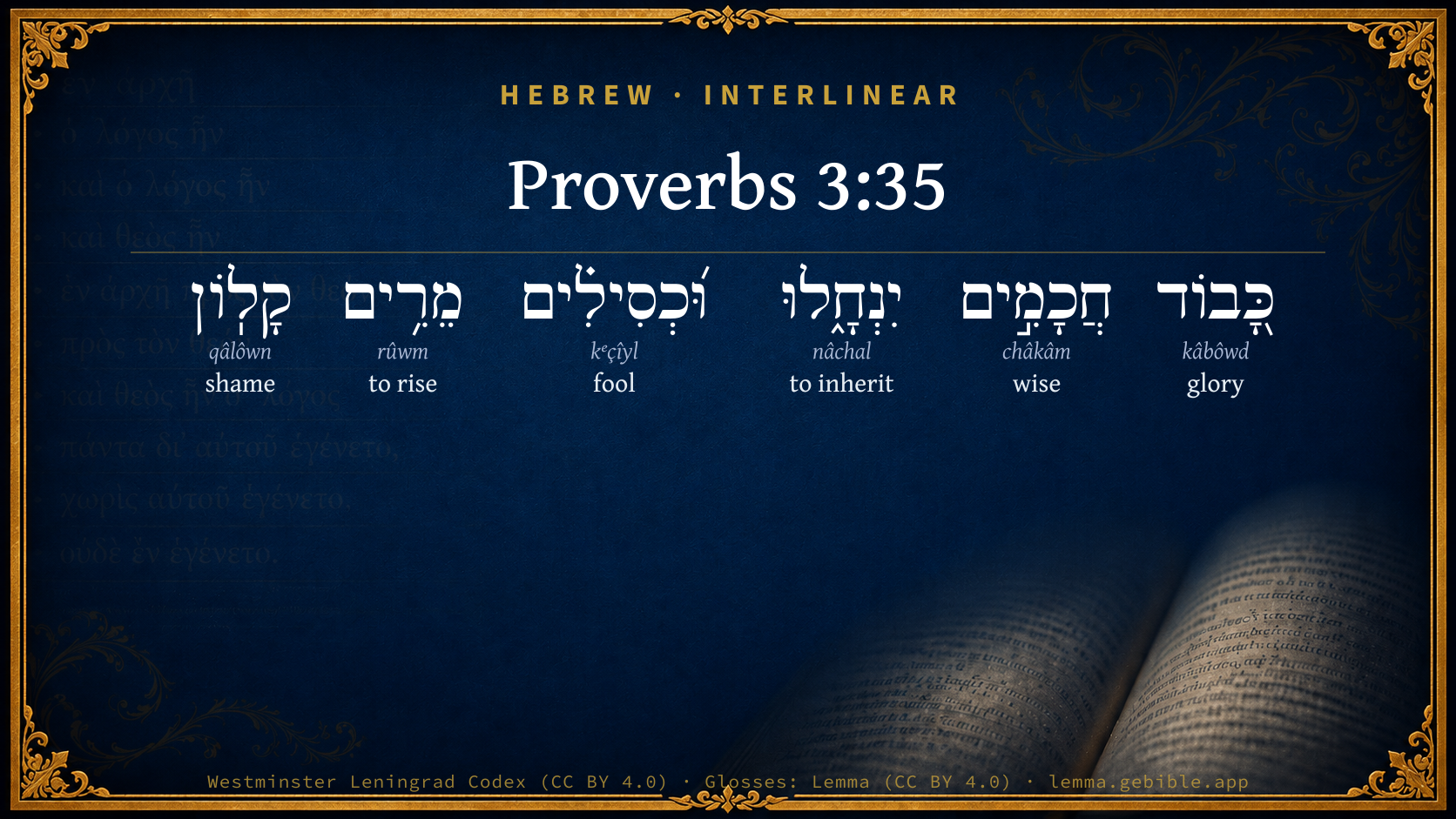
Hebrew (Westminster Leningrad Codex) Proverbs 3:35 appears in the Hebrew Old Testament. The text above is from the Westminster Leningrad Codex. Each word links to its Strong’s number, a concise gloss, and parsing drawn from the Open Scriptures Hebrew Bible morphology. Click any word for its full Brown-Driver-Briggs (BDB) entry.
Download image
Cite this verse

Proverbs 3:35 (World English Bible). Public Domain. Lemma interlinear Bible study tool, https://lemma.gebible.app/v/proverbs/3/35.

Show BibTeX & RIS
BibTeX
RIS
English Translation
The wise will inherit glory, But shame will be the promotion of fools.
World English Bible · Public Domain
Download a study sheet

One document with this verse’s original text, its word-by-word gloss line, the meaning frame, cross-references with their text, attributed commentary, and full source and license credits — printable, and it pastes into notes with its structure intact.

This verse Autodidact and up

Study sheet (.html) Plain text (.txt)

A passage Seminary Student

Up to 50 verses in one chapter. A passage sheet keeps up to 6 commentary sources and 12 cross-references per verse, in the order this page ranks them, and says so on the sheet whenever that leaves anything out. Ask for a single verse and you get the Autodidact verse sheet above.

Everything on this page stays free to read, with no account — the sheet is a download of what is already on screen, not access to it.

Want to remove ads? Support Godless Engineer
Compare translations 3

The same verse in 3 English versions, stacked beneath the original-language interlinear above. Click any original word for its lexicon entry.

Each is an independent rendering of the whole verse — the interlinear is not word-aligned to these translations.

Highlighted words mark where these versions differ — a whole-verse word diff, not a word-by-word alignment.

  • World English Bible Public Domain
    The wise will inherit glory, But shame will be the promotion of fools.
  • King James Version Public Domain
    The wise shall inherit glory: but shame shall be the promotion of fools.
  • unfoldingWord Literal Text CC BY-SA 4.0
    Wise ones will inherit honor, but stupid ones lift up dishonor.

unfoldingWord Literal Text — © unfoldingWord, licensed CC BY-SA 4.0. Word-aligned USFM3 via Door43 (git.door43.org/unfoldingWord/en_ult).

Versions to compare (up to 4)

3 of 4 selected

Show all 18 translations

Every available English version of this verse, each an independent rendering of the whole verse.

  • World English Bible Public Domain
    The wise will inherit glory, But shame will be the promotion of fools.
  • Berean Standard Bible Public Domain
    The wise will inherit honor, but fools are held up to shame.
  • Majority Standard Bible Public Domain
    The wise will inherit honor, but fools are held up to shame.
  • King James Version Public Domain
    The wise shall inherit glory: but shame shall be the promotion of fools.
  • American Standard Version (1901) Public Domain
    The wise shall inherit glory; But shame shall be the promotion of fools.
  • Revised Version (1885) Public Domain
    The wise shall inherit glory; but shame shall be the promotion of fools.
  • Geneva Bible (1599) Public Domain
    The wise shall inherite glorie: but fooles dishonour, though they be exalted.
  • Douay-Rheims (1899) Public Domain
    The wise shall possess glory: the promotion of fools is disgrace.
  • Young's Literal Translation Public Domain
    Honour do the wise inherit, And fools are bearing away shame!
  • Literal Standard Version CC BY-SA 4.0
    The wise inherit glory, || And fools are bearing away shame!
  • Unlocked Literal Bible CC BY-SA 4.0
    Wise people inherit honor, but fools will be lifted up in their shame.
  • unfoldingWord Literal Text CC BY-SA 4.0
    Wise ones will inherit honor, but stupid ones lift up dishonor.
  • Darby Bible Public Domain
    The wise shall inherit glory; but shame shall be the promotion of the foolish.
  • World Messianic Bible Public Domain
    The wise will inherit glory, but shame will be the promotion of fools.
  • Webster's Bible Public Domain
    The wise shall inherit glory: but shame shall be the promotion of fools.
  • Free Bible Version CC BY-SA 4.0
    The wise will receive honor, but fools are held up in disgrace.
  • Bible in Basic English Public Domain
    The wise will have glory for their heritage, but shame will be the reward of the foolish.
  • JPS Tanakh (1917) Public Domain
    The wise shall inherit honour; but as for the fools, they carry away shame.

Literal Standard Version (2020), Covenant Press — licensed CC BY-SA 4.0. Text via the HelloAO Bible API (eBible.org). Unlocked Literal Bible (unfoldingWord) — licensed CC BY-SA 4.0. Text via the HelloAO Bible API (eBible.org). unfoldingWord Literal Text — © unfoldingWord, licensed CC BY-SA 4.0. Word-aligned USFM3 via Door43 (git.door43.org/unfoldingWord/en_ult). Free Bible Version, Dr. Jonathan Gallagher — licensed CC BY-SA 4.0. Text via the HelloAO Bible API (eBible.org).

Word by word

More ways to search: Search by grammar → Find every occurrence → Compare this word →

Practice this passage: Drill this verse → Learn its vocabulary →

About this verse

These counts appear in no published source. They are computed here, from the morphology-tagged text and Lemma’s own curated glosses. What Lemma adds →

6
words
6
distinct lemmas
Wisdom
section

Notable vocabulary

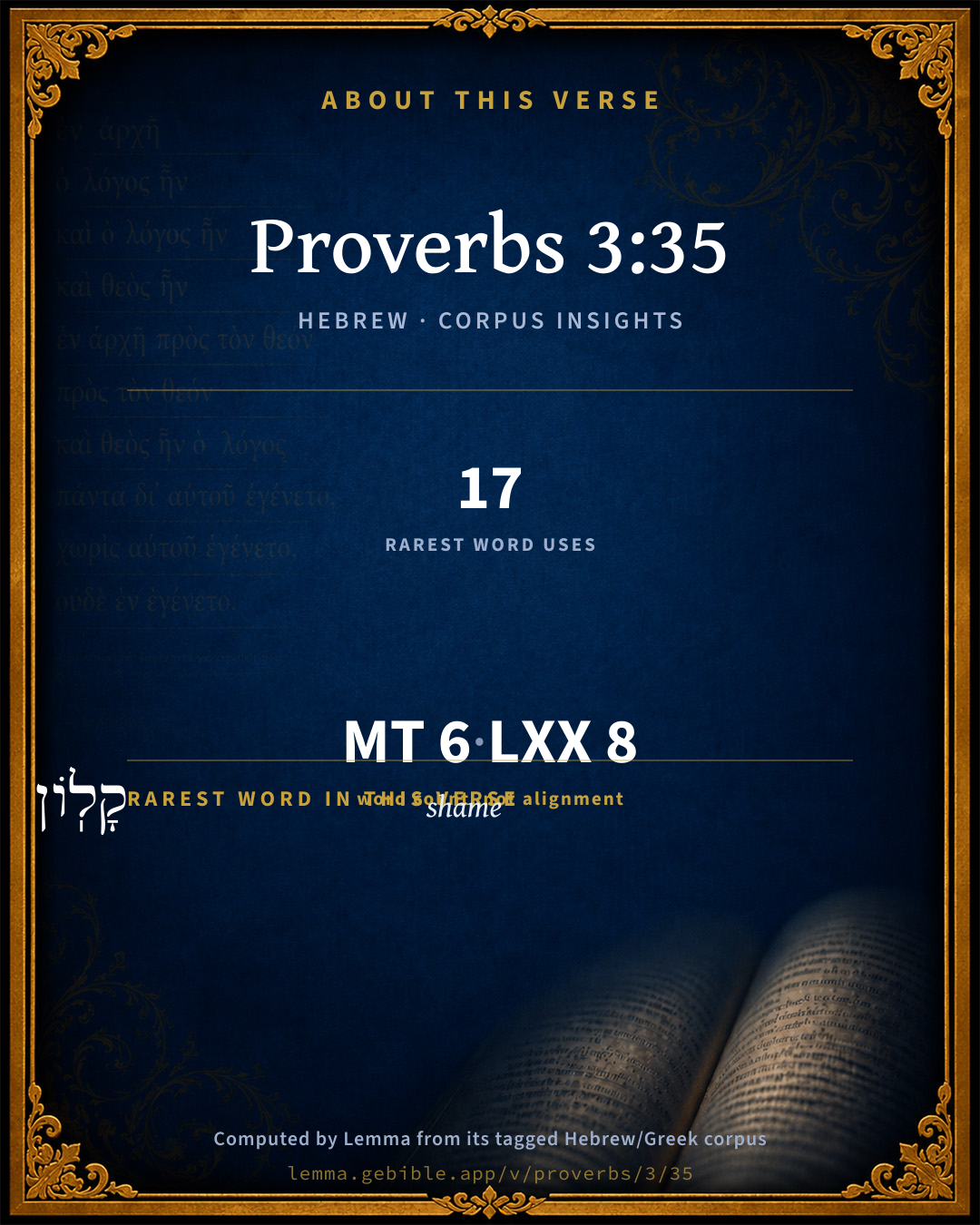
The rarest word here is קָלֽוֹן shame H7036 — appearing just 17 times in the whole Hebrew Bible.

Shared distinctive vocabulary

קָלֽוֹן shame H7036 occurs in 17 verses of the Hebrew Bible. Also found in:

Grammatical profile

  • 2 verbs
  • 3 nouns
  • 1 adjective

Verb forms

  • יִנְחָ֑לוּ Qal · Imperfect
  • מֵרִ֥ים Hiphil · Participle Active

Hebrew & Septuagint length

In English translation the verse runs 13 words from the Hebrew and 13 from the Septuagint (LXX English) — the same length.

A rough comparison of the two English renderings, which tokenize alike — not a word-level alignment.

Word counts can differ between the Hebrew and the Greek without any difference in meaning — e.g. the Hebrew direct-object marker אֵת has no separate Greek word, and Greek often adds the article ὁ.

In the original languages it is 6 Hebrew tokens and 8 Greek tokens — but the two are counted differently (Hebrew bundles its prefixes and suffixes into one token; the Greek is in lemma form), so that isn’t a like-for-like length.

Cross-references

7

Topical passages linked to Proverbs 3:35 in the Treasury of Scripture Knowledge — connected by theme and wording, ordered by reader-vote popularity; previews shown in the World English Bible.

  • Psalms 132:18 I will clothe his enemies with shame, But on himself, his crown will be resplendant."
  • Isaiah 65:13–15 Therefore thus says the Lord Yahweh, Behold, my servants shall eat, but you shall be hungry; behold, my servants shall drink, but you shall be thirsty; behold, my servants shall rejoice, but you shall be disappointed;
  • 1 Samuel 2:30 Therefore Yahweh, the God of Israel, says, I said indeed that your house, and the house of your father, should walk before me forever: but now Yahweh says, Be it far from me; for those who honor me I will honor, and those who despise me shall be lightly esteemed.
  • Psalms 73:24 You will guide me with your counsel, And afterward receive me to glory.
  • Daniel 12:2–3 Many of those who sleep in the dust of the earth shall awake, some to everlasting life, and some to shame and everlasting contempt.
  • Proverbs 4:8 Esteem her, and she will exalt you. She will bring you to honor, when you embrace her.
  • Proverbs 13:8 The ransom of a man's life is his riches, But the poor hear no threats.

Cross-references courtesy of OpenBible.info (CC BY 4.0).

Hebrew and Greek witnesses Masoretic Hebrew ↔ Greek Septuagint

The same verse in the two great witnesses to the Old Testament, shown verse-for-verse.

These are two independent witnesses, not word-aligned to each other, and the Septuagint is shown in lemma (dictionary) form.

Hebrew Proverbs 3:35 Masoretic · Westminster Leningrad Codex

כָּ֭בוֹד חֲכָמִ֣ים יִנְחָ֑לוּ וּ֝כְסִילִ֗ים מֵרִ֥ים קָלֽוֹן

The wise will inherit glory, But shame will be the promotion of fools.

World English Bible · Public Domain

Greek LXX Proverbs 3:35 Septuagint · lemma form

δόξα σοφός κληρονομέω ὁ δέ ἀσεβής ὑψόω ἀτιμία

The wise shall inherit glory; but the ungodly have exalted their own dishonor.

LXX2012 (modern English Septuagint) · Public Domain

On this verse, The Pulpit Commentary discusses the Septuagint’s reading. Read the note in Commentary ↓

Hebrew: Westminster Leningrad Codex (CC BY 4.0). Greek: Septuagint (public domain); English from LXX2012 (modern English Septuagint) (Public Domain). How the Septuagint differs from the Hebrew →

Commentary

Notes on Proverbs 3:35 from classic Christian and Jewish commentators (each source and its license shown beneath its notes). The classic Christian expositions comment on the surrounding passage and are grouped to its opening verse, so a note may address several verses; the Jewish commentaries on the Tanakh (Rashi and others) are per-verse, so they appear only where the commentator wrote on this verse.

Lemma curates 59 commentaries, every one of them public domain or Creative Commons licensed, each selected and text-cleaned for this edition rather than reprinted as found. About our sources →

Trapp's Complete Commentary

John Trapp

Pro 3:35 The wise shall inherit glory: but shame shall be the promotion of fools.

Ver. 35. The wise shall inherit glory.] Not have it only, but inherit it - Hoc est, proprio, perfecto et perpetuo iure possidebunt, as Pellican; they shall have it as their proper, perfect, and perpetual right.

But shame shall be the promotion of fools.] A fair promotion they come to, but good enough for them, unless they were better. If they attain to high places and preferments, these prove but as high gibbets to bring them to more disgrace in this world, and torment in the next. Some there be that read the text thus: "But shame taketh away the foolish"; that is, it carrieth both them and their hope away in a pinch of time, or twinkling of the eye, as it were.

John Trapp, A Commentary or Exposition upon All the Books of the Old and New Testament (1647–1656) — public domain. Text from a community e-Sword module.

The Biblical Illustrator

Joseph S. Exell

Pro_3:35

The wise shall inherit glory.

Sanctified intellect

I. Its character. Intelligence, mind, reason is that power by which the supremacy of man over the beasts of the earth is asserted. Whilst, other things being equal, the greatest minds have been Christian, the powers may be predicated of intellect, irrespective of the moral character of its possessor. But a great intellect dissociated from moral control may become a scourge and a terror.

II. The work of sanctified intellect. It is the glory of God. But this involves the good of man. There is no subject to which intelligence can devote itself but may be made to minister to both. How then shall we work?

1. By prayer. A devotional spirit is the first essential element of piety.

2. By the press.

3. By the pulpit.

III. The reward of sanctified intellect. It shall inherit glory. (William Leask.)

But shame shall be the promotion of fools.--

The folly of the earthly-minded

I. In the choice which he makes.

1. The sinner prefers the favour of man to the favour of God.

2. He prefers the interests of the body to the interests of the soul.

3. He prefers temporal pleasure to eternal happiness; and in so doing, verily, he prefers the rags to the robes, the pebbles to the jewels, and the shadow to the substance.

II. In the conduct which he pursues.

1. He rebels against God his Maker, refusing to submit to His authority.

2. The sinner is going to an eternal world, and makes no preparation for that eternal world.

3. He is condemned; a pardon is freely offered by the Lord, and he rejects the offered pardon.

III. What is to be the end of these things? Shame shall be the promotion of fools. This shame will arise from several sources.

1. From disappointment. Should a soldier be cashiered for cowardice, when he expected promotion for his supposed bravery; should an author be cried down, when he expected great applause; or should a person find that no mention is made of him in a will, when he expected to be one of the principal heirs; in all such cases disappointment would be a matter of shame. How much more when the sinner wakes up in eternity, and finds all his fond hopes of heaven blasted for avert

2. From the full development of character which shall then be made. Some years since a certain man in one of our Atlantic cities was charged with a very base act--was charged with opening a letter which had been put into the post-office, and divulging some family secrets which that letter contained. He denied the charge. A committee was appointed to investigate the charge and make a report. I was present when the report was made. In the presence of some one or two hundred citizens, the chairman of the committee came forward and said, We have investigated the charge alleged against the gentleman, and find it to be true. I saw the man the moment his character was thus blasted for ever. After one frantic effort with a pistol to take the life of the person who had thus exposed him, he dropped his head; he could not bear to look upon man or woman any more; and, returning to his lodgings, he laid himself down upon his bed, and died of a broken heart. Shame killed him. And now, if the divulging of one base act in such an assembly on earth occasioned him such overwhelming, heartbreaking shame, oh! what intolerable shame must come upon the sinner when every base act, when every impure thought, when every unlawful deed shall be revealed before God and angels and men!

3. From the manifestation of his folly.

4. From the company with which he will be obliged to associate. (D. Baker, D.D.)

.

The Biblical Illustrator, edited by Joseph S. Exell (c. 1880s–1900s) — public domain. Text from a community e-Sword module.

Jamieson, Fausset & Brown

Robert Jamieson, A. R. Fausset & David Brown

inherit--as a portion.

shame--or disgrace, as opposed to honor.

promotion--(Compare Margin); as honor for well-doing makes men conspicuous, so fools are signalized by disgrace.

Next: Proverbs Chapter 4

Jamieson, Fausset & Brown — Commentary Critical and Explanatory on the Whole Bible (1871) — public domain (CC PDM 1.0). Text via the HelloAO Bible API.

Adam Clarke's Commentary

Verse 35. The wise] The person who follows the dictates of wisdom, as mentioned above, shall inherit glory; because, being one of the heavenly family, a child of God, he has thereby heaven for his inheritance; but fools, such as those mentioned Pr 1:7 and Pr 2:12; Pr 2:22, shall have ignominy for their exaltation. Many such fools as Solomon speaks of are exalted to the gibbet and gallows. The way to prevent this and the like evils, is to attend to the voice of wisdom.

Adam Clarke's Commentary on the Bible (1810–1826) — public domain. Text from a community e-Sword/MySword module.

Ellicott's Commentary for English Readers

(35) Shame shall be the promotion ‘of fools.—That is, dull, stupid people, who despise God’s threatenings (Pro_1:32), are distinguished from others by what is a disgrace to them (Php_3:19), and so are noticeable only as examples to be shunned by others. (See Note on Pro_14:29.)

A Bible Commentary for English Readers, edited by Charles John Ellicott (1878–1897) — public domain. Text from a community e-Sword module.

The Cambridge Bible for Schools and Colleges

gen. ed. J. J. S. Perowne

35. the promotion] There is force and irony in this rendering, which is retained in R.V. text, whereas the alternative of R.V. margin, fools carry away shame, though it may be thought to preserve the parallelism better, is insipid. Their glory is even now (Php_3:19), and in the day when all things become real shall be seen to be, their shame.

The Cambridge Bible for Schools and Colleges (gen. ed. J. J. S. Perowne; Cambridge University Press, 1878–1918) — public domain. Text from a community e-Sword module.

John Gill's Exposition

The wise shall inherit glory,.... The wise are the same with the just and lowly before mentioned, to whom God gives grace, and to these he gives glory. The "wise" are such who are so, not in a natural, civil, or notional sense, or that are wise in the things of nature, in civil affairs and in speculative matters of religion; but in a spiritual sense, who are wise unto salvation; who know themselves, the sinfulness of their nature, their inability to do that which is good, and their want of righteousness to justify them before God; who are sensible of the sickness and diseases of their souls, their spiritual poverty, and their great folly and ignorance with respect to things of a spiritual nature; who know Christ, and him crucified, the way of peace, pardon, righteousness, and salvation by him; that know him, not only notionally, but so as to apply unto him, and rest on him for salvation; who build it on him the foundation, on him only, and give him all the glory of it; and who have also a competent knowledge of the Gospel, and a comfortable experience of the truths of it; and who take up a profession of religion upon such an experience, and hold it fast without depending on it, and have a conversation becoming it, walking circumspectly, not as fools, but as wise. Now these shall "inherit glory"; not the glory of this world, or honour among men in it; but the glory of another, of which the glory of this world, and of, he most excellent things in it, is but a faint resemblance: it is unseen, inconceivable, and incomparable; it is an eternal glory which Christ is entered into, and the same the Father has given him; and will lie in the vision of God, and communion with him; in beholding the glory of Christ, and in having a glory put upon them both in soul and body: and this they shall enjoy as an inheritance; not by purchase or acquisition, but by free gift; as a bequest of their Father; which comes to them as children, through the death of Christ the testator, and will be possessed for ever, as inheritances run;

but shame shall be the promotion of fools; not fools in a natural, but in a religious sense; such who know not themselves, nor the way of salvation; who mock at sin, and scoff at religion: these and everyone of these "shall take" or "lift up shame" (m), as their part and portion, alluding to the heave offering under the law, in opposition to the glory the wise shall inherit and possess. Or, "shame shall lift up fools" (n); hold them forth, and make them manifest and conspicuous: all the promotion they shall be raised unto will be only shame and confusion, if not in this world, yet in that to come; for, when they shall rise from the dead, it will be "to shame and everlasting contempt", Dan 12:2. The Targum is,

"fools shall receive tribulation;''

that shall be their inheritance in the other world.

(m) "unusquisque stultorum suscipit, vel sustinet, ignominiam", Vatablus. (n) "Stolidos vero tollit ignominia", Junius & Tremellius.

Next: Proverbs Chapter 4

John Gill's Exposition of the Whole Bible (1746–1763) — public domain (CC PDM 1.0). Text via the HelloAO Bible API.

Haydock's Catholic Bible Commentary

Disgrace. They are seen by more, and their fall is more dangerous. (Calmet) --- "A fool extols what is ignominious." (Pagnin) (Haydock)

George Leo Haydock (1774–1849), Haydock's Catholic Family Bible and Commentary, 1859 edition — public domain. Excludes Psalms (Douay-Rheims chapter numbering differs from Protestant) and Deuterocanonical books (Catholic canon only).

Matthew Poole's English Annotations

Shall inherit glory; shall enjoy it not only for a season, as wicked men ofttimes do, but as an inheritance, constantly, and to perpetuity.

Shame shall be the promotion of fools; instead of that glory which they greedily seek, they shall meet with nothing but ignominy. Or, as it is in the margin, shame exalteth or lifteth up fools, i.e. it makes them manifest and notorious, as this very word is used Pro 14:29. Or, as the words lie in the Hebrew text fools take or carry away (as this word is here rendered by divers both ancient and modern translators, and as it is used Lev 6:10,15, and oft elsewhere) shame, to wit, as his proper portion or inheritance; which is here very fitly opposed to the portion or inheritance of the just. And although the verb be singular, yet it agrees well enough with the noun plural, because this is taken distributively, such constructions being very usual in the Hebrew text.

Matthew Poole's English Annotations on the Holy Bible (1683–1685) — public domain. Text from a community e-Sword/MySword module.

The Pulpit Commentary

The wise shall inherit glory. Pro_11:2 indicates that "the wise" here are to be identified with "the lowly" of the preceding verse. Inherit; succeed to it as a matter of course by hereditary right as sons. Heirship implies sonship. Glory (kavod); or, honour; not merely earthly distinction and splendour, the glory of man, but the "glory of God. But shame shall be the promotion of fools; or, as margin, shame exalteth the fools. The rendering of the original, vuk"silim merim kalon, depends upon the meaning to be given to merim, the hiph. participle of rum, hiph. "to lift up, exalt;" and whether the plural, k"silim, in a distributive sense, as in ver. 18, or kalon, is the subject. Various interpretations have been given of the passage.

(1) The Vulgate renders, stultorum exaltatio ignominia; i.e. as in the Authorized Version, "shame exalts fools." They "glory in their shame" Php_2:19); or shame renders them conspicuous as warning examples (Ewald); or, as Dathe explains it, "Stulti infamia sunt famosi," "Fools become famous by infamy;" or as Rabbi Levi, "Shame exalts them as into the air, and makes them vanish away.

(2) The LXX renders, Ai asebeiv uqwsan atimian , i.e. "Fools exalt shame, prize what others despise" (Plumptre).

(3) Umbreit, Bertheau, Zockler, render, "Shame sweeps fools away," i.e. lifts them up in order to sweep away and destroy them. (cf. Isa_57:14)

(4) The true rendering seems to be given by Michaelis, "Fools carry away shame" as their portion. So the Targum, Delitzsch, Hitzig, Wordsworth. They look for "promotion." They attain such as it is, but the end of their attainments is "shame and everlasting contempt." As the wise inherit glory, so fools get as their portion shame and ignominy.

The Pulpit Commentary (1880–1919), ed. H.D.M. Spence-Jones & Joseph S. Exell — public domain. Text from a community e-Sword module.

John Wesley's Explanatory Notes

Shame - Instead of that glory which they seek.

John Wesley, Explanatory Notes Upon the Whole Bible (1754–1765) — public domain. Text via the GEBible commentary corpus.

Keil & Delitzsch

C. F. Keil & F. Delitzsch

This group of the proverbs of wisdom now suitably closes with the fundamental contrast between the wise and fools:

The wise shall inherit honour,

But fools carry away shame.

If we take וּכסילים as the object, then we can scarcely interpret the clause: shame sweeps fools away (Umbreit, Zckler, Bertheau), for הרים [Hiph. of רוּם] signifies (Isa 57:14; Eze 21:31) "to raise up anything high and far," not "to sweep away." Preferable is the rendering: τοὺς δ ̓ ἄφρονας ὑψοῖ ἀτιμία (Graec. Venet., and similarly Jerome), i.e., only to it do they owe their celebrity as warning examples (Ewald), to which Oetinger compares "whose glory is in their shame," Phi 3:19;

(Note: Jona Gerundi renders it otherwise: "But shame raises the fools high;" i.e., only the infamous, he who has no sense of honour, makes much advancement out of fools.)

but קלון is the contrary of כּבוד (glory, Hab 2:16), and therefore is as much an object conception as is the latter, 35a. If it is the object, then if we take מרים from מר after the form of לן, Neh 13:21 = ממירים (Hos 4:7), it might be rendered: Yet fools exchange shame (Lwenstein). But מוּר, like the Arab. mrr, transire, means properly to pass over or to wander over; it is intransitive, and only in Hiph. signifies actively to exchange. מרים thus will be the participle of הרים; the plur. taken distributively (fools = whoever is only always a fool) is connected with the singular of the predicate. This change in the number is here, however, more difficult than at Pro 3:18, and in other places, where the plur. of the part. permits the resolution into a relative clause with quicunque, and more difficult than at Pro 28:1, where the sing. of the predicate is introduced by attraction; wherefore מרים may be an error in transcribing for מרימים or מרימי (Bttcher). J. H. Michaelis (after the Targ. and Syr.) has properly rendered the clause: "stulti tollunt ignominiam tanquam portionem suam," adding "quae derivato nomine תרומה dicitur." הרים signifies, in the language of the sacrificial worship and of worship generally, to lift off from anything the best portion, the legitimate portion due to God and the priesthood (vid., at Pro 3:9); for which reason Rashi glosses מרים by מפרישׁ לו, and Ralbag by מגביה לו. See Pro 14:29. Honour is that which the wise inherit, it falls to them unsought as a possession, but fools receive shame as the offal (viz., of their foolish conduct). The fut. and part. are significantly interchanged. The life of the wise ends in glory, but fools inherit shame; the fruit of their conduct is shame and evermore shame.

Keil & Delitzsch — Biblical Commentary on the Old Testament (1861–1891) — public domain (CC PDM 1.0). Text via the HelloAO Bible API. (Old Testament only.)

Bridges on Proverbs

Charles Bridges

This is the last contrast drawn to restrain our envy at the prosperity of the wicked. (Pro 3:31 .) It carries us forward to the coming day, when all shall "discern" in the full light of eternity. (Mal 3:18 .) The wise — the heirs of glory — are identified with the lowly (Pro 3:34 ; Pro 11:2 ) — the heirs of grace. Self-knowledge — the principle of lowliness — is the very substance of wisdom. Their inheritance also is one — grace and glory. (Psa 84:11 .) For what higher glory can there be than the grace, which "hath redeemed" a vile worm of the earth, "and made him a king and priest unto God"? (Rev 5:9-10 .) Oh! let the redeemed cherish honourable thoughts of their present glory. Be careful to clear it from the defilement and degradation of the world’s dust, and enjoy it in adoring praise to Him, who hath chosen thee to this so undeserved grace. (Rev 1:5-6 .)

But who can tell the glory of the after inheritance — not like this world’s glory — the shadow of a name; but real, solid; ’an infinite gain, in the exchange of dross for down-weight of pure gold.’†1 All occasion of sin and temptation is shut out for ever. ’The tree of knowledge shall be without enclosure. There shall be neither lust, nor forbidden fruit; no withholding of desirable knowledge, nor affectation of undesirable. The glorified spirits touch nothing that can defile, and defile nothing they touch.’†2 But after all, the glory of this glory will be communion and likeness with our Lord — "to be with him — to behold his glory." (Joh 17:24 . 1Jn 3:2 .) We need not pry too minutely. This much is clear. The value of our inheritance is beyond all price; its happiness unspeakable; its security unchangeable; its duration eternity. The wise shall inherit glory. "They that be wise shall shine as the brightness of the firmament for ever and ever." (Dan 12:3 . Mat 13:43 .)

Oh! will not the fools then discover the vanity of this world’s glory, too late to make a wise choice? Shame is their present fruit. (Pro 13:18 ; Pro 10:9 .) Honour even now sits unseemly upon them. (Pro 26:1 .) But "what fruit will eternity bring" of those things, whereof they will "then be ashamed?" (Rom 6:21 .) Truly shame will be their promotion. Their fame will be infamous, their disgrace conspicuous; lifting them up, like Haman upon his elevated gallows (Est 7:9 ) — ’a gazing-stock to the world.’ How solemn and complete will be the great separation for eternity! "Many that sleep in the dust of the earth shall awake; some to everlasting life, and some to shame and everlasting contempt." (Dan 12:2 .)

Footnotes

†1 Leighton on 1Pe 5:10 .

†2 Howe’s Blessedness of the Righteous. Chapter 5. 11.

Charles Bridges, An Exposition of the Book of Proverbs (1846) — public domain. Text from a community e-Sword module.

unfoldingWord translationNotes

Door43 World Missions Community

Wise people inherit honor

The writer speaks of wise people obtaining a reputation of honor as if they inherited honor as a permanent possession. AT: "Wise people will obtain honor" or "Wise people will gain an honorable reputation" (See: Metaphor)

fools will be lifted up in their shame

The writer speaks of Yahweh making the shame of fools evident to everyone as if Yahweh were lifting fools up for everyone to see them. This can be stated in active form. AT: "Yahweh will cause everyone to see the shame of fools" (See: Metaphor and Active or Passive)

translationWords

wise

inherit

honor

fool

shame

unfoldingWord translationNotes — © Distant Shores Media and the Door43 World Missions Community, licensed CC BY-SA 4.0. Source: git.door43.org/Door43/en_tn.

Rashi

Rabbi Shlomo Yitzchaki (Rashi)

The wise shall inherit honor, but the fools take disgrace as their portion For himself, he takes disgrace for his portion.

Rashi on the Tanakh — English translations: “The Judaica Press complete Tanach with Rashi, translated by A. J. Rosenberg” (CC BY 4.0); “Pentateuch with Rashi's commentary by M. Rosenbaum and A.M. Silbermann, 1929-1934” (public domain); “The Metsudah Tanach series, Lakewood, N.J” (CC BY 4.0); and “The Book of Joshua, Metsudah Publications, 1997” (CC BY 4.0). Text via Sefaria.

Lesson kit

Teaching starters — assembled from the data on this page, not authored interpretation. Every prompt links to the verse data it draws on. Edit before teaching.

Proverbs, in the Wisdom, opens this verse with 6 words (6 distinct Hebrew lemmas). Its most distinctive word is qâlôwn (“shame”). A historical commentator’s framing appears above. Read the whole chapter for the surrounding context.

Discussion questions

  1. How does “shame” (qâlôwn) shape what this verse is saying?
  2. Job 10:15 shares the word «shame» with this verse. How do the two illuminate each other?
  3. The translations on this page render this verse differently — a whole-verse word diff, not a word-by-word alignment. What might account for the different wordings?
  4. The verb «יִנְחָ֑לוּ» is Qal Imperfect. How does its form color the action?
  5. Reading how Trapp's Complete Commentary and The Biblical Illustrator read this verse, where do the two commentators agree and where do they part?

Things to notice

Reading settings

Reading text

Shown beneath each verse's original-language words.

Old Testament
Old Testament edition

Read the OT as the Masoretic Hebrew (MT) or the Greek Septuagint (LXX).

English shown for the Greek Septuagint (in the Hebrew ↔ Greek comparison).

Comparing translations? Open the Compare panel on any verse page to stack up to four side by side.