

Isaiah 2:13

Hebrew (Westminster Leningrad Codex) Isaiah 2:13 appears in the Hebrew Old Testament. The text above is from the Westminster Leningrad Codex. Each word links to its Strong’s number, a concise gloss, and parsing drawn from the Open Scriptures Hebrew Bible morphology. Click any word for its full Brown-Driver-Briggs (BDB) entry.
Download image
Cite this verse

Isaiah 2:13 (World English Bible). Public Domain. Lemma interlinear Bible study tool, https://lemma.gebible.app/v/isaiah/2/13.

Show BibTeX & RIS
BibTeX
RIS
English Translation
For all the cedars of Lebanon, that are high and lifted up, For all the oaks of Bashan,
World English Bible · Public Domain
Download a study sheet

One document with this verse’s original text, its word-by-word gloss line, the meaning frame, cross-references with their text, attributed commentary, and full source and license credits — printable, and it pastes into notes with its structure intact.

This verse Autodidact and up

Study sheet (.html) Plain text (.txt)

A passage Seminary Student

Up to 50 verses in one chapter. A passage sheet keeps up to 6 commentary sources and 12 cross-references per verse, in the order this page ranks them, and says so on the sheet whenever that leaves anything out. Ask for a single verse and you get the Autodidact verse sheet above.

Everything on this page stays free to read, with no account — the sheet is a download of what is already on screen, not access to it.

Want to remove ads? Support Godless Engineer
Compare translations 3

The same verse in 3 English versions, stacked beneath the original-language interlinear above. Click any original word for its lexicon entry.

Each is an independent rendering of the whole verse — the interlinear is not word-aligned to these translations.

Highlighted words mark where these versions differ — a whole-verse word diff, not a word-by-word alignment.

  • World English Bible Public Domain
    For all the cedars of Lebanon, that are high and lifted up, For all the oaks of Bashan,
  • King James Version Public Domain
    And upon all the cedars of Lebanon, that are high and lifted up, and upon all the oaks of Bashan,
  • unfoldingWord Literal Text CC BY-SA 4.0
    and against all of the cedars of Lebanon, being high and being lifted up, and against all of the oaks of Bashan,

unfoldingWord Literal Text — © unfoldingWord, licensed CC BY-SA 4.0. Word-aligned USFM3 via Door43 (git.door43.org/unfoldingWord/en_ult).

Versions to compare (up to 4)

3 of 4 selected

Show all 18 translations

Every available English version of this verse, each an independent rendering of the whole verse.

  • World English Bible Public Domain
    For all the cedars of Lebanon, that are high and lifted up, For all the oaks of Bashan,
  • Berean Standard Bible Public Domain
    against all the cedars of Lebanon, lofty and lifted up, against all the oaks of Bashan,
  • Majority Standard Bible Public Domain
    against all the cedars of Lebanon, lofty and lifted up, against all the oaks of Bashan,
  • King James Version Public Domain
    And upon all the cedars of Lebanon, that are high and lifted up, and upon all the oaks of Bashan,
  • American Standard Version (1901) Public Domain
    and upon all the cedars of Lebanon, that are high and lifted up, and upon all the oaks of Bashan,
  • Revised Version (1885) Public Domain
    and upon all the cedars of Lebanon, that are high and lifted up, and upon all the oaks of Bashan;
  • Geneva Bible (1599) Public Domain
    Euen vpon all the cedars of Lebanon, that are hie and exalted, and vpon all the okes of Bashan,
  • Douay-Rheims (1899) Public Domain
    And upon all the tall and lofty cedars of Libanus, and upon all the oaks of Basan.
  • Young's Literal Translation Public Domain
    And for all cedars of Lebanon, The high and the exalted ones, And for all oaks of Bashan,
  • Literal Standard Version CC BY-SA 4.0
    And for all cedars of Lebanon, || The high and the exalted ones, || And for all oaks of Bashan,
  • Unlocked Literal Bible CC BY-SA 4.0
    and against all the cedars of Lebanon that are high and lifted up, and against all the oaks of Bashan.
  • unfoldingWord Literal Text CC BY-SA 4.0
    and against all of the cedars of Lebanon, being high and being lifted up, and against all of the oaks of Bashan,
  • Darby Bible Public Domain
    and upon all the cedars of Lebanon, high and lifted up, and upon all the oaks of Bashan;
  • World Messianic Bible Public Domain
    for all the cedars of Lebanon, that are high and lifted up, for all the oaks of Bashan,
  • Webster's Bible Public Domain
    And upon all the cedars of Lebanon, that are high and lifted up, and upon all the oaks of Bashan,
  • Free Bible Version CC BY-SA 4.0
    He will cut down the cedars of Lebanon, tall and high, and all the great oaks of Bashan,
  • Bible in Basic English Public Domain
    And on all the high trees of Lebanon, and on all the strong trees of Bashan;
  • JPS Tanakh (1917) Public Domain
    And upon all the cedars of Lebanon that are high and lifted up, and upon all the oaks of Bashan;

Literal Standard Version (2020), Covenant Press — licensed CC BY-SA 4.0. Text via the HelloAO Bible API (eBible.org). Unlocked Literal Bible (unfoldingWord) — licensed CC BY-SA 4.0. Text via the HelloAO Bible API (eBible.org). unfoldingWord Literal Text — © unfoldingWord, licensed CC BY-SA 4.0. Word-aligned USFM3 via Door43 (git.door43.org/unfoldingWord/en_ult). Free Bible Version, Dr. Jonathan Gallagher — licensed CC BY-SA 4.0. Text via the HelloAO Bible API (eBible.org).

Word by word

More ways to search: Search by grammar → Find every occurrence → Compare this word →

Practice this passage: Drill this verse → Learn its vocabulary →

About this verse

These counts appear in no published source. They are computed here, from the morphology-tagged text and Lemma’s own curated glosses. What Lemma adds →

10
words
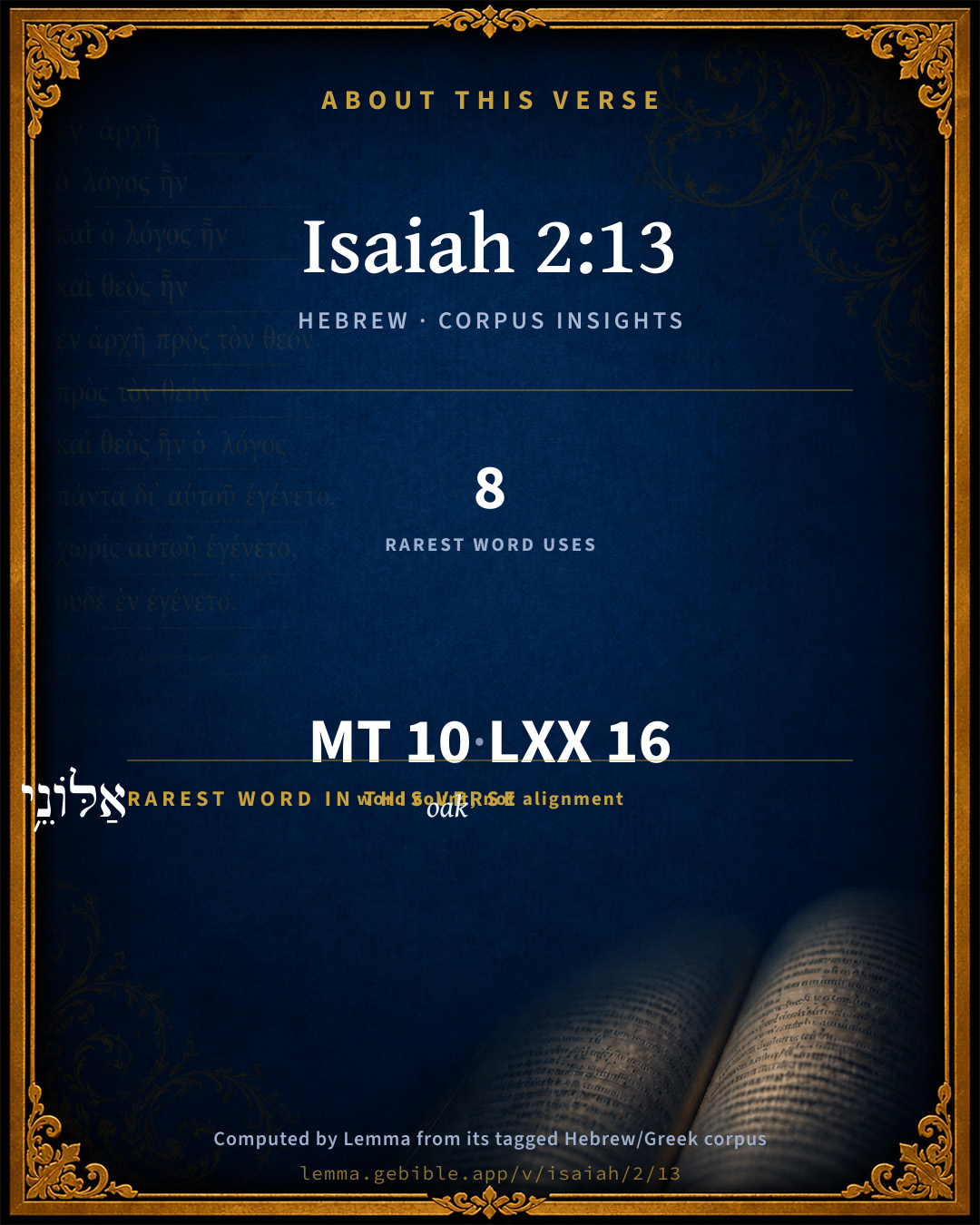
8
distinct lemmas
Prophets
section

Notable vocabulary

The rarest word here is אַלּוֹנֵ֥י oak H437 — appearing just 8 times in the whole Hebrew Bible.

Shared distinctive vocabulary

אַלּוֹנֵ֥י oak H437 occurs in 8 verses of the Hebrew Bible. Also found in:

Grammatical profile

  • 2 verbs
  • 6 nouns
  • 2 prepositions

Verb forms

  • הָרָמִ֖ים Qal · Participle Active
  • וְהַנִּשָּׂאִ֑ים Niphal · Participle Active

Repetition

Words recur within this verse — often emphatic in Hebrew:

  • וְעַל֙ upon H5921 ×2
  • כָּל all H3605 ×2

Hebrew & Septuagint length

In English translation the verse runs 18 words from the Hebrew and 19 from the Septuagint (LXX English) — closely comparable.

A rough comparison of the two English renderings, which tokenize alike — not a word-level alignment.

Word counts can differ between the Hebrew and the Greek without any difference in meaning — e.g. the Hebrew direct-object marker אֵת has no separate Greek word, and Greek often adds the article ὁ.

In the original languages it is 10 Hebrew tokens and 16 Greek tokens — but the two are counted differently (Hebrew bundles its prefixes and suffixes into one token; the Greek is in lemma form), so that isn’t a like-for-like length.

Cross-references

6

Topical passages linked to Isaiah 2:13 in the Treasury of Scripture Knowledge — connected by theme and wording, ordered by reader-vote popularity; previews shown in the World English Bible.

  • Isaiah 14:8 Yes, the fir trees rejoice at you, [and] the cedars of Lebanon, [saying], Since you are laid low, no lumberjack is come up against us.
  • Zechariah 11:1–2 Open your doors, Lebanon, That the fire may devour your cedars.
  • Isaiah 10:33–34 Behold, the Lord, Yahweh of Hosts, will lop the boughs with terror: and the high of stature shall be hewn down, and the lofty shall be brought low.
  • Isaiah 37:24 By your servants have you defied the Lord, and have said, With the multitude of my chariots am I come up to the height of the mountains, to the innermost parts of Lebanon; and I will cut down the tall cedars of it, and the choice fir trees of it; and I will enter into its farthest height, the forest of its fruitful field;
  • Ezekiel 31:3–12 Behold, the Assyrian was a cedar in Lebanon with beautiful branches, and with a forest-like shade, and of high stature; and its top was among the thick boughs.
  • Amos 2:5 But I will send a fire on Judah, And it will devour the palaces of Jerusalem."

Cross-references courtesy of OpenBible.info (CC BY 4.0).

Hebrew and Greek witnesses Masoretic Hebrew ↔ Greek Septuagint

The same verse in the two great witnesses to the Old Testament, shown verse-for-verse.

These are two independent witnesses, not word-aligned to each other, and the Septuagint is shown in lemma (dictionary) form.

Hebrew Isaiah 2:13 Masoretic · Westminster Leningrad Codex

וְעַל֙ כָּל אַרְזֵ֣י הַלְּבָנ֔וֹן הָרָמִ֖ים וְהַנִּשָּׂאִ֑ים וְעַ֖ל כָּל אַלּוֹנֵ֥י הַבָּשָֽׁן

For all the cedars of Lebanon, that are high and lifted up, For all the oaks of Bashan,

World English Bible · Public Domain

Greek LXX Isaiah 2:13 Septuagint · lemma form

καί ἐπί πᾶς κέδρος ὁ λίβανος ὁ ὑψηλός καί μετέωρος καί ἐπί πᾶς δένδρον βάλανος βασαν

and upon every cedar of Libanus, of them that are high and towering, and upon every oak of Basan,

LXX2012 (modern English Septuagint) · Public Domain

Hebrew: Westminster Leningrad Codex (CC BY 4.0). Greek: Septuagint (public domain); English from LXX2012 (modern English Septuagint) (Public Domain). How the Septuagint differs from the Hebrew →

Targum (Aramaic paraphrase)

1

The Targum is the ancient Jewish Aramaic paraphrase of the Hebrew Scriptures — an interpretive translation, not the Hebrew text itself. Onkelos (literal) and Pseudo-Jonathan (expansive) render the Torah, and Jonathan the Prophets. Coverage is partial: where no permissively-licensed English translation exists for a verse, only the Aramaic is shown. This is verse-level text, not a word-by-word alignment to the Hebrew.

  1. Targum Jonathan Prophets (Joshua–Malachi)
    וְעַל כָּל רַבְרְבָנֵי עַמְמַיָא תַּקִיפַיָא וַחֲסִינַיָא וְעַל כָּל טוּרְנֵי מְדִינָתָא:

    And upon all the kings of the nations, the strong and the mighty; and upon all the princes of the provinces;

    Targum Jonathan — Aramaic: “Mikraot Gedolot” (public domain). English: “Sefaria Community Translation” (CC0 1.0 (public-domain dedication)); “London "Chaldee Paraphrase," 1871” (public domain). Text via Sefaria.

Commentary

Notes on Isaiah 2:13 from classic Christian and Jewish commentators (each source and its license shown beneath its notes). The classic Christian expositions comment on the surrounding passage and are grouped to its opening verse, so a note may address several verses; the Jewish commentaries on the Tanakh (Rashi and others) are per-verse, so they appear only where the commentator wrote on this verse.

Lemma curates 59 commentaries, every one of them public domain or Creative Commons licensed, each selected and text-cleaned for this edition rather than reprinted as found. About our sources →

Trapp's Complete Commentary

John Trapp

Isa 2:13 And upon all the cedars of Lebanon, [that are] high and lifted up, and upon all the oaks of Bashan,

Ver. 13. And upon all the cedars of Lebanon.] Which was to the north. Ab Aquilone nihil boni.

That are high and lifted up.] No man’s might or height, whether of state or of stature, can secure him in the day of God’s displeasure.

And upon all the oaks of Bashan.] Which was to the east, by which way the Chaldees were to come upon them.

John Trapp, A Commentary or Exposition upon All the Books of the Old and New Testament (1647–1656) — public domain. Text from a community e-Sword module.

Tyndale Open Study Notes

Tyndale Open Resources

2:13-16 The prophet used several images of human strength to elaborate on 2:11-12.

2:13 The cedars of Lebanon were prized trees used in the construction of Solomon’s Temple and palace (1 Kgs 5:6) and other important buildings (Ezra 3:7). They represented wealth and power (2 Chr 25:18; Pss 92:12; 104:16), yet these mighty trees were as nothing before the Lord (Isa 10:34; 33:9; see the boast of Sennacherib in 37:24). • The oaks of Bashan were also an image of strength and splendor (Ezek 27:6); they, too, will disappoint (Isa 33:9; Nah 1:4; Zech 11:2).

Tyndale Open Study Notes — © Tyndale Open Resources, licensed CC BY-SA 4.0. Text via the HelloAO Bible API.

Jamieson, Fausset & Brown

Robert Jamieson, A. R. Fausset & David Brown

cedars . . . oaks--image for haughty nobles and princes (Amo 2:9; Zac 11:1-2; compare Rev 19:18-21).

Bashan--east of Jordan, north of the river Jabbok, famous for fine oaks, pasture, and cattle. Perhaps in "oaks" there is reference to their idolatry (Isa 1:29).

Jamieson, Fausset & Brown — Commentary Critical and Explanatory on the Whole Bible (1871) — public domain (CC PDM 1.0). Text via the HelloAO Bible API.

Adam Clarke's Commentary

Verse 13. - 16. And upon all the cedars - "Even against all the cedars"] Princes, potentates, rulers, captains, rich men, c. - So Kimchi. These verses afford us a striking example of that peculiar way of writing, which makes a principal characteristic of the parabolical or poetical style of the Hebrews, and in which the prophets deal so largely, namely, their manner of exhibiting things Divine, spiritual, moral, and political, by a set of images taken from things natural, artificial, religious, historical, in the way of metaphor or allegory. Of these nature furnishes much the largest and the most pleasing share and all poetry has chiefly recourse to natural images, as the richest and most powerful source of illustration. But it may be observed of the Hebrew poetry in particular, that in the use of such images, and in the application of them in the way of illustration and ornament, it is more regular and constant than any other poetry whatever; that it has for the most part a set of images appropriated in a manner to the explication of certain subjects. Thus you will find, in many other places besides this before us, that cedars of Lebanon and oaks of Bashan, are used in the way of metaphor and allegory for kings, princes, potentates of the highest rank; high mountains and lofty hills, for kingdoms, republics, states, cities; towers and fortresses, for defenders and protectors, whether by counsel or strength, in peace or war; ships of Tarshish and works of art, and invention employed in adorning them, for merchants, men enriched by commerce, and abounding in all the luxuries and elegances of life, such as those of Tyre and Sidon; for it appears from the course of the whole passage, and from the train of ideas, that the fortresses and the ships are to be taken metaphorically, as well as the high trees and the lofty mountains.

Ships of Tarshish] Are in Scripture frequently used by a metonymy for ships in general, especially such as are employed in carrying on traffic between distant countries, as Tarshish was the most celebrated mart of those times, frequented of old by the Phoenicians, and the principal source of wealth to Judea and the neighbouring countries. The learned seem now to be perfectly well agreed that Tarshish is Tartessus, a city of Spain, at the mouth of the river Baetis, whence the Phoenicians, who first opened this trade, brought silver and gold, (Jer 10:9; Eze 27:12,) in which that country then abounded; and, pursuing their voyage still farther to the Cassiterides, (Bogart, Canaan, i. c. 39; Huet, Hist. de Commerce, p. 194,) the islands of Scilly and Cornwall, they brought from thence lead and tin.

Tarshish is celebrated in Scripture, 2Ch 8:17-18; 2Ch 9:21, for the trade which Solomon carried on thither, in conjunction with the Tyrians. Jehoshaphat, 1Kg 22:48; 2Ch 20:36, attempted afterwards to renew their trade. And from the account given of his attempt it appears that his fleet was to sail to Ezion-geber on the Red Sea; they must therefore have designed to sail round Africa, as Solomon's fleet had done before, (see Huet, Histoire de Commerce, p. 32,) for it was a three years' voyage, (2Ch 9:21,) and they brought gold from Ophir, probably on the coast of Arabia; silver from Tartessus; and ivory, apes, and peacocks, from Africa. " אופרי Afri, Africa, the Roman termination, Africa terra. תרשיש Tarshish, some city or country in Africa. So the Chaldee on 1Kg 22:49, where it renders תרשיש Tarshish by אפריקה Aphricah; and compare 2Ch 20:36, from whence it appears, to go to Ophir and to Tarshish is one and the same thing." - Dr. Jubb.

It is certain that under Pharaoh Necho, about two hundred years afterwards, this voyage was made by the Egyptians; Herodot. iv. 42. They sailed from the Red Sea, and returned by the Mediterranean, and they performed it in three years, just the same time that the voyage under Solomon had taken up. It appears likewise from Pliny, Nat. Hist., ii. 67, that the passage round the Cape of Good Hope was known and frequently practised before his time, by Hanno the Carthaginian, when Carthage was in its glory; by one Eudoxus, in the time of Ptolemy Lathyrus, king of Egypt; and Coelus Antipater, a historian of good credit, somewhat earlier than Pliny, testifies that he had seen a merchant who had made the voyage from Gades to Ethiopia. The Portuguese under Vasco de Gama, near three hundred years ago, recovered this navigation, after it had been intermitted and lost for many centuries. - L.

Adam Clarke's Commentary on the Bible (1810–1826) — public domain. Text from a community e-Sword/MySword module.

Ellicott's Commentary for English Readers

(13) Upon all the cedars of Lebanon . . .—The words find a striking parallel in the passage from Herodotus just referred to. In that storm which is about to burst over the land, the cedars and the oaks, and, we may add, those who were as the cedars and the oaks, in their pride and glory, should all alike be shattered.

A Bible Commentary for English Readers, edited by Charles John Ellicott (1878–1897) — public domain. Text from a community e-Sword module.

John Gill's Exposition

And upon all the cedars of Lebanon that are high and lifted up,.... That is, upon the kings of the earth, who have committed fornication with Babylon, and will join with the beast and false prophet in making war with the Lamb. So the Targum, Jarchi, and Kimchi, interpret it of the kings of the nations, mighty and strong:

and upon all the oaks of Bashan; nobles, princes, governors of provinces, as the same writers explain the words, oaks being inferior to cedars: the day of the Lord will be upon these, and their destruction come on at the battle of Armageddon, Rev 19:18.

John Gill's Exposition of the Whole Bible (1746–1763) — public domain (CC PDM 1.0). Text via the HelloAO Bible API.

Albert Barnes' Notes on the Bible

And upon all the cedars of Lebanon - This is a beautiful specimen of the poetic manner of writing, so common among the Hebrews, where spiritual and moral subjects are represented by grand or beautiful imagery taken from objects of nature. Mount Lebanon bounded Palestine on the north. It was formerly much celebrated for its large and lofty cedars. These cedars were from thirty-five to forty feet in girth, and very high. They were magnificent trees, and were valuable for ceiling: statues, or roofs, that required durable, and beautiful timber. The roof of the temple of Diana of Ephesus, according to Pliny, was of cedar, and no small part of the temple of Solomon was of this wood. A few lofty trees of this description are still remaining on Mount Lebanon. ‘After three hours of laborious traveling,’ says D’Arvieux, ‘we arrived at the famous cedars about eleven o’clock. We counted twenty-three of them. The circumference of these trees is thirty-six feet. The bark of the cedar resembles that of the pine; the leaves and cone also bear considerable resemblance. The stem is upright, the wood is hard, and has the reputation of being incorruptible. The leaves are long, narrow, rough, very green, ranged in tufts along the branches; they shoot in spring, and fall in the beginning of winter. Its flowers and fruit resemble those of the pine. From the full grown trees, a fluid trickles naturally, and without incision; this is clear, transparent, whitish, and after a time dries and hardens; it is supposed to possess great virtues. The place where these great trees are stationed, is in a plain of nearly a league in circumference, on the summit of a mount which is environed on almost all sides by other mounts, so high that their summits are always covered with snow. This plain is level, the air is pure, the heavens always serene.’

Maundrell found only sixteen cedars of large growth, and a natural plantation of smaller ones, which were very numerous. One of the largest was twelve yards six inches in girth, and thirty-seven yards in the spread of its boughs. At six yards from the ground, it was divided into five limbs, each equal to a great tree. Dr. Richardson visited them in 1818, and found a small clump of large, tall, and beautiful trees, which he pronounces the most picturesque productions of the vegetable world that he had ever seen. In this clump are two generations of trees; the oldest are large and massy, rearing their heads to an enormous height, and spreading their branches to a great extent. He measured one, not the largest in the clump, and found it thirty-two feet in circumference. Seven of these trees appeared to be very old, the rest younger, though, for want of space, their branches are not so spreading.

Bush’s “Illustrations of Scripture.” ‘The celebrated cedar-grove of Lebanon,’ says Dr. Robinson, ‘is at least two days journey from Beirut, near the northern, and perhaps the highest summit of the mountain. It has been often and sufficiently described by travelers for the last three centuries; but they all differ as to the number of the oldest trees, inasmuch as in counting, some have included more and some less of the younger ones. At present, the number of trees appears to be on the increase, and amounts in all to several hundred. This grove was long held to be the only remnant of the ancient cedars of Lebanon. But Seetzen, in 1805, discovered two other groves of greater extent; and the American Missionaries, in traveling through the mountains, have also found many cedars in other places. The trees are of all sizes, old and young; but none so ancient and venerable as those usually visited.’ “Bib. Researches,” iii., 440; 441. The cedar, so large, lofty, and grand, is used in the Scriptures to represent kings, princes, and nobles: compare Eze 31:3; Dan 4:20-22; Zec 11:1-2; Isa 14:8. Here it means the princes and nobles of the land of Israel. The Chaldee renders it, ‘upon all the strong and mighty kings of the people.’

And upon all the oaks of Bashan - “Bashan” was east of the river Jordan, in the limits of the half tribe of Manasseh. It was bounded on the north and east by Gilead, south by the river Jabbok, and west by the Jordan. It was celebrated for pasturage, and for producing fine cattle; Num 21:33; Num 32:33; Psa 22:12; Eze 39:18; Amo 4:1; Mic 7:14. Its lofty oaks are also particularly celebrated; Eze 27:6; Amo 2:9; Zec 11:2. The sense here is not different from the former member of the sentence - denoting the princes and nobles of the land.

Albert Barnes' Notes on the Bible (1834–1885) — public domain. Text from a community e-Sword/MySword module.

Haydock's Catholic Bible Commentary

Basan. Israel; or Syria and the Ammonites, (Calmet) whom Nabuchodonosor subdued, five years after he had taken Jerusalem, (Josephus, [Antiquities?] x. 11.) as the Idumeans, (ver. 14.) Philistines, and Egyptians, (ver. 15.) and Tyrians, (ver. 16.) who felt also the indignation of the Lord, Jeremias xxv. 15.

George Leo Haydock (1774–1849), Haydock's Catholic Family Bible and Commentary, 1859 edition — public domain. Excludes Psalms (Douay-Rheims chapter numbering differs from Protestant) and Deuterocanonical books (Catholic canon only).

Matthew Poole's English Annotations

Either,

1. Metaphorically, upon the highest and proudest sinners; or,

2. Literally, as may seem probable from the following verses, where there is distinct mention made of mountains and hills, Isa 2:14, of towers and walls, Isa 2:15, of ships and pictures, Isa 2:16. Whereby he intimates that the judgment should be so universal and terrible, that it should not only reach to men, but to things also, whether natural or artificial, in all which there should be manifest tokens of God’s displeasure against the land. The cedars and oaks standing in the mountains shall be either thrown down by furious winds or earthquakes, or torn in pieces by thunder and lightning, and the stately houses built with cedars and oaks shall be destroyed.

Matthew Poole's English Annotations on the Holy Bible (1683–1685) — public domain. Text from a community e-Sword/MySword module.

Whedon's Commentary on the Bible

Daniel D. Whedon

13. Cedars — Majestic trees in the Lebanon range, unsurpassed for beauty, strength, and building utility; often used as symbols of the great men in war and civil power.

Oaks of Bashan — They abound on the east of the Jordan. The metaphor applies to men in Israel strong in their self-conscious independence and power. Before Jehovah their pride is to have a fearful fall.

Daniel D. Whedon (gen. ed.), Commentary on the Old and New Testaments (1874–1909) — public domain. Text from a community e-Sword module.

The Pulpit Commentary

Upon all the cedars of Lebanon. It is usual to take this metaphorically; and no doubt men are often compared to trees in Scripture, (Psa_1:3 Jer_17:8 Job_8:16, Job_8:17) and "cedars of Lebanon" especially are symbols of the great and proud ones. (Eze_31:3) But it has been well observed that either all the details of the description in the text must be taken literally, or all of them metaphorically, and that the mention of such objects as "ships of Tarshish" and "pleasant pictures" pleads strongly for a literal interpretation. The day of the Lord was upon the cedars when Sennacherib "with chariots upon chariots came up to the height of the mountains, to the sides of Lebanon, and cut down the tall cedars thereof, and the choice fir trees thereof"; and (Isa_37:24) similar devastation accompanied, it is probable, the other invasions of the Assyrians (see "Ancient Monarchies," vol. 1. pp. 474, 475). Upon all the oaks of Bashan. The "oaks of Bashan" are celebrated also by Ezekiel (Eze_27:6) and by Zechariah. (Zec_11:2) It is quite likely that the Assyrians cut timber in Bashan, as they did in Lebanon and Amanus.

The Pulpit Commentary (1880–1919), ed. H.D.M. Spence-Jones & Joseph S. Exell — public domain. Text from a community e-Sword module.

John Wesley's Explanatory Notes

The cedars - The cedars and oaks on the mountains shall be either thrown down by furious winds or earthquakes, or torn in pieces by thunder and lightning; and the stately houses built with cedars and oaks, shall be destroyed.

John Wesley, Explanatory Notes Upon the Whole Bible (1754–1765) — public domain. Text via the GEBible commentary corpus.

Keil & Delitzsch

C. F. Keil & F. Delitzsch

The prophet then proceeds to enumerate all the high things upon which that day would fall, arranging them two and two, and binding them in pairs by a double correlative Vav. The day of Jehovah comes, as the first two pairs affirm, upon everything lofty in nature. "As upon all the cedars of Lebanon, the lofty and exalted, so upon all the oaks of Bashan. As upon all mountains, the lofty ones, so upon all hills the exalted ones." But wherefore upon all this majestic beauty of nature? Is all this merely figurative? Knobel regards it as merely a figurative description of the grand buildings of the time of Uzziah and Jotham, in the erection of which wood had been used from Lebanon as well as from Bashan, on the western slopes of which the old shady oaks (sindiân and ballūt) are flourishing still.

(Note: On the meaning of the name of this region, Bashan (Basanitis), see Comm. on Job, Appendix, Eng. Tr.)

But the idea that trees can be used to signify the houses built with the good obtained from them, is one that cannot be sustained from Isa 9:9 (10.), where the reference is not to houses built of sycamore and cedar wood, but to trunks of trees of the king mentioned; nor even from Nah 2:4 (3.), where habberoshim refers to the fir lances which are brandished about in haughty thirst for battle. So again mountains and hills cannot denote the castles and fortifications built upon them, more especially as these are expressly mentioned in Isa 2:15 in the most literal terms. In order to understand the prophet, we must bear in mind what the Scriptures invariably assume, from their first chapter to the very close, namely, that the totality of nature is bound up with man in one common history; that man and the totality of nature are inseparably connected together as centre and circumference; that this circumference is affected by the sin which proceeds from man, as well as by the anger or the mercy which proceeds from God to man; that the judgments of God, as the history of the nations proves, involve in fellow-suffering even that part of the creation which is not free; and that this participation in the "corruption" (phthora) and "glory" (doxa) of humanity will come out with peculiar distinctness and force at the close of the world's history, in a manner corresponding to the commencement; and lastly, that the world in its present condition needs a palingenesia, or regeneration, quite as much as the corporeal nature of man, before it can become an object of good pleasure on the part of God. We cannot be surprised, therefore, that, in accordance with this fundamental view of the Scriptures, when the judgment of God fell upon Israel, it should also be described as going down to the land of Israel, and as overthrowing not only the false glory of the nation itself, but everything glorious in the surrounding nature, which had been made to minister to its national pride and love of show, and to which its sin adhered in many different ways. What the prophet foretold began to be fulfilled even in the Assyrian wars. The cedar woods of Lebanon were unsparingly destroyed; the heights and valleys of the land were trodden down and laid waste; and, in the period of the great empires which commenced with Tiglath-pileser, the Holy Land was reduced to a shadow of its former promised beauty.

Keil & Delitzsch — Biblical Commentary on the Old Testament (1861–1891) — public domain (CC PDM 1.0). Text via the HelloAO Bible API. (Old Testament only.)

J. A. Alexander on Isaiah

Joseph Addison Alexander

To convey the idea of lofty and imposing objects, the Prophet makes use, not of symbols but of specimens selected from among the things of this class most familiar to his readers, beginning with the two noblest species of forest trees. “And on all the cedars of Lebanon” (or the White Mountain, the chain dividing Palestine from Syria), “and on all the oaks of Bashan” (now called El Bethenyeh, a mountainous district, east of Jordan, famous of old for its pastures and oak-forests). Cedars and oaks are supposed by some to be here named, as emblems of great men in general, or of the great men of Syria and Israel distinctively; but this is not in keeping with the subsequent context, in which some things are mentioned, which cannot be understood as emblems, but only as samples of their several classes. On the trees and places mentioned in this verse, see Robinson’s Palestine, vol. iii. p. 440, and Appendix, p. 158.

Joseph Addison Alexander, The Prophecies of Isaiah (1846–1847; New York: Scribner, 1870–1878) — public domain. Text from a community e-Sword module.

Rashi

Rabbi Shlomo Yitzchaki (Rashi)

the cedars of the Lebanon This is symbolic of the heroes [var. the kings].

the oaks of the Bashan The governors, just as the oaks are inferior to the cedars.

Rashi on the Tanakh — English translations: “The Judaica Press complete Tanach with Rashi, translated by A. J. Rosenberg” (CC BY 4.0); “Pentateuch with Rashi's commentary by M. Rosenbaum and A.M. Silbermann, 1929-1934” (public domain); “The Metsudah Tanach series, Lakewood, N.J” (CC BY 4.0); and “The Book of Joshua, Metsudah Publications, 1997” (CC BY 4.0). Text via Sefaria.

Ibn Ezra

Rabbi Abraham ibn Ezra

The cedars, etc. All this may be taken either literally, or symbolically for the young, great, rich, mighty, and the kings.

Ibn Ezra on the Tanakh — English translations: “Sefaria Community Translation” (CC0 1.0 (public-domain dedication)); “Yalkut, Sifsei Chachomim Chumash, Metsudah Publications, 2009” (CC BY 4.0); and “Commentary of Ibn Ezra on Isaiah - trans. by M. Friedlander, 1873” (public domain). Text via Sefaria.

Lesson kit

Teaching starters — assembled from the data on this page, not authored interpretation. Every prompt links to the verse data it draws on. Edit before teaching.

Isaiah, in the Prophets, opens this verse with 10 words (8 distinct Hebrew lemmas). Its most distinctive word is ʼallôwn (“oak”). A historical commentator’s framing appears above. Read the whole chapter for the surrounding context.

Discussion questions

  1. What does “oak” (ʼallôwn) contribute to the verse as a whole?
  2. How does Genesis 35:8, which shares the word «oak», read alongside this verse?
  3. What does the repetition of “upon” (2× in this one verse) do in this verse?
  4. These translations render this verse differently; the difference is in the English rendering, not the original. What questions does that raise?
  5. «הָרָמִ֖ים» is a Qal Participle Active verb. How does that grammatical form shape the action described?
  6. Compare how Trapp's Complete Commentary and Tyndale Open Study Notes read this verse. Where do they agree or differ?

Things to notice

Reading settings

Reading text

Shown beneath each verse's original-language words.

Old Testament
Old Testament edition

Read the OT as the Masoretic Hebrew (MT) or the Greek Septuagint (LXX).

English shown for the Greek Septuagint (in the Hebrew ↔ Greek comparison).

Comparing translations? Open the Compare panel on any verse page to stack up to four side by side.