
Lamentations 2:17

Hebrew (Westminster Leningrad Codex) Lamentations 2:17 appears in the Hebrew Old Testament. The text above is from the Westminster Leningrad Codex. Each word links to its Strong’s number, a concise gloss, and parsing drawn from the Open Scriptures Hebrew Bible morphology. Click any word for its full Brown-Driver-Briggs (BDB) entry.
Download image
Cite this verse

Lamentations 2:17 (World English Bible). Public Domain. Lemma interlinear Bible study tool, https://lemma.gebible.app/v/lamentations/2/17.

Show BibTeX & RIS
BibTeX
RIS
English Translation
Yahweh has done that which he purposed; he has fulfilled his word that he commanded in the days of old; He has thrown down, and has not pitied: He has caused the enemy to rejoice over you; he has exalted the horn of your adversaries.
World English Bible · Public Domain
Download a study sheet

One document with this verse’s original text, its word-by-word gloss line, the meaning frame, cross-references with their text, attributed commentary, and full source and license credits — printable, and it pastes into notes with its structure intact.

This verse Autodidact and up

Study sheet (.html) Plain text (.txt)

A passage Seminary Student

Up to 50 verses in one chapter. A passage sheet keeps up to 6 commentary sources and 12 cross-references per verse, in the order this page ranks them, and says so on the sheet whenever that leaves anything out. Ask for a single verse and you get the Autodidact verse sheet above.

Everything on this page stays free to read, with no account — the sheet is a download of what is already on screen, not access to it.

Want to remove ads? Support Godless Engineer
Compare translations 3

The same verse in 3 English versions, stacked beneath the original-language interlinear above. Click any original word for its lexicon entry.

Each is an independent rendering of the whole verse — the interlinear is not word-aligned to these translations.

Highlighted words mark where these versions differ — a whole-verse word diff, not a word-by-word alignment.

  • World English Bible Public Domain
    Yahweh has done that which he purposed; he has fulfilled his word that he commanded in the days of old; He has thrown down, and has not pitied: He has caused the enemy to rejoice over you; he has exalted the horn of your adversaries.
  • King James Version Public Domain
    The LORD hath done that which he had devised; he hath fulfilled his word that he had commanded in the days of old: he hath thrown down, and hath not pitied: and he hath caused thine enemy to rejoice over thee, he hath set up the horn of thine adversaries.
  • unfoldingWord Literal Text CC BY-SA 4.0
    Yahweh has done what he planned; he has fulfilled his word that he commanded from days of old. He has torn down and has not shown compassion, and he has made the enemy rejoice over you; he has lifted up the horn of your adversaries. TSADHE

unfoldingWord Literal Text — © unfoldingWord, licensed CC BY-SA 4.0. Word-aligned USFM3 via Door43 (git.door43.org/unfoldingWord/en_ult).

Versions to compare (up to 4)

3 of 4 selected

Show all 18 translations

Every available English version of this verse, each an independent rendering of the whole verse.

  • World English Bible Public Domain
    Yahweh has done that which he purposed; he has fulfilled his word that he commanded in the days of old; He has thrown down, and has not pitied: He has caused the enemy to rejoice over you; he has exalted the horn of your adversaries.
  • Berean Standard Bible Public Domain
    The LORD has done what He planned; He has accomplished His decree, which He ordained in days of old; He has overthrown you without pity. He has let the enemy gloat over you and exalted the horn of your foes.
  • Majority Standard Bible Public Domain
    The LORD has done what He planned; He has accomplished His decree, which He ordained in days of old; He has overthrown you without pity. He has let the enemy gloat over you and exalted the horn of your foes.
  • King James Version Public Domain
    The LORD hath done that which he had devised; he hath fulfilled his word that he had commanded in the days of old: he hath thrown down, and hath not pitied: and he hath caused thine enemy to rejoice over thee, he hath set up the horn of thine adversaries.
  • American Standard Version (1901) Public Domain
    Jehovah hath done that which he purposed; he hath fulfilled his word that he commanded in the days of old; He hath thrown down, and hath not pitied: And he hath caused the enemy to rejoice over thee; he hath exalted the horn of thine adversaries.
  • Revised Version (1885) Public Domain
    The LORD hath done that which he devised; he hath fulfilled his word that he commanded in the days of old; he hath thrown down, and hath not pitied: and he hath caused the enemy to rejoice over thee, he hath exalted the horn of thine adversaries.
  • Geneva Bible (1599) Public Domain
    The Lord hath done that which he had purposed: he hath fulfilled his worde that he had determined of old time: he hath throwen downe, and not spared: hee hath caused thine enemie to reioyce ouer thee, and set vp the horne of thine aduersaries.
  • Douay-Rheims (1899) Public Domain
    Ain. The Lord hath done that which he purposed, he hath fulfilled his word, which he commanded in the days of old: he hath destroyed, and hath not spared, and he hath caused the enemy to rejoice over thee, and hath set up the horn of thy adversaries.
  • Young's Literal Translation Public Domain
    Jehovah hath done that which He devised, He hath fulfilled His saying That He commanded from the days of old, He hath broken down and hath not pitied, And causeth an enemy to rejoice over thee, He lifted up the horn of thine adversaries.
  • Literal Standard Version CC BY-SA 4.0
    YHWH has done that which He devised, || He has fulfilled His saying || That He commanded from the days of old, || He has broken down and has not pitied, || And causes an enemy to rejoice over you, || He lifted up the horn of your adversaries.
  • Unlocked Literal Bible CC BY-SA 4.0
    Yahweh has done what he planned to do. He has fulfilled his word. He has overthrown you without pity, for he has permitted the enemy to rejoice over you; he has lifted up the horn of your enemies.
  • unfoldingWord Literal Text CC BY-SA 4.0
    Yahweh has done what he planned; he has fulfilled his word that he commanded from days of old. He has torn down and has not shown compassion, and he has made the enemy rejoice over you; he has lifted up the horn of your adversaries. TSADHE
  • Darby Bible Public Domain
    Jehovah hath done what he had devised; he hath fulfilled his word which he had commanded from the days of old: he hath thrown down, and hath not spared, and he hath caused the enemy to rejoice over thee; he hath set up the horn of thine adversaries.
  • World Messianic Bible Public Domain
    The LORD has done that which he planned. He has fulfilled his word that he commanded in the days of old. He has thrown down, and has not pitied. He has caused the enemy to rejoice over you. He has exalted the horn of your adversaries.
  • Webster's Bible Public Domain
    The LORD hath done that which he had devised; he hath fulfilled his word that he had commanded in the days of old: he hath thrown down, and hath not pitied: and he hath caused thy enemy to rejoice over thee, he hath set up the horn of thy adversaries.
  • Free Bible Version CC BY-SA 4.0
    The Lord has achieved what he decided; he has done what he warned he would. Just as he determined to do long ago, he has destroyed you, showing no mercy. He has allowed the enemy to gloat over your defeat, and he has given power to those who attack you.
  • Bible in Basic English Public Domain
    The Lord has done that which was his purpose; he has put into force the orders which he gave in the days which are past; pulling down without pity, he has made your hater glad over you, lifting up the horn of those who were against you.
  • JPS Tanakh (1917) Public Domain
    The LORD hath done that which He devised; He hath performed His word that He commanded in the days of old; He hath thrown down unsparingly; and He hath caused the enemy to rejoice over thee, He hath exalted the horn of thine adversaries.

Literal Standard Version (2020), Covenant Press — licensed CC BY-SA 4.0. Text via the HelloAO Bible API (eBible.org). Unlocked Literal Bible (unfoldingWord) — licensed CC BY-SA 4.0. Text via the HelloAO Bible API (eBible.org). unfoldingWord Literal Text — © unfoldingWord, licensed CC BY-SA 4.0. Word-aligned USFM3 via Door43 (git.door43.org/unfoldingWord/en_ult). Free Bible Version, Dr. Jonathan Gallagher — licensed CC BY-SA 4.0. Text via the HelloAO Bible API (eBible.org).

Word by word

More ways to search: Search by grammar → Find every occurrence → Compare this word →

Practice this passage: Drill this verse → Learn its vocabulary →

זָמָ֗ם
zâmam
H2161
“to devise”
Verb, Qal, Perfect, 3rd Person, Masculine, Singular
Part of Speech
Verb
Stem
Qal
Form
Perfect
Person
3rd Person
Gender
Masculine
Number
Singular
Full BDB Definition

Origin: a primitive root

TWOT: 556

to have a thought, devise, plan, consider, purpose - (Qal) - to consider, fix thought upon - to purpose, devise - to plot (of evil intent)
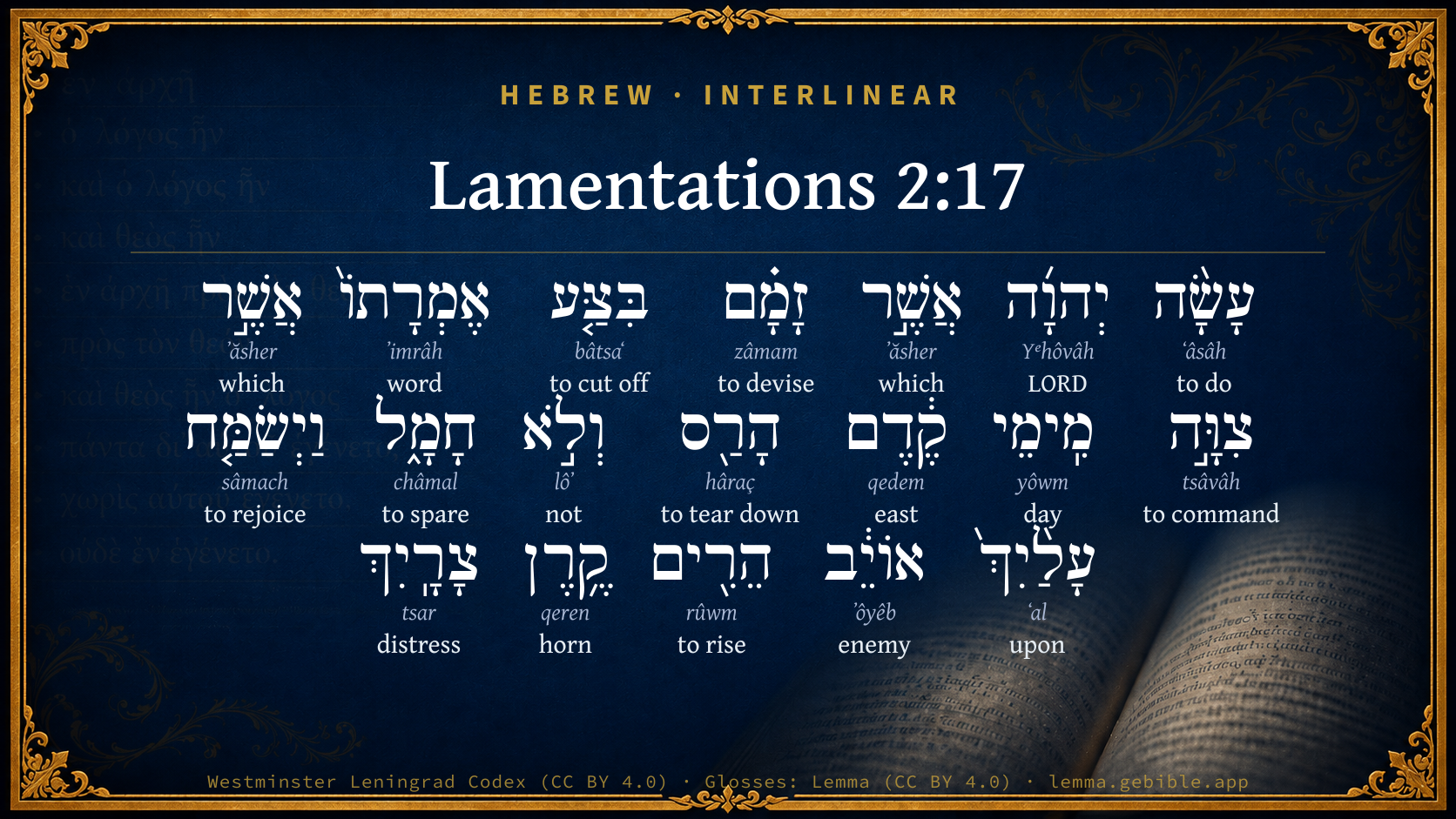
  1. עָשָׂ֨ה ʻâsâh H6213 “to do” Verb, Qal, Perfect, 3rd Person, Masculine, Singular
  2. יְהוָ֜ה Yᵉhôvâh H3068 “LORD” Noun, Proper
  3. אֲשֶׁ֣ר ʼăsher H834 “which” Particle, Relative
  4. בִּצַּ֤ע bâtsaʻ H1214 “to cut off” Verb, Piel, Perfect, 3rd Person, Masculine, Singular
  5. אֶמְרָתוֹ֙ ʼimrâh H565 “word · his” Noun, Common, Feminine, Singular, Construct + Suffix, Personal, 3rd Person, Masculine, Singular
  6. אֲשֶׁ֣ר ʼăsher H834 “which” Particle, Relative
  7. צִוָּ֣ה tsâvâh H6680 “to command” Verb, Piel, Perfect, 3rd Person, Masculine, Singular
  8. מִֽימֵי yôwm H3117 “from · days of” Preposition + Noun, Common, Masculine, Plural, Construct
  9. קֶ֔דֶם qedem H6924 “east” Noun, Common, Masculine, Singular, Absolute
  10. הָרַ֖ס hâraç H2040 “to tear down” Verb, Qal, Perfect, 3rd Person, Masculine, Singular
  11. וְלֹ֣א lôʼ H3808 “and · not” Conjunction + Particle, Negative
  12. חָמָ֑ל châmal H2550 “to spare” Verb, Qal, Perfect, 3rd Person, Masculine, Singular
  13. וַיְשַׂמַּ֤ח sâmach H8055 “and · to rejoice” Conjunction + Verb, Piel, Sequential Imperfect, 3rd Person, Masculine, Singular
  14. עָלַ֨יִךְ֙ ʻal H5921 “upon · you” Preposition + Suffix, Personal, 2nd Person, Feminine, Singular
  15. אוֹיֵ֔ב ʼôyêb H341 “enemy” Verb, Qal, Participle Active, Masculine, Singular, Absolute
  16. הֵרִ֖ים rûwm H7311 “to rise” Verb, Hiphil, Perfect, 3rd Person, Masculine, Singular
  17. קֶ֥רֶן qeren H7161 “horn of” Noun, Common, Both, Singular, Construct
  18. צָרָֽיִךְ tsar H6862 “distresses · your” Noun, Common, Masculine, Plural, Construct + Suffix, Personal, 2nd Person, Feminine, Singular

About this verse

These counts appear in no published source. They are computed here, from the morphology-tagged text and Lemma’s own curated glosses. What Lemma adds →

19
words
18
distinct lemmas
Prophets
section

Notable vocabulary

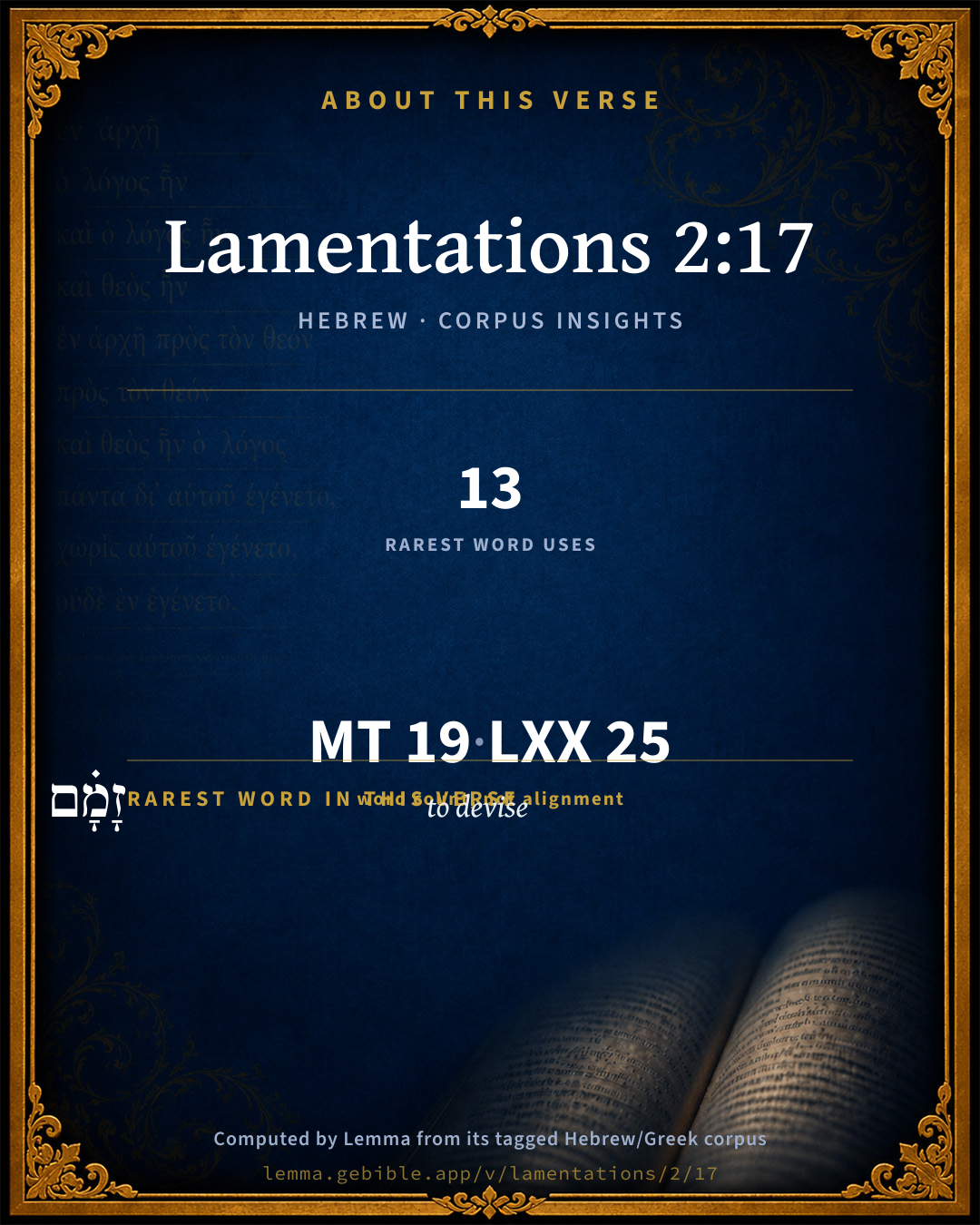
The rarest word here is זָמָ֗ם to devise H2161 — appearing just 13 times in the whole Hebrew Bible.

Shared distinctive vocabulary

זָמָ֗ם to devise H2161 occurs in 13 verses of the Hebrew Bible. Also found in:

Grammatical profile

  • 9 verbs
  • 6 nouns
  • 1 preposition
  • 3 particles

Verb forms

  • עָשָׂ֨ה Qal · Perfect
  • זָמָ֗ם Qal · Perfect
  • בִּצַּ֤ע Piel · Perfect
  • צִוָּ֣ה Piel · Perfect
  • הָרַ֖ס Qal · Perfect
  • חָמָ֑ל Qal · Perfect
  • וַיְשַׂמַּ֤ח Piel · Sequential Imperfect
  • אוֹיֵ֔ב Qal · Participle Active
  • הֵרִ֖ים Hiphil · Perfect

Repetition

A word recurs within this verse — often emphatic in Hebrew:

  • אֲשֶׁ֣ר which H834 ×2

Hebrew & Septuagint length

In English translation the verse runs 45 words from the Hebrew and 52 from the Septuagint (LXX English) — closely comparable.

A rough comparison of the two English renderings, which tokenize alike — not a word-level alignment.

Word counts can differ between the Hebrew and the Greek without any difference in meaning — e.g. the Hebrew direct-object marker אֵת has no separate Greek word, and Greek often adds the article ὁ.

In the original languages it is 19 Hebrew tokens and 25 Greek tokens — but the two are counted differently (Hebrew bundles its prefixes and suffixes into one token; the Greek is in lemma form), so that isn’t a like-for-like length.

Cross-references

16

Topical passages linked to Lamentations 2:17 in the Treasury of Scripture Knowledge — connected by theme and wording, ordered by reader-vote popularity; previews shown in the World English Bible.

  • Ezekiel 5:11 Therefore, as I live, says the Lord Yahweh, surely, because you have defiled my sanctuary with all your detestable things, and with all your abominations, therefore will I also diminish [you]; neither shall my eye spare, and I also will have no pity.
  • Psalms 89:42 You have exalted the right hand of his adversaries. You have made all of his enemies rejoice.
  • Leviticus 26:14–46 "'But if you will not listen to me, and will not do all these commandments;
  • Deuteronomy 28:15–68 But it shall come to pass, if you will not listen to the voice of Yahweh your God, to observe to do all his commandments and his statutes which I command you this day, that all these curses shall come on you, and overtake you.
  • Deuteronomy 31:16–17 Yahweh said to Moses, Behold, you shall sleep with your fathers; and this people will rise up, and play the prostitute after the strange gods of the land, where they go to be among them, and will forsake me, and break my covenant which I have made with them.
  • Lamentations 1:5 Her adversaries are become the head, her enemies prosper; For Yahweh has afflicted her for the multitude of her transgressions: Her young children are gone into captivity before the adversary.
  • Lamentations 2:1–2 How has the Lord covered the daughter of Zion with a cloud in his anger! He has cast down from heaven to the earth the beauty of Israel, And hasn't remembered his footstool in the day of his anger.
  • Ezekiel 7:8–9 Now will I shortly pour out my wrath on you, and accomplish my anger against you, and will judge you according to your ways; and I will bring on you all your abominations.
  • Ezekiel 8:18 Therefore will I also deal in wrath; my eye shall not spare, neither will I have pity; and though they cry in my ears with a loud voice, yet will I not hear them.
  • Deuteronomy 29:18–23 lest there should be among you man, or woman, or family, or tribe, whose heart turns away this day from Yahweh our God, to go to serve the gods of those nations; lest there should be among you a root that bears gall and wormwood;
  • Deuteronomy 32:15–27 But Jeshurun grew fat, and kicked: You have grown fat, you are grown thick, you are become sleek; Then he forsook God who made him, Lightly esteemed the Rock of his salvation.
  • Psalms 38:16 For I said, "Don't let them gloat over me, Or exalt themselves over me when my foot slips."
  • Jeremiah 18:11 Now therefore, speak to the men of Judah, and to the inhabitants of Jerusalem, saying, Thus says Yahweh: Behold, I frame evil against you, and devise a device against you: return you now everyone from his evil way, and amend your ways and your doings.
  • Lamentations 2:8 Yahweh has purposed to destroy the wall of the daughter of Zion; He has stretched out the line, he has not withdrawn his hand from destroying; He has made the rampart and wall to lament; they languish together.
  • Ezekiel 9:10 As for me also, my eye shall not spare, neither will I have pity, but I will bring their way on their head.
  • Micah 2:3 Therefore thus says Yahweh: "Behold, I am planning against these people a disaster, From which you will not remove your necks, Neither will you walk haughtily; For it is an evil time.

Cross-references courtesy of OpenBible.info (CC BY 4.0).

Hebrew and Greek witnesses Masoretic Hebrew ↔ Greek Septuagint

The same verse in the two great witnesses to the Old Testament, shown verse-for-verse.

These are two independent witnesses, not word-aligned to each other, and the Septuagint is shown in lemma (dictionary) form.

Hebrew Lamentations 2:17 Masoretic · Westminster Leningrad Codex

עָשָׂ֨ה יְהוָ֜ה אֲשֶׁ֣ר זָמָ֗ם בִּצַּ֤ע אֶמְרָתוֹ֙ אֲשֶׁ֣ר צִוָּ֣ה מִֽימֵי קֶ֔דֶם הָרַ֖ס וְלֹ֣א חָמָ֑ל וַיְשַׂמַּ֤ח עָלַ֨יִךְ֙ אוֹיֵ֔ב הֵרִ֖ים קֶ֥רֶן צָרָֽיִךְ

Yahweh has done that which he purposed; he has fulfilled his word that he commanded in the days of old; He has thrown down, and has not pitied: He has caused the enemy to rejoice over you; he has exalted the horn of your adversaries.

World English Bible · Public Domain

Greek LXX Lamentations 2:17 Septuagint · lemma form

ποιέω κύριος ὅς ἐνθυμέομαι συντελέω ῥῆμα αὐτός ὅς ἐντέλλομαι ἐκ ἡμέρα ἀρχαῖος κατααἱρέω καί οὐ φείδομαι καί εὐφραίνω ἐπί σύ ἐχθρός ὑψόω κέρας θλίβω σύ

PHE. The Lord has done that which he purposed; he has accomplished his word, even the things which he commanded from the ancient days: he has thrown down, and has not spared: and he has caused the enemy to rejoice over you, he has exalted the horn of him that afflicted you.

LXX2012 (modern English Septuagint) · Public Domain

Hebrew: Westminster Leningrad Codex (CC BY 4.0). Greek: Septuagint (public domain); English from LXX2012 (modern English Septuagint) (Public Domain). How the Septuagint differs from the Hebrew →

Commentary

Notes on Lamentations 2:17 from classic Christian and Jewish commentators (each source and its license shown beneath its notes). The classic Christian expositions comment on the surrounding passage and are grouped to its opening verse, so a note may address several verses; the Jewish commentaries on the Tanakh (Rashi and others) are per-verse, so they appear only where the commentator wrote on this verse.

Lemma curates 59 commentaries, every one of them public domain or Creative Commons licensed, each selected and text-cleaned for this edition rather than reprinted as found. About our sources →

Trapp's Complete Commentary

John Trapp

Lam 2:17 The LORD hath done [that] which he had devised; he hath fulfilled his word that he had commanded in the days of old: he hath thrown down, and hath not pitied: and he hath caused [thine] enemy to rejoice over thee, he hath set up the horn of thine adversaries.

Ver. 17. The Lord hath done that which he hath devised.] Or, Performed what he purposed. See Lam 2:8.

He hath fulfilled his word that he had commanded.] That is, his threats annexed to his commands, and of as great authority as they.

In the days of old.] And not two or three days only since. God’s menaces are ancient and infallible, not uttered in terrorem only; neither is his forbearance any acquittance.

And he hath caused thine enemy to rejoice over thee.] Still the prophet calleth off this distressed people from the jeers and insolencies of their enemies, whom they too much looked upon, to the just judgment of God, who turned those dogs loose upon them, to bark at them and to bait them, in the manner said before.

John Trapp, A Commentary or Exposition upon All the Books of the Old and New Testament (1647–1656) — public domain. Text from a community e-Sword module.

Whedon's Commentary on the Bible

Daniel D. Whedon

THE CALL TO PRAYER, Lam_2:17-19.

17. Devised — Better, purposed. This calamity was no fortuitous event, neither was it a mere devise of Jehovah, but simply the moving forward of the chariot-wheels of the divine administration. The Jewish nation had persisted in placing themselves and their interests in the way of these, and so, of course, the inevitable result must be ruin.

Daniel D. Whedon (gen. ed.), Commentary on the Old and New Testaments (1874–1909) — public domain. Text from a community e-Sword module.

Keil & Delitzsch

C. F. Keil & F. Delitzsch

In this calamity, which Jahveh has ordained, it is only He who can bring comfort and help; [and this He will do], if earnest and incessant complaint be made to Him regarding the misery. In order to turn the thoughts of the people in this direction, the prophet lays emphasis on the fact that God has now executed this destruction which He has threatened long before, and has prepared for the triumph of the enemy. "Jahveh hath done what He hath purposed," has now performed the word which He has commanded all along from the days of yore. Zechariah (Zac 1:6) also lays this truth before the heart of his contemporaries. בּצּע, to cut off, is used metaphorically in the sense of finishing, completing, as in Isa 10:12; Zac 4:9. To fulfil a word that has been ordered, signifies to execute it. צוּה does not mean to announce, but to command, order; the word has been chosen, not merely with reference to the fact that the threatened rejection of Israel was announced in the law, but also with regard to the circumstance that the threat of punishment for sins is an evidence of the moral government of the world, and the holiness of the Lord and Ruler of the world demands the punishment of every act of rebellion against the government and decrees of God. "The days of old" are the times of Moses; for Jeremiah has before his mind the threatenings of the law, Lev 26:23., Deu 28:15. "Without sparing," as Jeremiah (Jer 4:28) has announced to the people. In the following clause, "He hath made thine enemy rejoice over thee," thoughts are reproduced from Psa 89:43. To "exalt the horn" means to grant power and victory; cf. Sa1 21:1; Psa 75:5.

Lam 2:18

When it is seen that the Lord has appointed the terrible calamity, the people are driven to pray for mercy. Hence Lam 2:18 follows, yet not at once with the summons to prayer, but with the assertion of the fact that this actually takes place: "their heart cries out unto the Lord;" and it is not till after this that there follows the summons to entreat Him incessantly with tears. The perfect צעק represents the crying as already begun, and reaching on to the present (cf. Ewald, 135, b), for which we use the present in German [and in English]. That the suffix in "their heart" does not point to the enemies mentioned at the close of Lam 2:17, but to the inhabitants of Jerusalem, is indubitably evident from what is substantially stated in the clause, viz., that crying to the Lord merely indicates the crying to God for help in distress. There is no sufficient reason for Ewald's change of צעק ל into צעקי לבּך, "outcries of thine heart," i.e., let the cry of thine heart sound forth; still less ground is there for the conjecture of Thenius, that לבּם should be changed into חנּם, because this is opposed to the following summons to implore help: other more unnatural changes in the text it were needless to mention. The following clauses, "O wall of the daughter of Zion," etc., do not state how her heart has cried and still cries to the Lord, but bid her constantly go on imploring. Several expositors have taken objection to the direct address, "O wall of the daughter of Zion," and have sought to remove the difficulty by making conjectures. Hence, e.g., Thenius still holds that there is good ground for the objection, saying that there is a wide difference between the poetic expression, "the wall mourns" (Lam 2:8), and the summons, "O wall, let tears run down." This difference cannot be denied, yet such personification is not without analogy. A similar summons is found in Isa 14:31 : "Howl, O gate" (porta). It is self-evident that it is not the wall simply as such that is considered, but everything besides connected with it, so that the wall is named instead of the city with its inhabitants, just as in Isa 14:31 gate and city are synonymous. Hence, also, all the faculties of those residing within the wall (eyes, heart, hands) may be ascribed to it, inasmuch as the idea of the wall easily and naturally glides over into that of the daughter of Zion. The expression, "Let tears run down like a stream," is a hyperbole used to indicate the exceeding greatness of the grief. "By day and night" is intensified by the clauses which follow: "give not," i.e., grant not. פּוּגת לך , "torpidity (stagnation) to thyself." The noun פּוּגה is ἅπ. λεγ., like הפוּגה, Lam 3:49; the verb פּוּג, however, occurs in Gen 25:26 and Psa 77:3, where it is used of the torpidity of the vital spirits, stagnation of the heart. The expression in the text is a poetic one for פּוּגתך: "do not permit thy numbness," i.e., let not thy flood of tears dry up; cf. Ewald, 289, b. בּת עין is the eyeball, not the tears (Pareau); cf. Psa 17:8. תּדּם comes from דּמם, to be still, as in Jer 47:6. On the thought here presented, cf. Jer 14:17.

Lam 2:19

רנן (prop. to raise a whining cry, but commonly "to shout for joy") here means to weep aloud, lament. לראשׁ אשׁמרות, at the beginning of the night-watches (cf. Jdg 7:19); not "in the first night-watch" (Kalkschmidt, following Bochart and Ngelsbach), but at the beginning of each night-watch, i.e., throughout the night; cf. Psa 63:7. "Pour out thine heart like water before the face of the Lord," i.e., utter the sorrow of thine heart in tears to the Lord. The uplifting of the hands is a gesture indicative of prayer and entreaty (cf. Psa 28:2; Psa 63:5, etc.), not "of the deepest distress" (Thenius). על־נפשׁ does not mean pro vita parvulorum tuorum, that God may at least preserve them (Rosenmller, Gerlach), but "on account of the soul of thy children," which is more distinctly stated, in the following relative sentence, to mean that they have breathed out their soul through hunger. On this matter, cf. Lam 2:11 and the exposition of that verse. Ewald has placed the last member of the verse within parentheses, as an interpolation, on the ground that a fourth member offends against the law observed in these verses; on the other hand, Thenius is of opinion that the words do not form a member of the verse by themselves, but are a mere prolongation of the third, "because the conclusion of the prophet's address, begun in Lam 2:19, was certainly intended to be a complete finish." But the deviation from the rule is not thereby accounted for. Inasmuch as the words are essential to the expression of the thought, we must simply acknowledge the irregularity, and not arbitrarily cast suspicion on the genuineness of the words.

Keil & Delitzsch — Biblical Commentary on the Old Testament (1861–1891) — public domain (CC PDM 1.0). Text via the HelloAO Bible API. (Old Testament only.)

Tyndale Open Study Notes

Tyndale Open Resources

2:17 promises . . . made long ago: God’s promises of blessing were always contingent upon Israel’s obedience to the law (Deut 8). He had promised to destroy them if they disobeyed it (Lev 26).

Tyndale Open Study Notes — © Tyndale Open Resources, licensed CC BY-SA 4.0. Text via the HelloAO Bible API.

Jamieson, Fausset & Brown

Robert Jamieson, A. R. Fausset & David Brown

Lord--Let not the foe exult as if it was their doing. It was "the Lord" who thus fulfilled the threats uttered by His prophets for the guilt of Judea (Lev 26:16-25; Deu 28:36-48, Deu 28:53; Jer 19:9).

Jamieson, Fausset & Brown — Commentary Critical and Explanatory on the Whole Bible (1871) — public domain (CC PDM 1.0). Text via the HelloAO Bible API.

Adam Clarke's Commentary

Verse 17. The Lord hath done that] This and the sixteenth verse should be interchanged, to follow the order of the letters in the Hebrew alphabet; as the sixteenth has פ phe for its acrostic letter, and the seventeenth has ע ain, which should precede the other in the order of the alphabet.

Adam Clarke's Commentary on the Bible (1810–1826) — public domain. Text from a community e-Sword/MySword module.

John Calvin's Commentaries

Had the Prophet related only the boastings of enemies, the people would have probably become more hardened in their sorrow. But now, on the other hand, he assumes a different character. After having represented how insolently the enemies conducted themselves, he now says, Jehovah hath done what he had determined; and thus from the taunts of enemies he calls the attention of the people to the judgment of God. For when enemies insult us, we: indeed feel hurt, but afterwards grief in a manner blunts our feelings. Our best remedy then is, not to have our thoughts fixed on the insolence of men, but to know what the Scripture often reminds us, that the wicked are the scourges of God by which he chastises us. This, then, is the subject which the Prophet now handles. He says that God had done, etc.; as though he had said, that however enemies might exceed moderation, yet if the people attended to God there was a just cause why they should humble themselves.

He says, first, that Jehovah had done what he had determined: for the word to think is improperly applied to God, but yet it is often done, as we have before seen. He then says, that he had fulfilled the word which he had formerly commanded; for had the Prophet touched only on the secret counsel of God, the Jews might have been in doubt as to what it was. And certainly, as our minds cannot penetrate into that deep abyss, in vain would he have spoken of the hidden judgments of God. It was therefore necessary to come down to the doctrine, by which God, as far as it is expedient, manifests to us what would otherwise be not only hidden, but also incomprehensible; for were we to inquire into God’s judgments, we should sink into the deep. But when we direct our minds to what God has taught us, we find that he reveals to us whatever is necessary to be known; and though even by his word, we cannot perfectly know his hidden judgments. yet we may know them in part, and as I have said, as far as it is expedient for us. This, then, is the reason why the Prophet, after having spoken of God’s counsels and decrees, adds the word

Let us then hold to this rule, even to seek from the Law and the Prophets, and the Gospel, whatever we desire to know respecting the secret judgments of God; for, were we to turn aside, even in the smallest degree, from what is taught us, the immensity of God’s glory would immediately swallow up all our thoughts; and experience sufficiently teaches us, that nothing is more dangerous and even fatal than to allow ourselves more liberty in this respect than what behooves us. Let us then learn to bridle all curiosity when we speak of God’s secret judgments, and instantly to direct our minds to the word itself, that they may be in a manner enclosed there. Moreover, the Prophet was also able, in this manner, more easily to check whatever the Jews might have been otherwise ready to object: for we know that they were always wont to murmur, and that as soon as the prophets spake, they brought forward many exceptions, by which they attempted to confute their doctrine.

As, then, they were an unteachable people, Jeremiah did not only speak of God’s hidden judgments, of which some doubt might have been alleged; but, in order to cut off every occasion for disputes and contentions, he mentioned the word itself; and thus he held the Jews as it were convicted; for, as it is said by Moses, they could not have objected and said,

“Who shall ascend into heaven? who shall descend into the deep? who shall pass over the sea?” (Deuteronomy 30:12-14;)

for in their mouth was God’s word, that is, God had sufficiently made known his judgments, so that they could not complain of obscurity. We now then perceive another reason why the Prophet joined the word to God’s judgments and decrees or counsel.

But he says that this word had been published from ancient days; and here he touches on the untameable obstinacy of the people; for had they been admonished a few days or a short time before, they might have expostulated with God; and there might have been some specious appearance that God had as it were made too great haste in his rigor. But as prophets had been sent, one after another, and as he had not ceased for many years, nay, for many ages, to exhort them to repentance, and to threaten them also that they might repent, hence their inveterate impiety more fully betrayed itself. This is the reason why the Prophet now mentions the ancient days, in which God had published his word.

He at length adds, he hath subverted and not spared. He does not here charge God with too much rigor, but rather he reproves the Jews, so that from the grievousness of their punishment they might know how intolerable had been their iniquity. He would then have them to judge of their sins by their punishment, for God does not act unjustly towards men. It hence follows, that when we are severely afflicted by his hand, it is a proof that we have been very wicked.

He then concludes that it was God who had exhilarated their enemies, and raised up their horn By these words he confirms the doctrine, on which I have already touched, that we ought to turn our eyes to God, when men are insolent to us, and exult over our miseries; for such a reproach might otherwise wholly overwhelm us. But when we consider that we are chastised by God, and that the wicked, however petulantly they may treat us, are yet God’s scourges, then we resolve with calm and resigned minds to bear what would otherwise wear us out by its acerbity. It follows, —

John Calvin's Commentaries (1540-1563) — public domain. Text from the Calvin Translation Society English edition (1840s-50s) via the Christian Classics Ethereal Library (ccel.org). Calvin's coverage is partial (roughly two-thirds of the Bible); uncommented books and verses are honest gaps, never fabricated. The 19th-century editor's footnotes and remarks are omitted so the notes are faithfully Calvin's own voice.

Ellicott's Commentary for English Readers

(17) The Lord hath done . . .—The writer points, in opposition to the boasts of the enemies, to the true author of the misery of the people. In that thought, terrible as it might at first seem, there was an element of hope. It was better to fall into the hands of God than into those of men (2Sa_24:14). The suffering came as a chastisement for past transgressions, and might therefore be mitigated by repentance. The Destroyer was also the Healer, and would answer the prayers of those who called on Him.

A Bible Commentary for English Readers, edited by Charles John Ellicott (1878–1897) — public domain. Text from a community e-Sword module.

The Cambridge Bible for Schools and Colleges

gen. ed. J. J. S. Perowne

17. fulfilled] mg. finished. Cp. the same Heb. verb in Isa_10:12 “perform.”

in the days of old] That which had happened was in fulfilment of the warnings of Lev_26:14 ff., Deu_28:15, as well as of the prophets.

He hath exalted the horn of thine adversaries] See on Lam_2:3, and cp. 1Sa_2:1; 1Sa_2:10; also Psa_89:42.

The Cambridge Bible for Schools and Colleges (gen. ed. J. J. S. Perowne; Cambridge University Press, 1878–1918) — public domain. Text from a community e-Sword module.

John Gill's Exposition

The Lord hath done that which he had devised,.... It was not so much the Chaldeans that did it, though they ascribed it to themselves; but it was the Lord's doing, and what he had deliberately thought of, purposed and designed within himself; all whose purposes and devices certainly come to pass:

he hath fulfilled his word that he had commanded in the days of old; not only by the mouth of Jeremiah, years ago, or in the times of Isaiah, long before him; but even in the days of Moses; see Lev 26:17, &c. Deu 28:20, &c. So the Targum,

"which he commanded to Moses the prophet from ancient days, that if the children of Israel would not keep the commands of the Lord, he would take vengeance on them:''

he hath thrown down, and hath not pitied; he hath thrown down, or caused to be thrown down, without any pity, the walls of Jerusalem; and not only the houses and palaces in it, but also his own house, the temple:

and he hath caused thine enemy to rejoice over thee; giving thorn victory, and putting all into their hands; on which they insulted them, and gloried over them:

he hath set up the horn of thine adversaries; increased their strength and power, their kingdom and authority; and which swelled their pride, and made them more haughty and insolent.

John Gill's Exposition of the Whole Bible (1746–1763) — public domain (CC PDM 1.0). Text via the HelloAO Bible API.

Albert Barnes' Notes on the Bible

That which he had devised - Or, what he purposed. Zion’s ruin was the fulfillment of God’s determination, of which they had been forwarned from the days of old (see the margin reference).

Fulfilled - Or, finished.

Albert Barnes' Notes on the Bible (1834–1885) — public domain. Text from a community e-Sword/MySword module.

Haydock's Catholic Bible Commentary

Old, by Moses, (Deuteronomy xxviii. 15, 49., and Leviticus xxvi. 14.) Micheas, (chap. xxvi. 18.) Holda, &c. (Calmet)

George Leo Haydock (1774–1849), Haydock's Catholic Family Bible and Commentary, 1859 edition — public domain. Excludes Psalms (Douay-Rheims chapter numbering differs from Protestant) and Deuterocanonical books (Catholic canon only).

Matthew Poole's English Annotations

God hath not surprised us by these providences, he gave us notice what he would do, and hath done no more than what he threatened long since, Lev 26:16, &c.; Deu 28:15, &c. It is true lie hath severely punished us, so as in his dispensation there appear no prints of pity, he hath set up our enemies, and hath made them to triumph over his people, but in all this he hath but justified his truth, and fulfilled his word.

Matthew Poole's English Annotations on the Holy Bible (1683–1685) — public domain. Text from a community e-Sword/MySword module.

The Pulpit Commentary

His word that he had commanded, etc. "Commanded," i.e. given in charge to. Comp. Zec_1:6, My words and my statutes, which I commanded my servants the prophets." Zechariah continues, in language which illustrates the foregoing words of this verse, "Did they not take hold of overtake your fathers;" where the persons spoken of as "your fathers" are the same as those who are represented by the speaker of the elegy. "In the days of old;" alluding, perhaps, to such passages as Deu_28:52, etc. The horn of thine adversaries. "Horn" has a twofold meaning or "defence" (comp. ver. 3), and "honour" or "dignity". (comp. 1Sa_2:1) The figure is too natural to need explanation.

Ruin from God.

In the fifteenth and sixteenth verses we find strangers and enemies indulging in unseemly jubilation over the fall of Jerusalem. Now, we see what they do not see that the cause of that fall was the direct action of God. This fact aggravates the dismay and wretchedness of the suffering city, for it signifies that her own King and Friend has brought about her ruin not outsiders and antagonists. God himself has handed her over to the contempt and derision of the world. At the same time, the sight of God"s hand. in the calamity reveals the folly of the world"s triumph. How shallow and ignorant that appears to be directly the veil which covers the awful action of God is lifted! Man"s spite and malice sink into insignificance before the awful wrath of God, as the growling of beasts of the forest is drowned in the dread roar of thunder. The triumph of man is also shown to be misplaced. Man has not done the deed. He is but a spectator. This is a dread work of God. Let human passion be hushed before the solemn sight.

I GOD BRINGS RUIN. This is a terrible statement. Looking at the particulars of the action itself, we see only the more of its horrors as we observe:

1. God does it deliberately. He devises it plans, considers, and calmly executes the ruin.

2. God does it in fulfilment of his Word. "In the days of old" the rain is threatened. The storm is long in brewing. An ancient promise makes the coming of it certain.

3. God does it by authority. He "had commanded" it. With all the authority and power of divinity over innumerable agents bending in perfect compliance to his will, God executes his solemn threat.

4. He does it destructively. He throws down. This shows violence and hurt.

5. He does it, to all human appearance, pitilessly. There is nothing visible that might mitigate the blow. No acts of mercy are seen to alleviate the misery.

6. He does it to the satisfaction of enemies. "He hath caused thine enemy to rejoice over thee," etc. This is the most sure sign that the ruin is complete.

II THE FACT THAT GOD BRINGS RUIN IS NOT INCONSISTENT WITH HIS CHARACTER. It appears to be so, for it represents the Creator as a destroyer, and the God of love as a God of enmity. The difficulty should be examined. Then some light may break upon it.

1. The goodness of God makes him the enemy of all evil. He would cease to be good if he became universally complacent. As a righteous Judge he must condemn sin; even the Son of man, the Saviour of the world, had a mission of destruction. He came with fan to winnow out the chaff, and fire to burn it; he came to destroy the works of the devil.

2. God makes external ruin that he may produce internal salvation. He destroys the city that he may save the citizens. Jerusalem is overthrown in order that the Jews, through this chastisement, may be delivered from the ruin of their souls. So God breaks up a man"s home and wrecks his hopes and flings him on the ash heap of misery, in a merciful design to urge him to repentance and so to save the man himself.

3. God is more concerned with the goodness than with the pleasure of his creature. He certainly does not show the mild benevolence that characterizes some sanguine philanthropists. A safe house and abundance of bread are not the greatest things to be preserved, because pleasure and comfort are not the first requisites of the soul. Pain and loss may be blessings if they lead to purity and obedience. It is well for this life"s pleasure to be ruined if thereby the soul is saved for life eternal.

The Pulpit Commentary (1880–1919), ed. H.D.M. Spence-Jones & Joseph S. Exell — public domain. Text from a community e-Sword module.

unfoldingWord translationNotes

Door43 World Missions Community

He has overthrown

"He has destroyed"

to rejoice over you

This means that the enemy rejoiced because they defeated them. AT: "to rejoice over defeating you"

he has lifted up the horn of your enemies

Here "horn" (that is, an animal horn) represents strength. AT: "he has increased the power of your enemies" (See: Metonymy)

translationWords

Yahweh

fulfill

word

preach

compassion

joy

strength

adversary

unfoldingWord translationNotes — © Distant Shores Media and the Door43 World Missions Community, licensed CC BY-SA 4.0. Source: git.door43.org/Door43/en_tn.

Rashi

Rabbi Shlomo Yitzchaki (Rashi)

He has carried out His word He completed His decree, like (Job 6:9): “let loose His hand and finish me off (וִיבַצְעֵנִי).”

which He decreed long ago that which is written in the Torah (Lev. 26: 18): “and I shall continue to chastise you sevenfold.”

Rashi on the Tanakh — English translations: “The Judaica Press complete Tanach with Rashi, translated by A. J. Rosenberg” (CC BY 4.0); “Pentateuch with Rashi's commentary by M. Rosenbaum and A.M. Silbermann, 1929-1934” (public domain); “The Metsudah Tanach series, Lakewood, N.J” (CC BY 4.0); and “The Book of Joshua, Metsudah Publications, 1997” (CC BY 4.0). Text via Sefaria.

Lesson kit

Teaching starters — assembled from the data on this page, not authored interpretation. Every prompt links to the verse data it draws on. Edit before teaching.

Lamentations, in the Prophets, opens this verse with 19 words (18 distinct Hebrew lemmas). Its most distinctive word is zâmam (“to devise”). A historical commentator’s framing appears above. Read the whole chapter for the surrounding context.

Discussion questions

  1. How does “to devise” (zâmam) shape what this verse is saying?
  2. How does Genesis 11:6, which shares the word «to devise», read alongside this verse?
  3. What does the repetition of “which” (2× in this one verse) do in this verse?
  4. These translations render this verse differently; the difference is in the English rendering, not the original. What questions does that raise?
  5. «עָשָׂ֨ה» is a Qal Perfect verb. How does that grammatical form shape the action described?
  6. Compare how Trapp's Complete Commentary and Whedon's Commentary on the Bible read this verse. Where do they agree or differ?

Things to notice

Reading settings

Reading text

Shown beneath each verse's original-language words.

Old Testament
Old Testament edition

Read the OT as the Masoretic Hebrew (MT) or the Greek Septuagint (LXX).

English shown for the Greek Septuagint (in the Hebrew ↔ Greek comparison).

Comparing translations? Open the Compare panel on any verse page to stack up to four side by side.