
Ezekiel 20:28

Hebrew (Westminster Leningrad Codex) Ezekiel 20:28 appears in the Hebrew Old Testament. The text above is from the Westminster Leningrad Codex. Each word links to its Strong’s number, a concise gloss, and parsing drawn from the Open Scriptures Hebrew Bible morphology. Click any word for its full Brown-Driver-Briggs (BDB) entry.
Download image
Cite this verse

Ezekiel 20:28 (World English Bible). Public Domain. Lemma interlinear Bible study tool, https://lemma.gebible.app/v/ezekiel/20/28.

Show BibTeX & RIS
BibTeX
RIS
English Translation
For when I had brought them into the land, which I swore to give to them, then they saw every high hill, and every thick tree, and they offered there their sacrifices, and there they presented the provocation of their offering; there also they made their sweet savor, and they poured out there their drink-offerings.
World English Bible · Public Domain
Download a study sheet

One document with this verse’s original text, its word-by-word gloss line, the meaning frame, cross-references with their text, attributed commentary, and full source and license credits — printable, and it pastes into notes with its structure intact.

This verse Autodidact and up

Study sheet (.html) Plain text (.txt)

A passage Seminary Student

Up to 50 verses in one chapter. A passage sheet keeps up to 6 commentary sources and 12 cross-references per verse, in the order this page ranks them, and says so on the sheet whenever that leaves anything out. Ask for a single verse and you get the Autodidact verse sheet above.

Everything on this page stays free to read, with no account — the sheet is a download of what is already on screen, not access to it.

Want to remove ads? Support Godless Engineer
Compare translations 3

The same verse in 3 English versions, stacked beneath the original-language interlinear above. Click any original word for its lexicon entry.

Each is an independent rendering of the whole verse — the interlinear is not word-aligned to these translations.

Highlighted words mark where these versions differ — a whole-verse word diff, not a word-by-word alignment.

  • World English Bible Public Domain
    For when I had brought them into the land, which I swore to give to them, then they saw every high hill, and every thick tree, and they offered there their sacrifices, and there they presented the provocation of their offering; there also they made their sweet savor, and they poured out there their drink-offerings.
  • King James Version Public Domain
    For when I had brought them into the land, for the which I lifted up mine hand to give it to them, then they saw every high hill, and all the thick trees, and they offered there their sacrifices, and there they presented the provocation of their offering: there also they made their sweet savour, and poured out there their drink offerings.
  • unfoldingWord Literal Text CC BY-SA 4.0
    When I brought them into the land that I had sworn to give them, and then whenever they saw any high hill and leafy tree, they offered their sacrifices, they provoked me by their offerings, and there they also burned their fragrant incense and poured out their drink offerings.

unfoldingWord Literal Text — © unfoldingWord, licensed CC BY-SA 4.0. Word-aligned USFM3 via Door43 (git.door43.org/unfoldingWord/en_ult).

Versions to compare (up to 4)

3 of 4 selected

Show all 18 translations

Every available English version of this verse, each an independent rendering of the whole verse.

  • World English Bible Public Domain
    For when I had brought them into the land, which I swore to give to them, then they saw every high hill, and every thick tree, and they offered there their sacrifices, and there they presented the provocation of their offering; there also they made their sweet savor, and they poured out there their drink-offerings.
  • Berean Standard Bible Public Domain
    When I brought them into the land that I swore to give them and they saw any high hill or leafy tree, there they offered their sacrifices, presented offerings that provoked Me, sent up their fragrant incense, and poured out their drink offerings.
  • Majority Standard Bible Public Domain
    When I brought them into the land that I swore to give them and they saw any high hill or leafy tree, there they offered their sacrifices, presented offerings that provoked Me, sent up their fragrant incense, and poured out their drink offerings.
  • King James Version Public Domain
    For when I had brought them into the land, for the which I lifted up mine hand to give it to them, then they saw every high hill, and all the thick trees, and they offered there their sacrifices, and there they presented the provocation of their offering: there also they made their sweet savour, and poured out there their drink offerings.
  • American Standard Version (1901) Public Domain
    For when I had brought them into the land, which I sware to give unto them, then they saw every high hill, and every thick tree, and they offered there their sacrifices, and there they presented the provocation of their offering; there also they made their sweet savor, and they poured out there their drink-offerings.
  • Revised Version (1885) Public Domain
    For when I had brought them into the land, which I lifted up mine hand to give unto them, then they saw every high hill, and every thick tree, and they offered there their sacrifices, and there they presented the provocation of their offering, there also they made their sweet savour, and they poured out there their drink offerings.
  • Geneva Bible (1599) Public Domain
    For when I had brought them into the land, for the which I lifted vp mine hand to giue it to them, then they saw euery hie hill, and all the thicke trees, and they offred there their sacrifices, and there they presented their offering of prouocation: there also they made their sweete sauour, and powred out there their drinke offerings.
  • Douay-Rheims (1899) Public Domain
    And I had brought them into the land, for which I lifted up my hand to give it them: they saw every high hill, and every shady tree, and there they sacrificed their victims: and there they presented the provocation of their offerings, and there they set their sweet odours, and poured forth their libations.
  • Young's Literal Translation Public Domain
    And I bring them in unto the land, That I did lift up My hand to give to them, And they see every high hill, and every thick tree, And they sacrifice there their sacrifices, And give there the provocation of their offering, And make there their sweet fragrance, And they pour out there their libations.
  • Literal Standard Version CC BY-SA 4.0
    And I bring them into the land, || That I lifted up My hand to give to them, || And they see every high hill, and every thick tree, || And they sacrifice their sacrifices there, || And give the provocation of their offering there, || And make their refreshing fragrance there, || And they pour out their drink-offerings there.
  • Unlocked Literal Bible CC BY-SA 4.0
    When I brought them into the land that I had sworn to give them, and then whenever they saw any high hill and leafy tree, they offered their sacrifices, they provoked me by their offerings, and there they also burned their fragrant incense and poured out their drink offerings.
  • unfoldingWord Literal Text CC BY-SA 4.0
    When I brought them into the land that I had sworn to give them, and then whenever they saw any high hill and leafy tree, they offered their sacrifices, they provoked me by their offerings, and there they also burned their fragrant incense and poured out their drink offerings.
  • Darby Bible Public Domain
    When I had brought them into the land which I had lifted up my hand to give unto them, then they saw every high hill and all the thick trees, and they offered there their sacrifices, and there they presented the provocation of their offering; and there they placed their sweet savour, and there poured out their drink-offerings.
  • World Messianic Bible Public Domain
    For when I had brought them into the land which I swore to give to them, then they saw every high hill and every thick tree, and they offered there their sacrifices, and there they presented the provocation of their offering. There they also made their pleasant aroma, and there they poured out their drink offerings.
  • Webster's Bible Public Domain
    For when I had brought them into the land, for which I lifted up my hand to give it to them, then they saw every high hill, and all the thick trees, and they offered there their sacrifices, and there they presented the provocation of their offering: there also they made their sweet savor, and poured out there their drink-offerings.
  • Free Bible Version CC BY-SA 4.0
    After I led them into the land that I had promised to give them, on any high hill or under any leafy tree they saw there they offered their pagan sacrifices and presented offerings to idols that made me angry, burning their sweet-smelling incense and pouring out their drink offerings.
  • Bible in Basic English Public Domain
    For when I had taken them into the land which I made an oath to give to them, then they saw every high hill and every branching tree and made their offerings there, moving me to wrath by their offerings; and there the sweet smell of their offerings went up and their drink offerings were drained out.
  • JPS Tanakh (1917) Public Domain
    For when I had brought them into the land, which I lifted up My hand to give unto them, then they saw every high hill, and every thick tree, and they offered there their sacrifices, and there they presented the provocation of their offering, there also they made their sweet savour, and there they poured out their drink-offerings.

Literal Standard Version (2020), Covenant Press — licensed CC BY-SA 4.0. Text via the HelloAO Bible API (eBible.org). Unlocked Literal Bible (unfoldingWord) — licensed CC BY-SA 4.0. Text via the HelloAO Bible API (eBible.org). unfoldingWord Literal Text — © unfoldingWord, licensed CC BY-SA 4.0. Word-aligned USFM3 via Door43 (git.door43.org/unfoldingWord/en_ult). Free Bible Version, Dr. Jonathan Gallagher — licensed CC BY-SA 4.0. Text via the HelloAO Bible API (eBible.org).

Word by word

More ways to search: Search by grammar → Find every occurrence → Compare this word →

Practice this passage: Drill this verse → Learn its vocabulary →

עָבֹ֗ת
ʻâbôth
H5687
“leafy”
Adjective, Adjective, Masculine, Singular, Absolute
Part of Speech
Adjective
Type
Adjective
Gender
Masculine
Number
Singular
State
Absolute
Full BDB Definition

Origin: from H5686

TWOT: 1558a

having interwoven foliage, leafy, dense with foliage
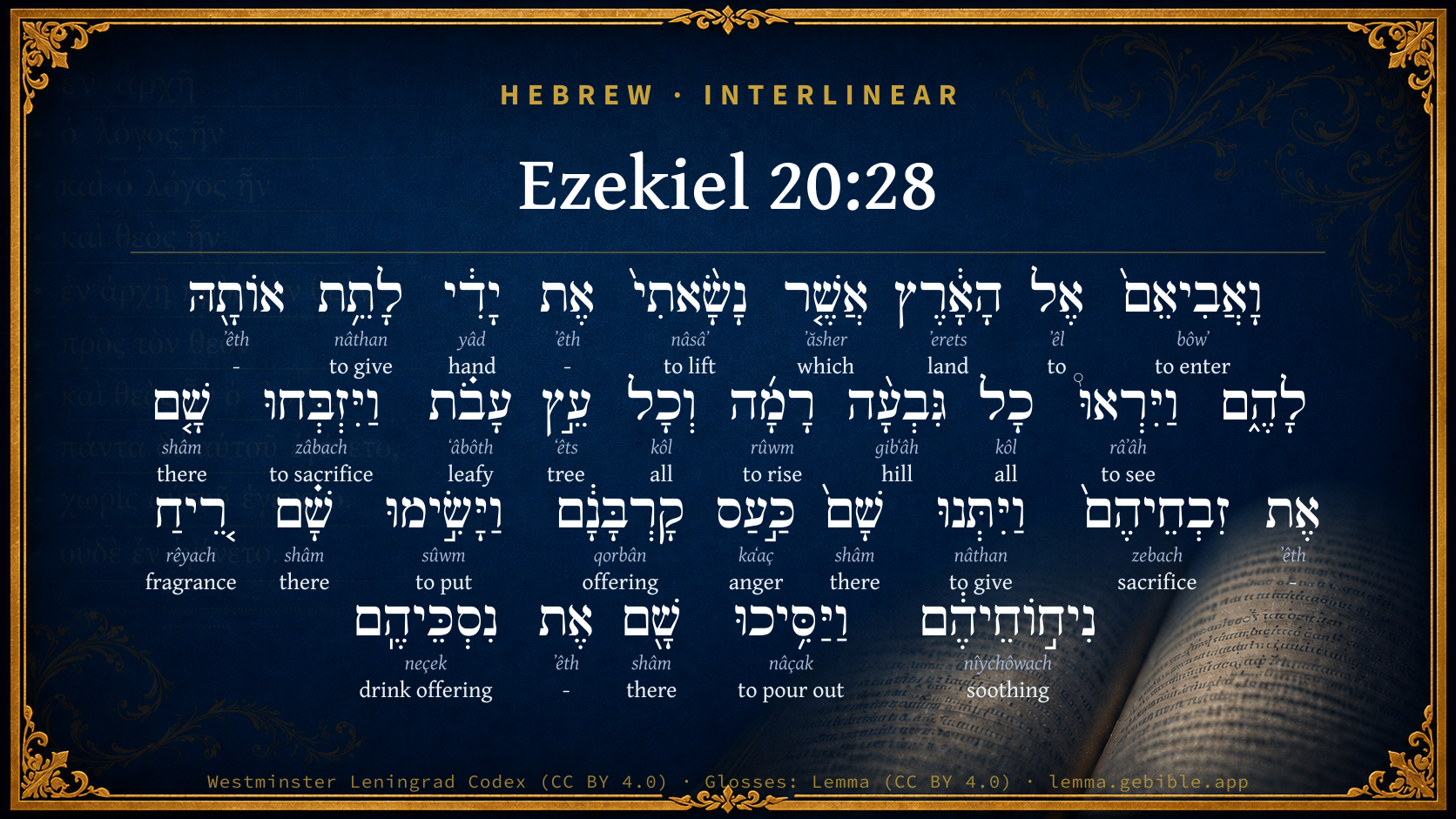
  1. וָאֲבִיאֵם֙ bôwʼ H935 “and · to enter · them” Conjunction + Verb, Hiphil, Sequential Imperfect, 1st Person, Common, Singular + Suffix, Personal, 3rd Person, Masculine, Plural
  2. אֶל ʼêl H413 “to” Preposition
  3. הָאָ֔רֶץ ʼerets H776 “the · land” Particle, Definite Article + Noun, Common, Both, Singular, Absolute
  4. אֲשֶׁ֤ר ʼăsher H834 “which” Particle, Relative
  5. נָשָׂ֨אתִי֙ nâsâʼ H5375 “to lift” Verb, Qal, Perfect, 1st Person, Common, Singular
  6. אֶת ʼêth H853 “-” Particle, Direct Object
  7. יָדִ֔י yâd H3027 “hand · my” Noun, Common, Both, Singular, Construct + Suffix, Personal, 1st Person, Common, Singular
  8. לָתֵ֥ת nâthan H5414 “to give” Preposition + Verb, Qal, Infinitive Construct
  9. אוֹתָ֖הּ ʼêth H853 “- · her” Particle, Direct Object + Suffix, Personal, 3rd Person, Feminine, Singular
  10. וַיִּרְאוּ֩ râʼâh H7200 “and · to see” Conjunction + Verb, Qal, Sequential Imperfect, 3rd Person, Masculine, Plural
  11. כָל kôl H3605 “all of” Noun, Common, Masculine, Singular, Construct
  12. גִּבְעָ֨ה gibʻâh H1389 “hill” Noun, Common, Feminine, Singular, Absolute
  13. רָמָ֜ה rûwm H7311 “rising” Verb, Qal, Participle Active, Feminine, Singular, Absolute
  14. וְכָל kôl H3605 “and · all of” Conjunction + Noun, Common, Masculine, Singular, Construct
  15. עֵ֣ץ ʻêts H6086 “tree” Noun, Common, Masculine, Singular, Absolute
  16. וַיִּזְבְּחוּ zâbach H2076 “and · to sacrifice” Conjunction + Verb, Qal, Sequential Imperfect, 3rd Person, Masculine, Plural
  17. שָׁ֤ם shâm H8033 “there” Adverb
  18. אֶת ʼêth H853 “-” Particle, Direct Object
  19. זִבְחֵיהֶם֙ zebach H2077 “sacrifices · their” Noun, Common, Masculine, Plural, Construct + Suffix, Personal, 3rd Person, Masculine, Plural
  20. וַיִּתְּנוּ nâthan H5414 “and · to give” Conjunction + Verb, Qal, Sequential Imperfect, 3rd Person, Masculine, Plural
  21. שָׁם֙ shâm H8033 “there” Adverb
  22. כַּ֣עַס kaʻaç H3708 “anger of” Noun, Common, Masculine, Singular, Construct
  23. קָרְבָּנָ֔ם qorbân H7133 “offering · their” Noun, Common, Masculine, Singular, Construct + Suffix, Personal, 3rd Person, Masculine, Plural
  24. וַיָּשִׂ֣ימוּ sûwm H7760 “and · to put” Conjunction + Verb, Qal, Sequential Imperfect, 3rd Person, Masculine, Plural
  25. שָׁ֗ם shâm H8033 “there” Adverb
  26. רֵ֚יחַ rêyach H7381 “fragrance of” Noun, Common, Masculine, Singular, Construct
  27. נִיח֣וֹחֵיהֶ֔ם nîychôwach H5207 “soothings · their” Noun, Common, Masculine, Plural, Construct + Suffix, Personal, 3rd Person, Masculine, Plural
  28. וַיַּסִּ֥יכוּ nâçak H5258 “and · to pour out” Conjunction + Verb, Hiphil, Sequential Imperfect, 3rd Person, Masculine, Plural
  29. שָׁ֖ם shâm H8033 “there” Adverb
  30. אֶת ʼêth H853 “-” Particle, Direct Object
  31. נִסְכֵּיהֶֽם neçek H5262 “drink offerings · their” Noun, Common, Masculine, Plural, Construct + Suffix, Personal, 3rd Person, Masculine, Plural

About this verse

These counts appear in no published source. They are computed here, from the morphology-tagged text and Lemma’s own curated glosses. What Lemma adds →

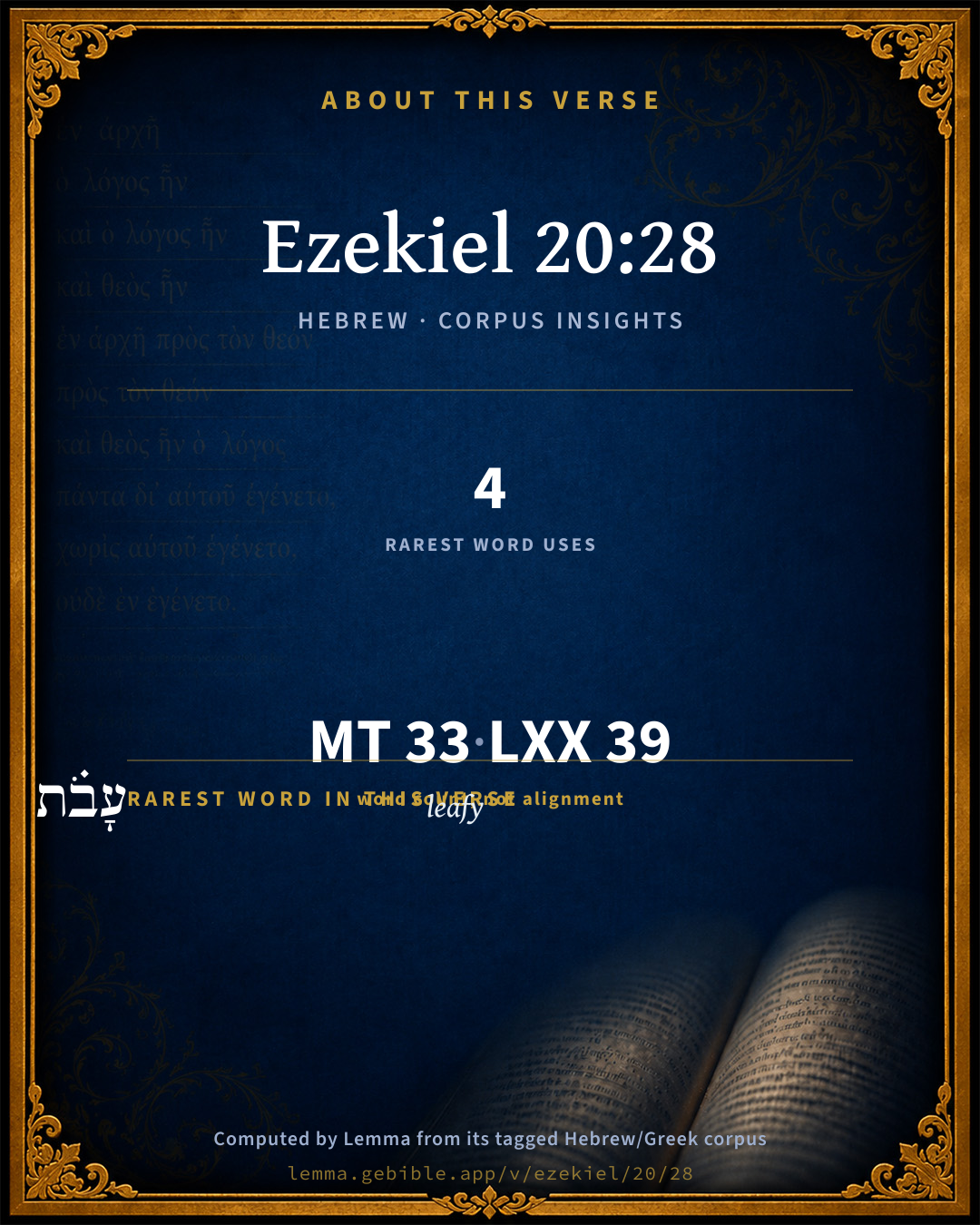
33
words
24
distinct lemmas
Prophets
section

Notable vocabulary

The rarest word here is עָבֹ֗ת leafy H5687 — appearing just 4 times in the whole Hebrew Bible.

Shared distinctive vocabulary

עָבֹ֗ת leafy H5687 occurs in 4 verses of the Hebrew Bible. Also found in:

Grammatical profile

  • 9 verbs
  • 12 nouns
  • 1 adjective
  • 2 prepositions
  • 4 adverbs
  • 5 particles

Verb forms

  • וָאֲבִיאֵם֙ Hiphil · Sequential Imperfect
  • נָשָׂ֨אתִי֙ Qal · Perfect
  • לָתֵ֥ת Qal · Infinitive Construct
  • וַיִּרְאוּ֩ Qal · Sequential Imperfect
  • רָמָ֜ה Qal · Participle Active
  • וַיִּזְבְּחוּ Qal · Sequential Imperfect
  • וַיִּתְּנוּ Qal · Sequential Imperfect
  • וַיָּשִׂ֣ימוּ Qal · Sequential Imperfect
  • וַיַּסִּ֥יכוּ Hiphil · Sequential Imperfect

Repetition

Words recur within this verse — often emphatic in Hebrew:

  • שָׁ֤ם there H8033 ×4
  • לָתֵ֥ת to give H5414 ×2
  • כָל all H3605 ×2

Hebrew & Septuagint length

In English translation the verse runs 55 words from the Hebrew and 49 from the Septuagint (LXX English) — closely comparable.

A rough comparison of the two English renderings, which tokenize alike — not a word-level alignment.

Word counts can differ between the Hebrew and the Greek without any difference in meaning — e.g. the Hebrew direct-object marker אֵת has no separate Greek word, and Greek often adds the article ὁ.

In the original languages it is 33 Hebrew tokens and 39 Greek tokens — but the two are counted differently (Hebrew bundles its prefixes and suffixes into one token; the Greek is in lemma form), so that isn’t a like-for-like length.

Cross-references

14

Topical passages linked to Ezekiel 20:28 in the Treasury of Scripture Knowledge — connected by theme and wording, ordered by reader-vote popularity; previews shown in the World English Bible.

  • Ezekiel 6:13 You shall know that I am Yahweh, when their slain men shall be among their idols round about their altars, on every high hill, on all the tops of the mountains, and under every green tree, and under every thick oak, the places where they offered sweet savor to all their idols.
  • Joshua 23:14 Behold, this day I am going the way of all the earth: and you know in all your hearts and in all your souls, that not one thing has failed of all the good things which Yahweh your God spoke concerning you; all are happen to you, not one thing has failed of it.
  • Nehemiah 9:22–26 Moreover you gave them kingdoms and peoples, which you did allot after their portions: so they possessed the land of Sihon, even the land of the king of Heshbon, and the land of Og king of Bashan.
  • Isaiah 57:5–7 you who inflame yourselves among the oaks, under every green tree; who kill the children in the valleys, under the clefts of the rocks?
  • Jeremiah 2:7 I brought you into a plentiful land, to eat the fruit of it and the goodness of it; but when you entered, you defiled my land, and made my heritage an abomination.
  • Jeremiah 3:6 Moreover Yahweh said to me in the days of Josiah the king, Have you seen that which backsliding Israel has done? she is gone up on every high mountain and under every green tree, and there has played the prostitute.
  • Genesis 15:18–21 In that day Yahweh made a covenant with Abram, saying, "To your seed have I given this land, from the river of Egypt to the great river, the river Euphrates:
  • Genesis 26:3–4 Sojourn in this land, and I will be with you, and will bless you. For to you, and to your seed, I will give all these lands, and I will establish the oath which I swore to Abraham your father.
  • Joshua 23:3–4 and you have seen all that Yahweh your God has done to all these nations because of you; for Yahweh your God, he it is that has fought for you.
  • Psalms 78:55–58 He also drove out the nations before them, Allotted them for an inheritance by line, And made the tribes of Israel to dwell in their tents.
  • Psalms 105:8–11 He has remembered his covenant forever, The word which he commanded to a thousand generations,
  • Ezekiel 16:19 My bread also which I gave you, fine flour, and oil, and honey, with which I fed you, you did even set it before them for a sweet savor; and [thus] it was, says the Lord Yahweh.
  • Ezekiel 20:6 in that day I swore to them, to bring them forth out of the land of Egypt into a land that I had searched out for them, flowing with milk and honey, which is the glory of all lands.
  • Ezekiel 20:15 Moreover also I swore to them in the wilderness, that I would not bring them into the land which I had given them, flowing with milk and honey, which is the glory of all lands;

Cross-references courtesy of OpenBible.info (CC BY 4.0).

Hebrew and Greek witnesses Masoretic Hebrew ↔ Greek Septuagint

The same verse in the two great witnesses to the Old Testament, shown verse-for-verse.

These are two independent witnesses, not word-aligned to each other, and the Septuagint is shown in lemma (dictionary) form.

Hebrew Ezekiel 20:28 Masoretic · Westminster Leningrad Codex

וָאֲבִיאֵם֙ אֶל הָאָ֔רֶץ אֲשֶׁ֤ר נָשָׂ֨אתִי֙ אֶת יָדִ֔י לָתֵ֥ת אוֹתָ֖הּ לָהֶ֑ם וַיִּרְאוּ֩ כָל גִּבְעָ֨ה רָמָ֜ה וְכָל עֵ֣ץ עָבֹ֗ת וַיִּזְבְּחוּ שָׁ֤ם אֶת זִבְחֵיהֶם֙ וַיִּתְּנוּ שָׁם֙ כַּ֣עַס קָרְבָּנָ֔ם וַיָּשִׂ֣ימוּ שָׁ֗ם רֵ֚יחַ נִיח֣וֹחֵיהֶ֔ם וַיַּסִּ֥יכוּ שָׁ֖ם אֶת נִסְכֵּיהֶֽם

For when I had brought them into the land, which I swore to give to them, then they saw every high hill, and every thick tree, and they offered there their sacrifices, and there they presented the provocation of their offering; there also they made their sweet savor, and they poured out there their drink-offerings.

World English Bible · Public Domain

Greek LXX Ezekiel 20:28 Septuagint · lemma form

καί εἰςἄγω αὐτός εἰς ὁ γῆ ὅς αἴρω ὁ χείρ ἐγώ ὁ δίδωμι αὐτός καί ὁράω πᾶς βουνός ὑψηλός καί πᾶς ξύλον κατάσκιος καί θύω ἐκεῖ ὁ θεός αὐτός καί τάσσω ἐκεῖ ὀσμή εὐωδία καί σπένδω ἐκεῖ σπονδή αὐτός

Whereas I brought them into the land concerning which I lifted up my hand to give it them; and they looked upon every high hill, and every shady tree, and they sacrificed there to their gods, and offered there sweet smelling savor, and there they poured out their drink-offerings.

LXX2012 (modern English Septuagint) · Public Domain

On this verse, The Cambridge Bible for Schools and Colleges discusses the Septuagint’s reading. Read the note in Commentary ↓

Hebrew: Westminster Leningrad Codex (CC BY 4.0). Greek: Septuagint (public domain); English from LXX2012 (modern English Septuagint) (Public Domain). How the Septuagint differs from the Hebrew →

Targum (Aramaic paraphrase)

1

The Targum is the ancient Jewish Aramaic paraphrase of the Hebrew Scriptures — an interpretive translation, not the Hebrew text itself. Onkelos (literal) and Pseudo-Jonathan (expansive) render the Torah, and Jonathan the Prophets. Coverage is partial: where no permissively-licensed English translation exists for a verse, only the Aramaic is shown. This is verse-level text, not a word-by-word alignment to the Hebrew.

  1. Targum Jonathan Prophets (Joshua–Malachi)
    וְאָעֵילְתִּינוּן לְאַרְעָא דְקַיֵמִית בְּמֵימְרִי לְמִתַּן יָתָהּ לְהוֹן וַחֲזוֹ כָּל רָמָא מְנַטְלָא וְכָל אִילַן עַבּוּף וּנְכִיסוּ תַמָן אַרְגָזָא קוּרְבָּנֵיהוֹן וְשַׁוִיאוּ תַמָן פּוּלְחַן דִבְחֵיהוֹן וּנְסִיכוּ תַמָן יַת נִכְסֵיהוֹן:

    (no public-domain English translation for this verse)

    Targum Jonathan — Aramaic: “Mikraot Gedolot” (public domain). English: “Sefaria Community Translation” (CC0 1.0 (public-domain dedication)); “London "Chaldee Paraphrase," 1871” (public domain). Text via Sefaria.

Commentary

Notes on Ezekiel 20:28 from classic Christian and Jewish commentators (each source and its license shown beneath its notes). The classic Christian expositions comment on the surrounding passage and are grouped to its opening verse, so a note may address several verses; the Jewish commentaries on the Tanakh (Rashi and others) are per-verse, so they appear only where the commentator wrote on this verse.

Lemma curates 59 commentaries, every one of them public domain or Creative Commons licensed, each selected and text-cleaned for this edition rather than reprinted as found. About our sources →

Trapp's Complete Commentary

John Trapp

Eze 20:28 [For] when I had brought them into the land, [for] the which I lifted up mine hand to give it to them, then they saw every high hill, and all the thick trees, and they offered there their sacrifices, and there they presented the provocation of their offering: there also they made their sweet savour, and poured out there their drink offerings.

Ver. 28. For when I had brought them into the land.] It hath been already observed that good turns aggravate unkindnesses, and men’s sins are much increased by their obligations.

John Trapp, A Commentary or Exposition upon All the Books of the Old and New Testament (1647–1656) — public domain. Text from a community e-Sword module.

Geneva Bible (1599)

Geneva Bible translators

Not only in the wilderness, when I brought them out of Egypt, but since I placed them in this land: which declareth how prompt man’s heart is to idolatry, seeing that by no admonitions he can be drawn back.

Geneva Bible (1599) marginal notes — public domain. Text via Bolls.life.

Jamieson, Fausset & Brown

Robert Jamieson, A. R. Fausset & David Brown

provocation of their offering--an offering as it were purposely made to provoke God.

sweet savour--What ought to have been sweet became offensive by their corruptions. He specifies the various kinds of offerings, to show that in all alike they violated the law.

Jamieson, Fausset & Brown — Commentary Critical and Explanatory on the Whole Bible (1871) — public domain (CC PDM 1.0). Text via the HelloAO Bible API.

John Calvin's Commentaries

Hence, after I had brought them into the land for which, or concerning which, I had lifted up my hand to give it them, they saw, says he, every high hill, and every green or branching tree, and there they sacrificed. God wished to have one altar built for himself, and sacrifices to be offered in one place; nay, before the people had any certain and fixed station, God was unwilling that any altar should be built to him of polished stones, that no trace of it should remain; but a mound only was to be made of either turf or rough stones. (Exodus 20:25; Deuteronomy 27:5, 6.) Now he says, whenever hills and branching trees were lying before them, there they found enticements to superstition. This, therefore, is the reproach which God now complains was offered to him. But this passage, like many others, teaches, that not only is God’s worship corrupted when his honor is transferred to idols, but also when men heap up their own fictions, and contaminate God’s commands by the mixture. We must remember, then, that there are two kinds of idolatries; the one being grossest when idols are worshipped openly, and Moloch, or any Baal, is substituted for the living God: that is a palpable superstition, because God is in some sense cast down from his throne. But the other kind of idolatry, although more hidden, is abominable before God, namely, when, under the disguise of a name, men boldly mingle whatever comes into their minds, and invent various modes of worship; as at present we see in the papacy statues adored, and dead men invoiced, and God’s honor violated in various ways. Hence, however, the papists chatter, they are self-convicted, and the wonder is that they are not utterly silenced, since their superstitions are so gross that even boys perceive them. But there are other superstitions more specious and refined; for when they have invented many things in honor of God, they will not bring forward the names of either St. Barbara or St. Christopher, but the name of God covers all those abominations. But we see that this excuse is frivolous, when men assert that they have nothing else in their mind than the worship of God. Not only does God wish worship to be offered to himself alone, but that it should be without any dependence on human will: he wishes the law to be the single rule of true worship; and thus he rejects all fictitious rites. Hence the Prophet deservedly excuses the Israelites, because they turned their eyes towards every high hill and every branching tree, and there offered the provocation of their offering. He calls it the provocation of their offering, since they not only foolishly poured forth much money on those vitiated rites, but also provoked God to anger. We see, therefore, that men not only lose their labor when they decline from God’s commands, and rashly fatigue themselves with their own superstitions, but they provoke God to a contest, because they snatch from him the right of a lawgiver: for it is in his power to determine how he ought to be worshipped; and when men claim this power to themselves, it is like ascending to the very throne of God. But if they follow the inventions of others, still it is setting them up as lawgivers, while God is degraded from his tribunal. Thus it is not surprising if God’s wrath is provoked by any sacrifices, besides those which the law prescribes. And this is expressed very clearly by Isaiah, when God announces that he will do what will frighten them all as an unexpected prodigy: I will blind the eyes of the wise, says he, and I will take away prudence from the aged. (Isaiah 29:14.) And why so? because they worship me by the precepts of men.

It follows, And they offered their sweet odor, or agreeable fragrance. These two things seem contrary to each other, that their offerings inflamed God’s wrath, and yet their savor was sweet. But the Prophet. speaks ironically when he says, their incense was sweet-smelling. By conceding this he derides them, since they falsely supposed God was appeased in this way, although he reproves them at the same time for defiling, by their corruption’s, that incense which ought to have been of delightful fragrance. For the language of Moses is repeated: The scent shall reach God’s nostrils, and he shall be appeased. (Deuteronomy 33:10.) Since, then, the incense of the law was sweet-smelling, God here bitterly reproaches the Jews for infecting that good odor with their foulness. Hence the phrase is used in a sense contrary to its direct meaning. Lastly, he says, they have poured out their drink-offerings there. Here God reviews the various kinds of oblations which he had fully prescribed in the law but he shows that the Jews were rebellious against them all; and he further detects their unbridled petulance, since they had not only violated the law in one point, but had left no part untouched by their superstitions. God had commanded sacrifices, but these they rendered polluting: he added various oblations, yet all these they defiled: he desired libations to be made, and will to be poured out, but this part of the service was not kept pure from superstitions. Thus he shows that the people purposely took all means of declaring war against God, when they falsely pretended that nothing more was prescribed than to worship him as they pleased. It follows —

John Calvin's Commentaries (1540-1563) — public domain. Text from the Calvin Translation Society English edition (1840s-50s) via the Christian Classics Ethereal Library (ccel.org). Calvin's coverage is partial (roughly two-thirds of the Bible); uncommented books and verses are honest gaps, never fabricated. The 19th-century editor's footnotes and remarks are omitted so the notes are faithfully Calvin's own voice.

The Cambridge Bible for Schools and Colleges

gen. ed. J. J. S. Perowne

28. The prophet regards the worship on the high-places and under the evergreen trees as a Canaanitish usage adopted by Israel, as Deuteronomy 12. At the same time Israel usually employed the altars or chapels which they found for the service of Jehovah; but naturally many corruptions would creep into such service, and it might become little different from a service of Baal. In the oldest prophets, Amos and Hosea, it is the kind of worship at the high-places that is condemned, the revelry and heathenish merrymaking (Hos_9:1) the sensuousness (Hos_8:13; Amo_5:21), and the false conception Of deity implied in it (Hos_6:6). The mere localities or multitude of altars do not seem assailed, except that the more there were of them the more sin was committed, because the whole worship was sinful (Hos_8:11; Amo_4:4). Later this impure worship was perceived to be inseparable from the high-places and these themselves came under condemnation. Ezekiel does not go further in his condemnation of the high hills and green trees than his predecessor Jeremiah (Jer_2:20; Jer_3:6).

all the thick trees] Evergreen and umbrageous trees appear to have been regarded as abodes of deity.

offered … their sacrifices] Four words are employed: offerings of flesh, particularly the peace or thank-offerings; what is called their “offering” or oblation, a general word used of bloodless sacrifices as well as of others, possibly first-fruits and the like; their “sweet savour,” usually said of the odour of the flesh or fat burnt upon the altar, but also of the odour of meal-offerings (ch. Eze_16:19); and finally, drink-offerings. The clause “and there … provocation of their offering” is wanting in LXX. The term “offering” (Korban), found only in Lev., Numb., again in Eze_40:43 (see there).

The Cambridge Bible for Schools and Colleges (gen. ed. J. J. S. Perowne; Cambridge University Press, 1878–1918) — public domain. Text from a community e-Sword module.

John Gill's Exposition

For when I had brought them into the land,.... Brought them out of Egypt through the wilderness into the land of Canaan, through so many difficulties, by such displays of power, goodness, and truth:

for the which I lifted up mine band to give it to them; which he swore he would give unto them, and which he did, and so fulfilled his word and oath; and which was an instance of his bounty and goodness; and not owing to any merits of theirs; which he did, and so fulfilled his word and oath; and which was an instance of his bounty and goodness, and not owing to any merits of theirs:

then they saw every high hill, and all the thick trees; as soon as they had got into the land, and took a view of it, they at once fixed their eyes upon the high hills and groves, as proper places to set up their idols on, and perform idolatrous worship in; in the one place more openly, and in the other more secretly, as they might judge proper and necessary; in which they imitated the Heathens, who had their temples, idols, altars, and sacrifices, amidst groves and thick trees. So Herodotus (n) relates of the temple of Diana at Bubastis in Egypt, that at the entrance of it there were rivulets from the Nile, which flowed about it here and there, shaded with trees; and within were a vast grove of the largest trees, planted about the temple; and which he afterwards calls trees reaching to heaven:

and they offered there their sacrifices; either to the God of Israel, as some of them sometimes did, and which was sinful; for though they might offer sacrifices, as were commanded, to a right object, yet not in the proper place: or rather to their idols; and so the Septuagint and Arabic versions,

to their own gods; which they had made to themselves, and had chose and approved of:

and there they presented the provocation of their offering; or their offering which provoked the wrath of God against them; being such as either he had not appointed, or was offered in a wrong place, or the wrong object; than which nothing could be more provoking to him; it was giving his glory to another, and his praise to graven images:

there also they made their sweet saviour; incense to their deities. The Targum is the worship of their sacrifices:

and poured out there their drink offerings; libations of wine: all kind of sacrifices were offered up here by them; which shows to what lengths in idolatry they ran, and how dreadfully guilty they were.

(n) Euterpe: sive l. 2. c. 138.

John Gill's Exposition of the Whole Bible (1746–1763) — public domain (CC PDM 1.0). Text via the HelloAO Bible API.

Matthew Poole's English Annotations

When; so soon as settled in the land promised to Abraham and his seed.

Lifted up mine hand: see Eze 20:5,23.

Saw; lookest after them, and, when seen, liked and prepared after the manner of the heathen; though this was forbidden, yet this thou didst, buildedst thy high places, and thou settest up thy groves every where.

There; not where God appointed, but where they listed.

Their sacrifices; either to God, as sometimes some did, or to their own idols, as the most did, which is here called the presenting the provocation of their offering.

Their offering; which being presented to their idol, was a provocation unto God.

Sweet savour; burnt sweet odours to their idols, which did stink in the nostrils of God.

Their drink-offerings; wine was a part of the offering that sacrificers offered, and so did these idolatrous Jews here, they violated the whole law of sacrifice, and did all that to idols they should have done only to God.

Matthew Poole's English Annotations on the Holy Bible (1683–1685) — public domain. Text from a community e-Sword/MySword module.

Whedon's Commentary on the Bible

Daniel D. Whedon

28. They offered there their sacrifices — They were enticed into the evil Canaanitish worship against which they were ever being warned (Hos_8:11; Hos_8:13; Hos_9:1; Amo_4:4; Amo_5:21; Jer_2:20; Jer_3:6). It is now seen from the Baal sacrifice tablets (600-500 B.C.) recently discovered, that in many details the form of the ritual closely resembled that of the Hebrews. (See MacDonald’s Massera-Carthago, 1897.) This made it easier for unspiritual and sensually inclined Israelites to forget the essential differences between these sacrificial cults. (See also notes Eze_6:13; Eze_8:14-15.)

The provocation of their offering — Disobedient or heathenish offerings were an insult to the one true God.

Daniel D. Whedon (gen. ed.), Commentary on the Old and New Testaments (1874–1909) — public domain. Text from a community e-Sword module.

The Pulpit Commentary

It was a special aggravation of the sin that it was committed in the very land into which they had been brought by the oath (the "hand lifted up") of Jehovah, that it might be a holy land, a witness of the Divine righteousness to the nations round about. The forms of worship include that of the high places, and the thick trees (Isa_57:5; Jer_2:20 Jer_3:6) width witnessed the cultus of the Asherah or of Ashtaroth.

The Pulpit Commentary (1880–1919), ed. H.D.M. Spence-Jones & Joseph S. Exell — public domain. Text from a community e-Sword module.

Lesson kit

Teaching starters — assembled from the data on this page, not authored interpretation. Every prompt links to the verse data it draws on. Edit before teaching.

Ezekiel, in the Prophets, opens this verse with 33 words (24 distinct Hebrew lemmas). Its most distinctive word is ʻâbôth (“leafy”). A historical commentator’s framing appears above. Read the whole chapter for the surrounding context.

Discussion questions

  1. How does “leafy” (ʻâbôth) shape what this verse is saying?
  2. How does Leviticus 23:40, which shares the word «leafy», read alongside this verse?
  3. What does the repetition of “there” (4× in this one verse) do in this verse?
  4. These translations render this verse differently. What is at stake in choosing one wording over another?
  5. «וָאֲבִיאֵם֙» is a Hiphil Sequential Imperfect verb. How does that grammatical form shape the action described?
  6. Compare how Trapp's Complete Commentary and Geneva Bible (1599) read this verse. Where do they agree or differ?

Things to notice

Reading settings

Reading text

Shown beneath each verse's original-language words.

Old Testament
Old Testament edition

Read the OT as the Masoretic Hebrew (MT) or the Greek Septuagint (LXX).

English shown for the Greek Septuagint (in the Hebrew ↔ Greek comparison).

Comparing translations? Open the Compare panel on any verse page to stack up to four side by side.