Exodus 17:11

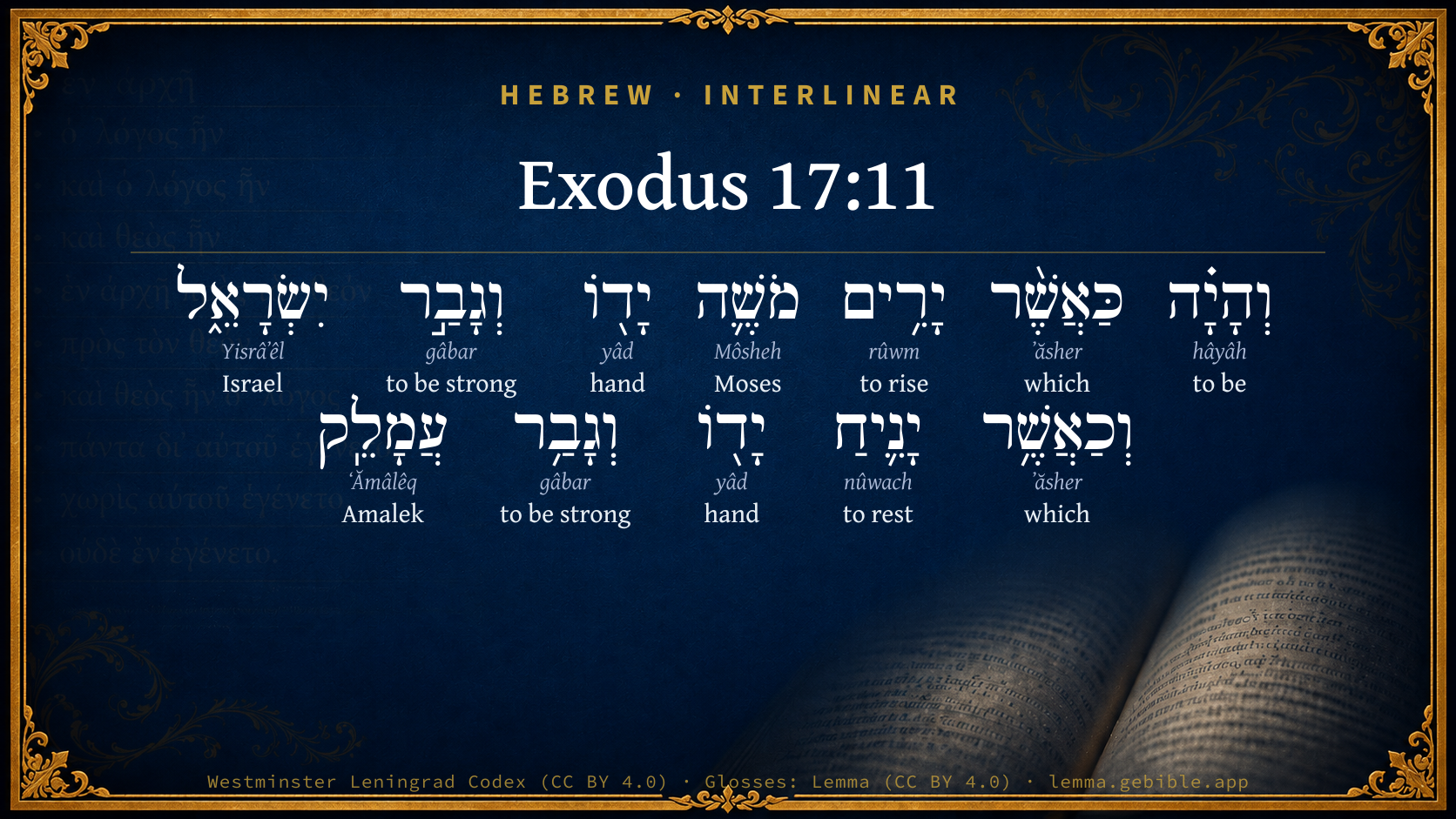
Hebrew (Westminster Leningrad Codex) Exodus 17:11 appears in the Hebrew Old Testament. The text above is from the Westminster Leningrad Codex. Each word links to its Strong’s number, a concise gloss, and parsing drawn from the Open Scriptures Hebrew Bible morphology. Click any word for its full Brown-Driver-Briggs (BDB) entry.
Download image
Cite this verse

Exodus 17:11 (World English Bible). Public Domain. Lemma interlinear Bible study tool, https://lemma.gebible.app/v/exodus/17/11.

Show BibTeX & RIS
BibTeX
RIS
English Translation
It happened, when Moses held up his hand, that Israel prevailed; and when he let down his hand, Amalek prevailed.
World English Bible · Public Domain
Download a study sheet

One document with this verse’s original text, its word-by-word gloss line, the meaning frame, cross-references with their text, attributed commentary, and full source and license credits — printable, and it pastes into notes with its structure intact.

This verse Autodidact and up

Study sheet (.html) Plain text (.txt)

A passage Seminary Student

Up to 50 verses in one chapter. A passage sheet keeps up to 6 commentary sources and 12 cross-references per verse, in the order this page ranks them, and says so on the sheet whenever that leaves anything out. Ask for a single verse and you get the Autodidact verse sheet above.

Everything on this page stays free to read, with no account — the sheet is a download of what is already on screen, not access to it.

Want to remove ads? Support Godless Engineer
Compare translations 3

The same verse in 3 English versions, stacked beneath the original-language interlinear above. Click any original word for its lexicon entry.

Each is an independent rendering of the whole verse — the interlinear is not word-aligned to these translations.

Highlighted words mark where these versions differ — a whole-verse word diff, not a word-by-word alignment.

  • World English Bible Public Domain
    It happened, when Moses held up his hand, that Israel prevailed; and when he let down his hand, Amalek prevailed.
  • King James Version Public Domain
    And it came to pass, when Moses held up his hand, that Israel prevailed: and when he let down his hand, Amalek prevailed.
  • unfoldingWord Literal Text CC BY-SA 4.0
    And so it was, when Moses raised his hand, then Israel would be winning, and when he set his hand down, then Amalek would be winning.

unfoldingWord Literal Text — © unfoldingWord, licensed CC BY-SA 4.0. Word-aligned USFM3 via Door43 (git.door43.org/unfoldingWord/en_ult).

Versions to compare (up to 4)

3 of 4 selected

Show all 18 translations

Every available English version of this verse, each an independent rendering of the whole verse.

  • World English Bible Public Domain
    It happened, when Moses held up his hand, that Israel prevailed; and when he let down his hand, Amalek prevailed.
  • Berean Standard Bible Public Domain
    As long as Moses held up his hands, Israel prevailed; but when he lowered them, Amalek prevailed.
  • Majority Standard Bible Public Domain
    As long as Moses held up his hands, Israel prevailed; but when he lowered them, Amalek prevailed.
  • King James Version Public Domain
    And it came to pass, when Moses held up his hand, that Israel prevailed: and when he let down his hand, Amalek prevailed.
  • American Standard Version (1901) Public Domain
    And it came to pass, when Moses held up his hand, that Israel prevailed; and when he let down his hand, Amalek prevailed.
  • Revised Version (1885) Public Domain
    And it came to pass, when Moses held up his hand, that Israel prevailed: and when he let down his hand, Amalek prevailed.
  • Geneva Bible (1599) Public Domain
    And when Moses helde vp his hande, Israel preuailed: but when he let his hande downe, Amalek preuailed.
  • Douay-Rheims (1899) Public Domain
    And when Moses lifted up his hands, Israel overcame: but if he let them down a little, Amalec overcame.
  • Young's Literal Translation Public Domain
    and it hath come to pass, when Moses lifteth up his hand, that Israel hath been mighty, and when he letteth his hands rest, that Amalek hath been mighty.
  • Literal Standard Version CC BY-SA 4.0
    and it has come to pass, when Moses lifts up his hand, that Israel has been mighty, and when he lets his hands rest, that Amalek has been mighty.
  • Unlocked Literal Bible CC BY-SA 4.0
    While Moses was holding his hands up, Israel was winning; when he let his hands rest, Amalek would begin to win.
  • unfoldingWord Literal Text CC BY-SA 4.0
    And so it was, when Moses raised his hand, then Israel would be winning, and when he set his hand down, then Amalek would be winning.
  • Darby Bible Public Domain
    And it came to pass when Moses raised his hand, that Israel prevailed; and when he let down his hand, Amalek prevailed.
  • World Messianic Bible Public Domain
    When Moses held up his hand, Israel prevailed. When he let down his hand, Amalek prevailed.
  • Webster's Bible Public Domain
    And it came to pass, when Moses held up his hand, that Israel prevailed: and when he let down his hand, Amalek prevailed.
  • Free Bible Version CC BY-SA 4.0
    As long as Moses held up the walking stick in his hands, the Israelites were the ones winning, but when he lowered them, it was the Amalekites.
  • Bible in Basic English Public Domain
    Now while Moses' hand was lifted up, Israel was the stronger: but when he let his hand go down, Amalek became the stronger.
  • JPS Tanakh (1917) Public Domain
    And it came to pass, when Moses held up his hand, that Israel prevailed; and when he let down his hand, Amalek prevailed.

Literal Standard Version (2020), Covenant Press — licensed CC BY-SA 4.0. Text via the HelloAO Bible API (eBible.org). Unlocked Literal Bible (unfoldingWord) — licensed CC BY-SA 4.0. Text via the HelloAO Bible API (eBible.org). unfoldingWord Literal Text — © unfoldingWord, licensed CC BY-SA 4.0. Word-aligned USFM3 via Door43 (git.door43.org/unfoldingWord/en_ult). Free Bible Version, Dr. Jonathan Gallagher — licensed CC BY-SA 4.0. Text via the HelloAO Bible API (eBible.org).

Word by word

More ways to search: Search by grammar → Find every occurrence → Compare this word →

Practice this passage: Drill this verse → Learn its vocabulary →

וְגָבַ֣ר
gâbar
H1396
“and · to be strong”
Conjunction + Verb, Qal, Sequential Perfect, 3rd Person, Masculine, Singular
Part of Speech
Conjunction + Verb
Stem
Qal
Form
Sequential Perfect
Person
3rd Person
Gender
Masculine
Number
Singular
Full BDB Definition

Origin: a primitive root

TWOT: 310

to prevail, have strength, be strong, be powerful, be mighty, be great - (Qal) - to be strong, mighty - to prevail - (Piel) to make strong, strengthen - (Hiphil) - to confirm, give strength - to confirm (a covenant) - (Hithpael) - to show oneself mighty - to act proudly (toward God)
  1. וְהָיָ֗ה hâyâh H1961 “and · to be” Conjunction + Verb, Qal, Sequential Perfect, 3rd Person, Masculine, Singular
  2. כַּאֲשֶׁ֨ר ʼăsher H834 “like/as · which” Preposition + Particle, Relative
  3. יָרִ֥ים rûwm H7311 “to rise” Verb, Hiphil, Imperfect, 3rd Person, Masculine, Singular
  4. מֹשֶׁ֛ה Môsheh H4872 “Moses” Noun, Proper
  5. יָד֖וֹ yâd H3027 “hand · his” Noun, Common, Both, Singular, Construct + Suffix, Personal, 3rd Person, Masculine, Singular
  6. יִשְׂרָאֵ֑ל Yisrâʼêl H3478 “Israel” Noun, Proper
  7. וְכַאֲשֶׁ֥ר ʼăsher H834 “and · like/as · which” Conjunction + Preposition + Particle, Relative
  8. יָנִ֛יחַ nûwach H5117 “to rest” Verb, Hiphil, Imperfect, 3rd Person, Masculine, Singular
  9. יָד֖וֹ yâd H3027 “hand · his” Noun, Common, Both, Singular, Construct + Suffix, Personal, 3rd Person, Masculine, Singular
  10. וְגָבַ֥ר gâbar H1396 “and · to be strong” Conjunction + Verb, Qal, Sequential Perfect, 3rd Person, Masculine, Singular
  11. עֲמָלֵֽק ʻĂmâlêq H6002 “Amalek” Noun, Proper

About this verse

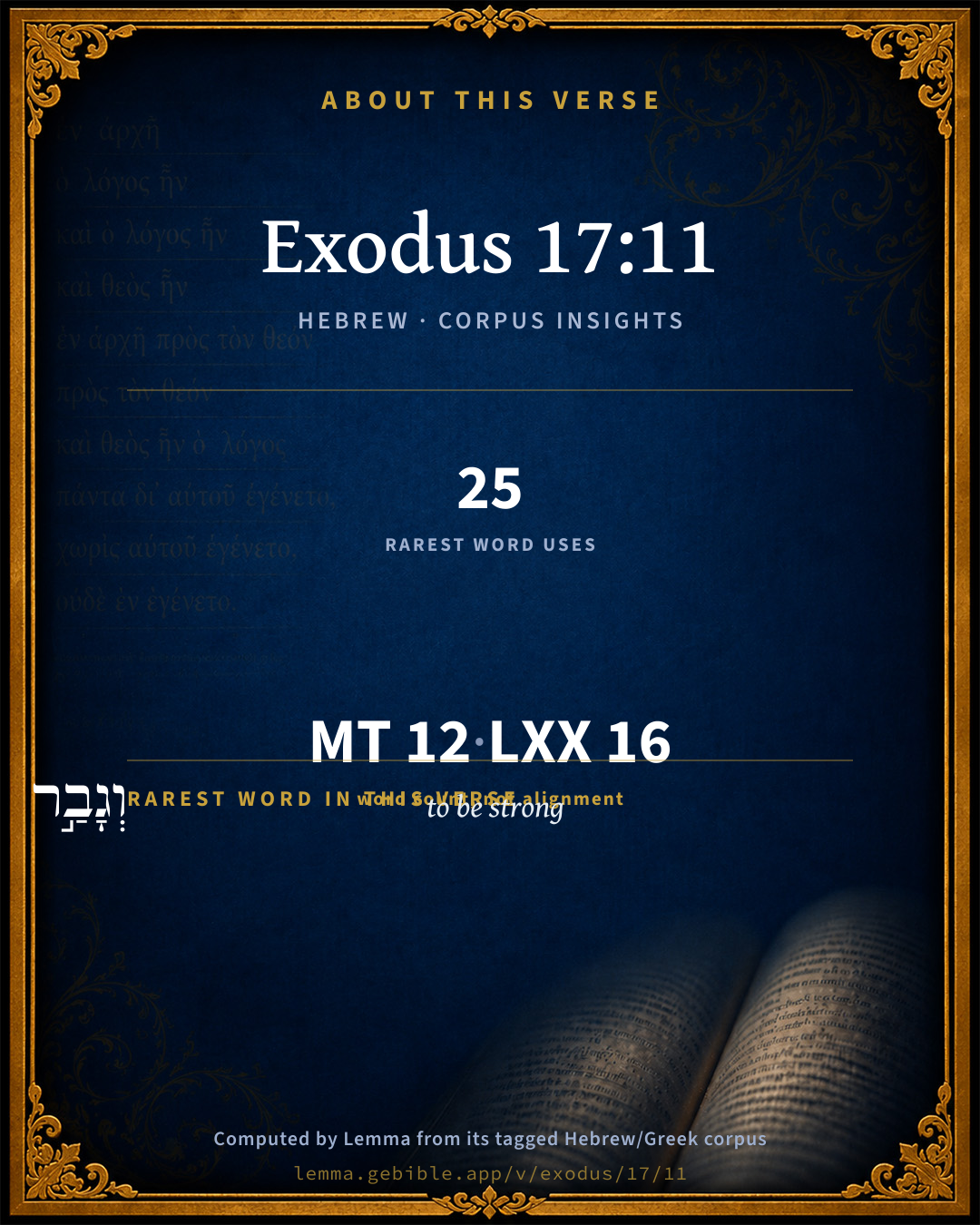
These counts appear in no published source. They are computed here, from the morphology-tagged text and Lemma’s own curated glosses. What Lemma adds →

12
words
9
distinct lemmas
Pentateuch
section

Notable vocabulary

The rarest word here is וְגָבַ֣ר to be strong H1396 — appearing just 25 times in the whole Hebrew Bible.

Shared distinctive vocabulary

וְגָבַ֣ר to be strong H1396 occurs in 24 verses of the Hebrew Bible. Also found in:

Grammatical profile

  • 5 verbs
  • 5 nouns
  • 2 particles

Verb forms

  • וְהָיָ֗ה Qal · Sequential Perfect
  • יָרִ֥ים Hiphil · Imperfect
  • וְגָבַ֣ר Qal · Sequential Perfect
  • יָנִ֛יחַ Hiphil · Imperfect
  • וְגָבַ֥ר Qal · Sequential Perfect

Repetition

Words recur within this verse — often emphatic in Hebrew:

  • יָד֖וֹ hand H3027 ×2
  • וְגָבַ֣ר to be strong H1396 ×2
  • כַּאֲשֶׁ֨ר which H834 ×2

Hebrew & Septuagint length

In English translation the verse runs 20 words from the Hebrew and 22 from the Septuagint (LXX English) — closely comparable.

A rough comparison of the two English renderings, which tokenize alike — not a word-level alignment.

Word counts can differ between the Hebrew and the Greek without any difference in meaning — e.g. the Hebrew direct-object marker אֵת has no separate Greek word, and Greek often adds the article ὁ.

In the original languages it is 12 Hebrew tokens and 16 Greek tokens — but the two are counted differently (Hebrew bundles its prefixes and suffixes into one token; the Greek is in lemma form), so that isn’t a like-for-like length.

Cross-references

4

Topical passages linked to Exodus 17:11 in the Treasury of Scripture Knowledge — connected by theme and wording, ordered by reader-vote popularity; previews shown in the World English Bible.

  • 1 Timothy 2:8 I desire therefore that the men in every place pray, lifting up holy hands without wrath and doubting.
  • James 5:16 Confess your offenses to one another, and pray one for another, that you may be healed. The effective, earnest prayer of a righteous man is powerfully effective.
  • Psalms 56:9 Then my enemies shall turn back in the day that I call. I know this, that God is for me.
  • Luke 18:1 He also spoke a parable to them that they must always pray, and not give up,

Cross-references courtesy of OpenBible.info (CC BY 4.0).

Hebrew and Greek witnesses Masoretic Hebrew ↔ Greek Septuagint

The same verse in the two great witnesses to the Old Testament, shown verse-for-verse.

These are two independent witnesses, not word-aligned to each other, and the Septuagint is shown in lemma (dictionary) form.

Hebrew Exodus 17:11 Masoretic · Westminster Leningrad Codex

וְהָיָ֗ה כַּאֲשֶׁ֨ר יָרִ֥ים מֹשֶׁ֛ה יָד֖וֹ וְגָבַ֣ר יִשְׂרָאֵ֑ל וְכַאֲשֶׁ֥ר יָנִ֛יחַ יָד֖וֹ וְגָבַ֥ר עֲמָלֵֽק

It happened, when Moses held up his hand, that Israel prevailed; and when he let down his hand, Amalek prevailed.

World English Bible · Public Domain

Greek LXX Exodus 17:11 Septuagint · lemma form

καί γίγνομαι ὅταν ἐπιαἴρω μωυσῆς ὁ χείρ καταἰσχύω ἰσραήλ ὅταν δέ καταἵημι ὁ χείρ καταἰσχύω αμαληκ

And it came to pass, when Moses lifted up his hands, Israel prevailed; and when he let down his hands, Amalec prevailed.

LXX2012 (modern English Septuagint) · Public Domain

Hebrew: Westminster Leningrad Codex (CC BY 4.0). Greek: Septuagint (public domain); English from LXX2012 (modern English Septuagint) (Public Domain). How the Septuagint differs from the Hebrew →

Targum (Aramaic paraphrase)

2

The Targum is the ancient Jewish Aramaic paraphrase of the Hebrew Scriptures — an interpretive translation, not the Hebrew text itself. Onkelos (literal) and Pseudo-Jonathan (expansive) render the Torah, and Jonathan the Prophets. Coverage is partial: where no permissively-licensed English translation exists for a verse, only the Aramaic is shown. This is verse-level text, not a word-by-word alignment to the Hebrew.

  1. Targum Onkelos Torah (Genesis–Deuteronomy)
    וַהֲוִי כַּד יְרִים משֶׁה יְדוֹהִי וּמִתְגַבְּרִין דְבֵית יִשְׂרָאֵל וְכַד מַנַח יְדוֹהִי וּמִתְגַבְּרִין דְבֵית עֲמָלֵק:

    (no public-domain English translation for this verse)

    Targum Onkelos — Aramaic: “Onkelos Genesis” (public domain); “Onkelos Exodus” (public domain); “Onkelos Leviticus” (public domain); “Onkelos Numbers” (public domain); “Onkelos Deuteronomy” (public domain). English: “Sefaria Community Translation” (CC0 1.0 (public-domain dedication)); “J.W. Etheridge. The Targums of Onkelos and Jonathan Ben Uzziel on the Pentateuch. London: Longmans, Green, 1862” (public domain). Text via Sefaria.

  2. Targum Pseudo-Jonathan Torah (Genesis–Deuteronomy)
    וַהֲוָה כַד זְקֵיף משֶׁה יְדוֹי בִּצְלוֹי וּמִתְגַּבְּרִין דְּבֵית יִשְרָאֵל וְכַד הֲוָה מָנַח יְדוֹי מִן לְמַצְלַיָיא וּמִתְגַּבְּרִין דְּבֵית עֲמָלֵק

    And it was, when Mosheh lifted up his hands in prayer, that the house of Israel prevailed; and when he rested his hand from praying, that the house of Amalek prevailed.

    Targum Pseudo-Jonathan — Aramaic: “Targum Jonathan on Genesis” (public domain); “Targum Jonathan on Exodus” (public domain); “Targum Jonathan on Leviticus” (public domain); “Targum Jonathan on Numbers” (public domain); “Targum Jonathan on Deuteronomy” (public domain). English: “The Targum of Jonathan ben Uzziel, trans. J. W. Etheridge, London, 1862” (public domain). Text via Sefaria.

Commentary

Notes on Exodus 17:11 from classic Christian and Jewish commentators (each source and its license shown beneath its notes). The classic Christian expositions comment on the surrounding passage and are grouped to its opening verse, so a note may address several verses; the Jewish commentaries on the Tanakh (Rashi and others) are per-verse, so they appear only where the commentator wrote on this verse.

Lemma curates 59 commentaries, every one of them public domain or Creative Commons licensed, each selected and text-cleaned for this edition rather than reprinted as found. About our sources →

Trapp's Complete Commentary

John Trapp

Exo 17:11 And it came to pass, when Moses held up his hand, that Israel prevailed: and when he let down his hand, Amalek prevailed.

Ver. 11. When Moses held up his hand.] The push of Moses’s prayers did more than the pikes of all Israel besides. Moses orat et vincit, cessat et vincitur, saith one. Great is the power of prayers. Henricus Anceps, the Emperor of Germany, slew and put to flight a huge army of the Hungarians, his soldiers all crying out with a loud voice, Kyrie eleison; Kyrie eleison! - i.e., Lord, have mercy upon us; Lord, have mercy upon us! This was done before the city of Mersburg. {a}

{a} Bucholc., Chronol.

John Trapp, A Commentary or Exposition upon All the Books of the Old and New Testament (1647–1656) — public domain. Text from a community e-Sword module.

Geneva Bible (1599)

Geneva Bible translators

So that we see how dangerous a thing it is to faint in prayer.

Geneva Bible (1599) marginal notes — public domain. Text via Bolls.life.

Adam Clarke's Commentary

Verse 11. When Moses held up his hand] We cannot understand this transaction in any literal way; for the lifting up or letting down the hands of Moses could not, humanly speaking, influence the battle. It is likely that he held up the rod of God in his hand, Ex 17:9, as an ensign to the people. We have already seen that in prayer the hands were generally lifted up and spread out, (See Clarke on Ex 9:29,) and therefore it is likely that by this act prayer and supplication are intended. The Jerusalem Targum says, "When Moses held up his hands in prayer, the house of Israel prevailed; and when he let down his hands from prayer, the house of Amalek prevailed." We may therefore conclude, that by holding up the hands in this case these two things were intended:

1. That hereby a reference was made to God, as the source whence all help and protection must come, and that on him alone they must depend.

2. That prayer and supplication to God are essentially necessary to their prevalence over all their enemies.

It is indisputably true that, while the hands are stretched out, that is, while the soul exerts itself in prayer and supplication to God, we are sure to conquer our spiritual adversaries; but if our hands become heavy - if we restrain prayer before God, Amalek will prevail - every spiritual foe, every internal corruption, will gain ground. Several of the fathers consider Moses, with his stretched-out hands, as a figure of Christ on the cross, suffering for mankind, and getting a complete victory over sin and Satan.

Adam Clarke's Commentary on the Bible (1810–1826) — public domain. Text from a community e-Sword/MySword module.

Ellicott's Commentary for English Readers

(11) When Moses held up his hand . . . Israel prevailed, &c.—In order to teach the lesson of the value of intercessory prayer, God made the fortunes of the fight to vary according as Moses “held up his hand,” or allowed it to sink down. It is not probable that the Israelites were directly affected by the bodily movements of Moses, or indeed could discern them, but Moses, Aaron, and Hur were struck by the fact that the fluctuations in the battle coincided with the motions of Moses’ hands.

A Bible Commentary for English Readers, edited by Charles John Ellicott (1878–1897) — public domain. Text from a community e-Sword module.

The Cambridge Bible for Schools and Colleges

gen. ed. J. J. S. Perowne

11. held up, &c.] a gesture suggestive partly of strenuousness and energy, partly of appeal for help to God.

The Cambridge Bible for Schools and Colleges (gen. ed. J. J. S. Perowne; Cambridge University Press, 1878–1918) — public domain. Text from a community e-Sword module.

John Gill's Exposition

And it came to pass, when Moses held up his hand, that Israel prevailed,.... With his rod in it as a banner displayed, as some think, which inspired the Israelites with courage to fight, and they had the better of it; though Aben Ezra rejects that notion, observing, that if that had been the case, Aaron or Hur would have lifted it up, or fixed it in a high place on the mount, that it might have been seen standing; and therefore he thinks the sense of the ancients the most correct, that it was a prayer gesture. And among the Heathens, Moses was famous for the efficacy of his prayers; Numenius, the Pythagoric philosopher (y), says of him, that he was a man very powerful in prayer with God: and so all the Targums interpret it, and particularly the Targums of Jonathan and Jerusalem paraphrase the words,"when Moses lift up his hands in prayer, the house of Israel prevailed, but when he restrained his hands from prayer, the house of Amalek prevailed,''as it follows:

when he let down his hand, Amalek prevailed; so that victory seemed to go sometimes on one side, and sometimes on the other, according as the hand of Moses, with the rod in it, was held up or let down; when it was held up, and Israel saw it, they fought valiantly, but when it was let down, and they could not see it, their hearts failed them, and they feared it portended ill to them, which caused them to give way to the enemy. The spiritual Israel of God are engaged in a warfare with spiritual enemies, some within, and some without; and sometimes they prevail over their enemies, and sometimes their enemies prevail over them for a while; and things go on very much as a man either keeps up or leaves off praying, which is signified by the lifting up of holy hands without wrath and doubting, Ti1 2:8 and which when rightly performed, under the influence of the divine Spirit in faith, in sincerity, and with fervency and constancy, has great power with God and Christ, and against Satan and every spiritual enemy.

(y) Apud Euseb. Praepar, Evangel. l. 9. c. 8. p. 411.

John Gill's Exposition of the Whole Bible (1746–1763) — public domain (CC PDM 1.0). Text via the HelloAO Bible API.

Albert Barnes' Notes on the Bible

The act represents the efficacy of intercessory prayer - offered doubtless by Moses - a point of great moment to the Israelites at that time and to the Church in all ages.

Albert Barnes' Notes on the Bible (1834–1885) — public domain. Text from a community e-Sword/MySword module.

Haydock's Catholic Bible Commentary

And when Moses lifted up his hands. Here Moses was a figure of Christ on the cross, by whose power and mediation we overcome our spiritual enemies. (Challoner) --- Hands, forming the sign of the cross, as the fathers observe, in the posture of a suppliant. St. Jerome says, the people fasted also till the evening. (contra Jos. ii.) (Calmet) --- If heretics deride the priests of God, standing with their hands extended at the altar, let them reflect on Moses, and on Jesus Christ, who, lifting up his hands, blessed his disciples; and hence learn, that such ceremonies are not vain. (Worthington)

George Leo Haydock (1774–1849), Haydock's Catholic Family Bible and Commentary, 1859 edition — public domain. Excludes Psalms (Douay-Rheims chapter numbering differs from Protestant) and Deuterocanonical books (Catholic canon only).

Matthew Poole's English Annotations

Moses held up his hand, with the rod of God in it. This gesture, though fervent prayer was doubtless joined with it, seems not to have been the gesture of praying, which is the lifting up of both hands, but of an ensign-bearer, or of one ready to smite his enemies. Howsoever this was only a sign whereby Moses strengthened his faith, and quickened his prayers, and heightened the courage of the soldiers below, and protested that he expected victory not from the skill and prowess of his army, but from the assistance of God.

When he let down his hand, Amalek prevailed; God so dispensing his favour, that the honour of the day and victory might be wholly ascribed to the rod and power of God, not to Israel.

Matthew Poole's English Annotations on the Holy Bible (1683–1685) — public domain. Text from a community e-Sword/MySword module.

The Pulpit Commentary

When Moses held up his hand, Israel prevailed. The elevation of Moses" hand, with the rod held in it, was an appeal to God for aid, and must be supposed to have been accompanied by fervent prayer to God, that he would help his people and give them victory over their enemies. So long as the hand was upraised, the Israelites prevailed; not because they saw it, and took it as directing them to continue the fight (Kalisch), but because God gave them strength, and vigour and courage, while Moses interceded, and left them to themselves when the intercession ceased, It may be said, that Moses might have continued to pray, though his hands were weary; but only those who have tried, know how difficult a thing it is to pray with any intensity for a continuance. Probably Moses" spiritual and physical powers collapsed together; and when he dropped his hand through physical fatigue, he rested also from his mental effort. To impress upon Israel the importance of intercessory prayer, God made success and failure alternate with its continuance and discontinuance, thus teaching his people a lesson of inestimable value.

The Pulpit Commentary (1880–1919), ed. H.D.M. Spence-Jones & Joseph S. Exell — public domain. Text from a community e-Sword module.

John Wesley's Explanatory Notes

And when Moses held vp his hand in prayer (so the Chaldee explains it) Israel prevailed, but when he let down his hand from prayer, Amalek prevailed - To convince Israel that the hand of Moses (with whom they had just now been chiding) contributed more to their safety than their own hands; the success rises and falls, as Moses lifts up or lets down his hand. The church's cause is ordinarily more or less successful, according as the church's friends are more or less fervent in prayer.

John Wesley, Explanatory Notes Upon the Whole Bible (1754–1765) — public domain. Text via the GEBible commentary corpus.

unfoldingWord translationNotes

Door43 World Missions Community

Israel was winning ... Amalek would begin to win

The words "Israel" and "Amalek" represent the fighters from those groups. AT: "the Israelite fighters were winning ... the Amalekite fighters would begin to win" (See: Synecdoche)

hands became heavy

The author writes of Moses' arms becoming tired as if his hands became heavy. AT: "arms became tired" (See: Metonymy)

with the sword

The sword represents battle. AT: "in battle" (See: Metonymy)

translationWords

rest

Aaron

sword

unfoldingWord translationNotes — © Distant Shores Media and the Door43 World Missions Community, licensed CC BY-SA 4.0. Source: git.door43.org/Door43/en_tn.

Rashi

Rabbi Shlomo Yitzchaki (Rashi)

כאשר ירים משה ידו WHEN MOSES LIFTED UP HIS HAND — But could Moses’ hands win the battle etc.? See the whole passage as it is given in the Treatise Rosh Hashanah 29a.

Rashi on the Tanakh — English translations: “The Judaica Press complete Tanach with Rashi, translated by A. J. Rosenberg” (CC BY 4.0); “Pentateuch with Rashi's commentary by M. Rosenbaum and A.M. Silbermann, 1929-1934” (public domain); “The Metsudah Tanach series, Lakewood, N.J” (CC BY 4.0); and “The Book of Joshua, Metsudah Publications, 1997” (CC BY 4.0). Text via Sefaria.

Ramban (Nachmanides)

Rabbi Moshe ben Nachman (Ramban / Nachmanides)

AND WHEN HE LET DOWN HIS HAND, AMALEK PREVAILED. By way of the plain meaning of Scripture, when Moses was compelled to lower his hands because of weariness, he saw that Amalek prevailed. He then commanded Aaron and Hur to support them, and thus he would not lower them again. Our Rabbis have said in the Midrash: “Did Moses cause Amalek to prevail over Israel? It was merely because a person is forbidden to tarry three hours with his hands spread heavenward.”

Ramban (Nachmanides) on the Tanakh — English translation: “Commentary on the Torah by Ramban (Nachmanides). Translated and annotated by Charles B. Chavel. New York, Shilo Pub. House, 1971-1976” (CC BY 4.0). Text via Sefaria.

Lesson kit

Teaching starters — assembled from the data on this page, not authored interpretation. Every prompt links to the verse data it draws on. Edit before teaching.

Exodus, in the Pentateuch, opens this verse with 12 words (9 distinct Hebrew lemmas). Its most distinctive word is gâbar (“to be strong”). A historical commentator’s framing appears above. Read the whole chapter for the surrounding context.

Discussion questions

  1. What does “to be strong” (gâbar) contribute to the verse as a whole?
  2. Genesis 7:18 shares the word «to be strong» with this verse. How do the two illuminate each other?
  3. “hand” occurs 2× in this one verse. What is the effect of the repetition?
  4. These translations render this verse differently. What is at stake in choosing one wording over another?
  5. The verb «וְהָיָ֗ה» is Qal Sequential Perfect. How does its form color the action?
  6. Reading how Trapp's Complete Commentary and Geneva Bible (1599) read this verse, where do the two commentators agree and where do they part?

Things to notice

Reading settings

Reading text

Shown beneath each verse's original-language words.

Old Testament
Old Testament edition

Read the OT as the Masoretic Hebrew (MT) or the Greek Septuagint (LXX).

English shown for the Greek Septuagint (in the Hebrew ↔ Greek comparison).

Comparing translations? Open the Compare panel on any verse page to stack up to four side by side.