
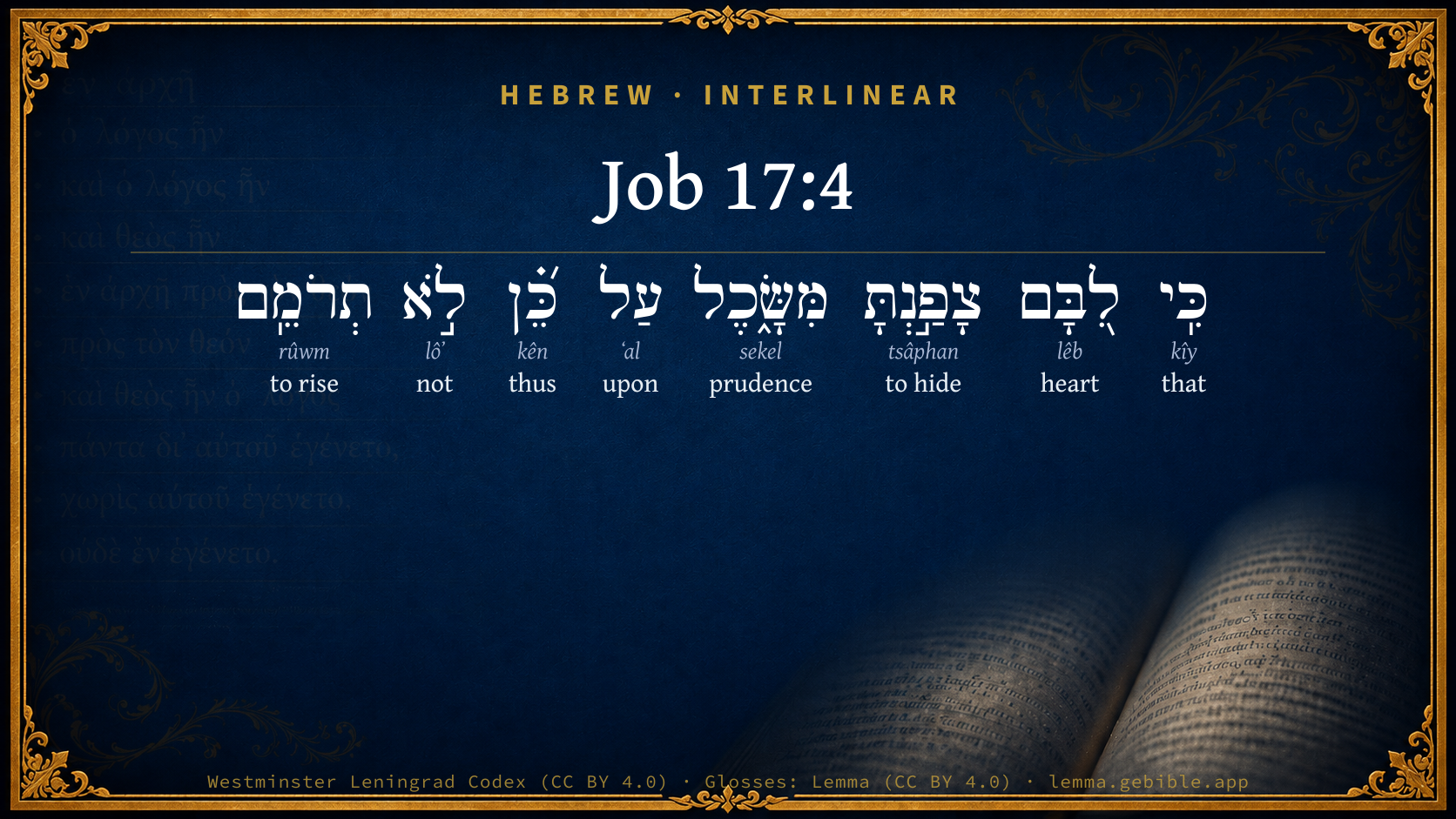
Job 17:4

Hebrew (Westminster Leningrad Codex) Job 17:4 appears in the Hebrew Old Testament. The text above is from the Westminster Leningrad Codex. Each word links to its Strong’s number, a concise gloss, and parsing drawn from the Open Scriptures Hebrew Bible morphology. Click any word for its full Brown-Driver-Briggs (BDB) entry.
Download image
Cite this verse

Job 17:4 (World English Bible). Public Domain. Lemma interlinear Bible study tool, https://lemma.gebible.app/v/job/17/4.

Show BibTeX & RIS
BibTeX
RIS
English Translation
For you have hidden their heart from understanding, Therefore shall you not exalt them.
World English Bible · Public Domain
Download a study sheet

One document with this verse’s original text, its word-by-word gloss line, the meaning frame, cross-references with their text, attributed commentary, and full source and license credits — printable, and it pastes into notes with its structure intact.

This verse Autodidact and up

Study sheet (.html) Plain text (.txt)

A passage Seminary Student

Up to 50 verses in one chapter. A passage sheet keeps up to 6 commentary sources and 12 cross-references per verse, in the order this page ranks them, and says so on the sheet whenever that leaves anything out. Ask for a single verse and you get the Autodidact verse sheet above.

Everything on this page stays free to read, with no account — the sheet is a download of what is already on screen, not access to it.

Want to remove ads? Support Godless Engineer
Compare translations 3

The same verse in 3 English versions, stacked beneath the original-language interlinear above. Click any original word for its lexicon entry.

Each is an independent rendering of the whole verse — the interlinear is not word-aligned to these translations.

Highlighted words mark where these versions differ — a whole-verse word diff, not a word-by-word alignment.

  • World English Bible Public Domain
    For you have hidden their heart from understanding, Therefore shall you not exalt them.
  • King James Version Public Domain
    For thou hast hid their heart from understanding: therefore shalt thou not exalt them.
  • unfoldingWord Literal Text CC BY-SA 4.0
    For you have hidden their hearts away from understanding; therefore you will not exalt.

unfoldingWord Literal Text — © unfoldingWord, licensed CC BY-SA 4.0. Word-aligned USFM3 via Door43 (git.door43.org/unfoldingWord/en_ult).

Versions to compare (up to 4)

3 of 4 selected

Show all 18 translations

Every available English version of this verse, each an independent rendering of the whole verse.

  • World English Bible Public Domain
    For you have hidden their heart from understanding, Therefore shall you not exalt them.
  • Berean Standard Bible Public Domain
    You have closed their minds to understanding; therefore You will not exalt them.
  • Majority Standard Bible Public Domain
    You have closed their minds to understanding; therefore You will not exalt them.
  • King James Version Public Domain
    For thou hast hid their heart from understanding: therefore shalt thou not exalt them.
  • American Standard Version (1901) Public Domain
    For thou hast hid their heart from understanding: Therefore shalt thou not exalt `them'.
  • Revised Version (1885) Public Domain
    For thou hast hid their heart from understanding: therefore shalt thou not exalt them.
  • Geneva Bible (1599) Public Domain
    For thou hast hid their heart from vnderstanding: therefore shalt thou not set them vp on hie.
  • Douay-Rheims (1899) Public Domain
    Thou hast set their heart far from understanding, therefore they shall not be exalted.
  • Young's Literal Translation Public Domain
    For their heart Thou hast hidden From understanding, Therefore Thou dost not exalt them.
  • Literal Standard Version CC BY-SA 4.0
    For You have hidden their heart from understanding, || Therefore You do not exalt them.
  • Unlocked Literal Bible CC BY-SA 4.0
    For you, God, have kept their hearts from understanding; therefore, you will not exalt them over me.
  • unfoldingWord Literal Text CC BY-SA 4.0
    For you have hidden their hearts away from understanding; therefore you will not exalt.
  • Darby Bible Public Domain
    For thou hast hidden their heart from understanding; therefore thou wilt not exalt [them].
  • World Messianic Bible Public Domain
    For you have hidden their heart from understanding, therefore you will not exalt them.
  • Webster's Bible Public Domain
    For thou hast hid their heart from understanding: therefore shalt thou not exalt them.
  • Free Bible Version CC BY-SA 4.0
    You have closed their minds to understanding, so do not let them win!
  • Bible in Basic English Public Domain
    You have kept their hearts from wisdom: for this cause you will not give them honour.
  • JPS Tanakh (1917) Public Domain
    For Thou hast hid their heart from understanding; therefore shalt Thou not exalt them.

Literal Standard Version (2020), Covenant Press — licensed CC BY-SA 4.0. Text via the HelloAO Bible API (eBible.org). Unlocked Literal Bible (unfoldingWord) — licensed CC BY-SA 4.0. Text via the HelloAO Bible API (eBible.org). unfoldingWord Literal Text — © unfoldingWord, licensed CC BY-SA 4.0. Word-aligned USFM3 via Door43 (git.door43.org/unfoldingWord/en_ult). Free Bible Version, Dr. Jonathan Gallagher — licensed CC BY-SA 4.0. Text via the HelloAO Bible API (eBible.org).

Word by word

More ways to search: Search by grammar → Find every occurrence → Compare this word →

Practice this passage: Drill this verse → Learn its vocabulary →

About this verse

These counts appear in no published source. They are computed here, from the morphology-tagged text and Lemma’s own curated glosses. What Lemma adds →

8
words
8
distinct lemmas
Wisdom
section

Notable vocabulary

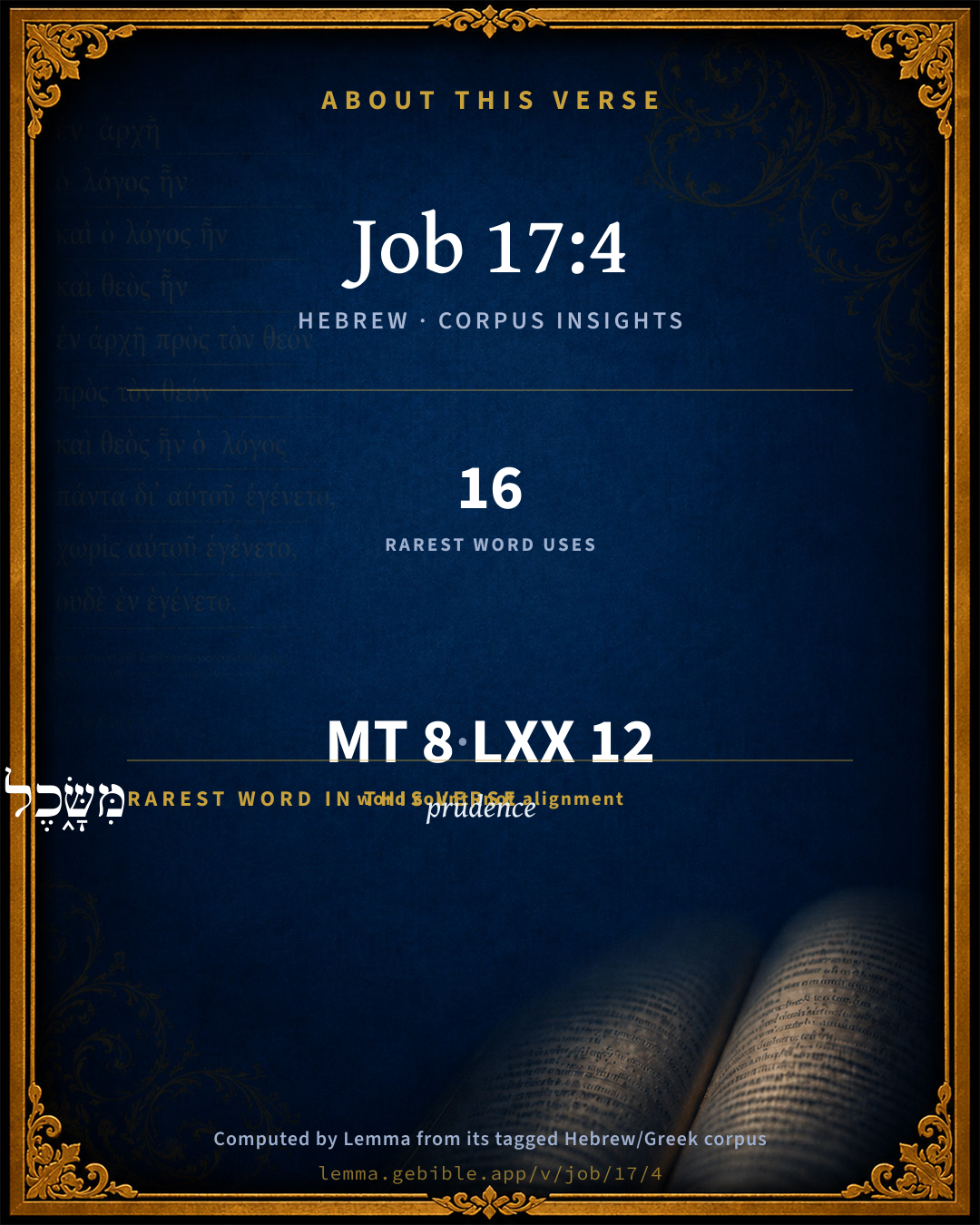
The rarest word here is מִּשָּׂ֑כֶל prudence H7922 — appearing just 16 times in the whole Hebrew Bible.

Shared distinctive vocabulary

מִּשָּׂ֑כֶל prudence H7922 occurs in 16 verses of the Hebrew Bible. Also found in:

Grammatical profile

  • 2 verbs
  • 2 nouns
  • 1 preposition
  • 1 conjunction
  • 2 particles

Verb forms

  • צָפַ֣נְתָּ Qal · Perfect
  • תְרֹמֵֽם Polel · Imperfect

Hebrew & Septuagint length

In English translation the verse runs 14 words from the Hebrew and 14 from the Septuagint (LXX English) — the same length.

A rough comparison of the two English renderings, which tokenize alike — not a word-level alignment.

Word counts can differ between the Hebrew and the Greek without any difference in meaning — e.g. the Hebrew direct-object marker אֵת has no separate Greek word, and Greek often adds the article ὁ.

In the original languages it is 8 Hebrew tokens and 12 Greek tokens — but the two are counted differently (Hebrew bundles its prefixes and suffixes into one token; the Greek is in lemma form), so that isn’t a like-for-like length.

Cross-references

8

Topical passages linked to Job 17:4 in the Treasury of Scripture Knowledge — connected by theme and wording, ordered by reader-vote popularity; previews shown in the World English Bible.

  • Matthew 11:25 At that time, Jesus answered, "I thank you, Father, Lord of heaven and earth, that you hid these things from the wise and understanding, and revealed them to infants.
  • Matthew 13:11 He answered them, "To you it is given to know the mysteries of the Kingdom of Heaven, but it is not given to them.
  • 2 Samuel 17:14 Absalom and all the men of Israel said, The counsel of Hushai the Archite is better than the counsel of Ahithophel. For Yahweh had ordained to defeat the good counsel of Ahithophel, to the intent that Yahweh might bring evil on Absalom.
  • 1 Corinthians 1:20 Where is the wise? Where is the scribe? Where is the lawyer of this world? Hasn't God made foolish the wisdom of this world?
  • Isaiah 19:14 Yahweh has mixed a spirit of perverseness in the midst of her; and they have caused Egypt to go astray in every work of it, as a drunken man staggers in his vomit.
  • Romans 11:8 According as it is written, "God gave them a spirit of stupor, eyes that they should not see, and ears that they should not hear, to this very day."
  • 2 Chronicles 25:16 It happened, as he talked with him, that [the king] said to him, Have we made you of the king's counsel? Stop! Why should you be struck down? Then the prophet stopped, and said, I know that God has determined to destroy you, because you have done this, and have not listened to my counsel.
  • 2 Samuel 15:31 One told David, saying, Ahithophel is among the conspirators with Absalom. David said, Yahweh, please turn the counsel of Ahithophel into foolishness.

Cross-references courtesy of OpenBible.info (CC BY 4.0).

Hebrew and Greek witnesses Masoretic Hebrew ↔ Greek Septuagint

The same verse in the two great witnesses to the Old Testament, shown verse-for-verse.

These are two independent witnesses, not word-aligned to each other, and the Septuagint is shown in lemma (dictionary) form.

Hebrew Job 17:4 Masoretic · Westminster Leningrad Codex

כִּֽי לִ֭בָּם צָפַ֣נְתָּ מִּשָּׂ֑כֶל עַל כֵּ֝֗ן לֹ֣א תְרֹמֵֽם

For you have hidden their heart from understanding, Therefore shall you not exalt them.

World English Bible · Public Domain

Greek LXX Job 17:4 Septuagint · lemma form

ὅτι καρδία αὐτός κρύπτω ἀπό φρόνησις διά οὗτος οὐ μή ὑψόω αὐτός

For you have hid their heart from wisdom; therefore you shall not exalt them.

LXX2012 (modern English Septuagint) · Public Domain

Hebrew: Westminster Leningrad Codex (CC BY 4.0). Greek: Septuagint (public domain); English from LXX2012 (modern English Septuagint) (Public Domain). How the Septuagint differs from the Hebrew →

Commentary

Notes on Job 17:4 from classic Christian and Jewish commentators (each source and its license shown beneath its notes). The classic Christian expositions comment on the surrounding passage and are grouped to its opening verse, so a note may address several verses; the Jewish commentaries on the Tanakh (Rashi and others) are per-verse, so they appear only where the commentator wrote on this verse.

Lemma curates 59 commentaries, every one of them public domain or Creative Commons licensed, each selected and text-cleaned for this edition rather than reprinted as found. About our sources →

Trapp's Complete Commentary

John Trapp

Job 17:4 For thou hast hid their heart from understanding: therefore shalt thou not exalt [them].

Ver. 4. Thou hast hid their heart from understanding] That is, thou hast hidden understanding from their heart, thou hast left them in the dark, destitute of a right judgment, while they condemn me to be a wicked person, because I am grievously afflicted; and thence it is that I do so confidently appeal to thee in Jesus Christ, since my friends are so far mistaken in this controversy. If God give not both light and sight, if he vouchsafe not to irradiate both organ and object, the best will be bemisted. Every good gift and perfect cometh from above, even from the Father of lights, Jas 1:17. It was he that made Reverend Doctor Sibbs (as one saith of him) spiritually rational and rationally spiritual; one that seemed to see the insides of nature and grace, and the world and heaven, by those perfect anatomies he had made of them all.

Therefore shalt thou not exalt them] Therefore thou shalt not give them honour, so Broughton rendereth it. But that is not all. Litotes est, saith Mercer; it is a figure, wherein less is said, and more is meant; thou shalt not only not exalt them, but thou shalt also abase and humble them; this contestation shall be nothing at all to their commendation in the end. It is sound knowledge of the truth according to godliness, that exalteth a man, and makes him to be accounted of; and the contrary. Howbeit many great and good men have been greatly mistaken in very great controversies and transactions, as was Luther, Doctor resolutus, sed non in omnibus illuminatus. And yet how many learned able men hath his name misled in the point of consubstantiation! Ursin was carried away with it awhile, till he read his arguments, which he found to be little better than an illogical argument. Holy Greenham, when pressed to conformity to the ceremonies, by the bishop of Ely, who urged Luther’s approbation of them; and are you wiser than Luther? his sober and gracious answer was, I reverence more the revealed will of God in teaching Luther so many necessary things to salvation than I search into his secret will, why he hid his heart from understanding in things less necessary.

John Trapp, A Commentary or Exposition upon All the Books of the Old and New Testament (1647–1656) — public domain. Text from a community e-Sword module.

Joseph Benson's Commentary

Job 17:4. Thou hast hid their heart from understanding — Rather, thou hast hid understanding from their heart. The minds of my friends are so blinded, that they cannot see those truths which are most plain and evident to all men of sense and experience. Hence, I desire a more wise and able judge. Therefore shalt thou not exalt them — Thou wilt not give them the victory over me in this contest, but wilt give sentence for me, and make them ashamed of their confidence in affirming falsehoods of thee, and wilt punish them severely for their misconduct.

Joseph Benson's Commentary on the Old and New Testaments (1811–1818) — public domain. Text from a community e-Sword module.

Geneva Bible (1599)

Geneva Bible translators

That these mine afflictions are thy just judgments, though man know not the cause.

Geneva Bible (1599) marginal notes — public domain. Text via Bolls.life.

Jamieson, Fausset & Brown

Robert Jamieson, A. R. Fausset & David Brown

their heart--The intellect of his friends.

shalt . . . exalt--Rather imperative, "exalt them not"; allow them not to conquer [UMBREIT], (Isa 6:9-10).

Jamieson, Fausset & Brown — Commentary Critical and Explanatory on the Whole Bible (1871) — public domain (CC PDM 1.0). Text via the HelloAO Bible API.

Adam Clarke's Commentary

Verse 4. For thou hast hid their heart] This address is to God; and here he is represented as doing that which in the course of his providence he only permits to be done.

Shalt thou not exalt them.] This was exactly fulfilled: not one of Job's friends was exalted; on the contrary, God condemned the whole; and they were not received into the Divine favour till Job sacrificed, and made intercession for them.

Adam Clarke's Commentary on the Bible (1810–1826) — public domain. Text from a community e-Sword/MySword module.

Ellicott's Commentary for English Readers

(4) Their heart.—i.e., the heart of his friends.

A Bible Commentary for English Readers, edited by Charles John Ellicott (1878–1897) — public domain. Text from a community e-Sword module.

The Cambridge Bible for Schools and Colleges

gen. ed. J. J. S. Perowne

4. This verse answers the question in Job_17:3, Who (else) will strike hands with me? None else will, for the hearts of the three friends and all others have been blinded, and can take no true view of the sufferer’s cause.

exalt them] i. e. give them the upper hand or victory; cf. Job_42:7-8. To give the friends the upper hand would be to give an issue to Job’s cause such as answered their expectations. The connexion may be: give a pledge now, none else will, for thou hast blinded them, and having blinded them thou wilt not give an issue that meets their expectations.

4–9. These verses support the petition in Job_17:3. If God will not undertake for Job none else will, for the hearts of his friends have been blinded. This thought of the perverse obstinacy and cruelty of his friends leads Job again to a gloomy survey of his whole condition (cf. Job_16:22 to Job_17:2). He is become a public contempt to mankind and brought to the lowest ebb of mortal weakness and humiliation (Job_17:6-7). Such moral perversions on the earth astonish the righteous and rouse them to indignation against the wicked in their prosperity (Job_17:8). Yet they will not permit themselves to be misled by such things to err from the paths of rectitude. Full of moral terror as these perversions are the righteous will in spite of them cleave to his righteousness. He will feel that he is in possession of the only true good, and even because of them and though he sees the world under the rule of God given over to wrong, he will wax stronger and stronger in well doing (Job_17:9)—an astonishing passage.

The Cambridge Bible for Schools and Colleges (gen. ed. J. J. S. Perowne; Cambridge University Press, 1878–1918) — public domain. Text from a community e-Sword module.

John Gill's Exposition

For thou hast hid their heart from understanding,.... That is, the hearts of his friends, and therefore they were unfit to undertake his cause, or be sureties for him, or be judges in it. It is the same thing as to hide understanding from their hearts, which God sometimes does in a natural sense; when men like not the knowledge of him, as attainable by the light of nature, he gives them up to reprobate minds, minds void of knowledge and judgment in things natural; and sometimes, in a spiritual sense, he hides men's hearts from the knowledge of things divine and evangelical, and even this he does from the wise and prudent of this world; yea, sometimes he hides the knowledge of his providential dealings with men from his own people, as he did from Asaph, Jeremiah, Habakkuk, and others; and, as it seems, from Job's friends, who therefore mistook his case, and were very unfit and insufficient to determine it:

therefore shalt thou not exalt them; to such honour and dignity, to be umpires, arbitrators, or judges in the case of Job; this God had reserved for another, Elihu, or rather himself, who decided the controversy between Job and his friends, and declared in his favour, and that they had not spoken the thing that was right of him, as his servant Job had done, Job 42:7;

John Gill's Exposition of the Whole Bible (1746–1763) — public domain (CC PDM 1.0). Text via the HelloAO Bible API.

Albert Barnes' Notes on the Bible

For thou hast hid their heart from understanding - That is, the heart of his professed friends. Job says that they were blind and perverse, and indisposed to render him justice; and he therefore pleads that he may carry his cause directly before God. He attributes their want of understanding to the agency of God in accordance with the doctrine which prevailed in early times, and which is so often expressed in the Scriptures, that God is the source of light and truth, and that when people are blinded it is in accordance with his wise purposes; see Isa 6:9-10. It is “because” they were thus blind and perverse, that he asks the privilege of carrying the cause at once up to God - and who could blame him for such a desire?

Therefore thou shalt not exalt them - By the honor of deciding a case like this, or by the reputation of wisdom. The name of sage or “wise” man was among the most valued in those times; but Job says that that would not be awarded to his friends. God would not exalt or honor people thus devoid of wisdom.

Albert Barnes' Notes on the Bible (1834–1885) — public domain. Text from a community e-Sword/MySword module.

Haydock's Catholic Bible Commentary

Understanding. They will not answer for me. They are not of such a generous disposition; nor can they distinguish between the punishment of guilt and the trial of virtue. (Calmet)

George Leo Haydock (1774–1849), Haydock's Catholic Family Bible and Commentary, 1859 edition — public domain. Excludes Psalms (Douay-Rheims chapter numbering differs from Protestant) and Deuterocanonical books (Catholic canon only).

Matthew Poole's English Annotations

Thou hast blinded the minds of my friends, that they can not see those truths which are most plain and evident to all men of sense and experience; therefore I desire a more wise and able judge.

Therefore shalt thou not exalt them, i.e. thou wilt not give them the victory over me in this contest, but wilt give sentence for me, and discharge them, and make them ashamed of their confidence in affirming falsehoods of thee, and punish them severely for their miscarriage. It is a usual figure, whereby much more is understood than is expressed.

Matthew Poole's English Annotations on the Holy Bible (1683–1685) — public domain. Text from a community e-Sword/MySword module.

Whedon's Commentary on the Bible

Daniel D. Whedon

4. For — None but God can “undertake” for him! His purblind friends certainly cannot.

Not exalt them — above me. Thou wilt not let them prevail.

Daniel D. Whedon (gen. ed.), Commentary on the Old and New Testaments (1874–1909) — public domain. Text from a community e-Sword module.

The Pulpit Commentary

For thou hast hid their heart from understanding. My so-called friends will certainly not undertake for me, since thou hast blinded their eyes and hardened their hearts against me. Therefore shalt thou not exalt them. God will not exalt those who are without understanding.

The heart that is hidden from understanding.

Job is persuaded that God will not desert him. He even takes the very delusions of his tormentors as the pledge from God for which he has been praying; for these delusions seem to come from God, and to show that he has hidden the heart of the three friends from understanding. If it be so, they will not be exalted by God to trample on the sufferer in his misery.

I UNDERSTANDING DEPENDS ON THE CONDITION OF THE HEART If the heart is wrong the judgment will be at fault. We do not judge simply as we see with our eyes. The mental and spiritual condition within largely determines the shape and character of our convictions. Observe some of the states of the heart that hide it from understanding.

1. Obtuseness. The heart may be simply dull and blind to truth. if the light shines with meridian splendour, the man who has cataracts in his eyes will stumble into the ditch as surely as if he were walking in midnight darkness. Some men have no eyes of sympathy with which to see their neighbours; they cannot understand them. Some have no spiritual perceptions of God; and they cannot understand him.

2. Prejudice. We see with the mind as well as with the eyes. Our perception is an amalgam of sight and thought. If the thought is warped, the perception will be crooked. A prejudiced heart excludes truth from the understanding.

3. Passion. Strong feeling blinds the judgment by its own fiery fury. The enraged heart, the sin-loving heart, the ill-regulated heart, are all void of understanding. We need a new and clean heart that we may receive God"s truth.

II THE HEART FROM WHICH UNDERSTANDING IS HIDDEN CANNOT ENJOY THE FAVOUR OF GOD. His favour does not depend on intellectual conditions. Purely mental perplexity is no barrier against the soul in its enjoyment of the Divine love, for God does not wait for perfect orthodoxy before he will help and bless his children. But we have now to do with quite another kind of error. The error which cuts off from God"s favour is moral; it springs from a perversion of heart. For this we are to blame, and therefore the loss it entails is justly deserved. The loss of God"s favour is seen throughout, both in the origin and in the results of the error.

1. In its origin. The startling thought of Job is that it is God who has hidden the heart from understanding. The blindness is judicial, a result of God"s action. This nay look like attributing moral evil to God. If Job in his terrible darkness meant anything of the kind, of course we know that he must have been in error.

(1) But without going so far as this, we may see that God would withdraw his aiding Spirit from the perverse heart. The result would be to hide that heart from understanding,.

(2) The laws of human life and thought which connect perversity of heart with lack of understanding proceed from God.

(3) It is not well that truth should be understood by the perverse heart. Christ bade his disciples not cast their pearls before swine. The ideas for which we are not morally fit would be misapplied and degraded if we could receive them.

2. In its results. All error is dangerous, and moral error is fatal. God pities the bewildered doubter; he is angry with the perverse and wilful thinker, who goes wrong in thought because his heart is wrong. Such a man cannot prosper under the favour of God. W.F.A.

The Pulpit Commentary (1880–1919), ed. H.D.M. Spence-Jones & Joseph S. Exell — public domain. Text from a community e-Sword module.

John Wesley's Explanatory Notes

Hid - Thou hast blinded the minds of my friends: therefore I desire a more wise and able judge. Therefore - Thou wilt not give them the victory over me in this contest, but wilt make them ashamed of their confidence.

John Wesley, Explanatory Notes Upon the Whole Bible (1754–1765) — public domain. Text via the GEBible commentary corpus.

unfoldingWord translationNotes

Door43 World Missions Community

General Information:

Job continues to speak.

have kept their hearts

The word "their" refers to his friends. They are referred to by their "hearts" to emphasize their emotions. AT: "have kept them" or "have kept my friends" (See: Synecdoche)

you will not exalt them over me

"you will not allow them to triumph over me"

He who

"Anyone who"

denounces his friends for a reward

"falsely accuses his friends in order to get a profit" or "betrays his friends to receive a reward"

the eyes of his children will fail

The person's children are referred to here by their "eyes." This phrase describes the children suffering because of what their father or mother did. AT: "his children will suffer for it" (See: Synecdoche and Assumed Knowledge and Implicit Information)

translationWords

God

heart

understand

exalt

reward

children

unfoldingWord translationNotes — © Distant Shores Media and the Door43 World Missions Community, licensed CC BY-SA 4.0. Source: git.door43.org/Door43/en_tn.

Rashi

Rabbi Shlomo Yitzchaki (Rashi)

For Behold. You have hidden their hearts from understanding Therefore, Your glory will not be exalted through them.

Rashi on the Tanakh — English translations: “The Judaica Press complete Tanach with Rashi, translated by A. J. Rosenberg” (CC BY 4.0); “Pentateuch with Rashi's commentary by M. Rosenbaum and A.M. Silbermann, 1929-1934” (public domain); “The Metsudah Tanach series, Lakewood, N.J” (CC BY 4.0); and “The Book of Joshua, Metsudah Publications, 1997” (CC BY 4.0). Text via Sefaria.

Lesson kit

Teaching starters — assembled from the data on this page, not authored interpretation. Every prompt links to the verse data it draws on. Edit before teaching.

Job, in the Wisdom, opens this verse with 8 words (8 distinct Hebrew lemmas). Its most distinctive word is sekel (“prudence”). A historical commentator’s framing appears above. Read the whole chapter for the surrounding context.

Discussion questions

  1. How does “prudence” (sekel) shape what this verse is saying?
  2. How does 1 Samuel 25:3, which shares the word «prudence», read alongside this verse?
  3. These translations render this verse differently; the difference is in the English rendering, not the original. What questions does that raise?
  4. «צָפַ֣נְתָּ» is a Qal Perfect verb. How does that grammatical form shape the action described?
  5. Compare how Trapp's Complete Commentary and Joseph Benson's Commentary read this verse. Where do they agree or differ?

Things to notice

Reading settings

Reading text

Shown beneath each verse's original-language words.

Old Testament
Old Testament edition

Read the OT as the Masoretic Hebrew (MT) or the Greek Septuagint (LXX).

English shown for the Greek Septuagint (in the Hebrew ↔ Greek comparison).

Comparing translations? Open the Compare panel on any verse page to stack up to four side by side.