Deuteronomy 9:2

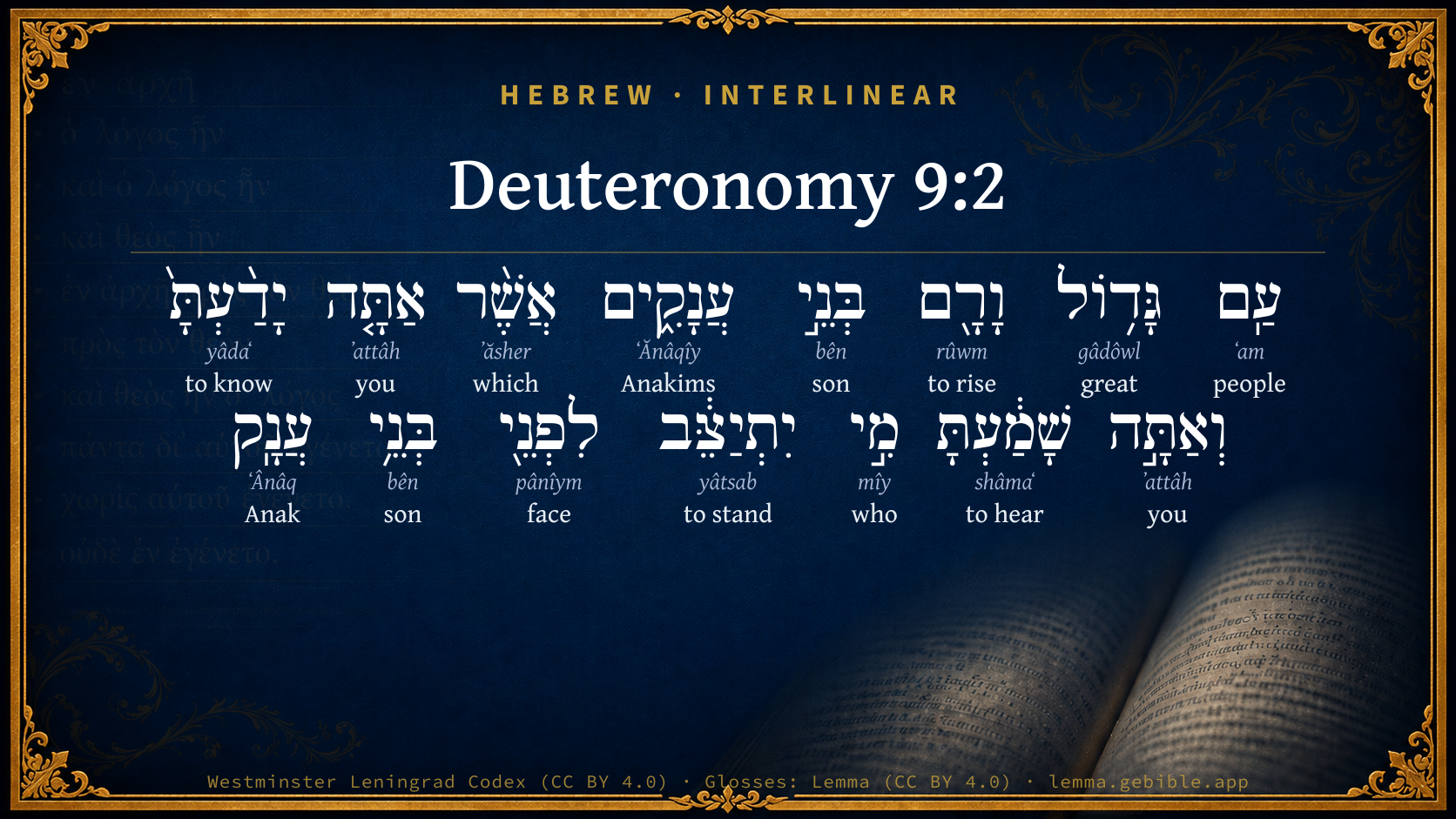
Hebrew (Westminster Leningrad Codex) Deuteronomy 9:2 appears in the Hebrew Old Testament. The text above is from the Westminster Leningrad Codex. Each word links to its Strong’s number, a concise gloss, and parsing drawn from the Open Scriptures Hebrew Bible morphology. Click any word for its full Brown-Driver-Briggs (BDB) entry.
Download image
Cite this verse

Deuteronomy 9:2 (World English Bible). Public Domain. Lemma interlinear Bible study tool, https://lemma.gebible.app/v/deuteronomy/9/2.

Show BibTeX & RIS
BibTeX
RIS
English Translation
a people great and tall, the sons of the Anakim, whom you know, and of whom you have heard say, Who can stand before the sons of Anak?
World English Bible · Public Domain
Download a study sheet

One document with this verse’s original text, its word-by-word gloss line, the meaning frame, cross-references with their text, attributed commentary, and full source and license credits — printable, and it pastes into notes with its structure intact.

This verse Autodidact and up

Study sheet (.html) Plain text (.txt)

A passage Seminary Student

Up to 50 verses in one chapter. A passage sheet keeps up to 6 commentary sources and 12 cross-references per verse, in the order this page ranks them, and says so on the sheet whenever that leaves anything out. Ask for a single verse and you get the Autodidact verse sheet above.

Everything on this page stays free to read, with no account — the sheet is a download of what is already on screen, not access to it.

Want to remove ads? Support Godless Engineer
Compare translations 3

The same verse in 3 English versions, stacked beneath the original-language interlinear above. Click any original word for its lexicon entry.

Each is an independent rendering of the whole verse — the interlinear is not word-aligned to these translations.

Highlighted words mark where these versions differ — a whole-verse word diff, not a word-by-word alignment.

  • World English Bible Public Domain
    a people great and tall, the sons of the Anakim, whom you know, and of whom you have heard say, Who can stand before the sons of Anak?
  • King James Version Public Domain
    A people great and tall, the children of the Anakims, whom thou knowest, and of whom thou hast heard say, Who can stand before the children of Anak!
  • unfoldingWord Literal Text CC BY-SA 4.0
    a people great and tall, the sons of the Anakites, whom you, you know, and you, you have heard, ‘Who can stand to the faces of the sons of Anak?’

unfoldingWord Literal Text — © unfoldingWord, licensed CC BY-SA 4.0. Word-aligned USFM3 via Door43 (git.door43.org/unfoldingWord/en_ult).

Versions to compare (up to 4)

3 of 4 selected

Show all 18 translations

Every available English version of this verse, each an independent rendering of the whole verse.

  • World English Bible Public Domain
    a people great and tall, the sons of the Anakim, whom you know, and of whom you have heard say, Who can stand before the sons of Anak?
  • Berean Standard Bible Public Domain
    The people are strong and tall, the descendants of the Anakim. You know about them, and you have heard it said, “Who can stand up to the sons of Anak?”
  • Majority Standard Bible Public Domain
    The people are strong and tall, the descendants of the Anakim. You know about them, and you have heard it said, “Who can stand up to the sons of Anak?”
  • King James Version Public Domain
    A people great and tall, the children of the Anakims, whom thou knowest, and of whom thou hast heard say, Who can stand before the children of Anak!
  • American Standard Version (1901) Public Domain
    a people great and tall, the sons of the Anakim, whom thou knowest, and of whom thou hast heard say, Who can stand before the sons of Anak?
  • Revised Version (1885) Public Domain
    a people great and tall, the sons of the Anakim, whom thou knowest, and of whom thou hast heard say, Who can stand before the sons of Anak?
  • Geneva Bible (1599) Public Domain
    A people great and tall, euen the children of the Anakims, whom thou knowest, and of whom thou hast heard say, Who can stand before the children of Anak?
  • Douay-Rheims (1899) Public Domain
    A People great and tall, the sons of the Enacims, whom thou hast seen, and heard of, against whom no man is able to stand.
  • Young's Literal Translation Public Domain
    a people great and tall, sons of Anakim, whom thou -- thou hast known, (and thou -- thou hast heard: Who doth station himself before sons of Anak?)
  • Literal Standard Version CC BY-SA 4.0
    a people great and tall, sons of Anakim, whom you have known, and [of whom] you have heard: Who stations himself before sons of Anak?
  • Unlocked Literal Bible CC BY-SA 4.0
    a people great and tall, the sons of the Anakim, whom you know, and of whom you have heard people say, 'Who can stand before the sons of Anak?'
  • unfoldingWord Literal Text CC BY-SA 4.0
    a people great and tall, the sons of the Anakites, whom you, you know, and you, you have heard, ‘Who can stand to the faces of the sons of Anak?’
  • Darby Bible Public Domain
    a people great and tall, the sons of the Anakim, whom thou knowest, and of whom thou hast heard [say], Who can stand before the sons of Anak!
  • World Messianic Bible Public Domain
    a people great and tall, the sons of the Anakim, whom you know, and of whom you have heard say, “Who can stand before the sons of Anak?”
  • Webster's Bible Public Domain
    A people great and tall, the children of the Anakims, whom thou knowest, and of whom thou hast heard it said, Who can stand before the children of Anak!
  • Free Bible Version CC BY-SA 4.0
    The people are strong and tall; they are the descendants of the Anakim. You all know about them and you have heard the saying, “Who could ever defeat the sons of Anak?”
  • Bible in Basic English Public Domain
    A people great and tall, the sons of the Anakim, of whom you have knowledge and of whom it has been said, All are forced to give way before the sons of Anak.
  • JPS Tanakh (1917) Public Domain
    a people great and tall, the sons of the Anakim, whom thou knowest, and of whom thou hast heard say: 'Who can stand before the sons of Anak?'

Literal Standard Version (2020), Covenant Press — licensed CC BY-SA 4.0. Text via the HelloAO Bible API (eBible.org). Unlocked Literal Bible (unfoldingWord) — licensed CC BY-SA 4.0. Text via the HelloAO Bible API (eBible.org). unfoldingWord Literal Text — © unfoldingWord, licensed CC BY-SA 4.0. Word-aligned USFM3 via Door43 (git.door43.org/unfoldingWord/en_ult). Free Bible Version, Dr. Jonathan Gallagher — licensed CC BY-SA 4.0. Text via the HelloAO Bible API (eBible.org).

Word by word

More ways to search: Search by grammar → Find every occurrence → Compare this word →

Practice this passage: Drill this verse → Learn its vocabulary →

עֲנָקִ֑ים
ʻĂnâqîy
H6062
“Anakims”
Noun, Common, Masculine, Plural, Absolute
Part of Speech
Noun
Type
Common
Gender
Masculine
Number
Plural
State
Absolute
Full BDB Definition

Origin: from H6061

TWOT: None

Anakims = "long-necked" - a tribe of giants, descendants of Anak, which dwelled in southern Canaan
  1. עַֽם ʻam H5971 “people” Noun, Common, Masculine, Singular, Absolute
  2. גָּד֥וֹל gâdôwl H1419 “great” Adjective, Adjective, Masculine, Singular, Absolute
  3. וָרָ֖ם rûwm H7311 “and · rising” Conjunction + Verb, Qal, Participle Active, Masculine, Singular, Absolute
  4. בְּנֵ֣י bên H1121 “sons of” Noun, Common, Masculine, Plural, Construct
  5. אֲשֶׁ֨ר ʼăsher H834 “which” Particle, Relative
  6. אַתָּ֤ה ʼattâh H859 “you” Pronoun, Personal, 2nd Person, Masculine, Singular
  7. יָדַ֨עְתָּ֙ yâdaʻ H3045 “to know” Verb, Qal, Perfect, 2nd Person, Masculine, Singular
  8. וְאַתָּ֣ה ʼattâh H859 “and · you” Conjunction + Pronoun, Personal, 2nd Person, Masculine, Singular
  9. שָׁמַ֔עְתָּ shâmaʻ H8085 “to hear” Verb, Qal, Perfect, 2nd Person, Masculine, Singular
  10. מִ֣י mîy H4310 “who” Particle, Interrogative
  11. יִתְיַצֵּ֔ב yâtsab H3320 “to stand” Verb, Hithpael, Imperfect, 3rd Person, Masculine, Singular
  12. לִפְנֵ֖י pânîym H6440 “to/for · face(s) of” Preposition + Noun, Common, Both, Plural, Construct
  13. בְּנֵ֥י bên H1121 “sons of” Noun, Common, Masculine, Plural, Construct
  14. עֲנָֽק ʻÂnâq H6061 “Anak” Noun, Proper

About this verse

These counts appear in no published source. They are computed here, from the morphology-tagged text and Lemma’s own curated glosses. What Lemma adds →

15
words
13
distinct lemmas
Pentateuch
section

Notable vocabulary

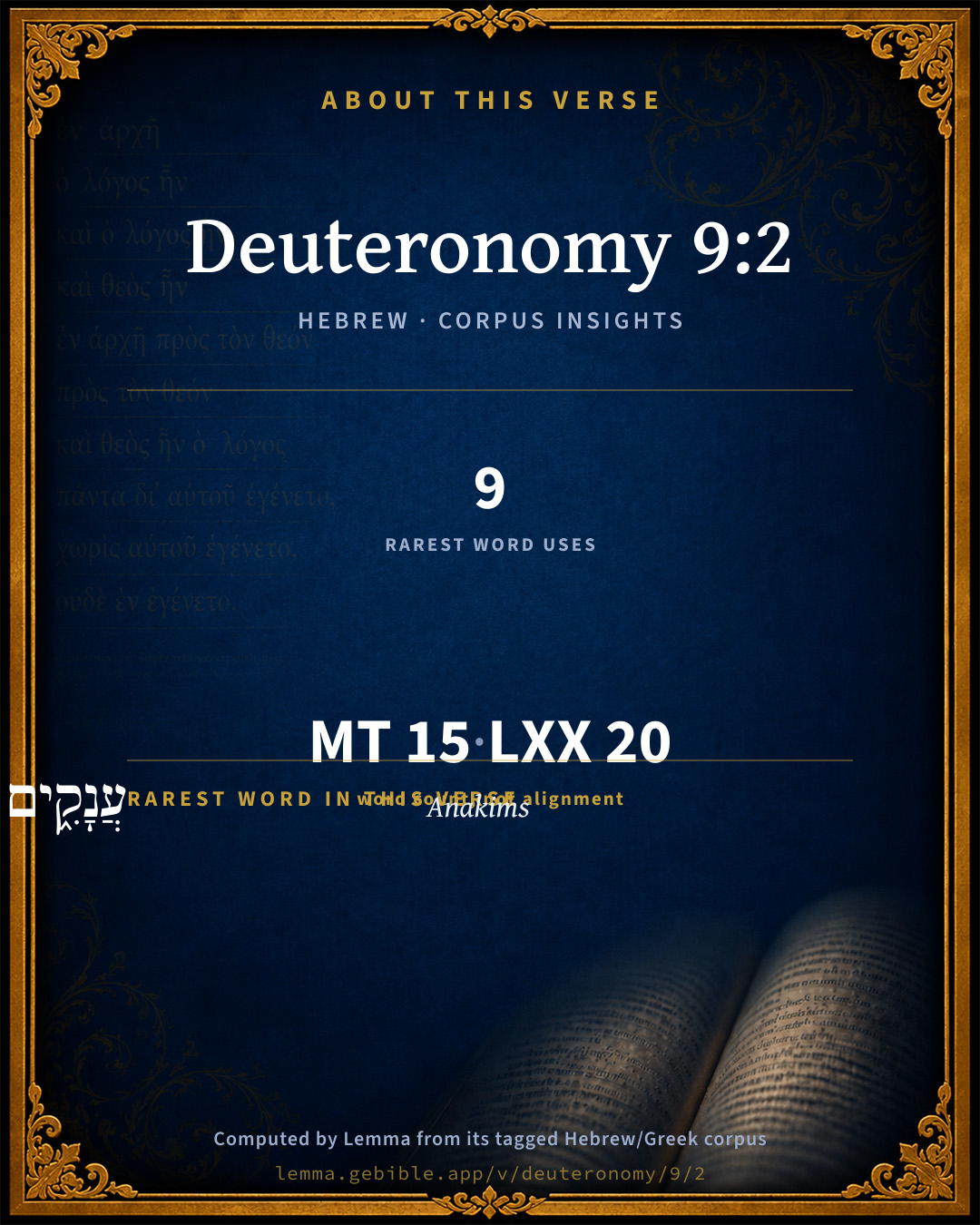
The rarest word here is עֲנָקִ֑ים Anakims H6062 — appearing just 9 times in the whole Hebrew Bible.

Shared distinctive vocabulary

עֲנָקִ֑ים Anakims H6062 occurs in 9 verses of the Hebrew Bible. Also found in:

Grammatical profile

  • 4 verbs
  • 6 nouns
  • 1 adjective
  • 2 pronouns
  • 2 particles

Verb forms

  • וָרָ֖ם Qal · Participle Active
  • יָדַ֨עְתָּ֙ Qal · Perfect
  • שָׁמַ֔עְתָּ Qal · Perfect
  • יִתְיַצֵּ֔ב Hithpael · Imperfect

Repetition

Words recur within this verse — often emphatic in Hebrew:

  • בְּנֵ֣י son H1121 ×2
  • אַתָּ֤ה you H859 ×2

Hebrew & Septuagint length

In English translation the verse runs 28 words from the Hebrew and 29 from the Septuagint (LXX English) — closely comparable.

A rough comparison of the two English renderings, which tokenize alike — not a word-level alignment.

Word counts can differ between the Hebrew and the Greek without any difference in meaning — e.g. the Hebrew direct-object marker אֵת has no separate Greek word, and Greek often adds the article ὁ.

In the original languages it is 15 Hebrew tokens and 20 Greek tokens — but the two are counted differently (Hebrew bundles its prefixes and suffixes into one token; the Greek is in lemma form), so that isn’t a like-for-like length.

Cross-references

11

Topical passages linked to Deuteronomy 9:2 in the Treasury of Scripture Knowledge — connected by theme and wording, ordered by reader-vote popularity; previews shown in the World English Bible.

  • Numbers 13:22 They went up by the South, and came to Hebron; and Ahiman, Sheshai, and Talmai, the children of Anak, were there. (Now Hebron was built seven years before Zoan in Egypt.)
  • Exodus 9:11 The magicians couldn't stand before Moses because of the boils; for the boils were on the magicians, and on all the Egyptians.
  • Numbers 13:28 However the people who dwell in the land are strong, and the cities are fortified, [and] very great: and moreover we saw the children of Anak there.
  • Numbers 13:33 There we saw the Nephilim, the sons of Anak, who come of the Nephilim: and we were in our own sight as grasshoppers, and so we were in their sight.
  • Deuteronomy 2:11–12 these also are accounted Rephaim, as the Anakim; but the Moabites call them Emim.
  • Deuteronomy 2:21 a people great, and many, and tall, as the Anakim; but Yahweh destroyed them before them; and they succeeded them, and lived in their place;
  • Deuteronomy 7:24 He will deliver their kings into your hand, and you shall make their name to perish from under the sky: there shall no man be able to stand before you, until you have destroyed them.
  • Job 11:10 If he passes by, or confines, Or convenes a court, then who can oppose him?
  • Daniel 8:4 I saw the ram pushing westward, and northward, and southward; and no animals could stand before him, neither was there any who could deliver out of his hand; but he did according to his will, and magnified himself.
  • Daniel 11:16 But he who comes against him shall do according to his own will, and none shall stand before him; and he shall stand in the glorious land, and in his hand shall be destruction.
  • Nahum 1:6 Who can stand before his indignation? Who can endure the fierceness of his anger? His wrath is poured out like fire, and the rocks are broken apart by him.

Cross-references courtesy of OpenBible.info (CC BY 4.0).

Hebrew and Greek witnesses Masoretic Hebrew ↔ Greek Septuagint

The same verse in the two great witnesses to the Old Testament, shown verse-for-verse.

These are two independent witnesses, not word-aligned to each other, and the Septuagint is shown in lemma (dictionary) form.

Hebrew Deuteronomy 9:2 Masoretic · Westminster Leningrad Codex

עַֽם גָּד֥וֹל וָרָ֖ם בְּנֵ֣י עֲנָקִ֑ים אֲשֶׁ֨ר אַתָּ֤ה יָדַ֨עְתָּ֙ וְאַתָּ֣ה שָׁמַ֔עְתָּ מִ֣י יִתְיַצֵּ֔ב לִפְנֵ֖י בְּנֵ֥י עֲנָֽק

a people great and tall, the sons of the Anakim, whom you know, and of whom you have heard say, Who can stand before the sons of Anak?

World English Bible · Public Domain

Greek LXX Deuteronomy 9:2 Septuagint · lemma form

λαός μέγας καί πολύς καί εὐμήκης υἱός ενακ ὅς σύ οἶδα καί σύ ἀκούω τίς ἀντιἵστημι κατά πρόσωπον υἱός ενακ

a people great and many and tall, the sons of Enac, whom you know, and concerning whom you have heard say, Who can stand before the children of Enac?

LXX2012 (modern English Septuagint) · Public Domain

Hebrew: Westminster Leningrad Codex (CC BY 4.0). Greek: Septuagint (public domain); English from LXX2012 (modern English Septuagint) (Public Domain). How the Septuagint differs from the Hebrew →

Targum (Aramaic paraphrase)

2

The Targum is the ancient Jewish Aramaic paraphrase of the Hebrew Scriptures — an interpretive translation, not the Hebrew text itself. Onkelos (literal) and Pseudo-Jonathan (expansive) render the Torah, and Jonathan the Prophets. Coverage is partial: where no permissively-licensed English translation exists for a verse, only the Aramaic is shown. This is verse-level text, not a word-by-word alignment to the Hebrew.

  1. Targum Onkelos Torah (Genesis–Deuteronomy)
    עַם רַב וְתַקִיף בְּנֵי גִבָּרַיָא דִי אַתְּ יְדַעַתְּ וְאַתְּ שְׁמַעְתְּ מָן יִכּוּל לְמֵיקַם קֳדָם בְּנֵי גִבָּרַיָא

    (no public-domain English translation for this verse)

    Targum Onkelos — Aramaic: “Onkelos Genesis” (public domain); “Onkelos Exodus” (public domain); “Onkelos Leviticus” (public domain); “Onkelos Numbers” (public domain); “Onkelos Deuteronomy” (public domain). English: “Sefaria Community Translation” (CC0 1.0 (public-domain dedication)); “J.W. Etheridge. The Targums of Onkelos and Jonathan Ben Uzziel on the Pentateuch. London: Longmans, Green, 1862” (public domain). Text via Sefaria.

  2. Targum Pseudo-Jonathan Torah (Genesis–Deuteronomy)
    עַם חָסִין וְגֵיוְתָן הֵי כְּגִנְבָּרַיָא דְּאַתּוּן יְדַעְתּוּן וְאַתּוּן שְׁמַעְתּוּן מַן יֵיכוּל לְמֵיקָם קֳדָם בְּנוֹי גִבָּרַיָא

    A people (are they) strong and tall as the giants whom you know, and of whom you have heard (say), Who can stand before the sons of the giants?

    Targum Pseudo-Jonathan — Aramaic: “Targum Jonathan on Genesis” (public domain); “Targum Jonathan on Exodus” (public domain); “Targum Jonathan on Leviticus” (public domain); “Targum Jonathan on Numbers” (public domain); “Targum Jonathan on Deuteronomy” (public domain). English: “The Targum of Jonathan ben Uzziel, trans. J. W. Etheridge, London, 1862” (public domain). Text via Sefaria.

Commentary

Notes on Deuteronomy 9:2 from classic Christian and Jewish commentators (each source and its license shown beneath its notes). The classic Christian expositions comment on the surrounding passage and are grouped to its opening verse, so a note may address several verses; the Jewish commentaries on the Tanakh (Rashi and others) are per-verse, so they appear only where the commentator wrote on this verse.

Lemma curates 59 commentaries, every one of them public domain or Creative Commons licensed, each selected and text-cleaned for this edition rather than reprinted as found. About our sources →

Trapp's Complete Commentary

John Trapp

Deu 9:2 A people great and tall, the children of the Anakims, whom thou knowest, and [of whom] thou hast heard [say], Who can stand before the children of Anak!

Ver. 2. The children of Anak.] Hence seems to come the Greek word, Aναξ, for a king; for these great men were looked upon as so many little kings. {See Trapp on "Gen 6:4"}

John Trapp, A Commentary or Exposition upon All the Books of the Old and New Testament (1647–1656) — public domain. Text from a community e-Sword module.

Geneva Bible (1599)

Geneva Bible translators

By the report of the spies, Num. 13:26.

Geneva Bible (1599) marginal notes — public domain. Text via Bolls.life.

Ellicott's Commentary for English Readers

(2) Whom thou knowest.—The pronoun is emphatic. The twelve spies, two of whom were still living, had seen them (Num_13:33), and their fame was doubtless notorious. It seems to have been a common saying, possibly among the Anakim themselves, “Who will stand up to the children of Anak?” No one could be found to face them.

A Bible Commentary for English Readers, edited by Charles John Ellicott (1878–1897) — public domain. Text from a community e-Sword module.

The Cambridge Bible for Schools and Colleges

gen. ed. J. J. S. Perowne

2. great and tall … Anakim] See on Deu_1:28.

whom thou knowest, etc.] Deu_7:15; and hast heard say, Deu_1:28; Num_13:28.

The Cambridge Bible for Schools and Colleges (gen. ed. J. J. S. Perowne; Cambridge University Press, 1878–1918) — public domain. Text from a community e-Sword module.

John Gill's Exposition

A people great and tall,.... Of a large bulky size, and of an high stature, so that the spies seemed to be as grasshoppers to them, Num 13:33,

the children of the Anakims, whom thou knowest; by report, having had an account of them by the spies, who described them as very large bodied men, and of a gigantic stature, the descendants of one Anak, a giant; and so the Targum of Jonathan,"a people strong and high like the giants;''from these Bene Anak, children of Anak, or Phene Anak, as the words might be pronounced, the initial letter of the first word being of the same sound, Bochart (z) thinks the country had its name of Phoenicia:

and of whom thou hast heard say, who can stand before the children, of Anak? or the children of the giants, as the Targums of Onkelos and Jonathan; which they had heard either from the spies who had suggested the same, Num 13:31 or as a common proverb in the mouths of most people in those days.

(z) Canaan, l. 1. c. 1. col. 346.

John Gill's Exposition of the Whole Bible (1746–1763) — public domain (CC PDM 1.0). Text via the HelloAO Bible API.

Haydock's Catholic Bible Commentary

Stand. Hebrew, "who can stand before the sons of Enak?" as if this were a sort of proverb. (Calmet) --- The spies had formerly terrified the people with the report of the high walls and gigantic inhabitants of Chanaan, Numbers xiii. 18.

George Leo Haydock (1774–1849), Haydock's Catholic Family Bible and Commentary, 1859 edition — public domain. Excludes Psalms (Douay-Rheims chapter numbering differs from Protestant) and Deuterocanonical books (Catholic canon only).

Matthew Poole's English Annotations

Either from the spies, or rather from common fame, for this seems to be a proverb used. in those times.

Matthew Poole's English Annotations on the Holy Bible (1683–1685) — public domain. Text from a community e-Sword/MySword module.

The Pulpit Commentary

Anakim (cf. Deu_1:28) It was a common saying, Who can stand before the sons of Anak? But even these gigantic foes should be unable to stand before Israel: (cf. Deu_7:24)

The Pulpit Commentary (1880–1919), ed. H.D.M. Spence-Jones & Joseph S. Exell — public domain. Text from a community e-Sword module.

John Wesley's Explanatory Notes

Who can stand - This seems to be a proverb used in those times.

John Wesley, Explanatory Notes Upon the Whole Bible (1754–1765) — public domain. Text via the GEBible commentary corpus.

Lesson kit

Teaching starters — assembled from the data on this page, not authored interpretation. Every prompt links to the verse data it draws on. Edit before teaching.

Deuteronomy, in the Pentateuch, opens this verse with 15 words (13 distinct Hebrew lemmas). Its most distinctive word is ʻĂnâqîy (“Anakims”). A historical commentator’s framing appears above. Read the whole chapter for the surrounding context.

Discussion questions

  1. What does “Anakims” (ʻĂnâqîy) contribute to the verse as a whole?
  2. Deuteronomy 1:28 shares the word «Anakims» with this verse. How do the two illuminate each other?
  3. “son” occurs 2× in this one verse. What is the effect of the repetition?
  4. The translations on this page render this verse differently — a whole-verse word diff, not a word-by-word alignment. What might account for the different wordings?
  5. The verb «וָרָ֖ם» is Qal Participle Active. How does its form color the action?
  6. Reading how Trapp's Complete Commentary and Geneva Bible (1599) read this verse, where do the two commentators agree and where do they part?

Things to notice

Reading settings

Reading text

Shown beneath each verse's original-language words.

Old Testament
Old Testament edition

Read the OT as the Masoretic Hebrew (MT) or the Greek Septuagint (LXX).

English shown for the Greek Septuagint (in the Hebrew ↔ Greek comparison).

Comparing translations? Open the Compare panel on any verse page to stack up to four side by side.