
Psalms 57:11

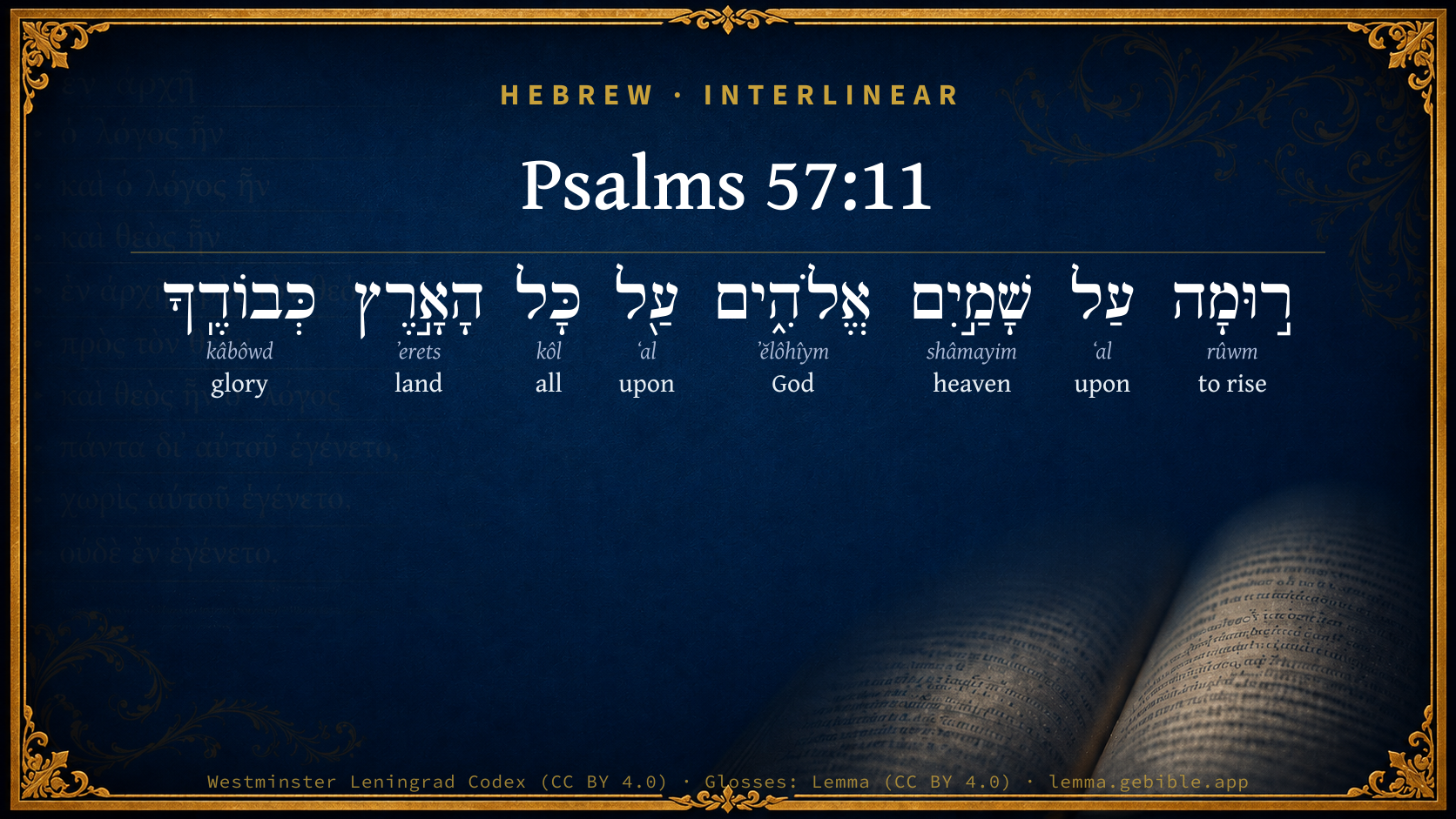
Hebrew (Westminster Leningrad Codex) Psalms 57:11 appears in the Hebrew Old Testament. The text above is from the Westminster Leningrad Codex. Each word links to its Strong’s number, a concise gloss, and parsing drawn from the Open Scriptures Hebrew Bible morphology. Click any word for its full Brown-Driver-Briggs (BDB) entry.
Download image
Cite this verse

Psalms 57:11 (World English Bible). Public Domain. Lemma interlinear Bible study tool, https://lemma.gebible.app/v/psalms/57/11.

Show BibTeX & RIS
BibTeX
RIS
English Translation
Be exalted, God, above the heavens. Let your glory be over all the earth.
World English Bible · Public Domain
Download a study sheet

One document with this verse’s original text, its word-by-word gloss line, the meaning frame, cross-references with their text, attributed commentary, and full source and license credits — printable, and it pastes into notes with its structure intact.

This verse Autodidact and up

Study sheet (.html) Plain text (.txt)

A passage Seminary Student

Up to 50 verses in one chapter. A passage sheet keeps up to 6 commentary sources and 12 cross-references per verse, in the order this page ranks them, and says so on the sheet whenever that leaves anything out. Ask for a single verse and you get the Autodidact verse sheet above.

Everything on this page stays free to read, with no account — the sheet is a download of what is already on screen, not access to it.

Want to remove ads? Support Godless Engineer
Compare translations 3

The same verse in 3 English versions, stacked beneath the original-language interlinear above. Click any original word for its lexicon entry.

Each is an independent rendering of the whole verse — the interlinear is not word-aligned to these translations.

Highlighted words mark where these versions differ — a whole-verse word diff, not a word-by-word alignment.

  • World English Bible Public Domain
    Be exalted, God, above the heavens. Let your glory be over all the earth.
  • King James Version Public Domain
    Be thou exalted, O God, above the heavens: let thy glory be above all the earth.
  • unfoldingWord Literal Text CC BY-SA 4.0
    Be high above the heavens, God, your glory above all of the earth.

unfoldingWord Literal Text — © unfoldingWord, licensed CC BY-SA 4.0. Word-aligned USFM3 via Door43 (git.door43.org/unfoldingWord/en_ult).

Versions to compare (up to 4)

3 of 4 selected

Show all 18 translations

Every available English version of this verse, each an independent rendering of the whole verse.

  • World English Bible Public Domain
    Be exalted, God, above the heavens. Let your glory be over all the earth.
  • Berean Standard Bible Public Domain
    Be exalted, O God, above the heavens; may Your glory cover all the earth.
  • Majority Standard Bible Public Domain
    Be exalted, O God, above the heavens; may Your glory cover all the earth.
  • King James Version Public Domain
    Be thou exalted, O God, above the heavens: let thy glory be above all the earth.
  • American Standard Version (1901) Public Domain
    Be thou exalted, O God, above the heavens; `Let' thy glory `be' above all the earth. Psalm 58 For the Chief Musician; `set to' Al-tashheth. `A Psalm' of David Michtam.
  • Revised Version (1885) Public Domain
    Be thou exalted, O God, above the heavens; let thy glory be above all the earth.
  • Geneva Bible (1599) Public Domain
    Exalt thy selfe, O God, aboue the heauens, and let thy glory be vpon all the earth.
  • Douay-Rheims (1899) Public Domain
    For thy mercy is magnified even to the heavens: and thy truth unto the clouds.
  • Young's Literal Translation Public Domain
    Be thou exalted above the heavens, O God. Above all the earth Thine honour!
  • Literal Standard Version CC BY-SA 4.0
    Be exalted above the heavens, O God. Your glory above all the earth!
  • Unlocked Literal Bible CC BY-SA 4.0
    Be exalted, God, above the heavens; may your glory be exalted over all the earth.
  • unfoldingWord Literal Text CC BY-SA 4.0
    Be high above the heavens, God, your glory above all of the earth.
  • Darby Bible Public Domain
    Be exalted above the heavens, O God; let thy glory be above all the earth!
  • World Messianic Bible Public Domain
    Be exalted, God, above the heavens. Let your glory be over all the earth.
  • Webster's Bible Public Domain
    \\57:10\\For thy mercy is great to the heavens, and thy truth to the clouds.
  • Free Bible Version CC BY-SA 4.0
    God, your greatness is above the highest heavens; and your glory covers the whole earth!
  • Bible in Basic English Public Domain
    Be lifted up, O God, higher than the heavens, let your glory be over all the earth.
  • JPS Tanakh (1917) Public Domain
    (57-12) Be Thou exalted, O God, above the heavens; Thy glory be above all the earth.

Literal Standard Version (2020), Covenant Press — licensed CC BY-SA 4.0. Text via the HelloAO Bible API (eBible.org). Unlocked Literal Bible (unfoldingWord) — licensed CC BY-SA 4.0. Text via the HelloAO Bible API (eBible.org). unfoldingWord Literal Text — © unfoldingWord, licensed CC BY-SA 4.0. Word-aligned USFM3 via Door43 (git.door43.org/unfoldingWord/en_ult). Free Bible Version, Dr. Jonathan Gallagher — licensed CC BY-SA 4.0. Text via the HelloAO Bible API (eBible.org).

Word by word

More ways to search: Search by grammar → Find every occurrence → Compare this word →

Practice this passage: Drill this verse → Learn its vocabulary →

ר֣וּמָה
rûwm
H7311
“rise”
Verb, Qal, Imperative, 2nd Person, Masculine, Singular + Suffix, h
Part of Speech
Verb
Stem
Qal
Form
Imperative
Person
2nd Person
Gender
Masculine
Number
Singular
Full BDB Definition

Origin: a primitive root

TWOT: 2133

to rise, rise up, be high, be lofty, be exalted - (Qal) - to be high, be set on high - to be raised, be uplifted, be exalted - to be lifted, rise - (Polel) - to raise or rear (children), cause to grow up - to lift up, raise, exalt - to exalt, extol - (Polal) to be lifted up - (Hiphil) - to raise, lift, lift up, take up, set up, erect, exalt, set on high - to lift up (and take away), remove - to lift off and present, contribute, offer, contribute - (Hophal) to be taken off, be abolished - (Hithpolel) to exalt oneself, magnify oneself - (Qal) to be rotten, be wormy
  1. עַל ʻal H5921 “upon” Preposition
  2. שָׁמַ֣יִם shâmayim H8064 “heaven(s)” Noun, Common, Masculine, Plural, Absolute
  3. אֱלֹהִ֑ים ʼĕlôhîym H430 “God(s)” Noun, Common, Masculine, Plural, Absolute
  4. עַ֖ל ʻal H5921 “upon” Preposition
  5. כָּל kôl H3605 “all of” Noun, Common, Masculine, Singular, Construct
  6. הָאָ֣רֶץ ʼerets H776 “the · land” Particle, Definite Article + Noun, Common, Both, Singular, Absolute
  7. כְּבוֹדֶֽךָ kâbôwd H3519 “glory · your” Noun, Common, Both, Singular, Construct + Suffix, Personal, 2nd Person, Masculine, Singular

About this verse

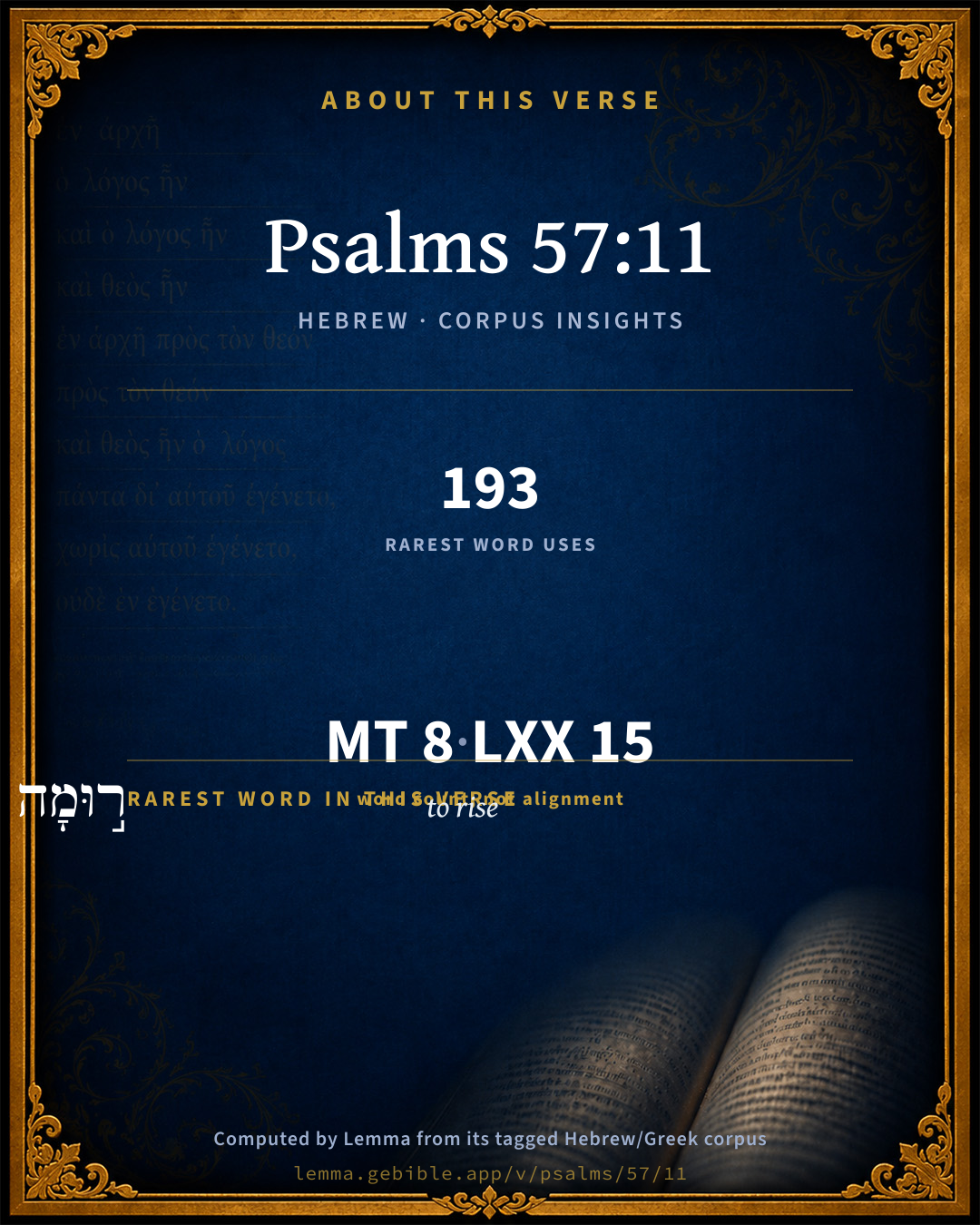
These counts appear in no published source. They are computed here, from the morphology-tagged text and Lemma’s own curated glosses. What Lemma adds →

8
words
7
distinct lemmas
Wisdom
section

Grammatical profile

  • 1 verb
  • 5 nouns
  • 2 prepositions

Verb forms

  • ר֣וּמָה Qal · Imperative

Repetition

A word recurs within this verse — often emphatic in Hebrew:

Hebrew & Septuagint length

In English translation the verse runs 14 words from the Hebrew and 15 from the Septuagint (LXX English) — closely comparable.

A rough comparison of the two English renderings, which tokenize alike — not a word-level alignment.

Word counts can differ between the Hebrew and the Greek without any difference in meaning — e.g. the Hebrew direct-object marker אֵת has no separate Greek word, and Greek often adds the article ὁ.

In the original languages it is 8 Hebrew tokens and 15 Greek tokens — but the two are counted differently (Hebrew bundles its prefixes and suffixes into one token; the Greek is in lemma form), so that isn’t a like-for-like length.

Cross-references

4

Topical passages linked to Psalms 57:11 in the Treasury of Scripture Knowledge — connected by theme and wording, ordered by reader-vote popularity; previews shown in the World English Bible.

  • Psalms 57:5 Be exalted, God, above the heavens! Let your glory be above all the earth!
  • Psalms 8:1 Yahweh, our Lord, how majestic is your name in all the earth, Who has set your glory above the heavens!
  • Revelation 15:3–4 They sang the song of Moses, the servant of God, and the song of the Lamb, saying, "Great and marvelous are your works, Lord God, the Almighty; Righteous and true are your ways, you King of the nations.
  • Psalms 8:9 Yahweh, our Lord, How majestic is your name in all the earth!

Cross-references courtesy of OpenBible.info (CC BY 4.0).

Hebrew and Greek witnesses Masoretic Hebrew ↔ Greek Septuagint

The same verse in the two great witnesses to the Old Testament, shown verse-for-verse.

You’re reading Greek Psalm 56 (Hebrew Psalm 57). The Septuagint counts the superscription, so verse numbers can differ from the Hebrew — chapter-level alignment, not verse-by-verse. Numbering follows Rahlfs.

These are two independent witnesses, not word-aligned to each other, and the Septuagint is shown in lemma (dictionary) form.

Hebrew Psalms 57:11 Masoretic · Westminster Leningrad Codex

ר֣וּמָה עַל שָׁמַ֣יִם אֱלֹהִ֑ים עַ֖ל כָּל הָאָ֣רֶץ כְּבוֹדֶֽךָ

Be exalted, God, above the heavens. Let your glory be over all the earth.

World English Bible · Public Domain

Greek LXX Greek Psalm 56:11 Septuagint · lemma form

ὅτι μεγαλύνω ἕως ὁ οὐρανός ὁ ἔλεος σύ καί ἕως ὁ νεφέλη ὁ ἀλήθεια σύ

Be you exalted, O God, above the heavens; and your glory above all the earth.

LXX2012 (modern English Septuagint) · Public Domain

Hebrew: Westminster Leningrad Codex (CC BY 4.0). Greek: Septuagint (public domain); English from LXX2012 (modern English Septuagint) (Public Domain). How the Septuagint differs from the Hebrew →

Commentary

Notes on Psalms 57:11 from classic Christian and Jewish commentators (each source and its license shown beneath its notes). The classic Christian expositions comment on the surrounding passage and are grouped to its opening verse, so a note may address several verses; the Jewish commentaries on the Tanakh (Rashi and others) are per-verse, so they appear only where the commentator wrote on this verse.

Lemma curates 59 commentaries, every one of them public domain or Creative Commons licensed, each selected and text-cleaned for this edition rather than reprinted as found. About our sources →

Trapp's Complete Commentary

John Trapp

Psa 57:11 Be thou exalted, O God, above the heavens: [let] thy glory [be] above all the earth.

Ver. 11. Be thou exalted, &c.] Versus amoibaeus: see Psa 57:5, only that is in way of prayer; this, of praise.

John Trapp, A Commentary or Exposition upon All the Books of the Old and New Testament (1647–1656) — public domain. Text from a community e-Sword module.

J. A. Alexander on Psalms

Joseph Addison Alexander

12. (Psa 57:11). Be thou high above the heavens, O God, above all the earth thy glory! The strophe ends as it began in Psa 57:5 above. In the last clause the verb of the first may be repeated, be thy glory high; or the substantive verb alone may be supplied, let thy glory be above all the earth!

Joseph Addison Alexander, The Psalms Translated and Explained (1850) — public domain. Text from a community e-Sword module.

Adam Clarke's Commentary

Verse 11. Be thou exalted, O God, above the heavens] The same sentiments and words which occur in Ps 57:5. See Clarke on Ps 57:5.

David was not only in a happy state of mind when he wrote this Psalm, but in what is called a state of triumph. His confidence in God was unbounded; though encompassed by the most ferocious enemies, and having all things against him except God and his innocence. David will seldom be found in a more blessed state than he here describes. Similar faith in God will bring the same blessings to every true Christian in similar circumstances.

ANALYSIS OF THE FIFTY-SEVENTH PSALM

The contents of this Psalm are, -

I. David's petition, Ps 57:1.

II. The reasons which induced him to offer it, Ps 57:2-6.

III. His resolution to give God due praise, Ps 57:5; Ps 57:7-11.

I. His petition is ardent. The repetition shows this: it is for grace and protection: "Be merciful unto me, be merciful unto me, O God!"

II. He adduces his reasons to persuade the Lord to be merciful.

First reason. The faith and confidence he had in God: "My soul trusteth in thee; and under the shadow of thy wings," as the chicken does under those of the hen, "shall be my refuge until these calamities be overpast."

Second reason. The sufficiency and efficiency of God: "I will call upon God."

l. He is the Most High; then he is sufficient and able to deliver me.

2. He will perform all things for me: therefore he will effect this.

In the following verse he insists on this argument.

"He shall send from heaven." He will do it in a miraculous way, if there be no other way: "He will send from heaven, and save me. He will send forth his mercy and his truth;" he will perform his word, and graciously save me.

The third reason of his petition is the extreme danger he was then in by a cruel and merciless enemy.

1. "My soul is among the lions," a ravenous, strong, and bloody creature.

2. "I lie even among those who are set on fire." Their anger and hatred to me are implacable.

3. Even among those whose "teeth are spears and arrows, and their tongue a sharp sword." They wound by calumniating me. A spear wounds near; an arrow, afar off; a sword, at hand: near or far off, they spare not to disgrace me.

He now brings another argument, stronger than all the rest, viz., God's glory. It will be to his glory to be merciful, to save, and to deliver; and therefore he prays: "Be thou exalted, O God, above the heavens, and let thy glory," c. That is, Let not the wicked triumph but display thy power, and assert thy glory; which, if thou do, thy glory will be conspicuous above - in the heavens, and below - over all the earth.

He then begins his complaint, describing the practices of his enemies: -

1. "They have prepared a net for my feet." They lay snares as fowlers do.

2. Through which "my soul is bowed down." My life is in extreme danger.

3. "They have digged a pit before me," intending to take me like some wild beast, but, praised be God I foresee the event. "They are fallen into the pit themselves."

III. In confidence of this David gives thanks, which may be considered a fourth argument; for there is no such way to procure a new favour as to be thankful. Our thanksgiving: should consist of two especial points: 1. Commemoration; 2. Declaration.

1. He that will be thankful should treasure up in his heart and memory the kindness that is done to him. This David had done: "My heart is fixed, my heart is fixed."

2. After he remembers it, he should be affected by it, and resolve on it. So does David. My heart is ready, prepared, fixed. I will be thankful. I am determined.

3. It is not enough that a man have a thankful heart; he must declare it, and make publicly known what God has done for him: "I will sing, and give praise."

4. He should use all means in his power to make it known; tongue, psaltery, harp, are all little enough. To these he addresses himself: "Awake, tongue, lute, harp," c.

5. He must not do it carelessly: "Awake! Awake! Myself will awake."

6. He must take the first opportunity, and not delay it: "I will awake EARLY."

7. He should do it in such a way as most tends to God's glory: "I will praise thee among the people - I will sing of thee among the nations."

That all this may be done, David gives a sufficient reason, - God's mercy and truth. His infinite mercy in promising, his truth in performing: "Thy mercy is great unto the heavens thy truth unto the clouds."

And then he concludes with a repetition of the fifth verse: "Be thou exalted above the heavens, and thy truth unto the clouds." Let all give thee the glory due to thy name.

Adam Clarke's Commentary on the Bible (1810–1826) — public domain. Text from a community e-Sword/MySword module.

The Cambridge Bible for Schools and Colleges

gen. ed. J. J. S. Perowne

11. How can the Psalmist conclude more fitly than with a repetition of this prayer, which now looks beyond his own immediate needs to that perfect and universal sovereignty of God, which is the final goal of hope (1Co_15:28; Rev_19:6)?

The Cambridge Bible for Schools and Colleges (gen. ed. J. J. S. Perowne; Cambridge University Press, 1878–1918) — public domain. Text from a community e-Sword module.

John Gill's Exposition

Be thou exalted, O God, above the heavens,.... As Christ now is at the Father's right hand, and who is God over all, blessed for ever;

let thy glory be above all the earth; as it is above all the men on earth and angels in heaven. This is repeated from Psa 57:5; See Gill on Psa 57:5, and shows the vehemency of his desire after these things, and how much his heart was set upon them.

Next: Psalms Chapter 58

John Gill's Exposition of the Whole Bible (1746–1763) — public domain (CC PDM 1.0). Text via the HelloAO Bible API.

Albert Barnes' Notes on the Bible

Be thou exalted, O God, above the heavens - See the notes at Psa 57:5. The sentiment here is repeated as being that on which the mind of the psalmist was intensely fixed; that which he most earnestly desired; that which was the crowning aim and desire of his life.

Albert Barnes' Notes on the Bible (1834–1885) — public domain. Text from a community e-Sword/MySword module.

Matthew Poole's English Annotations

See Poole "Psa 57:5".

Matthew Poole's English Annotations on the Holy Bible (1683–1685) — public domain. Text from a community e-Sword/MySword module.

The Treasury of David

Charles H. Spurgeon

Ver. 11. Be thou exalted, O God, above the heavens. A grand chorus. Take it up, ye angels and ye spirits made perfect, and join in it, ye sons of men below, as ye say,

Let thy glory be above all the earth. The prophet in the previous verse spoke of mercy "unto the heavens, "but here his song flies "above the heavens; "praise rises higher, and knows no bound

Ver. 11. Be thou exalted, O God, above the heavens, etc. Greater words of prayer than these never came from human lips. Heaven and earth have as they imply, a mutually interwoven history, and the blessed, glorious end of this is in the sunrise of the Divine glory over both. Franz Delitzsch, 1869.

None.

Charles H. Spurgeon's The Treasury of David (1869–1885) — public domain. Psalms only. Text from a community e-Sword/MySword module.

Whedon's Commentary on the Bible

Daniel D. Whedon

11. The daydawn of triumph, which opened in Psa_57:5, is here brought forward as a closing refrain.

Daniel D. Whedon (gen. ed.), Commentary on the Old and New Testaments (1874–1909) — public domain. Text from a community e-Sword module.

The Pulpit Commentary

Be thou exalted, O God, above the heavens: let thy glory he above all the earth (compare the comment on ver. 5, with which this verso is identical).

The Pulpit Commentary (1880–1919), ed. H.D.M. Spence-Jones & Joseph S. Exell — public domain. Text from a community e-Sword module.

Lesson kit

Teaching starters — assembled from the data on this page, not authored interpretation. Every prompt links to the verse data it draws on. Edit before teaching.

Psalms, in the Wisdom, opens this verse with 8 words (7 distinct Hebrew lemmas). Its most distinctive word is rûwm (“to rise”). A historical commentator’s framing appears above. Read the whole chapter for the surrounding context.

Discussion questions

  1. How does “to rise” (rûwm) shape what this verse is saying?
  2. Psalms 57:5 shares this passage’s theme. How do the two illuminate each other?
  3. “upon” occurs 2× in this one verse. What is the effect of the repetition?
  4. The translations on this page render this verse differently — a whole-verse word diff, not a word-by-word alignment. What might account for the different wordings?
  5. The verb «ר֣וּמָה» is Qal Imperative. How does its form color the action?
  6. Reading how Trapp's Complete Commentary and J. A. Alexander on Psalms read this verse, where do the two commentators agree and where do they part?

Things to notice

Reading settings

Reading text

Shown beneath each verse's original-language words.

Old Testament
Old Testament edition

Read the OT as the Masoretic Hebrew (MT) or the Greek Septuagint (LXX).

English shown for the Greek Septuagint (in the Hebrew ↔ Greek comparison).

Comparing translations? Open the Compare panel on any verse page to stack up to four side by side.