
Psalms 89:17

Hebrew (Westminster Leningrad Codex) Psalms 89:17 appears in the Hebrew Old Testament. The text above is from the Westminster Leningrad Codex. Each word links to its Strong’s number, a concise gloss, and parsing drawn from the Open Scriptures Hebrew Bible morphology. Click any word for its full Brown-Driver-Briggs (BDB) entry.
Download image
Cite this verse

Psalms 89:17 (World English Bible). Public Domain. Lemma interlinear Bible study tool, https://lemma.gebible.app/v/psalms/89/17.

Show BibTeX & RIS
BibTeX
RIS
English Translation
For you are the glory of their strength. In your favor, our horn will be exalted.
World English Bible · Public Domain
Download a study sheet

One document with this verse’s original text, its word-by-word gloss line, the meaning frame, cross-references with their text, attributed commentary, and full source and license credits — printable, and it pastes into notes with its structure intact.

This verse Autodidact and up

Study sheet (.html) Plain text (.txt)

A passage Seminary Student

Up to 50 verses in one chapter. A passage sheet keeps up to 6 commentary sources and 12 cross-references per verse, in the order this page ranks them, and says so on the sheet whenever that leaves anything out. Ask for a single verse and you get the Autodidact verse sheet above.

Everything on this page stays free to read, with no account — the sheet is a download of what is already on screen, not access to it.

Want to remove ads? Support Godless Engineer
Compare translations 3

The same verse in 3 English versions, stacked beneath the original-language interlinear above. Click any original word for its lexicon entry.

Each is an independent rendering of the whole verse — the interlinear is not word-aligned to these translations.

Highlighted words mark where these versions differ — a whole-verse word diff, not a word-by-word alignment.

  • World English Bible Public Domain
    For you are the glory of their strength. In your favor, our horn will be exalted.
  • King James Version Public Domain
    For thou art the glory of their strength: and in thy favour our horn shall be exalted.
  • unfoldingWord Literal Text CC BY-SA 4.0
    for you the splendor of their strength, and by your favor you raise up our horn.

unfoldingWord Literal Text — © unfoldingWord, licensed CC BY-SA 4.0. Word-aligned USFM3 via Door43 (git.door43.org/unfoldingWord/en_ult).

Versions to compare (up to 4)

3 of 4 selected

Show all 18 translations

Every available English version of this verse, each an independent rendering of the whole verse.

  • World English Bible Public Domain
    For you are the glory of their strength. In your favor, our horn will be exalted.
  • Berean Standard Bible Public Domain
    For You are the glory of their strength, and by Your favor our horn is exalted.
  • Majority Standard Bible Public Domain
    For You are the glory of their strength, and by Your favor our horn is exalted.
  • King James Version Public Domain
    For thou art the glory of their strength: and in thy favour our horn shall be exalted.
  • American Standard Version (1901) Public Domain
    For thou art the glory of their strength; And in thy favor our horn shall be exalted.
  • Revised Version (1885) Public Domain
    For thou art the glory of their strength: and in thy favour our horn shall be exalted.
  • Geneva Bible (1599) Public Domain
    For thou art the glory of their strength, and by thy fauour our hornes shall be exalted.
  • Douay-Rheims (1899) Public Domain
    and in thy name they shall rejoice all the day, and in thy justice they shall be exalted.
  • Young's Literal Translation Public Domain
    For the beauty of their strength `art' Thou, And in Thy good will is our horn exalted,
  • Literal Standard Version CC BY-SA 4.0
    For You [are] the beauty of their strength, || And in Your good will is our horn exalted,
  • Unlocked Literal Bible CC BY-SA 4.0
    You are their majestic strength, and by your favor we are victorious.
  • unfoldingWord Literal Text CC BY-SA 4.0
    for you the splendor of their strength, and by your favor you raise up our horn.
  • Darby Bible Public Domain
    For thou art the glory of their strength; and in thy favour our horn shall be exalted.
  • World Messianic Bible Public Domain
    For you are the glory of their strength. In your favor, our horn will be exalted.
  • Webster's Bible Public Domain
    \\89:16\\In thy name shall they rejoice all the day: and in thy righteousness shall they be exalted.
  • Free Bible Version CC BY-SA 4.0
    They rely on you, their glory and strength; by your grace you lift us up.
  • Bible in Basic English Public Domain
    For you are the glory of their strength; in your pleasure will our horn be lifted up.
  • JPS Tanakh (1917) Public Domain
    (89-18) For Thou art the glory of their strength; and in Thy favour our horn is exalted.

Literal Standard Version (2020), Covenant Press — licensed CC BY-SA 4.0. Text via the HelloAO Bible API (eBible.org). Unlocked Literal Bible (unfoldingWord) — licensed CC BY-SA 4.0. Text via the HelloAO Bible API (eBible.org). unfoldingWord Literal Text — © unfoldingWord, licensed CC BY-SA 4.0. Word-aligned USFM3 via Door43 (git.door43.org/unfoldingWord/en_ult). Free Bible Version, Dr. Jonathan Gallagher — licensed CC BY-SA 4.0. Text via the HelloAO Bible API (eBible.org).

Word by word

More ways to search: Search by grammar → Find every occurrence → Compare this word →

Practice this passage: Drill this verse → Learn its vocabulary →

תִפְאֶ֣רֶת
tiphʼârâh
H8597
“glory of”
Noun, Common, Feminine, Singular, Construct
Part of Speech
Noun
Type
Common
Gender
Feminine
Number
Singular
State
Construct
Full BDB Definition

Origin: from H6286

TWOT: 1726b

beauty, splendour, glory - beauty, finery (of garments, jewels) - glory - of rank, renown - as attribute of God - honour (or nation Israel) - glorying, boasting (of individual)
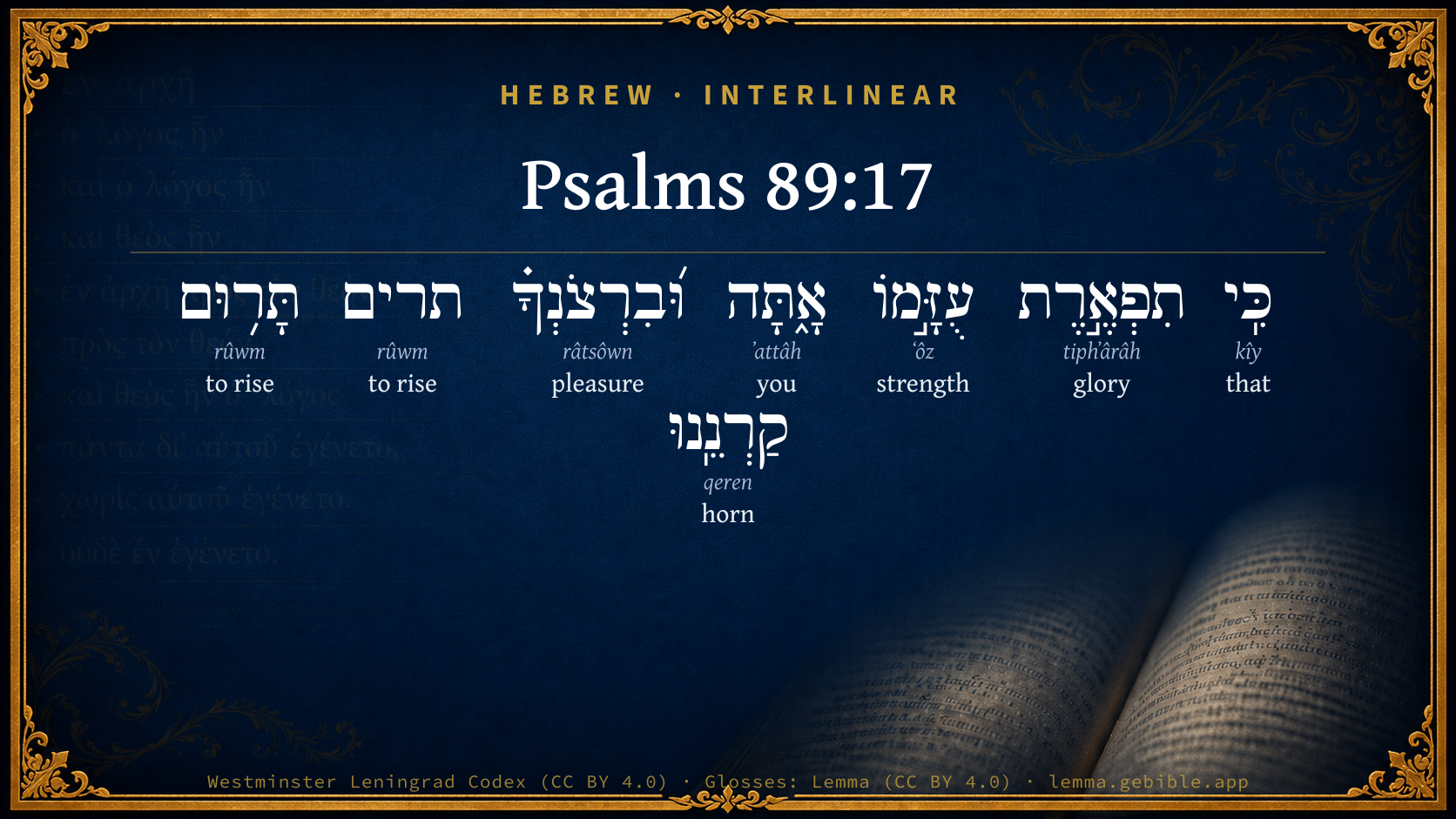
  1. כִּֽי kîy H3588 “that” Conjunction
  2. עֻזָּ֣מוֹ ʻôz H5797 “strength · their” Noun, Common, Masculine, Singular, Construct + Suffix, Personal, 3rd Person, Masculine, Plural
  3. אָ֑תָּה ʼattâh H859 “you” Pronoun, Personal, 2nd Person, Masculine, Singular
  4. וּ֝בִרְצֹנְךָ֗ râtsôwn H7522 “and · in/at · pleasure · your” Conjunction + Preposition + Noun, Common, Masculine, Singular, Construct + Suffix, Personal, 2nd Person, Masculine, Singular
  5. תרים rûwm H7311 “to rise” Verb, Hiphil, Imperfect, 2nd Person, Masculine, Singular
  6. תָּר֥וּם rûwm H7311 “to rise” Verb, Qal, Imperfect, 3rd Person, Feminine, Singular
  7. קַרְנֵֽנוּ qeren H7161 “horn · our” Noun, Common, Both, Singular, Construct + Suffix, Personal, 1st Person, Common, Plural

About this verse

These counts appear in no published source. They are computed here, from the morphology-tagged text and Lemma’s own curated glosses. What Lemma adds →

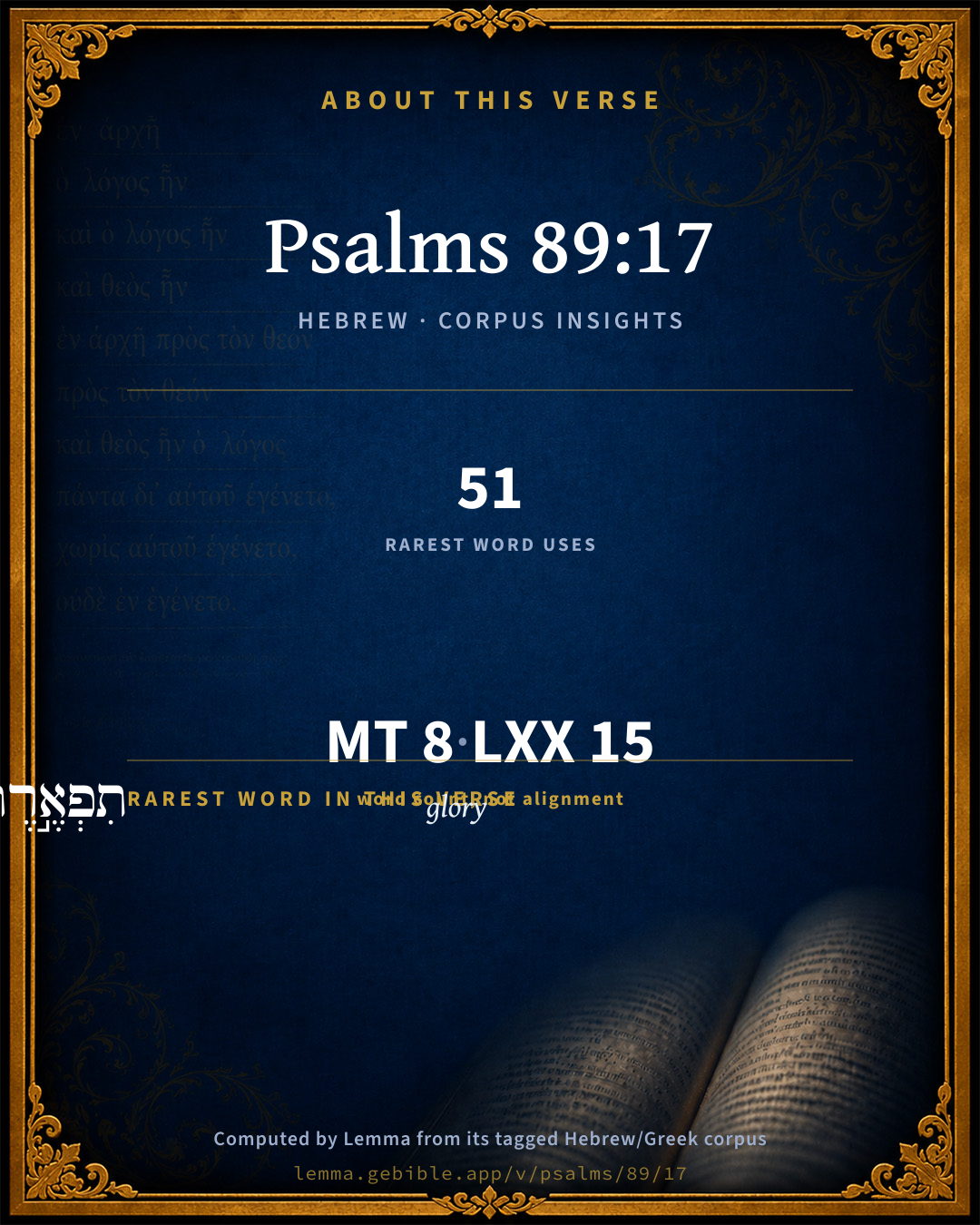
8
words
7
distinct lemmas
Wisdom
section

Shared distinctive vocabulary

תִפְאֶ֣רֶת glory H8597 occurs in 50 verses of the Hebrew Bible. Also found in:

Grammatical profile

  • 2 verbs
  • 4 nouns
  • 1 pronoun
  • 1 conjunction

Verb forms

  • תרים Hiphil · Imperfect
  • תָּר֥וּם Qal · Imperfect

Repetition

A word recurs within this verse — often emphatic in Hebrew:

  • תרים to rise H7311 ×2

Hebrew & Septuagint length

In English translation the verse runs 16 words from the Hebrew and 18 from the Septuagint (LXX English) — closely comparable.

A rough comparison of the two English renderings, which tokenize alike — not a word-level alignment.

Word counts can differ between the Hebrew and the Greek without any difference in meaning — e.g. the Hebrew direct-object marker אֵת has no separate Greek word, and Greek often adds the article ὁ.

In the original languages it is 8 Hebrew tokens and 15 Greek tokens — but the two are counted differently (Hebrew bundles its prefixes and suffixes into one token; the Greek is in lemma form), so that isn’t a like-for-like length.

Cross-references

12

Topical passages linked to Psalms 89:17 in the Treasury of Scripture Knowledge — connected by theme and wording, ordered by reader-vote popularity; previews shown in the World English Bible.

  • Psalms 75:10 I will cut off all the horns of the wicked, But the horns of the righteous shall be lifted up.
  • Psalms 92:10 But you have exalted my horn like that of the wild ox. I am anointed with fresh oil.
  • Psalms 148:14 He has lifted up the horn of his people, The praise of all his saints; Even of the children of Israel, a people near to him. Praise Yah!
  • Psalms 112:9 He has dispersed, he has given to the poor. His righteousness endures forever. His horn will be exalted with honor.
  • 1 Corinthians 1:30–31 But of him, you are in Christ Jesus, who was made to us wisdom from God, and righteousness and sanctification, and redemption:
  • 2 Corinthians 12:9–10 He has said to me, "My grace is sufficient for you, for my power is made perfect in weakness." Most gladly therefore I will rather glory in my weaknesses, that the power of Christ may rest on me.
  • 1 Samuel 2:1 Hannah prayed, and said: My heart exults in Yahweh; My horn is exalted in Yahweh; My mouth is enlarged over my enemies; Because I rejoice in your salvation.
  • 1 Samuel 2:10 Those who strive with Yahweh shall be broken to pieces; Against them will he thunder in the sky: Yahweh will judge the ends of the earth; He will give strength to his king, Exalt the horn of his anointed.
  • Psalms 28:7 Yahweh is my strength and my shield. My heart has trusted in him, and I am helped. Therefore my heart greatly rejoices. With my song I will thank him.
  • Psalms 89:24 But my faithfulness and my loving kindness will be with him. In my name, his horn will be exalted.
  • Psalms 132:17 There I will make the horn of David to bud. I have ordained a lamp for my anointed.
  • Philippians 4:13 I can do all things through Christ, who strengthens me.

Cross-references courtesy of OpenBible.info (CC BY 4.0).

Hebrew and Greek witnesses Masoretic Hebrew ↔ Greek Septuagint

The same verse in the two great witnesses to the Old Testament, shown verse-for-verse.

You’re reading Greek Psalm 88 (Hebrew Psalm 89). The Septuagint counts the superscription, so verse numbers can differ from the Hebrew — chapter-level alignment, not verse-by-verse. Numbering follows Rahlfs.

These are two independent witnesses, not word-aligned to each other, and the Septuagint is shown in lemma (dictionary) form.

Hebrew Psalms 89:17 Masoretic · Westminster Leningrad Codex

כִּֽי תִפְאֶ֣רֶת עֻזָּ֣מוֹ אָ֑תָּה וּ֝בִרְצֹנְךָ֗ תרים תָּר֥וּם קַרְנֵֽנוּ

For you are the glory of their strength. In your favor, our horn will be exalted.

World English Bible · Public Domain

Greek LXX Greek Psalm 88:17 Septuagint · lemma form

καί ἐν ὁ ὄνομα σύ ἀγαλλιάομαι ὅλος ὁ ἡμέρα καί ἐν ὁ δικαιοσύνη σύ ὑψόω

For you are the boast of their strength; and in your good pleasure shall our horn be exalted,

LXX2012 (modern English Septuagint) · Public Domain

On this verse, Adam Clarke's Commentary discusses the Septuagint’s reading. Read the note in Commentary ↓

Hebrew: Westminster Leningrad Codex (CC BY 4.0). Greek: Septuagint (public domain); English from LXX2012 (modern English Septuagint) (Public Domain). How the Septuagint differs from the Hebrew →

Commentary

Notes on Psalms 89:17 from classic Christian and Jewish commentators (each source and its license shown beneath its notes). The classic Christian expositions comment on the surrounding passage and are grouped to its opening verse, so a note may address several verses; the Jewish commentaries on the Tanakh (Rashi and others) are per-verse, so they appear only where the commentator wrote on this verse.

Lemma curates 59 commentaries, every one of them public domain or Creative Commons licensed, each selected and text-cleaned for this edition rather than reprinted as found. About our sources →

Trapp's Complete Commentary

John Trapp

Psa 89:17 For thou [art] the glory of their strength: and in thy favour our horn shall be exalted.

Ver. 17. For thou art the glory of their strength] And hence it is that they are filled top full with comfort, and do over abound exceedingly with joy in all their tribulation, 2Co 7:4.

John Trapp, A Commentary or Exposition upon All the Books of the Old and New Testament (1647–1656) — public domain. Text from a community e-Sword module.

J. A. Alexander on Psalms

Joseph Addison Alexander

18. (Psa 89:17) For the beauty of their strength (art) thou, and in thy favour thou wilt lift up our horn. God is at once their mighty ornament and their glorious protection. See above, on Psa 78:61. In thy favour, at the time, and by the means, of thy experienced favour. Lift our horn, enable us to triumph in security. See above, on Psa 75:10, and below, on Psa 92:10.

Joseph Addison Alexander, The Psalms Translated and Explained (1850) — public domain. Text from a community e-Sword module.

Tyndale Open Study Notes

Tyndale Open Resources

89:17-18 The Lord protects his people with the same power by which he established the created order.

Tyndale Open Study Notes — © Tyndale Open Resources, licensed CC BY-SA 4.0. Text via the HelloAO Bible API.

Geneva Bible (1599)

Geneva Bible translators

In that they are preserved and continue, they ought to give the praise and glory only to thee.

Geneva Bible (1599) marginal notes — public domain. Text via Bolls.life.

Adam Clarke's Commentary

Verse 17. For thou art the glory of their strength] They are strong in faith, and give glory to thee, because they know that their strength cometh from the Lord of hosts.

And in thy favour our horn shall be exalted.] Instead of תרום tarum, "shall be exalted," תרים tarim, "thou shalt exalt," is the reading of several MSS.: but תרום tarum, "shall be exalted," is supported by forty-four of Kennicott's MSS., and sixty of De Rossi's, as well as by several ancient editions, with the Septuagint, Syriac, Vulgate, and Arabic Versions. In the enjoyment of the Divine favour they shall grow more wise, more holy, more powerful, and, consequently, more happy.

Adam Clarke's Commentary on the Bible (1810–1826) — public domain. Text from a community e-Sword/MySword module.

John Calvin's Commentaries

17. For thou art the glory of their strength. The same sentiment is confirmed when it is declared, that God never leaves his faithful servants destitute of strength. By the appellation the glory of their strength, which is ascribed to him, is meant that they are always so sustained by his present aid as to have just ground to glory in him; or which amounts to the same thing, that his power appears always glorious in aiding and sustaining them. They are, however, at the same time, reminded of the duty of yielding to God all the praise of their being preserved in safety. If this is true as to the present life, it is much more truly applicable to the spiritual life of the soul. Farther, the more highly to magnify this instance of God’s liberality, we are taught, at the same time, that it depends entirely upon his good pleasure, there being no other cause of it. Whence it follows, that they are wholly bound and indebted to Him who is induced by his free bounty alone to continue to extend to them his help.

John Calvin's Commentaries (1540-1563) — public domain. Text from the Calvin Translation Society English edition (1840s-50s) via the Christian Classics Ethereal Library (ccel.org). Calvin's coverage is partial (roughly two-thirds of the Bible); uncommented books and verses are honest gaps, never fabricated. The 19th-century editor's footnotes and remarks are omitted so the notes are faithfully Calvin's own voice.

Ellicott's Commentary for English Readers

(17) Glory.—Better, ornament. The crown of a nation’s strength is not the triumphs it wins, nor the prosperity it secures, but the spirit in which these are used. Humility, and not pride, acknowledgment of God, and not conceit in her wealth or power, was the ornament of Israel’s strength, and made her greatness in her best days.

Our horn shall be exalted.—See Note, Psa_132:17. Modern Eastern proverbs, such as “What a fine horn he has!” spoken of a great man, still preserve the figure.

A Bible Commentary for English Readers, edited by Charles John Ellicott (1878–1897) — public domain. Text from a community e-Sword module.

The Cambridge Bible for Schools and Colleges

gen. ed. J. J. S. Perowne

17. Jehovah alone is the strength of which they boast. Cp. Psa_44:6 ff.

in thy favour] Cp. Psa_44:3; Psa_30:7.

our horn shall be exalted] So the Qrç, with the LXX and Syr. The Kthîbh, with which agree Targ. and Jer., has wilt thou exalt our horn. Cp. Psa_75:5; Psa_75:10. By the change of person, the poet claims his share in this glorious inheritance. “They gives place to we unconsciously, as his heart swells with the joy that he paints.” (Maclaren.)

The Cambridge Bible for Schools and Colleges (gen. ed. J. J. S. Perowne; Cambridge University Press, 1878–1918) — public domain. Text from a community e-Sword module.

John Gill's Exposition

For the Lord is our defence,.... From all their enemies, being all around them, as a wall of fire to protect them, and as the mountains were round about Jerusalem, and being kept by his power as in a fortress, strong hold, or garrison, unto salvation; or our shield (f); see Psa 84:9 as are his favour, righteousness, and salvation, Psa 5:12 or "to the Lord belongs our defence or shield" (g) our protection and salvation is from him:

and the Holy One of Israel is our King; he who was to be, and is of Israel according to the flesh, and is holy in his nature, life, and office; he is King of saints, that rules over them, protects and defends them, and therefore they must be happy: or "to" or "with the Holy One of Israel is our king" (h); Christ is King of Zion by designation, appointment, and constitution, of God the Holy One of Israel, the holy God that has chosen Israel for his peculiar people; though it rather seems that Christ is the Holy One by what follows.

(f) "clypeus noster", Pagninus, Montanus, Vatablus, Tigurine version; "scutum nostrum", Junius & Tremellius, Piscator. (g) "Domino", Pagninus, Montanus. (h) "et sancto Israelis", Pagninus, Montanus.

John Gill's Exposition of the Whole Bible (1746–1763) — public domain (CC PDM 1.0). Text via the HelloAO Bible API.

Albert Barnes' Notes on the Bible

For thou art the glory of their strength - The ornament; the beauty; the honor; that is, Their strength derives its beauty and honor, not from anything in themselves, but from the fact that it is derived from thee. The strength thus imparted is an honor or ornament in itself; it is an honor and glory to them that it is imparted to them.

And in thy favor - Or, by thy favor, or good pleasure.

Our horn shall be exalted - The horn is a symbol of power. Compare Psa 22:21, note; Psa 75:4; Dan 7:8, note; Job 16:15, note. The meaning here is, that their power had been derived from God; or that all which contributed to their exaltation and honor in the world, had been derived from him.

Albert Barnes' Notes on the Bible (1834–1885) — public domain. Text from a community e-Sword/MySword module.

Matthew Poole's English Annotations

All that strength in which they do or may glory is not their own, but is a mere vouchsafement of thy grace, and to thee alone belongs the glory of all their valiant achievements.

Our horn shall be exalted, i.e. our power and honour, which now lies in the dust, shall be raised and recovered.

Matthew Poole's English Annotations on the Holy Bible (1683–1685) — public domain. Text from a community e-Sword/MySword module.

The Treasury of David

Charles H. Spurgeon

Ver. 17. For thou art the glory of their strength. Surely in the Lord Jehovah have we both righteousness and strength. He is our beauty and glory when we are strong in him, as well as our comfort and sustenance when we tremble because of conscious weakness in ourselves. No man whom the Lord makes strong may dare to glory in himself, he must ascribe all honour to the Lord alone; we have neither strength nor beauty apart from him.

And in thy favour our horn shall be exalted. By the use of the word our the Psalmist identifies himself with the blessed people, and this indicates how much sweeter it is to sing in the first person than concerning others. May we have grace to claim a place among those in covenant with God, in Christ Jesus, for then a sense of divine favour will make us also bold and joyous. A creature full of strength and courage lifts up its horn, and so also does a believer become potent, valiant, and daring. The horn was an eastern ornament, worn by men and women, or at least is so at this day, and by the uplifting of this the wearer showed himself to be in good spirits, and in a confident frame of mind: we wear no such outward vanities, but our inward soul is adorned and made bravely triumphant when the favour of God is felt by us. Worldly men need outward prosperity to make them lift up their heads, but the saints find more than enough encouragement in the secret love of God.

Ver. 17. In thy favour our horn shall be exalted. A man of lofty bearing is said to carry his horn very high. To him who is proudly interfering with the affairs of another it will be said, "Why show your kombu", "horn", "here?" "See that fellow, what a fine horn he has; he will make the people run." "Truly, my lord, you have a great horn." "Chinnan has lost his money; aye, and his hornship too." "Alas, alas! I am like the deer, whose horns have fallen off." Joseph Roberts "Oriental Illustrations."

Ver. 17.

1. The blessedness of the righteous.

(a) Their internal glory. Reliance upon divine strength.

(b) Their internal honour. "In thy favour", etc.

2. The participation in that blessedness. The their of the people of God becomes our. Their strength our horn. Happy they, who, with respect to all the privileges of the saints, can thus turn their into our.

Ver. 17.

1. Consider our natural weakness.

2. Consider our strength in God.

3. Give God the glory of it.

Psalms 89:18*

Charles H. Spurgeon's The Treasury of David (1869–1885) — public domain. Psalms only. Text from a community e-Sword/MySword module.

The Pulpit Commentary

For thou art the Glory of their strength; or, "the Ornament that in which their strength and might as a people culminate. And in thy favour our horn shall be exalted. Thy favour towards us exalts us among the nations.

The exalted horn; or, the secret of strength.

The horn is a constant symbol of strength; the exalted horn, therefore, of strength triumphant. Now, we observe

I STRENGTH IS THE GREAT NEED OF THE SOUL OF MAN. Not physical strength, nor intellectual, nor social, but spiritual. There may be knowledge, and good desire, and religious emotions, and holy resolve; but all these things leave a man weak unless they be rendered effectual by a fervent will.

II ITS SECRET IS THE FAVOUR OF GOD. For that favour:

1. Restores it.

2. Sustains it.

3. Inspires it.

4. The loss of God"s favour paralyzes it.

We know how the favour of men, their applause and encouragement, puts strength into us: how much more the conscious favour of God! With that there is nothing a man will not do and dare and be.

III THOSE WHO ARE IN THAT FAVOUR ALONE POSSESS THIS SECRET. We may know of it, speak of it, extol it, commend it, and yet not be "in" it. We enter into it:

1. By coming away from whatever cannot dwell with it; from all known sin especially.

2. By surrender of our will our heart, that is to God.

3. By keeping touch with God, in habitual prayer, praise, and obedience. So we enter this favour, and abide there. S.C.

The Pulpit Commentary (1880–1919), ed. H.D.M. Spence-Jones & Joseph S. Exell — public domain. Text from a community e-Sword module.

John Wesley's Explanatory Notes

The glory - To thee alone belongs the glory of all their valiant achievements.

John Wesley, Explanatory Notes Upon the Whole Bible (1754–1765) — public domain. Text via the GEBible commentary corpus.

unfoldingWord translationNotes

Door43 World Missions Community

You are their majestic strength

The abstract noun "strength" can be stated as an adjective. AT: "You make them wonderfully strong" (See: Abstract Nouns)

You are their

Here "their" refers to the Israelites. The writer would have included himself as a member of the Israelites. AT: "You are our" (See: Assumed Knowledge and Implicit Information)

we are victorious

Here "we" refers to the writer and the Israelites but not to Yahweh, to whom he speaks. (See: Exclusive and Inclusive "We")

For our shield belongs to Yahweh

The king who protects his people and whom Yahweh chose is spoken of as if he were a shield that belongs to Yahweh. (See: Metaphor)

translationWords

majesty

favor

shield

king

Israel

unfoldingWord translationNotes — © Distant Shores Media and the Door43 World Missions Community, licensed CC BY-SA 4.0. Source: git.door43.org/Door43/en_tn.

Lesson kit

Teaching starters — assembled from the data on this page, not authored interpretation. Every prompt links to the verse data it draws on. Edit before teaching.

Psalms, in the Wisdom, opens this verse with 8 words (7 distinct Hebrew lemmas). Its most distinctive word is tiphʼârâh (“glory”). A historical commentator’s framing appears above. Read the whole chapter for the surrounding context.

Discussion questions

  1. The word tiphʼârâh carries the sense “glory.” How does it shape the verse?
  2. How does Exodus 28:2, which shares the word «glory», read alongside this verse?
  3. What does the repetition of “to rise” (2× in this one verse) do in this verse?
  4. These translations render this verse differently; the difference is in the English rendering, not the original. What questions does that raise?
  5. «תרים» is a Hiphil Imperfect verb. How does that grammatical form shape the action described?
  6. Compare how Trapp's Complete Commentary and J. A. Alexander on Psalms read this verse. Where do they agree or differ?

Things to notice

Reading settings

Reading text

Shown beneath each verse's original-language words.

Old Testament
Old Testament edition

Read the OT as the Masoretic Hebrew (MT) or the Greek Septuagint (LXX).

English shown for the Greek Septuagint (in the Hebrew ↔ Greek comparison).

Comparing translations? Open the Compare panel on any verse page to stack up to four side by side.