
Job 21:22

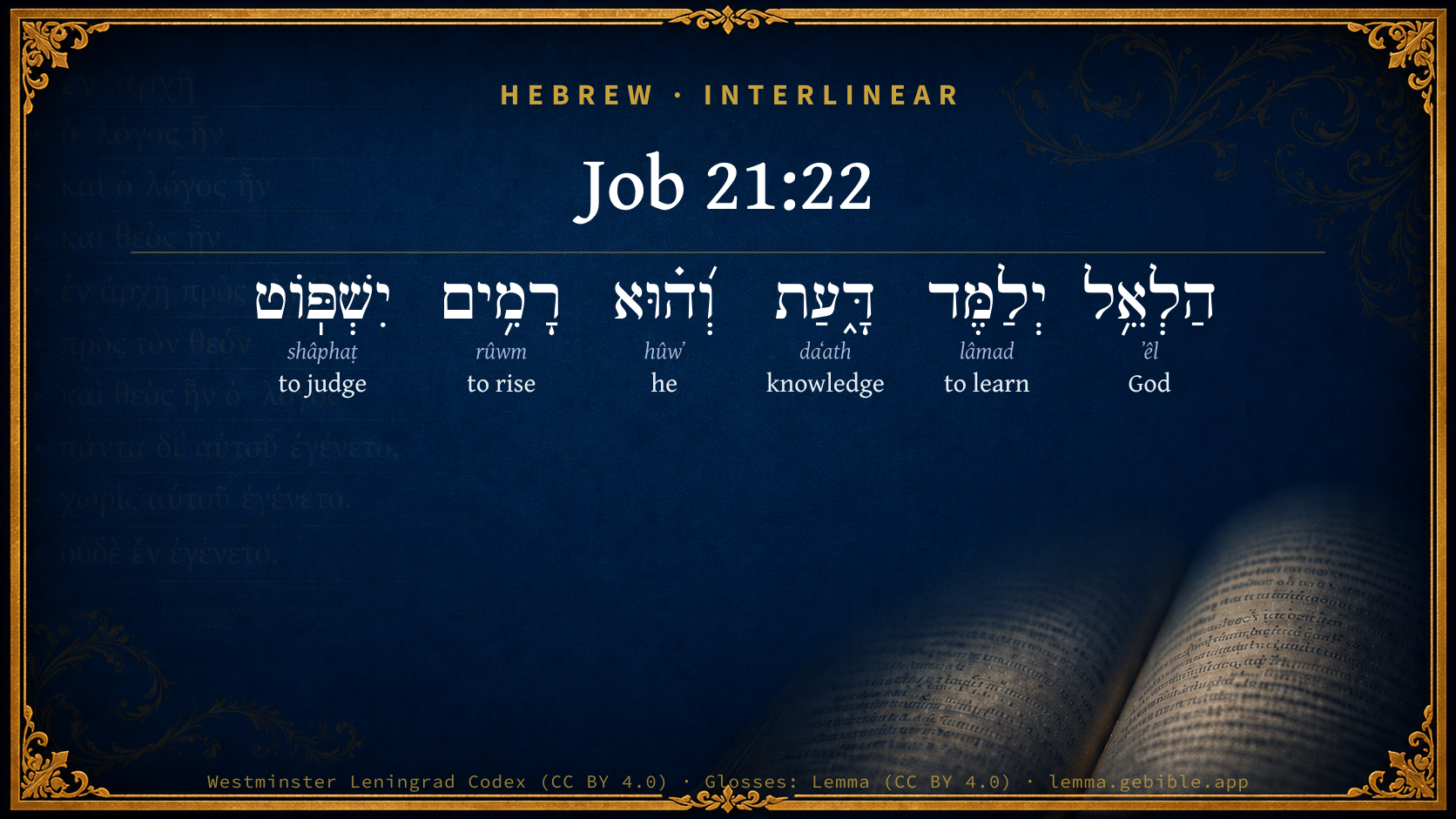
Hebrew (Westminster Leningrad Codex) Job 21:22 appears in the Hebrew Old Testament. The text above is from the Westminster Leningrad Codex. Each word links to its Strong’s number, a concise gloss, and parsing drawn from the Open Scriptures Hebrew Bible morphology. Click any word for its full Brown-Driver-Briggs (BDB) entry.
Download image
Cite this verse

Job 21:22 (World English Bible). Public Domain. Lemma interlinear Bible study tool, https://lemma.gebible.app/v/job/21/22.

Show BibTeX & RIS
BibTeX
RIS
English Translation
"Shall any teach God knowledge, Seeing he judges those who are high?
World English Bible · Public Domain
Download a study sheet

One document with this verse’s original text, its word-by-word gloss line, the meaning frame, cross-references with their text, attributed commentary, and full source and license credits — printable, and it pastes into notes with its structure intact.

This verse Autodidact and up

Study sheet (.html) Plain text (.txt)

A passage Seminary Student

Up to 50 verses in one chapter. A passage sheet keeps up to 6 commentary sources and 12 cross-references per verse, in the order this page ranks them, and says so on the sheet whenever that leaves anything out. Ask for a single verse and you get the Autodidact verse sheet above.

Everything on this page stays free to read, with no account — the sheet is a download of what is already on screen, not access to it.

Want to remove ads? Support Godless Engineer
Compare translations 3

The same verse in 3 English versions, stacked beneath the original-language interlinear above. Click any original word for its lexicon entry.

Each is an independent rendering of the whole verse — the interlinear is not word-aligned to these translations.

Highlighted words mark where these versions differ — a whole-verse word diff, not a word-by-word alignment.

  • World English Bible Public Domain
    "Shall any teach God knowledge, Seeing he judges those who are high?
  • King James Version Public Domain
    Shall any teach God knowledge? seeing he judgeth those that are high.
  • unfoldingWord Literal Text CC BY-SA 4.0
    Will one teach knowledge to God, since he judges the ones being high?

unfoldingWord Literal Text — © unfoldingWord, licensed CC BY-SA 4.0. Word-aligned USFM3 via Door43 (git.door43.org/unfoldingWord/en_ult).

Versions to compare (up to 4)

3 of 4 selected

Show all 18 translations

Every available English version of this verse, each an independent rendering of the whole verse.

  • World English Bible Public Domain
    "Shall any teach God knowledge, Seeing he judges those who are high?
  • Berean Standard Bible Public Domain
    Can anyone teach knowledge to God, since He judges those on high?
  • Majority Standard Bible Public Domain
    Can anyone teach knowledge to God, since He judges those on high?
  • King James Version Public Domain
    Shall any teach God knowledge? seeing he judgeth those that are high.
  • American Standard Version (1901) Public Domain
    Shall any teach God knowledge, Seeing he judgeth those that are high?
  • Revised Version (1885) Public Domain
    Shall any teach God knowledge? seeing he judgeth those that are high.
  • Geneva Bible (1599) Public Domain
    Shall any teache God knowledge, who iudgeth the highest things?
  • Douay-Rheims (1899) Public Domain
    Shall any one teach God knowledge, who judgeth those that are high?
  • Young's Literal Translation Public Domain
    To God doth `one' teach knowledge, And He the high doth judge?
  • Literal Standard Version CC BY-SA 4.0
    Does [one] teach knowledge to God, || Since He judges [those] on high?
  • Unlocked Literal Bible CC BY-SA 4.0
    Can anyone teach God knowledge since he judges even those who are high?
  • unfoldingWord Literal Text CC BY-SA 4.0
    Will one teach knowledge to God, since he judges the ones being high?
  • Darby Bible Public Domain
    Can any teach ùGod knowledge? And he it is that judgeth those that are high.
  • World Messianic Bible Public Domain
    “Shall any teach God knowledge, since he judges those who are high?
  • Webster's Bible Public Domain
    Shall any teach God knowledge? seeing he judgeth those that are high.
  • Free Bible Version CC BY-SA 4.0
    Can anyone teach God anything he doesn't already know, since he is the one who judges even heavenly beings?
  • Bible in Basic English Public Domain
    Is anyone able to give teaching to God? for he is the judge of those who are on high.
  • JPS Tanakh (1917) Public Domain
    Shall any teach God knowledge? seeing it is He that judgeth those that are high.

Literal Standard Version (2020), Covenant Press — licensed CC BY-SA 4.0. Text via the HelloAO Bible API (eBible.org). Unlocked Literal Bible (unfoldingWord) — licensed CC BY-SA 4.0. Text via the HelloAO Bible API (eBible.org). unfoldingWord Literal Text — © unfoldingWord, licensed CC BY-SA 4.0. Word-aligned USFM3 via Door43 (git.door43.org/unfoldingWord/en_ult). Free Bible Version, Dr. Jonathan Gallagher — licensed CC BY-SA 4.0. Text via the HelloAO Bible API (eBible.org).

Word by word

More ways to search: Search by grammar → Find every occurrence → Compare this word →

Practice this passage: Drill this verse → Learn its vocabulary →

About this verse

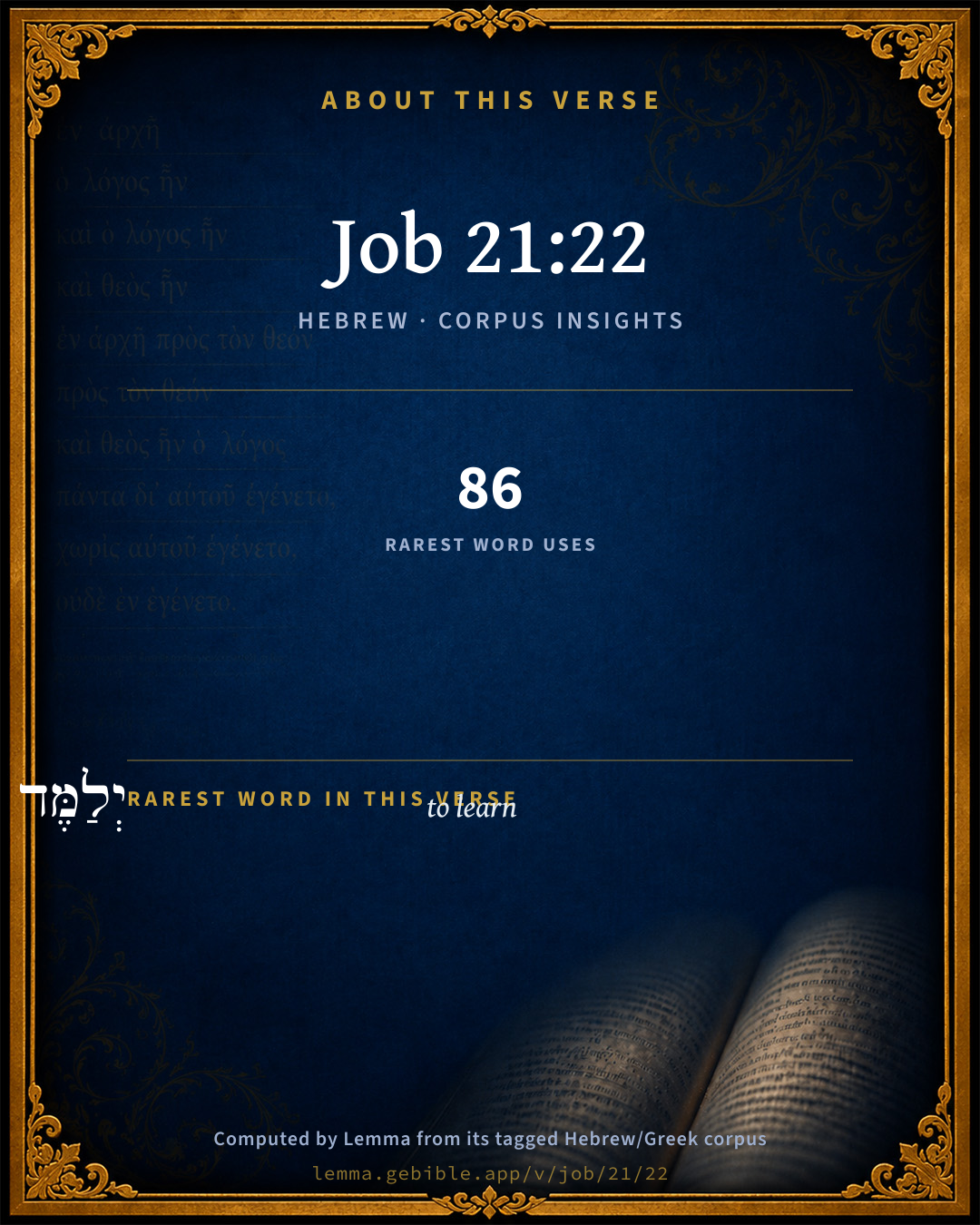
These counts appear in no published source. They are computed here, from the morphology-tagged text and Lemma’s own curated glosses. What Lemma adds →

6
words
6
distinct lemmas
Wisdom
section

Grammatical profile

  • 3 verbs
  • 2 nouns
  • 1 pronoun

Verb forms

  • יְלַמֶּד Piel · Imperfect
  • רָמִ֥ים Qal · Participle Active
  • יִשְׁפּֽוֹט Qal · Imperfect

Hebrew & Septuagint length

In English translation the verse runs 12 words from the Hebrew and 16 from the Septuagint (LXX English) — closely comparable.

A rough comparison of the two English renderings, which tokenize alike — not a word-level alignment.

Word counts can differ between the Hebrew and the Greek without any difference in meaning — e.g. the Hebrew direct-object marker אֵת has no separate Greek word, and Greek often adds the article ὁ.

Cross-references

19

Topical passages linked to Job 21:22 in the Treasury of Scripture Knowledge — connected by theme and wording, ordered by reader-vote popularity; previews shown in the World English Bible.

  • Romans 11:34 "For who has known the mind of the Lord? Or who has been his counselor?"
  • 1 Corinthians 2:16 "For who has known the mind of the Lord, that he should instruct him?" But we have Christ's mind.
  • Isaiah 40:13–14 Who has directed the Spirit of Yahweh, or being his counselor has taught him?
  • Job 4:18 Behold, he puts no trust in his servants. He charges his angels with error.
  • Job 15:15 Behold, he puts no trust in his holy ones; Yes, the heavens are not clean in his sight:
  • Job 34:17–19 Shall even one who hates justice govern? Will you condemn him who is righteous and mighty?--
  • Job 35:11 Who teaches us more than the animals of the earth, And makes us wiser than the birds of the sky?'
  • Job 36:22 Behold, God is exalted in his power. Who is a teacher like him?
  • Job 40:2 "Shall he who argues contend with the Almighty? He who argues with God, let him answer it."
  • Psalms 82:1 God presides in the great assembly. He judges among the gods.
  • Psalms 113:5–6 Who is like Yahweh, our God, Who has his seat on high,
  • Ecclesiastes 5:8 If you see the oppression of the poor, and the violent taking away of justice and righteousness in a district, don't marvel at the matter: for one official is eyed by a higher one; and there are officials over them.
  • Isaiah 40:22–23 [It is] he who sits above the circle of the earth, and the inhabitants of it are as grasshoppers; who stretches out the heavens as a curtain, and spreads them out as a tent to dwell in;
  • Isaiah 45:9 Woe to him who strives with his Maker--a potsherd among the potsherds of the earth! Shall the clay ask him who fashions it, "What are you making?" or your work, "He has no hands?"
  • 1 Corinthians 6:3 Don't you know that we will judge angels? How much more, things that pertain to this life?
  • 2 Peter 2:4 For if God didn't spare angels when they sinned, but cast them down to Tartarus, and committed them to pits of darkness, to be reserved to judgment;
  • Jude 1:6 Angels who didn't keep their first domain, but deserted their own dwelling place, he has kept in everlasting bonds under darkness for the judgment of the great day.
  • Revelation 20:1–3 I saw an angel coming down out of heaven, having the key of the abyss and a great chain in his hand.
  • Revelation 20:12–15 I saw the dead, the great and the small, standing before the throne, and they opened books. Another book was opened, which is the book of life. The dead were judged out of the things which were written in the books, according to their works.

Cross-references courtesy of OpenBible.info (CC BY 4.0).

Hebrew and Greek witnesses Masoretic Hebrew ↔ Greek Septuagint

The same verse in the two great witnesses to the Old Testament, shown verse-for-verse.

These are two independent witnesses, not word-aligned to each other, and the Septuagint is shown in lemma (dictionary) form.

Hebrew Job 21:22 Masoretic · Westminster Leningrad Codex

הַלְאֵ֥ל יְלַמֶּד דָּ֑עַת וְ֝ה֗וּא רָמִ֥ים יִשְׁפּֽוֹט

"Shall any teach God knowledge, Seeing he judges those who are high?

World English Bible · Public Domain

Greek LXX Job 21:22 Septuagint · lemma form

πότερον οὐ ὁ κύριος εἰμί ὁ διδάσκω σύνεσις καί ἐπιστήμη αὐτός δέ φόνος διακρίνω

Is it not the Lord who teaches understanding and knowledge? and does not he judge murders?

LXX2012 (modern English Septuagint) · Public Domain

On this verse, Keil & Delitzsch discusses the Septuagint’s reading. Read the note in Commentary ↓

Hebrew: Westminster Leningrad Codex (CC BY 4.0). Greek: Septuagint (public domain); English from LXX2012 (modern English Septuagint) (Public Domain). How the Septuagint differs from the Hebrew →

Commentary

Notes on Job 21:22 from classic Christian and Jewish commentators (each source and its license shown beneath its notes). The classic Christian expositions comment on the surrounding passage and are grouped to its opening verse, so a note may address several verses; the Jewish commentaries on the Tanakh (Rashi and others) are per-verse, so they appear only where the commentator wrote on this verse.

Lemma curates 59 commentaries, every one of them public domain or Creative Commons licensed, each selected and text-cleaned for this edition rather than reprinted as found. About our sources →

Trapp's Complete Commentary

John Trapp

Job 21:22 Shall [any] teach God knowledge? seeing he judgeth those that are high.

Ver. 22. Shall any teach God knowledge?] None but a presumptuous fool will take upon him to do that. Such as was Alphonso the wise (the fool rather), who feared not to say openly, that if he had been of God’s counsel at the creation, some things should have been better made and marshalled (Roderic, Sanct. Hist. Hispan, p. 4, ch. 5). The wisest men are benighted in many things; and whatever light they have it is from the Father of lights, whose judgments are unsearchable, and his ways past finding out. What a madness were it therefore for any mortal to prescribe to the Almighty, or to define whom, when, by what means, and in what measure he must punish offenders! Herein Job’s friends took too much upon them; and he gives them the telling of it, wishing them to be wise to sobriety, and not to give laws to God, who well knoweth what he hath to do, and how to order his earthly kingdom. To disallow of his dealings is to teach him knowledge; which is greatest sauciness.

Seeing he judgeth those that are high] Excelsos in excelsis, the angels, who are so far above us in all manner of excellencies, and yet are ignorant of the wisdom of God’s ways, which they know but in part; for how little a portion is heard of him? Job 26:14. His judgments therefore are rather to be adored than pryed into: Mirari oportet. Non rimari, it is proper to be amazed, not to explore. Let us rest contented with a learned ignorance.

John Trapp, A Commentary or Exposition upon All the Books of the Old and New Testament (1647–1656) — public domain. Text from a community e-Sword module.

The Biblical Illustrator

Joseph S. Exell

Job_21:22

Shall any teach God knowledge?

Mental independence of God

The mental independency of God involves two things--uninstructibleness and irresponsibleness. The former in man is either a calamity or a crime. But that which in any finite intelligence would be either a misfortune or a sin, is a glorious perfection in God. It is the glory of God that He cannot be instructed--that no one can teach Him knowledge. He knows all things, actual and possible. But whilst the former ought not to exist in any intelligent creature, the latter irresponsibility does not exist. No being is authorised to use his knowledge in any way he may think fit. All rational creatures are accountable for the use of their knowledge. Not so with God. He can use His infinite knowledge in any way He pleases. He is answerable to none: all are responsible to Him.

I. That all His operations must emanate from pure sovereignty. All that exists must be traced to the counsel of His own will. He received neither the plan nor motive for any act. Creation--redemption--conversion--every part of each--every Divine movement in connection with each--rises out of benevolent spontaneity.

II. That all His laws must be the transcript of His own mind. It is seldom just to regard human laws as a correct reflection of the mind of the sovereign, for a human sovereign, in most cases, receives counsels and suggestions from others; but as God has had no counsellor, His laws are the expression of Himself. What they are, He is. The history of His government is the history of Himself. Irresponsible power in a creature would be despotism, but in God it has, from the beginning, been mercy.

III. That all His dispensations should be cordially acquiesced in.

1. Rectitude dictates this. The Absolute Mind has a right to do what He does.

2. Expediency dictates this. Opposition is useless. No being can give Him a new idea or motive, and, therefore, no one can turn Him from His course.

IV. That all His revelations should be properly studied. A book from a Mind absolutely independent should be studied--

1. With an expectation of difficulties.

2. With the profoundest reverence. (Homilist.)

The Biblical Illustrator, edited by Joseph S. Exell (c. 1880s–1900s) — public domain. Text from a community e-Sword module.

Joseph Benson's Commentary

Job 21:22. Shall any teach God knowledge — How to govern the world? For so you do while you tell him that he must not afflict the godly, nor give the wicked prosperity; that he must invariably punish the wicked, and reward the righteous in this world. No: he will act as sovereign, and with great variety in his providential dispensations. Seeing he judgeth those that are high — The highest persons on earth, he exactly knows them, and gives sentence concerning them, as he sees fit. Thus, as Job had introduced the foregoing particular, namely, that wicked men are sometimes severely punished in this world, by an easy transition, at Job 21:16; so, by another as easy, he here introduces the remaining article of his discourse above mentioned, namely, that God deals out things promiscuously in this world, not according to men’s merit or demerit, which he pursues in the following verses.

Joseph Benson's Commentary on the Old and New Testaments (1811–1818) — public domain. Text from a community e-Sword module.

Keil & Delitzsch

C. F. Keil & F. Delitzsch

22 Shall one teach God knowledge,

Who judgeth those who are in heaven?

23 One dieth in his full strength,

Being still cheerful and free from care.

24 His troughs are full of milk,

And the marrow of his bones is well watered.

25 And another dieth with a sorrowing spirit,

And hath not enjoyed wealth.

26 They lie beside one another in the dust,

And worms cover them both.

The question, Job 21:22, concerns the friends. Since they maintain that necessarily and constantly virtue is rewarded by prosperity, and sin by misfortune, but without this law of the divine order of the world which is maintained by them being supported by experience: if they set themselves up as teachers of God, they will teach Him the right understanding of the conduct which is to be followed by Him as a ruler and judge of men, while nevertheless He is the Absolute One, beneath whose judicial rule not merely man, but also the heavenly spirits, are placed, and to which they must conform and bow. The verb למּד, instead of being construed with two acc., as in the dependent passage Isa 40:14, is here construed with the dat. of the person (which is not to be judged according to Job 5:2; Job 19:3, but according to διδάσκειν τινί τι, to teach one anything, beside the other prevailing construction). With והוא a circumstantial clause begins regularly: while He, however, etc. Arnh. and Lwenth. translate: while, however, He exaltedly judges, i.e., according to a law that infinitely transcends man; but that must have been מרום (and even thus it would still be liable to be misunderstood). Hahn (whom Olsh. is inclined to support): but He will judge the proud, to which first the circumstantial clause, and secondly the parallels, Job 35:2; Job 15:15; Job 4:18 (comp. Isa 24:21), from which it is evident that רמים signifies the heavenly beings (as Psa 78:69, the heights of heaven), are opposed: it is a fundamental thought of this book, which abounds in allusions to the angels, that the angels, although exalted above men, are nevertheless in contrast with God imperfect, and therefore are removed neither from the possibility of sin nor the necessity of a government which holds them together in unity, and exercises a judicial authority over them. The rule of the all-exalted Judge is different from that which the three presumptuously prescribe to Him.

The one (viz., the evil-doer) dies בּעצם תּמּו, in ipsa sua integritate, like בעצם היום, ipso illo die; the Arabic would be fı̂ ‛yn, since there the eye, here the bone (comp. Uhlemann, Syr. Gramm. 58), denote corporeality, duration, existence, and therefore identity. תּם is intended of perfect external health, as elsewhere מתם; comp. תּמימים, Pro 1:12. In Job 21:23 the pointing שׁלאנן (adj.) and שׁלאנן (3 praet.) are interchanged in the Codd.; the following verbal adjective favours the form of writing with Kametz. As to the form, however (which Rd. and Olsh. consider to be an error in writing), it is either a mixed form from שׁאנן and שׁלו with the blended meaning of both (Ew. 106, c), to which the comparison with שׁליו (= שׁלו) is not altogether suitable, or it is formed from שׁאנן by means of an epenthesis (as זלעף from זעף, aestuare, and בלסם, βάλσαμον, from בשׂם), and of similar but intensified signification; we prefer the latter, without however denying the real existence of such mixed forms (vid., on Job 26:9; Job 33:25). This fulness of health and prosperity is depicted in Job 21:24. The ancient translators think, because the bones are mentioned in the parallel line, עטיניו must also be understood of a part of the body: lxx ἔγκατα, Jer. viscera; Targ. בּיזוי, his breasts, βυζία

(Note: Vid., Handschriftliche Funde, 2. S. V.)

(for Hebr. שׁדים, שׁד); Syr. version gabauh (= ganbauh), his sides in regard to עטמא, Syr. ‛attmo = אטמא, side, hip; Saad. audâguhu, his jugular veins, in connection with which (not, however, by this last rendering) חלב is read instead of חלב: his bowels, etc., are full of fat.

(Note: Gesenius in his Thes. corrects the אודאגה which was found in Saadia's manuscript translation to אודאעה, Arab. awdâ‛uhu, which is intended to mean repositoria ejus, but is really not Arabic; whereas אודאגה is the correct plur. of Arab. wadaj: his jugular veins, which occurs not merely of horses, but also of animals and men. Saadia, with reference to the following מלאוּ חלב, has thought of the metaphorical phrase Arab. ḥalaba awdâjahu: "he has milked his jugular vein," i.e., he has, as it were, drawn the blood from his jugular veins = eum jugulavit, vid., Bibliotheca Arabo-Sicula, p. 563: "and with the freshly milked juice of the jugular veins, viz., of the enemy (Arab. w-mn ḥlb 'l-'wdâj), our infant ready to be weaned is nourished in the midst of the tumult of battle, as soon as he is weaned." The meaning of Saadia's translation is then: his jugular veins are filled with fresh blood swollen with fulness of blood. - Fl.)

But the assumption that עטיניו must be a part of the body is without satisfactory ground (comp. against it e.g., Job 20:17, and for it Job 20:11); and Schlottm. very correctly observes, that in the contrast in connection with the representation of the well-watered marrow one expects a reference to a rich nutritious drink. To this expectation corresponds the translation: "his resting-places (i.e., of his flocks) are full of milk," after the Arab. ‛aṭan or ma‛ṭin. which was not first compared by Schultens and Reiske (epaulia), but even by Abul-walid, Aben-Ezra, and others.

But since the reference of what was intended to be said of the cattle at the watering-places to the places where the water is, possesses no poetic beauty, and the Hebrew language furnished the poet with an abundance of other words for pastures and meadows, it is from the first more probable that עטיניו are large troughs, - like Talm. מעטן, a trough, in which the unripe olives were laid in order that they might become tender and give forth oil, that they may then be ready for the oil-press (בּד), and עטן denotes this laying in itself, - and indeed either milk-tubs or milk-pails (שׁחולבין לתוכן), or with Kimchi (who rightly characterizes this as more in accordance with the prosperous condition which is intended to be described), the troughs for the store of milk, which also accords better with the meaning of the verb עטן, Arab. ‛aṭana, to lay in, confire.

(Note: The Arab. verb 'tn, compared by the Orientals themselves with Arab. wtn, cognate in sound and meaning, has the primary signification to lie secure and to lay secure, as Arab. 'atan, a resting-place of camels, sheep, and goats about the watering-places, is only specifically distinct from Arab. watan, a cow-shed, cow-stall. The common generic notion is always a resting-place, wherefore the Kamus interprets 'attan by wattan wa-mebrek, viz., round about the drinking-places. Arab. ma'tin as n. loci, written m'atn by Barth in his Wanderungen durch die Kstenlnder des Mittelmeeres, Bd. i. (vid., Deutsch. Morgenlnd. Zeitschrift, iv. S. 275) S. 500, 517, is similar in meaning. The Arab. verb 'atana, impf. j'attunu, also j'attina, n. act. 'uttn, a v. instrans., signifies, viz., of camels, etc., to lay themselves down around the drinking-troughs, after or even before drinking from them. On the other hand, Arab. 'atana, impf. j'attinu, also j'attunu, n. act. 'attn, a v. trans. used by the dresser of skins: to lay the skins in the tan or ooze (French, confire; low Latin, tanare, tannare, whence French, tanner, to tan, tan, the bark) until they are ready for dressing, and the hairs will easily scrape off. Hence Arab. 'atina, impf. j'attanu, n. act. 'attan, a v. intrans. used of skins: to become tender by lying in the ooze, and to smell musty, to stink, which is then transferred to men and animals: to stink like a skin in the ooze, comp. situs, mould, mildew, rest. - Fl. Starting from the latter signification, macerare pellem, Lee explains: his bottles (viz., made of leather); and Carey: his half-dressed skins (because the store of milk is so great that he cannot wait for the preparation of the leather for the bottles); but the former is impossible, the latter out of taste, and both are far-fetched.)

From the abundance of nutriment in Job 21:24, the description passes over in Job 21:24 to the well-nourished condition of the rich man himself in consequence of this abundance. מח (Arab. muchch, or even nuchch, as נף = מף, naurag = מורג) is the marrow in the bones, e.g., the spinal marrow, but also the brain as the marrow of the head (Psychol. S. 233). The bones (Pro 3:8), or as it is here more exactly expressed, their marrow, is watered, when the body is inwardly filled with vigour, strength, and health; Isaiah, Isa 58:11, fills up the picture more (as a well-watered garden), and carries it still further in Isa 66:14 (thy bones shall blossom like a tender herb). The counterpart now follows with וזה (and the other, like Job 1:16). The other (viz., the righteous) dies with a sorrowful soul (comp. Job's lament, Job 7:11; Job 10:1), i.e., one which is called to experience the bitterness of a suffering life; he dies and has not enjoyed בּטּובה, any of the wealth (with partitive Beth, as Psa 141:4, comp. supra, Job 7:13), has had no portion in the enjoyment of it (comp. Job's lament, Job 9:25). In death they are then both, unrighteous and righteous, alike, as the Preacher said: מקרה אחד comes upon the wise as upon the fool, Ecc 2:15, comp. Job 9:2. They lie together in the dust, i.e., the dust of the grave (vid., on Job 19:25), and worms cover them. What then is become of the law of retribution in the present world, which the friends maintained with such rigid pertinacity, and so regardless of the deep wound they were inflicting on Job?

Keil & Delitzsch — Biblical Commentary on the Old Testament (1861–1891) — public domain (CC PDM 1.0). Text via the HelloAO Bible API. (Old Testament only.)

Tyndale Open Study Notes

Tyndale Open Resources

21:22 The rhetorical answer is that no one can teach a lesson to God (Isa 40:13-14; 45:9; Rom 11:34; 1 Cor 2:16). • The most powerful might refer to angels or demons (1 Cor 6:3; 2 Pet 2:4; Jude 1:6; Rev 20:1-3) or, more likely, to the powerful on earth (Job 34:17-19).

Tyndale Open Study Notes — © Tyndale Open Resources, licensed CC BY-SA 4.0. Text via the HelloAO Bible API.

Geneva Bible (1599)

Geneva Bible translators

Who sendeth to the wicked prosperity, and punisheth the godly.

Geneva Bible (1599) marginal notes — public domain. Text via Bolls.life.

Jamieson, Fausset & Brown

Robert Jamieson, A. R. Fausset & David Brown

Reply of Job, "In all these assertions you try to teach God how He ought to deal with men, rather than prove that He does in fact so deal with them. Experience is against you. God gives prosperity and adversity as it pleases Him, not as man's wisdom would have it, on principles inscrutable to us" (Isa 40:13; Rom 11:34).

those . . . high--the high ones, not only angels, but men (Isa 2:12-17).

Jamieson, Fausset & Brown — Commentary Critical and Explanatory on the Whole Bible (1871) — public domain (CC PDM 1.0). Text via the HelloAO Bible API.

Adam Clarke's Commentary

Verse 22. Shall any teach God knowledge?] Who among the sons of men can pretend to teach GOD how to govern the world, who himself teaches those that are high-the heavenly inhabitants, that excel us infinitely both in knowledge and wisdom? Neither angels nor men can comprehend the reasons of the Divine providence. It is a depth known only to God.

Adam Clarke's Commentary on the Bible (1810–1826) — public domain. Text from a community e-Sword/MySword module.

Ellicott's Commentary for English Readers

(22) Shall any teach God knowledge? may be regarded as the hypothetical reply of the antagonist. If the reader prefers to understand these latter verses in any other way, it is open to him to do so, but in our judgment it seems better to understand them thus. The supposed alternative hypothetical argument seems to throw much light upon them.

A Bible Commentary for English Readers, edited by Charles John Ellicott (1878–1897) — public domain. Text from a community e-Sword module.

The Cambridge Bible for Schools and Colleges

gen. ed. J. J. S. Perowne

22. The emphasis falls on God—Shall any teach knowledge unto God? The principles of providence insisted on by the friends were not those according to which God’s actual providence was administered. They were substituting their principles for His.

seeing he judgeth] The clause emphasises the word God: Shall any teach knowledge unto God—God who judges those that are high? “Those that are high” are the inhabitants of the heavens; and to “judge” means to decide in regard to, to bring His judicial power to bear upon; the word does not mean to condemn. God judges the heavens, and shall one teach Him how to rule the affairs of earth? Cf. ch. Job_22:13.

22–26. By insisting on a doctrine of providence which did not correspond to God’s providence as actually seen in facts, Job’s friends were making themselves wiser than God and becoming His teachers—Will any teach knowledge unto God? Shall we insist on His method of government being what it plainly is not? This is what it is: One man dieth in his full prosperity,—wholly at ease and quiet. Another man dieth in the bitterness of his soul and has not tasted pleasure. They lie down alike in the dust and the worm covers them. Their different fortune is not determined by their different character. The one is not good and the other wicked. But God distributes to them as He chooses.

The Cambridge Bible for Schools and Colleges (gen. ed. J. J. S. Perowne; Cambridge University Press, 1878–1918) — public domain. Text from a community e-Sword module.

John Gill's Exposition

One dieth in his full strength,.... Man is born a weak feeble creature, and it is by degrees, and through various stages of infancy, childhood, and youth, that he arrives to his full strength in manhood; and, when he does, sometimes so it is, that his strength is not weakened in the course of his life by a train of disorders and diseases, as it is in some; but death seizes and carries him off in the prime of his days, and in the fulness of his strength; for no strength of man, even the greatest, is a security against death: thousands die before they come to their full strength, and multitudes after it begins to decay; and when it is almost wasted, through the force of distempers, or the infirmities of old age, and others, as here, when their strength is in its highest rigour and utmost perfection, and all as God pleases: the words may be rendered "in the strength of his integrity", or "of his perfection" (f); in the Targum and Ben Gersom, and so Mr. Broughton, "in his very perfection"; and the word is sometimes used, in a moral and spiritual sense, of the integrity of a man's heart, and the uprightness of his ways and walk, and of the perfection of his state God-ward; see Job 1:1; and such a man who is upright in heart and conversation, who is truly gracious, sincerely a good man, and perfect through the complete righteousness of Christ, he dies such, his integrity continues with him to the last; and his graces being brought to maturity, he comes to his grave like a shock of corn in its season, and is found in the perfect righteousness of his living Redeemer: but it seems best to take the words in a natural and literal sense, as before; or to interpret them of the fulness of outward felicity, which some men arrive unto, and die in the midst of, when they have got to the highest degree of honour and grandeur, and attained to the greatest degree of wealth and riches, it could well be supposed they would; and then, when in the perfection of it, have been taken away by death; both these senses may stand together: it follows,

being wholly at ease and quiet; in easy circumstances, having an affluence of all good things, and nothing to disturb them, nor are in trouble as others, or plagued as they be; having all that heart can wish, or more, and without any pains of body, at least any long and continued ones; while others are attended with them, days, and months, and years, before their death, Job 33:19; whereas these go down to the grave in a moment, feeling little or no pain, and are quiet and easy in their minds, thoughtless of a future state, and unconcerned how it will be with them in another world; having no sight nor sense of sin, of the evil nature and just demerit of it, feel not the weight and burden of it in their consciences; have no concern or grief of mind for sins of omission or commission, no godly sorrow for it, or repentance of it, nor any fears of wrath and ruin, hell and damnation; but as they are at ease from their youth, with respect to those things, so they live and so they die, secure, stupid, and senseless. Some interpret this of good men (g); and it is not to be wondered at that a man that dies in his integrity, in the perfection of grace, holiness, and righteousness, should be at ease and quiet; who has an interest in the God of peace, whose peace is made by the blood of Christ, his Peacemaker, and who has a conscience peace arising from a comfortable view of the peace speaking blood, righteousness, and sacrifice of the Mediator; who knows his state is safe, being interested in everlasting love, in an unchangeable covenant in God, as his covenant God, in Jesus his living Redeemer; and knows where he is going, to heaven, to happiness and glory, to be with God, with Christ, with holy angels and glorified saints: but the former sense seems best, of a man dying in easy circumstances, without pain of booty, or distress of mind, whether we understand it of a good man or bad man, though the latter is rather meant.

(f) "in fortitudine perfectionis suae", Pagninus; so Junius and Tremellius, Piscator; "in fortitudine integritatis suae", Montanus, Bolducius; so Drusius, Mercerus. (g) So Schmidt.

John Gill's Exposition of the Whole Bible (1746–1763) — public domain (CC PDM 1.0). Text via the HelloAO Bible API.

Albert Barnes' Notes on the Bible

Shall any teach God knowledge? - This commences the reply of Job to the sentiments of his friends to which he had just adverted. The substance of the reply is, that no one could prescribe to God how he should deal with people, and that it; was not a FACT that people were treated as they had supposed. Instead of its being true, as they maintained, that wicked people would all be cut down in some fearful and violent manner, as a punishment for their sins, Job goes on Job 21:23-26 to show that they died in a great variety of ways - one in full age and prosperity, and another in another manner. This, he says, God directs as he pleases. No one can teach him knowledge; no one can tell him what he ought to do. The reasoning of his friends, Job seems to imply, had been rather an attempt to teach God how he “ought” to deal with people, than a patient and candid inquiry into the “facts” in the case, and he says the facts were not as they supposed they ought to be.

Seeing he judgeth those that are high - Or rather, he judges “among the things” that are high. He rules over the great affairs of the universe, and it is presumptuous in us to attempt to prescribe to him how he shall govern the world. The design of this and the following verses is to show, that, from the manner in which people actually die, no argument can be derived to determine what was their religious condition, or their real character. Nothing is more fallacious than that kind of reasoning.

Albert Barnes' Notes on the Bible (1834–1885) — public domain. Text from a community e-Sword/MySword module.

Matthew Poole's English Annotations

Knowledge, i.e. discretion, or how to govern the world. For so you do, whilst you tell him that he must not sorely afflict the godly, nor give the wicked much and long prosperity here.

He judgeth those that are high; either,

1. The highest persons, whether in earth, as the greatest kings; or in heaven, as the angels: he judgeth them, i.e. he exactly knows them, and accordingly gives sentence concerning them, as he sees fit; and therefore it is great folly and presumption in us to direct or correct his judgments. Or,

2. Those things that are high, and deep, and far out of our reach, as God’s secret counsels and judgments are.

Matthew Poole's English Annotations on the Holy Bible (1683–1685) — public domain. Text from a community e-Sword/MySword module.

Whedon's Commentary on the Bible

Daniel D. Whedon

22. Teach God knowledge — Prescribe to God what he ought to do! (Job_20:23,) who is perfectly competent to administer his own government.

Those that are high — Literally, For he judgeth the high, that is, angels. (Job_4:18; Job_15:15.)

Daniel D. Whedon (gen. ed.), Commentary on the Old and New Testaments (1874–1909) — public domain. Text from a community e-Sword module.

The Pulpit Commentary

Shall any teach God knowledge? Job has been searching the "deep things of God," speculating upon the method of the Divine government of the world, he has perhaps rashly ventured to "rush in where angels fear to tread." Now, however, he cheeks himself with the confession that God"s ways are inscrutable, his knowledge far beyond any knowledge possessed by man. Men must not presume to judge him; it is for him to judge them. Seeing he judgeth those that are high. None so exalted, none so advanced in wisdom and knowledge, none so venturesome in sounding depths that they cannot fathom, but God is above them, judges them, knows their hearts, and, according to his infallible wisdom, condemns or approves them. This is a chastening thought, and its effect on Job is to make him contract his sails, and, leaving the empyrean, content himself with s lower flight. Previously he has maintained, as if he were admitted to the Divine counsels, that the prosperity of the wicked was a rule of God"s government. Now he goes no further than to say that there is no rule discoverable. Happiness and misery are dispensed as far as man can see on no definite principle, and, at the end, one lot happens to all: all go down into the tomb, and lie in the dust, and the worms devour them (vers. 23-26).

Teaching God.

Job has already warned his friends that their advocacy of a cruel creed was speaking wickedly for God. (Job_13:7) The presumption of the foolish advocates of an effete orthodoxy now reaches a greater height, and they virtually assume to teach God. Their dogma is above Divine revelation. If the two differ, so much the worse for the revelation. Let us see how this same error may be found in other branches of life and thought.

I IN AUTHORITATIVE ORTHODOXY. It cannot be said that the mere act of calling in the aid of authority to establish and support what we believe to be the truth implies a disposition to assume to be the teachers of God. But there is a tendency in absolute reliance on authority to move towards that absurdity which reaches its climax in the folly that Job ascribes to his friends. The tendency is to think the settled opinion of our party or section of the Church a certain and infallible truth. Thus people are urged to submit to such settled opinion without inquiry. Though God may have given teaching available to all in nature and in the Scriptures, though he may be speaking in the hearts of his children by the voice of his Spirit, all these Divine communications are set aside in favour of the one human authoritative utterance. Instead of this being subject to the test of nature, Scripture, and conscience, God"s voice in those three channels is translated and often distorted into accordance with the dogma of authority.

II IN PRIVATE JUDGMENT. The same error may be seen in the opposite direction, in a sort of ultra-Protestant employment of the right of freedom of thought. The individual man asserts his opinion as infallible, regardless of the ideas of all other people. He poses as "Athanasius contra mundum," without possessing the title to independence which was earned by the hero of Nicaea. The mischief is not that he is independent surely everybody should think for himself; it is that he rejects all external aids to knowledge, and sets up his own reason, or often his own prejudice, as the standard of truth. He rejects the Pope of Rome that he may be his own pope. Even the Divine revelation in the Bible must be interpreted so as to agree with his opinions. Instead of going to the Scriptures as a humble learner seeking light, he approaches them as one who has made up his mind, and who mast now get the Bible to echo his notions. The same mistake is made by those who presume to judge nature or providence, thinking they would have done better if they had been in God"s place.

III IN PRAYER. Is it not very common for people to pray as though they were instructing God? They inform him of what he already knows far better than they know it themselves. God invites our confidence and confession; but this is that we may put ourselves into right relations with him, not that we may tell him anything of which he would be ignorant but for our prayer. Or people go further, and offer instructions to God as to the way in which he should act. Prayer, instead of being a supplication, becomes a dictating to God. Entreaty is virtually converted into a demand. We have to learn to submit to the higher knowledge as well as the higher authority of God. Prayer needs to be more simply the trusting of ourselves to God for him to do with us just what he knows to be best. W.F.A.

The Pulpit Commentary (1880–1919), ed. H.D.M. Spence-Jones & Joseph S. Exell — public domain. Text from a community e-Sword module.

John Wesley's Explanatory Notes

Teach - How to govern the world? For so you do, while you tell him that he must not afflict the godly, nor give the wicked prosperity. That he must invariably punish the wicked, and reward the righteous in this world. No: he will act as sovereign, and with great variety in his providential dispensations. High - The highest persons, on earth, he exactly knows them, and gives sentence concerning them, as he sees fit.

John Wesley, Explanatory Notes Upon the Whole Bible (1754–1765) — public domain. Text via the GEBible commentary corpus.

unfoldingWord translationNotes

Door43 World Missions Community

Connecting Statement:

Job continues speaking to his friends.

Can anyone teach God knowledge since he judges even those who are high?

Job asks this question to emphasize that God knows everything. AT: "Obviously, no one can teach anything to God since he even judges those in heaven." (See: Rhetorical Question)

those who are high

Possible meanings are 1) "those who are in heaven" or 2) "powerful people."

One man dies in his full strength

Job contrasts this man who dies in health and peace to the man who dies in sorrow and pain in Job 21:25. You can make this explicit. AT: "If there are two men, one may die in his full strength" (See: Assumed Knowledge and Implicit Information)

His body is full of milk ... the marrow of his bones is moist

Both of these phrases mean that the person is very healthy. (See: Parallelism)

His body is full of milk

The word for "milk" may mean "fat." Either rendering means he is well-fed. AT: "His body if full of fat" (See: Idiom)

the marrow of his bones is moist

This idiom means his body is youthful and healthy. (See: Idiom)

translationWords

know

judge

die

unfoldingWord translationNotes — © Distant Shores Media and the Door43 World Missions Community, licensed CC BY-SA 4.0. Source: git.door43.org/Door43/en_tn.

Rashi

Rabbi Shlomo Yitzchaki (Rashi)

Can anyone teach knowledge for God Is there anyone among you who is in the place of God, who can teach the knowledge of what this standard is [i.e., the standard of God’s judgment]?

But He judges high-handedly Heb. והוא רמים ישפוט. [He punishes the exalted.] Those like me, and the righteous and the esteemed, He chastises, judges, and requites, like (below 24:18), “and he will not turn in the way of the vineyards,” stated in regard to Noah and Methuselah in the Aggadah of [chapter] Chelek (Sanh. 108a). Another explanation: Can anyone teach God knowledge? That is, do I have to teach Him knowledge to judge fairly? He Himself knows that it is so, but He passes high- handed judgments with His loftiness and His greatness, and He does not care to be exact. I heard this one but not the first one.

Rashi on the Tanakh — English translations: “The Judaica Press complete Tanach with Rashi, translated by A. J. Rosenberg” (CC BY 4.0); “Pentateuch with Rashi's commentary by M. Rosenbaum and A.M. Silbermann, 1929-1934” (public domain); “The Metsudah Tanach series, Lakewood, N.J” (CC BY 4.0); and “The Book of Joshua, Metsudah Publications, 1997” (CC BY 4.0). Text via Sefaria.

Lesson kit

Teaching starters — assembled from the data on this page, not authored interpretation. Every prompt links to the verse data it draws on. Edit before teaching.

Job, in the Wisdom, opens this verse with 6 words (6 distinct Hebrew lemmas). Its most distinctive word is lâmad (“to learn”). A historical commentator’s framing appears above. Read the whole chapter for the surrounding context.

Discussion questions

  1. The word lâmad carries the sense “to learn.” How does it shape the verse?
  2. Romans 11:34 shares this passage’s theme. How do the two illuminate each other?
  3. The translations on this page render this verse differently — a whole-verse word diff, not a word-by-word alignment. What might account for the different wordings?
  4. The verb «יְלַמֶּד» is Piel Imperfect. How does its form color the action?
  5. Reading how Trapp's Complete Commentary and The Biblical Illustrator read this verse, where do the two commentators agree and where do they part?

Things to notice

Reading settings

Reading text

Shown beneath each verse's original-language words.

Old Testament
Old Testament edition

Read the OT as the Masoretic Hebrew (MT) or the Greek Septuagint (LXX).

English shown for the Greek Septuagint (in the Hebrew ↔ Greek comparison).

Comparing translations? Open the Compare panel on any verse page to stack up to four side by side.