
Psalms 99:9

Hebrew (Westminster Leningrad Codex) Psalms 99:9 appears in the Hebrew Old Testament. The text above is from the Westminster Leningrad Codex. Each word links to its Strong’s number, a concise gloss, and parsing drawn from the Open Scriptures Hebrew Bible morphology. Click any word for its full Brown-Driver-Briggs (BDB) entry.
Download image
Cite this verse

Psalms 99:9 (World English Bible). Public Domain. Lemma interlinear Bible study tool, https://lemma.gebible.app/v/psalms/99/9.

Show BibTeX & RIS
BibTeX
RIS
English Translation
Exalt Yahweh, our God. Worship at his holy hill, For Yahweh, our God, is holy!
World English Bible · Public Domain
Download a study sheet

One document with this verse’s original text, its word-by-word gloss line, the meaning frame, cross-references with their text, attributed commentary, and full source and license credits — printable, and it pastes into notes with its structure intact.

This verse Autodidact and up

Study sheet (.html) Plain text (.txt)

A passage Seminary Student

Up to 50 verses in one chapter. A passage sheet keeps up to 6 commentary sources and 12 cross-references per verse, in the order this page ranks them, and says so on the sheet whenever that leaves anything out. Ask for a single verse and you get the Autodidact verse sheet above.

Everything on this page stays free to read, with no account — the sheet is a download of what is already on screen, not access to it.

Want to remove ads? Support Godless Engineer
Compare translations 3

The same verse in 3 English versions, stacked beneath the original-language interlinear above. Click any original word for its lexicon entry.

Each is an independent rendering of the whole verse — the interlinear is not word-aligned to these translations.

Highlighted words mark where these versions differ — a whole-verse word diff, not a word-by-word alignment.

  • World English Bible Public Domain
    Exalt Yahweh, our God. Worship at his holy hill, For Yahweh, our God, is holy!
  • King James Version Public Domain
    Exalt the LORD our God, and worship at his holy hill; for the LORD our God is holy.
  • unfoldingWord Literal Text CC BY-SA 4.0
    Exalt Yahweh our God, and worship at the hill of his holiness, for Yahweh our God is holy.

unfoldingWord Literal Text — © unfoldingWord, licensed CC BY-SA 4.0. Word-aligned USFM3 via Door43 (git.door43.org/unfoldingWord/en_ult).

Versions to compare (up to 4)

3 of 4 selected

Show all 18 translations

Every available English version of this verse, each an independent rendering of the whole verse.

  • World English Bible Public Domain
    Exalt Yahweh, our God. Worship at his holy hill, For Yahweh, our God, is holy!
  • Berean Standard Bible Public Domain
    Exalt the LORD our God and worship at His holy mountain, for the LORD our God is holy.
  • Majority Standard Bible Public Domain
    Exalt the LORD our God and worship at His holy mountain, for the LORD our God is holy.
  • King James Version Public Domain
    Exalt the LORD our God, and worship at his holy hill; for the LORD our God is holy.
  • American Standard Version (1901) Public Domain
    Exalt ye Jehovah our God, And worship at his holy hill; For Jehovah our God is holy. Psalm 100 A Psalm of thanksgiving.
  • Revised Version (1885) Public Domain
    Exalt ye the LORD our God, and worship at his holy hill; for the LORD our God is holy.
  • Geneva Bible (1599) Public Domain
    Exalt the Lord our God, and fall downe before his holy Mountaine: for the Lord our God is holy.
  • Douay-Rheims (1899) Public Domain
    Exalt ye the Lord our God, and adore at his holy mountain: for the Lord our God is holy.
  • Young's Literal Translation Public Domain
    Exalt ye Jehovah our God, And bow yourselves at His holy hill, For holy `is' Jehovah our God!
  • Literal Standard Version CC BY-SA 4.0
    Exalt our God YHWH, || And bow yourselves at His holy hill, || For our God YHWH [is] holy!
  • Unlocked Literal Bible CC BY-SA 4.0
    Praise Yahweh our God, and worship at his holy hill, for Yahweh our God is holy.
  • unfoldingWord Literal Text CC BY-SA 4.0
    Exalt Yahweh our God, and worship at the hill of his holiness, for Yahweh our God is holy.
  • Darby Bible Public Domain
    Exalt Jehovah our God, and worship at the hill of his holiness; for holy is Jehovah our God.
  • World Messianic Bible Public Domain
    Exalt the LORD, our God. Worship at his holy hill, for the LORD, our God, is holy!
  • Webster's Bible Public Domain
    Exalt the LORD our God, and worship at his holy hill; for the LORD our God is holy.
  • Free Bible Version CC BY-SA 4.0
    Honor the Lord our God, and worship at his holy mountain. For the Lord our God is holy!
  • Bible in Basic English Public Domain
    Give high honour to the Lord our God, worshipping with your faces turned to his holy hill; for the Lord our God is holy.
  • JPS Tanakh (1917) Public Domain
    Exalt ye the LORD our God, and worship at His holy hill; for the LORD our God is holy.

Literal Standard Version (2020), Covenant Press — licensed CC BY-SA 4.0. Text via the HelloAO Bible API (eBible.org). Unlocked Literal Bible (unfoldingWord) — licensed CC BY-SA 4.0. Text via the HelloAO Bible API (eBible.org). unfoldingWord Literal Text — © unfoldingWord, licensed CC BY-SA 4.0. Word-aligned USFM3 via Door43 (git.door43.org/unfoldingWord/en_ult). Free Bible Version, Dr. Jonathan Gallagher — licensed CC BY-SA 4.0. Text via the HelloAO Bible API (eBible.org).

Word by word

More ways to search: Search by grammar → Find every occurrence → Compare this word →

Practice this passage: Drill this verse → Learn its vocabulary →

קָ֝ד֗וֹשׁ
qâdôwsh
H6918
“holy”
Adjective, Adjective, Masculine, Singular, Absolute
Part of Speech
Adjective
Type
Adjective
Gender
Masculine
Number
Singular
State
Absolute
Full BDB Definition

Origin: from H6942

TWOT: 1990b

sacred, holy, Holy One, saint, set apart
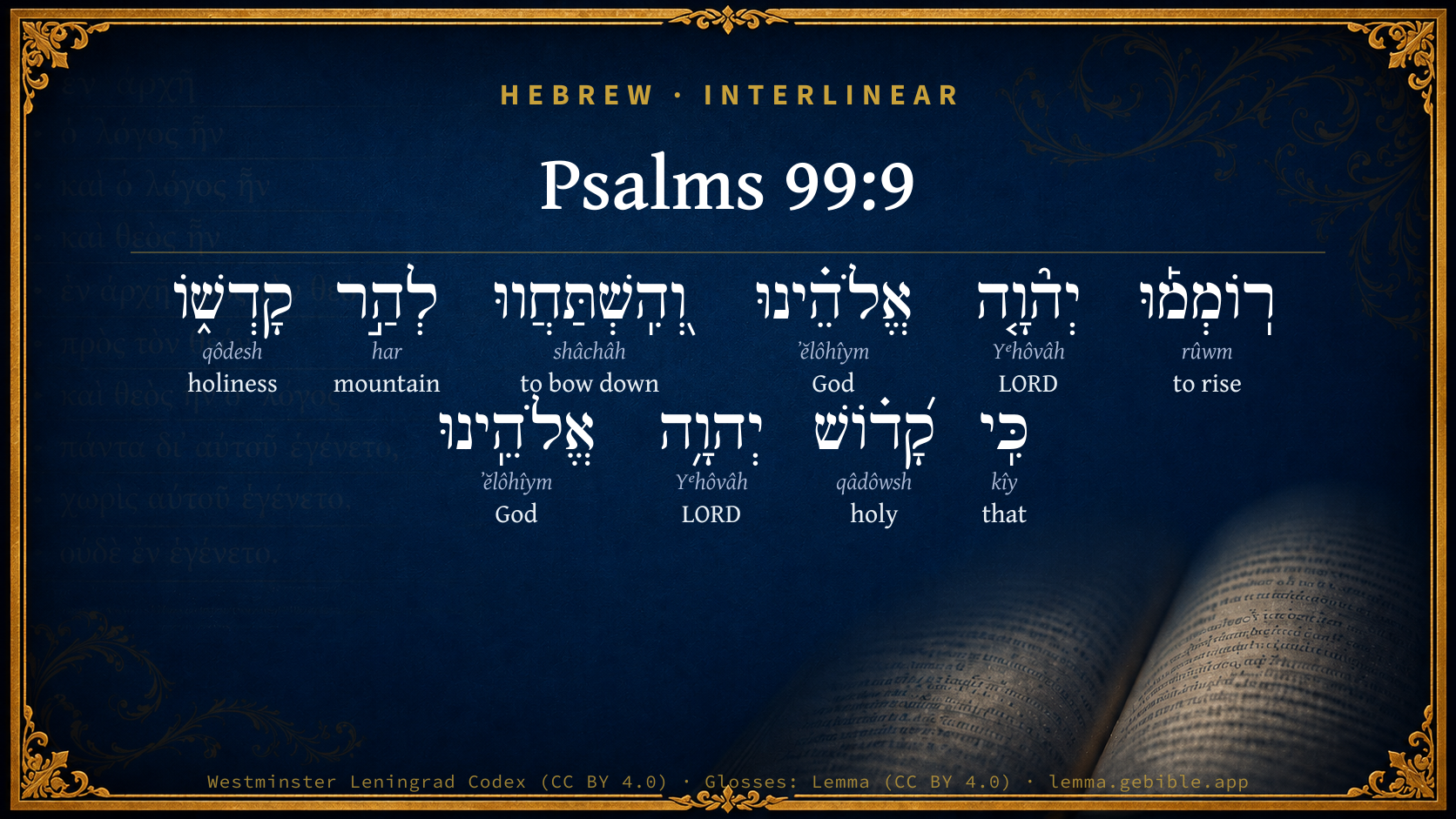
  1. רֽוֹמְמ֡וּ rûwm H7311 “rise” Verb, Polel, Imperative, 2nd Person, Masculine, Plural
  2. יְה֘וָ֤ה Yᵉhôvâh H3068 “LORD” Noun, Proper
  3. אֱלֹהֵ֗ינוּ ʼĕlôhîym H430 “God(s) · our” Noun, Common, Masculine, Plural, Construct + Suffix, Personal, 1st Person, Common, Plural
  4. וְ֭הִֽשְׁתַּחֲווּ shâchâh H7812 “and · bow down” Conjunction + Verb, Hishtaphel, Imperative, 2nd Person, Masculine, Plural
  5. לְהַ֣ר har H2022 “to/for · mountain of” Preposition + Noun, Common, Masculine, Singular, Construct
  6. קָדְשׁ֑וֹ qôdesh H6944 “holiness · his” Noun, Common, Masculine, Singular, Construct + Suffix, Personal, 3rd Person, Masculine, Singular
  7. כִּֽי kîy H3588 “that” Conjunction
  8. יְהוָ֥ה Yᵉhôvâh H3068 “LORD” Noun, Proper
  9. אֱלֹהֵֽינוּ ʼĕlôhîym H430 “God(s) · our” Noun, Common, Masculine, Plural, Construct + Suffix, Personal, 1st Person, Common, Plural

About this verse

These counts appear in no published source. They are computed here, from the morphology-tagged text and Lemma’s own curated glosses. What Lemma adds →

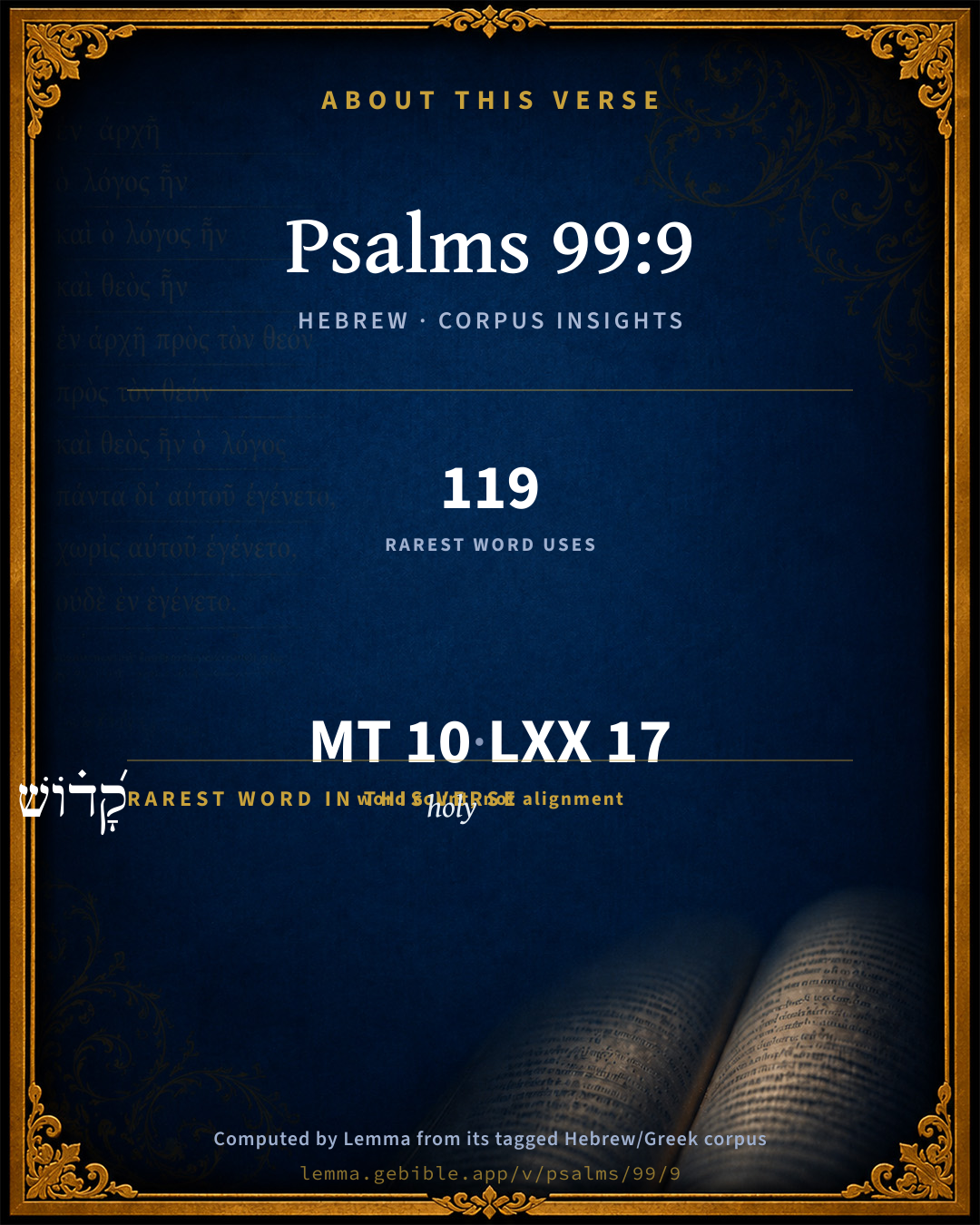
10
words
8
distinct lemmas
Wisdom
section

Grammatical profile

  • 2 verbs
  • 6 nouns
  • 1 adjective
  • 1 conjunction

Verb forms

  • רֽוֹמְמ֡וּ Polel · Imperative
  • וְ֭הִֽשְׁתַּחֲווּ Hishtaphel · Imperative

Repetition

Words recur within this verse — often emphatic in Hebrew:

  • יְה֘וָ֤ה LORD H3068 ×2
  • אֱלֹהֵ֗ינוּ God H430 ×2

Hebrew & Septuagint length

In English translation the verse runs 15 words from the Hebrew and 19 from the Septuagint (LXX English) — closely comparable.

A rough comparison of the two English renderings, which tokenize alike — not a word-level alignment.

Word counts can differ between the Hebrew and the Greek without any difference in meaning — e.g. the Hebrew direct-object marker אֵת has no separate Greek word, and Greek often adds the article ὁ.

In the original languages it is 10 Hebrew tokens and 17 Greek tokens — but the two are counted differently (Hebrew bundles its prefixes and suffixes into one token; the Greek is in lemma form), so that isn’t a like-for-like length.

Cross-references

14

Topical passages linked to Psalms 99:9 in the Treasury of Scripture Knowledge — connected by theme and wording, ordered by reader-vote popularity; previews shown in the World English Bible.

  • Luke 1:49 For he who is mighty has done great things for me. Holy is his name.
  • Isaiah 57:15 For thus says the high and lofty One who inhabits eternity, whose name is Holy: I dwell in the high and holy place, with him also who is of a contrite and humble spirit, to revive the spirit of the humble, and to revive the heart of the contrite.
  • Isaiah 5:16 But Yahweh of Hosts is exalted in justice, And God the Holy One is sanctified in righteousness.
  • 1 Peter 1:15–16 but just as he who called you is holy, you yourselves also be holy in all of your behavior;
  • Revelation 4:8 The four living creatures, each one of them having six wings, are full of eyes around about and within. They have no rest day and night, saying, "Holy, holy, holy, holy, holy, holy, holy, holy, holy is the Lord God, the Almighty, who was and who is and who is to come!"
  • Psalms 2:6 "Yet I have set my king on my holy hill of Zion."
  • Psalms 99:5 Exalt Yahweh our God. Worship at his footstool. He is Holy!
  • Isaiah 6:3 One called to another, and said, "Holy, holy, holy, is Yahweh of Hosts! The whole earth is full of his glory!"
  • 1 Samuel 2:2 There is none holy as Yahweh; For there is none besides you, Neither is there any rock like our God.
  • Psalms 48:1–2 Great is Yahweh, and greatly to be praised, In the city of our God, in his holy mountain.
  • Psalms 87:1–3 His foundation is in the holy mountains.
  • Psalms 99:3 Let them praise your great and awesome name. He is Holy!
  • Habakkuk 1:12 Aren't you from everlasting, Yahweh my God, my Holy One? We will not die. Yahweh, you have appointed him for judgment. You, Rock, have established him to punish.
  • Revelation 3:7 "To the angel of the assembly in Philadelphia write: "He who is holy, he who is true, he who has the key of David, he who opens and no one can shut, and who shuts and no one opens, says these things:

Cross-references courtesy of OpenBible.info (CC BY 4.0).

Hebrew and Greek witnesses Masoretic Hebrew ↔ Greek Septuagint

The same verse in the two great witnesses to the Old Testament, shown verse-for-verse.

You’re reading Greek Psalm 98 (Hebrew Psalm 99). The Septuagint counts the superscription, so verse numbers can differ from the Hebrew — chapter-level alignment, not verse-by-verse. Numbering follows Rahlfs.

These are two independent witnesses, not word-aligned to each other, and the Septuagint is shown in lemma (dictionary) form.

Hebrew Psalms 99:9 Masoretic · Westminster Leningrad Codex

רֽוֹמְמ֡וּ יְה֘וָ֤ה אֱלֹהֵ֗ינוּ וְ֭הִֽשְׁתַּחֲווּ לְהַ֣ר קָדְשׁ֑וֹ כִּֽי קָ֝ד֗וֹשׁ יְהוָ֥ה אֱלֹהֵֽינוּ

Exalt Yahweh, our God. Worship at his holy hill, For Yahweh, our God, is holy!

World English Bible · Public Domain

Greek LXX Greek Psalm 98:9 Septuagint · lemma form

ὑψόω κύριος ὁ θεός ἐγώ καί προςκυνέω εἰς ὄρος ἅγιος αὐτός ὅτι ἅγιος κύριος ὁ θεός ἐγώ

Exalt you⌃ the Lord our God, and worship at his holy mountain; for the Lord our God is holy.

LXX2012 (modern English Septuagint) · Public Domain

Hebrew: Westminster Leningrad Codex (CC BY 4.0). Greek: Septuagint (public domain); English from LXX2012 (modern English Septuagint) (Public Domain). How the Septuagint differs from the Hebrew →

Commentary

Notes on Psalms 99:9 from classic Christian and Jewish commentators (each source and its license shown beneath its notes). The classic Christian expositions comment on the surrounding passage and are grouped to its opening verse, so a note may address several verses; the Jewish commentaries on the Tanakh (Rashi and others) are per-verse, so they appear only where the commentator wrote on this verse.

Lemma curates 59 commentaries, every one of them public domain or Creative Commons licensed, each selected and text-cleaned for this edition rather than reprinted as found. About our sources →

Trapp's Complete Commentary

John Trapp

Psa 99:9 Exalt the LORD our God, and worship at his holy hill; for the LORD our God [is] holy.

Ver. 9. Exalt the Lord] Versus amoibaeus. See Psa 99:5.

John Trapp, A Commentary or Exposition upon All the Books of the Old and New Testament (1647–1656) — public domain. Text from a community e-Sword module.

J. A. Alexander on Psalms

Joseph Addison Alexander

9. (Psa 99:9) Exalt ye Jehovah our God, and bow down to his holy hill; for holy (is) Jehovah our God. See above, on Psa 99:5, from which this differs only in the substitution of the holy hill for the equivalent expression footstool, and in the more distinct assertion of God's holiness as a reason for the worship thus required.

Joseph Addison Alexander, The Psalms Translated and Explained (1850) — public domain. Text from a community e-Sword module.

Adam Clarke's Commentary

Verse 9. Worship at his holy hill] Worship him publicly in the temple.

For the Lord our God is holy.] The words of the chorus; as in the third and fifth verses.

ANALYSIS OF THE NINETY-NINTH PSALM

There are two parts in this Psalm: -

I. A description of the kingdom of God.

1. From the majesty and terror of it against his enemies, Ps 99:1-3.

2. From its equity in the execution of judgment and justice, Ps 99:4.

3. From his patience and clemency in giving audience to his servants, Ps 99:6-8.

II. A demand of praise and honour of all that acknowledge him for their King, begun at the third verse, repeated at the fifth, and continued in the last. The Psalm contains a prophecy of the kingdom of Christ, and its glory.

I. 1. The terror, power, and majesty of this kingdom: "The Lord reigneth." 1. He bids defiance to his enemies: "Let the people tremble." 2. "He sitteth between the cherubim." He is always present with his people; they need not fear, though the earth be moved. 3. "He is great in Zion." More potent and higher than all people. 4. "His name is great and terrible." His enemies have every thing to fear, while his friends have every thing to hope.

2. The psalmist describes this kingdom, from its justice and equity. 1. "He loveth judgment." This is one of his perfections. 2. "He establishes equity." Gives just and equal laws to all. 3. "He executes judgment in Jacob." None of his followers shall live without law; they are obedient children, living according to his will. 4. And therefore he requires them to exalt and adore him. 5. They are to worship at his foot-stool - all their approaches are to be made in the deepest reverence, with the truest self-abasement. 6. "For he is holy;" and he requires all his followers to be holy also.

3. He describes it from the mercy and clemency of the ruler. 1. He showed his mercy and kindness to Moses, Aaron, and Samuel, as intercessors for the people. "They called upon God," for themselves and for the people; "and he answered them." 1. See the intercession of Moses, Ex 32:31; 2. Of Aaron, Nu 16:46-48. 3. Of Samuel, 1Sa 7:5; 1Sa 7:9-10. 4. He spake to Moses, Ex 33:8-9; Ex 33:11; and to Aaron, Nu 12:5-8.

And now he adds the reason why he heard them: -

1. "They kept his testimonies." Those precepts that were common to all others.

2. "And the ordinances that he gave them." As public persons who were to rule in Church and state.

And that it was a great mercy that the Lord heard them, the prophet acknowledges by this apostrophe -

1. "Thou answeredst them, O Lord our God." Which the history shows.

2. "Thou forgavest them;" that is, the people for whom they prayed: for in Hebrew the relative is often put without an antecedent.

3. "Thou tookest vengeance of their inventions." The golden calf was broken to pieces, Ex 32:20; and the false gods were put away 1Sa 7:3-4. The people were not consumed, though their sin was in a certain manner visited upon them. See Nu 14:23; Nu 14:30; Nu 20:12.

II. The psalmist concludes with a demand of praise to this kind God.

1. "Exalt the Lord." Show that he is high, holy, just, good, and kind.

2. "Worship at his holy hill." Attend his public worship, and show a godly example in this way to all others. He who is indifferent about the public worship of God is generally not less so in private devotion.

3. The reason for all this is: "The Lord our God is holy." He requires this worship because it is a chief means by which he communicates his holiness to his followers. Without this holiness there is no happiness here, and without it none shall ever see God. Get holiness, that you may get happiness here, and heaven hereafter.

Adam Clarke's Commentary on the Bible (1810–1826) — public domain. Text from a community e-Sword/MySword module.

John Calvin's Commentaries

In the close of the psalm he repeats the same sentence which we had in the fifth verse, only substituting his holy mountain instead of his footstool; and as for the sake of brevity he had formerly said somewhat obscurely קדוש הוא, kadosh hu, he is holy, he now says more plainly, Jehovah our God is holy His intention is to show that God is not to be worshipped by the Israelites at random, (as the religion of the heathen depended upon fancy alone,) but that his worship is founded upon the assurance of faith.

John Calvin's Commentaries (1540-1563) — public domain. Text from the Calvin Translation Society English edition (1840s-50s) via the Christian Classics Ethereal Library (ccel.org). Calvin's coverage is partial (roughly two-thirds of the Bible); uncommented books and verses are honest gaps, never fabricated. The 19th-century editor's footnotes and remarks are omitted so the notes are faithfully Calvin's own voice.

The Cambridge Bible for Schools and Colleges

gen. ed. J. J. S. Perowne

9. A final call to worship the God of Israel in Zion, in His holy mountain (Psa_2:6; Isa_66:20), for holy is Jehovah our God.

The Cambridge Bible for Schools and Colleges (gen. ed. J. J. S. Perowne; Cambridge University Press, 1878–1918) — public domain. Text from a community e-Sword module.

John Gill's Exposition

Exalt the Lord our God,.... Having given the above instances of Moses, Aaron, and Samuel, serving and worshipping the Lord, the psalmist repeats the exhortation in Psa 99:5, which he enforces by their example; See Gill on Psa 99:5,

and worship at his holy hill; the holy hill of Zion, the church; attend the public worship and service of it: the Targum is,

"worship at the mountain of the house of his sanctuary; the temple, a type of the church of Christ:''

for the Lord our God is holy; his nature is holy, and he is glorious in the perfection of his holiness, and therefore to be praised and exalted; and his name is holy, and so reverend, and therefore to be worshipped; see in Psa 99:3.

Next: Psalms Chapter 100

John Gill's Exposition of the Whole Bible (1746–1763) — public domain (CC PDM 1.0). Text via the HelloAO Bible API.

Albert Barnes' Notes on the Bible

Exalt the Lord our God - See the notes at Psa 99:5.

And worship at his holy hill - In Psa 99:5, this is, “at his footstool.” The “holy hill” refers to Zion, as the seat of the national worship.

For the Lord our God is holy - See Psa 99:5. This appropriately closes the psalm, by a distinct and solemn statement that the fact that Yahweh is a holy God is a reason for worshipping him. This is at all times the highest reason for adoration and praise.

Albert Barnes' Notes on the Bible (1834–1885) — public domain. Text from a community e-Sword/MySword module.

Matthew Poole's English Annotations

At his holy hill; either in Zion; or in his church typified by it, and oft called Zion.

Matthew Poole's English Annotations on the Holy Bible (1683–1685) — public domain. Text from a community e-Sword/MySword module.

The Treasury of David

Charles H. Spurgeon

Ver. 9. Exalt the LORD our God. A second time the delightful title of Jehovah our God is used, and it is quickly followed by a third. The Psalm is Trinitarian in its whole structure. In each of his sacred persons the Lord is the God of his people; the Father is ours, the Son is ours, and the Holy Spirit is ours: let us exalt him with all our ransomed powers.

And worship at his holy hill. Where he appoints his temple let us resort. No spot of ground is now fenced about as peculiarly holy, or to be regarded as more sacred than another; yet his visible church is his chosen hill, and there would we be found, numbered with his people, and unite with them in worship.

For the LORD our God is holy. Again this devout description is repeated, and made the climax of the song. Oh for hearts made pure within, so that we may rightly perceive and worthily praise the infinite perfection of the Triune Lord.

Ver. 9. The Lord our God. A very sweet topic will be found in the consideration of the questions, "In what respect is Jehovah ours? and in what relations does he stand to his people?"

In "The Golden Diary of Heart Converse with Jesus in the Book of Psalms. By the Rev. Dr. EDERSHEIM, Tarquay. Arranged for every Sunday in the year. Re-issue. 1873" there are expositions of Psalms 99, 101, and 102.

Charles H. Spurgeon's The Treasury of David (1869–1885) — public domain. Psalms only. Text from a community e-Sword/MySword module.

Whedon's Commentary on the Bible

Daniel D. Whedon

9. Exalt the Lord our God—A repetition of Psa_99:5, with the change of holy hill, here, for footstool there, and “the Lord our God,” for the pronoun he—indicating a rising emphasis.

Daniel D. Whedon (gen. ed.), Commentary on the Old and New Testaments (1874–1909) — public domain. Text from a community e-Sword module.

The Pulpit Commentary

Exalt the Lord our God, and worship at his holy hill. Repeated from ver. 5, with the slight variation that "his holy hill" is substituted for "his footstool Zion, on which the temple stood, for the sanctuary of the temple itself. For the Lord our God is holy; rather, for holy is the Lord our God (comp. vers. 3 and 5).

The Pulpit Commentary (1880–1919), ed. H.D.M. Spence-Jones & Joseph S. Exell — public domain. Text from a community e-Sword module.

Rashi

Rabbi Shlomo Yitzchaki (Rashi)

for the Lord our God is holy because He is strict with the righteous, He is sanctified in the world, and so He says (Exod. 29:43): “and it will be sanctified with My glory,” meaning “with those glorified by Me.”

Rashi on the Tanakh — English translations: “The Judaica Press complete Tanach with Rashi, translated by A. J. Rosenberg” (CC BY 4.0); “Pentateuch with Rashi's commentary by M. Rosenbaum and A.M. Silbermann, 1929-1934” (public domain); “The Metsudah Tanach series, Lakewood, N.J” (CC BY 4.0); and “The Book of Joshua, Metsudah Publications, 1997” (CC BY 4.0). Text via Sefaria.

Lesson kit

Teaching starters — assembled from the data on this page, not authored interpretation. Every prompt links to the verse data it draws on. Edit before teaching.

Psalms, in the Wisdom, opens this verse with 10 words (8 distinct Hebrew lemmas). Its most distinctive word is qâdôwsh (“holy”). A historical commentator’s framing appears above. Read the whole chapter for the surrounding context.

Discussion questions

  1. What does “holy” (qâdôwsh) contribute to the verse as a whole?
  2. How does Luke 1:49, which shares this passage’s theme, read alongside this verse?
  3. What does the repetition of “LORD” (2× in this one verse) do in this verse?
  4. The translations on this page render this verse differently — a whole-verse word diff, not a word-by-word alignment. What might account for the different wordings?
  5. «רֽוֹמְמ֡וּ» is a Polel Imperative verb. How does that grammatical form shape the action described?
  6. Compare how Trapp's Complete Commentary and J. A. Alexander on Psalms read this verse. Where do they agree or differ?

Things to notice

Reading settings

Reading text

Shown beneath each verse's original-language words.

Old Testament
Old Testament edition

Read the OT as the Masoretic Hebrew (MT) or the Greek Septuagint (LXX).

English shown for the Greek Septuagint (in the Hebrew ↔ Greek comparison).

Comparing translations? Open the Compare panel on any verse page to stack up to four side by side.