
Job 32:2

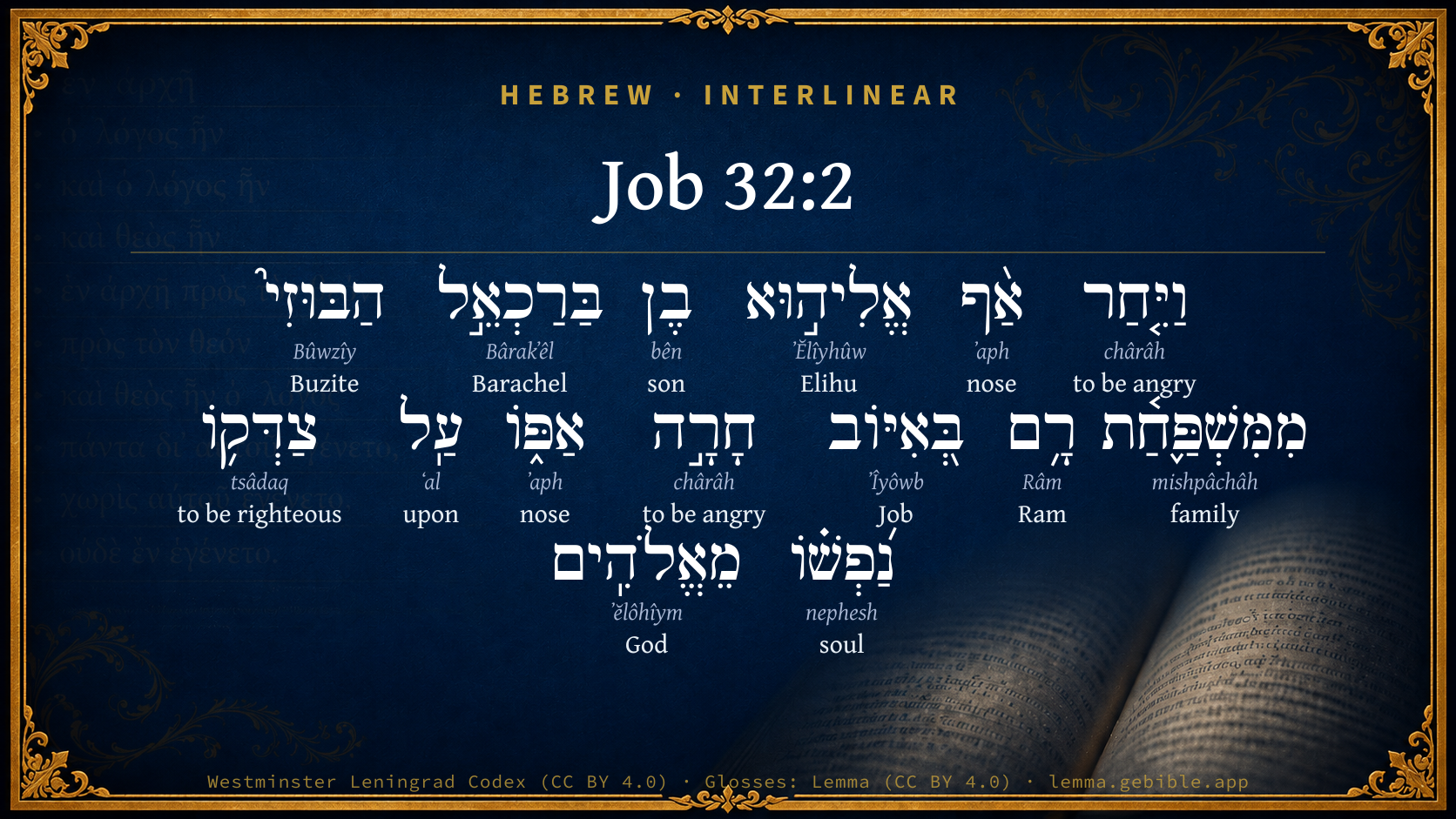
Hebrew (Westminster Leningrad Codex) Job 32:2 appears in the Hebrew Old Testament. The text above is from the Westminster Leningrad Codex. Each word links to its Strong’s number, a concise gloss, and parsing drawn from the Open Scriptures Hebrew Bible morphology. Click any word for its full Brown-Driver-Briggs (BDB) entry.
Download image
Cite this verse

Job 32:2 (World English Bible). Public Domain. Lemma interlinear Bible study tool, https://lemma.gebible.app/v/job/32/2.

Show BibTeX & RIS
BibTeX
RIS
English Translation
Then the wrath of Elihu the son of Barachel, the Buzite, of the family of Ram, was kindled against Job. His wrath was kindled because he justified himself rather than God.
World English Bible · Public Domain
Highlights
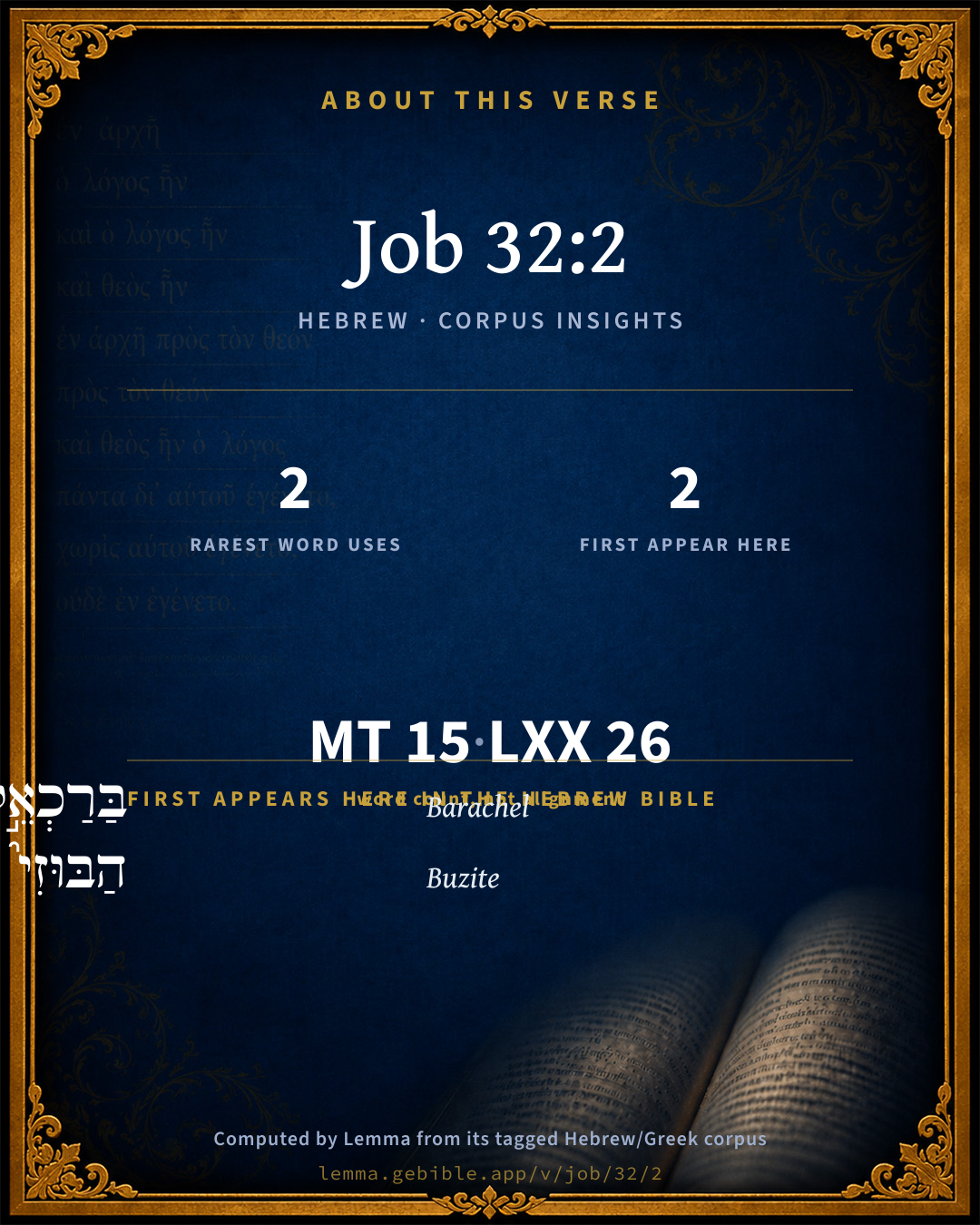
  • 2 first appearances in the Hebrew Bible
Full analysis ↓
Download a study sheet

One document with this verse’s original text, its word-by-word gloss line, the meaning frame, cross-references with their text, attributed commentary, and full source and license credits — printable, and it pastes into notes with its structure intact.

This verse Autodidact and up

Study sheet (.html) Plain text (.txt)

A passage Seminary Student

Up to 50 verses in one chapter. A passage sheet keeps up to 6 commentary sources and 12 cross-references per verse, in the order this page ranks them, and says so on the sheet whenever that leaves anything out. Ask for a single verse and you get the Autodidact verse sheet above.

Everything on this page stays free to read, with no account — the sheet is a download of what is already on screen, not access to it.

Want to remove ads? Support Godless Engineer
Compare translations 3

The same verse in 3 English versions, stacked beneath the original-language interlinear above. Click any original word for its lexicon entry.

Each is an independent rendering of the whole verse — the interlinear is not word-aligned to these translations.

Highlighted words mark where these versions differ — a whole-verse word diff, not a word-by-word alignment.

  • World English Bible Public Domain
    Then the wrath of Elihu the son of Barachel, the Buzite, of the family of Ram, was kindled against Job. His wrath was kindled because he justified himself rather than God.
  • King James Version Public Domain
    Then was kindled the wrath of Elihu the son of Barachel the Buzite, of the kindred of Ram: against Job was his wrath kindled, because he justified himself rather than God.
  • unfoldingWord Literal Text CC BY-SA 4.0
    Then the nose burned of Elihu son of Barakel the Buzite, from the clan of Ram. His nose burned against Job upon him declaring himself righteous rather than God.

unfoldingWord Literal Text — © unfoldingWord, licensed CC BY-SA 4.0. Word-aligned USFM3 via Door43 (git.door43.org/unfoldingWord/en_ult).

Versions to compare (up to 4)

3 of 4 selected

Show all 18 translations

Every available English version of this verse, each an independent rendering of the whole verse.

  • World English Bible Public Domain
    Then the wrath of Elihu the son of Barachel, the Buzite, of the family of Ram, was kindled against Job. His wrath was kindled because he justified himself rather than God.
  • Berean Standard Bible Public Domain
    This kindled the anger of Elihu son of Barachel the Buzite, of the family of Ram. He burned with anger against Job for justifying himself rather than God,
  • Majority Standard Bible Public Domain
    This kindled the anger of Elihu son of Barachel the Buzite, of the family of Ram. He burned with anger against Job for justifying himself rather than God,
  • King James Version Public Domain
    Then was kindled the wrath of Elihu the son of Barachel the Buzite, of the kindred of Ram: against Job was his wrath kindled, because he justified himself rather than God.
  • American Standard Version (1901) Public Domain
    Then was kindled the wrath of Elihu the son of Barachel the Buzite, of the family of Ram: against Job was his wrath kindled, because he justified himself rather than God.
  • Revised Version (1885) Public Domain
    Then was kindled the wrath of Elihu the son of Barachel the Buzite, of the family of Ram: against Job was his wrath kindled, because he justified himself rather than God.
  • Geneva Bible (1599) Public Domain
    Then the wrath of Elihu the sonne of Barachel the Buzite, of the familie of Ram, was kindled: his wrath, I say, was kindled against Iob, because he iustified himselfe more then God.
  • Douay-Rheims (1899) Public Domain
    And Eliu the son of Barachel the Buzite, of the kindred of Ram, was angry and was moved to indignation: now he was angry against Job, because he said he was just before God.
  • Young's Literal Translation Public Domain
    and burn doth the anger of Elihu son of Barachel the Buzite, of the family of Ram; against Job hath his anger burned, because of his justifying himself more than God;
  • Literal Standard Version CC BY-SA 4.0
    and the anger of Elihu son of Barachel the Buzite burns, of the family of Ram; his anger has burned against Job, because of his justifying himself more than God;
  • Unlocked Literal Bible CC BY-SA 4.0
    Then was kindled the anger of Elihu son of Barakel the Buzite, of the family of Ram; it was kindled against Job because he justified himself rather than God.
  • unfoldingWord Literal Text CC BY-SA 4.0
    Then the nose burned of Elihu son of Barakel the Buzite, from the clan of Ram. His nose burned against Job upon him declaring himself righteous rather than God.
  • Darby Bible Public Domain
    Then was kindled the anger of Elihu the son of Barachel, the Buzite, of the family of Ram: against Job was his anger kindled, because he justified himself rather than God;
  • World Messianic Bible Public Domain
    Then the wrath of Elihu the son of Barachel, the Buzite, of the family of Ram, was kindled against Job. His wrath was kindled because he justified himself rather than God.
  • Webster's Bible Public Domain
    Then was kindled the wrath of Elihu the son of Barachel the Buzite, of the kindred of Ram: against Job was his wrath kindled, because he justified himself rather than God.
  • Free Bible Version CC BY-SA 4.0
    Then Elihu, the son of Barachel the Buzite, of the family of Ram, grew angry. He was angry with Job for claiming he was right rather than God.
  • Bible in Basic English Public Domain
    And Elihu, the son of Barachel the Buzite, of the family of Ram, was angry, burning with wrath against Job, because he seemed to himself more right than God;
  • JPS Tanakh (1917) Public Domain
    Then was kindled the wrath of Elihu the son of Barachel the Buzite, of the family of Ram; against Job was his wrath kindled, because he justified himself rather than God.

Literal Standard Version (2020), Covenant Press — licensed CC BY-SA 4.0. Text via the HelloAO Bible API (eBible.org). Unlocked Literal Bible (unfoldingWord) — licensed CC BY-SA 4.0. Text via the HelloAO Bible API (eBible.org). unfoldingWord Literal Text — © unfoldingWord, licensed CC BY-SA 4.0. Word-aligned USFM3 via Door43 (git.door43.org/unfoldingWord/en_ult). Free Bible Version, Dr. Jonathan Gallagher — licensed CC BY-SA 4.0. Text via the HelloAO Bible API (eBible.org).

Word by word

More ways to search: Search by grammar → Find every occurrence → Compare this word →

Practice this passage: Drill this verse → Learn its vocabulary →

בַּרַכְאֵ֣ל
Bârakʼêl
H1292
“Barachel”
Noun, Proper
Part of Speech
Noun
Type
Proper
Full BDB Definition

Origin: from H1288 and H410

TWOT: None

Barachel = "God blesses" - father of Elihu
  1. וַיִּ֤חַר chârâh H2734 “and · to be angry” Conjunction + Verb, Qal, Sequential Imperfect, 3rd Person, Masculine, Singular
  2. אַ֨ף ʼaph H639 “nose” Particle, Accusative
  3. אֱלִיה֣וּא ʼĔlîyhûw H453 “Elihu” Noun, Proper
  4. בֶן bên H1121 “son of” Noun, Common, Masculine, Singular, Construct
  5. הַבּוּזִי֮ Bûwzîy H940 “the · Buzite” Particle, Definite Article + Noun, Gentilic, Masculine, Singular, Absolute
  6. מִמִּשְׁפַּ֪חַ֫ת mishpâchâh H4940 “from · family of” Preposition + Noun, Common, Feminine, Singular, Construct
  7. רָ֥ם Râm H7410 “Ram” Noun, Proper
  8. בְּ֭אִיּוֹב ʼÎyôwb H347 “in/at · Job” Preposition + Noun, Proper
  9. חָרָ֣ה chârâh H2734 “to be angry” Verb, Qal, Perfect, 3rd Person, Masculine, Singular
  10. אַפּ֑וֹ ʼaph H639 “nose · his” Noun, Common, Masculine, Singular, Construct + Suffix, Personal, 3rd Person, Masculine, Singular
  11. עַֽל ʻal H5921 “upon” Preposition
  12. צַדְּק֥וֹ tsâdaq H6663 “to be righteous · him” Verb, Piel, Infinitive Construct + Suffix, Personal, 3rd Person, Masculine, Singular
  13. נַ֝פְשׁ֗וֹ nephesh H5315 “soul · his” Noun, Common, Both, Singular, Construct + Suffix, Personal, 3rd Person, Masculine, Singular
  14. מֵאֱלֹהִֽים ʼĕlôhîym H430 “from · God(s)” Preposition + Noun, Common, Masculine, Plural, Absolute

About this verse

These counts appear in no published source. They are computed here, from the morphology-tagged text and Lemma’s own curated glosses. What Lemma adds →

15
words
13
distinct lemmas
Wisdom
section

Notable vocabulary

The rarest word here is בַּרַכְאֵ֣ל Barachel H1292 — appearing just 2 times in the whole Hebrew Bible.

First appearance in Scripture

These words make their first canonical appearance in the Hebrew Bible here:

  • בַּרַכְאֵ֣ל Barachel H1292
  • הַבּוּזִי֮ Buzite H940

Shared distinctive vocabulary

בַּרַכְאֵ֣ל Barachel H1292 occurs in 2 verses of the Hebrew Bible. Also found in:

Grammatical profile

  • 3 verbs
  • 10 nouns
  • 1 preposition
  • 1 particle

Verb forms

  • וַיִּ֤חַר Qal · Sequential Imperfect
  • חָרָ֣ה Qal · Perfect
  • צַדְּק֥וֹ Piel · Infinitive Construct

Repetition

Words recur within this verse — often emphatic in Hebrew:

  • וַיִּ֤חַר to be angry H2734 ×2
  • אַ֨ף nose H639 ×2

Hebrew & Septuagint length

In English translation the verse runs 31 words from the Hebrew and 34 from the Septuagint (LXX English) — closely comparable.

A rough comparison of the two English renderings, which tokenize alike — not a word-level alignment.

Word counts can differ between the Hebrew and the Greek without any difference in meaning — e.g. the Hebrew direct-object marker אֵת has no separate Greek word, and Greek often adds the article ὁ.

In the original languages it is 15 Hebrew tokens and 26 Greek tokens — but the two are counted differently (Hebrew bundles its prefixes and suffixes into one token; the Greek is in lemma form), so that isn’t a like-for-like length.

Cross-references

13

Topical passages linked to Job 32:2 in the Treasury of Scripture Knowledge — connected by theme and wording, ordered by reader-vote popularity; previews shown in the World English Bible.

  • Genesis 22:21 Uz his firstborn, Buz his brother, Kemuel the father of Aram,
  • Job 27:2 "As God lives, who has taken away my right, The Almighty, who has made my soul bitter.
  • Job 27:5 Far be it from me that I should justify you. Until I die I will not put away my integrity from me.
  • Job 35:2 "Do you think this to be your right, Or do you say, 'My righteousness is more than God's,'
  • Job 40:8 Will you even annul my judgment? Will you condemn me, that you may be justified?
  • Job 10:3 Is it good to you that you should oppress, That you should despise the work of your hands, And smile on the counsel of the wicked?
  • Job 30:21 You have turned to be cruel to me. With the might of your hand you persecute me.
  • Job 34:5–6 For Job has said, 'I am righteous, God has taken away my right:
  • Job 34:17–18 Shall even one who hates justice govern? Will you condemn him who is righteous and mighty?--
  • Psalms 69:9 For the zeal of your house consumes me. The reproaches of those who reproach you have fallen on me.
  • Mark 3:5 When he had looked around at them with anger, being grieved at the hardening of their hearts, he said to the man, "Stretch out your hand." He stretched it out, and his hand was restored as healthy as the other.
  • Luke 10:29 But he, desiring to justify himself, asked Jesus, "Who is my neighbor?"
  • Ephesians 4:26 "Be angry, and don't sin." Don't let the sun go down on your wrath,

Cross-references courtesy of OpenBible.info (CC BY 4.0).

Hebrew and Greek witnesses Masoretic Hebrew ↔ Greek Septuagint

The same verse in the two great witnesses to the Old Testament, shown verse-for-verse.

These are two independent witnesses, not word-aligned to each other, and the Septuagint is shown in lemma (dictionary) form.

Hebrew Job 32:2 Masoretic · Westminster Leningrad Codex

וַיִּ֤חַר אַ֨ף אֱלִיה֣וּא בֶן בַּרַכְאֵ֣ל הַבּוּזִי֮ מִמִּשְׁפַּ֪חַ֫ת רָ֥ם בְּ֭אִיּוֹב חָרָ֣ה אַפּ֑וֹ עַֽל צַדְּק֥וֹ נַ֝פְשׁ֗וֹ מֵאֱלֹהִֽים

Then the wrath of Elihu the son of Barachel, the Buzite, of the family of Ram, was kindled against Job. His wrath was kindled because he justified himself rather than God.

World English Bible · Public Domain

Greek LXX Job 32:2 Septuagint · lemma form

ὀργίζω δέ ελιους ὁ ὁ βαραχιηλ ὁ βουζίτης ἐκ ὁ συγγένεια ραμ ὁ αυσίτις χώρα ὀργίζω δέ ὁ ιωβ σφόδρα διότι ἀποφαίνω ἑαυτοῦ δίκαιος ἐναντίον κύριος

Then Elius the son of Barachiel, the Buzite, of the kindred of Ram, of the country of Ausis, was angered: and he was very angry with Job, because he justified himself before the Lord.

LXX2012 (modern English Septuagint) · Public Domain

On this verse, Albert Barnes' Notes on the Bible discusses the Septuagint’s reading. Read the note in Commentary ↓

Hebrew: Westminster Leningrad Codex (CC BY 4.0). Greek: Septuagint (public domain); English from LXX2012 (modern English Septuagint) (Public Domain). How the Septuagint differs from the Hebrew →

Commentary

Notes on Job 32:2 from classic Christian and Jewish commentators (each source and its license shown beneath its notes). The classic Christian expositions comment on the surrounding passage and are grouped to its opening verse, so a note may address several verses; the Jewish commentaries on the Tanakh (Rashi and others) are per-verse, so they appear only where the commentator wrote on this verse.

Lemma curates 59 commentaries, every one of them public domain or Creative Commons licensed, each selected and text-cleaned for this edition rather than reprinted as found. About our sources →

Trapp's Complete Commentary

John Trapp

Job 32:2 Then was kindled the wrath of Elihu the son of Barachel the Buzite, of the kindred of Ram: against Job was his wrath kindled, because he justified himself rather than God.

Ver. 2. Then was kindled the wrath of Elihu] Or, Then burnt the nose of Elihu; a periphrasis of anger, which appeareth in the nose, eyes, and other parts of the body. Quis enim celaverit ignem? Who can hide fire? The Rabbis have a saying, that a man shows what he is becos, bechis, becagnas, by his purse, his cups, and his anger; which, if it be rash and unadvised, is a mortal sin, and not venial (as the Papists falsely infer from Mat 5:22), dispossessing a man of his wit and reason, and disfiguring his body with fieriness of the face, swelling of the veins, stammering of the tongue, gnashing of the teeth, and many other impotent and unmanly behaviours. Hence angry men were counselled, in the heat of their fit, to look themselves in a glass, where they may see themselves swollen like a toad, glowing like a devil, &c. But Elihu’s anger was not of this kind. A fire it was, but the flame of God, as holy zeal is called, Son 8:6, a most vehement flame (as it is there rendered) kindled upon the hearth of his heart by the spirit of judgment and of burning, Isa 4:4, and such as many waters could not quench, for the zeal is the extreme heat of all the affections; and the coals thereof are coals of fire, Son 8:6, only we must see that it burns clear and quick, without all smoke of sin; wherein, though Elihu somewhat faulted, yet, because he was right for the main, all was well taken. We are apt to mingle sin with our best actions, and so to plough with an ox and an ass. But God considers whereof we are made, and graciously lays the finger of mercy on the scars of our sins, as that painter in the story.

Of Elihu the son of Barachel the Buzite] Descended he was of good parents ( Fortes creantur fortibus, et bonis) who gave him a good name, signifying, He is my God, or, My God is Jehovah; to remind him of his duty, whereunto we have need of all helps that may be. His father’s name, Barachel, signifieth, One whom God hath blessed; he hath blessed him indeed in so good a son, as could not but make him a glad father, Pro 10:1. The Buzite he is called, either from his progenitor Buz, the son of Nahor, who was the brother of Abraham, and had by Milcah, Huz, his firstborn (of whom some think Job came), and Buz, his brother, Gen 22:21; or else from his country, the city of Buz, a city of Idumea, Jer 25:23. Jerome will have this Elihu to be the same with Balaam, who, while young, was a prophet of God, and dealt thus divinely with Job, but afterwards, being corrupted by Balak, he became the devil’s boggyman. This I look upon as a Jewish tradition, not much to be credited. His pedigree is here more fully described, Ut certitudo historiae ostenderetur, saith Mercer, that we might not doubt the truth and certainty of the history so circumstanced; as also, because Elihu did better than the rest of Job’s friends, who proved no better than Satan’s instruments. How he came to make one among them we know not. It is conceived, that hearing about the going of the other three by consent to visit Job, he also went to hear their conferences, not doubting that he should thereby derive much benefit to his understanding. But failing in his expectation, and finding both parties incorrect in their discourses, he steps forth, and takes the boldness to interpose as an arbiter, or moderator, blaming both sides, and beginning, in the six following chapters, that determination of the difference between them, which God himself will afterwards finish. Meanwhile it is well observed by the learned Beza, that Elihu in blaming Job (as there was cause), doth for the most part interpret Job’s words far otherwise than he meant them; and moreover, that even in finding fault with those things that were justly to be found fault withal he kept not always that moderation that was meet; which is evident to godly men, and especially such as are of a more earnest nature and disposition; so hard a thing is it, even when we do well, not to offend on the one side or on the other. But if we consider how far Job, being thereto driven by the importunity of his accusers, and his most intolerable calamity, did range out of the right way, and how we are all given, even to the uttermost, to defend and maintain our credit and estimation, especially when we are therein touched by those men who ought, least of all others, to have done the same; we shall confess that it was very requisite and necessary for Job rather to be censured in this sharp manner, as he was, than after any milder sort; to the end he might the better acknowledge and humble himself before God; as always he had done, till, through the slanderous speeches of his friends, be was drawn into these altercations.

Of the kindred of Ram] E familia Syra, so Tremellius; as if Ram were put for Aram. The Chaldee saith, it is put for Abraham, who was first called Ram, secondly Abram, thirdly Abraham. But Elihu was of the family of Nahor rather than of Abraham; and Ram seemeth to have been some famous man of that family.

Because he justified himself rather than God] This he did not directly, et totidem verbis; but by consequence; and Elihu was kindled at it. It is a blessed thing to have a stomach for God, and to be blown up in his cause, as was Moses, Exo 32:19-20, Elijah with his Zelando zelavi, Phinehas, David, Christ, Joh 3:17, the angel of Ephesus, Rev 2:2; to be all on a light fire with love to God, and indignation against all that do him any dishonour by word or deed. Job had uttered some discontented speeches against God; which reflected upon his justice and goodness; he had also despaired of a restoration, and most earnestly wished for death, &c., and thereby seemed to justify himself rather than God; this good Elihu could not brook.

John Trapp, A Commentary or Exposition upon All the Books of the Old and New Testament (1647–1656) — public domain. Text from a community e-Sword module.

Joseph Benson's Commentary

Job 32:2-4. Then was kindled the wrath of Elihu — Elihu, a new personage, here makes his appearance. Attentive, all the while, to the debate between Job and his friends, he utters not a word till both sides have done speaking; and then shows, that a stander-by may sometimes see further into a dispute than they who are eagerly engaged therein, and who, by having their passions raised to an undue height, are very apt to carry things to an extreme. The son of Barachel the Buzite — Of the posterity of Buz, Nahor’s son, Gen 22:21; of the kindred of Ram — Or, Aram; for the names Ram and Aram are used promiscuously in the Hebrew, as the learned reader may see, by comparing 2Ki 8:28, and 2Ch 22:5. The land of Buz was doubtless somewhere in the neighbourhood of Job, as the posterity of Nahor settled in this country. His pedigree is thus particularly described, partly for his honour, as being both a wise and a good man, and principally to evidence the truth of this history. Because he (Job) justified himself rather than God — He justified himself not without reflection upon God, as dealing severely with him. He took more care to maintain his own innocence than God’s glory. The word Elihu signifies, My God is he. They had all tried in vain to convince Job, but My God is he, who both can and will convince him. Elihu was not a little provoked at the behaviour of Job for attempting so to vindicate himself as to leave an imputation of injustice on God’s providence. Also against his three friends was his wrath kindled — For charging Job with such atrocious crimes, and falling so miserably short, when they should have come to the proof, as not to be able to convict him of one of them. Now Elihu had waited — With patience and expectation, as the word חכה, chiccha, here used, means; till Job had spoken — And his three friends; because they were elder than he — Old age in those days was so highly honoured, that a young man scarcely dared to open his mouth before his elders. Elihu therefore begins with a very modest apology for his engaging in the dispute at all, drawn from his youth. He tells them he had waited a long while to hear what they would offer; but, finding they did not design to reply, he desired their leave to speak his opinion; a liberty, however, which he would not indulge himself in, if they were willing to make an answer, or could any way convict Job of what they had laid to his charge. He intimates that his intention was to attack him in a quite different manner from what they had done, for which reason he should not think himself at all obliged to answer the same arguments he had urged against them. But, at the same time, he declares it was not his intention to speak partially in his favour, since the acceptance of persons was a crime which he was sensible would be severely punished by the Almighty.

Joseph Benson's Commentary on the Old and New Testaments (1811–1818) — public domain. Text from a community e-Sword module.

Tyndale Open Study Notes

Tyndale Open Resources

32:2 the Buzite: Buz had connections with Aram (Gen 22:21) and Arabia (Jer 25:23), as did Uz (Job 1:1). • Elihu repeatedly stated that he was angry; he probably regarded his anger as righteous zeal (Ps 69:9).

Tyndale Open Study Notes — © Tyndale Open Resources, licensed CC BY-SA 4.0. Text via the HelloAO Bible API.

Geneva Bible (1599)

Geneva Bible translators

By making himself innocent, and by charging God of rigor.

Which came of Buz, the son of Nahor, Abraham’s brother.

Or, as the Chaldean paraphrase readeth, Abram.

Geneva Bible (1599) marginal notes — public domain. Text via Bolls.life.

Jamieson, Fausset & Brown

Robert Jamieson, A. R. Fausset & David Brown

Elihu--meaning "God is Jehovah." In his name and character as messenger between God and Job, he foreshadows Jesus Christ (Job 33:23-26).

Barachel--meaning "God blesses." Both names indicate the piety of the family and their separation from idolaters.

Buzite--Buz was son of Nahor, brother of Abraham. Hence was named a region in Arabia-Deserta (Jer 25:23).

Ram--Aram, nephew of Buz. Job was probably of an older generation than Elihu. However, the identity of names does not necessarily prove the identity of persons. The particularity with which Elihu's descent is given, as contrasted with the others, led LIGHTFOOT to infer Elihu was the author of the book. But the reason for particularity was, probably, that Elihu was less known than the three called "friends" of Job; and that it was right for the poet to mark especially him who was mainly to solve the problem of the book.

rather than God--that is, was more eager to vindicate himself than God. In Job 4:17, Job denies that man can be more just than God. UMBREIT translates, "Before (in the presence of) God."

Jamieson, Fausset & Brown — Commentary Critical and Explanatory on the Whole Bible (1871) — public domain (CC PDM 1.0). Text via the HelloAO Bible API.

Adam Clarke's Commentary

Verse 2. Then was kindled the wrath] This means no more than that Elihu was greatly excited, and felt a strong and zealous desire to vindicate the justice and providence of God, against the aspersions of Job and his friends.

Elihu the son of Barachel the Buzite] Buz was the second son of Nahor, the brother of Abram, Ge 22:21.

Of the kindred of Ram] Kemuel was the third son of Nahor; and is called in Genesis (see above) the father of Aram, which is the same as Ram. A city of the name of Buz is found in Jer 25:23, which probably had its name from this family; and, as it is mentioned with Dedan and Tema, we know it must have been a city in Idumea, as the others were in that district. Instead of the kindred of Ram, the Chaldee has of the kindred of Abraham. But still the question has been asked, Who was Elihu? I answer, He was "the son of Barachel the Buzite, of the kindred of Ram:" this is all we know of him. But this Scriptural answer will not satisfy those who are determined to find out mysteries where there are none. Some make him a descendant of Judah; St. Jerome, Bede, Lyranus, and some of the rabbins, make him Balaam the son of Beor, the magician; Bishop Warburton makes him Ezra the scribe; and Dr. Hodges makes him the second person in the glorious Trinity, the Lord Jesus Christ, and supposes that the chief scope of this part of the book was to convict Job of self-righteousness, and to show the necessity of the doctrine of justification by faith! When these points are proved, they should be credited.

Because he justified himself rather than God.] Literally, he justified his soul, נפשו naphhso, before God. He defended, not only the whole of his conduct, but also his motives, thoughts, &c.

Adam Clarke's Commentary on the Bible (1810–1826) — public domain. Text from a community e-Sword/MySword module.

Ellicott's Commentary for English Readers

(2) Because he justified himself rather than God.—See Job_19:6. Job maintained his innocence, and could not understand how his affliction could be reconciled with the justice of God. Yet, at the same time, he declared that God was his salvation (Job_13:16), and that it was impossible for man to be absolutely just with God (Job_9:2; Job_9:28), though at the same time he might hope in His righteousness (Job_23:3 seqq.).

A Bible Commentary for English Readers, edited by Charles John Ellicott (1878–1897) — public domain. Text from a community e-Sword module.

The Cambridge Bible for Schools and Colleges

gen. ed. J. J. S. Perowne

2–5. Introduction of Elihu, a new speaker, who appears to have been a listener during the progress of the former debate. The descent of Elihu is given with fuller details than in the case of the other speakers. The name Elihu, meaning probably my God is he, occurs elsewhere, 1Sa_1:1; 1Ch_12:20. He is named the Buzite. Buz was brother of Uz, Gen_22:21, and son of Nahor. In Jer_25:23 Buz is mentioned along with Tema (cf. Job_6:19), and reckoned among the Arab tribes. The name Ram, therefore, which does not occur elsewhere, is scarcely to be taken as a contraction for Aram or Syria (though comp. 2Ch_22:5, where Ramites = Aramites).

justified himself rather than God] The meaning appears to be, justified himself as against God, in his plea with God and at the expense of God’s justice. The sense is given in ch. Job_40:8, where the Lord says to Job, “Wilt thou condemn me that thou mayest be righteous”? There are two points to be attended to in these passages when the question of right is raised, the one a formal point and the other a material one. God had afflicted Job and thus, in Job’s view and the view of his time, passed a verdict of wickedness on him. Against this verdict Job reclaims, God does him wrong in this. This is the formal question of right between Job and God. But this naturally goes back into the material question of Job’s past life. Elihu, defending the righteousness of God, keeps before him chiefly the formal question. He touches little upon Job’s life and history, differing in this entirely from the three friends. He makes a general, abstract question out of Job’s complaints against God, which he argues on general lines with almost no reference to Job’s particular case. Job’s complaints do little more than suggest to him the question, Can God be justly complained of?

The Cambridge Bible for Schools and Colleges (gen. ed. J. J. S. Perowne; Cambridge University Press, 1878–1918) — public domain. Text from a community e-Sword module.

John Gill's Exposition

Then was kindled the wrath of Elihu the son of Barachel the Buzite,.... Both against Job and his three friends, for reasons after given; who this person was is not easy to say; they debase him too much, who make him to be Balaam the soothsayer, according to the tradition of the Jews (g); for neither the time he lived in, nor his character, will agree with him; this man living before the times of Balaam; and being also a holy good man, which all his discourses show: and they too much exalt him who make him to be Christ; for though some phrases, being strained, may seem to agree with him, and some things in the signification of his name, and the names of his ancestors, may be thought to answer to him; Elihu signifying, "my God is he"; the son of Barachel, "the son of the blessed God"; of the kindred of Ram, of the high and holy line; the Buzite, one "despised" and reproached; yet there are other things that cannot be said of him, as particularly in Job 32:22; besides, the Messiah seems to be spoken of by him as another person, Job 33:23; it is very probable that he was one of Job's relations that was come to visit him in his melancholy circumstances, had been a bystander, and an hearer of the whole dispute between Job and his friends, with the management of which he was not a little displeased; he is described by his descent, when Job's other three friends are not, because he was a young man, and not known as they were: and this serves to show the truth of this history, that it is not a mere apologue, or moral fable, but a real fact; though who his father Barachel the Buzite was cannot easily be determined; it is probable he was a descendant of Buz, the son of Nahor, Abraham's brother, Gen 22:20; of this opinion are Aben Ezra and Ben Gersom; unless it can be thought he was so called from the city Buz, of which he might be an inhabitant, mentioned along with Dedan and Tema, Jer 25:23, places in Edom or Idumea, where or near to which Job lived:

of the kindred of Ram; according to the Targum, of the kindred of Abraham, in which it is followed by other Jewish writers (h); and some even take him to be Isaac, the son of Abraham (i); Aben Ezra thinks he is the same with Ram the father of Amminadab, Rut 4:19; but he is abundantly too late for this man to be of his kindred; others take him to be the same with Aram, the son of Kemuel, a brother of Buz, Gen 22:21; these names being used for one another, either by adding or removing a letter; see Mat 1:3; compared with Rut 4:19;

against Job was his wrath kindled, because he justified himself rather than God; not that he made himself more just than God, he could never think or say so, see Job 4:17; nor that he was just before him or by him; for he was so in an evangelic, though not in a legal sense; and Elihu would not have been displeased with him for asserting that; he did not deny that Job was a righteous man in the sight of God; nor that he was righteous, and in the right in the sight of God, with respect to the controversy between him and his friends; nor did he blame him for justifying himself from their charges; but that he justified himself "more" than God; so the Jewish writers (k) generally render it: he spent more time, and insisted longer on his own justification than upon the justification of God in the dealings of his providence with him; he was more careful of his own character and reputation than he was of the honour of God, and the glory of his justice; he said more for himself than he did for God; and this displeased Elihu; it gave this good man some concern, that, though Job did not directly charge God with unrighteousness in his dealings with him, yet by consequence; and he expressed himself in such language that would bear such a construction, whether it was his real sense or not; and to hear him complain so heavily of God, and at the same time enlarge so much on his own innocence, and to importune in so bold and daring a manner to have a hearing of his cause; these things being observed by Elihu, raised his choler and indignation.

(g) T. Hieros. Sotah, fol. 20. 4. Hieron. Quaest. seu Traditiones in Gen. fol. 69. D. so Bolducius. (h) Jarchi, Bar Tzemach, &c. (i) T. Hieros. Sotah, fol. 20. 4. (k) Jarchi, Aben Ezra. Ben Gersom.

John Gill's Exposition of the Whole Bible (1746–1763) — public domain (CC PDM 1.0). Text via the HelloAO Bible API.

Albert Barnes' Notes on the Bible

Then was kindled the wrath - Wrath or anger is commonly represented as kindled, or as burning.

Of Elihu - The name Elihu (אליהוא 'ĕlı̂yhû') means, “God is he;” or, since the word He (הוא hû') is often used by way of eminence to denote the true God or Yahweh, the name is equivalent to saying, “God is my God,” or “my God is Yahweh.” On what account this name was given to him, is now unknown. The names which were anciently given, however, were commonly significant, and it was not unusual to incorporate the name of God in those given to human beings. See the notes at Isa 1:1. This name was probably given as an expression of piety on the part of his parents.

The son of Barachel - The name Barachel ברכאל bârak'êl means “God blesses,” and was also probably given as expressive of the piety of his parents, and as furnishing in the name itself a valuable motto which the child would remember. Nothing more is known of him than the name; and the only propriety of remarking on the philology of the names arises from the fact that they seem to indicate the existence of piety, or of the knowledge of God, on the part of the ancestors of Elihu.

The Buzite - Buz was the second son of Nahor, the brother of Abraham, Gen 22:20-21. A city of the name Buz is mentioned in Jer 25:23, in connection with Dedan and Tema, cities of Arabia, and it is probable that Barachel, the father of Elihu, was of that city. If this name was given to the place after the son of Nahor, it will follow that Elihu, and consequently Job, must have lived after the time of Abraham.

Of the kindred of Ram - Of Ram nothing is certainly known. The Chaldee renders this גניסת מן אברחם, of the race of Abraham. Some have supposed that the Ram mentioned here is the same as the ancestor of David mentioned in Rth 4:19, and in the genealogical table in Mat 1:3-4, under the name of Aram. Others suppose that he was of the family of Nahor, and that the name is the same as ארם 'ărâm mentioned in Gen 22:21. Thus, by aphaeresis the Syrians are called רמים rammı̂ym, 2Ch 22:5, instead of ארמים 'ărammı̂ym, as they are usually denominated; compare 2Ki 8:29. But nothing certain is known of him who is mentioned here. It is worthy of observation that the author of the book of Job has given the genealogy of Elihu with much greater particularity than he has that of either Job or his three friends. Indeed, he has not attempted to trace their genealogy at all. Of Job he does not even mention the name of his father; of his three friends he mentions merely the place where they dwelt. Rosenmuller infers, from this circumstance, that Elihu is himself the author of the book, since, says he, it is the custom of the Turks and Persians, in their poems, to weave in, near the end of the poem, the name of the author in an artificial manner. The same view is taken by Lightfoot, Chronica temporum et ord. Text. V. T. A circumstance of this kind, however, is too slight an argument to determine the question of the authorship of the book. It may have been that Elihu was less known than either of the other speakers, and hence, there was a propriety in mentioning more particularly his family. Indeed, this fact is morally certain, for he is not mentioned, as the others are, as the “friend” of Job.

Because he justified himself - Margin, his soul. So the Hebrew; the word נפשׁ nephesh, soul, being often used to denote oneself.

Rather than God - Prof. Lee renders this, “justified himself with God;” and so also Umbreit, Good, and some others. And so the Vulgate renders it: - coram Deo. The Septuagint renders it, ἐναντίον κυρίου enantion kuriou - against the Lord; that is, rather than the Lord. The proper translation of the Hebrew (מאלהים mē'ĕlôhı̂ym) is undoubtedly more than God: and this was doubtless the idea which Elihu intended to convey. He understood Job as vindicating himself rather than God; as being more willing that aspersions should be cast on the character and government of God, than to confess his own sin.

Albert Barnes' Notes on the Bible (1834–1885) — public domain. Text from a community e-Sword/MySword module.

Haydock's Catholic Bible Commentary

Buzite, a descendant of Buz, the son of Nachor, Genesis xxii. 21. (Calmet) --- Of, &c. Septuagint, "of the country of Hus." --- Ram. Chaldean, "Abraham;" (Menochius) or rather (Haydock) this is put for Aram. Symmachus, "Syria," 2 Paralipomenon xxii. 5. Some suppose that Eliu spring from Aram, the son of Esron, of the tribe of Juda. Others think that (Calmet) he was the same with Balaam. (St. Jerome; Ven. Bede) --- He is never ranked among the friends of Job, as he perhaps did not come from a distance. His speech, or good intention, is not condemned by God; and Job seems to have acquiesced in what he said. (Calmet) --- This silence of the latter might rather proceed from a just (Haydock) contempt, as Eliu said nothing to the purpose; many of his observations being palpably false, and others not at all controverted. Yet with his private spirit he comes forth, not much unlike Protestants and Puritans, who pretend that they will overturn the Catholic faith by arguments which have escaped the sagacity of all preceding ages! (Worthington) --- God also did not let Eliu pass entirely unnoticed; but, in one line, showed his displeasure: (chap. xxxviii. 2.; Houbigant) as Job perhaps did likewise, by repeating the same decision, chap. xlii. 3. (Haydock) --- Eliu vainly explains why he had not spoken before. He arraigns Job for asserting his own innocence, though the holy man only maintained that he was not punished thus for his crimes, according to the laws of vindictive justice; (chap. xxvii. 2.) much less did he pretend that he was juster than God, (chap. xxxv. 2.) as his adversary asserts; taking thence occasion to praise the divine wisdom and power, as if Job had called them in question. (Calmet) --- God, whose eyes behold the smallest faults. (Menochius) --- Hebrew, "rather on, or (Haydock) above God." (Calmet) --- This young man, who was learned and proud, is the pattern of those hot disputants who set themselves above their elders. (St. Gregory xxiii. 2.) (Worthington)

George Leo Haydock (1774–1849), Haydock's Catholic Family Bible and Commentary, 1859 edition — public domain. Excludes Psalms (Douay-Rheims chapter numbering differs from Protestant) and Deuterocanonical books (Catholic canon only).

Matthew Poole's English Annotations

The Buzite; of the posterity of Buz, Nahor’s son, Gen 22:21.

Of the kindred of Ram, or of Aram; for Ram and Aram are used promiscuously: compare 2Ki 8:28, with 2Ch 22:5; Rth 4:19; Mat 1:3. Others, of Abraham, who as he was called Abram, possibly was at first called only Ram. His pedigree is thus particularly described, partly for his honour, because his speech declares him to be both a wise and a good man; and principally to evidence the truth of this history, which otherwise might seem to be but a poetical fiction.

He justified himself rather than God; he justified himself, not without reflection upon God, as dealing too severely with him, and denying him that hearing which he so passionately desired. He took more care to maintain his own innocency than God’s glory.

Matthew Poole's English Annotations on the Holy Bible (1683–1685) — public domain. Text from a community e-Sword/MySword module.

Whedon's Commentary on the Bible

Daniel D. Whedon

2. Elihu — My God is he, (Gesenius.) This name, together with that of his father, Barachel, “May God bless,” points to a religious line of descent, perhaps through Nahor, the brother of Abraham. Gen_22:21. The Buzite — Huz and Buz, the names of two sons of Nahor, Abraham’s brother, thus reappear, the one in the name of Job’s country, and the other in that of the tribe to which Elihu belonged. “The circumstance of his belonging to the family of Buz was thus pointedly mentioned by the sacred writer to draw respectful attention to him, notwithstanding his youth, on account of his relationship to Abraham.” (Kitto, D.B.I.) Genealogical wastes like that of Gen_22:21 are made to blossom, as one part of the Scripture thus interweaves itself with another.

Kindred of Ram — Ewald and others think the word Ram may be interchangeable with the Aram mentioned in Genesis in connexion with Huz and Buz. Gen_22:21. This may sufficiently account for the Aramaic forms of speech with which the language of Elihu is marked, and nullify all objections urged against Elihu on the ground of his Aramaisms.

Rather than God — The same comparison as in Job_4:17, on which see note.

Daniel D. Whedon (gen. ed.), Commentary on the Old and New Testaments (1874–1909) — public domain. Text from a community e-Sword module.

The Pulpit Commentary

Then was kindled the wrath of Elihu. The name "Elihu" was not uncommon among the Israelites. It is found among the ancestors of Samuel, (1Sa_1:1) among the Korhite Levites of the time of David, (1Ch_26:7) and as a variant for Eliab, one of David"s brothers (1Ch_27:8) The meaning of the word was, "He is my God" (awhyla). The son of Barachal. Barachel is also a significant name. It means, "Bless, O God," or "God blesses" (la rb). Both names imply that the new interlocutor belonged to a family of monotheists. The Buzite. "Huz" and "Buz" were brothers, the sons of Nahor, Abraham"s brother, by Maleah, the daughter of Haran. (Gen_11:29 Gen_22:20, Gen_22:21) Of the kindred of Ram. By "Ram" we are probably to understand "Aram," who was the son of Kemuel, a brother of Huz and Buz. (On the connection of Huz and Buz with the Arabian tribes of Khazu and Bazu, see the comment on Job_1:1) Against Job was his wrath kindled, because he justified himself rather than God. Elihu was well-intentional; and it is perhaps not surprising that he had been shocked by some of Job"s expressions. Job had himself apologized for them; (Job_6:26) and certainly they went perilously near taxing God with injustice. (see Job_40:8) But it is to be remembered that finally God justifies Job"s sayings, while condemning those of his "comforters." "My wrath is kindled," he says to Eliphaz, "against thee, and against thy two friends: for ye have not spoken of me the thing that is right" as my servant Job hath". (Job_42:7)

Vers. 2, 3. Elihu the young man.

We now reach another act in the drama. The vexatious controversy between Job and his three friends is over. Suddenly and quite unexpectedly a new character appears on the stage. We need not trouble ourselves with the question as to whether the Elihu episode was an original part of the poem or whether it was inserted later by the author or even by another hand. We may be thankful that we have it, and we may make use of its lessons with confidence; for we do not know who was the author of any part of the Book of Job, and yet we find the grand work alive with Divine inspiration and rich in spiritual lessons. Let us consider the character of Elihu. Most contradictory opinions have been expressed about him.

I A YOUNG MAN. The elders have spoken; now is the time for youth. Wisdom does not wholly reside with age. In the present day an American freedom is doing away with old-fashioned restraints upon youth, and young people are enjoying a prominence which was once regarded as not becoming. Whether the change is wholly profitable may be gravely questioned. But most assuredly it is not without some advantages. There is an elan, a freshness, and a vivacity which only the young can contribute to life; all the world should be thankful for the breezy vigour that accompanies youthful activity, for all the world is the better for it.

II A CONFIDENT MAN. Elihu waited in modesty while the old men were speaking; yet there is a touch of satire in his tone of humility. For, in fact, he has a supreme contempt for the droning commonplaces of the elder advisers. Even Job comes under his lash. He hits out all round. It is exceedingly difficult for young people to believe that they are not infallible. The confidence that is natural to youth tends to develop into censoriousness.

III A KEEN-SIGHTED MAN. Elihu had some ground for his confidence. He could see that the three friends had blundered most outrageously. Job, too, was in error. Elihu comes forward with a new truth. The friends should not accuse Job; Job should not accuse God. The sufferings of Job were not penal at all; they were medicinal. Thus this young man lifts the question on to a new stage. He it is who introduces the great thought of the disciplinary character of suffering.

IV AN INSPIRED MAN. Elihu claimed a direct inspiration not one that is peculiar to seers like Eliphaz, and that comes in startling vision, but one that is vouchsafed to man as man. He claims to have a share in this inspiration himself. Thus he too would speak for God; and to a certain extent he is right. Hence the truth and value of his words. We can only reach truth when we touch God. We must be free from worldly maxims and selfish prejudices, and open to the voice of Heaven, if we would possess Divine truth. W.F.A.

The Pulpit Commentary (1880–1919), ed. H.D.M. Spence-Jones & Joseph S. Exell — public domain. Text from a community e-Sword module.

John Wesley's Explanatory Notes

The Buzite - Of the posterity of Buz, Nahor's son, Gen. xxii, 21. Ram - Or, of Aram; for Ram and Aram are used promiscuously; compare

2 Kings viii, 28; 2 Chron. xxii, 5. His pedigree is thus particularly described, partly for his honour, as being both a wise and good man, and principally to evidence the truth of this history. He justified - Himself not without reflection upon God, as dealing severely with him, he took more care to maintain his own innocency, than God's glory. The word Elihu signifies, my God is he. They had all tried in vain to convince Job: but my God is he who both can and will do it.

John Wesley, Explanatory Notes Upon the Whole Bible (1754–1765) — public domain. Text via the GEBible commentary corpus.

Scofield Reference Notes

C. I. Scofield

Elihu

Elihu has a far juster and more spiritual conception of the problem than Eliphaz, Bildad, and Zophar because he has an infinitely higher conception of God. The God of Eliphaz and the others, great though they perceive Him to be in His works, becomes in their thought petty and exacting in His relations with mankind. It is the fatal misconception of all religious externalists and moralizers. Their God is always a small God. Elihu’s account of God is noble and true, and it is noteworthy that at the last Jehovah does not class him with Eliphaz, Bildad, and Zophar (cf) Job 42:7 but he is still a dogmatist, and his eloquent discourse is marred by self-assertiveness (e.g); Job 32:8; Job 32:9; Job 33:3. Jehovah’s judgment of Elihu is that he darkened counsel by words Job 38:2 the very charge that Elihu had brought against Job.; Job 34:35; Job 35:16. Furthermore, the discourse of Jehovah is wholly free from the accusations of Job with which even Elihu’s lofty discourse abounds.

himself Heb. his soul.

The Scofield Reference Bible (1917 edition), notes by C. I. Scofield — public domain. Text from a community e-Sword module.

Rashi

Rabbi Shlomo Yitzchaki (Rashi)

Elihu’s Addressof the family of Ram Abraham, as it is stated (Josh. 14:15): “the greatest man among the Anakim.” This is Abraham.

than God More than the Omnipresent.

Rashi on the Tanakh — English translations: “The Judaica Press complete Tanach with Rashi, translated by A. J. Rosenberg” (CC BY 4.0); “Pentateuch with Rashi's commentary by M. Rosenbaum and A.M. Silbermann, 1929-1934” (public domain); “The Metsudah Tanach series, Lakewood, N.J” (CC BY 4.0); and “The Book of Joshua, Metsudah Publications, 1997” (CC BY 4.0). Text via Sefaria.

Lesson kit

Teaching starters — assembled from the data on this page, not authored interpretation. Every prompt links to the verse data it draws on. Edit before teaching.

Job, in the Wisdom, opens this verse with 15 words (13 distinct Hebrew lemmas). Its most distinctive word is Bârakʼêl (“Barachel”). A historical commentator’s framing appears above. Read the whole chapter for the surrounding context.

Discussion questions

  1. What does “Barachel” (Bârakʼêl) contribute to the verse as a whole?
  2. 2 words here appear for the first time in Scripture. What is being introduced at this debut?
  3. Job 32:6 shares the word «Barachel» with this verse. How do the two illuminate each other?
  4. “to be angry” occurs 2× in this one verse. What is the effect of the repetition?
  5. These translations render this verse differently; the difference is in the English rendering, not the original. What questions does that raise?
  6. The verb «וַיִּ֤חַר» is Qal Sequential Imperfect. How does its form color the action?
  7. Reading how Trapp's Complete Commentary and Joseph Benson's Commentary read this verse, where do the two commentators agree and where do they part?

Things to notice

Reading settings

Reading text

Shown beneath each verse's original-language words.

Old Testament
Old Testament edition

Read the OT as the Masoretic Hebrew (MT) or the Greek Septuagint (LXX).

English shown for the Greek Septuagint (in the Hebrew ↔ Greek comparison).

Comparing translations? Open the Compare panel on any verse page to stack up to four side by side.