Numbers 15:20

Hebrew (Westminster Leningrad Codex) Numbers 15:20 appears in the Hebrew Old Testament. The text above is from the Westminster Leningrad Codex. Each word links to its Strong’s number, a concise gloss, and parsing drawn from the Open Scriptures Hebrew Bible morphology. Click any word for its full Brown-Driver-Briggs (BDB) entry.
Download image
Cite this verse

Numbers 15:20 (World English Bible). Public Domain. Lemma interlinear Bible study tool, https://lemma.gebible.app/v/numbers/15/20.

Show BibTeX & RIS
BibTeX
RIS
English Translation
Of the first of your dough you shall offer up a cake for a heave-offering: as the heave-offering of the threshing floor, so shall you heave it.
World English Bible · Public Domain
Highlights Full analysis ↓
Download a study sheet

One document with this verse’s original text, its word-by-word gloss line, the meaning frame, cross-references with their text, attributed commentary, and full source and license credits — printable, and it pastes into notes with its structure intact.

This verse Autodidact and up

Study sheet (.html) Plain text (.txt)

A passage Seminary Student

Up to 50 verses in one chapter. A passage sheet keeps up to 6 commentary sources and 12 cross-references per verse, in the order this page ranks them, and says so on the sheet whenever that leaves anything out. Ask for a single verse and you get the Autodidact verse sheet above.

Everything on this page stays free to read, with no account — the sheet is a download of what is already on screen, not access to it.

Want to remove ads? Support Godless Engineer
Compare translations 3

The same verse in 3 English versions, stacked beneath the original-language interlinear above. Click any original word for its lexicon entry.

Each is an independent rendering of the whole verse — the interlinear is not word-aligned to these translations.

Highlighted words mark where these versions differ — a whole-verse word diff, not a word-by-word alignment.

  • World English Bible Public Domain
    Of the first of your dough you shall offer up a cake for a heave-offering: as the heave-offering of the threshing floor, so shall you heave it.
  • King James Version Public Domain
    Ye shall offer up a cake of the first of your dough for an heave offering: as ye do the heave offering of the threshingfloor, so shall ye heave it.
  • unfoldingWord Literal Text CC BY-SA 4.0
    The first of your dough, a loaf, you shall raise a contribution. As a contribution of the threshing floor, so you shall raise it.

unfoldingWord Literal Text — © unfoldingWord, licensed CC BY-SA 4.0. Word-aligned USFM3 via Door43 (git.door43.org/unfoldingWord/en_ult).

Versions to compare (up to 4)

3 of 4 selected

Show all 18 translations

Every available English version of this verse, each an independent rendering of the whole verse.

  • World English Bible Public Domain
    Of the first of your dough you shall offer up a cake for a heave-offering: as the heave-offering of the threshing floor, so shall you heave it.
  • Berean Standard Bible Public Domain
    From the first of your dough, you are to lift up a cake as a contribution; offer it just like an offering from the threshing floor.
  • Majority Standard Bible Public Domain
    From the first of your dough, you are to lift up a cake as a contribution; offer it just like an offering from the threshing floor.
  • King James Version Public Domain
    Ye shall offer up a cake of the first of your dough for an heave offering: as ye do the heave offering of the threshingfloor, so shall ye heave it.
  • American Standard Version (1901) Public Domain
    Of the first of your dough ye shall offer up a cake for a heave-offering: as the heave-offering of the threshing-floor, so shall ye heave it.
  • Revised Version (1885) Public Domain
    Of the first of your dough ye shall offer up a cake for an heave offering: as ye do the heave offering of the threshing-floor, so shall ye heave it.
  • Geneva Bible (1599) Public Domain
    Ye shall offer vp a cake of the first of your dowe for an heaue offring: as the heaue offring of the barne, so ye shall lift it vp.
  • Douay-Rheims (1899) Public Domain
    Of the things you eat. As you separate firstfruits of your barnfloors:
  • Young's Literal Translation Public Domain
    the beginning of your dough a cake ye heave up -- a heave-offering; as the heave-offering of a threshing-floor, so ye do heave it.
  • Literal Standard Version CC BY-SA 4.0
    you raise up a cake of the first of your dough [as] a raised-offering; as the raised-offering of a threshing-floor, so you raise it up.
  • Unlocked Literal Bible CC BY-SA 4.0
    From the first of your dough you must offer a loaf to raise it up as a raised offering from the threshing floor. You must raise it up in this way.
  • unfoldingWord Literal Text CC BY-SA 4.0
    The first of your dough, a loaf, you shall raise a contribution. As a contribution of the threshing floor, so you shall raise it.
  • Darby Bible Public Domain
    the first of your dough shall ye offer, a cake, for a heave-offering; as the heave-offering of the threshing-floor, so shall ye offer this.
  • World Messianic Bible Public Domain
    Of the first of your dough you shall offer up a cake for a wave offering. As the wave offering of the threshing floor, so you shall heave it.
  • Webster's Bible Public Domain
    Ye shall offer a cake of the first of your dough for a heave-offering: as ye do the heave-offering of the threshing-floor, so shall ye heave it.
  • Free Bible Version CC BY-SA 4.0
    You are to give some of the flour you make into loaves as a gift—present it just like an offering from the threshing floor.
  • Bible in Basic English Public Domain
    Of the first of your rough meal you are to give a cake for a lifted offering, lifting it up before the Lord as the offering of the grain-floor is lifted up.
  • JPS Tanakh (1917) Public Domain
    Of the first of your dough ye shall set apart a cake for a gift; as that which is set apart of the threshing-floor, so shall ye set it apart.

Literal Standard Version (2020), Covenant Press — licensed CC BY-SA 4.0. Text via the HelloAO Bible API (eBible.org). Unlocked Literal Bible (unfoldingWord) — licensed CC BY-SA 4.0. Text via the HelloAO Bible API (eBible.org). unfoldingWord Literal Text — © unfoldingWord, licensed CC BY-SA 4.0. Word-aligned USFM3 via Door43 (git.door43.org/unfoldingWord/en_ult). Free Bible Version, Dr. Jonathan Gallagher — licensed CC BY-SA 4.0. Text via the HelloAO Bible API (eBible.org).

Word by word

More ways to search: Search by grammar → Find every occurrence → Compare this word →

Practice this passage: Drill this verse → Learn its vocabulary →

עֲרִסֹ֣תֵכֶ֔ם
ʻărîyçâh
H6182
“dough · your”
Noun, Common, Feminine, Plural, Construct + Suffix, Personal, 2nd Person, Masculine, Plural
Part of Speech
Noun
Type
Common
Gender
Feminine
Number
Plural
State
Construct
Full BDB Definition

Origin: from an unused root meaning to comminute

TWOT: 1699a

dough, meal, coarse meal, kneading trough - meaning dubious
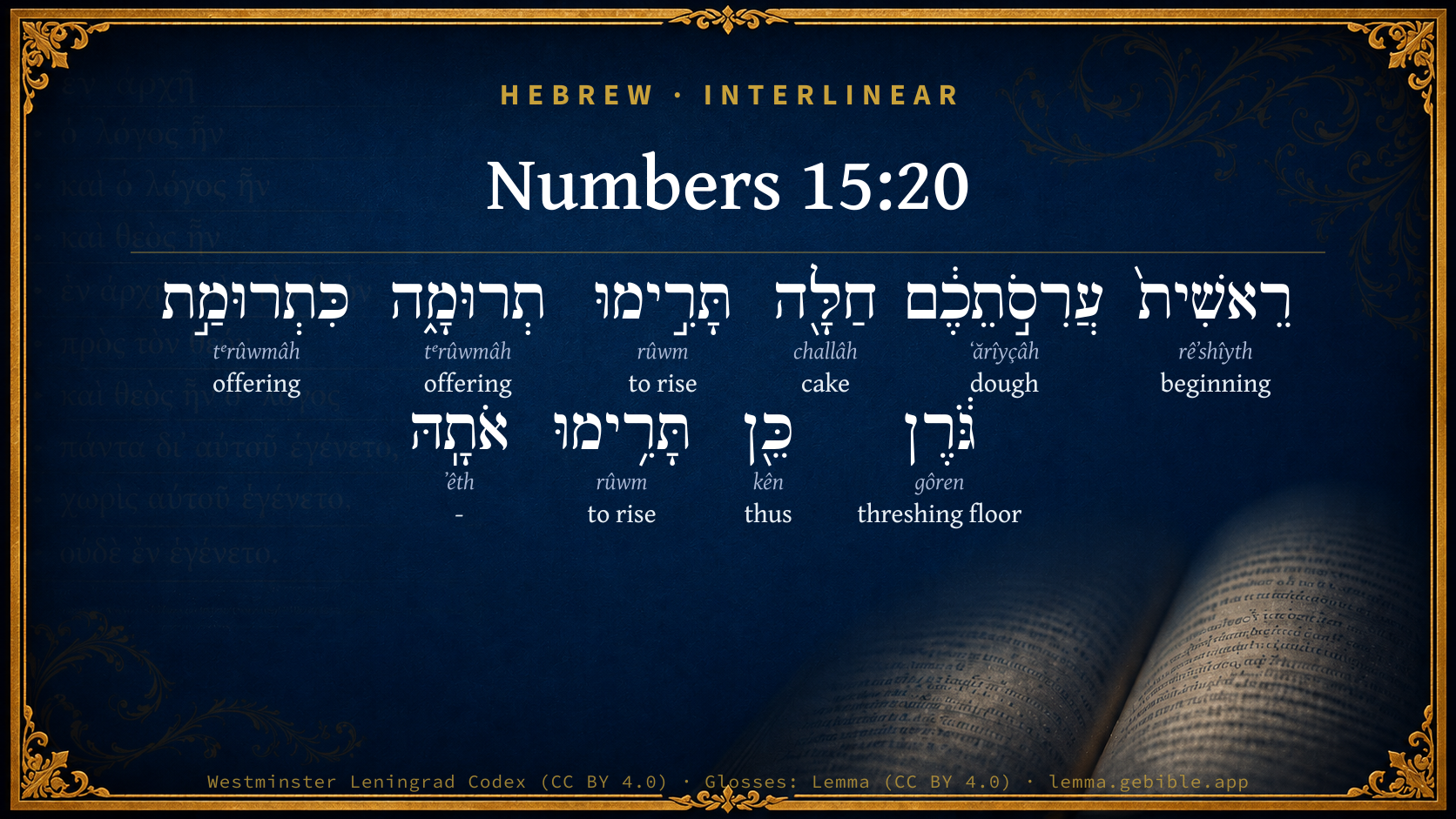
  1. רֵאשִׁית֙ rêʼshîyth H7225 “beginning of” Noun, Common, Feminine, Singular, Construct
  2. חַלָּ֖ה challâh H2471 “cake” Noun, Common, Feminine, Singular, Absolute
  3. תָּרִ֣ימוּ rûwm H7311 “to rise” Verb, Hiphil, Imperfect, 2nd Person, Masculine, Plural
  4. תְרוּמָ֑ה tᵉrûwmâh H8641 “offering” Noun, Common, Feminine, Singular, Absolute
  5. כִּתְרוּמַ֣ת tᵉrûwmâh H8641 “like/as · offering of” Preposition + Noun, Common, Feminine, Singular, Construct
  6. גֹּ֔רֶן gôren H1637 “threshing floor” Noun, Common, Both, Singular, Absolute
  7. כֵּ֖ן kên H3651 “thus” Particle, Demonstrative
  8. תָּרִ֥ימוּ rûwm H7311 “to rise” Verb, Hiphil, Imperfect, 2nd Person, Masculine, Plural
  9. אֹתָֽהּ ʼêth H853 “- · her” Particle, Direct Object + Suffix, Personal, 3rd Person, Feminine, Singular

About this verse

These counts appear in no published source. They are computed here, from the morphology-tagged text and Lemma’s own curated glosses. What Lemma adds →

10
words
8
distinct lemmas
Pentateuch
section

Notable vocabulary

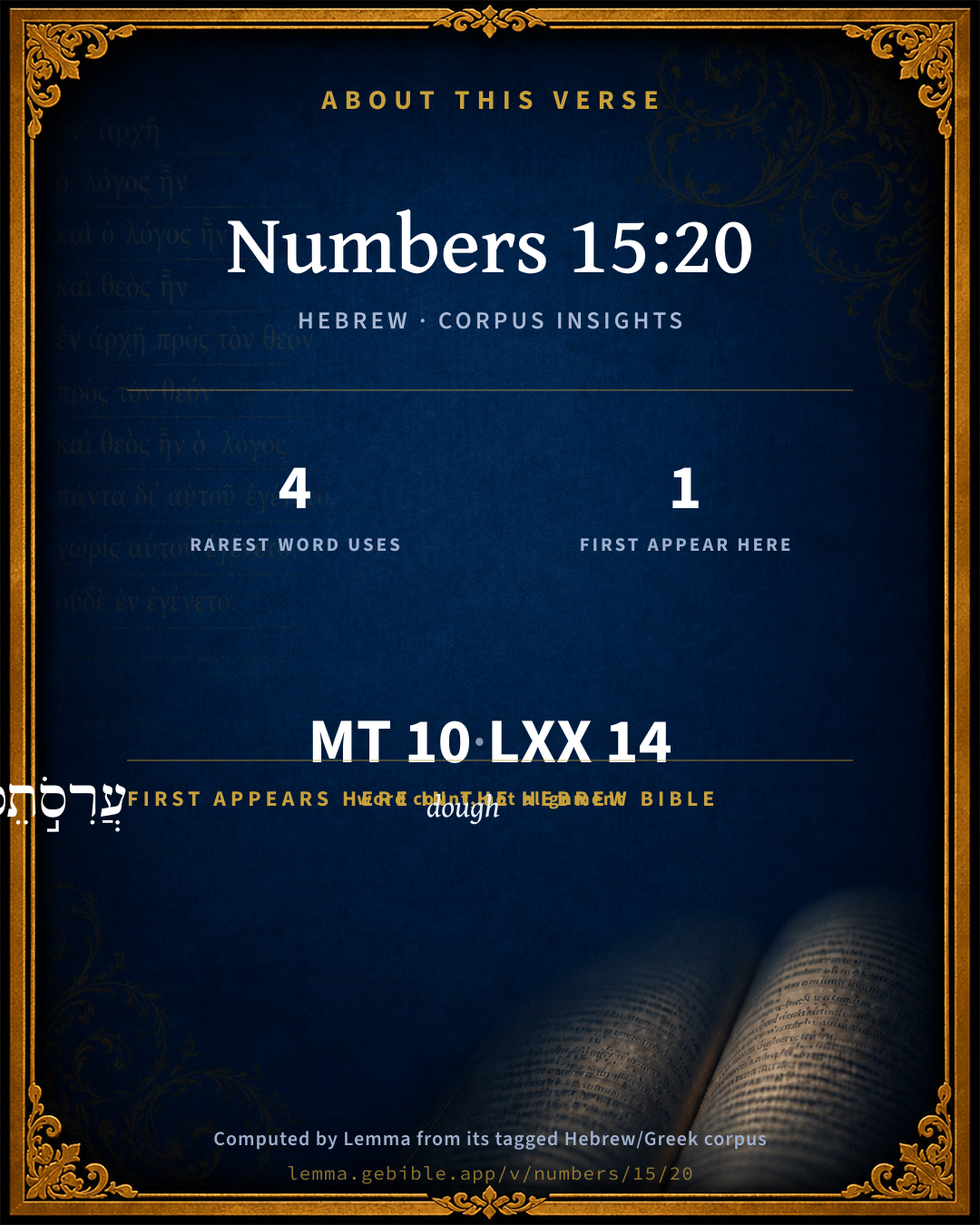
The rarest word here is עֲרִסֹ֣תֵכֶ֔ם dough H6182 — appearing just 4 times in the whole Hebrew Bible.

First appearance in Scripture

This word makes its first canonical appearance in the Hebrew Bible here:

  • עֲרִסֹ֣תֵכֶ֔ם dough H6182

Shared distinctive vocabulary

עֲרִסֹ֣תֵכֶ֔ם dough H6182 occurs in 4 verses of the Hebrew Bible. Also found in:

Grammatical profile

  • 2 verbs
  • 6 nouns
  • 2 particles

Verb forms

  • תָּרִ֣ימוּ Hiphil · Imperfect
  • תָּרִ֥ימוּ Hiphil · Imperfect

Repetition

Words recur within this verse — often emphatic in Hebrew:

  • תָּרִ֣ימוּ to rise H7311 ×2
  • תְרוּמָ֑ה offering H8641 ×2

Hebrew & Septuagint length

In English translation the verse runs 27 words from the Hebrew and 19 from the Septuagint (LXX English) — the Septuagint runs noticeably shorter here. See the side-by-side →

A rough comparison of the two English renderings, which tokenize alike — not a word-level alignment.

Word counts can differ between the Hebrew and the Greek without any difference in meaning — e.g. the Hebrew direct-object marker אֵת has no separate Greek word, and Greek often adds the article ὁ.

In the original languages it is 10 Hebrew tokens and 14 Greek tokens — but the two are counted differently (Hebrew bundles its prefixes and suffixes into one token; the Greek is in lemma form), so that isn’t a like-for-like length.

Cross-references

17

Topical passages linked to Numbers 15:20 in the Treasury of Scripture Knowledge — connected by theme and wording, ordered by reader-vote popularity; previews shown in the World English Bible.

  • Leviticus 2:14 "'If you offer a meal offering of first fruits to Yahweh, you shall offer for the meal offering of your first fruits grain in the ear parched with fire, bruised grain of the fresh ear.
  • Exodus 34:26 You shall bring the first of the first fruits of your ground to the house of Yahweh your God. You shall not boil a young goat in its mother's milk."
  • Deuteronomy 26:2–10 that you shall take of the first of all the fruit of the ground, which you shall bring in from your land that Yahweh your God gives you; and you shall put it in a basket, and shall go to the place which Yahweh your God shall choose, to cause his name to dwell there.
  • Exodus 23:19 The first of the first fruits of your ground you shall bring into the house of Yahweh your God. "You shall not boil a kid in its mother's milk.
  • Leviticus 23:10 "Speak to the children of Israel, and tell them, 'When you have come into the land which I give to you, and shall reap its the harvest, then you shall bring the sheaf of the first fruits of your harvest to the priest:
  • Leviticus 23:14–17 You shall eat neither bread, nor roasted grain, nor fresh grain, until this same day, until you have brought the offering of your God. This is a statute forever throughout your generations in all your dwellings.
  • Nehemiah 10:37 and that we should bring the first fruits of our dough, and our heave-offerings, and the fruit of all manner of trees, the new wine and the oil, to the priests, to the chambers of the house of our God; and the tithes of our ground to the Levites; for they, the Levites, take the tithes in all the cities of our tillage.
  • Proverbs 3:9–10 Honor Yahweh with your substance, With the first fruits of all your increase:
  • Ezekiel 44:30 The first of all the first fruits of every thing, and every offering of everything, of all your offerings, shall be for the priest: you shall also give to the priests the first of your dough, to cause a blessing to rest on your house.
  • Leviticus 23:20 The priest shall wave them with the bread of the first fruits for a wave offering before Yahweh, with the two lambs. They shall be holy to Yahweh for the priest.
  • Numbers 18:12 All the best of the oil, and all the best of the vintage, and of the grain, the first fruits of them which they give to Yahweh, to you have I given them.
  • Deuteronomy 14:22 You shall surely tithe all the increase of your seed, that which comes forth from the field year by year.
  • Matthew 6:33 But seek first God's Kingdom, and his righteousness; and all these things will be given to you as well.
  • Romans 11:16 If the first fruit is holy, so is the lump. If the root is holy, so are the branches.
  • 1 Corinthians 15:20 But now Christ has been raised from the dead. He became the first fruits of those who are asleep.
  • James 1:18 Of his own will he brought us forth by the word of truth, that we should be a kind of first fruits of his creatures.
  • Revelation 14:4 These are those who were not defiled with women, for they are virgins. These are those who follow the Lamb wherever he goes. These were redeemed by Jesus from among men, the first fruits to God and to the Lamb.

Cross-references courtesy of OpenBible.info (CC BY 4.0).

Hebrew and Greek witnesses Masoretic Hebrew ↔ Greek Septuagint

The same verse in the two great witnesses to the Old Testament, shown verse-for-verse.

Here the Septuagint runs noticeably shorter than the Hebrew — LXX2012 (modern English Septuagint) 19 words vs World English Bible 27. A rough length comparison of the two English translations, not a word-level alignment — read both below.

These are two independent witnesses, not word-aligned to each other, and the Septuagint is shown in lemma (dictionary) form.

Hebrew Numbers 15:20 Masoretic · Westminster Leningrad Codex

רֵאשִׁית֙ עֲרִסֹ֣תֵכֶ֔ם חַלָּ֖ה תָּרִ֣ימוּ תְרוּמָ֑ה כִּתְרוּמַ֣ת גֹּ֔רֶן כֵּ֖ן תָּרִ֥ימוּ אֹתָֽהּ

Of the first of your dough you shall offer up a cake for a heave-offering: as the heave-offering of the threshing floor, so shall you heave it.

World English Bible · Public Domain

Greek LXX Numbers 15:20 Septuagint · lemma form

ἀπαρχή φύραμα σύ ἄρτος ἀφαίρεμα ἀποὁρίζω αὐτός ὡς ἀφαίρεμα ἀπό ἅλων οὕτως ἀποαἱρέω αὐτός

You⌃ shall offer your bread a heave-offering: as a heave-offering from the threshing floor, so shall you⌃ separate it,

LXX2012 (modern English Septuagint) · Public Domain

On this verse, Haydock's Catholic Bible Commentary discusses the Septuagint’s reading. Read the note in Commentary ↓

Hebrew: Westminster Leningrad Codex (CC BY 4.0). Greek: Septuagint (public domain); English from LXX2012 (modern English Septuagint) (Public Domain). How the Septuagint differs from the Hebrew →

Targum (Aramaic paraphrase)

2

The Targum is the ancient Jewish Aramaic paraphrase of the Hebrew Scriptures — an interpretive translation, not the Hebrew text itself. Onkelos (literal) and Pseudo-Jonathan (expansive) render the Torah, and Jonathan the Prophets. Coverage is partial: where no permissively-licensed English translation exists for a verse, only the Aramaic is shown. This is verse-level text, not a word-by-word alignment to the Hebrew.

  1. Targum Onkelos Torah (Genesis–Deuteronomy)
    רֵישׁ אַצְוַתְכוֹן חַלְתָא תַּפְרְשׁוּן אַפְרָשׁוּתָא כְּמָא דִי מַפְרְשִׁין מִן אִדְרָא כֵּן תַּפְרְשׁוּן יָתַהּ

    (no public-domain English translation for this verse)

    Targum Onkelos — Aramaic: “Onkelos Genesis” (public domain); “Onkelos Exodus” (public domain); “Onkelos Leviticus” (public domain); “Onkelos Numbers” (public domain); “Onkelos Deuteronomy” (public domain). English: “Sefaria Community Translation” (CC0 1.0 (public-domain dedication)); “J.W. Etheridge. The Targums of Onkelos and Jonathan Ben Uzziel on the Pentateuch. London: Longmans, Green, 1862” (public domain). Text via Sefaria.

  2. Targum Pseudo-Jonathan Torah (Genesis–Deuteronomy)
    שֵׁירוּי אַצְוַותְכוֹן חַלְתָא חַד מִן עֶשְרִין וְאַרְבָּעָה תִּפְרְשׁוּן אַפְרָשׁוּתָא לְכַהֲנָא כְּמָא דִמְפָרְשִׁין מִן אִדְרָא הֵיכְדֵין תִּפְרְשׁוּן יָתָהּ

    you shall set apart a separation before the Lord. Of the first of your dough one cake of twenty-four you shall set apart as a separation for the priest; as with the separation from the threshing floor, so shall you set it apart.

    Targum Pseudo-Jonathan — Aramaic: “Targum Jonathan on Genesis” (public domain); “Targum Jonathan on Exodus” (public domain); “Targum Jonathan on Leviticus” (public domain); “Targum Jonathan on Numbers” (public domain); “Targum Jonathan on Deuteronomy” (public domain). English: “The Targum of Jonathan ben Uzziel, trans. J. W. Etheridge, London, 1862” (public domain). Text via Sefaria.

Commentary

Notes on Numbers 15:20 from classic Christian and Jewish commentators (each source and its license shown beneath its notes). The classic Christian expositions comment on the surrounding passage and are grouped to its opening verse, so a note may address several verses; the Jewish commentaries on the Tanakh (Rashi and others) are per-verse, so they appear only where the commentator wrote on this verse.

Lemma curates 59 commentaries, every one of them public domain or Creative Commons licensed, each selected and text-cleaned for this edition rather than reprinted as found. About our sources →

Trapp's Complete Commentary

John Trapp

Num 15:20 Ye shall offer up a cake of the first of your dough [for] an heave offering: as [ye do] the heave offering of the threshingfloor, so shall ye heave it.

Ver. 20. Ye shall offer up a cake.] As a homage penny, as acknowledging God the chief Lord of all; and as craving his leave to partake of his creatures.

John Trapp, A Commentary or Exposition upon All the Books of the Old and New Testament (1647–1656) — public domain. Text from a community e-Sword module.

Geneva Bible (1599)

Geneva Bible translators

Which is made of the first corn ye gather.

Geneva Bible (1599) marginal notes — public domain. Text via Bolls.life.

Jamieson, Fausset & Brown

Robert Jamieson, A. R. Fausset & David Brown

heave offering of the threshing-floor--meaning the corn on the threshing-floor; that is, after harvest.

so shall ye heave it--to the priests accompanying the ceremony with the same rites.

Jamieson, Fausset & Brown — Commentary Critical and Explanatory on the Whole Bible (1871) — public domain (CC PDM 1.0). Text via the HelloAO Bible API.

Adam Clarke's Commentary

Verse 20. Ye shall offer - the first of your dough] Concerning the offerings of first-fruits, See Clarke on Ex 22:29.

Adam Clarke's Commentary on the Bible (1810–1826) — public domain. Text from a community e-Sword/MySword module.

Ellicott's Commentary for English Readers

(20) Of the first of your dough.—Or, mixed meal. The word arisoth is used only in the plural number, and is found only in Neh_10:37 and Eze_44:30, besides this and the following verse.

A Bible Commentary for English Readers, edited by Charles John Ellicott (1878–1897) — public domain. Text from a community e-Sword module.

The Cambridge Bible for Schools and Colleges

gen. ed. J. J. S. Perowne

20. the first of your dough] The word rç’shîth ‘the first’ need not necessarily mean ‘first-fruits,’ which were offered annually. It may be simply ‘the first part,’ i.e. a small fixed amount, perhaps at the getting in of each fresh supply for the household.

The Cambridge Bible for Schools and Colleges (gen. ed. J. J. S. Perowne; Cambridge University Press, 1878–1918) — public domain. Text from a community e-Sword module.

John Gill's Exposition

Of the first of your dough shall ye give unto the Lord,.... As an acknowledgment of his being the sovereign Lord and possessor of heaven and earth, and of his being the owner and proprietor of the land of Canaan; and by way of thankfulness to him for the plenty of bread corn he had given them; and wherefore this cake was to he heaved or lifted up towards him in heaven, as follows:

an heave offering in your generations: for this respected not only the first time of their entrance into the land of Canaan, but was to be observed every year when they made their first dough, and was to continue as long as the ceremonial law lasted: this cake was anciently given to the priest, which is meant by giving it to the Lord, but now the Jews take it and cast it into the fire and burn it (s) the apostle seems to allude to this cake of the first dough in Rom 11:16.

(s) Buxtorf. ut supra, (Synagog. Jud. c. 34. p. 602.) & Leo Modena, History of the present Jews, par. 2. c. 9.

John Gill's Exposition of the Whole Bible (1746–1763) — public domain (CC PDM 1.0). Text via the HelloAO Bible API.

Albert Barnes' Notes on the Bible

Dough - “Coarse meal” Neh 10:37; Eze 44:30.

Albert Barnes' Notes on the Bible (1834–1885) — public domain. Text from a community e-Sword/MySword module.

Haydock's Catholic Bible Commentary

Eat. Hebrew and Septuagint, "of your dough." They elevated a part towards heaven, and gave it to the priest or Levite, who lived nearest them; and, in case none could be found, as at the present day, they were to burn it in honour of God. Tradition determines the quantity to be between a 40th and a 60th part. (St. Jerome in Ezec. xlv.) This they do every time they bake, according to Philo, and Leo of Modena, (2. 9,) though the law be not clear, and some might think it sufficient to give a part, the first time they baked with new flour.

George Leo Haydock (1774–1849), Haydock's Catholic Family Bible and Commentary, 1859 edition — public domain. Excludes Psalms (Douay-Rheims chapter numbering differs from Protestant) and Deuterocanonical books (Catholic canon only).

Matthew Poole's English Annotations

i.e. Of the corn in the threshing-floor, as Deu 16:13, when you have gathered in your corn.

So shall ye heave it, i.e. you shall offer this in the same proportion, to the same persons, i.e. the priests, and with the same rites.

Matthew Poole's English Annotations on the Holy Bible (1683–1685) — public domain. Text from a community e-Sword/MySword module.

Whedon's Commentary on the Bible

Daniel D. Whedon

20. The first of your dough — This command is not addressed to the nation as in the case of “the sheaf of the firstfruits,” (see Lev_23:10, note,) but to every private family, and the Jews consider a woman as very culpable who neglects it. They interpret the command as requiring not merely a portion of the first dough made from the new harvest, but a portion of every bread-making through the year, whenever the lump of dough exceeds the bulk of forty eggs. This sacred portion was given to the priests or Levites in order to sanctify the rest. In the absence of any of these it was thrown into the fire. Paul refers to this usage in Rom_11:16. See note. Its symbolism is thus explained: “The cake signified in mystery the congregation of Israel, called the firstfruits of the world; which, when it is put into the oven that burneth with the fire of the blessed God, it is necessary to separate therefrom a cake, that it be not partaker of severe judgment; and therefore is a blessing reserved in the world.” — Rabbi Menahem. A still wider mystical import is found in the sons of God by adoption, who “are a kind of firstfruits of his creatures.” Jas_1:18.

Daniel D. Whedon (gen. ed.), Commentary on the Old and New Testaments (1874–1909) — public domain. Text from a community e-Sword module.

The Pulpit Commentary

A cake of the first of your dough. tsori, only used here and in the two passages which refer to this enactment. (Neh_10:37 Eze_44:30) It probably means whole meal coarsely ground, the first preparation of the new corn available for baking and eating. Septuagint has aparch furamatov , an expression used by St. Paul in Rom_11:16.

As...the heave offering of the threshing floor, so shall ye heave it, i.e., the offering of bread from the home was to be made in addition to the offering of ears or grains from the threshing-floor, and in the same manner. No doubt this latter offering was a very ancient (Gen_4:3) and general one, but it is not clearly described in the Law. (see, however, Lev_2:14 Lev_23:10) All these heave offerings were the perquisite of the priest.

The Pulpit Commentary (1880–1919), ed. H.D.M. Spence-Jones & Joseph S. Exell — public domain. Text from a community e-Sword module.

John Wesley's Explanatory Notes

The threshing floor - That is, of the corn in the threshing floor, when you have gathered in your corn.

John Wesley, Explanatory Notes Upon the Whole Bible (1754–1765) — public domain. Text via the GEBible commentary corpus.

unfoldingWord translationNotes

Door43 World Missions Community

the first of your dough

Possible meanings are that this refers to 1) the first grain that they would gather during the harvest or 2) the dough that they would make from the first of their grain. (See: Metonymy)

a loaf

Calling it a loaf implies that they would cooked the dough first.

to raise it up as a raised offering

This idiom "raise it up" refers to offering it as a gift. AT: "to offer it as a gift" (See: Idiom)

a raised offering from the threshing floor

The offering is spoken of as being from the threshing floor because this is where they would separate the grain from the other parts of the plant.

translationWords

raise

thresh

unfoldingWord translationNotes — © Distant Shores Media and the Door43 World Missions Community, licensed CC BY-SA 4.0. Source: git.door43.org/Door43/en_tn.

Rashi

Rabbi Shlomo Yitzchaki (Rashi)

ראשית ערסתכם OF THE FIRST OF YOUR DOUGH [YE SHALL HEAVE A CAKE] — This means: when you knead as much as is now your dough (ערסתכם), i.e. the quantity which you are accustomed to knead in the wilderness — and how much is this? You may learn it from the statements (Exodus 16:18) “And they measured with the Omer” and (Exodus 16:16) “An Omer a head”, — you shall set apart at its very beginning (ראשית), meaning, before you eat from it its first portion, one cake (חלה) shall you set apart, as a heave-offering in honour of the Lord (תרימו תרומה לה׳) (Eruvin 83a).

חלה is tourteau in O. F., (Engl = cake).

כתרומת גרן EVEN AS THE HEAVE OFFERING OF THE THRESHING FLOOR for which no minimum quantity is stated in the Torah, so shall ye heave it, and not as the “Heave-offering of the Tithe (תרומת מעשר, the priest’s share in the Levite’s tithe) for which a minimum quantity is stated (cf. Numbers 18:26) (Sifrei Bamidbar 110:1). — The Sages, however have stipulated a minimum quantity for it (the portion set aside) — for a private person (lit., the owner of a house) one twenty-fourth, and for the baker one forty-eighth of the dough (Sifrei Bamidbar 110:1; Mishnah Challah 2:7).

Rashi on the Tanakh — English translations: “The Judaica Press complete Tanach with Rashi, translated by A. J. Rosenberg” (CC BY 4.0); “Pentateuch with Rashi's commentary by M. Rosenbaum and A.M. Silbermann, 1929-1934” (public domain); “The Metsudah Tanach series, Lakewood, N.J” (CC BY 4.0); and “The Book of Joshua, Metsudah Publications, 1997” (CC BY 4.0). Text via Sefaria.

Lesson kit

Teaching starters — assembled from the data on this page, not authored interpretation. Every prompt links to the verse data it draws on. Edit before teaching.

Numbers, in the Pentateuch, opens this verse with 10 words (8 distinct Hebrew lemmas). Its most distinctive word is ʻărîyçâh (“dough”). The Greek Septuagint runs shorter here. A historical commentator’s framing appears above. Read the whole chapter for the surrounding context.

Discussion questions

  1. What does “dough” (ʻărîyçâh) contribute to the verse as a whole?
  2. The word “dough” first appears here in Scripture. What is being introduced at this debut?
  3. Numbers 15:21 shares the word «dough» with this verse. How do the two illuminate each other?
  4. “to rise” occurs 2× in this one verse. What is the effect of the repetition?
  5. Compared with the Hebrew, the Septuagint runs shorter here. What questions does that raise?
  6. These translations render this verse differently. What is at stake in choosing one wording over another?
  7. The verb «תָּרִ֣ימוּ» is Hiphil Imperfect. How does its form color the action?
  8. Reading how Trapp's Complete Commentary and Geneva Bible (1599) read this verse, where do the two commentators agree and where do they part?

Things to notice

Reading settings

Reading text

Shown beneath each verse's original-language words.

Old Testament
Old Testament edition

Read the OT as the Masoretic Hebrew (MT) or the Greek Septuagint (LXX).

English shown for the Greek Septuagint (in the Hebrew ↔ Greek comparison).

Comparing translations? Open the Compare panel on any verse page to stack up to four side by side.